It Doesn't Have To Be Right…

… it just has to sound plausible


2 Comments

Moving pictures, #57

Managed to tick a few off the 1001 Movies You Must See Before You Die list this time.

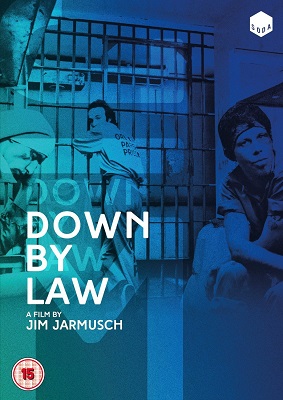
down_by_lawDown by Law*, Jim Jarmusch (1986, USA). I don’t get Jarmusch. I don’t get why his films are so highly regarded. A bit like Hartley, then. Both are US independent directors with substantial careers, and I have no idea why anything they’ve made appears on the 1001 Movies You Must See Before You Die list. Having said that, I can see why Down by Law might appeal to some. It stars Tom Waits, John Lurie and Roberto Benigni as three hapless convicts, all of whom have been imprisoned for crimes they didn’t commit. They manage to escape, andmake their way through a swamp, before stumbling across an isolated diner run by a young Italian woman. The film runs on the dynamics between the three leads, and it is, I admit, well-handled. The black-and-white photography also looks pretty good, and the soundtrack isn’t bad either. But the story is just a bit, well, tired. Three semi-lowlifes thrown together into a cell (well, Lurie’s character is a pimp, but the other two are a disc jockey and a tourist), and the rest of the story rests on the setting, New Orleans. It’s entertaining enough, but I’m not convinced it belongs on 1001 Movies You Must See Before You Die list.

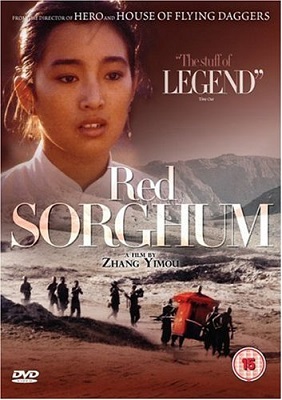
red_sorghumRed Sorghum*, Zhang Yimou (1987, China). Jiu’er is given in marriage to a much older, and leprous, man who owns a sorghum farm and distillery. During the trip to the distillery a bandit attacks the wedding party, but is fought off by one of the sedan chair carriers. Later, on a visit to her parents, the man who killed the bandit abducts and rapes Jiu’er. On her arrival at the distillery, she discovers her husband has died under mysterious circumstances. She takes over the failing business and tries to make a go of it. But when her rapist re-appears, tries to claim her but is rebuffed, he responds by peeing in the jars of liquor. It turns out this actually improves the taste of the liquor, and the business flourishes. I’m not making this up. Years later, after Jiu’er has given birth to a son, the Japanese invade China, and eventually arrive in the region. They take the distillery workers prisoner, and force one of them to flay another alive. When he kills the prisoner instead, they get another distillery worker to skin him. The workers then set an ambush for the Japanese soldiers but it goes wrong. The story is narrated by Jiu’er’s grandson, who frames it as the history of his grandmother. I’m not sure the narration adds anything to the film, because it works pretty well without it. It’s beautifully shot, and looks absolutely gorgeous – something the West seemed to discover big time about Chinese historical and wu xia films after Crouching Tiger, Hidden Dragon. Red Sorghum won a shedload of awards at film festivals around the world, although that year’s Academy Award for Best Foreign Language Film featured entries from Denmark, France, Spain, Italy and Norway – and was won by Denmark’s Babette’s Feast, which is, admittedly, excellent. In fact, a Chinese film wasn’t nominated until 1990, and that was also by Zhang Yimou. But, anyway, Red Sorghum, a good film, and it definitely belongs on the 1001 Movies You Must See Before You Die list.

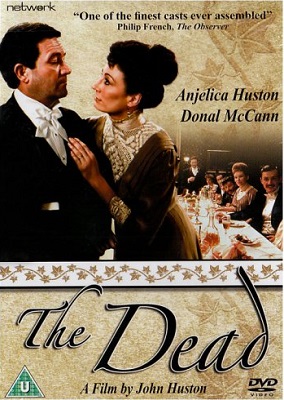
the_deadThe Dead*, John Huston (1987, UK). I couldn’t find a copy of this to rent anywhere, nor were there any for sale on Amazon. So I ended up buying one on eBay (admittedly for much cheapness), but I now see a seller on Amazon has apparently found a load somewhere… although, to be honest, I wasn’t all that taken with it. Huston was eighty when he directed this film, mostly from a wheelchair, and was on oxygen for much of the time. Certainly, The Dead is not your usual Huston film, although his age at the time is completely irrelevant. The Dead is based on a short story by James Joyce, and while I’ve not read the source text, the film at least possesses the virtues of beginning, middle and end. But, for all that, I wasn’t especially taken with it. It is set in Dublin in 1904 at a party on the Feast of the Epiphany hosted by three unmarried sisters. The great and good of their social circle turn up, eat, drink, dance, listen to recitals and genereally do the sort of things people did at posh parties in Ireland at that time. The story apparently focuses on the memories of Anjelica Huston’s character of an ex-lover, when quizzed by her husband on her sombre mood, but the film seems mostly interested in exploring the social dynamics of the people at the party. There’s no doubt it’s a well-made film, and there’s an economy of technique which evidences a long and illustrious career in cinema… but it’s a film that, for me, seems to mostly appeal to those who like the type of film it is – whether that’s drawing-room dramas or Jocycean adaptations. Not for me, I’m afraid.

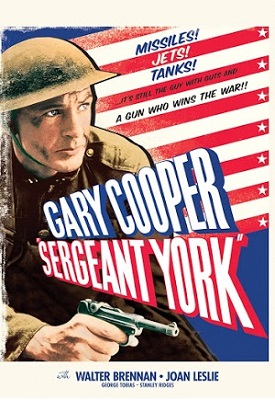
sergeant_yorkSergeant York*, Howard Hawks (1941, USA). The only copy of this I’d found was on Amazon Prime, but it wasn’t one of its free movies. I had to pay £3.49 to see it – for a “48 hour rental” – which was a bit steep, I thought. I have since learnt that new Hollywood blockbusters cost up to £9.99 to view by streaming. Oof. I get 12 rental DVDs a month for that. Anyway, Sergeant York is based on a true story. A Tennessee hillbilly volunteers to fight in WWI (not the 1917-1918 War, which is a really insulting way of referring to it), and becomes a war hero when he captures 132 Germans. I have a lot of time for the Silver Fox, he made some great films. But this is not one of them – despite being the only one for which Hawks was ever nominated for the best director Oscar. Gary Cooper is too old for the title role, and the scenes set on the Front clearly show Californian hills in the background. But. The scenes set in Tennesse are all studio sets, and they’re really fake and strange and quite weirdly beautiful. It’s all deeply unconvincing – but where that works against the film in the scenes set during WWI, it actually improves the scenes set in the valleys of Tennessee. There’s one particular scene where Cooper is trying to plough a patch of stony ground when the preacher appears and lectures him, pointing to a distant tree in illustration of the point he is making. And it’s like Hawks used tilt-shift on a bonsai tree, it looks so strange and unwordly and quite peculiarly lovely. Sadly, the story is hampered by an over-reliance on sterotypes, Cooper’s miscasting in the title role, and a failure to convince in either of the two chief worlds it presents. It was entertaining, and I’m really taken by some of the cinematography, but, to be honest, Hawks made better films, and the success of this one when it was released feels mostly a consequence of pro-war propaganda.

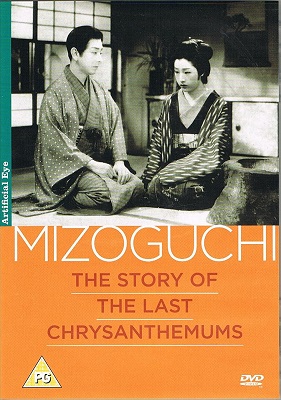
chrysanthemumsThe Story of the Last Chrysanthemums*, Kenji Mizoguchi (1939, Japan). Mizoguchi is one of the big Japanese film names, like Ozu and Kurosawa, and while I’ve seen some of his films I’ve never really managed to work out what makes him distinctive. Admittedly, I’ve never really cottoned to Japanese historical films, and though I now find them more enjoyable than I once did, I’ve yet to figure out why, say, I enjoyed Floating Weeds (Ozu) but not Sansho Dayu (Mizoguchi). Of the four films I’ve now seen by Mizoguchi – and I suspect at some point I’ll watch more, whether or not they’re on the 1001 Movies You Must See Before You Die list – the one I liked best was Gion Bayashi, which I didn’t actually rent but came with Sansho Dayu as part of a double-DVD set. But The Story of the Last Chrysanthemums… The copy I saw, the Artificial Eye edition, was not an especially good transfer – no doubt due to the lack of a good print to transfer. The story concerns a man, the son of a famous Kabuki actor, who fails to meet his father’s expectations. After becoming involved with a wet nurse at his father’s house, the nurse is dismissed and the son leaves to make his own fortune elesewhere. The son tracks down the wet nurse, and the two live as husband and wife. But times are hard, and he turns nasty. Throughout, the son is presented with a stark choice several times: his wife or his career. When he chooses his wife, he turns bitter; when he chooses his career, his wife dies. It’s hardly a subtle dilemma, and though Mizoguchi wraps it all up in the traditions of Kabuki in the 1930s, this is not a film that treats its characters nicely or seeks to convince the viewer that people are intrinsically nice. It was interesting enough, although I’m doubtful as to the reason for its presence on 1001 Movies You Must See Before You Die list; but then I much prefer Ozu.

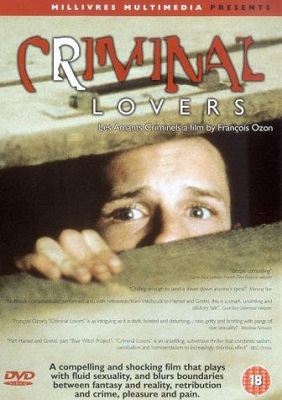
criminal_loversCriminal Lovers, François Ozon (1999, France). I don’t think there’s another director whose films are, for me, so widely variable in quality. Some of Ozon’s movies are bona fide classics, some are totally forgettable; but most are somewhere in between. Having thought about it, while considering what to write about Criminal Lovers, I’ve come to the conclusion that Ozon is most interesting when he’s not trying not be someone else. And in Criminal Lovers, I think, he was trying to be Lars von Trier. A young woman and a young man at a Lycée murder another pupil (an Arab), after the woman claims to her boyfriend she had been raped. They go on a crime spree, before eventually finding a wood some distance from their town in which to bury their victim’s body. But they get lost in the woods while returning to their car after burying the body, and stumble across the home of a poacher. He takes them prisoner, uses the young man for sex, and threatens to eat the pair of them. This is not a cheerful movie. If it fails, it’s because the villain never seems really menacing enough, the two leads never quite charismatic enough, and the cinematography nowhere near  as lovely as that of von Trier’s Antichrist. It feels, in other words, like a second-string work from a director who has produced much better. To be fair, it’s an early work, and so I suppose it’s unfair to compare it with later films, but even so comparisons are inevitable. One for Ozon fans, I suspect.

1001 Movies You Must See Before You Die count: 817


1 Comment

Moving pictures, #56

A right proper mix this time around. I have recently simplified my lists on LoveFilm. Previously, I was running three lists – one for Hollywood blockbusters, one for classic movies, and one for world cinema. I’ve now combined them into one for English-language films and one for non-Anglophone movies. I am not in the slightest bit desperate to see the latest films released by Hollywood as soon as I can and am happy to wait before eventually watching them. Besides, there’s always Amazon Prime if I want to watch crap US films…

ray_1Charulata, Satyajit Ray (1964, India). This is the second film in the Satyajit Ray collection I bought, but unlike the first it is an historical piece. The title is the name of a young woman in 1870s Kolkata, whose husband asks a friend to keep her company. It’s based on a novella by Rabindranath Tagore. Her husband is rich and publishes a newspaper called The Sentinel. Determined not to be a member of the “idle rich”, he involves himself in every aspect of running his newspaper. To keep his wife company, he invites his cousin to stay. The cousin, Amal, is a bit of a waster but claims to be a writer, and Bhupati hopes Amal will help Charu with her stated intention to write. But the two’s relationship soon moves beyond mentor and pupil – especially after the pupil demonstrates more talent than the master. The film takes place almost entirely within the large house occupied by Bhupati and Charu, and even features a couple of musical numbers. There’s a scene set on s beach which features some nice photography, although Ray is not above using clichés (a camera moving from the foot of a table up to its surface to reveal a letter, for example). Madhabi Mukherjee totally shines in the title role, outdoing many a Hollywood star. It’s an odd film in that it feels complete ahistorical, despite its carefully presented period – not just the set dressing and costumes, but also several mentions that India is still governed by Britain. It’s the first film I’ve seen that has persuaded me Ray is as good as Ghatak, although they each had a very different approach to cinema. For most of its length,  Charulata feels like a cross between a light social comedy and drawing-room farce, with a strong thread of rom com and social drama, but there’s an astonishing daydream sequence in the middle, in which Charu has a blinding moment of inspiration and writes a story which is then published in a magazine. Good stuff.

herzogStroszek, Werner Herzog (1977, Germany). Herzog had stumbled across Bruno S and cast him in the lead in The Enigma of Kaspar Hausar, but was so taken with the busker, that he wrote this film specifially with Bruno S in mind as the title character. Of course, there are other of Herzog’s interests paraded before the camera, such as a livestock auctioneer, as in How Much Wood Would A Woodchuck Chuck, auctioning off the title character’s possessions toward the end of the film. Stroszek is a Berlin street performer who has fled Germany with his girlfriend after running afoul of gangsters, They decide to settle in “Railroad Flats”, a dead-end town in middle America. Things initially go well, but their natures will out and the pair end up badly in debt. she does a runner and he turns to drink. A friend persuades him to help in a bank robbery. It goes badly wrong. It’s hard to know what to make of Stroszek. It is, on the surface, a straightforward drama about a hard-luck protagonist. But, on the one had, it’s so clearly tailored to Bruno S that it wouldn’t work without him; but on the other hand, some of the elements of the plot simply don’t ring true as something Bruno S would do. But then Herzog was always more about the philosophy than he was such bourgeois ideas as narrative, plot and structure. Stroszek is not a film about a man who makes a fresh start only to see it turn to shit, it’s about an implacable universe and the way stories too often manipulate that indifference in order to provide the ending the audience desires. Most movies are commercial constructs and so formalising their design – creating a “formula” – helps the industry maximise their effectiveness. But there’s no truth in that, and art is about truth. Hollywood delivers product, Herzog can never be accused of doing the same. He has built a career out of presenting naivety, but doing it in such a way that it not only entertains but also reveals truth. Stroszek is big on naivety – it’s Bruno S’s biggest selling-point – but low on truth. And while the film is entertaining, I can’t help thinking Herzog’s instincts led him astray. There is nothing new in Stroszek, and the film suffers as a result.

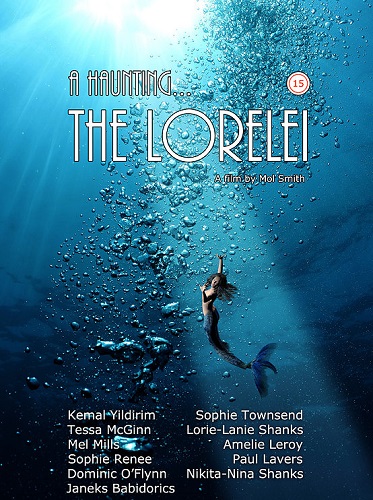
loreleiThe Lorelei, Mol Smith (2016, UK). I found this on Amazon Prime, and was sufficiently misled by the description to watch it. The Lorelei is a British independent film, which means it has production values on a par with a double-glazing advert. A young woman hires a private investigator to investigate the death of her step-father in Oxford under mysterious circumstances. He involves his house-mate, a student who moonlights as an escort. The police then become involved when some of the escorts run by the same woman who runs the student are found dead in mysterious circumstances. We’re meant to believe the deaths are the work of a lorelei, a creature living in the Isis who takes the form of a young woman. Who pours water into their mouth from her own mouth and so drowns them. But The Lorelei is not framed as a horror film, but as a mystery. And as a mystery it fails because it can’t keep its central idea secret until the third act. There’s one twist in the story, but it’s a weak one – because it doesn’t really matter, the story has focused so much on other things that the mystery it resolves is secondary. I’ve no idea why I bothered watching this all the way to the end, it was pretty bad.

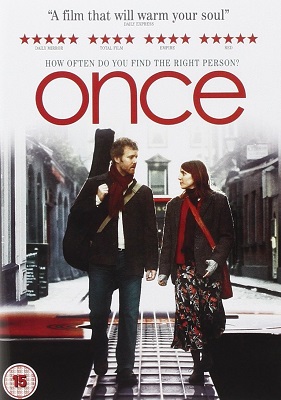
onceOnce, John Carney (2007, Ireland). This is not my usual viewing, as you no doubt have realised, but Once is on one of the other 1001 Movies You Must See Before you Die lists and it was free to watch on Amazon Prime and it was a Sunday afternoon, so… Sadly, Once has a more interesting genesis than it does a plot. A busker in Dublin becomes friends with a young Czech woman, the two perform together, eventually record a demo of his songs, before returning to their separate loves. Initially, Cillian Murphy was going to play the lead role, but he pulled out and the part was taken by Glen Hansard, who had written the songs, and who is probably best-known for playing Outspan in The Commitments. The initial financing for the film pretty much collapsed, and it was eventually made on the cheap for $150,000, only to earn considerably more than that at the box office. That I find heartening. The story itself is packed full of clichés from start to finish, but happily is carried by the charm of its cast and the verisimilitude of its musical performances. It’s not precisely a feelgood movie, although it definitely heads in that direction – but no one is going to walk away from seeing it depressed. I can’t call myself a fan, but I sort of enjoyed it.

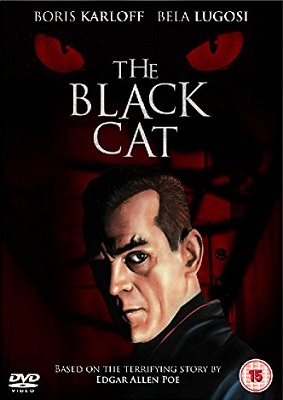
black_catThe Black Cat*, Edward G Ulmer (1934, USA). I’ve noticed that some film critics seem to revere monster movies out of all proportion to their quality. They even talk of a “Golden Age”. I’m not sure that The Black Cat fits in that period, but it’s on the 1001 Movies You Must See Before You Die list, so clearly the makers of the list held it in’some regard. I have no idea why. A young married couple are travelling through Hungary when their train breaks down. They have made the acqauntaince of Béla Lugosi, who is returning to the area after many years away (most of which were spent in a POW camp). There’s a bus accident, and they all end up at the home of Boris Karloff, a renowned Austrian architect, whose house in built on the ruins of a castle whose garrison he betrayed during the war. Lugosi was at that garrison and he’s out for vengeance. Karloff also collects the corpses of young women, er, because. One of which is Lugosi’s wife. There’s also Lugosi’s daughter, who is being kept by Karloff. And it’s all to do with some secret Satanic cult which Karloff leads. The sets aren’t bad, although Lang did much better, and the film generally looks quite good for a movie of its period and genre. But Lugosi is absolutely terrible, he gurns and grimaces like a prime hock of ham. The Black Cat is one of those films whose presence on the 1001 Movies You Must See Before You Die list I find completely baffling.

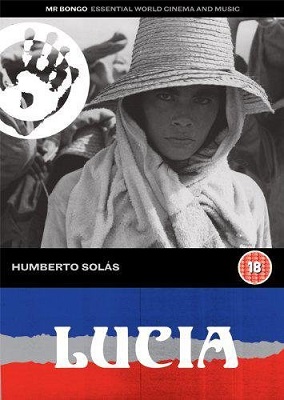
luciaLucía*, Humberto Solás (1968, Cuba). I watched this film purely because it was on the 1001 Movies You Must See Before you Die list. I knew nothing about it before putting it into the DVD player. But having now seen it… I’m reminded of my response to Black God White Devil. I watched it… and then went and bought all three films available on DVD by Glauber Rocha. Coincidentally, also released by Mr Bongo. And also piss-poor transfers. While I didn’t dash out and buy all of Solás’s films after seeing Lucía, I did buy myself a copy of Lucía. Because it’s a film that is just so good. Which came as a surprise to me as, much like the Rocha one, I had not expecting to find myself so taken by it. It tells the story of three women called Lucía, in 1895, 1933 and 196-. The first is an historical conflict piece, the second a doomed romance, and the third more of a cinema verité movie. Lucía in 1895 elopes with a dashing young man, only to learn she has been used to discover the location of the nationalists’ headquarters. It’s all completely over-the-top, but in a gloriously historical way. Lucía 1933 is a more sedate affair, in which the eponymous young woman leaves her middle-class family to live with a young revolutionary, and ends up working in a cigar factory. The section marks a cusp between the first and last sections, and contrasts the two social classes. The final section shows Lucía living in a hearty communist utopia, which is couched in terms of her relationship with her new husband. It’s handled with a light, even comedic, touch, and the cast are uniformly good – in fact they are in all three sections. Something about Lucía immediately appealed to me, so I went and bought myself a copy. I shall no doubt now discover there’s a much better, and correspondingly expensive, transfer of the film available from Criterion… Recommended.

1001 Movies you Must See Before you Die count: 812


1 Comment

Weekend in Iceland

The last weekend in October has just seen the first ever Icelandic science fiction convention, Icecon 2016, take place in Reykjavík. As soon as I heard it was happening, I signed up – for a number of reasons: I’d never visited Reykjavík but wanted to; I know a few people in Icelandic fandom; and, in recent years, I’ve attended several Nordic conventions. And, of course, I’m more than happy to support Icelandic fandom’s first ever convention.

I flew from Manchester to Keflavík (the plane was named “Eyafjallajökull”, which I hoped wasn’t an omen). The flight was uneventful – except for some turbulence – but as the Boeing 757 finally reached land, I looked out the window, saw a snowy landscape like that of some Jovian moon, and thought, shit, I’ve brought the wrong clothing. Fortunately, as the plane flew further north and closer to the airport, the snow disappeared and the land began to resemble what I had expected: wet, scrubby and windy. Keflavík airport proved surprisingly large. Iceland has a population of around 330,000, but the airport is comparable to that of the capital cities of nations ten to twenty times the population. Since Johan Anglemark was arriving thirty minutes after my flight, I’d arranged to meet up with him at the airport. So I waited… only to receive a text from him that he’d probably miss the next bus to Reykjavík – which would mean a further hour’s wait. I went and caught the bus – actually a coach – only for Johan to appear five minutes later.

imag0700

To get from Keflavík to Reykjavík, a distance of 50 km, you can either take a taxi, which would cost around £100, or catch a coach, such as Flybus, which costs around £36 for a return. The coach takes you to the BSÍ, where you transfer to a minibus, and that takes you direct to your hotel. Which, in my case, was the Apotek Hotel, located 250 m from the con venue, Iðnó theatre. (Those members of Icecon who had flown into Iceland were scattered in hotels and apartments around Reykjavík, as the con had not arranged any deals with hotels.) The con did not start until 8 pm, when the attendees were gathering in Klaustur bar, the con’s designated bar, in the block next to Iðnó and some 200 metres from my hotel. So I ate in the restaurant attached to the Apotek Hotel – except, it would be more accurate to say the hotel was attached to the restaurant, as it was an actual restaurant. The menu featured puffin and minke whale, but I avoided those and had salmon. The meal, plus a small beer, cost me around £44. Iceland is expensive.

Given this was the first Icecon, meeting up at the bar was an excellent way to start the convention. We were actually sharing it with a book group, who were discussing The Girl with all the Gifts, so some people sat in on that (I’ve neither read the book nor seen the film). Registration was also onhand in the bar – which was important, as con membes could buy drinks at happy hour prices (a mere 800 ISK, £5.85, for 500 ml of Viking pilsner beer). It was an excellent night. The two guest of honour, Karin Tidbeck and Elizabeth Bear, were present, as were con members from Iceland, Sweden, Norway, Finland, the UK, the US and Ireland. And probably further afield.

imag0720
Icecon 2016 began in earnest the next day. The first programme item was at 10 am, an introduction to fandom. The Iðnó is a theatre, and is used for a variety of functions. There is a stage at one end, a foyer at the other, and off that a small room containing a bar for serving hot and cold drinks, and another small room with three tables. Upstairs, one room was being used as the dealers room. The conventiob took place entirely within Iðnó’s main room, which had been left with the chairs arranged around small tables. On the stage, there was an armchair for the moderator, two sofas for the panellists, and a small coffee table for carafes of water. The layout gave the con an informal atmosphere, which worked really well.
imag0708

I didn’t catch every programme item on the Saturday, but I did see Johan Jönsson interview Karin Tidbeck (which was good), and a panel on “The multimedia of science fiction: adaptation, borrowings and rewriting” (which was, to be honest, a bit waffley). I spent some time in the small room with the three tables, chatting to people, and I wandered outside to take a couple of photographs on my phone. At 6 pm, I joined a group of Nordic fans – mostly Swedes, but also Norwegian, Icelandic and Finnish – on a hunt for a meal. A restaurant called Snaps had been recommended to me on Twitter, so we went looking for it. But there were nine of us in the group, and this was too many to seat in Snaps. And in the next restaurant we found. And the next. We ended up in an Italian place, called, imaginatively, Italia, where they put five two-seater tables together for us. The food was good (not as posh as that in the Apotek Bar and Restaurant, but not as expensive either). The restaurant was good about gluten-free, as one of the party had a gluten allergy, but less so about dairy. (One consequence of being lactose-intolerant is I’m now learning the words for cheese, butter and milk in different languages – in Icelandic, it’s ostur, smör and mjólk.)

Back at Iðnó, the costume ball had begun. It was essentially a con disco, but people had been encouraged to turn up in fancy dress. And quite a few had. Some had put more effort into it than others. I, er, made no effort. I stayed until about midnight. The music was loud, and so shouting over it proved tiring – although I did have a good time.

On the Sunday, the programme didn’t start until 1 pm. (There was a hangover lunch in Iðnó at noon, but I didn’t sign up for it.) So I used the time to explore the city. Both Iðnó and my hotel are in the touristy bit of Reykjavík, between the lagoon and the old harbour. It was wet and windy, and not much different to UK weather during November or March. During my wander, I spotted a huge shop that sold Icelandic tat for tourists and the Listasafn Reykjavíkur, Reykjavík Art Museum… but the latter was closed. Back at my hotel, I spotted a brochure in the foyer for the Volcano House, and the opening times indicated it would be open. So I headed for it – it was just up the road from the Art Museum. The Volcano House has a small exhibit of volcanic rocks, but it also offers a 60-minute documentary on two of Iceland’s most famous volcanic eruptions: Eldfell on Heimaey in the Westman Isles in 1973, and Eyjafjallajökull in 2010. Fascinating stuff. And I can now almost say Eyjafjallajökull. On my way back to the hotel, I swung by the Art Museum, and saw that it was open. Whenever I visit my sister and her family in Denmark, we usually go to an art museum, so I’ve found myself becoming interested in them. The Listasafn Reykjavíkur was… Um, well. The biggest exhibit was for Icelandic pop artist Erró, but I was not impressed. Neither did I think much to the Yoko Ono exhibition. One of the galleries contained “Some New Works” by Örn Alexander Ámundson, which I thought very clever, and reminded me of the tricks with narrative structure I enjoy reading and writing. The highlight of the museum, however, was “The Enclave”, a six-channel video installation by Richard Mosse, shot in the Democratic Republic of Congo on infra-red satellite photography film which transform shades of green into shades of pink… Sadly, there was nothing by Mosse available in the gift shop.

imag0726

Back at Iðnó, I caught the programme item on “Inclusive futures: diversity in speculative fiction and publishing”, which was good, before I climbed onto the stage myself for “Climate change, nationalism, famine: addressing contemporary problems in scifi and fantasy”, with moderator Hildur Knútsdóttir and panellists Carolina Gómez Lagerlöf, Kristján Atli and Scott Lynch. You know that thing where you have several important points to make on a topic, but once you’re up on stage your mind goes completely blank? It was a bit like that; although I was told afterwards that the panel went well. I was also told that once Brexit had been mentioned I turned into a stereotypical Brit (Remainer, of course).

The programme item following the above was the last of the convention, “Carving a path to the future: Icelandic sci-fi and fantasy writers”, which was informative, and it sometimes comes as a surprise – although it shouldn’t – quite how different the road to publication in genre is in countries other than the UK and US. Once the panel had finished, the con organisers all appeared on stage, and admitted they were hugely gratified at the turnout. Just over one hundred people had joined the convention, and nearly half of them had been from outside Iceland. Oh, and did I mention that the first lady of Iceland, the Icelandic president’s wife, dropped by Iðnó on the Saturday afternoon to see how the con was going? Not many conventions can say that. And all this was despite the fact a general election had been called and was taking place over the same weekend. (Two of the moderators for the con’s panel items were standing for parliament.)

The con finished back where it had started, with a dead dog party in Klaustur Bar. I lasted until midnight… but then I did have to get up at 4 am to catch a Flybus to the airport for a 8 am flight back to Manchester.

I thought Icecon 2016 was very successful – and so too, I hope, did the organisers (to their surprise, they admitted). The next one is scheduled for 2018, and I certainly plan to attend. I thoroughly enjoyed my stay in Reykjavík and would welcome the opportunity to explore the city, and the country, further. Despite the expense. The convention ran very smoothly, and the venue worked so much better than expected – seriously, other cons should adopt the chairs around tables layout, rather than row upon row of chairs; the sofa thing also works a lot better than having the panellists behind a table (fun with dodgy microphones notwithstanding). It was an excellent convention, and a definite highlight of 2016.

I’ve now atteneded conventions in Sweden, Finland and Iceland. Next year, of course, the Worldcon is in Helsinki. But I’d still like to do a con in Norway and Denmark. Perhaps next year…


1 Comment

Moving pictures, #55

An odd selection this time round – some old, some new, some good, some bad, some Hollywood, some world cinema, some television…

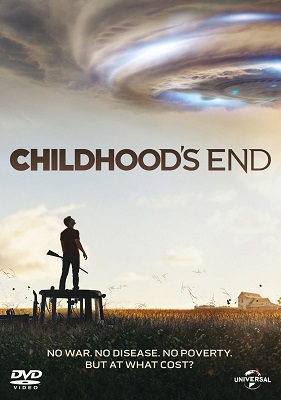
childhoods_endChildhood’s End (2015, USA). Yes, this is an adaptation of the Arthur C Clarke novel, which, I think, I read back in the late 1970s. I have the SF Masterwork edition of it somewhere (the one I read all those years ago was likely a library book, or perhaps a Pan paperback I have since lost). As it is, all I can remember is the big reveal about the Overlords, not what the actual plot of the novel was. Which pretty much ruins the big reveal at the end of the first episode of this three-part mini-series. It starts intriguingly enough, with a man on a deserted Earth, explaining that he is the only human being left. And then it’s straight into flashback, with the Overlords’ ships appearing in the sky over cities across the globe (although very Americo-centric, as US television and films always tend to be, Childhood’s End does make more of a nod to the rest of the world than usual). One man – an American, of course – is chosen by the Overlords to be Earth’s ambassador. He’s a humble farmer, with one of those farms which consists of a small house in the middle of a vast acreage of maize, and which you only see in films. And it never seems to get harvested either. Even though years pass during the series, the corn is always high and green. Colm Meaney plays a press baron who doesn’t believe the Overlords’ – well, Overlord’s, as only one appears for much of the series, Karellen, the Supervisor for Earth – stated objective of ushering in a new utopian age. So, like Rupert Murdoch, he works to make things shit for everyone except himself. Fortunately, his “resistance movement” is quickly shown to be a selfish bunch of lies. There’s also another narrative thread about a devoutly Christian woman who thinks the Overlords are agents of Satan – so she gets a bit of a shock when they reveal themselves. And there’s a young black boy in a wheelchair, who is shot by a gangbanger, resurrected by the Overlords, and grows up to become an astrophysicist and the first human to visit the Overlords’ home world – and the person in the progolue. In hindsight, it all sounds a bit hokey and simplistic, not unlike a 1950s science fiction novel, in fact. But the production values were pretty good, the cast were likeable, and it entertained throughout its 246 minutes. I’m still not how the Overlords managed to invent giant spaceships, interstellar travel and all sorts of super-advanced technological gizmos, but not clothes.

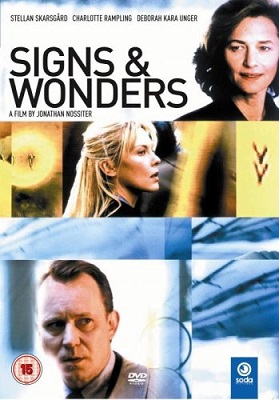
signsSigns & Wonders, Jonathan Nossiter (2000, France). This is not on the 2013 1001 Movies you Must See Before You Die list I’ve been using, but I’ve seen it on another version of the list – which is why I added it to my rental list. And despite being a French film, Signs & Wonders is an English-language movie, starring Stellan Skarsgård, Charlotte Rampling and Deborah Kara Unger, and is set mostly in Greece. Skarsgård plays a US businessman, who has been having an affair with Unger. He decides to break it off after becoming worried by “signs” he has seen in everyday things. He tells his wife, Rampling, and their marriage suffers. Six months later, while on a family skiing trip, he bumps into Unger, and convinces himself their relationship was fated. so he divorces his wife and moves to the US with Unger. But when she admits she manufactured their meeting at the ski resort, he realises his mistake and returns to his wife in Greece. Except she is now in a relationship with a Greek journalist, who is documenting US complicity in the Greek military dictatorship’s brutal regime. And she doesn’t want Skarsgård back. Accidents, near-fatal ones, then start to happen to the journalist… and… Meh. I couldn’t get invested much in this film, and I couldn’t see why it had made the 1001 Movies You Must See Before You Die list, or at least one iteration of it.

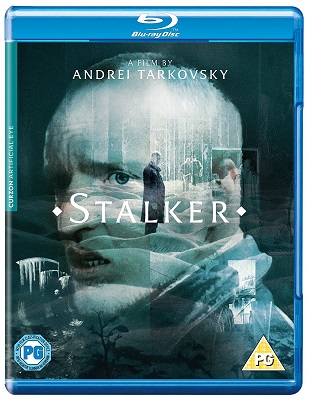
stalkerStalker*, Andrei Tarkovsky (1979, Russia). Ask people who have a favourite Tarkovsky film which one it is, and most will say Stalker. It’s certainly the film that looks and feels the most Tarkovskian. Famously, it’s adapted from Roadside Picnic by Arkady & Boris Strugatsky, although it’s ny no means a faithful adaptation. (I’ve yet to understand the appeal of the novel – I read the original SF Masterworks edition, and the translation had couched everything in US vernacular, which ruined it for me; a more recent translation is apparently much better.) Tarkovsky’s film opens in sepia, with a colour palette that immediately signifies how miserable and shit the world is – an impression only deepened by the opening argument between Stalker and his wife. Outside, the light is yellow and everywhere is shrouded in fog. Stalker meets up with Professor and Writer, the two people he is taking into the Zone, in a nearby bar. After a sequence in which the three of them drive around a post-apocalyptic industrial landscape, being chased by a man on a motorbike, and being shot at by him, they eventually take a tiny diesel train into the Zone… where the movie abruptly shifts to colour. The route through the  Zone, however, is far from straightforward – routes double-back on themselves, time passes strangely. When they lose the Professor, they find him waiting at their destination, even though he didn’t overtake them – and they then realise they are back where they started. It’s hard not to draw conclusions from the depiction of the “real” world compared to that of the Zone, and when you consider the lambent cinematography of the scenes set at the farm during the narrator’s childhood in Mirror, it seems to suggest Tarkovsky was romanticising the pre-industrial past – either his own or history’s (indeed, his next film was titled Nostalgia). Having said that, the Zone is also littered with industrial debris, indicating nature has reclaimed what was once the province of science and industry. The centre of the Zone is the Room, which apparently makes wishes come true. But the three experience a number of strange things before they reach it. Stalker in a long film – 161 minutes – and comprises a number of very long takes in which very little happens. It’s a great-looking film, but one in which the normal rules of cinema narrative do not apply – and that makes parsing it difficult, and also makes it hard to place in Tarkovsky’s oeuvre. It’s definitely not my favourite of his films, but I’m also not sure if it’s his best.

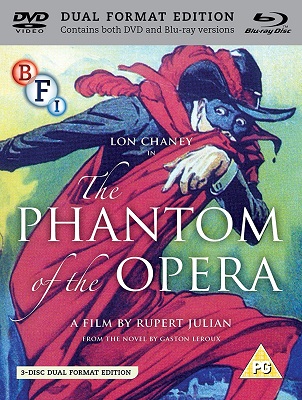
phantomThe Phantom of the Opera*, Rupert Julian (1925, USA). One of the joys of following the 1001 Movies you Must See Before You Die list has been watching films I would not normally have seen. And that’s especially true of silent films – because few of them are available on DVD, and because people are much less likely to watch silent films these days (recent Oscar winner notwithstanding). True, as is evident from the DVD cover art, The Phantom of the Opera is very much available, and even in a dual-format edition from the BFI. But it is also true that Gaston Leroux’s story has been adapted many times, and is perhaps best-known these days for a musical version. The version here is from 1925, and is not even the first film adaptation – that honour goes to a 1916 German silent film, Das Phantom der Oper, now lost. In this one, Lon Chaney plays the title role, and his depiction is famous. The scene where he is unmasked apparently caused cinema audiences to scream and faint, and actually is quite shocking, even to jaded modern eyes. The film also boasts enormous sets, almost Expressionist in design, which are the basements beneath the opera house. The story itself is completely melodramatic, and some of the silent-era gurning looks weird to a modern viewer – but even ninety years after it was made this is still an entertaining movie. Worth seeing.

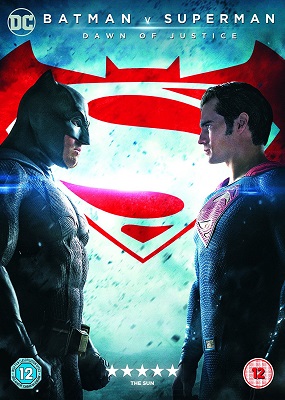
batmanvsupermanBatman v Superman: Dawn of Justice, Zack Snyder (2016, USA). What happens when an irresistible force meets an immovable object? Pretty much the same as when Zack Snyder meets a superhero property. For some reason, he recasts it as an alien invasion story. So, if superheroes are supposed to be defenders of the righteous, but actually turn out to be pretty much fascists in tights, but Snyder prefers to think of them as alien invaders… Just where exactly is this going? I admit it, I quite liked Snyder’s Watchmen – I felt it overdid the violence, they weren’t meant to be super-powered after all, but I felt the movie’s ending was an improvement on the original. However, the less said about Snyder’s Man of Steel, the better. Unfortunately, Batman v Superman: Dawn of Justice is a sequel to Man of Steel, in which Henry Cavill reprises his role as the alien with godlike powers and the occasional urge to perform good deeds and snatched-from-death rescues. (Superman doesn’t hold up to scrutiny in much the same way as Santa Claus – there’s no way Santa could deliver presents to every kid on one day, so there’s no way Superman can save every person in danger every minute of every day. But then plausibility left the building when superheroes walked in nearly a century ago.) Anyway, Batman, played by Ben Affleck, has decided for Batman reasons that Superman is a foreigner and so a threat to Metropolis (where Batman doesn’t even live, FFS), and so he builds a supersuit so he can go mano a mano with the Kryptonite boy scout. There’s also some plot about Jesse Eisenberg as Lex Luthor, who wants to weaponize some green kryptonite but isn’t allowed to, so he weaponizes General Zod’s DNA instead and creates a super-powered monster that Superman and Batman have to fight. Oh, and Wonder Woman randomly turns up, and we know who she is because of a single photo showing her with some Tommies during WWI when she had never even been mentioned in any DC film before. I have, in short, absolutely no idea what this film was supposed to be about. It felt like someone glommed together a dozen random superhero vignettes and expected the big fight between Batman and Superman to make sense of it all. It doesn’t. None of it makes sense.

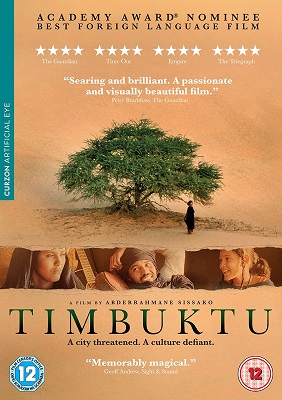
timbuktuTimbuktu, Abderrahmane Sissako (2014, Mauritania). I’d seen only one Sissako film prior to this – Bamako – and was not overly taken with it, but given how good Timbuktu was I may have to track down a copy and rewatch it. On the other hand, Timbuktu features quite a bit of West African music – such as Tuareg assouf (I’ve been a fan of Tinariwen for many years) – which I don’t remember from the other film, as well as being a biting satire of jihadism. The main story is about a Tuareg herder, who sits about in a tent, playing the guitar, while his kids care for his meagre herd, and his strong-willed wife keeps him company. At the river, one of his cows panics and trashes a fisherman’s net. So the fisherman kills the cow. So the Tuareg goes to see the fisherman, they fight, and in the struggle the Tuareg accidentally shoots the fisherman. He is immediately arrested by the local jihadist militia, and sentenced to pay blood money of 40 cattle. But he only has seven cows. So he is sentenced to death. As this story unfolds, the camera breaks away at intervals to record life in Timbuktu under jihadists. There are a bunch of kids playing football with an imaginary ball as sports are banned. A couple are stoned for adultery (a brutal and disgusting custom). A group of French jihadists argue about their favourite football teams. A Bambara woman scares the jihadists with her witchcraft. And a local imam patiently explains why the jihadists must follow the teachings of Islam and not their own extremist views. There was nothing that was bad about this film. It looked gorgeous, the non-professional actors were impressively convincing (especially the Tuareg herdsman), and the music was excellent. Highly recommended.

1001 Movies you Must See Before You Die count: 810


Leave a comment

Moving pictures, #54

Another varied batch of films. I think I might well end up having watched more movies this year than last year… and I watched 544 in 2015. Oh well.

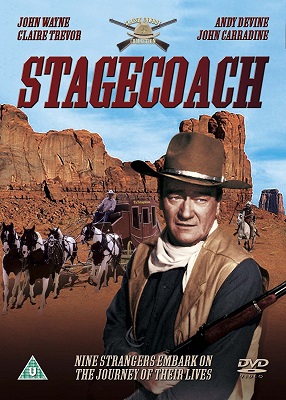
stagecoachStagecoach*, John Ford (1939, USA). Do westerns belong on the 1001 Movies You Must See Before You Die list? If they do something unexpected and original with the form, or if they’re seminal, then yes, I suppose they do. But I can’t see that Stagecoach does any of those. It’s best-known as John Wayne’s breakthrough movie. He’d made lots of Poverty Row westerns, and his one previous appearance in a big-budget western was a box office flop. But Ford, who had not made a talky western before, wanted Wayne and fought the studio to get him. The film was a hit. But why does that make it one of the 1001 best movies ever made? The story is pretty stereotypical: a handful of people with back-stories leave town on the stagecoach, they pick up Wayne en route, who has just broken out of prison, and then chase the US Cavalry across the state, pursued by Apache. According to Wikipedia, Stagecoach “has been lauded as one of the most influential films ever made”. But given that Wayne had been in about eighty Poverty Row Westerns during the 1930s, I find it hard to believe everything in Stagecoach was seminal – some western at some point must have introduced whatever tropes exist in Stagecoach. Of course, a Poverty Row film might not have had the release of a major studio movie… Perhaps it’s just that Stagecoach has been overtaken by westerns that came after it. I mean, some of the westerns from the 1001 Movies You Must See Before You Die list I’ve seen have been pretty damn good, albeit for a variety of reasons. But I can’t say Stagecoach was one of them.

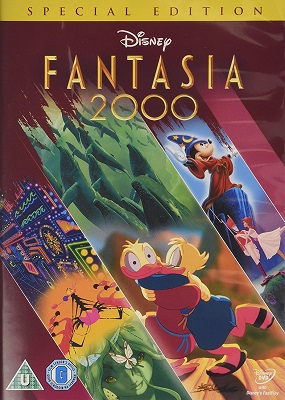
fantasia_2kFantasia 2000, Don Hahn, Pixote Hunt, Hendel Butoy, Eric Goldberg, James Algar, Francis Glebas & Paul and Gaëtan Brizzi (1999, USA). I watched a much earlier Disney anthology film a few weeks ago, one that was put together to keep the studio in work during World War II. Fantasia 2000 has no such excuse. It claims to be a celebration of the original Fantasia, but comes across more like an excuse for its animators to show off – and, to be fair, some of the animation is very impressive. Unfortunately, each of the film’s eight segments is introduced by Hollywood stars at their most smirkingly oleaginous. Instead of a celebration of the original Fantasia, it gives the whole project the feel of a self-congratulatory Hollywood/Disney celebration. Of the segments, the abstract shapes of the opener were cleverly done, the space whales in the second were also good, the Al Hirschfeld-style animation in the third segment was clever but soon wore thin… and then it all started to go downhill, with one of the remaining segments a repeat from Fantasia. One for Disney fans, I suspect.

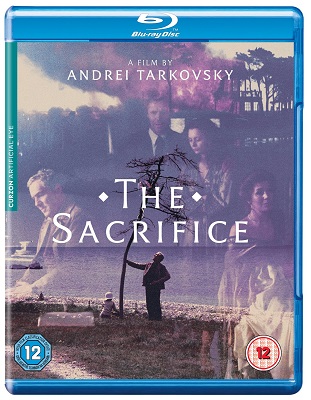
sacrificeThe Sacrifice, Andrei Tarkovsky (1986, Sweden). I’ve now replaced all my Tarkovsky DVDs with the new Blu-ray releases – well, all except The Tarkovsky Companion, which I don’t think is getting a Blu-ray release – and since I now own shiny new copies in a much better format, I’ve been rewatching them… And it’s been sort of weird sitting through these films, given the high opinion of them I held. Take The Sacrifice. I would have counted it among my favourite of his films, perhaps second to Mirror… And yet, having now rewatched it, it sort of feels like a Bergman film played at slow speed. Of course, this is chiefly because the dialogue is in Swedish (with some English), the star is Erland Josephson, and it was filmed on Gotland. But even then, the concerns of the film feel quite Bergman-esque…. up to the point where the nuclear holocaust takes place. That isn’t Bergman at all. And the wife’s subsequent breakdown, which is harrowing to watch, is not something you’d expect to see in a Bergman film. But would you expect to see it in a Tarkovsky film? And yet… I still think The Sacrifice is one of Tarkovsky’s best films, not because it least resembles the others but because so much of its emotion is there on the screen to see. Kelvin in Solaris was a bit of an enigma, Mirror was too patchy to have a real emotional payload… but The Sacrifice is all about emotion – not just Adelaide’s hysterics, but Alexander’s response to the holocaust. It’s a film that, like a densely-written literary story, rewards attention and rewatching, and even when you’ve given it neither, it still tells you that you should have done. And certainly more so than Solaris or Mirror. It’s as if the cinematic tricks used to tell the non-linear story of Mirror were used in service to a superficially uncomplicated linear narrative. There are films you rewatch because you enjoyed them; but there are films where every time you rewatch it you feel like you’re digging a little deeper into its meaning. Tarkovsky’s films definitely fall into the latter category, and I’m particularly glad buying the Blu-rays has prompted me into rewatching them. Which I will be doing a few more times before the year is out, I think.

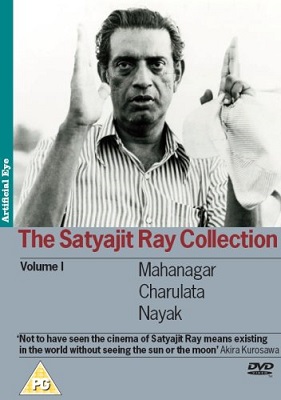
ray_1Mahanagar, Satyajit Ray (1963, India). Ray is considerably better-known outside India than Ritwik Ghatak, but he also has a considerably larger body of work. And most of it seems to have been released on DVD in the UK (I wonder if it’s because Ray was championed by Merchant & Ivory…). Like Ghatak, Ray was Bengali, and Mahanagar is set in his native Kolkata. A young couple in Kolkata are having trouble meeting their bills, so the wife takes a job as a door-to-door saleswoman. She proves to be good at it. But when her husband realises this means he’s not being looked after to the degree to which he is customed, he asks her to quit. But then he loses his job, and she becomes the only breadwinner in the family. And the whole experience has given her the confidence and independence to carry the family over her husband’s objections. So much so, in fact, that when a colleague of hers, an Anglo-Indian, is fired because the manager believed she had thrown a sickie, she confronts the manager but ends up resigning in protest. A comparison with Ghatak’s films is, for me, inevitable. And while I’ve seen only a fraction of Ray’s oeuvre, I have seen more films by him than by Ghatak… I do like the urban character of Mahanagar – it doesn’t have those great shots of the river and countryside you see in Ghatak’s A River Called Titas, and its narrative is much more traditional in structure; but it’s an engaging drama and it’s played completely straight, with no frills. The end result is a movie which doesn’t have the scope of  A River Called Titas but handles its constrained domestic drama, and the social changes it documents, in a nicely low-key way. Recommended. And yes, once I’ve watched the three films in this box set, I’ll be buying volume 2 and then volume 3, and then the Apu trilogy if I can find a copy (as it’s been deleted already, I think).

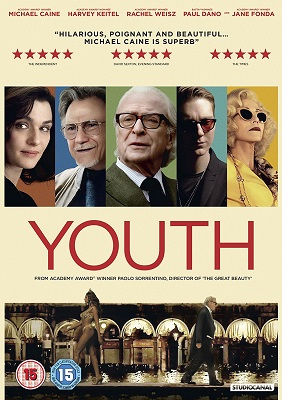
youthYouth, Paolo Sorrentino (2015, Italy). I stumbled across this on Amazon Prime, and since I’d seen and been impressed by Sorrentino’s The Consequences of Love and The Great Beauty in previous years, it was an easy decision to watch it. Unlike those other two films, however, Youth is English-language – in fact, it stars Michael Caine and Harvey Keitel in the two main roles, supported by, among others, Rachel Weisz, Paul Dano, Jane Fonda and Paloma Faith. Caine and Keitel are old friends, currently staying at a Swiss health resort. Caine is a famous composer, Keitel a famous director. A “queen’s emissary” (wouldn’t that be an equerry?) visits Caine and asks him to conduct one of his pieces at a special concert for Queen Elizabeth II. He refuses. Keitel, meanwhile, is trying to write the screenplay – with the help of half a dozen screenwriters – for his last movie, his “testament”. As you’d expect from Sorrentino, the cinematography is gorgeous, and there are extended moments when the story is put to one side and the viewer is allowed to just revel in the atmosphere while suitable music plays (it’s part of the narrative, not something imposed by the medium). But the rest of the story… there are a couple of good cinematic tricks, and the dialogue is never actively bad, but it all feels a bit banal and perhaps even a bit stereotyped in places (especially Jane Fonda’s part).  I don’t know; Sorrentino is a master director, but I’ve seen three of his films now and each has left me slightly dissatisfied in some way – and the nearest I can come to articulating why, is that the way he structures his stories seems to flatten their dramatic beats and makes them feel a bit, well, hollow. But his films do look beautiful. So I’ll continue to watch them.

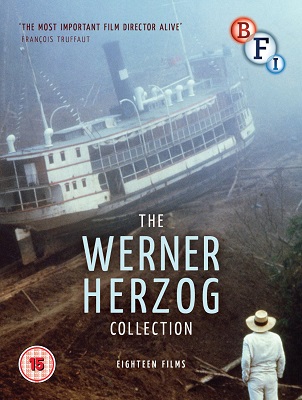
herzogThe Enigma of Kaspar Hauser, Werner Herzog (1974, Germany). I picked up a copy of this Werner Herzog Blu-ray collection a few weeks ago, and have been working my way through it. I already had many of the films on DVD – in a pair of box sets I bought years ago – but Herzog is definitely worth upgrading. The Enigma of Kaspar Hauser is not as bonkers as Herzog gets, but it is pretty bonkers. It’s also based on a “true” story. In 1828, a young man was found wandering the streets of Nuremberg. He claimed to have been kept imprisoned in a cellar for his entire life up until that point. It was rumoured he might be related to a royal house, although he denied it. It is now considered more likely he was a con artist, and made it all up in order to blag his way to notoriety and riches. Herzog goes with the mystery – but casts Bruno S, a completely bonkers Berlin musician, in the title role, despite Bruno S being in his forties and the historical Hauser being in his late teens. But it works because Bruno S is such a mad actor. Imagine someone had sucked Brad Dourif’s brains out of his ears, and the memory having had brains still remained, and you might get some idea of what Bruno S’s acting is like. And if that wasn’t enough, Herzog has Hauser bark his new-found learning throughout the film in a series of pedagogical conversations and interviews. It is completely unconvincing, and yet totally believable – a quality a lot of Herzog’s films possess. The Enigma of Kaspar Hauser is by no means Herzog’s best film, although it remains one of his more interesting ones – but this collection is definitely worth getting, and not just for the feature films but also for the special features, such as How Much Wood Would A Woodchuck Chuck, a 1976 German TV documentary on the World Livestock Auctioneer Championship in the US.

1001 Movies You Must See Before You Die count: 809


9 Comments

Moving pictures, #53

I think I’m managing a decent balance of countries in my film-viewing – France currently scores highest after the USA and UK (then Germany, Japan, Italy, Russia, Canada and Sweden…). But I would like to improve it. I’ve found a good source for African films, and emailed them to ask if they deliver to the UK – but no reply yet. Some other nations’ cinemas are much harder to find films… like Albania. It apparently has a thriving film industry, has even produced a handful of festival favourites… but finding copies on DVD is proving difficult. I shall continue to look, however. Meanwhile…

jungle_bookThe Jungle Book, Wolfgang Reitherman (1968, USA). I can remember the first time I saw this film. It was in the gym at the Doha English-Speaking School in Qatar, sometime around 1970 or 1971. (I’m a founding pupil of two English-speaking schools in the Middle East.) We also had an LP of songs from the film, and given I heard the songs so often during my childhood, I may well have confabulated that into multiple viewings of the film. So I was quite keen to watch it again (in contrast to, say, 101 Dalmatians, which I had no firm memories of ever seeing as a kid, but suspected I might have done). And… it was okay. I had expected it to be better than it was. The animation was nowhere near as beautiful as that of Sleeping Beauty or Cinderella, and while the songs were mostly very memorable… that was all they were. It all felt a bit weak. Which was weird. I couldn’t help comparing it to 101 Dalmations, which I had not expected to like when I saw it a couple of months ago, but found quite charming. I’m not sure where The Jungle Book fits in the Disney canon – I’m not that much of a fan of their films, to be honest, and am only working my way through them out of a sense of completeness (and a vain hope of being blown away again as I was when I watched Sleeping Beauty). At the moment, myself I’d classify The Jungle Book as middling Disney – not great, but not awful; fun, with catchy songs but an unmemorable story.

eccentricitiesEccentricities of a Blonde-haired Girl, Manoel de Oliveira (2009, Portugal). Among the countries from which I had not seen a film was Portugal. (I can’t find a felicitous way of phrasing that which emphasises the country, but what I mean is: I had never seen a film from Portugal.) So I hunted around on LoveFilm, and found this, Eccentricities of a Blond-haired Girl, directed by Maniel de Oliviera. And… it was good, very good. It felt like a dramatisation of a story by Karen Blixen. Which is a compliment. A man on a train introduces himself to the woman sitting beside him, and then proceeds to tell her his life-story. Cue flashback. And it’s a very Blixen-like story. In the apartment across the street from the man’s office lived a young woman. He fell in love with her, and arranged to meet her. They were drawn to each other and decided to marry. But his uncle, who is his guardian and employer, wouldn’t let him marry, and fired him when he insisted on going ahead with it. In desperation, the man accepted a job from a friend running a plantation on Cape Verde. A few years later, he returned, having made his fortune. He again asked the young woman to marry him, and she accepted. But another friend asked him to stand guarantor to a business venture… but then disappeared with all the cash, leaving the young man penniless once again. He was offered the job in Cape Verde a second time… but managed to reconcile with his uncle and so turned it down. Now, he had his original job back, his uncle would pay for the wedding, everything was working fine… but the fiancée turned out to be a kleptomaniac (hinted at throughout the film) and so he rejected her. At only 64 minutes, this is a pretty economical film. But it has that literary quality with which the best directors can imbue their movies. It feels like an adaptation of a literary story (it is: by Eça de Quierós), it feels like The Immortal Story or Babette’s Feast. Recommended; and I have added more films by de Oliveira to my rental list.

mutinyMutiny on the Bounty*, Frank Lloyd (1935, USA). Some stories seem to become so much a part of Western Anglophone culture there’s no real need to read the book or see the film or watch the play or hear the song… and so it is with Mutiny on the Bounty, in which the crew of an English ship in the late eighteenth century mutiny, set their evil captain and his sycophants adrift in a boat, settled down to a life of ease on a Pacific island, only for the captain to survive a 7,000 mile ocean journey, set the Royal Navy on the mutineers, and so bring them to justice. And the story goes: that Captain Bligh was a total monster, Fletcher Christian was an Everyman hero, and bad luck and circumstances prevented the mutineers from living the fruitful and paradisical lives they deserved. At least, so Hollywood would have you believe. It’s true that history has demonised Bligh, and Hollywood – in this film especially – fixed that version in the public consciousness. But apparently he was a good captain, and Christian was far from the selfless hero played by, in this movie, Clarke Gable. But that’s all by the bye – it’s a Hollywood film, historical accuracy is not in the product description. I had, however, expected to be mostly unimpressed by Mutiny on the Bounty. But it made a surprisingly excellent fist of life aboard an eighteenth-century sailing vessel, and the storm scenes in particular were done well. Not bad.

electraElectra, My Love, Miklós Jancsó (1974, Hungary). This may be one of the most bonkers films I have ever seen. I have seen a number of bonkers films. I have seen all of Jancsó’s films available on DVD in the UK; Jancsó makes bonkers films. But even by his lights, this is an odd one. Now I love the declamatory nature of Jancsó’s films, and I like the continual movement – of the camera, of the cast – that he uses. But even so, Electra, My Love seemed weirder than I was used to from Jancsó. As the title suggests, it’s about Electra, a thorn in the side of the tyrant Aegisthus who had murdered her father, Agamemnon, fifteen years earlier. And the film plays out Electra’s story, as her brother Orestes, believed dead, reappears in disguise, reveals himself, kills Aegisthus, and takes power. But given that this is a Jancsó film… The story takes place in the middle of nowhere, a grassy plain with no evidence of civilisation other than the crude buildings which feature in the film. And while Electra walks about declaiming, there is a cast of several hundred in continual movement about and around her, including men with whips, dwarves with cymbals, naked women and men dancing, marching bands, dancers with sticks, and a giant ball. It’s like watching a Greek myth in interpretative dance with dramatic dialogues on top. It shouldn’t work, it should feel pretentious to the nth degree… But Jancsó’s genius is that he does make it work, that it comes across as a somewhat peculiar staging of the story, but a staging that adds to the story rather than obscures it. Jancsó is undoubtedly an acquired taste, but I count myself a fan.

springSpring, Summer, Autumn, Winter… and Spring, Kim Ki-duk (2003, South Korea). The title refers to the “seasons” of a monk’s lifetime. He lives in a tiny monastery which sits in the middle of a lake, and at various points in his life, events happen which are documented under the seasons of the title. The Wikipedia entry – see here – has an excellent description of them. I will admit, I am woefully uninformed when it comes to the creed and practices of Buddhism (but then I’ve never read the Bible, Talmud or Qur’an either), so much of the symbolism in this film went straight over my head. Which may be why, despite its often gorgeous cinematography, I think I like Ki-duk’s 3-Iron more – although Spring, Summer, Autumn, Winter… and Spring is plainly the better-looking film. But then Spring, Summer, Autumn, Winter… and Spring is a film which succeeds because of its photography. The plot starts out as a series of vignettes, and any story-arc feels like something of an after-thought, but the film’s biggest draw, its Buddhist symbology, would be likely lost on all but students of the religion (but then, who catches every reference in a literary novel?). Both 3-Iron and Spring, Summer, Autumn, Winter… and Spring were recommendations from David Tallerman, who I believe counts Ki-duk among his favourite directors… and while my tastes usually lie a little closer to home – ie, from India through the Middle East and Africa to Russia and Northern Europe – and my knowledge of Far Eastern cinema is patchy at best, I do think I’d like to see more by this director.

chinoiseLa Chinoise, Jean-Luc Godard (1967, France). I think I can ditch my Theory of Godard, it’s plainly complete nonsense. It’s not as if I can split out his famous “political” films either, and declare they don’t work for me – because some of them do. I suspect that if there is something in common to the Godard films I like, it’s that his focus in the ones I like seems to be more on experimenting with narrative forms than it is on just his cast. So in Weekend, he told a surreal story; in Two or Three Things I Know About Her, he tried several different narrative forms; and in Détective, he set out to tell a mystery story that could not be parsed in one sitting. But in La Chinoise, it’s all about the cast members monologuing to camera – especially his new wife of the time, Anne Wiazemsky – and while its story (it can hardly be called a plot) presages the student revolts of a couple of years later while simultaneously mocking left-wing student politics, it still possesses Godard’s baffling love of US iconography. The end result is not one of his most gripping, although some of the jokes are good, and the overall structure is interesting, if not entirely successful. Back in 2002 (I could have sworn it was a year or two earlier as I seem to remember buying the DVD while in Abu Dhabi, probably from Amazon), but anyway, in that year I saw my first Godard, À bout de souffle. It was also, I think, my first exposure to the Nouvelle Vague. I have never really considered myself a fan of French New Wave cineman, but the more of Godard’s oeuvre I watch, the more I admire him for his body of work and the more of his films I find that I do like. La Chinoise, I think, is currently borderline – but I’d like to watch it again sometime, so who knows…

1001 Movies You Must See Before You Die count: 808


5 Comments

Reading diary, #37

I didn’t set out to read mostly women this month, but that’s the way it worked out. Still, if the reading plan is going to fail, it’s best to fail this way than the other.

sunboundThe Sunbound, Cynthia Felice (1981). I’d enjoyed Felice’s Godsfire, which I’d picked up at Archipelacon and was expecting something similar from The Sunbound, which I bought at Fantastika 2016 in Stockholm. In the event, it proved quite a problematical novel – see my review on SF Mistressworks here – and I really can’t recommend it… although I’ve not given up Felice’s oeuvre by any means. In fact, the novel published after this one, Eclipses, looks quite interesting. I just need to find a copy…

arrival_missivesThe Arrival of Missives, Aliya Whitely (2016). I bought both this novella and the one below at Fantasycon. I’d been keen to read something by Whitely after a tweet had named half a dozen or so under-appreciated genre authors including Nina Allan, myself and Whiteley, among others; and given that’d read a lot of Allan’s fiction and found it good, I wanted to try Whiteley. I read this on the train on the way back from Scarborough – a surprisingly pleasant journey, given the shocking state of our railways. The Arrival of Missives is set immediately after the First World War, in a small village that has suffered its fair share of casualties. Most of those in the novella, however, are children – or at least were too young to fight. Shirley Fearn, a teenager, dreams of a life outside the small village in which she lives, although her father wants her to marry a local lad who can then inherit the farm. Shirley also has a crush on the new village school teacher, Mr Tiller, a veteran of the war. She makes plans to attend teacher training in a nearby town, and insinuates herself into Tiller’s life… only to discover that his torso has a largew piece of rock embedded in it, large enough that he should not be alive as it occupies the space where his organs should be. At this point, The Arrival of Missives takes this piece of weirdness and runs with it. The stone was sent back in time by humans from the distant future, and is one of many such “missives” – this one happened to find Tiller near-death and caught up on some barbed wire in No Man’s Land. It makes for a weird disconnect – a detailed story of post-WWI life in a small village, almost Lawrentian in tone, and this science-fictional idea, which has no rational support or narrative scaffolding. But that, I guess, is what New Weird is. And yet The Arrival of Missives works because the writing is so good. Shirley is a compelling narrator, and her concerns are well-handled. The “missive” adds an odd flavour to the novella, which most will like more than I did… but I suspect this is still a contender for a BSFA or BFS Award next year.

golden_notebookThe Golden Notebook*, Doris Lessing (1962). I admit it, I had thought this would be extremely hard-going. I’d read a couple of Lessing’s other novels and not been taken with them – and even if the first book of her sf quintet, Canopus in Argos Archives, Shikasta, felt to me like being beaten about the head by Ursula K Le Guin. The Golden Notebook, Lessing’s most celebrated novel, I expected to be a bit of a chore – especially given its 576 pages… So I was pleasantly surprised to discover it was an engrossing read. I’m only glad I read it after writing All That Outer Space Allows, as some structural elements of my novel might well have changed and in hindsight I’m not convinced they’d have been improvements. The Golden Notebook is a novel titled ‘Free Women’, about Anna Wulf, writer of a single successful novel based on her years in Africa during WWII, who is now living in London. She is also a communist. Between Sections of ‘Free Women’ are Wulf’s notebooks – black, red, yellow and blue. In the black notebook, she describes her time in Africa – on which her one published novel, ‘Frontiers of War’ (and which I kept on mis-thinking as Olivia Manning’s Fortunes of War) was based – and later, her life in London. The red notebook details Wulf’s politics and her interactions with the Communist Party. The yellow notebook is a fictionalisation of Wulf’s own life, title ‘The Shadow of the Third’, in which Wulf’s part is played by a woman called Ella. And the blue notebook starts out as a diary, but at times is more of a scrapbook, filled with newspaper cuttings. The five narratives, despite covering similar ground, don’t actually confuse The Golden Notebook‘s story, they actually deepen it and successfully show different aspects of Wulf’s character – as a writer, as a communist, her sex life (especially her affairs, none of which last) and her relations with her friends. The more observant among you will have noticed that the title of Lessing’s novel refers to a notebook not yet mentioned. This only appears near the end, opens by describing Anna breaking free of her then-boyfriend, before becoming that boyfriend’s own novel (a précis is given only), since writing is the catalyst the two use to part amicably. I really liked The Golden Notebook, and I honestly hadn’t expected to. I can see how it might have shocked in 1962 – Lessing is very forthright about Wulf’s sex life – and the sharp criticism of the lives women were expected to live can’t have gone down too well. I expect the communism would be more of a turn-off to twenty-first century readers than the sexual politics. But The Golden Notebook does read like a book ahead of its time. Recommended.

nocillaNocilla Dream, Agustín Fernández Mallo (2006). I seem to remember seeing this discussed on David Hebblethwaites’s blog, and the fact it inspired a new generation of writers in Spain – the “Nocilla generation” – only made it me want to read it all the more. It’s actually the first book of a trilogy, and the second book, Nocilla Experience. will be published in English next month. Despite my disappointment with some aspects of Nocilla Dream, it’s on my wish list. But Nocilla Dream… The book is structured as 113 sections, which vary in length from several lines to several pages. There also excerpts from other books and scholarly articles, on a wide range of subjects. There is no plot per se. Repeated mention is made of a tree on the desert road between Carson City and Ely, Nevada, over whose branches people have thrown pairs of shoes. Some of the stories involve people who have provided at least one pair of those shoes; some of the others involve people who have interacted with those people. The stories take place all over the world – which results in one of my gripes: a couple of sections are set in Denmark and it’s a very unconvincing depiction of the country. Another gripe is more the publisher’s fault, as on page 87, the section is headed “Relevant physical constants”, and the exponential figures haven’t been printed with the powers as superscript – so you get, for example, “Speed of Light, c = 3.00 x 10⁸ m/s” when it should be 3.00 x 10⁸ m/s. Despite these, Nocilla Dream is fascinating, does some very interesting things with narrative structure, and I’m looking forward to reading the remaining two books in the trilogy. I will admit to some disappointment, however, when I discovered that Nocilla is a brand-name of a Nutella-like spread in Spain…

the_beautyThe Beauty, Aliya Whiteley (2014). I don’t think this is quite as successful a novella as The Arrival of Missives – partly because the writing is not as good, but also because it seems even more consciously New Weird. Fungi! The narrator is the storyteller of a group of men living in a remote valley in the south-west after a fungal infection killed off all the women (it’s not said but it’s implied it’s global). The Group had been formed before that, a back-to-the-land survivalist sort of commune. But then the women all begin to die from a strange yellow fungus. The Group stumbles on for a while without women. Then the storyteller, Nathan, is taken to see growths of the strange yellow fungus in the nearby wood, whic resemble those growing on the graves of the women in the Group’s cemetery – clearly indicating women are buried there. He is captured by a strange creature which looks like a woman but is made of yellow fungus. It traps him underground, but keeps him alive. He is initially revulsed, but comes to love the creature, which he names Bee. The rest of the Group soon have one each. These are the Beauty. They’re implied to be reincarnations of the lost women, but are unable to communicate except by projecting moods and feelings. Nathan has frequent sex with Bee – this despite there being a maternal element to their relationship (the other members of the Group treat their Beauty as they did their wives and girlfriends). But then one of the group, Thomas, begins to develop a tumour… except it isn’t a tumour, it’s a baby, part-human part-Beauty. And so the roles are swapped, and a new world is ushered in. The novella finishes with Nathan and Bee leaving the Group to find out what is happening in the outside world. There are some types of New Weird I can take – such as The Arrival of Missives, for example – and some I can’t. The Beauty falls squarely in the latter. Whiteley’s writing, while good, has definitely improved by the later novella – which is just as well as I doubt I would have read further had I come across The Beauty in 2014.

legacy_lehrThe Legacy of Lehr, Katherine Kurtz (1986). Another book from Fantastika 2016. Kurtz, of course, as the cover of this paperback makes plain, is better known for fantasy than science fiction. In fact, The Legacy of Lehr appears to be her only science fiction novel. And this despite having an engaging pair of protagonists in a set-up ripe for further adventures. Perhaps the book didn’t sell well  enough to encourage Kurtz, or the publisher, to continue as a series. I enjoyed the book, although it’s lightweight. My review will appear on SF Mistressworks later this week.

1001 Books You Must Read Before You Die count: 127


6 Comments

“When I read a story, I skip the explanations”

In my review of Katherine Kurtz’s The Legacy of Lehr, a 1986 science fiction novel, for SF Mistressworks – the review will appear on Wednesday – I use the phrase “Ruritanian sf” as a description of the novel’s type of genre fiction. There is, of course, already a genre of “Ruritanian romance”, in which an invented European country is used as the setting for a swashbuckling adventure, “centred on the ruling classes, almost always aristocracy and royalty”, as Wikipedia has it. The Wikipedia entry goes on to point out that Ruritanian romances have colonised genre fiction, naming Andre Norton as an early proponent. And yet…

Fiction, especially romance, has been all too happy to use invented royal and aristocratic houses in existing countries for its stories. There’s no need to invent an entire nation. Actual literature, on the other hand, can’t seem to make up its mind – for example, the plot of Nabokov’s Pale Fire, hidden though it is, revolves around the royal house of an invented country, and Boyd’s A Good Man in Africa is set in the invented country of Kinjanja; but Greene’s The Heart of the Matter is set in… Sierra Leone. So why use an invented country? What is it about the story that it must be set in a fictional nation? The most obvious explanation appears to be that no existing nation has the characteristics required by the story, whether they are geographic, historical, or social. Which neatly leads into science fiction and “Ruritanian sf”…

zenda_2854338b

… because the settings of sf novels, especially “heartland sf”, are by definition entirely invented. They are the future, or an alien world, or an interstellar empire. But where a Ruritanian romance allows an author to tell a story that would not be plausible in a real place, Ruritanian sf allows an author to tell a story that is plausible but happens to boast an invented setting. And it does that by pretty much transposing elements of the real world into a science fiction setting. So cruise liners become spaceships, airliners becomes shuttles, assault rifles become blasters, and so on… Everything is an analogue of something in the real world with which the reader is familiar. There’s no need to explain the workings of the VanGriff Mk 29 Magnum Blaster because it works, in effect, in story terms, just like a Colt .45. There’s no need to describe the layout of a spaceship, because it uses the familiar terminology of ships that sail the oceans – bridge, cabin, engine room… (Of course, it goes without saying that real-world spacecraft are nothing like this.)

The end result is a setting built up from well-understood and commonly-accepted tropes that need no explanation, or scaffolding, in the text itself. There’s no need to explain how FTL works because it’s so prevalent in sf its effects in story terms are more important than its (invented) workings. It gets characters from A to B, where A and B are interstellar distances apart. Far too many sf tropes have become “black boxes” in this fashion. And a story which uses them uncritically, which simply slots them together like Lego, is Ruritanian sf. It’s telling a present-day story in an invented setting, but a setting that is as familiar as the reader’s world. It’s only science fiction because of the furniture and vocabulary.

1954-imagination_5411

That’s the essence of Ruritanian science fiction. It is genre fiction which builds an invented setting out of elements which might as well not be invented. The labels are different but the objects are the same, or fulfil the same function. It’s not a failure of imagination, because imagination doesn’t feature in the process. And it’s only a failure of craft if the author is attempting something more than Ruritanian sf. If all they want is a science-fictional setting the reader can parse, one that’s uncoupled from the real world but close enough to it that few explanations are required, then if they’ve produced Ruritanian sf they’ve succeeded. Info-dumps are a given, but they’re usually “historical”, inasmuch as they attempt to give the invented world solidity and depth through exposition – but shifting the burden of exposition onto the setting’s own narrative only demonstrates how little exposition the tropes in the story actually need.

Needless to say, I think such forms of science fiction are low on invention and make poor use of the tools at the genre’s disposal. They can be entertaining, there’s no doubt about that; but their uncritical use of tropes, and their failure to interrogate the form, means they have little or nothing to add to the genre conversation. This doesn’t mean they can’t be commercially successful – because, after all, their chief characteristic is that they confirm readers’ prejudices (even when they seem to be challenging them – or rather, it’s the challenge itself that the reader wants). Ruritanian sf is comfort reading, it is unadventurous and unlikely to promote critical discussion.

It also forms the bulk of science fiction being published today (and yes, I’m including self-published sf).


Leave a comment

Moving pictures, #52

Another bunch of films, of mixed quality…

trustTrust*, Hal Hartley (1990, USA). Hartley has two films on the 1001 Movies You Must See Before You Die list, and I can’t honestly see why he even has one. I can only guess he was the US independent film-making scene’s darling in the 1980s. He doesn’t translate to the UK. Or perhaps it’s just me. Maria is dumped by her jock boyfriend when she tells him she is pregnant, and the news causes her father to die of heart failure. Matthew is an electronics genius who thinks he’s some kind of alpha male. The two become involved. And, er, that’s it. Everything is resolutely amateur, the characters are not at all believable, and the central story – the relationship – is neither engaging nor dramatic. I really don’t see the appeal of Hartley’s movies. I thought his The Unbelievable Truth was singularly unimpressive, and wondered at its presence on the 1001 Movies you Must See Before You Die list, and I can only say the same of Trust. I will say, however, that Trust is very 1980s – but that’s hardly a compliment. Still, at least I can cross it off the list.

capsuleCapsule, Andrew Martin (2015, UK). Someone mentioned this film to me assuming I’d already know of it given its subject. But I hadn’t. So I checked it out, the DVD was cheap, so I ordered a copy… The story mostly takes place inside the first British spacecraft, which is supposed to have beaten both the US and the USSR into space. Now, I know all about bending the history of the space race, I have won awards for doing as much, after all – kof kof – and I’m fully on board with a British astronaut orbiting the Earth in 1959 in advance of both the USA and USSR. (Stephen Baxter and Simon Bradshaw wrote an excellent short story, ‘Prospero One’, on the same subject.) Unfortunately, I’m not in the slightest bit convinced by Capsule’s alternate history. Just look at the DVD cover, it looks like a Mercury capsule. Why would the British design a space craft that looked just like a Mercury capsule? And if they did, you’d expect the interior to resemble a Mercury spacecraft, where as the one in Capsule looks like the sort of interior designed by someone who doesn’t know much about spacecraft. And then there’s the story itself. By it’s very nature, it’s going to consist mostly of a camera focused on a single bloke in a pressure suit crammed inside said spacecraft. The plot of Capsule is about his dealings with the people on the ground through his radio – UK, USA and USSR. There is, I admit, a clever twist in the tale; but the journey to that point is not convincing and sadly lacking in drama. Disappointing.

nuummioqNuummioq, Otto Rosing & Torben Bech (2009, Greenland). One weekend, I tried to work out the countries from which I’d seen at least one film and, by extension, which nations’ movies I had yet to see. And Greenland was one of those countries on the not-seen list. So I went looking for some, discovered the Greenlanders had made several over the decades, and bought Nuummioq, AKA The Man from Nuuk, because it sounded interesting. A Greenlandic casual labourer finds his view of life changing when he is diagnosed with testicular cancer. He could get treatment, but in Denmark. Meanwhile, an ex-lover has returned, and the two rekindle their relationship. One of his two friends has an idea for selling glacier ice to gullible Westerners (don’t laugh, there’s already a brand of bottle water that boasts it’s made from glacier water), and he persuades the man from Nuuk to help him film a commercial. So they take their boat up the fjord into the country, where they normally hunt… and go stay with the sheep farmer, who has a complicated history with them and their families… And this is solid Nordic drama, well-written and well-acted, with some amazing Greenlandic scenery. I’m surprised it’s a not better known. I had to buy a DVD copy in order to see it, but it was by no means a wasted purchase. And I plan to watch more Greenlandic films too. Recommended.

le_boucherLe boucher*, Claude Chabrol (1970, France). I’ve seen half a dozen films by Chabrol, and I know he’s highly-regarded, but every film I’ve seen by him has felt somewhat meh. Le boucher was, I admit, much better than the others I’d seen. A man and a woman meet at a wedding in their village – he is the butcher of the title, she is the school mistress. They begin seeing each other. Meanwhile, someone has been murdering young women in the area. The school mistress’s suspicions gradually fasten onto the butcher, and when she finds his lighter at one of the crime scenes… The film plays the thriller plot very much as a social drama, and is far more concerned with the relationship between the two than it is the crimes being committed. For a start, the murders are off-stage, and second, the police are not presented in a flattering light – it is, not after all, about them and their investigation. Unfortunately, this does mean the final act, when the butcher realises he’s been rumbled, comes across like a cut-price The Shining. What most people are likely to remember of the film, however, is the school trip to the Grottes de Cougnac, a large cave system – althoughly, I suspect, chiefly from the weird scenery more than anything else. Le boucher takes an interesting approach to its story, and if it feels a more solid than innovative it’s probably because time hasn’t been especially kind to it. But on balance, I think it probably belongs on the 1001 Movies You Must See Before You Die list.

bridge_of_spiesBridge of Spies, Steven Spielberg (2015, USA). In 1957, the FBI catches a Soviet spy. When it comes to prosecuting the man, a lawyer specialising in insurance law is asked to defend him. Rather than do the perfunctory job expected of him – because this is Tom Hanks, in a Steven Spielberg film – he is determined to see his client treated with fairness and dignity, and due process, and also avoid the death penalty. Which he manages, chiefly by suggesting the Soviet spy would then be available to trade in the future should the USSR catch a US spy. Which proves pretty damn handy when the Soviets shoot down Gary Powers in his U-2 and goes on trial in Moscow for spying. And so the two sides arrange a swap, but this turns complicated when  the East Germans grab a US student studying in Berlin, and while the US government is happy to let him rot in prison, Hanks insists he’s included in the exchange. While it’s certainly true that governments don’t seem to much care about the human cost when in pursuit of goals – especially those for the millitary-industrial complex or intelligence community – Spielberg’s career-long insistence that one good man can mitigate that tendency is getting both tiresome and damaging. Hanks specialises in playing an Everyman, and yet in all his films he is quite clearly something special to achieve what he achieves. It’s completely disingenuous. It’s like celebrating a billionaire for being a patron of the arts, when in fact society should not be relying on the largesse of the wealthy to fund the arts. Charity does not begin at home; it should be systemic. And interesting though historical incidents such as that in Bridge of Spies are, and no matter how well Spielberg evokes the era in his production design and photography, you’ve still got a film which presents the wrong message (look it up on Wikipedia – the film takes liberties with history; and Abel, the Soviet spy, was a fascinating man). Meh.

river_titasA River Called Titas, Ritwik Ghatak (1973, India). For the last couple of months, I’ve been putting A River Called Titas on when I’ve had a little too much to drink and I just want to sit back and just look at pretty pictures without having my intelligence beaten to a pulp. In the past, I’ve used All That Heaven Allows, Sokurov’s The Second Circle or Whispering Pages, or the first episode of Sokurov’s Spiritual Voices, or one of James Benning’s California Trilogy… but of late, I’ve been using A River Called Titas instead. Unlike those other films, it is black-and-white, and while it has a beginning, middle and end, it’s more a series of linked stories than an actual plot. It opens with two young girls, who live in a Malo village on the banks of the Titas River in what is now Bangladesh, discussing which of the village’s fishermen they will marry. Some fishermen from a village across the river visit the village during a festival, during which it is attacked. Kishore, one of those visiting fishermen, saves Rajar Jhi, and a marriage is arranged between the two. But on their journey to Kishore’s village, their boat is attacked by pirates, who kidnap Rajar. She manages to escape them and is taken in by some villagers. Unfortunately, she doesn’t know her husband’s name, only the village from which he came. The story jumps ahead ten years. Kishore has lost his mind after losing his wife. Rajar now has a ten-year-old son, Ananta. She sets off to find her husband, and arrives at his village. But he does not recognise her. A young widow, Basanti, one of the two girls in the film’s opening, helps her. During a festival, Kishore and Rajar meet up. He carries her away, but is set upon by the villagers and beaten to death. Before he dies, he recognises Rajar as his wife. In trying to save him, she drowns. Basanti takes care of Ananta. This is by no means a cheerful story, and I’m not entirely sure what draws me to it. The photography of the river is beautiful, and the way the characters’ stories loop in and out of each other is cleverly done. (The film is based on a novel, of the same title, by Adwaita Mallabarman.) Like Satyajit Ray’s films, this is Indian realist cinema – although at least one of the cast seems a bit more Bollywood than everyone else – and the focus is very much on presenting Malo village life as it really existed. I’m not entirely sure what it is that draws me to A River Called Titas – and although I find the only other two films by Ghatak I’ve managed to source on DVD, The Cloud-Capped Star and Subarnarekha, equally excellent, they don’t draw me quite as strongly. Ghatak made eight feature-length films before dying of tuberculosis at fifty-eight; he also made a number of short films, and even wrote seven books… Only the three films mentioned above are available in the Anglophone world. This is very annoying – he has become one of my favourite directors. Even more annoying, the BFI version of A River Called Titas I own was made from a poor print. There is a Criterion box set which includes a restored version of the film. I want it. And I just know I will love a proper restored print of A River Called Titas so much more than I do my current copy.

1001 Movies You Must See Before You Die count: 807


Leave a comment

Moving pictures, #51

There have been too many movies of late – typically Hollywood action or thriller movies – which I’ve started to watch on Amazon Prime, only to give up ten minutes in because of their macho stupidity and lack of resemblance to anything approaching the real world. So I guess in that respect the service is proving useful, since I haven’t wasted rental DVDs on those films. Unfortunately, it does mean I have to look further afield for the sort of films I do want to watch – and I was already watching pretty obscure ones… It’s also proving annoying how few non-Anglophone movies are released on DVD in the UK – and some are released in such low numbers, they’re deleted less than a year later. Several years ago, I used to operate what I called “The Rule of DVD” – ie, don’t buy a DVD unless it was priced under £10. At the time, it made sense since most DVDs were released at £19.99 or £16.99. Unfortunately, the cheapest ones were generally the big Hollywood blockbusters, so it meant waiting for a sale or picking up second-hand ones on eBay… Nowadays, DVDs under £5 are pretty common, but again it’s the blockbusters (or really shit straight-to-DVD films). And the ones I now want are even more expensive than they were. Argh.

Having said all that, this bunch of films is mostly obscure – with one glaring exception, which, unbelievably, I’d never seen before (I thought I had but, watching it, nothing was familiar).

kumikoKumiko, the Treasure Hunter, David Zellner (2014, USA). I think this was a recommendation from David Tallerman. It’s certainly not a film I’d have put on my rental list. And despite the first half being set in Japan. and entirely in Japanese, it’s an American film. It’s based on an urban legend, that a young Japanese woman who was found dead in Minnesota in 2001 had been searching for the ransom money buried in the snow by Steve Buscemi in the Coen brothers’ Fargo. Kumiko, an introverted office lady, finds a videotape hidden in a cave on the shore. It’s a copy of Fargo, but she convinces herself it’s real, uses her employer’s credit card to buy a plane ticket to the US, but the card is cancelled, so she starts walking toward Fargo. She’s picked up en route by a friendly sheriff, but her English is poor and when he learns her purpose he can’t get across to her that Fargo is fiction. An odd film. Zellner manages to get across Kumiko’s alienation pretty effectively – both in Japan and in the US – and Rinko Kikuchi’s slightly-bewildered but blank-faced expression throughout convinces you she is precisely the sort of person who would fixate on something fictional as fact. Worth seeing.

assassinThe Assassin, Hou Hsiao-Tsien (2015, China). And another recommendation from David Tallerman. I’m not entirely sure what to make of this film. I’m not an especially big fan of wu xia, although many of those I’ve watched have been gorgeous spectacles. The Assassin, however, takes a different approach – it’s very slow, very quiet, and a lot of it takes place indoors. Shu Qi plays the title role, who after failing to kill her target (because he had his baby son in his arms), is sent to the province of Weibo to kill the governor… to whom she was once betrothed. While The Assassin doesn’t have the colourful and kinetic cinematography found in a lot of wu xia, it is beautifully shot, and makes a great deal of use of stillness – which is only emphasised by the cast’s deliberate lack of affect in playing their parts, and which also makes the sudden eruptions of violence all the more visually shocking. Definitely worth seeing.

classic_bergmanIt Rains on Our Love, Ingmar Bergman (1949, Sweden). This was the second film Bergman directed, with a script co-written by himself and based on a Norwegian play by Oskar Braaten. A young woman runs away to a provincial town after becoming pregnant, and a young man, fresh out of prison, is looking for a new life. The woman misses her train and bumps into the young man. They decide that since luck brought them together then they are fated to be together. After leaving their train, they stumble along a lane during a downpour, and end up breaking into a small house for shelter. But the owner catches them. He offers to rent it to them. The young man goes looking for a job, finds one, and the two settle down. But every time good luck comes their way, it’s followed by bad. Fortunately, there is a man with an umbrella, who appears every now and again and speaks to camera, who helps them out of their difficulties. I can’t say this was especially memorable – it was interesting seeing how Swedes lived in the country back in the 1940s, but the whole thing felt like a somewhat unsubtle play. One for fans only, I suspect.

starA Star is Born*, George Cukor (1954, USA). I was pretty sure I’d seen this before – as I mention above – but perhaps I just thought I had because I knew the story from the Barbra Streisand / Kris Kristofferson version, which I definitely remember seeing. Oh, and I’ve seen the Janet Gaynor / Fredric March version too – this time last year, in fact. The story is simple enough: matinee idol on the way down spots young talent and helps her to become a star, and as their careers head in opposite directions so their relationship suffers. In this version, the upwardly-mobile star is Judy Garland in a comeback role, although apparently still suffering from chemical dependencies, and the star heading downwards is James Mason, who was not the first choice by any means but despite being a little too urbane for the role proves capable of a surprisingly good drunk. The film was shot in glorious Technicolor, and Cukor makes good use of it. But it was by all accounts an unhappy shoot, and the studio then butchered Cukor’s cut in an effort to chop it down to a “more commercial” length. The version I watched is the 176-minute restored version from 1983, which uses still photos and voice-over dialogue to fill in the scenes lost on the cutting-room floor. And judging by which scenes were cut, I’m surprised the theatrical release made any sense at all. I’m not a Garland fan, and this film is pretty obviously her star-vehicle, nor did I think the musical numbers all that good – the overly-long ‘Born in a Trunk’ number, filmed after Cukor had left the production, was especially self-indulgent. Still, at least I can cross it off the list.

detectiveDétective, Jean-Luc Godard (1985, France). I am mostly indifferent to French cinema, I have discovered, except for a handful of exceptions – Ozon, of course; and some Renoir; Demy; Rivette, perhaps; Tati, obviously; Denis, Assayas, assorted migrant directors like Kieślowski and Żuławski; and, I’m surprised to discover, quite a bit of Godard. I had a theory that I liked colour Godard but not black-and-white Godard, but what I hadn’t expected was that I’d like colour Godard so much. True, I count Le Mépris as a favourite film, but it’s his “commercial” film and not typical of his oeuvre. But I’ve found myself liking, and admiring, some of Godard’s later work, like Two or Three Things I Know About HerWeekend, Film Socialisme and Goodbye to Language. I find him… interesting. In the positive sense of the word (as it’s used by Brits). Détective is a case in point. It’s ostensibly several thriller plot lines entangled together, all of which revolve around a single hotel in Paris. But it’s also almost impossible to parse in a single sitting. I’m going to have to get a copy of my own, because I want to watch it again – it’s a film that demands rewatching. And to make a film that can’t be parsed with a single viewing is such an astonishingly arrogant thing to do that I can’t help admiring Godard for doing it.

returnThe Return, Andrey Zvyagintsev (2003, Russia). I’d seen Zvyagintsev’s Leviathan last year, and thought it very good – although I did prefer Lungin’s Ostrov, but Zvyagintsev’s earlier films are easier to get on DVD in the UK (in fact, all of Zvyagintsev’s feature films are available for rental, none of Lungin’s are) – so I added The Return, The Banishment and Elena to my rental list… and The Return duly arrived. And… it is bloody good. I liked it more, I think, than Leviathan. Two boys return home one day to discover that their father, who disappeared twelve years before, has returned. He takes the two on a fishing trip in an attempt to reconnect with them, but his methods are harsh and brutal. He stands by, for instance, when the two boys are mugged for the wallet of cash he has just given them. When the muggers escape, he goes after them, and brings the ringleader back for his sons to have revenge on – but they can do nothing. One son is keen to earn the father’s approval, the other is resistant. The trip ends in disaster, when the younger son climbs a decrepit watch tower, echoing the opening scene of the film in which the boy is too scared to climb down from a similar tower, and the father climbs up to fetch him down but falls to his death. The film is beautifully photographed, with a a washed-out colour palette that suits its story and setting. An excellent film.

1001 Movies You Must See Before You Die count: 805