
Last week, this post, Is Science Fiction Getting More Conservative?, appeared on pajamasmedia.com. The writer contacted four right-wing genre authors, and asked their opinion. The article has, at the time of writing, more than 350 comments. Almost none are dissenting opinions.
I’m not going to debate the rightness or wrongness of the article. (They’re wrong, of course.) It just strikes me as interesting how politicised commentary about the genre has become in recent years. Back in the 1970s and 1980s, when I was discovering science fiction, an author’s politics didn’t seem especially important to me. Perhaps it was just my age. I devoured Heinlein’s novels and, while I was never convinced by his bizarre politics, it didn’t put me off his books. Not that I understood quite why they were considered so good, however. The same was true for other works – all those demonisations of the Other, all that libertarian new frontier hogwash – none of it seemed to affect my enjoyment of the sf books I read. Back in the 1960s, I believe, Donald Wollheim polled sf readers and discovered that their preferred form of government was a “benevolent dictatorship” – which tells you more about the immaturity of the genre’s readers than it does their politics.
Later, after I’d discovered fandom and started attending conventions, I remember conversations about authors’ politics – laughing at rumours that David Drake wore a belt with a swastika buckle, for example. But it didn’t seem to have any bearing on the fiction I read (not that I read Drake anyway). Even when Iain M Banks started writing his – famously left-wing – Culture novels, it scarcely seemed relevant. The Culture would be a nice place to live in, yes. So too would John Varley’s Eight Worlds – the fact that Earth is forbidden, notwithstanding – and Varley is often quoted as the successor to Heinlein.
But now, the debate over politics within sf texts, and without, seems to taking up more and more bandwidth in the genre commentary space. Perhaps it’s simply because what were once private conversations have become public – it’s an artefact of the Internet. Or maybe the US’s drift further to the right over the past twenty years has made previously extremist views more mainstream. Certainly the Internet has meant that US voices are now among the loudest in genre conversations in other countries, conversations that were once protected by the Atlantic Ocean.
What makes this worse – to me – is that the right seems to be dominating the conversation. Declare that sf is becoming too “conservative” (ie, right-wing, rather than its old meaning of “reactionary”), and right-wing fans will jump in to agree. Say it’s becoming too left-wing, and they’ll jump in to disagree. It’s almost a war – except only the right are fielding troops. They’ll tell you the left is just as guilty of spreading propaganda and lies, but… where? I can’t see it. I look at the genre landscape, and the loudest voices are often those of the right. Don’t forget it’s only the right that has its own version of Wikipedia (and anyone who claims Wikipedia itself is left-wing is an idiot).
I don’t have an issue with the personal politics of authors. They are, after all, personal. If those politics flavour their output, and I disagree politically, then I probably won’t read them. It doesn’t mean I categorically won’t, however. There are some tropes in sf which seem a natural fit for right-wing sentiments – autocratic galactic empires, libertarian space pioneers, etc. – although I suspect that “fit” is more a matter of custom than the result of any real thought or speculation.
There are few consciously left-wing sf texts, and most of those are dystopian. Even Banks’ Culture is a bit of a cheat as it’s a post-scarcity civilisation. There are also few near-future novels which show a happily socialist Earth (Ken MacLeod’s springs to mind as excellent examples). It often feels like Reaganomics has cast a shadow over the next fifty years as far as science fiction is concerned. Perhaps this disparity is why conversations about science fiction often seem to gravitate rightwards – there isn’t enough critical mass on the left to counter it.
Surely it’s time to redress the balance? We live in a science-fictional world, after all, and it’s certainly not a monocultural one-party state. I would, of course, prefer to see more sf which met my own political preferences. And I’d like to see such sf discussed intelligently. By both sides. I don’t think it’s doing the genre any good to have two antagonistic camps – one of which is armed; guess which – and one is not.
But then I also believe utopias are possible. But maybe that’s more a result of my politics than my taste in literature…
 (see
 (see


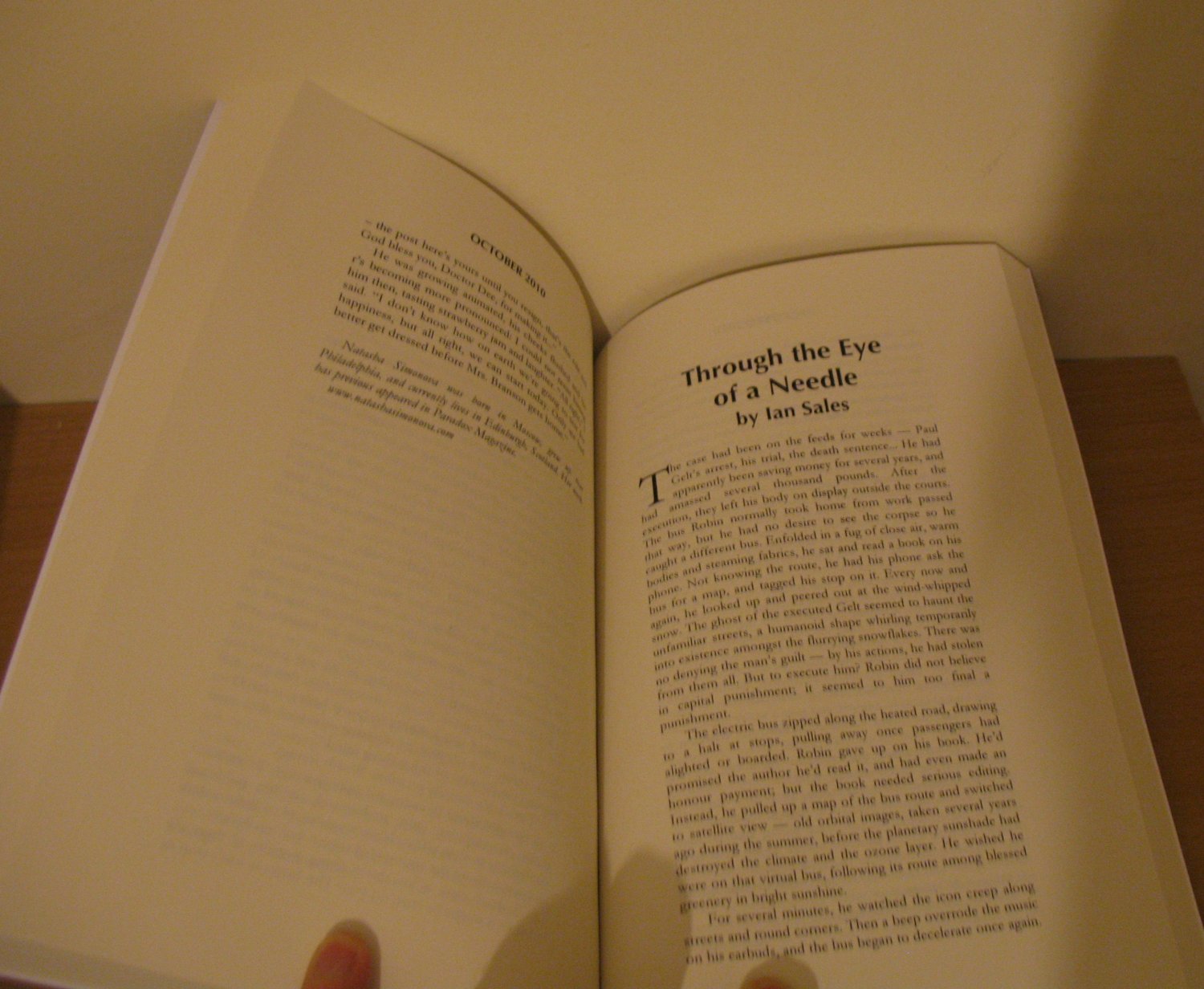

 by Rosemary Kirstein. It was in the last year or so, although the book was originally published in 1989. I do know that it’s not well known in the UK. But whenever, and whatever, I read about it, I decided it might appeal, and so determined to keep my eyes open for a copy. Which I found several months later in a local charity shop.
 ).

 , which opens up its story’s universe in a series of appendices and so becomes almost a space opera; or even the hints dropped regarding the Age of Legends in Robert Jordan’s bloated Wheel of Time series.
 ,
 and
 . All four are available in an omnibus volume,
 . I shall have get me that omnibus volume. (Edit: apparently the omnibus only contains the first two books. Ah well. I shall try to find all three books, then…)
 , Paolo Bacigalupi (Orbit)
 , Lauren Beukes (Angry Robot)
 , Ken MacLeod (Orbit)
 , Ian McDonald (Gollancz)
 , Tricia Sullivan (Orbit)
 , a much more substantial work – in fact, the posts above would likely have been no more than a single essay in that book.
 , Francis Spufford (Faber and Faber)

