
I think this was a reread but I couldn’t swear to it. I think I’ve seen the film adaptation (some stills from which are on the back cover of the paperback edition I read) but I couldn’t swear to it. I certainly know the basics of the story – and if I didn’t get them from the book or the film, then… who, er, knows?
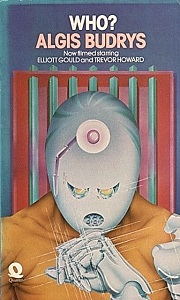
The basics of Who? (1958, USA) are: an important US scientist is blown up in his laboratory in Europe, the Russians get there first and spirit away the heavily-injured scientist and rebuild him, so to speak – robotic arm, new head which is a featureless ovoid with electronic eyes and mechanical mouth. The US (or rather, the Allied Nations Government) demands him back, the Soviets oblige. But is the scientist they returned really the one who was nearly killed in the explosion? This is important because he was working on “K-Eighty-eight”, some sort of vitally important defence project which is never explained (but, to be honest, never really needs to be, and I suppose we should be grateful Budrys chose not to).
Is robot-head Martino the real Martino? The ANG needs to know before putting him back to work on K-Eighty-eight, which is annoyingly never written as K-88. They somewhat reluctantly decide they cannot confirm his identity, so they let him go home to New York and keep a careful eye on him to see if he behaves as the real Martino would have done.
It occurred to me as I read the novel that it would be relatively straightforward to confirm Martino’s identity, especially in a sf novel set in the 1990s (I think; Martino attends university in the late 1960s), even though written in the 1950s. After all, DNA had been discovered decades before Budrys wrote Who?. Surprisingly, it wasn’t known it could be used to uniquely identify an individual until 1984. It’s so ubiquitous now that feels wrong. But there you go.
So, no face. Fingerprints can be faked. (So can faces, for that matter.) Is metalhead Martino a ringer? Once loose in New York, he behaves exactly as the real Martino would do – which the reader knows thanks to alternating flashback chapters covering Martino’s life. Of course, a well-trained replacement would also behave exactly as the real Martino would do. A real puzzler.
Budrys dangles “he’s a fake!” before the reader, then sets up a plausible fake, but soon lets the cat out of the bag. According to my paperback copy, Who? is “one of the classic giants among science-fiction novels – and among spy thrillers too”, and it was nominated for the Hugo Award. But I think it fails as both. It’s no le Carré, and even when it tries for ambiguity, it bottles it. The world-building is perfunctory and unconvincing – the West has formed the Allied Nations Government (hello! the Treaty of Rome was 1957!); the Russians and Chinese and all those other countries in between are now Soviet. Technology has apparently stagnated, other than the tech required to rebuild Martino. The New York of is-it-really-Martino is pretty much the same as that of the real Martino in his twenties.
I think they call novels like this “high concept” – ie, a neat idea you can encapsulate in a handful of words, but everything else is either slapdash or badly done. Who? is neither good nor interesting- Its conceit is interesting, but nothing else between the covers of the book is.
(At one point, Martino takes his girlfriend to the cinema to see a film. They leave when they reach the point in the movie when they entered. That was how people used to go to the cinema: they’d enter the auditorium, no matter when the film had started, sit down and watch it through to the end, then stay to see the part they’d missed. It was Hitchcock’s Psycho (1960, USA) which changed that. He didn’t want to spoil the surprise of Janet Leigh’s murder, so he insisted people were only allowed to watch the film from the start, and cinemas would lock the auditorium doors to prevent people from entering after the movie had begun. It changed the way people visited the cinema.)


2026-07-04 at 13:13
Part of the problem in the novel that would make the DNA identification a problem (but which the characters acknowledge) is that not only do they need to figure out if X is Martino, but they also need to be sure that even if he’s Martino, he hasn’t been turned by the enemy – and without the usual physiological signs of truth-telling (pulse, pupil dilation, etc.), that’s difficult.