
I’m reading this series in order of internal chronology rather than publication order, which no doubt affects my responses to the books. Although the seventh book published in the Vorkosigan series, Barryar (1991, USA) follows on directly from Bujold’s debut novel, Shards of Honor (1986, USA). I read both in the omnibus Cordelia’s Honor (1996, USA; it also includes a short story, ‘Aftermath’). I was impressed Bujold had picked up a narrative from five years previously and continued it so seamlessly… until I read the afterword in Cordelia’s Honor and learnt Shards of Honor and Barrayar were originally written as a single novel, and then split. And now I wonder why it took five years for the second part to appear…
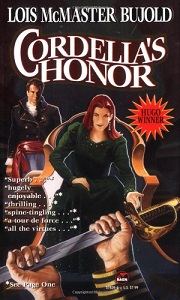
In Shards of Honor, Cordelia Naismith, a Survey captain from Beta Colony, encounters Aral Vorkosigan, a military officer and aristocrat from the Russian-derived martial world of Barrayar. His reputation is not good but, of course, (mostly) undeserved. After various ups and downs – war, invasion, torture, that sort of thing – they marry. Barrayar opens with Cordelia trying to adjust to life on the titular planet with her new husband.
Vorkosigan retired from his military career but is asked to become regent for the five-year-old grandson of the emperor when the mortally-ill emperor dies. He accepts. He is not a popular choice. To make matters worse, Cordelia is pregnant but the foetus is damaged by an assassination attempt using a poisonous gas grenade. She persuades the Barrayans to implant the foetus into a Betan “uterine replicator” in order to better manage its development, but this causes a rift with her father-in-law.
Civil war kicks off, one faction supporting Vorkosigan, the other supposedly acting in the interests of the dead emperor’s daughter. The latter get hold of the uterine replicator, and Cordelia sets off on a rescue mission, without her husband’s knowledge. She succeeds, partly through luck, but mostly because she does not behave as Barrayarans expect women to behave – something she demonstrates throughout the novel. Which brings to mind, yes, the shopping scene…
I’m almost one hundred percent sure I’ve never read Barrayar before, but the shopping scene felt like I was rereading it. Perhaps an excerpt appeared in an anthology or magazine. All the same, it was fun.
There’s a big difference between Shards of Honor and Barrayar, even if there’s almost none in story terms. The latter is so much more polished: the backgrounds, especially Barrayar, are better grounded, and while you have to wonder why it took an additional five years for Barrayar to see print, it was clearly worth the wait. The story focus in Barrayar is also much clearer. While it’s effectively an origin story for Miles Vorkosigan, chief protagonist of much of the series, the novel is about Barrayar, about a woman who not only does not fit the mould when it comes to women on Barrayar but also breaks it wide open, and about her response to her new life and the trials it throws at her. It’s about women in Bujold’s space opera universe.
Of course, both books were originally published in the late 1980s/early 1990s, and space opera – US space opera – has changed a lot since then. At that time, New British Space Opera was still, well, British, and had not been appropriated and distorted by US science fiction. The Vorkosigan series, for much of its length, was in a mode of US science fiction that was often identified as either space opera or military sf, as the two subgenres were often indistinguishable in US science fictions. Barrayar does in fact read like military sf – much of the plot is set during a civil war, after all – but it’s only one instalment in a series containing over twenty books. And an early instalment, too. Certainly, Barrayar strengthens my resolve to read the full series, when the two books preceding it did not.

