
(This is another review first posted on Facebook.)
I used to own a copy of this, so I know I must have read it sometime in the 1980s, probably the first half of the decade, and no doubt prompted by having read Niven’s Protector (1973, USA) and Ringworld (1970, USA), both of which I remembered reasonably fondly until rereading them this century. Which doesn’t exactly explain why I bothered to reread Tales of Known Space (1975, USA), given I’ve known for a long time what Niven, er, and his fiction, is like.
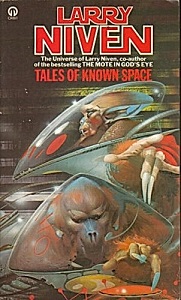
On the other hand, I like future histories, and Niven’s is a good example. It wasn’t until he was a few years into his career that he decided to fit his stories into a single timeline, from 1975 through to 3100 (at the time of Tales of Known Space’s publication in 1975). As a result, there are inconsistencies, such as the planet Mount Lookitthat, the setting of the novel A Gift from Earth (1968, USA), being occasionally referred to as Plateau.
Tales of Known Space is a collection of stories, set during the centuries covered by Niven’s future history (and also handily shown in a timeline chart after the table of contents). And speaking of contents… I must have purged some of these stories from my memory because, well, wow… One is the most homophobic genre story it has ever been my misfortune to read: first settlement on Mars is all male, some of the men “turn queer”, one is beaten to death when he flirts with a homophobe, homophobe flees in a Mars buggy, but does not survive, leader of mission writes report explaining why all-male colonies are a Bad Thing.
It doesn’t help that Niven’s early stories get the planets of the Solar System entirely wrong – Mercury does not rotate, Mars does not have a nitrous oxide atmosphere (the secretive Martians are forgivable, but not the noxious atmosphere). Later stories are set after humanity has encountered several alien races, but even then relations between the races are implausibly easy. The Kzin, Niven’s most popular creation – giant alien warrior cats!, go figure – may have been hostile from the start, but they’re so easily defeated, despite their advanced technology, it makes them a joke.
The stories generally make a lot of their scientific credibility, throwing out terms and concepts that would not look out of place in a hard sf story, but even back in the 1960s and 1970s Niven would have got more right if he’d actually bothered to do any real research. I think he tried, I think he didn’t understand everything he researched, and I think he didn’t let his imperfect understanding of his research get in the way of drama – and today, in the 21st century, we would hold writers to a much high standard because research has become so much easier (right-wing misinformation and lies notwithstanding).
I quite like the idea of Niven’s future history, even if the individual instalments are actually pretty bad. Niven has never been a great writer – he’s a fan of “transparent prose”, he may even have originated the phrase – and the stories in this collection vary from bad to mediocre. It includes a single Beowulf Shaeffer story, and yet hints at many much more interesting ones. The whole organ bank concept is offensive, and ‘Intent to Deceive’ reads like a right-wing wank fantasy. ‘Cloak of Anarchy’ at least reads like a sensible commentary on libertarianism, but calls it anarchy…
Even as an historical document, this collection is best avoided. Reading it will add nothing to a reader’s appreciation of the history of the genre. It should certainly never be read for enjoyment in 2024. I believe Larry Niven is still in print. I have no idea why.

