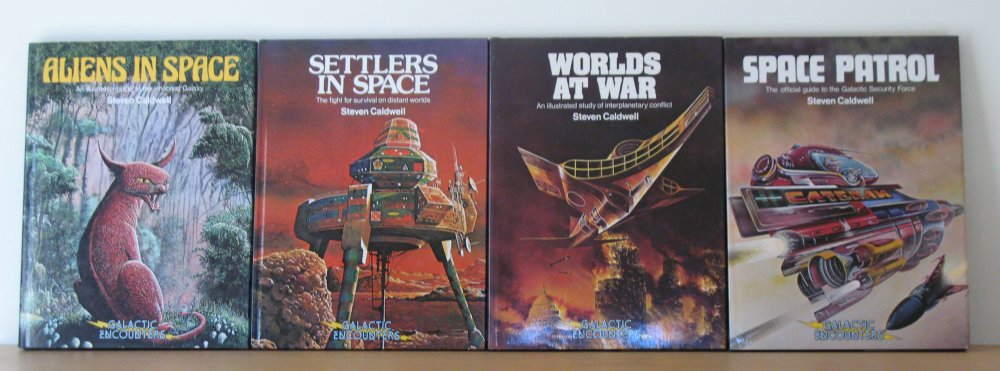
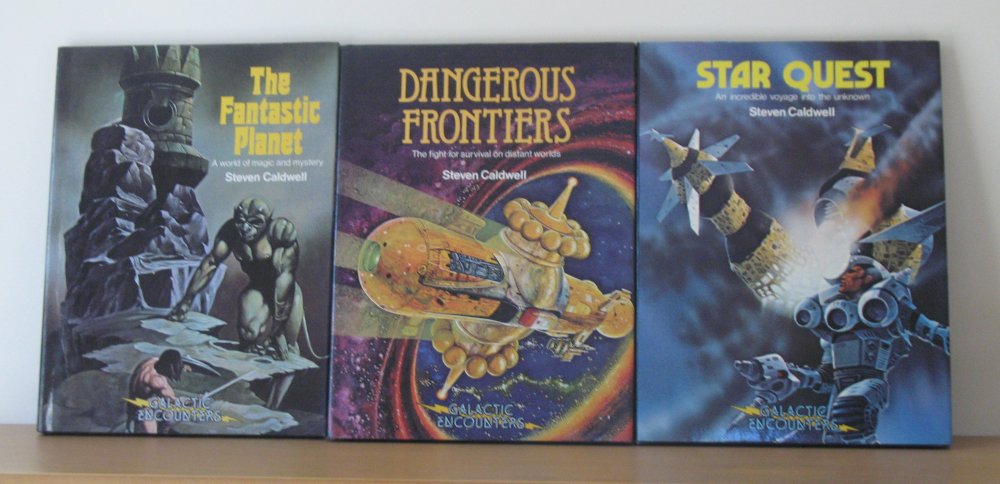
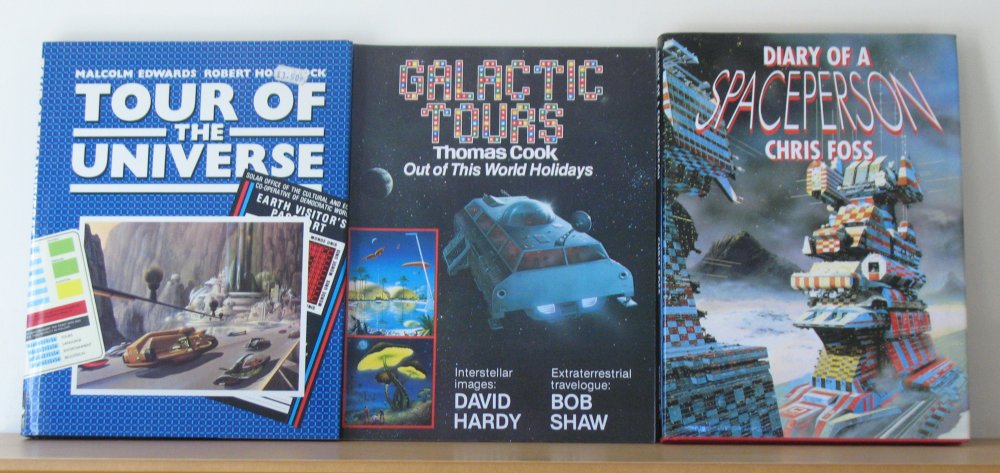
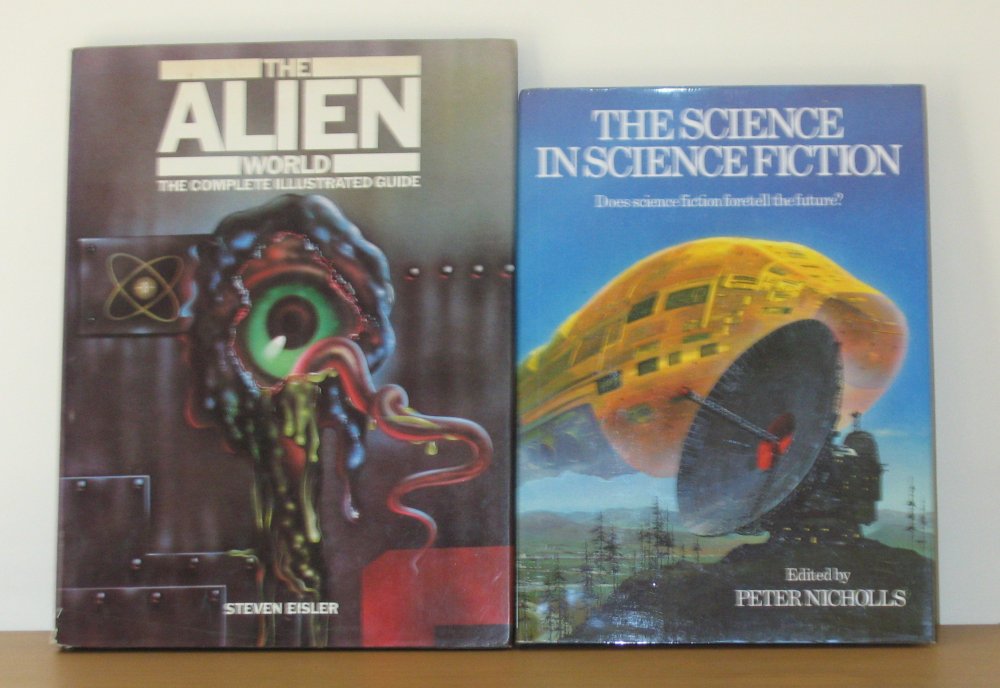
Back in the late 1970s and early 1980s, several publishers brought out colourful coffee-table sf books. Usually, they were filled with cover-art from sf novels, around which someone had written some text to tie the pictures together. Stewart Cowley’s Terran Trade Authority is probably the best-remembered example. I used to buy them whenever I saw them – often from book discount shops.
Finally, a few years ago Morrigan Press produced a RPG based on the Terran Trade Authority. Morrigan Press seem to be now defunct, and the books are out of print.
This is the final post detailing the books I read and the films I watched during 2011. I don’t think I’ll bother doing these in 2012 as I suspect I’m stretching myself a bit thin with them. They’re also a bit long, which probably puts some people off reading them. Perhaps I’ll just blog about individual books or films I consider worthy of recommendation on an ad hoc basis. What do people think?
For the time-being anyway, here it is, the culture (and I use the term loosely) I consumed right up until the 31 December 2011…
Books Time to Live, John Rackham (1966) / The Man Without a Planet, Lin Carter (1966), was an Ace double I picked up at a convention chiefly, I seem to recall, because Rackham was a British sf writer of the 1960s and 1970s I’d not read. (Though he also wrote as John T Phillifent, his real name, and I think I’ve read one of his books published under that name.) And so… Well, it’s hackwork right from the first page. Time to Live opens with an amnesiac protagonist, and the entire story feels like it was made up as Rackham wrote it. The amnesiac is wanted for murder, but he didn’t commit it, of course. And the native race on the planet on which this takes place are all preternaturally good-looking, have psychic powers, are near-immortal, and have willingly turned their backs on high technology. The native woman who rescues the amnesiac when his car crashes quickly realises he is innocent and later falls in love with him. Of course. This is not a book that will ever make the British SF Masterworks list. Lin Carter, on the other hand, was not a Brit, and he also seems to have made a career from writing pastiches of sf and fantasy from an earlier age. His Callisto books, for example, take off Edgar Rice Burrough’s Barsoom stories, and his Thongor is Conan in all but name. The Man Without a Planet belongs to Carter’s History of the Great Imperium trilogy, and it’s real swords & spaceships stuff. The protagonist is a naval hero who returns to his home world but doesn’t like what he finds there. He is reluctantly pushed into the arms of a displaced empress who wants her planet back. It’s all stupid cod mediaeval dialogue and most of the cast wearing next to nothing as manly men battle to protect feisty females and ensure that what is right prevails. I have to wonder how many readers lapped it up and didn’t realise Carter was taking the piss.
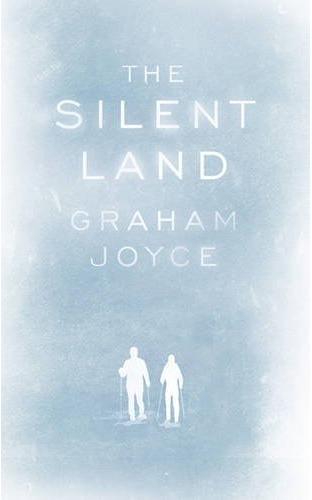
The Silent Land, Graham Joyce (2010), is likely to end up on a few short-lists this year was on several short-lists last year, though I ultimately found it an unsatisfactory read. A young couple are on a skiing holiday and get caught in an avalanche. They manage to rescue themselves, but when they return to the village where they’re staying, they find it deserted. Certain things don’t seem quite as they should, or as they remember them – candles don’t burn down, meat doesn’t go off, things don’t taste as they ought… and whenever they try to leave the village they find themselves circling back to it. The couple and their relationship are drawn exceedingly well, but most readers will probably figure out what’s going about halfway through, and it’s the lack of a final unexpected twist that left me slightly disappointed. Otherwise, a book definitely worth reading.
The Nemesis from Terra, Leigh Brackett (1951), was originally published in Startling Stories in 1944 as Shadow Over Mars, and that earlier title strikes me as the better of the two. Much as I like Brackett’s Mars stories, I don’t think this is one of her better ones. It’s pretty much a Western set on the Red Planet. Take away the mention of Mars’ ancient civilisations – and the trip to the Thinker’s dome at the pole, which adds little – and it’s not even science fiction. Most of the dialogue reads like Brackett was trying it out for her movie scripts, and the story is predictable from start to finish. Disappointing.
The Last Battle, CS Lewis (1956), is the final book of the Chronicles of Narnia. I can now cross them off the list. The battle of the title is the great battle for Narnia… Er, well, no: it’s not actually a “great” battle at all. There are less than a hundred on each side. A Talking Ape finds a dead lion and persuades his somewhat dim Donkey companion to dress up in its skin and pretend to be Aslan. Of course, everyone is taken in by the disguise – so much so that the King of Narnia is very surprised when he learns someone is chopping down the dyads’ trees. That someone proves to be Talking Animals in thrall to a group of Calormene. Who are, of course, smelly and evil and foreign. But then Eustace and Jill appear and help the king discover what’s really going on. Then a few more Pevensies turn up and there’s a small battle and Aslan turns up and Narnia gets rolled up and everyone ends up in a walled garden which has the whole world inside it including friends and loved ones who have died even those back in the real world because it’s really Heaven and if everyone is jolly nice then that’s where they’ll end up when they die. So there.
Solaris Rising, Ian Whates (2011), I reviewed for SFF Chronicles here. It’s a good showcase of contemporary science fiction, and Whates lets the stories speak for themselves.
The Witches Of Karres, James H Schmitz (1966), was short-listed for the Hugo Award in 1967, and appeared in three Locus All Time Best (SF) Novel polls. It was originally published in 1949 as a novelette, but expanded to novel-length in 1966. It is also shit. In fact, looking at that 1967 short-list, there’s perfect reason to be embarrassed at the poor taste frequently shown by the Hugo voters. That short-list included Babel-17 and Flowers For Algernon, both very good sf novels, but instead they gave it to… The Moon is a Harsh Mistress. But The Witches Of Karres… Captain Pausert is a humorously incompetent space captain, trying to make a living and prove a point by operating a merchant starship. He inadvertently finds himself buying three slaves, all young girls whose owners are more than glad to get rid of them. That’s because the girls are witches from Karres. Which means they have mental powers. Sort of. Among which is the “Sheewash Drive”, a super-fast star drive powered by the three of them. Everyone else wants this magical drive, but Pausert – with much help from the witches – manages to prevent them from getting it. And, as a result, he becomes embroiled in a plot to save the galaxy from some worm-like aliens from an alternate dimension. The writing is bad, the world-building is bad, and the science fiction is bad. At one point, Pausert’s ship detects another “just ahead, some nine light years away”. That’s 85 trillion kilometres. People writing this sort of crap sf seem to think space is no bigger than the Atlantic ocean. The Witches Of Karres is a definite contender for Shittest Book To Be Short-Listed For A Hugo Award, a list which, it must be said, is far far longer than it should be.
Blood Count, Robert Goddard (2011), is the latest of Goddard’s potboilers, which, for some reason, I continue to read. His books are the sort which win the WH Smith “Thumping Good Read” Award, and I generally prefer fiction with somewhat higher aspirations. But never mind. There’s no point looking in Goddard’s novels for deep meaning, wonderful prose or profound insight. Instead, you get an everyman made victim to a conspiracy and which he must puzzle out to save himself. In Blood Count, the protagonist is a surgeon who performed a liver transplant on a Serbian warlord. Years later, the warlord is under trial at the International Court of Justice. The warlord’s daughter blackmails the surgeon into approaching the warlord’s ex-accountant who has control of the family’s ill-gotten gains. But it’s all a plot within a plot within a plot, and people get murdered and the warlord escapes and… Goddard’s books are fast mostly entertaining reads, and this one, I have to admit, was one of his better ones.
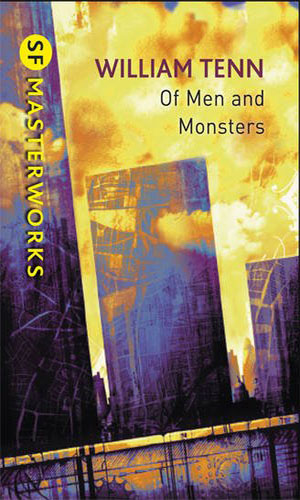
Of Men and Monsters, William Tenn (1968). The Earth has been conquered and the remains of humanity now live like rats in the walls of the giant aliens’ dwellings. Eric the Only is a hunter in the forward-burrow tribe that calls itself Humanity. It’s his job to leave the tunnels and fetch alien food or artefacts – or, at least, small enough such things that he can carry them. It’s a conceit that doesn’t quite stand up to scrutiny – aliens so large aren’t that plausible, nor is a human civilisation surviving as household pests. Still, Of Men and Monsters is a neat little fable and an easy read. I’m not entirely sure whether it’s a bona fide SF Masterwork, though there are certainly worse books already in the series.
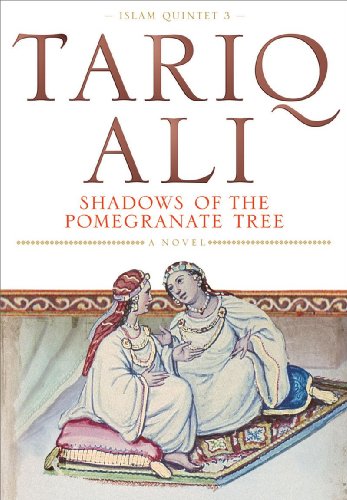
Shadows Of The Pomegranate Tree, Tariq Ali (1992), is the first book of the Islam Quintet, and opens in 1500 CE in Moorish Spain. The Catholic Spaniards reconquered Granada eight years previously but now a new archbishop has arrived and is determined to stamp out Islam. This is in direct contravention of the treaty signed between the Moors and the Castilian king and queen. But never mind. I mean, he’s doing it for God, so that’s all right isn’t it? That makes it okay to kill women and children, to burn books, to forbid the Moors from speaking Arabic or wearing their customary dress, to steal their lands from them, to torture them into confessing crimes/sins they have not committed… The story is told from the viewpoint of a single Muslim family, and it’s strong stuff. Ali’s frequently inelegant prose often works against the story, but never mind. I shall probably read the rest of the quintet, though I won’t be dashing out immediately to buy them.
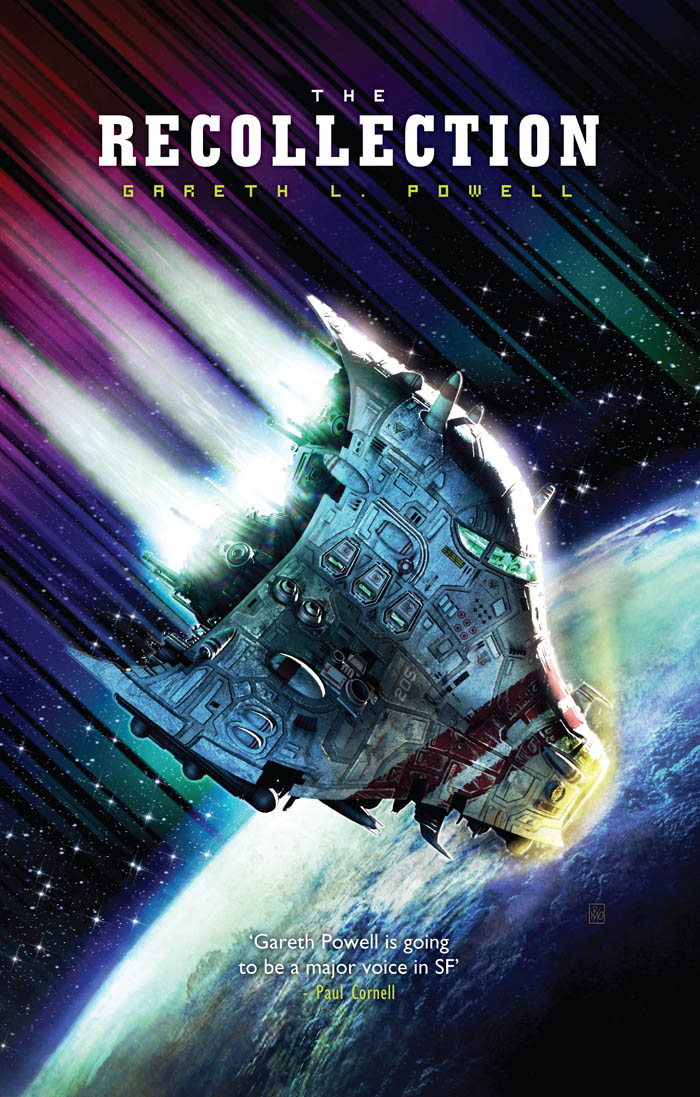
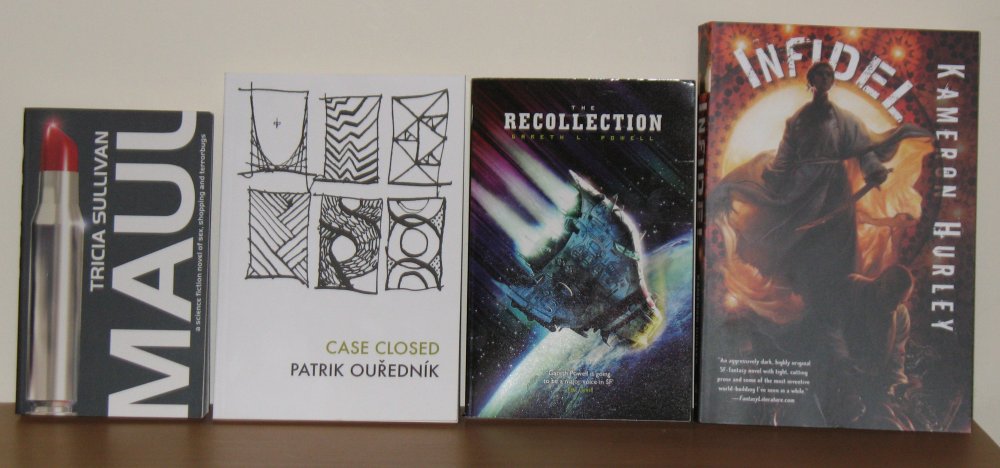
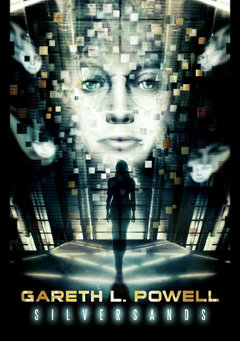
The Recollection, Gareth L Powell (2011), was my final book of 2011. There’s a lot in The Recollection that’s typical, if not characteristic, of contemporary British commercial sf. It opens in the near-future, when strange arches appear throughout the world. Ed Rico’s brother, Verne, disappears into one such arch in a London Underground station, and Ed vows to find and rescue him. Meanwhile, four centuries hence, trader starship captain and black sheep Kat Abdulov has been welcomed back into the bosom of her powerful family because only she is in a position to beat a rival trader to the centennial Pep harvest on the world of Djatt. Throw in an enigmatic alien race inhabiting a vast slower-than-light starship, and the Bubble Belt, a mysterious BDO comprising millions of small habitats orbiting the Gnarl, an unknown energy source. And then there’s the eponymous Recollection itself, a “cloud” which devours everything in its path as it travels throughout the galaxy. I’d initially thought Powell was trying for Light territory with his two plot-threads separated by centuries, but the two tied up far too neatly for that. And besides, Kat’s space opera future was a little too generic for my taste, and the introduction of the Recollection then saw the book drift into Peter F Hamilton-esque sf. If The Recollection is a mélange of contemporary UK sf tropes and concerns, it’s a well put-together one. It did promise more in its early pages than it managed to deliver, but nonetheless a lot of people will find much to like in it.
Films Star Trek: The Next Generation season five (1991) sees the USS Blanderprise continue in its ongoing mission to bring insipid sf to the masses – or to its fanbase, at least. As in previous seasons, the episodes all blur into the televisual equivalent of beige, with no real episodes standing out – not even the double-parter in which Spock contacts the Romulan underground because they want to reunite with the Vulcans. On the other hand, there are a number of embarrassingly bad ones. ‘The Outcast’, in which Riker falls in love with a member of a single-sexed race… though the story still manages to impose binary gender sensibilities on the neuter aliens. Or ‘I, Borg’, in which emotional attachment is seen as a perfectly valid reason not to commit genocide. Much of the writing in the series remains poor and ill thought-out. Ethics and morality take a back seat to story needs, and there’s often little consistency between the various ethical and/or political stances taken by the characters or various institutions from episode to episode. But that, I think, is a failing of all the Trek franchises, and may well be a result of US television’s habit of writing by committee.
Rosebud, Otto Preminger (1975), is a strange film. It’s a mostly forgettable euro-thriller, despite its director, albeit with a star-studded cast. Peter O’Toole plays a Brit ex-CIA agent currently working as a stringer in Rome. When the daughters of three European plutocrats are kidnapped by Palestinian terrorists, he is employed to get them back in one piece. The girls are played by Lalla Ward, Isabelle Huppert and Kim Cattrall. The villain of the piece is Richard Attenborough, as an ex-SAS man convert to Islam. It’s all played very flat and affectless, and so despite its cosmopolitanism it seems bizarrely charmless.
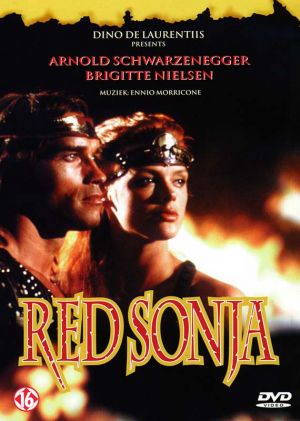
Red Sonja, Richard Fleischer (1985), may well be the best high fantasy film ever made. When Sonja – who doesn’t actually do anything during the film to earn the sobriquet “red”, though she does have improbably red hair – comes to beside the smoking ruins of her parents’ house, a ghostly creature helpfully explains to her in voice-over exactly what she has just experienced. Which Red Sonja already knows, of course, but the film has to get the story across to the viewer. It makes “As you know, Bob” dialogue look positively sophisticated. Then there’s Red Sonja herself, played by Brigitte Nielsen, who actually resembles a skinny boy with a bad mullet for much of the film. And the villainess lives in the Land of Perpetual Night, though it’s often daytime there. Not to mention that Red Sonja is allegedly a superlative sword-fighter – and is shown as such early in the film – but seems incapable of winning a duel against a man and must always be helped out by Arnold Schwarzenegger’s character. Though Red Sonja does insist no man “can have her” unless he defeats her in a sword-fight – so the only man she manages to hold off with a sword is Schwarzenegger, as he wants to get into her chainmail pants. The climax of the film sees the world falling to pieces but the villainess of course insists on hanging onto the magical device causing the destruction because, well, because with it she can rule the world. Even, er, if there isn’t one left. Red Sonja is a gloriously inept sword & sorcery movie, which appears to have been written by a pair of drunks. Admittedly, the production design leaves a bit to be desired – the makers could have had so much more fun, but perhaps they reined it in for a PG certificate…
The Valley of the Bees, František Vláčil (1968), is a Czech film about the Teutonic knights, and for much of its length I thought it a little dull. Having said that, it presents a complex moral landscape, and so proved itself so much more satisfying than the likes of Star Trek: The Next Generation season five. The film is black and white throughout and evokes its period well, but it’s also very slow. It’s been a few weeks since I watched it, and I can remember little about it. Having said that, I’d rather be bored by a film like The Valley of the Bees than have my intelligence beaten into submission by your typical Hollywood blockbuster…
The Man with the Golden Arm, Otto Preminger (1955), scored Frank Sinatra an Oscar nomination for the title role, though he lost out to Ernest Borgnine in Marty. That may well be because The Man with the Golden Arm deals with heroine addiction. Sinatra plays a small time crook who has just come out of rehab and dreams of being a drummer with a big band. But he soon picks up his drug habit again and his life duly falls to pieces. For all its plaudits, I found the film slow and not especially involving. Sinatra’s character is too self-centred to sympathise with, and the general dour tone of the story could only really appeal to masochists. Given that I disliked Kerouac’s On the Road when I read it, then it’s no real surprise that I didn’t enjoy The Man with the Golden Arm.
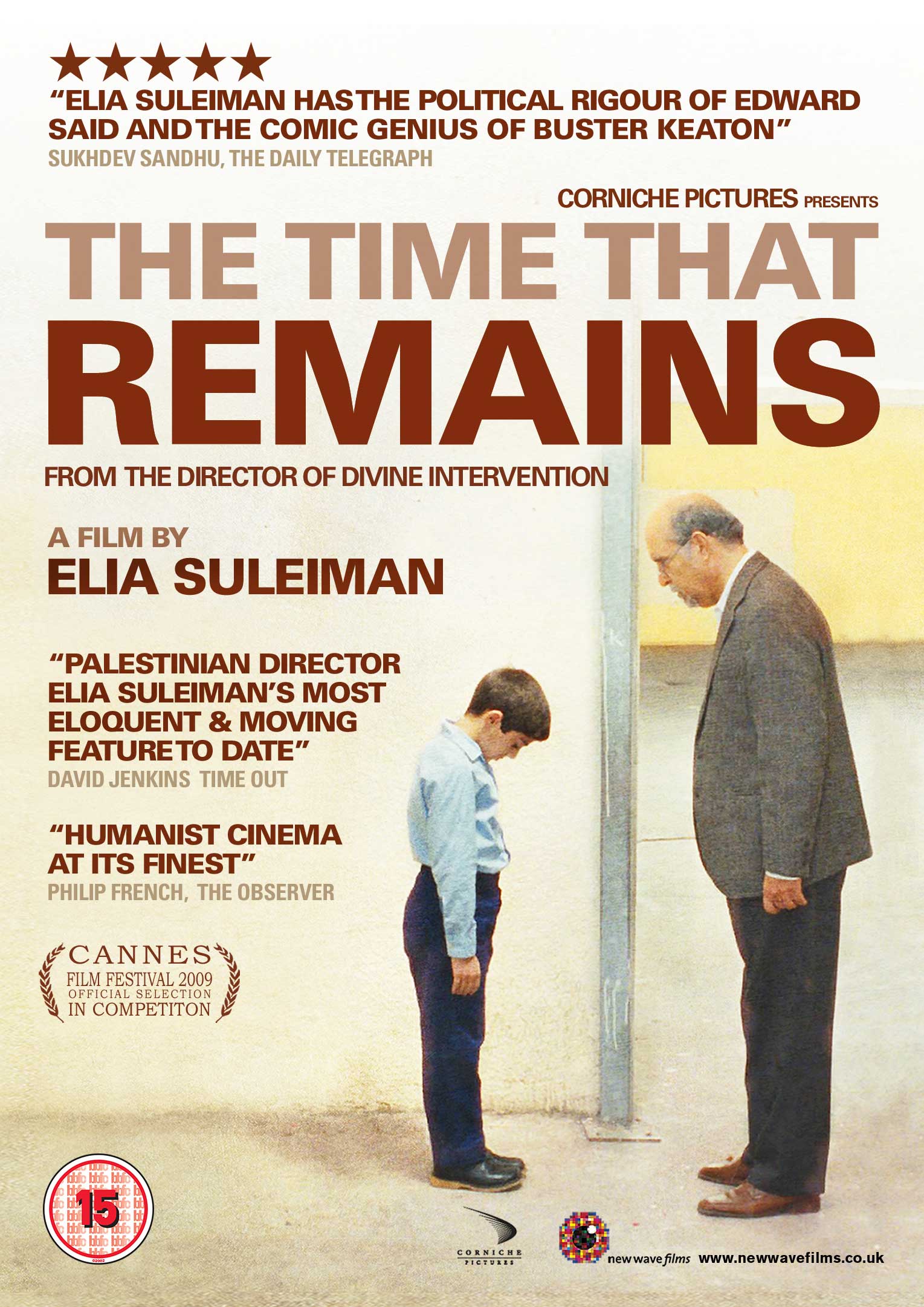
The Time that Remains, Elia Suleiman (2009), I picked as one of the best films I watched in 2011, which is no real surprise as I count Suleiman as one of my favourite directors. He’s only made three feature-length films, and all three deal with Palestine / Israel in more or less the same fashion. They’re a commentary on the Occupation, built up from vignettes, some of which are taken from Suleiman’s own life. The Time that Remains is mostly the story of Suleiman’s father, and opens in 1948 with the Israeli invasion of territory mandated to the Palestinians. It continues through the decades to the present day, where Suleiman appears as himself. There are some excellent scenes, displaying some very funny black humour and an overall sense of very Arabic fatalism that only makes the story even more poignant. Highly recommended.
Sanctum, Alister Grierson (2011), I bought because it’s about an expedition to explore some underwater caves and I thought it might appeal. And it did. A little. Unfortunately, in amongst all the excellent photography of the underwater caves was a dumb father-son story filled with macho bullshit from start to finish. Manly explorer has neglected his son and thinks little of him. But they all get trapped deep underground when a monsoon hits, and must escape by following an underground river through a (astonishingly-filmed) flooded cave system. Son duly proves his manliness to father, who dies a happy man as his thrusting virility will now continue for another generation. This is probably a film best watched with the volume turned off.
Inception, Christopher Nolan (2010), I finally got around to watching a year after everyone else and… Well, there are some astonishing visuals, but the logic of the story doesn’t parse. There’s this Mission: Impossible-type team, led by Leonardo di Caprio, and what they do is invade people’s dreams to try and ferret out their secrets. But they can also do the opposite, though it is considered near-impossible: they can plant ideas in people’s heads in their dreams. This is known as an “inception”. To ensure the implanted idea takes in the head of their victim, the team play a shell-game, using dreams within dreams within dreams. But it all goes a bit wrong and di Caprio and victim end up in “limbo”, a dreamworld from which people rarely return (and in which years might pass in a matter of minutes). Given that di Caprio has only agreed to such a risky venture in order to be able to return to his family in the US, naturally everything in the film in some way links back to said family. And it’s implied at the end of Inception that what the viewer has been led to believe is actually just another layer of dream – and this is suggested by a token di Caprio uses to remind himself he’s dreaming. Except, of course, when he used it before it worked fine and did exactly that. There’s a sense throughout Inception that the film wants to have its cake and eat it. It pushes so hard to confuse reality and dream that it only ends up confusing itself.
The Colour of Pomegranates, Sergei Parajanov (1968), is on the BFI’s Top 100 films list, which is why I rented it. And… I like the idea of “poetic cinema”, and I’m a big fan of Andrei Tarkovsky… but The Colour of Pomegranates really is a very odd and slow and chiefly plot-less movie. You can’t watch it as you would other films, much as it’s impossible to watch and enjoy a film by Alejandro Jodorowsky while sober. The Colour of Pomegranates sort of tells the story of the life of Sayat Nova, a famous mediaeval Armenian poet. It does this not by dramatising scenes from his life, but by representing them through moving tableaux. They are beautifully staged and shot, but it’s difficult to decide what they’re actually telling you unless you’re familiar with Sayat Nova’s life. Which I’m not. I’m almost certain The Colour of Pomegranates is a film which needs to be watched a number of times. So I suppose I’ll have to go and buy a copy for myself…
Never Let Me Go, Mark Romanek (2010), is an adaptation of the novel by Kazuo Ishiguro, which I read back in 2009. The problem with the book, which you manage to avoid thinking about for much of its length because of Ishiguro’s exploration of his characters, is that the story is predicated on a monstrous practice: human beings are grown specifically to be organ donors to “real” people. The moral implications of this, the fact such a practice would seem to be accepted by the population at large, is largely ignored by the novel, though by showing that the donors are entirely human Ishiguro is making oblique commentary. The film, unfortunately, can’t ignore its world’s central conceit though it tries to do so. The final confrontation between Kathy, Tommy, Ruth and Miss Emily fails to show how evil the world of the story is. There’s some wishy-washy mention of souls, but it’s not even a serious attempt at justification. Nor is “it was worse before and we can’t go back to that” any kind of rationale. The problem with the film – which, it must be said, is pretty faithful to the book – is that it not only fails to comment on the practice of raising humans to act merely as donors, presenting the practice as normal and acceptable, but it also fails to present enough to hooks to trigger outrage. This is not helped by the use of flat washed-out colours or low-key performances by the cast – if anything, these make the film appear more like a comment on the grimness of earlier decades than on the actual world of the story. It’s a bit like the way thrillers and detective television shows have desensitised us to the reality of gruesomely murdered victims to the extent that the outrage the crime itself should engender becomes lost in intellectual satisfaction in the exploration of the murder’s techniques, the investigation, or the world of the story. Sometimes, the bad stuff needs to be put front and centre, if only to stress to people that it is indeed bad.
Far from Heaven, Todd Haynes (2002), is an attempt to “re-imagine” one of my favourite films, Douglas Sirk’s All That Heaven Allows. In Sirk’s masterpiece, a middle-class widow (Jane Wyman) enters into a relationship with her bohemian gardener (Rock Hudson) and is condemned by her friends and grown-up children for doing so. The film is beautifully played and shot, and makes a particular feature of its autumnal palette. In Far from Heaven, Haynes has taken that story and slapped on more, well, more stuff. The gardener is now black, which makes the relationship even more transgressive – except it’s not a relationship in Far from Heaven, the woman (Julianne Moore) is merely being friendly and polite with him. She’s not a widow either. And her husband (Dennis Quaid) has discovered that he is gay and is now having sex with other men. It’s all too much. The black gardener alone would have provided an interesting perspective on Sirk’s original, but to throw in a homosexual husband is over-egging the cake enormously. It dilutes the story’s focus. Haynes manages to recreate Sirk’s palette, and the production design throughout is evocative of the period. And yet… there seems to be something in Far from Heaven which reveals it is as a film set in the 1950s rather than a film shot in the 1950s. A valorous attempt, but it doesn’t quite win the cigar.
The Girl with the Dragon Tattoo, David Fincher (2011), I saw at the Kino Palæet in Lyngby, Denmark, over Christmas. Cinemas there are much more expensive than in the UK – a ticket cost Kr 100.00, which is just over £11. But then pretty much everything is more expensive in Denmark. But The Girl with the Dragon Tattoo… I’ve not read the book, but I have seen the original Swedish film adaptation starring Michael Nyqvist and Noomi Rapace, and directed by Niels Arden Oplev. The US remake, of course, stars Daniel Craig and Rooney Mara, and is directed by David Fincher. There’s little need to rehash the plot as I suspect everyone knows it. From what I remember of the Swedish film, Fincher’s version is broadly similar though better-paced, though I’ve no idea how faithful either were to the book. I don’t recall Salander going abroad and emptying Wennerström’s offshore bank accounts from Oplev’s version but that may just be faulty memory on my part. I do recall the rape scene being more brutal than it is in Fincher’s, however. And I seem to remember Rapace was presented as a more convincing hacker than Mara, though the latter is good in the role. Otherwise, Fincher plays the story straight, with little in the way of frills, though the climax turns brutal in a way that hints at Se7en. Craig is more of an action-man type than Nyqvist but still manages to convince as a journalist, though the relationship between Nyqvist and Salander never seems entirely plausible. After watching both films, I suspect I shall have to finally succumb and read the damn book. Happily, copies are readily available for much cheapness in charity shops throughout the UK…
Star Trek: Deep Space Nine season seven (1998), is the end of the franchise, and the first Trek franchise I have watched all the way to the final episode. Though Deep Space Nine had its cringe-worthy episodes – and the Ferengi should have been quietly forgotten after being introduced in Star Trek: The Next Generation – I still think it had a more interesting cast and a more gripping story-arc than the rest of the stable. Having said that, I never understood the appeal of the holodeck episodes, and it’s toss-up as to which is less embarrassing: Next Gen’s Dixon Hill or DS9’s Vic Fontaine. Perhaps using Fontaine’s 1960s Las Vegas world as a way of allowing Nog to recover from the trauma of losing a leg showed a different approach to the usual Trek psychobabble, but it made the episodes feel like they were from a bad 1970s detective show. Likewise, the desperate desire to shoe-horn star villain Gul Dukat back into the story by making him some sort of dark messiah just felt like a narrative thread from an entirely different story. And then there were the Breen… In the final season, DS9 introduces a new super-technological race on the baddies’ side, but then decides it best to leave them mysterious. There are so many stories hiding in there, yet the writers blithely ignored them all. In fact, on reflection, the Breen added nothing to series’ story-arc. The season is not all bad, however. The wheels-within-wheels-within-wheels episode set on Romulus in which Bashir becomes an unwilling pawn of Section 31 was quite good. Damar’s gradual transformation from drunken lackey to rebel leader was played well, and even the Klingon political shenanigans managed to maintain my interest. Oh, and the replacement for Jadzia Dax, Ezri Dax was actually quite watchable initially. But then they blanded her out, and not even hot sex with Worf, or the bumbling screwball romance with Bashir, could make her interesting. But, as they say, all (good) things must come to an end, and Deep Space Nine sort of faded away rather than ending on anything that felt like closure. Yes, the various plot-threads were resolved, and everyone did their little speeches on what they were up to next, but it still felt like there should have been more episodes following. I’m also working my way through the Next Generation seasons (see above), but have yet to see anything that challenges the opinion that Deep Space Nine remains the best of the Trek franchises.
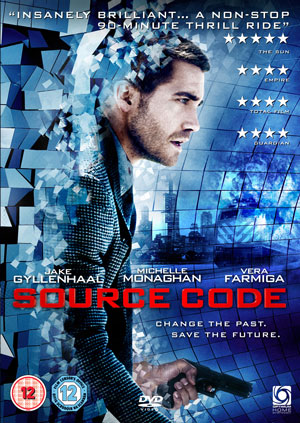
Source Code, Duncan Jones (2011), has at its core an intriguing premise, and manages to pull an action-packed 93 minutes from it. Jake Gyllenhaal is sent back in time to earlier that day into the body of a passenger on a train heading into Chicago. A bomb exploded on the train, and the bomber has a second bomb poised to inflict much greater damage within the city. Gyllenhaal has eight minutes to identify the bomber so that the authorities can prevent him setting off that second bomb. Each time Gyllenhaal fails, he is sent back to eight minutes prior to the train explosion. In between time-trips, it’s revealed he’s an Army helicopter pilot sent home injured from Afghanistan. Gyllenhaal’s visits are actually to an alternate timeline since he can’t prevent the train from blowing up in his timeline as it has already happened. Jones manages to get across a simplified version of the Many Worlds Hypothesis without confusing, or insulting the intelligence of, viewers. Personally, I was annoyed by the use of the term “source code” as the explanation for the name doesn’t fit the actual meaning of the term. All things considered, however, that’s a minor quibble. The fact that a helicopter pilot could disarm a bomb so quickly and easily is, however, more problematical. Unless, that is, you consider it a Hollywood convention. I could, of course, complain about the default Hollywood assumption that a time-travel project would be militarised, and that any benefits it might incur would be military. Not to mention the glorification of the military and its exploits. But why bother? Soldiers make for better heroes than scientists, and we know this because Hollywood has spent the last 100 years persuading us this is the case. If not all of us believe that, it must be because we’ve not been watching the right films…
Faces in the Crowd, Julien Magnat (2011), I watched for The Zone, and a review will appear there shortly.
The Ward, John Carpenter (2010), was another review copy for The Zone.
Christmas is over for another year, and life can now return to what passes for normal. Once again, I was in Denmark for the festivities, but this year it was wet and windy rather than the usual deep snow. There was a lot of eating involved, and a lot of walking. The day after Boxing Day, we went to see David Fincher’s The Girl with the Dragon Tattoo at the cinema (English with Danish subtitles, fortunately). Though I’ve not read the book, I have seen the Swedish version of the film. To be honest, I’m not sure which of the two versions is the better.
The flight back from Denmark was… interesting. On the approach to Manchester Airport, the plane was thrown around by turbulence and we almost touched down… before the captain decided to abort and up we went for another go around. Fortunately, the second attempt was much smoother and we landed in one piece. I first flew in 1968 and I’ve flown at least once a year since, and that was the first time I’ve ever been in an aircraft that took more than one attempt to land. Having said that, I’ve never been a big fan of air travel – and less so these days than I used to be. All that “security theatre” is just unnecessary palaver – how many terrorists has it actually caught? We certainly know it failed to catch two bombers… And while airlines seem to want us to believe that air travel has become easier and more convenient, the reverse is actually true. Also, budget airlines appear to hold their customers in complete contempt. They ask you to queue at the boarding-gate for an hour but don’t provide anywhere to sit. Aircraft are not buses – and given all the hoops passengers are forced to jump through before boarding at present, they never will be. The entire industry needs over-hauling.
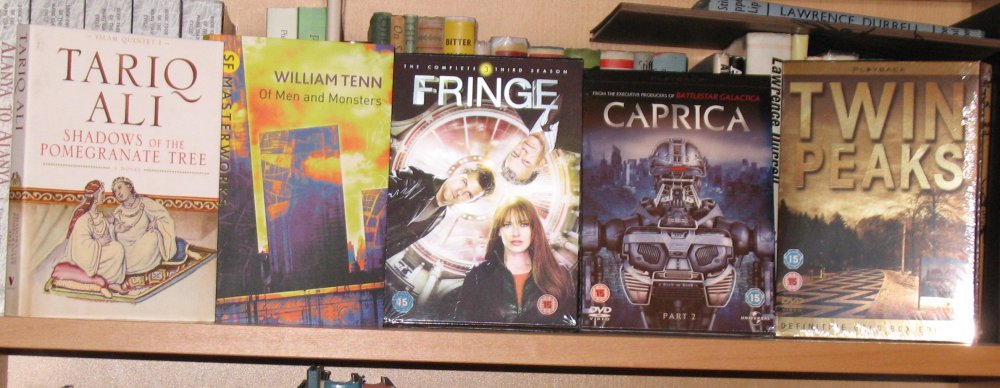
Santa brought me some books and some DVDs: William Tenn’s Of Men and Monsters and Tariq Ali’s Shadows Of The Pomegranate Tree, the first book of the Islam Quintet; and Twin Peaks: Definitive Gold Box Edition, Fringe Season 3 and Caprica Season 1 Volume 2. I read the two books before returning to the UK. Of Men and Monsters was better than I expected, though I’m in two minds whether it belongs in the SF Masterwork series. Shadows Of The Pomegranate Tree is set in Moorish Spain in 1500 CE, and chronicles the Spanish Catholics’ campaign to wipe out Islam and its practitioners on the peninsula. It’s strong stuff, though Ali’s frequently inelegant prose didn’t do the book any favours. I’ll probably read the rest of the Quintet at some point, but I’m not going to dash out and buy them immediately.
I’ll also read a number of books during the holiday – in fact, I was averaging one a day. The books were Engleby, Sebastian Faulks (2007), which was a definite improvement on the longeur-packed On Green Dolphin Street. A working-class scholar at Oxford University fancies a female student from afar, but one day she disappears and is never found. It’s not difficult to work out what happened to her, though it’s hard to tell if Faulks thought the reveal was an actual plot twist. The final third of the book is a character-study of the narrator, which not only means Engleby is not a murder-mystery novel but also means it’s unsatisfactory as either murder-mystery or literary fiction.
The Manual of Detection, Jedediah Berry (2009), I remember seeing an approving review of in the Guardian by Michael Moorcock when the book was published. As a result, I’ve kept an eye open for a copy in charity shops ever since. It is… an odd beast. The story seems better-suited to a comic or graphic novel and, as a result, doesn’t work all that well as prose. A clerk for the Agency, a huge detective agency which seems to be the most important company in a 1950s-style city, is promoted to detective when the detective whose reports he files disappears. He soon ends up out of his depth in some weird conspiracy between the Agency and a villain based in a carnival, and it’s all to do with the way the Agency actually operates. The missing detective is called Travis S Sivart, but nothing is actually made of the fact that the name is a palindrome. It makes you wonder why the author bothered.
Black Swan Green, David Mitchell (2006), is Mitchell’s fourth novel, and is told entirely in the voice of a thirteen-year-old boy living in the eponymous Worcestershire village in 1982. He’s being bullied at school, his parents’ marriage is on the rocks, and an act of petty revenge leads to a tragedy. Everything in the book struck me as a little clichéd, but perhaps that’s because I remember the early eighties quite well. Mitchell handles his narrator’s voice with skill and it’s a very readable story, but it all felt a bit soap-opera-ish in places. It’s not as successful as Cloud Atlas, though it is better than his first two novels, Ghostwritten and number9dream.
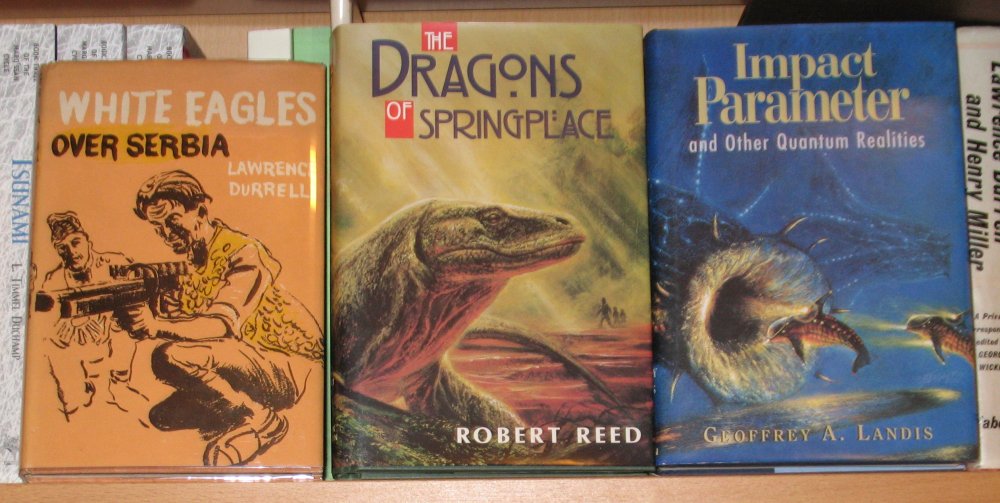
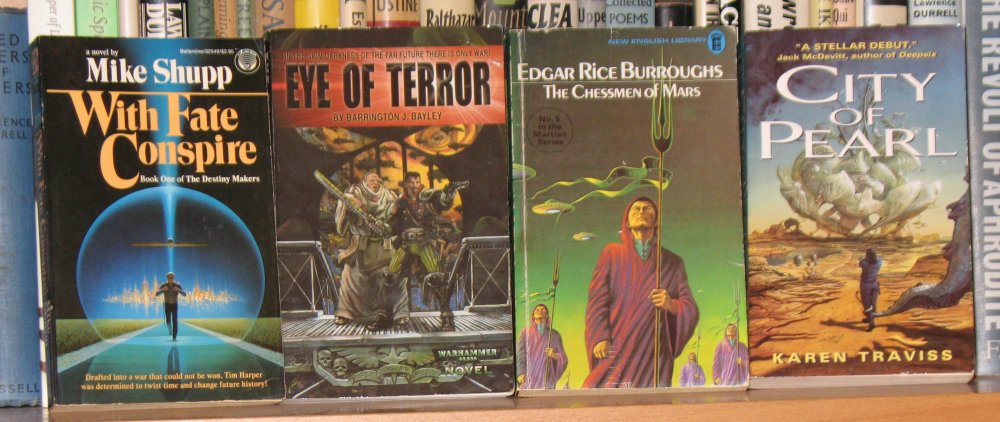
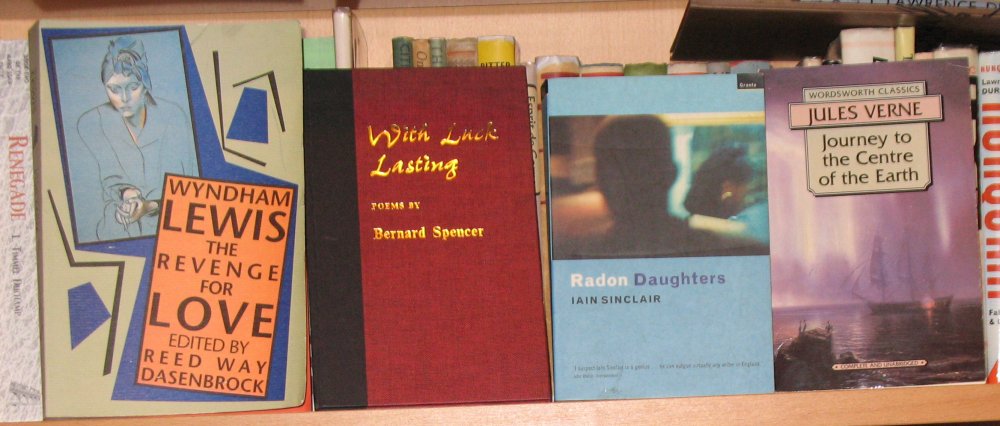
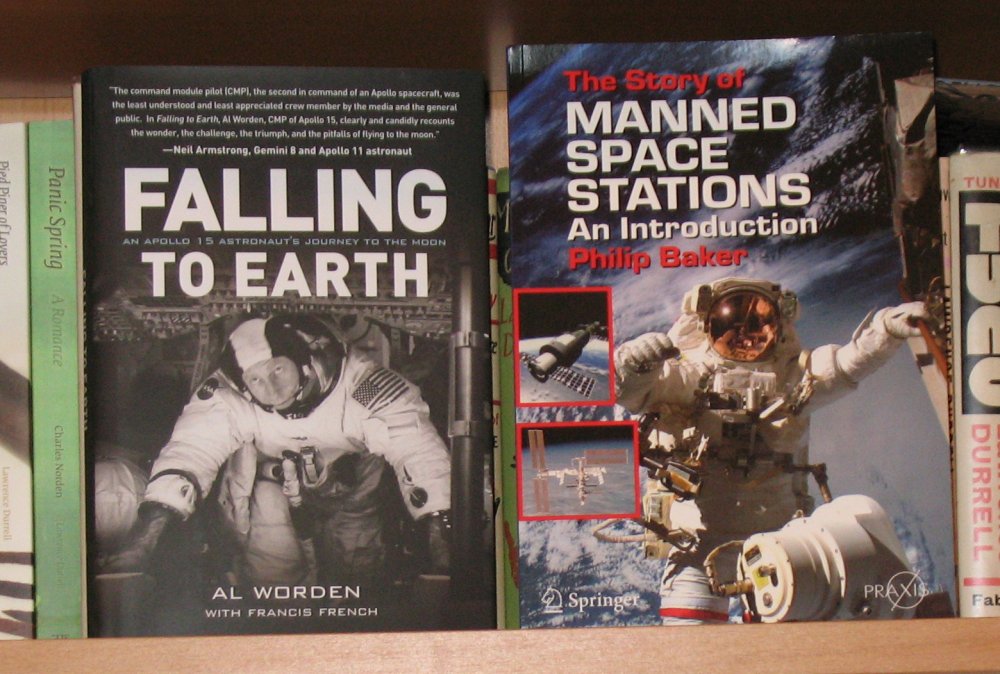
Of course, in the weeks leading up to Christmas the postie was also busy. Since my last book haul post, the following books have landed on the mat:
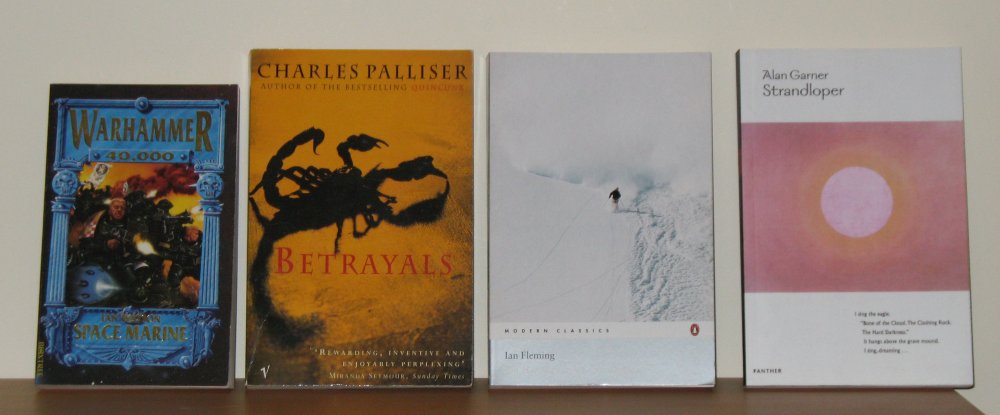
A few sf paperbacks. I used to correspond with Mike Shupp, and I’ve always wanted to read his Destiny Makers quintet, but it’s taken me a while to find decent copies. Now that I have the first book in the series, With Fate Conspire, I can make a start, although I still need to find a copy of the third book, Soldier of Another Fortune. Eye of Terror is Barrington Bayley’s only Warhammer 40K novel, and by all accounts is especially mad – even for him. The Chessmen of Mars almost completes my set of 1970s NEL editions of the John Carter books – because, of course, I have to have a set that all looks the same, and the ones I already had were NEL paperbacks from the 1970s. City of Pearl is November’s belated read for the reading challenge. I doubt I’ll read it before the end of the year, but never mind.
My father owned quite a large collection of Penguin paperbacks. I found an invoice in one, and discovered that he’d actually ordered them direct from the publisher. This was back in the mid-1960s. Though he read and admired all the Penguin books he bought, for the past few decades his reading had mostly been thrillers. Some of his books I want to read myself so I’ve started bringing them home a few at a time, and so… Le Grand Meaulnes, Alain-Fournier; Hear Us O Lord from Heaven Thy Dwelling Place, a short story collection by Malcolm Lowry; Clock Without Hands, The Member of the Wedding and The Heart is a Lonely Hunter, all by Carson McCullers; Albert Camus’ The Plague; Raymond Chandler’s The Little Sister; and The Sound And The Fury by William Faulkner.
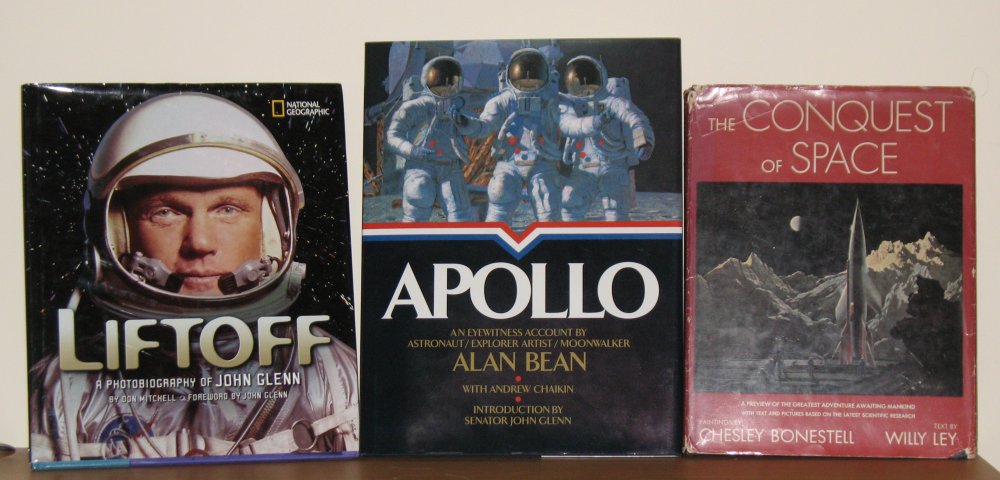
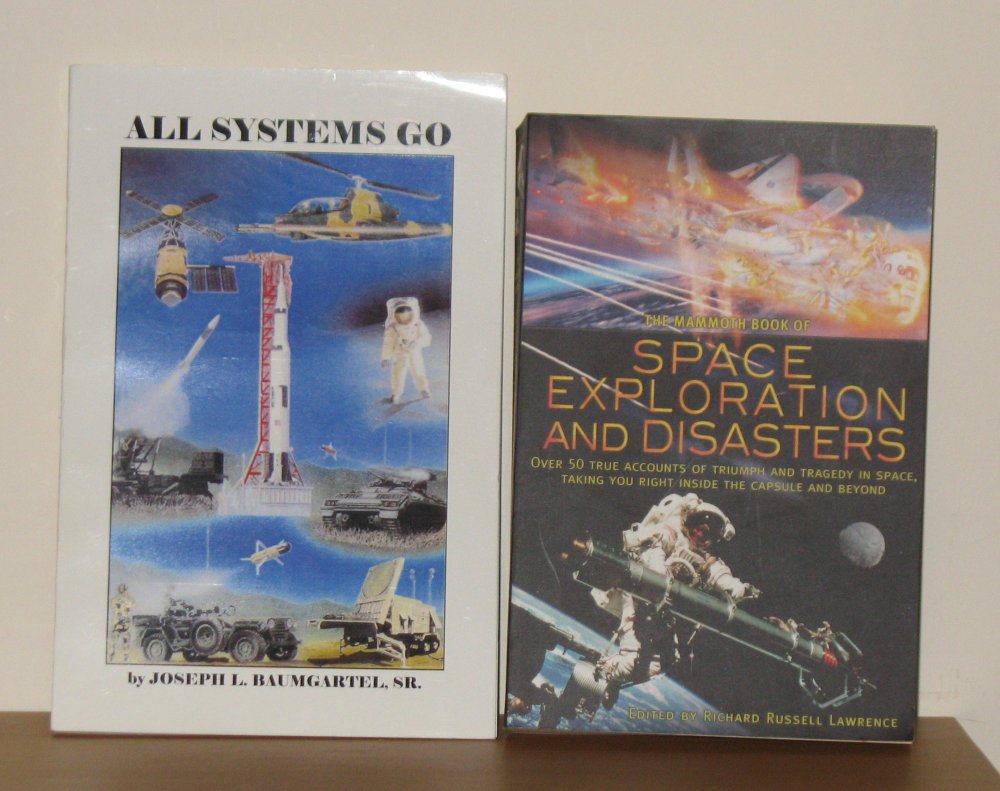
Finally, two books for the space books collection. Falling to Earth is the autobiography of Apollo 15 astronaut Al Worden. It’s signed. The Story of Manned Space Stations was ridiculously cheap on eBay – about £3.50 compared to £18.99 on Amazon.
This year is almost over, but what will the new year bring? I already have more than a dozen titles from 2012 on my wish list. They are (in alphabetical order by surname of author):
Despite making a compulsion of reading every day, the TBR pile looks no smaller – and, in fact, might well have grown. If I was smart I’d institute a policy of only buying a new book if I’ve read one from the TBR. Sadly, I’m not. Maybe I should get a Kindle or something – at least then the books wouldn’t take up as much space. Mind you, it would make my book haul posts look a bit silly…
Anyway, here are the books I have read in the past month or so; here are the films I’ve watched in the past month or so. Some were good, some were bad, some were meh. And so it goes. Apologies for the length of this post; I really should do these more frequently.
Books Hardball, Sara Paretsky (2009). I’ve been a fan of Paretsky’s novels since first reading one back in the early 1990s. Perhaps their chief appeal is that Paretsky wears her politics on her sleeve, and VI Warshawski’s investigations always end up uncovering something interesting about Chicago’s political landscape and history – and often as commentary on the US as a whole. Hardball, a slight return to form after the disappointing Fire Sale, is no different in that respect. Warshawski is asked to track down a young black man who disappeared during Martin Luther King’s visit, and the subsequent riot, in 1968… and discovers some unwelcome facts about the city’s police department of the time. Of which her late father was a member. There are a lot of angry men in Hardball – in fact, it often seems like the entire male cast are angry at Warshawski, and not always for good reason.
Shadow Man, Melissa Scott (1995), was September’s book for my reading challenge and I wrote about it here.
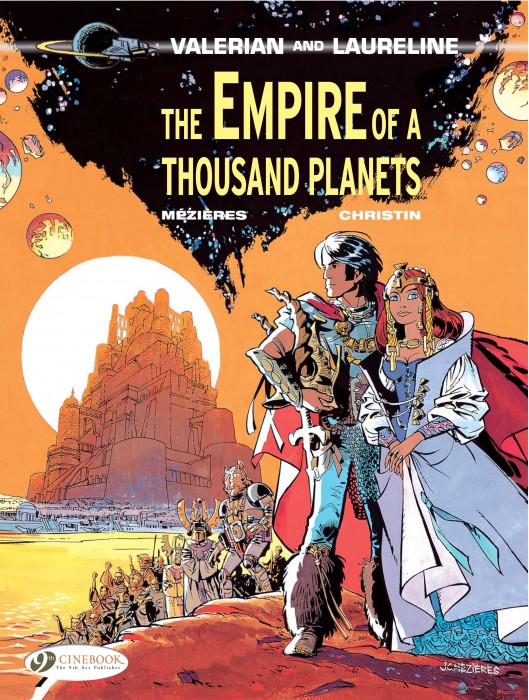
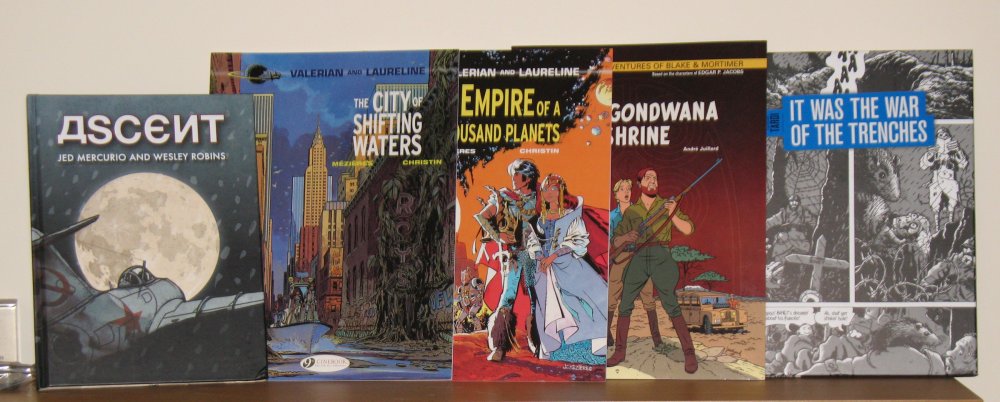
Valerian 1: The City of Shifting Waters (1970) and Valerian 2: The Empire of a Thousand Planets, Jean-Claude Mézières & Pierre Christin (1971), are the first two English translations by Cinebook of a well-known sf bande dessinée series. Valerian is a spatio-temporal agent and, with his sidekick Laureline, gets involved in various adventures throughout the universe and history. In The City of Shifting Waters, he’s sent back to 1980s New York, which is flooded after a global environmental disaster, to prevent an evil villain from a nefarious plot to prevent the creation of the agency for which Valerian works. In The Empire of a Thousand Planets, Valerian and Laureline are sent as diplomats to a thousand-world planetary system (!), but discover that some strange group controls all the planets and seems determined to wage war on Earth. These books are not entirely serious – there’s a gentle humour running throughout them, though it’s not very subtle. Laureline, the sidekick, for example, is the clever one, who always gets Valerian out of his scrapes. There’s some inelegant info-dumping, and some of the story and art of The Empire of a Thousand Planets looks suspiciously like a direct inspiration for Star Wars (as an afterword points out tongue-in-cheek). Fun, though.
On Green Dolphin Street, Sebastian Faulks (2001), I’m fairly sure I tried reading when I was living in Abu Dhabi, but gave up a couple of chapters in because nothing seemed to be happening. This time, I ploughed on and… nothing happened. The van Lindens are a diplomatic couple in 1959 USA. Charlie is an analyst at the British Embassy, and was something of a wunderkind. But his star is now waning, mostly as a result of his drinking. When Frank Renzo, an acquaintance from Charlie’s visit to Vietname years before, re-introduces himself at a party, it results in an affair between Renzo and Mary van Linden. This comes to a head when Charlie has a breakdown during a trip to Moscow, and Mary has to go and fetch him. I was expecting a final section like that in Charlotte Gray – another Faulks novel which ambles along at a geriatric pace – but there isn’t one in On Green Dolphin Street. Charlie has a breakdown, Mary rescues him. That’s it. There’s some nice writing, but it’s not really enough to keep you reading. Disappointing. I’ve got four more novels by Faulks on the TBR. I hope they’re better than this one…
The Adventures of Blake & Mortimer 11: The Gondwana Shrine, Yves Sente & André Juillard (2011), is another addition to Edgar P Jacob’s series, and follows on directly from the two The Sarcophagi of the Sixth Continent volumes. It’s drawn in Hergé’s ligne claire style, but is very talky with great speech balloons filling up many panels. The plot is completely bonkers, as Blake & Mortimer stumble across evidence of a secret base in Africa of a civilisation which existed on Gondwana millions of years before the first humans left the Rift Valley. Sometimes, you get the impression Yves Sente is a bit too clever for his own good…
Ascent, Jed Mercurio & Wesley Robins (2011), is a graphic novel adaptation of Mercurio’s excellent novel of the same title. The hardware is well drawn, but the rest looks a bit rubbish and amateur. Disappointing.
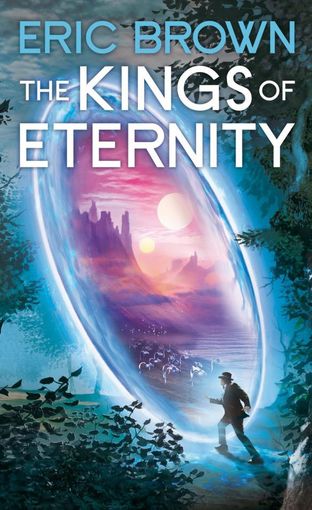
The Kings of Eternity, Eric Brown (2011), has been receiving lots of positive notices, though I think it’s unlikely to bounce Brown’s career to the next level. It’s very good, but it’s far too considered a novel to have broad genre appeal. It’s also not space opera. A reclusive writer living on a Greek island in 1999 falls in love with the painter who has moved in next to him, but only reluctantly opens himself to her. Four friends in 1935 meet at the country home of one of them, and in the woods nearby witness the opening of a portal from another world and rescue the creature which comes through it. The link between the two narratives is not difficult to guess, but that doesn’t spoil any enjoyment this novel might have. The narrative set on the Greek island has a somewhat Fowlesian feel to it, though it’s perhaps more sentimental than anything Fowles ever wrote. The other narrative is very Wellsian, though it uses Wellsian-type tropes with the sophistication of a twenty-first century sf writer. Is this Brown’s best novel? Hard to say. I still like Kéthani a lot, though The Kings of Eternity is certainly a very good novel. Perhaps my reading of it was spoiled slightly as a result of reading the novella on which it was based, ‘The Blue Portal’, some years ago.
Silicon Embrace, John Shirley (1996), however, is not a good novel. I like Shirley’s fiction, but he can be very slapdash. And Silicon Embrace is one of the slapdash ones. It’s a post-apocalyptic US crossed with UFO mythology, featuring a Damnation Alley-style journey across California and Nevada, with a secret underground base staffed by a military in league with the Greys. Then the story heads for New York, and turns into something slightly different. This book was poorly edited, with far too many ellipses left in the dialogue, and a number of silly mistakes, like mention of “Neil Stephenson” (sic). Disappointing.
It Was the War of the Trenches, Jacques Tardi (1993), is a bande dessinée treatment of WWI from the point of view of the soldiers. Tardi has picked out some of the worst and most horrific stories, and given them a graphic novel treatment. Such as the one about the Sicilian soldier who could not speak French and so didn’t go over the top when ordered, and was subsequently tried and shot as a deserter. Or the officer who ordered machine-guns to open fire on his own men because they were being mowed down by the Germans and were trying to get back to their trenches. The more you learn about the First World War, the more you realise the wrong people were killed. Anyone who reads this and continues to glorify war and the military is clearly an idiot.
Maul, Tricia Sullivan (2003), was October’s book for my reading challenge and I’m still working on a blog post about it.
The Joy of Technology, Roy Gray (2011), is a chapbook published by Pendragon Press. The author is a friend of mine. The technology in question is that used in sex clubs in Germany in order to better titillate customers. The customers, in this case, are a coach-load of football fans from the UK, visiting Germany as their team is playing away. A father introduces his son to the joys of travelling onto the Continent to see a footy match, and also to the delights to be had before and after the match. Gray pulls no punches, and if his story dehumanises its characters I suspect that was its intent. It does trail off a bit towards the end, and perhaps would have been improved by a punchier finale.
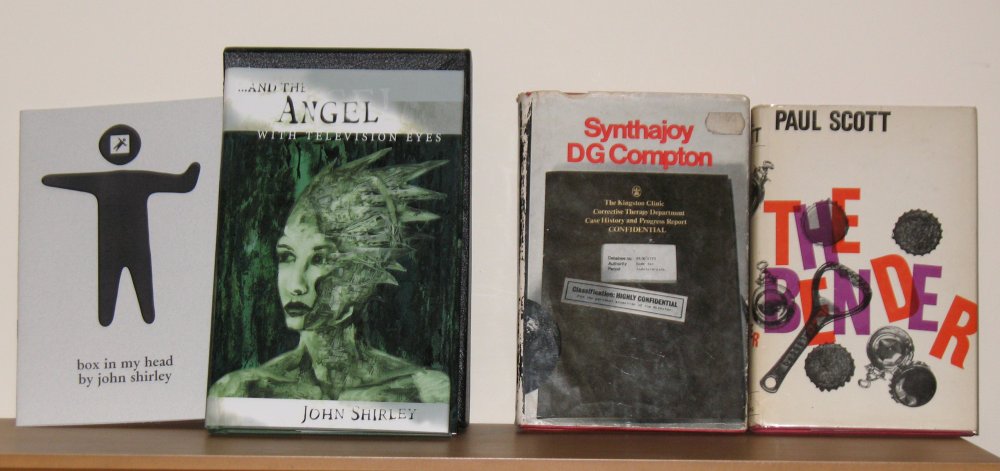
Synthajoy, DG Compton (1968). A blinding novel by a much-underappreciated writer. I wrote about it here.
Dead Girls: Act 1 – The Last of England, Richard Calder & Leonardo M Giron (2011), is a graphic novel of part of Calder’s novel of the same title. I’ve read that novel – in fact, I’ve read the trilogy – and it’s very good. The graphic novel is also very good. The style of art suits the material perfectly. The story is actually the flashback from the novel, which actually makes the world of the book easier to understand. I’m looking forward to seeing the next installment.
The Unit, Ninni Holmqvist (2006), has lots of praise on the covers of my paperback copy of this book, and I’m not entirely sure why. In a near-future, or alternate present, Sweden, anyone over the age of fifty without children, or who has not made a significant contribution to culture or industry, is deemed “dispensable”. They are taken to luxurious centres – such as the “unit” of the title – where they have free housing, food and healthcare, and are encouraged to use the copious leisure facilities. While there, they must volunteer for medical experiments and, over a period of years, donate whenever necessary their organs. Dorrit is one such woman. Something of a loner, inside the unit she finds friendship, and then love. At which point, of course, she no longer wants to be dispensable. The concept of the unit is, I admit, quite neat, though it doesn’t hold up to scrutiny. From the description, it would cost far more to run than it returns in the form of drug testing or donated organs. The rules on who is dispensable are also open to abuse, especially for those who are childless but have contributed in some highly-recognised fashion. Also, the fact that survival is predicated on having children will also push women back into their traditional roles, undoing decades of feminism. None of this seems to have occurred to Holmqvist. She makes Dorrit a bit mannish, but has her enjoy being passive and feminine as if it were something to aspire to. I also thought the writing was very clumsy in places, though that may be more the translator’s fault than the author’s. I suspect this is one of those books where people can see little beyond the central conceit – like Oscar Wilde’s The Picture of Dorian Gray, for example, which has a brilliant central idea but is appallingly written. And yet those same people will sneer at science fiction because so many of its fans look only at its ideas and ignore all else in a text.
Warlord of Mars Vol 1, Arvid Nelson, Stephen Sadowski & Lui Antonio (2011). I have a love-hate relationship with John Carter. Or rather, with the books in which he features. Barsoom is a great invented land, but the prose is often quite painful to read – not only is the style horribly dated, but Edgar Rice Burroughs was a hack. But there’s something in John Carter and Barsoom which fires the imagination… even if every incarnation of it to date has yet to match expectation. This miniseries is an attempt at a more faithful comic adaptation of the first book of the series, A Princess of Mars. However, like all such it stands or falls on the quality of its art… and here it’s not too bad. Okay, so Dejah Thoris is improbably bosomed and near naked – though, to be fair, in ERB’s novel all the character are naked all the time. And the Tharks do bear a suspicious resemblance to the Tharks in Marvel’s 1978 John Carter, Warlord of Mars comic. Overall, this is quite a good adaptation, though it does make the source material appear more shallow than it actually is. Meanwhile, I’ll have to wait until Pixar’s film adaptation is released in March 2012…
The Uncensored Man, Arthur Sellings (1964), I read as part of my British sf Masterworks investigation, and I wrote about it here.
Warlord of Mars, Dejah Thoris Vol 1: Colossus of Mars, Arvid Nelson & Carlos Rafael (2011), is much better than the adaptation of A Princess of Mars by the same writer mentioned above. The artwork is lovely, though Dejah Thoris is still implausibly pneumatic. And mostly naked. But Dejah Thoris is certainly the heroine and drives the plot from start to finish. The story is set hundreds of years before John Carter appears on Mars, when Greater and Lesser Helium were at war and both owed allegiance to another city-state. The jeddak of that state finds an ancient colossus and goes on a rampage, but Dejah Thoris manages to ally the two Heliums and leads a force to defeat him. I’ll be keeping an eye open for the next book in the series.
The Testament of Jessie Lamb, Jane Rogers (2011), was, I believe, longlisted for the Booker, but since the plot summary made it clear it was sf-written-by-a-mainstream-author I picked up a copy just before Waterstone’s abolished their 3-for-2 promotion. And it’s certainly sf, in the same way The Handmaid’s Tale or The Children of Men are. Or even Nineteen Eighty-four. At some point in the near-future, a virus is released which infects everyone. But when women become pregnant, it turns into full-blown Creuzfeld-Jakob Syndrome and is always fatal. In other words, women can’t have children anymore – or they die. And it’s a particularly horrible death, as their brain dissolves in their skulls over a period of weeks and sometimes days. Jessie Lamb is 16-year-old whose father works at a clinic attempting to find a cure to Maternal Death Syndrome. While around them the world slowly falls apart. The first section of the novel, in which Jessie tries to come to terms with the world, and in which the role of women in society slowly erodes, is very good indeed. But about halfway through Jessie volunteers to become as “Sleeping Beauty” – she joins a programme which will keep the mothers in comas so the babies can be born safely, though, of course, the mothers will not survive. At which point, the novel turns into YA story and is all about Jessie trying to convince her parents that her choice is the right one. Yet the trigger for that choice doesn’t seem especially obvious. The Testament of Jessie Lamb is a pretty good book, but it’s also half of what could have been an excellent one.
The Garments of Caean, Barrington Bayley (1978). Bayley’s fiction was always slightly odd, and this one’s no exception. It’s 1970s hackwork, but it starts from a point, with a conceit, that no self-respecting sf hack would ever have tried. But Bayley makes it work. Sort of. In the Tzist Arm of the galaxy there are two major cultures, the Ziode cluster and Caean. The Ziodeans are just like contemporary Anglophone Westerners, but with spaceships and few other sf trappings of the day. The Caeanites, however, are entirely different. They have developed tailoring to such a degree – they call it the Art of Attire – that clothes do indeed maketh the man. So when a black marketeer liberates a cargo of Caeanic clothing from a crashed spaceship, it threatens the already minimal relations between the two groups. The prose veers from serviceable to the odd piece of fairly good writing. About two-thirds of the way through, the plot takes a turn that makes a nonsense of the book’s set-up up until that point. And there’s a casual mention of rape which is really quite offensive in this day and age. Not one of Bayley’s best. There were much better books written by British sf authors during the 1970s. Don’t bother with this one.
Films The Big Heat, Fritz Lang (1953), is one of Lang’s noir films from his Hollywood period. Glenn Ford plays the white knight, an honest cop, who tries to bring down the mob boss who runs the city. While the film is generally considered a classic of the genre, it does suffer heavily from simplistic morality, the righteousness of its hero, and the characterisation of women as either duplicitous or victims (Lang’s While the City Sleeps has a woman beat the shit out of a serial killer who attacks her). The Big Heat is especially brutal in this last regard, when mobster lieutenant Lee Marvin throws boiling hot coffee into the face of his girlfriend because she was seen talking to Ford. And she’s not the only victim of Ford’s relentlessness. He continues to harrass the mobster – ignoring due process, evidence, etc. – despite being told not to by his lieutenant, and as a result is suspended. But still he carries on. And he gets his man in the end, no matter who suffers or perishes in the process. Of the Lang noir films I’ve seen, The Big Heat is the least interesting – it’s too formulaic, has little or no ambiguity, and, let’s face it, Marvin’s brutality is no reason to celebrate a film.
Winter’s Bone, Debra Granik (2010), I vaguely recall hearing good things about, though I think I kept on getting it confused with Hanna. I’ve no idea why – the only thing the two films have in common are a teenage girl as protagonist. Anyway, I put it on the rental list, several weeks later it dropped through the letter box, I picked it up and looked at it and thought “meh”. One weekend night I stuck it in the DVD-player… and it proved to be one of the best films I’ve seen so far this year. A teenage girl is visited by the local sheriff, who tells her that her father, whom she has not seen for weeks, is due in court soon. He has put up his house as surety for his bail and if he doesn’t appear, then the girl, her young brother, and their mentally ill mother will be put out on the street when the bail bonds company seizes the property. So she goes looking for her errant pa. The film is set in the Ozarks, among poor families who live on subsistence farming and cooking methamphetamine. It’s an insular society, ruled by the threat of violence, in which women live in fear and even kin asking questions is unwelcome – and punished by threats and then violence. Jennifer Lawrence is excellent as the girl. Winter’s Bone is a scary film, set among very scary people. I now want to read the novel by Daniel Woodrell on which it’s based. In fact, I’d like to read all of his books. This is not always a good move: for example, Hitchcock’s Marnie is greatly superior to Winston Graham’s, and the film of Roddy Doyle’s The Commitments is much better than the book. But I’d still like to read them.
Black Heaven, Gilles Marchand (2010), I reviewed for The Zone and it was meh. See here.
The Wedding Song (Le chant des mariées), Karin Albou (2008), is one of those films that occasionally appears on my rental list but I forget why I put it there. Perhaps it was because it’s set in Tunisia, and I’ve seen many excellent North African films. The Wedding Song is set during WWII after the invasion of Tunisia by the Nazis. Two teenage girls, one an Arab Muslim, the other Jewish, are friends, but the Germans’ demands on the population soon push them apart. Not helping this are the Arab girl’s fiancé, who goes to work for the Germans identifying the local Jews, or the Jewish girl’s mother who marries her off to a wealthy doctor much older than her. This is not a pacey film, it’s far more about developing the characters in order to better understand their responses to the Nazi depradations. I’ve seen the film presented as a lesbian film, which it isn’t. The two girls are childhood friends, though that doesn’t prevent one from betraying the other – and later saving her. The Wedding Song is as much about the Nazi invasion’s effect on Tunisia as it is about the effect on the two girls. An excellent film.
Summer Storm, Douglas Sirk (1944). I’ve always thought that Sirk was to the melodrama what Hitchcock was to the thriller. But while Hitchcock never made a film that wasn’t entertaining, Sirk’s oeuvre is not so consistent. It’s not just later-period fluff like 1957’s Battle Hymn, but even earlier works such as this adaptation of Chekov’s novella, ‘The Shooting Party’. It just seems… weird. It’s melodramatic, and very much a mid-1940s melodrama. But everyone is dressed in nineteenth-century Russian costumes, and they all have Russian names. It makes for a weird disconnect between story and presentation. George Sanders plays a provincial judge ensnared by a scheming peasant beauty (Linda Darnell). First she marries the local aristocrat’s estate manager – and the aristocrat throws a party and invites all his effete peers as a joke – but Darnell’s sights are set higher. There’s probably a good script hiding in Summer Storm, but I kept on getting thrown by the fake scenery and American jocularity.
Thor, Kenneth Branagh (2011). Of all the heroes in Marvel’s stable, you have to wonder why they chose Thor for a movie adaptation. He’s one of the least interesting. He’s a Norse god with a big hammer, and in his secret identity he works as a doctor. The Thor from Norse mythology had much more interesting adventures. Of course, Thor is one of the Avengers, and The Avengers is next year’s Marvel tentpole release (the preview trailer actually looks quite boring). In order to introduce Thor, Branagh ripped off the plot of Superman II, but flipped it so that the good guy is exiled to Earth rather than the baddies. Thor’s brother Loki schemes for Odin’s throne, and big dumb Thor falls for his dastardly tricks, and a sa result is exiled to Earth. Where he happens to land in the lap of scientist Natalie Portman. For much of the film, Thor’s superpower appears to be stupidity, though he quickly learns to be a nice person, which not only gets him back to Asgard and allows him to defeat evil Loki, but also returns him to the loving bosom of his father. Because, of course, Thor is a father-son film. Admittedly, the film looks good – especially the bits set in Asgard, though it seems to have ditched the whole Norse mythology thing and implies that Asgard is an alien world / alternate dimension sort of place that just happens to be populated by humanoid Viking-types. I can’t see much point in trying to rationalise superheroes – it can’t be done. They are nonsense, their powers are magic. And the comics industry has never understood what rigour is, anyway.
Tron Legacy, Joseph Kosinski (2010). Perhaps the desire to update Tron, given the current state of special effects, is understandable. I mean, the original Tron had some good ideas, and an interesting look, but it wasn’t very good. Unfortunately, it was still a damn sight better than Tron Legacy. Yes, the special effects are much improved. But the story is rubbish. And it makes no sense. Jeff Bridges’ son accidentally gets himself digitised and ends up in the virtual world where his father has been trapped for the past umpteen years. In order to escape, they both need to defeat the evil copy of Bridges he created to run the virtual world. This is all supposed to have something to do with microprocessor architecture and programming, but I work in IT and it made no sense to me. anyway, Bridges, as creator, has special powers. But he only uses them in the last ten minutes of the film to save his son. He could have used them at any time. And the only way he can save him is to commit total genocide. Despite the fact he has been fighting his evil copy because said copy committed genocide on some virtual life that spontaneously appeared in the virtual world. Who writes this crap? Oh, and did I mention it’s a father-son film? Well, obviously.
Almighty Thor, Christopher Ray (2011), is the Asylum’s take on Thor. Except it’s completely different. Sort of. Odin and his two sons live in generic semi-mediaeval fantasyland (one of the greener parts of California, by the look of it, with a poor CGI rendering of a castle). Baldir is Odin’s heir, a powerful warrior. Thor, however, is a weakling and not very bright. He doesn’t know how to fight with a sword, either. Then Loki – Richard Grieco, looking like he’s spent the last decade shooting up – invades Asgard, and kills both Odin and Baldir. It’s up to Thor to save the day. Except he’s useless. Happily, Valkyrie Jarnsaxa appears and agrees to train him up. This involves hiding out in present-day Los Angeles – well, those back-streets where filming permits are evidently quite cheap. If the sections set in Asgard looked cheap, the ones set in LA resemble something from public access television. The Asylum are rightly known for making shit films, and the only astonishing things about them are the levels of shitness those film actually reach. Yes, some films are so bad they’re good, but that’s one trick the Asylum has yet to master.
Bonjour Tristesse, Otto Preminger (1958). When I think of Preminger I think of classy noir films from the 1940s, but Bonjour Tristesse, adapted from the novel by Françoise Sagan, is a 1950s melodrama. It opens in black and white, with Jean Seberg describing her ennui in voice-over as she flits from one Parisian night-club to the next, from one wealthy young playboy to the next… The action then shifts to the previous summer, on the French Riviera, and in colour. Seberg is holidaying there with her father, shallow playboy David Niven. Staying with them is a bouncy Swedish blonde playmate… but then Deborah Kerr, an old flame, unexpectedly accepts an invitation to visit. and she manages to tame the playboy father. This unfortunately puts the kaibosh on Seberg’s plans for a life of profligate leisure, so she hatches a cunning ploy. Which has a somewhat unfortunate consequence. It’s all very high-society and irresponsible wealth, and you can’t feel much sympathy for the characters. But it’s an excellently-made film, and both Niven and Kerr are very good in it. Seberg I found too gamine and empty-headed to really convince, and as a result the film for me never quite managed the charm of Hitchcock’s To Catch A Thief or the cool sophistication of Antonioni’s L’Avventura.
Princess of Mars, Mark Atkins (2009), I stumbled across one night on Movies 24, but only managed to catch part of it. So I made a note of its next showing, and sat down to watch it from start to finish. It is, of course, an Asylum film, and while it’s currently titled Princess of Mars to cash in on Pixar’s release of John Carter of Mars next March, it was originally titled Avatar of Mars after James Cameron’s blue-peopled epic. In fact, Princess of Mars follows ERB’s novel quite closely – though, like every adaptation ever made, it ditches the nudity. Carter himself is updated to a Special Forces soldier in Afghanistan, and the mechanism which sends him to Barsoom is a military experiment performed on him since he’s at death’s door. But once on the Red Planet, he runs into the Tharks, joins them, captures Dejah Thoris, falls in love with her, and goes on to save the planet and unite the Red and Green Men. Mars itself resembles an Arizona desert, most of the special effects are cheap and nasty, as are the make-up and prosthetics, and Traci Lords as Dejah Thoris is astonishingly bad. But for an Asylum film, this one is actually almost watchable.
Ricky, François Ozon (2009). There’s something about Ozon’s films I find appealing – though, it’s not true of all of them. Angel is garish and amusing, Water Drops On Burning Rocks has that astonishing dance scene in it, Under The Sand is beautifully played… but Le Refuge is a bit dull, as is Swimming Pool, and 8 Women I find a little too OTT. Certainly he’s a director whose films I seek out, however. And happily, Ricky is one of the good ones. A working-class French woman falls in love with a spaniard who works at the same factory. He moves in with her, the woman’s young daughter is upset at having her world altered but gradually comes to accept him… then the woman becomes pregnant. The family dynamic immediately changes. That is until the baby – rickey – is born and when several months old develops bruises on his shoulder blades. The woman accuses the father of hurting Ricky. Hurt and disgusted, he leaves her. The bruises grow worse… and sprout into a pair of wings. Ricky can fly. Mother and father are reconciled. At first they try to keep Ricky’s ability a secret, but he escapes during a trip to the local supermarket, so they reluctantly call in the media. Perhaps Ricky with his angel’s wings feels a little too much like over-egging the new-family-new-baby cake – it’s perhaps a cliché that families always see their new babies as “little angels”. And there’s the daughter to consider too – she goes through the typical cycle of jealousy to acceptance to pride.
X-Men: First Class, Matthew Vaughn (2011), has been much praised as an intelligent addition to the (typically dumb) corpus of superhero films. Which is to forget that the first two men X-Men films directed by Bryan Singer were actually pretty smart movies. In X-Men: First Class – which is, of course, a cunning pun – the action is set in the 1960s and shows the X-Men helping the CIA prevent a conspiracy by evil mutants to use the blockade of Cuba to trigger nuclear Armageddon. Along the way, we get to discover how the above-the-title mutants discovered their powers, and the use they put them to before deciding the patriotic thing to do was work for a bunch of interfering types like the CIA. While X-Men: First Class is a pretty smart film for a superhero film, and it marches along at an energetic pace, look too closely and things start to look less shiny. It’s not just Kevin Bacon’s really bad German accent – which he thankfully drops when he reappears as Sebastian Shaw… or the over-preponderance of semi-naked women throughout the film… or that Banshee, an Irishman in the comic, has been recast as American in the film… or that Angel is now female, though he was male in the comic and earlier films… or that the Soviet villain uses a Bell 47 helicopter to visit his dacha (which looks more like a stately home left to wrack and ruin, anyway)… or why the villains always win in their fights against the good guys until the last reel of the film… or that the X-Men supersonic jet, which has always been modelled on a Lockheed SR-71, apparently has no room in its interior for jet fuel… or that Magneto introduces himself to Nazi refugees in South America by offering to buy them a Bitburger, but no one says “bitte, ein Bit”… But perhaps I’m asking too much of what is essentially pure entertainment. Except, if it’s “pure entertainment”, why try to position it as an intelligent film which comments on real life geopolitical events? Why not just admit it’s men – and women – in tights with logic-defying superpowers trying to remould the planet to fit in with US preconceptions of what Earth should be?
Green Lantern, Martin Campbell (2011). You’d think a story about a man with a magic ring that allows him to defeat evil, and who wears magic tights, wouldn’t be science fiction. But Green Lantern has aliens in it, and lots of lovely shots of galaxies and other celestial objects, and apparently the Green Lantern Corps are the guardians of galactic civilisation. If there’s a genre this film belongs to it’s the genre of tosh. I am a science fiction fan, but even I couldn’t swallow the central premise of Green Lantern. Still, it is a Marvel film. It’s also a Hollywood film, so it’s all about a son and the father he could never live up to. Because all Hollywood films are father-son films. I suspect some powerful studio executive has done way too much therapy. Anyway, Green Lantern was entertaining in a “nice visuals” sort of way, providing you turn off your higher cognitive functions. The story didn’t make much sense, and was filled with pointless scenes. For example, the commander of the Green Lantern Corps beats the crap out of Green Lantern and then tells him he’s rubbish. Well, of course he is. He only put the ring on twenty minutes ago, and no one’s trained him how to use it. And then the super-powerful villain that no one can beat only be defeated by that self-same rookie who has, um, oh hours of experience in the job. Then you have lines such as “The bigger you are, the faster you burn.” Er, no. But why expect accurate physics in a film about a man with a magic ring?
51, Jason Connery (2011), I reviewed for The Zone, and it was shit. See here.
Dr Who: The Ribos Operation, The Pirate Planet, The Stones of Blood, The Androids of Tara, The Power of Kroll and The Armageddon Factor (1978 – 1979), are the six stories which make up the Key to Time sequence, which introduced fellow Time Lord Romana as the Doctor’s companion. The final story also revealed the Doctor’s real name, which is apparently Theta Sigma, so I’m not surprised he insists on being called the Doctor. (According to the mythology, this is a “known alias”, though why someone would use an alias at an academy is never explained. It also transpires that ΘΣ was used in the New Testament as an abbreviation for God, so it’s most likely a case of a scriptwriter having a small joke…). The Key to Time is some sort of magic thingummy which, er, safeguards time or the universe or something. The White Guardian tasks the Doctor with gathering the six pieces, which have been hidden throughout time and space, and giving him the completed Key. Because then it would be safer than being hidden in six pieces throughout time and space. Apparently.
The Ribos Operation is a straightforward sting story. A pair of interstellar conmen try to sell a planet – without the knowledge of its semi-mediaeval natives – to a deposed noble by planting a sample of a valuable mineral and pretending not to understand its worth. The Doctor puts a stop to their con, but also prevents the nasty noble from furthering his own nasty plan.
The Pirate Planet is Douglas Adams’ first Dr Who script, and so is held in high regard. I can’t see why myself. The story has a neat idea but it doesn’t stand up to scrutiny. The titular world is hollow and hyperjumps to enclose other planets. Which it then strips of their resources. These worlds are generally inhabited, except… if the pirate planet was only after the natural resources of a world, then populated ones would probably already be mined out. Uninhabited ones would be a much better prospect. Unless it’s the fruits of their societies – technology, artworks, jewellery, etc – the pirates are after… The Pirate Planet is also infamous for a fight between K-9 and a robot parrot. Which is exactly as silly as it sounds. Incidentally, the hidden segment in this story proves to be latest planetary victim of the pirates. So even if they hadn’t committed genocide, the Doctor would have done so when he transformed the planet into a segment of the Key to Time.
The Stones of Blood feels a little like a return to a slightly older Dr Who story. It’s set on Earth around the time of filming (ie, late 1970s). Two women are researching a local stone circle, but there’s funny stuff going on at the manor, which is now owned by the oily leader of a druidic sect. It’s all to do with some alien that looks like a standing stone – well, which is meant to look like a standing stone, but actually looks a bit crap – an immortal alien, and a spaceship hidden in hyperspace somewhere over the stone circle. It’s one of the better stories.
As is The Androids of Tara, in which Dr Who rips off The Prisoner of Zenda, only with androids impersonating various members of the rival factions for the throne of Tara. It was filmed in and around Leeds Castle, and certainly looks good. It’s Dr Who at its frothiest.
The Power of Kroll, on the other hand, is Dr Who at its wettest. It’s set in a swamp – well, an estuary. With green-skinned humans, who worship a semi-mythical giant squid; and a really crap model of an oil rig, which is supposedly a facility for converting methane into “protein”. Their drilling has woken the giant squid, Kroll, which is actually a couple of miles across. Terror ensues. There’s a lot of really offensive racism against the green-skinned people in this, and while it’s plainly intended to make a point, the writers seem to forget what that point is halfway through.
The final episode, The Armageddon Factor, is perhaps the worst of the six. The story reminded me of one from the classic Star Trek series. Or maybe it was from Star Trek: The Next Generation. Anyway, there are two planets engaged in nuclear war, and it’s all going very badly. The Marshal of one talks to a mirror and refuses to accept the possibility of negotiation. But then the Doctor arrives, and it turns out there’s no one left alive on the other planet and their military machine is all being run by a computer. And there’s this toad-like evil villain called the Shadow who has manufactured the entire situation because he wants the Key to Time. At one point, the Doctor ends up running around some caves in a secret planet, miniaturised. But I think my eyes had started to glaze by that point.
I never saw the Key to Time stories when they were first broadcast (1978 – 1979), though I was in the UK at the time. At boarding-school. So there was no rosy tint watching these, though I admit to being a very small fan of Dr Who, inasmuch as it was an on-and-off part of my childhood. While the six stories in the sequence are not especially good – some of Tom Baker’s other adventures are much, much better – they are interesting because of the presence of Romana (played by Mary Tamm). For the first couple of stories, she actually runs things. Yes, she’s portrayed as a somewhat clichéd bossy, interfering female, but at least she’s not just running around and screaming. Sadly, as the sequence progresses she becomes less of an equal, and more like a typical companion. But perhaps she went on to better things. There’s only one way to find out…
David Hebblethwaite has just done this on his blog, and I read his blog, so I guess I’ll have a go at it. Again. Because we’ve all done this before. But so what: it’s about books. Books are good, and reading them is even better. The only thing better than reading that you can do with books is, er building a fallout shelter with them and pretending World War III has happened. Or maybe a zombie apocalypse. And while the rest of the world succumbs to anarchy and chaos and radiation / undeadedness, you read the books you built your shelter from. Win.
Anyway, the meme: it goes like this:
1. the book I’m currently reading Synthajoy, DG Compton – the best British science fiction writer of the 1970s, and his novels continue to be superb and very, er, 1970s. And that’s why I think they’re brilliant.
2. the last book I finished Maul, Tricia Sullivan – this was October’s book for my reading challenge (see here), and I was expecting to like this a lot more than I did. Proper full write-up to follow soon-ish. For the present, I will say it has a slightly American Psycho vibe to it which, like that book, struggles to convince, and a near-future in which men are exceedingly rare, and correspondingly prized, due to a plague, which feels like an entirely different type of society.
3. the next book I want to read The Unit, Ninni Holmqvist – the TBR actually numbers in the hundreds, but I have a sort of mini-TBR, a half-dozen books which will be my next immediate reads. And top of this list is The Unit, which Michaela Staton gave me ages ago and keeps on asking me what it’s like. It does look very interesting, in fact.
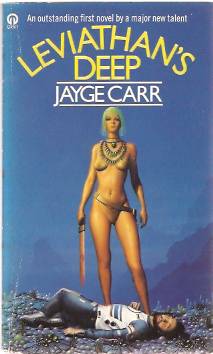
4. the last book I bought Leviathan’s Deep, Jayge Carr – when I say “bought”, I didn’t pay any money for this. It was priced 50p but since we’d just given the Harewood House second-hand bookshop two carriers bags full of books, they let us have the handful we wanted for nothing. Which was pretty cool, as Leviathan’s Deep had been on the wants list since reading Carr’s story in Women of Wonder: the Contemporary Years (see here). It’s a shame about the slightly dodgy cover art, though.
5. the last book I was given Blood Count, Robert Goddard – I have no excuse for this one. Goddard writes formulaic potboilers, but I’ve read every one of his books to date. My mother got this from the above-mentioned second-hand bookshop, and has passed it on to me. In their defence, they are very quick reads.
Book meme! Here are the 25 titles chosen for 2012’s World Book Night. Do the usual: bold for read, italics for owned by unread. And, given the multimedia nature of our cultural landscape, asterisk those with film or television adaptations you have seen.
*Pride and Prejudice by Jane Austen The Player of Games by Iain M Banks
Sleepyhead by Mark Billingham Notes from a Small Island by Bill Bryson
The Alchemist by Paulo Coelho
The Take by Martina Cole
Harlequin by Bernard Cornwell
Someone Like You by Roald Dahl
A Tale of Two Cities by Charles Dickens
Room by Emma Donoghue
*Rebecca by Daphne Du Maurier *The Remains of the Day by Kazuo Ishiguro
Misery by Stephen King
The Secret Dreamworld of a Shopaholic by Sophie Kinsella
Small Island by Andrea Levy
*Let the Right One In by John Ajvde Lindqvist The Road by Cormac McCarthy
*The Time Traveler’s Wife by Audrey Niffenegger
The Vanishing Act of Esme Lennox by Maggie O’Farrell *The Damned Utd by David Peace
Good Omens by Terry Pratchett & Neil Gaiman
How I Live Now by Meg Rosoff
Touching the Void by Joe Simpson
I Capture the Castle by Dodie Smith
The Book Thief by Markus Zuzak
Not so good a score: six read, six seen. None on the TBR. Oh well.
It has been a good month for the book collection and a bad month for the TBR: both have grown larger. As follows…
Some charity shop finds to start: Maureen Kincaid Speller has been singing the praises of Alan Garner for decades, though my only exposure to him has been the children’s classic fantasies The Weirdstone of Brisingamen, The Moon of Gomrath, Elidor and The Owl Service. Time to remedy that with Strandloper, methinks. Despite thinking they’re really bad, I’m determined to work my way through Fleming’s Bond novels – hence, On Her Majesty’s Secret Service. I remember being impressed by Palliser’s The Quincunx when I read it back in the early 1990s, and also enjoyed his The Unburied some ten years ago. But he’s not an author who appears often in charity shops, so I was pleased to pick up Betrayals. The infamous, and expensive, Warhammer 40, 000: Space Marine by Ian Watson I didn’t find in a charity shop but bought off a seller in Canada on eBay. I got it for less than the going rate – especially considering its condition – so I’m happy. And now I get to read it, too.
New paperbacks: Infidel is the sequel to the excellent God’s War (see here). A third book, Rapture, is I believe due next year. The Recollection is Gareth Powell’s debut novel from a big publisher. Patrik Ouředník’s Europeana made my best of the year list back in 2006 (see here), so I felt it was time to try his next book, Case Closed. And Maul is this month’s book for my 2011 reading challenge (see here).
Graphic novels: I like Jacques Tardi’s bandes dessinée, and these Fanatagraphics editions are handsome volumes, so I’ve been buying them. It Was the War of the Trenches is about, well, World War I. The Gondwana Shrine is the eleventh volume of the adventures of Blake and Mortimer, and is another one by the team of Yves Sente and André Juillard (series creator Edgar P Jacobs died in 1987). The books have all the intense seriousness of Tintin, but where Hergé tempers his stories with slapstick humour, Jacobs (and now Sente) marry them with bonkers pulp scientific romance. It makes for an entertaining combination. Then there’s the first two books of Jean-Claude Mézière and Pierre Christin’s Valérian et Laureline, Agents Spatio-Temporel, now in English translation – and published by Cinebook, who are doing excellent work. The series currently stands at 21 volumes, although previously only seven have been translated into English (I have them all). Both The City of Shifting Waters and The Empire of a Thousand Planets are a bit clumsily written, but they’re fun – and the series does improve a great deal. There are, incidentally, some interesting similarities between elements of the latter and the Star Wars films, though The Empire of a Thousand Planets was originally published in 1971. Coincidence? Ascent is a graphic novel adaptation of Jed Mercurio’s excellent novel of the same title (see here).
And more space books: All Systems Go is a self-published memoir by an engineer involved in a number of NASA and US military projects, including SAGE, Apollo, Skylab, and the TOW missile. The Mammoth Book of Space Exploration and Disasters was a charity shop find. I suppose the publishers thought exploration on its own wasn’t exciting enough – people would only buy the book if it included shit blowing up.
A trio for the Baxter collection: Sunstorm, book two of the A Time Odyssey trilogy, completes it for me; Conqueror is the second of the Time Tapestry quartet and I still need to get books 3 and 4; and Bronze Summer is the sequel to Stone Spring, which I have yet to pick up a copy of.
More first editions: Paul Scott’s The Bender was lucky find on eBay. As was Compton’s Synthajoy, though it’s a tatty copy. …And the Angel with Television Eyes is the signed slipcased edition from Night Shade Books, which includes a chapbook, the box in my head, of lyrics and poems.
It’s been just under a month since the last one of these, and that one proved to be a somewhat humungous post. So I thought I’d try for a more bite-sized installment this month. Sort of. Anyway, you know the drill: the books wot I have read, the films wot I have watched. Comments thereon.
Books SS-GB, Len Deighton (1978), is perhaps the classic “Hitler won” alternate history, although it’s by no means the first. A Scotland Yard detective, now working under the aegis of the SS in an occupied Britain, is dragged into several intersecting plots when he investigates the murder of an unknown man in a small flat in London. It’s all tied in with the British resistance’s plan to smuggle the imprisoned King George VI out of the country, the fierce – and often violent – rivalry between the SS and the Wehrmacht, and the Wehrmacht’s secret atom bomb being built by British scientists. Archer, the detective, is a bit of a cipher, and, in fact, much of the cast are blanks. That Deighton has done his research is obvious from the first page, and he paints a convincing portrait of a UK under the Nazis. The writing, sadly, is pretty poor. I’ve read Deighton’s Harry Palmer novels, and his Game, Set and Match and Faith, Hope and Charity trilogies, and I don’t remember his writing being this inept and clumsy. Still, I’m glad I read it, and it can go back to the charity shop now. Incidentally, I wonder if choosing a photo of Hitler in such a camp pose for the cover was a wise decision: his depredations are not something we should make light of, or forget.
The League of Extraordinary Gentlemen: Century 1969, Alan Moore & Kevin O’Neill (2011), is the latest installment in Moore’s slow progress back up his own bumhole. Actually, this one is slightly better than the previous two. The League are now in England Swings territory, and an acolyte of Aleister Crowley, but with very real powers, is trying to bring about the creation of an Antichrist. This will take place during a free concert in Hyde Park. There’s some nice touches, and plenty of in-jokes, but I’m starting to wonder where this series is heading and whether it’s going to be worth it when it gets there.
The Extraordinary Adventures of Adèle Blanc-Sec 1, Jacques Tardi (2010), I picked up after enjoying Tardi’s The Arctic Marauder. It has apparently been made into a film by Jean-Pierre Jeunet, master of Gallic surgary whimsy, and starring Audrey Tatou. And yet there’s little that’s whimsical about the two stories in The Extraordinary Adventures of Adèle Blanc-Sec 1. In the first, a pterodactyl is terrorising Paris, and Adèle uses it as cover to help solve an entirely different crime. Which is sort of linked. The final scene, in which a villain turns up and explains the plot, only to be gazumped by another villain who explains another more-encompassing plot, who is then gazumped by another, is completely bonkers. The second story is more traditional: a demon is terrorising Paris, and Adèle tracks it down to a group of cultists associated with a local theatre. If it hadn’t been for that pesky Adele… Fun. And I’ve already ordered another one of Tardi’s graphic novels.
Daily Voices (Author’s Choice Monthly #3), Lisa Goldstein (1989). Back in the late 1980s, Kristine Kathryn Rusch and Dean Wesley Smith published twenty-nine collections, each contain no more than half a dozen short stories, by twenty-nine different genre authors. Each book was published in three editions: a trade paperback, a signed and numbered jacketed hardback, and a signed and lettered leather hardback. The stories were mostly reprints. This volume, the third in the series, contains five stories, all originally published in Asimov’s. One, ‘Tourists’, inspired a novel of the same title. These are literary stories, deceptively fantastical, and unsettling. ‘Tourists’ is a case in point: part Hav, part The City & The City (though contemporary with one and predating the other). Nothing especially jumped out at me in this collection, though they are stories it is easy to admire.
The Lifecycle of Software Objects, Ted Chiang (2010), won this year’s Hugo for Best Novella. Which is hardly a surprise. The only time Chiang doesn’t win is when he withdraws his work. And certainly he’s produced an enviably high-quality body of work over the years. Unfortunately, while The Lifecycle of Software Objects is as well-written as you’d expect from Chiang, it’s also a little dull and doesn’t go anywhere very interesting. A startup produces a new range of heuristic software lifeforms, “digients”, but the amount of work required by customers to parent them proves the company’s undoing. But a handful of people, emotionally attached to their digients as if they were real children, continue to nurture this new form of life. It’s a neat idea, but it does feel in places a little like Chiang wasn’t entirely sure where to take his idea. It’s like someone had invented the cat and had no idea what it was good for. Except the concept of a “better mousetrap” doesn’t appear to have occurred to Chiang. Disappointing, though only because Chiang sets his own bar so high.
Gravity Dreams, Stephen Baxter (2011), is another brick in the great wall that is Baxter’s Xeelee Sequence. In fact, Gravity Dreams brings the sequence full circle as it’s tied into Baxter’s first novel Raft (and the PS novella includes the short story on which Raft was based). Gravity Dreams is a very… expositionary type of story. A man in the unimaginably distant future experiences strange lucid dreams, which prove to be contact with a device in the universe of Raft (where the universal gravitic constant is considerably higher). The people of that universe, and the tech which the dreamer embodies, could prove of use in the ongoing war against the Xeelee. As a whole, the Xeelee Sequence is quite an achievement, certainly greater than the sum of its parts. Which, unfortunately, has the logical consequence that individual parts may not be as exciting, or as interesting, as the whole suggests. I enjoy reading hand-wavey magical cosmological-type hard sf, but not as much as I like reading nuts & bolts engineering-type hard sf.
Red Plenty, Francis Spufford (2010), appeared on the non-fiction short list for the BSFA Award this year, though it lost out to a series of blog posts on the Hugo novel shortlist by Paul Kincaid. I’ll admit I had somewhere picked up an entirely erroneous impression of Red Plenty. I knew that it was non-fiction told as if it were fiction – dramatisations, if you will, of the life of ordinary Russians during the years of the USSR. But I’d also got the impression from somewhere – perhaps by the use of the word “science fiction” to describe it some place – that it also extrapolated the great Soviet experiment into later decades, as if perestroika and glasnost had never happened. That isn’t the case. Red Plenty ends in 1968. Nor did it affect my enjoyment: I thought the book excellent. Red Plenty follows the lives of a handful of peoples – some real, some invented – through the first half-century of the USSR. There’s a very real sense of utopia in the book, and it is sad to see how it is slowly corrupted. The USSR was one of history’s two great attempts to create a utopian society and, like the other one, Islam, its ideals didn’t last much beyond the first generation. All too often people forget what the USSR was trying to achieve. That it failed doesn’t invalidate the experiment, or its objectives.
Debris, Jo Anderton (2011), I read for review for Interzone. “File under science fiction” it says on the back cover, but I’m not convinced…
Leap of Faith, Gordon Cooper (2000), I reviewed on my Space Books blog here.
Snakehead, Ann Halam (2007), is Gwyneth Jones’ last novel as Halam, although apparently a new one – a sequel to Dr Franklin’s Island – will be published next year in the US. Snakehead is a retelling of the Perseus and Andromeda story from Ancient Greece. But slightly different. In the myth, Perseus first meets Andromeda when he returns from slaying Medusa, but in Snakehead Andromeda has run away from home and is taken in by Perseus and his mother Danaë. Much of the novel concerns Perseus’ life, and Andromeda’s introduction to it, on the island of Seriphos. The killing of the Gorgon occupies only a chapter or two towards the end of the book. There is a lovely matter-of-factness about the way the story is presented, the way its strangenesses are streamlined into the narrative. Also good is Perseus’ meeting with his father, Zeus, which reads like pure science fiction. Halam’s novels have always been extremely strong – I’d argue her Inland trilogy is better than Le Guin’s Earthsea books – but may have suffered from their variety. YA book series sell by the boatload, but Halam’s novels have been (mostly) singletons. As an adult reader, that variety is part of their appeal – when else am I going to read a novel treatment of the Perseus myth, for example? – but it may have hampered their success.
The Old Funny Stuff (Author’s Choice Monthly 1), George Alec Effinger (1989), is a collection of short stories from the early 1980s. The collection takes its title from a complaint by a fan of Effinger, who preferred the writer’s comic tales to the ersatz cyberpunk of When Gravity Fails. I vaguely recall enjoying the latter, but I didn’t enjoy any of the stories in The Old Funny Stuff. One story is set in the editorial offices of a genre magazine and reads like it was written in the 1930s. Another story has a mugged couple “assisted” by a variety of fictional detectives and vigilantes… yet all those characters are from the 1940s and earlier, though the story does mention an ATM. ‘Mars Needs Beatniks’ at least successfully pastiches Beat prose, but is unfortunately quite dull. An eminently forgettable collection, but mercifully short.
A Quiet Flame, Philip Kerr (2008), is the fifth Bernie Gunther, featuring the Berlin-based private investigator from Nazi Germany. The One from the Other, the first post-war novel, ended with Gunther on a boat to South America in the company of an ex-Panzer captain and Adolph Eichmann. Though not a Nazi himself, a case of stolen identity had resulted in Europe being a bit too hot for Gunther and so now he’s pretending to be someone else. The trio arrive in Argentina, and Gunther is taken to meet Juan Perón. At which point he confesses his true identity. But that’s fine, because the head of the secret police remembers, and admired, him back when Gunther was a detective for the Berlin police force, and there just happens to have been a recent murder in Buenos Aires which resembles a pair of unsolved murders Gunther had investigated just before Hitler seized power and Gunther left the police. The inference, of course, is that the murderer is a Nazi war criminal who is hiding out in Argentine with all the other Nazis. A Quiet Flame follows Gunther’s investigation into this murder, which soon spirals into an entirely different case, but is eventually resolved, and Gunther’s time in Berlin in the 1930s when the Weimar Republic was booted out of power by the Nazis. An afterword makes it clear that the plot of the novel, while invented, is based on either true events, or plausibly extrapolated ones. It’s one of those books that both makes you angry such things were ever permitted to happen and scared that there are people who would not think twice about doing such things. I thought it so good I moved the next book in the series, If the Dead Rise Not, up the TBR pile.
The Coming of the Terrans, Leigh Brackett (1967), is a pretty clumsy fix-up. Half a dozen of Brackett’s Mars stories have had dates stuck on them, and then placed in order as if they were part of a coherent future history. But ignore all that, because the stories in this collection are excellent stuff. Brackett’s sf doesn’t seem to fit in anywhere – it uses the tropes of early sf but is written with the sophistication of much later genre fiction. So we have Mars, populated with ancient civilisations and dying races, but stories that are considerably more than just swashes being buckled, uppity natives being quelled, or righteous pioneers carving out homesteads. The upstart Earthlings who come to exploit the Martian races rarely end up on top. This is not the gung-ho adventurism of Edgar Rice Burroughs, but its antithesis.
Charlotte Gray, Sebastian Faulks (1998). I’m pretty sure I tried reading this shortly after it was published. I’d have borrowed it from the Daly Community Library in Abu Dhabi. I think I gave up on it because I found the pacing so glacial. Later, I saw the film. Now that I’ve read it I’m sorry I didn’t persevere all those years ago. Yes, it’s a slow book. The title character volunteers for a department of the Special Operations Executive because she speaks French like a native. She is parachuted into Vichy France to courier some radio crystals to a member of a British network, but stays on because her lover, a RAF pilot, is missing in action somewhere in the country. For much of Charlotte Gray, she does little except pine for her lover and help out the local resistance. But the final third of the book more than makes up for that. Before returning to the UK, she tries to track down two Jewish children taken by the Germans, and discovers something of the truth behind their fates.
Oryx and Crake, Margaret Atwood (2003), is not science fiction, of course it’s not. It’s speculative fiction. Yes, well. Atwood’s idiosyncratic categorisations aside, I think most people would classify Oryx and Crake as science fiction. I’m not entirely sure what to make of it. There’s some sharp prose in it; there are also some embarrassingly bad neologisms. Some time in the future, rogue genius Crake unleashes a plague on the world, killing off everyone except his friend Jimmy and the Crakers, a handful of genetically-engineered humans he has bred. Now calling himself Snowman, Jimmy acts as a beneficial god/shaman to the Crakers, while trying to survive in a world in which he no longer fits. His life is interspersed with flashbacks detailing his friendship with Crake, how we went to work for him, and how the world became as it is. Most of the satire is so blunt as to be ineffective. And the “trendy” names Atwood uses for all the corporations, like RejoovEsense, annoy mightily. I preferred The Blind Assassin.
Films 51, Jason Connery (2011), I watched for The Zone, but I’ve yet to finish my review.
Time to Leave, François Ozon (2005). I like Ozon’s films, but only when he’s being playful not when he’s being serious. Except, perhaps, for Under The Sand, which I did like. But, Time to Leave (AKA Le temps qui reste): a gay fashion photographer learns he has three months left to live. He keeps this secret, telling only his grandmother (played by French screen legend Jeanne Moreau). The protagonist is, frankly (no pun intended), selfish and unlikeable, and his eventual change of heart feels overly sentimental and clichéd. Not one of Ozon’s best.
Leviathan, George P Cosmatos (1989), is another film set in a mining installation at the bottom of the ocean. This one, however, does not rip off Outland. It rips off Alien, instead. A reasonably good cast for the time – Peter Weller, Richard Crenna, Amanda Pays, Ernie Hudson, Hector Elizondo, Daniel Stern – unwittingly release some old Soviet bio-experiment aboard their habitat, and it tries to turn everyone into some sort of Cronenberg-esque monster. But Weller and Pays manage to escape. Leviathan makes a decent fist of imagining its environment, but the plot is by-the-numbers from start to finish and the characters are not allowed to develop much beyond clichés.
Lifeforce, Tobe Hooper (1985). I remember going to see this at the cinema when it was released. I didn’t take it seriously then, and I couldn’t take it seriously this time. A space mission to Halley’s comet finds a giant spaceship in its coma. Aboard are a pair of naked humans: a beautiful young woman and a handsome young man, both in hibernation. The astronauts take both aboard their Shuttle and head back to Earth. On arrival, mission control can’t reach anyone aboard the spacecraft, so they send up a mission. The crew is dead, and the Shuttle has been gutted by fire. The only survivor is the naked young woman. so they take her back to Earth, to London. But she’s a space vampire – the film is based on Colin Wilson’s novel, The Space Vampires – and she brings about a plague of zombies to the UK. All those people who claimed 28 Days Later such an astonishing film because it showed zombies running rather than shuffling along should watch Lifeforce. Zombies run in it too. It’s about all the film does have in its favour, however.
The Taming of the Shrew, Jonathan Miller (1980). I’ve been enjoying these Shakespeare plays, but every now and again you have to wonder what was going through the Bard’s head when he wrote them. Like this one. Everyone wants to marry Bianca, but her father has decided that she will not entertain suitors until her older sister, Katherina, is wed. But Kate is a “shrew” – i.e., an independent woman, not afraid to voice her own opinion, and far from the demure mistress apparently valued in Padua. Along comes Petruchio (played by John Cleese), who decides to woo Kate, for reasons never satisfactorily explained – the challenge? her fortune? There are several instances of witty banter, though Kate is played disconcertingly as a shrill termagant which often seems at odds with her dialogue. So there I was thinking that the part was just misplayed and The Taming of the Shrew couldn’t be as sexist as it seemed. Only for the final wedding banquet scene to feature speeches by each of the male cast explaining what a good wife should be, and it’s the worst sort of sexist claptrap and I’m surprised Elizabeth I didn’t have their heads off for it. Not one of the Bard’s best.
Predators, Antal Nimród (2010), is yet another sf franchise getting the reboot. Which is a creative process I find hard to understand. The Predator and Alien franchises were munged together into a series of increasingly rubbish films, and that should have killed them stone dead. Instead, we got Predators, and Ridley Scott reported working on a prequel to Alien. To be honest, of the two, I always much preferred the latter, though none of the films were as good as the first. Predator, on the other hand, was just an uglier Rambo. And Predators is just I’m a Celebrity Get Me Out of Here with guns. A group of scumbags are parachuted into a jungle. They’ve no idea where they are, how they got there, or even why they are there. It doesn’t take long before they discover they’re being hunted by aliens, the Predators, for sport. But never mind, they’re Men, the horneriest critters in the universe, and of course they can beat someone who is both phyisically and technologically superior because they’re Men. It’s Neanderthal tosh like this that gives Hollywood a bad name– No, wait, Hollywood already has a bad name. It would be nice to see the occasional sf film of real intelligence from Hollywood, but I’m not holding my breath. It would also be nice to see sf films which didn’t celebrate violence, psychopaths or sociopaths, and which didn’t paint all aliens (that’s everybody outside the US, you understand) as fit targets for invasion, repression, dismemberment, or genocide. Avoid.
The Green Hornet, Michel Gondry (2011), I’d heard mixed reports on, but I rented it anyway. I’m not a big fan of the Seth Rogen / Judd Apatow style of humour, though I do like superhero films. Sadly, the humour outweighed the appeal of the superhero aspect, and I hated this. I hated Rogen’s character, I hated the stupid jokes, and I hated the concept, which was even more implausible than your average superhero movie. Rubbish film. Avoid.
Underground, Emir Kusturica (1995), I wasn’t initially sure what to make if. It opens during World War II, with the Germans bombing, and then invading, Belgrade. A pair of local wideboys become heroes of the resistance, more by accident than by design. They’re out for themselves, but somehow or other that helps the resistance. And then one of them, Blacky, is injured, so the other, Marko hides him, and the rest of the resistance cell, in his cellar. But he never tells them when the war ends. As Marko rises in Tito’s government in post-war Yugoslavia, so those in the cellar continue to believe WWII is ongoing. They make weapons, which Marko sells. Eventually Blacky manages to escape, but he stumbles on the set of a film re-enacting the climactic raid in which he was injured. He kills the actor playing the part of the German officer, and runs way. Later, after Tito’s death, he is the leader of a militia in the former-Yugoslavia. Marko, meanwhile, disappeared when Tito fell, and is now an international arms dealer. Underground opens with the Germans bombing Belgrade Zoo, and initially seems like a somewhat clumsy comedy. But as movie progress, so does the comedy turner blacker… and blacker… and more surreal. And the end result is superb. Recommended.
A bit of an epic post this, partly because in my last readings & watchings I only gave the books I’d read and not the films I’ve watched. But how can more be bad, eh?
Books Troika, Alastair Reynolds (2010), is the first piece of fiction Reynolds has had shortlisted for a Hugo. It lost out on best novella to Ted Chiang, which is unfortunate. With Chiang on the shortlist, everyone else stands little or no chance of taking the award. Having said that, I’ve yet to read Chiang’s award-winning The Lifecycle of Software Objects, though I have the Subterranean Press edition on my book-shelves. And the copy of Troika I read was also the Subterranean Press edition, although the novella originally appeared in Godlike Machines, a SFBC-only anthology. Clearly the US Science Fiction Book Club is quite influential in Hugo nominations. Troika is BDO sf meets alternate Soviet space history, but is not, I think, Reynolds’ best work to date, despite being short-listed. The BDO itself feels too enigmatic, and the final twist on the “present day” sections doesn’t quite make sense of the whole thing. I enjoyed it, but I wouldn’t have nominated (had I chosen to pay for the privilege of doing so).
SVK, Warren Ellis and d’Israeli (2011), was sold on a gimmick: it requires a black light torch (packaged with the comic) to read some of the speech balloons. It is otherwise a fairly typical Ellis sf piece, with a nice twist in the end. A freelance fixer is called in by a government department to recover a piece of technology, which, it transpires, allows a person to read the thoughts of other people (and it’s those which are printed in invisible ink). D’Israeli’s art is good, Ellis’ dialogue is also good, but it all feels a little thin and a bit overwhelmed by the invisible ink gimmick.
My Dirty Little Book of Stolen Time, Liz Jensen (2006), I picked up in a local charity shop because I remembered enjoying her The Rapture (2009) (see here). That later novel had been marketed as literary fiction – Jensen herself is marketed as a literary fiction writer – but was plainly sf. And so the title of My Dirty Little Book of Stolen Time suggested the same also held true for it. And so it does. A prostitute in late 19th century Copenhagen goes to work as a cleaner for the widow of an inventor who vanished several years before. In the basement of the widow’s house, the prostitute finds a strange device… and is inadvertently catapulted to modern-day London. There she discovers the inventor and a colony of time-displaced Danes, all of whom have chosen to build new lives in twenty-first century Britain. All have been warned, however, to keep their contact with the locals to a minimum. But then the prostitute falls in love with a London man… The story is told entirely in the prostitute’s voice, which gets a little wearying after a while, but it’s well-handled. I think I’ll seek out some more of Jensen’s books.
Silversands, Gareth L Powell (2010), is Powell’s first published novel. It was published by Pendragon Press – and Powell’s first novel by a major publisher, The Recollection, has just come out from Solaris. Something similar happened to Mark Charan Newton. Perhaps it’s a pattern. Silversands is a solid sf mystery set on a a colony world. When a ship from Earth arrives – it’s important to the plot that the wormholes which connect the colonies can’t be navigated – it triggers a series of events which threaten to bring down the colony’s government. Though only short, the novel is well-paced, the characters rounded, and the setting sketched in with skill. Despite all this, it’s not especially memorable, perhaps because its one big idea is peripheral to the plot and only impacts at the end.
Heaven’s Shadow, David S Goyer & Michael Cassutt (2011), I reviewed on SFF Chronicles here.
Adventures in Capitalism, Toby Litt (1996). To be honest, the most interesting thing about Litt’s career so far has been his intention that each of his book be alphabetically titled. Which is not say that those of his books I’ve read so far have been bad. I quite enjoyed Corpsing (2000), and while Journey into Space (2009) was a little old-fashioned I did think it nicely-written. But the stories in this collection, Adventures in Capitalism, are somewhat variable, and several of them are, well, a bit dull.
Spin State, Chris Moriarty (2003), was August’s book for the reading challenge, and I wrote about here.
The Magician’s Nephew, CS Lewis (1955), is the seventh Narnia book by year of publication, but the first according to internal chronology. In fact, it’s a prequel and explains the origin of Narnia. Which is that, well, Aslan made it. Just like that. But in a lot less time than six days. Neighbours Digory and Polly use one of Digory’s uncle’s magic rings and find themselves in a strange wood. In the wood are pools of water, and each pool leads to a different world. Unfortunately, the first world they visit is in some sort of magical stasis, after evil witch Jadis spoke the Deplorable Word in order to defeat her ruling sister (I can think of many deplorable words, so I’ve no idea which particular one Jadis actually used). Digory foolishly wakes Jadis, who follows them back to Victorian London, and promptly wreaks havoc as she tries to conquer it – despite her magic powers not working. In desperation, Digory and Polly use the rings… and send themselves, Jadis, a cabbie, his horse, and their uncle to a land of nothingness. Then they hear singing, light appears, and so too does Aslan, and Narnia is created. There are some nice touches: a piece of a street lamp used by Jadis as a weapon in London is dropped by her, and becomes the street lamp in The Lion, the Witch and the Wardrobe; Jadis becomes the White Witch; and the cabbie and his wife become the first kind and queen of Narnia, despite being working class.The dialogue throughout is quite fun, although, the Garden of Eden rip-off was blatant and the general tone of the book is very preachy. Definitely one of the better books of the series, though I still wouldn’t recommend them to a kid.
From Russia with Love, Ian Fleming (1957), is the fifth 007 book, but was the second film to be made. It was also a far more successful film than its predecessor Dr No, and so probably responsible for the existence of the franchise. Given that I’d previously read four Bond novels, you’d think I’d know what to expect from the fifth one. Admittedly, my memory’s vague on the plot of the film – I remember only the periscope, the attack in the gypsy camp, and the iconic punt through the Basilica Cistern. The first two certainly make an appearance in the book, but not the third. And if I’d thought the other Bond books contained an uncomfortable strand of misogyny, in From Russia with Love it’s downright offensive. Not only does Istanbul station chief Karim Bey insist that all women want to be raped, but the scene at the gypsy camp sees the women present treated as nothing more than amusement for the men. Then there’s the racial stereotyping and racism… Bond was better when he stayed in the UK. I can’t honestly recommend this book to anyone, and the more of them I read the more I’m convinced they only remain in print because of the film franchise.
Orbital Vol 4: Ravages, Sylvain Runerg & Serge Pellé (2010) is, I think the last of this series – at least the ending suggests as much. Though it’s been sold as the fourth book of a series, it’s actually the second in a two-part story – with Volume 3 Nomads – as the story continues on directly from that earlier volume. Something alien and mysterious has been killing fish – and now people – in the mangrove swamps near Kuala Lumpur, just as the preparations for a celebration of the Human-Sanjarr alliance (they fought a war not so long ago) are in full swing. The locals are revolting and convinced some alien nomads who have settled in the swamp are responsible. They’re not, of course. At least, not directly. I’ve enjoyed this series – it’s good solid sf, nicely drawn and well thought-out. If it seems a bit abrupt in places, or choppy in others, I suspect that’s more the style of bandes desinée than it is the fault of the writer.
Dancer of the Sixth, Michelle Shirey Crean (1993), was a reread for review for SF Mistressworks here.
Films What A Way To Go, dir. J Lee Thompson (1964). Every now and again I like to watch a bit of fluff. Once, my preferred choice had been crap science fiction films – of which there are very, very many – but watching them is actually hard work. Now, I’d much sooner watch something from the 1950s or early 1960s – they’re far more entertaining, there are no bad special effects to burn out your eyes, the acting is of a much higher calibre, and the scripts actually display some wit. Having said all that, What A Way To Go is a bit of an odd beast. Shirley MacLaine plays a young woman who inadvertently inspires each man she marries to become successful and rich. So much so, in fact, that on her last husband’s death, she is determined to give away the vast fortune she has amassed. But the government won’t accept it. (Things were clearly very different in those days.) Her husbands are played by Dick van Dyke, Paul Newman, Gene Kelly, and Robert Mitchum – so this is a star-studded comedy. There’s even an extended dance number – with MacLaine and Kelly, of course – in the middle. It’s quite a strange film. I enjoyed it, though.
…All the Marbles, dir. Robert Aldrich (1981), was Aldrich’s last film, and while it has its moments, it’s not especially memorable. Peter Falk plays the manager of a female tag-team wrestling duo. Most of the matches are fixed, but the two wrestlers are determined to make it to the final in Las Vegas. And so they do – though not without Falk making some enemies along the way. This is a pretty grim film. The characters are just about hanging on, and the story takes them through some of the grimmer parts of the United States. I think it’s supposed to be a comedy, though there aren’t many laughs. At least, some of the characters are so broadly-drawn, they belong in a comedy. The wrestling itself reminds me wrestling on British telly back in the early 1980s, during the heyday of Big Daddy, Giant Haystacks and the like. Although, of course, they weren’t women.
Where The Sidewalk Ends, dir. Otto Preminger (1950). I do like Preminger’s movies. I’m not so keen on Dana Andrews as a leading man, however. He always strikes me as a bit too louche and expressionless for the roles he plays. In this film – consider a classic noir – Andrews is a police detective who accidentally kills a suspect. He tries to cover up the death by accusing a cabbie who called on the victim. Except the cabbie is actually the victim’s father-in-law, and Andrews’ detective falls in love with the estranged wife (played by Gene Tierney). This is classic twisty-turny stuff, all baggy suits and trilbies and mean streets. They don’t make them like this anymore.
Skyline, dir. the Strause Brothers (2010), is, as far as I understand, a rip-off of Battle: Los Angeles, for which the Strause brothers provided special effects. For whatever reason, they decided they could do a better job themselves, and made their own film. Perhaps they should have stuck to special effects. There are some mysterious aliens. And they have attacked Los Angeles. And there is a bunch of bad actors stuck in a penthouse apartment, who try to escape. Er, that’s about it. Avoid.
Shirin, dir. Abbas Kiarostami (2008). I’ve now seen three films by Kiarostami – and several more by other Iranian directors – and I’m still not quite what to make of him. Certified Copy (2010) was a clever and accomplished drama (see my VideoVista review here); Taste of Cherry (1997) was odd but entertaining, though the ending was near-genius; but Shirin… The film takes place in a cinema with an entirely female audience. The camera moves from face to face, while the dialogue from the movie being shown is heard (it’s the story of Khosrow and Shirin, a 800-year old Persian tale). That’s it. A series of close-ups of faces, many in hijab. For 92 minutes. I don’t think it works as a concept.
My Best Enemy, dir. Wolfgang Murnberger (2011), I reviewed for VideoVista here.
Brief Encounter, dir. David Lean (1945). I’d never seen this before. I know, unbelievable. But there you go. And now that I have seen it… I was disappointed. Perhaps because it does exactly what it says on the tin. Celia Johnson travels regularly into town on the train. One day, she meets Leslie Howard. They enjoy each other’s company, so they meet whenever they’re in town. It goes further. Meanwhile, both have families at home. I actually felt sorry for Johnson’s husband – he seemed like a decent sort. And she was so drippy, the whole affair felt about as __
Videodrome, dir. David Cronenberg (1983), is another film I’ve somehow not seen in the twenty-seven years since it was released, though I have seen many of Cronenberg’s other films. It is… odd, though it hasn’t aged well. All that snuff television, screwing with your minds stuff is a little old. I suspect some of it was back in 1983. The weird organic gun was peculiar, as was the body-horror bits. Sometimes they felt like they belonged in a different film. And there was a surprising cheapness to the production, which I hadn’t expected – perhaps because Cronenberg’s later films have better production values. Oh well, I’ve seen it now.
Moolaadé, dir. Ousmane Sembène (2004). I’ve found myself watching a lot of African cinema in recent years, particularly North African. So when Lovefilm threw up Moolaadé – set in West Africa – I wasn’t especially interested in seeing it. But I stuck it on my “world cinema” list, and several weeks later it was sent to me. And i thought it excellent. It’s set in a small rural village in Burkina Faso. Three girls have run away from the traditional female circumcision ceremony and seek protection from Collé, who had refused to have her daughter’s genitals mutilated a few years before. Collé use moolaadé, magical protection, to ensure the girls are kept safe within her house – or rather, the house of her husband, which she shares with his other two wives. The men of the village are not amused, as they consider female circumcision necessary for marriage, as well as required by Islam (neither, of course, is true). In an effort to control the women of the village, the men gather up all their radios and destroy them. A visiting trader – a veteran of the local civil war – takes the side of the women, as does the headman’s son, who has recently returned from working in France. But the women are not empowered, and it does not go well. This is an excellent film, a definite contender for my best of the year. I’d like to see more by Sembène but, unfortunately, Moolaadé is the only film of his available on DVD in the UK. Make more available, please.
Star Trek: The Next Generation season 4 (1990), in which the Enterprise-D boldly goes on and on and on, in its continuing mission to provide bland science fiction television entertainment with the occasional episode which makes you sit up and take notice. Not to mention the several episodes which are downright embarrassing – like ‘Brothers’, in which Picard returns home to France and argues with his brother. Or ‘Data’s Day’ – but then, I never liked the character of Data. Or the one with Lwaxana Troi in it, another character I dislike. On the other hand, Legacy’, in which Tasha Yar’s sister plays one faction against the other against the Enterprise isn’t bad. And ‘The Drumhead’ manages a consistent feeling of paranoia throughout. But the overwhelming sense seems to be of blandness – bland uniforms, bland characters, bland stories. Four seasons in it and it feels like the programme is already well settled into a rut. It needs jollying out of it. Perhaps that happens in season 5. I can but hope.
Kiss Them for Me, dir. Stanley Donen (1957), I watched most of on Film4, but then ended up buying the DVD for a couple of quid. What an odd film. It’s ostensibly a screwball comedy, set during World War II, but it’s hard to know what to make of it. Cary Grant plays a war hero Navy pilot who’s had enough, and wangles a week’s furlough in San Francisco with two buddies. The trio plan to get drunk and party the entire time. And so they mostly do. Jayne Mansfield plays a dumb blonde, with a voice like fingernails on a blackboard, as comic relief, but Grant has his eye set on Suzy Parker (who, for some bizarre reason, had her voice dubbed over by Deborah Kerr), the fiancée of an industrialist who could arrange for Grant and his buddies to sit out the rest of the war. Grant leers a lot, there are some strange comic turns, and the natives of San Francisco don’t exactly seem brimming over with patriotism.
Next, dir. Lee Tamahori (2007), stars Nicolas Cage, who perhaps in some alternate world hasn’t turned into a parody of himself. Perhaps in that same alternate world, Philip K Dick’s stories won’t have been bent and twisted in the service of Hollywood, and he’s mostly remembered as a sf author and not a provider of glossy middle-brow concept movies. In Next, Cage can see two minutes into the future, and the FBI are after him because they’ve figured this out and are convinced his talent can help them find the nuclear bomb terrorists have hidden somewhere in the US. It’s all very silly, Cage plays his part with a sort of wooden-faced intensity, and Tamahori manages some good action set-pieces. Dick’s stories demand you think about them; the films they’ve made of his stories demand you don’t.
Caramel, dir. Nadine Labaki (2007), was a surprise. It’s about three women who work in a beauty salon in Beirut. One is in an affair with a married man, and hasn’t noticed that the local policeman is in love with her. Another is a lesbian, and fancies one of the salon’s customers. And the third is engaged but has not told her husband she is not a virgin and is afraid of the consequences should he learn so. I thoroughly enjoyed it. The cast play their parts well, and there’s much about the story that is very Lebanese. While Caramel may be a feel-good movie, it’s not insultingly so.
Dark Matter, dir. Shi-Zheng Chen (2007), I reviewed for VideoVista here.
The Stoning of Soraya M, dir. Cyrus Nowrasteh (2008), I had mixed feelings about. Like the female circumcision in Moolaadé, stoning is barbaric and unjustifiable. The Stoning of Soraya M is apparently based on a true story. It’s set in a village in Iran, where a man falsely accuses his wife of adultery because she won’t divorce him and allow him to marry a younger woman. Stoning is barbaric. Any justice system in which women are judged more harshly than men is barbaric. any justice system which sentences people to death is barbaric. It doesn’t need for Soraya M to be innocent and virtuous. So what if she had committed adultery? The fact she was stone is condemnation enough of the village and its justice. Making the husband out to be a manipulative moustache-twirling villain is entirely unnecessary and feels like the story is pandering to people who might consider adultery crime enough – for a woman only, of course – to require severe punishment. The Stoning of Soraya M is a film worth seeing but, sadly, it undermines its own argument.
Twelfth Night, dir. John Gorrie (1980), I’m fairly sure I saw when I was at school, though the Shakespeare play I studied for English O Level was Henry IV, Part 1. It’s another typical Shakespearean comedy of mistaken identities and cross-dressing. Felicity Kendall plays Viola/Cesario, Robert Hardy is Sir Toby Belch, Clive Arrindell is Orsino, and Sinéad Cusack is Olivia. Alec McCowen plays a good Malvolio, both unctuous and creepy. I was, incidentally, surprised to discover that the line “Some are born great, some achieve greatness and some have greatness thrust upon them” is from this play – specifically from a love letter written by Sir Toby, Sir Andrew Aguecheek and Feste the jester, but purpotedly from his mistress, Olivia, as revenge on Malvolio. In context, it seems an ironic choice of phrase for people who use it to justify their own over-inflated sense of worth. Much Ado About Nothing remains the best of the comedies I’ve seen so far, though this one comes a close second.
Blake’s Seven series 4 (1981) feels like an unwanted coda to the first three series. And so it was. The makers had not expected to be renewed after series three, and so had to quickly cobble together something for an additional thirteen episodes. Including a new spaceship, since they had blown up Liberator. Plus a new base. And several new additions to the “Seven”. The base is underground and belongs to a salvage-man of dubious legality who Avon’s gang defeat and kill in a story entirely ripped off from The Picture of Dorian Gray. His lover and partner, Soolin, joins Avon, and the obsequious computer of his ship, Scorpio, makes up the seven. The Federation/empire ruled by Servalan which Blake and co had destroyed is now busy recreating itself, but Servalan – believed dead – is reviled. So she has re-invented herself as Sleer, a police commissioner, and is busy planning a return to power. It’s as well Blake’s Seven finished after this season. The special effects are embarrassingly cheap, the sets more so, the stories don’t make much sense, and the story-arc seems to lurch about without coming close to any sort of end. So they killed everyone off. They should have kept it to three series.
Chronicles of Narnia 3: The Voyage of the Dawn Treader, dir. Michael Apted (2010), led to a small discussion on Twitter. I maintain the films are better than the books – I find the books deeply patronising, and their old-fashioned sensibilities often offensive. The films at least have modernised the books’ attitudes. However, as was pointed out to me, this has not always been done for the better. When on the island of the invisible Dufflepuds, in the book a magic tome allows Lucyto hear what everyone else thinks for her, whereas in the film she imagines what her life might be like were she as beautiful as her sister, Susan. It’s a step backwards as Lewis was mostly evenhanded in his treatment of gender, with the girls as noble and heroic as the boys. But then, the best bit of the Narnia books is that the Pevensie children remained in Narnia as kings and queens, grew up and ruled wisely… and then returned to their real lives as children, no more than minutes older than when they had left. Lewis throws all that away in a single line. The Voyage of the Dawn Treader is a string of minor adventures, in which Prince Caspian, Lucy, Edmund and cousin Useless Eustace try to discover the fates of the seven lost Lords of Narnia. Which they do.
Twin Daggers, dir. Keun-Hou Chen (2008), I reviewed for VideoVista here.
Only Angels Have Wings, dir. Howard Hawks (1939), is the sort of Hemingway-esque movie they don’t make any more. And with good reason: it’s mostly nonsense. Cary Grant plays the manager of a small fleet of aeroplanes which carry mail over the Andes. It’s a dangerous job because they don’t have radar, or even planes powerful enough to fly over the tops of the mountains. So they have a tendency to crash in the passes when the weather is bad. And it’s often bad. There’s lots of macho posturing, the dialogue is snappy, Cary Grant makes good fist of his role despite the part not requiring debonair charm, Rita Hayworth smoulders, and the model-work for the aeroplanes almost convinces. I do like the Silver Fox’s movies, and many of them are classics, but I’m finding that the ones I like are not always the ones everyone else likes…
30,000 Leagues Under the Sea, dir. Gabriel Bologna (2007), was produced by The Global Asylum. So when I sat down to watch it I knew I was going to get a shit film. I was not disappointed. It’s allegedly an update of Verne’s classic, though how increasing the number of leagues signals that fact is a mystery. A US ballistic missile sub has sunk in a deep marine trench, and so the Navy calls in Lieutenant Arronax and his deep sea submersible. To make matters more interesting, they put the submersible under the command of Arronax’s ex-wife, Lieutenant Commander Conciel. The submersible descends from the USS Abraham Lincoln (an Iowa-class battleship that can somehow manage 75 knots) to 20,000 feet, where the missile sub lies. Bizarrely, there is a bubble of reduced pressure there, which allows the crew of the submersible to use ordinary scuba gear. It doesn’t explain how the missile sub didn’t implode on its way down, however. Also down there is a vast submarine, commanded by Captain Nemo, who wants to use the sub’s nuclear missiles to destroy the world above the waves. Arronax must stop him, even though some of his crew have been brainwashed by a device of Nemo’s. This film has no redeeming qualities – the CGI is crap, the acting is worse, the script is dreadful – with exchanges such as “I want it soon.” “How soon?” “Immediately!” – and the story makes no sense. How The Global Asylum remains in business is a mystery.
Mammoth, dir. Lukas Moodysson (2009). I was not very impressed by Moodysson’s Container – although I like his other films, especially Lilya 4-Ever – so was somewhat afraid I’d feel the same about this film. But I actually thought it was superb. A young dotcom millionaire files out to Thailand to sign a deal with some venture capitalists. His wife is a surgeon in the ER at a New York hospital. Their nanny is a Filipina, who has left her two young sons back in the Philippines. But it’s a film mostly about children. In Thailand, the millionaire heads for the beach, bored by the negotiations, and there meets a young prostitute. He pays her to go home, rather than sleep with him. But she returns the following day and offers to be his guide. Meanwhile, the wife objects to the nanny introducing the couple’s young daughter to Filipino culture. While in the Philippines, the older of the two boys tries to make extra money by selling his body. Gael Garciá Bernal is astonishingly good as the young millionaire, but the rest of the cast are also very good. An excellent film, and another contender for the best of the year.
Moonwalk One, dir. Theo Kamecke (1970), I will be reviewing at some point on my Space Books blog. It’s a strangely hippie documentary of the Apollo 11 mission, which gives a very real idea of contemporary reactions to it.
Dark Descent, dir. Wilfred Schmidt (2004). When I saw a description of this, I thought it might prove interesting as it’s set in an undersea habitat in the Challenger Deep. What I hadn’t expected it to be is a complete rip-off of Outland (which was itself “inspired” by High Noon). Dean Cain (how the, er, super have fallen) plays the marshal of the aforementioned habitat, which is actually a mining-town. He’s cleaned the place up as it was a hive of scum and villainy – well, drunken violence, the occasional murder, prostitution and vice. Days before he is due to be relieved, he learns that three villains he put away are on their way back to take their revenge. But everyone else in the facility is afraid of them. There is too much in this film which makes no sense. The facility is at the deepest part of the ocean, and the pressure outside is seven tons per square inch. It’s such a dangerous place, in which survival is so totally dependent on machinery, you wouldn’t put there the sort of people who would booze it up, get violent, and behave like criminals. Stupid. The rest of the plot involves some drug which allows humans to take the pressure – water pressure or the stress of the job? Can’t be the water pressure, because no pill is going to make seven tons per square inch survivable. As is later proven when a jet of water at that pressure goes straight through a man. Anyway, the local doctor has been secretly trialling overdoses of the drug, and this has led to a series of suicides. When Cain gets suspicious, the company hires the three villains to sort him out. A film to avoid.
Apollo 18, dir. Gonzalo López-Gallego (2011), I reviewed on my Space Books blog here.