For every book you see in these book haul posts, I get rid of two books. So the collection is steadily being reduced to manageable proportions… That is, of course, a complete lie. It’s getting bigger every month. It’s not quite up to hoarder levels yet, but there are piles on the floor. And they reach knee-height.
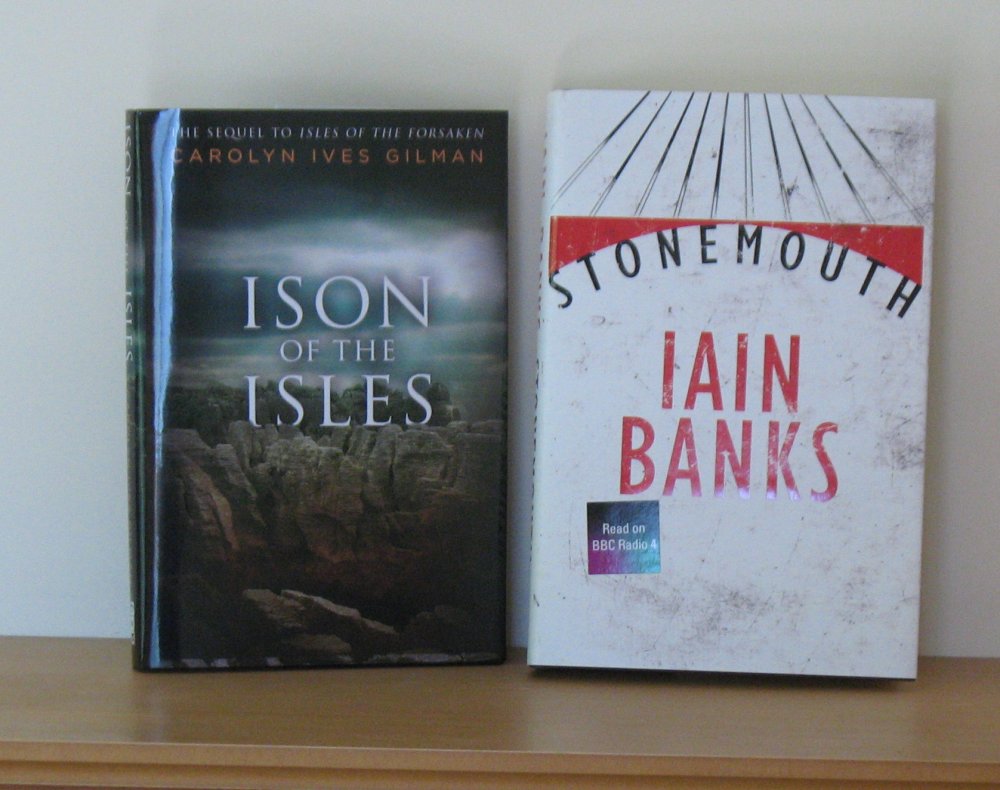
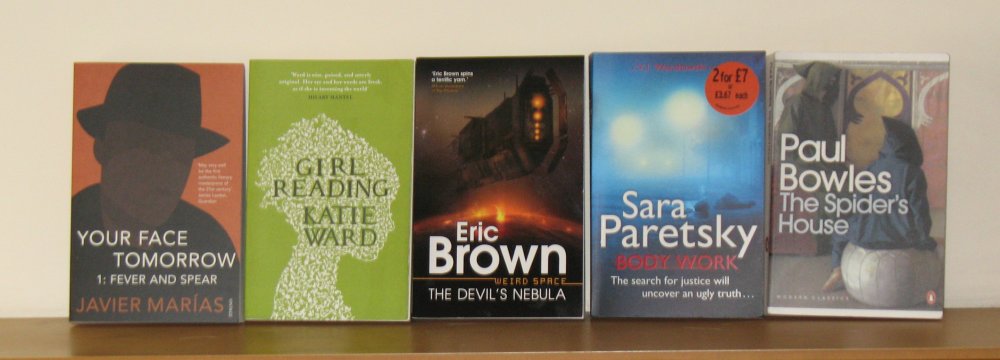
Some paperbacks, new and second-hand. Fever and Spear is, er, May’s book for this year’s reading challenge. I really must get caught up on that. Girl Reading I borrowed from my mother after seeing a positive comment on it on someone’s blog. Eric sent me The Devil’s Nebula; one day I hope to be able to return the favour. I’ve been a fan of Sara Paretsky’s books for many years and Body Work is her latest. I found it in a charity shop. As I did The Spider’s House, though I really must get around to reading The Sheltering Sky first.
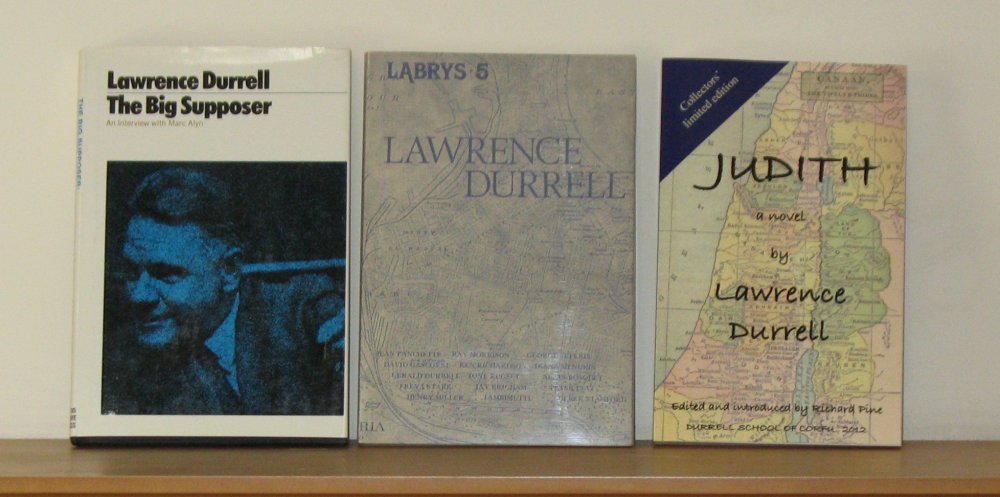
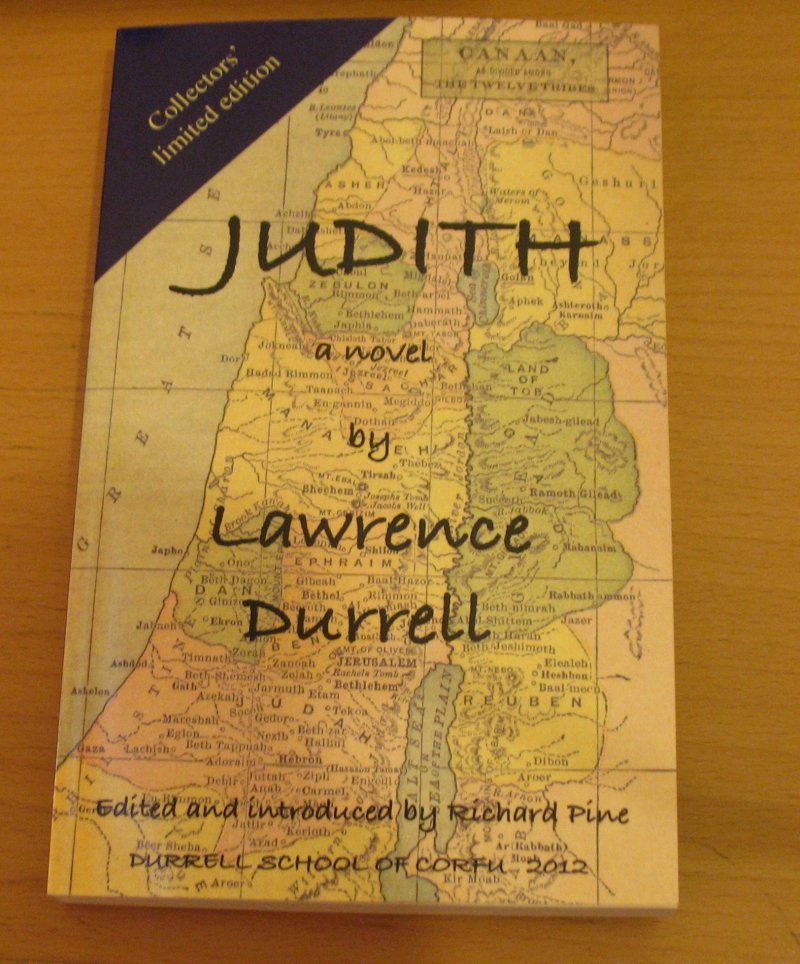
Some more Durrelliana. The Big Supposer is the English translation of a long interview which originally appeared in French. Labrys #5 is a special issue on Durrell. It’s also signed by him. And Judith is a previously-unpublished novel published only this year for the Durrell centenary.
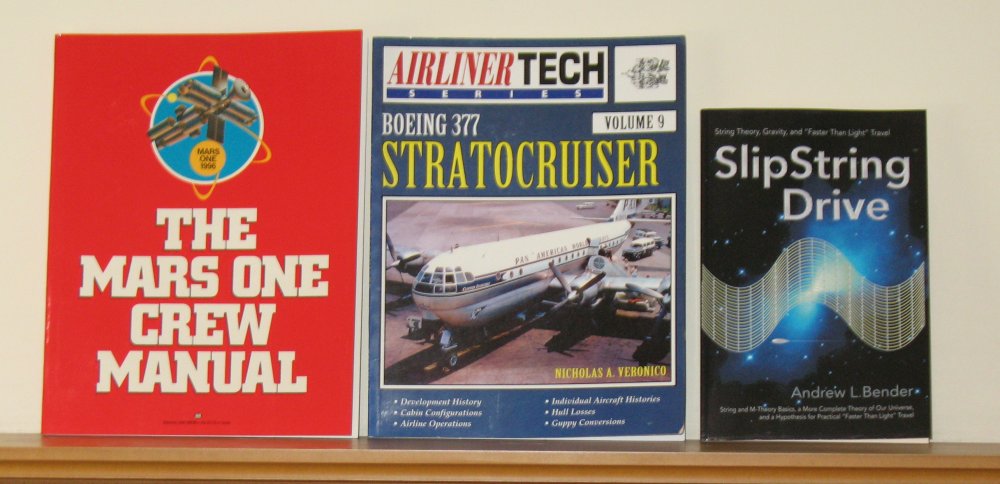
Here’s some research material. Both The Mars One Crew Manual and SlipString Drive are for Apollo Quartet 2: The Eye With Which The Universe Beholds Itself. The Boeing 377 Stratocruiser book is because I’m fascinated by the aircraft of the early days of air travel (it was also cheap on eBay).
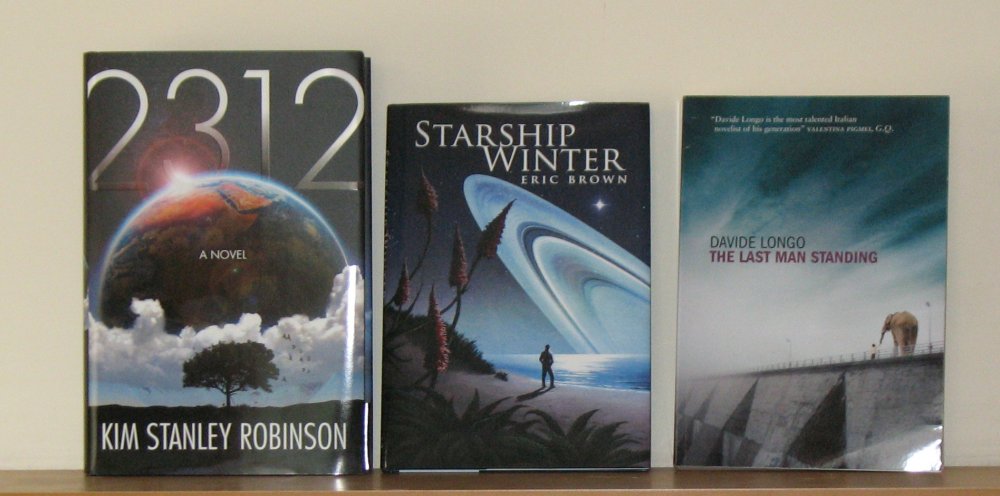
Kim Stanley Robinson is a genre writer whose fiction I admire, so I’m looking forward to reading 2312. Starship Winter is the third of Eric Brown’s seasonal novellas set on the world of Chalcedony. The Last Man Standing is an Italian novel in its first English translation, and I have to review it for Interzone.
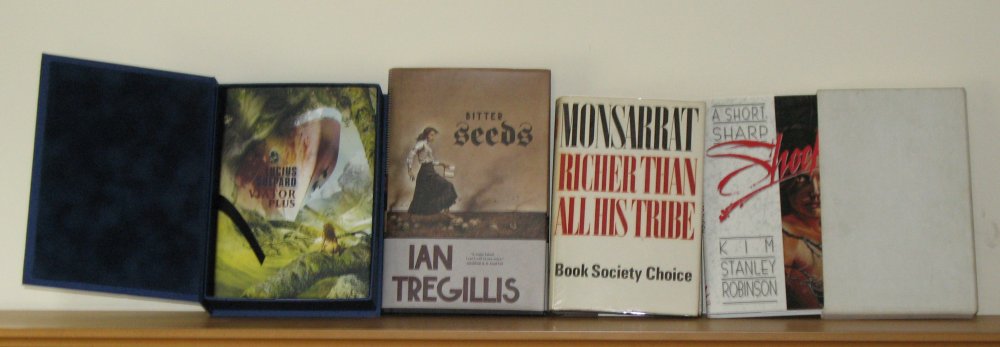
For the collection, here’s the traycased signed edition of Lucius Shepard’s Viator Plus, bought for half-price in their recent sale; Bitter Seeds I won on Twitter for a silly joke (many thanks, Andrew); Richer Than All His Tribe is signed and for the Monsarrat collection; and I found a cheap copy of the slipcased signed edition of Kim Stanley Robinson’s A Short, Sharp Shock.
I took this meme from David Hebblethwaite’s Follow the Thread blog, and he says he found it Story in a Teacup. It’s fifty-five questions about your reading. I think some of my answers are pretty much the same as David’s…
1 Favourite childhood book? I started out in sf reading Dr Who novelisations, but I can remember virtually nothing about them now. I don’t recall any specific books that I loved prior to that. I just read voraciously.
3 What books do you have on request at the library? I don’t use the library.
4 Bad book habit? Buying more books than I can read, and starting books when I haven’t finished the current read.
5 What do you currently have checked out at the library? I don’t use the library.
6 Do you have an e-reader? Nope.
7 Do you prefer to read one book at a time, or several at once? I prefer to read serially, but sometimes – often – I end up reading several books in parallel.
8 Have your reading habits changed since starting a blog? Yes. Since starting SF Mistressworks, and contributing to Daughters of Prometheus, I read far more fiction by women writers. I’ve also used this blog to challenge myself to read books I wouldn’t normally read – see this year’s world fiction reading challenge here.
11 How often do you read out of your comfort zone? Regularly.
12 What is your reading comfort zone? Science fiction and/or literary fiction. Also non-fiction about space exploration.
13 Can you read on the bus? Yes. I commute to work on a tram and read on it every day.
14 Favourite place to read? I usually read for 30 minutes to an hour in bed every night.
15 What is your policy on book lending? For my collectible books, never. Others, I’m happy to give away – and visitors have occasionally left with piles of paperbacks.
16 Do you ever dog-ear books? Never.
17 Do you ever write in the margins of your books? Never. But I will probably buy an ereader of some description soon because it’ll allow me to annotate what I’m reading.
18 Not even with text books? Nope.
19 What is your favourite language to read in? English.
20 What makes you love a book? Beautiful prose, it says something important, engaging characters, interesting structure… rigour, beauty, insight and depth.
21 What will inspire you to recommend a book? I’m happy to recommend books I both enjoy and admire; and often do.
22 Favourite genre? Science fiction.
23 Genre you rarely read (but wish you did)? I’ve read just about every genre there is, but… The genres I don’t read I generally have no intention of reading. Like urban fantasy.
25 Have you ever read a self-help book? No. I’ve no intention of ever doing so.
26 Favourite cookbook? I don’t have one. I prefer eating to cooking.
27 Most inspirational book you’ve read this year (fiction or non-fiction)? I don’t think of books as “inspirational”, or read ones that describe themselves as such.
28 Favorite reading snack? I don’t usually eat while I’m reading.
29 Name a case in which hype ruined your reading experience. Probably The Quantum Thief by Hannu Rajaniemi. It was good, but not as good as I’d expected it to be.
30 How often do you agree with critics about a book? Depends on the critic, obviously. But quite often. Award shortlists, on the other hand…
31 How do you feel about giving bad/negative reviews? Not giving a negative review to a bad book is dishonest. And dishonest reviews are next to useless.
32 If you could read in a foreign language, which language would you choose? I’ve tried reading in French, German and Arabic, and I’d like to improve my facility in those languages. But I also quite like the idea of being able to read Russian classic literature in Russian.
33 Most intimidating book you’ve ever read? In terms of sheer size, probably Ash: A Secret History by Mary Gentle. It proved to be excellent.
34 Most intimidating book you’re too nervous to begin? Possibly House Of Leaves by Mark Z Danielewski. Ian McNiven’s biography of Lawrence Durrell is also intimidatingly big, especially in hardback.
35 Favourite poet? Bernard Spencer or John Jarmain.
36 How many books do you usually have checked out of the library at any given time? I don’t use the library. When I lived in the UAE, I was a member of a subscription library and would generally take out four books every fortnight.
37 How often have you returned books to the library unread? In the UAE, I did it a couple of times. One such book was… The Alexandria Quartet by Lawrence Durrell. I later bought a copy and read it, and subsequently became a huge fan of his writing.
38 Favourite fictional character? I don’t know. There are characters I admire as writerly creations; there are characters who are little more than placeholders for the reader. I prefer the former.
39 Favourite fictional villain? See above.
40 Books I’m most likely to bring on vacation? Big fat ones that require sustained bouts of reading, such as I’ll enjoy on a plane flight or long train journey.
41 The longest I’ve gone without reading. A week, maybe slightly longer.
42 Name a book that you could/would not finish. Most recently, The Windup Girl by Paolo Bacigalupi.
43 What distracts you easily when you’re reading? The television, the internet, the cat…
44 Favourite film adaptation of a novel? It used to be The Right Stuff, but after a recent rewatch I found myself disappointed by the film. Now it would be Fahrenheit 451 – though I love the film but hate the book. Irony in action…
45 Most disappointing film adaptation? The Sylvia Kristal adaptation of DH Lawrence’s Lady Chatterley’s Lover? It’s a bad film and it’s an adaptation. But the same could be said for a lot of sf adaptations… I don’t really know. I rate David Lynch’s Dune as a flawed masterpiece (and I’d have paid good money to see Alejandro Jodorowski’s film of the book had it been made). And Paul Verhoeven’s Starship Troopers is vastly superior to the book…
46 The most money I’ve ever spent in the bookstore at one time? No idea. I’ve spent around £100 on a single order at Amazon a number of times. The most money I’ve spent on a single book is $500, for a first edition of Pied Piper of Lovers, Lawrence Durrell’s first novel. See here.
47 How often do you skim a book before reading it? Very rarely.
48 What would cause you to stop reading a book halfway through? Blatant racism and/or sexism. Offensive sensibilities. Eye-stabbingly bad prose. An inability to plot. Despicable characters.
49. Do you like to keep your books organized? Yes, though the collection is getting a little bit out of hand…
50 Do you prefer to keep books or give them away once you’ve read them? Depends. Collectibles I keep. Likewise books that were hard to find. Others I get rid of as soon as I’ve read them. I’ve also purged my book shelves several times – for example, I saw no good reason to keep the Stainless Steel Rat novels I originally bought back in the early 1980s…
51 Are there any books you’ve been avoiding? Urban fantasy novels. Anything with zombies in it. Many of the books that have appeared on recent Hugo Award shortlists…
52 Name a book that made you angry.Leviathan Wakes by James SA Corey. See my review here.
53 A book you didn’t expect to like but did?Lady Chatterley’s Lover, DH Lawrence. My father was a big fan of Lawrence’s writing, but I never bothered trying any of his books. And this despite Lawrence Durrell being a big admirer of Lawrence. But after watching Pascale Ferran’s excellent adaptation, Lady Chatterley, in 2009, I decided to have a go at the book. And loved it. After my father died, I promised myself I would read all of Lawrence’s fiction, and recently finished The White Peacock. Structurally it’s a bit odd, but there’s some lovely prose in it. And it is sort of “local” fiction for me as I was born in Nottinghamshire. I am now becoming a bit of a Lawrence fan.
54 A book that you expected to like but didn’t?Bodies by Jed Mercurio. I loved his Ascent, and thought American Adulterer very good indeed. But Bodies was just too gruesome for me.
No, not me, but Lawrence Durrell. To celebrate his centenary this year, the Durrell School of Corfu have published a previously-unpublished novel by Durrell, Judith. It was originally written as a vehicle for the 1966 film of the same title, but after being rewritten in 1970 still never saw the light of day. Until now. A limited number of 500 copies have been published. I have one of them. See:
It’s halfway through 2012, and it must be shaping up to be one of the wettest years on record in the UK. But that’s okay because my hobbies are chiefly indoor ones – reading books, watching films and listening to music. I occasionally do a bit of writing too. But, since we’re in June, with around six months to go until the end of the year, it’s time to look back and determine what was the best of what I read, watched and heard in 2012. And it goes something like this…
Words
I seem to have read a lot of books that were good without being great; and possibly a larger number of books that weren’t good at all. Picking the best five proved harder than expected, though one or two titles were obvious…
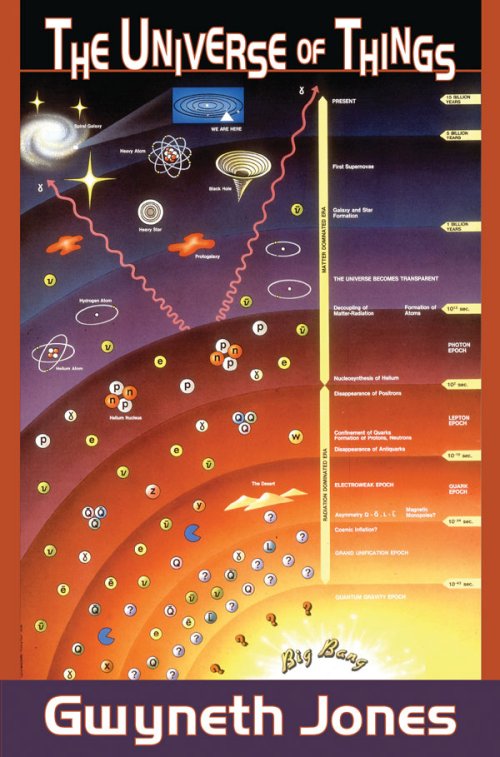
The Universe of Things, Gwyneth Jones (2011). Jones has been my favourite writer for many years, so this collection’s appearance on the top five is no surprise. I had, in fact, read most of the stories in The Universe of Things before (I even published one; sort of), but rereading them only cemented my admiration of them. Jones has not written many stories, but there are no clunkers among them. This collection is an excellent introduction to her fiction. I wrote a review of the book for Daughters of Prometheus.
Omega, Christopher Evans (2008). I’ve long admired Evans’ fiction, but he seemed to stop writing after 1995’s Mortal Remains… until Omega four years ago. I won’t say it was worth the wait, because it’s never good when a writer whose books you enjoy and admire disappears for more than a decade. But certainly Omega is a good book, a clever alternate history dimension-slip thriller partly set in a world where World War II continued on throughout the twentieth century. I wrote about Omega on my blog here.
The Door, Magda Szabó (1987). This year for my reading challenge I decided to read books by non-Anglophone writers I’d never read before. The Door was the second book I read for the challenge, and I really enjoyed it. Unfortunately, the challenge has got a little bogged down of late – I failed to finish March’s book, read April’s book late, and have yet to even start May’s. Anyway, I wrote about The Door on my blog here.
The Bender, Paul Scott (1963). I read the first book of the Raj Quartet for one of my reading challenges, and thought the book was superb. As a result, I added Scott to the list of authors whose books I track down to read. In first edition. The Bender predates the Raj Quartet and is not as weighty as those four books. It’s a very 1960s comedy, but also a beautifully witty one. I wrote about it on my blog here.
Betrayals, Charles Palliser (1994). I’m surprised this book isn’t better known. It’s an amazingly-put-together series of stories which form a much greater story. It opens with a series of Victorian travellers, trapped on a train by snow, who tell each other stories… and then proceeds to unravel and then stitch together the stories told by those travellers. There’s a superb take-down of a cult semiotician, a clever spoof of the Scottish detective programme Taggart, and a brilliant pastiche of Jeffrey Archer. Perhaps the links between the stories aren’t quite strong enough to carry the story-arc, but Betrayals is a very clever, very amusing, and excellent novel.
Honourable mentions go to Eastermodern by Herta Hurnaus, Oscar Niemeyer Houses by Alan Weintraub and Building Brasilia by Marcel Gautherot, which are books of photographs of modernist and brutalist buildings. Niemeyer’s work perfectly encapsulates the future we could have had, and all cities should resemble Brasilia. Also worthy of note are How to Suppress Women’s Writing by Joanna Russ, which every writer and critic should read; Alias Grace, which is probably Margaret Atwood’s best novel; and Hear Us O Lord from Heaven Thy Dwelling Place by Malcolm Lowry, a collection by an author new to me which contains some excellent novellas and some not so interesting short stories.
Pictures
I’ve already visited the cinema twice so far this year, which is something of a record for me. One of the films I saw in IMAX 3D makes it onto my top five; the other one was rubbish, so it doesn’t. The other films I’ve seen were all on DVD – some borrowed, some bought, and some rented.
Red Psalm (Még kér a nép), Miklós Janscó (1972). I bought this after seeing a review of the DVD in Sight & Sound. I wasn’t sure what to expect, but it certainly wasn’t a group of hippie-looking Hungarians wandering around a farm spouting socialist rhetoric and singing folk songs, and then getting shot at by soldiers. I loved it. I wrote about Red Psalm on my blog here.
Red Desert (Il deserto rosso), Michelangelo Antonioni (1964). I’ve admired Antonioni’s films since first seeing L’Avventura several years ago. Red Desert was his first film in colour, and it shows – it’s an amazingly painterly film. Unlike in most films, the characters do not over-shadow their world but are very much a part of it. It creates a distance between viewer and cast, but there’s an immersive quality to the mise en scène which renders that of little importance. Films don’t need viewer analogues – that’s just confining the medium to the simplicity of oral storytelling: films use images just like books use words, and that’s where their focus should lie. I wrote about Red Desert on my blog here.
Shadows of Forgotten Ancestors (Тіні забутих предків), Sergei Parajanov (1965). I watched Parajanov’s The Colour of Pomegranates last year. That film is perhaps the zenith of “poetical cinema”, but Shadows of Forgotten Ancestors is definitely a way-station on the climb to it. It is, on the face of it, a simple story of one young man’s trials and tribulations. He is a member of Ukrainian Hutsul culture, and the film is rich with its costumes, music and traditions. Shadows of Forgotten Ancestors is by no means an easy film to watch, however, as it operates on so many levels – but it at least has a coherent plot, which is more than can be said for The Colour of Pomegranates.
On the Silver Globe (Na srebrnym globie), Andrzej Żuławski (1978/1988). If you can imagine a film that out-Tarkovskys Solaris, then you might have some idea of what On the Silver Globe is like. It’s based on a trilogy of novels published in Poland in 1911 by Jerzy Żuławski, which have apparently never been translated into English. On the strength of this film, they should be. It’s probably evident that I’m not a huge fan of traditional Hollywood-style cinema; it often feels to me like a waste of the medium’s potential. And yet films such as Red Psalm and On the Silver Globe, with their declarative dialogue, often feel like they’re only partway to what film could truly be. I like the painterly mise en scène of poetical cinema, but often find the declarative dialogue as clumsy as science fiction’s crude use of exposition. And so it is in On the Silver Globe – characters run around and gurn at the camera, and then speechify on the meaning of life. However, it’s in the story and the imagery that the film really impresses – enough, in fact, to offset the fact the film was never completed – much like Andrzej Munk’s Passenger. The Polish Ministry of Culture closed down the production of On the Silver Globe when the film was only 80% complete. It was ten years before Żuławski returned to it, and then he could only complete it by using stock footage and voice-over for some parts. It works surprisingly well. I plan to write more about On the Silver Globe on this blog.
John Carter, Andrew Stanton (2012). John Carter received a mauling at the US box office, so much so it was officially declared a flop by its studio, Disney. Happily, the world outside the US had more discerning taste and went to see the film in sufficient numbers for it to eventually turn a profit. But the profitability of a film is measured solely on its performance at the US box office – which is both dumb and parochial – so it’s unlikely a sequel to John Carter will ever be made. Which is a shame. John Carter was a spectacle, with a clever script that managed to make something twenty-first century of its early twentieth-century source material. It had its flaws – some longeurs, and an inelegant info-dump to explain the plot – but other parts more than made up for it. I wrote more about it on my blog here.
Honourable mentions go to 8½, Federico Fellini (1962), which after seeing La Dolce Vita many years ago and disliking it, I had expected to hate – I didn’t; I loved it. Troll Hunter, André Øvredal (2010), was another deadpan Norwegian spoof and cleverly done, though not quite as good as Norwegian Ninja. The Third Part of the Night, Andrzej Żuławski (1971), was the first Żuławski I saw, and it’s off-the-wall Hitchcockian style appealed to me greatly (as did Andrzej Korzyñski’s superb soundtrack). Went the Day Well?, Cavalcanti (1942), was a surprisingly brutal piece of wartime propaganda in which a German fifth column try to conquer a small English village. It goes badly. The Extraordinary Adventures of Adèle Blanc Sec, Luc Besson (2010), gets a mention as an entertaining adaptation of Jacques Tardi’s bande dessinée, and though it’s completely silly it was great fun. Finally, some quality telly: Twin Peaks (1990 – 1991), which has not dated at all, and is still great entertainment despite being completely bonkers; and Caprica (2010), which promised so much more than it ever got the chance to deliver.
Sounds
I knew from early this year that 2012 was going to be good for music. Perhaps few of my favourite bands are releasing albums, or touring the UK, but I’ve stumbled across some bands new to me that have been on almost constant play on the iPod.
Dwellings, Cormorant (2011). The band self-released this last year and it’s a powerful mélange of half a dozen metal genres. I loved it from the first listen, and even went back and got copies of their earlier two albums.
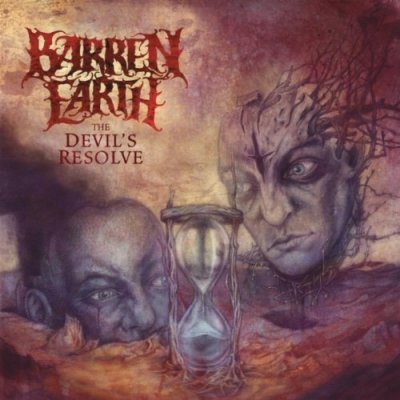
The Devil’s Resolve, Barren Earth (2012). This is the superband’s second album, and it’s a heavier and yet proggier effort than their first. The riffs are not quite as memorable as they are on The Curse of the Red River, but the lead breaks are much more impressive, and the proggy break-outs even stranger. Opeth’s Heritage proved there was a market for 1970s-inspired weird Scandinavian prog, and Barren Earth have taken that and melded it with Scandinavian death/doom to create a winning combination.
The Weight of Oceans, In Mourning (2012). I saw a review of this and it sounded appealing, so I ordered a copy from a Finnish website. It’s death/doom in that way the Finns do so well, but with added slow modern progginess. It’s not proggy like Barren Earth is proggy, inasmuch its acoustic parts feel more of a piece with the heavy parts. I’ve been playing it constantly since it arrived.
Nostalgia, Gwynbleidd (2009). Another band I came across mention of and who I thought I might like. So I bought the album. And yes, I do like them. Very much. They’re a sort of mix between Opeth and Northern Oak, but also not much like either. There are long sustained death metal parts, interspersed with folky acoustic guitar, and it all hangs together exceedingly well.
Legacy, Hypnos 69 (2010). I’ve been a fan of Hypnos 69 since hearing their The Intrigue of Perception several years ago. I’s taken me a while to get hold of Legacy, chiefly because it was released by a small label in Germany and wasn’t available in the UK. Recently I discovered it was on bandcamp, so I bought it from there. It’s Hypnos 69 doing Hypnos 69-type stuff, and I love it.
Honourable mentions go to Finnish death metallers (Psychoparalysis), who have self-released three excellent EPs; Weather Systems by Anathema (2012), which I much prefer to the previous album; Wood 5: Grey Skies & Electric Light by Woods of Ypres, which is folky black metal that sounds a little like Type O Negative in places and includes strings and oboe; and finally, All Spawns, a recent compilation of Czech death metal pioneers Apalling Spawn’s two released from the late 1990s (now, if I can only find a copy of the Sparagmos compilation, I’ll be really happy…).
It’s been a while since my last book haul post – two months, in fact – which goes some way to explaining the number of books which appear in this one. Someone needs to put more hours in the day so I can actually get around to reading some of them…
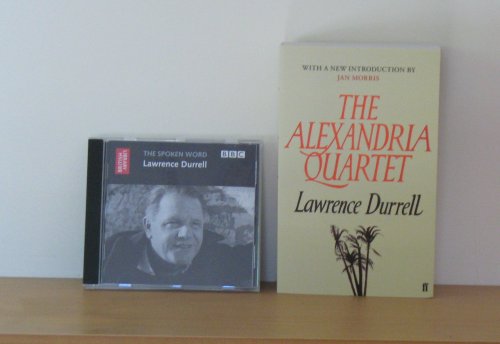
This year, of course, is the Durrell Centenary. So I’ll be rereading The Alexandria Quartet at some point, and I thought I’d buy myself the new paperback edition so I could do so. The CD is a collection of poetry readings, interviews and, er, Durrell singing.
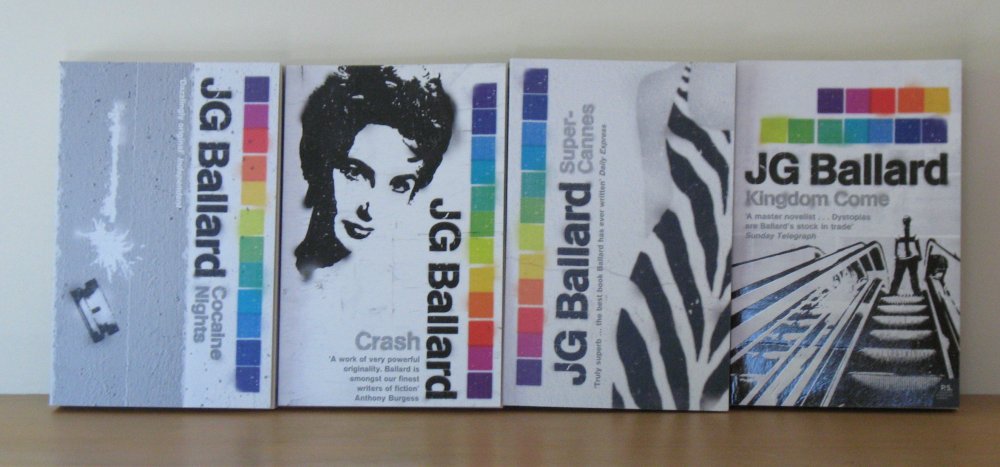
Ballard is not a young man’s writer – not enough shit gets blown up, for a start; and then there’s that cynicism – so while I’ve read many of his stories and books over the years it’s only in the past few I’ve come to really appreciate his fiction. As a result, I’ve been building up a small paperback collection of his books – and they are attractively packaged paperbacks, these 4th Estate ones.
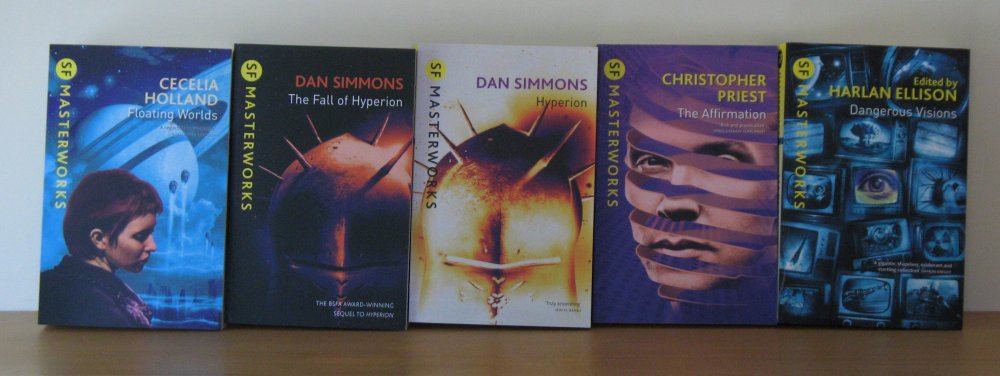
I am not, it has to be said, a particularly big fan of all the titles that have appeared in the SF Masterworks series, and most people don’t spend money on books they know they don’t especially like… but… they make a set. They’re packaged to look the same – or they were until they revamped the entire series. And some of them really are genre classics: Hyperion and The Fall of Hyperion, certainly; and much as I loathe Harlan Ellison and his works, I have to admit Dangerous Visions was an important anthology.
From my trawls through various charity shops some books from the would-like-to-read list. I’ve been working my way through Litt’s alphabetical oeuvre, though none have especially impressed me so far. McCarthy should only be read when you’re feeling unaccountably cheerful and would like to torpedo your good mood. The Satanic Verses is infamous, but I’ve never read it. The Mailer was a swap from readitswapit.co.uk, and I’m not sure why I bought The Apple.
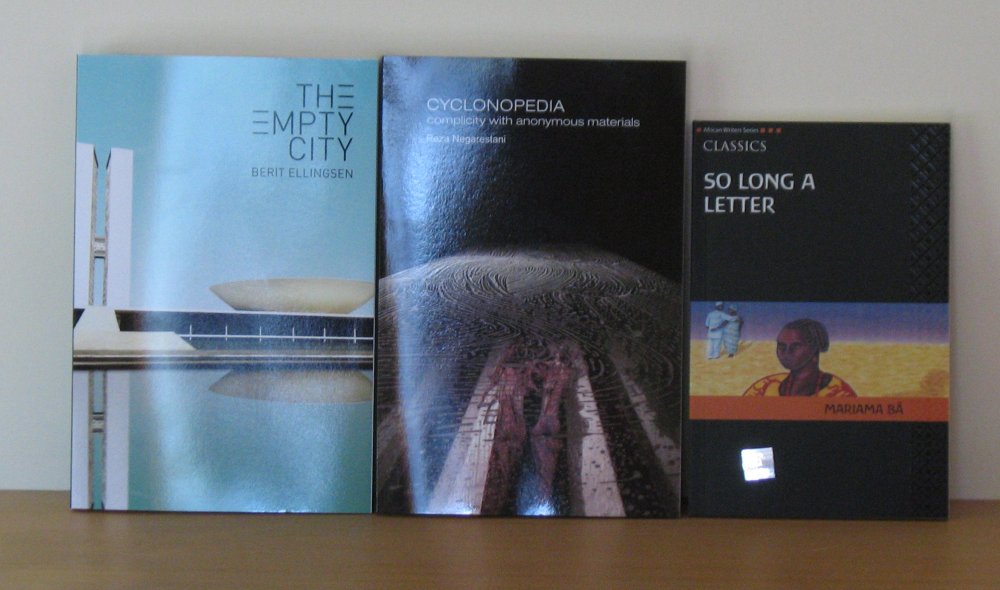
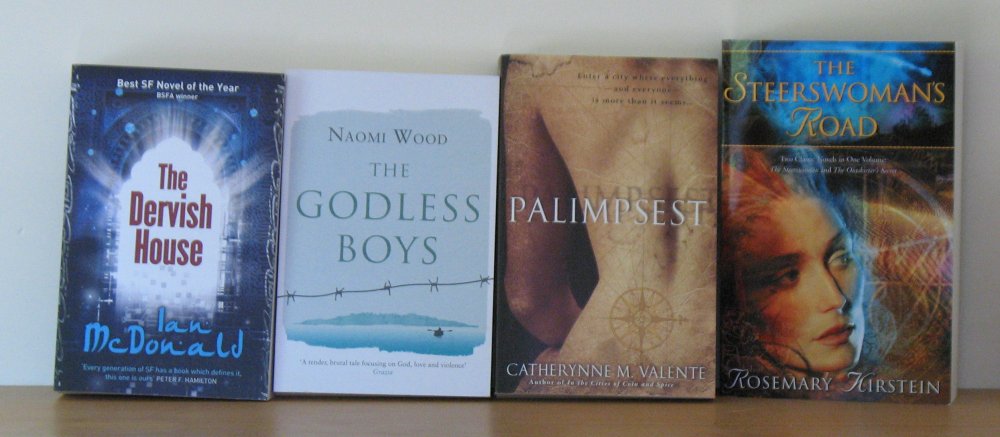
So Long A Letter is May’s book for this year’s reading challenge (see here). Cyclonopedia has been repeatedly recommended by Jonathan McAlmont, and Berit Ellingsen is one of the contributors to Rocket Science (plus, the cover art of The Empty City is the National Congress building in Brasilia – see later).
Three genre titles for the collection – both Remaking History and Moon Dogs are signed (and those two authors pretty much describe the two endpoints of the type of sf I like best). The Ice Monkey is really hard to find in hardback but I lucked out.
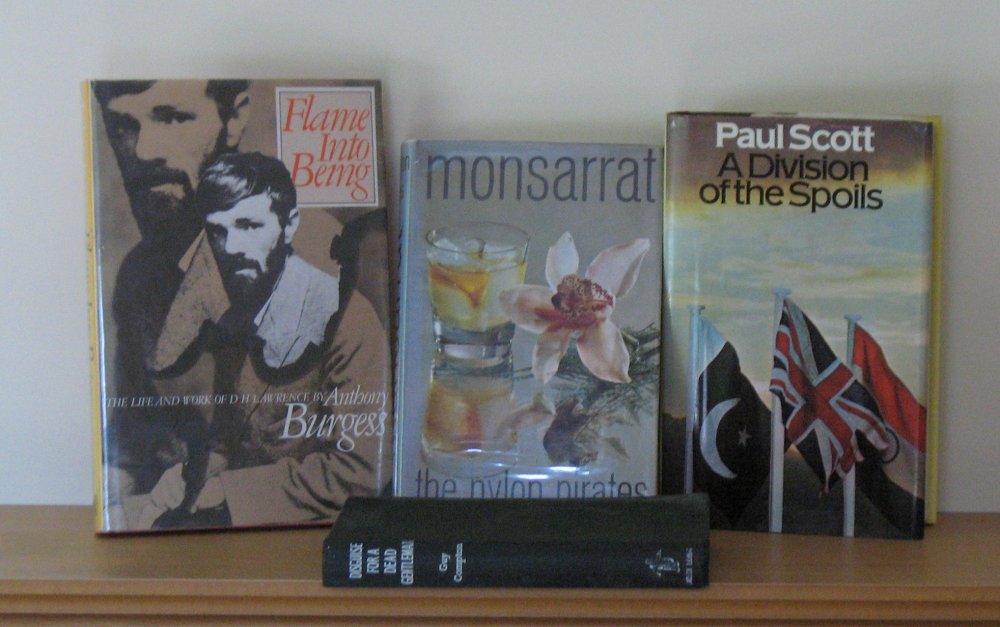
I collect first editions by Anthony Burgess, and I’m interested in the works of DH Lawrence, so Flame into Being neatly covers two of my literary interests. The Nylon Pirates is one of Nicholas Monsarrat’s potboilers – he managed to write potboilers and literary fiction with equal facility if somewhat variable results. A Division of the Spoils is the third book of the Raj Quartet, and Disguise for a Dead Gentleman is DG Compton in his initial guise as a crime writer. I expect good condition first editions of those early “Guy Compton” books are extremely difficult to find, so this tatty one will have to do.
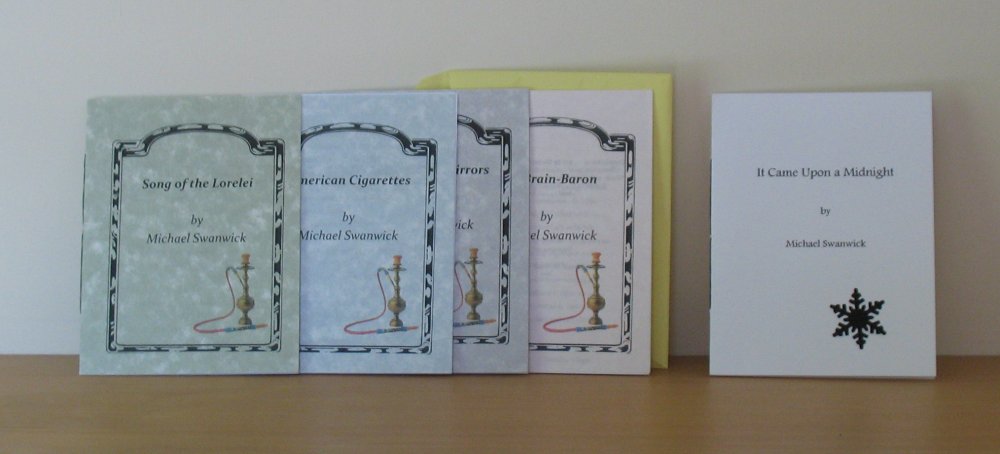
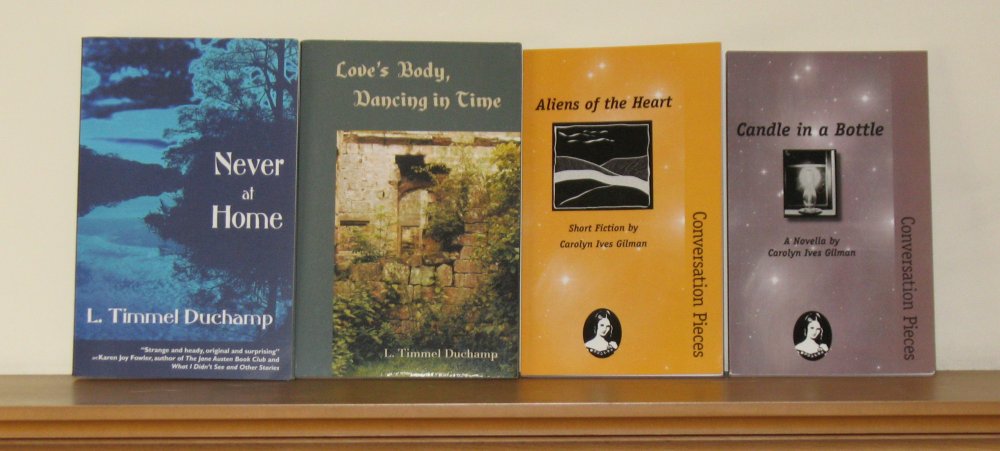
I spotted mention of these chapbooks by Michael Swanwick from Dragonstairs Press somewhere and decided to take a punt on them.
If I ever visit Brazil, it won’t be for the carnival, the beaches, the cocktails, the culture… it’ll be to see the buildings in Brasilia. I love the fact that even unfinished, or badly weathered, they still embody the optimistic future past decades imagined we’d all share. The man chiefly responsible, of course, was Oscar Niemeyer. Eastmodern is more Warsaw Pact architecture, a collection of photographs of modernist buildings in Slovakia, and some of them really are quite skiffy.
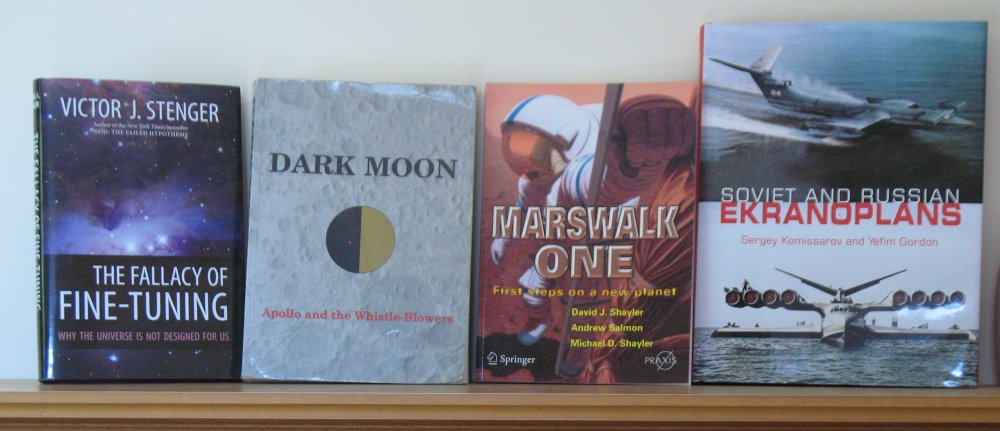
The giant book on ekranoplans was research for a story, honest. Or it will be when I’ve thought of an idea for story which has ekranoplans in it. Well, I managed it for flying boats (see here), so anything’s possible. Besides, if Sebastian Faulks can include one in his 007 novel Devil May Care, why shouldn’t I? Marswalk One is one of several Mars book I now own and which I will use as research while writing the second book of the Apollo Quartet (I got it very cheap on eBay). Dark Moon is one of those fake Moon landing nutjob books, and I thought it might prove entertaining. The Fallacy of Fine-Tuning is also research for Apollo Quartet book 2.
I am, I suspect, like most people: I know that Amazon is a Big Bad Monopoly and famous for screwing over publishers, but, well, the books and DVDs they sell are competitively priced and the service is good and… So I buy from them. I even link books titles on this blog to my Amazon affiliates account – it currently earns me about £15 a year. (To be fair, I have always linked small press books directly to their own site, in order to better support them.) I’ve also tried selling books on Amazon Marketplace, but given that I have to price them so low to get sales, and that Amazon take off around £2.80 in fees, many of them I’ve sold at a loss. And I don’t mean a loss when factoring in their original purchase price. I mean, it cost me more to post the book than I received from the sale. But I didn’t much care – at least the books were no longer cluttering up my house.
But now the shoe is well and truly on the other foot.
Last month, I started up Whippleshield Books, a niche small press to publish literary hard sf. I did it partly to self-publish something I felt I needed more control over than another small press would give me. I also wanted it out quickly, so I could launch it on the back of Rocket Science at Olympus 2012 last weekend. Which I did. It’s called Adrift on the Sea of Rains.
I bought some ISBNs, and I paid to have the book professionally printed by MPG Biddles. Since the book has an ISBN – two, in fact, one for the paperback and one for the limited edition hardback – it appears in Nielsen’s database, and so was picked up by Amazon. Where the two editions were offered for pre-order.
But the product pages on Amazon were very basic, with only title, author, price, artwork, publisher, pagecount and ISBN. I decided to add a blurb and some reviews. I identified myself as the publisher, and filled in the necessary online form. It would take five days to update the product page, I was told. A day or two later, the book could no longer be pre-ordered; it was now marked “unavailable”. Thinking this might have been a consequence of my editing, I contacted Amazon.
They assured me it wasn’t, and said it was simply because they “did not have a relationship with the supplier”. Amazon suggested I join their Amazon Advantage programme. Now, I’d only edited one of the two editions of my book. The other could still be pre-ordered. The whole thing smelled to me, but never mind… I signed up for Amazon Advantage. It costs £23.50 a year. This was much better, I thought. I had much greater control over the product page. For the small annual fee, this seems okay.
Then Amazon ordered a copy of the paperback edition of Adrift on the Sea of Rains, and I discovered things weren’t so good after all.
Amazon take 60% of the retail price. This is non-negotiable. For a £3.99 paperback, this means I earn £1.60 per copy sold. Amazon take £2.39. And they’ll carry as much stock as they think they can sell, which in this case is a single copy.
The paperback of Adrift on the Sea of Rains costs me £1.32 per copy to print (not including one-off set-up costs, or the fixed cost of the ISBN). So that’s 28p profit per copy sold on Amazon. A bit small, but never mind. Except… I have to ship the order. I have to pay for the postage and packing. At the moment, that’s 20p for a padded envelope and 92p postage for second class large letter. My 28p profit has now become 84p lost. If I have to supply single copies to Amazon, then for each copy I will lose £0.84. If they order 100 copies one at a time, I will be £84 out of pocket. I may not be a businessman, but even I can see this is no way to run a business.
It was always my intention to set up a website of my own for Whippleshield Books, and I would sell copies there. But only a microscopic percentage of the people who visit Amazon were likely to visit my site. So selling on Amazon appeared a good move. And so it would have been. If they’d ordered 100 copies from me at £1.60 for stock, I’d have made £28 (less shipping, which would be less than £28). But since I might have to supply each individual order… it’s untenable.
I’m going to withdraw my Whippleshield Books from Amazon. I am going to stop using my Amazon affiliates account (I’ll leave the existing links on this blog; I don’t have time to go back and remove them all). I am going to pull my books from my Amazon Marketplace account. And I will look elsewhere to buy books and DVDs. Even if it costs me more. (That may result in me buying less, which can only be to the good.)
Having said that, I will be providing a Kindle edition of Adrift on the Sea of Rains. I have no choice in that – the platform is popular and it is the easiest way for Kindle owners to purchase the book. I can also make a profit on each sale. And I hope to have the Whippleshield Books website up and running in the two to three weeks.
Wasn’t yesterday fun? The Clarke Award shortlist is announced on Tuesday to muted cries of disbelief: what, no By Light Alone? No Osama? No The Islanders? Sheri S Tepper? Are you serious? This is neither unusual nor unexpected. But then Christopher Priest comes crashing into the debate with a long and (mostly) well-argued rant that teeters throughout on the edge of madness and then at the end finally topples into lunacy. Kill the jury! They are incompetent! They didn’t pick the best books!
And now the Clarke Award is all over the newspapers, and even people in the US have actually heard of it.
Result.
This is a photo of China Miéville - because every piece on the Clarke Award or the state of British sf should be accompanied by a photo of China Miéville (source: guardian)
I remember back in the early 1990s when one publisher was so pissed off at the Clarke shortlist they boycotted the awards ceremony. Another year – it may even have been the same year – the “wrong” book won, and a publisher threatened to never submit any books ever again. It happens, it passes. We talk about it, we move on.
Which is not to say that sometimes awards do royally fuck up. Blackout / All Clear*, for instance. And many people, including myself, are somewhat disappointed with the 2012 Clarke Award shortlist. I didn’t think Embassytown belonged on it. Hull Zero Three I’ve heard mixed reports about. I’ve not heard anything good about The Waters Rising. Rule 34 is a loose sequel to Halting State, which has been sat unread on my book-shelves since I was given a free ARC of it at alt.fiction in 2008 (see here). Besides, I’ve worked in IT for twenty years, I’m a geek – and I hate geek fiction. I know nothing about The End Specialist, though the general consensus seems to be it’s pretty good and shows promise but isn’t exactly award-worthy. The Testament of Jessie Lamb I’ve read and it was the one title I guessed would be – and wanted to be – on the shortlist, so I’m pleased I got that right.
Of course, when teacup tempests like this occur, something is needed to calm the troubled, er, beverage. “It wasn’t a failure of process” is one. “The committee did exactly what they were charged with doing” is another. Both are valid. “It’s entirely subjective” is a third. It’s also complete bollocks. As Adam Roberts put it “aesthetic judgment is not an exact science”. But it’s certainly not an “entirely subjective” process. Otherwise we wouldn’t have literary sf vs every other type of sf. We wouldn’t even have classics of literature. Some books are objectively better than others. FACT.
The Clarke is a juried award, so it’s not a popularity contest. It doesn’t matter how nice the author of a book is; it should not influence the judges’ decision (see Cheryl Morgan here for mention of the different ways in which juried awards can work). Books don’t get on juried shortlists as rewards for long and well-regarded careers. Having said that, the Clarke is not just about the best science fiction novels published during the preceding year. It also tries to say something about the state of the genre in the UK. It’s a bloody great loud announcement in the genre conversation. (Which does make you wonder why they shortlisted a ten-year-old Tim Powers novel last year…) The Clarke shortlist does not just say, “here are the six best sf novels published last year” – because they are patently not. The shortlist also says something about what British science fiction is and should be. Whether we want to hear, or understand, that message is another matter entirely.
I certainly think that British science fiction appears to have smeared out into a spectrum with two extremes, at one end China Miéville and at the other Neal Asher. We have “literary” sf on the one side – Adam Roberts, Christopher Priest, Gwyneth Jones, etc. On the other, the giant splodey spaceships school of sf – Gary Gibson, Michael Cobley, Stephen Baxter (mostly), Gavin Smith, Charles Stross, Paul McAuley, Al Reynolds… And everything spread out on a line in between. The more literary end has dominated the Clarke Award in recent years. The current shortlist shifts the balance a little back towards the core genre end.
It’s an argument worth making. I can’t claim to know what was going through the heads of the judges, I can only speculate given the six books they chose for the shortlist. Some of them are acquaintances, and I’m aware of their opinions on certain genre-related matters. But even then, I wouldn’t dream of speaking for them as I’m as likely to be completely wrong as I am anywhere near the truth. However, if their intention was to get people talking, then in that respect they have succeeded admirably.
One such conversation took place yesterday on Twitter between myself and Neil Williamson. He argued that entertainment was often under-valued when determining the quality of a book. I pointed out that good books should do more than just entertain – “a book that aims for a low target should not be praised for hitting it”. Bad books can also prove entertaining – the example I gave was the works of AE van Vogt, which are abysmal but I enjoy reading them. Neil responded that writers should be praised if their books are entertaining, and skilfully and deliberately so. And so forth. We agreed to agree. I don’t doubt that over the next few weeks – and especially in the bar at the Eastercon next weekend – the Clarke shortlist will spark off further discussions. Some of them may even reach a conclusion or two.
And then, of course, there is the awards ceremony, when the winner of the Clarke will be announced. They will, of course, pick the wrong book. That’s how it works. And then we can argue about it all over again…
Until next year.
(* Completely unrelated, but has no one noticed that choosing Blackout and All Clear as titles links them incorrectly? During WWII, the blackout was permanent, it did not signal the start of an air-raid. The “all clear” was sounded after an air raid had finished.)
Well, I didn’t see that coming. I was expecting a more literary shortlist, but this one is definitely more core genre. So much so, in fact, that at least half of the books harken back to much older sf. Hull Zero Three is a generation starship story (with, apparently, a resemblance to Pandorum), and The Waters Rising is a sequel to a book published in 1993. Embassytown I’ve read (my review here), and thought it somewhat 1970s in story and style.
The remaining three at least appear to be more relevant. I’ve read The Testament of Jessie Lamb and thought it very good – well, I thought the first half excellent, and the second half less good. Rule 34 I may try reading, but The End Specialist doesn’t appeal at all.
Anyway, once again the Clarke Award has confounded expectation, something it has done since it was first inaugurated. I am, perhaps, a little disappointed in the shortlist – there were, I thought, better books than some of the ones chosen. Interestingly, Nicholas Whyte guessed four of the six, and could have guessed five of them, simply from their popularity on Goodreads.com and LibraryThing.com. Does this mean the Clarke was looking for “readability”, just as the Booker judges foolishly claimed to be last year? I’m pretty sure that’s not the case, but I do think there was an attempt at narrowing the definition of science fiction after previous years’ occasionallly bizarre flexibility over the term.
And no, I’m not going to predict the winner. I just hope it’s not Miéville.
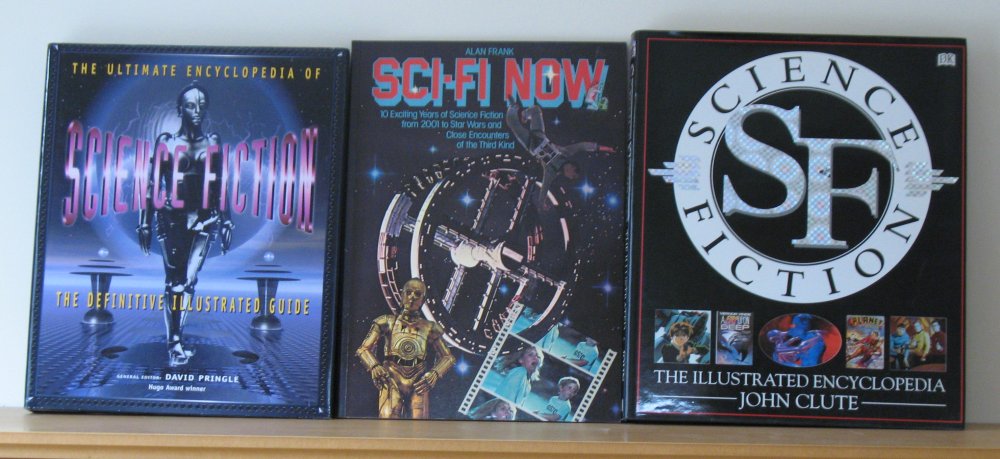
According to Damon Knight, “science fiction is whatever I’m pointing at when I say ‘science fiction'”, which is about the most useless and yet most accurate definition of the genre to date. Which has not stopped countless people trying to come up with definitions of their own. They’ve even written entire encyclopaedias on the subject. These are some of the ones I have on my book-shelves…
Peter Nicholls’ 1979 The Encyclopedia of Science Fiction was the first such. I bought a paperback copy for £1 at an antiques fair back in the late 1980s, but later picked up a hardback copy for a fiver on eBay several years ago. I have two copies of the next version, Clute & Nicholl’s The Encyclopedia of Science Fiction, because I bought the hardback edition when it was published – RRP £45!; but I got it for £27 from an acquaintance who claimed to have contacts in the book distribution trade. Anyway, when I moved to the Middle East after graduation, the book went into storage. But I stumbled across a paperback copy of the US second edition in Abu Dhabi. I don’t remember where I got the James Gunn The New Encyclopedia Of Science Fiction from. The latest version of The Encyclopedia of Science Fiction is, of course, online at sf-encyclopedia.com.
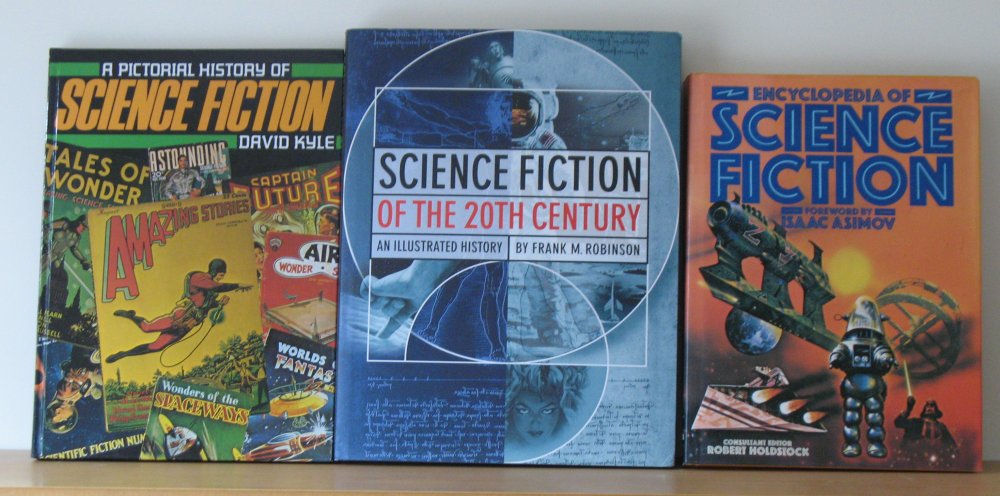
A trio of coffee-table books on science fiction. The Kyle and the Holdstock I’ve had for a couple of decades. Science Fiction of the 20th Century by Frank M Robinson I found cheap on eBay a few years ago.
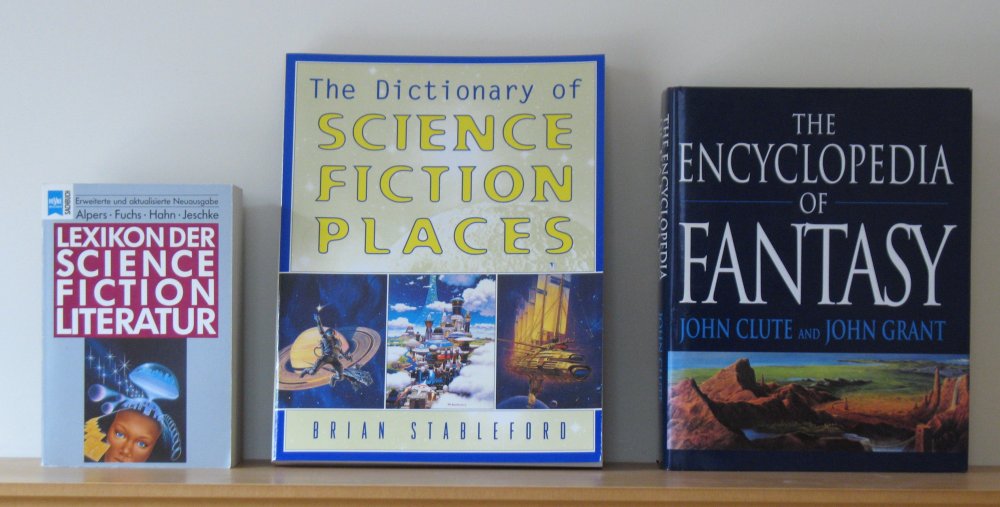
No collection of science fiction encyclopedias would be, er, complete without Clute & Grant’s The Encyclopedia of Fantasy. Lexicon der Science Fiction Literatur I bought while studying in Aachen in 1990. According to my records, I bought The Dictionary of Science Fiction Places for £2 in a discount book shop in Harrogate in 2004.
Edit: for reference, my post on critical works on science fiction is here.
I shamelessly stole this idea from Pornokitsch, who did the same yesterday. Since I’m not doing my readings & watching posts this year, I thought thirty words on the last thirty novels I’ve read might be a good way of mentioning my recent reading. But 30 words is actually harder to do than it looks…
Final Days, Gary Gibson (2011)
Discovery on planet orbiting distant star reached by wormhole suggests future is fixed and immutable. World starts to fall apart. Nice Apollo re-enactment but otherwise not that much stands out.
The Member of the Wedding, Carson McCullers (1946)
Tom Sawyer-ish Frankie daydreams of brother’s wedding. A GI mistakes her age, wants to get frisky. Lovely writing, though it’s hard not to suspect Frankie is wrong in the head.
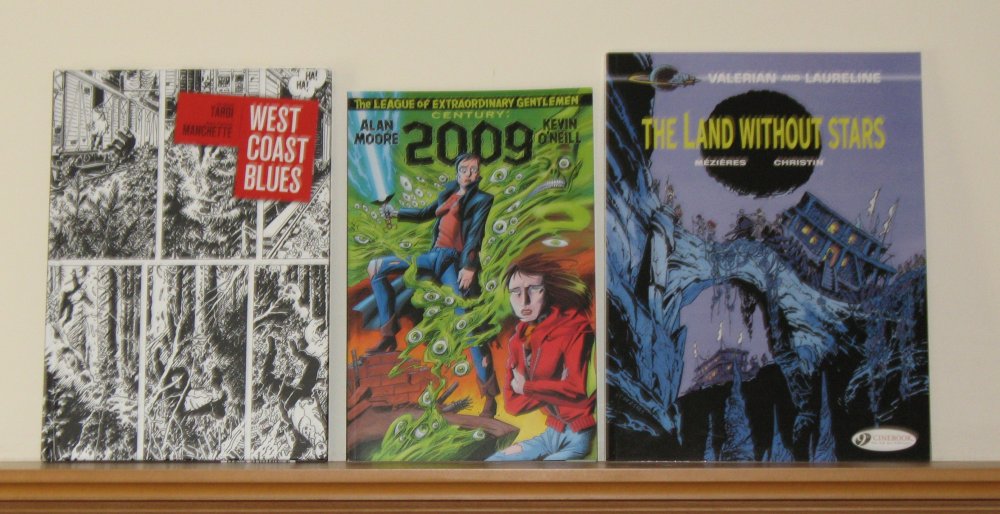
Like A Sniper Lining Up His Shot, Jacques Tardi (2010)
Graphic novel adaption of French thriller set in the UK. Assassin like father like son. With guns. And gore. Not much more to be said. Tardi is definitely worth reading.
Bodies, Jed Mercurio (2002)
Incompetent doctors get away with murder on the NHS. New houseman is horrified. He learns to work with the system. A favourite writer but it will scare you off hospitals.
City of Pearl, Karen Traviss (2004)
First human colony disappears, rescue mission discovers aliens protecting them. Mix of hard sf and space opera. Nice heroine, not so interesting aliens. Oozes competence without suggesting more. Review here.
The Bender, Paul Scott (1963)
Should have been a film with Dirk Bogarde. 1960s wastrel goes begging for cash and sparks family crisis. Great wit, great writing, and an astonishing postmodern interlude. Recommended. Review here.
Leviathan’s Deep, Jayge Carr (1979)
Freak alien resembles humans. They want to conquer her planet and fall in love with her. She scuppers their plans. Somewhat old-fashioned sf, though protagonist well-drawn. Review on SF Mistressworks.
The Bookman, Lavie Tidhar (2010)
Literary and pulp potage which stripmines steampunk tropes. Orphan adventures, starts cleverly in Victorian Lizard London but loses steam about halfway through before Bond-esque Vernian finish. The first of three.
Omega, Christopher Evans (2008)
Man recovering from terrorist bomb explosion dreams himself into alternate self in a world where WWII never ended. Very cleverly done, alternate world very real, great writing. Recommended. Review here.
Angel At Apogee, SN Lewitt (1987)
Princess pilot, a hot-shot of course, proves to be catalyst which rejoins three sundered races on three separate planets. Interesting debut, though perhaps a little over-egged. Review on SF Mistressworks.
The Fat Years, Chan Koonchung (2009)
China prospers while rest of world in financial crisis. Interesting window on Chinese society, though unsatisfactory as a novel – the plot is explained in a final chapter info-dump. Review here.
The Fall, Albert Camus (1957)
Pompous ex-lawyer monologues at stranger in Amsterdam bar and over several days tells him of his somewhat boring fall from grace. Mercifully short, though there’s some insightful writing in it.
Selected Poems, Lawrence Durrell (1956)
It’s a book of poems. And they were selected. By Lawrence Durrell. He did this several times. Except when he wasn’t collecting his poems for his Collected Poems. More here.
Betrayals, Charles Palliser (1994)
A story told through several stories – including a superb pisstake of Taggart, and a righteous skewering of Jeffrey Archer. Superbly done, though perhaps needed the stories tying together more. Recommended.
Leviathan Wakes, James SA Corey (2011)
Solar system shenanigans as alien virus wreaks havoc for corporate profit. Who needs New Space Opera? Regressive: no diversity, old school sexism, implausible villainy. Mostly right physics. Avoid. Review here.
Native Tongue, Suzette Haden Elgin (1984)
Men repeal rights of women, so they secretly develop women’s language. Interesting linguistics, good female characters, though characterisation of men not so convincing and world-building weak. Review on SF Mistressworks.
This Island Earth, Raymond F Jones (1952)
Manly engineer saves the galaxy by demonstrating good old US engineering know-how. Womanly PhD does his ironing and cooking. Happily they don’t write them like this any more. More here.
The Lady in the Lake, Raymond Chandler (1944)
Mixed-up femme fatales don’t fool Marlowe in hunt for rich man’s missing wife. Not the cunningest murder-mystery plot and Marlowe often gets away with murder. Strong on place and time.
The Door, Magda Szabó (1987)
In Hungary, writer hires housekeeper, who proves to be old school peasant and a right character. Fascinating portrait of housekeeper, thoroughly enjoyed it. Soon to be major film. Review here.
The Unorthodox Engineers, Colin Kapp (1979)
Collection of sf shorts in which lateral thinking engineers solve seemingly intractable problems. Dated, problems not especially unsolvable, nor especially original. Entirely forgettable, in fact. Hard book to find, though.
Journey to the Centre of the Earth, Jules Verne (1864)
Story not as good as Nemo’s though text is more pleasingly detailed. Science horribly dated, of course, and often wrong. Characters bizarrely emphatic – except for phlegmatic Icelandic guide. Historical document.
Arkfall, Carolyn Ives Gilman (2008)
Novella set on human-colonised Europa-like planet with interesting socialist society. Woman and male tourist find themselves on unintended journey after seaquake. Promises more than it delivers but still worth reading.
Kamikaze l’Amour, Richard Kadrey (1995)
Kadrey channels Ballard and Shepard in rock star epiphany in California overrun by Amazonian jungle. Not sure how original was 17 years ago but is not now. After Metrophage, disappointing.
Smart-Aleck Kill, Raymond Chandler (1958)
Collection of four shorts. Simple direct prose, strong on place and time, though plotting something of a direct line and characterisation sketchy. More for noir fans than normal readers, possibly.
Embassytown, China Miéville (2011)
Truthful aliens get hooked on impossible Ambassador’s speech. World falls apart. Narrator teaches aliens to lie and saves planet. Interesting ideas but old-fashioned science fiction. Likely award-winner. Sigh. Review here.
Dr No, Ian Fleming (1958)
Bond in Jamica. Again. Racial stereotype has evil plan to do evil. Bond foils, with help of trusty local. He nearly dies in the process, but he gets girl. Again.
The Incal, Alejandro Jodorowsky & Moebius (1981)
Seminal bande dessinée allegedly cobbled together from failed Dune film project. Light and dark Incal combine to save galaxy from evil Darkness. Completely bonkers. Lovely art. Everyone should own copy.
Alias Grace, Margaret Atwood (1997)
Character study of true life murderess from 1840s. Clevery done – never quite determines innocence or guilt, though very detailed on life and crime. Lovely writing. Possibly Atwood’s best novel. Recommended.
The Planet Dweller, Jane Palmer (1985)
Hot flushes and giant aliens that live inside planets. Cartoon aliens that want to conquer galaxy. Hit and miss comedy, but too fantastical for sf. Review soon on SF Mistressworks.
The Ginger Star, Leigh Brackett (1974)
By-the-numbers swords and planets. Manly hero brought up by animals battles way across barbarian planet to save mentor. Been there, done that. Yawn. Review soon on SF Mistressworks.

 Evans’ fiction, but he seemed to stop writing after 1995’s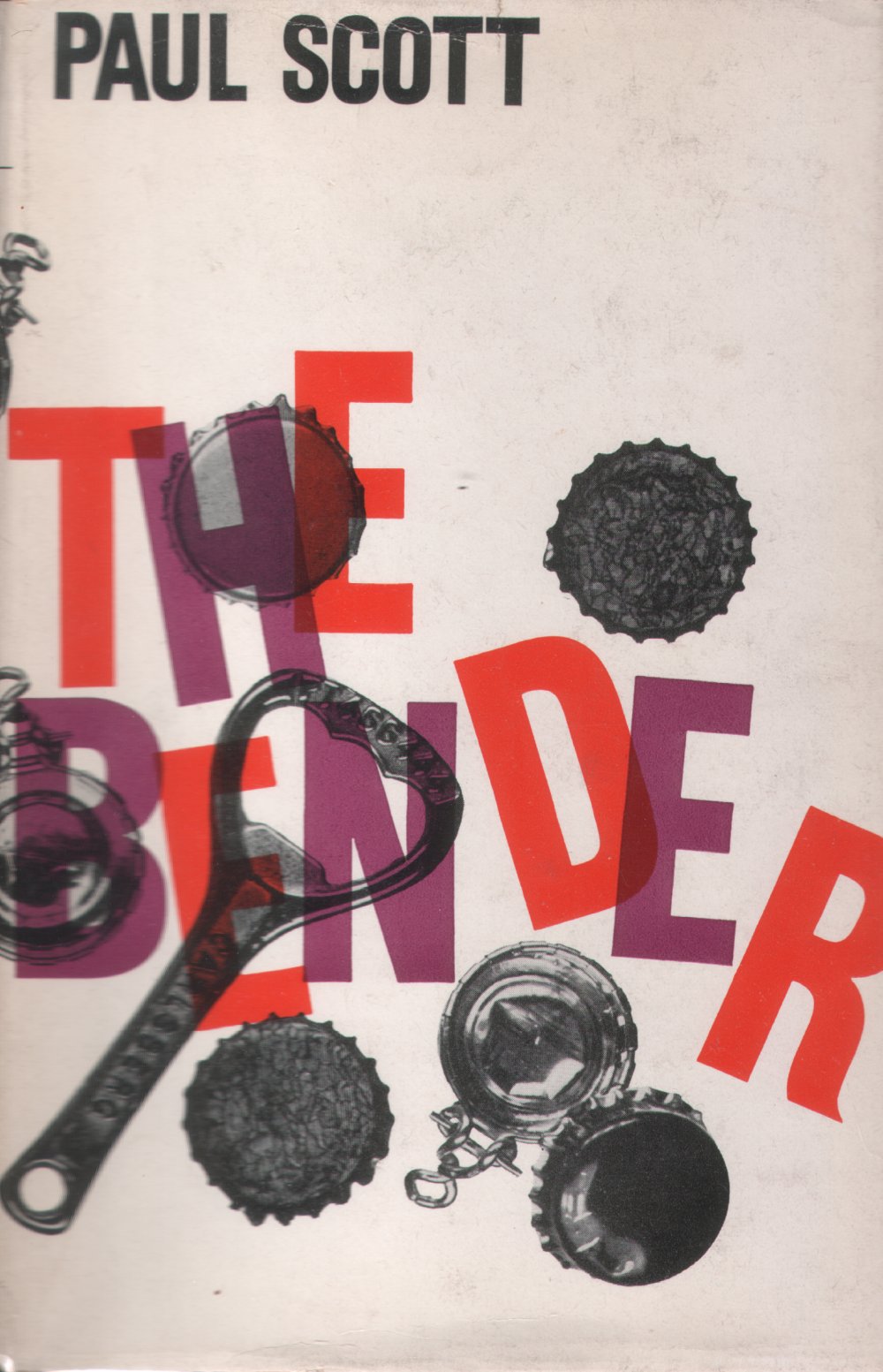
 I bought this after seeing a review of the DVD in Sight & Sound. I wasn’t sure what to expect, but it certainly wasn’t a group of hippie-looking Hungarians wandering around a farm spouting socialist rhetoric and singing folk songs, and then getting shot at by soldiers. I loved it. I wrote about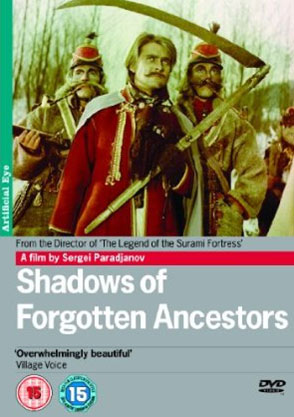
 Żuławski (1978/1988). If you can imagine a film that out-Tarkovskys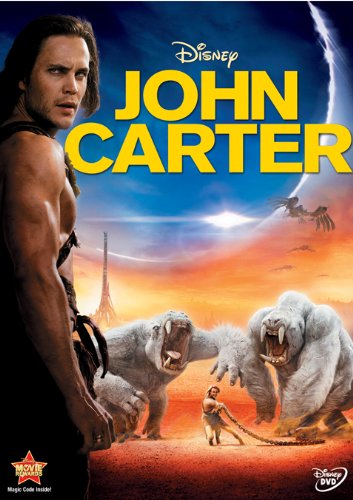
 across mention of and who I thought I might like. So I bought the album. And yes, I do like them. Very much. They’re a sort of mix between Opeth and Northern Oak, but also not much like either. There are long sustained death metal parts, interspersed with folky acoustic guitar, and it all hangs together exceedingly well.