It Doesn't Have To Be Right…

… it just has to sound plausible


1 Comment

The shelf that groaned

It’s been over a month since my last book haul post, but if I leave it any longer, it’ll take me an entire weekend to photograph my purchases. So herewith approximately five to six weeks worth of slippery “bid”, “buy it now” and “place order” buttons, and the results thereof.

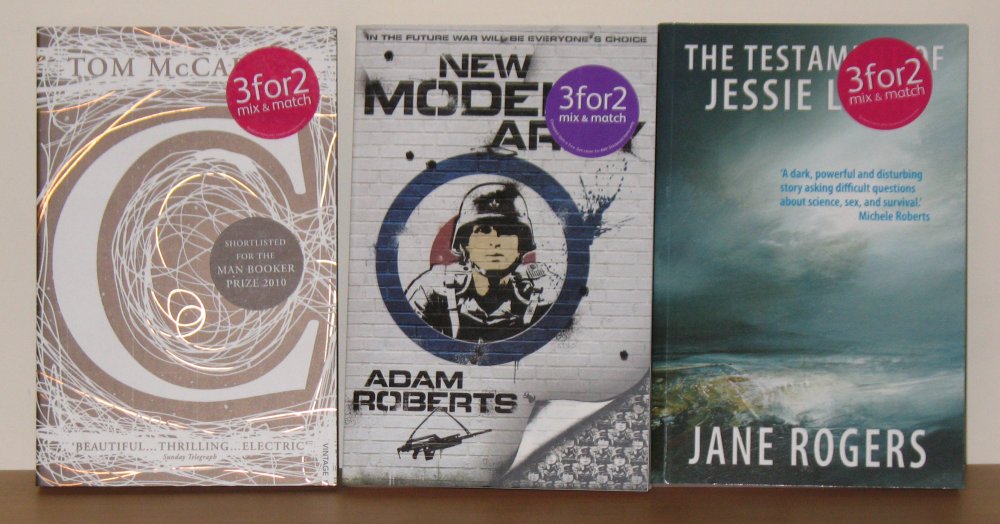
Some time this month, we say goodbye to Waterstone’s 3-for-2 offer, so I felt obliged to go out and have one last go on it. C I’m told is very, very good; I haven’t quite found the right way to read Adam Roberts yet, but I’m reliably informed New Model Army is very good; and The Testament of Jessie Lamb is a literary-but-it’s-really-sf novel and was on this year’s Booker long list.

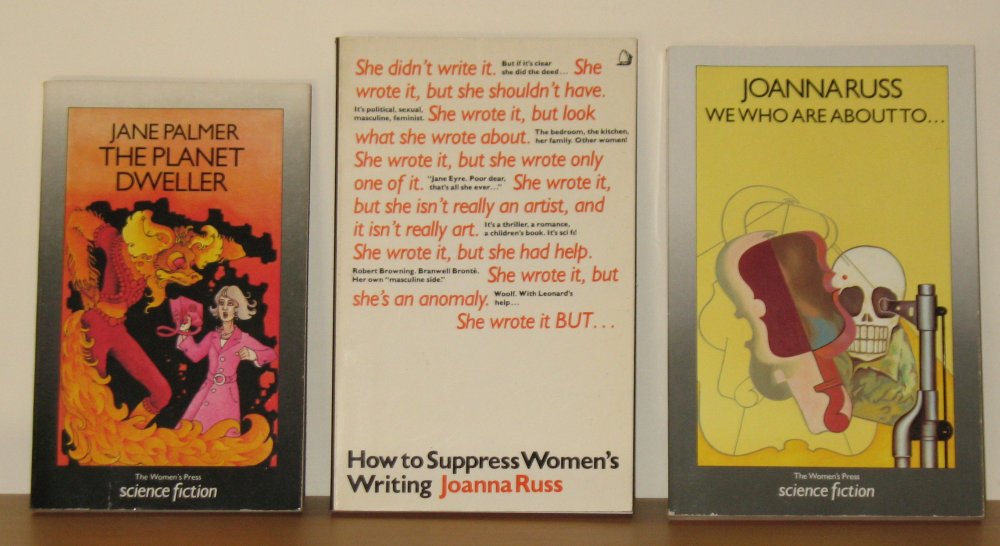
A trio for the SF Mistressworks collection: The Planet Dweller, We Who Are About To…, and How To Suppress Women’s Writing.

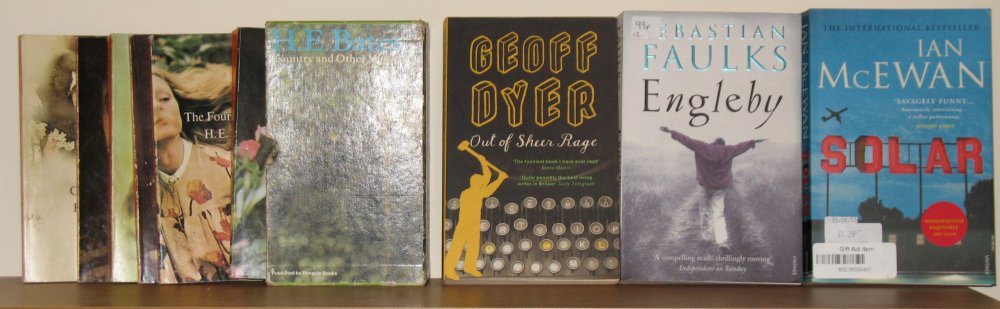
Some charity shop finds. I went off McEwan after Saturday, but I might as well give Solar a go. Engleby is the only Faulks I’ve not got, but I really need to get cracking on reading them. Out of Sheer Rage is about DH Lawrence – sort of – and I’ve heard it’s good. The HE Bates boxed set was a surprise find. It contains: Fair Stood the Wind for France, Dulcima, Seven by Five, The Four Beauties, The Wild Cherry Tree and The Triple Echo.

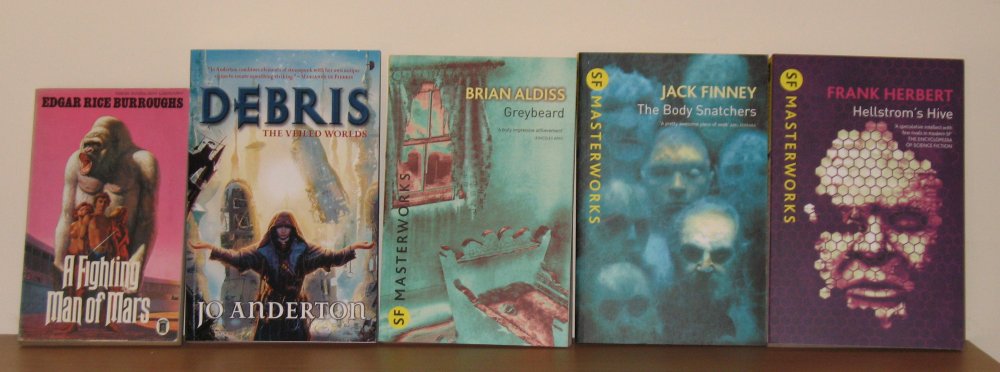
Some science fiction, which I do of course still read every now and again. Three SF Masterworks: Greybeard and The Body Snatchers I’ve never read; Hellstrom’s Hive I’m looking forward to rereading. Debris I have to review for Interzone. A Fighting Man of Mars… well, I’m looking forward to the film due out later this year – I may even go to see it at the cinema. The books I’m less keen on, but never mind.

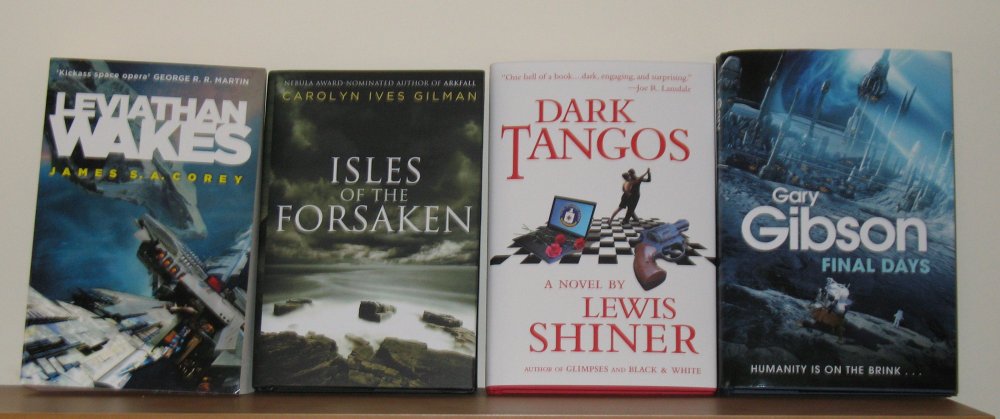
First editions: Final Days and Leviathan Wakes are both science fiction (much thanks to Gary for the former, and Sharon for the latter). Isles of the Forsaken is fantasy – and yes, that’s the signed, numbered edition. Dark Tangos is, well, it’s by Lewis Shiner. And it’s also the signed edition.

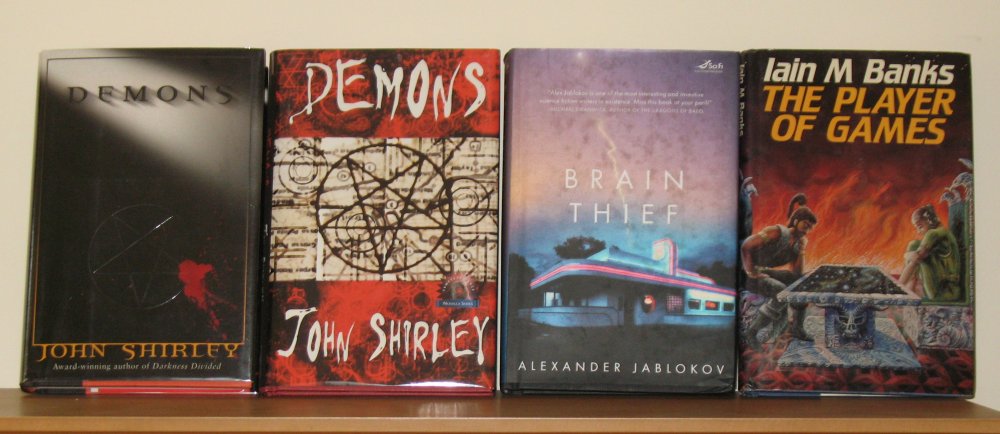
First editions for the collection. Yes, that really is Demons by John Shirley and, er, Demons by John Shirley. The one with the red cover is a novella from Cemetery Dance, and the other is a novel, of which the novella forms the first half. Both are signed. As is Brain Thief, which I reviewed for Interzone last year (but was only sent an ARC). The Player of Games is hard to find for a reasonable price in first edition, but I managed it.

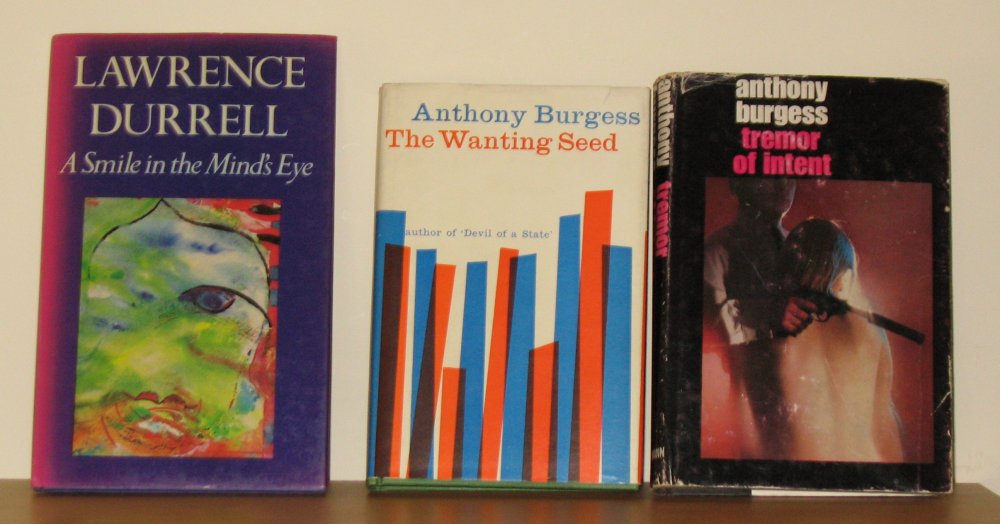
A Smile in the Mind’s Eye is signed and goes on the shelves dedicated to Lawrence Durrell and his works. The Wanting Seed and Tremor of Intent are difficult to find in first edition.

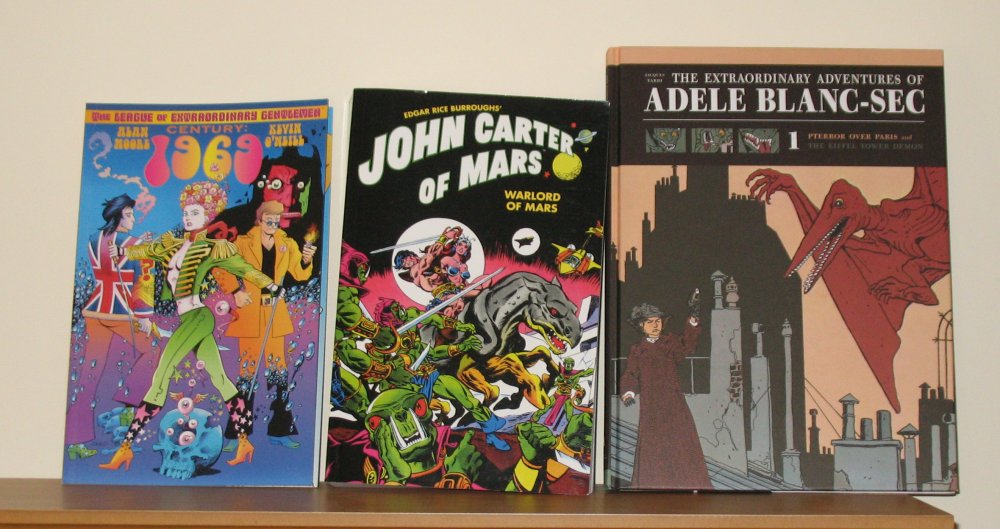
Graphic novels: the latest in The League of Extraordinary Gentlemen, the fab and groovy Century 1969. I have fond memories of Marvel’s John Carter of Mars comic from the 1970s, and a few years ago tracked down all 28 issues and three “king size” annuals. But a trade paperback is so much more convenient – except the artwork in it is black and white, and not colour as in the original comics. The Extraordinary Adventures of Adéle Blank-Sec 1 I bought after enjoying Tardi’s The Arctic Marauder.

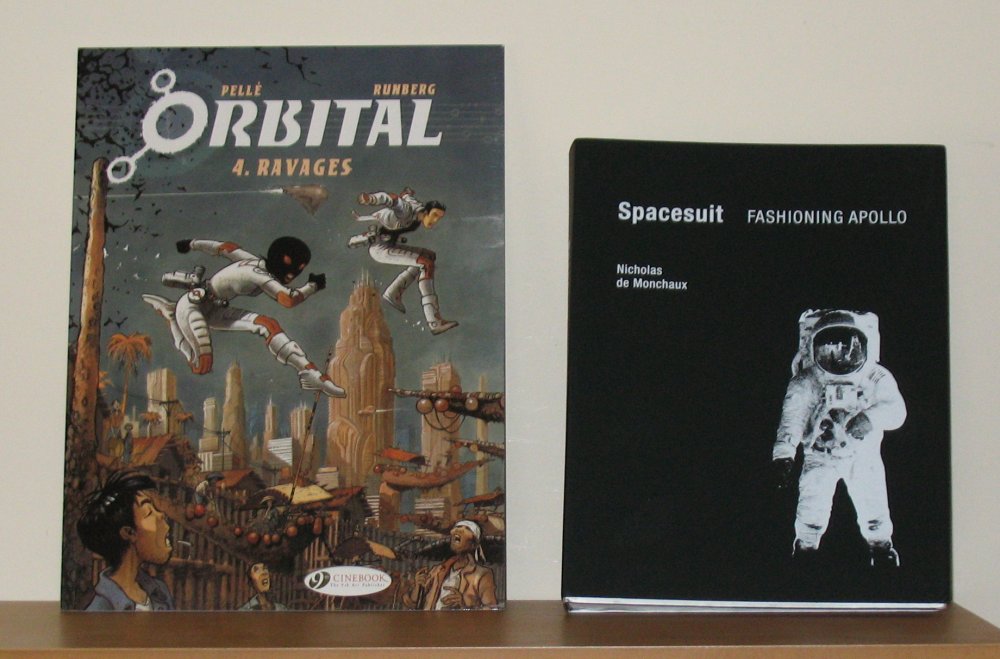
Finally, Ravages, the last, I think, of the Orbital graphic novels, and a book about, er spacesuits titled Spacesuit: Fashioning Apollo. I don’t know what the cover of the latter is made from but it has a similar texture to rubber matting and is quite strange.


Leave a comment

reading & watchings 6: the women-only month

As promised, during July I limited my reading to only books written by women. A dozen, in fact, which is about average for me; as are the subjects covered – science fiction, mainstream, crime, space, and autobiography.

The Year of Our War, Steph Swainston (2004), was June’s book for my reading challenge, though I didn’t read it until July. I wrote about it here.

Hav, Jan Morris (2006), I’d been meaning to read for ages – ever since it was shortlisted for the Arthur C Clarke Award, in fact. But, well, I never got around to buying a copy. And that despite reading and very much enjoying Morris’ Fisher’s Face back in 2000. I found a copy of Hav on bookmooch.com last year, and picked it up this month to read as the book is actually an omnibus of two books, and the first was originally published in 1985 and so could be reviewed on SF Mistressworks. Which is what I did – see here. The more recent section, ‘Hav of the Myrmidons’, I found less successful. It takes place after the “Intervention”, in a state now booming under the control of a secretive council of Cathars. Quite what is driving the economy is never really revealed, though Morris suggests it may not be entirely legal. Morris visits old sights (almost all gone) and old friends (almost all changed). Progress has been good to Hav – it is now prosperous – but Morris mourns the old Hav, with its rich mélange of culture and history. Which does sort of make the piece read like a paean to nostalgia.

Bluebeard’s Egg , Margaret Atwood (1983), is a collection of short stories. Some I like more than others. The title story especially stood out. I also liked ‘Significant Moments in the Life of My Mother’ a great deal. One of my favourite mainstream short story writers is Helen Simpson, because her stories seem to capture real experiences. Her stories are about the quotidian, but they are written with intelligence and a lightness of touch which belies their content. Atwood in Bluebeard’s Egg , by contrast, seems more focused on the emotional landscapes in her stories and that, perversely, often makes them seem less real. True, the stories in this collection are chiefly focused on relationships and sexual politics, but even so, some of them felt more like plays than attempts to depict slices of life. There was a studiedness to the situations they describe, and I found that a little distancing. I have yet to make up my mind about Atwood’s fiction, though I’ve only read three of her books. The Handmaid’s Tale is superb, and I remember enjoying The Blind Assassin. I still have plenty more by her on the TBR (for a while, it seemed every local charity shop had one of her books), so we shall see how it goes…

Cloudcry, Sydney J Van Scyoc (1977), I reviewed for SF Mistressworks – see here. I’ve been a fan of Van Scyoc’s writing for many years, and have collected all of her books.

Packing for Mars, Mary Roach (2010), I bought because I’d heard good things about from several people. They were wrong. I reviewed it on my Space Books blog here.

Beirut Blues, Hanan al-Shaykh (1992), is al-Shaykh’s second novel. I thought her first, Women of Sand & Myrrh, very good indeed, but this one was, to be honest, a bit of a slog. It’s structured as a series of letters by a woman called Asmahan – to her childhood friend, to an ex-lover, to her mother, to Billie Holliday – in which she recounts incidents, and feelings, of life in war-torn Beirut. Some of the writing is lovely, some of the story is quite heart-breaking, and al-Shaykh is extremely good at getting across the realities of the life she describes. In that respect, Beirut Blues provides an excellent window on a place, its people and events that readers in the West probably know little about – and certainly very little about what it was actually like for those who suffered through those times. The format unfortunately does distance the reader somewhat and nothing has quite the impact it feels it ought to. Despite this, worth reading.

The Goda War, Jay D Blakeney (1989), I reviewed for SF Mistressworks – see here. The Goda War was, I think, the first book I read by Blakeney. I vaguely remember looking her up afterwards on The Encyclopaedia of Science Fiction, which reccommended her The Children of Anthi / Requiem for Anthi duology. I hunted down copies of those two books, and they are indeed good. The Goda War, unfortunately, isn’t. She wrote a fourth novel, The Omcri Matrix, which I will no doubt reread and review for SF Mistressworks sometime.

Desert Governess, Phyllis Ellis (2000), is a slim autobiographical book about the one year spent in Saudi by the writer. Originally a dancer/actress, Ellis turned to TEFL as a career after the death of her husband. She spent a year in Hail, in the centre of the Arabian peninsula, as English teacher – not really a governess – to the son and two daughters of HRH Prince Muqrin bin Abdul Aziz Al Saud, the youngest son of ibn Saud. Ellis seems eager to learn and understand Arab/Muslim culture, but equally unwilling to accept some of its elements – resulting in incidents which caused offense and could have been avoided. She is homesick for much of the time and, unsurprisingly, finds the life too restricting. To some extent, Desert Governess provides an interesting insight into the lives of Saudi princesses – particularly the sections set in Jeddah. The writing is mostly acceptable, and there are some mistakes in the transliteration of the Arabic (though they might have been typos). The book is a quick easy read, spoiled somewhat by Ellis’ reluctance to either accept or respect the culture in which she found herself.

Resurrection Code, Lyda Morehouse (2011), is actually a prequel to Morehouse’s AngeLINK quartet, which I’ve not read. I think Amazon recommended it to me when I purchased Kameron Hurley’s God’s War (see here), and it looked sort of similar so I bought it. It’s an interesting mix of cyberpunk and, er, angels, set in a post-apocalyptic Cairo. Odd, but in a good way. I plan to write about it here soon-ish. Meanwhile, I plan to hunt down copies of the original AngeLINK books: Archangel Protocol, Fallen Host, Messiah Node and Apocalypse Array..

City of Veils, Zoë Ferraris (2011), is her second crime novel set in Saudi, featuring the same two characters from her first, The Night of the Mi’raj: Nayir Sharqi, Palestinian desert guide, and Katya Hijazi, forensic scientist. I thought that first book interesting, though somewhat flawed – and I wasn’t convinced by some of the details. City of Veils is a much better book – perhaps because it has a larger cast and a much more satisfying central mystery (most of which proves to be a sub-plot, but never mind). A young woman’s body is found washed up on a Jeddah beach. She is later identified as Leila Nawar, a young film-maker who seemed determined to court controversy by filming subjects certain to offend the Saudi authorities. Meanwhile, Miriam Walker, an American, has returned to Jeddah after a month’s leave back home, and hours after she arrives home with her husband, he vanishes. Miriam doesn’t live on a camp, and can’t speak Arabic. Ferraris weaves the two incidents together into a mystery, one which drags in both Katya and Nayir. The characters seem better-drawn in this novel, but the plot does get wrapped a little two quickly. Still, I enjoyed it and I’ll read the next one when it’s published.

Zoo City, Lauren Beukes (2010), was July’s book for this year’s reading challenge, and I wrote about it here.

Solitaire, Kelley Eskridge (2002), I found in a charity shop, though it’s a US paperback. I read and enjoyed Eskridge’s collection, Dangerous Space, back in 2008, and Solitaire is a novel that had been much praised. I’m surprised I didn’t read it earlier. Because it is very good indeed. In a nearish-future in which Earth has finally acceded to a single global government, Ren ‘Jackal’ Segura is a Hope – i.e., a child born in the first second of the EarthGov era, and trained from birth to be a credit, ambassador and example to the new age. She works for Ko, the planet’s only nation-corporation, and so is under more pressure to succeed than other hopes. On a visit to Hong Kong, she inadvertently causes the deaths of a group of people – an elevator fails in the city’s tallest tower, killing all those in it – including a Chinese senator, and Jackal’s circle of friends or “web”. When a terrorist group claims responsibility for the sabotage, Jackal is arrested and charged. Her Hope status is revoked and, so that her parents are not fired by Ko, she does not contest the charges. She is put in experimental Virtual Reality solitary confinement – eight months real-time, eight years VR elapsed time. Somehow, while in VR solitary, she discovers how to edit her environment, and creates a simulation of her home on Ko’s sovereign island. So when she finishes her sentence and comes out of “prison”, she is less damaged psychologically than others who had served sentences in the same fashion. The title of the book refers to a bar Jackal discovers some weeks after her release, which caters to “solos” – i.e., those who have served VR solitary confinement sentences. And is the events, and the people, there which lead to the story’s resolution. Solitaire is beautifully-written – this is not the prose you expect to find in a genre heartland novel. There are a few hand-wavey moments here and there, but they’re minor and in no way spoil the story. Eskridge’s knowledge of motivational studies comes across as extremely authoratitive (I believe that’s her day-job). Highly recommended.

Unfortunately, even after a month of women-only writers my reading is only 32% female and 68% male. So I need to do more. From now on, I’m going to try and alternate with each book I read, though I’m not going to be obsessive about it.

Oh, and no watchings this time, I’m afraid. I’m saving them up for the next readings & watchings post.


12 Comments

Battered books? Criminal!

On Monday, David Barnett wrote a paean to tatty paperbacks on the Guardian website here. He even included a photograph of one of his most treasured books, a battered copy of Shirley Jackson’s We Have Always Lived in the Castle. It is, quite frankly, falling apart. I’m surprised it’s still readable.

I, on the other hand, hate battered books. Almost every book I own appears brand new. I have paperbacks I bought in the 1970s which look like they were published last week. Some of the books I’ve given away or sold – on eBay or Amazon marketplace – are in as good condition as those you’d find on the shelves of your local Waterstone’s, though they might be ten, twenty or thirty years old.

I have bought tatty books, of course. Some books that I want to read, but have no intention of keeping, I will buy irrespective of condition – usually from charity shops. And they’ll go back there once I’ve read them. Books that are going in the collection, however, have to be fine or near mint. But if I discover that I really like the book and want to keep it, and it’s pretty dog-eared – then I’ll go and buy a new copy of the book.

I have lent books to people and been seriously pissed off when they’ve returned them with broken spines and creases in the covers. When you borrow a book, it should be handed back in the same condition it was in when it was lent. You don’t borrow someone’s car and then return it with dents and scrapes and smashed headlights, after all. And yet, some books you really want people to read because you love them so much. Some books you will accept the possibility of damage because you want someone else to share your opinion of them.

It’s not just the condition of books. Genre fiction has a fondness for series. I admit to having inherited the “squirrel gene” from my father. (This doesn’t mean I’m half-man half-squirrel, it just means I collect things. Books, obviously, in my case.) Series are good for collecting. Except when publishers change the cover design halfway through the series. Or when two books of a trilogy are published in hardback, but the third is only published in paperback. I find that really annoying. I’ve been known to wait until a trilogy is complete so I can buy all three books with a matching cover design. I have also replaced books in a trilogy so I have them all in the same format, rather than one in trade paperback and two in A-format paperback.

Given that most of the books I buy are out-of-print and second-hand, you’d think I’d be a gibbering wreck most of the time. I find the book I’ve spent ages looking for on eBay, click on “Buy it Now”, and days later a parcel is shoved through my letter-box… Sellers on eBay tend to display a wide variance in their interpretation of terms such as “fine”, “very good” or “good” when relating to condition. It can make book-buying a bit of a lottery. I have returned books because they were not at all as described. But usually I tend to only buy from sellers who post a photograph of the book in which the condition is plain to see. As a result, I’ve not bought books I really want even though there are copies available. I’d sooner wait until I see a copy in a charity shop, second-hand book shop, or dealers’ room at a convention, where I can see in person whether or not the book’s condition is good enough.

There is probably a fancy Latin name for the above behaviour. I don’t care. What it means to me is that my books will last. I can return to them again and again, and not worry about pages falling out. After all, you can’t read a novel when it has pages missing.


2 Comments

readings & watchings 2011 #5

Time for another journey through the cultural landscape as navigated by Your Somewhat Whimsical Cartographer. Bit of a marathon journey, I’m afraid – other projects have meant this has been delayed a week or two, and so grown a little larger than usual.

Books
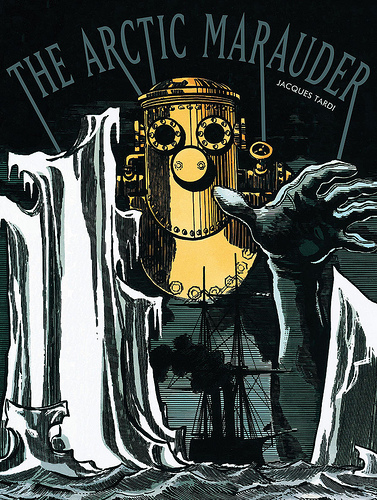
The Arctic Marauder, Jacques Tardi (1974), I bought because Warren Ellis had raved about these on his blog. Tardi is a famous bande desinée writer/artist in France but isn’t well-known in English. Fantagraphics are translating all of his best-known works , and publishing them as handsome hardback volumes. I admit, it was the cover art which caused me to pick this one – and it was a good choice. The story is like Jules Verne on, well, on drugs. A young man survives a mysterious attack which sinks the ship he is travelling on in the Arctic. Later, he returns to solve the mystery, and discovers a pair of mad scientists in a floating fort disguised as an iceberg. Tardi’s style is very distinctive, but the story is very quick. I’m glad I bought it, though. I think I’ll buy some of the other volumes…

A Confederacy of Dunces, John Kennedy Toole (1980), is apparently one of the great American comic novels of the twentieth century. Or so I was told. By many people. Perhaps they over-sold it. Because I didn’t like it all that much. I’m a firm believer in the Confucian maxim that “the funniest sight on the whole world is watching an old friend fall off a high roof”. In other words, slapstick makes me laugh. A great fat over-educated arrogant and self-deluded idiot like Ignatius J Reilly doesn’t. There is some wit in A Confederacy of Dunces, notably in the dialogue of the black characters, but too often the story is asking the reader to laugh at Reilly and not with him. Disappointing.

The Female Man, Joanna Russ (1975), I read to honour Russ after her recent death, and I was surprised at how well the book has aged. It’s set chiefly in 1969, although it was published in 1975, and reads very much like a book set in the late 1960s – so it didn’t feel at all dated. But even the overtly sfnal sections have aged quite well. I’d remembered the book as an angry one, but I’d forgotten that as the story progresses, so does the book’s anger. Towards the end, it reaches quite astonishing levels. One chapter seemed more familiar to me than the rest of the book – which I’ve read only the once before during the 1980s. It didn’t take me long to figure out why – I’d read it as a short story titled ‘An Old Fashioned Girl’ in the anthology Final Stage: The Ultimate Science Fiction Anthology when I was about twelve years old. That anthology was one of the first sf books I ever read, and its stories have stuck with me over the decades (yes, even the Harlan Ellison one). I still have that original copy on my book-shelves. But The Female Man: I have the SF Masterworks edition, and it’s a worthy addition to the series – it’s one of those remarkably few sf novels which can change the way you view the world. This is a book I think I will be reading again. Regularly.

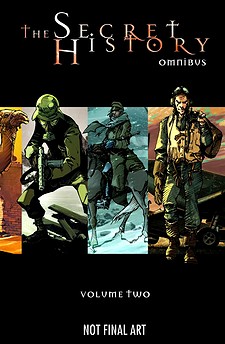
The Secret History Omnibus Vol 2, Jean-Pierre Pécau (2005), is, as the, er, title suggests, the second collected volume in English of a bande desinée.  In prehistoric times, four “archons” were each gifted with immortality and a rune of power. In the centuries since, they have fought each other, independently and in temporary alliances. During the early years of the Holy Roman Empire, an experiment went awry, resulting in the birth of William of Lecce, a monstrous boy who is committed to bending the world to his evil ends. Three of the four archons have battled William ever since. Volume 2 takes the story from 1918 to 1945, opening with St John Philby in the Empty Quarter hunting for the fabled city from which the Queen of Sheba ruled, and continuing on through both world wars to Hitler’s defeat. The Secret History cleverly stitches real historical events into its plot, and it’s especially obvious in this second volume. The Tarot as the story’s inspiration is also clearer. The story is not yet complete, and I believe it continues in another series under a different title. I’ll be buying them, then.
Blood Meridian, Cormac McCarthy (1985), got an honourable mention in my Best of the Half-Year post recently. It should probably have made the top five (especially since I only actually picked four), but, well, it’s such a bleak and monstrous story, and its cast behave like animals, that I can’t really love or admire it that much. I guess I’m just a big softy at heart. True, Blood Meridian is beautifully written, and McCarthy’s descriptive prose is often as breathtaking as the scenery he describes. A troop of Indian hunters in Mexico during the 1850s ride around the area, attacking both innocent and guilty Indians and Mexicans and collecting their scalps for a bounty. The characters have no redeeming qualities whatsoever and you can only wonder why they were permitted their depredations for so long. Turning cowboys into monsters may have been a novel approach to the western, but I can’t see that it adds much to the genre.

China Mountain Zhang, Maureen F McHugh (1992), was May’s book for this year’s reading challenge, and I wrote about it here. I also cross-posted the review on the SF Mistressworks blog here.

The Styx Complex, Russell Rhodes (1977). Dear me, I’d forgotten how badly written most airport-bestseller books are. This one was published in the mid-1970s but I suspect there’s been very little increase in quality in the decades since. It’s probably got worse. Ava Bardoff is the mysterious, and beautiful, head of a global cosmetics empire which seems to have discovered the secret of eternal youth, and which appears to control a great many important people around the world. Philanthropist billionaire Hugo Montcrief has been trying to break Bardoff’s conspiracy for years but never succeeded. Along comes Bardoff’s god-daughter, Sarah, a trust-fund babe, who has decided to settle down. The billionaire recruits playboy athlete Michael, whose estranged father is a senior executive in Bardoff’s cosmetics company, to use Sarah to infiltrate and investigate Bardoff’s chateau headquarters near Cannes. The prose is eye-stabbingly bad, the plot is ludicrous, the characters are wildly implausible, and I can only wonder why I bothered to read it. Ah well.

The Horse and His Boy, CS Lewis (1954), is the fifth book by publication of the Chronicles of Narnia. And Lewis is at his most hectoring so far in this one. It doesn’t help that it’s not set in Narnia but in Calormen, which is full of nasty foreigners of a 1001 Nights persuasion. They even smell a bit too. Not to mention practicing slavery. One such young slave is rescued by a horse which reveals it can talk – because it’s a Narnian horse. So the two try to escape across the desert to Narnia, with the help of a young princess fleeing an arranged marriage and her talking horse, and en route they foil a fiendish plot by the Calormen to attack and conquer Narnia’s nearest neighbour. Even more so than the other Narnia books, The Horse and His Boy suffers from outdated sensibilities that really shouldn’t be taught to children in the twenty-first century. There isn’t enough charm in this book to offset that.
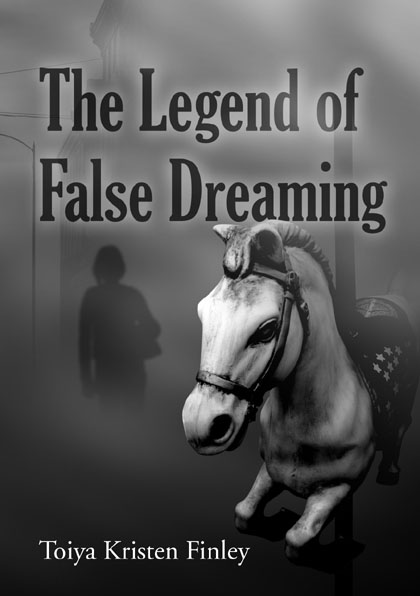
The Legend of False Dreaming, Toiya Kristen Finley (2011). Finley had one of the more inventive stories in the anthology Text: Ur (an anthology I recommend reading), and I liked it enough to track down some of her other fiction online. Her stories are strange and elliptical, and not always told in a straightforward fashion. Unfortunately, The Legend of False Dreaming is much more conventional narrative-wise. A young woman, fleeing her family, arrives in a town in which the inhabitants refuse to acknowledge the presence of the town’s transient population, who are themselves trapped by a strange magical fog which won’t permit them to leave. Not a bad story, but not as good as other ones by Finley I’ve read.

The Fifth Child, Doris Lessing (1988), is about a young middle-class liberal couple who buy a big house they can’t really afford because they want to fill it with children and live like bohemians. They get a bit of help from well-off parents and out plop a succession of kids. The relatives all come and stay for the holidays and a jolly good time is had by all. But then another little sperm slips through and the titular sprog appears. Only this one is different. Physically, he resembles a Neanderthal. Temperamentally, he resembles… well, some sort of cunning animal. As a result, the happy home is no longer a happy home. Though a light read, this book packs quite a punch. Lessing’s deceptively simple prose style lets the story slip down, though it’s an unpleasant one. Perversely, I couldn’t help feeling sorry for the fifth child, and I wondered if that was Lessing’s intent – clues in the story sort of suggested it was the mother’s moral strength which was the point of the story.

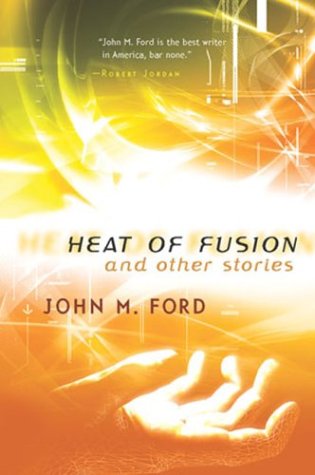
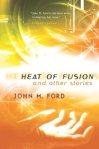
Heat of Fusion & Other Stories, John M Ford (2004), is a collection of short stories and poems from a much under-rated sf author. These are cleverly done, though some are more involving than others. ‘Erase/Record/Play: A Drama for Print’ is especially good – a powerful story that refuses to tackle its subject head-on but works all the better for not doing so. Can’t say I was overly fond of the epic poems, which often felt more like clever word-play than actual poems. All the same, it’s worth tracking down a copy of this and reading it, if you can.
The Unconsoled, Kazuo Ishiguro (1995). I like Ishiguro’s novels, though I find them a bit variable and often insipid. And now that I’ve read The Unconsoled, I’ve read all of them – but I wish I hadn’t bothered. Ryder is a world-famous concert pianist, come to an unnamed East European city to perform. But there’s something strange about the city, about the people who live there, and about what he is supposed to do. Everything is dream-like: he is driven for miles out into the country to visit someone, then steps through a door in their house and is back in his hotel. The city constantly changes, Ryder finds himself rushing around from one errand to another, suddenly recognising the people he meets and remembering things about them… And the people, when they speak to him: they waffle, they repeat themselves, they go on and on and on… I was expecting all this to be explained when I reached the end of the novel – it’s clearly fabulist, but in service to what? Not Ryder’s role, because that’s never explained – it’s repeatedly hinted that it involves more than simply playing the piano. I expected answers. There are none. The Unconsoled just finishes. Bah. Rubbish book.

How Spacecraft Fly, Graham Swinerd (2008), I reviewed on my Space Books blog here.

Metropolis, Thea von Harbou (1927), I reviewed on the SF Mistressworks blog here.

The Noise Within (2010) and The Noise Revealed (2011), Ian Whates, I read for review for Vector, the critical journal of the British Science Fiction Association. I know a lot of people like these books, but I found them a little too old-fashioned and slapdash for my taste.
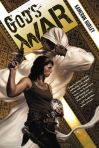
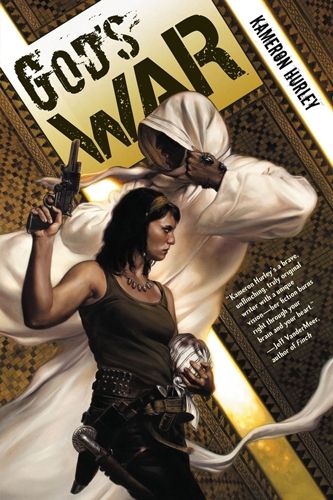
God’s War, Kameron Hurley (2011), was the novel Niall Harrison persuaded a whole bunch of us on Twitter to buy. It was all ready on my radar – as any sf novel which makes use of Arab culture would be – and I’d read the first chapter online, but that hadn’t been enough to persuade me to actually order a copy. But when Niall raved about it – describing it as a cross between Gwyneth Jones and Richard Morgan – I thought it worth a go, and… I’m currently working on a piece about it which I’ll post up here when it’s done.

The Third Eagle, RA MacAvoy (1989), I reviewed on the SF Mistressworks blog here.

Robopocalypse, Daniel H Wilson (2011), I read for review for Interzone. It appears to be this year’s mega-hyped genre title from the US. Wilson has a PhD in Robotics, and is television’s go-to guy on the subject. He’s previously written other books about robots, some of which, like Robopocalypse, have been optioned for movies. So there’s plenty of money behind him. But, like all such books, there’s not much in the way of substance. The story is presented as a series of vignettes from a future war with robots. Some are better than others. The structure is actually quite annoying, and I’m not very convinced by some of the robotics used in the book either.

Films
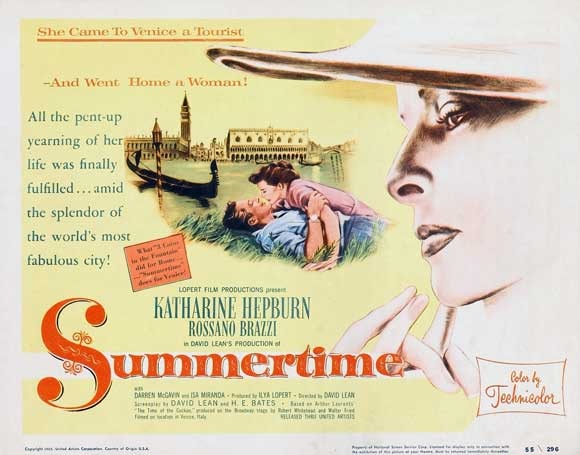
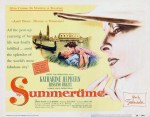
Summertime, David Lean (1955). I’m not a major fan of Lean’s work, although Lawrence of Arabia is a favourite film. Summertime surprised me in two ways: I actually really liked it, and star Katherine Hepburn didn’t annoy me. Hepburn plays a spinster who is visiting Venice. It’s her first time abroad, and this holiday has been a lifetime dream. She meets a smooth Italian lothario who runs an “antique” shop, and the two enter into a relationship. The photography of Venice is excellent, which is perhaps the film’s chief attraction. The story is not especially ground-breaking, although Hepburn’s strength of will – she walks away from her lover at the end of the film – is surprising for a film of the period.
Millennium season 3 (1998), was the last of the series, although a final cross-over episode with The X-Files was used to tie up the last few loose ends. For a series that promised so much in its first series, Millennium did go out with a bit of a wet fart. Most of the episodes in this season were mythology-related, and over the previous two seasons that mythology had gone from vague protestations of biblical millennial doom! doom! doom! to some weird underground apocalyptic cult which began back in the Crusades and was now planning on bringing about the end of the world itself. Naturally, this pisses off FBI profiler Frank Black – who is now back in the fold of the Bureau – and he maintains a consistent petulance on the topic throughout this season’s twenty-two episodes. And speaking of which, a couple of the episodes in season three were good – the one set at Los Alamos in the 1940s was especially good. The one featuring KISS, however, was embarrassingly bad.

High Noon, Fred Zinnemann (1952), is a classic Western, though I will confess I watched it chiefly because it stars Grace Kelly. But then I’m not a big fan of Westerns, and have found only a handful over the years that I actually like – and only one, Howard Hawks’ Rio Bravo, that comes close to being a favourite film. But, after all that, Kelly was a bit insipid as the marshal’s wife, though Cooper as the marshal projected an impressively steely competence. Parts of High Noon felt like a checklist of genre clichés, but it picked up towards the end. Not a bad film, then; but I doubt I’ll be returning to it.

You Can’t Take It with You, Frank Capra (1938). Every Capra film I watch I find appealing is a sort of happy, fluffy way – and this one is no exception. An anarchic bohemian family become embroiled in capitalist shenanigans when their refusal to sell their house prevents a nasty industrialist from buying up an entire city block for a project. This is not helped by the industrialist’s son being affianced to the daughter of the bohemians. It’s all very jolly and overtly liberal in an unchallenging way. The characters are appealingly eccentric, the dialogue has wit, and the story romps along with all the charm and geniality of a favourite uncle – the nice one, not the creepy one. I still intend to work my way through Capra’s oeuvre – I don’t think he’s as consistently entertaining, or as technically innovative, as Hitchcock, but I do enjoy his films.

Dark and Stormy Night, Larry Blamire (2009), I reviewed for VideoVista and you can see my review here.

The Bed Sitting Room, Richard Lester (1969), felt mostly like a play that had escaped from some 1960’s Brit comedian’s bottom drawer. It seemed to chiefly comprise a bunch of British comedy stalwarts wandering around a disused quarry in search of a plot. Some bits were good. I liked Ralph Richardson as Lord Fortnum, who was convinced he was going to turn into the titular chamber. And, in fact. did. The sections involving Harry Secombe in his fallout shelter I also liked. The Bed Sitting Room felt a bit like a very English “nice” version of a film by Alejandro Jodorowsky – although unlike one of Jodorowsky’s films, it wouldn’t need several beers to make sense of. Just a cup of tea; or a small sherry.

Journey to Promethea, Dan Garcia (2009), was another VideoVista review – see here – and also quite possibly the worst film ever made.

Container, Lukas Moodysson (2006). I have the Lukas Moodysson Presents box set (which contains Show Me Love, Together, Lilya 4-Ever and A Hole in My Heart), and I like the films in it. So I expected to like Container. Except, well, I’m not that big a fan of experimental cinema. Some of it I like and admire. But not this one. It’s seventy-two black-and-white minutes set in a shipping container, showing things sort of happening, with a stream-of-conscious narrative track. No amount of wine could improve it. And I tried.

Night And The City, Jules Dassin (1950), was one of the oddest noir films I’ve seen because, while it met the forms of the genre pretty much spot on, it was a) set in London, and b) had US stars. Richard Widmark runs around a night-time London, sweating profusely, playing a Yank wide-boy on the make who gets himself on the wrong side of a gangster who has the local wrestling scene tied up. I like noir, but I couldn’t get excited about this one – maybe because, to me, it has to be set in the US because part of it is the perversion of the American Dream. After World War 2, the US was prosperous and optimistic, and it’s the conflict with that which makes gives noir its sting. The UK, on the other hand, was grim, struggling to recover from the war, and still in rationing. It doesn’t make for much of a contrast with the typical noir worldview.

Star Trek (The Original Series) season 1 (1966), I borrowed from a friend because, while I remember watching these back in the 1970s when I was a kid, and I’d never been that big a fan of the original series, I thought it might be interesting to see what I’d think to them now. And the answer is… not much. Even Harlan Ellison’s much-celebrated episode ‘The City on the Edge of the Forever’ failed to impress – chiefly because it has a logical flaw in the plot: McCoy travels back in time and creates a paradox, except the original situation only occurs because they went back to fix the paradox… Despite the occasional mildly entertaining episode, there’s much to moan about. For all its vaunted sexual equality, all the women are pretty, have roles defined by their relationships to the male cast, and are always filmed in soft focus. The captain’s log voice-over is inconsistent throughout, being either a real-time commentary or an after-the-fact summation, and often both in the same episode. But then that’s on a par with the nonsense dating system used. This may be ground-breaking sf telly, but that’s not all that much to brag about really, is it?

They Met In The Dark, Carl Lamac (1943), is a quota quickie I reviewed for VideoVista, and a review of it should be up there soon.

The A-Team, Joe Carnahan (2010). Discussing books with Justina Robson at alt.fiction, I remarked that when I read a novel I like to come away with the impression the author is cleverer than me. Which means I certainly don’t enjoy watching films which make me feel like I’ve lost IQ points. Even if I do have several beers inside me at the time. And that’s what The A-Team is like. It’s like having a conversation with someone who thinks some really dumb stuff, which wouldn’t stand up to a nanosecond’s scrutiny, is totally cool. In other words, The A-Team is monumentally stupid. Even worse, it thinks being monumentally stupid is cool. The television series was risible, but this movie takes that to an entirely new level. The stunt with the helicopter was jaw-droppingly implausible, and you had to wonder why the film-makers didn’t at least be honest about it all and put the cast in skin-tight spandex. And then there was the set-piece with the tank in the transport aeroplane… After that, I was using more neurons drinking my beer than I was watching the film.
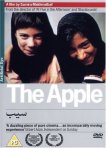
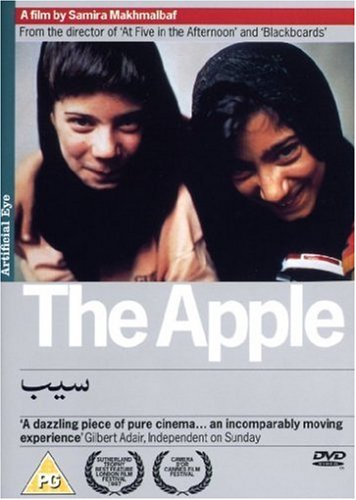
The Apple, Samira Makhmalbaf (1998), is perhaps the least successful of the Iranian films I’ve seen this year. A near-blind old man and his blind wife have kept their two young daughters locked up indoors for years – though not like that bloke in Austria. The neighbours complain to the authorities, who send round a social worker. The social worker persuades the old man to let his daughters out of the house, which he does. With the help of a neighbouring boy, they discover something of the world around them. It’s filmed like a documentary, is quite poignant in places, but I kept on waiting for something approaching a plot to kick off. But it never did.

Don’t Ever Leave Me, Arthur Crabtree (1949), I reviewed for VideoVista, and a review of it should be up there soon.

Iron Man 2, Jon Favreau (2010), I can actually remember very little about even though it’s not that long since I watched it. There’s this bloke in a metal suit. No, two blokes. And lots of robots. And Mickey Rourke, who looks like he’s been chewed up and spat out by a Great White. Although apparently he normally looks like that. And Robert Downey Jr wisecracks his way through a plot that’s even thinner than the first Iron Man film without actually making much of an impression on the viewer. I like superhero films, and I think they’re ideal material for blockbuster movies – but I’m beginning to wonder if the genre has reached the point of diminishing returns. No one really gives a shit about any multi-film story-arc, so why bother with sequels? A fresh new hero will pull in the punters, so all the director has to do is throw two hours’ worth of flash-bang-wallop at them, and everyone goes home happy. Anything else is like putting Smarties on a cheesecake.

The Warrior’s Way, Sngmoo Lee (2010), I reviewed for VideoVista, and a review of it should be up there soon. I was quite impressed with this – it’s the best attempt at using comicbook story-telling I’ve seen in a film.

Red, Robert Schwentke (2010), I rented because it’s based on a graphic novel written by Warren Ellis. The title is actually an acronym – RED: Retired, Extremely Dangerous. Which refers to ex-CIA hitman Bruce Willis, who has been chatting up on the telephone a woman who works at the federal office which issues his pension checks. Then one day, assassins come to call on him. Convinced the woman will be their next target, he sort of abducts her… and then introduces her to his old buddies – Morgan Freeman, John Malkovich and Helen Mirren, all of whom are also retired. The first half of the film is fun, with some entertaining stunts and mayhem. But then it all turns drearily predictable in the second half, and whatever charm the film had built up soon dissipates. Worth seeing, though.

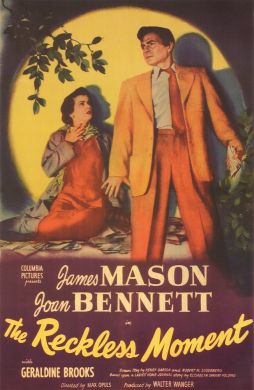
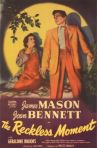
The Reckless Moment, Max Ophüls (1949), is almost proper noir. It’s set in California, it’s black and white, and it has the American middle class being rudely accosted by society’s criminal underbelly. Unfortunately, said underbelly is in the person of James Mason who, despite an Irish brogue, is far too urbane to convince as a gangster loan shark / blackmailer. Joan Bennett plays the mum of a teenage daughter at art school who has taken up with a sleazy art dealer twice her age. When the art dealer tries to extort money from the daughter, she hits him and runs away, not realising he has subsequently stumbled and fallen onto an anchor, and died. Mum discovers this next morning (it happened at the family’s boathouse), panics, and hides the body in a nearby swamp. Mason then turns up with love letters from the daughter to the “murdered” art dealer, demanding money or he’ll send them to the police. Except Mason isn’t really cut out to be a blackmailer, and begins to fall for Bennett. Nicely played throughout, and nicely shot, but it didn’t quite have the edge real noir demands.
Micmacs, Jean-Pierre Jeunet (2009). Delicatessen is one of my favourite films, and I like The City of Lost Children a great deal. but since splitting up, Jeunet and Caro have never quite individually managed to produce films as good as those two. Caro’s single solo effort, Dante 01, had its moments but seemed to fumble its way to a derivative ending. Jeunet’s career has been much more successful, though the overwhelming treacly whimsicality of his films has meant I’ve not greatly enjoyed them. Micmacs is perhaps not as cloyingly sweet as Amélie, or as twee as A Very Long Engagement, but is for much of its length surprisingly dull. A video-store clerk, Bazil, is an accidental victim of a drive-by shooting, and the bullet lodges in his brain. The surgeon decides to leave it in there, though there’s the possibility it may result in a sudden fatal aneurism. Bazil leaves hospital to discover he has been thrown out of his apartment and has lost his job. After living on the street for a couple of months, Bazil is adopted by a clan of lovable eccentrics who live underneath a rubbish heap. Meanwhile, Bazil has decided to have his revenge on two arms dealers – one who made the bullet which currently resides in his brain, the other who made the mine which killed his army bomb-disposal father thirty years before. So Bazil uses the peculiar talents of his friends to set up a con to bring both arms manufacturers down. There are a couple of clever set-pieces, but they’re not enough to carry the story over its 105 minutes. Disappointing.

1 Comment

The Best of the Half-Year

We’re halfway through the year, and it’s time to pick out the top five books, films and albums consumed over the previous six months. Not eaten, obviously – but read, watched and listened to, for the first time.

Books
Last year, three out of the five books I picked at the halfway-mark made it through to the end of year top five. It’ll be interesting to see if that happens again this year.

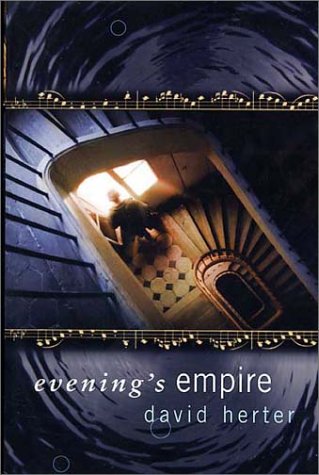
Evening’s Empire, David Herter (2002). I read Herter’s debut, Ceres Storm, shortly after it was published and thought it very good. So as soon as his second book, Evening’s Empire, appeared on Amazon, I bought it. But, unlike his debut, it was fantasy, not sf, and so it sat on my book-shelves for close on a decade until I finally got around to reading it this year. I’ve no idea why it took me so long, but I’m deeply sorry I didn’t read it earlier. Because I loved it. Evening’s Empire starts out as a Crowley-esque fantasy set in a US north-west coastal town, but around halfway through it takes an odd left-hand turn and becomes something quite different. As a side-effect of reading Evening’s Empire, I dug out my copy of Verne’s Twenty Thousand Leagues Under the Sea and read it – the main character in Herter’s novel is writing an opera based on Verne’s book – but my edition is from 1966 and I’m told it’s an inferior translation, which probably explains why I didn’t enjoy it very much.

China Mountain Zhang, Maureen F McHugh (1992), was May’s book for my reading challenge and, while I enjoyed January’s book, Rosemary Kirstein’s The Steerswoman, more, I think this is the better of the two books. I wrote about it here.

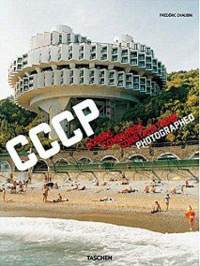
CCCP: Cosmic Communist Constructions Photographed, Frédéric Chaubin (2011), may boast a somewhat forced title, but don’t let that put you off. Over a period of some ten or so years, Chaubin photographed modernist buildings throughout the USSR and East Europe, buildings he describes as part of a fourth age of Soviet architecture. The results are strange and quite beautiful.

Voices from the Moon, Andrew Chaikin (2009), may have been yet another book celebrating the fortieth anniversary of the Apollo 11 Moon landings, but it’s better than most of those published that year. I wrote about it on my Space Books blog here.

And that’s it. But there are a lot of honourable mentions – books which didn’t quite make the cut into the top five four: Blood Meridian, Cormac McCarthy (1985), though it contained some beautiful prose, was a bit too bleak, and its cast too monstrous, to make the list; Time of Hope, CP Snow (1949), the first book by internal chronology of Snow’s Strangers and  Brothers series was an excellent well-observed read; The Best of Kim Stanley Robinson (2010), was a good showcase though I’d not have described every story as “best”, and Icehenge (1984), Kim Stanley Robinson, would have made the top five but for the fact it was a reread; Stretto, L Timmel Duchamp (2008), brought the Marq’ssan Cycle to an excellent end, and I really must finish that piece on the series I have planned; American Adulterer, Jed Mercurio (2009), maintains Mercurio’s status as a writer I watch, though the subject matter was not as appealing as his Ascent; God’s War, Kameron Hurley (2011), is a very strong debut, with a strong female protagonist and some excellent world-building, but its bleakness just stops it from making the list (I’ll be buying the sequel, though); and The Steerswoman, Rosemary Kirstein (1989), was a book I thoroughly enjoyed, and I plan to read the entire series.

Films
Pretty much all the films I watch are on DVD – either rentals, sent for review by Videovista, borrowed, or my own purchases. Most of them have been merely okay, and those that stood out did so by quite a margin. A bit of a cheat this time, as I’m going to include an entire season of a television series.

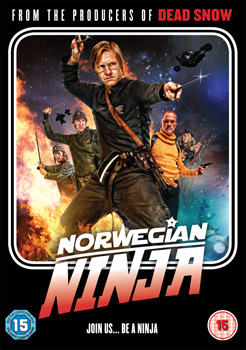
Norwegian Ninja, Thomas Cappelan Malling (2010), is, well, is hard to describe. It’s a spoof 1980s action film based on an alternate take on the real life of Norwegian spy and traitor Arne Trehold. I loved it. I reviewed it for VideoVista here.

Ajami, dir. Scandar Copti and Yaron Shani (2009), is an Iraeli thriller, and a bloody excellent one too. I reviewed it for VideoVista here.

Much Ado About Nothing, dir. Stuart Burge (1984), was one of the BBC adaptations of Shakespeare’s plays which I’ve been renting and watching. It’s been an interesting exercise, though so far the tragedies have proven superior to the comedies. Except for this one. I don’t know why it worked so well. Cherie Lunghi and Robert Lindsay were good in their roles as Beatrice and Benedick, but that’s hardly unexpected. It just seemed in this play Shakespeare’s wit really sparkled, his characters were appealing, and even Michael Elphick’s strangely sweaty Dogberry with his ponderous malapropisms couldn’t spoil things. The best of the Bard’s so far.

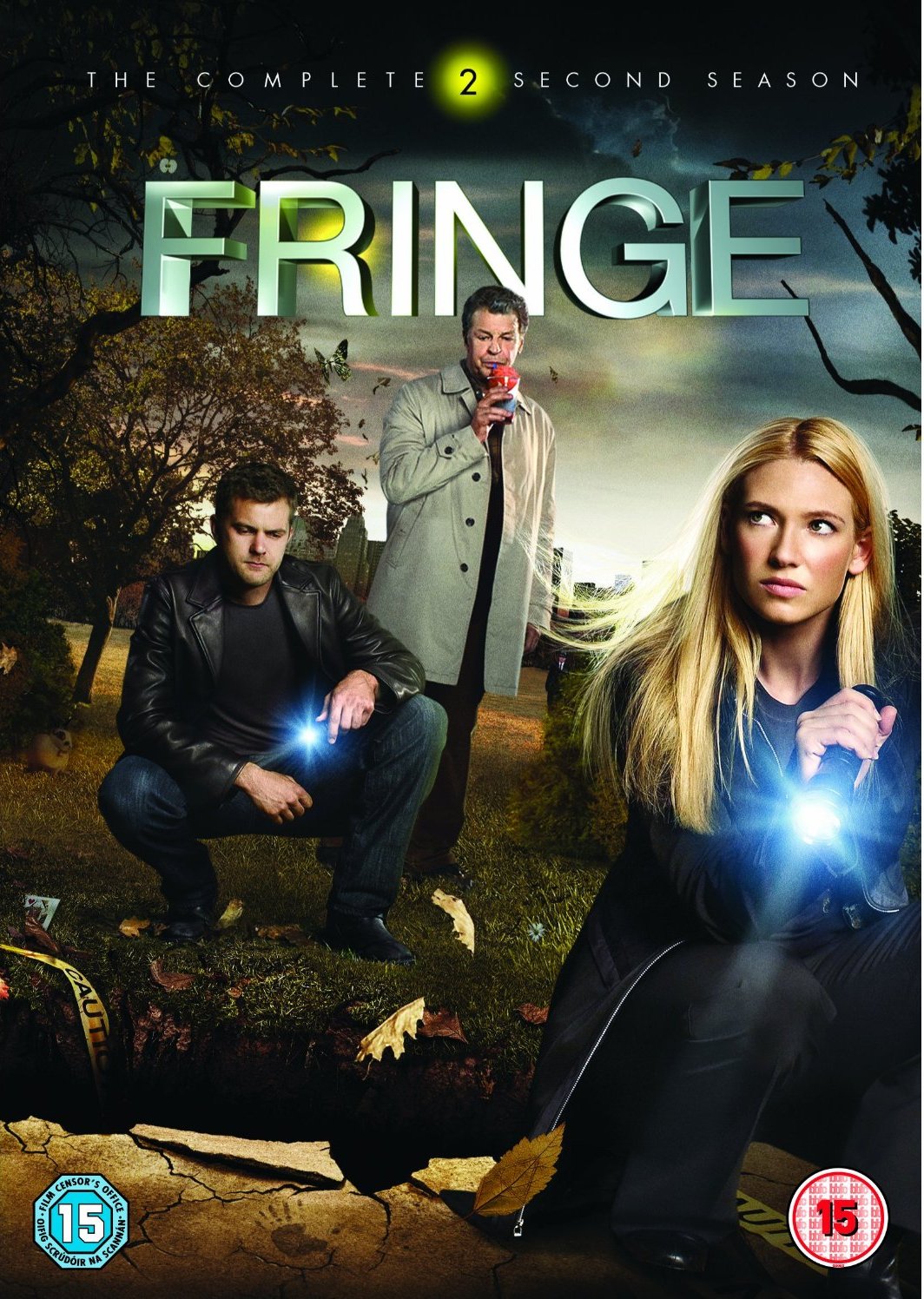
Fringe season 2 (2009). Fringe may just be a 21st century X-Files, but since I was a fan of the X-Files… Except that’s unfair on Fringe which, though it shares some similarities with the X-Files, is also very good television in its own right. I like the series mythology with its war with an alternate universe, and I like the weird science that Walter seems to have spent most of his life researching – and which he has now forgotten. Some episodes were better than others, but overall the quality was high. And the move in this season more toward the mythology made for some good and interesting drama.

Honourable mentions? Tales Of The Four Seasons, Éric Rohmer (1990 – 1998), of which I liked A Summer’s Tale a great deal; The Secret In Their Eyes, Juan José Campanella (2009), was an extremely well-plotted thriller from Argentina; Water Drops On Burning Rocks, François Ozon (2000), is Ozon’s film of a Rainer Werner Fassbinder script and is worth watching for the dancing scene alone; Summertime, David Lean (1955), is beautifully-shot and, for once, I didn’t find Katherine Hepburn annoying in a film.

Music
It has not been an especially good year for music so far. I’ve bought very few CDs, and seen only eleven bands perform live – although, admittedly, two of them were favourites: Anathema and Pallas. Mind you, there’s Bloodstock in a couple of months…

XXV, Pallas (2011), is the band’s sixth studio album, and the first with new vocalist Paul Mackie. I heard it live before I heard the CD, and a very good performance it was too. The band were celebrating twenty-five years together and it showed. XXV feels a little heavier than earlier albums, though it still contains much proggy goodness and even – dare I say it? – a little radio-friendliness in places.

The Human Connection, Chaos Divine (2011), is the second album by an Australian death metal / prog band, and it’s a little more prog than death than their debut. It’s also a much better album. Opening track ‘One Door’ is superb. Each of the songs lulls you into a false sense of security before hammering you with some excellent riffs. A fine piece of work.

Návaz, Silent Stream of Godless Elegy (2011). I’ve been a fan of SSOGE’s mix of doom metal and Moravian folk music since stumbling across some of their songs five or six years ago. Návaz is more folk-oriented than earlier albums, though there’s plenty of chugging guitars and doomy growls to satisfy. The vocal layering at the end of ‘Skryj Hlavu Do Dlaní’ (‘Hide Your Head In His Hands’, according to Google Translate) will make the hairs on the back of your neck stand up.

BBC Radio 1 Live in Concert, Lone Star (1994). Welsh 1970s heavy rockers Lone Star have been a favourite band since I was at school. They only released two albums before splitting (a third was recorded, but an inferior copy of it was only released on CD in 2000). Between those two albums, the band swapped vocalists, from Kenny Driscoll to John Sloman, and BBC Radio 1 Live in Concert, recorded in 1976 and 1977, showcases some of their songs with each of the two singers. Strangely, the best tracks live are not the best ones on the studio albums – the version of ‘Lonely Soldier’ on BBC Radio 1 Live in Concert, for example, is absolutely superb and a classic piece of 1970s rock. Given that this album is only a sample of three radio sessions, I’d happily pay for a CD of all three sets.

Honourable mentions: In Live Concert at The Royal Albert Hall, Opeth (2010), a comprehensive live set recorded at the titular venue with the band’s usual expertise, and accompanied by Åkerfeld’s usual wit; Edge Of The Earth, Sylosis (2011), a good solid death metal concept album with some excellent riffs; Semper Fidelis, Sanctorum (2011), the third album by a young British death metal band – ambitious and mature; Communication Lost, Wolverine (2011), not as immediately likeable as previous albums but definitely a grower.


3 Comments

It’s not just the women of sf

Though I’ve posted here about women sf writers – on both the sf mistressworks list and SF Mistressworks blog – I do read fiction of other genres written by women. And I thought it might be worth mentioning some of the non-sf works by women writers I’ve enjoyed and admired in the past:

Helen Simpson is one of my favourite mainstream short story writers, and has been ever since I came across her story ‘Heavy Weather’ in a collection of modern short fiction (it’s also in her Dear George And Other Stories). Simpson has yet to write a novel but she’s had six collections of short stories published. I have them all.

Given the amount of time I spent in the Middle East, it’s no surprise I’m fascinated by Arab culture – and yet I’ve not read that many Arabic authors. Of the few I have, the best book I’ve read so far is Hanan Al-Shaykh’s Women of Sand and Myrrh. Which reminds me: I must get hold of one of Freya Stark’s books…

Kate Ross wrote four novels set in Regency England featuring an upper-class dandy who turns amateur detective. As crime novels go, they’re a bit fluffy, but the last one, The Devil in Music, is an all together different matter. It is masterfully-plotted, surprisingly dark, and nothing like the consciously-Austenesque comedy of manners that are the earlier three books.

I’ve always preferred female crime writers to male; I’ve no idea why. The best of them is easily Sara Paretsky. But I’d be hard-pressed to pick a favourite VI Warshawski novel. Guardian Angel, perhaps; or Toxic Shock. Hell, just read them all.

Fisher’s Face, Jan Morris, is a sort of biography of Admiral of the Fleet Jackie Fisher, who was instrumental in building up the Royal Navy during the early years of the twentieth century. Fisher was responsible for HMS Dreadnought, the battleship which made every other warship on the planet obsolete the moment it was launched. Fisher’s Face is a fascinating meditation on the man.

You can blame the Acnestis APA for the fact that I’ve read most of Georgette Heyer’s books. Several of the members were fans, and their comments led me to try one of her novels. And so I too became a fan. The history is dubious at best, and some of her later books were a little too romantic for my tastes, but they’re also witty and great fun. I’m not sure I have a favourite – The Talisman Ring, perhaps; or An Infamous Army. It’s proper comfort reading, for when it’s chucking it down outside, there’s nothing on the telly, and you’re feeling a bit down in the dumps.

Years ago in my middle or late teens, while spending the holidays with my parents in the Middle East, the only books I had access to where the ones they’d bought. I worked my way through my father’s handful of thrillers quickly, but then I was stuck. So I picked up one of my mother’s books: MM Kaye’s The Far Pavilions. And I thoroughly enjoyed it. So much so I read her other historical novels and, years later, I tracked down and read her crime novels.

It was the Lawrence Durrell connection which brought Olivia Manning to my attention. She was in Cairo during World War II, as he was, and they both belonged to the same loose group of poets and writers in the city. So I read The Balkan Trilogy and thought it excellent, and then read The Levant Trilogy and thought that excellent too. I even bought the DVD of the BBC adaptation, Fortunes Of War, starring Emma Thompson and Kenneth Branagh. It’s also very good.

Finally, a couple of cheats…

RA MacAvoy is on the sf mistressworks list, but she has written both science fiction and fantasy. And her fantasy trilogy of Lens of the World, King of the Dead, and Winter of the Wolf is very, very good indeed. The books are out of print now, but definitely worth tracking down.

Also on the sf mistressworks list is Susan Shwartz, but she too wrote fantasy as well. Her The Grail of Hearts was a novel I never expected to like as much as I did. The title suggests it’s a fantasy romance, but it’s actually a clever re-telling of the Matter of Britain featuring a female Wandering Jew. It’s also worth hunting down.


10 Comments

A critical bookshelf

Over the years I’ve picked up a number of book about science fiction and about science fiction writers. These are books I’ve mostly dipped into, rather than read from cover to cover. Not all of them cover authors I still read, and some of them aren’t at all useful as critical works… but still I hang onto them. And here they are:


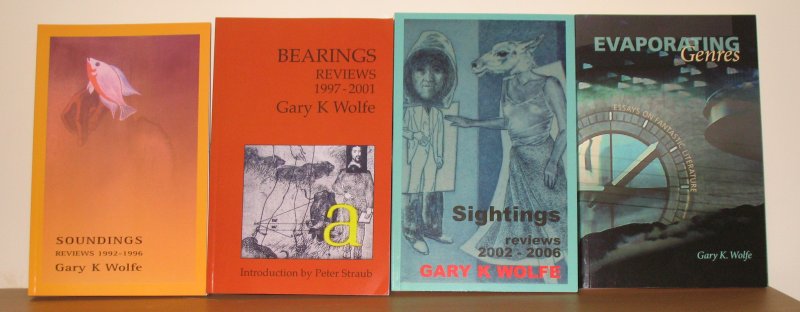
First up, four books by Gary K Wolfe: Soundings, Bearings, Sightings and Evaporating Genres. Wolfe writes sharp incisive reviews of genre books, and the first three books are collections of his reviews. Evaporating Genres is a more general critical work, and I’ve yet to read it (it was only published this year).

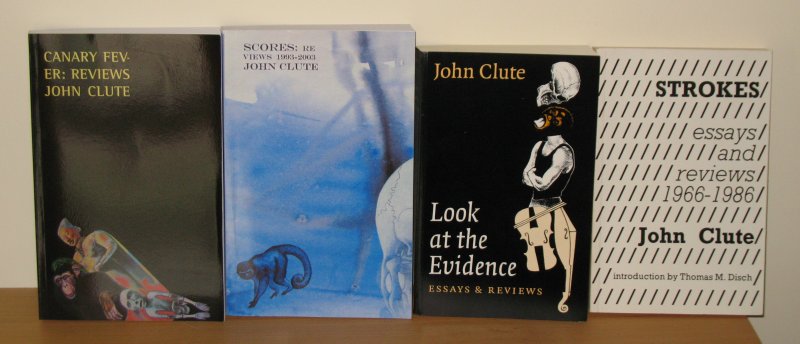
On this side of the Atlantic, we have sf critic John Clute, whose reviews are collected in these four books: Strokes, Look at the Evidence, Scores and Canary Fever. A new book of his essays has just been published, Pardon This Intrusion, but I’ve yet to buy a copy. Clute’s reviews can be difficult, if not willfully obscure, but he is also extremely sharp and clever.

These three books do exactly what it says on the tin: annotated lists of the top one hundred genre books, as chosen by the editors. Science Fiction: The 100 Best Novels and Fantasy: The 100 Best Books are sister-works; I’m guessing Pringle wanted to do both but ended up approaching another publisher for his Modern Fantasy: The Hundred Best Novels . Interesting books, but I can’t say I agree with the majority of their choices.

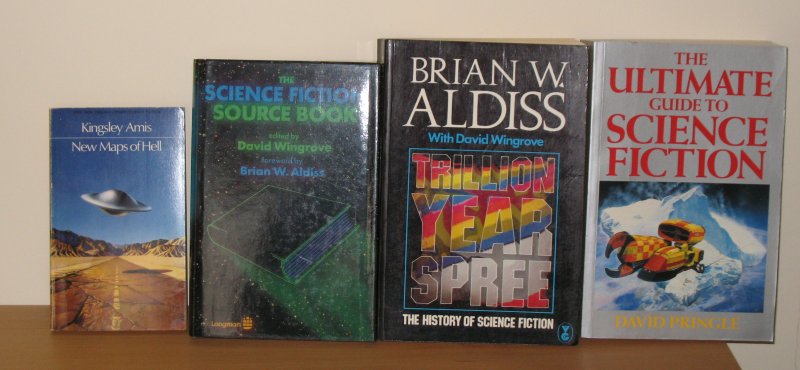
Two important critical works, New Maps of Hell by Kingsley Amis and Trillion Year Spree by Brian Aldiss, and a couple of general guides to sf, David Wingrove’s The Science Fiction Source Book and David Pringle’s The Ultimate Guide to Science Fiction.

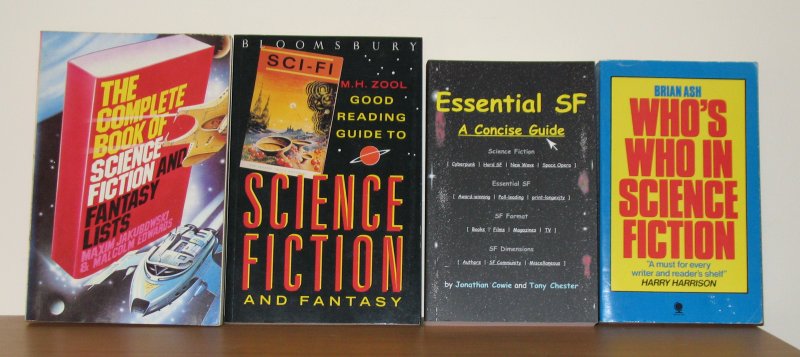
I’m not sure what use is The Complete Book of Science Fiction and Fantasy Lists, but never mind. Likewise, the Good Reading Guide to Science Fiction and Fantasy (Zool is actually the Oxford SF Group). Essential SF is, well, just that – at least according to the authors. Who’s Who in Science Fiction lists the pseudonyms used by genre writers.

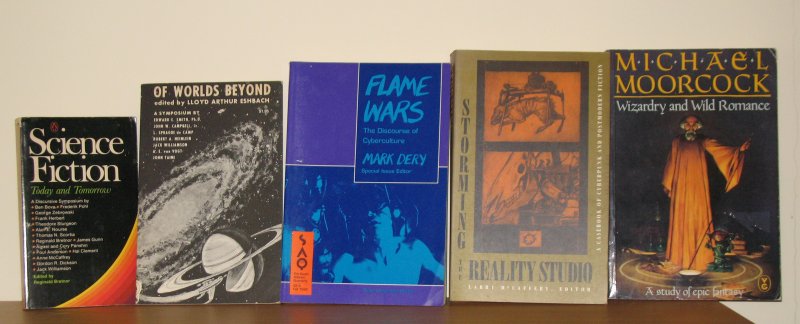
Four critical works. Bretnors’ Science Fiction Today and Tomorrow is a collection of essays by many big name authors of the 1970s and earlier: Frederik Pohl, Frank Herbert, Theodore Sturgeon, Jack Williamson, Gordon R Dickson, Ben Bova… Of Worlds Beyond is a series of essays on science fiction and writing science fiction by big name authors of an earlier generation: AE van Vogt, Robert Heinlein, EE ‘Doc’ smith, John W Campbell, and, er, Jack Williamson (most of the writing advice in the book is actually quite useless). Flame Wars and Storming the Reality Studio are academic studies of cyberpunk. Wizardry and Wild Romance is Michael Moorcock biting the hand that kept him in whisky for several decades.

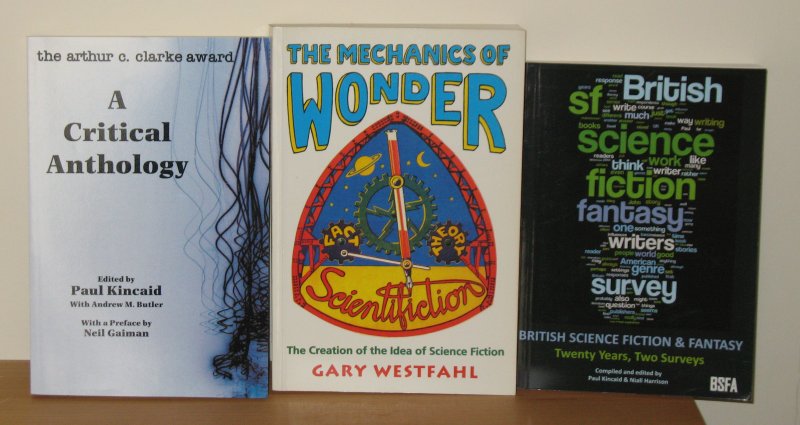
I seem to recall Gary Westfahl’s The Mechanics of Wonder causing something of a fuss when it was published in the late 1990s. I enjoyed it and, like Westfahl, I’ve always felt science fiction began in 1926 with the publication of the first issue of Amazing Stories. The Arthur C Clarke Award: A Critical Anthology is just that, and the title of British Science Fiction and Fantasy: Twenty Years, Two Surveys pretty accurately describes its contents too.

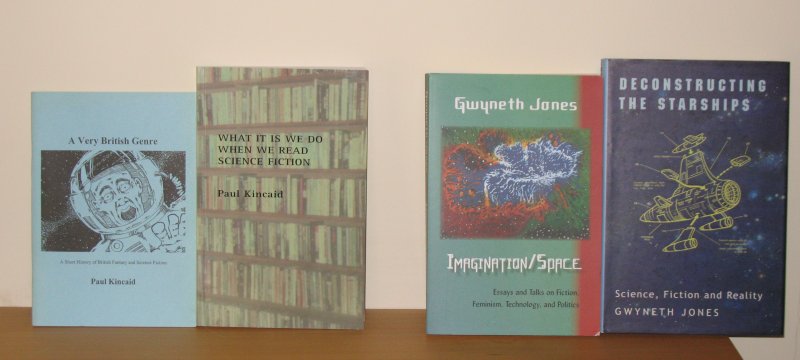
A pair of British critics: Paul Kincaid’s A Very British Genre and What It Is We Do When We Read Science Fiction; and Gwyneth Jones’ Deconstructing the Starships and Imagination / Space.

Some books about writers: Snake’s Hands is a study of the fiction of John Crowley; The Cherryh Odyssey covers CJ Cherryh’s works; Parietal Games is criticism about, and by, M John Harrison; Heinlein in Dimension is about Robert Heinlein; and The Universes of EE Smith is about the works of EE ‘Doc’ Smith.

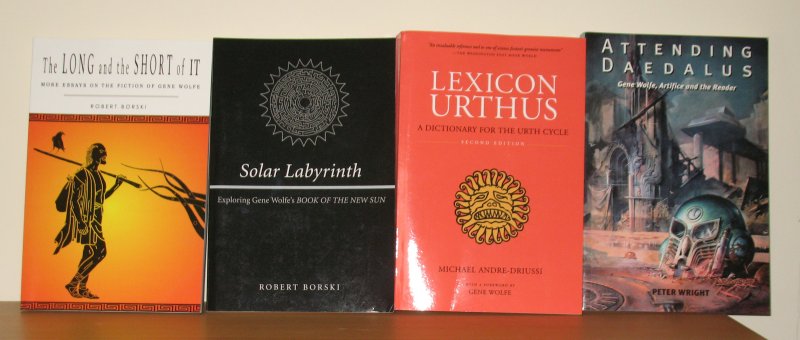
Some books about one writer: Gene Wolfe. The Long and the Short of It does not cover any specific work of Wolfe’s, unlike Solar Labyrinth, Lexicon Urthus, Second Edition and Attending Daedalus, all of which are about The Book Of The New Sun. I reviewed Lexicon Urthus, Second Edition for Interzone.

I picked these up years ago in a publishers’ clearance bookshop. I’m not sure why the series is titled Writers of the 21st Century, as only one – Le Guin – is still writing. Mind you, Philip K Dick is still being published, and having his stories adapted for the cinema, even though he died in 1982 (the book is copyrighted 1983). Jack Vance‘s last novel, Lurulu, was published in 2004, but we’re extremely unlikely to ever see anything new from him.
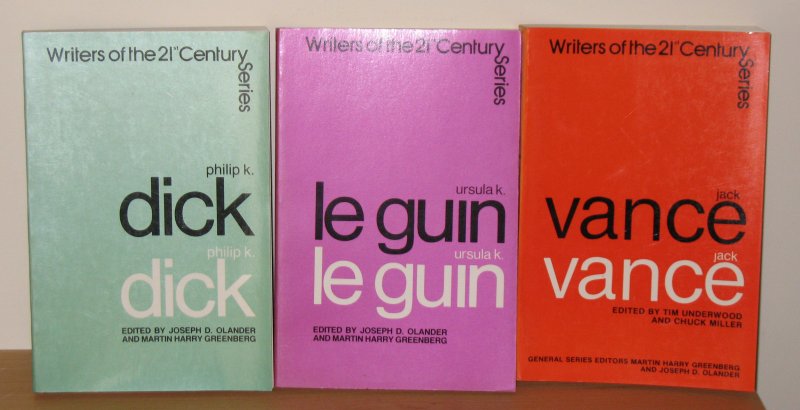
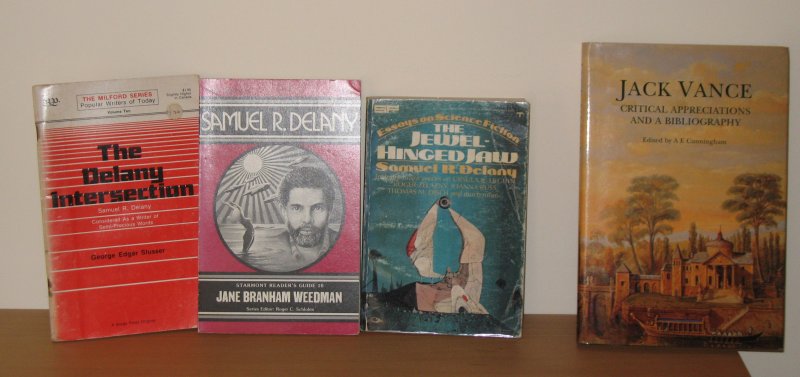
The Delany Intersection and the Starmont Reader’s Guide are both about Delany’s fiction. The Jewel-Hinged Jaw is Delany’s first and probably best-known work of criticism, though he’s written nearly a dozen such books. Jack Vance – Critical Appreciations and a Bibliography is just that.

Finally, two books about Edgar Rice Burroughs, Master Of Adventure about his fiction and A Guide to Barsoom specific to his Mars books. Who Writes Science Fiction? and Wordsmiths of Wonder are both collections of interviews with genre writers.

As well as the above books, I also have a number of science fiction and fantasy encyclopaedias and reference works. But that’s a post for another day.


6 Comments

So you think you know good sf?

So the Guardian wants to know what are our favourite sf novels. And up pop the usual suspects. Sigh. I can’t be bothered to post yet another rant on the topic. Instead, I will point you at these previous posts of mine:

The Ten Best Science Fiction Books… Ever
The Best Science Fiction Series
The Best SF Novels Since 1990

And for all you Foundation and Lensman fans:

The Worst Science Fiction Series


Leave a comment

readings & watchings 2011 #4

Here we go again – we know a song about that – it’s time for more scrapings from the petri-dish of popular and unpopular culture, as studied under the microscope by Your Scientifically-Minded Correspondent.

Books
Satan Wants Me, Robert Irwin (1999). Irwin’s The Arabian Nightmare is one of the best fantasies of the 1980s, and his Night and Horses and the Desert (re-issued as The Penguin Anthology of Classical Arabic Literature) is a highly-entertaining and informative study of, well, classical Arabic literature. Satan Wants Me – god knows what people thought when they saw me reading this on the tram during my commute to work – is presented as the journal of a hippie sociology doctoral student in early 1970s London. He has recently joined an occult group spun off from Aleister Crowley’s Order of the Golden Dawn. He’s also taking a lot of drugs. And he has some very weird friends. There are some very funny laugh-out-loud bits in this novel – which probably got me even stranger looks on the tram – and it’s sharply-observed throughout. Then it goes completely batshit weird towards the end. While not the classic The Arabian Nightmare is, it certainly confirms my belief that Irwin is a writer very much worth reading.
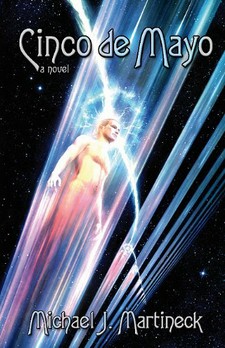
Cinco de Mayo, Michael Martineck (2010), I reviewed for SFF Chronicles here. I’ve known Michael for a long time, though we’ve never actually met in person. We’re both members of an informal critting group, with a couple of other people – i.e., we email each other stories, novel extracts, etc., for comments. So I saw bits of Cinco de Mayo several years ago. But I’d never seen the finished product. I have now, and I enjoyed it very much. And thought it a happily diverse and intelligently put-together story. Definitely worth a read.

Twenty Thousand Leagues Under the Sea, Jules Verne (1870). This 1973 edition of Verne’s classic has my name and old school number written on the ffep, which means I’ve owned this book for just over thirty years. So I must have read it at some point. I know the story – everyone does – but is that from actually reading the book, or just from some form of cultural osmosis? This (re)read did demonstrate that there’s much about the story I’d forgotten / not known. It’s very dull, for one thing. There are endless pages listing ocean flora and fauna. Very little actually happens. Aronnax et al go hunting a mysterious sea monster which has been sinking ships. In an encounter with it, they are swept overboard and then rescued by the monster… which proves to be a submarine: Captain Nemo’s Nautilus. The Nautilus sails around the world, and they do things every now and again. Eventually, Aronnax and his two companions manage to escape, and witness the Nautilus being sucked into a giant maelstrom. That’s pretty much it. Some of the science is impressively detailed; in other places it is impressively wrong – the quoted ocean depths, for instance, are out by quite a margin, claiming the deepest part of the Pacific is something like 15,000 fathoms deep – that’s 90,000 feet! Challenger Deep is actually almost 36,000 feet deep – I know this because of this. Still, despite Twenty Thousand Leagues Under the Sea being a bit of a slog to read, I actually fancy trying a bit more Verne. Perhaps I’ve been unduly influenced by David Herter’s Evening’s Empire

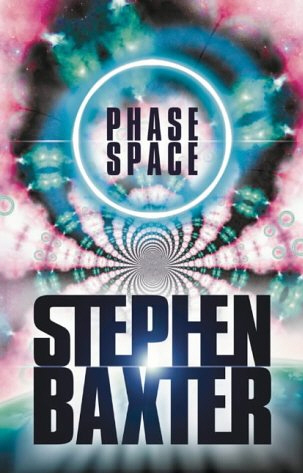
Phase Space, Stephen Baxter (2002), is a collection of short stories, many of which are off-cuts from Baxter’s Manifold trilogy. I read those three books back in 1999, 2000 and 2001 – when they were published, in other words. But not Phase Space. I have a lot of time for Baxter’s fiction, both short and long; but this collection was a bit of a disappointment. There’s some good stuff in it – ‘War Birds’, for example, which won the BSFA Award for Best Short Story in 1998 (and unfortunately resembles something I’ve been working on myself; damn); ‘Tracks’, based on an interview Baxter conducted with Apollo 16 astronaut Charlie Duke; ‘Moon-Calf’, about a retired astronaut on holiday in south-west England; ‘Barrier’, which is the sort of sf I’d be happy to have in Rocket Science. Unfortunately, many of the other stories follow a similar pattern – the narrative is interspersed with italicised first-person infodumps – and so they tend to blur together. And one or two, well, I was surprised to see they’d originally been published by Asimov’s and Interzone… Phase Space is not Baxter’s strongest collection by any means, but there’s some good stuff in it.

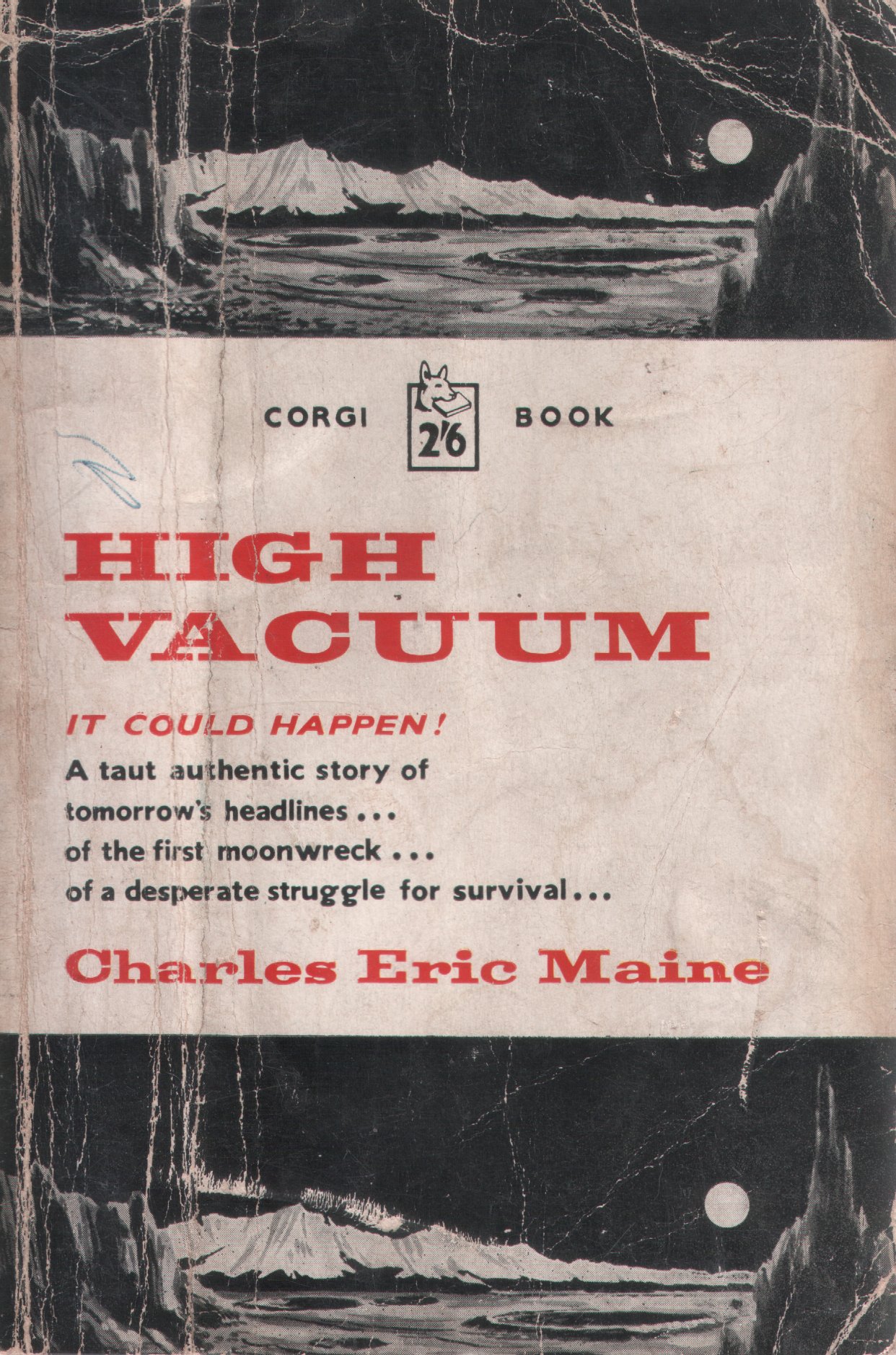
High Vacuum, Charles Eric Maine (1957). I’m currently working on a two-hander review of this and Jeff Sutton’s First on the Moon for my Space Books blog. I thought it might be an interesting exercise to contrast two novels about Moon landings written before the Apollo programme with the real world lunar landings. While I would have said there was plenty of drama in actually trying to get to the Moon, both Sutton and Maine clearly felt what was need for real drama was… a crash-landing.
Icehenge, Kim Stanley Robinson (1984). I have planned a “cage-fight” – which I will write up on this blog – between this book and Robert Heinlein’s The Moon is a Harsh Mistress (which I will have to read first; sigh). Because Icehenge is a much better candidate for the SF Masterwork series. Some of the world-building is a little quaint now – USA vs USSR – but I’ll be completely unsurprised if I find that Icehenge shits all over the Heinlein.

Winterlong, Elizabeth Hand (1990), was April’s book for my reading challenge and I wrote about it here.

The Silver Chair, CS Lewis (1953), is the fourth book of the Chronicles of Narnia by publication date, but the sixth book by internal chronology. Useless Eustace and new-found friend Jill Pole escape from bullies at “modern” school Experiment House (dear god, but Lewis shows his reactionary side with his description of the school), because Aslan wants them to find Prince Rilian of Narnia, who was abducted ten years before. Aslan gives Jill four clues, which she manages to screw up, but it all works out in the end. And everyone gets lashings of buttered scones and hot chocolate at the end, or something. These books are a bit like your old Daily Mail-reading grandad telling a bedtime story – the only bits missing are rants against immigration and falling house prices…

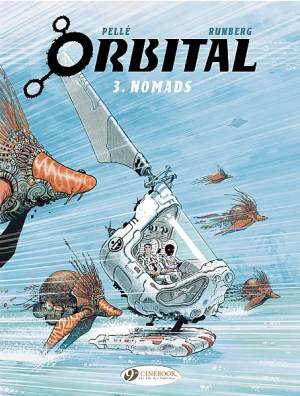
Orbital Vol 3: Nomads, Sylvain Runberg & Serge Pellé (2011), is the third book of a bande desinée series published in English by Cinebook. It’s heartland sf, but far more adult than you’d expect of a science fiction “comic.” Earth is a reluctant new member of a galactic federation, after a war with the alien Sandjarr. A pair of special agents, one human and one Sandjarr, must ensure the celebrations in Kuala Lumpur to mark the end of the war, to which a Sandjarr delegation has been invited, goes without a hitch. But a nomadic alien race has settled nearby, and something is killing all the fish and the fisherman are not happy about it… Good stuff.

Films
Barbarossa – Siege Lord, Renzo Martinelli (2009), I reviewed for VideoVista – see here.

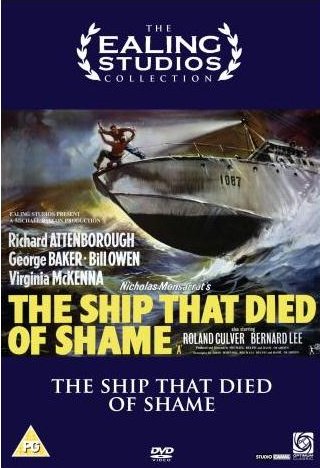
The Ship That Died of Shame, Basil Deardon (1955), is an adaptation of a Nicholas Monsarrat short story of the same title. The crew of a wartime MGB are re-united when they find their old boat – stripped of her weapons, of course – for sale. So they buy her, make her seaworthy, and use her to run contraband across the Channel into post-war austerity Britain. But it all goes horribly wrong when they accept a job to smuggle a murderer to France. Good solid British film-making from the Fifties.

Tin Man (2007), is a mini-series “re-imagining” of The Wizard of Oz, in which Oz becomes the Outer Zone or “Oh Zee”. DG, not Dorothy Gale, finds herself embroiled in a plot by her evil sister to bring endless darkness to the OZ. DG hadn’t known she had a sister, or that the OZ even existed. But when the Midwest farmhouse where she lives with her parents is attacked by strange men in black uniforms, she escapes through a tornado – discovering as she does so that her parents are actually robots. Because she’s really a princess from the OZ. With the help of a heartless ex-law officer (i.e., a “tin man”), the queen’s old advisor who has had his brain removed, and a cowardly lion-like humanoid – oh, and her old tutor, who can transform into a small terrier – DG must find the Emerald of the Eclipse in order to defeat her sister. An interesting spin on a children’s classic which, to be honest, has never appealed to me; but it all felt a bit meh in places. Though it reminded me a lot of the Sci Fi Channel Flash Gordon telly series – which was cheap and a bit silly, but which I quite liked – it didn’t have that programme’s charm.

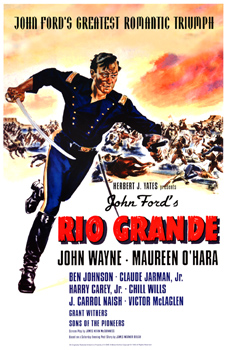
Rio Grande, John Ford (1950). I am not, I admit, a big fan of Westerns. In fact, the only one in my DVD collection is Howard Hawk’s Rio Bravo – which is actually an alternative name for the Rio Grande, the river forming part of the border between the US and Mexico. Rio Grande the film is the third in Ford’s cavalry trilogy, following on from Fort Apache and She Wore a Yellow Ribbon, neither of which I’ve seen. It’s John Wayne doing manly men stuff in the Wild West as injuns run rampant and hide out in Mexico where Wayne’s cavalry can’t follow them. Except he does, even though it might provoke a diplomatic incident. Then he learns that the injuns have captured a wagonload of white kids, which only makes the mission more righteous. The US Cavalry must have been the biggest bunch of war criminals in uniform until the formation of the SS, and their portrayal in films such as Rio Grande has only romanticised their crimes. It’s unlikely a John Wayne film would be “warts and all”, given that there’s always been a strong element of fantasy to the depiction of the Wild West in Hollywood cinema. Wayne’s character may be a racist, but he’s still the hero…

The Spy Who Came In From The Cold, Martin Ritt (1965), is a curiously flat adaptation of Le Carré’s novel of the same name. Richard Burton, who always sounds as though he’s declaiming rather than acting, plays the head of the Berlin office who comes under a cloud when a defection from East Berlin is bungled. He is demoted to a lowly position in London, eventually leaves the “Circus”, and turns to drink and a succession of low-paid jobs. At which point he is approached by East German agents, and reluctantly defects to them. But, of course, it’s all a cunning plot. They’re a bit bloody convoluted these Le Carré films. I have the novel on the TBR; I shall have to read it.

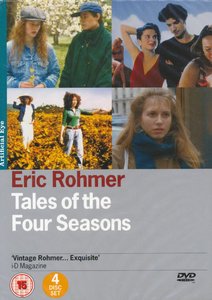
An Autumn Tale, Éric Rohmer (1998). That’s it, all four of Rohmer’s Contes des quatre saisons now watched. In this one, a forty-something woman attempts to matchmake for a winemaker friend of the same age. As does the winemaker’s son’s ex-girlfriend, who has just split up with her university professor lover and who she thinks is an ideal candidate. Unfortunately, most of the characters in An Autumn Tale aren’t especially likable. They prattle and pontificate too much. The ex-girlfriend is particularly annoying – she spouts off lots of arrogant drivel about love and people, but doesn’t actually display much insight. Some poor bloke who gets dragged in as a prospective suitor is horribly mistreated but still hangs in there, though he and the winemaker don’t appear all that well-suited to each other… I first came to Rohmer’s films after watching Triple Agent, and enjoyed its slow-burning drama very much. These Four Seasons films have been… mixed. A Summer’s Tale was easily the best one, with A Winter’s Tale a middling second. A Tale Of Springtime and An Autumn Tale both suffered from unlikable casts. All the same, I’ll be bunging Rohmer’s six Comédies et Proverbes films on the Lovefilm rental list.

Frau im Mond, Fritz Lang (1929), I will be reviewing in more depth on my Space Books blog. For the time-being, I’ll just say that it’s badly-paced, with far too much silliness up-front and not enough screen-time devoted to the mission to the Moon.

The Objective, Daniel Myrick (2008), is advertised as being by the director of The Blair Witch Project, which I’ve never actually seen. A Special Forces team of walking clichés, led by a tight-lipped CIA agent, infiltrate the mountains of Afghanistan where satellites have spotted something very strange indeed. If you like films in which US military stereotypes spout manly men bullshit, and then shoot at things, you might find The Objective interesting inasmuch as it’s not wholly a war film: the eponymous, er, objective, is – keep this to yourselves – not of this world. The film felt a bit amateur in places, and probably would have benefitted from a couple of beers inside the viewer.

I Come With The Rain, Anh Hung Tran (2008), I reviewed for VideoVista – see here.

Aliens From Outer Space, Bill Knell (2009), I reviewed for VideoVista – see here.

The Small Back Room, The Archers (1949). Those back room boys… Without them, we’d never have won the war, you know. Though they don’t actually appear to do much in this film. Sammy Rice is one such back room boy. He has an artificial foot, which pains him; and a dependency on pills and alcohol. He’s also in a strange relationship with his boss’s secretary. When a new type of booby-trapped explosive device, dropped by Jerry planes, starts killing children, Rice is brought in to puzzle out how it works. Meanwhile, he’s crawling further into a bottle, politics at the office is causing major problems, and his increasing bitterness is jeopardising his relationship with his girlfriend. Despite some clever photography, the tension and drama in The Small Back Room never quite works, but as a study of a man succumbing to despair during wartime – including a bizarre drunken dream sequence – the film is very effective. The Archers – Powell and Pressburger – were bloody clever filmmakers, and it certainly shows in this. In lesser hands, The Small Back Room could have been just another anodyne WWII home-front melodrama. We need directors like the Archers in the twenty-first century.

Le Refuge, François Ozon (2009), was surprisingly ordinary and a bit dull for an Ozon film. Could it really have been directed by the same person who made 8 Women, Angel or Water Drops On Burning Rocks? Two junkies score some smack, but one dies of an overdose. The other, the dead man’s girlfriend, only just survives. And then discovers that she’s pregnant. The dead junkie’s family, who are wealthy, don’t want her to keep the baby. But she chooses to have it, so runs away to a friend’s house on the coast. A few months later, the dead junkie’s gay brother comes to visit, and ends up staying a week or so. And, er, that’s about it. There are a number of scenes filmed on a beach, in which the woman’s pregnant belly is plainly visible. I was quite impressed by the prostheses and make-up used for this effect, only to learn in a featurette on the DVD that the actress, Isabelle Carré, really was pregnant during the making of the film. You have to wonder if she was cast because she was pregnant; or did Ozon completely rewrite the script on learning she was pregnant? Le Refuge is a likable drama, but Ozon has made much more interesting films.

Norwegian Ninja, Thomas Cappelan Malling (2010), I will be reviewing for VideoVista, but I decided to give it an early mention because it’s a pitch-perfect spoof of low-budget action/spy movies, and might well end up on my Best of the Year top five films.


1 Comment

I saw this meme and…

I spotted this on David Hebblethwaite’s blog and, while something similar went round on World Book Day (see here), I decided to have a bash at it. Besides, I’ve not posted much this week, and I don’t want all my fans (ha!) to think I’m slacking…

1. The book I’m currently reading

A Confederacy of Dunces, John Kennedy Toole

Many people have recommended this to me, but I can’t see what all the fuss is about. The main character, Ignatius J Reilly, is an over-educated idiot, and the novel is asking us to laugh at him. That’s cheap humour. Some of the slapstick, on the other hand, is quite amusing; and there is some wit in the black characters’ dialogue. But this is no American classic.

2. The last book I finished

The Silver Chair, CS Lewis.

I’m about thirty-five years too old to enjoy the Chronicles of Narnia, but I’m ploughing my way through the books nonetheless. I suspect if I had read them when I was a kid I would have found them just as patronising and dated. Oh well, only three more to go…

3. The next book I want to read

Blood Meridian, Cormac McCarthy

The TBR pile is frighteningly large and, of course, I want to read every book on it. But some sooner rather than later. I’ve had Blood Meridian for a while, and have been meaning to read it for just as long. I think I shall tackle it next. Honest.

4. The last book I bought

The Atrocity Exhibition, JG Ballard

I made a few bob on Amazon affiliates recently and was sent a voucher. Which I promptly spent. Chiefly on graphic novels. But I also included a SF Masterwork, and this, the nicely-packaged Fourth Estate edition of The Atrocity Exhibition. I read a lot of Ballard’s later “mainstream” novels when I was living in Abu Dhabi, and enjoyed them; but as I get older I find myself appreciating his writing more and more.

5. The last book I was given

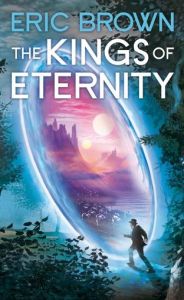
The Kings of Eternity, Eric Brown

I’ve known Eric for nearly two decades, and liked his fiction for a couple of years longer than that. He sends me copies of his novels now when they’re published. Some day I hope to be able to return the favour. The Kings of Eternity is, by all accounts (including Eric’s), the best novel he’s written to date. So I really need to read it before the end of the year as it may well appear on a few shortlists in 2012.