
Well, not really. However, Alt Hist #3 was published yesterday and is currently available on Kindle here and from Smashwords here. I mention this because it is a good magazine, and because it contains my story ‘A Light in the Darkness’ about Wilfred Owen and Nikola Tesla. It’s alternate history, of course. One of these days I’ll have to have a go at a straight historical story. But for now, go out and buy Alt Hist #3. It’s a good thing.
Bookjoy: more Compton
Synthajoy was DG Compton’s fourth science fiction novel. Previously, he had written half a dozen crime novels under the name Guy Compton. So it should come as no surprise that Synthajoy is as much a crime novel as it is a science fiction novel.

Thea Cadence has been incarcerated in the Kingston, a clinic designed to rehabilitate criminals using the Sensitape process. Thea’s husband, Dr Teddy Cadence invented Sensitape – or rather, he invented the concept. The device itself was invented by Tony Stech, his business partner. Sensitape is, as the name suggests, recorded emotional states which can be played into a person’s mind, and thus directly affect it. At the Kingston, Thea is undergoing Sensitape treatment in contrition as her sentence for a crime.
Cadence had been inspired to invent Sensitape while attempting to cure Stech’s father of an increasingly common condition called UDW, Uncompensated Death Wish. He failed to prevent the man’s death, but Sensitape did subsequently make UDW extremely rare. In fact, Sensitape was a great success. But the recording made of a couple making love, Sexitape, was an even bigger success. Cadence, however, always dreamed of artificially creating the emotions on a Sensitape, i.e., deliberately programming the effect required. He called this process Synthajoy.
Thea drifts in and out of her memories as she is being treated. Though she did not defend herself during her trial, she does not consider herself guilty of the crime. She resists her rehabilitation treatment. And in between periods of introspection and rebellion, she relives – or explains to her nurse – the history of Sensitape and her involvement with it. In this way, facts pertinent to the crime of which she has been charged are revealed.
Thea murdered her husband.
An early Sensitape session in which she was the guinea pig gave her a revulsion for her husband’s body. He found sexual companionship in the arms of another woman – the one from the Sexitape, in fact. Thea meanwhile had an affair with Tony. Who later committed suicide under suspicious circumstances. During her trial, the prosecution claimed it was jealousy that had led to the murder. They did not know of Thea’s relationship with Tony, nor did she tell anyone of it.
Synthajoy is a carefully-plotted ramble through Thea’s consciousness and history. She is hiding the truth from herself as much as she is from her prosecutors and rehabilitators. And it is only as she reveals her past that the truth about Tony’s suicide and the murder of Dr Cadence are uncovered. Unlike later novels, Synthajoy is a single-hander, and told entirely from Thea’s point of view. She is intelligent, educated, middle-class, and beautifully real. Unsurprisingly, the writing is a joy to read:
It is extraordinary to watch my hands. They smooth and fold, now so neat and expert, so accomplished now that they act without mind, without my volition … Hope is like a fever, a heat engendered by battle, and it leaves a deadly chill behind it. My arms ache. My hands tingle and creak. (p 50)
Also, unsurprisingly, the book is very firmly British, and very firmly a novel of the late 1960s / early 1970s. (It was first published in 1968). Those characteristics, as much as the writing, are the essence of Compton’s appeal. His novels are fiercely intelligent and beautifully crafted, but it is their finely-tuned sense of time and place, the way the central ideas are so well integrated into the real world, that makes them stand out.
There are ideas that Compton returns to again and again. The abuse of technology is an obvious marker – and one that demands a story set in as close an analogue of the real world as is possible. And yet… It seems odd that Compton should begin his writing career in crime, writing novels in which the purpose of the story is to explain a death. Yet his science fiction novels typically feature epidemics of unexplainable deaths – UDW in Synthajoy, Gordon’s Syndrome in The Continuous Katherine Mortenhoe (see here), and the Disappearances in Ascendancies (see here).
In his three decades of writing science fiction, Compton never won an award, despite being published regularly in both the UK and the US. The Steel Crocodile was shortlisted for the Nebula in 1971, but lost out to Ringworld (an extremely popular book, but nowhere near as well-written). He appeared on the Locus Award shortlist three times, and in 2007 the SFWA made him an Author Emeritus. Yet he was possibly the best British sf writer of the 1970s. At a time when US authors of the 1950s dominated the field on both sides of the Atlantic – Asimov, Smith, Herbert, Heinlein – Compton was one of a handful of British sf writers writing sf novels so much more intelligent and well-crafted than those of their contemporaries. It’s a shame they appear to be mostly forgotten, and it’s the likes of Foundation and Stranger in a Strange Land which dominate lists of so-called genre classics. Perhaps the re-issue of Compton’s back-catalogue as ebooks through the SF Gateway (Compton’s entry is here), and The Continuous Katherine Mortenhoe‘s appearance in the SF Masterwork series in October 2012, will see Compton receive the recognition he deserves.
The following novels by Compton are currently available on Kindle via the SF Gateway. If you own such a device, you should buy them immediately: Farewell, Earth’s Bliss (1966), The Silent Multitude (1966), The Quality of Mercy (1967), Synthajoy (1968), The Steel Crocodile (1968), Chronocules (1970), A Usual Lunacy (1978), Windows (1979), Ascendancies (1980), Scudder’s Game (1988), Nomansland (1993), Justice City (1995) and Back of Town Blues (1997).
Oh no what have I done?
I appear to have done something very foolish. I was sort of toying with the idea, but I didn’t really intend to do it. I mean, it’s not like I haven’t got enough on my plate already. So I’ve no idea what possessed me to sign up for Nanowrimo this year.
But I did.
Well, I had this idea for a series of novels, a sort of literary treatment of a hard science fiction staple: the first interstellar mission. This was inspired – structurally, that is – by the likes of CP Snow’s Strangers & Brothers, Anthony Powell’s A Dance to the Music of Time and Simon Raven’s Alms for Oblivion. The individual novels would be short – in fact, Nanowrimo’s 50,000-word target is pretty much the perfect size. Anyway, I wanted to see if the idea worked, if I could write something of that sort of literary hard sf. And Nanowrimo seemed like a good way to motivate myself.
I could have chosen a better time, however. It’s not like I’d have spent November twiddling my thumbs. There’s Rocket Science to get sorted out – once I’ve decided on a final TOC, I need to start line-editing the contributions. Then there’s the fiction in various degrees of completion I have knocking about on my computer. Some just need a quick buff and polish; others need need me to work what the hell is going on in them. Plus, there’s the many reviews I need to get done…
Anyway, Nanowrimo. Write 50,000 words by the end of the month. That’s 1,667 words a day. That’s all I have to do. Yeah right. You can find me on the Nanowrimo website here. It should be… interesting.
The future we used to have, part 6
Time for yet another in my ongoing series on retro-futures. The past, they say, is another country and they do things differently there. But the future we’ve come to inhabit is every bit as different as the one the past imagined into existence. And not necessarily for the better. We never had utopia within our reach, but neither should we have turned our back on the struggle towards it.
There is something that strives towards utopia in Brutalist architecture – which no doubt explains why so many Brutalist projects did not ultimately survive. The car designs of Nuccio Bertone seem to me the closest automobile equivalent. And I still think the Lamborghini Marzal is one of the nicest-looking cars ever designed. According to Wikipedia, the Marzal was a one-off concept car, but I have a very clear memory of seeing one in lime green in Doha, Qatar, during the early 1970s. It belonged to a sheikh, and my father even got to drive it.
buildings
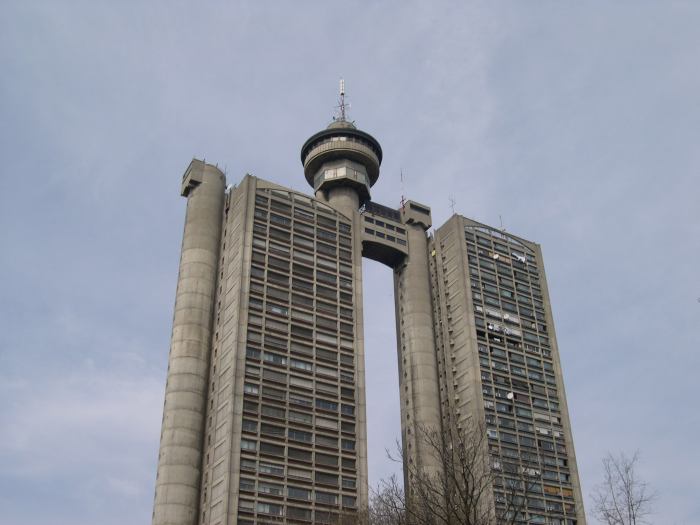
Genex, Tower, Belgrade

Habitat 67, Montreal

Torres Blancas, Madrid

Geisel Library, University of California, San Diego

Tricorn Centre, Portsmouth (demolished 2004)

Alexandra Road Estate, London
cars

Lamborghini Marzal, 1967 (Bertone)

Inside the Lamborgini Marzal (Bertone)

Alfa Romeo Navajo, 1976 (Bertone)

In the future, all drivers will wear crash helmets and skintight clothing: Alfa Romeo Carabo, 1968 (Bertone)

In the future, all drivers will wear bikinis: Ferrari 512 S Modulo, 1970 (Pininfarina)
planes

Boeing 733 SST

Myasishchev M-50 Bounder supersonic bomber

Rockwell XFV-12 supersonic VTOL fighter

McDonnell XF-88B hybrid supersonic jet-turboprop fighter
space

Hyperion Single Stage To Orbit (Philip Bono)

ROMBUS, Pegasus and Ithacus SSTOs (Philip Bono)

Boeing LEO SSTO

Soviet SPIRAL Project: GSR and OS (source: http://www.buran-energia.com)
Reading snapshot meme
David Hebblethwaite has just done this on his blog, and I read his blog, so I guess I’ll have a go at it. Again. Because we’ve all done this before. But so what: it’s about books. Books are good, and reading them is even better. The only thing better than reading that you can do with books is, er building a fallout shelter with them and pretending World War III has happened. Or maybe a zombie apocalypse. And while the rest of the world succumbs to anarchy and chaos and radiation / undeadedness, you read the books you built your shelter from. Win.
Anyway, the meme: it goes like this:
1. the book I’m currently reading
Synthajoy, DG Compton – the best British science fiction writer of the 1970s, and his novels continue to be superb and very, er, 1970s. And that’s why I think they’re brilliant.
2. the last book I finished
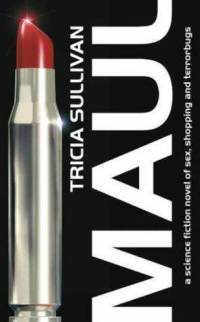 Maul, Tricia Sullivan – this was October’s book for my reading challenge (see here), and I was expecting to like this a lot more than I did. Proper full write-up to follow soon-ish. For the present, I will say it has a slightly American Psycho vibe to it which, like that book, struggles to convince, and a near-future in which men are exceedingly rare, and correspondingly prized, due to a plague, which feels like an entirely different type of society.
3. the next book I want to read
The Unit, Ninni Holmqvist – the TBR actually numbers in the hundreds, but I have a sort of mini-TBR, a half-dozen books which will be my next immediate reads. And top of this list is The Unit, which Michaela Staton gave me ages ago and keeps on asking me what it’s like. It does look very interesting, in fact.
4. the last book I bought
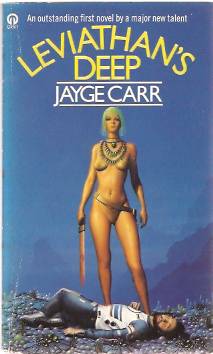 Leviathan’s Deep, Jayge Carr – when I say “bought”, I didn’t pay any money for this. It was priced 50p but since we’d just given the Harewood House second-hand bookshop two carriers bags full of books, they let us have the handful we wanted for nothing. Which was pretty cool, as Leviathan’s Deep had been on the wants list since reading Carr’s story in Women of Wonder: the Contemporary Years (see here). It’s a shame about the slightly dodgy cover art, though.
5. the last book I was given
Blood Count, Robert Goddard – I have no excuse for this one. Goddard writes formulaic potboilers, but I’ve read every one of his books to date. My mother got this from the above-mentioned second-hand bookshop, and has passed it on to me. In their defence, they are very quick reads.
Why there’s nothing fantastic about science fiction
We all like our genre labels, even if we argue over their provenance – literary genre, marketing category, or whatever it is we are pointing at. But people have a natural tendency to categorise things, to seek out patterns, in order to make things more manageable. It helps no one to insist that there is no such thing as genre, that all literature is one big amorphous field in which authors play with a selection of tools. Not only does this fail to recognise the nature of those tools, the author’s intent, or the reader’s response, it hampers discussion and confuses matters.
Genre exists. Deal with it.
There are also those who like to lump science fiction and fantasy together as a single genre. Certainly, they can both be found in the same part of a book shop. They call this “speculative fiction”. But sf and fantasy have as much in common as… sf and mainstream fiction, say, or fantasy and crime fiction; than they have in common with each other. Sf and fantasy and crime, for example, share a reliance on plot; or, sf and fantasy can be as mimetic as literary fiction.
In fact, other than the (not obligatory) use of invented worlds, sf and fantasy have very little in common. And there are mainstream novels which use invented locales – such as South Riding, Barchester, Wetherton or Kings Markham. But then, all literature is speculative, all literature is imaginative – but that doesn’t make all literature the same.
Even distinctions between “science fiction” and “category science fiction” are facile. The latter is what some people use to describe books sold as science fiction – the difference, in other words, between an Iain M Banks’ Surface Detail and Cormac McCarthy’s The Road. The former has “SF” on its spine, and is shelved in the sf and fantasy section of the book shop.
As for science fiction and fantasy belonging to an all-encompassing “speculative fiction” genre… That too is a failure of taxonomy. They are entirely different modes. Science fiction is, at heart, modernist. It may be plot-dependent, which much modernist literature is not, but its modern form was certainly created as a means of explaining an ever-changing industrialised world. It even began in an electronics magazine! Sf’s self-reflective nature – i.e., “a genre in conversation with itself” – is also a characteristic of modernist fiction. As is the gradual shift from a chiefly utopian mode to a dystopian one.
Fantasy displays none of these characteristics. It is not always plot-dependent, though epic/high fantasy (i.e., secondary world fantasies) tends to rely heavily on either the quest or hero’s journey templates. It does not seek to explain the world, but to lend it further mystery; its worlds are not open to explanation. It is neither utopian nor dystopian, but always returns to the status quo. It is not self-reflective, though over the decades it has built up a large toolbox of conventions and tropes.
Without genres, we cannot discuss literature intelligently. Without taxonomy, we cannot know what we are talking about. As marketing categories, sf and fantasy serve a purpose for readers and purchases and fans. But sf and fantasy as definable (however nebulously) modes of fiction provides the context we need to engage and comment on fictions displaying genre characteristics.
World book meme!
Book meme! Here are the 25 titles chosen for 2012’s World Book Night. Do the usual: bold for read, italics for owned by unread. And, given the multimedia nature of our cultural landscape, asterisk those with film or television adaptations you have seen.
*Pride and Prejudice by Jane Austen
The Player of Games by Iain M Banks
Sleepyhead by Mark Billingham
Notes from a Small Island by Bill Bryson
The Alchemist by Paulo Coelho
The Take by Martina Cole
Harlequin by Bernard Cornwell
Someone Like You by Roald Dahl
A Tale of Two Cities by Charles Dickens
Room by Emma Donoghue
*Rebecca by Daphne Du Maurier
*The Remains of the Day by Kazuo Ishiguro
Misery by Stephen King
The Secret Dreamworld of a Shopaholic by Sophie Kinsella
Small Island by Andrea Levy
*Let the Right One In by John Ajvde Lindqvist
The Road by Cormac McCarthy
*The Time Traveler’s Wife by Audrey Niffenegger
The Vanishing Act of Esme Lennox by Maggie O’Farrell
*The Damned Utd by David Peace
Good Omens by Terry Pratchett & Neil Gaiman
How I Live Now by Meg Rosoff
Touching the Void by Joe Simpson
I Capture the Castle by Dodie Smith
The Book Thief by Markus Zuzak
Not so good a score: six read, six seen. None on the TBR. Oh well.
The enmity of postmen
It has been a good month for the book collection and a bad month for the TBR: both have grown larger. As follows…
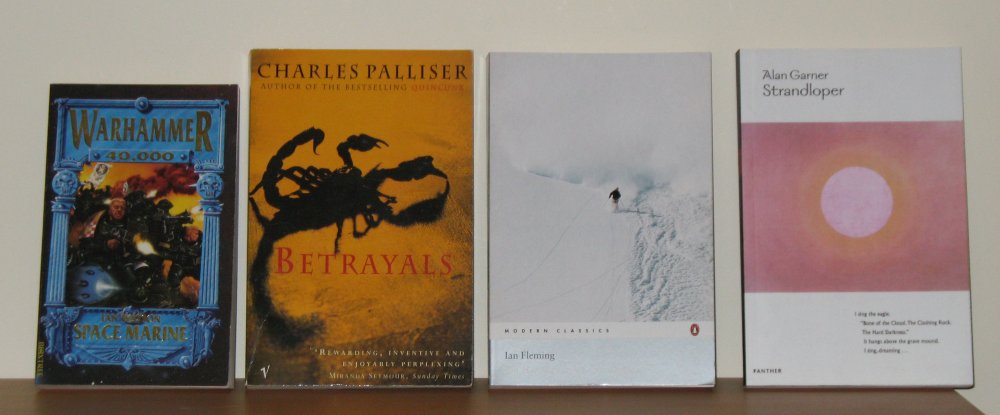
Some charity shop finds to start: Maureen Kincaid Speller has been singing the praises of Alan Garner for decades, though my only exposure to him has been the children’s classic fantasies The Weirdstone of Brisingamen, The Moon of Gomrath, Elidor and The Owl Service. Time to remedy that with Strandloper, methinks. Despite thinking they’re really bad, I’m determined to work my way through Fleming’s Bond novels – hence, On Her Majesty’s Secret Service. I remember being impressed by Palliser’s The Quincunx when I read it back in the early 1990s, and also enjoyed his The Unburied some ten years ago. But he’s not an author who appears often in charity shops, so I was pleased to pick up Betrayals. The infamous, and expensive, Warhammer 40, 000: Space Marine by Ian Watson I didn’t find in a charity shop but bought off a seller in Canada on eBay. I got it for less than the going rate – especially considering its condition – so I’m happy. And now I get to read it, too.
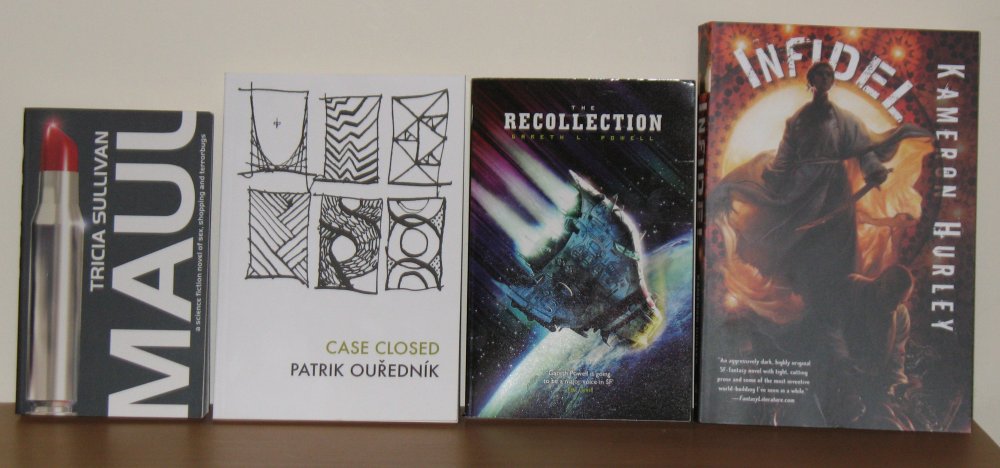
New paperbacks: Infidel is the sequel to the excellent God’s War (see here). A third book, Rapture, is I believe due next year. The Recollection is Gareth Powell’s debut novel from a big publisher. Patrik Ouředník’s Europeana made my best of the year list back in 2006 (see here), so I felt it was time to try his next book, Case Closed. And Maul is this month’s book for my 2011 reading challenge (see here).
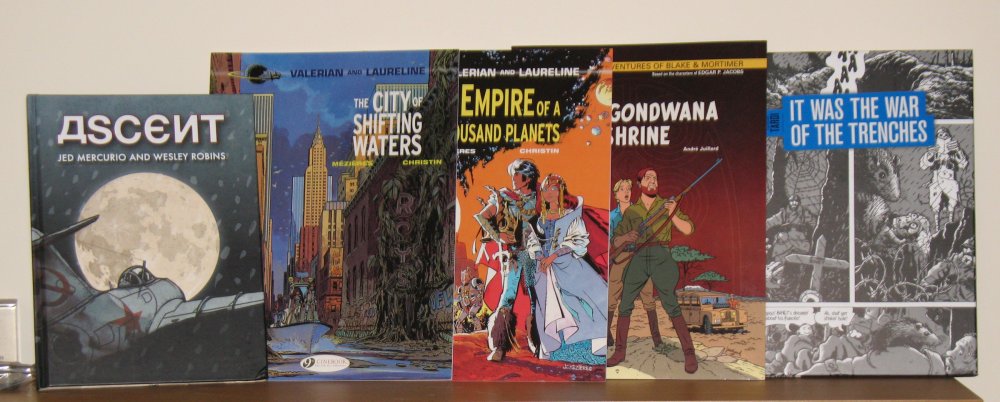
Graphic novels: I like Jacques Tardi’s bandes dessinée, and these Fanatagraphics editions are handsome volumes, so I’ve been buying them. It Was the War of the Trenches is about, well, World War I. The Gondwana Shrine is the eleventh volume of the adventures of Blake and Mortimer, and is another one by the team of Yves Sente and André Juillard (series creator Edgar P Jacobs died in 1987). The books have all the intense seriousness of Tintin, but where Hergé tempers his stories with slapstick humour, Jacobs (and now Sente) marry them with bonkers pulp scientific romance. It makes for an entertaining combination. Then there’s the first two books of Jean-Claude Mézière and Pierre Christin’s Valérian et Laureline, Agents Spatio-Temporel, now in English translation – and published by Cinebook, who are doing excellent work. The series currently stands at 21 volumes, although previously only seven have been translated into English (I have them all). Both The City of Shifting Waters and The Empire of a Thousand Planets are a bit clumsily written, but they’re fun – and the series does improve a great deal. There are, incidentally, some interesting similarities between elements of the latter and the Star Wars films, though The Empire of a Thousand Planets was originally published in 1971. Coincidence? Ascent is a graphic novel adaptation of Jed Mercurio’s excellent novel of the same title (see here).
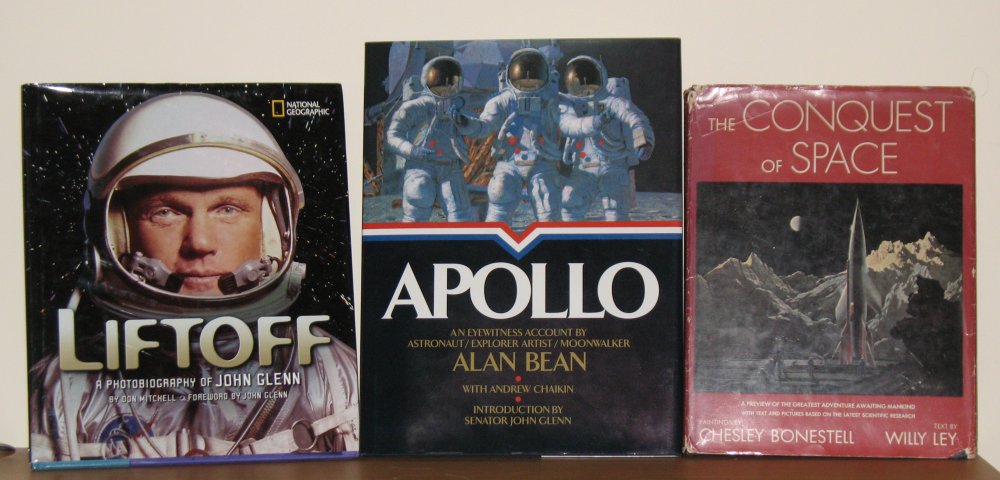
For the space books collection: The Conquest of Space contains some lovely art by Chesley Bonestell, which are worth the price of admission alone. Apollo: An Eyewitness Account by Alan Bean has been on the wants list for a while. It’s a signed first edition. Liftoff: A Photobiography of John Glenn was, er, cheap.
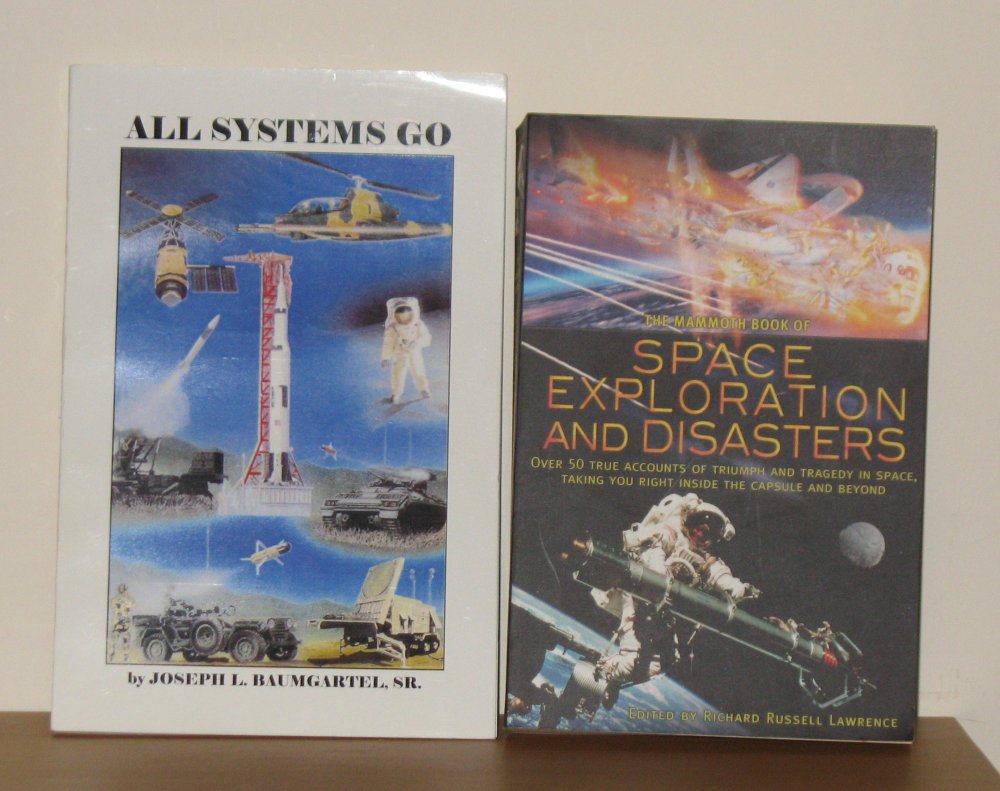
And more space books: All Systems Go is a self-published memoir by an engineer involved in a number of NASA and US military projects, including SAGE, Apollo, Skylab, and the TOW missile. The Mammoth Book of Space Exploration and Disasters was a charity shop find. I suppose the publishers thought exploration on its own wasn’t exciting enough – people would only buy the book if it included shit blowing up.
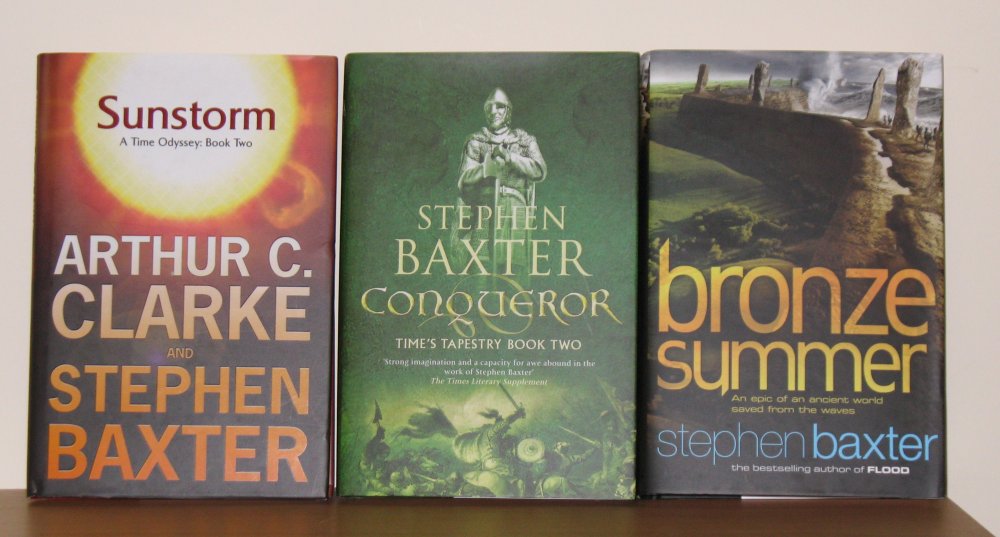
A trio for the Baxter collection: Sunstorm, book two of the A Time Odyssey trilogy, completes it for me; Conqueror is the second of the Time Tapestry quartet and I still need to get books 3 and 4; and Bronze Summer is the sequel to Stone Spring, which I have yet to pick up a copy of.
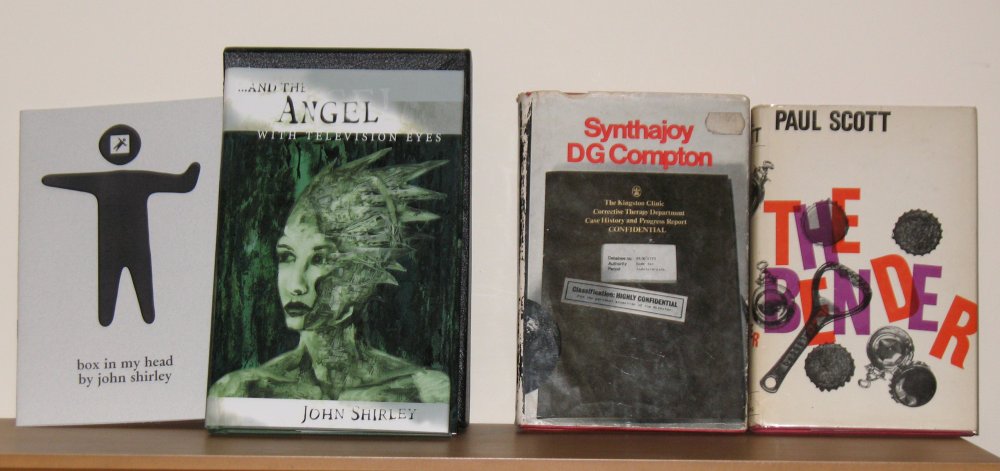
More first editions: Paul Scott’s The Bender was lucky find on eBay. As was Compton’s Synthajoy, though it’s a tatty copy. …And the Angel with Television Eyes is the signed slipcased edition from Night Shade Books, which includes a chapbook, the box in my head, of lyrics and poems.
Women in sf reading challenge #9: Shadow Man, Melissa Scott
If I’ve had trouble reading the books for my challenge in their proper months, it’s not because reading them is proving a, er, challenge. On the contrary, it’s because I’ve made a change in my reading patterns which makes the books I chose for the challenge less of a conscious or deliberate act of selection of reading material. I now read more books by women writers, and so the dozen books of my reading challenge are just twelve among many. In that respect, the challenge can be counted a success – and only nine months in, too. Nor have any of those nine books been bad books, though a couple I didn’t enjoy as much as the others.
Which brings me to Shadow Man by Melissa Scott, September’s book for the challenge. I was aware of the book’s reputation before choosing it – in fact, it was that which likely led to its selection. However, that reputation had not really prepared for what I found when I started reading it. Because what Shadow Man is, is Ursula LeGuin’s The Left Hand of Darkness through a funhouse mirror. It is also a more political novel than the political The Left Hand of Darkness. Comparisons are inevitable, even though LeGuin’s novel takes place on a world with one gender and Shadow Man takes place in a universe with five genders. Both novels have placed the treatment of gender – culturally and legally – front and centre.

In the universe of Shadow Man, the use of a drug to offset “FTL shock” has resulted in a far greater than normal incidence of intersex and hermaphrodite births (miscarriages are also correspondingly higher). The Concord Worlds now recognise five genders – woman, man, fem, mem and herm; respectively, she, he, ðe, þe and 3e. (Unfortunately, I kept on reading the pronouns referring to herms as if they used the Arabic ﻉ (‘ayn) rather than the numeral 3.) These five genders have led, in turn, to nine sexual preferences, and this has bearing on the plot of the novel.
On the world of Hara, a colony planet re-contacted 100 years previously after several centuries of independent development, the law and society only recognise two genders – man and woman. So the herms, mems and fems must take on the role of one or the other – though there is apparently a facility for herms at least to legally change gender. The Traditionalist Harans feel that true humans have only two genders, and they do not want to join the Concord. The Modernists want the other three genders to be recognised in Haran law. It is the battle between these two groups which drives the plot of Shadow Man.
Warreven is a herm, but legally male, and works as an advocate in the Haran legal system. Years before, 3e almost married the son of the Most Important Man – the de facto ruler of Hara – but 3e refused to change legal gender. Now, 3e fights for gender rights in the courts. Mhyre Tatian is the manager of a middle-sized Concord pharmaceutical company’s operations on Hara. The world’s biggest export is its drugs, all derived from the local flora. Also important is “trade”, which is prostitution, mostly involving the three genders not recognised on Hara.
Warreven is involved in a court case which looks set to play a major role in the fight for gender equality. But the Most Important Man doesn’t want that to happen, because as long as things muddle along as they presently are doing, a delicate balance between the Traditionalists and the Modernists is maintained. But his son, Tendlathe, is a staunch Traditionalist – a blinkered, chauvinist and conservative Traditionalist of the worst kind. In an effort to keep Warreven from the courts, the Most Important Man has him elected as his clan’s seeraliste, the person responsible for selling off the clan’s surplus crops. Meanwhile, the Interstellar Disease Control Agency, the organisation responsible for preventing the spread of diseases – a variety of HIVs were also created by the FTL drug – also wants to prevent that case from going to court for their own reasons. Tatian is caught in the middle as one of his employees is a key witness. When Warreven offers Tatian the entire clan surplus in return for the employee’s testimony, it kicks off a series of Traditonalist attacks on the Modernists and the “odd-bodied”.
Scott makes no concessions when introducing the world of Shadow Man. It’s straight in at the deep end. There are one or two info-dumps streamlined into the narrative, but they provide little more than local colour. The story is told from the points of view – alternating – of Warreven and Tatian. From Warreven, we see what it’s like to be a herm in a society that does not recognise it as a gender, and we get the politics which affects that. Tatian provides an outsider’s view of Hara and its culture. Though both mention at various points some physical attraction between them, it never amounts to anything.
As a sf novel set in a strange and interesting world, with a pair of likeable protagonists, Shadow Man succeeds. There’s an air of exploration to the story, as it spends a great deal of time savouring the culture of Hara before the somewhat abrupt final confrontation. Yet the action never moves outside the capital city, though places elsewhere on the world are often mentioned. It makes for a languid read, a story in which the politics of the climax seems to page by page subsume the story of Warreven and Tatian – in fact, for at least half of the book, they’re barely acquaintances.
But it is the gender politics for which Shadow Man is known, and I found them a little problematical in places. For a start, the thing driving the gender politics in the story is “trade”. It’s almost as if the odd-bodied genders are defined by the roles they play in prostitution. There’s a level of prurience implicit in the Traditionalist response to herms, mems and fems, and given the focus on trade it’s not hard to understand why they might hold such an opinion. Perhaps Shadow Man needed to show a Concord world’s society as contrast, because all the reader has with which to compare it is the situation in the real world. It’s also worth noting that the genders in Shadow Man are defined by biology – it’s the secondary sexual characteristics and equipment which determine which gender a person is. And while the book’s glossaries helpfully explain the nine sexual preferences – there is a glossary of Concord terms and one of Haran words – those sexual preferences make only a few appearances in the story. Haran society is dual-sexed, and the story treats all interactions as such, acknowledging the existence of sexual preferences beyond woman-man but not really exploring them. And this is in a novel whose story describes the start of a sexual revolution comparable to the fight for gay rights in the real world. In fact, Shadow Man‘s penultimate chapter is very much an analogue of Stonewall.
Literalising a metaphor is not uncommon in fiction, and is an excellent tool for commentary. I’m not entirely convinced that literalising sexual preferences as biological gender necessarily helps discussion, though in Shadow Man it has resulted in an interesting universe. It’s a pity Shadow Man doesn’t explore more of it. Which is not to say it’s a bad novel by any means. I enjoyed it and thought it good. I’d happily recommend it. I am somewhat surprised it has never been published in the UK. It seems to me it would fit in quite happily with a number of sf novels which have been available here over the years – not just the aforementioned LeGuin, but also books by Storm Constantine, Samantha Lee, Mary Gentle, or even Gwyneth Jones’ Aleutian trilogy…
Readings & watchings 2011 #8
It’s been just under a month since the last one of these, and that one proved to be a somewhat humungous post. So I thought I’d try for a more bite-sized installment this month. Sort of. Anyway, you know the drill: the books wot I have read, the films wot I have watched. Comments thereon.
Books
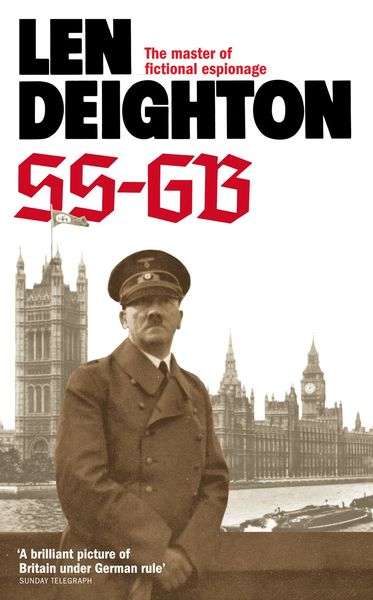 SS-GB, Len Deighton (1978), is perhaps the classic “Hitler won” alternate history, although it’s by no means the first. A Scotland Yard detective, now working under the aegis of the SS in an occupied Britain, is dragged into several intersecting plots when he investigates the murder of an unknown man in a small flat in London. It’s all tied in with the British resistance’s plan to smuggle the imprisoned King George VI out of the country, the fierce – and often violent – rivalry between the SS and the Wehrmacht, and the Wehrmacht’s secret atom bomb being built by British scientists. Archer, the detective, is a bit of a cipher, and, in fact, much of the cast are blanks. That Deighton has done his research is obvious from the first page, and he paints a convincing portrait of a UK under the Nazis. The writing, sadly, is pretty poor. I’ve read Deighton’s Harry Palmer novels, and his Game, Set and Match and Faith, Hope and Charity trilogies, and I don’t remember his writing being this inept and clumsy. Still, I’m glad I read it, and it can go back to the charity shop now. Incidentally, I wonder if choosing a photo of Hitler in such a camp pose for the cover was a wise decision: his depredations are not something we should make light of, or forget.
The League of Extraordinary Gentlemen: Century 1969, Alan Moore & Kevin O’Neill (2011), is the latest installment in Moore’s slow progress back up his own bumhole. Actually, this one is slightly better than the previous two. The League are now in England Swings territory, and an acolyte of Aleister Crowley, but with very real powers, is trying to bring about the creation of an Antichrist. This will take place during a free concert in Hyde Park. There’s some nice touches, and plenty of in-jokes, but I’m starting to wonder where this series is heading and whether it’s going to be worth it when it gets there.
The Extraordinary Adventures of Adèle Blanc-Sec 1, Jacques Tardi (2010), I picked up after enjoying Tardi’s The Arctic Marauder. It has apparently been made into a film by Jean-Pierre Jeunet, master of Gallic surgary whimsy, and starring Audrey Tatou. And yet there’s little that’s whimsical about the two stories in The Extraordinary Adventures of Adèle Blanc-Sec 1. In the first, a pterodactyl is terrorising Paris, and Adèle uses it as cover to help solve an entirely different crime. Which is sort of linked. The final scene, in which a villain turns up and explains the plot, only to be gazumped by another villain who explains another more-encompassing plot, who is then gazumped by another, is completely bonkers. The second story is more traditional: a demon is terrorising Paris, and Adèle tracks it down to a group of cultists associated with a local theatre. If it hadn’t been for that pesky Adele… Fun. And I’ve already ordered another one of Tardi’s graphic novels.
Daily Voices (Author’s Choice Monthly #3), Lisa Goldstein (1989). Back in the late 1980s, Kristine Kathryn Rusch and Dean Wesley Smith published twenty-nine collections, each contain no more than half a dozen short stories, by twenty-nine different genre authors. Each book was published in three editions: a trade paperback, a signed and numbered jacketed hardback, and a signed and lettered leather hardback. The stories were mostly reprints. This volume, the third in the series, contains five stories, all originally published in Asimov’s. One, ‘Tourists’, inspired a novel of the same title. These are literary stories, deceptively fantastical, and unsettling. ‘Tourists’ is a case in point: part Hav, part The City & The City (though contemporary with one and predating the other). Nothing especially jumped out at me in this collection, though they are stories it is easy to admire.
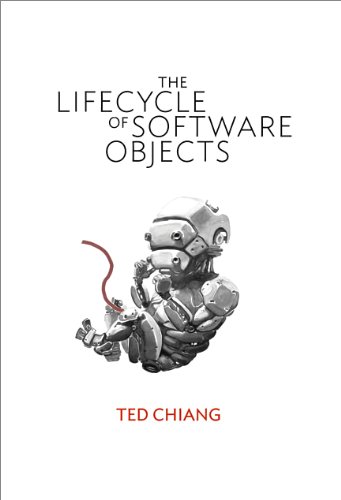 The Lifecycle of Software Objects, Ted Chiang (2010), won this year’s Hugo for Best Novella. Which is hardly a surprise. The only time Chiang doesn’t win is when he withdraws his work. And certainly he’s produced an enviably high-quality body of work over the years. Unfortunately, while The Lifecycle of Software Objects is as well-written as you’d expect from Chiang, it’s also a little dull and doesn’t go anywhere very interesting. A startup produces a new range of heuristic software lifeforms, “digients”, but the amount of work required by customers to parent them proves the company’s undoing. But a handful of people, emotionally attached to their digients as if they were real children, continue to nurture this new form of life. It’s a neat idea, but it does feel in places a little like Chiang wasn’t entirely sure where to take his idea. It’s like someone had invented the cat and had no idea what it was good for. Except the concept of a “better mousetrap” doesn’t appear to have occurred to Chiang. Disappointing, though only because Chiang sets his own bar so high.
Gravity Dreams, Stephen Baxter (2011), is another brick in the great wall that is Baxter’s Xeelee Sequence. In fact, Gravity Dreams brings the sequence full circle as it’s tied into Baxter’s first novel Raft (and the PS novella includes the short story on which Raft was based). Gravity Dreams is a very… expositionary type of story. A man in the unimaginably distant future experiences strange lucid dreams, which prove to be contact with a device in the universe of Raft (where the universal gravitic constant is considerably higher). The people of that universe, and the tech which the dreamer embodies, could prove of use in the ongoing war against the Xeelee. As a whole, the Xeelee Sequence is quite an achievement, certainly greater than the sum of its parts. Which, unfortunately, has the logical consequence that individual parts may not be as exciting, or as interesting, as the whole suggests. I enjoy reading hand-wavey magical cosmological-type hard sf, but not as much as I like reading nuts & bolts engineering-type hard sf.
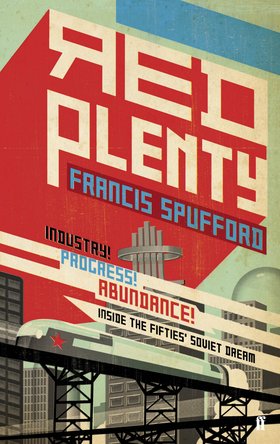 Red Plenty, Francis Spufford (2010), appeared on the non-fiction short list for the BSFA Award this year, though it lost out to a series of blog posts on the Hugo novel shortlist by Paul Kincaid. I’ll admit I had somewhere picked up an entirely erroneous impression of Red Plenty. I knew that it was non-fiction told as if it were fiction – dramatisations, if you will, of the life of ordinary Russians during the years of the USSR. But I’d also got the impression from somewhere – perhaps by the use of the word “science fiction” to describe it some place – that it also extrapolated the great Soviet experiment into later decades, as if perestroika and glasnost had never happened. That isn’t the case. Red Plenty ends in 1968. Nor did it affect my enjoyment: I thought the book excellent. Red Plenty follows the lives of a handful of peoples – some real, some invented – through the first half-century of the USSR. There’s a very real sense of utopia in the book, and it is sad to see how it is slowly corrupted. The USSR was one of history’s two great attempts to create a utopian society and, like the other one, Islam, its ideals didn’t last much beyond the first generation. All too often people forget what the USSR was trying to achieve. That it failed doesn’t invalidate the experiment, or its objectives.
Debris, Jo Anderton (2011), I read for review for Interzone. “File under science fiction” it says on the back cover, but I’m not convinced…
Leap of Faith, Gordon Cooper (2000), I reviewed on my Space Books blog here.
 Snakehead, Ann Halam (2007), is Gwyneth Jones’ last novel as Halam, although apparently a new one – a sequel to Dr Franklin’s Island – will be published next year in the US. Snakehead is a retelling of the Perseus and Andromeda story from Ancient Greece. But slightly different. In the myth, Perseus first meets Andromeda when he returns from slaying Medusa, but in Snakehead Andromeda has run away from home and is taken in by Perseus and his mother Danaë. Much of the novel concerns Perseus’ life, and Andromeda’s introduction to it, on the island of Seriphos. The killing of the Gorgon occupies only a chapter or two towards the end of the book. There is a lovely matter-of-factness about the way the story is presented, the way its strangenesses are streamlined into the narrative. Also good is Perseus’ meeting with his father, Zeus, which reads like pure science fiction. Halam’s novels have always been extremely strong – I’d argue her Inland trilogy is better than Le Guin’s Earthsea books – but may have suffered from their variety. YA book series sell by the boatload, but Halam’s novels have been (mostly) singletons. As an adult reader, that variety is part of their appeal – when else am I going to read a novel treatment of the Perseus myth, for example? – but it may have hampered their success.
The Old Funny Stuff (Author’s Choice Monthly 1), George Alec Effinger (1989), is a collection of short stories from the early 1980s. The collection takes its title from a complaint by a fan of Effinger, who preferred the writer’s comic tales to the ersatz cyberpunk of When Gravity Fails. I vaguely recall enjoying the latter, but I didn’t enjoy any of the stories in The Old Funny Stuff. One story is set in the editorial offices of a genre magazine and reads like it was written in the 1930s. Another story has a mugged couple “assisted” by a variety of fictional detectives and vigilantes… yet all those characters are from the 1940s and earlier, though the story does mention an ATM. ‘Mars Needs Beatniks’ at least successfully pastiches Beat prose, but is unfortunately quite dull. An eminently forgettable collection, but mercifully short.
A Quiet Flame, Philip Kerr (2008), is the fifth Bernie Gunther, featuring the Berlin-based private investigator from Nazi Germany. The One from the Other, the first post-war novel, ended with Gunther on a boat to South America in the company of an ex-Panzer captain and Adolph Eichmann. Though not a Nazi himself, a case of stolen identity had resulted in Europe being a bit too hot for Gunther and so now he’s pretending to be someone else. The trio arrive in Argentina, and Gunther is taken to meet Juan Perón. At which point he confesses his true identity. But that’s fine, because the head of the secret police remembers, and admired, him back when Gunther was a detective for the Berlin police force, and there just happens to have been a recent murder in Buenos Aires which resembles a pair of unsolved murders Gunther had investigated just before Hitler seized power and Gunther left the police. The inference, of course, is that the murderer is a Nazi war criminal who is hiding out in Argentine with all the other Nazis. A Quiet Flame follows Gunther’s investigation into this murder, which soon spirals into an entirely different case, but is eventually resolved, and Gunther’s time in Berlin in the 1930s when the Weimar Republic was booted out of power by the Nazis. An afterword makes it clear that the plot of the novel, while invented, is based on either true events, or plausibly extrapolated ones. It’s one of those books that both makes you angry such things were ever permitted to happen and scared that there are people who would not think twice about doing such things. I thought it so good I moved the next book in the series, If the Dead Rise Not, up the TBR pile.
The Coming of the Terrans, Leigh Brackett (1967), is a pretty clumsy fix-up. Half a dozen of Brackett’s Mars stories have had dates stuck on them, and then placed in order as if they were part of a coherent future history. But ignore all that, because the stories in this collection are excellent stuff. Brackett’s sf doesn’t seem to fit in anywhere – it uses the tropes of early sf but is written with the sophistication of much later genre fiction. So we have Mars, populated with ancient civilisations and dying races, but stories that are considerably more than just swashes being buckled, uppity natives being quelled, or righteous pioneers carving out homesteads. The upstart Earthlings who come to exploit the Martian races rarely end up on top. This is not the gung-ho adventurism of Edgar Rice Burroughs, but its antithesis.
Charlotte Gray, Sebastian Faulks (1998). I’m pretty sure I tried reading this shortly after it was published. I’d have borrowed it from the Daly Community Library in Abu Dhabi. I think I gave up on it because I found the pacing so glacial. Later, I saw the film. Now that I’ve read it I’m sorry I didn’t persevere all those years ago. Yes, it’s a slow book. The title character volunteers for a department of the Special Operations Executive because she speaks French like a native. She is parachuted into Vichy France to courier some radio crystals to a member of a British network, but stays on because her lover, a RAF pilot, is missing in action somewhere in the country. For much of Charlotte Gray, she does little except pine for her lover and help out the local resistance. But the final third of the book more than makes up for that. Before returning to the UK, she tries to track down two Jewish children taken by the Germans, and discovers something of the truth behind their fates.
Oryx and Crake, Margaret Atwood (2003), is not science fiction, of course it’s not. It’s speculative fiction. Yes, well. Atwood’s idiosyncratic categorisations aside, I think most people would classify Oryx and Crake as science fiction. I’m not entirely sure what to make of it. There’s some sharp prose in it; there are also some embarrassingly bad neologisms. Some time in the future, rogue genius Crake unleashes a plague on the world, killing off everyone except his friend Jimmy and the Crakers, a handful of genetically-engineered humans he has bred. Now calling himself Snowman, Jimmy acts as a beneficial god/shaman to the Crakers, while trying to survive in a world in which he no longer fits. His life is interspersed with flashbacks detailing his friendship with Crake, how we went to work for him, and how the world became as it is. Most of the satire is so blunt as to be ineffective. And the “trendy” names Atwood uses for all the corporations, like RejoovEsense, annoy mightily. I preferred The Blind Assassin.
Films
51, Jason Connery (2011), I watched for The Zone, but I’ve yet to finish my review.
Time to Leave, François Ozon (2005). I like Ozon’s films, but only when he’s being playful not when he’s being serious. Except, perhaps, for Under The Sand, which I did like. But, Time to Leave (AKA Le temps qui reste): a gay fashion photographer learns he has three months left to live. He keeps this secret, telling only his grandmother (played by French screen legend Jeanne Moreau). The protagonist is, frankly (no pun intended), selfish and unlikeable, and his eventual change of heart feels overly sentimental and clichéd. Not one of Ozon’s best.
Leviathan, George P Cosmatos (1989), is another film set in a mining installation at the bottom of the ocean. This one, however, does not rip off Outland. It rips off Alien, instead. A reasonably good cast for the time – Peter Weller, Richard Crenna, Amanda Pays, Ernie Hudson, Hector Elizondo, Daniel Stern – unwittingly release some old Soviet bio-experiment aboard their habitat, and it tries to turn everyone into some sort of Cronenberg-esque monster. But Weller and Pays manage to escape. Leviathan makes a decent fist of imagining its environment, but the plot is by-the-numbers from start to finish and the characters are not allowed to develop much beyond clichés.
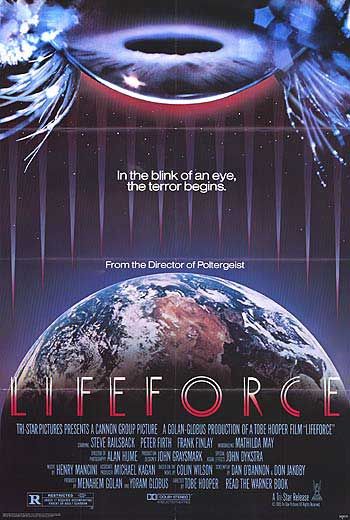 Lifeforce, Tobe Hooper (1985). I remember going to see this at the cinema when it was released. I didn’t take it seriously then, and I couldn’t take it seriously this time. A space mission to Halley’s comet finds a giant spaceship in its coma. Aboard are a pair of naked humans: a beautiful young woman and a handsome young man, both in hibernation. The astronauts take both aboard their Shuttle and head back to Earth. On arrival, mission control can’t reach anyone aboard the spacecraft, so they send up a mission. The crew is dead, and the Shuttle has been gutted by fire. The only survivor is the naked young woman. so they take her back to Earth, to London. But she’s a space vampire – the film is based on Colin Wilson’s novel, The Space Vampires – and she brings about a plague of zombies to the UK. All those people who claimed 28 Days Later such an astonishing film because it showed zombies running rather than shuffling along should watch Lifeforce. Zombies run in it too. It’s about all the film does have in its favour, however.
The Taming of the Shrew, Jonathan Miller (1980). I’ve been enjoying these Shakespeare plays, but every now and again you have to wonder what was going through the Bard’s head when he wrote them. Like this one. Everyone wants to marry Bianca, but her father has decided that she will not entertain suitors until her older sister, Katherina, is wed. But Kate is a “shrew” – i.e., an independent woman, not afraid to voice her own opinion, and far from the demure mistress apparently valued in Padua. Along comes Petruchio (played by John Cleese), who decides to woo Kate, for reasons never satisfactorily explained – the challenge? her fortune? There are several instances of witty banter, though Kate is played disconcertingly as a shrill termagant which often seems at odds with her dialogue. So there I was thinking that the part was just misplayed and The Taming of the Shrew couldn’t be as sexist as it seemed. Only for the final wedding banquet scene to feature speeches by each of the male cast explaining what a good wife should be, and it’s the worst sort of sexist claptrap and I’m surprised Elizabeth I didn’t have their heads off for it. Not one of the Bard’s best.
Predators, Antal Nimród (2010), is yet another sf franchise getting the reboot. Which is a creative process I find hard to understand. The Predator and Alien franchises were munged together into a series of increasingly rubbish films, and that should have killed them stone dead. Instead, we got Predators, and Ridley Scott reported working on a prequel to Alien. To be honest, of the two, I always much preferred the latter, though none of the films were as good as the first. Predator, on the other hand, was just an uglier Rambo. And Predators is just I’m a Celebrity Get Me Out of Here with guns. A group of scumbags are parachuted into a jungle. They’ve no idea where they are, how they got there, or even why they are there. It doesn’t take long before they discover they’re being hunted by aliens, the Predators, for sport. But never mind, they’re Men, the horneriest critters in the universe, and of course they can beat someone who is both phyisically and technologically superior because they’re Men. It’s Neanderthal tosh like this that gives Hollywood a bad name– No, wait, Hollywood already has a bad name. It would be nice to see the occasional sf film of real intelligence from Hollywood, but I’m not holding my breath. It would also be nice to see sf films which didn’t celebrate violence, psychopaths or sociopaths, and which didn’t paint all aliens (that’s everybody outside the US, you understand) as fit targets for invasion, repression, dismemberment, or genocide. Avoid.
The Green Hornet, Michel Gondry (2011), I’d heard mixed reports on, but I rented it anyway. I’m not a big fan of the Seth Rogen / Judd Apatow style of humour, though I do like superhero films. Sadly, the humour outweighed the appeal of the superhero aspect, and I hated this. I hated Rogen’s character, I hated the stupid jokes, and I hated the concept, which was even more implausible than your average superhero movie. Rubbish film. Avoid.
Damnation Alley, Jack Smight (1977), I reviewed for The Zone. See here.
 Underground, Emir Kusturica (1995), I wasn’t initially sure what to make if. It opens during World War II, with the Germans bombing, and then invading, Belgrade. A pair of local wideboys become heroes of the resistance, more by accident than by design. They’re out for themselves, but somehow or other that helps the resistance. And then one of them, Blacky, is injured, so the other, Marko hides him, and the rest of the resistance cell, in his cellar. But he never tells them when the war ends. As Marko rises in Tito’s government in post-war Yugoslavia, so those in the cellar continue to believe WWII is ongoing. They make weapons, which Marko sells. Eventually Blacky manages to escape, but he stumbles on the set of a film re-enacting the climactic raid in which he was injured. He kills the actor playing the part of the German officer, and runs way. Later, after Tito’s death, he is the leader of a militia in the former-Yugoslavia. Marko, meanwhile, disappeared when Tito fell, and is now an international arms dealer. Underground opens with the Germans bombing Belgrade Zoo, and initially seems like a somewhat clumsy comedy. But as movie progress, so does the comedy turner blacker… and blacker… and more surreal. And the end result is superb. Recommended.

