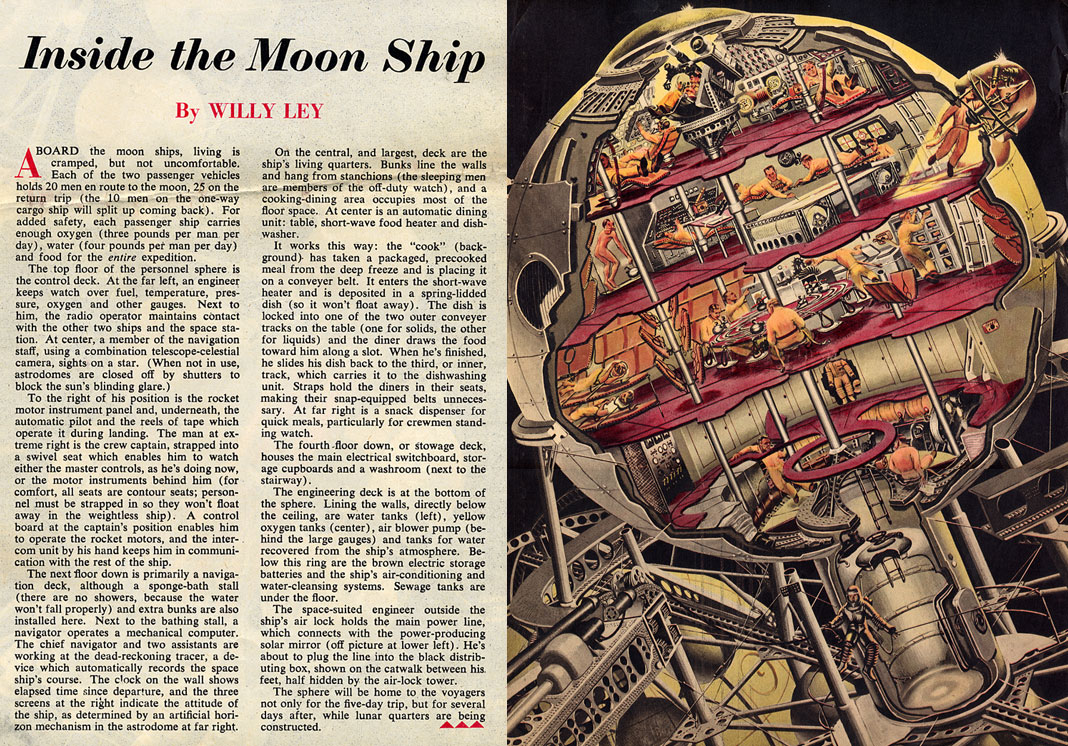
Perhaps at one point last century the future was so bright because of all those nuclear bombs exploding – at least, so they imagined. But they were also wildly optimistic about what the twenty-first century would hold. And it certainly wasn’t double-dip recessions, an ever-widening equity gap, anthropogenic global warming, and rule 34. Sometimes they built the future as they saw it, sometimes they just drew it. Either way, it appeals more than what we actually got…
architecture
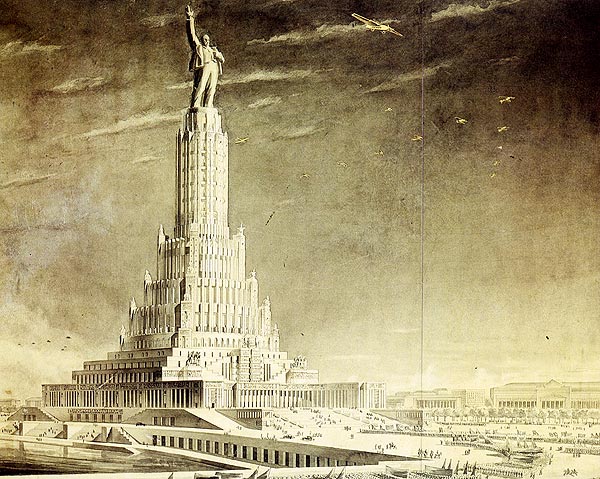
Palace of the Soviets. B Iofan, O Gelfreikh, V Schuko, sculptor S Merkulov - 1934 version
Palace of the Soviets. B Iofan, O Gelfreikh V Schuko, sculptor S Merkulov - 1946 version
A bit of an epic post this, partly because in my last readings & watchings I only gave the books I’d read and not the films I’ve watched. But how can more be bad, eh?
Books Troika, Alastair Reynolds (2010), is the first piece of fiction Reynolds has had shortlisted for a Hugo. It lost out on best novella to Ted Chiang, which is unfortunate. With Chiang on the shortlist, everyone else stands little or no chance of taking the award. Having said that, I’ve yet to read Chiang’s award-winning The Lifecycle of Software Objects, though I have the Subterranean Press edition on my book-shelves. And the copy of Troika I read was also the Subterranean Press edition, although the novella originally appeared in Godlike Machines, a SFBC-only anthology. Clearly the US Science Fiction Book Club is quite influential in Hugo nominations. Troika is BDO sf meets alternate Soviet space history, but is not, I think, Reynolds’ best work to date, despite being short-listed. The BDO itself feels too enigmatic, and the final twist on the “present day” sections doesn’t quite make sense of the whole thing. I enjoyed it, but I wouldn’t have nominated (had I chosen to pay for the privilege of doing so).
SVK, Warren Ellis and d’Israeli (2011), was sold on a gimmick: it requires a black light torch (packaged with the comic) to read some of the speech balloons. It is otherwise a fairly typical Ellis sf piece, with a nice twist in the end. A freelance fixer is called in by a government department to recover a piece of technology, which, it transpires, allows a person to read the thoughts of other people (and it’s those which are printed in invisible ink). D’Israeli’s art is good, Ellis’ dialogue is also good, but it all feels a little thin and a bit overwhelmed by the invisible ink gimmick.
My Dirty Little Book of Stolen Time, Liz Jensen (2006), I picked up in a local charity shop because I remembered enjoying her The Rapture (2009) (see here). That later novel had been marketed as literary fiction – Jensen herself is marketed as a literary fiction writer – but was plainly sf. And so the title of My Dirty Little Book of Stolen Time suggested the same also held true for it. And so it does. A prostitute in late 19th century Copenhagen goes to work as a cleaner for the widow of an inventor who vanished several years before. In the basement of the widow’s house, the prostitute finds a strange device… and is inadvertently catapulted to modern-day London. There she discovers the inventor and a colony of time-displaced Danes, all of whom have chosen to build new lives in twenty-first century Britain. All have been warned, however, to keep their contact with the locals to a minimum. But then the prostitute falls in love with a London man… The story is told entirely in the prostitute’s voice, which gets a little wearying after a while, but it’s well-handled. I think I’ll seek out some more of Jensen’s books.
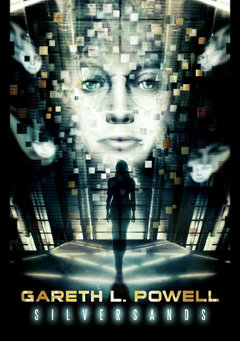
Silversands, Gareth L Powell (2010), is Powell’s first published novel. It was published by Pendragon Press – and Powell’s first novel by a major publisher, The Recollection, has just come out from Solaris. Something similar happened to Mark Charan Newton. Perhaps it’s a pattern. Silversands is a solid sf mystery set on a a colony world. When a ship from Earth arrives – it’s important to the plot that the wormholes which connect the colonies can’t be navigated – it triggers a series of events which threaten to bring down the colony’s government. Though only short, the novel is well-paced, the characters rounded, and the setting sketched in with skill. Despite all this, it’s not especially memorable, perhaps because its one big idea is peripheral to the plot and only impacts at the end.
Heaven’s Shadow, David S Goyer & Michael Cassutt (2011), I reviewed on SFF Chronicles here.
Adventures in Capitalism, Toby Litt (1996). To be honest, the most interesting thing about Litt’s career so far has been his intention that each of his book be alphabetically titled. Which is not say that those of his books I’ve read so far have been bad. I quite enjoyed Corpsing (2000), and while Journey into Space (2009) was a little old-fashioned I did think it nicely-written. But the stories in this collection, Adventures in Capitalism, are somewhat variable, and several of them are, well, a bit dull.
Spin State, Chris Moriarty (2003), was August’s book for the reading challenge, and I wrote about here.
The Magician’s Nephew, CS Lewis (1955), is the seventh Narnia book by year of publication, but the first according to internal chronology. In fact, it’s a prequel and explains the origin of Narnia. Which is that, well, Aslan made it. Just like that. But in a lot less time than six days. Neighbours Digory and Polly use one of Digory’s uncle’s magic rings and find themselves in a strange wood. In the wood are pools of water, and each pool leads to a different world. Unfortunately, the first world they visit is in some sort of magical stasis, after evil witch Jadis spoke the Deplorable Word in order to defeat her ruling sister (I can think of many deplorable words, so I’ve no idea which particular one Jadis actually used). Digory foolishly wakes Jadis, who follows them back to Victorian London, and promptly wreaks havoc as she tries to conquer it – despite her magic powers not working. In desperation, Digory and Polly use the rings… and send themselves, Jadis, a cabbie, his horse, and their uncle to a land of nothingness. Then they hear singing, light appears, and so too does Aslan, and Narnia is created. There are some nice touches: a piece of a street lamp used by Jadis as a weapon in London is dropped by her, and becomes the street lamp in The Lion, the Witch and the Wardrobe; Jadis becomes the White Witch; and the cabbie and his wife become the first kind and queen of Narnia, despite being working class.The dialogue throughout is quite fun, although, the Garden of Eden rip-off was blatant and the general tone of the book is very preachy. Definitely one of the better books of the series, though I still wouldn’t recommend them to a kid.
From Russia with Love, Ian Fleming (1957), is the fifth 007 book, but was the second film to be made. It was also a far more successful film than its predecessor Dr No, and so probably responsible for the existence of the franchise. Given that I’d previously read four Bond novels, you’d think I’d know what to expect from the fifth one. Admittedly, my memory’s vague on the plot of the film – I remember only the periscope, the attack in the gypsy camp, and the iconic punt through the Basilica Cistern. The first two certainly make an appearance in the book, but not the third. And if I’d thought the other Bond books contained an uncomfortable strand of misogyny, in From Russia with Love it’s downright offensive. Not only does Istanbul station chief Karim Bey insist that all women want to be raped, but the scene at the gypsy camp sees the women present treated as nothing more than amusement for the men. Then there’s the racial stereotyping and racism… Bond was better when he stayed in the UK. I can’t honestly recommend this book to anyone, and the more of them I read the more I’m convinced they only remain in print because of the film franchise.
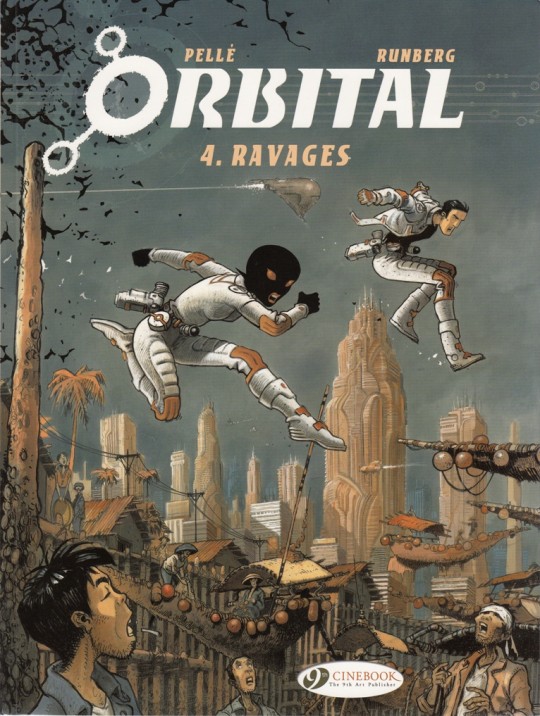
Orbital Vol 4: Ravages, Sylvain Runerg & Serge Pellé (2010) is, I think the last of this series – at least the ending suggests as much. Though it’s been sold as the fourth book of a series, it’s actually the second in a two-part story – with Volume 3 Nomads – as the story continues on directly from that earlier volume. Something alien and mysterious has been killing fish – and now people – in the mangrove swamps near Kuala Lumpur, just as the preparations for a celebration of the Human-Sanjarr alliance (they fought a war not so long ago) are in full swing. The locals are revolting and convinced some alien nomads who have settled in the swamp are responsible. They’re not, of course. At least, not directly. I’ve enjoyed this series – it’s good solid sf, nicely drawn and well thought-out. If it seems a bit abrupt in places, or choppy in others, I suspect that’s more the style of bandes desinée than it is the fault of the writer.
Dancer of the Sixth, Michelle Shirey Crean (1993), was a reread for review for SF Mistressworks here.
Films What A Way To Go, dir. J Lee Thompson (1964). Every now and again I like to watch a bit of fluff. Once, my preferred choice had been crap science fiction films – of which there are very, very many – but watching them is actually hard work. Now, I’d much sooner watch something from the 1950s or early 1960s – they’re far more entertaining, there are no bad special effects to burn out your eyes, the acting is of a much higher calibre, and the scripts actually display some wit. Having said all that, What A Way To Go is a bit of an odd beast. Shirley MacLaine plays a young woman who inadvertently inspires each man she marries to become successful and rich. So much so, in fact, that on her last husband’s death, she is determined to give away the vast fortune she has amassed. But the government won’t accept it. (Things were clearly very different in those days.) Her husbands are played by Dick van Dyke, Paul Newman, Gene Kelly, and Robert Mitchum – so this is a star-studded comedy. There’s even an extended dance number – with MacLaine and Kelly, of course – in the middle. It’s quite a strange film. I enjoyed it, though.
…All the Marbles, dir. Robert Aldrich (1981), was Aldrich’s last film, and while it has its moments, it’s not especially memorable. Peter Falk plays the manager of a female tag-team wrestling duo. Most of the matches are fixed, but the two wrestlers are determined to make it to the final in Las Vegas. And so they do – though not without Falk making some enemies along the way. This is a pretty grim film. The characters are just about hanging on, and the story takes them through some of the grimmer parts of the United States. I think it’s supposed to be a comedy, though there aren’t many laughs. At least, some of the characters are so broadly-drawn, they belong in a comedy. The wrestling itself reminds me wrestling on British telly back in the early 1980s, during the heyday of Big Daddy, Giant Haystacks and the like. Although, of course, they weren’t women.
Where The Sidewalk Ends, dir. Otto Preminger (1950). I do like Preminger’s movies. I’m not so keen on Dana Andrews as a leading man, however. He always strikes me as a bit too louche and expressionless for the roles he plays. In this film – consider a classic noir – Andrews is a police detective who accidentally kills a suspect. He tries to cover up the death by accusing a cabbie who called on the victim. Except the cabbie is actually the victim’s father-in-law, and Andrews’ detective falls in love with the estranged wife (played by Gene Tierney). This is classic twisty-turny stuff, all baggy suits and trilbies and mean streets. They don’t make them like this anymore.
Skyline, dir. the Strause Brothers (2010), is, as far as I understand, a rip-off of Battle: Los Angeles, for which the Strause brothers provided special effects. For whatever reason, they decided they could do a better job themselves, and made their own film. Perhaps they should have stuck to special effects. There are some mysterious aliens. And they have attacked Los Angeles. And there is a bunch of bad actors stuck in a penthouse apartment, who try to escape. Er, that’s about it. Avoid.
Shirin, dir. Abbas Kiarostami (2008). I’ve now seen three films by Kiarostami – and several more by other Iranian directors – and I’m still not quite what to make of him. Certified Copy (2010) was a clever and accomplished drama (see my VideoVista review here); Taste of Cherry (1997) was odd but entertaining, though the ending was near-genius; but Shirin… The film takes place in a cinema with an entirely female audience. The camera moves from face to face, while the dialogue from the movie being shown is heard (it’s the story of Khosrow and Shirin, a 800-year old Persian tale). That’s it. A series of close-ups of faces, many in hijab. For 92 minutes. I don’t think it works as a concept.
My Best Enemy, dir. Wolfgang Murnberger (2011), I reviewed for VideoVista here.
Brief Encounter, dir. David Lean (1945). I’d never seen this before. I know, unbelievable. But there you go. And now that I have seen it… I was disappointed. Perhaps because it does exactly what it says on the tin. Celia Johnson travels regularly into town on the train. One day, she meets Leslie Howard. They enjoy each other’s company, so they meet whenever they’re in town. It goes further. Meanwhile, both have families at home. I actually felt sorry for Johnson’s husband – he seemed like a decent sort. And she was so drippy, the whole affair felt about as __
Videodrome, dir. David Cronenberg (1983), is another film I’ve somehow not seen in the twenty-seven years since it was released, though I have seen many of Cronenberg’s other films. It is… odd, though it hasn’t aged well. All that snuff television, screwing with your minds stuff is a little old. I suspect some of it was back in 1983. The weird organic gun was peculiar, as was the body-horror bits. Sometimes they felt like they belonged in a different film. And there was a surprising cheapness to the production, which I hadn’t expected – perhaps because Cronenberg’s later films have better production values. Oh well, I’ve seen it now.
Moolaadé, dir. Ousmane Sembène (2004). I’ve found myself watching a lot of African cinema in recent years, particularly North African. So when Lovefilm threw up Moolaadé – set in West Africa – I wasn’t especially interested in seeing it. But I stuck it on my “world cinema” list, and several weeks later it was sent to me. And i thought it excellent. It’s set in a small rural village in Burkina Faso. Three girls have run away from the traditional female circumcision ceremony and seek protection from Collé, who had refused to have her daughter’s genitals mutilated a few years before. Collé use moolaadé, magical protection, to ensure the girls are kept safe within her house – or rather, the house of her husband, which she shares with his other two wives. The men of the village are not amused, as they consider female circumcision necessary for marriage, as well as required by Islam (neither, of course, is true). In an effort to control the women of the village, the men gather up all their radios and destroy them. A visiting trader – a veteran of the local civil war – takes the side of the women, as does the headman’s son, who has recently returned from working in France. But the women are not empowered, and it does not go well. This is an excellent film, a definite contender for my best of the year. I’d like to see more by Sembène but, unfortunately, Moolaadé is the only film of his available on DVD in the UK. Make more available, please.
Star Trek: The Next Generation season 4 (1990), in which the Enterprise-D boldly goes on and on and on, in its continuing mission to provide bland science fiction television entertainment with the occasional episode which makes you sit up and take notice. Not to mention the several episodes which are downright embarrassing – like ‘Brothers’, in which Picard returns home to France and argues with his brother. Or ‘Data’s Day’ – but then, I never liked the character of Data. Or the one with Lwaxana Troi in it, another character I dislike. On the other hand, Legacy’, in which Tasha Yar’s sister plays one faction against the other against the Enterprise isn’t bad. And ‘The Drumhead’ manages a consistent feeling of paranoia throughout. But the overwhelming sense seems to be of blandness – bland uniforms, bland characters, bland stories. Four seasons in it and it feels like the programme is already well settled into a rut. It needs jollying out of it. Perhaps that happens in season 5. I can but hope.
Kiss Them for Me, dir. Stanley Donen (1957), I watched most of on Film4, but then ended up buying the DVD for a couple of quid. What an odd film. It’s ostensibly a screwball comedy, set during World War II, but it’s hard to know what to make of it. Cary Grant plays a war hero Navy pilot who’s had enough, and wangles a week’s furlough in San Francisco with two buddies. The trio plan to get drunk and party the entire time. And so they mostly do. Jayne Mansfield plays a dumb blonde, with a voice like fingernails on a blackboard, as comic relief, but Grant has his eye set on Suzy Parker (who, for some bizarre reason, had her voice dubbed over by Deborah Kerr), the fiancée of an industrialist who could arrange for Grant and his buddies to sit out the rest of the war. Grant leers a lot, there are some strange comic turns, and the natives of San Francisco don’t exactly seem brimming over with patriotism.
Next, dir. Lee Tamahori (2007), stars Nicolas Cage, who perhaps in some alternate world hasn’t turned into a parody of himself. Perhaps in that same alternate world, Philip K Dick’s stories won’t have been bent and twisted in the service of Hollywood, and he’s mostly remembered as a sf author and not a provider of glossy middle-brow concept movies. In Next, Cage can see two minutes into the future, and the FBI are after him because they’ve figured this out and are convinced his talent can help them find the nuclear bomb terrorists have hidden somewhere in the US. It’s all very silly, Cage plays his part with a sort of wooden-faced intensity, and Tamahori manages some good action set-pieces. Dick’s stories demand you think about them; the films they’ve made of his stories demand you don’t.
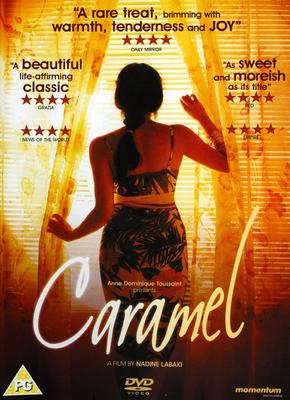
Caramel, dir. Nadine Labaki (2007), was a surprise. It’s about three women who work in a beauty salon in Beirut. One is in an affair with a married man, and hasn’t noticed that the local policeman is in love with her. Another is a lesbian, and fancies one of the salon’s customers. And the third is engaged but has not told her husband she is not a virgin and is afraid of the consequences should he learn so. I thoroughly enjoyed it. The cast play their parts well, and there’s much about the story that is very Lebanese. While Caramel may be a feel-good movie, it’s not insultingly so.
Dark Matter, dir. Shi-Zheng Chen (2007), I reviewed for VideoVista here.
The Stoning of Soraya M, dir. Cyrus Nowrasteh (2008), I had mixed feelings about. Like the female circumcision in Moolaadé, stoning is barbaric and unjustifiable. The Stoning of Soraya M is apparently based on a true story. It’s set in a village in Iran, where a man falsely accuses his wife of adultery because she won’t divorce him and allow him to marry a younger woman. Stoning is barbaric. Any justice system in which women are judged more harshly than men is barbaric. any justice system which sentences people to death is barbaric. It doesn’t need for Soraya M to be innocent and virtuous. So what if she had committed adultery? The fact she was stone is condemnation enough of the village and its justice. Making the husband out to be a manipulative moustache-twirling villain is entirely unnecessary and feels like the story is pandering to people who might consider adultery crime enough – for a woman only, of course – to require severe punishment. The Stoning of Soraya M is a film worth seeing but, sadly, it undermines its own argument.
Twelfth Night, dir. John Gorrie (1980), I’m fairly sure I saw when I was at school, though the Shakespeare play I studied for English O Level was Henry IV, Part 1. It’s another typical Shakespearean comedy of mistaken identities and cross-dressing. Felicity Kendall plays Viola/Cesario, Robert Hardy is Sir Toby Belch, Clive Arrindell is Orsino, and Sinéad Cusack is Olivia. Alec McCowen plays a good Malvolio, both unctuous and creepy. I was, incidentally, surprised to discover that the line “Some are born great, some achieve greatness and some have greatness thrust upon them” is from this play – specifically from a love letter written by Sir Toby, Sir Andrew Aguecheek and Feste the jester, but purpotedly from his mistress, Olivia, as revenge on Malvolio. In context, it seems an ironic choice of phrase for people who use it to justify their own over-inflated sense of worth. Much Ado About Nothing remains the best of the comedies I’ve seen so far, though this one comes a close second.
Blake’s Seven series 4 (1981) feels like an unwanted coda to the first three series. And so it was. The makers had not expected to be renewed after series three, and so had to quickly cobble together something for an additional thirteen episodes. Including a new spaceship, since they had blown up Liberator. Plus a new base. And several new additions to the “Seven”. The base is underground and belongs to a salvage-man of dubious legality who Avon’s gang defeat and kill in a story entirely ripped off from The Picture of Dorian Gray. His lover and partner, Soolin, joins Avon, and the obsequious computer of his ship, Scorpio, makes up the seven. The Federation/empire ruled by Servalan which Blake and co had destroyed is now busy recreating itself, but Servalan – believed dead – is reviled. So she has re-invented herself as Sleer, a police commissioner, and is busy planning a return to power. It’s as well Blake’s Seven finished after this season. The special effects are embarrassingly cheap, the sets more so, the stories don’t make much sense, and the story-arc seems to lurch about without coming close to any sort of end. So they killed everyone off. They should have kept it to three series.
Chronicles of Narnia 3: The Voyage of the Dawn Treader, dir. Michael Apted (2010), led to a small discussion on Twitter. I maintain the films are better than the books – I find the books deeply patronising, and their old-fashioned sensibilities often offensive. The films at least have modernised the books’ attitudes. However, as was pointed out to me, this has not always been done for the better. When on the island of the invisible Dufflepuds, in the book a magic tome allows Lucyto hear what everyone else thinks for her, whereas in the film she imagines what her life might be like were she as beautiful as her sister, Susan. It’s a step backwards as Lewis was mostly evenhanded in his treatment of gender, with the girls as noble and heroic as the boys. But then, the best bit of the Narnia books is that the Pevensie children remained in Narnia as kings and queens, grew up and ruled wisely… and then returned to their real lives as children, no more than minutes older than when they had left. Lewis throws all that away in a single line. The Voyage of the Dawn Treader is a string of minor adventures, in which Prince Caspian, Lucy, Edmund and cousin Useless Eustace try to discover the fates of the seven lost Lords of Narnia. Which they do.
Twin Daggers, dir. Keun-Hou Chen (2008), I reviewed for VideoVista here.
Only Angels Have Wings, dir. Howard Hawks (1939), is the sort of Hemingway-esque movie they don’t make any more. And with good reason: it’s mostly nonsense. Cary Grant plays the manager of a small fleet of aeroplanes which carry mail over the Andes. It’s a dangerous job because they don’t have radar, or even planes powerful enough to fly over the tops of the mountains. So they have a tendency to crash in the passes when the weather is bad. And it’s often bad. There’s lots of macho posturing, the dialogue is snappy, Cary Grant makes good fist of his role despite the part not requiring debonair charm, Rita Hayworth smoulders, and the model-work for the aeroplanes almost convinces. I do like the Silver Fox’s movies, and many of them are classics, but I’m finding that the ones I like are not always the ones everyone else likes…
30,000 Leagues Under the Sea, dir. Gabriel Bologna (2007), was produced by The Global Asylum. So when I sat down to watch it I knew I was going to get a shit film. I was not disappointed. It’s allegedly an update of Verne’s classic, though how increasing the number of leagues signals that fact is a mystery. A US ballistic missile sub has sunk in a deep marine trench, and so the Navy calls in Lieutenant Arronax and his deep sea submersible. To make matters more interesting, they put the submersible under the command of Arronax’s ex-wife, Lieutenant Commander Conciel. The submersible descends from the USS Abraham Lincoln (an Iowa-class battleship that can somehow manage 75 knots) to 20,000 feet, where the missile sub lies. Bizarrely, there is a bubble of reduced pressure there, which allows the crew of the submersible to use ordinary scuba gear. It doesn’t explain how the missile sub didn’t implode on its way down, however. Also down there is a vast submarine, commanded by Captain Nemo, who wants to use the sub’s nuclear missiles to destroy the world above the waves. Arronax must stop him, even though some of his crew have been brainwashed by a device of Nemo’s. This film has no redeeming qualities – the CGI is crap, the acting is worse, the script is dreadful – with exchanges such as “I want it soon.” “How soon?” “Immediately!” – and the story makes no sense. How The Global Asylum remains in business is a mystery.
Mammoth, dir. Lukas Moodysson (2009). I was not very impressed by Moodysson’s Container – although I like his other films, especially Lilya 4-Ever – so was somewhat afraid I’d feel the same about this film. But I actually thought it was superb. A young dotcom millionaire files out to Thailand to sign a deal with some venture capitalists. His wife is a surgeon in the ER at a New York hospital. Their nanny is a Filipina, who has left her two young sons back in the Philippines. But it’s a film mostly about children. In Thailand, the millionaire heads for the beach, bored by the negotiations, and there meets a young prostitute. He pays her to go home, rather than sleep with him. But she returns the following day and offers to be his guide. Meanwhile, the wife objects to the nanny introducing the couple’s young daughter to Filipino culture. While in the Philippines, the older of the two boys tries to make extra money by selling his body. Gael Garciá Bernal is astonishingly good as the young millionaire, but the rest of the cast are also very good. An excellent film, and another contender for the best of the year.
Moonwalk One, dir. Theo Kamecke (1970), I will be reviewing at some point on my Space Books blog. It’s a strangely hippie documentary of the Apollo 11 mission, which gives a very real idea of contemporary reactions to it.
Dark Descent, dir. Wilfred Schmidt (2004). When I saw a description of this, I thought it might prove interesting as it’s set in an undersea habitat in the Challenger Deep. What I hadn’t expected it to be is a complete rip-off of Outland (which was itself “inspired” by High Noon). Dean Cain (how the, er, super have fallen) plays the marshal of the aforementioned habitat, which is actually a mining-town. He’s cleaned the place up as it was a hive of scum and villainy – well, drunken violence, the occasional murder, prostitution and vice. Days before he is due to be relieved, he learns that three villains he put away are on their way back to take their revenge. But everyone else in the facility is afraid of them. There is too much in this film which makes no sense. The facility is at the deepest part of the ocean, and the pressure outside is seven tons per square inch. It’s such a dangerous place, in which survival is so totally dependent on machinery, you wouldn’t put there the sort of people who would booze it up, get violent, and behave like criminals. Stupid. The rest of the plot involves some drug which allows humans to take the pressure – water pressure or the stress of the job? Can’t be the water pressure, because no pill is going to make seven tons per square inch survivable. As is later proven when a jet of water at that pressure goes straight through a man. Anyway, the local doctor has been secretly trialling overdoses of the drug, and this has led to a series of suicides. When Cain gets suspicious, the company hires the three villains to sort him out. A film to avoid.
Apollo 18, dir. Gonzalo López-Gallego (2011), I reviewed on my Space Books blog here.
There are those who believe science fiction is a predominantly pessimistic genre, and certainly many of the futures that sf novels posit can hardly be called utopias. Of course, much of this depends upon your personal politics – a neoliberal fantasy, for instance, would likely appeal to a plutocrat, or to someone so deluded they think they actually stand a chance of becoming one. Yet such futures are common in science fiction, and often the protagonist – ie, the character with whom the reader is asked to identify – is a victim of this society, a person whose agency does not stretch much beyond what they can actually grasp with two hands. Frequently too they are fighting on two fronts: both against the enemy, and against those for whom they are ostensibly fighting.
Personally, I don’t think such futures are either desirable or inevitable, nor do I think they’re especially necessary for dramatic purposes. Perhaps it’s a peculiarly US perspective, that general antipathy towards anything smacking of state or state apparatus, whereby, by definition, a protagonist must battle their own government as much as they fight the enemies of their nation.
Spin State by Chris Moriarty is a case in point. It was my August read for this year’s reading challenge (see here), and, above caveats aside, I found it an intriguing blend of hard sf, cyberpunk, coal mining and quantum physics.
Catherine Li is a soldier for the UN; she is also a genetic construct. She has hidden the latter fact, claiming only descent from a genetic construct grandmother, otherwise she would not be able to serve in the UN military. After a raid on a secret Syndicates laboratory goes slightly wrong, Li is assigned to Compson’s World to look into the death of genius physicist Hannah Sharifi. Shortly after her death, an encrypted file was sent by Sharifi to UNSec, the UN’s military. Li’s commanding officer wants her to find the private key to the file – Sharifi was working on a way to artificially culture Bose-Einstein condensate, and if she discovered a means of doing so it would have profound effects on the balance of power between the UN and the Syndicates.
In the future of Spin State, Earth has spread out to a number of exoplanets, mostly using STL transport. However, by the use of quantum entanglement, information can be sent FTL. As can some people – most typically UNSec soldiers. But this process requires Bose-Einstein condensate, a mineral with pre-entangled qubits. There is also a side effect to such FTL travel: decoherence. Memories must be backed up or they disappear. And for soldiers, those memories are often edited to remove sensitive or classified information.
There is one source of naturally-occurring condensate: Compson’s World. Where Sharifi was running her experiment. And, incidentally, Li’s home world. But more than that: like Li, Sharifi is a genetic construct – in fact, they are clones from the same template. On arrival at the station in orbit about Compson’s world, Li immediately finds herself thrown into the middle of what appears to be a corrupt satrapy. The importance of the condensate means Compson’s World is entirely corporate-owned, and its workers are treated like the meanest of slaves. Because harvesting the condensate is a dangerous and dirty job: it has to be dug out of coal seams in deep underground mines.
It was in a chamber in one of the mines that Sharifi had been performing her mysterious experiment. She also died nearby. Though her death has been ruled an accident, Li soon learns it was murder. But what exactly was the physicist doing in the chamber in the mine, why would that lead to her murder, and what is in the encrypted file sent to UNSec?
Spin State is an unholy mixture of cyberspace, military sf, murder-mystery and coal-mining. And I use the term “unholy” approvingly. That mix shouldn’t work, but it does. Extremely well, in fact. Perhaps the big secret driving the mystery element of the plot is not difficult to guess, but Moriarty loads up her story with more than enough in the other areas. At one point, there is a covert infiltration by Li of Alba, UNSec’s headquarters in orbit about Earth. There is the jockeying for power and control ofthe mines amongst the various factions on Compson’s World. There’s the Cold War between the UN and the Syndicates. There’s Li’s relationship with the AI, Cohen. And there’s Li’s own somewhat corrupted identity, built upon redacted and lost and rewritten memories. Also many of the population of Compson’s World are ex-IRA and have fought in the (re-ignited?) Troubles.
There is as much going on in the universe of Spin State as there is in the story. The novel opens shortly after the UN defeated its enemies, the Syndicates. Li was instrumental in this victory during fighting on the Syndicate world of Gilead. But those memories have been redacted, so she’s not entirely sure what she did to become a decorated hero. The Syndicates, worlds populated entirely by genetic constructs, each of whom are treated as little more than components in a vast system, sounds like a place worth exploring, but in Spin State they are little more than ersatz Commies in the Cold War of the novel’s universe.
Then there are the AIs, which are not just hugely-sophisticated and sentient computer programs but networks of AIs, some of which are only semi-sentient and some of which have been added in what were effectively hostile take-overs. These AIs live in the novel’s version of cyberspace, streamspace (also referred to as the spinstream), an interstellar FTL network. I’ve never been convinced by cyberspace as a sf trope – it was built upon a computing metaphor, and the link between it and its operations and implementation has never struck me as especially plausible. In Spin State, Moriarty uses a full-on VR-style cyberspace and, Matrix-like, Li often “dives into the numbers” beneath the actual metaphor.
But these are minor quibbles. Spin State is a novel dense with ideas, dense with plot. Li is an engagingly cynical heroine, although perhaps a little too often she is blown hither and thither by the machinations of more powerful players. Not to mention she is sometimes a little too slow on the uptake. Compson’s World is a nasty place, and the coal-mining aspect is handled extremely well (although the industry as described is surprisingly crude, given that the novel is set more than a century hence). I really liked the idea of the Syndicates, and thought they were worth exploring more. The AIs I found less convincing, and the concpet of “shunts”, by which AIs “borrow” the bodies of humans, felt a little 1980s to me. I also was very much intrigued by the UNSec practice of redacting the memories of its soldiers. There is, I think, more than one novel there in that concept alone. It’s certainly to Moriarty’s credit that she’s filled a single novel with several novels-worth of ideas.
And speaking of Moriarty… There are no clues to the writer’s gender anywhere on the Bantam trade paperback I read. Even the “About the Author” at the end is careful not to use any pronouns in reference to the writer. But was disguising the author’s gender enough? The main character in the novel is female, and there are anecdotes a-plenty about editors telling writers that female protagonists do not sell (the classic example being Stephen Donaldson’s Mordant’s Need). Certainly Spin State was never published in the UK, and yet the recent success of Gavin Smith’s Veteran proves there is a market in this country for this particular type of science fiction. True, this is now, and Spin State was originally published in 2003, when things might very well have been different. And, of course, there are those references in the book to the IRA…
While Spin State is a type of science fiction I find it hard to truly enjoy, it’s plainly a skilfully put-together novel. I’m tempted to have a go at the sequels, Spin Control (2006) or Ghost Spin (due next year), and I’m very much surprised these books are not better-known.
Apparently, World Book Night asked people to nominate their top ten books in order to determine what titles would be given away next year. Bold if you’ve read it; italicise if it’s on the TBR.
1 To Kill a Mockingbird*, Harper Lee
2 Pride and Prejudice*, Jane Austen
3 The Book Thief, Markus Zusak
4 Jane Eyre, Charlotte Brontë
5 The Time Traveler’s Wife*, Audrey Niffenegger
6 The Lord of the Rings*, JRR Tolkien
7 The Hitchhiker’s Guide to the Galaxy*, Douglas Adams
8 Wuthering Heights, Emily Brontë
9 Rebecca*, Daphne Du Maurier
10 The Kite Runner, Khaled Hosseini
11 American Gods, Neil Gaiman
12 A Thousand Splendid Suns, Khaled Hosseini
13 Harry Potter Adult Hardback Boxed Set, JK Rowling – read the first only
14 The Shadow of the Wind, Carlos Ruiz Zafon
15 The Hobbit, JRR Tolkien
16 One Day, David Nicholls
17 Birdsong, Sebastian Faulks
18 The Help, Kathryn Stockett
19 Nineteen Eighty-Four*, George Orwell
20 Good Omens, Terry Pratchett and Neil Gaiman
21 The Notebook, Nicholas Sparks
22 The Girl with the Dragon Tattoo*, Stieg Larsson
23 The Handmaid’s Tale*, Margaret Atwood
24 The Great Gatsby*, F Scott Fitzgerald
25 Little Women, Louisa M Alcott
26 Memoirs of a Geisha*, Arthur Golden
27 The Lovely Bones, Alice Sebold
28 Atonement*, Ian McEwan
29 Room, Emma Donoghue
30 Catch-22, Joseph Heller
31 We Need to Talk About Kevin, Lionel Shriver
32 His Dark Materials*, Philip Pullman
33 Captain Corelli’s Mandolin, Louis De Bernieres
34 The Island, Victoria Hislop
35 Neverwhere, Neil Gaiman
36 The Poisonwood Bible, Barbara Kingsolver
37 The Catcher in the Rye, JD Salinger
38 Chocolat, Joanne Harris
39 Never Let Me Go, Kazuo Ishiguro
40 The Five People You Meet in Heaven, Mitch Albom
41 One Hundred Years of Solitude, Gabriel Garcia Marquez
42 Animal Farm, George Orwell
43 The Pillars of the Earth, Ken Follett
44 The Eyre Affair, Jasper Fforde
45 Tess of the D’Urbervilles, Thomas Hardy
46 Charlie and the Chocolate Factory*, Roald Dahl
47 I Capture the Castle, Dodie Smith
48 The Wasp Factory, Iain Banks
49 Life of Pi, Yann Martel
50 The Road, Cormac McCarthy
51 Great Expectations*, Charles Dickens
52 Dracula*, Bram Stoker
53 The Secret History, Donna Tartt
54 Small Island, Andrea Levy
55 The Secret Garden, Frances Hodgson Burnett
56 Lord of the Flies, William Golding
57 Persuasion*, Jane Austen
58 A Prayer for Owen Meany, John Irving
59 Notes from a Small Island, Bill Bryson
60 Watership Down*, Richard Adams
61 Night Watch, Terry Pratchett
62 Brave New World, Aldous Huxley
63 The Curious Incident of the Dog in the Night-time, Mark Haddon
64 Jonathan Strange and Mr Norrell, Susanna Clarke
65 The Color Purple, Alice Walker
66 My Sister’s Keeper, Jodi Picoult
67 The Stand, Stephen King
68 Cloud Atlas, David Mitchell
69 The Master and Margarita, Mikhail Bulgakov
70 Anna Karenina*, Leo Tolstoy
71 Cold Comfort Farm*, Stella Gibbons
72 Frankenstein*, Mary Wollstonecraft Shelley
73 The Guernsey Literary and Potato Peel Pie Society, Mary Ann Shaffer
74 The Picture of Dorian Gray, Oscar Wilde
75 Gone with the Wind*, Margaret Mitchell
76 The Graveyard Book, Neil Gaiman
77 The Woman in White, Wilkie Collins
78 The Princess Bride*, William Goldman
79 A Suitable Boy, Vikram Seth
80 Perfume*, Patrick Suskind
81 The Count of Monte Cristo*, Alexandre Dumas
82 The God of Small Things, Arundhati Roy
83 Middlemarch*, George Eliot
84 Dune*, Frank Herbert
85 Wolf Hall, Hilary Mantel
86 Stardust*, Neil Gaiman
87 Lolita*, Vladimir Nabokov
88 Midnight’s Children, Salman Rushdie
89 Harry Potter and the Philosopher’s Stone*, JK Rowling – eh? The set makes an appearance and the first book too? Cheat!
90 Shantaram, Gregory David Roberts
91 The Remains of the Day*, Kazuo Ishiguro
92 Possession: A Romance*, AS Byatt
93 Tales of the City*, Armistead Maupin
94 Kafka on the Shore, Haruki Murakami
95 The Magus*, John Fowles
96 The Boy in the Striped Pyjamas, John Boyne
97 A Fine Balance, Rohinton Mistry
98 Alias Grace, Margaret Atwood
99 Norwegian Wood, Haruki Murakami
100 The Wind-up Bird Chronicle, Haruki Murakami
Um, a lot of them I’ve seen the film adaptations (I’ve asterisked those ones). But I make that 33% read. Not bad considering there are at least 15 books I have no intention of ever reading.
It’s been over a month since my last book haul post, but if I leave it any longer, it’ll take me an entire weekend to photograph my purchases. So herewith approximately five to six weeks worth of slippery “bid”, “buy it now” and “place order” buttons, and the results thereof.
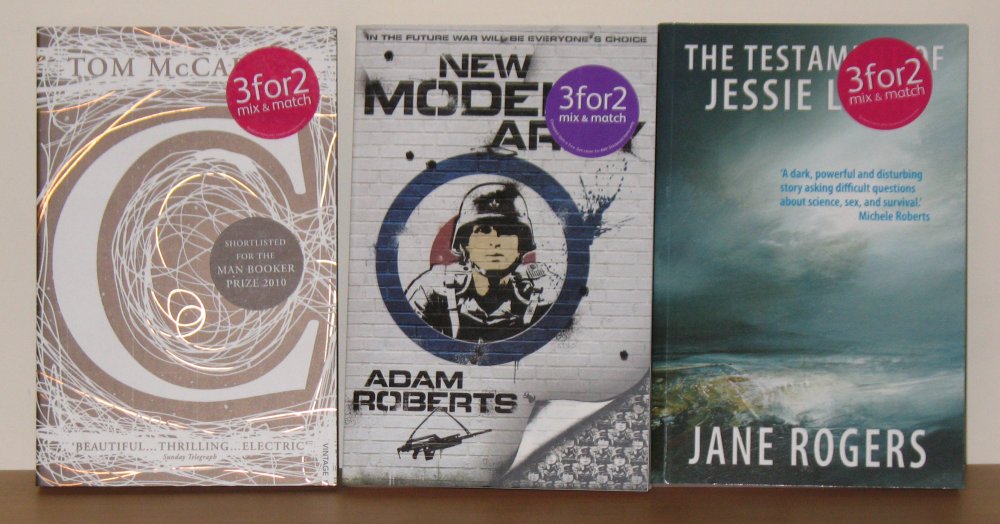
Some time this month, we say goodbye to Waterstone’s 3-for-2 offer, so I felt obliged to go out and have one last go on it. C I’m told is very, very good; I haven’t quite found the right way to read Adam Roberts yet, but I’m reliably informed New Model Army is very good; and The Testament of Jessie Lamb is a literary-but-it’s-really-sf novel and was on this year’s Booker long list.
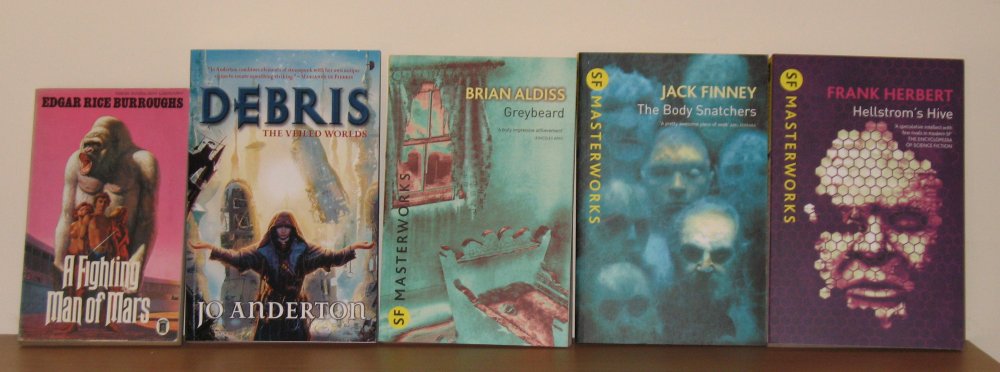
Some science fiction, which I do of course still read every now and again. Three SF Masterworks: Greybeard and The Body Snatchers I’ve never read; Hellstrom’s Hive I’m looking forward to rereading. Debris I have to review for Interzone. A Fighting Man of Mars… well, I’m looking forward to the film due out later this year – I may even go to see it at the cinema. The books I’m less keen on, but never mind.
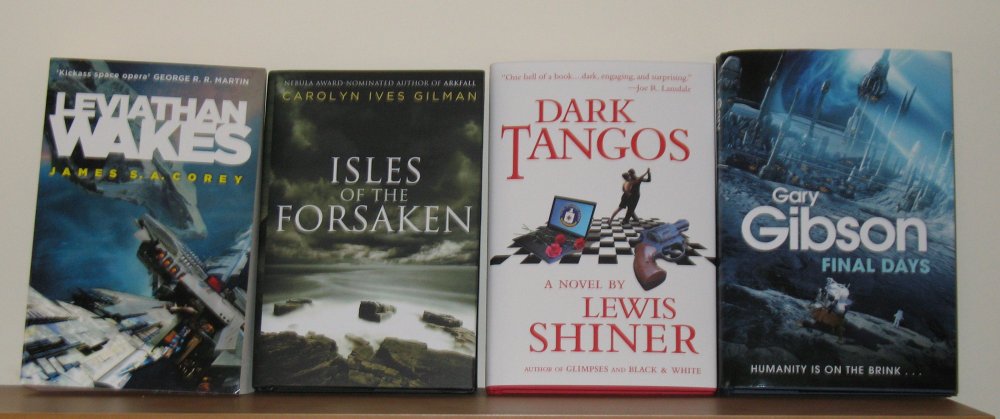
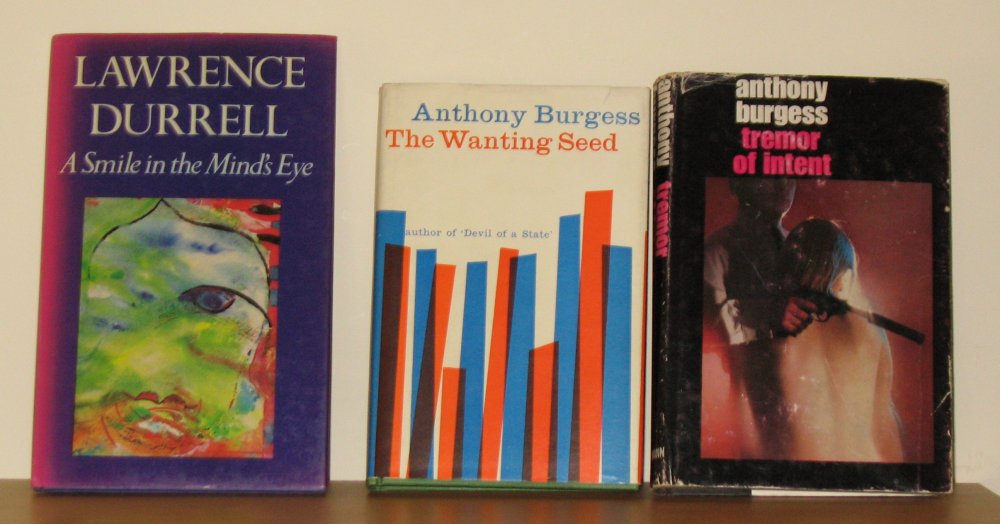
First editions: Final Days and Leviathan Wakes are both science fiction (much thanks to Gary for the former, and Sharon for the latter). Isles of the Forsaken is fantasy – and yes, that’s the signed, numbered edition. Dark Tangos is, well, it’s by Lewis Shiner. And it’s also the signed edition.
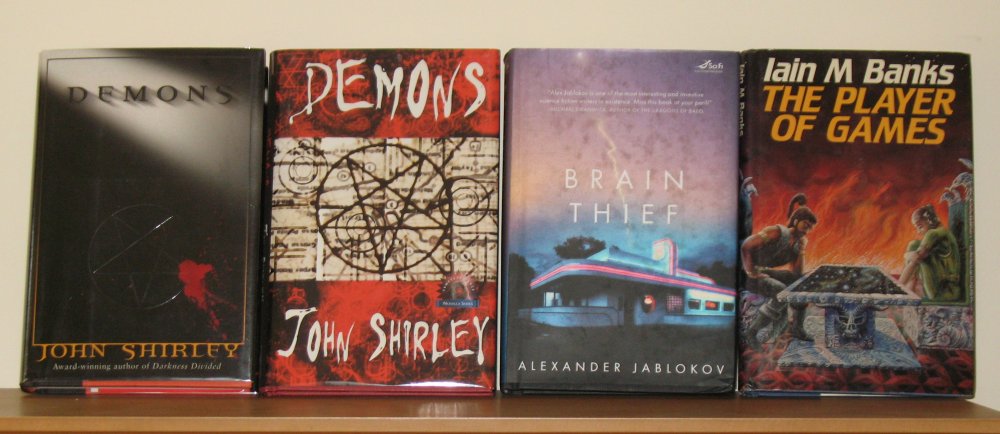
First editions for the collection. Yes, that really is Demons by John Shirley and, er, Demons by John Shirley. The one with the red cover is a novella from Cemetery Dance, and the other is a novel, of which the novella forms the first half. Both are signed. As is Brain Thief, which I reviewed for Interzone last year (but was only sent an ARC). The Player of Games is hard to find for a reasonable price in first edition, but I managed it.
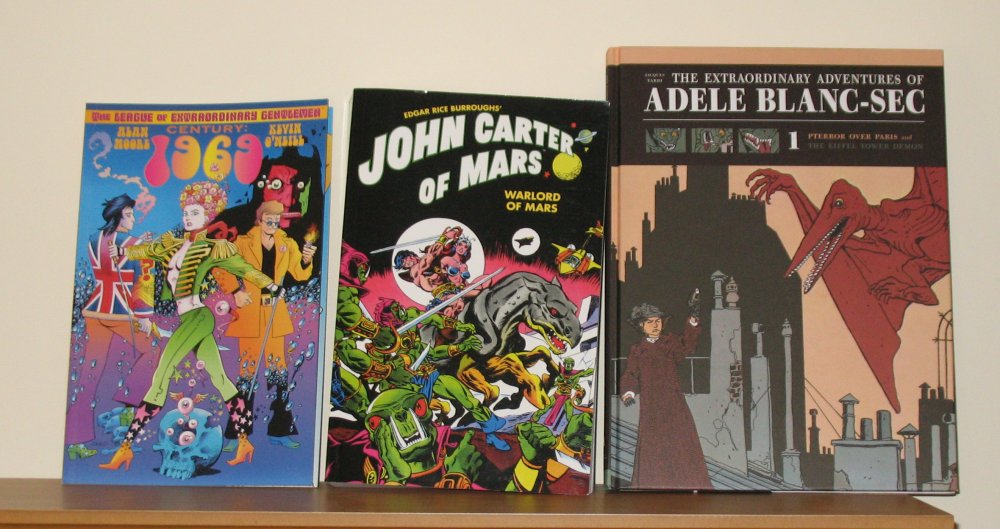
Graphic novels: the latest in The League of Extraordinary Gentlemen, the fab and groovy Century 1969. I have fond memories of Marvel’s John Carter of Mars comic from the 1970s, and a few years ago tracked down all 28 issues and three “king size” annuals. But a trade paperback is so much more convenient – except the artwork in it is black and white, and not colour as in the original comics. The Extraordinary Adventures of Adéle Blank-Sec 1 I bought after enjoying Tardi’s The Arctic Marauder.
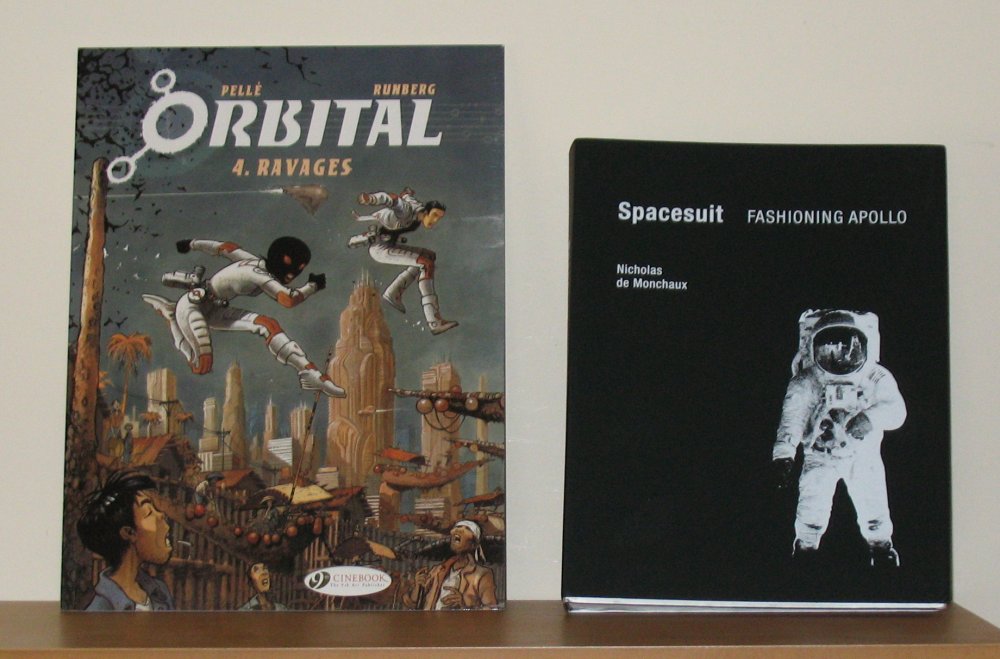
Finally, Ravages, the last, I think, of the Orbital graphic novels, and a book about, er spacesuits titled Spacesuit: Fashioning Apollo. I don’t know what the cover of the latter is made from but it has a similar texture to rubber matting and is quite strange.
You know when someone on-line puts together a list – especially for films – and not only do you disagree with the choices they’ve made, but whether or not their choices actually qualify for the list in the first place? Well, someone did that recently with a “top ten space opera movies” list, and half the films on it weren’t even space opera. So here is a proper list of ten space opera films.
Of course, first of all you must define what you mean by “space opera”. According to Wikipedia, it is science fiction “that emphasizes romantic, often melodramatic adventure, set mainly or entirely in outer space, generally involving conflict between opponents possessing advanced technologies and abilities”. For the purposes of my list, I will be even more specific. A space opera must feature interstellar starships, at least one polity that rules tens or hundreds or thousands of star systems (preferably an empire), does not feature projectile weapons, and has some alien races. The exemplar would, of course, be the Star Wars series.
There are a great number of sf films which fit the above definition. Unfortunately, many of them are dreadful. Such as The Humanoid (Aldo Lado, 1979), an Italian rip-off of Star Wars which features Richard Kiel in the title role. Or Starcrash (Luigi Cozzi, 1978), also Italian, which contains the immortal line, “Imperial battleship, stop the flow of time!” There are other films whose focus only implies the existence of space opera characteristics somewhere off-stage, like Stargate (Roland Emmerich, 1994), Barbarella (Roger Vadim, 1968) or even Forbidden Planet (Fred M Wilcox, 1956).
I have not, it must be admitted, seen every film ever made which might qualify as space opera. I have, however, seen a large number of them – both good and appalling. The following ten, I think, are films which clearly meet all of the defined criteria, although perhaps not always in an obvious way. Not all of them, however, were marketed as space opera movies.
Battle Beyond the Stars (Jimmy T Murikami, 1980), makes no effort to hide its inspirations – it’s ripping off Star Wars and The Magnificent SevenSeven Samurai. Nonetheless, there’s much to be enjoyed in it, although none of it can really be taken seriously: the bra-shaped spaceship flown by Richard Thomas, Sybil Danning’s constant double entendres, George Peppard being quite plainly pissed throughout, and Robert Vaughn simply reprising his role from The Magnificent Seven. The ending, it has to be said, does look pretty cheap, but there are plenty of fun moments during the hour and a half leading up to that point.
The Chronicles Of Riddick (David N Twohy, 2004) was ostensibly the sequel to Pitch Black, though the only thing they actually have in common is the title character. It’s more Warhammer 40k than your actual space opera, but still close enough to pass. There’s an over-the-top gothic grandeur to the film’s universe – cathedrals in spaaaace! – but the story is little more than a squirming bucket of space opera clichés. Nonetheless, it manages to entertain throughout its length – even if it’s often inadvertently. You have to wonder, however, how much Judi Dench was paid for her walk-on part…
The Empire Strikes Back (Irvin Kershner, 1980) is generally reckoned to be the best of the six Star Wars films. That’s probably because George Lucas left the direction and script in the hands of people who were actually good at them. I’m not a fan of the Star Wars franchise – the original films or the Expanded Universe media juggernaut – although I have fond memories of the first time I saw the original movie. But still, Star Wars and its sequels are the very definition of cinematic space opera. And we know this because they’ve been ripped off so many times.
The Fifth Element (Luc Besson, 1997) was apparently a childhood project of Besson’s on which he worked for decades before finally actually making. And it shows: much of it probably only makes sense inside Besson’s head. It is gloriously stupid – indeed it often revels in its stupidity – and camp, in as much as camp is not something the French do very well (for proper sf camp, see Flash Gordon (Mike Hodges, 1980)). The one thing The Fifth Element does well – and it’s not a quality normally associated with space operas – is leave you with a big grin on your face when it finishes.
Galaxy of Terror (Bruce Clark, 1981). Well, there had to be at least one obscure film in this list. Like Battle Beyond the Stars, this was a New Worlds film and so designed to cash in on the popularity of a film made by a major Hollywood studio – and in this movie’s case, it was Alien. However, Ridley Scott’s Alien is not space opera per se. And for much of its length, Galaxy of Terror doesn’t appear to be. But its ending drags it firmly into space opera territory, given that it’s all to do with some sort of interstellar polity and the quest for a new leader. The special effects are somewhat dated, and the monsters look very rubbery, but the film still has plenty of, well, charm.
Space Truckers (Stuart Gordon, 1996) is a film it’s difficult to say anything nice about as it’s pretty crap. It’s certainly space opera – it has lots of aliens in it, and Dennis Hopper and Stephen Dorff play the crew of an independent tramp space freighter. Nevertheless, treasure the film for Charles Dance’s performance as the villain – he chews the scenery with a insouciant gusto only British thesps are capable of, and also loses body-parts at an embarrassing rate.
Spacehunter: Adventures in Forbidden Zone (Lamont Johnson, 1983) is perhaps best described as Mad Max 2 meets Barbarella, which doesn’t initially suggest much in the way of space opera qualifying characteristics. And given that the story takes place on a single planet, it doesn’t much feel like a space opera film either. But it’s close enough. Ernie Hudson embarrasses as sidekick to Peter Strauss’ title role, but it is Michael Ironside as Overdog, one of the few US actors capable of taking great bites from scenery, who stands out.
Star Trek 5: The Final Frontier (William Shatner, 1989) may well be the most contentious choice on this list. But of all the Trek films it’s the most obviously space operatic – from its opening on a planet where alien scum and villainy congregate to its final confrontation with, er, god. There are those who foolishly think The Wrath of Khan is the best Trek film, but they’re quite clearly wrong. It’s just a submarines in space film, and quite frankly those sorts of movies are much, much better when they feature actual submarines. The Final Frontier is never more than a snigger away from collapsing into farce, and the fact that it never quite does only proves it is proper space opera.
Starship Troopers 1 – 3 (Paul Verhoeven, 1997; Phil Tippett, 2004; Edward Neumeier, 2008). The first is a superb spoof of Heinlein’s execrable novel. The second, subtitled ‘Hero of the Federation’, is not very good and has a plot a little too close to The Thing (John Carpenter, 1982) for comfort. The third – ‘Marauder’ – completely transcends its badness with its gleefully camp fascism, Casper Van Dien reprising his role from the first film with a cheesy knowing grin throughout, and Jolene Blalock playing the best Sigourney Weaver since Alien: Resurrection.
Space opera as a cinematic genre is never going to produce truly excellent films – or even good ones – as should be obvious from the above list. In fact, it is more likely to produce embarrassingly bad ones – such as the incoherent Cosmos: War of the Planets, dull Soldier or confusing Supernova. There are some movies which might have sneaked in, had I been a little more flexible in my definition, such as Dune (though it’s really stretching a point to call it space opera), Serenity (which takes place in a single planetary system), In the Dust of the Stars (AKA Im Staub der Sterne: excellent but bonkers East German sf, but not quite space opera enough), or Humanoid Woman (AKA Cherez ternii k zvyozdam: absolutely mad Russian sf film – or so I assume from the badly-butchered English-language edit I’ve seen, though I am told the original Russian version is actually very good).
No doubt I have missed off some obvious films, but at least I think the ten I’ve chosen actually are space opera. Sort of.
There has been some discussion of late of the role science fiction might play in inspiring science – see Damien G Walter’s piece here, Cheryl Morgan’s here, and Mark Charan Newton’s here. The argument being that, allegedly, innovators read science fiction, or many scientists chose their careers because of science fiction, and so the genre is assumed to have a very real influence on the future of science, technology and engineering.
I don’t buy it.
For one thing, most present-day science fiction has very little real science in it. Space opera, arguably the most visible form of sf, has almost none at all. It’s little more than space adventure stories. Which is not to say, of course, that space opera in any way epitomises the genre. However, what it does do is associate outrageous, non-realistic ideas in science or technology with science fiction. So when someone comes up with such an idea, it’s immediately labelled “science fiction”. Sf is not a tool for innovation, it is a licence to imagine, a legitimisation of blue-sky thinking. It suggests the unrealistic is feasible and/or desirable, it makes it palatable.
Take the example of a crewed base on the Moon. It has been the dream of NASA and space enthusiasts since the 1950s, if not earlier. Had the Apollo programme continued as originally planned, it might even had happened. Now it’s back on the space exploration agenda – or rather, it’s back in the public arena of space exploration. But there have been remarkably few science fiction novels published in the past fifteen years about such an endeavour. Sf novels set on a colonised Moon, yes; but about colonising the Moon? No.
Before Apollo, there were a number of sf novels published about the landing on the Moon – e.g., Jeff Sutton’s First On The Moon, Charles Eric Maine’s High Vacuum, or Hank Searle’s The Pilgrim Project. But even then they comprised only a small fraction of the genre’s output, and they were as much inspired by actual real studies on – and real work towards – Moon landings as they were by pure genre speculation. The truly speculative lunar landing novels had been written decades earlier; whereas the actual science of space exploration fed back into the sf of the 1950s – not that it was depicted especially accurately, it must be admitted.
Science fiction reflects the ambitions of its time. Some of it may speculate about the concerns of its time. Some of those concerns may be scientific, but if science fiction has one true role it is as a licence to free the imagination. It is a label that can be applied to ideas in the real world which are not really scientific, though they may involve science or technology. This, however, can swing both ways – both putting down innovation, as well as encouraging it.
It’s not science fiction which inspires innovation, it’s imagination. And that’s not something science fiction has a monopoly on.
Ever have one of those days where you’re busy all the time but never seem to get anything done? I’ve had a few weeks like that. Possibly because I have so many things on the go – and a day job as well – that though I chip away at each individual one I don’t actually get close to the finish on any of them. Such as…
Editing Rocket Science – so far this has not proven as time-consuming as I had expected. But reading submissions, making decisions on them, and then replying to the writers does take time. As does posting regularly to the Rocket Science News blog.
Writing
I’m still waiting for word back on my hard sf space opera novel treatment, Hard Vacuum. That’s never much fun. Fingers crossed.
I have four stories due out in anthologies before the end of the year, or early next year:
‘Dancing the Skies’ in The Monster Book for Girls, edited by Terry Grimwood (theExaggeratedPress)
‘Wunderwaffe’ in Vivisepulture, edited by Andy Remic (Anarchy Press)
‘Far Voyager’ in Postscripts winter 2011/2012 (as yet untitled), edited by Peter Crowther and Nick Gevers (PS Publishing)
‘The Way The World Works’ in Where Are We Going?, edited by Allen Ashley (Eibonvale Press)
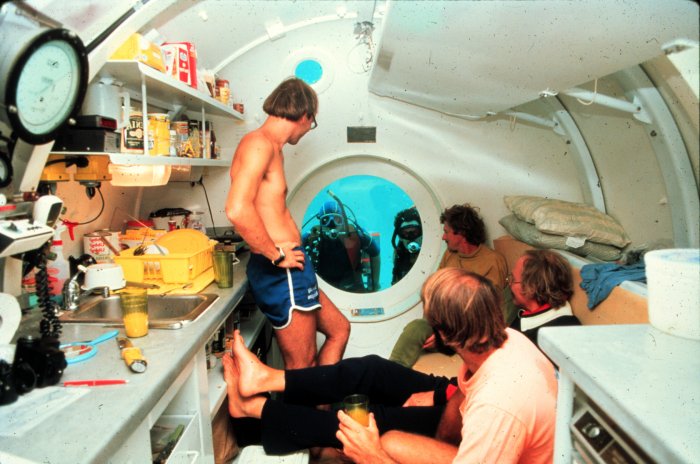
‘Dancing the Skies’ is the Spitfire/ATA story, for those who remember my tweets on the topic (see also here). ‘Wunderwaffe’ is about Nazi occult science – well, sort of. ‘The Way The World Works’ is the infamous bathypunk story, inspired by this. And ‘Far Voyager’ is the third in a series of stories exploring alternate histories of the Space Race. See also ‘Barker’ in the British Fantasy Society Journal Winter 2010 and ‘The Old Man of the Sea of Dreams‘.
I’m also working on a further two alt space stories, one about a mission to Mars and another sort of about the Mercury programme. Also currently being worked on is a Marxist space opera, rejoicing in the title of ‘Spatial Cultural-Historical Units of Great Importance’, which I stole from a Wikipedia article I found while reading up on on spomeniks (someone keeps on chopping and changing the articles on the monuments of the ex-Yugoslavia, which makes it difficult to link to them).
I have another anti-capitalism story – see ‘Through the Eye of a Needle‘ and ‘The Contributors‘ – that really needs revisiting as the current draft doesn’t quite work. Not to mention at least half a dozen stories in the “bottom drawer”, which will need revisiting at some point. I’m also working on a series of flash fiction pieces: the first has already been bounced by three magazines, and the second is almost ready to start sending out. I have two stories currently sitting on editors’ desks, waiting for a response. And one of these days, I really must write another Euripidean Space story – see ‘Thicker than Water‘ and ‘A Cold Dish‘.
Finally close to a final draft is the notorious moon base novella, ‘Adrift on the Sea of Rains’, which has taken humungous amounts of research – the bibliography currently stands at twenty books and five DVDs. I once described it as “Cormac McCarthy meets Neil Armstrong”, which sort of kind of maybe fits. I have another novella also plotted out, but have yet to start writing it. As soon as ‘Adrift on the Sea of Rains’ is done, I will.
Poetry
Unfortunately, I’ve let this lapse over the last few months. I really need to go back to some of the poems I posted to sferse, and see if they can be cleaned up and submitted. I think I’ll wait until Rocket Science is put to bed first, though.
Reviewing SF Mistressworks – I’m having to chose what I read carefully since at least once or twice a month one of the books must be suitable for a review on SF Mistressworks. This is not a hardship.
Space Books – on the other hand, has not been updated in a while. I have three pieces that I need to work on for it, but have yet to squeeze in time to do so. Soon, I hope.
Interzone – every couple of months, a book drops through the letter box which I have to read for Interzone. At the moment, it’s Debris by Jo Anderton, the first of a space opera trilogy from Angry Robot. It looks quite interesting.
It Doesn’t Have To Be Right… – well, there’s this year’s reading challenge (see here), which has been going well. August’s book was Spin State by Chris Moriarty, which I thought very good. Review to appear here soon-ish. I also have a piece on Lyda Morehouse’s Resurrection Code lined up. And one of these days I really must gather together my notes on L Timmel Duchamp’s Marq’ssan Cycle and write something on the books.
It’s fortunate the day job is only four days a week, though I’m often busier on the three days I’m at home. And I do this by choice. Someone please tell me why…
I was watching Smiley-seque BBC2 drama Page Eight last night, which bases its plot on the notion that the prime minister was aware of the US practice of covertly torturing people, and it occurred to me it was a story driven by moral outrage. This is not something that’s typically in short supply. Just look at the various responses to the recent riots. There is plenty of moral outrage in real life; there is also a lot of it in assorted entertainment media and modes of fiction.
But not, I realised, in science fiction.
Which is odd, because moral outrage is a characteristic of the middle classes, and science fiction is a middle class genre. (Fantasy, I think, was once higher, but was democratized by Tolkien.) It would be reasonable to expect moral outrage to be a common fuel in genre story-engines, but it is, in fact, surprisingly rare. Perhaps this is because science fiction is an inherently optimistic genre. It presupposes that problems have solutions, that mysteries can be explained; that the universe itself is open to explanation and eventual exploitation. Science fiction stories are about the things we can control, or they are about the process of gaining control over them.
This last may be why there is a preponderance of right-leaning science fiction. Admittedly, control can be democratic, egalitarian and universal; it does not need to be restricted to the privileged. It could be argued that dramatic tension necessitates the limiting of control to a select few – either to narrate their defence of it against an external threat, or watch as it’s wrested from them by some group better-suited to wield it. Such battles are usually driven by survival or jealousy. The rewards are typically limited to the privileged, but it’s everyone else who suffers. So the unprivileged, of course, have good reason to be fatalistic. But science fiction is not a fatalistic genre – and it would need to be to make effective use of moral outrage. The genre lionises the privileged far more than mimetic fiction does, and that is why it’s not a fatalistic genre.
True, science fiction is fond of playing Cassandra – and hindsight has always provided sharper vision than foresight – but all that doom-saying does admit of a solution. Something can be done. Or perhaps, something should be done. These are problems of the future – over-population, climate change, biosphere collapse, asteroid strike, etc. – they are not the crimes of today. They may have been created by the actions of the past and present, but as far as science fiction is concerned, the problem which requires fixing lies ahead of us. The message is: Act soon, because we can avert it. The message is: let us take control now, let us impose our will on the times ahead.
There are those who say science fiction’s only purpose is to entertain. Which is a bit like saying the purpose of economics is to reward greed, or the purpose of politics is to rationalise bad policies. Art, in any media, should always aspire to more than mere escapism. That it fails to do so does not invalidate that aspiration.