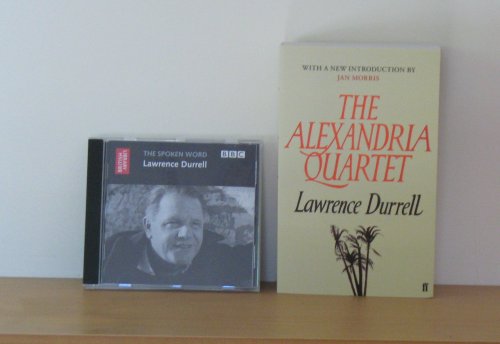
2012 is the centenary of Lawrence Durrell’s birth and there are apparently a number of things happening to celebrate it, including a conference in June. In bloody London, of course. But never mind. Lawrence Durrell is my favourite writer – see here and here – and on a purely sentence-by-sentence level I believe there has been no finer writer in the English language. Since pootling along to events in London is not that easy for me, I shall have to mark the centenary in my own way.
And the obvious way to do that is to read his books.
So, sometime during 2012, I am going to reread The Alexandria Quartet. And then The Avignon Quintet. And then The Revolt of Aphrodite. But first I need to get hold of the omnibus editions, as they were “improved” slightly from the original individual editions. I shall also read Durrell’s poetry. And whatever other bits and pieces of his writing that catch my eye.
And I shall blog about it all, of course.
Due to ongoing projects, none of this is likely to start until after Easter. In the meantime, here’s a link to my review of Durrell’s first novel, Pied Piper of Lovers, from 1935. The novel is from 1935, that is; not my review. Enjoy.
It would have been nice if I could have made a New Year’s resolution to buy no books in 2012. But that was clearly impossible as there were a number of 2012 releases I wanted. I’ll just have to try and limit my purchases instead. Sadly, I’ve not been entirely successful in that regard – only one month into the year and look what’s been added to the bookshelves all ready…
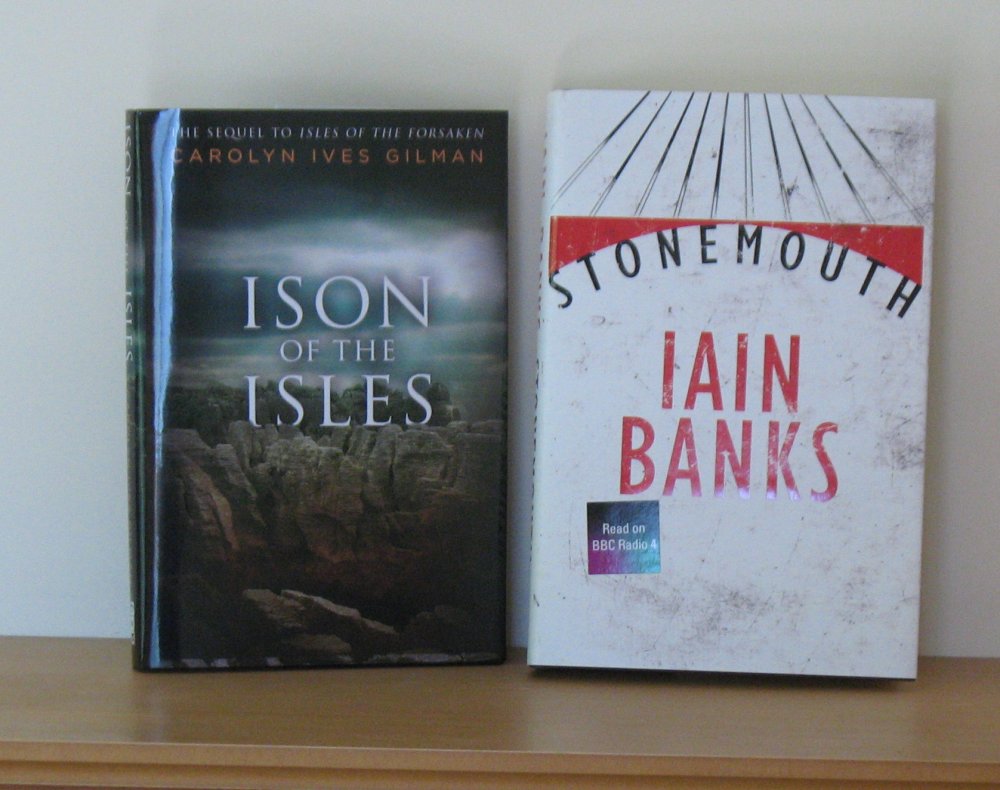
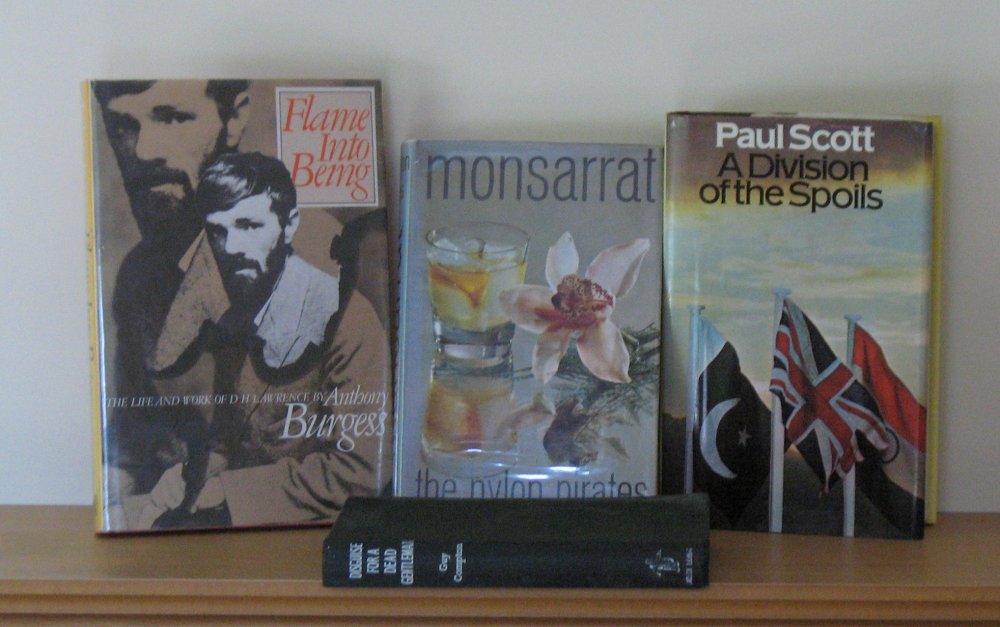
Three for the collections: Homage to QWERTYUIOP, Anthony Burgess, which is signed; The Steel Albatross, an underwater thriller by Mercury astronaut Scott Carpenter, which is also signed; and Selected Poems, Lawrence Durrell, from 1956, which is not signed.
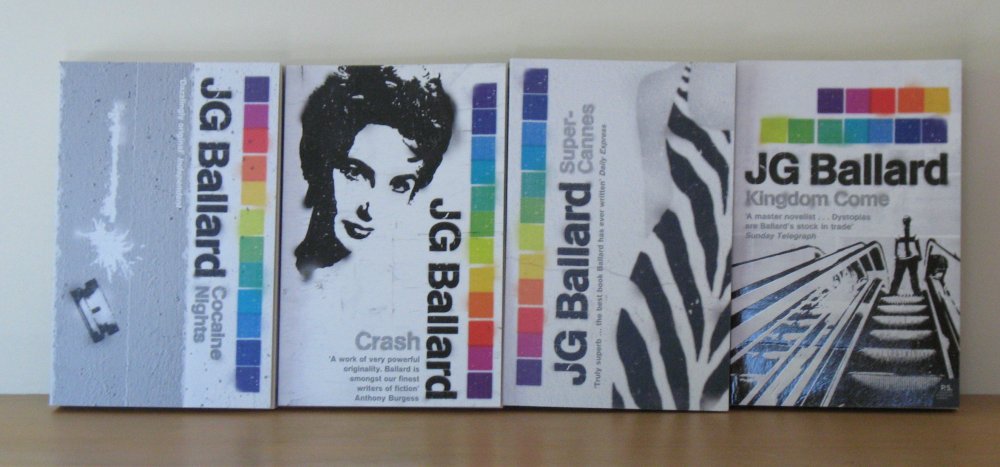
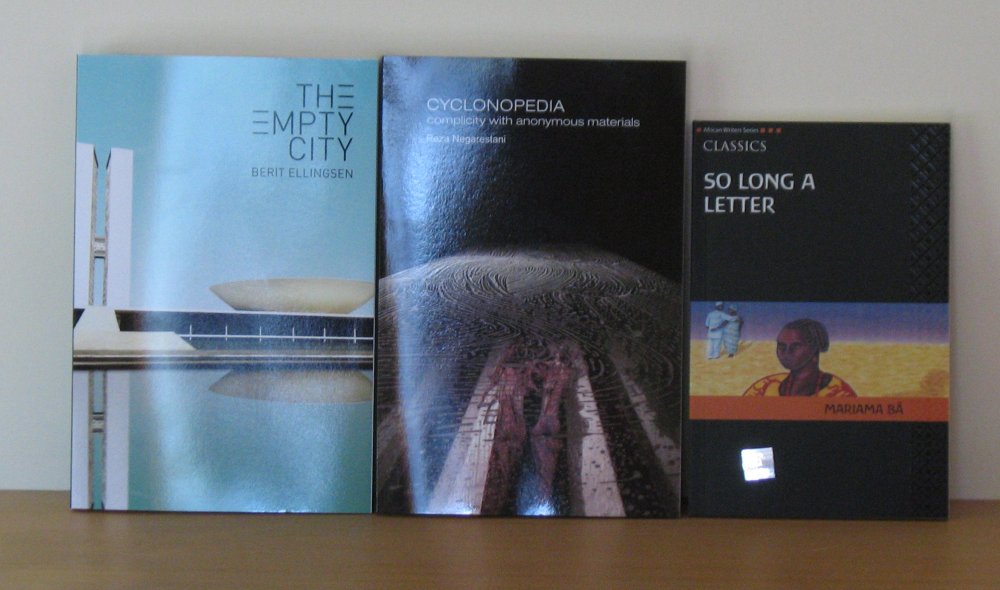
Two books for this year’s reading challenge – world fiction (see here): The Fat Years, Chan Koonchung, from China, and which you can see from the bookmark that I’m currently reading; and The Door, Magda Szabó, from Hungary. High-Rise joins the other nice 4th Estate paperback editions Ballards on my bookshelves.
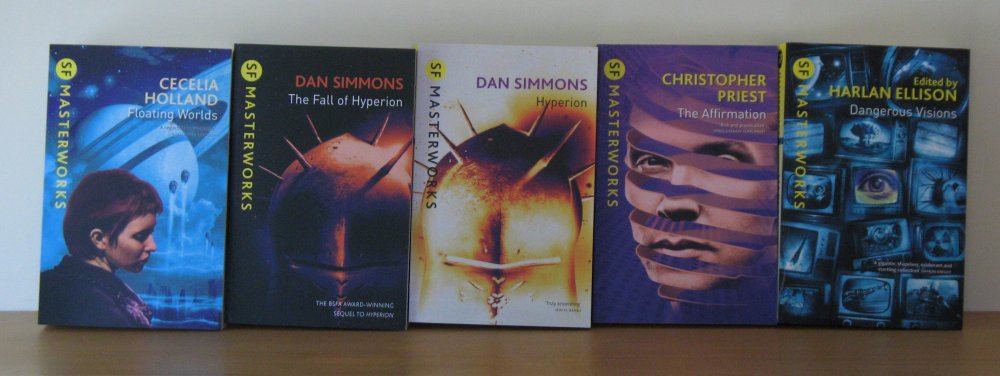
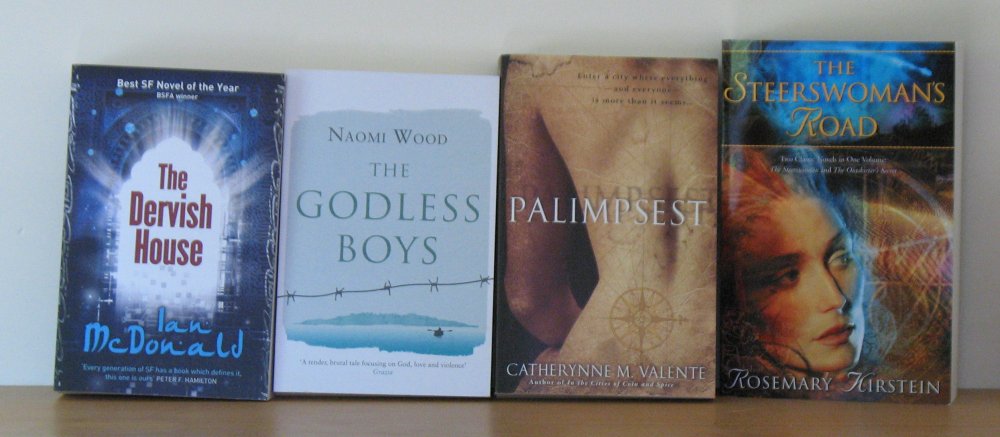
Some science fiction… A pair of SF Masterworks: RUR & War with the Newts, Karel Capek, and Sirius, Olaf Stapledon. Colin Greenland’s Spiritfeather, one of the volumes from the four-book Dreamtime YA series published in 2000. There was a bit of a fad for Brit sf authors contributing to YA series at that time – not just Dreamtime, but also The Web, which boasted books by Stephen Baxter, Ken MacLeod, Peter F Hamilton, Eric Brown and Pat Cadigan. And, finally, Mission Child, Maureen McHugh, a charity shop find I plan to review for SF Mistressworks.
And here is The Monster Book for Girls, an anthology of dark fantasy and horror from theExaggeratedpress, which looks very nice indeed, but also…
… contains my story ‘Dancing the Skies’, which is the ATA/Spitfire story, which required much research on the Air Transport Auxiliary and WWII fighters and bombers.
I bunged Miklós Jancsó’s Red Psalm (1972) onto an order of Christmas presents at the beginning of December, though I can’t for the life of me remember why. I’d seen Janscó’s The Red And The White before – in June 2010, and wrote then that it was “definitely worth seeing” – but what possessed me to buy a Jancsó DVD is something of a mystery. Perhaps it was a review in Sight & Sound. No matter. I bought it. And now I’ve watched it.
I think I was expecting a paean to socialism when I put the DVD in the player. The title, and Jancsó’s politics, certainly suggest as much. Even the film’s original Hungarian title, Még kér a nép (The People Still Demand), fosters this impression. Except Red Psalm, while certainly a socialist film, is no paean. It is based upon a number of peasant uprisings in Hungary between 1890 and 1910, and melds these into a single extended dramatic piece – though it has no plot, no characters, and no dialogue per se.
There are the workers, represented by a group of young people in peasant costumes. And there are the authorities, represented variously by the rural police, a bailiff, the army, the local count, and a priest. Most of the cast have 1970s haircuts, which does make it look all a bit hippie. The film takes place at a rural farming community and the countryside surrounding it, though no effort is made to give the story any real sense of place.
The workers walk around, either singing folk songs (often with socialist lyrics) or making small speechlets about socialism. The soldiers and policemen also walk around (or ride around on horseback), trying to either intimidate or charm the workers. No one stands still, everyone moves. This “balletic” movement is a feature of Jancsó’s style. One soldier defects to the workers but is shot. Later, he reappears, as if resurrected. A worker is shot through the hand, but her wound becomes a red rosette. Later, all the workers wear such rosettes.
The local count attempts to explain the benefits of capitalism to the workers – though it is an unconvincing argument – but seems to die of a heart attack when his words fall on deaf ears. His wife subsequently attacks the workers with a whip. A priest exhorts the workers to obey the authorities, claiming it is the godly thing to do, but is forced back into his church, which is then set on fire.
Throughout Red Psalm, there is a sense of a story in continual evolution. Characters exchange roles, dialogue is declamatory or explanatory, but does not progress anything as bourgeois as a plot. At the end, the workers and soldiers come together to celebrate but, at a signal, the soldiers then separate, form a cordon about the workers… and massacre them. Tellingly, the cordon is in the shape of a heart.
But even that death is not final, as the workers later re-appear. And one takes a soldier’s gun, and then kills all the soldiers.
Red Psalm is an argument, framed in song, movement, political oratory and the interactions between opposing groups. If its young and good-looking cast make it appear more of a hippie film than a socialist one, it’s an illusion that is quickly dispelled. It’s perhaps not to everyone’s taste, but I thought it excellent and have even bought The Miklós Jancsó Collection box set. And I think more of Jancsó’s films should be released on DVD.
There are comic novels and there are novels of wit. Some novels evince humour by describing ridiculous characters in ridiculous situations; others prefer to amuse through their use of language. Paul Scott’s The Bender (1963) is a novel of wit and its characters, while amusingly drawn, are not comic caricatures. There is also much in the novel that points to Scott’s Raj Quartet, a use of language, voice and narrative that presages The Jewel In The Crown and its sequels.
George Lisle-Spruce is a wastrel. A relative left him a legacy of £10,000, which he cannot touch. But it does provide him with an annual income of £400. Initially, this was more than enough to live on, but by the beginning of the 1960s, George is finding it increasingly hard to make ends meet on his monthly allowance. And now his brother, a successful accountant, wants repaying the £200 he lent George years before. George spent the War in Cairo, and was never in combat. Since then he’s never held down a proper job. He has some charm, but never really made the most of it. And this is despite the best efforts of his Aunt Clara – who is not really his aunt, but whose husband it was who left George his legacy.
The Bender is told from the points of view of George, Aunt Clara, a real aunt who is on her death-bed, brother Tim, and youngest brother Guy (an Angry Young Man, with a play that has been broadcast on television to critical acclaim). The repayment of Tim’s loan precipitates a crisis in George’s life – though it is exacerbated by Clara’s renewed meddling, Tim’s impending change of career, and Guy’s success.
The writing in The Bender is a delight. It’s witty, the voices are handled superbly – though, one, Guy’s hippie chick girlfriend, feels somewhat forced – and a section two-thirds of the way through astonishes with its seamless post-modern blending of narratives and voices. The novel is also a pitch-perfect evocation of time and place, and feels throughout like a 1960s British black and white film starring Dirk Bogarde. Aunt Clara is perhaps the most amusing character – a forceful and opinionated dowager, with old school views about class and ability, views she has a habit of setting forth on tape:
…the Grundig’s microphone in one hand and, in the other, one of the Floris chocolates for which her lunchtime liquid slimming diet always gave her an appetite…
The Raj Quartet are novels of consequence. While The Bender may be somewhat inconsequential, it reaffirms my admiration of Scott’s writing. Fortunately, I have many more of his books to read. Recommended.
To be honest, I had not really expected to enjoy City of Pearl by Karen Traviss. From what I’d heard about the novel, it seemed the sort of science fiction I don’t especially like. And Traviss is known as an especially mercenary writer. No matter how talented she may be, such an attitude is unlikely to create works I would find appealing. Nonetheless, I picked the book as one of my dozen for my 2011 reading challenge, and though I may have slipped a little towards the end of last year, I had every intention of reading and blogging about the twelve listed novels.
And so I came to City of Pearl with, I admit, a few preconceptions. Some of them were indeed met, but I was surprised to find myself enjoying the novel more than I had expected.
Shan Frankland is a hard-as-nails police officer in a near-future in which corporations dominate ineffectual governments. All crops are genetically-engineered and trademark, such that no foodstuff can be grown without paying a license fee to a company. When Frankland is offered command of a mission to Earth’s only interstellar colony on Cavanagh’s Star’s second planet, she accepts the mission. But she doesn’t know exactly why, because whatever was told to her to persuade her to accept was part of a Suppressed Briefing, which only releases information into her memory in response to certain triggers.
The mission arrives at Cavanagh’s Star 2 and finds a situation it had not expected: a small low-tech human colony with an extremely small environmental footprint living under the aegis of an alien race, the wess’har. The aliens are actually native to Cavanagh’s Star 2’s twin planet, and are on Cavanagh’s Star 2 to protect that planet’s native squid-like aquatic race, the bezeri. Who had been almost polluted to extinction by a third alien race, the isenj, who had colonised the world. The wess’har wiped out the isenj colony, but now allow the humans to stay on sufferance. Aras is the wess’har responsible for the planet and its ecosystem, and he has been given this role because he has been infected by a native parasite, the c’naatat, which has made him immortal and almost impossible to kill.
Though Frankland tries to keep a tight leash on the scientific team she has brought to Cavanagh’s Star 2, they cavil at her restrictions and continually seek to subvert them. This makes tensions high within Frankland’s mission, a situation not helped by her high-handed and take-no-prisoners attitude. When a second starship from Earth turns up, having departed fifty years after the first, it seems Earth has formed an alliance with the idenj, who determined to take back Cavanagh’s Star 2. During a skirmish with the isenj, Frankland is mortally wounded, but Aras, who has come to value her, infects her with c’naatat. Now she can never return to Earth.
I liked Frankland, and the best parts of City of Pearl were the parts which focused on her. Unfortunately, the aliens are all single-note: the wess’har are literal and unbending, the bezeri are enigmatic, and the isenj are numerous. The scientists are all characterised as venal and selfish, and only the military characters appear to possess any redeeming virtues. The human colonists on Cavanagh’s Star 2 are treated like simple back-to-the-land peasants, and the novel makes little or no judgment on them or their way of life. A lot of City of Pearl is in Aras’ point of view, and he’s neither convincingly alien nor especially interesting.
There’s a fixity of views throughout City of Pearl which I found a little off-putting. The wess’har are very literal and do not compromise. Frankland is very much convinced her own opinion is always correct. The entire cast – with the exception of those Traviss villanises – are straight from the US mode of science fiction, with its Rational Competent Men. Though many in City of Pearl are actually women. Or alien. There’s no subtlety or complexity in the novel. The scientists are wrong, the isenj are wrong. And that’s it. I can see how such binary views might appeal to some readers, especially genre readers, since populist genre fiction seems incapable of psychological depth.
There are apparently a further five Wess’har books, but I’ll not be bothering to read them. While City of Pearl managed an interesting meld of near-future sf and space opera, it was too much like military sf in tone to really appeal to me. Traviss’s prose is readable and well-paced, though to be honest I kept reading more because I liked the character of Frankland than anything else.
Oh, and the titular city is the wess’har capital on their world, and it makes perhaps a half dozen appearances in the novel. Frankland visits it toward the end in order to seek permission from the wess’har elders to stay with Aras. It’s a somewhat peripheral element of the story with which to title it.
To all the people who read Liz Bourke’s review on Strange Horizons of Michael J Sullivan’s Theft Of Swords, and didn’t like the review because:
a) historians should not review epic fantasy
b) “intellectuals” should not review epic fantasy
c) women should not review epic fantasy
d) a negative review will upset the author
e) a negative review will negatively impact the author’s sales
f) popularity and quality are the same thing, as any fule kno
g) bad prose is better than good prose, as is demonstrated by any best-seller list
h) taking quotes from the novel “out of context” would make any author’s prose look bad
i) you read the book and enjoyed it so it can’t be bad
j) the book is meant to be “fun” and “light reading” so it can’t be bad
k) a negative review is obviously not objective since you disagree with it
Congratulations. You are officially stupid. If you want to know why genre fiction is not taken seriously, go and look in the mirror.
First, see this review of Michael J Sullivan’s Theft Of Swords on Strange Horizons. See its long comment thread. This post is not aimed at Liz Bourke, who has written an excellent review of what is plainly a bad book. This post is for some of the commenters on that thread, who clearly don’t understand what a review is for, or how a book is reviewed.
1 A dishonest review is a bad review. 2 Not all books are good. 3 It’s not just good books that deserve reviews. 4 If a book is a bad book, it’s dishonest not to say so. 5 If a book is not a good book, it’s dishonest to refuse to review it. 6 Books can be bad for a number of reasons; most of those reason are a result of failure of craft. 7 Reviews are not written for the author of the book being reviewed; their audience is potential readers of the book being reviewed. 8 A good review is not opinion because it will contain evidence supporting its assertions. 9 Whether or not a reviewer enjoyed a book is completely meaningless, since enjoyment is unrelated to quality and is entirely subjective. 10 A review does not have to meet the expectations of people who have read the book being reviewed. 11 A review is based on a critical read of a book; this means the reviewer has probably put a lot more thought into their reading of it than you have. 12 If you come across a negative review of a book you thought was good but you did not read the book in question critically, then you are not qualified to comment on the review’s findings.
A new meme. Cool. This one is the Nobel Prize for Literature winners meme. I took this list from Larry’s OF Blog of the Fallen. You know the rules: bold if you’ve read anything by the author, italicize if it’s on the TBR.
2011 Tomas Tranströmer
2010 Mario Vargas Llosa
2009 Herta Müller
2008 Jean-Marie Gustave Le Clézio
2007 Doris Lessing
2006 Orhan Pamuk
2005 Harold Pinter
2004 Elfriede Jelinek
2003 John M Coetzee
2002 Imre Kertész
2001 Sir Vidiadhar Surajprasad Naipaul
2000 Gao Xingjian
1999 Günter Grass
1998 José Saramago
1997 Dario Fo
1996 Wislawa Szymborska
1995 Seamus Heaney
1994 Kenzaburo Oe
1993 Toni Morrison
1992 Derek Walcott
1991 Nadine Gordimer
1990 Octavio Paz
1989 Camilo José Cela
1988 Naguib Mahfouz
1987 Joseph Brodsky
1986 Wole Soyinka
1985 Claude Simon
1984 Jaroslav Seifert
1983 William Golding
1982 Gabriel García Márquez
1981 Elias Canetti
1980 Czeslaw Milosz
1979 Odysseus Elytis
1978 Isaac Bashevis Singer
1977 Vicente Aleixandre
1976 Saul Bellow
1975 Eugenio Montale
1974 Eyvind Johnson, Harry Martinson
1973 Patrick White
1972 Heinrich Böll
1971 Pablo Neruda
1970 Aleksandr Isayevich Solzhenitsyn
1969 Samuel Beckett
1968 Yasunari Kawabata
1967 Miguel Angel Asturias
1966 Shmuel Yosef Agnon, Nelly Sachs
1965 Mikhail Aleksandrovich Sholokhov
1964 Jean-Paul Sartre
1963 Giorgos Seferis
1962 John Steinbeck
1961 Ivo Andric
1960 Saint-John Perse
1959 Salvatore Quasimodo
1958 Boris Leonidovich Pasternak
1957 Albert Camus
1956 Juan Ramón Jiménez
1955 Halldór Kiljan Laxness
1954 Ernest Hemingway
1953 Sir Winston Leonard Spencer Churchill
1952 François Mauriac
1951 Pär Fabian Lagerkvist
1950 Earl (Bertrand Arthur William) Russell
1949 William Faulkner
1948 Thomas Stearns Eliot
1947 André Paul Guillaume Gide
1946 Hermann Hesse
1945 Gabriela Mistral
1944 Johannes Vilhelm Jensen
1943 No Nobel Prize was awarded this year.
1942 No Nobel Prize was awarded this year.
1941 No Nobel Prize was awarded this year.
1940 No Nobel Prize was awarded this year.
1939 Frans Eemil Sillanpää
1938 Pearl Buck
1937 Roger Martin du Gard
1936 Eugene Gladstone O’Neill
1935 No Nobel Prize was awarded this year.
1934 Luigi Pirandello
1933 Ivan Alekseyevich Bunin
1932 John Galsworthy
1931 Erik Axel Karlfeldt
1930 Sinclair Lewis
1929 Thomas Mann
1928 Sigrid Undset
1927 Henri Bergson
1926 Grazia Deledda
1925 George Bernard Shaw
1924 Wladyslaw Stanislaw Reymont
1923 William Butler Yeats
1922 Jacinto Benavente
1921 Anatole France
1920 Knut Pedersen Hamsun
1919 Carl Friedrich Georg Spitteler
1918 No Nobel Prize was awarded this year.
1917 Karl Adolph Gjellerup, Henrik Pontoppidan
1916 Carl Gustaf Verner von Heidenstam
1915 Romain Rolland
1914 No Nobel Prize was awarded this year.
1913 Rabindranath Tagore
1912 Gerhart Johann Robert Hauptmann
1911 Count Maurice (Mooris) Polidore Marie Bernhard Maeterlinck
1910 Paul Johann Ludwig Heyse
1909 Selma Ottilia Lovisa Lagerlöf
1908 Rudolf Christoph Eucken
1907 Rudyard Kipling
1906 Giosuè Carducci
1905 Henryk Sienkiewicz
1904 Frédéric Mistral, José Echegaray y Eizaguirre
1903 Bjørnstjerne Martinus Bjørnson
1902 Christian Matthias Theodor Mommsen
1901 Sully Prudhomme
Not a very good showing, I’m afraid. Only half a dozen read; though I have more sitting on the TBR – and in several cases, multiple books by those authors.
I think it was Orson Scott Card who wrote in an essay in Asimov’s back in the 1990s that any future of consequence would be American. That assertion was debatable then – if not offensively arrogant – but the world has changed a great deal in the past twenty years, making’s Card’s boast even less likely. And yet still I see contemporary sf novels in which Planet Earth seems to be either monoculturally US-ian, or contains worlds extrapolated from present US society.
Science fiction is chiefly a white, male, middle-class genre and is dominated by the USA, and so its sensibilities and concerns are typically those which confirm the prejudices of that demographic. But not always, of course – back in 1991, William Barton and Michael Capobianco’s Fellow Traveler was set in a future Soviet space programme; in 2012, Alastair Reynolds’ Blue Remembered Earth opens in a future where “Africa is the dominant technological and economic power” and follows the fortunes of an African family. (There is no mention in the blurb, however, of which African nation the family are from – Africa is, after all, as monocultural as Europe: ie, not at all; and since we’d say French or German or Polish or Swedish, we shouldn’t be saying “African”.)
Photo taken by Columbia Space Shuttle
In reference to the near-future, sf has maintained some degree – though it could be greatly improved – of diversity of setting and cast. But anything set further hence usually devolves to the white, Western, Anglophone, vaguely US, vaguely right-wing default world carried over from the genre’s early beginnings. There’s no good reason for this. True, the US still performs much of the tentpole science, but not exclusively. The LHC is in Switzerland; the Soviets had a space station before the Americans; the Chinese may well be the first to set foot on Mars. Many nations have space agencies – indeed, out of the twenty-two past and present ESA astronauts, only one speaks English as a first language.
Even looking at the cyclical nature of empires suggests that US hegemony will no longer exist in any recognisable form by the middle of this century. Then there’s everyday technology and its uses. Such as surveillance. The US provides no good model for any future society in this regard. If anything, looking at the UK would be more useful. Twenty-five percent of the world’s CCTV cameras are in the UK. It is the most-surveillanced nation on the planet. Yet we don’t especially much care about the fact we’re always being watched. US ideas of privacy exist only in the US, and the US attitude to video surveillance does not map onto British sensibilities. It is likely that, as surveillance becomes more pervasive and ubiquitous, it is the UK attitude to it which will prevail.
Europe is also, of course, defiantly not monocultural. Its twenty-seven member states speak twenty-three official languages. Back in the day, Harry Harrison may have thought Earth, and hence any subsequent interstellar polity, might uniformly adopt an artificial language, but even the language he chose, Esperanto, has never been used routinely by more than an estimated one million people. India, a single nation, has no national language but recognises twenty-two regional languages (although the SIL Ethnologue lists 415 spoken throughout the country). History has shown that languages come to dominate areas as a result of conquest, religion, trade, or cultural imperialism; and often from a combination of all four. But that, obviously, does not mean that their dominance remains eternal: Arabic is no longer spoken in Spain, for example.
All of which suggests that science fiction has changed very little from the days of Amazing Stories, especially in regards to its in-built attitudes and sensibilities. The tropes it has developed over the generations have become shortcuts and defaults. It’s not just those galactic empires of whitebread worlds, but the technology and science and their uses. Can’t be bothered to figure out how spaceflight really works? Bung in some “thrusters” and “inertial compensators”. Can’t be bothered to design a plausible future? Just make it like the US, but with neat toys. It’s authorial laziness. Writing stories that not only cater to the prejudices of a perceived market but actively reinforce those prejudices is not something a genre which boasts of its inventiveness and transgressive achievements should be doing.
Mundane SF was seen by many genre fans as throwing the baby out with the bathwater – it’s the wildly improbably stuff like aliens and time travel which can be the most fun. But at least Mundane SF required its adherents to focus on the basics. You couldn’t just make shit up, you couldn’t just slot in those neat ideas from Tropes R Us, you couldn’t just pretend that interstellar travel was like air travel of today or sea travel of earlier decades. You had to think about the world of your story, not just pin a few baubles on the default setting. Sadly, Mundane SF is little more than a Wikipedia entry these days, but let’s hope it had some effect on the genre.
And let’s hope that Blue Remembered Earth, the first of a trilogy, is the start of a new movement in science fiction to break away from white middle-class Anglophone futures, a move towards more plausible and more representative world-building. Let’s hope Alastair Reynold’s new novel helps pave the way to a more adult and thoughtful genre. After all, if we want to take be taken seriously by non-genre writers, we shouldn’t bitch and moan about being ill-treated, we should show them that we can be as good as they are. We’ll only ever be taken seriously if we up our game.
This is the final post detailing the books I read and the films I watched during 2011. I don’t think I’ll bother doing these in 2012 as I suspect I’m stretching myself a bit thin with them. They’re also a bit long, which probably puts some people off reading them. Perhaps I’ll just blog about individual books or films I consider worthy of recommendation on an ad hoc basis. What do people think?
For the time-being anyway, here it is, the culture (and I use the term loosely) I consumed right up until the 31 December 2011…
Books Time to Live, John Rackham (1966) / The Man Without a Planet, Lin Carter (1966), was an Ace double I picked up at a convention chiefly, I seem to recall, because Rackham was a British sf writer of the 1960s and 1970s I’d not read. (Though he also wrote as John T Phillifent, his real name, and I think I’ve read one of his books published under that name.) And so… Well, it’s hackwork right from the first page. Time to Live opens with an amnesiac protagonist, and the entire story feels like it was made up as Rackham wrote it. The amnesiac is wanted for murder, but he didn’t commit it, of course. And the native race on the planet on which this takes place are all preternaturally good-looking, have psychic powers, are near-immortal, and have willingly turned their backs on high technology. The native woman who rescues the amnesiac when his car crashes quickly realises he is innocent and later falls in love with him. Of course. This is not a book that will ever make the British SF Masterworks list. Lin Carter, on the other hand, was not a Brit, and he also seems to have made a career from writing pastiches of sf and fantasy from an earlier age. His Callisto books, for example, take off Edgar Rice Burrough’s Barsoom stories, and his Thongor is Conan in all but name. The Man Without a Planet belongs to Carter’s History of the Great Imperium trilogy, and it’s real swords & spaceships stuff. The protagonist is a naval hero who returns to his home world but doesn’t like what he finds there. He is reluctantly pushed into the arms of a displaced empress who wants her planet back. It’s all stupid cod mediaeval dialogue and most of the cast wearing next to nothing as manly men battle to protect feisty females and ensure that what is right prevails. I have to wonder how many readers lapped it up and didn’t realise Carter was taking the piss.
The Silent Land, Graham Joyce (2010), is likely to end up on a few short-lists this year was on several short-lists last year, though I ultimately found it an unsatisfactory read. A young couple are on a skiing holiday and get caught in an avalanche. They manage to rescue themselves, but when they return to the village where they’re staying, they find it deserted. Certain things don’t seem quite as they should, or as they remember them – candles don’t burn down, meat doesn’t go off, things don’t taste as they ought… and whenever they try to leave the village they find themselves circling back to it. The couple and their relationship are drawn exceedingly well, but most readers will probably figure out what’s going about halfway through, and it’s the lack of a final unexpected twist that left me slightly disappointed. Otherwise, a book definitely worth reading.
The Nemesis from Terra, Leigh Brackett (1951), was originally published in Startling Stories in 1944 as Shadow Over Mars, and that earlier title strikes me as the better of the two. Much as I like Brackett’s Mars stories, I don’t think this is one of her better ones. It’s pretty much a Western set on the Red Planet. Take away the mention of Mars’ ancient civilisations – and the trip to the Thinker’s dome at the pole, which adds little – and it’s not even science fiction. Most of the dialogue reads like Brackett was trying it out for her movie scripts, and the story is predictable from start to finish. Disappointing.
The Last Battle, CS Lewis (1956), is the final book of the Chronicles of Narnia. I can now cross them off the list. The battle of the title is the great battle for Narnia… Er, well, no: it’s not actually a “great” battle at all. There are less than a hundred on each side. A Talking Ape finds a dead lion and persuades his somewhat dim Donkey companion to dress up in its skin and pretend to be Aslan. Of course, everyone is taken in by the disguise – so much so that the King of Narnia is very surprised when he learns someone is chopping down the dyads’ trees. That someone proves to be Talking Animals in thrall to a group of Calormene. Who are, of course, smelly and evil and foreign. But then Eustace and Jill appear and help the king discover what’s really going on. Then a few more Pevensies turn up and there’s a small battle and Aslan turns up and Narnia gets rolled up and everyone ends up in a walled garden which has the whole world inside it including friends and loved ones who have died even those back in the real world because it’s really Heaven and if everyone is jolly nice then that’s where they’ll end up when they die. So there.
Solaris Rising, Ian Whates (2011), I reviewed for SFF Chronicles here. It’s a good showcase of contemporary science fiction, and Whates lets the stories speak for themselves.
The Witches Of Karres, James H Schmitz (1966), was short-listed for the Hugo Award in 1967, and appeared in three Locus All Time Best (SF) Novel polls. It was originally published in 1949 as a novelette, but expanded to novel-length in 1966. It is also shit. In fact, looking at that 1967 short-list, there’s perfect reason to be embarrassed at the poor taste frequently shown by the Hugo voters. That short-list included Babel-17 and Flowers For Algernon, both very good sf novels, but instead they gave it to… The Moon is a Harsh Mistress. But The Witches Of Karres… Captain Pausert is a humorously incompetent space captain, trying to make a living and prove a point by operating a merchant starship. He inadvertently finds himself buying three slaves, all young girls whose owners are more than glad to get rid of them. That’s because the girls are witches from Karres. Which means they have mental powers. Sort of. Among which is the “Sheewash Drive”, a super-fast star drive powered by the three of them. Everyone else wants this magical drive, but Pausert – with much help from the witches – manages to prevent them from getting it. And, as a result, he becomes embroiled in a plot to save the galaxy from some worm-like aliens from an alternate dimension. The writing is bad, the world-building is bad, and the science fiction is bad. At one point, Pausert’s ship detects another “just ahead, some nine light years away”. That’s 85 trillion kilometres. People writing this sort of crap sf seem to think space is no bigger than the Atlantic ocean. The Witches Of Karres is a definite contender for Shittest Book To Be Short-Listed For A Hugo Award, a list which, it must be said, is far far longer than it should be.
Blood Count, Robert Goddard (2011), is the latest of Goddard’s potboilers, which, for some reason, I continue to read. His books are the sort which win the WH Smith “Thumping Good Read” Award, and I generally prefer fiction with somewhat higher aspirations. But never mind. There’s no point looking in Goddard’s novels for deep meaning, wonderful prose or profound insight. Instead, you get an everyman made victim to a conspiracy and which he must puzzle out to save himself. In Blood Count, the protagonist is a surgeon who performed a liver transplant on a Serbian warlord. Years later, the warlord is under trial at the International Court of Justice. The warlord’s daughter blackmails the surgeon into approaching the warlord’s ex-accountant who has control of the family’s ill-gotten gains. But it’s all a plot within a plot within a plot, and people get murdered and the warlord escapes and… Goddard’s books are fast mostly entertaining reads, and this one, I have to admit, was one of his better ones.
Of Men and Monsters, William Tenn (1968). The Earth has been conquered and the remains of humanity now live like rats in the walls of the giant aliens’ dwellings. Eric the Only is a hunter in the forward-burrow tribe that calls itself Humanity. It’s his job to leave the tunnels and fetch alien food or artefacts – or, at least, small enough such things that he can carry them. It’s a conceit that doesn’t quite stand up to scrutiny – aliens so large aren’t that plausible, nor is a human civilisation surviving as household pests. Still, Of Men and Monsters is a neat little fable and an easy read. I’m not entirely sure whether it’s a bona fide SF Masterwork, though there are certainly worse books already in the series.
Shadows Of The Pomegranate Tree, Tariq Ali (1992), is the first book of the Islam Quintet, and opens in 1500 CE in Moorish Spain. The Catholic Spaniards reconquered Granada eight years previously but now a new archbishop has arrived and is determined to stamp out Islam. This is in direct contravention of the treaty signed between the Moors and the Castilian king and queen. But never mind. I mean, he’s doing it for God, so that’s all right isn’t it? That makes it okay to kill women and children, to burn books, to forbid the Moors from speaking Arabic or wearing their customary dress, to steal their lands from them, to torture them into confessing crimes/sins they have not committed… The story is told from the viewpoint of a single Muslim family, and it’s strong stuff. Ali’s frequently inelegant prose often works against the story, but never mind. I shall probably read the rest of the quintet, though I won’t be dashing out immediately to buy them.
The Recollection, Gareth L Powell (2011), was my final book of 2011. There’s a lot in The Recollection that’s typical, if not characteristic, of contemporary British commercial sf. It opens in the near-future, when strange arches appear throughout the world. Ed Rico’s brother, Verne, disappears into one such arch in a London Underground station, and Ed vows to find and rescue him. Meanwhile, four centuries hence, trader starship captain and black sheep Kat Abdulov has been welcomed back into the bosom of her powerful family because only she is in a position to beat a rival trader to the centennial Pep harvest on the world of Djatt. Throw in an enigmatic alien race inhabiting a vast slower-than-light starship, and the Bubble Belt, a mysterious BDO comprising millions of small habitats orbiting the Gnarl, an unknown energy source. And then there’s the eponymous Recollection itself, a “cloud” which devours everything in its path as it travels throughout the galaxy. I’d initially thought Powell was trying for Light territory with his two plot-threads separated by centuries, but the two tied up far too neatly for that. And besides, Kat’s space opera future was a little too generic for my taste, and the introduction of the Recollection then saw the book drift into Peter F Hamilton-esque sf. If The Recollection is a mélange of contemporary UK sf tropes and concerns, it’s a well put-together one. It did promise more in its early pages than it managed to deliver, but nonetheless a lot of people will find much to like in it.
Films Star Trek: The Next Generation season five (1991) sees the USS Blanderprise continue in its ongoing mission to bring insipid sf to the masses – or to its fanbase, at least. As in previous seasons, the episodes all blur into the televisual equivalent of beige, with no real episodes standing out – not even the double-parter in which Spock contacts the Romulan underground because they want to reunite with the Vulcans. On the other hand, there are a number of embarrassingly bad ones. ‘The Outcast’, in which Riker falls in love with a member of a single-sexed race… though the story still manages to impose binary gender sensibilities on the neuter aliens. Or ‘I, Borg’, in which emotional attachment is seen as a perfectly valid reason not to commit genocide. Much of the writing in the series remains poor and ill thought-out. Ethics and morality take a back seat to story needs, and there’s often little consistency between the various ethical and/or political stances taken by the characters or various institutions from episode to episode. But that, I think, is a failing of all the Trek franchises, and may well be a result of US television’s habit of writing by committee.
Rosebud, Otto Preminger (1975), is a strange film. It’s a mostly forgettable euro-thriller, despite its director, albeit with a star-studded cast. Peter O’Toole plays a Brit ex-CIA agent currently working as a stringer in Rome. When the daughters of three European plutocrats are kidnapped by Palestinian terrorists, he is employed to get them back in one piece. The girls are played by Lalla Ward, Isabelle Huppert and Kim Cattrall. The villain of the piece is Richard Attenborough, as an ex-SAS man convert to Islam. It’s all played very flat and affectless, and so despite its cosmopolitanism it seems bizarrely charmless.
Red Sonja, Richard Fleischer (1985), may well be the best high fantasy film ever made. When Sonja – who doesn’t actually do anything during the film to earn the sobriquet “red”, though she does have improbably red hair – comes to beside the smoking ruins of her parents’ house, a ghostly creature helpfully explains to her in voice-over exactly what she has just experienced. Which Red Sonja already knows, of course, but the film has to get the story across to the viewer. It makes “As you know, Bob” dialogue look positively sophisticated. Then there’s Red Sonja herself, played by Brigitte Nielsen, who actually resembles a skinny boy with a bad mullet for much of the film. And the villainess lives in the Land of Perpetual Night, though it’s often daytime there. Not to mention that Red Sonja is allegedly a superlative sword-fighter – and is shown as such early in the film – but seems incapable of winning a duel against a man and must always be helped out by Arnold Schwarzenegger’s character. Though Red Sonja does insist no man “can have her” unless he defeats her in a sword-fight – so the only man she manages to hold off with a sword is Schwarzenegger, as he wants to get into her chainmail pants. The climax of the film sees the world falling to pieces but the villainess of course insists on hanging onto the magical device causing the destruction because, well, because with it she can rule the world. Even, er, if there isn’t one left. Red Sonja is a gloriously inept sword & sorcery movie, which appears to have been written by a pair of drunks. Admittedly, the production design leaves a bit to be desired – the makers could have had so much more fun, but perhaps they reined it in for a PG certificate…
The Valley of the Bees, František Vláčil (1968), is a Czech film about the Teutonic knights, and for much of its length I thought it a little dull. Having said that, it presents a complex moral landscape, and so proved itself so much more satisfying than the likes of Star Trek: The Next Generation season five. The film is black and white throughout and evokes its period well, but it’s also very slow. It’s been a few weeks since I watched it, and I can remember little about it. Having said that, I’d rather be bored by a film like The Valley of the Bees than have my intelligence beaten into submission by your typical Hollywood blockbuster…
The Man with the Golden Arm, Otto Preminger (1955), scored Frank Sinatra an Oscar nomination for the title role, though he lost out to Ernest Borgnine in Marty. That may well be because The Man with the Golden Arm deals with heroine addiction. Sinatra plays a small time crook who has just come out of rehab and dreams of being a drummer with a big band. But he soon picks up his drug habit again and his life duly falls to pieces. For all its plaudits, I found the film slow and not especially involving. Sinatra’s character is too self-centred to sympathise with, and the general dour tone of the story could only really appeal to masochists. Given that I disliked Kerouac’s On the Road when I read it, then it’s no real surprise that I didn’t enjoy The Man with the Golden Arm.
The Time that Remains, Elia Suleiman (2009), I picked as one of the best films I watched in 2011, which is no real surprise as I count Suleiman as one of my favourite directors. He’s only made three feature-length films, and all three deal with Palestine / Israel in more or less the same fashion. They’re a commentary on the Occupation, built up from vignettes, some of which are taken from Suleiman’s own life. The Time that Remains is mostly the story of Suleiman’s father, and opens in 1948 with the Israeli invasion of territory mandated to the Palestinians. It continues through the decades to the present day, where Suleiman appears as himself. There are some excellent scenes, displaying some very funny black humour and an overall sense of very Arabic fatalism that only makes the story even more poignant. Highly recommended.
Sanctum, Alister Grierson (2011), I bought because it’s about an expedition to explore some underwater caves and I thought it might appeal. And it did. A little. Unfortunately, in amongst all the excellent photography of the underwater caves was a dumb father-son story filled with macho bullshit from start to finish. Manly explorer has neglected his son and thinks little of him. But they all get trapped deep underground when a monsoon hits, and must escape by following an underground river through a (astonishingly-filmed) flooded cave system. Son duly proves his manliness to father, who dies a happy man as his thrusting virility will now continue for another generation. This is probably a film best watched with the volume turned off.
Inception, Christopher Nolan (2010), I finally got around to watching a year after everyone else and… Well, there are some astonishing visuals, but the logic of the story doesn’t parse. There’s this Mission: Impossible-type team, led by Leonardo di Caprio, and what they do is invade people’s dreams to try and ferret out their secrets. But they can also do the opposite, though it is considered near-impossible: they can plant ideas in people’s heads in their dreams. This is known as an “inception”. To ensure the implanted idea takes in the head of their victim, the team play a shell-game, using dreams within dreams within dreams. But it all goes a bit wrong and di Caprio and victim end up in “limbo”, a dreamworld from which people rarely return (and in which years might pass in a matter of minutes). Given that di Caprio has only agreed to such a risky venture in order to be able to return to his family in the US, naturally everything in the film in some way links back to said family. And it’s implied at the end of Inception that what the viewer has been led to believe is actually just another layer of dream – and this is suggested by a token di Caprio uses to remind himself he’s dreaming. Except, of course, when he used it before it worked fine and did exactly that. There’s a sense throughout Inception that the film wants to have its cake and eat it. It pushes so hard to confuse reality and dream that it only ends up confusing itself.
The Colour of Pomegranates, Sergei Parajanov (1968), is on the BFI’s Top 100 films list, which is why I rented it. And… I like the idea of “poetic cinema”, and I’m a big fan of Andrei Tarkovsky… but The Colour of Pomegranates really is a very odd and slow and chiefly plot-less movie. You can’t watch it as you would other films, much as it’s impossible to watch and enjoy a film by Alejandro Jodorowsky while sober. The Colour of Pomegranates sort of tells the story of the life of Sayat Nova, a famous mediaeval Armenian poet. It does this not by dramatising scenes from his life, but by representing them through moving tableaux. They are beautifully staged and shot, but it’s difficult to decide what they’re actually telling you unless you’re familiar with Sayat Nova’s life. Which I’m not. I’m almost certain The Colour of Pomegranates is a film which needs to be watched a number of times. So I suppose I’ll have to go and buy a copy for myself…
Never Let Me Go, Mark Romanek (2010), is an adaptation of the novel by Kazuo Ishiguro, which I read back in 2009. The problem with the book, which you manage to avoid thinking about for much of its length because of Ishiguro’s exploration of his characters, is that the story is predicated on a monstrous practice: human beings are grown specifically to be organ donors to “real” people. The moral implications of this, the fact such a practice would seem to be accepted by the population at large, is largely ignored by the novel, though by showing that the donors are entirely human Ishiguro is making oblique commentary. The film, unfortunately, can’t ignore its world’s central conceit though it tries to do so. The final confrontation between Kathy, Tommy, Ruth and Miss Emily fails to show how evil the world of the story is. There’s some wishy-washy mention of souls, but it’s not even a serious attempt at justification. Nor is “it was worse before and we can’t go back to that” any kind of rationale. The problem with the film – which, it must be said, is pretty faithful to the book – is that it not only fails to comment on the practice of raising humans to act merely as donors, presenting the practice as normal and acceptable, but it also fails to present enough to hooks to trigger outrage. This is not helped by the use of flat washed-out colours or low-key performances by the cast – if anything, these make the film appear more like a comment on the grimness of earlier decades than on the actual world of the story. It’s a bit like the way thrillers and detective television shows have desensitised us to the reality of gruesomely murdered victims to the extent that the outrage the crime itself should engender becomes lost in intellectual satisfaction in the exploration of the murder’s techniques, the investigation, or the world of the story. Sometimes, the bad stuff needs to be put front and centre, if only to stress to people that it is indeed bad.
Far from Heaven, Todd Haynes (2002), is an attempt to “re-imagine” one of my favourite films, Douglas Sirk’s All That Heaven Allows. In Sirk’s masterpiece, a middle-class widow (Jane Wyman) enters into a relationship with her bohemian gardener (Rock Hudson) and is condemned by her friends and grown-up children for doing so. The film is beautifully played and shot, and makes a particular feature of its autumnal palette. In Far from Heaven, Haynes has taken that story and slapped on more, well, more stuff. The gardener is now black, which makes the relationship even more transgressive – except it’s not a relationship in Far from Heaven, the woman (Julianne Moore) is merely being friendly and polite with him. She’s not a widow either. And her husband (Dennis Quaid) has discovered that he is gay and is now having sex with other men. It’s all too much. The black gardener alone would have provided an interesting perspective on Sirk’s original, but to throw in a homosexual husband is over-egging the cake enormously. It dilutes the story’s focus. Haynes manages to recreate Sirk’s palette, and the production design throughout is evocative of the period. And yet… there seems to be something in Far from Heaven which reveals it is as a film set in the 1950s rather than a film shot in the 1950s. A valorous attempt, but it doesn’t quite win the cigar.
The Girl with the Dragon Tattoo, David Fincher (2011), I saw at the Kino Palæet in Lyngby, Denmark, over Christmas. Cinemas there are much more expensive than in the UK – a ticket cost Kr 100.00, which is just over £11. But then pretty much everything is more expensive in Denmark. But The Girl with the Dragon Tattoo… I’ve not read the book, but I have seen the original Swedish film adaptation starring Michael Nyqvist and Noomi Rapace, and directed by Niels Arden Oplev. The US remake, of course, stars Daniel Craig and Rooney Mara, and is directed by David Fincher. There’s little need to rehash the plot as I suspect everyone knows it. From what I remember of the Swedish film, Fincher’s version is broadly similar though better-paced, though I’ve no idea how faithful either were to the book. I don’t recall Salander going abroad and emptying Wennerström’s offshore bank accounts from Oplev’s version but that may just be faulty memory on my part. I do recall the rape scene being more brutal than it is in Fincher’s, however. And I seem to remember Rapace was presented as a more convincing hacker than Mara, though the latter is good in the role. Otherwise, Fincher plays the story straight, with little in the way of frills, though the climax turns brutal in a way that hints at Se7en. Craig is more of an action-man type than Nyqvist but still manages to convince as a journalist, though the relationship between Nyqvist and Salander never seems entirely plausible. After watching both films, I suspect I shall have to finally succumb and read the damn book. Happily, copies are readily available for much cheapness in charity shops throughout the UK…
Star Trek: Deep Space Nine season seven (1998), is the end of the franchise, and the first Trek franchise I have watched all the way to the final episode. Though Deep Space Nine had its cringe-worthy episodes – and the Ferengi should have been quietly forgotten after being introduced in Star Trek: The Next Generation – I still think it had a more interesting cast and a more gripping story-arc than the rest of the stable. Having said that, I never understood the appeal of the holodeck episodes, and it’s toss-up as to which is less embarrassing: Next Gen’s Dixon Hill or DS9’s Vic Fontaine. Perhaps using Fontaine’s 1960s Las Vegas world as a way of allowing Nog to recover from the trauma of losing a leg showed a different approach to the usual Trek psychobabble, but it made the episodes feel like they were from a bad 1970s detective show. Likewise, the desperate desire to shoe-horn star villain Gul Dukat back into the story by making him some sort of dark messiah just felt like a narrative thread from an entirely different story. And then there were the Breen… In the final season, DS9 introduces a new super-technological race on the baddies’ side, but then decides it best to leave them mysterious. There are so many stories hiding in there, yet the writers blithely ignored them all. In fact, on reflection, the Breen added nothing to series’ story-arc. The season is not all bad, however. The wheels-within-wheels-within-wheels episode set on Romulus in which Bashir becomes an unwilling pawn of Section 31 was quite good. Damar’s gradual transformation from drunken lackey to rebel leader was played well, and even the Klingon political shenanigans managed to maintain my interest. Oh, and the replacement for Jadzia Dax, Ezri Dax was actually quite watchable initially. But then they blanded her out, and not even hot sex with Worf, or the bumbling screwball romance with Bashir, could make her interesting. But, as they say, all (good) things must come to an end, and Deep Space Nine sort of faded away rather than ending on anything that felt like closure. Yes, the various plot-threads were resolved, and everyone did their little speeches on what they were up to next, but it still felt like there should have been more episodes following. I’m also working my way through the Next Generation seasons (see above), but have yet to see anything that challenges the opinion that Deep Space Nine remains the best of the Trek franchises.
Source Code, Duncan Jones (2011), has at its core an intriguing premise, and manages to pull an action-packed 93 minutes from it. Jake Gyllenhaal is sent back in time to earlier that day into the body of a passenger on a train heading into Chicago. A bomb exploded on the train, and the bomber has a second bomb poised to inflict much greater damage within the city. Gyllenhaal has eight minutes to identify the bomber so that the authorities can prevent him setting off that second bomb. Each time Gyllenhaal fails, he is sent back to eight minutes prior to the train explosion. In between time-trips, it’s revealed he’s an Army helicopter pilot sent home injured from Afghanistan. Gyllenhaal’s visits are actually to an alternate timeline since he can’t prevent the train from blowing up in his timeline as it has already happened. Jones manages to get across a simplified version of the Many Worlds Hypothesis without confusing, or insulting the intelligence of, viewers. Personally, I was annoyed by the use of the term “source code” as the explanation for the name doesn’t fit the actual meaning of the term. All things considered, however, that’s a minor quibble. The fact that a helicopter pilot could disarm a bomb so quickly and easily is, however, more problematical. Unless, that is, you consider it a Hollywood convention. I could, of course, complain about the default Hollywood assumption that a time-travel project would be militarised, and that any benefits it might incur would be military. Not to mention the glorification of the military and its exploits. But why bother? Soldiers make for better heroes than scientists, and we know this because Hollywood has spent the last 100 years persuading us this is the case. If not all of us believe that, it must be because we’ve not been watching the right films…
Faces in the Crowd, Julien Magnat (2011), I watched for The Zone, and a review will appear there shortly.
The Ward, John Carpenter (2010), was another review copy for The Zone.