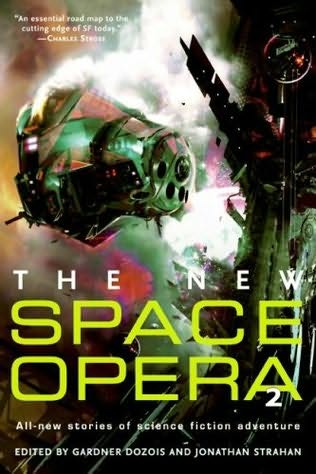
The New Space Opera 2, Gardner Dozois and Jonathan Strahan, eds.
(2009 Eos, $15.99, 544pp)
When Wilson Tucker coined the term “space opera” in 1941 to refer to “the hacky, grinding, stinking, outworn space-ship yarn”, he can’t have imagined the sub-genre would still be going strong sixty-nine years later. Or indeed that it would be considered one of the more successful forms of science fiction. That’s not to say that the “outworn space-ship yarn” no longer exists. There are plenty of examples of it being published in the twenty-first century. Some of them are even space opera.
According David G Hartwell and Kathryn Cramer in The Space Opera Renaissance (2006), space opera never went away and merely evolved over the decades into the form we now call New Space Opera. Which is, of course, to completely ignore the British re-invigoration of the sub-genre in the 1980s and 1990s. Before there was New Space Opera, there was New British Space Opera. Of the nineteen authors in The New Space Opera 2, only three are British. Since this anthology is a successor volume and its publisher is American, this is not unexpected. Likewise the fact that eleven of the authors are from the US, with only three Canadians and two Australians. Science fiction is a US-dominated genre.
But is space opera?
It is, if you extend its definition to include some of the stories in The New Space Opera 2. Because from this anthology, the only possible conclusion is that the new space opera has not only morphed back into the old space opera, but it has also expanded to include a great deal more of science fiction. How else to explain the stories by Kristine Kathryn Rusch or Elizabeth Moon in The New Space Opera 2? Both are the sort of sf CJ Cherryh was churning out by the yard in the 1980s. Or Mike Resnick’s spoof tale, which may riff off Tucker’s original definition, but seems to miss the point of new space opera. While John Scalzi’s ‘The Tale of the Wicked’ may be space opera, inasmuch as it features spaceships, AIs and humanity at war with an alien race, it has neither the vigour, scale, nor inventiveness of new space opera. And Bill Willingham’s ‘Fearless Space Pirates of the Outer Rings’ is pure pulp sf, although its ending does drag it into the twenty-first century.
Perhaps this is the way of things. A new movement injects vigour into a moribund genre, and is then subsumed by it. Which is not to say that science fiction was entirely moribund, nor that it has been wholly re-invigorated. There is still a whiff of corruption from some areas of sf.
Happily, The New Space Opera 2 is mostly a good read. With contents provided by, as the back-cover blurb has it, “some of the most beloved names in science fiction”, the stories are readable and mostly entertaining. But naming any anthology after a movement – however arguable its definition – is a hostage to fortune. There are some good stories in The New Space Opera 2. There is some new space opera in The New Space Opera 2. There is even a small overlap between those two groups. But there are a number of pages which do not belong in either group.
The New Space Opera 2 scores best at presenting a snapshot of science fiction in 2009. It is not an all-inclusive snapshot – for that, one of the many “best of the year” anthologies is needed. The New Space Opera 2‘s contents lean in a specific direction. But the good stories in it show what’s been good in sf during the past couple of years – those stories, for example, by Robert Charles Wilson, John Barnes, John Kessel, John Meaney, Justina Robson, Sean Williams and Bruce Sterling. No anthology will ever be perfect, no matter how “beloved” its contributors. The New Space Opera 2 improves its chances with its titular theme. For most readers it will have a higher than average hit-rate. But as part two of a manifesto for new space opera, its title does it few favours.
This review originally appeared in Interzone #226, January-February 2010.
It’s been a while since I last noted here what books I’d read. Yes, I’ve given up on the readings & watchings posts, but I’d still like to record what literature I’ve consumed throughout the year. Here I shall attempt to do it in a single line per book (occasionally through the creative use of punctuation, I must admit).
A Torrent of Faces, James Blish (1967) Pleasingly detailed, somewhat dated, but a much more interesting sf novel than I’d expected.
The Girl with the Dragon Tattoo, Stieg Larsson (2005) Oof – worse than I’d expected (though I’ve heard the translation was rushed), but Blomqvist is a Gary Stu and the attempts to drag in references to the original title (Män som hatar kvinnor, Men Who Hate Women) are hamfisted to say the least.
The Immersion Book of SF, Carmelo Rafala, ed. (2010) Small press anthology of, er, science fiction; some contents better than others, though nothing stands out especially.
The Ghost, Robert Harris (2007) Blair’s biographer is murdered so pro ghost writer is drafted in and discovers something rotten in the ex-PM’s career– oh wait, it’s not Blair, it’s a made-up politician…
Devil May Care, Sebastian Faulks (2008) Faulks does Fleming and makes a pretty good fist of it – also: a Caspian Sea Monster!
Islands, Marta Randall (1976) Reviewed on SF Mistressworks here.
If the Dead Rise Not, Philip Kerr (2009) Bernie Gunther in Berlin after leaving the Kripo; and decades later in Cuba – and it’s all about corruption by US mobsters over building work for the 1936 Olympics in Berlin.
Eastmodern, Herta Hurnaus (2007) Bratislava, home to some surprisingly interesting-looking Modernist buildings; as this book amply demonstrates.
Dulcima, HE Bates (1953) I read it but I’m not sure why it was written; apparently they made a film of it too…
The Maginot Line, Rob Redman, ed., (2012) Literary paperback anthology, contains some good stories, including one by a bloke called Sales.
Goldfinger, Ian Fleming (1959). A bit like the film, but with added homophobia and sexism! – Bond turns ice-cold lesbian Pussy Galore into a warm and loving heterosexual with a good rogering; plus a half-page homophobic rant by 007.
So Long a Letter, Mariama Bâ (1980) April’s book for my reading challenge; I wrote about it here.
Girl, David Thomas (1995) Man goes into hospital but through implausible mix-up gets vaginoplasty; played for laughs, manages some sensitivity, but definitely from the male gaze so nothing learned.
The Maquisarde, Louise Marley (2002) Reviewed on Daughters of Prometheus here.
Machine, Jennifer Pelland (2012) Read for review in Vector; interesting approach to the central conceit, though a little muddled in execution.
Disguise for a Dead Gentleman, Guy Compton (1964) Actually DG Compton: murder most foul at a public school; some nice-ish writing but a bit all over the place structurally.
Two Sides of the Moon, David Scott & Alexei Leonov (2004) Reviewed on A Space About Books About Space here.
The Summer Book, Tove Jansson (1972) Not a Moomin in sight, just grandma and granddaughter having fun and games among Finland’s islands; simple, elegiac.
Impact Parameter & Other Quantum Realities, Geoffrey A Landis (2001) Variable collection by Analog/Asimov’s stalwart; contains a couple of good ones, but a few are surprisingly poor given their initial publication venues.
Time Future, Maxine McArthur (1999) Reviewed on SF Mistressworks here.
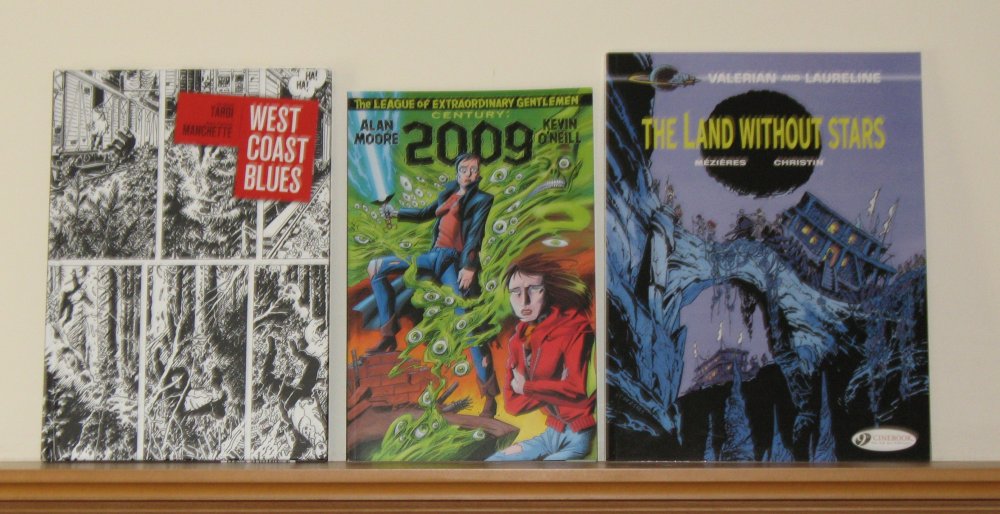
Valerian 3: The Land Without Stars, Mézière & Christin (1972) English slowly catches up with famous French lightweight space opera bande dessinée series.
The Jagged Orbit, John Brunner (1969) Even in 1969, Brunner should have thought twice about this – a near-anarchic over-armed US with voluntary racial segregration; painfully, embarrassingly and datedly hip.
West Coast Blues, Jacques Tardi (2009) Bande dessinée about a man who goes on the run after being mistakenly targetted by hitman; astonishingly nihilistic.
In Great Waters, Kit Whitfield (2009) European history re-imagined with mermen, sort of; a slow start, drags even slower for the first third, then gets moving… and proved actually rather good.
The White Peacock, DH Lawrence (1911) His first novel: structurally weird and the viewpoint lacks rigour, but some lovely prose and it all feels very local to me; will definitely be reading more.
Ison of the Isles, Carolyn Ives Gilman (2012) Read for review in Vector – sequel to Isles of the Forsaken (see here), and not quite the expected story; some excellent bits nonetheless, though the plot feels a little problematical.
Starship Winter, Eric Brown (2012) Third in a quartet of seasonal novellas set on the world of Chalcedony; shenanigans at an art exhibition; the weakest of the three so far.
The Sea, The Sea, Iris Murdoch (1978) Published in 1978, from the characters’ ages would appear to be set in 1968, feels like it was set in 1958; Booker Prize winner, though felt far too long and flabby to me.
Starshadows, Pamela Sargent (1977) Collection of early short fiction with a patronising introduction by Terry Carr; will be reviewed on SF Mistressworks soon.
‘À Propos of Lady Chatterley’s Lover’ & Other Essays, DH Lawrence (1961) English literature’s one true Puritan wibbles on about masturbation (bad), the right sex (good), marriage (sacrosanct!) and obscenity (“moi?”) – he really was a dirty old reactionary…
Griffin’s Egg, Michael Swanwick (1990) Novella about, er, a group of astronauts stranded on the Moon after a nuclear war on Earth – not an inspiration, honest; nor anywhere as good as I’d vaguely remembered it.
For every book you see in these book haul posts, I get rid of two books. So the collection is steadily being reduced to manageable proportions… That is, of course, a complete lie. It’s getting bigger every month. It’s not quite up to hoarder levels yet, but there are piles on the floor. And they reach knee-height.
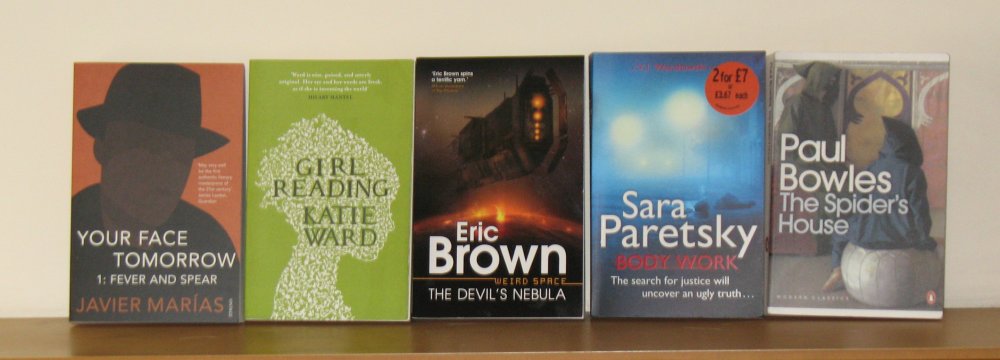
Some paperbacks, new and second-hand. Fever and Spear is, er, May’s book for this year’s reading challenge. I really must get caught up on that. Girl Reading I borrowed from my mother after seeing a positive comment on it on someone’s blog. Eric sent me The Devil’s Nebula; one day I hope to be able to return the favour. I’ve been a fan of Sara Paretsky’s books for many years and Body Work is her latest. I found it in a charity shop. As I did The Spider’s House, though I really must get around to reading The Sheltering Sky first.
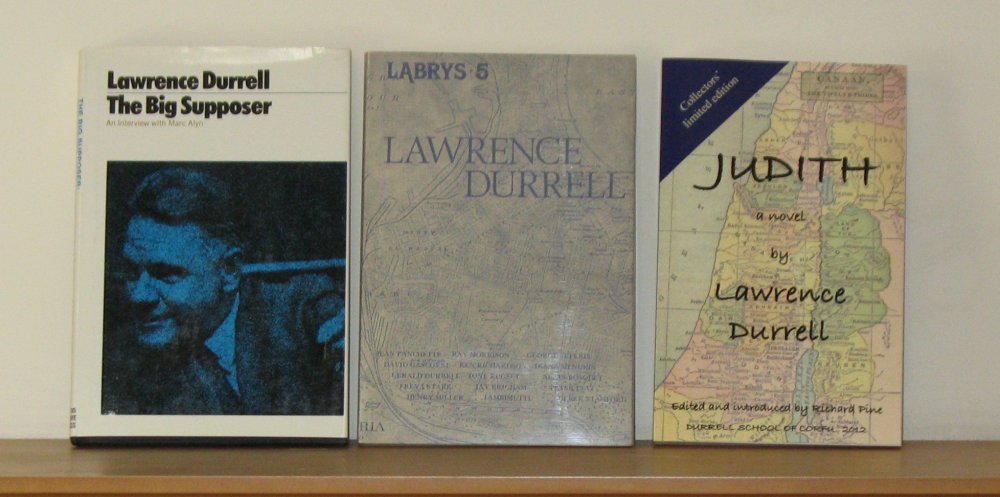
Some more Durrelliana. The Big Supposer is the English translation of a long interview which originally appeared in French. Labrys #5 is a special issue on Durrell. It’s also signed by him. And Judith is a previously-unpublished novel published only this year for the Durrell centenary.
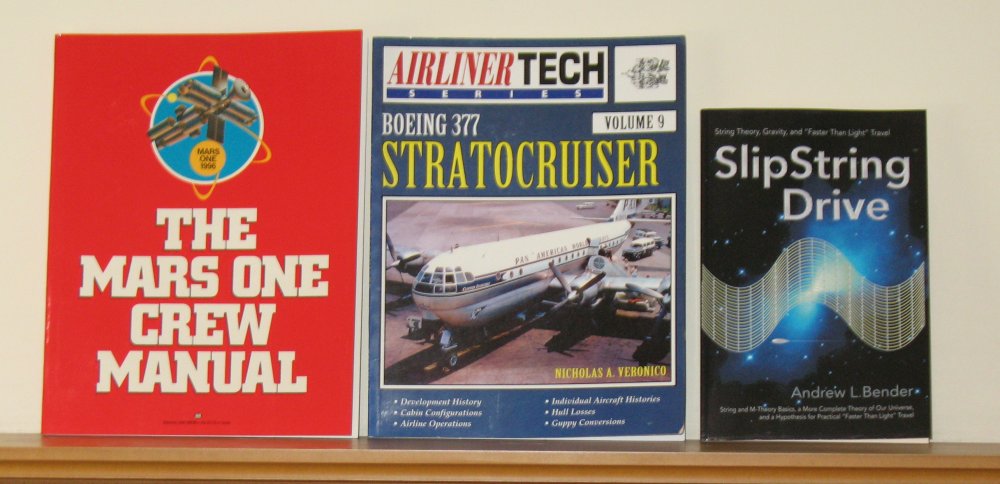
Here’s some research material. Both The Mars One Crew Manual and SlipString Drive are for Apollo Quartet 2: The Eye With Which The Universe Beholds Itself. The Boeing 377 Stratocruiser book is because I’m fascinated by the aircraft of the early days of air travel (it was also cheap on eBay).
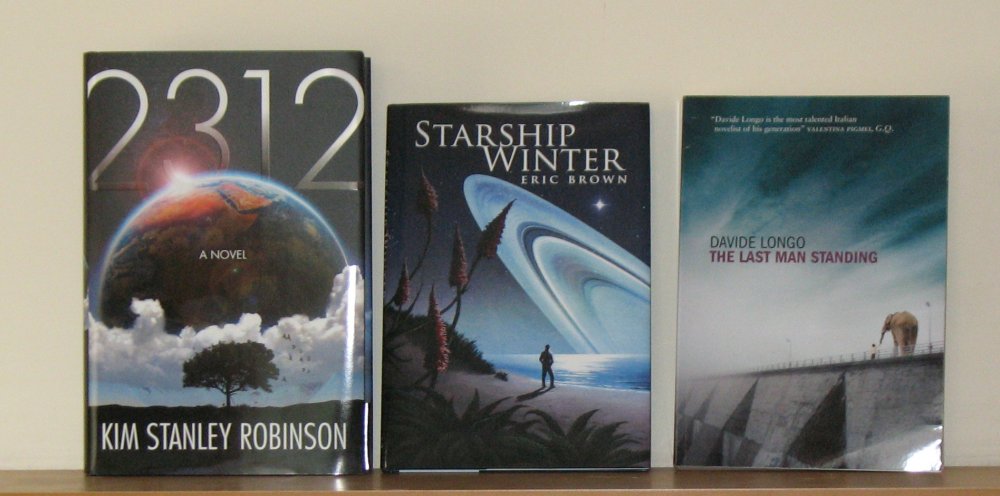
Kim Stanley Robinson is a genre writer whose fiction I admire, so I’m looking forward to reading 2312. Starship Winter is the third of Eric Brown’s seasonal novellas set on the world of Chalcedony. The Last Man Standing is an Italian novel in its first English translation, and I have to review it for Interzone.
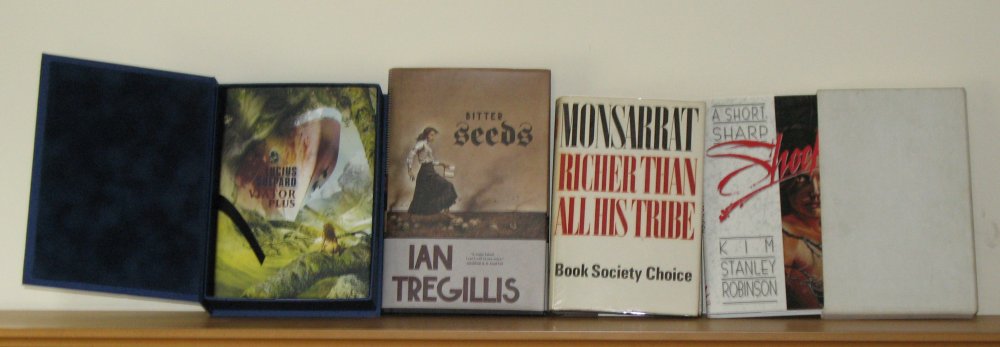
For the collection, here’s the traycased signed edition of Lucius Shepard’s Viator Plus, bought for half-price in their recent sale; Bitter Seeds I won on Twitter for a silly joke (many thanks, Andrew); Richer Than All His Tribe is signed and for the Monsarrat collection; and I found a cheap copy of the slipcased signed edition of Kim Stanley Robinson’s A Short, Sharp Shock.
I took this meme from David Hebblethwaite’s Follow the Thread blog, and he says he found it Story in a Teacup. It’s fifty-five questions about your reading. I think some of my answers are pretty much the same as David’s…
1 Favourite childhood book? I started out in sf reading Dr Who novelisations, but I can remember virtually nothing about them now. I don’t recall any specific books that I loved prior to that. I just read voraciously.
3 What books do you have on request at the library? I don’t use the library.
4 Bad book habit? Buying more books than I can read, and starting books when I haven’t finished the current read.
5 What do you currently have checked out at the library? I don’t use the library.
6 Do you have an e-reader? Nope.
7 Do you prefer to read one book at a time, or several at once? I prefer to read serially, but sometimes – often – I end up reading several books in parallel.
8 Have your reading habits changed since starting a blog? Yes. Since starting SF Mistressworks, and contributing to Daughters of Prometheus, I read far more fiction by women writers. I’ve also used this blog to challenge myself to read books I wouldn’t normally read – see this year’s world fiction reading challenge here.
11 How often do you read out of your comfort zone? Regularly.
12 What is your reading comfort zone? Science fiction and/or literary fiction. Also non-fiction about space exploration.
13 Can you read on the bus? Yes. I commute to work on a tram and read on it every day.
14 Favourite place to read? I usually read for 30 minutes to an hour in bed every night.
15 What is your policy on book lending? For my collectible books, never. Others, I’m happy to give away – and visitors have occasionally left with piles of paperbacks.
16 Do you ever dog-ear books? Never.
17 Do you ever write in the margins of your books? Never. But I will probably buy an ereader of some description soon because it’ll allow me to annotate what I’m reading.
18 Not even with text books? Nope.
19 What is your favourite language to read in? English.
20 What makes you love a book? Beautiful prose, it says something important, engaging characters, interesting structure… rigour, beauty, insight and depth.
21 What will inspire you to recommend a book? I’m happy to recommend books I both enjoy and admire; and often do.
22 Favourite genre? Science fiction.
23 Genre you rarely read (but wish you did)? I’ve read just about every genre there is, but… The genres I don’t read I generally have no intention of reading. Like urban fantasy.
25 Have you ever read a self-help book? No. I’ve no intention of ever doing so.
26 Favourite cookbook? I don’t have one. I prefer eating to cooking.
27 Most inspirational book you’ve read this year (fiction or non-fiction)? I don’t think of books as “inspirational”, or read ones that describe themselves as such.
28 Favorite reading snack? I don’t usually eat while I’m reading.
29 Name a case in which hype ruined your reading experience. Probably The Quantum Thief by Hannu Rajaniemi. It was good, but not as good as I’d expected it to be.
30 How often do you agree with critics about a book? Depends on the critic, obviously. But quite often. Award shortlists, on the other hand…
31 How do you feel about giving bad/negative reviews? Not giving a negative review to a bad book is dishonest. And dishonest reviews are next to useless.
32 If you could read in a foreign language, which language would you choose? I’ve tried reading in French, German and Arabic, and I’d like to improve my facility in those languages. But I also quite like the idea of being able to read Russian classic literature in Russian.
33 Most intimidating book you’ve ever read? In terms of sheer size, probably Ash: A Secret History by Mary Gentle. It proved to be excellent.
34 Most intimidating book you’re too nervous to begin? Possibly House Of Leaves by Mark Z Danielewski. Ian McNiven’s biography of Lawrence Durrell is also intimidatingly big, especially in hardback.
35 Favourite poet? Bernard Spencer or John Jarmain.
36 How many books do you usually have checked out of the library at any given time? I don’t use the library. When I lived in the UAE, I was a member of a subscription library and would generally take out four books every fortnight.
37 How often have you returned books to the library unread? In the UAE, I did it a couple of times. One such book was… The Alexandria Quartet by Lawrence Durrell. I later bought a copy and read it, and subsequently became a huge fan of his writing.
38 Favourite fictional character? I don’t know. There are characters I admire as writerly creations; there are characters who are little more than placeholders for the reader. I prefer the former.
39 Favourite fictional villain? See above.
40 Books I’m most likely to bring on vacation? Big fat ones that require sustained bouts of reading, such as I’ll enjoy on a plane flight or long train journey.
41 The longest I’ve gone without reading. A week, maybe slightly longer.
42 Name a book that you could/would not finish. Most recently, The Windup Girl by Paolo Bacigalupi.
43 What distracts you easily when you’re reading? The television, the internet, the cat…
44 Favourite film adaptation of a novel? It used to be The Right Stuff, but after a recent rewatch I found myself disappointed by the film. Now it would be Fahrenheit 451 – though I love the film but hate the book. Irony in action…
45 Most disappointing film adaptation? The Sylvia Kristal adaptation of DH Lawrence’s Lady Chatterley’s Lover? It’s a bad film and it’s an adaptation. But the same could be said for a lot of sf adaptations… I don’t really know. I rate David Lynch’s Dune as a flawed masterpiece (and I’d have paid good money to see Alejandro Jodorowski’s film of the book had it been made). And Paul Verhoeven’s Starship Troopers is vastly superior to the book…
46 The most money I’ve ever spent in the bookstore at one time? No idea. I’ve spent around £100 on a single order at Amazon a number of times. The most money I’ve spent on a single book is $500, for a first edition of Pied Piper of Lovers, Lawrence Durrell’s first novel. See here.
47 How often do you skim a book before reading it? Very rarely.
48 What would cause you to stop reading a book halfway through? Blatant racism and/or sexism. Offensive sensibilities. Eye-stabbingly bad prose. An inability to plot. Despicable characters.
49. Do you like to keep your books organized? Yes, though the collection is getting a little bit out of hand…
50 Do you prefer to keep books or give them away once you’ve read them? Depends. Collectibles I keep. Likewise books that were hard to find. Others I get rid of as soon as I’ve read them. I’ve also purged my book shelves several times – for example, I saw no good reason to keep the Stainless Steel Rat novels I originally bought back in the early 1980s…
51 Are there any books you’ve been avoiding? Urban fantasy novels. Anything with zombies in it. Many of the books that have appeared on recent Hugo Award shortlists…
52 Name a book that made you angry.Leviathan Wakes by James SA Corey. See my review here.
53 A book you didn’t expect to like but did?Lady Chatterley’s Lover, DH Lawrence. My father was a big fan of Lawrence’s writing, but I never bothered trying any of his books. And this despite Lawrence Durrell being a big admirer of Lawrence. But after watching Pascale Ferran’s excellent adaptation, Lady Chatterley, in 2009, I decided to have a go at the book. And loved it. After my father died, I promised myself I would read all of Lawrence’s fiction, and recently finished The White Peacock. Structurally it’s a bit odd, but there’s some lovely prose in it. And it is sort of “local” fiction for me as I was born in Nottinghamshire. I am now becoming a bit of a Lawrence fan.
54 A book that you expected to like but didn’t?Bodies by Jed Mercurio. I loved his Ascent, and thought American Adulterer very good indeed. But Bodies was just too gruesome for me.
I don’t write about music very often on this blog, but given that my tastes in that field are just as fringe as they are in literature perhaps that’s no surprise. (Mind you, there probably is a small overlap between science fiction readers and death metal fans – certainly I know a handful of people who qualify as both.) But another reason is that, as the late great Frank Zappa once said, “writing about music is like dancing about architecture”. And it’s only recently that I’ve starting buying books on architecture – well, books of photographs of Brutalist and Modernist buildings, and those designed by, for example, Oscar Niemeyer…
Anyway, on my way home from the Gojira gig earlier this week, I challenged a friend to come up with a list of ten essential metal albums. He’ll post his on The Mix Eclectic. We didn’t bother to define “essential”, but agreed only that we were allowed five additional “honourable mentions”. At the time I issued the challenge, I thought it would be quite easy… but, of course, such things never are. There were a few obvious picks, and they, in turn, defined what “essential” meant to me as regards this list. It means albums I always return to, ones I play again and again, even years after I bought them. They’re not necessarily seminal in their chosen genre, they’re not especially important albums in the progression of metal (death or otherwise). They’re just albums I love.
And the list goes like this…
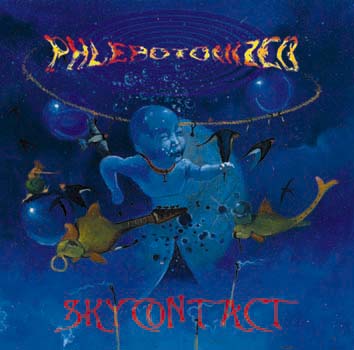
Skycontact, Phlebotomized (1997, Netherlands) Phlebotomized were a short-lived band during the Netherlands’ brief flowering of great death metal talent in the 1990s. They recorded a pair of EPs and a pair of albums. Skycontact was their second and last album. Their CDs now go for silly money on eBay. Skycontact is elegiac, mournful, and yet quite beautiful at times. There’s even a violin in it. ‘A Cry in July’ is an especially stand-out track.
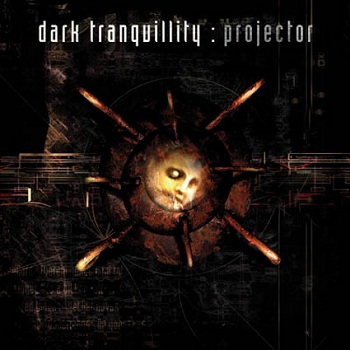
Projector, Dark Tranquillity (1999, Sweden) This is the album that introduced me to Dark Tranquillity, and made me a fan of the group. It’s perhaps their most commercial album, and certainly it shows the breadth of their music – from the crunching riffs of the opening track ‘FreeCard’ to the synth-heavy ‘Day to End’ to the near-ballad ‘Auctioned’. Despite the somewhat mordant tone to the lyrics, Projector is an album that never fails to put me in a good mood. To date, I’ve seen Dark Tranquillity perform live four times, and it’s about bloody time they toured the UK again.
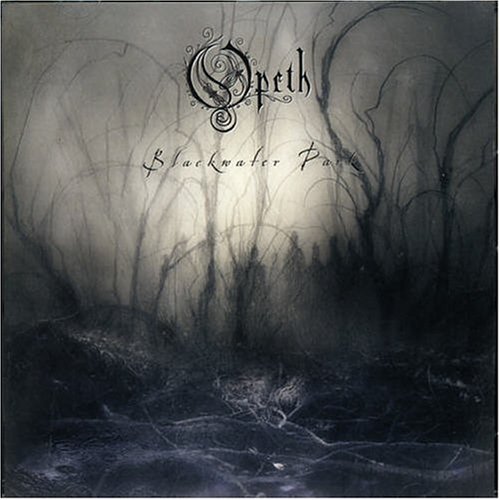
Blackwater Park, Opeth (2001, Sweden) This may well be the high-water mark for Opeth. It’s the first album by them I bought and I still consider it their best. The preceding album, Still Life, is excellent, but its songs don’t quite gel in the way Blackwater Park‘s do. This album has the perfect mix of Opeth’s trademark complex heaviness and acoustic interludes. The title track alone is a work of genius. I’ve seen Opeth live four times to date, and will be seeing them again later this year. They usually put on a damn good show.
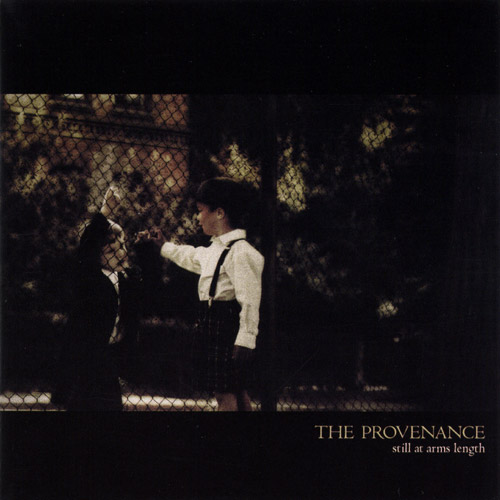
Still At Arms Length, The Provenance (2002, Sweden) The Provenance disbanded in 2006 after four albums. Still At Arms Length was their second. It’s a hard-to-describe mix of death, gothic, doom and progressive metal. With a flute. Like some other Scandinavian metal bands, vocals were shared between male and female, with the male vocals often sung as growls. But there’s something about The Provenance’s songs which lift them above others of their ilk. They were more experimental – in their sound and their song structures – than their peers. And like all the best death metal bands, they could play a mean and heavy riff. I regret never getting to see them perform live.
Worlds Beyond the Veil, Mithras (2003, UK) I forget where I first heard Mithras, but I remember being immediately captivated by the combination of spacey ambient synth and furiously insane guitar and drumming. They’re probably the most science-fictional death metal I’ve ever heard – or rather, there’s something about their music which speaks to me of the best of science fiction. Which is probably why I used the lyrics to this album in a short story – originally published in Jupiter magazine, but also posted on my blog here. I’ve seen Mithras live twice – the first time at the Day of Unrest mini-festival in 2008 at the Purple Turtle in Camden; and I remember being exhausted after their set just from listening to the music. They have a new album due out later this year, On Strange Loops; and I’m very much looking forward to it.
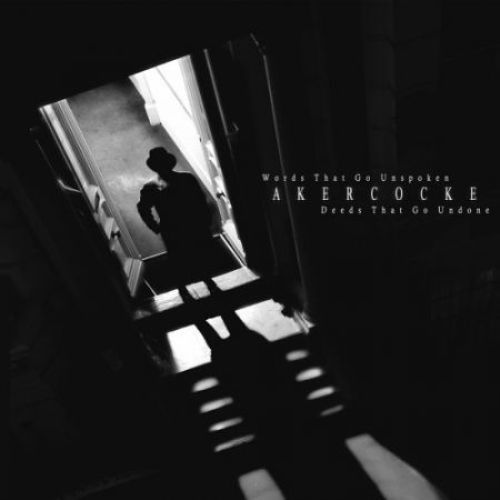
Words That Go Unspoken, Deeds That Go Undone, Akercocke (2005, UK) I first came across Akercocke in 2005, when they supported Opeth at the Forum in London. I vaguely recall being impressed by the sheer noise they made, and the fact that they all wore suit and tie on stage. (They were sometimes called “Satan’s bankers” because of their stage attire.) However, it wasn’t until I saw them perform in the small room at the Corporation, supporting their Antichrist album, that I became a fan. I saw them once more before they split up. Words That Go Unspoken, Deeds That Go Undone is my favourite of their albums (and has a great title, too), with its abrupt changes from furious blackened death metal to slow and mournful acoustic parts. The opener ‘Verdelet’ is probably my favourite Akercocke track, too.
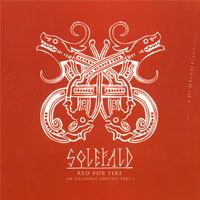
Red for Fire + Black for Death, Solefald (2005/2006, Norway) This one is a bit of a cheat as it was released as two albums, though the band wrote it as a single project. It is based on an Icelandic edda about Bragi, a court poet who dallies with the queen but is forced to flee when it is discovered. The album is a mix of post-black metal, Icelandic poetry, and even some jazz fusion. It’s the sheer variety that appeals as much as the individual songs.
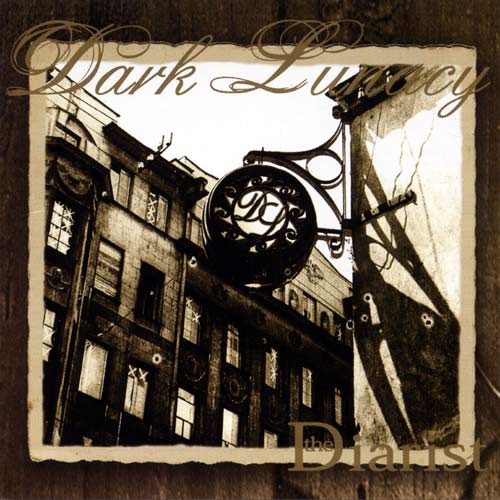
The Diarist, Dark Lunacy (2006, Italy) Metal is well-suited to concept albums, and this is true of death metal as much as any other branch of the genre. The diarist of the title is a woman trapped in Stalingrad during the siege by the Nazis. The tracks successfully evoke the time and place, though without losing sight of its musical genre. There’s an epic quality to Dark Lunacy’s music which I think this album showcases especially well. I have never seen the band live but I would very much like to.
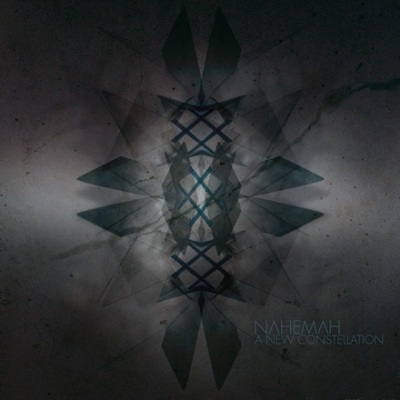
A New Constellation, NahemaH (2009, Spain) I was tricked into buying a NahemaH album. The label had put a sticker on the cover of the band’s second album, The Second Philosophy, which likened it to Opeth. Thinking that might appeal, I bought it. And listened to it. And discovered it was nothing like Opeth. But I hung onto the CD because I suspected it might be a grower. And so it proved. Within a few months I was listening to it constantly. And everything that was good, and that appealed to me, about The Second Philosophy is just more so in A New Constellation. It’s a death metal / prog metal wall of sound, accomplished and complex. I really want to see NahemaH live.
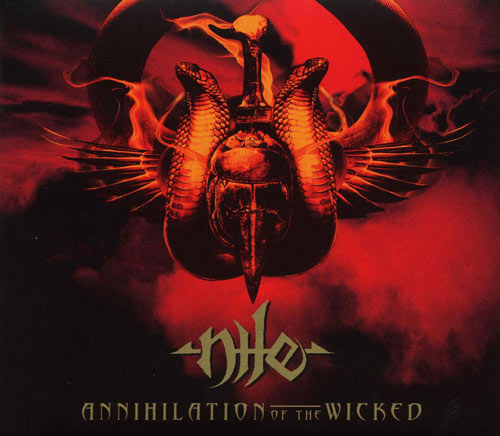
Annihilation of the Wicked, Nile (2005, US) I wanted Nile to be in this list of ten, but I couldn’t think which album to pick. In the end, I plumped for this one because it best displays their fusion of Ancient Egyptian themes and relentless US death metal. It’s like exploring the pyramids while suffering from a heart attack. The track ‘The Burning Pits of Duat’ allegedly features drumming at 320 bpm. Which is astonishing. Nile are a fixture on the death metal scene, and for good reason. I’ll get to see them for the first time at this year’s Bloodstock festival.
For my five honourable mentions, I picked:
Reflections of the I, Winds (2002, Norway) A mix of classical music and progressive metal by a side-project of four members of other metal bands.
Mabool, Orphaned Land (2004, Israel) Death metal, prog metal and Middle Eastern music in a concept album about the Flood.
Shin-Ken, Persefone (2009, Andorra) A polished mix of death metal and progressive metal from Andorra’s finest musical export. It’s a concept album too.
Leviathan, Mastodon (2004, US) Another mix of metal subgenres, and another concept album. There seems to be a pattern here…
Sowberry Hagan, Ultraphallus (2011, Belgium) It should sound like sheer noise, but it doesn’t. An astonishing musical balancing act.
There were so many other albums I wanted to pick, like As Night Conquers Day, Autumn Leaves (1999, Denmark), wihch is a favourite album, or something by Anathema (but I couldn’t think which of their albums was especially typical), or Themes, Silent Stream of Godless Elegy (2000, Czech Republic), which provides an excellent sample of their sound but does include a couple of duff tracks…
Brain Thief, Alexander Jablokov
(2010 Tor, $24.99, 383pp)
In recent years, a number of literary authors have dipped their toes in the waters of science fiction. However, their lack of confidence, or inexperience, in deploying sf tropes often gives such attempts an air of diffidence, which in turn gives the novels an old-fashioned feel. This is because sf is a mode of storytelling, it is not just the garden in which its stories play. The reverse, science fiction authors writing mainstream fiction, is less common. But when science fiction authors write non-sf, it is never really not science fiction. Brain Thief, Alexander Jablokov’s new novel, is a case in point. It is science fiction lite; it presents its mystery credentials with greater authority than it does its science fiction credentials. But it is still at heart a story told in science fiction mode.
Brain Thief is Jablokov’s first novel after a ten-year hiatus. When a pop singer or rock star disappears for a decade, they’re retrenching, or “charging their creative batteries”, and there’s an expectation their new material will be a significant improvement over their last. When a writer – especially a genre writer – vanishes for ten years, it’s usually because real life has intervened. And so it was with Alexander Jablokov, whose previous novel, Deepdrive, was published in 1998. Jablokov has made no secret of that fact that he stopped writing novels “to raise a family and make a living”.
If there’s a fear attached to the return to writing of novelists after a lengthy period, it’s that they’ve failed to keep progress with their chosen genre and their new book reads like one that could have been written before they dropped from sight. Admittedly, Jablokov had shown a wide facility within the genre, from knowing interplanetary adventure to cyberpunk to new space opera. Happily, Brain Thief is very much a late noughties sf novel and – if this doesn’t sound too much like jacket copy – is almost the novel Bruce Sterling might have written if he hadn’t written The Caryatids.
While there are clear likenesses to Sterling’s fiction, Jablokov does not spin off ideas with the same frequency or outrageousness. Nor does he need to – Brain Thief is, after all, not a science fictional novel, but a mystery novel told in science fiction mode. Initially, this collision of modes makes for an annoying read – in science fiction, there is a world to be laid out before the reader; in a mystery novel, much has to be withheld. So while Jablokov happily explains the world of his story, he’s less open about the plot which drives it.
Bernal Haydon-Rumi is personal assistant to Muriel Inglis, a wealthy widow who finances oddball projects. One of these projects is Hesketh, an AI-controlled interplanetary probe under development by lone researcher Madeline Ungaro. On his return from a business trip, Bernal discovers that both Muriel and Hesketh have disappeared. And their disappearances are linked. He finds himself following a trail of clues – some generated by Muriel herself, some discovered on his own. Both disappearances, of course, have a single solution – not only the nature of the Artificial Intelligence which drives Hesketh, but also the one thread which binds all the characters into a single narrative.
Brain Thief is populated with a well-drawn, entertaining cast of characters. Bernal himself might be a tabula rasa, as is required by the story, but the rest might well populate an oddball comedy-drama set somewhere in one the USA’s more oddball corners. This is not a criticism – Brain Thief‘s characters are one of its strengths. Another is its writing. Its biggest strength is perhaps the fact that it isn’t trying to be a science fiction novel and a mystery novel. The sf permeates the mystery story, it’s not continually fighting it for dominance. Which means the resolution satisifies because it doesn’t need to do more than resolve the story. Jablokov has judged his plot, and integrated his world, to a nicety.
I wouldn’t surprised to see Brain Thief on a few shortlists in 2011.
This review originally appeared in Interzone #226, January – February 2010.
(Yet more evidence that sf awards are completely out of touch, irrelevant and no longer serve a useful purpose – Brain Thief, an excellent novel, appeared on only the Locus SF Novel list (as 16th of 18 titles). The big winner in 2011 was the bloated monstrosity that is Connie Willis’ Blackout/All Clear. Why bother, eh?)
There were two chief reasons why I self-published the first book of the Apollo Quartet, Adrift on the Sea of Rains: timing and control. I wanted to launch it on the back of Rocket Science at the Eastercon this year, and only by doing it myself would I make that deadline. I also took some chances with the book that most self-respecting editors would have baulked at: not using speech marks for dialogue, writing the flashback sequences in long discursive passages in italics, and using a list of abbreviations and an extensive glossary. I could have just formatted the book for Kindle, and loaded it up onto Amazon. Which is what a lot of self-published authors do. But – if only for my own self-respect – I decided that if I was going to self-publish I was going to do it properly: paperbacks, hardbacks, ISBNs, a proper small press…
And that’s what I did.
To be honest, the hardest part was writing the book. Typesetting it and getting it printed were not difficult. Likewise buying ISBNs. Or setting up the online shop. The launch at Eastercon went well, and I sold a good number of copies – and not just to people who knew me, or who had read other fiction I’d written (sadly, the latter number is lower than the former). And yes, I did have to do a bit of a “hard sell” at times.
But once the Eastercon was over, and I was back home, the really hard part began. They say the average self-published book sells less than a hundred copies, and those are mostly to family and friends. I’d gone past that number by selling my book at Eastercon and alt.fiction. But if I wanted sales to continue to grow, I needed to make them online. My next priority might well be writing book two of the Apollo Quartet – the working title is currently The Eye With Which The Universe Beholds Itself – but I also needed to work on promoting Adrift on the Sea of Rains.
And having now spent two months trying to do that, I’ve learnt a few home truths:
1. breaking out of your community is hard
There are about a dozen reviews of Adrift on the Sea of Rains online. Quite a few were done by friends of mine. I value their opinions, so the fact they thought the book good makes me happy. Some of the reviews were done by people unknown to me. But if I want to sell more copies of Adrift on the Sea of Rains, I need more of the latter than the former. I need people who have never heard of me to buy copies of the book. Reaching them is hard – they have no reason to listen to me. I’m an unknown quantity. I don’t even have the benefit of a known imprint on the spine of my book -ie, a logo which indicates a history of publishing science fiction a buyer knows they like.
2. there is no secret place online which will lead to sales
I have started threads promoting Adrift on the Sea of Rains on a handful of forums. I’ve watched the number of views of those threads climb up into the hundreds, but only a few people have actually posted comments. Even less have actually followed the links and purchased a copy. Again, it comes down to being an unknown. I’ve been a member of some forums for several years; people there know me. On others, I’m pretty much a drive-by spammer. People in the former situation are more forgiving of my promotional posts; but in neither case has it proven especially effective at generating sales.
3. quality is immaterial
I made sure Adrift on the Sea of Rains was a quality product – a well-made paperback and hardback, with striking cover art, and properly-edited text. None of that is obvious online. The same is true for the quality of the writing. Amazon provides a preview for the Kindle edition, but is that really enough to get an idea of how good the book is? You read the previews for some self-published authors, and the prose is semi-literate. Yet they seem to sell hundreds of copies a day. I suspect it’s the number of books such writers have available which is the chief factor in driving sales.
4. promoting your book will often lead to you defending your choice to self-publish
The fact that I chose to self-publish Adrift on the Sea of Rains will damn it in many people’s eyes. It’s true the vast majority of self-published titles are complete rubbish – even the successful ones. People will choose to believe I self-published because my story wasn’t good enough for a commercial publisher. (For some reason, small presses never seem to factor into this argument.) I could have pretended Whippleshield Books was not my press, and created some separate online identity to promote it. But that’s a lot of trouble to go to for a lie that would be quickly seen through. I’m operating an open submissions policy for Whippleshield Books, so it’s not a true self-publishing venture, it’s not solely for my books. But that’s a distinction many critics of self-published books consider irrelevant.
5. the internet allows you see how badly you’re failing in real-time
If you publish for Kindle, the Kindle Direct Publishing website displays how many copies you’ve sold on a monthly basis. Other sites, like goodreads.com or librarything.com, tell you how many people on those sites own copies of your book, or have seen fit to review it or comment on it. Very few casual readers will bother to write a short review of a book they’ve read. And when the number of readers is still in double-figures… Unsurprisingly, it can be very disheartening.
I came up with the idea for the Apollo Quartet partly because I’m a big fan of Lawrence Durrell’s Alexandria Quartet and partly because I had a couple of ideas for stories which I felt could be thematically linked (a third has changed greatly to fit into the quartet, and another was entirely replaced). I’m hoping that the appearance of each book will increase sales of the preceding volumes. And if, as some of the reviews have stated, Adrift on the Sea of Rains is good enough to appear on an award shortlist or two (providing people remember to nominate it, of course), then that too can only help.
None of this, however, alters the fact that Adrift on the Sea of Rains is a self-published book, a fact which will be seen to define it far more than its story or the quality of its prose. And while I can bemoan that, I can understand why it happens. Because, bar very rare exceptions, self-published books are typically pretty damn poor. Evangelists for so-called “indie” publishing may get all offended when this is pointed out – no, they’re not the future; yes, ignoring self-published books is entirely reasonable – but I’m not interested in promoting the means I used to get Adrift on the Sea of Rains out into the market, I’m interested in promoting my book. I may have self-published it, but that doesn’t mean I automatically support every self-published author on the planet. Nor am I convinced it is the best way to publish a book, or the only way which is economically sustainable in the mid-term. I support those books and authors I like and admire, irrespective of how their books were published.
This weekend, I’ve been working on the second book of the Apollo Quartet, which will now be titled The Eye With Which The Universe Beholds Itself. It’s a line from the final verse of Percy Bysshe Shelley’s ‘Hymn of Apollo’ (1824):
VI. I am the eye with which the Universe
Beholds itself and knows itself divine;
All harmony of instrument or verse,
All prophecy, all medicine is mine,
All light of art or nature;—to my song
Victory and praise in its own right belong.
Not only does the poem title link to the quartet title, but the quote I’ve used also sort of explains the plot.
Apollo Quartet Book 2 is partly about a colony on an exoplanet… and in my researches, I discovered that Apollo is the god of colonisation. Which is a pleasing link.
But, even better – the story requires a form of faster-than-light travel, and for reasons I no longer remember, I decided that the story’s FTL spacecraft were actually repurposed asteroids. This was because they needed an “anchoring mass” of – and I plucked this figure completely out of thin air – five gigatonnes. So I went googling for real asteroids with masses in the region of 5 x 10¹² kg. And the first one I found was… 1862 Apollo.
Let’s be reductive and say science fiction refers only to those subgenres which occupy what is generally considered the genre’s heartland – hard sf, space opera, soft sf, first landing, first contact, military sf, etc. Let’s call all the rest “speculative fiction”, a term I dislike, but since they seem not to bother with the science aspect it is perhaps more appropriate.
Let’s say there are two types of science fiction as defined above. There is the type of science fiction that appeals to people who would happily read supplements for a role-playing game. And there is the type for people who would prefer to read a physics text, or a book about the engineering involved in building the Saturn V. Both types, at heart, operate by adjusting a reader’s sense of scale and turning that which cannot be conceived into something which can. Or vice versa. For example…
Credit: ESA/NASA/JPL/University of Arizona
Look at the photograph above. That’s the surface of Titan, a moon of Saturn. The photo was taken by Cassini-Huygens, a space probe which launched in 1997, and the Huygens part of which descended to Titan’s surface in 2005. Saturn orbits between 1.3 billion and 1.5 billion kilometres from the Sun. Earth orbits between 147 million and 152 million kilometres from the Sun. If you could travel to Titan in a straight line (which you can’t), it’d be a journey of around 1.2 billion kilometres… That’s equivalent to flying from London to New York and back over 108,000 times, or 6.5 million circuits of the M25 (at an average speed of 120 kph, that would take you about 1,150 years).
Numbers. They define our world – what we can directly see and experience, and what we can’t see or experience. As those numbers increase in size, so our sense of place in our world is increasingly diminished. Using science we can investigate, and gain an intellectual understanding of, this feeling of diminution. Science fiction, however, postulates situations in which we can experience it directly. It also gifts us with agency in this new world being explored. It is a visceral, albeit vicarious, manifestation of what science can show us.
Science fiction is scale, its uses and abuses. It can take something huge and beyond direct human experience, and by giving it the purpose of something within the reader’s real-world frame of reference, render it unfamiliar:
Planets. Seven of them. Armed and powered as only a planet can be armed and powered; with fixed-mount weapons impossible of mounting upon a lesser mobile base, with fixed-mount intakes and generators which only planetary resources could excite or feed. (p 40, Second Stage Lensman, EE ‘Doc’ Smith (1953))
It can directly manipulate the human frame of reference, and make of it something which would otherwise be strange and impossible to fathom:
It was not clear what had happened to the man for the next million years or so. One line of argument held that he had expanded himself to encompass a massive swathe of galactic space – swallowing hundreds of thousands of systems, across thousands of lights. (p 239, House of Suns, Alastair Reynolds (2008))
Or, it can simply map parts of the real world we cannot experience, and allow us to compare the scale of our frame of reference with that being described:
It took an effort to remember that the distance to the horizon was more than ten times that on Earth. That the storm was two thousand kilometres across. That the sky was hydrogen and helium a thousand kilometres deep, with cloud layers of ammonium ice above and decks of ammonium hydrosulphide and ammonium-rich water-ice and water-droplet clouds below, endlessly blowing around this vast world. (p 215, The Quiet War, Paul McAuley (2008))
There are a number of rhetorical tools and literary devices science fiction uses to manipulate scale and the reader’s perception of it. Analogy is a particularly common one – by directly referencing something known, and of a size encompassable by the reader’s mind, the sf text can make manageable the scale of something normally beyond comprehension. This is not always a good thing, as it can have a trivialising effect.
There is a great deal of implication in the findings of science. The photograph earlier in this post does not in and of itself present a particularly impressive-looking picture. It’s a stretch of orange ground littered with pebbles. But it’s on Titan. Which means… the launch of the space probe, the journey there, the distance the probe travelled, the mechanisms which comprise the probe and the science behind them, the descent into Titan’s atmosphere, Titan’s surface conditions… the real and true fact that it is an alien world.
Science fiction not only gives us the orange photograph, but it also shows us how it was achieved. It makes explicit the wonder. And since wonder is central to science fiction, then to define wonder is to define science fiction:
…where: W = wonder lg = greatest distance mentioned in the text tg = greatest length of time mentioned in the text Nn = number of ideas/nova in the text Nf = number of ideas/nova reader has encountered previously ir = closeness of the viewpoint character to the reader as a function of background, worldview, attitudes, etc – ie, an indicator of their ability to identify with the character jn = number of situations of jeopardy for point-of-view character(s) ja = amplitude of situations of jeopardy for point-of-view character(s), where 1 is fatal Cn = size of cast in the text Br = bandwidth of the reader (calculated from educational level, number of books read, age) Dr = willingness of the reader to suspend disbelief
From DH Lawrence’s ‘Pornography and Obscenity’, first published in 1929:
The only positive effect of masturbation is that it seems to release a certain mental energy, in some people. But it is mental energy which manifests itself always in the same way, in a vicious circle of analysis and impotent criticism, or else a vicious circle of false and easy sympathy, sentimentalities.
So, if you hate a book, you’re wanker. And if you like a book, you’re a wanker. Sounds about right to me…
 The New Space Opera 2, Gardner Dozois and Jonathan Strahan, eds.