It Doesn't Have To Be Right…

… it just has to sound plausible


12 Comments

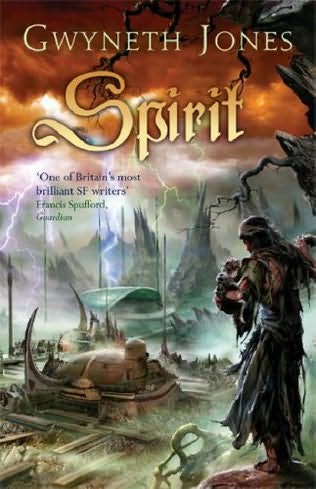
Beyond the Bounds of Vengeance – Spirit by Gwyneth Jones

To date, Gwyneth Jones has appeared on the Arthur C Clarke Award short list six times, and won it once – for Bold As Love in 2002. Only Stephen Baxter has been nominated more times, and he has yet to win the award. If Jones’ 2004 novel Life had been published in the UK, I suspect it too would have been short-listed – it did, after all, win the Philip K Dick Award for that year. As David Soyka wrote in his review of the book on on sfsite.com:

Simply, put, Life is one of the best things Jones has written. You can stop reading right now and go out and buy the book. Otherwise, you’ll have to endure yet another one of these diatribes about how science fiction doesn’t get any respect from the literary mainstream. Because you can’t read this book and not reflect on the fact that had this been written by, say, Margaret Atwood, Life would be receiving more of the widespread attention it deserves.

In other words, Gwyneth Jones is probably one of the best British science fiction writers currently being published. So a new novel by her is certain to be one worth reading. Spirit; or the Princess of Bois Dormant is her latest. It was published at the end of December 2008.
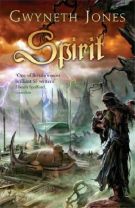
The plot of Spirit is based on that of The Count of Monte Cristo, but it shares its universe with the Aleutian trilogy of White Queen, North Wind and Phoenix Café. The universe has also featured in a number of Jones’ short stories, including ‘Saving Tiamaat’ in The New Space Opera (it can be read here); and ‘The Tomb Wife’, which has just been shortlisted for this year’s Nebula Award (it can be read here).

The shape of Dumas’ story is well-known: Dantès is falsely accused of treason, sentenced to life imprisonment in the Chateau d’If, befriended by a fellow prisoner who teaches him all manner of useful skills and knowledge, escapes, sets himself up in society using treasure whose location was given to him by his friend in prison… and subsequently has his revenge on those who conspired to send him to prison in the first place.

And Spirit does, in broad aspect, follow this. The novel’s protagonist is also unjustly imprisoned for twenty years, is educated while in prison, escapes and uses the “fortune” she was bequeathed by her mentor inside to… Not revenge, but neither is it justice. Call it a “balancing”.

Of course, Spirit is space opera – new space opera, in fact. The conspiracy which puts Dantès in prison was historical and reasonably well-known by readers. The conspiracy underlying Spirit is wholly invented; the world in which Spirit takes place is wholly invented. Which means the narrative of Jones’ protagonist – Gwibiwr; quickly shortened to Bibi – must begin much earlier than that of Dantès. It must give her origin, in fact. And the conspiracy which results in Bibi’s imprisonment must also be set up. It is not until halfway through Spirit that Bibi is actually sent to prison. This is not a criticism – Spirit is not about Bibi’s revenge, it is about Bibi. She is “the Princess of Bois Dormant”.

In the Aleutian trilogy, aliens arrived on Earth and precipitated a crisis. This led to the Gender Wars and, eventually, a World Republic. In Spirit, Jones has expanded this universe into an interstellar Hegemony of five worlds, ruled from a space station in the Kuiper Belt called Speranza. Each of the five worlds is the home of an “alien” race, although there is sufficient biological commonality between the various races to suggest Earth as a common home world in the ancient past. This is known as “having your cake and eating it”. A major theme of the Aleutian trilogy was colonialism, and Earth was the colonised; but in Spirit the humans – or “Blues”, as Earth is known as the Blue Planet – are the colonisers. The Hegemony also allows Jones to spread her commentary on gender and gender roles across societies that are very much other.

And there is plenty of cake to eat in Spirit. Not a Black Forest gateau or the like, not some fancy confection covered whipped cream and chocolate shavings. But a strong English fruitcake, steeped in brandy. Perhaps that’s too silly a conceit. Certainly Spirit contains plenty to chew on, not just the themes carried over from the Aleutian trilogy.

Admittedly, those themes strongly season the book, making Spirit very much a thematic sequel to Phoenix Café. But there are other ingredients: the opening section, in which Bibi grows up in semi-feudal Baykonur, has a flavour of Frank Herbert’s Dune. The sudden decamp to Speranza, and the explanation of the workings of the Hegemony’s interstellar transit network, contains pieces of Frederik Pohl’s Gateway. When Bibi is on Sigurt’s World as part of a diplomatic mission, and it all goes horribly wrong, Spirit tastes almost Banksian. And there’s a soupçon of Samuel Delany in the section set on Ki/An.

Also present are small nuggets of Jones’ earlier works: Escape Plans – the distributed systems of that book have become virtual, or 4-Space; and Kairos – travel via Buonarotti transit-pod mimics in some respects the effects of that novel’s eponymous drug.

All this is mixed in with The Count of Monte Cristo. And layered with new space opera as a mode of science fiction.

It makes for a rich and complex story; a story which, no matter how well stirred, can sometimes overwhelm the palate. As each new flavour or tang rises to the surface, so the focus of the story shifts. Bibi is not always there. At one point, for example, the story breaks away from her, simply so we can experience her ex-boyfriend laying another brick in the conspiracy which will condemn her. And in the final section of the book, the Princess of Bois Dormant has taken Bibi’s place entirely.

It is in fact that last section where Spirit becomes less the dish of its ingredients. Dumas serves this dish cold, but Jones is less focused on revenge. The Princess of Bois Dormant sets out to redress the wrongs done to her, but also to right the wrongs done to those who suffered because of her. Chief among the latter is her son, a prince of Sigurt’s World. This leads to an odd detour, following the prince’s holiday on Ki/An, his trip into the marshes, and his kidnap. Later on Speranza, the prince and his companion help rescue a pair of young women from the Traditionalist roles their family intend them to play. Both women are the daughters of Bibi’s enemies. Those enemies, of course, get their compeuppance, although Bibi seems to have little to do with it. One has a stroke, another is killed while trying to escape. It all seems a bit… incidental.

Not everything in Spirit works. I don’t understand Jones’ decision to pepper the names of the natives of Sigurt’s World with apostrophes, such as her alien prince D”ffyd. If it’s a joke, it soon wears thin. The many references to the French Revolution also seem to add little – despite the novel’s template, The Count of Monte Cristo; despite the novel’s title, Spirit, also referring to the Princess’s Aleutian transit-pod, Spirit of Eighty-Nine (1789, that is). And speaking of French… Sleeping Beauty in French is known as La Belle au Bois Dormant. Perhaps my French isn’t as good as it should be, but I thought the dormant (sleeping) referred to the belle (beauty) and not the bois (wood). La Princesse au Bois Dormant makes much more sense. And is especially ironic as the Interplanetary Prison Moon of Fenmu is a rocky inhospitable place, and Bibi spends twenty years there underground…

Spirit is an excellent novel. I’d have expected no less of Gwyneth Jones. I fully expect it to appear in my best novels of the year list for 2009. However, I suspect Spirit will not be on the short list for the Arthur C Clarke Award next year. It is too rich and complex a novel, and the Clarke seems to prefer works of a much stronger and more distinctive flavour. But I do think it will be on the BSFA Award short list – literate sf novels by British authors do well with the BSFA Award. And so they should.

Incidentally, 2009 should prove a good year for Jones. Spirit may have been published right at the end of 2008, but due during 2009 are a short-fiction collection from PS Publishing, Grazing the Long Acre; and a “Conversation Piece”, The Buonarotti Quartet, and a non-fiction collection, Imagination/Space, both from Aqueduct Press.

(Ah well. The cake-thing seemed like a good idea at the time. But never mind…)


Leave a comment

This Blog and Books…

When I started this blog back in November 2006, it was never intended to be a review blog. I still don’t plan for it to become one. I already review books for Interzone, and I’ve no desire to write a review of every book I read.

But. I have posted book reviews here. There are my annual reading challenges, of course. Others are of books I really like, or books I think are important. One or two have been reviews I wrote years ago, and I’ve posted them here because I thought people might like to read them. I might dig out some more of them.

And I’ll continue to do that. I’m currently working on a post on Gwyneth Jones’ latest novel, Spirit; or the Princess of Bois Dormant. Next month I’m going to work my way through L Timmel Duchamp’s Marq’ssan Cycle, and I’ll be writing about those – a single post on all five books, rather than one per book, I think. I’d like to do the same for Doris Lessing’s Canopus in Argos Archives, but that’ll have to wait until much later in the year.

Christopher Evans’ Omega will likely be worth a post, as will Lewis Shiner’s Black & White. Then there’s Lawrence Durrell’s second novel, Panic Spring, originally published under the name Charles Norden. And, from the sublime to the, er, slightly ridiculous, there’s Child of Earth by EC Tubb, the recently published 33rd and perhaps final book in the long-running Dumarest Saga.

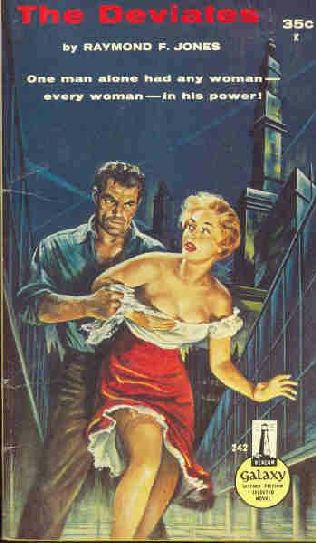
I’d also like to write about the Beacon Books I’ve managed to collect – but I read during my commute to work and, given their cover art, I’d be too embarrassed to read them on the tram. But we’ll see.

And, of course, whatever other books I read which inspire to me write something about them.

As a reminder, here are the books I’ve written about on this blog to date, in alphabetical order by author. It doesn’t include my annual reading challenge posts. Click on the title to go to the review.


3 Comments

From Page to Screen

There has been some discussion of late in the blogosphere about film adaptations of science fiction novels. Everyone has a favourite they’d like to see on the silver screen, but it’s a process that usually results in failures. After all, how many good, faithful film adaptations of sf novels are there?

David Lynch’s version of Frank Herbert’s Dune was a bit of a mess. Stanisław Lem wasn’t happy with Andrei Tarkovsky’s adaptation of his Solaris. Ridley Scott’s Blade Runner doesn’t actually bear much resemblance to Philip K Dick’s Do Androids Dream Of Electric Sheep?. There are notable differences between François Truffaut’s Fahrenheit 451 and Ray Bradbury’s Fahrenheit 451 – not that Truffaut’s film was all that successful. And Paul Verhoeven deservedly took the piss out of Robert Heinlein’s Starship Troopers, although that didn’t go down too well with many sf fans (myself not included).

And those are films I happen to think are very good.

The quality of the original novel is almost immaterial to the quality of the film adaptation. Yes, a good novel can make a good film, such as A Clockwork Orange. But even a dull novel can make a good film, like The Children of Men.

If there’s one common factor to successful adaptations, it’s that they take great liberties with their source texts. Faithfulness simply doesn’t work. Which makes you wonder why anyone would want to see their favourite sf novel on the silver screen. Because the end result won’t bear much resemblance to the book. I like David Cronenberg’s films of JG Ballard’s Crash and William S Burroughs’ Naked Lunch – both “unfilmable” novels – but they’re more like addenda to the novels than adaptations of them.

So when people put forward sf novels they think will make good films – as io9 has done here – it’s axiomatic that most choices won’t make the transition unchanged. Or appear in any form much resembling the source text. It’s not just the size of the story; a 600-page novel can’t be squeezed into 120 minutes. It’s also the structure. Films have three acts – it’s the ruling story paradigm in Hollywood. A novel’s story has to be twisted and bent to fit this. A movie also demands a romantic subplot. And clear character arcs – very clear character arcs, because there’s not going to be much room for deep characterisation. The story also has to have strong narrative impetus, because it needs to keep bums on seats.

With these factors in mind, here is my list, in no particular order, of five science fiction novels which I think will make entertaining films.

Ringworld, Larry Niven
The setting itself is impressive enough. The sheer scale of the ringworld will keep people watching. But there’s also a very simple story buried in the novel, and it lends itself well to adaptation: Louis Wu and his comrades crash on the ringworld, and then they manage to escape. This can easily be slimmed down to 120 minutes. Throw in the romantic subplot between Louis and Teela Brown, and you have perfect adaptation material.

The Stars My Destination, Alfred Bester
This novel is essentially The Count of Monte Cristo in space, and they’ve made plenty of film adaptations of Dumas’ book. It has everything you need for a good movie – an arresting opening sequence (Gully Foyle left to die on a wrecked spaceship), Gully Foyle’s character arc, arresting visuals (the burning man), and romance (Foyle and Olivia Presteign).

The Undercover Aliens, AE van Vogt
This is one of my favourite novels, and one of the reasons I like it so much is because it has such great cinematic potential. It’s certainly not one of van Vogt’s best novels. It’s an appealing mix of California noir and pulp sf, although the plot is just plain silly. A small town lawyer, Allison Stephens, stumbles across a conspiracy run by a group of people centred around the big house owned by the family which founded the town. These people turn out to be immortals – a gift from a robot ship which has beeen buried beneath the house for millennia. Stephens’ first introduction to the group is via the beautiful Mistra Lanett – so there’s your romantic subplot. Throw in a penthouse apartment which turns into a spaceship and the mystery surrounding the identity of the late family patriarch’s nephew, and you have perfect film fodder…

The Santaroga Barrier, Frank Herbert
Like The Undercover Aliens, this is another sf novel set in a small town in which all is not as it appears. In this case, a psychologist is sent to Santaroga to find out why its inhabitants appear to be immune to marketing and advertising. There’s the conspiracy running the town to unravel, several attempts are made to kill the hero, and he runs across an old flame and rekindles their romance. No great visuals, perhaps, but then there weren’t any in Invasion Of The Body Snatchers.

Equator, Brian Aldiss
This is essentially a spy story tricked out as science fiction. It opens with a secret raid on an alien base on the Moon, but ends in the jungles of Malaysia. The opening alone should keep the audience glued to their seats. But when the raid goes wrong, and the hero has to figure out what happened… There is, of course, a romantic subplot. The aliens are humanoid, but different enough to stand out; and the final scene takes place at an enormous automated pumping station. It’s also a short novel, so there’s no need to leave great swathes of the story on the cutting-room floor.

Looking at the books I’ve chosen probably says quite a bit about the sort of films I like. None of the above require huge amounts of special effects. But then films dominated by special effects often suffer in other areas. Like story. And acting. And direction.

Yes, there are many spectacular scenes and/or artefacts from sf novels I’d like to see on the silver screen. But. Either the stories would lose so much in adaptation I see little point in trying. Or there’s not enough story there in the first place. I’d love to see the eponymous alien artefact in Arthur C Clarke’s Rendezvous With Rama, but there’s no real story in the novel. A team explores Rama. They fail to discover who built it. Or why. Rama leaves the Solar system. The End. If Rendezvous With Rama ever does appear in the cinema, that story won’t survive the transition. At least the five novels I’ve chosen above stand some chance of being faithfully adapted. Mostly.


Leave a comment

Guessing Games

Niall Harrison on Torque Control has posted the long list for this year’s Arthur C Clark Award. It’s the first time they’ve done this. I think it’s a good idea.

I’m not going to repeat the list, nor am I going to turn it into one of those “memes” – you know the sort, the titles you’ve read in bold, those on the TBR pile in italics. I will point out that, of the list, I’ve read Matter, Iain Banks (blogged about it here); Kéthani, Eric Brown; Template, Matthew Hughes (reviewed it for Interzone 218); The Night Sessions, Ken MacLeod (blogged about it here); Debatable Space, Philip Palmer; and House of Suns Alastair Reynolds. Sitting on my book shelves and waiting to be read are The Knife of Never Letting Go, Patrick Ness; Going Under, Justina Robson; Halting State, Charles Stross; Necropath, Eric Brown; and Omega, Christopher Evans.

What I thought might prove an interesting exercise would be to try and predict the short list. That’s six from the forty-six on the long list. And here are my guesses…

I’ve not chosen these titles because they’re the ones that would make my own personal short list. I’ve picked them because they’re the ones I think the judges will choose – based on reviews I’ve read of the books, comments on various blogs and sites, my general feeling of each book’s reception, and previous short lists for the Arthur C Clarke Award.

We’ll find out how close I was in about a month’s time…

EDIT: by “long list”, I mean the list of books submitted by the publishers for consideration. These are not novels the Award jury has chosen.


10 Comments

2009 Reading Challenge #2 – Rendezvous with Rama, Arthur C Clarke

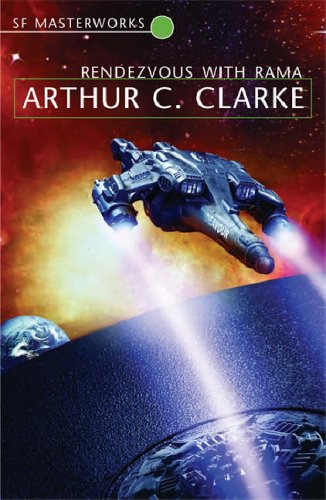
There’s a fitting synchronicity to my choice of Rendezvous With Rama by Arthur C Clarke as the second book of my 2009 Reading Challenge. Like Larry Niven’s Ringworld, it is a book that’s dominated by a Big Dumb Object. It also won both the Hugo and Nebula Awards for Best Novel, and is in the SF Masterworks series. So, another highly-regarded science fiction novel. In fact, it’s probably considered Clarke’s best novel, and he’s one of the “Big Three” of the genre, with Robert Heinlein and Isaac Asimov.

The plot of Rendezvous With Rama is not complicated. In 2131 AD, an object – named Rama by Spaceguard – is detected entering the Solar system. It is determined to be artificial, and the nearest spaceship is sent to investigate. The crew of Endeavour discover that Rama is an alien artefact, a cylinder fifty kilometres long and sixteen kilometres in diameter. Its interior is hollow, and it is roatating fast enough to provide gravity on its inside surface. Endeavour‘s crew explores Rama as it travels through the inner Solar system towards the Sun. They find no clues to its makers or origin. In fact, it is deserted but for a wide variety of “biots”, or biological machines. Eventually, the explorers abandon Rama, and the artefact uses the Sun to boost itself on a path out of the Solar system. End of story.

In other words, very little actually happens in the book. There is no explanation, no resolution. Rama is presented as a puzzle, but there is no solution. It is alien.

Rendezvous With Rama is a strange book in many ways. Not just the complete lack of narrative closure, or the way it resolutely fails to answer the questions it poses. It is also a book which has aged both gracefully and badly.

The framing narrative, which introduces the world of the future and then describes the deliberations of the committee overseeing the exploration of Rama, reads as though it’s taking place in the 1950s. Even in 1972, it must have seem dated. In 2009, of course, it reads even more out-of-date: for example, “when he was able to get computer time to process the results” (page 14). In 1972, perhaps, when mainframes were prevalent, this might have seemed plausible. But the novel is set in 2131. One hundred and fifty nine years later. One hundred and twenty-two years in our future.

The main narrative details the exploration by Commander Norton, captain of Endeavour, and his crew. The emphasis is on Rama itself, which helps distance the novel from its time of writing. The characters are also so bland they could be from any age. Admittedly, it’s also very Anglophonic Americo- and Euro-centric – far more so than any vision of the future written now would be. But their concerns are immediate, direct and almost entirely related to the story, so nothing especially jars.

However, like Ringworld, Rendezvous With Rama is over-shadowed by its eponymous BDO. It’s Rama that stays with you. There’s not much in the way of plot, anyway. And the characters aren’t remotely memorable.

But.

Should a science fiction novel be remembered for its furniture or for its story? Both Ringworld and Rendezvous With Rama have been lauded, and are held in high esteem, for the invented artefacts their casts discover and/or explore. Not for their story, or their writing, or indeed any of their characters. It’s little wonder the genre is held in low regard, when the fans themselves apply such reductive appreciation to the works they deem “classics”. After all, Dickens’ Great Expectations is not notable for Miss Havisham’s ruined mansion.

Rendezvous With Rama is an odd book. There’s a timelessness to its story, but its narrative firmly dates it. Its refusal to explain itself makes it more interesting than, by rights, it actually should be. If science fiction were only about “sense of wonder”, then Rendezvous With Rama succeeds as a science fiction novel. But it has not aged as gracefully as memory might insist it has. It’s the product of an imagined world, which in turn created imaginary worlds, which never really existed. And that tells against it.

In the final analysis, Rendezvous With Rama is, I suppose, another partial success. I’m glad I reread it. I may do so again one day. While it’s certainly not a very good novel, I’m beginning to wonder if it’s a good science fiction novel and if “good science fiction novel” means it doesn’t have to be a “good novel”…


2 Comments

Gods and Robots – The Night Sessions by Ken MacLeod

According to John Clute, every science fiction novel has three dates: the date it was written, the date it is set, and the date it is about. For all that it may be set in the future millennia hence, the best time to read a science fiction novel is in its year of publication. And if the novel is set in the near-future, this is even more true. After all, the near-future is seen as an extension of the present, with the present’s issues and concerns…

All of which may well have a sell-by date.

So, a decade or two from now, will we look back at the rise of creationism as some bizarre atavistic aberration? Will we look back in relief at our narrow escape from religious domination? Or will we, as Ken MacLeod posits in The Night Sessions, go to war and in the aftermath completely secularise society?

The Night Sessions is a near-future sf novel masquerading as a crime novel, much as The Execution Channel was a near-future sf novel masquerading as a thriller. It’s set in Edinburgh a decade or two in the future. The world differs from ours – and perhaps what ours might be – in several ways. There was a war, the “Faith War”, fought in Israel with tactical nuclear weapons, and the forces of the West lost. Society has turned its back on organised religion and everywhere is now entirely secular. By law. Churches and priests are no longer officially recognised. There are also robots, and some of them have developed artificial intelligence.

The novel opens with a fundamentalist Christian from New Zealand visiting Edinburgh to meet with the members of an underground Scottish Christian sect. The fundamentalist works in a “creationist science park” in New Zealand which has become a refuge for sentient robots. He has been preaching to the robots, and the Scots intend to broadcast his sermons to their own congregation. These are the night sessions of the title.

The story proper begins with the murder of a priest by a letter bomb. Detective Inspector Ferguson is in charge of the case. Clues suggest an underground Christian group, the Third Covenant, are responsible. Then a bishop is assassinated by a shot to the head. Ferguson’s investigation soon focuses on a robot called Hardcastle, who has been masquerading as a disfigured war veteran with extensive prostheses. And from there it cascades to take in a host of other Christian denominations, various youth subcultures in Edinburgh, more robots, and the Atlantic and Pacific Space Elevators…

Unfortunately, as a crime novel The Night Sessions mostly fails. Fortunately, as a science fiction novel it mostly succeeds. The problem is that the world of the book requires explanation – it’s neither the reader’s world, nor part of the reader’s history. The story requires its background – it cannot progress, nor be resolved, without those background details MacLeod has created. Which means that the crime novel is frequently interrupted by info-dumps. And because this is a crime novel, they seem horribly out of place. The Night Sessions asks to be read as a crime novel, but it cannot be because it is as exposition-heavy as the science fiction novel it really is.

As science fiction, however… The world MacLeod has created is both clever and interesting, but the requirements of the crime plot have led to a withholding of story information – something not normally found in science fiction. Science fiction novels are open – they lay bare their workings as they progress. The reader can see the rods and gears which drive the plot. And has to in order for the resolution to make sense (not doing so can result in the sin of deus ex machina). A crime novel, however, operates with a different mechanism, and part of the reading process involves the reader’s discovery of those rods, gears and linkages. The reader must build the mechanism in their mind in order to understand the book’s resolution.

Where The Night Sessions is especially good is in its depiction of life in this near-future Edinburgh, and in the tools used by the police of the time. As a near-future novel it convinces, and there’s an impressive inevitability, given MacLeod’s invented history, to the society depicted. Which makes it seem such a shame that Ferguson’s investigation seem to be mostly driven by authorial sleight of hand. Science fiction is essentially a logical genre – all sf stories follow an underlying logic. The same is true of crime stories. There’s a similar implacability to the end of a crime novel as there is to the end of sf novel. But in the crime genre there are no shortcuts on the route there. Ferguson seems to stumble upon the conspiracy at the heart of The Night Sessions more by serendipity than by methodical police-work (he has a number of neat tools, and they do help, however). This is not helped by the Columbo-style prologue. This names the villains of the piece, and means we must watch Ferguson and his team stumble through the clues to reach a destination we already know. Except that destination is a blind – because The Night Sessions is actually more of a whydunnit than a whodunnit, and the real why remains hidden for much of the narrative.

Because The Night Sessions is a crime novel, the resolution of the plot should be the identity of the murder and their motivation. Because The Night Sessions is a science fiction novel, that is not enough. The motivation for the crimes has to be science-fictional. And it is. But again not quite enough. Like The Execution Channel, the final plot-zinger in The Night Sessions happens off-screen – it is in fact recounted by one character to another.

The Night Sessions is one of the novels shortlisted for this year’s BSFA Award. It’s certainly one of the most interesting depictions of the near-future I’ve come across in science fiction. But I don’t think the engine of its plot is geared correctly to the wheels of its story. I also suspect it appears too prophetic to read well a decade from now. Its concerns are too specific – unlike, say, Nineteen Eighty-Four – and it’s not pure enough science fiction to weather the years. Read it now and it’s very good. Read it five years from now…?

Ken MacLeod writes bloody good science fiction novels, but we’ve yet to see his best.


8 Comments

149 SF Novels Everyone Must Read… Apparently

All week the Guardian has been running 1000 Novels Everyone Must Read. Not 1000 Novels Everyone Should Read. Must read. And these 1000 novels have been arbitrarily – and weirdly – split into seven categories: love, crime, comedy, family & self, state of the nation, science fiction & fantasy, and war & travel. To date, I’ve averaged between one and two dozen read in each category.

But today it’s science fiction & fantasy and, unsurprisingly, I make a much better showing.

Here is the list:

Douglas Adams: The Hitchhiker’s Guide to the Galaxy (1979)
Brian W Aldiss: Non-Stop (1958)
Isaac Asimov: Foundation (1951)
Margaret Atwood: The Handmaid’s Tale (1985)
Margaret Atwood: The Blind Assassin (2000)
Paul Auster: In the Country of Last Things (1987)
JG Ballard: The Drowned World (1962)
JG Ballard: Crash (1973)
JG Ballard: Millennium People (2003)
Iain Banks: The Wasp Factory (1984)
Iain M Banks: Consider Phlebas (1987)
Clive Barker: Weaveworld (1987)
Nicola Barker: Darkmans (2007)
Stephen Baxter: The Time Ships (1995)
Greg Bear: Darwin’s Radio (1999)
William Beckford: Vathek (1786)
Alfred Bester: The Stars My Destination (1956)
Ray Bradbury: Fahrenheit 451 (1953)
Poppy Z Brite: Lost Souls (1992)
Charles Brockden Brown: Wieland (1798)
Algis Budrys: Rogue Moon (1960)
Mikhail Bulgakov: The Master and Margarita (1966)
Edward Bulwer-Lytton: The Coming Race (1871)
Anthony Burgess: A Clockwork Orange (1960)
Anthony Burgess: The End of the World News (1982)
Edgar Rice Burroughs: A Princess of Mars (1912)
William Burroughs: Naked Lunch (1959)
Octavia Butler: Kindred (1979)
Samuel Butler: Erewhon (1872)
Italo Calvino: The Baron in the Trees (1957)
Ramsey Campbell: The Influence (1988)
Lewis Carroll: Alice’s Adventures in Wonderland (1865)
Lewis Carroll: Through the Looking-Glass, and What Alice Found There (1871)
Angela Carter: The Passion of New Eve (1977)
Angela Carter: Nights at the Circus (1984)
Michael Chabon: The Amazing Adventures of Kavalier and Clay (2000)
Arthur C Clarke: Childhood’s End (1953)
GK Chesterton: The Man Who Was Thursday (1908)
Susanna Clarke: Jonathan Strange and Mr Norrell (2004)
Michael G Coney: Hello Summer, Goodbye (1975)
Douglas Coupland: Girlfriend in a Coma (1998)
Mark Danielewski: House of Leaves (2000)
Marie Darrieussecq: Pig Tales (1996)
Samuel R Delaney: The Einstein Intersection (1967)
Philip K Dick: Do Androids Dream of Electric Sheep? (1968)
Philip K Dick: The Man in the High Castle (1962)
Thomas M Disch: Camp Concentration (1968)
Umberto Eco: Foucault’s Pendulum (1988)
Michel Faber: Under the Skin (2000)
John Fowles: The Magus (1966)
Neil Gaiman: American Gods (2001)
Alan Garner: Red Shift (1973)
William Gibson: Neuromancer (1984)
Charlotte Perkins Gilman: Herland (1915)
William Golding: Lord of the Flies (1954)
Joe Haldeman: The Forever War (1974)
M John Harrison: Light (2002)
Nathaniel Hawthorne: The House of the Seven Gables (1851)
Robert A Heinlein: Stranger in a Strange Land (1961)
Frank Herbert: Dune (1965)
Hermann Hesse: The Glass Bead Game (1943)
Russell Hoban: Riddley Walker (1980)
James Hogg: The Private Memoirs and Confessions of a Justified Sinner (1824)
Michel Houellebecq: Atomised (1998)
Aldous Huxley: Brave New World (1932)
Kazuo Ishiguro: The Unconsoled (1995)
Shirley Jackson: The Haunting of Hill House (1959)
Henry James: The Turn of the Screw (1898)
PD James: The Children of Men (1992)
Richard Jefferies: After London; Or, Wild England (1885)
Gwyneth Jones: Bold as Love (2001)
Franz Kafka: The Trial (1925)
Daniel Keyes: Flowers for Algernon (1966)
Stephen King: The Shining (1977)
Marghanita Laski: The Victorian Chaise-longue (1953)
Joseph Sheridan Le Fanu: Uncle Silas (1864)
Ursula K Le Guin: The Left Hand of Darkness (1969)
Ursula K Le Guin: The Earthsea series (1968-1990)
Stanislaw Lem: Solaris (1961)
Doris Lessing: Memoirs of a Survivor (1974)
CS Lewis: The Chronicles of Narnia (1950-56)
MG Lewis: The Monk (1796)
David Lindsay: A Voyage to Arcturus (1920)
Ken MacLeod: The Night Sessions (2008)
Hilary Mantel: Beyond Black (2005)
Michael Marshall Smith: Only Forward (1994)
Richard Matheson: I Am Legend (1954)
Charles Maturin: Melmoth the Wanderer (1820)
Patrick McCabe: The Butcher Boy (1992)
Cormac McCarthy: The Road (2006)
Jed Mercurio: Ascent (2007)
China Miéville: The Scar (2002)
Andrew Miller: Ingenious Pain (1997)
Walter M Miller Jr: A Canticle for Leibowitz (1960)
David Mitchell: Cloud Atlas (2004)
Michael Moorcock: Mother London (1988)
William Morris: News From Nowhere (1890)
Toni Morrison: Beloved (1987)
Haruki Murakami: The Wind-up Bird Chronicle (1995)
Vladimir Nabokov: Ada or Ardor (1969)
Audrey Niffenegger: The Time Traveler’s Wife (2003)
Larry Niven: Ringworld (1970)
Jeff Noon: Vurt (1993)
Flann O’Brien: The Third Policeman (1967)
Ben Okri: The Famished Road (1991)
George Orwell: Nineteen Eighty-four (1949)
Chuck Palahniuk: Fight Club (1996)
Thomas Love Peacock: Nightmare Abbey (1818)
Mervyn Peake: Titus Groan (1946)
Frederik Pohl & CM Kornbluth: The Space Merchants (1953)
John Cowper Powys: A Glastonbury Romance (1932)
Terry Pratchett: The Discworld series (1983- )
Christopher Priest: The Prestige (1995)
Philip Pullman: His Dark Materials (1995-2000)
François Rabelais: Gargantua and Pantagruel (1532-34)
Ann Radcliffe: The Mysteries of Udolpho (1794)
Alastair Reynolds: Revelation Space (2000)
Kim Stanley Robinson: The Years of Rice and Salt (2002)
JK Rowling: Harry Potter and the Philosopher’s Stone (1997)
Salman Rushdie: The Satanic Verses (1988)
Joanna Russ: The Female Man (1975)
Geoff Ryman: Air (2005)
Antoine de Sainte-Exupéry: The Little Prince (1943)
José Saramago: Blindness (1995)
Will Self: How the Dead Live (2000)
Mary Shelley: Frankenstein (1818)
Dan Simmons: Hyperion (1989)
Olaf Stapledon: Star Maker (1937)
Neal Stephenson: Snow Crash (1992)
Robert Louis Stevenson: The Strange Case of Doctor Jekyll and Mr Hyde (1886)
Bram Stoker: Dracula (1897)
Rupert Thomson: The Insult (1996)
JRR Tolkien: The Hobbit (1937)
JRR Tolkien: The Lord of the Rings (1954-55)
Mark Twain: A Connecticut Yankee at King Arthur’s Court (1889)
Kurt Vonnegut: Sirens of Titan (1959)
Horace Walpole: The Castle of Otranto (1764)
Robert Walser: Institute Benjamenta (1909)
Sylvia Townsend Warner: Lolly Willowes (1926)
Sarah Waters: Affinity (1999)
HG Wells: The Time Machine (1895)
HG Wells: The War of the Worlds (1898)
TH White: The Sword in the Stone (1938)
Angus Wilson: The Old Men at the Zoo (1961)
Gene Wolfe: The Book of the New Sun (1980-83)
Virginia Woolf: Orlando (1928)
John Wyndham: Day of the Triffids (1951)
John Wyndham: The Midwich Cuckoos (1957)
Yevgeny Zamyatin: We (1924)

I make that 63 read of 149 – they’re the ones in bold. Plus a further 10 I own but have yet to read (in italics).

It’s a bloody odd list, that much is for sure. No Mars trilogy from Kim Stanley Robinson, but The Years of Rice and Salt instead. Banks’ Consider Phlebas rather than Use of Weapons. Memoirs of a Survivor but not the Canopus in Argos Archives for Lessing. Michael G Coney manages to sneak one on there – I suspect a fondness for his work on the part of one of the compilers. There’s a few I’d never recommend to people – Orlando might have its fans, but I hated it. Nor was I that impressed by Michael Faber’s Under The Skin. Several titles I’d never heard of – especially the old Gothic ones. And… Toni Morrison? Sarah Waters? Ben Okri? Still, there’s a few there I wouldn’t mind giving a go. I might even stick them on the wants list…

EDIT: Thanks to Martin Lewis for posting the list on his blog.


5 Comments

2009 Reading Challenge #1 – Ringworld, Larry Niven

I forget when I last read this book. I seem to recall reading it several times during my early teens, but I’ve avoided it since. I’m not sure why – perhaps I was afraid it would disappoint. I’ve learnt to my cost that “nostalgia ain’t what it used to be”. Few books I loved as a teenager have survived a reread now that I’m just over halfway through my three score years and ten.

Having said that, I may well have not reread it simply because my To Be Read pile is big enough already. And continues to grow…

But Ringworld.

The novel won both the Hugo and Nebula Awards in 1971. It’s also No 60 in the SF Masterworks series. So it’s safe to say it’s highly regarded by sf fans. But I’m not convinced sf novels stand the test of time as well as most fans would have us believe, and Ringworld is now 39 years old.

Everyone knows that the first edition had Earth rotating the wrong way – but this was corrected in subsequent editions. But there are other mistakes (in my 1981 Sphere paperback). On page 22, there is a description of the Long Shot: “The ship would carry practically no cargo, though it was over a mile in diameter.” Yet when they finally see the ship: The Long Shot was a transparent bubble over a thousand feet in diameter” (pg 46). The last time I looked, a mile was 5,280 feet. There’s also a strange mix of metric and Imperial units: “The ring masses two times ten to the thirtieth power in grams, measures .95 times ten to the eighth power miles in radius, and something less than ten to the sixth power miles across.” (pg 70). These are minor complaints, however.

Louis Wu is a 200-year-old adventurer in the 29th Century. He is recruited by Nessus, a Pierson’s Puppeteer, for a mysterious mission. Also recruited are Speaker-to-Animals, a kzin, which is a large feline war-like alien; and Teela Brown, a young woman descended from five generations of winners of the Birthright Lotteries and so supposed to be very lucky. The mission requires a trip to an unspecified destination 200 light years from Earth. This would normally take several decades, but Nessus has use of a ship fitted with a secret “quantum II hyperdrive shunt”, which travels orders of magnitude faster. This ship, the Long Shot, and the secret of its drive, will be Louis Wu and his team-mates’ payment for the mission.

The team head for the home world of the Pierson Puppeteers… which proves to be a fleet of five worlds travelling through space at 80% of the speed of light. The puppeteers are a cowardly race and are fleeing the explosion of the galactic core, whose wavefront won’t reach Known Space for another 20,000 years. Recently, they had discovered an artefact a couple of light years from their present position. A ringworld – a single band of material approximately one million miles in width and 600 million miles in circumference, orbiting one AU from its primary, and comprising the surface area of three million Earths. The puppeteers do not know who built the ringworld, and want Louis and the others to investigate it.

In a second ship provided by the puppeteers, Louis, Teela, Nessus and Speaker-to-Animals travel to the ringworld. While investigating one of the “shadow squares”, which orbit nearer the sun and provde night and day on the ringworld, they are attacked by automated defences and crash on the ringworld’s surface. They must then trek some 250,000 miles to the rim to seek help…

Niven’s ringworld is one of the most famous Big Dumb Objects in science fiction. And justifiably so. It’s huge. And Niven mostly succeeds in getting across its size to the reader. From the crash-site, for example, Louis can see for thousands of miles, but still can’t make out the rim to either side. Compare that with Earth – on flat ground the horizon would be around three miles away for someone six feet tall.

And, I suppose, that if I’d forgotten anything about Ringworld, it was that sense of vast scale. Louis Wu is a protagonist very much in the mould of a US 1970s Competent Man. Teela Brown is decorative, screams a lot, and occasionally manages to surprise Louis with her perceptiveness and intelligence. He still refers to her as “my woman”, however. The kzin is war-like, and the puppeteer is cowardly. Much of the universe of the novel, Known Space, was worked out in earlier novels and short stories. The prose is efficient at best, neither impeding the reading experience nor enhancing it.

But still.

The ringworld casts a huge shadow. It’s the ringworld you remember when you close the book. It’s the ringworld you remember decades later when you pick up the book to reread it. The rest is, well, just a story. The ringworld is sense of wonder. And if that’s all you want in a science fiction novel, then you’ll get it in Ringworld. If you’re looking for more, you’ll perhaps come away disappointed. Niven makes no attempt to explain the origin of the ringworld. The book’s plot is little more than a trek to find a way off it. There are, I admit, one or two interesting sub-plots: for example, the puppeteers’ meddling in both human history and kzin, the first to breed a “lucky” human and the second to make the kzin more docile; and the various speculations these revelations generate. Niven also manages to create a human but slightly off-kilter civilisation-in-ruins on the ringworld, although the name of one of its city, Zignamuclickclick, generates a wince.

I enjoyed my reread, but it did leave me somewhat dissatisfied. Not from the book’s shortcomings – but because I’d forgotten how glibly sf writers of the 1970s used to make stuff up. They made very little effort to convince, they just waved their hands a little more vigorously. That’s a style which is no longer in fashion. Science fiction in the 21st century is a far more rigorous genre, and it’s better for it.

There are more novels following on from this one – The Ringworld Engineers, The Ringworld Throne, and Ringworld’s Children – and these explain who built the ringworld, and why. I vaguely recall reading The Ringworld Engineers back in my teens, but I’ll not bother this time. Nor have I any desire to read more of the series.

That’s not, I hasten to add, because this first book in my 2009 Reading Challenge was a failure. On the contrary, it achieved pretty much what I expected it to achieve. I enjoyed the book, was reminded of some of the reasons why I’d liked it in the first place, and will someday no doubt read it again. But it’s no great work of literature, and there are many science fiction novels I’d consider better than it.


2 Comments

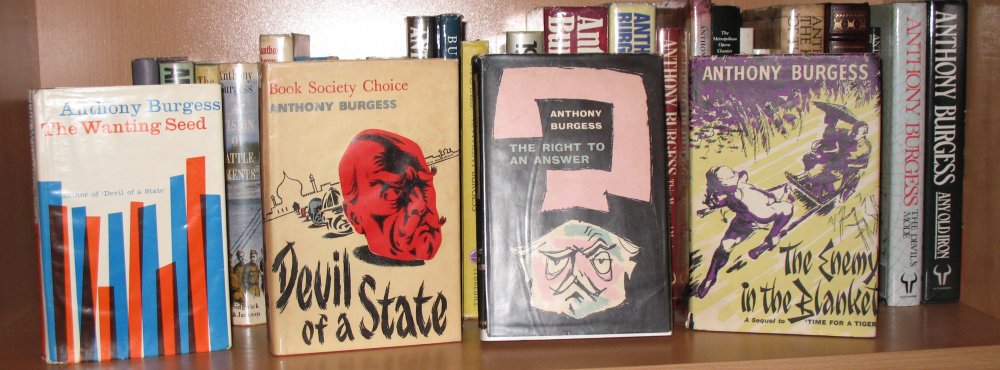
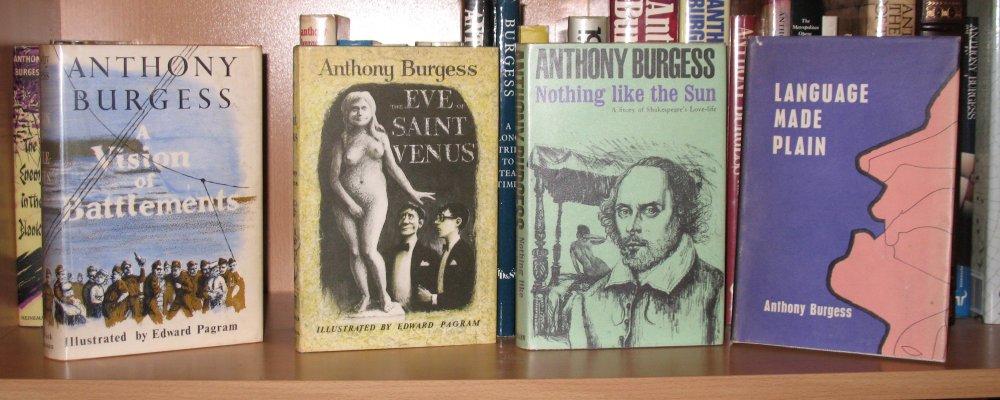
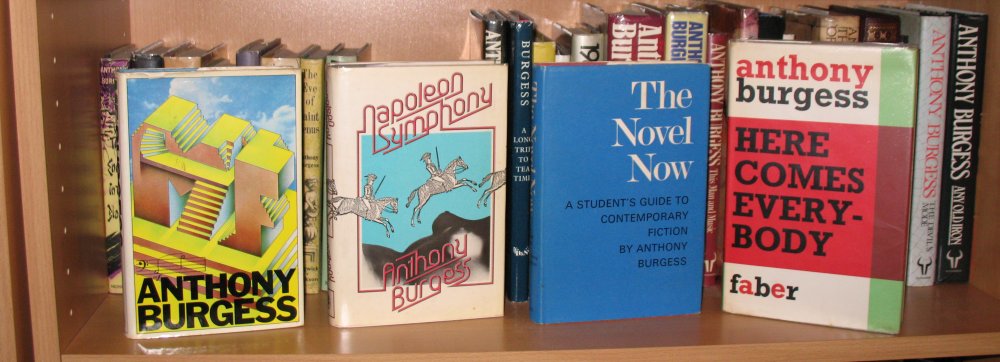
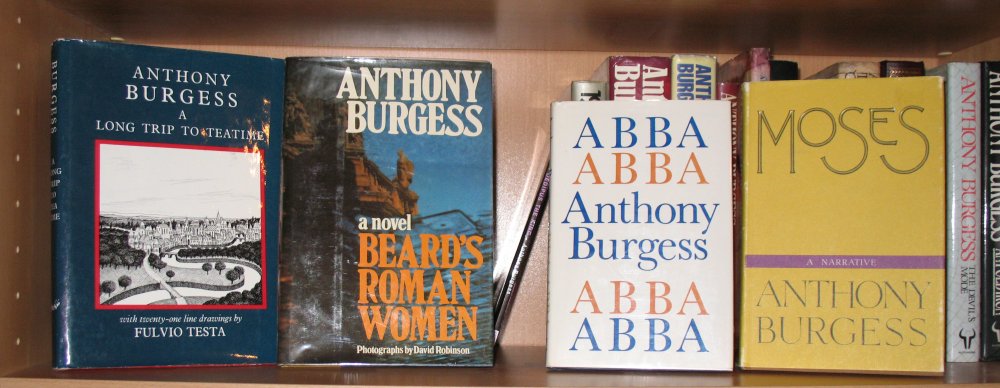
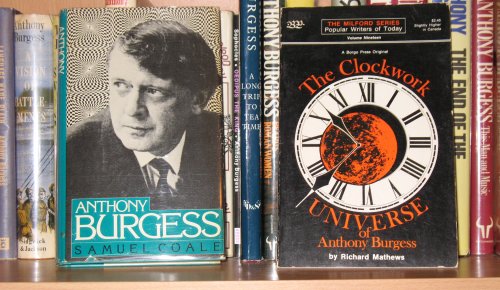
Some Burgessery

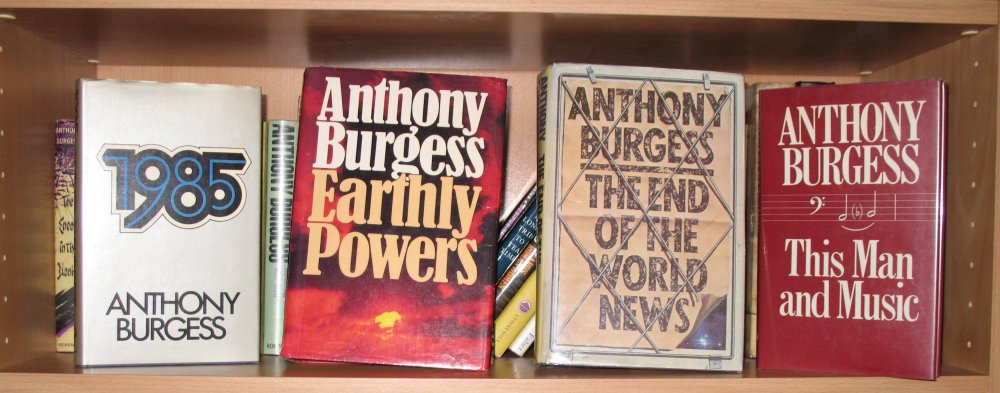
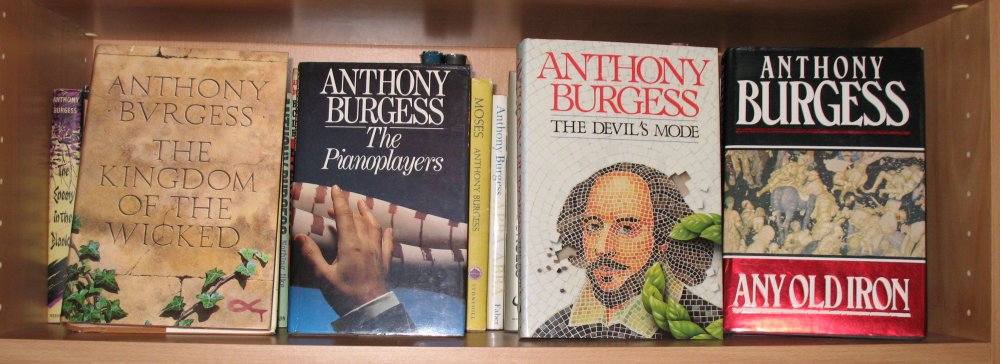
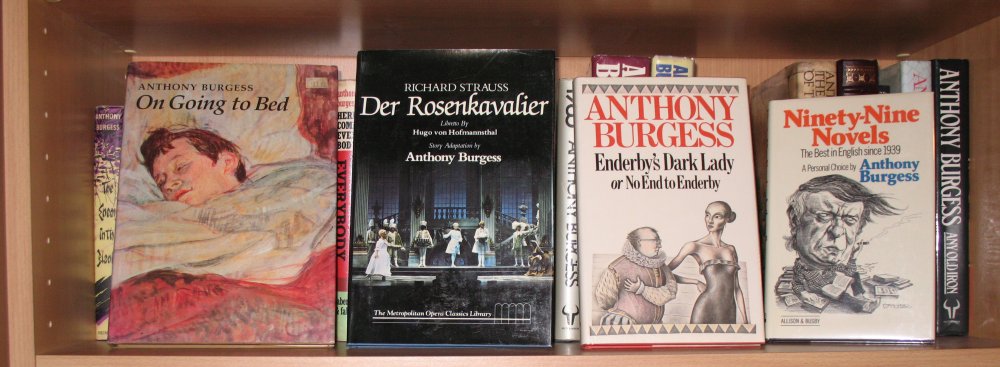
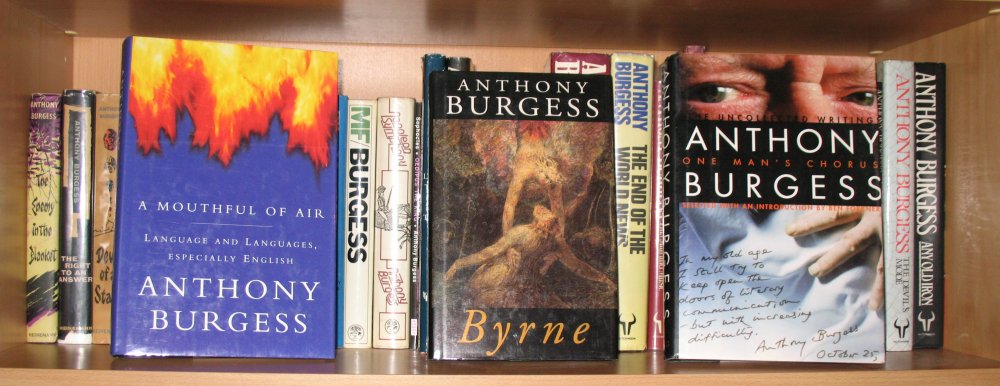
I’m not sure what the collective term for books by Anthony Burgess would be, but Burgessery seems to fit – even if it does sound a little rude. Still, it was Burgess who felt science fiction would be better called “futfic” – which sounds just as unwholesome – so I’m sticking with Burgessery.

I’ve been a fan of Burgess’ writing since reading A Dead Man in Deptford in the early 1990s. He was another author I discovered via the Daly Community Library in Abu Dhabi. After A Dead Man in Deptford, it was A Mouthful of Air, The Devil’s Mode, The Kingdom of the Wicked, Enderby’s Dark Lady, Wanting Seed and Any Old Iron – and that was just within six months.

Whenever I returned to the UK on leave, I’d hunt out Burgess paperbacks. At some point, I decided I wanted the books in hardback. And that included all the non-fiction he had written. My collection is by no means complete, and only one book – Any Old Iron – is a signed copy. Burgess was a good deal more prolific than Lawrence Durrell or Nicholas Monsarrat.

Burgess has been described as a great writer who never wrote a great novel. Which is a bit unfair. Earthly Powers is definitely a great novel. I prefer to think of him as a writer who made a career out of self-indulgence – much as Frank Zappa did in music. Both were extremely talented, so even their most self-indulgent works are interesting. But both also had a tendency to privilege displays of cleverness over accessibility. Who but Burgess, for example, would write a novel in three parts: the libretto of a Broadway musical about Trotsky visiting New York in 1917, the home life of Sigmund Freud, and a science fiction story about an asteroid called Lynx smashing into the earth and ending everything. The book is The End of the World News.

But on with the book porn…


3 Comments

Worth a Seventy-Three Year Wait?

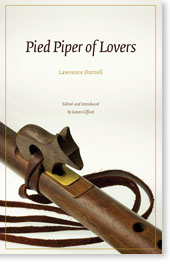
Most people believe Lawrence Durrell’s first novel to be The Black Book, published in 1938 by the Obelisk Press in Paris (it was considered obscene by UK publishers, and not published in this country until 1977). In fact, Durrell’s first novel had been published three years earlier by Cassell. It was titled Pied Piper of Lovers. Unfortunately, it sold badly, was savaged in a review in Janus magazine by John Mair, and few copies survived the Blitz. Durrell himself also refused to allow the book to be reprinted – perhaps because it was a little too autobiographical. As a result, copies are very hard to find – in fact, “barely a dozen copies survive in libraries around the world”.

But now the Canadian University of Victoria’s ELS Editions has, after 73 years, finally published a new edition of Pied Piper of Lovers. And a very nice edition it is too. There is an excellent introduction by editor James Gifford – from which the above quote about “barely a dozen copies” is taken. The text itself is copiously footnoted – perhaps too copiously in places: I should have thought it unnecessary to point out, for example, that “Portsmouth, England, is a coastal city in Hampshire”, as only the dimmest of readers is going to blithely ignore context and confuse it with the many Portsmouths in the USA.

After the text of the novel is an essay, ‘An Unacknowledged Trilogy’, by James A Brigham, which argues that Pied Piper of Lovers, Durrell’s second novel Panic Spring (published in 1937 under the pseudonym Charles Norden), and The Black Book are a thematic trilogy. Pied Piper of Lovers also features a “Works Cited & Selected Bibliography”.

Some books are plainly written by young men, and Pied Piper of Lovers is one of them. The prose seems to foreground the senses, more so than plot or structure or characterisation. Every raindrop is lovingly described, every emotion takes on supreme importance. Durrell’s prose was always lush, but it was in service to the story. In Pied Piper of Lovers, Durrell appeared to be intent primarily on making a point with his novel – in as rich a language as he could manage – and only secondarily in actually constructing a narrative. Perhaps this was because he was at the time chiefly a poet.

Clifton Walsh is born in India of an English father and an Indian mother who dies in childbirth. He is raised by his father, a civil engineer, and his aunt, Brenda. His schooling is haphazard, and eventually his father determines he should be sent to school in England. While Clifton is at boarding-school, Brenda settles down in London. When his father dies – Clifton has not been back to India since being sent to England – Clifton leaves school. He has no fixed ambition, just a need to get away. He stays at a sea-side cottage near Hangar, on the border between Devon and Dorset, and meets Ruth. They fall immediately in love. Meanwhile, Clifton has discovered he has a gift for music – specifically, for writing it. He sells a piece to a music publisher, although the publisher is more interested in the “tune” in Clifton’s music and turns it into a piece of popular jazz. Clifton goes to live in Fitzrovia, an area of London, where he meets and interacts with a variety of bohemian types. He stumbles across Ruth, and the two settle down together. She, however, is terminally ill. They move back to the south coast, and he supports them by writing popular tunes. The final chapter of the book is a letter from Clifton to his best friend from boarding-school.

It’s perhaps the language of Pied Pipers of Lovers which is most interesting, and most appealing. The prose was clearly written with a poet’s eye. Perhaps it’s not always successful, and there are no passages which grab the eye as there are in Durrell’s later works. Perhaps even, the rich language occasionally works against the story, obscuring what should be clear. Especially in the Prologue, thirteen pages of which describe the arrival of the doctor at the bedside of Clifton’s mother, his birth, and her subsequent death. In other parts of the novel, the narrative seems to enter a literary “bullet-time”, and emotional events which transpire over almost no time are dissected in lush prose over several pages. And yet Durrell’s writing is often at his best when his focus pulls back and he moves the story forward.

One of the aspects of The Alexandria Quartet which appeals most to me is that it is a series of novels about British expatriates in the Middle East. Pied Piper of Lovers turns this on its head – Clifton doesn’t feel himself to be English, but he is in England. But neither is he not English. In fact, the major theme of the novel is Clifton’s feelings of being torn between two homelands, yet not fully part of either. Durrell, like Clifton, was born and brought up in India, then sent to England to be educated. Durrell also lived briefly in Fitzrovia, and was as much a “Bohemian” as those he describes in the novel.

There is also – and this further indicates to me that Pied Piper of Lovers is a young man’s novel – an uncritical reflection of the attitudes of that set at that time, as if they were adopted unthinkingly. There are a number of anti-semitic comments in the book, a stereotyping of Jews as grasping merchants – a not-uncommon attitude in 1930s Britain, but at odds with Durrell’s later pro-Zionism in The Alexandria Quartet. But there is also an open tolerance of homosexuality – something which seems to me was a peculiarity of the Bohemian set (cf Oscar Wilde, Charles Scott-Moncrieff, Robert Ross, Wilfred Owen and others a decade or two earlier).

The book’s structure displays Durrell’s frequent inability to stick to his intended narrative plan. The timescale is uneven, events are not properly placed, and Clifton’s age is occasionally hard to calculate. And yet the book is carefully split into five parts: Prologue (birth), Part I (childhood in India), Part II (boarding school in England), Part III (Fitzrovia), and Epilogue. I’m reminded of The Avignon Quintet, in which each of the five books begins clearly on track but seems to soon drift from it… until the central mystery of the quintet, Templar treasure hidden somewhere in Provence, is solved almost in passing near the end of the fifth book, Quinx. It’s strange that while Durrell showed a poet’s careful control over his language, he never seemed to have as much control over his plots.

So, how grateful should we be to ELS Editions for publishing Pied Pier of Lovers? Personally, I’m very glad indeed. I love Durrell’s work and, while I found Pied Piper of Lovers less satisfying than his later works, I’m very glad I read it. I’ll probably even read it again. It’s always interesting seeing how favourite writers develop, and Pied Piper of Lovers is an important novel in that regard. Anyone with an interest in Durrell should read it.