
It Doesn't Have To Be Right…

… it just has to sound plausible


2 Comments

Recent Reading & Watching Roundup

This is turning into a sort of irregular thing. And why not? This time it’s more watching then reading, but never mind.

Books
The Dorsai Companion(1986) and The Spirit of Dorsai (1979), Gordon R Dickson, I read in the, ah, spirit of completeness. I’d loved the original Dorsai trilogy when I’d read them as a kid, but I was less impressed when I reread them a couple of years ago – see here. But there is still something a little fascinating about Dickson’s future history, and The Dorsai Companion gives more information on it than are contained in the various novels. It also contains several short stories set in that future history. And like a lot of sf of that period, the plot is carried via the dialogue. They’re very talky. Which made for an odd experience after reading more contemporary sf. The Spirit of Dorsai shares much of its contents with The Dorsai Companion (or vice versa), so I only had to read a handful of additional pages to finish both books.

How to Build Your Own Spaceship, Piers Bizony (2008) was a review book sent to me by Portobello Books – well, I requested it, and they kindly sent me a copy. So, thank you very much. I reviewed it here on my Space Books blog. It’s very good.

The Discovery of Heaven, Harry Mulisch (1992), I wanted to read after seeing and liking the film (which I reviewed for videovista.net – see here). Having now read the book, I think the film adapted it very well indeed. The novel is richer, of course, and more happens in it, but nothing of real substance is missing from the movie – if anything, the book does have a tendency to ramble in places. I can also understand Mulisch’s insistence that Stephen Fry be cast in the role of Onno Quist. I doubt it’s a novel I’ll be returning to, although it is very good. Bizarrely, it didn’t strike me as being very Dutch, despite Mulisch being one of the “Great Three” of Dutch postwar writers and this his best-known and best-selling work.

First on the Moon, Buzz Aldrin, Neil Armstrong and Michael Collins (1970). I’m reading a bunch of books on Apollo 11 in order to celebrate the 40th anniversary of the Moon Landing on my Space Books blog. So a review of this book will appear there some time around 20th July. For now, it’s much, much, much better than Shepard & Slayton’s Moon Shot (reviewed here).

Offworld, Robin Parrish (2009), was read for a review for Interzone.

alawforthestarsA Law for the Stars, John Morressy (1976), is the first of two of Morressy’s Sternverein novels which were never published in the UK. I managed to pick up a Laser Books edition a while ago (which has an especially ugly cover). Unlike the other Sternverein novels, this one focuses on the Security Troops. Ryne is an orphan from a low-tech world who becomes the perfect Sternverein Security Trooper. From what I remember of the other books, this one isn’t quite as well written, although it does have its moments.


Films
The Duchess, dir. Saul Dibb (2008), is a dramatisation of the life of Georgiana Cavendish, the 18th century Duchess of Devonshire. It’s clearly a star vehicle for Keira Knightley, so it’s somewhat unfortunate that throughout the film she looked uncannily like a puppet from a Gerry Anderson television programme. Other than that, it’s a British period drama. It probably takes liberties with history – I’ve not read the book on which it is based, Georgiana, Duchess of Devonshire by Amanda Foreman, so I’m only guessing. Sumptuously shot, slow in places, and it provided a couple of hours of mild entertainment.

Star Wreck 6: In The Pirkinning, dir. Timo Vuorensola (2005), I watched and reviewed for videovista.net. See here. I also watched Star Wrecks 1 through 5 in order to write my review. I won’t be doing that again in a hurry….

Valkyrie, dir. Bryan Singer (2008), I watched and reviewed for videovista.net. See here.

Tokyo Story, dir. Yasujiro Ozu (1953), is on the Time Out’s 1995 Centenary Top 100 Films at No. 9. Much as I appreciate Tarkovsky’s films and their glacial pace, at least his cinematography provides sufficient eye candy to hold your attention. Tokyo Story is a slow film, but its focus is on its characters. They’re well-drawn but ultimately it wasn’t enough for me and my eyes were starting to glaze before reaching the halfway mark. Perhaps I’ll try it again some day, although I may need to down half a dozen cans of Red Bull first.

Sunrise, dir. FW Murnau (1927) is also on Time Out’s 1995 Centenary Top 100 Films. At No. 84. And despite being only 95 minutes, it felt as long as Metropolis (153 mins) or Pandora’s Box (133 mins). Perhaps that was because it was silent. Or perhaps German Expressionist films just seem to drag on and on. Ah well, at least I can cross it off the list.

Titan A.E., dir. Don Bluth (2000), is a strange beast. It’s an animated sf film, which uses CGI backgrounds but traditional cell animation for the characters and foreground “sets”. The two main characters are voiced by Matt Damon and Drew Barrymore, and her voice doesn’t quite fit her character’s appearance. The story has its moments, and some of the CGI set-pieces are quite impressive. Apparently, it’s now a cult film. Maybe that’s because it feels like anime, although it looks like a Hollywood animated film.

Juno, dir. Jason Reitman (2007), is a mildly-amusing comedy about a teenage mother, the title character. Unfortunately, she talks throughout like someone whose lines were written to be witty and precocious, so she never feels real.

Battle Beyond the Stars, dir. Jimmy T Murakami (1980), is a Roger Corman cash-in onStar Wars, with a plot shamelessly stolen from The Magnificent Seven (and Akira Kurosawa’s Seven Samurai). Robert Vaughn even reprises his role from the western. There’s a lot in it that will make you cringe – George Peppard especially, who appears to have spent the entire film pissed – but Richard Thomas plays a good part, and John Saxon as the villain gives the scenery a thorough chewing.

Code Unknown, dir. Michael Haneke (2000), is one of those films whose plot spirals out from a single seemingly unimportant event, showing the ramifications of it on a variety of peoples’ lives. In this case, it’s the casual mistreatment by a French teenager of a Romanian woman begging on the streets of Paris. A young man, the son of Malian immigrants, tells the teenager to apologise to the woman. He refuses… and this leads to a fight. The police turn up and the Malian is carted off. By the time the film finishes, we’ve seen how that one moment of thoughtlessness altered their lives, and yet nothing much seems to have changed. A film it is difficult to like.

Supernova, dir. Thomas Lee (2000) – Thomas Lee is actually Walter Hill, but he pulled his name from this, because apparently the studio were unhappy with his cut and brought in Jack Sholder to film additional scenes and Francis Ford Coppola to re-edit it. I can’t say I think much of their “rescue” job because the film is rubbish. I wonder if Hill’s original was any better.

Tales From Earthsea, dir. Goro Miyazaki (2006), is a charm-free adaptation of Le Guin’s tetrology. Sort of. It’s been a while since I read the books, But I seem to recall that Tehanu dealt a lot with Tenar’s domestic life – and she lives on small farm in this film. Sparrowhawk is also in his thirties or forties – hard to tell, being animation. He’s voiced by Timothy Dalton, and he’s another example of an animated character whose voice doesn’t fit their appearance.

My Darling Clementine, dir. John Ford (1946), is another film from Time Out’s 1995 Centenary Top 100 Films. It’s at No. 38. The film is also notable for its claim of accuracy – when a youth Ford had known Wyatt Earp, and the shoot-out at the OK Corral is staged as Earp described it to him. There’s a horrible casualness to killing in the film, as if the first solution to every problem was to shoot the other person in the back. Makes you wonder why they ever bothered with marshals and sheriffs. I’m not a huge fan of westerns – well, except for Rio Bravo – but this is one of the good ones.

Robinson Crusoe on Mars, dir. Byron Haskin (1964), is a classic piece of sf cinema. A US spacecraft surveying Mars narrowly avoids a collision with a meteorite. Both crewmen ject, but only Commander Draper and the craft’s pet monkey survive the landing. He is marooned on the red planet, where he discovers how to manufacture sufficient “air” for him to breathe, finds water, and even finds a native plant which proves edible. It’s all wildly inaccurate – hardly surprising given when it was made. And gets even more fanciful when alien humans from a star in Orion’s belt appear and mine ore using slaves. One of the slaves escapes and becomes Friday to Draper’s Robinson Crusoe. The slave is played by Victor Lundin, and I kept on expecting him to break into an Elvis Presley impression.

Fahrenheit 451, dir. François Truffaut (1966), remains a favourite after this rewatch. It’s complete nonsense of course, although it makes more sense than Bradbury’s vastly overrated novel. Books are banned… but people can still read. How do they learn to read if there are no books? Never mind. There’s something quintessentially English about the film – despite being directed by a Frenchman, starring an Austrian, and based on a novel by an American. It sort of exudes a late 1960s / early 1970s menacing UK charm, a cross between the quaint contemporary futurism of G-Plan-furnished A-plan houses in green suburban streets lined with silver birches and the reality of Brutalist high-rise sink estates.

5 X 2, dir. François Ozon (2004), is constructed from five incidents in the shared lives of a married couple, recounted backwards from their divorce to their first meeting. The husband, Gilles, is thoroughly unlikeable, and any explanation for his bad behaviour is only hinted at and never explained. It’s clear where Ozon’s sympathies lay. I like Ozon’s films, but he never quite delivers what you expect, or quite lives up to what he’s promised. Admittedly, I’ve not seen all his films. Yet.


11 Comments

Fighting Talk…

We all know what arguing on the Internet is like, but none of us can stay away when someone is wrong. Here are a few opinions I hold which often provoke a response in sf forums:

1. Paul Verhoeven’s Starship Troopers is an excellent film, but the novel on which it was based – by Robert Heinlein – is right-wing rubbish.

2. The sequels to Frank Herbert’s Dune do not decline in quality. In fact, the sequels are better-written books than Dune. (Until, that is, you get to the ones written by Brian Herbert and Kevin J Anderson, which are appalling.)

3. The Wrath Of Khan is not the best Star Trek film. Its sequel, The Search For Spock, is a much better film.

Now discuss.


3 Comments

Reading & Watching Roundup

Since my last round-up, I have read the following books and watched the following films.

Books:
The Stainless Steel Rat, Harry Harrison (1961), was one for the reading challenge – see here.

Guardians of the Galaxy: Earth Shall Overcome, by a whole bunch of people (2009). Don’t ask me why, but I quite like the Guardians of the Galaxy. For one thing, they’re a purely science-fictional superhero group – a 1,000-year-old astronaut with psychic powers, a soldier from a high-gravity planet, a silica-based man, and a blue barbarian with a “magic” bow. Oh, and there’s the mysterious Starhawk, “One Who Knows”, as well. Sadly, this collection, gathering the GotG’s first appearances is not very good at all. The writing is terrible and the art is perfunctory. Apart from their 1968 debut title, the other stories in Earth Shall Overcome are shared titles with The Thing and Captain America, neither of whom I particularly like. It’s easy to understand why there was a 8-year gap between the group’s first and subsequent appearances.

Kingdom Come, Alex Ross & Mark Waid (1996). I had in the past dismissed DC as less interesting than Marvel – well, it’s hard not to think of its core superheroes as clichés. But Identity Crisis made me reconsider my opinion on DC. And while Justice was a little muddled, Kingdom Come certainly demonstrates that DC has done some interesting things with its core cast. In this one, Superman, Batman, Wonder Woman and various others have all retired, and now a new breed of superhero, one which doesn’t care much about normal humans, has taken over. Things take a turn for the worse, and Superman is persuaded out of retirement. Waid has done a good job of making rounded characters of the stars of DC’s stable, and Ross’s art is, as usual, gorgeous.

Alice in Sunderland, Bryan Talbot (2007), was nominated for the BSFA Award last year but lost out to Ian Macdonald’s Brasyl. It was, I believe, the first graphic novel to ever make the BSFA Award shortlist. And it’s easy to see why. The fact that Alice in Sunderland is a book with pictures on every page seems almost incidental – it’s a discussion of Lewis Carroll’s life, his links to Sunderland, the history of Sunderland, and modern Sunderland’s rich artistic heritage. Excellent stuff.

A Scanner Darkly, Philip K Dick (1977), is No 20 in the SF Masterwork series. I’m not that big a PKD fan. Most of his novels I find not very good and instantly forgettable. Admittedly, he did write one of my favourite short stories, ‘A Little Something For Us Tempunauts’, but the bulk of his output leaves me unimpressed. But this one is good. Perhaps because it’s only peripherally sf. It’s about junkies and junkie culture and junkie paranoia – what little sf there is in it merely enables the story. The absurdities are nicely handled, the characterisation is a cut above most sf novels of the period, and it’s very funny. I also can’t think of anyone else better suited to play Barris than Robert Downey Jr – who did so in the Richard Linklater film. It’s almost as if he’d been born to play the role.

The Memoirs of a Survivor, Doris Lessing (1974), is set in a post-apocalyptic London. The narrator is a middle-aged woman who lives alone in a flat. Then a young girl, Emily, is dumped on her, and the narrator has to look after her. Meanwhile, outside the flat the world slowly falls apart. The narrator watches Emily grow up, watches her as she joins a gang of youths trying to form some sort of Survivors-type community, led by a young man called Gerald (and when did you ever come across a hero called Gerald?). The narrator also discovers that she can explore a dream-like alternate reality which she can see through one wall of her flat. This is not the most… compelling of novels. It’s also peculiarly old-fashioned – not just the name Gerald – but Emily behaves in a fashion better suited to a 1930s novel than a 1970s one. To be honest, it was a bit of a slog.

Starfall, Stephen Baxter (2009), is a new novella from PS Publishing set in Baxter’s Xeelee sequence. This one is set early in the universe’s history – humanity has an interstellar empire but has yet to be subjugated by any alien races. They’ll quite happily subjugate themselves, thank you very much. But the inhabitants of the colonies are not too happy about this, and put together a plan to attack Earth sixty years hence. The nature of the story – fast-forwarding through the decades to the actual attack – means Starfall occasionally reads more like a synopsis than a novella. But Baxter is very good at this stuff, so it all hangs together entertainingly.

Last And First Men, Olaf Stapledon (1931), I read for the LT sf reading group. It’s not a novel per se, more a dry telling of humanity’s future history for the next two billion years. Reading the book, I kept on picturing 1920s visions of the future, as seen in, for example, Fritz Lang’s Metropolis – great mile-high skyscrapers with runways on every tenth floor. Another film the book brought to mind is William Cameron Menzies’ Things To Come. Unfortunately, while the prose successfully depicts the vast scale of the story, it makes for an uninvolving tale. There are bits which would have made really interesting novels, but they’re dealt with in a couple of sentences or a paragraph or two. There really isn’t any other sf novel like Last And First Men, and I’m glad I read it… but it’ll be a while before I try reading it again.

Films:
Ran, dir. Akira Kurosawa (1985), is essentially King Lear in feudal Japan. I know Kurosawa is considered one of the great directors of all time, and I’ve seen several of his films… but I just don’t get it. I don’t find his movies all that engrossing or beautifully shot. I’ll sit and watch them, but I don’t find them as visually stunning as Tarkovsky’s films, or as fiercely intelligent as Ingmar Bergman’s, or as perfectly put together as Kieslowski’s…

Duets, dir. Bruce Paltrow (2000), was a rewatch; and afterwards I wondered why I’d ever bought the DVD in the first place. It’s about karaoke, and stars Huey Lewis, Maria Bello, Gwyneth Paltrow, André Braugher and Paul Giamatti. It’s… inconsequential. They’re all karaoke singers, working their way towards the $5,000 big competition in Omaha, all with stories. It’s a bit like American Idol, but with a plot. And slightly better singers.

The Sentinel, dir. Clark Johnson (2006), is a routine thriller. Michael Douglas plays an ageing Secret Service agent who is set up as the villain of a plot to assassinate the president. So he flees and tries to uncover the plot all by himself. And succeeds. Sigh. It’s a bit like those US crime television programmes – it doesn’t matter if the police are useless because they’ve got attorneys, crime writers, book shop owners, forensic pathologists, private investigators and high school students, among others, to solve crimes. Unlike us Brits, who only have private detectives, the police, and little old ladies…

Twisted, dir. Philip Kaufman (2004), is a not very good thriller. Ashley Judd is a San Francisco homicide inspector. She is assigned to a murder. It turns out she knew the deceased – she enjoys casual sex with strangers, and he was one of her lovers. And so was the next victim. And the victim after that. So she goes from investigating detective to chief suspect. But it’s all a plot to frame her, and the “twist” – the identity of the villain of the piece – comes as no real surprise.

Complicity, dir. Gavin Millar (2000), on the other hand, is a very good thriller. It’s based on the novel of the same name by Iain Banks. This was a rewatch and, unfortunately, it’s one of those films that you can’t really watch more than once. An important part of the plot is the identity of the person who has been killing arms dealers, corrupt politicians, and the like… and if you’ve seen it before (or read the book recently), knowing his identity from the start does spoil things a bit.

Raging Bull, dir. Martin Scorsese (1980). I used to like Scorsese’s Goodfellas and Casino. And then I saw Mean Streets and The Departed and realised he’s been making the same film over and over again. You know the one: foul-mouthed wiseguys, starring Robert De Niro and Joe Pesci. Raging Bull is much the same, although it’s about a boxer – Jake La Motta. The period detail is done well, but it still seems like a film about foul-mouthed wiseguys in boxing gloves.

The Crimson Rivers, dir. Mathieu Kassovitz (2000), I remember being impressed by this when I first watched it. And it is good. Up to a point. And that point is about two-thirds of the way through the film, when the story suddenly makes a jump the viewers can’t follow. There’s a conspiracy driving the plot, and we’re slowly introduced to it… and then suddenly Jean Reno tells us how it all works, despite obviously having had no opportunity to learn that information. According to a featurette on the DVD, the film-makers were aware of this, but decided it was better to leave the viewer confused than slow down the pace of the movie. Yeah right…

The Incredibles, dir. Brad Bird (2004), was another film which impressed me when I first saw it several years ago. And it’s just as good the second time round. Perhaps the pro-family message is a bit heavy-handed, but the jokes are funny and it all looks pretty cool. Especially Syndrome’s secret island base, which seems to include bits and pieces of evil villains’ secret bases from Bond to Flint.

The City Of Ember, dir. Gil Kenan (2008), is a kids’ film based on a YA novel by Jeanne Duprau. Which I’ve never read. The eponymous city is an underground town, built and settled 200 years ago for reasons its inhabitants now no longer remember. In fact, they’ve even forgotten there is a world outside Ember. Happily, the builders thought this might happen and created a locked box to be handed from mayor to mayor. At some point in the future, it would open and explain how to leave Ember for the outside world. But the box has been lost. But then Lina Mayfleet stumbles across the mayor’s theft of the city’s stores, and the lost box – which is now open. With the help of friend Doon Harrow, they escape the city and discover the open air. At one point in the film, the city is attacked by a giant mole. Doon also finds a giant moth. So I kept on expecting Lina and Doon to discover that the Emberites were actually miniaturised humans. Only they’re not. The City Of Ember was mildly entertaining, but the fruitless wait for that other shoe to drop spoiled it for me.

The Piano Teacher (2001) and Time Of The Wolf (2003), dir. Michael Haneke, are two of the films from The Michael Haneke Collection DVD boxed set I bought cheap last month. The Piano Teacher is based on the novel by Elfriede Jelinek and is… quite disturbing. Isabelle Huppert plays the title role, a sexually repressed piano teacher at a Viennese conservatory. A male student falls for her and badgers her into entering into a relationship with him. She eventually acquiesces, but the result is not what he expected. At all. A difficult film to watch. Huppert is astonishing in it. Thankfully, Time Of The Wolf is a less harrowing movie. Although not by much. It’s set after some unspecified holocaust. Not a great deal happens – the film is mostly days in the lives of a group of refugees at some country railway halt. They fight, they argue, they starve, they bargain with passing bandits. There is no hope, no reason for optimism. Cormac McCarthy’s The Road (which I wrote about here) is not dissimilar to it.

W., dir. Oliver Stone (2008), I watched and reviewed for videovista.net.

Fighter, dir. Natasha Arthy (2007), I also watched and reviewed for videovista.net.

Lifeboat, Alfred Hitchcock (1941). I’m a big fan of Hitchcock’s films. I consider him the most consistently entertaining director ever, and Lifeboat is a case in point. It’s WWII, a ship en route to the US across the Atlantic is torpedoed by a U-boat, and a handful of survivors manage to clamber aboard a lifeboat. Also rescued is a crewman from the U-boat, which was destroyed by the ship before it sank. The film is set entirely on that lifeboat, and it’s gripping drama throughout. They don’t, as they say, make them like this anymore.

Femme Fatale, dir. Brian de Palma (2002), was a re-watch. This film was never released in the UK for some reason, so I ended up buying a Region 1 copy off someone on eBay. It’s the sort of twisty-turny thriller de Palma does reasonably well, voyeuristic in places (which de Palma also does), and given a quick coat of European gloss. Rebecca Romijn-Stamos (Mystique from the X-Men films) plays a double-crossing jewel-thief who hides out by stealing another woman’s identity. She returns to Paris years later as the wife of the US ambassador, and Antonio Banderas is the paparazzi who inadvertently blows her cover. Not a routine thriller, but not altogether memorable either.


2 Comments

To Put Away Childish Things?

So Ursula K LeGuin’s Powers, a YA novel, has won the Nebula Award for Best Novel, and Patrick Ness’ The Knife of Never Letting Go, also a YA novel, has co-won the Tiptree Award. Not to mention the two YA novels on the Hugo shortlist – Little Brother by Cory Doctorow, and The Graveyard Book by Neil Gaiman. Seems a bit silly complaining that science fiction needs to grow up when YA novels are all over non-YA sf awards.

Or is it?

John Scalzi thinks this is cause for celebration – or rather, not cause for commiseration – because, he writes, “how horrible it is that some of what is being hailed as the best science fiction and fantasy written today is in a literary category designed to encourage millions of young people to read for the rest of their natural lives“.

Which doesn’t exactly address the “genre growing up argument”.

There are other sf awards, of course. And one book on the Arthur C Clarke Award short list is Ian R Macleod’s Song of Time. Of which, Helena Bowles wrote, “This is the point at which Science Fiction left adolescence behind and grew up”.

Perhaps science fiction is like a suspension bridge, a catenary between two poles. One pole is YA and the other is adult literary sf. The saggy bit in the middle, where the curve nearly touches dirt, would be those interminable and derivative military sf series churned out by publishers like Baen. Or the populist stuff.

Except… sf-as-a-bridge implies a journey from YA to literary sf… which does sort of fit. But it also means you’d have to pass through the middle, where Honor Harrington and her ilk lurk. Which is not necessarily true….

Or is it?

An example: a new reader to sf has devoured all the good YA stuff – Ness, Le Guin, Philip Pullman, Ann Halam, (the Arthur C Clarke Award nominated) The H-bomb Girl, etc. – and moves onto the populist adult sf. And then it’s a long hard uphill slog to the literary end of the genre, a slog that not everyone makes. After all, gravity alone means most will gather in the middle, where the curve is at its lowest.

Perhaps this metaphor isn’t so silly after all….


Leave a comment

Recenter Reading Roundup

I think I’m going to start doing this sort of thing regularly – a fortnightly run-down on the books I’ve read and the films I’ve watched. It’s sort of the blog equivalent of reality television, without having to resort to pimpage or thieving content from elsewhere.

Books:
Stickleback, Ian Edginton & D’Israeli (2007), first appeared in the comic 2000AD. The title character is a Victorian crime lord, initially presented as a mystery to be investigated by half-Turkish Scotland Yard detective Inspector Valentine Bey. But it’s all a plot because Stickleback is trying to defeat the City Fathers, a druidic brotherhood which has secretly controlled London since the Dark Ages. In the second story in this volume, Stickleback is the hero – well, antihero – as he prevents some eldritch horrors from taking over the earth after they’ve stolen the last dragon’s egg. Some mysteries are left unexplained – Stickleback’s real identity, for example. Excellent stuff.

Rocketman, Nancy Conrad (2005). See here.

Cloud Atlas, David Mitchell (2004), I liked less than I had expected to. It was shortlisted for the Booker, Nebula and Arthur C Clarke Awards, and won the British Book Awards Literary Fiction Award, so I had high hopes of it. Unfortunately, I thought the sf elements were clumsily done – a post-apocalypse story written in debased English… yawn. And the transcript of an interview with an uplifted clone in a corporate near-future Korea – hardly a ground-breaking idea – which is spoiled because the clone actually speaks in purple prose. Having said that, the book’s structure of six nested stories was a neat idea, and the writing was generally very good. Unfortunately, the whole didn’t quite add up to the sum of the parts, and the links between the stories often came across as forced. A noble failure, I think.

On Chesil Beach, Ian McEwan (2007), I was unsure about reading. I hadn’t really enjoyed his previous book, Saturday, so I wasn’t going to shell out money for his latest. But I managed to blag a copy of On Chesil Beach for nothing on bookmoch.com. And I’m glad I got it for nothing. It’s typical McEwan – well-written (and excellent in parts) – but his formula has long since lost its shine: ie, a leisurely build-up to a decision, the wrong choice is made, and the rest of the book shows the consequences of that choice. A new plot would be nice.

The Tar-Aiym Krang, Alan Dean Foster (1972). See here.

The Levant Trilogy, Olivia Manning (1977 – 1980), is, I think, better than The Balkan Trilogy. Admittedly, I’m interested in the period it covers – World War II in Egypt – because of the Salamander and Personal Landscape groups, two groups of poets and writers active during that time, which included Manning herself, Lawrence Durrell, Terence Tiller, Bernard Spencer, John Jarmain and Keith Douglas, among others. In this book, Guy Pringle remains mostly unsympathetic and Harriet Pringle still incapable of recognising what the people around her are really like. Sadly, the television adaptation Fortunes Of War didn’t handle this half of the story as well as it did The Balkan Trilogy – too much was missed out. The fact that the books are better should come as no real surprise. And this might well be one of the best books I’ve read so far this year.

Alice’s Adventures in Wonderland, Lewis Carroll (1865), is a book I’d never actually read as a child, although I’d picked up the story through cultural osmosis. Unfortunately, it seems to be a book you should read as a child. As an adult, I found it patronising and simplistic. Ah well. At least I can cross it off the Guardian’s 1000 Must-Read books list.

The History Man, Malcolm Bradbury (1975), is another of the books on the Guardian’s 1000 Must-Read books. Which is why I mooched a copy and read it. It took me two goes to start, and the second time I was on a coach heading for London, so I couldn’t really put it down and pick up another book… And I’m glad I forced myself to read it. It takes a while to get going, but once you’ve clicked into the narrative, it’s an excellent read. The committee meeting alone is worth the price of admission. Now I want to see the 1980 BBC television adaptation…

The Custodians, Richard Cowper (1976), is a collection of four short stories by the author of the excellent White Bird of Kinship trilogy. In fact, The Custodians includes the prequel short story, ‘Pipers at the Gates of Dawn’, for that trilogy. The other three stories are very much of their time and place – very considered British science fiction of the 1970s, with some good writing, some creaky ideas, and a mostly slow narrative pace.

Films:
Show Me Love, Together, Lilja 4-Ever and A Hole in my Heart, dir. Lukas Moodysson (1998 – 2004), are all in the Lukas Moodysson Presents DVD boxed set which I bought when it was on sale. Show Me Love, a sort of Swedish Skins – misbehaving teenagers – in which the most popular girl in the year first victimises the class lesbian then falls in love with her, is good. Together – battered wife takes her kids to join her brother in his leftie peacenik vegetarian commune – is less gripping, although a more gently affectionate film. Lilja 4-Ever is the best of the four – fifteen year-old Lilja is left behind in Russia when her mother emigrates to the US. Abandoned and in desperate need of cash, she becomes a prostitute… and finds herself a new boyfriend who promises to take her to live in Sweden. When she gets there, she’s kept locked up in a flat, and escorted by a brutal minder to have sex with other men. Oksana Akinshina is superb as Lilja, and Artyom Bogucharsky is very good as her friend Volodya. A hard film to watch. A Hole in my Heart is also difficult to watch, but for different reasons. It takes place entirely in a single apartment, in which a man is making amateur porn films while his teenage son hides in his bedroom and listens to music. It’s one of those films where the director’s intentions are clear, but he’s not been entirely successful in presenting them.

City Lights, dir, Charlie Chaplin (1931), should be familiar to everyone. Chaplin’s cheeky tramp saves the life of a rich businessman, who rewards him by showing him the high life. But he does so when he’s drunk. When he sobers up, he forgets who Chaplin is. It might be eighty years old, but it’s still very funny.

Walk On Water, dir. Eytan Fox (2004), proved a surprise. A Mossad agent returns to Israel after assassinating a Hamas leader to discover his wife has committed suicide. His boss gives him an “easy” assignment while he comes to terms with his loss: he is to act as guide to a German who is visiting his kibbutzim sister. Their grandfather is a Nazi war criminal who was in South America but has recently disappeared. The Mossad agent is tasked with discovering if they know the grandfather’s location. The story doesn’t quite progress the way it seems as though it might, but never mind. A good film. And apparently inspired by a true story.

Serenity, dir. Joss Whedon (2005), was a rewatch. I was never in to Buffy, and I thought Firefly was too much “Cowboys in space” – not to mention ripping off the Traveller role-playing game – to really appeal. Even on re-watch, Serenity seems too dependent on Firefly, and while its story does explain some things about Firefly‘s universe, it still feels too much like a sequence of set scenes. Oh, and the bit where River kills all the Reavers is just silly.

Smilla’s Sense of Snow, dir, Bille August (1997), was another rewatch. One of these days I’ll have to reread the novel by Peter Høeg on which it was based. Julia Ormond manages to make the prickly Smilla a sympathetic protagonist, but the opening mystery surrounding the young boy’s fatal fall from the roof of the apartment block feels mishandled – as if something else were driving the plot, and it was just being carried along for the ride. I still like the film, though.

Star Wars: The Clone Wars (2008) – the only thing I can say about this is, “Oh dear”. George Lucas must have decided that since his fanbase is greying, he needs to drag in the kiddies. Which explains some of the gloriously ill-considered mis-steps in this mess of a film. Anakin Skywalker is given a wise-cracking teenage girl as a sidekick, who manages to spend the entire film irritating the audience. The plot doesn’t make sense – rescue the (disgustingly cute) baby son of Jabba the Hutt, because the Republic needs access to the Hutt’s trade routes. Eh? A minor gangster on a backwater world suddenly controls half the galaxy? And so the Republic decides to send a single Jedi, plus teenage girl, to effect a rescue? It’s not so much that Lucas jumps the shark in this, as if he’s running the 400 metres hurdles over sharks. Definitely a film to avoid.


Leave a comment

1000 Must-Read Novels – Q2

Back in January of this year, the Guardian published a list of “1000 Must-Read Novels“, split over seven categories. The Science Fiction & Fantasy list went around the blogosphere, with bloggers marking off those books they’d read and those books they owned but had yet to read. I decided at the time that there were several books mentioned – in all of the categories – that I wouldn’t mind reading.

So I’ve been picking them up and reading in amongst my normal reading. And tracking my progress. As below.

tbr” is those books I own but have not read. The figures are from the beginning of each quarter – Q1 on publication of the list, Q2 1 April, Q3 1 July, and Q4 1 October. If I restricted my reading to books on the list, I’m sure I’d have made more of a dent – but I didn’t want to do that.

Q1 2009 Q2 2009
read tbr read tbr
comedy 12 1 13 2
crime 28 0 28 1
family & self 7 2 7 5
love 13 5 14 4
nation 7 1 7 1
sf & fantasy 63 10 65 13
war & travel 16 1 16 3
146 20 150 29


Leave a comment

Recent Reading Roundup

Or, A Desperate Search for Something to Write About…. If a book really impresses me, I’ll write about it on this blog. Which means those I don’t mention are mostly, well, meh. Which in turn makes me wonder why I’m bothering to mention them. But never mind.

I have in the past few weeks read:

Viator, Lucius Shepard (2004), reads like Shepard is channelling Ballard, who is in turn channelling Borges. The title is the name of a ship which has run aground on the Alaska coast near the small town of Kaliaska. Tom Wilander is one of five men of Scandinavian ancestry living aboard the ship and ostensibly preparing it for salvage. The novella’s central premise is one Shepard used again in the Hugo and Nebula nominated ‘Stars Seen Through Stone’. Like that novella, Viator‘s story is carried by its main character and his relationships with others; unlike that novella, in Viator Shepard attempts a rational explanation for the events of the story.

The Enemy Stars, Poul Anderson (1958), was shortlisted for the Hugo in 1959 under its serialised version’s title, ‘We Have Fed Our Sea’. It’s fairly typical of the time. Sf writers in those days used to just make shit up, and the lack of rigour or plausibility, or even logical consistency, seems weird nowadays. No wonder sf has ended up with the reputation it has. There are various mentions of “computational machines” and “databanks”… and yet a character pulls out a sliderule to calculate a starship’s orbit. Did Golden Age authors actually bother to think about what they were writing?

Fahrenheit 451, Ray Bradbury (1953). Truffaut’s film adaptation is one of my favourite genre films, so I thought it was about time I read the book. It is after all a sf classic. But, oh dear. It’s terrible. Lots of whinging and moaning by Montag. Lots of lectures by Clarissa, Beatty, Faber and assorted others. Dull, dull, dull. And none of it makes any sense – books banned for generations, but people can still read? There goes the logical consistency again. (And yes, the same criticism can be levelled at the film, but still….)

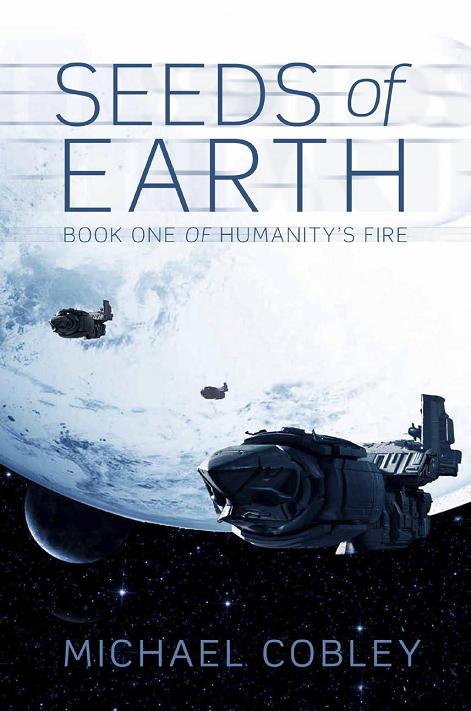
Seeds of Earth, Mike Cobley (2009). See here.

The Lion, the Witch and the Wardrobe, CS Lewis (1950), is a beloved classic. Allegedly. I have vague memories of the Narnia books, although whether I read them as a kid or just picked up the story by cultural osmosis I’ve no idea. Unfortunately, the book’s somewhat patronising hectoring style grated, the talking animals were juvenile, and the one-note characterisation made for an uninvolving read. Don’t know if I’ll bother reading the rest of the series.

A Fire Upon The Deep, Vernor Vinge (1992), I read for a LT group read. I remember being really impressed by this novel when I read it shortly after publication. It’s aged more gracefully than many books of that period, but not even “fruit micro-oils” or “pentapeptides” can hide the wrinkles. The novel makes much of a galactic USENET, and that now reads as somewhat quaint. It doesn’t help that USENET embodied a pretty much heterogeneous culture but in the book it’s supposed to be used by millions of alien races. So not much about it seems especially alien. Still, the Zones of Thought is a neat idea, the Tines are cleverly done, and it’s an entertaining read.

The Six Directions of Space, Alastair Reynolds (2009), is a new novella from Subterranean Press. It’s set in an alternate future in which the Mongols have an interstellar empire, a result of their discovery of a mysterious alien interstellar network. The Mongol future adds an interesting spin to an idea that’s been done before – Andrew M Stephenson’s Nightwatch, William Barton & Michael Capobianco’s White Light, and Sean Williams’ Geodesica duology, all leap to mind. Having said that, The Six Directions of Space then takes off in an unexpected direction. So-called classics of the Golden Age just can’t compare to sf such as this, and I fail to understand why anyone would sooner recommend some graceless and simplistic piece of crap by Asimov.

Millennium, John Varley (1983), is the novelisation of an early screenplay for a film adapted from one of my favourite sf short stories, Varley’s ‘Air Raid’. The film which was eventually made is unfortunately rubbish. But the novel is much better. On reread, the novel struck me as far more Heinlein-esque than I’d remembered. Perhaps that’s something you grow out of – Heinlein works for teenagers, but like all childish things should be put away in adulthood. But it’s only the character Bill Smith who especially reminds me of Heinlein’s works, and he’s soon completely out of his depth and the likeness no longer holds true. (A Heinlein hero would never be anything except completely in control, of course.)

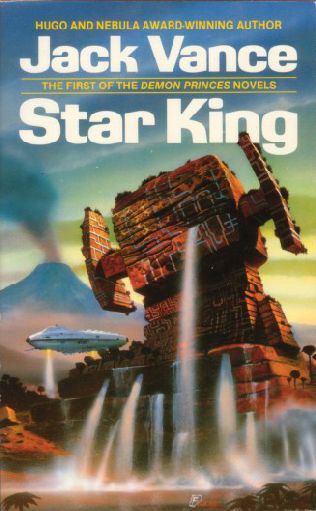
Star King, Jack Vance (1964). See here.

Moon Shot, Alan Shepard & Deke Slayton (1994). See here.

I also watched a few films during the same period. They were:

La Grande Illusion, dir. Jean Renoir (1937), is a World War I prisoner-of-war film. It was entertaining and the dialogue was nicely witty, but it also felt like a string of POW movie clichés knitted together into a story. Time can do that to films….

Fando y Lis, dir. Alejandro Jodorowsky (1968). Jodorowsky is a singular genius. In other words, he’s barking mad. Fando y Lis was his first feature film, and its premiere in Mexico City apparently caused a riot. It’s not as bizarre a film as his later El Topo or The Holy Mountain, but neither is it entirely sane. Some elements worked really well – I was, for example, much taken by the jazz cocktail party in the ruins, during which an upright piano is set on fire.

Rollerball, Norman Jewison (1975). There’s something about 1970s visions of the future I find strangely appealing. All those Brutalist buildings with interiors which appear as though they ought to be offended by the mere presence of people. If there’s one image which sums up the period for me, it’s the mainframe data centre – antiseptic décor, whirring tape reels, chunky moulded terminals and monochrome CRTs…. It promised so much and yet delivered so little. As for Rollerball: well, the eponymous sport isn’t the best bit about the film – in fact that looks a bit silly and nowhere near as lethal as is implied. No, the best bits are James Caan lolling about his mansion with a succession of paid “companions”, the “executive” cocktail party, and Sir Ralph Richardson as the librarian. And all that Brutalist architecture, of course. All it needed for a win of epic proportions was some Apollo Programme technology.

Sky Captain & the World Of Tomorrow, Kerry Conran (2004), was a rewatch. I’ve always felt this film received short shrift on its release. It failed to do well because it was too true to the pulp serials which inspired it – it not only aped their look and feel, but also borrowed their narrative mechanism. And that didn’t go down to well with modern audiences. This viewing of the film didn’t cause me to change my mind, although I thought perhaps it was also too consciously arty for a modern multiscreen audience. It’s all very well blowing shit up, but not in a palette of washed out blues. I still think it’s an under-rated film, though.

Lady Chatterley, Pascale Ferran (2006), was a rental, and I don’t remember why I stuck this on my list. But I’m glad I did. It’s an adaptation of DH Lawrence’s John Thomas and Lady Jane, an earlier alternative version of Lady Chatterley’s Lover. In French. It was a little odd to watch a French film adapted from such a well-known English novel. But, despite that “cognitive dissonance”, I thought Lady Chatterley an excellent film, with the sort of languid and elegiac pace, and detailed eye, of a Tarkovsky film. I fully expect the film to make my top five films at the end of the year.

Avalon, Mamorus Oshii (2001), was another rewatch. This film really impressed me when I first saw it. The special effects struck me at the time as jaw-dropping and, happily, still seemed impressive this time around. The story is, perhaps, none too original, but it’s handled well. And it looks gorgeous.

Watchmen, dir. Zack Snyder (2009) – no, I didn’t think it was as good as many others did. Although it was a great deal better than the execrable 300. I felt Watchmen was too faithful to the comic, and what works on the page doesn’t necessarily work on the screen. Some of the monologues were cringe-worthy. And why were all the Watchmen superheroes? In the comic, they’re just costumed vigilantes; only Dr Manhattan has real superpowers. The story flagged badly in the middle, and comic-book introspection sounds pretentious in a film. Also, Rohrschach appeared to be channelling Clint Eastwood, and The Comedian looked way too much like Robert Downey Jr to be taken seriously (should you take a man called The Comedian seriously? Just how much irony can you shoehorn into a superhero film?). All the same, I’ll be getting the DVD.

Hellboy 2: The Golden Army, Guillermo del Toro (2008). I liked the first Hellboy film, but I’d heard this one wasn’t as good. It wasn’t. Despite the excellent visuals, and some impressive set-pieces, it felt flat throughout. The characters just didn’t seem to do much. Abe was pushed centre-stage through his love affair with Princess Nuala, but still felt less of a character than he had in the first film. The ectoplasmic Johann Krauss, however, just struck an entirely wrong comedic note. Disappointing.


1 Comment

Clarke Award Shortlist Posted

Oh well. It doesn’t much resemble the shortlist I predicted in this post – I guessed The Quiet War and Anathem, but not the others. The shortlist goes like this:

The Quiet War, Paul J McAuley
Anathem, Neal Stephenson
Song of Time, Ian R MacLeod
House of Suns, Alastair Reynolds
The Margarets, Sherri S Tepper
Martin Martin’s on the Other Side, Mark Wernham

It’s not a list that makes me want to dash out and read the books. I’ve already read – and enjoyed – House of Suns, but I didn’t think it was good enough for the shortlist. (But then, I predicted Nick Harkaway’s The Gone-away World would be on the shortlist, but I’m currently reading it and not enjoying it at all….) I’ve only read MacLeod’s short fiction. Perhaps I should rectify that. I’ve read a few of Tepper’s novels, and they were all very much of a muchness – solid mid-list fare with a slight undercurrent of umbrage.
I’m not going to try and predict the winner. I think most expect Anathem to take the prize. I’ve yet to read it – I probably never will, since I disliked Stephenson’s Baroque Cycle so much.


1 Comment

Pure Space Opera – Seeds of Earth by Michael Cobley

I wanted to avoid reviewing books by friends on this blog because, well, it might cost me too much in beers if I ever ran into them at a con… Then I thought, what the hell. It’s not like my friends are crap writers. So I have implemented a policy change. And the first book to benefit from this is:

Seeds of Earth by Michael Cobley.

This is the first novel of a space opera trilogy called Humanity’s Fire. I’d read in several reviews that the book was slow to start but picked up about halfway through. I’d interpreted this to mean there was a steep learning curve. It’s not uncommon in space opera. The author has to lay out their universe and it’s usually a big universe.

But those reviews were quite correct. Cobley’s universe is perhaps not that large – although he’s certainly thrown everything he can think of into it. Seeds of Earth is very much heartland space opera – in fact, it sits right on the bullseye. While this does mean there’s a lot of set-up to plough through – including a somewhat excessive use of italicised alien vocabulary – it’s not just that which accounts for the initial slow pace. However, once the villains appear on the scene the story shifts into high gear, and the book becomes a real page-turner.

Having said that, I suspect Cobley has slightly over-egged his universe. While there are definitely some interesting ideas in there – a hyperspace consisting of strata of dead universes, for example – I personally prefer stories which aren’t so inclusive and which are a little more adventurous with sf tropes.

Which is not to say Seeds of Earth is a bad book. On the contrary, it’s very good. It’s well-constructed and well-written. It’s a pure hit of the purest space opera.

So go read it.

I’m looking forward to the sequel.


6 Comments

Reading Challenge #3 – Star King, Jack Vance

Ringworld and Rendezvous With Rama could certainly be considered classics of science fiction. And Jack Vance is certainly a classic sf author, and has written a couple of classic sf novels. But Star King is not one of them. However, Vance has always been a singular voice in sf, and I’ve always liked his books. So sticking one of his titles on the list for my 2009 Reading Challenge was a no-brainer. And I decided to choose one I’d not read for many years – for a couple of decades, even.

Star King is the first book of the Demon Princes quintet. The series’ story follows Kirth Gersen as he wreaks his revenge on five interstellar criminals who were responsible for enslaving his town when he was a child. Each novel details his revenge on one of the criminals. The first criminal is Attel Malagate the Woe, a member of an alien race known as Star Kings.

Star Kings are actually humanoid amphibians, but appear entirely human. They are also intensely competitive and driven to excel. The fact that Malagate is a member of this race does help Gersen eventually identify him…

Gersen has been brought to be an instrument of revenge by his grandfather. He has all the necessary skills, and is especially effective at unarmed combat. His grandfather dies and leaves him with a single name, a pirate captain he recognised who was present when the town was enslaved. In a flashback, Gersen visits the pirate, tortures him until he gives up the names of the five criminals – the demon princes of the series’ title – and then kills him.

While meditating on this information at Smade’s Tavern on Smade’s World, Gersen meets Lugo Teehalt, a locator who has discovered an Edenic world ripe for settlement. However, Teehalt has learnt that his sponsor is Malagate, and he doesn’t want to hand over the location of the world to the criminal. Teehalt is then murdered by three other guests of the tavern – who admit they work for Malagate. They take Gersen’s ship, assuming it is Teehalt’s.

Gersen finds Teehalt’s ship, and there are enough clues in it to indicate that Malagate is one of three administrators at Sea Province University on the world of Alphanor… But which one?

I read Star King in a day. There’s not much in it. My edition, the 1988 Grafton paperback, has only 208 pages. And even then, there’s not that much plot. Gersen fortuitously meets Teehalt. Gersen stumbles on a clue to Malagate’s real identity. Gersen puts into effect plan to identify Malagate. Plan works – albeit with one or two minor hurdles to overcome.

Vance has fleshed this out by having Gersen questioning everything he learns and everything he does. It makes the story somewhat… conditional. It’s bad enough that the plot starts with a coincidence, but the continual second-guessing only makes it seem as if Gersen is being driven by the plot rather than vice versa. Even the resolution relies on events Gersen could not have foreseen or planned for. He has his plan, yes; but the final clues which reveal which of the three administrators is Malagate are not part of it.

Still, this is a novel by Jack Vance. And you read his books as much for his voice as for the story. In that respect, Star King does not disappoint. It might be a thin work, but it could never be mistaken for another writer’s novel. Perhaps it’s more lightweight than I’d remembered, but it’s still a fun read. There are worse ways to kill a couple of hours, and certainly worse books available in any book shop.

I’m tempted to read the other four books of the Demon Princes series, but… the to-be-read pile is big enough already. Another day perhaps.