It Doesn't Have To Be Right…
… it just has to sound plausible


8 Comments

When men were men and so was science fiction

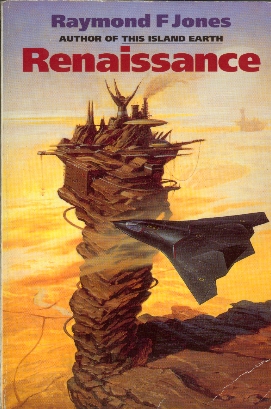
After reading the 2011 science fiction novel which prompted my Whores in Space post (see here), I read a 1950s sf novel: This Island Earth by Raymond F Jones. I’ve seen the film several times, and it’s fairly typical of its period – manly hero, women there only to scream, ugly mutant, flying saucer. I read the novel because I’d been toying with the idea of adapting part of it for a short story, and because I wanted to see if it was different to the movie.

It is.

The first half of the film more or less follows that of the book. Cal Meacham is a manly electronics engineer in California. When an order for parts for a project goes awry and he receives instead some devices which are decades ahead of what he is expecting, his curiosity is piqued. He orders a catalogue, and from it he then orders the parts necessary to build an “interociter”. Without actually knowing what an interociter does. The bits are delivered, he figures out how to put them together… and it’s a communications device. Which is promptly used by someone to offer him a job as he has “passed the test”.

In the film, this is a man called Essex Exeter, but in the book he’s called Jorgasnovara. Exeter is head of a secret thinktank with access to technology more advanced than that known to 1950s USA. Jorgasnovara is head of an industrial plant which builds interociters using technology more advanced than that known to 1950s USA. Both, it transpires, are actually alien and are using the Earth as a supply depot in a war. In the book, the war is intergalactic and between a good bloc, the Llanna, and an evil bloc, the Guarra (whose members also smell bad). There is no Metaluna in the book, and no mutant monster.

This Island Earth was originally published in 1952. It’s a fix-up of three stories published in 1949 and 1950: ‘The Alien Machine’, ‘The Shroud of Secrecy’ and ‘The Greater Conflict’. Meacham fought in WWII, and is determined that the devices invented and built by scientists or engineers should never again be used as they were in that conflict: “like careless and indifferent workmen they have tossed the product of their craft to gibbering apes and baboons”. He is not only an engineer but also fervently anti-war. (But not anti- the occasional need for fisticuffs, however.) His engineering know-how and can-do-it-iveness therefore means he is better than everyone else. Only he knows the rightful use to which the devices he builds should be put. (It is this very arrogance which Jorgasnovara uses to recruit engineers to his organisation.)

And then there are the women…

The lone female in the novel is Dr Ruth Adams. She has a doctorate in psychiatry, but is employed as the assistant to the head of personnel. Meacham is immediately attracted to her. When he picks her up for a dinner date, he considers it “impossible to think of a MD and PhD in that dress”. Surprisingly, Ruth keeps her job after she marries Cal, though she does all the cooking – despite a mention earlier that Cal is capable of cooking for himself. Perhaps it’s unrealistic to expect a strong female character with agency in a 1950s sf novel written by a man, one which elevates engineers to the status of special universe-saving snowflakes. But Ruth’s portrayal still offends – she may be educated, but she’s very much Dale Arden and not Hildy Johnson.

It’s not the only aspect of the book which should upset modern sensibilities. The working class fare badly too. When the plant manager fires an incompetent employee, the union pulls everyone out on strike – despite what appear to be reasonable grounds for termination. And then someone sabotages the assembly line. Meacham immediately accuses the shop steward. Because, of course, manly men of science fiction despise anything that smacks of socialism, and so it naturally follows that a union man would obviously destroy the very factory where he works because management won’t meet his “unreasonable” demands.

Meacham’s manliness and engineering expertise means he never surrenders – always there is a solution, or a means of escape. Ruth, of course, is always the first to scream and give up when the couple find themselves in jeopardy. This also applies to the “Greater Conflict”, which by the final quarter of the book is threatening to destroy Earth. Despite the war having raged for millennia, and involving uncountable alien races far more advanced than humanity (they have giant computers!), it takes a can-do engineer like Meacham to spot why the Llanna have been steadily losing. They rely on their giant computers to determine strategy and tactics. As a result, they’ve become predictable, and the Guarra can guess their every move. They need to act randomly! Like randomly saving the Earth from the approaching Guarra battle fleet!

This Island Earth is not even tosh. It’s desperately old-fashioned, and probably felt so back in the 1950s. The pilotless aircraft which carries Meacham from his company lab to Jorgasnovara’s factory near Phoenix, Arizona, is propeller-driven, though you’d have expected such an advanced organisation to have jet aircraft (which had been flying for nearly a decade by 1952). The science throughout is nonsense: the journey to the Moon, for example, takes all day in one chapter, and mere minutes in another. In the same spaceship. Earth is apparently only a few hundred light years from the edge of the Milky Way (it’s closer to 25,000 light years). But then Jones doesn’t seem entirely sure what a galaxy is, or how great the distances between them (clue: The Andromeda Galaxy is about 2.6 million light years from Earth). Oh, and the interociter turns out to be a telepathic communications device – its use as a videophone is just there to disguise its true function. Except it is later revealed to be a weapon which fires devastating telepathic blasts… which also kill the interociter user…

No wonder the Llanna were losing the war. If only they had recruited a manly engineer from Earth a couple of thousand years earlier.


3 Comments

World fiction reading challenge #1: The Fat Years, Chan Koonchung

I know very little about China and almost nothing about its literature or literary tradition. So a book from the country seemed a natural choice for my reading challenge this year. And since Chan Koonchung’s The Fat Years had recently been gaining notices, appeared to be sf masquerading as mainstream fiction, and was about, and set in, China, then it seemed the perfect book to choose.

Having read The Fat Years, I now know more about China and her recent history. I suspect I still know almost nothing about Chinese literary tradition, however, because The Fat Years is in many respects constructed like a Western novel. Except it also isn’t. More on that later.

The novel opens in 2013. Old Chen, a novelist and journalist, is a Taiwanese resident of Beijing. He is, like many middle-class Chinese, happy and contented. Suspiciously so, in fact. Further, the entire country – including the rural population – appears to be happier and more successful than they can previously remember. While the rest of the world suffers from a financial crisis, China is the happiest nation on Earth.

But not everyone is so contented. One or two people feel this happiness is artificial. It also seems to have come about after the events of February 2011, when the global economy crashed. Except there is no official record of that month. The economy crashed, and China’s “Age of Ascendancy” began – at the same time, according to the records. Old Chen finds himself dragged into a hunt for the missing month, which eventually leads him to the reason for China’s unnatural happiness. This he learns after he and some friends have kidnapped a Party leader Old Chen knows. The Party leader explains it all.

As a novel, The Fat Years is far from satisfactory. Chen meanders about, meeting friends and acquaintances, but not actually driving the plot forward. And the dénouement is one big info-dump delivered by the Party leader. According to a translator’s note, it is this last section which is of most interest to Chinese readers – chiefly because of its criticisms of Chinese society and government. Myself, I found the frequent asides and info-dumps on China’s twentieth-century history the most fascinating aspect of the book. I was even inspired to read up on some aspects on Wikipedia.

I’m glad I read The Fat Years and it is an interesting novel. But it’s also not an especially good one. It is its subject which fascinates, rather than its story or the presentation of its subject.


5 Comments

Books you must read: Omega, Christopher Evans

I’ve been a fan of Evans’ novels since reviewing his Aztec Century for Vector, the critical journal of the BSFA, back in 1993. His fiction is a literate, very British sort of sf, which doesn’t rely on flashy spectacle but on in-depth studies of their protagonists and their worlds. Omega, published in 2008 by PS Publishing and Evans’ first novel in more than a decade, is a case in point.

Owen Meredith is a maker of military history documentaries. One day while Christmas shopping with his wife and two daughters, a bomb explodes in Hamley’s. Meredith is outside and only injured in the blast, but his family are in the store and killed.

Major Owain Maredudd is an officer in an Allied army in a Britain that has been at war for over half a century. He had led a mission into enemy territory to test a new weapon, but something went wrong. Maredudd was the only survivor, and his memories of the mission are somewhat confused. As a result, he has been attached to his uncle’s staff. His uncle is the commander-in-chief of the allied forces in the UK and a member of the Joint Governing Council, the military junta that rules the Alliance. He is, in effect, the ruler of most of Europe.

When Meredith wakes in hospital after the bomb blast, he discovers first that at times he somehow inhabits Maredudd’s head, and so witnesses events in the major’s world. And secondly, Meredith’s memories of his life before the explosion don’t quite tally with the life he seems to now have. For a start, he is apparently in hospital because he was hit by a car while crossing the road. There was no bomb blast. And his wife left him several years before, taking the kids, and now lives in Australia.

As Meredith tries to figure out his life and pick up the pieces, so he comes to spend more time in Maredudd’s world. Maredudd himself is having his own problems as there seems to be something going on with his uncle to which he’s not privy but in which he is somehow involved. This is all to do with the secret weapon after which the book is titled. The Americans, once part of the Alliance, are apparently getting troublesome and the Omega weapon is intended to stop them.

Omega is not an easy book to do justice to. It’s an alternate history, inasmuch as part of the story is set in a world still embroiled in a world war. But it’s also much more than that. It’s a study of both Meredith and Maredudd, and their reactions to worlds they find it increasingly hard to fathom. While Meredith also has Maredudd’s world to explore, it’s implied that Maredudd is doing the same to Meredith. Certainly, there are periods when Meredith is strangely absent – though from others’ reactions it seems he continues to function as “normal”. The alternate UK is extremely well-drawn and very convincing, but it is the two protagonists who really carry the book. The writing is plain but elegant, the worlds of Meredith and Maredudd are portrayed with authority, and the novel is an engaging and surprisingly quick read.

I’m surprised Omega didn’t appear on any short-lists back in 2009. It’s certainly a better novel than the four that made it onto that year’s BSFA short-list – Aztec Century, incidentally, won the BSFA Award in 1994 – and it could have been a contender for the Clarke too. Recommended.


2 Comments

Books you must read: The Bender, Paul Scott

There are comic novels and there are novels of wit. Some novels evince humour by describing ridiculous characters in ridiculous situations; others prefer to amuse through their use of language. Paul Scott’s The Bender (1963) is a novel of wit and its characters, while amusingly drawn, are not comic caricatures. There is also much in the novel that points to Scott’s Raj Quartet, a use of language, voice and narrative that presages The Jewel In The Crown and its sequels.

George Lisle-Spruce is a wastrel. A relative left him a legacy of £10,000, which he cannot touch. But it does provide him with an annual income of £400. Initially, this was more than enough to live on, but by the beginning of the 1960s, George is finding it increasingly hard to make ends meet on his monthly allowance. And now his brother, a successful accountant, wants repaying the £200 he lent George years before. George spent the War in Cairo, and was never in combat. Since then he’s never held down a proper job. He has some charm, but never really made the most of it. And this is despite the best efforts of his Aunt Clara – who is not really his aunt, but whose husband it was who left George his legacy.

The Bender is told from the points of view of George, Aunt Clara, a real aunt who is on her death-bed, brother Tim, and youngest brother Guy (an Angry Young Man, with a play that has been broadcast on television to critical acclaim). The repayment of Tim’s loan precipitates a crisis in George’s life – though it is exacerbated by Clara’s renewed meddling, Tim’s impending change of career, and Guy’s success.

The writing in The Bender is a delight. It’s witty, the voices are handled superbly – though, one, Guy’s hippie chick girlfriend, feels somewhat forced – and a section two-thirds of the way through astonishes with its seamless post-modern blending of narratives and voices. The novel is also a pitch-perfect evocation of time and place, and feels throughout like a 1960s British black and white film starring Dirk Bogarde. Aunt Clara is perhaps the most amusing character – a forceful and opinionated dowager, with old school views about class and ability, views she has a habit of setting forth on tape:

…the Grundig’s microphone in one hand and, in the other, one of the Floris chocolates for which her lunchtime liquid slimming diet always gave her an appetite…

The Raj Quartet are novels of consequence. While The Bender may be somewhat inconsequential, it reaffirms my admiration of Scott’s writing. Fortunately, I have many more of his books to read. Recommended.


2 Comments

Women in sf reading challenge #10: City of Pearl, Karen Traviss

To be honest, I had not really expected to enjoy City of Pearl by Karen Traviss. From what I’d heard about the novel, it seemed the sort of science fiction I don’t especially like. And Traviss is known as an especially mercenary writer. No matter how talented she may be, such an attitude is unlikely to create works I would find appealing. Nonetheless, I picked the book as one of my dozen for my 2011 reading challenge, and though I may have slipped a little towards the end of last year, I had every intention of reading and blogging about the twelve listed novels.

And so I came to City of Pearl with, I admit, a few preconceptions. Some of them were indeed met, but I was surprised to find myself enjoying the novel more than I had expected.

Shan Frankland is a hard-as-nails police officer in a near-future in which corporations dominate ineffectual governments. All crops are genetically-engineered and trademark, such that no foodstuff can be grown without paying a license fee to a company. When Frankland is offered command of a mission to Earth’s only interstellar colony on Cavanagh’s Star’s second planet, she accepts the mission. But she doesn’t know exactly why, because whatever was told to her to persuade her to accept was part of a Suppressed Briefing, which only releases information into her memory in response to certain triggers.

The mission arrives at Cavanagh’s Star 2 and finds a situation it had not expected: a small low-tech human colony with an extremely small environmental footprint living under the aegis of an alien race, the wess’har. The aliens are actually native to Cavanagh’s Star 2’s twin planet, and are on Cavanagh’s Star 2 to protect that planet’s native squid-like aquatic race, the bezeri. Who had been almost polluted to extinction by a third alien race, the isenj, who had colonised the world. The wess’har wiped out the isenj colony, but now allow the humans to stay on sufferance. Aras is the wess’har responsible for the planet and its ecosystem, and he has been given this role because he has been infected by a native parasite, the c’naatat, which has made him immortal and almost impossible to kill.

Though Frankland tries to keep a tight leash on the scientific team she has brought to Cavanagh’s Star 2, they cavil at her restrictions and continually seek to subvert them. This makes tensions high within Frankland’s mission, a situation not helped by her high-handed and take-no-prisoners attitude. When a second starship from Earth turns up, having departed fifty years after the first, it seems Earth has formed an alliance with the idenj, who determined to take back Cavanagh’s Star 2. During a skirmish with the isenj, Frankland is mortally wounded, but Aras, who has come to value her, infects her with c’naatat. Now she can never return to Earth.

I liked Frankland, and the best parts of City of Pearl were the parts which focused on her. Unfortunately, the aliens are all single-note: the wess’har are literal and unbending, the bezeri are enigmatic, and the isenj are numerous. The scientists are all characterised as venal and selfish, and only the military characters appear to possess any redeeming virtues. The human colonists on Cavanagh’s Star 2 are treated like simple back-to-the-land peasants, and the novel makes little or no judgment on them or their way of life. A lot of City of Pearl is in Aras’ point of view, and he’s neither convincingly alien nor especially interesting.

There’s a fixity of views throughout City of Pearl which I found a little off-putting. The wess’har are very literal and do not compromise. Frankland is very much convinced her own opinion is always correct. The entire cast – with the exception of those Traviss villanises – are straight from the US mode of science fiction, with its Rational Competent Men. Though many in City of Pearl are actually women. Or alien. There’s no subtlety or complexity in the novel. The scientists are wrong, the isenj are wrong. And that’s it. I can see how such binary views might appeal to some readers, especially genre readers, since populist genre fiction seems incapable of psychological depth.

There are apparently a further five Wess’har books, but I’ll not be bothering to read them. While City of Pearl managed an interesting meld of near-future sf and space opera, it was too much like military sf in tone to really appeal to me. Traviss’s prose is readable and well-paced, though to be honest I kept reading more because I liked the character of Frankland than anything else.

Oh, and the titular city is the wess’har capital on their world, and it makes perhaps a half dozen appearances in the novel. Frankland visits it toward the end in order to seek permission from the wess’har elders to stay with Aras. It’s a somewhat peripheral element of the story with which to title it.


10 Comments

A fine fantasy

I remember reading Carolyn Ives Gilman’s Halfway Human back in 1998, thinking it very good, and then being somewhat disappointed when no further novels appeared from her. I later discovered she’d had a number of short stories published – chiefly in F&SF – and even a novella, ‘Arkfall’ (now available from Phoenix Pick here). There are also a pair of chapbooks from Aqueduct Press.

Last year, I learnt Gilman would have a new fantasy novel published by ChiZine Publications. I am not, it has to be said, a huge fan of fantasy. Too many strike me as too similar. Ripping off a different culture for the background, or implementing a new magic system, is not enough. But the description of Isles of the Forsaken seemed to me it might appeal. So I pre-ordered a copy.

I have now read it. And I was not disappointed.

The Inning Empire has just won a years-long war, and has decided to turn its attention to its colonial possessions, the Forsaken Isles. The empire is a lexarchy, which means it is ruled entirely by its Courts and legal system. Despite this, it’s not especially enlightened – in fact, the Innings as a race are arrogant and racist, and their colonial policies reflect this.

Harg Ismol is an Adaina, the lesser of the two races which inhabit the Forsaken Isles. The others, the Torna, are the dominant race and administer the islands in the name of the Innings. Also relevant are the Lashnura, or Grey Folk, semi-magical healers who can take away the pain and injuries of the islanders. The Innings do not understand this relationship, imagining the voluntary empathic bondage the Grey Folk undergo is little more than slavery. Harg had a good war, and rose to the rank of captain, the only Adaina to do so. Though he is offered the command of the Native Navy by Admiral Corbin Talley, head of the Inning Navy, he turns it down and returns home to Yora, an island in the South Chain of the Forsakens.

At which point, things start to go horribly wrong.

Isles of the Forsaken moves smoothly from a story about a disaffected hero returning home from war into a story about an archipelago-wide rebellion. This is driven by veterans having seen the rest of the empire, and by the Innings’ desire to finally “sort out” the islands. Harg is, of course, caught up in this, if not partly instrumental. Also important is Nathaway Talley, the youngest son of the Inning Chief Justice (and brother of Corbin), who is on Yora because he wants to introduce the Adaina to the benefits of Inning law. And there is also Spaeth, who was created as a companion by Yora’s lone Lashnura, but has yet to take on her healing responsibilites.

There are, however, one or two set-pieces in the book which feel a little contrived. Harg’s first run-in with the Tornan authorities, for example, seems a bit too well-designed to put him on the path the plot demands. Which is not to say Harg is not a well-rounded character. He’s a reluctant hero – while acknowledging that he’s best-placed, and has the necessary skills, to lead the islanders’ fight, he doesn’t want the responsibility of leading them into a war they would probably lose. And which would doubtless result in bloody reprisals. Further, there is an island myth about a leader, the Ison, who appears in times of need to lead the islanders to victory. Harg doesn’t believe he is the Ison, nor does he want to be him – part of the myth involves a “cleansing” by one of the Lashnura, which Harg refuses to undergo.

Nathaway’s transformation from idealistic naïf is better-handled, though it takes a while to get going. The Grey Folk, and the mythology which they represent, provide an interesting backdrop to the story, one which becomes increasingly important and relevant as the plot progresses. In parts, this mythology reminded me a little of Le Guin’s Earthsea books, particularly when Spaeth takes Nathaway to the “circles”, where the opposing balances which “rule” the islands manifest. The character of Tiarch, the Tornan governer of the Forsaken Islands, struck me as the sort of character Gwyneth Jones would write.

One section of the story which stands out takes place when Spaeth and Nathaway escape from Admiral Talley’s custody. They flee into the sewers beneath the city, but soon get lost and, somehow, cross over into another “circle”. This is one not even Spaeth recognises. It manifests as a series of mezzanine floors about a great well many many levels deep. Each level contains vast rooms in which are stored books and scrolls and other forms of document. The section is genuinely creepy, and the writing – which is good throughout the novel – is especially effective at getting this across.

Isles of the Forsaken is a post-colonial fantasy. Though the Inning Empire won its war, and is governed by what we would consider a fair and impartial system, the story’s sympathies plainly lie with the Forsaken Islanders. Of course, the Innings are far from the noble people their technology and political system would suggest. Nor are they the only ones who are racist – the Torna consider the Adaina to be nothing more than feckless and ignorant peasants. There are different ways of life on display in Isles of the Forsaken, and its ignorance about these among and between each group which is partly the fuel which drives the plot. The Innings’ lexarchy also comes under scrutiny. Theoretically an impartial and impersonal system with no real leadership, it is in practice dominated by the Talley family, and Corbin’s campaign in the Forsaken Islands is partly phrased as a launchpad for a bid for power by him back in the Inning homeland.

I read Isles of the Forsaken pretty much in two sittings. It may only be 312 pages long – definitely a point in its favour, given that it is a fantasy – but even so, I’ve not read many books in recent years which have dragged me into their story and kept me there quite so effectively. I’ve already pre-ordered the sequel, Ison of the Isles.


2 Comments

British sf masterwork: The Uncensored Man, Arthur Sellings

When I put together my list of British SF Masterworks last year (see here), a number of eligible authors were suggested to me that I’d never heard of before. One such was Arthur Sellings who, I discovered, had written six novels and numerous short stories (many of which were collected in two collections) between 1953 and 1970. He died suddenly in 1968 of a heart attack, “just as he was gaining more and more notice” according to his entry in the SF Encyclopedia here.

Although I actually put Sellings’ 1970 novel, Junk Day, on my British SF Masterworks list, I have so far only managed to acquire The Silent Speakers (1962), his debut novel, and The Uncensored Man (1964), his second novel. It was the latter I read.

Dr Mark Anders is a physicist at Jarwood, a secret British weapons laboratory. He is married to Ruth, who also works there, but their marriage is faltering. Ruth is too perfect, and too much a perfectionist, and whatever spark their relationship had possessed has long since dissipated. In an effort to cheer himself up, Anders goes visits an old friend who is a doctor in a distant town. While there, he witnesses a teenage patient of the doctor’s have an epileptic fit, wake up and talk for a minute in German, and then fall into a light coma. But the boy has learning difficulties and has never been taught a foreign language. Intrigued, Anders investigates further, but draws a blank. Then his brand-new computer spits out a page of Greek writing instead of the expected experimental results. He gets this translated, and it proves to be a quote from the Book of Revelations.

Mystified, and suspecting he may be suffering from some psychological condition, Anders visits Dr Nowatski, A Polish psychiatrist he met briefly at a party years before. Nowatski gives Anders a shot of LSD – it was legal, in those days. Under the influence of the drug, Anders… visits a parallel world and meets its human inhabitants. The remainder of the novel describes Anders attempts to learn the truth of this alternate Earth, his run-ins with Jarwood’s security stemming from his association with Nowatski, and his subsequent development of mental powers.

The Uncensored Man is tosh, but it’s quite well-written tosh. The central premise – the origin and reason for existence of the alternate Earth – is neither plausible nor convincing. While Anders is a nuclear physicist working on neutron bombs, Sellings gives no information on his actual work. And though the reason why his computer spouts Greek is explained, how it actually does so is ignored. The book lacks authenticity.

However, Anders is a well-drawn character. Likewise Nowatski. The two women – Ruth, and Nowatski’s wife, Anna – are less rounded, though their treatment is sympathetic. In fact, they are repeatedly shown to be better persons than their menfolk. The prose is also good – in other words, it is typical of British sf of the 1960s, and so much better than US sf of the same period. US authors of the time may have had the ideas, but British sf authors had the writing chops.

The Uncensored Man is a very British novel, and very much a novel of its time. These days, it’s little more than a curiosity. It’s no masterwork, and it remains to be seen which of Sellings’ novels belongs on my list. It’s an interesting read, but not one, I think, that would have set the genre alight.

As mentioned earlier, I also have a copy of Selling’s debut, The Silent Speakers (published as Telepath in the US), and if I see other novels by him I’ll no doubt pick them up. But he was neither as good as Compton, nor as prolific as other British sf authors of the time, such as Tubb, Brunner or Cooper. Like Rex Gordon and Leonard Daventry, the fact he’s now forgotten does not seem entirely surprising. But it would not have done the genre a disservice to have had the likes of Sellings and his peers representing it rather than some of the sf novels we now consider to be classics.


23 Comments

Bookjoy: more Compton

Synthajoy was DG Compton’s fourth science fiction novel. Previously, he had written half a dozen crime novels under the name Guy Compton. So it should come as no surprise that Synthajoy is as much a crime novel as it is a science fiction novel.

Thea Cadence has been incarcerated in the Kingston, a clinic designed to rehabilitate criminals using the Sensitape process. Thea’s husband, Dr Teddy Cadence invented Sensitape – or rather, he invented the concept. The device itself was invented by Tony Stech, his business partner. Sensitape is, as the name suggests, recorded emotional states which can be played into a person’s mind, and thus directly affect it. At the Kingston, Thea is undergoing Sensitape treatment in contrition as her sentence for a crime.

Cadence had been inspired to invent Sensitape while attempting to cure Stech’s father of an increasingly common condition called UDW, Uncompensated Death Wish. He failed to prevent the man’s death, but Sensitape did subsequently make UDW extremely rare. In fact, Sensitape was a great success. But the recording made of a couple making love, Sexitape, was an even bigger success. Cadence, however, always dreamed of artificially creating the emotions on a Sensitape, i.e., deliberately programming the effect required. He called this process Synthajoy.

Thea drifts in and out of her memories as she is being treated. Though she did not defend herself during her trial, she does not consider herself guilty of the crime. She resists her rehabilitation treatment. And in between periods of introspection and rebellion, she relives – or explains to her nurse – the history of Sensitape and her involvement with it. In this way, facts pertinent to the crime of which she has been charged are revealed.

Thea murdered her husband.

An early Sensitape session in which she was the guinea pig gave her a revulsion for her husband’s body. He found sexual companionship in the arms of another woman – the one from the Sexitape, in fact. Thea meanwhile had an affair with Tony. Who later committed suicide under suspicious circumstances. During her trial, the prosecution claimed it was jealousy that had led to the murder. They did not know of Thea’s relationship with Tony, nor did she tell anyone of it.

Synthajoy is a carefully-plotted ramble through Thea’s consciousness and history. She is hiding the truth from herself as much as she is from her prosecutors and rehabilitators. And it is only as she reveals her past that the truth about Tony’s suicide and the murder of Dr Cadence are uncovered. Unlike later novels, Synthajoy is a single-hander, and told entirely from Thea’s point of view. She is intelligent, educated, middle-class, and beautifully real. Unsurprisingly, the writing is a joy to read:

It is extraordinary to watch my hands. They smooth and fold, now so neat and expert, so accomplished now that they act without mind, without my volition … Hope is like a fever, a heat engendered by battle, and it leaves a deadly chill behind it. My arms ache. My hands tingle and creak. (p 50)

Also, unsurprisingly, the book is very firmly British, and very firmly a novel of the late 1960s / early 1970s. (It was first published in 1968). Those characteristics, as much as the writing, are the essence of Compton’s appeal. His novels are fiercely intelligent and beautifully crafted, but it is their finely-tuned sense of time and place, the way the central ideas are so well integrated into the real world, that makes them stand out.

There are ideas that Compton returns to again and again. The abuse of technology is an obvious marker – and one that demands a story set in as close an analogue of the real world as is possible. And yet… It seems odd that Compton should begin his writing career in crime, writing novels in which the purpose of the story is to explain a death. Yet his science fiction novels typically feature epidemics of unexplainable deaths – UDW in Synthajoy, Gordon’s Syndrome in The Continuous Katherine Mortenhoe (see here), and the Disappearances in Ascendancies (see here).
In his three decades of writing science fiction, Compton never won an award, despite being published regularly in both the UK and the US. The Steel Crocodile was shortlisted for the Nebula in 1971, but lost out to Ringworld (an extremely popular book, but nowhere near as well-written). He appeared on the Locus Award shortlist three times, and in 2007 the SFWA made him an Author Emeritus. Yet he was possibly the best British sf writer of the 1970s. At a time when US authors of the 1950s dominated the field on both sides of the Atlantic – Asimov, Smith, Herbert, Heinlein – Compton was one of a handful of British sf writers writing sf novels so much more intelligent and well-crafted than those of their contemporaries. It’s a shame they appear to be mostly forgotten, and it’s the likes of Foundation and Stranger in a Strange Land which dominate lists of so-called genre classics. Perhaps the re-issue of Compton’s back-catalogue as ebooks through the SF Gateway (Compton’s entry is here), and The Continuous Katherine Mortenhoe‘s appearance in the SF Masterwork series in October 2012, will see Compton receive the recognition he deserves.

The following novels by Compton are currently available on Kindle via the SF Gateway. If you own such a device, you should buy them immediately: Farewell, Earth’s Bliss (1966), The Silent Multitude (1966), The Quality of Mercy (1967), Synthajoy (1968), The Steel Crocodile (1968), Chronocules (1970), A Usual Lunacy (1978), Windows (1979), Ascendancies (1980), Scudder’s Game (1988), Nomansland (1993), Justice City (1995) and Back of Town Blues (1997).


8 Comments

Women in sf reading challenge #9: Shadow Man, Melissa Scott

If I’ve had trouble reading the books for my challenge in their proper months, it’s not because reading them is proving a, er, challenge. On the contrary, it’s because I’ve made a change in my reading patterns which makes the books I chose for the challenge less of a conscious or deliberate act of selection of reading material. I now read more books by women writers, and so the dozen books of my reading challenge are just twelve among many. In that respect, the challenge can be counted a success – and only nine months in, too. Nor have any of those nine books been bad books, though a couple I didn’t enjoy as much as the others.

Which brings me to Shadow Man by Melissa Scott, September’s book for the challenge. I was aware of the book’s reputation before choosing it – in fact, it was that which likely led to its selection. However, that reputation had not really prepared for what I found when I started reading it. Because what Shadow Man is, is Ursula LeGuin’s The Left Hand of Darkness through a funhouse mirror. It is also a more political novel than the political The Left Hand of Darkness. Comparisons are inevitable, even though LeGuin’s novel takes place on a world with one gender and Shadow Man takes place in a universe with five genders. Both novels have placed the treatment of gender – culturally and legally – front and centre.

In the universe of Shadow Man, the use of a drug to offset “FTL shock” has resulted in a far greater than normal incidence of intersex and hermaphrodite births (miscarriages are also correspondingly higher). The Concord Worlds now recognise five genders – woman, man, fem, mem and herm; respectively, she, he, ðe, þe and 3e. (Unfortunately, I kept on reading the pronouns referring to herms as if they used the Arabic ﻉ (‘ayn) rather than the numeral 3.) These five genders have led, in turn, to nine sexual preferences, and this has bearing on the plot of the novel.

On the world of Hara, a colony planet re-contacted 100 years previously after several centuries of independent development, the law and society only recognise two genders – man and woman. So the herms, mems and fems must take on the role of one or the other – though there is apparently a facility for herms at least to legally change gender. The Traditionalist Harans feel that true humans have only two genders, and they do not want to join the Concord. The Modernists want the other three genders to be recognised in Haran law. It is the battle between these two groups which drives the plot of Shadow Man.

Warreven is a herm, but legally male, and works as an advocate in the Haran legal system. Years before, 3e almost married the son of the Most Important Man – the de facto ruler of Hara – but 3e refused to change legal gender. Now, 3e fights for gender rights in the courts. Mhyre Tatian is the manager of a middle-sized Concord pharmaceutical company’s operations on Hara. The world’s biggest export is its drugs, all derived from the local flora. Also important is “trade”, which is prostitution, mostly involving the three genders not recognised on Hara.

Warreven is involved in a court case which looks set to play a major role in the fight for gender equality. But the Most Important Man doesn’t want that to happen, because as long as things muddle along as they presently are doing, a delicate balance between the Traditionalists and the Modernists is maintained. But his son, Tendlathe, is a staunch Traditionalist – a blinkered, chauvinist and conservative Traditionalist of the worst kind. In an effort to keep Warreven from the courts, the Most Important Man has him elected as his clan’s seeraliste, the person responsible for selling off the clan’s surplus crops. Meanwhile, the Interstellar Disease Control Agency, the organisation responsible for preventing the spread of diseases – a variety of HIVs were also created by the FTL drug – also wants to prevent that case from going to court for their own reasons. Tatian is caught in the middle as one of his employees is a key witness. When Warreven offers Tatian the entire clan surplus in return for the employee’s testimony, it kicks off a series of Traditonalist attacks on the Modernists and the “odd-bodied”.

Scott makes no concessions when introducing the world of Shadow Man. It’s straight in at the deep end. There are one or two info-dumps streamlined into the narrative, but they provide little more than local colour. The story is told from the points of view – alternating – of Warreven and Tatian. From Warreven, we see what it’s like to be a herm in a society that does not recognise it as a gender, and we get the politics which affects that. Tatian provides an outsider’s view of Hara and its culture. Though both mention at various points some physical attraction between them, it never amounts to anything.

As a sf novel set in a strange and interesting world, with a pair of likeable protagonists, Shadow Man succeeds. There’s an air of exploration to the story, as it spends a great deal of time savouring the culture of Hara before the somewhat abrupt final confrontation. Yet the action never moves outside the capital city, though places elsewhere on the world are often mentioned. It makes for a languid read, a story in which the politics of the climax seems to page by page subsume the story of Warreven and Tatian – in fact, for at least half of the book, they’re barely acquaintances.

But it is the gender politics for which Shadow Man is known, and I found them a little problematical in places. For a start, the thing driving the gender politics in the story is “trade”. It’s almost as if the odd-bodied genders are defined by the roles they play in prostitution. There’s a level of prurience implicit in the Traditionalist response to herms, mems and fems, and given the focus on trade it’s not hard to understand why they might hold such an opinion. Perhaps Shadow Man needed to show a Concord world’s society as contrast, because all the reader has with which to compare it is the situation in the real world. It’s also worth noting that the genders in Shadow Man are defined by biology – it’s the secondary sexual characteristics and equipment which determine which gender a person is. And while the book’s glossaries helpfully explain the nine sexual preferences – there is a glossary of Concord terms and one of Haran words – those sexual preferences make only a few appearances in the story. Haran society is dual-sexed, and the story treats all interactions as such, acknowledging the existence of sexual preferences beyond woman-man but not really exploring them. And this is in a novel whose story describes the start of a sexual revolution comparable to the fight for gay rights in the real world. In fact, Shadow Man‘s penultimate chapter is very much an analogue of Stonewall.

Literalising a metaphor is not uncommon in fiction, and is an excellent tool for commentary. I’m not entirely convinced that literalising sexual preferences as biological gender necessarily helps discussion, though in Shadow Man it has resulted in an interesting universe. It’s a pity Shadow Man doesn’t explore more of it. Which is not to say it’s a bad novel by any means. I enjoyed it and thought it good. I’d happily recommend it. I am somewhat surprised it has never been published in the UK. It seems to me it would fit in quite happily with a number of sf novels which have been available here over the years – not just the aforementioned LeGuin, but also books by Storm Constantine, Samantha Lee, Mary Gentle, or even Gwyneth Jones’ Aleutian trilogy…

5 Comments

Women in sf reading challenge #8: Spin State, Chris Moriarty

There are those who believe science fiction is a predominantly pessimistic genre, and certainly many of the futures that sf novels posit can hardly be called utopias. Of course, much of this depends upon your personal politics – a neoliberal fantasy, for instance, would likely appeal to a plutocrat, or to someone so deluded they think they actually stand a chance of becoming one. Yet such futures are common in science fiction, and often the protagonist – ie, the character with whom the reader is asked to identify – is a victim of this society, a person whose agency does not stretch much beyond what they can actually grasp with two hands. Frequently too they are fighting on two fronts: both against the enemy, and against those for whom they are ostensibly fighting.

Personally, I don’t think such futures are either desirable or inevitable, nor do I think they’re especially necessary for dramatic purposes. Perhaps it’s a peculiarly US perspective, that general antipathy towards anything smacking of state or state apparatus, whereby, by definition, a protagonist must battle their own government as much as they fight the enemies of their nation.

Spin State by Chris Moriarty is a case in point. It was my August read for this year’s reading challenge (see here), and, above caveats aside, I found it an intriguing blend of hard sf, cyberpunk, coal mining and quantum physics.

Catherine Li is a soldier for the UN; she is also a genetic construct. She has hidden the latter fact, claiming only descent from a genetic construct grandmother, otherwise she would not be able to serve in the UN military. After a raid on a secret Syndicates laboratory goes slightly wrong, Li is assigned to Compson’s World to look into the death of genius physicist Hannah Sharifi. Shortly after her death, an encrypted file was sent by Sharifi to UNSec, the UN’s military. Li’s commanding officer wants her to find the private key to the file – Sharifi was working on a way to artificially culture Bose-Einstein condensate, and if she discovered a means of doing so it would have profound effects on the balance of power between the UN and the Syndicates.

In the future of Spin State, Earth has spread out to a number of exoplanets, mostly using STL transport. However, by the use of quantum entanglement, information can be sent FTL. As can some people – most typically UNSec soldiers. But this process requires Bose-Einstein condensate, a mineral with pre-entangled qubits. There is also a side effect to such FTL travel: decoherence. Memories must be backed up or they disappear. And for soldiers, those memories are often edited to remove sensitive or classified information.

There is one source of naturally-occurring condensate: Compson’s World. Where Sharifi was running her experiment. And, incidentally, Li’s home world. But more than that: like Li, Sharifi is a genetic construct – in fact, they are clones from the same template. On arrival at the station in orbit about Compson’s world, Li immediately finds herself thrown into the middle of what appears to be a corrupt satrapy. The importance of the condensate means Compson’s World is entirely corporate-owned, and its workers are treated like the meanest of slaves. Because harvesting the condensate is a dangerous and dirty job: it has to be dug out of coal seams in deep underground mines.

It was in a chamber in one of the mines that Sharifi had been performing her mysterious experiment. She also died nearby. Though her death has been ruled an accident, Li soon learns it was murder. But what exactly was the physicist doing in the chamber in the mine, why would that lead to her murder, and what is in the encrypted file sent to UNSec?

Spin State is an unholy mixture of cyberspace, military sf, murder-mystery and coal-mining. And I use the term “unholy” approvingly. That mix shouldn’t work, but it does. Extremely well, in fact. Perhaps the big secret driving the mystery element of the plot is not difficult to guess, but Moriarty loads up her story with more than enough in the other areas. At one point, there is a covert infiltration by Li of Alba, UNSec’s headquarters in orbit about Earth. There is the jockeying for power and control ofthe mines amongst the various factions on Compson’s World. There’s the Cold War between the UN and the Syndicates. There’s Li’s relationship with the AI, Cohen. And there’s Li’s own somewhat corrupted identity, built upon redacted and lost and rewritten memories. Also many of the population of Compson’s World are ex-IRA and have fought in the (re-ignited?) Troubles.

There is as much going on in the universe of Spin State as there is in the story. The novel opens shortly after the UN defeated its enemies, the Syndicates. Li was instrumental in this victory during fighting on the Syndicate world of Gilead. But those memories have been redacted, so she’s not entirely sure what she did to become a decorated hero. The Syndicates, worlds populated entirely by genetic constructs, each of whom are treated as little more than components in a vast system, sounds like a place worth exploring, but in
Spin State they are little more than ersatz Commies in the Cold War of the novel’s universe.

Then there are the AIs, which are not just hugely-sophisticated and sentient computer programs but networks of AIs, some of which are only semi-sentient and some of which have been added in what were effectively hostile take-overs. These AIs live in the novel’s version of cyberspace, streamspace (also referred to as the spinstream), an interstellar FTL network. I’ve never been convinced by cyberspace as a sf trope – it was built upon a computing metaphor, and the link between it and its operations and implementation has never struck me as especially plausible. In Spin State, Moriarty uses a full-on VR-style cyberspace and, Matrix-like, Li often “dives into the numbers” beneath the actual metaphor.

But these are minor quibbles. Spin State is a novel dense with ideas, dense with plot. Li is an engagingly cynical heroine, although perhaps a little too often she is blown hither and thither by the machinations of more powerful players. Not to mention she is sometimes a little too slow on the uptake. Compson’s World is a nasty place, and the coal-mining aspect is handled extremely well (although the industry as described is surprisingly crude, given that the novel is set more than a century hence). I really liked the idea of the Syndicates, and thought they were worth exploring more. The AIs I found less convincing, and the concpet of “shunts”, by which AIs “borrow” the bodies of humans, felt a little 1980s to me. I also was very much intrigued by the UNSec practice of redacting the memories of its soldiers. There is, I think, more than one novel there in that concept alone. It’s certainly to Moriarty’s credit that she’s filled a single novel with several novels-worth of ideas.

And speaking of Moriarty… There are no clues to the writer’s gender anywhere on the Bantam trade paperback I read. Even the “About the Author” at the end is careful not to use any pronouns in reference to the writer. But was disguising the author’s gender enough? The main character in the novel is female, and there are anecdotes a-plenty about editors telling writers that female protagonists do not sell (the classic example being Stephen Donaldson’s Mordant’s Need). Certainly Spin State was never published in the UK, and yet the recent success of Gavin Smith’s Veteran proves there is a market in this country for this particular type of science fiction. True, this is now, and Spin State was originally published in 2003, when things might very well have been different. And, of course, there are those references in the book to the IRA…

While Spin State is a type of science fiction I find it hard to truly enjoy, it’s plainly a skilfully put-together novel. I’m tempted to have a go at the sequels, Spin Control (2006) or Ghost Spin (due next year), and I’m very much surprised these books are not better-known.