
This is the third and final novel in the Kindom trilogy. I liked the first book, These Burning Stars (2023, USA), and I especially liked the neat twist it pulled near the end. But its story was based on a difficult subject, one which has aged badly in the past year or two. The sequel, On Vicious Worlds (2024, USA), tried to pull a similar twist to the first book, but was less successful – the scaffolding wasn’t there to support the reveal. The second book ended with an attempt to seize power by one of the Hands–ie, the heads of the three institutions which rule the Kindom.
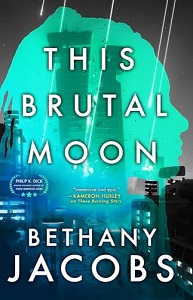
And that’s what This Brutal Moon (2025, USA) mostly is: a blow-by-blow account of the war between the rebels, allied Families and Jeveni against the Brutal Hand, the head of the Cloaks, the branch of government that’s assassins and secret police rolled into one (some would say they’re the same thing anyway). Chono, head of the Clerics, the religious branch of the Treble, a reluctant rebel and a reluctant figurehead, had to persuade the various factions to fight the Cloaks. Meanwhile, the Cloaks have sent a ship to Capamame, the distant world the Jeveni escaped to, demanding forty percent of their population to work the sevite trade.
A series of flashbacks set centuries before explain how the Jeveni discovered new seams of jevite, and used it to power a generation ship which was sent to settle the world which became Capamame.
There’s a battle at the gate leading to Capamame, and an invasion of Capamame by the Cloaks – and it looks like the Cloaks have the upper hand for much of the novel, but it’s pretty clear how the book is going to end. The upset, when it comes, is not much of a surprise – partly because the flashbacks have been teasing it throughout the novel, and partly because so much of the fighting occurs off-stage it’s hard to judge how it’s going. Instead, we get factional infighting, Six sidelined for most of the narrative, an unconvincing attempt to make the twist in the second book plausible, and a Guns of Navarone-style desperate mission to destroy the Cloaks’ secret headquarters.
All this is a fun space opera with more than a hint of Warhammer 40K, but there’s that elephant in the room which skews the reading experience. In an afterword, Jacobs writes the trilogy is about genocide, but not any particular genocide. Except it doesn’t read that way. The Jeveni are a racial and religious group who survived an attempted genocide, and are still being persecuted. In the Kindom’s universe, it’s because they’re the sole miners of jevite, and later, when the moon which is the only source blows up–the genocide–they’re the only makers of its synthetic replacement, sevite.
These Burning Stars was fun. There was a little Banks in it, the world-building was interesting, and while the characters were larger than life (and, unfortunately, included a Magical Hacker™), they were memorable. Its main plot was resolved in that novel, forcing the two sequels to deal with the larger story, which unfortunately hasn’t proven as captivating. The Capamame-based murder-mystery that was On Vicious Worlds brought the trilogy’s story arc to the fore but proved unsatisfying. And in This Brutal Moon, the resolution of the story arc has become the entire story, and it’s basically just a big battle. The cast has also grown by this point to the size where it’s sometimes difficult to keep track of who’s who and references to past events have to be taken on faith.
The first book was good enough to encourage me to carry on reading, which is not something that’s true of a number of recent space opera trilogies I’ve begun. If the second book was a dip, that’s hardly unusual in trilogies. But This Brutal Moon, to my mind, failed to pull the three books back to what the first book promised. Worth reading, but ultimately disappointing.

