It Doesn't Have To Be Right…

… it just has to sound plausible


Leave a comment

What I’ve Been Doing Recently…

… or A Desperate Attempt To Generate Content For This Blog Before People Give Up On It. Well, perhaps not “desperate” – it’s not been that long since I last posted. But my last few posts might have given the erroneous impression that I’ve mostly given up on reading science fiction. I haven’t. And here’s the proof. Sort of.

I have been reading…

The Quincunx of Time, James Blish (1973) – I knew this was an expansion of a short story, but I didn’t know if I’d read the story. So the déjà vu which hit me two pages into the book didn’t come as much of a surprise. I had read the story, ‘Beep’. Unfortunately, as Blish explains in a foreword, he had never intended to expand ‘Beep’, and when he was eventually persuaded to do so he chose to focus on some of the issues raised by the story. He didn’t expand the plot, or the story’s remit. He just deepened the scientific bollocks the various characters explain to each other. It made for a dull and unconvincing – and short – novel. Not one of Blish’s best.

The Facts of Life, Graham Joyce (2002) – I have unjustly neglected Graham in my reading. I thought his first few novels were very good indeed, but sort of stopped buying and reading them for no real reason. I actually interviewed him for a small press magazine when his debut novel, Dreamside, was published. Unfortunately, it was on the last day of a convention, and we’d both been drinking until 4 a.m. the night before and were very hungover. I sent Graham a verbatim transcript of the interview. He replied, “I remember it as quite an insightful interview… so who were those two fucking Martians on the tape?” A carefully edited version, which made both of us appear sane and intelligent, later appeared in the magazine. But, The Facts of Life. I decided to buy this because it’s set in Coventry. I went to university there, so I know the city. The Facts of Life is excellent stuff and I have no excuse now for not reading more of Graham’s books. Incidentally, I was little spooked by one chapter in the novel – because it’s set in Coventry it of course features Lady Godiva. Which couldn’t help but remind me of my own encounter with her (see here). Graham’s done that to me before: I had a lucid dream the morning before starting Dreamside, which opens… with someone having a lucid dream.

The Universe Maker, AE van Vogt (1953) – for some reason, an image from this novel has stayed with me throughout the decades since I last read it: a shadow in the shape of a person, and in which you can see stars, appearing in a park and speaking to someone. But I couldn’t remember the context. So I decided to reread the book to remind me. And it is apparently a Shadow, one of an elite which rules a future Earth and the members of which appear to have special powers. So there you go. This novel is, like most of van Vogt’s, completely bonkers. It’s a headlong charge through a number of sf tropes – chief among them time travel – most of which make little sense if you pause to think. And that’s part of its charm. Before you can even scoff, you’re thrown into something new and even more implausible. Now I want to reread van Vogt’s Mission to the Stars, which has the giant battleship that splits up into hundreds of little ships when it hits a galactic storm…

House of Suns, Alastair Reynolds (2007) – Reynolds is one of those authors whose books I buy in hardback as soon as they’re published. He’s also one of those authors whose work can sometimes disappoint, but only when compared to his other novels. And so it was with House of Suns. I never quite swallowed the novel’s timeline of millions of years, and the characters seemed a little too contemporary for me to willingly suspend disbelief. But, there were – as usual – some real gosh-wow special effects, some jaw-dropping ideas, and even an occasional nod here and there to other sf books and films. Good stuff.

The Ship That Died of Shame & Other Stories, Nicholas Monsarrat (1959) – I have a soft spot for Monsarrat’s fiction – The Cruel Sea is a classic, and his unfinished The Master Mariner is one of my favourite non-sf novels. So I continue to seek out and read his books, even though many of his plots have passed their sell-by date. It’s a bit like watching the first season of Alfred Hitchcock Presents from the mid-1950s – those twists in the tale have been done so many times you can see them coming a mile off. But they must have been a surprise when they were first used back then. And so it is for some of Monsarrat’s novels and short stories. But I’ll still read him.

I’ve been watching stuff, too. Such as…

The Sacrifice, Andrei Tarkovsky (1986) – Tarkovsky isn’t a science fiction film director, although three of his films were sf. Both Solaris and Stalker were adaptations of sf novels – by Stanisław Lem and the Strugatsky brothers, respectively. The Sacrifice, on the other hand, is from an original screenplay by Tarkovsky himself. A man living on Gotland, a Baltic island off the coast of Sweden, witnesses the end of the world by nuclear war, and in despair vows to God that he will sacrifice everything he loves if the world is returned to normal. He then – at the urging of a friend and neighbour – sleeps with a female servant, who is a witch. The next morning, it’s as if the nuclear holocaust had never happened. And so the man sets about fulfilling his vow, alienating his loved ones, destroying his possessions, and burning down his house. Like all Tarkovsky films, it’s very slow, with very long takes. But parts are disturbingly intense. The reaction of the man’s wife, for example, to the end of the world is difficult to watch. There are also dream sequences which might not be dream sequences, and a use of colour and black & white film which might help unravel the ambiguous story. I think I prefer Mirror more than The Sacrifice, but it’s a more affecting film than some of Tarkovsky’s, and he remains a favourite director.

Star Trek: Deep Space Nine season 2 (1993) – I’d read often enough that DS9 was the best of the Trek franchises, but I’d only ever seen a handful of episodes from the first season. From them it was hard to see it as any better than any of the other franchises. But I decided to give the series a go – prompted by a much-reduced price on Amazon. And discovered that not only was the setting interesting – the planet of Bajor after Cardassian occupationary forces have withdrawn – but I liked the characters. Much more so than the Star Trek: The Next Generation ones. Well, except for Quark the Ferengi. He’s just irritating. Anyway, I finished season 1, and then bought season 2. And I have every intention of working my way through to the end of season 7. Especially since I’m told it gets much better when the Federation go to war against the Dominion….

Indiana Jones and the Kingdom of the Crystal Skull, dir. Steven Spielberg (2008) – it seems a bit pointless to moan about Hollywood remakes of perfectly good films from earlier decades when they’re just as liable to dig up old franchises and add a new vehicle to it. And what a creaking lumbering vehicle it is. Harrison Ford manages to hold his own, despite his advanced years, but the plot in this thing is a horrible mess. It’s as if they chose to throw as many clichés at it as possible in the hope one or two would stick. Unfortunately, it’s not plot coupons which stuck. This film is just an embarrassingly bad sequence of CGI spectacles and stunts held together by a plot which makes no attempt at plausibility. Best avoided.

Aliens Vs Predator 2: Requiem, dir. the Strause brothers (2007) – sadly, my film-viewing could sink even further than a geriatric Indy chasing after a “magnetic” skull which can bizarrely attract non-ferrous materials. It plummetted to this. The directors clearly felt that making the film as dark as possible would hide a multitude of sins. And I don’t mean “dark” as in mood. I mean, “dark” as in filmed at night, “dark” as in having to sit in a pitch-black room in order to actually see what’s on the bloody screen. Which isn’t much more than the title suggests. There’s this Alien, see; and it crash-lands on Earth. And a Predator gets this signal telling it what’s happened. So off it goes to hunt it down. In Ridley Scott’s excellent Alien, the eponymous creature was an unstoppable killing machine. In AvP2, teenagers with shotguns slaughter hundreds of them. Which is a bit like revealing Sasquatch as a marmoset. But then, what teenager wants to watch a platoon of elite forces get blatted by a single alien? They’d much rather see themselves in the title role, wreaking mayhem and spraying bullets and killing all those nasty cunningly-externalised fears and neuroses… Avoid this film like you would a, well, an alien.

The DEFA Sci-Fi Collection – I mentioned one of these in a previous posts – Der Schweigende Stern / The Silent Star, dir. Kurt Maetzig (1960). See here. The other two in this boxed set are In the Dust of the Stars / Im Staub der Sterne, dir. Gottfried Kolditz (1976), and Eolomea, dir. Herrmann Zschoche (1972). The first is… plenty weird. A mission from one planet arrives on another. There’s something suspicious going on, but they’re welcomed with a big party. Of course, they soon find out what the actual situation is…. But. The strange 1970s GDR aesthetic is one thing. But the gratuitous – tastefully back-lit, so in silhouette only – nude scene just seems completely, well, gratuitous. And then there’s the party scenes. Disco-dancing East Germans in Spaaaacccceee. Sort of. Eolomea is a much more restrained affair. Some ships have gone missing, and a group of scientists are sent to figure out what happened. It seemed to me a bit of the story went missing somewhere as well. The film’s title makes no sense for the first thirty or so minutes, and is only explained in passing. But never mind. It’s all good post-2001: A Space Odyssey 1970s sf – none of that silly Western Imperialist space opera thank you very much. There is a fourth DEFA sf film which isn’t included in this collection, Signal: A Space Adventure (1970). I want a copy.

And I have been listening to…

The “double whammy” – I wanted to see Isis, who were performing locally last Sunday night, but no one else wanted to go. Then Stuart said he’d go, if I went to see Johnny Truant at the same venue the following night. The “double whammy”.

Isis were excellent, as usual. They’re another one of those bands you forget how good they are… and then you see them live. I ended up buying one of their CDs from the merchandise stand, and was tempted to buy more. They were ably supported by Torche, who were good in parts.

And then it was Johnny Truant… Who are a bit too hardcore for my taste. This was a much younger crowd than Isis – I could have passed as just about any audience member’s dad. The sound was also very loud. I don’t mind loud – and I’ve been to plenty of loud gigs. But it seems a bit pointless when everything’s turned up so high you can’t actually hear the guitars. Just the bass and blastbeats. The rest is a wall of noise. Mind you, there was a little more banter between songs than the previous night. The only words spoken by Isis were, “This is our last song.” The lead singer of Johnny Truant, however, was cracking jokes – “Our next two songs are ‘Hotel California’ and ‘Tiny Dancer'” – and moaning about eating too many pies. Not to mention the lead singer from support act Blackhole, who climbed down from the stage and performed most of the set from the middle of the dance-floor…

I’ve been working as well, of course. The big fat space opera sequel, assorted short stories (three sold this year so far; go me), and even another poem or two.


Leave a comment

We’re Supposed To Be Looking Forward To This?

In my last post on obscure sf films, I wrote:

In fact, with the remake of The Day The Earth Stood Still due for release later this year, and recent news that J Michael Straczynski is working on a “sequel” to Forbidden Planet, you have to wonder when Hollywood will get the message.

According to the LA Times, a remake of When Worlds Collide is due in cinemas next year, as are new additions to the Terminator and Robocop franchises; and, possibly, Ghostbusters. Also due in 2009 is a remake of Creature From The Black Lagoon, and a year later Fahrenheit 451. And plans are afoot to remake Flash Gordon, Logan’s Run, and Westworld.

So there you go. It’s the 21st Century and we’re strip-mining the 20th Century for culture.


6 Comments

Top Ten Obscure SF Films

I’ve not written about sf for a while. Or posted a list. People like lists, if only to argue over. So here’s one likely to generate some debate: the best ten obscure science fiction films*. My definition of “obscure” alone is probably open to interpretation – at least three of films below I also included in my list of best sf films since 1991. I also wouldn’t, for example, describe Andrei Tarkovsky’s Solaris as an obscure film, especially as it’s been remade by Hollywood. The same is true of Open Your Eyes by Alejandro Amenábar. Mind you, I wouldn’t call Tarkovsky’s Stalker obscure either. Or Alphaville by Jean-Luc Godard. All good films, of course. Well, not the Hollywood remakes. They’re not very good, and are best avoided. Stick to the originals.

In fact, with the remake of The Day The Earth Stood Still due for release later this year, and recent news that J Michael Straczynski is working on a “sequel” to Forbidden Planet, you have to wonder when Hollywood will get the message.

Anyway, below are ten science fiction films for which I feel the word “obscure” is a reasonably accurate description. One or two might be considered turkeys – certainly you’re only likely to find them in budget sf movie DVD sets, or being broadcast at 2 a.m. on some TV channel no one ever watches. That doesn’t mean they’re not good films, just that you have to dig a little harder to understand why they’re not bad films. Trust me on this.

The list is in chronological order by year of release, not order of merit.

The Silent Star, dir. Kurt Maetzig (1960) – AKA Der Schweigende Stern. Which should clue you in that this film is German. In fact, it’s East German, one of four sf films made by East German studio DEFA. It’s perhaps best known to US audiences by the title of its badly-edited and -dubbed English-language version, First Spaceship on Venus. The story is based on a novel by Polish sf author Stanisław Lem, and concerns a message discovered embedded in a crystal found at the site of the Tunguska Event. The message is partially decoded, and appears to have originated on Venus. An international crew of the best scientific brains is recruited – Soviet, German, Indian, Japanese, “African”, Polish, Chinese – and sent on the rocket Kosmokrator to Venus. En route, they finally decode the message fully… and learn it is a plan to invade Earth. But what they find on Venus is not at all what they expected… The sets of Venus are bizarrely alien, the model work is excellent, and the whole film has a peculiarly Soviet scientific internationalist atmosphere.

Queen of Blood, dir. Curtis Harrington (1966) – this film’s low beginnings are a matter of record. It’s one of many Russian films bought by Roger Corman, edited, dubbed in English, and with additional scenes starring US actors added, which American International Pictures released in the 1960s. Queen of Blood was based on Nebo Zovyot, and it looks weirdly compelling, despite its B-movie story. I reviewed it last year here.

Galaxy Of Terror, dir. Bruce Clark (1981) – it’s plain from the start of this film that Roger Corman’s New World Pictures intended it as a cash-in on the success of Alien. Yet what they managed to produce was something entirely different. A spaceship is sent to a mysterious planet to rescue the crew of a crashed ship, but they crash themselves. And the crew they were sent to rescue are all dead. They determine that the cause of their own crash was a huge alien pyramid just over the horizon. They decide to explore it… and are subsequently killed off one by one. The special effects are a bit rubbish – one of the alien monsters looks like cheap rubber tentacles – and the cast are better known for their roles on television. But the story works really well – and often reminds me of the first third of John Morressy’s novel, Under a Calculating Star (and, I suppose, Alastair Reynolds’ Diamond Dogs). The ending comes as a real surprise. James Cameron, incidentally, was a unit director on this film, and responsible for some of the production design.

Humanoid Woman, dir. Richard & Nikolai Viktorov (1981) – AKA To The Stars By Hard Ways. This is a Russian film and, sadly, the only edition I have is a badly-mangled English-dubbed version released by some cut-price B-movie re-packaging studio in the US. Even so, the film is clearly bonkers. The opening scenes, in which a team of cosmonauts explore a derelict alien ship in space were plainly filmed underwater. But at least it looks like zero gravity. They find one member of the ship’s crew still alive – Niya, played by the weirdly alien Yelena Metyolkina in a strange wig. The film is sort of a love story, and sort of a first contact story, and sort of a cautionary tale of ecological catastrophe. It has to be seen to be believed. It can’t really be described. I’m told the original Russian version is very good indeed, and a new director’s cut was recently released by the late Richard Viktorov’s son. Unfortunately, no edition with English subtitles is available.

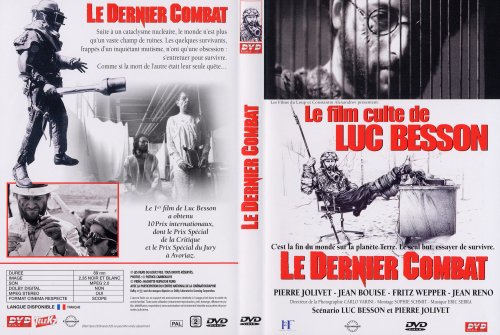
Le Dernier Combat, dir. Luc Besson (1983) – an early film by the director of The Fifth Element. There’s something very Moebius about the look and feel of the film, but I don’t believe he was involved. A man tries to survive in a post-apocalyptic city, while being menaced by another (played by Jean Reno). Filmed entirely in black and white,Le Dernier Combat contains no dialogue whatsoever. And yet it works. It’s also very funny in parts.
Delicatessen, dir. Jean-Pierre Jeunet & Marc Caro (1991) – this has been a favourite of mine since I first saw it back in the early 1990s. It’s another French post-apocalypse film. An ex-circus performer moves into an apartment block owned by a butcher. He’s intended to be the residents’ dinner – food is extremely scarce – but the butcher’s daughter falls in love with him and helps him escape. Sort of. There’s a superb set-piece in which one resident tries to commit suicide. And fails. A wonderfully strange film.

Until The End Of The World, dir. Wim Wenders (1991) – there’s not much more I can about this film that I haven’t already said here. And I still want the 3-disc director’s cut DVD.

Possible Worlds, dir. Robert LePage (2000) – I vaguely recall buying this because it looked quite interesting. It proved to be a cleverly-done and subtle sf film. The film opens with a murder – a man is found dead, his brain missing. He proves to be only the first such victim. The film shows how the murder came about – it’s all to do with alternate realities. Beautifully shot and acted, the ending perhaps lets the film down, but it’s definitely worth seeing. It’s apparently based on a stage play, which was adapted for the cinema by the author.

Avalon, dir. Mamoru Oshii (2003) – Oshii is better known for anime, but this is a live action film. Shot in Poland. With a Polish cast. It’s one of those films which opens with jaw-dropping visuals, and whose story – while not entirely original – doesn’t let the film down. Some time in the near-future, people are addicted to a VR war game. One player, Ash, hears of a secret level and tries to find it. Avalon is filmed in sepia tones and looks gorgeous. Its pacing is perhaps slower than many find acceptable (not to me: I like Tarkovsky’s films…), but the visuals are more than enough to keep your attention.

Natural City, dir. Byung-chun Min (2003) – this is a Korean film and, like Avalon, sort of a live-action anime. Again, the visuals are stunning, even if the plot isn’t all that original. In the near-future, a pair of agents hunt down and kill cyborgs – the “borrowings” from Blade Runner are deliberate and overt. And, like Blade Runner, Natural City creates an entirely plausible future world on-screen.

(* in my own DVD collection, of course)


1 Comment

Why Am I Still Doing This…? Part 3

It’s been a while since I last did a round-up of the films from my Nightmare Worlds 50-movie DVD set. This is because I’ve seen all the watchable ones, and the ones which are left are really bad. So I’ve been a bit slow in watching them. Anyway, here they are:

The Manster – an American reporter in Japan makes friends with a Japanese scientist, is wined and dined by him, introduced by him to the best of Japanese culture, falls for the scientist’s glamorous assistant despite being married… but it’s all a plot by the scientist so he can experiment on the reporter. Which turns him into a two-headed monster. It was all something to do with the scientist’s wife who had turned into a monster years before. More interesting as an early 1960s depiction of life in Japan than a monster movie.

They – AKA Invasion From Inner Earth. A bunch of Canadians have been holidaying up in the mountains, and when they return to civilisation they discover everyone has died of some strange plague. The only thing I remember from this film was that one of the characters was really annoying, and I was glad when he died. It was only a shame it took so long.

How Awful About Allan – Anthony Perkins is the eponymous Allan. A fire at home blinds him, kills his overbearing father, and scars his sister. Some time later, his sight partially returns – he can see blurred shapes, but little else. He moves back home with his sister. But there’s a stranger in the house, a lodger who creeps about and whom Allan never gets to actually meet. The sister claims there’s nothing unusual going on. Of course, it’s all a cunning revenge plot. A made-for-tv Monday afternoon psychological thriller from the early 1970s. Watch it while doing the ironing.

The Phantom Creeps – I suspect the title is verb-noun, rather than adjective-noun. The Phantom – or is that one of the Creeps? – is Bela Lugosi, a mad scientist with a secret laboratory hidden in his basement. He invents lots of useful gadgets, including a belt that makes him invisible, and sets about taking over the world. Well, California. Muahaha. This is another serial edited down to a feature. It shows.

Panic – I’m pretty sure I watched this one, but I have no memory of it. It must have been that good. Something to do with a model, and an old woman who’s a serial killer. Who said watching these films was into turning into a chore, eh?

Purple Death from Outer Space – another Flash Gordon serial chopped up to make a feature film. The dastardly Emperor Ming has spread some sort of dust across Earth, so Flash, Dale and Zarkov head off the Mongo to whip up support for an attack on Ming to stop his dastardly plan. I can’t honestly remember how this one differs from other Flash Gordon serials I’ve seen. They all seem to be played like pantomimes, the rocketships would look more convincing if the effects people just lobbed them through the air, and there’s a silliness to them which will strike you as either charming or risible. Oh yes, one of Ming’s dastardly henchmen in this one is called Lieutenant Thong.

The Return of Dr Mabuse – Gert Fröbe (i.e, Auric Goldfinger) is a police inspector. An Interpol agent is murdered, and Fröbe investigates. All the clues suggest the murderer is a man who was in prison at the time. And is still in prison. It never occurs to Fröbe that someone might have let the murderer out. When further clues suggest criminal mastermind Dr Mabuse is behind it all, it doesn’t occur to Fröbe that the prison warden might be Mabuse in disguise. This film was dubbed into English, and its setting moved to Chicago. Which strangely appears to have everywhere signposted in German…

Radio Ranch – gosh, kids, it’s the Singing Cowboy himself, Gene Autry. This film is like a 1930s thinly-disguised product-placement fest, except the brand they’re selling is Autry himself. At the eponymous ranch, the kids of his fanclub, the Thunder Riders, tangle with, well, the real Thunder Riders. Who live in a scientifically advanced city deep under California. And every now and again, they ride en masse through a valley near the ranch. For some unexplained reason. It’s The Coming Race meets Hollywood star vehicle meets some kids’ club film.
Ring of Terror – this was more like one of those terribly earnest US government information films from the 1940s than a horror film. Remember kids, sex can give you diseases that make your brain rot. Or something like that. A terribly earnest medical student suffered a childhood trauma involving a corpse. As you do. So when his frat brothers dream up an initiation ritual involving a ring for his girlfriend, and a corpse in the mortuary that isn’t really a corpse… well, it all goes horribly wrong. Yawn.

Robot Pilot – an inventor invents a remote-control kit for normal-sized aeroplanes – so, not “robot”, then. He demonstrates it to the company CEO, but it fails. So he hies off to the desert with the test pilot to work on it some more. Enemy agents get wind of the invention and try to steal it. Oh, and the CEO’s spoilt daughter decides to drive from somewhere to somewhere along a route which takes her and her aunt close by the desert ranch where the inventor and test pilot are living. Their car breaks down, and they’re rescued by the two men. Who decide to teach the spoilt daughter a lesson – with the CEO’s collusion – by treating her as a slave for a bit. But she and the test pilot fall in love, and I can’t really see why this film is science fiction or even included in a DVD set called Nightmare Worlds.

Terror at Red Wolf Inn – there’s this inn, called the Red Wolf Inn. And it’s terrible. Oops. Terrifying, I mean. A young female student wins a holiday at the titular hostelry, and is surprised when, one by one, the other young female guests disappear. But there’s always plenty of food. Meat, that is. And it’s no good running away, because the local sheriff is in on it.

UFO: Target Earth – this opens with “members of the public” discussing UFOs, as if it were a documentary. They’re actors, of course. The scene then shifts to a laboratory… Apparently, this filmed was touted as a highly-realistic study of ufology. In actual fact, it’s an extremely dull, cheap, and badly acted film about a UFO which has landed at the bottom of a lake. I remember very little else about the film, and I don’t consider that a bad thing.

Star Odyssey – Italian space opera nonsense. I thought StarCrash was bad, and Cosmos: War of the Planets worse. But this one definitely beats both of them. There’s a villain who looks like someone has scribbled all over his face, a pair of really irritating robots (male and female – you can tell which is which because the female one has eyelashes), an actor who thinks he’s a hero (or was it vice versa?) and camps it up something terrible, and… and… It’s one of those films you put on if a guest has overstayed their welcome. If they don’t leave after watching the first ten minutes of it, you only have to wait until they start frothing at the mouth and fall over, and then you can drag them outside and leave them.

Prisoners of the Lost Universe – I suspect Richard Hatch leaves this one off his c.v. He, and two others, are accidentally transported to a parallel world inhabited by fur-clad barbarians ruled by John Saxon. Hatch must defeat Saxon before he can return to Earth. So he does. That’s about it. Best avoided.

Sadly, the boxed set is not yet finished. There are still a few more to watch. However, I can say this much already: the next time I see a boxed DVD set of 50 sf films going for around ten quid, I’ll think twice before buying it…

Oh yes – earlier reviews of the boxed set here (part one) and here (part two).


3 Comments

Top 48 Films Based On A Book

Saw this on Mark Charan Newton‘s blog. No one tags me on these meme things, but I’m going to do it anyway. So there.

Below is a list of the top grossing 48 films based on science fiction novels. Apparently, the list is from Box Office Mojo, and it looks distinctly dodgy – at least one isn’t from a novel, and several are obscure straight-to-video films. And there are a lot of not very good ones there, too.

Anyway, the rules are: mark in bold those books you’ve read, italicise those films you’ve seen. I’ve also annotated it because, well, I wanted to.

1. Jurassic Park
2. War of the Worlds – seen all three versions, in fact.
3. The Lost World: Jurassic Park
4. I, Robot
5. Contact
6. Congo
7. Cocoon – nope, not based on a novel.
8. The Stepford Wives – seen both versions.
9. The Time Machine – seen both versions.
10. Starship Troopers – book bad, film good.
11. The Hitchhiker’s Guide to the Galaxy
12. K-PAX
13. 2010
14. The Running Man
15. Sphere
16. The Mothman Prophecies
17. Dreamcatcher
18. Blade Runner (Do Androids Dream of Electric Sheep?)
19. Dune – new film adaptation in production!
20. The Island of Dr. Moreau
21. Invasion of the Body Snatchers
22. The Iron Giant (The Iron Man)
23. Battlefield Earth – to my eternal shame, I have read the book. And it’s a toss-up which is worse, the book or the film.
24. The Incredible Shrinking Woman
25. Fire in the Sky – not novels, then: this is “based on a true story”. About a UFO abduction. Ah, so it is science fiction.
26. Altered States
27. Timeline
28. The Postman
29. Freejack (Immortality, Inc.)
30. Solaris – seen both. The Tarkovsky version is vastly superior. Lem apparently hated it.
31. Memoirs of an Invisible Man
32. The Thing (Who Goes There?) – seen both versions.
33. The Thirteenth Floor
34. Lifeforce (Space Vampires)
35. Deadly Friend – never even heard of this, looks like a straight-to-video.
36. The Puppet Masters
37. 1984
38. A Scanner Darkly
39. Creator – never heard of this one, either. These are supposed to be the 48 top grossing sf films?
40. Monkey Shines
41. Solo (Weapon)
42. The Handmaid’s Tale – I have the book, not read it yet though.
43. Communion
44. Carnosaur
45. From Beyond – apparently based on something by HP Lovecraft.
46. Nightflyers – another straight-to-video, although it seems the novel was by George RR Martin.
47. Watchers
48. Body Snatchers

I tag Jim Steel, Gary Gibson, Craig Andrews, and Mike Cobley.


Leave a comment

Why Am I Still Doing This…? Part 2

I must be mad, I tell you, mad… Well, if I’m not now, I will be by the time I’ve finished my Nightmare Worlds 50-movie pack. The SciFi Classics one was bad enough, but this set is rapidly showing itself to be of even lower quality.

But, never mind. Without further ado, here’s the next batch of personality-wipingly bad films from the set:

Death Warmed Up – many years ago, Peter Jackson, director of the Lord of the Rings trilogy and King Kong, started out his career with a bad sf/horror spoof called Bad Taste. The director of Death Warmed Up clearly tried for something similar – but his film is crap.

Doomsday Machine – the Chinese have built the ultimate weapon, so the crew of a soon-to-launch mission to Venus is quickly reshuffled, replacing half the men with women. The ultimate weapon does exactly what it says on the tin, leaving our hardy space explorers as the last of the human race. But, of course, they bicker and fight until there’s none of them left. Not a film to watch if you’re feeling misanthropic, but actually not bad for an early 1970s sf B-movie (if that’s not over-qualifying it too much).

Embryo – Rock Hudson is a genetic scientist who manages to save a dog fetus after its mother was run over. The dog grows to term and proves entirely normal – for a savage Rottweiler guard-dog. So Hudson decides to up his game and try the experiment with a human fetus. He’s successful, and the baby grows – using some super-growth scientific thingummy – into the bright and beautiful Barbara Carrere. But, of course, it all goes horribly wrong in the end. Hudson made a couple of odd but strangely watchable genre films during his career – like this one and Seconds.

End of the World – Christopher Lee is a priest who runs a convent. And he’s also an alien double. The aliens are trying to take over the world, of course. A young couple get involved somehow. I remember some scenes set in a 1970s computer centre, although the computer was apparently capable of tasks even modern ones can’t do. And there were the nuns, who were really aliens. And a transdimensional gate, or something, which was the cause of the natural disasters which were destroying Earth. A very odd film.

Eternal Evil – a television director is taught how to astral project by a mysterious woman, and while he sleeps does just that. And kills lots of people. I must have been astral travelling when I watched this, because I can’t remember any of it.

Evil Brain from Outer Space – Starman saves the Earth again. Sigh. This one had a really strange monster in it – I mean, yes, it was obviously a man in a rubber costume. But it looked very weird. Oh, and the titular evil brain spent the entire film being carried round in an attaché case. I’ve seen plenty of maguffins, but it’s the first time I’ve seen a brain used as one.

Shadow of Chinatown – this is actually a serial from 1936, and it’s real pulp action. A mad Eurasian scientist (Bela Lugosi) plots to put the Chinese merchants of an unnamed West Coast American city out of business. There’s a plucky reporter, her manly boyfriend, fistfights, narrow escapes, bombs, and poison traps. It would have been really exciting if it weren’t so, well, dull…

The Disappearance of Flight 412 – and here’s another one which proved less exciting than its title or synopsis suggested. A USAF plane witnesses a UFO encounter, and is directed to land at a disused airbase. Where the crew are held and interrogated by government agents. Their commanding officer, meanwhile, wants to know where his men have vanished to. It’s all because the policy is to cover up UFO sightings and not to investigate them, you see.

Idaho Transfer – I’m not entirely sure what to make of this one. The transfer was terrible, which didn’t help. But its story, and the way it approached it, was actually quite good. A group of scientists have perfected a time machine, and regularly send people 56 years into future, when the Earth appears to have suffered some form of ecological collapse and humanity has died off. The nature of the time travel device means only people under the age of twenty can go, and when the military seizes the time travel facility, a group of young people maroon themselves in the future. Only the Earth isn’t entirely depopulated, and it does eventually recover. An odd, low-budget, low-tech time travel film, not unlike Primer (although nowhere near as confusing).

Good Against Evil – a pilot for a television series which was never (thankfully) made. It apparently stars a young Kim Cattrall of Sex & the City. I don’t actually recall seeing her in it. But then I don’t actually recall much about this film. Something about Satan trying to possess a woman, and a writer trying to exorcise her. The writer is played by Dack Rambo. Who apparently has a twin brother called Dirk Rambo. Dack and Dirk. You can’t make this sort of stuff up…

Alien Zone – a man is dropped off on the wrong street while trying to return to his hotel. It’s raining badly, so a mortician offers him shelter. As they do. To while away the time, the mortician tells the man stories about four of the bodies currently occupying his coffins. As they do. I don’t actually recall what those stories were, however. Or what they had to do with aliens.

So, a mixed bag this time. Embryo, End of the World and Idaho Transfer weren’t bad – and might even have been quite good, if the transfer hadn’t been so poor. The Disappearance of Flight 412 proved duller than it should have been. The rest were as expected.

Don’t forget part one of this recipe for insanity.


1 Comment

Best SF Films

Last week, the American Film Institute released several new lists of top 10 films, including one for science fiction. And on his blog on AMC, the always entertaining John Scalzi commented on the list, pointing out that the most recent film on it was released in 1991. So he decided to create a list of Top Ten SF Films Released since 1991, and asked people for suggestions. Here’s my list (in order of year of release)…

1. Delicatessen, dir. Jean-Pierre Jeunet & Marc Caro (1991) – it’s hard to imagine how a post-apocalyptic black comedy featuring cannibalism could be, well, funny. But this film certainly manages it. The inhabitants of an apartment block in a Paris after some unspecified disaster regularly invite new tenants to take empty flats… so they can kill and eat them. Ex-circus performer Dominique Pinon is the latest such victim… but he manages to evade his fate.

2. Until the End of the World, dir. Wim Wenders (1991) – when I first saw this back in 1992, I thought the 1999 it depicted was the most plausible I’d seen on film. Having watched it recently, I can see why I thought so and why it wasn’t so prophetic after all. Wenders has said he intended Until the End of the World to be the “ultimate road movie”, and that it is for much of its length. I blogged about it here. I still want to see the 4 hour 40 minute version, though.

3. Abre los Ojos, dir. Alejandro Amenábar (1997) – César, a wealthy playboy, is hideously disfigured in a car crash caused by a jealous ex-girlfriend. But doctors use a new surgical technique on his face, and he regains his former good looks. And the love of his life. Except everything seems a little different and not quite right… An unsettling film. It was remade by Cameron Crowe as Vanilla Sky, starring Tom Cruise. Beware of expensive Hollywood imitations; go for the original.

4. The Fifth Element, dir. Luc Besson (1997) – okay, this is a supremely silly film. Which is where much of its charm lies. A vividly technicolour space opera, it owes more to French sf comics such as Métal Hurlant than it does to Star Wars. This, of course, is actually a good thing. On the other hand, thinking too hard about The Fifth Element is probably not a good thing – although, to be fair, it holds up better in that department than Star Wars does.

5. Starship Troopers, dir. Paul Verhoeven (1997) – the book is a thinly-disguised fascist political tract, so the only way to make a film of it would be as a satire. And that’s just what Verhoeven did. Perhaps it turns into a bit of a mindless bug hunt towards the end, but it skewers its satirical targets entertainingly – the adverts exhorting young people to sign up for the Mobile Infantry to kill bugs are a hoot.

6. Dark City, dir. Alex Proyas (1998) – a man wakes up in a bathtub, with no memory, and there’s a dead body in the other room. And the city outside is a dark and claustrophobic place which, bizarrely, changes each and every night. Despite initially appearing to be noir, Proyas piles on sufficient strangeness until the film can only be science fiction. It ends entirely appropriately.

7. Donnie Darko, dir. Richard Kelly (2001) – a troubled teenager survives a jet engine crashing onto his bedroom when a giant rabbit calls him outside and tells him the world will end in 28 days 6 hours 42 minutes and 12 seconds. The rabbit subsequently urges him to commit various acts of violence and vandalism. This is one of those films whose plot only becomes clear as the film progresses. But it all makes a clever kind of sense in the end.

8. Avalon, dir. Mamoru Oshii (2003) – better known for animé, Oshii made this live-action film in, of all places, Poland. In Polish. With a Polish cast. It opens in a VR war game, and the special effects are jaw-dropping. The plot – a hunt for a “hidden level” in the game – is not as eye-opening as the visuals, but neither is it some dumb First Person Shooter.

9. Primer, dir. Shane Carruthers (2004) – this starts off relatively straightforward: a pair of geeks inadvertently invent a time machine. But each time they go back in time, they’re co-existing with their earlier selves… and if they go back from that point… Two-thirds of the way into the film and there are several pairs wandering around, and several narrative threads following their exploits. A very clever film, and not a little mind-bending.

10. Sky Captain & the World of Tomorrow, dir. Kerry Conran (2004) – this was one of the first films released with entirely CGI-generated sets and backgrounds, but that’s not what makes it so remarkable. Sky Captain & the World of Tomorrow is an homage to old pulp science fiction and Saturday morning serials – not just the H Rider Haggard / Edward Bulmer Lytton plot, or the fantastic future of the past production design, but also all those shots so familiar from noir films: the policeman blowing his whistle, the heroine in the telephone booth, the running shadows thrown across buildings…


1 Comment

Why Am I Still Doing This…? Part 1

Well, I’ve now had a couple of weeks to regain my sanity after I finished watching the 50 films in the Sci Fi Classics 50-movie pack… So it’s on to the second 50-movie pack, Nightmare Worlds.

Alien Contamination – this Italian film pretty much transplants the plot of Ridley Scott’s Alien to Earth. A tramp freighter from South America drifts into New York harbour, its crew all dead. In the hold are strange alien eggs… which cause people to explode messily. The detective in charge, with the help of a secret government organisation of scientists, tracks down the surviving astronaut from a Mars mission. Together, they travel to the ship’s origin… and discover the other Mars astronaut, who had faked his own death and is now growing and distributing alien eggs for his alien masters on Mars. This film was entirely ordinary.

Alien Species – a trio of prisoners are being transported by sheriffs, when a fleet of UFOs attack Earth and force them off the road. The prisoners escape, and hide out in a nearby cave. Which proves to be the headquarters of the invading aliens. Initially watchable, this film quickly descended into silliness. The cave sets look fake, the aliens looks fake, and ten minutes in, the story began shedding plausibility and intelligence by the second.

Atomic Rulers of the World – a Japanese Starman film, and as such resembles all the other Starman films. The alien council of the Emerald Planet look like the deranged imaginings of the insane brother of the inventor of Teletubbies. The plot: Starman saves the Earth from human invaders from the planet Mirapolia.

The Alpha Incident – A space probe returns to Earth and brings with it a dangerous micro-organism. While being transported by train, a sample of this micro-organism is inadvertently released by a criminally stupid train guard. Five people are exposed, and promptly confined at a remote train stop while scientists rush to find a cure. This was as dull as it sounds.

Attack from Space – another Starman film. This time the Spherions are out to conquer Earth. Of course, Starman defeats them. Happily, they don’t make films like this any more.

Beast of the Yellow Night – a man sells his soul to the Devil after being saved from certain death. As a result, he turns into the titular creature at night – not just on yellow nights, I should add; whatever a “yellow night” might be – and kills people. This film couldn’t quite make up its mind what it was supposed to be – horror, thriller or family drama. The poor transfer made it even harder to figure out.

Warriors of the Wasteland – an Italian post-apocalypse movie. And if there’s one thing we now know about the Apocalypse from all the films on the subject, it’s that the Goths will inherit the Earth. Well, they’re not quite Goths in this one – the eponymous warriors wear white, for one thing. (Which means we also know Persil will survive the Apocalypse.) And they’re a bit too camp to be Goths. But, essentially, this film is Mad Max meets the Camp White-Clad Goths of the Wasteland. And he kills them all.

Werewolf Woman – this one is about a woman who turns into a werewolf. Of course. Actually, she only thinks she turns into a werewolf. Except she does at the end. Along the way, she meets and seduces numerous men, and then kills them. This is one of those movies where you get exactly what the title leads you to expect. In fact, the film’s alternative title Naked Werewolf Woman probably tells you more than you need to know…

The Nightmare Never Ends – an old Nazi hunter is killed, and the detective investigating the murder begins to obsess about the man’s death. The Nazi hunter had been tracking a notorious war criminal, a louche young SS officer, who doesn’t appear to have aged in the 35 years since WWII. Unfortunately, the title better refers to the film itself than it does to its plot…

Counterblast – a Nazi scientist escapes to England at the end of WWII, and murders and takes the identity of a British scientist returning from Australia. He continues to work on the biological weapons he had been creating for his Nazi masters, with the intention of using them to usher in a Fourth Reich. But it all starts to go wrong… This B&W British film from 1948 was actually quite good.

All the Kind Strangers – Stacy Keach is driving through deepest darkest Tennessee when it sees a young boy walking by the side of the road with a heavy bag of shopping. He stops and offers the kid a lift… which subsequently involves a long drive down a dirt track and across a creek… to a house where seven kids (ranging in age from late teens to under ten) live alone. They do have a “mother” – but she’s actually a woman they’ve kidnapped and forced to play that role. And so they likewise force Keach to become their father. There was a halfway decent story buried in this film – which isn’t at all sf or horror – but it didn’t deserve 74 minutes.

The Day the Sky Exploded – Earth is bombarded by asteroids. Which is sort of like the sky “exploding”. Cue lots of running around, explosions, buildings falling over. I don’t actually remember there being much in the way of a story in this film. Deep Impact it’s not. Happily, neither is it Armageddon.


3 Comments

I Did This So You Don’t Have To – Part 4

Here’s the final lot of films from the SciFi Classics 50-Movie Pack.

The Incredible Petrified World – a diving bell is sucked into a labyrinth of underground caverns, and the four crew-members are trapped there. A mad victim of a shipwreck from years before tells them there is no escape, but our plucky heroes – and heroines, of course – manage to find a route to the surface via a volcanic vent. This film is possibly only of interest to potholers.

Queen of the Amazons – a woman’s husband disappears during a trip into the African jungle. She organises an expedition to find him… only to discover he’s shacked up with the local Amazon queen. But she falls for her guide – who rescues her from all manner of jungle-related danger, of course; including man-eating lions and, er, locusts. There’s not much that’s sf about this movie. In fact, suspiciously many of the films in this 50-movie pack have been set in the African jungle. Maybe they’re hangovers from H Rider Haggard‘s She and King Solomon’s Mines

The Amazing Transparent Man – many years ago, comic 2000AD ran a story about a “Visible Man” – a chemical accident had turned his skin transparent so all his internal organs were, well, visible. This film, on the other hand, is just another tired retread of HG WellsThe Invisible Man. This time, however, he’s aiming for world domination. If he succeeds, how are they going to put his head on the coins and stamps, eh?

Horrors of Spider Island – an agent puts together a troupe of dancing girls for a show in Singapore. En route, their plane crashes and the bevy of beautiful girls find themselves stranded on a deserted island. It’s all sunbathing and skinny-dipping for a while… until their manager is attacked by a giant spider and turns into a half-man half-spider creature. Just like Club 18-30, then. While watching this, I couldn’t work out why the soundtrack was slightly off – the dialogue didn’t seem to match the lip movements. It was only afterwards I learnt that the film is German. I’d just assumed it was an early Roger Corman or something…

Devil of the Desert vs The Son of Hercules – another Italian swords & sandals starring some random bodybuilder as Hercules. These have all started to blur into one homogenous blob of badly-dubbed English, poorly-choreographed fight scenes, evil despots who live in caves and/or castles, and some bodybuilder hero in a leather skirt.

Zontar, The Thing from Venus – an object approaches Earth and proves to be an invader from Venus. It persuades an astronomer to act as its agent on Earth, but is eventually defeated. There was lots of people explaining the plot to each other – usually accompanied by manic laughter – and when Zontar finally does put in an appearance he looks like, well, like a bloke in a rubber monster suit.

Kong Island – some scientists visit the titular island with a plan to turn its gorilla population into an unstoppable army through the use of brain transplants. But a giant gorilla foils their fiendish plot. I know I’ve watched this one, but I have no memory of it. That’s probably a good thing

Bride of the Gorilla – Raymond Burr (better known as Perry Mason) is a plantation manager in a South American jungle. He falls for his boss’s beautiful wife, so he kills the old man and takes over the plantation and the wife. But his crime is witnessed by a native sorceress. She curses him. Every night, he turns into a… wild gorilla. After ripping various people to bits, he’s hunted down and shot. It’s all very silly but quite watchable.

Mesa of Lost Women – a mad scientist invents a serum which makes women beautiful. Men, however, turn into evil dwarves. (Sounds like beer to me.) The serum is actually made from, er, “spider hormones”. A group of people are taken to the secret lair of the mad scientist and manage to foil his fiendish plot.

Hercules and the Tyrants of Babylon – another US star gets roped into one of these Italian Hercules epics. This time it’s Peter Lupus of the Mission Impossible television series. He has to rescue the beautiful Queen of the Hellenes from the eponymous rulers of Babylon – who were actually the most interesting characters in the film. In all other respects, this was just like all the other Hercules films.

Hercules Unchained – happily, this was the last of swords & sandals. Hercules drinks from an enchanted spring, loses his memory, and shacks up with the beautiful but evil Queen Omphale. Fortunately, brave Ulysses helps him regain his memory, so Hercules wins the day yet again. I always thought Hercules only performed twelve labours, but it feels like I’ve watched hundreds of these films. I think I’d sooner muck out the Augean stables than watch another one…

White Pongo – the title creature a legendary white gorilla. A scientific expedition heads into the jungle to find it. One thing about this film puzzles me: the boxed set is titled SciFi Classics, but I fail to see what’s science-fictional about a jungle expedition to find a white gorilla. It’s not even horror, which at least some of the other non-sf films in the set are. But perhaps it’s a bit late to be asking this.

The Snow Creature – now this one is peripherally sf, inasmuch as the objective of the expedition is to find the fabulous Yeti. But in most other respects, it’s very like White Pongo. Parts of this movie appeared to have been filmed on location – although I suspect it’s the Rockies rather than the Himalayas…

That’s it. All fifty movies watched. And I survived. Now onto the second 50-movie pack, Nightmare Worlds

Also see parts one, two and three.