It Doesn't Have To Be Right…

… it just has to sound plausible


6 Comments

50 Essential SF Films

Time Out have put together a very strange list of their 50 essential sf films here (with nods to here and here). It does not include dystopias, for some completely arbitrary reason – so no Blade Runner or Fahrenheit 451. Their list is… silly. Cherry 2000? Howard the Duck? Battlefield Earth? If shiteness is an essental quality of sf cinema, then perhaps they do belong on the list. I, however, believe otherwise.

So I shall do the blog-worthy thing, and present my own list. And I will include dystopias. For as good a reason as Time Out excluded them from their list: because I want to.

Here then is my list of 50 essential sciencefiction films – in alphabetical order. Oh, and it is exactly 50 films. Rather than cheat and feature an entire franchise – Star Wars, Star Trek – I’ve picked the best of each. There is some overlap with the Time Out list.

2001: A Space Odyssey, dir. Stanley Kubrick (1968) – still a high-water mark for sf films. It possesses a grandeur unmatched by few other genre movies.
A Clockwork Orange, dir. Stanley Kubrick (1971) – it’s essential because it shows that sf is not all spaceships and robots; it’s essential because it shows that sf can be brutal (not violent, brutal) ; it’s essential because it shows that sf can be also for adults.
Abre los Ojos, dir. Alejandro Amenábar (1997) – ignore inferior remakes, this is an original piece of sf film-making.
Alien, dir. Ridley Scott (1979) – the first and still the best of the franchise.
Avalon, dir. Mamoru Oshii (2001) – perhaps the central premise is not the most original in the world – but then what sf film does feature an entirely original premise? – but in parts of this film, the presentation of it is jaw-dropping.
Back to the Future, dir. Robert Zemeckis (1985) – sf can be family entertainment too. And without being brainless.
Battle Beyond the Stars, dir. Jimmy T Murakami (1980) – although clearly made to cash in on Star Wars, the plot was ripped from The Seven Samurai by way of The Magnificent Seven (Robert Vaughan even reprises his role). It manages to transcend its origins just a tiny little bit.
Blade Runner, dir. Ridley Scott (1982) – I need say nothing about this film. Its presence here is a given.
Brazil, dir. Terry Gilliam (1985) – if George Orwell had not been so po-faced, he would have written Brazil. Ironic that it took an American to make a more English version of 1984 – totalitarianism is not frightening, it is absurd. See, sf doesn’t need to ignore politics, either.
Children of Men, dir. Alfonson Cuarón (2006) – the book was mediocre, the film is very good.
Close Encounters of the Third Kind, dir. Steven Spielberg (1977) – this film is too iconic to ignore it, although it has not aged entirely gracefully.
Dark City, dir. Alex Proyas (1998) – oh dear, what happened? Proyas went from this great little film to… I, Robot.
Delicatessen, dir. Jean-Pierre Jeunet & Marc Caro (1991) – sf can be very funny too, without being like Spaceballs. Poking fun at sf for humour’s sake is easy: it’s a huge target. But making something humorous and sf is much harder. Delicatessen does it superbly.
Destination Moon, dir. Irving Pichel (1950) – before the Americans went to the Moon for real, they went to the Moon on celluloid. They got quite a bit wrong in this film, but it’s a fascinating look at the thinking of the time on the subject.
Dune, dir. David Lynch (1984) – as adaptations of novels go, this one isn’t good. But as a realisation of the Dune universe, it beats all. Frank Herbert’s series of novels will forever be coloured by this film’s production design. And yet it could have been so good: there are moments of true greatness in it. And some really dumb bits, too.
Fahrenheit 451, dir. François Truffaut (1966) – the book is dull, but the film is weirdly engrossing.
Flash Gordon, dir. Mike Hodges (1980) – everything that sf fans hate about the public’s perception of the genre is in Flash Gordon. It’s as camp as a row of tents. It has stupid costumes and stupid lines and a universe that makes no sense. It is full of British thesps hamming it up so much Brian Blessed’s performance doesn’t even stand out as over-the-top. And yet… it’s great fun.
Forbidden Planet, dir. Fred M Wilcox (1956) – if you dismissed this as just another 1950s studio cash-in on sf, like This Island Earth for example, you’d be doing it a disservice. It’s a clever story, put together with state-of-the-art (of the time) effects. Okay, so the robot is silly, and Altaira’s wardrobe looks like it belongs in a bad B-movie… but it’s definitely an essential classic.
Galaxy of Terror, dir. Bruce Clark (1981) – sometimes cash-in films transcend the profit motive. Forbidden Planet did. And so does Galaxy of Terror. The sfx are a bit ropey, but the climax of the story makes up for it.
Independence Day, dir. Roland Emmerich (1996) – some films are events. This one was. Even though it’s brainless family entertainment, and everything a sf film doesn’t have to be.
La Jetée, dir. Chris Marker (1962) – some films transcend the media, and that’s what this one does. It is narrated; it is composed of black & white still photographs. And yet its power is undiminished.
Metropolis, dir. Fritz Lang (1927) – I shouldn’t need to explain or defend this film’s inclusion.
Naked Lunch, dir. David Cronenberg (1991) – it could be argued that William S Burrough’s work is not sf, but never mind. As adaptations of unfilmable novels go, this is one of the best.
Nineteen Eighty-Four, dir. Michael Radford (1984) – sometimes it was hard to tell the 1970s and 1984 apart; sometimes it was hard to tell the early part of this century and 1984 apart. Happily, we have this film to do it for us.
Pitch Black, dir. David N Twohy (2000) – a taut little sf movie, and so unlike its bloated sequel. It’s one of those films where the one-sentence, er, pitch tells you everything you need to know about it. More sf films should be made with that as an objective.
Planet of the Apes, dir. Franklin J Schaffner (1968) – too iconic to ignore.
Possible Worlds, dir. Robert LePage (2000) – another film that bucks the sf as brainless family entertainment trend, and so deserves to be on any self-respecting list.
Primer, dir. Shane Carruth (2004) – sf does not have to have multi-million dollar sfx budgets. Nor does it have to be heroically stupid. Admittedly, you can go too far in the other direction – certainly Primer‘s plot is likely to cause sustained bouts of head-scratching….
Queen of Blood, dir. Curtis Harrington (1966) – cobbled together from footage from Soviet sf film Nebo Zovyot, with inserts filmed in the US with a US cast (plus Basil Rathbone), this still manages to be a surprisingly modern film. I wrote about it here.
Repo Man, dir. Alex Cox (1984) – before there was guerilla film-making there was this: a cheap and cheerful movie that manages to celebrate its ideas in every frame.
Rollerball, dir. Norman Jewison (1975) – the future we deserved but never got: all those mainframe data centres and architecture by Oscar Niemeyer, not to mention the corporate oligarchy and plebian bread and circuses. Well, we got some of it. Ignore the silly eponymous sport, look at the world Jewison shows us.
Sky Captain & the World of Tomorrow, dir. Kerry Conran (2004) – another film with a future we deserved – airships, giant rockets, giant robots…. This film looks fantastic, but perhaps marrying its astonishing visuals with pulp story-telling was not the best way to do it. Nonetheless, it’s essential.
Solaris, dir. Andrei Tarkovsky (1972) – ignore inferior remakes. Tarkovsky is, I admit, an acquired taste and perhaps unsuited to the modern multiplex moviegoer, but this remains a powerful piece of film-making.
Stalker, dir. Andrei Tarkovsky (1979) – and Tarkovsky’s Stalker – an adaption of a novel by Boris & Arkady Strugatsky – is arguably even better than Solaris.
Star Trek: The Motion Picture, dir. Robert Wise (1979) – received wisdom would have it that Star Trek 2: The Wrath of Khan is the best of the franchise. It’s not, it’s a bloated television episode. Unfortunately, The Motion Picture is not the best either. But it is the most outright cinematic of them, cunningly hiding its television origins. Its pace may be glacial, but the presence of two Tarkovsky films on this list should have told you I don’t consider that necessarily bad.
Star Wars 5: The Empire Strikes Back, dir. Irvin Kershner (1980) – easily the best of the lot, thanks to a sharp script by Leigh Brackett. And Kershner, unlike Lucas, managed to get good performances out of his cast.
Starship Troopers, dir. Paul Verhoeven (1997) – a superb satire of Heinlein’s novel. The sight of Doogie Howser in a Nazi greatcoat has to be one of the biggest sensawunda moments of 1990s sf cinema.
The Abyss, dir. James Cameron (1989) – there’s an earnestness to this film which still appeals today, and the special effects still – ahem – hold water. Perhaps the ending is somewhat difficult to swallow, but this remains one of the best first contact films made.
The Day the Earth Stood Still, dir. Robert Wise (1951) – back in the day, they used to make thoughtful sf films with little in the way of gosh-wow special effects. Okay, so perhaps the story is a little simplistic and implausible, but it’s considerably closer to the people in it than your average modern-day soulless blockbuster.
The Fifth Element, dir. Luc Besson (1997) – this is not so much a film as a moving comic. It’s very colourful, it’s very silly, it doesn’t make a great deal of sense, and the characters are painted with the same bright palette as the backgrounds. But it’s still a lot fun. And you can’t go wrong with a space opera with European sensibilities. More space operas should have European sensibilities, in fact.
The Man Who Fell to Earth, dir. Nicolas Roeg (1976) – also too iconic to ignore, if only for Bowie in the title role.
The Matrix, dir. Larry & Andy Wachowski (1999) – ignore all inferior sequels. This was an astonishing film when it was released and we should remember it for that.
The Mysterians, dir. Ishiro Honda (1957) – a Japanese sf film from last century which is not structured around some recurring hero or monster is deserving of note. In all other respects, this is as strange as the many Gojira, Gamera or Starman films.
The Silent Star, dir. Kurt Maetzig (1960) – the second sf film produced by the East German DEFA studios, and it’s clearly not the product of western capitalist minds. The production design is amazing. I wrote a bit about it here.
The Terminator, dir. James Cameron (1984) – ignore all inferior sequels. This is a taut action sf film, with little pretensions and little need for any.
The Thing, dir. John Carpenter (1982) – the original had an earnest silliness about it; this one translated that into gore. It made aliens on Earth just as scary as the ones in spaceships.
The Time Machine, dir. George Pal (1960) – another iconic film, although it’s scuppered a little by 1960s sensibilities – silly lines like “How do the women of your time wear their hair?”
Things to Come, dir. William Cameron Menzies (1936) – not to be confused with the similarly-titled The Shape of Things to Come from 1979 which a) bears no resemblance to HG Wells’ novel, and b) is astonishly crap. Menzies’ version, however, is just an astonishing piece of early cinema.
Twelve Monkeys, dir. Terry Gilliam (1995) – Back to the Future proved that audiences could follow twisted time-travelling narratives; Twelve Monkeys pushed it even further, and still remained entertaining drama.
Until the End of the World, dir. Wim Wenders (1991) – this was the first film which for me made the future seem like a real place. Admittedly, its future is a little quaint these days, and the actual story feels like two stories badly welded together, but it is still as Wenders intended it: the “ultimate road movie”. I wrote about it here.


3 Comments

Reading & Watching Roundup

Since my last round-up, I have read the following books and watched the following films.

Books:
The Stainless Steel Rat, Harry Harrison (1961), was one for the reading challenge – see here.

Guardians of the Galaxy: Earth Shall Overcome, by a whole bunch of people (2009). Don’t ask me why, but I quite like the Guardians of the Galaxy. For one thing, they’re a purely science-fictional superhero group – a 1,000-year-old astronaut with psychic powers, a soldier from a high-gravity planet, a silica-based man, and a blue barbarian with a “magic” bow. Oh, and there’s the mysterious Starhawk, “One Who Knows”, as well. Sadly, this collection, gathering the GotG’s first appearances is not very good at all. The writing is terrible and the art is perfunctory. Apart from their 1968 debut title, the other stories in Earth Shall Overcome are shared titles with The Thing and Captain America, neither of whom I particularly like. It’s easy to understand why there was a 8-year gap between the group’s first and subsequent appearances.

Kingdom Come, Alex Ross & Mark Waid (1996). I had in the past dismissed DC as less interesting than Marvel – well, it’s hard not to think of its core superheroes as clichés. But Identity Crisis made me reconsider my opinion on DC. And while Justice was a little muddled, Kingdom Come certainly demonstrates that DC has done some interesting things with its core cast. In this one, Superman, Batman, Wonder Woman and various others have all retired, and now a new breed of superhero, one which doesn’t care much about normal humans, has taken over. Things take a turn for the worse, and Superman is persuaded out of retirement. Waid has done a good job of making rounded characters of the stars of DC’s stable, and Ross’s art is, as usual, gorgeous.

Alice in Sunderland, Bryan Talbot (2007), was nominated for the BSFA Award last year but lost out to Ian Macdonald’s Brasyl. It was, I believe, the first graphic novel to ever make the BSFA Award shortlist. And it’s easy to see why. The fact that Alice in Sunderland is a book with pictures on every page seems almost incidental – it’s a discussion of Lewis Carroll’s life, his links to Sunderland, the history of Sunderland, and modern Sunderland’s rich artistic heritage. Excellent stuff.

A Scanner Darkly, Philip K Dick (1977), is No 20 in the SF Masterwork series. I’m not that big a PKD fan. Most of his novels I find not very good and instantly forgettable. Admittedly, he did write one of my favourite short stories, ‘A Little Something For Us Tempunauts’, but the bulk of his output leaves me unimpressed. But this one is good. Perhaps because it’s only peripherally sf. It’s about junkies and junkie culture and junkie paranoia – what little sf there is in it merely enables the story. The absurdities are nicely handled, the characterisation is a cut above most sf novels of the period, and it’s very funny. I also can’t think of anyone else better suited to play Barris than Robert Downey Jr – who did so in the Richard Linklater film. It’s almost as if he’d been born to play the role.

The Memoirs of a Survivor, Doris Lessing (1974), is set in a post-apocalyptic London. The narrator is a middle-aged woman who lives alone in a flat. Then a young girl, Emily, is dumped on her, and the narrator has to look after her. Meanwhile, outside the flat the world slowly falls apart. The narrator watches Emily grow up, watches her as she joins a gang of youths trying to form some sort of Survivors-type community, led by a young man called Gerald (and when did you ever come across a hero called Gerald?). The narrator also discovers that she can explore a dream-like alternate reality which she can see through one wall of her flat. This is not the most… compelling of novels. It’s also peculiarly old-fashioned – not just the name Gerald – but Emily behaves in a fashion better suited to a 1930s novel than a 1970s one. To be honest, it was a bit of a slog.

Starfall, Stephen Baxter (2009), is a new novella from PS Publishing set in Baxter’s Xeelee sequence. This one is set early in the universe’s history – humanity has an interstellar empire but has yet to be subjugated by any alien races. They’ll quite happily subjugate themselves, thank you very much. But the inhabitants of the colonies are not too happy about this, and put together a plan to attack Earth sixty years hence. The nature of the story – fast-forwarding through the decades to the actual attack – means Starfall occasionally reads more like a synopsis than a novella. But Baxter is very good at this stuff, so it all hangs together entertainingly.

Last And First Men, Olaf Stapledon (1931), I read for the LT sf reading group. It’s not a novel per se, more a dry telling of humanity’s future history for the next two billion years. Reading the book, I kept on picturing 1920s visions of the future, as seen in, for example, Fritz Lang’s Metropolis – great mile-high skyscrapers with runways on every tenth floor. Another film the book brought to mind is William Cameron Menzies’ Things To Come. Unfortunately, while the prose successfully depicts the vast scale of the story, it makes for an uninvolving tale. There are bits which would have made really interesting novels, but they’re dealt with in a couple of sentences or a paragraph or two. There really isn’t any other sf novel like Last And First Men, and I’m glad I read it… but it’ll be a while before I try reading it again.

Films:
Ran, dir. Akira Kurosawa (1985), is essentially King Lear in feudal Japan. I know Kurosawa is considered one of the great directors of all time, and I’ve seen several of his films… but I just don’t get it. I don’t find his movies all that engrossing or beautifully shot. I’ll sit and watch them, but I don’t find them as visually stunning as Tarkovsky’s films, or as fiercely intelligent as Ingmar Bergman’s, or as perfectly put together as Kieslowski’s…

Duets, dir. Bruce Paltrow (2000), was a rewatch; and afterwards I wondered why I’d ever bought the DVD in the first place. It’s about karaoke, and stars Huey Lewis, Maria Bello, Gwyneth Paltrow, André Braugher and Paul Giamatti. It’s… inconsequential. They’re all karaoke singers, working their way towards the $5,000 big competition in Omaha, all with stories. It’s a bit like American Idol, but with a plot. And slightly better singers.

The Sentinel, dir. Clark Johnson (2006), is a routine thriller. Michael Douglas plays an ageing Secret Service agent who is set up as the villain of a plot to assassinate the president. So he flees and tries to uncover the plot all by himself. And succeeds. Sigh. It’s a bit like those US crime television programmes – it doesn’t matter if the police are useless because they’ve got attorneys, crime writers, book shop owners, forensic pathologists, private investigators and high school students, among others, to solve crimes. Unlike us Brits, who only have private detectives, the police, and little old ladies…

Twisted, dir. Philip Kaufman (2004), is a not very good thriller. Ashley Judd is a San Francisco homicide inspector. She is assigned to a murder. It turns out she knew the deceased – she enjoys casual sex with strangers, and he was one of her lovers. And so was the next victim. And the victim after that. So she goes from investigating detective to chief suspect. But it’s all a plot to frame her, and the “twist” – the identity of the villain of the piece – comes as no real surprise.

Complicity, dir. Gavin Millar (2000), on the other hand, is a very good thriller. It’s based on the novel of the same name by Iain Banks. This was a rewatch and, unfortunately, it’s one of those films that you can’t really watch more than once. An important part of the plot is the identity of the person who has been killing arms dealers, corrupt politicians, and the like… and if you’ve seen it before (or read the book recently), knowing his identity from the start does spoil things a bit.

Raging Bull, dir. Martin Scorsese (1980). I used to like Scorsese’s Goodfellas and Casino. And then I saw Mean Streets and The Departed and realised he’s been making the same film over and over again. You know the one: foul-mouthed wiseguys, starring Robert De Niro and Joe Pesci. Raging Bull is much the same, although it’s about a boxer – Jake La Motta. The period detail is done well, but it still seems like a film about foul-mouthed wiseguys in boxing gloves.

The Crimson Rivers, dir. Mathieu Kassovitz (2000), I remember being impressed by this when I first watched it. And it is good. Up to a point. And that point is about two-thirds of the way through the film, when the story suddenly makes a jump the viewers can’t follow. There’s a conspiracy driving the plot, and we’re slowly introduced to it… and then suddenly Jean Reno tells us how it all works, despite obviously having had no opportunity to learn that information. According to a featurette on the DVD, the film-makers were aware of this, but decided it was better to leave the viewer confused than slow down the pace of the movie. Yeah right…

The Incredibles, dir. Brad Bird (2004), was another film which impressed me when I first saw it several years ago. And it’s just as good the second time round. Perhaps the pro-family message is a bit heavy-handed, but the jokes are funny and it all looks pretty cool. Especially Syndrome’s secret island base, which seems to include bits and pieces of evil villains’ secret bases from Bond to Flint.

The City Of Ember, dir. Gil Kenan (2008), is a kids’ film based on a YA novel by Jeanne Duprau. Which I’ve never read. The eponymous city is an underground town, built and settled 200 years ago for reasons its inhabitants now no longer remember. In fact, they’ve even forgotten there is a world outside Ember. Happily, the builders thought this might happen and created a locked box to be handed from mayor to mayor. At some point in the future, it would open and explain how to leave Ember for the outside world. But the box has been lost. But then Lina Mayfleet stumbles across the mayor’s theft of the city’s stores, and the lost box – which is now open. With the help of friend Doon Harrow, they escape the city and discover the open air. At one point in the film, the city is attacked by a giant mole. Doon also finds a giant moth. So I kept on expecting Lina and Doon to discover that the Emberites were actually miniaturised humans. Only they’re not. The City Of Ember was mildly entertaining, but the fruitless wait for that other shoe to drop spoiled it for me.

The Piano Teacher (2001) and Time Of The Wolf (2003), dir. Michael Haneke, are two of the films from The Michael Haneke Collection DVD boxed set I bought cheap last month. The Piano Teacher is based on the novel by Elfriede Jelinek and is… quite disturbing. Isabelle Huppert plays the title role, a sexually repressed piano teacher at a Viennese conservatory. A male student falls for her and badgers her into entering into a relationship with him. She eventually acquiesces, but the result is not what he expected. At all. A difficult film to watch. Huppert is astonishing in it. Thankfully, Time Of The Wolf is a less harrowing movie. Although not by much. It’s set after some unspecified holocaust. Not a great deal happens – the film is mostly days in the lives of a group of refugees at some country railway halt. They fight, they argue, they starve, they bargain with passing bandits. There is no hope, no reason for optimism. Cormac McCarthy’s The Road (which I wrote about here) is not dissimilar to it.

W., dir. Oliver Stone (2008), I watched and reviewed for videovista.net.

Fighter, dir. Natasha Arthy (2007), I also watched and reviewed for videovista.net.

Lifeboat, Alfred Hitchcock (1941). I’m a big fan of Hitchcock’s films. I consider him the most consistently entertaining director ever, and Lifeboat is a case in point. It’s WWII, a ship en route to the US across the Atlantic is torpedoed by a U-boat, and a handful of survivors manage to clamber aboard a lifeboat. Also rescued is a crewman from the U-boat, which was destroyed by the ship before it sank. The film is set entirely on that lifeboat, and it’s gripping drama throughout. They don’t, as they say, make them like this anymore.

Femme Fatale, dir. Brian de Palma (2002), was a re-watch. This film was never released in the UK for some reason, so I ended up buying a Region 1 copy off someone on eBay. It’s the sort of twisty-turny thriller de Palma does reasonably well, voyeuristic in places (which de Palma also does), and given a quick coat of European gloss. Rebecca Romijn-Stamos (Mystique from the X-Men films) plays a double-crossing jewel-thief who hides out by stealing another woman’s identity. She returns to Paris years later as the wife of the US ambassador, and Antonio Banderas is the paparazzi who inadvertently blows her cover. Not a routine thriller, but not altogether memorable either.


Leave a comment

Recenter Reading Roundup

I think I’m going to start doing this sort of thing regularly – a fortnightly run-down on the books I’ve read and the films I’ve watched. It’s sort of the blog equivalent of reality television, without having to resort to pimpage or thieving content from elsewhere.

Books:
Stickleback, Ian Edginton & D’Israeli (2007), first appeared in the comic 2000AD. The title character is a Victorian crime lord, initially presented as a mystery to be investigated by half-Turkish Scotland Yard detective Inspector Valentine Bey. But it’s all a plot because Stickleback is trying to defeat the City Fathers, a druidic brotherhood which has secretly controlled London since the Dark Ages. In the second story in this volume, Stickleback is the hero – well, antihero – as he prevents some eldritch horrors from taking over the earth after they’ve stolen the last dragon’s egg. Some mysteries are left unexplained – Stickleback’s real identity, for example. Excellent stuff.

Rocketman, Nancy Conrad (2005). See here.

Cloud Atlas, David Mitchell (2004), I liked less than I had expected to. It was shortlisted for the Booker, Nebula and Arthur C Clarke Awards, and won the British Book Awards Literary Fiction Award, so I had high hopes of it. Unfortunately, I thought the sf elements were clumsily done – a post-apocalypse story written in debased English… yawn. And the transcript of an interview with an uplifted clone in a corporate near-future Korea – hardly a ground-breaking idea – which is spoiled because the clone actually speaks in purple prose. Having said that, the book’s structure of six nested stories was a neat idea, and the writing was generally very good. Unfortunately, the whole didn’t quite add up to the sum of the parts, and the links between the stories often came across as forced. A noble failure, I think.

On Chesil Beach, Ian McEwan (2007), I was unsure about reading. I hadn’t really enjoyed his previous book, Saturday, so I wasn’t going to shell out money for his latest. But I managed to blag a copy of On Chesil Beach for nothing on bookmoch.com. And I’m glad I got it for nothing. It’s typical McEwan – well-written (and excellent in parts) – but his formula has long since lost its shine: ie, a leisurely build-up to a decision, the wrong choice is made, and the rest of the book shows the consequences of that choice. A new plot would be nice.

The Tar-Aiym Krang, Alan Dean Foster (1972). See here.

The Levant Trilogy, Olivia Manning (1977 – 1980), is, I think, better than The Balkan Trilogy. Admittedly, I’m interested in the period it covers – World War II in Egypt – because of the Salamander and Personal Landscape groups, two groups of poets and writers active during that time, which included Manning herself, Lawrence Durrell, Terence Tiller, Bernard Spencer, John Jarmain and Keith Douglas, among others. In this book, Guy Pringle remains mostly unsympathetic and Harriet Pringle still incapable of recognising what the people around her are really like. Sadly, the television adaptation Fortunes Of War didn’t handle this half of the story as well as it did The Balkan Trilogy – too much was missed out. The fact that the books are better should come as no real surprise. And this might well be one of the best books I’ve read so far this year.

Alice’s Adventures in Wonderland, Lewis Carroll (1865), is a book I’d never actually read as a child, although I’d picked up the story through cultural osmosis. Unfortunately, it seems to be a book you should read as a child. As an adult, I found it patronising and simplistic. Ah well. At least I can cross it off the Guardian’s 1000 Must-Read books list.

The History Man, Malcolm Bradbury (1975), is another of the books on the Guardian’s 1000 Must-Read books. Which is why I mooched a copy and read it. It took me two goes to start, and the second time I was on a coach heading for London, so I couldn’t really put it down and pick up another book… And I’m glad I forced myself to read it. It takes a while to get going, but once you’ve clicked into the narrative, it’s an excellent read. The committee meeting alone is worth the price of admission. Now I want to see the 1980 BBC television adaptation…

The Custodians, Richard Cowper (1976), is a collection of four short stories by the author of the excellent White Bird of Kinship trilogy. In fact, The Custodians includes the prequel short story, ‘Pipers at the Gates of Dawn’, for that trilogy. The other three stories are very much of their time and place – very considered British science fiction of the 1970s, with some good writing, some creaky ideas, and a mostly slow narrative pace.

Films:
Show Me Love, Together, Lilja 4-Ever and A Hole in my Heart, dir. Lukas Moodysson (1998 – 2004), are all in the Lukas Moodysson Presents DVD boxed set which I bought when it was on sale. Show Me Love, a sort of Swedish Skins – misbehaving teenagers – in which the most popular girl in the year first victimises the class lesbian then falls in love with her, is good. Together – battered wife takes her kids to join her brother in his leftie peacenik vegetarian commune – is less gripping, although a more gently affectionate film. Lilja 4-Ever is the best of the four – fifteen year-old Lilja is left behind in Russia when her mother emigrates to the US. Abandoned and in desperate need of cash, she becomes a prostitute… and finds herself a new boyfriend who promises to take her to live in Sweden. When she gets there, she’s kept locked up in a flat, and escorted by a brutal minder to have sex with other men. Oksana Akinshina is superb as Lilja, and Artyom Bogucharsky is very good as her friend Volodya. A hard film to watch. A Hole in my Heart is also difficult to watch, but for different reasons. It takes place entirely in a single apartment, in which a man is making amateur porn films while his teenage son hides in his bedroom and listens to music. It’s one of those films where the director’s intentions are clear, but he’s not been entirely successful in presenting them.

City Lights, dir, Charlie Chaplin (1931), should be familiar to everyone. Chaplin’s cheeky tramp saves the life of a rich businessman, who rewards him by showing him the high life. But he does so when he’s drunk. When he sobers up, he forgets who Chaplin is. It might be eighty years old, but it’s still very funny.

Walk On Water, dir. Eytan Fox (2004), proved a surprise. A Mossad agent returns to Israel after assassinating a Hamas leader to discover his wife has committed suicide. His boss gives him an “easy” assignment while he comes to terms with his loss: he is to act as guide to a German who is visiting his kibbutzim sister. Their grandfather is a Nazi war criminal who was in South America but has recently disappeared. The Mossad agent is tasked with discovering if they know the grandfather’s location. The story doesn’t quite progress the way it seems as though it might, but never mind. A good film. And apparently inspired by a true story.

Serenity, dir. Joss Whedon (2005), was a rewatch. I was never in to Buffy, and I thought Firefly was too much “Cowboys in space” – not to mention ripping off the Traveller role-playing game – to really appeal. Even on re-watch, Serenity seems too dependent on Firefly, and while its story does explain some things about Firefly‘s universe, it still feels too much like a sequence of set scenes. Oh, and the bit where River kills all the Reavers is just silly.

Smilla’s Sense of Snow, dir, Bille August (1997), was another rewatch. One of these days I’ll have to reread the novel by Peter Høeg on which it was based. Julia Ormond manages to make the prickly Smilla a sympathetic protagonist, but the opening mystery surrounding the young boy’s fatal fall from the roof of the apartment block feels mishandled – as if something else were driving the plot, and it was just being carried along for the ride. I still like the film, though.

Star Wars: The Clone Wars (2008) – the only thing I can say about this is, “Oh dear”. George Lucas must have decided that since his fanbase is greying, he needs to drag in the kiddies. Which explains some of the gloriously ill-considered mis-steps in this mess of a film. Anakin Skywalker is given a wise-cracking teenage girl as a sidekick, who manages to spend the entire film irritating the audience. The plot doesn’t make sense – rescue the (disgustingly cute) baby son of Jabba the Hutt, because the Republic needs access to the Hutt’s trade routes. Eh? A minor gangster on a backwater world suddenly controls half the galaxy? And so the Republic decides to send a single Jedi, plus teenage girl, to effect a rescue? It’s not so much that Lucas jumps the shark in this, as if he’s running the 400 metres hurdles over sharks. Definitely a film to avoid.


Leave a comment

Recent Reading Roundup

Or, A Desperate Search for Something to Write About…. If a book really impresses me, I’ll write about it on this blog. Which means those I don’t mention are mostly, well, meh. Which in turn makes me wonder why I’m bothering to mention them. But never mind.

I have in the past few weeks read:

Viator, Lucius Shepard (2004), reads like Shepard is channelling Ballard, who is in turn channelling Borges. The title is the name of a ship which has run aground on the Alaska coast near the small town of Kaliaska. Tom Wilander is one of five men of Scandinavian ancestry living aboard the ship and ostensibly preparing it for salvage. The novella’s central premise is one Shepard used again in the Hugo and Nebula nominated ‘Stars Seen Through Stone’. Like that novella, Viator‘s story is carried by its main character and his relationships with others; unlike that novella, in Viator Shepard attempts a rational explanation for the events of the story.

The Enemy Stars, Poul Anderson (1958), was shortlisted for the Hugo in 1959 under its serialised version’s title, ‘We Have Fed Our Sea’. It’s fairly typical of the time. Sf writers in those days used to just make shit up, and the lack of rigour or plausibility, or even logical consistency, seems weird nowadays. No wonder sf has ended up with the reputation it has. There are various mentions of “computational machines” and “databanks”… and yet a character pulls out a sliderule to calculate a starship’s orbit. Did Golden Age authors actually bother to think about what they were writing?

Fahrenheit 451, Ray Bradbury (1953). Truffaut’s film adaptation is one of my favourite genre films, so I thought it was about time I read the book. It is after all a sf classic. But, oh dear. It’s terrible. Lots of whinging and moaning by Montag. Lots of lectures by Clarissa, Beatty, Faber and assorted others. Dull, dull, dull. And none of it makes any sense – books banned for generations, but people can still read? There goes the logical consistency again. (And yes, the same criticism can be levelled at the film, but still….)

Seeds of Earth, Mike Cobley (2009). See here.

The Lion, the Witch and the Wardrobe, CS Lewis (1950), is a beloved classic. Allegedly. I have vague memories of the Narnia books, although whether I read them as a kid or just picked up the story by cultural osmosis I’ve no idea. Unfortunately, the book’s somewhat patronising hectoring style grated, the talking animals were juvenile, and the one-note characterisation made for an uninvolving read. Don’t know if I’ll bother reading the rest of the series.

A Fire Upon The Deep, Vernor Vinge (1992), I read for a LT group read. I remember being really impressed by this novel when I read it shortly after publication. It’s aged more gracefully than many books of that period, but not even “fruit micro-oils” or “pentapeptides” can hide the wrinkles. The novel makes much of a galactic USENET, and that now reads as somewhat quaint. It doesn’t help that USENET embodied a pretty much heterogeneous culture but in the book it’s supposed to be used by millions of alien races. So not much about it seems especially alien. Still, the Zones of Thought is a neat idea, the Tines are cleverly done, and it’s an entertaining read.

The Six Directions of Space, Alastair Reynolds (2009), is a new novella from Subterranean Press. It’s set in an alternate future in which the Mongols have an interstellar empire, a result of their discovery of a mysterious alien interstellar network. The Mongol future adds an interesting spin to an idea that’s been done before – Andrew M Stephenson’s Nightwatch, William Barton & Michael Capobianco’s White Light, and Sean Williams’ Geodesica duology, all leap to mind. Having said that, The Six Directions of Space then takes off in an unexpected direction. So-called classics of the Golden Age just can’t compare to sf such as this, and I fail to understand why anyone would sooner recommend some graceless and simplistic piece of crap by Asimov.

Millennium, John Varley (1983), is the novelisation of an early screenplay for a film adapted from one of my favourite sf short stories, Varley’s ‘Air Raid’. The film which was eventually made is unfortunately rubbish. But the novel is much better. On reread, the novel struck me as far more Heinlein-esque than I’d remembered. Perhaps that’s something you grow out of – Heinlein works for teenagers, but like all childish things should be put away in adulthood. But it’s only the character Bill Smith who especially reminds me of Heinlein’s works, and he’s soon completely out of his depth and the likeness no longer holds true. (A Heinlein hero would never be anything except completely in control, of course.)

Star King, Jack Vance (1964). See here.

Moon Shot, Alan Shepard & Deke Slayton (1994). See here.

I also watched a few films during the same period. They were:

La Grande Illusion, dir. Jean Renoir (1937), is a World War I prisoner-of-war film. It was entertaining and the dialogue was nicely witty, but it also felt like a string of POW movie clichés knitted together into a story. Time can do that to films….

Fando y Lis, dir. Alejandro Jodorowsky (1968). Jodorowsky is a singular genius. In other words, he’s barking mad. Fando y Lis was his first feature film, and its premiere in Mexico City apparently caused a riot. It’s not as bizarre a film as his later El Topo or The Holy Mountain, but neither is it entirely sane. Some elements worked really well – I was, for example, much taken by the jazz cocktail party in the ruins, during which an upright piano is set on fire.

Rollerball, Norman Jewison (1975). There’s something about 1970s visions of the future I find strangely appealing. All those Brutalist buildings with interiors which appear as though they ought to be offended by the mere presence of people. If there’s one image which sums up the period for me, it’s the mainframe data centre – antiseptic décor, whirring tape reels, chunky moulded terminals and monochrome CRTs…. It promised so much and yet delivered so little. As for Rollerball: well, the eponymous sport isn’t the best bit about the film – in fact that looks a bit silly and nowhere near as lethal as is implied. No, the best bits are James Caan lolling about his mansion with a succession of paid “companions”, the “executive” cocktail party, and Sir Ralph Richardson as the librarian. And all that Brutalist architecture, of course. All it needed for a win of epic proportions was some Apollo Programme technology.

Sky Captain & the World Of Tomorrow, Kerry Conran (2004), was a rewatch. I’ve always felt this film received short shrift on its release. It failed to do well because it was too true to the pulp serials which inspired it – it not only aped their look and feel, but also borrowed their narrative mechanism. And that didn’t go down to well with modern audiences. This viewing of the film didn’t cause me to change my mind, although I thought perhaps it was also too consciously arty for a modern multiscreen audience. It’s all very well blowing shit up, but not in a palette of washed out blues. I still think it’s an under-rated film, though.

Lady Chatterley, Pascale Ferran (2006), was a rental, and I don’t remember why I stuck this on my list. But I’m glad I did. It’s an adaptation of DH Lawrence’s John Thomas and Lady Jane, an earlier alternative version of Lady Chatterley’s Lover. In French. It was a little odd to watch a French film adapted from such a well-known English novel. But, despite that “cognitive dissonance”, I thought Lady Chatterley an excellent film, with the sort of languid and elegiac pace, and detailed eye, of a Tarkovsky film. I fully expect the film to make my top five films at the end of the year.

Avalon, Mamorus Oshii (2001), was another rewatch. This film really impressed me when I first saw it. The special effects struck me at the time as jaw-dropping and, happily, still seemed impressive this time around. The story is, perhaps, none too original, but it’s handled well. And it looks gorgeous.

Watchmen, dir. Zack Snyder (2009) – no, I didn’t think it was as good as many others did. Although it was a great deal better than the execrable 300. I felt Watchmen was too faithful to the comic, and what works on the page doesn’t necessarily work on the screen. Some of the monologues were cringe-worthy. And why were all the Watchmen superheroes? In the comic, they’re just costumed vigilantes; only Dr Manhattan has real superpowers. The story flagged badly in the middle, and comic-book introspection sounds pretentious in a film. Also, Rohrschach appeared to be channelling Clint Eastwood, and The Comedian looked way too much like Robert Downey Jr to be taken seriously (should you take a man called The Comedian seriously? Just how much irony can you shoehorn into a superhero film?). All the same, I’ll be getting the DVD.

Hellboy 2: The Golden Army, Guillermo del Toro (2008). I liked the first Hellboy film, but I’d heard this one wasn’t as good. It wasn’t. Despite the excellent visuals, and some impressive set-pieces, it felt flat throughout. The characters just didn’t seem to do much. Abe was pushed centre-stage through his love affair with Princess Nuala, but still felt less of a character than he had in the first film. The ectoplasmic Johann Krauss, however, just struck an entirely wrong comedic note. Disappointing.


3 Comments

From Page to Screen

There has been some discussion of late in the blogosphere about film adaptations of science fiction novels. Everyone has a favourite they’d like to see on the silver screen, but it’s a process that usually results in failures. After all, how many good, faithful film adaptations of sf novels are there?

David Lynch’s version of Frank Herbert’s Dune was a bit of a mess. Stanisław Lem wasn’t happy with Andrei Tarkovsky’s adaptation of his Solaris. Ridley Scott’s Blade Runner doesn’t actually bear much resemblance to Philip K Dick’s Do Androids Dream Of Electric Sheep?. There are notable differences between François Truffaut’s Fahrenheit 451 and Ray Bradbury’s Fahrenheit 451 – not that Truffaut’s film was all that successful. And Paul Verhoeven deservedly took the piss out of Robert Heinlein’s Starship Troopers, although that didn’t go down too well with many sf fans (myself not included).

And those are films I happen to think are very good.

The quality of the original novel is almost immaterial to the quality of the film adaptation. Yes, a good novel can make a good film, such as A Clockwork Orange. But even a dull novel can make a good film, like The Children of Men.

If there’s one common factor to successful adaptations, it’s that they take great liberties with their source texts. Faithfulness simply doesn’t work. Which makes you wonder why anyone would want to see their favourite sf novel on the silver screen. Because the end result won’t bear much resemblance to the book. I like David Cronenberg’s films of JG Ballard’s Crash and William S Burroughs’ Naked Lunch – both “unfilmable” novels – but they’re more like addenda to the novels than adaptations of them.

So when people put forward sf novels they think will make good films – as io9 has done here – it’s axiomatic that most choices won’t make the transition unchanged. Or appear in any form much resembling the source text. It’s not just the size of the story; a 600-page novel can’t be squeezed into 120 minutes. It’s also the structure. Films have three acts – it’s the ruling story paradigm in Hollywood. A novel’s story has to be twisted and bent to fit this. A movie also demands a romantic subplot. And clear character arcs – very clear character arcs, because there’s not going to be much room for deep characterisation. The story also has to have strong narrative impetus, because it needs to keep bums on seats.

With these factors in mind, here is my list, in no particular order, of five science fiction novels which I think will make entertaining films.

Ringworld, Larry Niven
The setting itself is impressive enough. The sheer scale of the ringworld will keep people watching. But there’s also a very simple story buried in the novel, and it lends itself well to adaptation: Louis Wu and his comrades crash on the ringworld, and then they manage to escape. This can easily be slimmed down to 120 minutes. Throw in the romantic subplot between Louis and Teela Brown, and you have perfect adaptation material.

The Stars My Destination, Alfred Bester
This novel is essentially The Count of Monte Cristo in space, and they’ve made plenty of film adaptations of Dumas’ book. It has everything you need for a good movie – an arresting opening sequence (Gully Foyle left to die on a wrecked spaceship), Gully Foyle’s character arc, arresting visuals (the burning man), and romance (Foyle and Olivia Presteign).

The Undercover Aliens, AE van Vogt
This is one of my favourite novels, and one of the reasons I like it so much is because it has such great cinematic potential. It’s certainly not one of van Vogt’s best novels. It’s an appealing mix of California noir and pulp sf, although the plot is just plain silly. A small town lawyer, Allison Stephens, stumbles across a conspiracy run by a group of people centred around the big house owned by the family which founded the town. These people turn out to be immortals – a gift from a robot ship which has beeen buried beneath the house for millennia. Stephens’ first introduction to the group is via the beautiful Mistra Lanett – so there’s your romantic subplot. Throw in a penthouse apartment which turns into a spaceship and the mystery surrounding the identity of the late family patriarch’s nephew, and you have perfect film fodder…

The Santaroga Barrier, Frank Herbert
Like The Undercover Aliens, this is another sf novel set in a small town in which all is not as it appears. In this case, a psychologist is sent to Santaroga to find out why its inhabitants appear to be immune to marketing and advertising. There’s the conspiracy running the town to unravel, several attempts are made to kill the hero, and he runs across an old flame and rekindles their romance. No great visuals, perhaps, but then there weren’t any in Invasion Of The Body Snatchers.

Equator, Brian Aldiss
This is essentially a spy story tricked out as science fiction. It opens with a secret raid on an alien base on the Moon, but ends in the jungles of Malaysia. The opening alone should keep the audience glued to their seats. But when the raid goes wrong, and the hero has to figure out what happened… There is, of course, a romantic subplot. The aliens are humanoid, but different enough to stand out; and the final scene takes place at an enormous automated pumping station. It’s also a short novel, so there’s no need to leave great swathes of the story on the cutting-room floor.

Looking at the books I’ve chosen probably says quite a bit about the sort of films I like. None of the above require huge amounts of special effects. But then films dominated by special effects often suffer in other areas. Like story. And acting. And direction.

Yes, there are many spectacular scenes and/or artefacts from sf novels I’d like to see on the silver screen. But. Either the stories would lose so much in adaptation I see little point in trying. Or there’s not enough story there in the first place. I’d love to see the eponymous alien artefact in Arthur C Clarke’s Rendezvous With Rama, but there’s no real story in the novel. A team explores Rama. They fail to discover who built it. Or why. Rama leaves the Solar system. The End. If Rendezvous With Rama ever does appear in the cinema, that story won’t survive the transition. At least the five novels I’ve chosen above stand some chance of being faithfully adapted. Mostly.


Leave a comment

The Year in Question – 2008

It’s not quite the end of the year but, with Christmas coming up, now is probably a good time to look back at the books I read, the films I watched, and the albums I bought in 2008. And… it was a bit of an odd year. I caught a new “enthusiasm”. Aircraft. Specifically, jet bombers and interceptors of the Cold War. And 1930s flying boats. And no, I’ve no idea why those in particular. But I bought and read books on the B-3, 6, Avro Vulcan, XB-70, BAC Lightning, Tu-16 Badger, de Havilland Sea Vixen, and the Short Empire flying boat, among many others. Oh, and the Bristol Brabazon, because the noise its engines made is really impressive – see this video of its test flight here, around the 3:50 minute mark as it takes off.

But back to the books read, films seen, etc. By December 18, I’d read 213 books (a new record for me) but, as usual, had bought more. Science fiction still formed the bulk of my fiction reading – 62% of it, in fact – but no heartland sf novels were good enough to make the grade as best of the year. I also read considerably more non-fiction than I’ve read in previous years – more than half my total reading. And I also read a lot of graphic novels – fifty-four, to be precise.

I watched 245 films and/or assorted seasons/series of television programmes, most of which were on DVD. And most of which weren’t all that good. There were the contents of the two 50-movie boxed sets, of course. That started out as fun, but soon turned into a chore. And some of the crappy sf and fantasy films I bought cheap on eBay proved to be less entertaining than I’d hoped or imagined. Some didn’t – and I included them in my Top Ten Obscure SF Films. I also started watching Star Trek: Deep Space Nine for the first time, and discovered that I found (most of) the cast more appealing than in other Trek franchises. Having said that, the series’ treatment of terrorism and the like compares unfavourably with the new Battlestar Galactica‘s treatment of similar subjects. But then Deep Space Nine is pre-9/11.

On the music front, I attended twelve gigs and two festivals (Bloodstock and the Day of Unrest), and saw 46 bands perform live. That included several favourites – Dark Tranquillity, Blue Öyster Cult, Mostly Autumn (twice), Opeth, Pelican, Anathema, Mithras… In 2007, I tried to go to a gig a month, but failed. This year, I managed it – although that’s averaging it out over the year. I’ll have to see if I can do the same in 2009.

I bought around the same number of CDs as in previous years. Some bands I like released new albums – Opeth, Gojira, Martriden, Mostly Autumn, Scar Symmetry, and Anathema. The Opeth and the Anathema made my top five. I also discovered some new bands (some of which were, er, actually old), and a couple of them quickly became favourites. It was quite a good year for music.

Oh, and in 2008 I also became a book reviewer for Interzone and a DVD reviewer for VideoVista.

But on with the best of the year…

Books

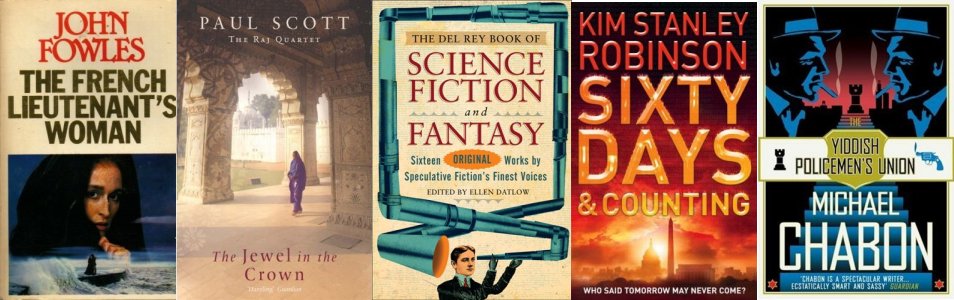
The French Lieutenant’s Woman, John Fowles (1969)
I’d seen the film many years before, and had a vague recollection of the plot. I’d also read other books by Fowles and I hold a high opinion of his fiction. But I’d somehow missed reading this one. So I took it with me on a business trip to Stuttgart… and couldn’t put it down. I hadn’t expected it to be so engrossing a read. Beautifully-written, clever, and affecting.

The Jewel in the Crown, Paul Scott (1966)
This was my October book for my 2008 Reading Challenge, and I loved it so much I immediately added Scott’s novels to my wants list. And I’m looking forward to reading the remaining three books of the Raj Quartet. I wrote about it here.

The Del Rey Book of Science Fiction and Fantasy, edited by Ellen Datlow (2008)
This is the only book in my top five which was actually published in 2008. I don’t actually read that many original anthologies – well, not unless they’re themed and the theme interests me, such as The New Space Opera or The Space Opera Renaissance. But I’d read a number of very approving reviews of this anthology, so I bought it. And… it’s a very strong anthology indeed. I wasn’t convinced by every story, but the overall standard was impressively high – albeit some stories worked better for me than others.

Sixty Days and Counting, Kim Stanley Robinson (2007)
This is the final book in Robinson’s Science in the Capital trilogy, and is a perfect indication of why Robinson is such an important sf writer. The book is educational – if not didactic – but eminently readable all the same. A fitting end to a trilogy which should be read by more people. Especially people who don’t believe in climate change.

The Yiddish Policemen’s Union, Michael Chabon (2007)
I’m clearly not the only person who thought this was very good – it won the Hugo Award, Nebula Award and Sidewise Award. Deservedly. I wrote about it here.

Honorable mentions:
Collected Poems, Bernard Spencer (1981)
I think I can safely say that 2008 was the Year of Poetry for me. I started reading considerably more of it, and I even had a go at writing it (see one effort here). And of the poems I read during the year, Bernard Spencer’s were among the best. Admittedly, this collection contains everything he published, so it’s no surprise it’s strong.

Matter, Iain M Banks (2008)
A new Culture novel is a matter for celebration, and while this one was certainly better than Banks’ last sf novel, the very disappointing The Algebraist (which wasn’t a Culture novel), it wasn’t as good as earlier ones. I wrote about it here.

Scarlet Traces: The Great Game, Ian Edginton & D’Israeli (2006)
Probably the best graphic novel I read in 2008. This is a sequel of sorts to a sequel of sorts to HG Wells’ The War of the Worlds. Its concept is perhaps not the most original idea ever – after the Martians die, the British empire reverse-engineers their technology – but it’s well handled. Great art too. The Great Game just wins out over Scarlet Traces because of a cameo by Dan Dare and Digby.

Films
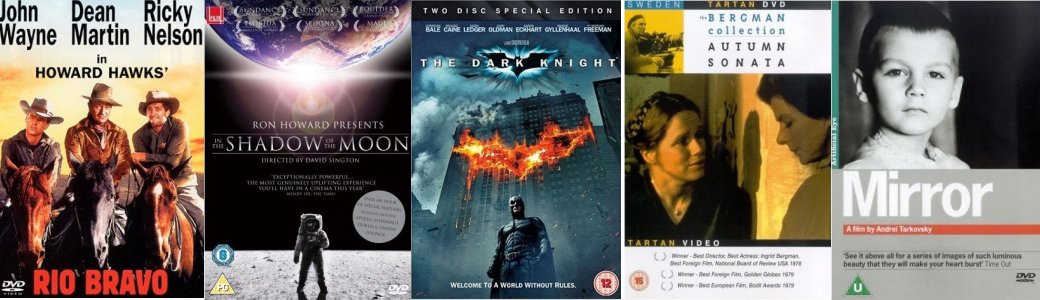
Rio Bravo, dir. Howard Hawks (1959)
The plan was to work my way through the Time Out Centenary Top 100 Films, which is why I stuck this one on my rental list. I’m no fan of westerns, but there were a few in the Top 100 – The Searchers, The Wild Bunch… and Rio Bravo. And I have to admit Rio Bravo didn’t seem as though it would appeal: John Wayne, Dean Martin (playing a drunk!), Ricky Nelson… Dean Martin and Ricky Nelson sing a duet! Sheriff has to defend town against evil cattle baron’s henchmen bent on vengeance, with drunken gunslinger and callow youth to help! So many clichés! But. I loved it. I even went out and bought the special edition DVD – once it no longer broke the Rule of DVD*, of course.

In The Shadow Of The Moon, dir. David Sington & Christopher Riley (2006)
My enthusiasm for all things space-related remains undimmed, although I didn’t buy as many books on the subject as last year – well, I still have a huge pile of them to read. This film pretty much explains the appeal. It consists chiefly of talking-head interviews with those involved in the Apollo project, interspersed with film of the various missions. As you hear the astronauts talking matter-of-factly about their trips to the Moon, you soon realise what an astonishing achievement it was. It should be repeated. Soon.

The Dark Knight, dir. Christopher Nolan (2008)
My only trip to the cinema in 2008 was to see this film. It’s a less baroque treatment of Batman than its predecessor – Gotham City resembles Chicago more than the weird Gothic metropolis of Batman Begins. Heath Ledger steals the film as the Joker, but he has excellent support from Aaron Eckhart, Christian Bale, and Gary Oldman. Maggie Gyllenhall makes a better Rachel Dawes than Katie Holmes did, but the character still seems mostly peripheral. Perhaps the film did at time feel like two films welded together – the Joker story, and the Two-Face story. But the various set-pieces more than made up for it. I’ll be getting the DVD.

Autumn Sonata, dir. Ingmar Bergman (1978)
Okay, so Bergman was sure to appear somewhere on this list, although it was a toss-up between this one and Shame (see below). But Autumn Sonata just wins out because it’s the less contrived of the two. Famous pianist Ingrid Bergman visits her neglected daughter, now the wife of a country pastor. Ingrid Bergman gives a polished performance, but Ullmann steals the show as the daughter. Anyone who thinks Ingmar Bergman’s films are dull and obscure should watch Autumn Sonata.

Mirror, dir. Andrei Tarkovsky (1975)
This film is near impossible to describe – and better people than me have tried. It’s the cinematic equivalent of stream of consciousness, which by rights shouldn’t really work. But it does. Extremely well. There are enactments of scenes from Tarkovsky’s childhood, newsreel footage, dream sequences… Despite lacking a plot, or any kind of coherent path through the story, Mirror is engrossing.

Honourable mentions:
Naked Lunch (1991), Crash (1996), Eastern Promises (2007), dir. David Cronenberg
2008 was a bit of a Cronenberg year for me. I’ve always enjoyed his films, but last year’s A History of Violence was something of a revelation – a polished and subversive thriller from the director of Scanners and The Fly? Eastern Promises is the same but more so – although perhaps in parts it could pass as an episode of a superior British television thriller. Naked Lunch and Crash, however, came as real surprises. Both are “unfilmable” novels, but Cronenberg managed to somehow make excellent, watchable drama out of them.

Shame, dir. Ingmar Bergman (1968)
Bergman favourites Max von Sydow and Liv Ullmann are enjoying the simple life on a rural island (Fåro), away from a civil war. The war catches up with them, however, and they are forced to give a television broadcast supporting one side… only to be subsequently captured by the other side. Emotional stuff, albeit perhaps a little overwrought in places. Nevertheless, it’s a strong story handled by two strong leads.

The Sacrifice, dir. Andrei Tarkovsky (1986)
Despite its glacial pace and its long takes, this is an intense film, and hard to watch in places. I wrote a little about it here.

Albums
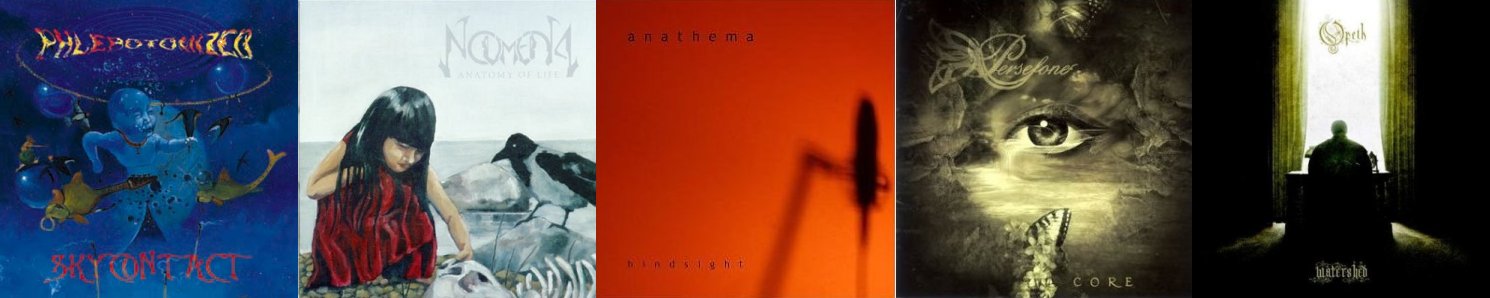
Skycontact, Phlebotomized (1997)
Phlebotomized were a short-lived death metal band from the Netherlands. They recorded a handful of demos, an EP and two albums. Skycontact was their last album. It’s progressive stuff – the band featured a violinist – and quickly became a favourite.

Anatomy of Life, Noumena (2006)
This is melodic death metal from Finland, but it also features some clean vocals and some female vocals. And the singer’s growl has to be heard to be believed. I suspect he uses a pitch shifter… Excellent stuff – and I’ve been playing the track ‘Monument of Pain’ almost constantly.

Hindsight, Anathema (2008)
Anathema are currently recording a new album – they said so when I saw them live. But until that’s released, we have this, a compilation of acoustic takes on some of their better-known songs. It’s yet more evidence that Anathema should be filling stadiums by now, not tiny rooms with beer-sodden carpets…

Corē, Persefone (2006)
One of things I love about extreme metal is that it’s an international genre. Admittedly, pretty much everyone sings in English – although with growl vocals it’s often hard to tell. Persefone are Andorran. That’s the tiny little country between France and Spain. Population about 70,000. Corē is a concept album about Persephone, the goddess for whom the band are named. An excellent mix of death metal, progressive metal and acoustic pieces, with both clean and growl male vocals, and female vocals.

Watershed, Opeth (2008)
And a new album which proves to be even more progressive than the preceding Ghost Reveries. I’m still not convinced I like the direction they’re going as much as I liked older albums such as Blackwater Park. But it’s proving to be an interesting journey, and they never disappoint.

Honourable mentions:
Still, Wolverine (2006)
I saw Wolverine supporting Anathema in Glasgow back in 2006. I enjoyed their set, but not enough to dash out and buy their albums. Then, for some reason, this year I ended up buying their latest CD anyway. And it quickly grew on me. So much so that at Bloodstock, I bought the preceding two albums, The Window Purpose and Cold Light of Monday, at the Earache stall.

Watch Us Deteriorate, Crystalic (2007)
If there’s a band which epitomises Scandinavian death metal, I suspect it’s Crystalic. This is fast-paced aggressive metal, but with a slight twist. And in Crystalic’s case that twist is the use of a fretless bass – or at least that’s what it sounds like.

Headspace EP, Headspace (2008)
Twenty-first century prog rock, featuring Rick Wakeman’s son Adam on keyboards and Threshold’s original singer Damian Wilson. This EP is a taster of their material. I’m looking forward to the debut album.

And finally, a few worsts…

Worst film isn’t going to be easy – I watched everything on those crap 50-movie boxed sets, after all. But other “gems” watched during the year include Barbarian Queen, The Warrior And The Sorceress, Star Odyssey, and Zombies Zombies Zombies (reviewed for VideoVista)

Worst books include Starship Troopers, Robert Heinlein (see here); Projekt Saucer 2: Phoenix, WA Harbinson (one day I’ll work out why I’m bothering to read this series); Orlando, Virgina Woolf (self-indulgent tosh; see here); The Fountainhead, Ayn Rand (silly OTT nonsense; see here); and the new charm-free Dan Dare comic from the now-defunct Virgin Comics. Two of these titles were from my reading challenge for the year, so in that respect it was less than successful… except the challenge also introduce me to Paul Scott’s writing. He made my top five, so I think that balances them out.

* the Rule of DVD: never pay more than £10 for a DVD.