
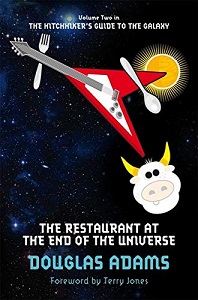
The Restaurant at the End of the Universe (1980, UK) is the direct sequel to The Hitchhiker’s Guide to the Galaxy (1979, UK), although reading them this time they feel more like two parts of the same novel. There is of course a third part to follow this. And then a further two novels, which were not based on the original radio series.
Zaphod Beeblebrox, president of the galaxy, is kidnapped from the Heart of Gold and finds himself on the home world of the company responsible for publishing the Hitchhiker’s Guide to the Galaxy. Apparently, he deliberately became president for a reason but then removed the reason from his mind. When he attempts to meet a contact suggested by another part of his mind, the city is attacked by Frogstar fighters and the entire building in which Zaphod is waiting in an office is carried away to another planet. There, Zaphod meets the man who really rules the universe, and whose identity Zaphod became president to discover. He decides the universe is in good hands.
The others meanwhile find themselves at Milliways, the titular restaurant. They’re then joined by Zaphod. They steal a ship to leave Milliways, but it turns out to be the stunt ship which will dive into a sun at the climax of the next concert by Disaster Area (a very loud music group). They jury-rig the ship’s emergency teleport system, and escape…
Ford and Arthur find themselves aboard a generation starship carrying only hairdressers, middle managers, “telephone sanitisers”, and others from the service industries. It’s the second of three generation ships – the first contains the elite, and the last the professional classes. It’s not a joke that’s aged well. It’s all very well to mock “useless” professions, but they’d been better to send off the first generation ship instead. Telephone sanitisers, whatever they are, as a rule do not fuck over vast swathes of the population on a regular basis. The generation ship crashes on a habitable world, which proves to be Earth in its prehistory.
The jokes in The Restaurant at the End of the Universe have not weathered the decades as gracefully as those in The Hitchhiker’s Guide to the Galaxy. At Milliways, the diners are introduced to the food they’re about to eat. Taking the piss out of vegetarians and vegans is not so funny these days. Disaster Area’s manager is spending a year dead “for tax purposes”. Also not a good topic for humour, when you have billionaire scumbags decamping to tax-free countries to avoid paying their contribution. Having said that, the revelation about who really rules the universe is probably more poignant now than it was in the 1970s and 1980s.
Generally, more misses than hits in this volume. True, there’s a lot of nostalgia at play here – and for those of us who remember the 1970s, that even applies to the targets of Adams’s humour. The humour in the first book struck me as less tied to its time than here. Which is not to say The Restaurant at the End of the Universe isn’t a fun, quick and light read, but YMMV. You may be better off stopping after The Hitchhiker’s Guide to the Galaxy. That novel at least shows how to do science fiction humour successfully – and I admit it’s British humour, not American, which is an entirely different beast – but it’s something a few current genre authors should probably look into.
 It Doesn't Have To Be Right...