
Winner of the Hugo Award in 1965, in a shortlist which included Cordwainer Smith, Edgar Pangborn and John Brunner. The Smith read like half a novel, I really didn’t like the Pangborn, and I have the Brunner on the TBR. Even so, I’m not convinced The Wanderer (1964, USA) was the best of the four.
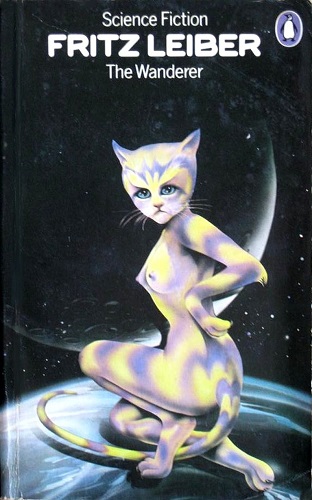
A strange planet appears suddenly – from hyperspace, it’s theorised – in the Solar System, just outside the orbit of the Moon. Its presence causes earthquakes and tidal waves, and rips the Moon apart. The planet, named the Wanderer, proves to be actually destroying the Moon for fuel. Because it’s populated by thousands of alien races (including sexy alien cat women), and they’re on the run. The universe is packed with life – none of it visible from Earth, for, er, reasons – and it’s ruled by a government which resists change and adventurism, and the Wanderer’s dwellers are free spirits, gallivanting about the universe in search of, well, adventure.
The story is told through short sections from a wide cast of characters, all American except for a handful of non-US ones. There’s a German scientist, who appears twice and comes across like a cartoon Nazi; and a pair of drunken British writers (one Welsh, one English), who are caricatures, not characters. They also live in a UK that doesn’t exist, where people eat “sausage-and-mashed” rather than sausages and mash.
All the time I was reading the book, I was trying to figure out when it was set. The US has a base on the Moon, and the USSR a mission on Mars… But the KKK is running around openly in Florida (there are several uses of the n-word and some really offensive racism), the English character remembers a bombing raid as a child, a man in the US claims to be the perpetrator of the Black Dahlia murder (from 1947), and South Africa still has apartheid. So, probably early Sixties, then. (Despite the moonbase and Mars.)
I’m told Leiber’s technique of using multiple viewpoints was something new in science fiction. Certainly it’s a technique more associated with techno-thrillers and the like, but they didn’t begin to appear until later. To be honest, most of the viewpoints don’t actually add anything – there’s a group of UFO nuts in California who explain what’s happening in the first half of the novel, and two Americans independently kidnapped by the aliens who have the second half of the novel explained to them. The rest are, well, not even local colour.
Hard to believe The Wanderer was the best science fiction novel published in 1964.
 It Doesn't Have To Be Right...
2025-06-01 at 20:14
It wasn’t the best in 1964. Davy was — haha (I know your views on Davy). And the only reason Davy didn’t win is that it didn’t get a paperback edition that voters could easily track down until 1965. And the 1964 hardback had one of the world’s worst covers… sooo…. Davy is the real winner in my universe. Muaha.