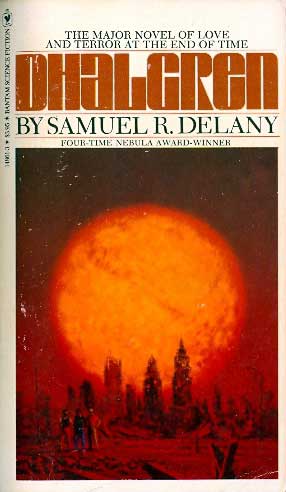
People either love or hate Dhalgren . This is not all together surprising – it’s an experimental novel, it’s pornographic in parts, and it’s only peripherally science fiction. On its publication in 1975, some sf commentators hated and condemned it. Harlan Ellison said, “When Dhalgren came out, I thought it was awful, still do… I was supposed to review it for the L.A. Times, got 200 pages into it and threw it against a wall.” (Ellison hating it is a good reason to like the book, if you ask me.) And yet Dhalgren proved to be Delany’s biggest-selling novel, finding a huge audience outside the genre.
The plot, what little of it there is, is simple: a young man who cannot remember his name enters the city of Bellona. Some catastrophe has taken place there, and only there, reducing the city to a post-apocalyptic urban wasteland. In this wasteland live a few hundred anarchic survivors. There is a commune of do-gooders in the park, gangs of scorpions roaming the streets, and Roger Calkins, publisher of the Bellona Times freesheet, lording over it all from his walled mansion. The young man – who is quickly named Kidd, the Kid, or Kid – meets various of Bellona’s residents. He helps the Richards move apartments. They are trying to continue their lives as if everything were normal, but it’s proving very difficult. Kid enters into a relationship with harmonica-playing Lanya. Eventually, he ends up as the leader of a nest of scorpions. And he becomes a poet, and has a book of poetry published by Calkins.
The prose operates at a very detailed level, with almost every itch, breath, or passing thought documented. Occasionally, it’s clumsy. Sometimes, it’s serviceable. Mostly, it’s good, but never quite brilliant. The characters are, by their very nature, chiefly ciphers. Bellona itself is probably the best drawn character in the novel. Some of the cast are merely mouthpieces. The prize-winning poet, Ernest Newboy, for example. The name itself is a giveaway. At several points in Dhalgren, Newboy discusses poetry with Kid – both the writing of it and people’s responses to it. I haven’t read enough of Delany’s non-fiction to spot if Newboy is reiterating Delany’s own theories. I doubt it, because Newboy’s theories are pompous twaddle. For instance, he tells an anecdote about how his appreciation of two writers was changed by personally meeting them. The work of one he found bland and dull, but after interviewing the writer, revised his opinion – he could now hear the author’s voice when he read, and what was anodyne he now saw was ironic and incisive. And vice versa for another writer, whose work he had always admired, but found near unreadable after getting to know the author. It’s complete and utter rubbish, of course. You might as well expect a soap opera star to behave in real life the same as the character they play on television…
Dhalgren is only peripherally science fiction. No explanation is given for the catastrophe which has befallen Bellona. The various hints Delany gives are not rational – a second moon in the night sky, a day when a vast sun fills the sky, the way the city seems to randomly change, the unreliable nature of time within the city… I’ve seen it suggested that much of this can be explained through Kid being schizophrenic. But there are other sfnal elements in the novel. The scorpions are so called because they wear holographic “light shields”. These were initially holograms of scorpions, although by the time Kid arrives in Bellona they’re all manner of colourful and mythical creatures. This use of science fiction ideas, without the underlying process, is what angered some sf commentators – Delany was breaking the “rules”.
But it’s not just the “rules” of science fiction that are broken in Dhalgren. Many of the “rules” of fiction are also carefully broken. The voice is third person, but occasionally lapses into first person. The final section “The Anathemata: A Plague Journal”, is presented with interlinear comments, and in parts reads like an edited manuscript. Kid’s character too is very different to that presented in the rest of the novel. The novel’s opening line, “… to wound the autumnal city” is actually the latter half of the novel’s last line. The narrative’s chronology is confused and confusing – Kid loses entire days at a time, and yet the novel’s timeline never quite adds up.
One of the interesting aspects of Dhalgren is not that you find something new every time you read the book, but that you consider the book itself anew. Each reread changes how you think about the novel as a whole. This time, I found many of the characters less appealing than I’d remembered. Newboy was a pompous arse, astronaut Captain Kamp (based on Buzz Aldrin? in places, he seemed to be) was patronising, George Harrison was almost a caricature, and most of the scorpions were unlikeable yobs. And yet, on this read, I learnt something new about Dhalgren: it is filled with references to Greek and Roman myths. Such as the opening scene, in which Kid has sex with a woman and then visits a grotto and finds a strange chain of prisms and lens – a reference to Daphne. In many parts of the novel, Kid’s story references that of Apollo. Dhalgren is more myth than literature, and in some respects its construction reflects that.
I still find the novel fascinating. There’s something primal in the story which appeals to me. As post-apocalyptic novel, it’s completely different to George R Stewart’s Earth Abides. Dhalgren is never dull. It hasn’t even dated, because it’s one of those sf novels – like van Vogt’s Undercover Aliens – which carries the time it was written around with it, irrespective of, and in addition to, the time in which the story is set.
So, that’s it – I read one of my favourite science fiction novels in each month of 2007. I’m glad I did. It went something like this…
January: Undercover Aliens, AE van Vogt (1950)
This one remains a favourite. Every time I read it, it never disappoints – perhaps because it has no pretensions, so my expectations are always met. It’s a lot of fun.
February: The Ophiuchi Hotline, John Varley (1977)
Whereas this one did disappoint a little. This time, I found the characterisation thinner than I’d remembered it, and the multiple copies of Lilo a little unnecessary. There are still a lot of great ideas in the book, though – even if the best one is thrown away in the last couple of pages. All the same, it’ll stay a favourite.
March: Stations of the Tide, Michael Swanwick (1991)
The first one to get demoted. I remember being blown away when I first read Stations of the Tide back in the early 1990s. Sadly, I wasn’t this time. Refusing to name the protagonist now seemed like a gimmick, parts of the story were lifted straight from a Southern Gothic, and the sections set in the Puzzle Palace were confused and confusing. A very good book, yes; but not a favourite any more.
April: Where Time Winds Blow, Robert Holdstock (1981)
I was in two minds about this one. The central conceit – Kriakta Rift, where strange winds blow through time, depositing unknowable artefacts from past and future – is a stunning invention. The central triumvirate of characters are handled with skill and compassion. But. But. But. It’s that last section, where the time winds are “explained”. It sort of spoiled it for me. On balance, however, I think it remains a favourite – because the first three-quarters overshadow the final quarter.
May: Soldier, Ask Not, Gordon R Dickson (1967)
Another book gets relegated. I bunged this one on the list to make it up to twelve, and chose it chiefly from fond memories of the trilogy and a recollection that this was the best of the three. And so it is. Unfortunately, those fond memories were a little rosier than I’d guessed. Dickson seemed more concerned with his historical theories than he was with his story, and the end result reads like a pulp sf action-adventure tale wrapped around some oddball lecture.
June: Kairos, Gwyneth Jones (1988)
This novel was once described to me as “a beautiful book badly written, or a bad book beautifully written”. The remark impressed me at the time – I was a callow youth then. Kairos is actually neither. Like many literary sf novels, there are sparkles of beauty and brilliance in its prose. But more than that, it is tightly plotted and the characterisation is superb. The story unfolds with the same remorselessness with which the eponymous drug unravels the world of the story. A favourite it is and a favourite it shall remain.
July: Against A Dark Background, Iain M Banks (1993)
Like Undercover Aliens, this one appeals because it’s fun. And every time I read it, it’s still fun. Not content with charging headlong through space opera tropes, Banks also subverts the standard fantasy quest template. Each time Sharrow wins a new plot coupon, she goes and loses it or has it taken from her. And yet Against A Dark Background is not in the least bit a frustrating read. Still a favourite.
August: Metrophage, Richard Kadrey (1988)
I’ve maintained for many years that the publication of Metrophage locked and bolted the door on cyberpunk. There was nothing more that needed to be said. Neal Stephenson’s piss-take of cyberpunk, Snow Crash, was only a bit of fancy icing on the cake – all sugary colour and no substance. And yet, rereading Metrophage, it occurred to me that what Kadrey had actually done – as I wrote in my original post on the book – was fold cyberpunk back into science fiction. Still a great novel, still a favourite.
September: Coelestis, Paul Park (1995)
There’s no doubt in my mind about this one. Each time I read it, it impresses me more. It stays a favourite.
October: Dune, Frank Herbert (1965)
I had to add two titles to my original list to make it a year’s worth of reading. And while I’ve read Dune many times, and enjoyed it each time, I’ve never really held the book in high enough regard to consider it a favourite. For one thing, it’s the start of a series, but not the strongest book in that series. But I decided to add it to my favourites challenge and… my opinion on it remains unchanged. I read it, I enjoyed it, I’ll likely read it again. I like Frank Herbert’s writing a great deal… but he’s written better books than Dune, and has written books with better writing in them than in Dune… Unfortunately, the Duniverse overshadows all his other creations. For the time-being, Dune will remain on the list. But at the bottom, ready to be relegated should another sf novel really take my fancy.
November: Take Back Plenty, Colin Greenland (1990)
I’d forgotten how good this novel really was. I’d remembered the too-pat ending, though. But that’s minor. An engaging heroine, a clever homage to pulp sf, and some lovely prose. This books deserves to back in print. It remains a favourite.
December: Dhalgren, Samuel Delany (1975)
See above. Yes, Dhalgren remains a favourite.
So there you have it. Of the twelve books, two didn’t make the grade, and one is ripe for relegation. I still have that list of also-rans, which I may work my way through. Having said that, the few from it I did read last year weren’t good enough for promotion. But then the list was chiefly put together from nostalgia, which is never a good indicator…