It Doesn't Have To Be Right…

… it just has to sound plausible


Leave a comment

Truth from the Tinterweb

I’m a big fan of Wikipedia. It’s both informative and entertaining. Of course, only a fool would use it uncritically. But where else would you find articles on quantum computing, kings of Poland, the club sandwich, and Finnish heavy metal bands?

The fact that Wikipedia can be edited by anyone is both a blessing and a curse… Which is how you can end up with an article on Finnish heavy metal band Heavy Metal Perse which includes the following line:

While their name in English might be viewed as “Heavy Metal Per Se”, in Finnish it has no specific meaning, except for the word “perse” meaning “ass”.


6 Comments

Rereading Favourites – June Update, Part 2

Kairos I did not expect to disappoint. If anything, I imagined I would get more from the book on this reread – it’s been over a decade since I read it last and I hope I’m a more discerning reader now than I was then. Which also means, I suppose, that I had higher expectations of this favourite novel than I’d had of the others I’ve reread so far…

And right from the first page, the prose was as good as I’d remembered it. By the end of the first chapter, something else about the novel had occurred to me – what had been near-future science fiction was now alternate history. Kairos was first published in 1988, and it posits a future extrapolated from Thatcher’s Britain. The ever-widening equity gap, the increasingly ham-fisted attempts to enforce law and order, the slow realisation that the decisions made by government were not for the benefit of the people it represented… It wasn’t hard to imagine a dystopic future back then. If anything, it seemed almost inevitable.

I was going to write that we’re better off now than we had expected to be – both politically and economically. But a couple of days after finishing Kairos, I happened to watch Red Road, a film set in a far-from-salubrious area of Glasgow (it’s a very good film, incidentally). If Red Road is a true reflection of life in the present day for some, then for them the future of Kairos has come true…

Jane “Otto” Murray is a lesbian ex-political activist, and the owner of a small secondhand book shop. One of her closest friends, James, a gay soap opera actor of Nigerian extraction, asks her to look after a small film container given to him by his sister. Both James’ sister and brother are involved with BREAKTHRU, a pharmaceutical company turned cult religion – there is, incidentally, no commentary here on cults or religions. BREAKTHRU have managed to obtain a sample of a drug, which they call Kairos. This drug allows users to directly affect the real world. There is mention of quantum theory, used to “scientifically explain” how the drug operates, but it is its effects not its mechanism which is important.

After dabbling with BREAKTHRU, Otto’s lover, Sandy Brize, leaves her. Shortly afterwards, Otto’s son, Candide, runs away. Someone has kidnapped his dog and demanded the film canister as ransom. But Candide runs to Sandy, taking the film canister with him, and enlists her help in rescuing the dog. Together, they head north, meet up with a posse of animal liberationists, and raid the BREAKTHRU laboratory where Candide believes the dog is being experimented upon. Throughout this period, the drug in the film canister has been affecting Sandy, who has in turn been affecting the real world…

There’s no denying that Kairos is a very good book, and rereading it I can understand why it became a favourite. I’ve admired Jones’ writing a great deal since first encountering it, and Kairos is neither the somewhat clumsy science fiction of her earlier Escape Plans nor the near-fantasy of her debut, Divine Endurance. It is a novel that feels important – less so now , of course, than it did when I first read it (which would be a couple of years after it was published). Even so, it’s nice to read a sf novel that actually had relevance, even though that relevance no longer holds true. Perhaps that’s one of the definitions of a favourite novel – it recaptures what you felt when you first read the book. And a definition of a well-written book must be one in which you sympathise with the protagonists no matter how little you have in common with them – and I certainly have very little in common with Otto.

I’m glad I reread Kairos. I will almost certainly reread it again. It’s by no means a cheerful or fun book, although it is liberating and hopeful in its resolution. I’m going to keep it on my favourites books list.

Incidentally, my copy of Kairos is inscribed by Gwyneth Jones, To Ian, In memory of the strange sausages. She never did tell me what that means…


1 Comment

Rereading Favourites – June Update, Part 1

After Soldier, Ask Not, I decided to expand the challenge to include an “also-ran” each month… just in case the favourite failed to make the grade. For June, the favourite was Gwyneth Jones’ Kairos, and the also-ran was Time and Again by Clifford Simak.

Time and Again was first published in 1951 under the title First He Died. It’s also one of the earliest sf novels I ever read. I can distinctly remember reading it when I lived in Dubai – likely borrowed from Dubai Country Club‘s subscription library. That would be sometime between 1976 and 1979. Thirty years ago! And yet I could recall some of the details of the plot – there was a time war; and a man who landed a wrecked spaceship despite it having no drives, nor even being airtight. One image from the novel which had stayed with me was of a car that had crashed into a tree, and which contained a book from the future.

I suppose disappointment was inevitable – I certainly hope I’m a more discerning reader now than I was when I was eleven years old. The novel opens with a typically Simakian scene: a man is sitting on his porch, the crickets are chirping, the brook is burbling, night is falling… Another man walks up, tells the seated man he is from the future, and that Asher Sutton is returning to Earth tomorrow and must be killed. It’s a great set-up for a story. And it gets better. Twenty years ago, Sutton was sent to 61 Cygni in an attempt to break through the mysterious barrier guarding the system’s seventh planet. He is the first and only person to have done so. And now he is back – travelling in a spaceship that has no spacedrive and isn’t even airtight. Sutton will write a book about something he learned on 61 Cygni. This book will be used as a rallying cry for a movement to emancipate androids (vat-grown humans, slaves in all but name). Others, however, will interpret Sutton’s revelations to refer to humans only. And so there will be a war.

Time and Again is set some 6,000 years from now, in a future when humanity has a galactic empire – which appears to be ruled by a bureacracy. Time travel has only just been discovered when Sutton returns to Earth, but factions from the future representing both sides have travelled back in time in an effort to influence events.

The great ideas promised by the novel’s opening, however, never really appear. Simak is more concerned with the character of Sutton, and the nature of his revelation, than he is with the ramifications of the situation Sutton creates. The world-building is poor – the Earth of the 81st Century comes across as no different to 1950s America, but with silly clothes and a code duello. The time travel, and any paradoxes it might create, never really kicks into gear. Early in the story, Sutton finds a letter written by an ancestor in 1987, and which has remained unopened since then. Ignoring the fact that paper would never last 6,000 years, the letter itself is written in a style of English which seems more 1900s than 1980s. It all adds up to a novel which is a great deal less than the sum of its parts. Perhaps it’s for good reason it’s not as well-known as some of Simak’s other works, like Way Station or City.

So, cross off one also-ran. It drops off that list, never mind being promoted to the favourites list. And on we go with the rereads…

Incidentally, you’ll notice that my editions of Time and Again and the Dorsai trilogy – see here – all feature cover art by Tony Roberts (who was recently famous for being “sampled” by Glenn Brown in his Turner Prize nominee, The Love of Shepherds 2000). I wonder if it’s the art that made me believe the books were favourites – because I really do like those covers. Perhaps it’s because I began to identify myself as a sf fan around that time, but I find the cover art of the late 1970s more appealing than that of sf books today. Tony Roberts, Angus McKie, Tim White, Bruce Pennington and, of course, Chris Foss… Stewart Cowley’s Terran Trade Authority books: Spacecraft 2000 – 2100 AD and Starliners… Spaceships. Cool spaceships. Book covers then always seemed to exude an air of mystery – something sadly lacking from today’s cover art. It seems almost irrelevant that those wonderful covers rarely had any link to the contents of the book. But they made you pick it up.


Leave a comment

In Recenseo Veritas

According to the Whorf-Sapir Hypothesis, language influences thought. Which makes you wonder what the writer of the following was thinking –

“Although the band’s music is very (and I emphasize on very) unique…”*

Are there different grades of uniqueness? Can something be only “slightly unique” – meaning, there’s more than one of them? What sort of world would be inhabited by a person who considers “unique” to include quantities of greater than one? Some weird kind of optimistic one, I suppose.

(* from a review of Lover, The Lord Has Left Us by The Sound of Animals Fighting)


Leave a comment

Logophilia

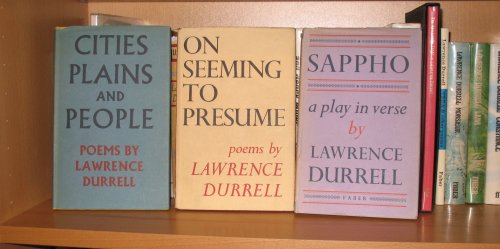
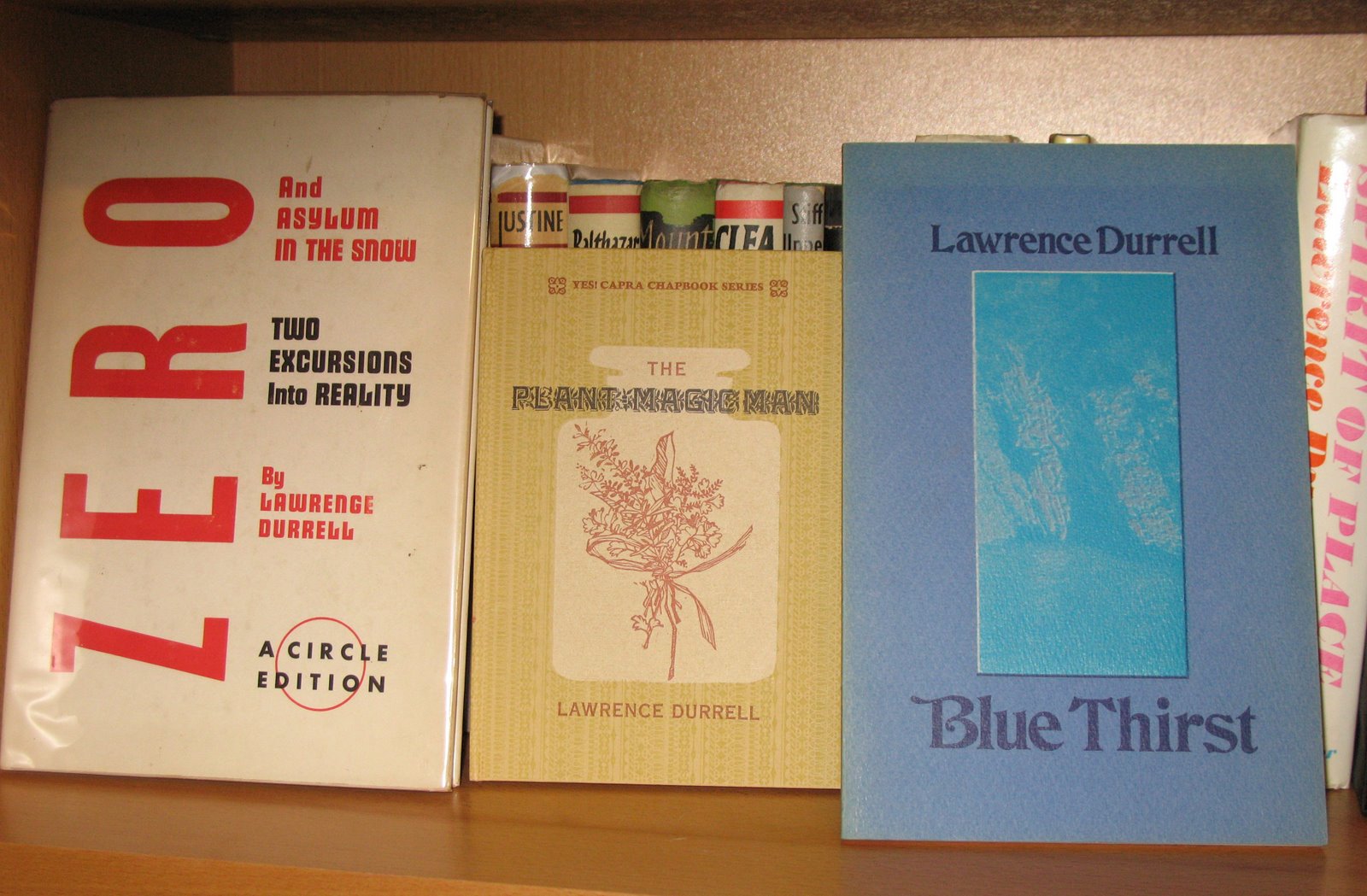
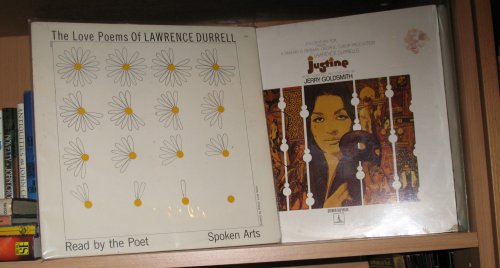
Some poems you fall in love with on first reading. Here’s the opening verse of one that did it for me recently:

Her sea limps up here twice a day
And sigh by leaden sigh deposes
Crude granite heft and sponges
Sucked smooth as foreheads and noses;
No footprints dove the labouring sand,
For terrene clays bake smooth
But coarse as a gipsy’s hand.

(‘Near Paphos’ by Lawrence Durrell)


Leave a comment

The Fine Art of Reviewing

Synchronicity strikes again. After my earlier rant about reviewing, I stumbled across the following “review” of the 2000 mini-album The Fluid by French death metal band Symbyosis:

“Many North Americans really hate the French. Is it their snooty attitude? Maybe it’s their cowardice during World War II? Either way, France’s Symbyosis are a great band and shouldn’t be lumped into the category of ‘a French band from Paris’.”

Bruce McKinlay from http://www.ripntear.net

Some people should not be allowed opinions…


Leave a comment

THIS BOOK IS GRATE!!!

The following comment appeared during a discussion on a literary mailing list:

“And please remember that anyone who is a professional reviewer, i.e. who earns a significant part of his/her income from reviewing, as I myself have done, does not in fact read the whole book – how could they, if they reviewed 2-3 books per week and held down a ‘day job’?”

I find this comment… horrifying. I used to review books for Vector, the critical journal of the British Science Fiction Association. I would never have dreamt of writing a review without reading the entire book. Admittedly, I wasn’t reviewing two or three books a week – more like two or three every couple of months. But to not read the book, to cobble together a review from a quick skim… That’s unfair to the book and its author, and it’s unfair to those who buy the book based on the review.

But then you have the likes of Harriet Klausner. As I write this, she has reviewed 14,022 books on Amazon (no doubt it will be more by the time you read this). Given that Jeff Bezos launched his on-line book shop in 1995, then Klausner has read an average of 1,167 books a year, or 3.2 books a day each and every day. Of course, that assumes she began reviewing the day Amazon went on-line. Which is unlikely. She could be posting reviews written prior to 1995 – according to her profile on Amazon, she was a librarian and “wrote a monthly review column of recommended reads”. I have neither the time nor the inclination to trawl through her 14,000 reviews to discover which books were published prior to 1995, however.

Is Klausner providing a useful service? Personally, I think her Amazon reviews are next to useless. She gives every book 4 or 5 stars – and some patently don’t deserve that. Her review of Hunters of Dune, a book – sadly – I have read myself, inaccurately summarises the plot, and then finishes on the nonsense line: “Still this is a fine entry that adds to the mythos while paying tribute to its founding father as the scientific techno concerns involving genetic engineering that Frank Herbert voiced years ago seems so valid now.” I’ve no idea what this means, or how it relates to Frank Herbert’s oeuvre. Certainly, he discussed genetic engineering in several of his novels – most notably in The Eyes of Heisenberg – but to some extent all of his novels were cautionary tales.

There are, of course, many good reviewers out there – both amateur and professional. Genre magazines such as Interzone and Locus (to pick two titles at random) have run book reviews since their first issues. It’s a standard component of any science fiction or fantasy magazine. In recent years, litblogging has also become an important resource. Like reviews in magazines, you soon learn which ones point you towards books and authors you would enjoy. It’s a shame some of the more traditional elements of publishing have yet to realise the usefulness of blogs. Actually, it’s not a shame – it’s just another indication of their blinkered snobbery.

Still, if they don’t read the books they review, why should they read blogs?


3 Comments

It’s in the Memes, er, Genes

When I resolved to read one of my favourite science fiction novels during each month of this year, I hadn’t realised quite how prevalent in the blogosphere was the idea of a themed year-long reading list. Admittedly, I saw it as more of a “resolution” than a “challenge”. After all, where’s the challenge in rereading your favourite books? Having said that, part of my intention was to determine if my list of favourites actually needed updating…

And the first update I made was to expand the list to twelve – so I could read a book for each month of the year. One of the two titles I added was Gordon R Dickson’s Soldier, Ask Not, the second book of the Dorsai trilogy. I remember the trilogy being a favourite during my teens, and I vaguely recalled that Soldier, Ask Not was the most interesting of the three. However, in a spirit of fairness, I decided to reread the entire trilogy…

Tactics of Mistake was the clearest of the three books in memory. Why this should be the case, I don’t know. It’s not as if I’d read the book more often than the other two in the trilogy. Perhaps it’s because it’s the most straightforward of the three; or perhaps it’s because, like Dune (another favourite), it features an ordinary young man who subsequently proves to be anything but. This young man is Cletus Grahame, a military officer and scholar. In the future of Tactics of Mistake, the Earth has settled into two mutually antagonistic blocs, the Western Alliance and the Eastern Coalition. These blocs manoeuvre for position and power, and occasionally fight, on the fourteen worlds so far settled by humanity. One such world is Kultis, where the settlement of Neuland is waging a guerrilla war against Bakhalla. The Western Alliance is supporting Bakhalla – a colony of Exotics, sort of Buddhist-like philosophers with arcane psychological skills; while the Eastern Coalition supports Neuland. (It’s odd how so many US sf novels of the mid-twentieth century attributed almost superhuman powers to psychologists – e.g., Isaac Asimov’s Foundation trilogy, Frank Herbert’s The Dragon in the Sea, or Algis Budrys’ Rogue Moon.) Grahame has had himself posted to Bakhalla in order to try out his tactical theories against the Neuland guerillas. He also makes an enemy of Dow deCastries, a rising star in the Eastern Coalition’s upper echelons. DeCastries intends to have the Eastern Coalition rule both Earth and the off-world colonies. Under himself, of course. Grahame plans to prevent him. And he does this, in part, by turning the Dorsai, a world of interstellar mercenaries, into the most effective fighting force ever seen.

Sadly, Tactics of Mistake did not match up to memory. Grahame is a little too competent to be entirely plausible – and his dodgy knee has a touch of characterisation-by-quirks to it. His love-interest, Melissa, acts like a teenager throughout the novel. And the chief hook on which the narrative hangs – Grahame’s genius at tactics – is, well, is unconvincing. His battle plans seem to rely on the enemy screwing up – in fact, they succeed because the enemy screws up exactly as Grahame had predicted. So much for “no battle plan survives contact with the enemy”… Ah well. Fond though my memories of the Dorsai trilogy may be, Tactics of Mistake is definitely not a contender for the favourites list…

But then it was Soldier, Ask Not that I actually added to the list. This is the second book in the trilogy. Unlike the other two, I’d actually reread it back in 1995 – after I’d found a copy in a remaindered book shop in Abu Dhabi I used to visit often when I lived in the UAE (the trilogy itself was in storage in the UK at the time). This may be why I remembered the book as the most interesting of the three – although the fact that it focused on the Friendlies, a pair of worlds settled by Christian fundamentalists, also contributed. What I’d forgotten, however, was that the novel is a first-person narrative. And that the narrator, Tam Olyn, is an Earth-born newsman (and we can tell this is science fiction: newsmen such as Olyn are renowned for their objectivity). He proves to be one of the very few people able to influence historical forces (Cletus Grahame, of course, was another). Olyn is a far from sympathetic character: selfishness and arrogant. When his one selfless act results in the death of his brother-in-law in a massacre of prisoners by a Friendly mercenary, Olyn sets out to destroy the Friendlies and their way of life.

Dickson appears to have tried for a more literary tone in Soldier, Ask Not than he had used in Tactics of Mistake. Unfortunately, it doesn’t work. I suppose in some respects this is the book showing its age – many of the various turns of phrase have become cliched, or are used with a clumsiness modern readers will no longer accept. Dickson also appears to confuse himself with his astrography – if not flatly contradicting his earlier self. The uninhabited world of Oriente, for example, is described as orbiting both Procyon and Sirius. There is something curiously one-dimensional about Dickson’s future setting too. There are few, if any, mentions of cultures other than West European/American; and the Friendlies are, of course, Christian fundamentalists. Yet Dickson takes great care to describe his characters as having mixed ethnicity (Jamethon Black in Soldier, Ask Not, for instance, is partly of Berber ancestry). The novel’s resolution is entirely expected – in fact, Olyn’s rehabilitation is pretty much obvious from the first page. Given that it was the presence of the Friendlies that I remembered as most interesting about this book, I was disappointed to see how they were treated. At times there’s a clear envy of their faith in the prose; and yet they’re completely monstered when required by the plot. The aforementioned massacre, for example, doesn’t seem plausible for a culture with a rigorously-defined moral framework.

The final book in the trilogy, Dorsai!, was the first book published (as The Genetic General), but was then heavily rewritten. It’s set at the same time as Soldier, Ask Not – in fact, the events of Dorsai! are mentioned in Soldier, Ask Not. Like Tactics of Mistake, its protagonist is a tactical genius, Donal Graeme, although he is not recognised as such by his peers. At least not initially. They just think he’s “strange”. Also like Cletus Grahame, Graeme sets himself in opposition to a powerful politician, William of Ceta, who also intends to control all the colonised worlds. In fact, the plot of Dorsai! bears many resemblances to that of Tactics of Mistake (or vice versa, given that Dorsai! was written and published first). In a nutshell, Graeme, a Dorsai, heads out among the colonised worlds to make a name for himself. He proposes unorthodox battle plans to his masters, which subsequently prove to be exactly what’s needed for victory, and so is promoted to ever higher positions. All of which is necessary for him to effectively block William’s plans. There’s not much in the way of jeopardy in Dorsai! – at no point do we doubt Graeme’s eventual success. But then the novel, and by extension the trilogy, always seemed more of a platform for Dickson’s theories regarding the sweep of history and splintering of humanity into specialised cultures than it was a serious attempt at well-plotted fiction.

Sadly, Dorsai! is on a par with the preceding two books in the trilogy. There are some interesting ideas in there but the books read as little more than adventure stories with a side-helping of pie-in-the-sky historical and psychological theorising. But even that doesn’t work plausibly. We have historical forces at work… and yet they can be controlled by Great Men. I always thought the two concepts were mutually exclusive. The setting of the Dorsai trilogy, contradictions aside, is lightly sketched in, which sometimes works against it. The structure of the books, however, are heavily dependent on military tactics and strategy, and their use on the battlefield, and these are not at all convincing.

So, after all that, Soldier, Ask Not becomes the first book to be dropped from the favourites list. I can see why I liked the books in my teens but, well, I’m older now and they no longer hold the same appeal. Dickson’s central premise is mildly interesting, but the implementation is disappointing. Ah well. I suppose I’ll have to turn to the almost-rans list to find a novel to take Soldier, Ask Not‘s place. Um, I seem to recall really liking Time And Again by Clifford Simak when I was younger. I suppose I’ll have to reread it…

Incidentally, here’s something Dorsai-related that is really scary


1 Comment

A Grand Day Out

Saturday 28 April was alt.fiction, a one-day science fiction and fantasy writing event in Derby. I went to the first one last year – it was good. And so was this one.

I nearly didn’t make it. The day before, Amazon had rejected my debit card on an order, so I rang my bank. They assured me there were no problems with my account. Saturday morning, the cash machine “retained” my card. I rang the bank again, and ranted at them. Apparently, my account had been marked “contact lost”, as correspondence had been returned. Surely my conversation with the bank the day before surely qualifies as “contact”? I later learned the returned correspondence had been sent to an address I’d vacated three years ago – and I’d never told the bank I lived there. Someone definitely screwed up somewhere. Still, it’s my own fault: only a couple of days before, I’d told a friend that I was happy with my bank and had experienced no problems with them…

I ended up using my credit card to withdraw cash. For some unknown but slightly prophetic reason, I’d decided to fetch money earlier than planned, so the delay didn’t actually result in me missing my train. I still arrived at the station with plenty of time to spare. There were a lot of blokes on the platform drinking tinned lager. Football fans. That was a bit worrying. For one thing, it meant the train would be full. When the train arrived, I managed to get a seat. It was reserved, but not until the next stop. And there was always a chance the person who’d booked it wouldn’t show. But they did. So I spent the rest of the trip standing.

alt.fiction began at noon, and I’d calculated that my travel plans would get me there no more than ten or fifteen minutes afterwards. I actually arrived at the Assembly Rooms at 12:05. I handed over my ticket, got my badge. I’d expected to see some familiar faces, and the first one I saw was Christian Dunn of Solaris. In the bar, of course. Over the course of the afternoon, I met the rest of the Solaris team. I spoke to a number of people throughout the day. It was good to catch up with friends, including some I’d not spoken to for many years, and also to meet new people. Topics of conversation were entirely normal and relevant, unlike at Contemplation: SFX‘s two new rival magazines, SciFiNow and Death Ray (are those really the best titles they could think of?); writing techniques with George Mann; the uncollected short stories of Peter F Hamilton; why tagging is a fundamentally flawed concept with Jyoti Mishra and Tony Ballantyne; book-selling with Brian Ameringen; novelisations with Tim Lebbon; and various other subjects I can’t recall. All this took place in the bar. Happily, the drummers who had been practicing behind a partition last year weren’t present.

I only made it to a single programme item – Iain Banks reading from his new Culture novel, Matter (due out next year). Probably because I was still in a foul mood from the cash-machine shenanigans that morning. In that sort of mood, my short attention span is even shorter, so I knew I’d not last 60 minutes listening to a panel. In that respect, alt.fiction seemed less successful to me than last year. That’s entirely my own fault, of course, and doesn’t reflect on the organisers. It was certainly a bigger event than 2006 – a longer programme, and more big names as guests. And more people attended too. I’ve only myself to blame for not making it out of the bar. And for my poor book-haul – a mere two books. A first edition of M John Harrison’s Signs of Life from Cold Tonnage, and Terry Bisson’s Fire on the Mountain in paperback from Porcupine Books. Well, okay, I can blame the poor book-haul on a reluctance to spend cash due to an inability to access my bank account because my debit card had been swallowed by an ATM. So it was really the bank’s fault.

I left straight after Banks’s reading. Taxi to the station, a cup of dangerously hot coffee from whatever food franchise they have in the concourse, and a 20 minute wait for a train. I got back home around half past nine, in plenty of time to meet friends who were out drinking in the town centre. This was in a “trendy” pub called Bungalows & Bears – and no, I’ve no idea what the name means. Given that, and the two new sf magazines mentioned earlier, I’m tempted to think people have lost the art of naming things… A good name is important. SciFiNow, Death Ray and Bungalows & Bears are not good names.

I forget what time I left the pub, but it was late. I ended up walking for over a mile before I managed to flag down an empty cab. I finished off the day with a doner kebab – all I’d had to eat that day since a sandwich from M&S on the train to Derby.

A… mixed day. My mood probably spoiled alt.fiction for me – or rather, my bank probably spoiled alt.fiction for me. I enjoyed myself there, but I think I would have done so more if it hadn’t been for the cock-up with my debit card. Who said money can’t buy you happiness…?


7 Comments

Favourites

Whenever people asked me what were my favorite science fiction novels, I always had a list of ten titles ready to trot out. Some of the books are novels I’ve returned to again and again; others I’ve read only once – but that was enough to deem it a “favourite”. It occurred to me several months ago that this list hasn’t changed in over a decade. It seemed odd that there hasn’t been one novel published in the last ten years I didn’t think good enough to be on the list. So, among the health- and finance-related New Year’s Resolutions for 2007, I decided to reread one of those favourite books each month. And, wonder of wonders, so far I’ve managed to stick to it…

Here’s the list (in order of year of publication):

(Annoyingly, most of these titles are currently out of print. Oh, and the more observant among you will have noticed that there are twelve titles in the list above – that’s so I can read one a month for the entire year.)

So far, I have read…
The Undercover Aliens – I actually read The Mating Cry (see here) – remains a favourite. It’s by no means van Vogt’s best-written novel. Nor does it have the most coherent plot of any of his books. But the mix and match of Otto Preminger-style California noir and Planet Stories-type science fiction appeals immensely. The protagonist is a classic hero; the female lead is an archetypal femme fatale. It has immortals, an alien robot spaceship, Mexican cultists, and masks in it. It is a great deal of fun.

John Varley’s debut novel, The Ophiuchi Hotline, is also fun. In a Solar System in which humanity has been booted off the Earth by gas-giant-dwelling Invaders in order to save the dolphins and whales, Lilo has been sentenced to death for illegal genetic experiments. She is rescued by Boss Tweed, mayor of Luna and head of a secret organisation dedicated to wrestling Earth from the Invaders. Lilo isn’t happy about being indentured to Boss Tweed – she’s a prisoner at a facility aboard an asteroid in the Saturn system – so she decides to escape. Well, a clone of Lilo is. And she’s not the only clone of Lilo loose in the plot. Oh, and she’s also figured out that the eponymous, er, “hotline”, a radio signal narrowcasting scientific and technological knowledge used by humanity to survive off-Earth… Well, the unknown senders have just presented their “bill”…

The plot is little more than an excuse to travel about the Eight Worlds, marvelling at its many strangenesses. And in later novels Varley flatly contradicts some of the background given here. But that’s minor. On this reread, I found the book a much lighter read than I’d remembered – Varley throws out ideas every other sentence, but there’s not much meat to the prose on which he hangs them. Lilo is a bit flat as a character (er, characters); but so are the rest of the cast. The ending had slipped from memory – which was odd, given that it involves probably the most interesting idea of the whole novel. The rest of The Ophiuchi Hotline is mere window-dressing compared to it. Despite all that, the book will remain on the list.

Next up was Stations of the Tide. The previous two novels I’d read and reread many times. This one I’d last read over ten years ago. However, I’d forgotten very little of the plot – so the twist ending wasn’t much of a twist. A bureacrat visits the world of Miranda, shortly before its sole continent is inundated by the Jubilee Tides. He’s hunting Gregorian, allegedly a magician, who has smuggled something proscribed, something apparently given to him by the avatar of post-human Earth, onto the planet’s surface. The quest plot is interspersed with sections set in the Puzzle Palace, a Palace-of-Memory-like virtual reality in which the administrators of a galactic federation live and work. Swanwick never quite categorically presents Gregorian as a “magician” – it’s not plausible in the universe Miranda inhabits; and various characters try and explain Gregorian’s tricks, albeit never entirely convincingly.

One of the remarkable things about Stations of the Tide – and a great deal moreso when it was published – is its referentiality. Its narrative riffs off a host of science fiction works – not all of the references I claim to have spotted. In 1992, this was fresh and exciting. Fifteen years later, it’s been done so often it’s almost humdrum. One thing I hadn’t noticed on previous reads was that the novel is a thinly-disguised Southern Gothic. Even down to the fat bed-ridden matriarch. The sections set in the Puzzle Palace also didn’t work as well as I’d remembered them – I seem to recall the Palace of Memory idea was popular at the time, but Swanwick’s use of it as a metaphor for a VR sensorium is mostly just confusing. For the time-being, the jury’s still out on this book. I have a handful of “also-rans”, and I suspect one of them may take Stations of the Tide place in the top ten.

Where Time Winds Blow was, like Stations of the Tide, a favourite I’d not read for many years. Something about its central premise had struck me powerfully when I’d first read it all those years ago. This one was going to be an interesting reread… And so it proved. It is, like many British science fiction novels of its time, literate, slightly mannered, and very considered in its treatment of its characters. Its central idea is the framework on which the entire plot is hung (compare this with Stations of the Tide above). On the world of Kamelios, winds blow in and out of time, picking up and depositing artefacts, and people, in different eras. Leo Faulcon is a member of team which investigates artefacts left by the time winds. When Kris Dojaan joins the team, it provokes a crisis in Faulcon. Dojaan is hoping to find his brother, who was picked up by a time wind several months before. Faulcon and Dojaan’s brother were close, but he doesn’t admit it to Kris. Faulcon is also in a relationship with the team’s leader, Lena Tanoway.

Where Time Winds Blow is a great novel… for about three-quarters of its length. The central premise is a superb idea – the time winds are strongest along along Kriakta Rift, where mysterious and unfathomable artefacts magically appear and disappear. Holdstock imbues his characters with a depth and breadth not often seen these days in science fiction (or indeed, throughout much of the genre’s history). He also carefully dissects his central cast – with an almost Graham-Greene-like callousness. The writing, however, is occasionally clumsy. And I noticed when reading Eye Among the Blind last year that his characters tend to flip between emotional states with implausible speed. But this is forgivable. What isn’t is… Prior to setting up the novel’s climax, Holdstock explains the mystery of the time winds. It’s a concept he explores in greater depth in Mythago Wood and its sequels. It’s also a disappointment, given what’s been before. Right up to the point where Faulcon discovers the “truth” about Kamelios, Where Time Winds Blow was secure in its position on the top ten. Now, I’m not so sure. It’ll need another read, I think. Perhaps next year.

To be continued when I’ve finished the next four books…