It Doesn't Have To Be Right…

… it just has to sound plausible


Leave a comment

Some Fantasies From A Fan of SF

The New Yorker published a list of seven essential fantasy reads, which were pretty much the usual genre heartland suspects. Mark Charan Newton provided his alternatives here, and Larry has done likewise on the OF Blog of the Fallen here. Both Mark and Larry are bigger fans of fantasy than I am – Mark, of course, writes it: his novel Nights of Villjamur has received much good press recently.

However, I have on occasion read the odd fantasy book. Some of them I liked a great deal more than others (yes, I’ve tried most of the big series). So here is my seven damn fine fantasy reads:

The Ægypt Cycle, John Crowley, comprising The Solitudes (originally published as Ægypt), Love & Sleep, Dæmonomania and Endless Things. This is one of the great works of fantastical literature, if not one of the great works of late twentieth century American literature. It is required reading.

A Princess of Roumania, Paul Park. Given Park’s previous works, that he then chose to write a secondary world fantasy with a female teenager as the protagonist was a surprise. But as this series progressed – through The Tourmaline, The White Tyger and The Hidden World – then what he was doing became far more typical of his oeuvre. This is a complex, beautifully written fantasy series, with, in Baroness Ceaucescu, one of the genre’s great villains.

The Lens of the World series, RA MacAvoy, is a trilogy – Lens of the World, King of the Dead and Winter of the Wolf – and they’re uncharacteristically thin books for fantasy. In other respects, it more closely resembles the typical secondary world / high fantasy… although not really. I’m surprised these books aren’t better known, they’re one of the best fantasy trilogies I’ve read. They’re out of print but definitely worth seeking out.

The Dragon Griaule, Lucius Shepard, is a series of novellas and short fiction, begun with ‘The Man Who Painted The Dragon Griaule’ published in F&SF in 1984. This was followed by The Scalehunter’s Beautiful Daughter, The Father of Stones, and Liar’s House… and The Taborin Scale is due from Subterranean Press later this year.

Lord of Stone, Keith Brooke, is not a well-known novel but it deserves to be. It’s a secondary world fantasy, but it’s not set in a cod mediaeval world. If anything, the setting is closest to Spain at the time of the Spanish Civil War. But with magic. Except the magic is dying out.

Viriconium, M John Harrison, is a series of stories and novels set in and around the eponymous city. The stories have been variously collected in Viriconium Nights and at least two books titled Viriconium; the novels are The Pastel City, A Storm of Wings and In Viriconium. These stories are an antidote to secondary world fantasies which, naturally, begin by appearing to be secondary world fantasies themselves.

The Stone Dance of the Chameleon, Ricardo Pinto, is the series title of three huge volumes – The Chosen, The Standing Dead and The Third God. This is world-building as an artform, with one of the most original secondary worlds I’ve ever come across – this again is no cod mediaeval England. The story which takes place there is equally ambitious and equally well put together.

honourable mentions
The Dragon Waiting, John M Ford, was in Gollancz’s Fantasy Masterworks series. Unlike the other novels mentioned in this list, The Dragon Waiting is more of an alternate history set in fifteenth century England. But with vampires.

Kirith Kirin, Jim Grimsley, is one of those books which reads entirely as secondary world fantasy, but has an appendix which makes you question its genre credentials. It was followed by The Ordinary and The Last Green Tree which are overtly science-fictional.

Shadowkings, Michael Cobley, is the first in a trilogy followed by Shadowgod and Shadowmasque. This is grim dark stuff, possibly because Cobley is Scottish.

The Iron Dragon’s Daughter, Michael Swanwick, like the Ford above was in Gollancz’s Fantasy Masterworks series. Swanwick has recently had a new novel in the same world published, The Dragons of Babel.


3 Comments

Reading & Watching – Aug 2009

More reading and watching over the past few weeks…

Books
The Affinity Trap, Martin Sketchley (2004), is solid twenty-first century British space opera: take some Banks, mix vigorously with Reynolds, add a pinch of Morgan, a soupçon of McAuley and garnish with a sprinkle of Warhammer 40K. Which is not to say that the end result is not done well. If my TBR weren’t already approaching Olympian heights, I’d be tempted to pick up books two and three in the trilogy begun by this novel.

Guardians Of The Galaxy: War Of Kings Book 1, Dan Abnett & Andy Lanning (2009), is the further adventures of the “re-booted” Guardians of the Galaxy sfnal superhero team from Marvel. The plot thickens, the dialogue continues to entertain, and the art is (mostly) high quality. I’ll admit I don’t understand why Marvel change artists from episode to episode on these mini-series things. I’d have thought consistency would be best. But perhaps they have to spread the work around to hit the planned publication date.

Return to Earth, Buzz Aldrin (1973), I reviewed for my Apollo 40 celebration on my Space Books blog here.

Carrying the Fire: An Astronaut’s Journeys, Michael Collins (1974), I reviewed for my Apollo 40 celebration on my Space Books blog here.

First Man: The Life of Neil Armstrong, James R Hansen (2005), I reviewed for my Apollo 40 celebration on my Space Books blog here.

A Fair Day’s Work, Nicholas Monsarrat (1964), is a potboiler which paints its characters with a little too broad a brush to be entirely plausible. It’s set aboard a liner on the eve of departure from Liverpool. Except the new “breed” of stewards – the first post-war generation, in other words – are lazy goodfornothing union layabouts, and they keep on staging strikes to delay the ship. It’s up to the captain – the best-drawn character in the book – to sort it out. Which he does.

Never Let Me Go, Kazuo Ishiguro (2005), I read on the train travelling up to Glasgow for Satellite 2. It was not the book I’d expected it to be. Set in an alternate recent past, it posited a UK in which clones exist as an underclass to provide replacement organs. They’re treated worse than slaves. Except for those at Hailsham, a boarding school where they were given special treatment. I suspect Ishiguro has never attended boarding-school. And a stylistic tic, in which the narrator mentions some event or past incident, and then breaks from the main plot to to describe it, became increasingly irritating as the novel progressed. But it was nice to read a science fiction novel with real characters and lovely prose, even if it was a very thin on ideas. Why can’t we have sf novels with all three, eh?

Atomised, Michel Houellebecq (1999), I read on the train travelling down from Glasgow after Satellite 2. An odd book, and I’m not entirely sure how successful it was. It’s certainly bleak, and the didactic tone of the early part of the novel made for an interesting read. But when one character started telling their life story to another character for no good reason, my sense of disbelief began to falter… and when I got to the final section in which a narrator describes Michel’s work following the years described in the rest of the novel, well, at that point my suspension of disbelief just gave up the ghost and expired. I like the idea of a postscript which changes all that has gone before, but you have to do the necessary preparation for it. Atomised didn’t. I’d still like to read more by Houellebecq, however.

Open Your Eyes, Paul Jessup (2009), describes itself as a “surreal space opera”, but I was reminded more of Delany’s early works than anything else – especially Nova, Babel-17 and ‘The Star Pit’. This is not a bad thing; they are fine antecedents. The universe of this novella was weirdly original, the writing worked more often than it failed, and the ideas may not have been entirely original but were given interesting spins. Unfortunately, the characters were a little flat. Nevertheless, a good novella, and I think it’d make a more interesting nomination for an award next year than most of those which end up on shortlists.

The Steel Remains, Richard Morgan (2008), is a book which promised so much before its arrival, but seems to have slowly faded from sight in the year since its publication. Morgan Does Fantasy. You can understand why this made many salivate – high fantasy as a genre is turning moribund, and after Black Man I can’t think of another writer better suited to inject some fresh vigour. But. Morgan made some interesting choices for his novel – his protagonist, Ringil Eskiath, is an out homosexual, in a world in which such a sexual orientation is a sin and illegal; his world is high fantasy, but hints at an underlying science-fictional nature; he begins his story with his “hardy band of adventurers” (so to speak) leading separate lives, so it takes a while to get them together for the climax…. Morgan wields his genre clichés as though they were morning stars, dirty great maces with heads covered in lethal spikes – blunt trauma and puncture wounds. It all makes for a high fantasy novel which struggles to escape the straitjacket of its genre trappings and succeeds only in rolling about loudly on the floor. All the same, The Steel Remains is a superior example of its type, and I’m a little disappointed its brightness seems to have waned over the past twelve months.

The Eyre Affair, Jasper Fforde (2001), was a book of which I had high hopes. I was told it was funny, and I do like literary metafictional tricks – even populist stuff like Lost In Austen (but not, I have to admit, Pride and Prejudice and Zombies). So The Eyre Affair promised much… but delivered very little. It’s a first novel, and it shows. Fforde breaks out of PoV all over the place, telling the reader stuff his narrator could not know; he can’t decide whether to focus on his alternate world with its 130-year-long Crimean War and high literature pop culture, or on the “Prose Portal” which allows characters to visit the world’s books; and there were a couple of places where the logic of the story broke down. Oh, and the puns were bad too. It didn’t help that I read a US edition, so the shoehorned-in references to US cultures, such as car models, just seemed really odd. I’ll not be bothering with the rest of the series….

Films
Taxi Driver, dir. Martin Scorsese (1976). I consider Scorsese the second most over-rated director after Tim Burton. His first few films weren’t bad, although they were pretty much the same movie with the same cast playing different parts. Once he stopped making his wiseguy picture, he started churning out Hollywood “product”. Taxi Driver is about the best of Scorsese’s early works, and if you have to watch one film by him then, yes, I’d say it was this one.

The Sheltering Sky, dir. Bernardo Bertolucci (1990), I didn’t expect to like very much. It was slow to start, and the characters were really unlikable. But then scenery began to take over the film… and for the second half I was hooked. Now I want to read the book.

Knowing, dir. Alex Proyas (2008), was reviewed for videovista.net. See here.

Fata Morgana (1971), Heart Of Glass (1976), The Enigma of Kaspar Hauser (1974), and Stroszek (1977), dir. Werner Herzog, are four of the five films in the Werner Herzog Box Set, and I was a bit surprised at which I discovered I liked and which ones I didn’t. Fata Morgana sounded as though it would appeal – it has no plot, and consists solely of footage shot in Africa while a voice reads out creation myths, strange observations, song lyrics, etc. Despite the arresting photography, it proved uninvolving. It probably needs a second attempt at watching it. Heart Of Glass is notable chiefly because the entire cast acted their parts while under hypnosis. It’s… odd. Not the story, but the way the cast behave. Not a very successful experiment, I suspect. The Enigma of Kaspar Hauser was held together by Bruno S’s bizarre performance. It’s a more traditional film than the previous two, but for Bruno S and his odd declamatory method of acting. It’s certainly easy to understand why Herzog was so taken with him that he went on to write Stroszek specially for him. And that last film proved the most watchable and involving of the four. Bruno S is released from prison, is bullied by his prostitute girlfriend’s pimps, and leaves with her for the US. In deepest, darkest Wisconsin, he struggles to survive as the American Dream drowns him in debt. Bruno S is still odd, and his peculiar acting style gives Stroszek a near-documentary feel which works in its favour. Easily the best of the four.

Lions For Lambs, dir. Robert Redford (2007), is one of those movies Hollywood releases at intervals as a sort of “sorry for being so venal and mercenary” note. It attacks Bush’s Administration with all the impact of a wet haddock across the face, is as wishy-washy in its criticisms as Bush’s government was in its justifications, and is basically little more than muddled moralising from a high ground no more than one step up from its target. Hollywood should stick to brainless action movies.

Time Regained, dir. Raoul Ruiz (1999), is, I think, the only cinematic adaptation ever made of Marcel Proust’s In Search of Lost Time. And even then it’s not especially faithful to the books; although, I suspect, it is in spirit. I have the novels on my bookshelves, but I’ve yet to read them. The film is surreal in parts, and a relatively straightforward historical movie in others. Definitely a film which bears rewatching. It’d be interesting to see it again after I’ve finally got round to reading the books.

The Quiet Man, dir. John Ford (1952), is a film from the Time Out Centenary Top 100, and I have absolutely no idea why. John Wayne returns to the Irish village where he was born, and woos fiery spinster Maureen O’Hara. The village is populated by stage Oirish stereotypes, Wayne happily beats O’Hara when she refuses to do his bidding – a female villager even offers him a stick as a weapon! – and even the film’s colour palette seems better suited to Oz than Eire. Most blarney is more plausible than this old-fashioned, offensive rubbish.

Pierrot Le Fou, dir. Jean-Luc Godard (1965). The version I watched was dubbed rather than subtitled, and it’s amazing how much more pretentious Nouvelle Vague films seem when the dialogue is in English. You can more or less forgive the pretentious bollocks most of the characters speak when you’re reading a subtitle or puzzling out the spoken French. But when drawled in American English, it sounds like the sort of stuff that makes you doubt the sanity of the speaker. Mind you, I’m not a big fan of the Nouvelle Vague – I quite like Alphaville, but not those of Godard’s other films I’ve seen; I love Fahrenheit 451, but have not enjoyed any of Truffaut’s other movies; and Last Year In Marienbad is tosh. Give me Tarkovsky any day of the week.

10,000 BC, dir. Roland Emmerlich (2008), is the latest film by a director who seems to have carved out a career making films which present in believable detail worlds which are complete and utter tosh. In this one, slavers on horses attack the village of a tribe of mammoth hunters, and cart off several. The film’s hero, a Hollywood Cro-Magnon with good teeth and male model looks, follows them to effect a rescue. This means crossing a huge mountain range, stumbling into the territory of a Nilotic race, trekking through a jungle and then through a desert, to reach… the pyramids of Egypt. Er, hang on. Caucasian Cro-Magnon travels south to the Nile via a jungle, the African plains and a desert? Not to mention all the fauna he meets, most of which went extinct a million years before 10,000 BC. And the stupid put-on accents didn’t help, either. Gah.

eXistenZ, David Cronenberg (1999), is a film which has sort of passed its sell-by date. Perhaps there were people out there ten years ago who would have found the nested virtual realities of eXistenZ‘s story confusingly impressive. But it’s old hat now, and the “are we still in the game or not?” mind tricks of the film are ho-hum and predictable. But, this is a Cronenberg film, so there’s a patina of strangeness which sort of makes the movie less dated than it should be. Jude Law’s bad America accent throughout is a bit annoying, though.


3 Comments

Reading Challenge #7 – Jack of Eagles, James Blish

This month’s book was somewhat delayed as I’ve been focusing on reading and writing about books related to Apollo 11 for my celebration of the 40th anniversary of the lunar landing. You can find those reviews on my Space Books blog here.

But on with the reading challenge…. My edition of James Blish’s Jack of Eagles is a 1977 Arrow paperback with cover art by Chris Foss. I suspect it was bought for me some time around then. So I must have been twelve or thirteen when I first read it. I actually have a number of Blish novels from that period – all with Foss cover art – as he was one of my favourite sf authors at the time. Which made rereading Jack of Eagles an interesting exercise.

The novel is about Danny Caiden, a young man who develops psychic powers – precognition, telepathy, teleportation, telekinesis, etc. – and subsequently becomes embroiled in a secret war between two groups of powerful psychics, one of which is bent on taking over the world. With the help of a parapsychology professor at a local university, Caiden learns how to control his new-found powers… but it is only when he comes into conflict with the Brotherhood In Psi that he discovers he is the most powerful psi ever.

There’s a definite sense of time and place to Jack of Eagles. It was expanded from a 1949 novelette, ‘Let the Finder Beware’, and with its mention of the GI Bill and other details, it’s clearly set a few years after the end of World War 2. The book is also, like much of Blish’s fiction, well written. But. And this is a problem I had with his The Quincunx of Time when I read it at the end of last year. That too had originally been a short story – which I’d read – but Blish had not chosen to expand the plot, or provide more details of the setting. Instead, he’d used the greater wordcount to waffle on about the bogus science and philosophy which underpinned the book’s central idea – a faster-than-light communication device which allowed people to pick up signals from the future.

And I suspect the same thing happened in Jack of Eagles. The first half of the novel is a relatively straightforward action story – Caiden loses his job, and seeks to learn more about his burgeoning powers by visiting various “experts”. But there’s a long section in which the parapsychologist, Dr Todd, tries to explain the scientific basis of Caiden’s powers, referencing some mangled form of quantum mechanics and the Many Worlds Hypothesis. It’s pointless, implausible guff, and it slows down the story to a crawl.

Later, during Caiden’s battle with the Brotherhood, he escapes by travelling into alternative futures – explained once again by the bogus science of earlier. Each of the futures he visits is interesting, but Blish spends far too long trying to explaining the how of it and his explanations ring false and spoil the atmosphere.

I can’t remember what it is about Blish’s stories and novels that appealed to me when I was in my early teens. Rereading them now, thirty years later, it’s plain that Blish was a good writer. But he seems to have this bad tendency to pad out his novels with implausibly bogus science and philosophy. He should have just finessed it. The explanations interrupt the pace of the narrative and add little or nothing to the story. They probably seemed impressive to a naive thirteen-year-old. Perhaps that was the attraction of Blish’s novels. That and the Chris Foss cover art, of course.

I’m tempted to try reading or rereading a Blish novel that wasn’t expanded from a shorter piece, just to see if it’s the expansion process which led to him padding out the story with scientific bollocks. Perhaps he didn’t do that for stories which were originally planned to be novel-length. The only difficulty is finding such a novel in his oeuvre.

Jack of Eagles was certainly better than the other books I’ve read for this challenge. I’m not entirely sure what it is about the book which originally appealed to me all those years ago, but I doubt I’d have become a fan if I’d read it at my current age. All the same, I still think Blish is a pretty good sf writer, and I won’t be purging my shelves of his books…


2 Comments

Relaxestcon

I spent last weekend at Satellite 2, a small sf con in Glasgow. Actually, it wasn’t just about science fiction; it was also about spaceflight, falling as it did just after the 40th anniversary of Apollo 11. The guest of honour was Iain Banks.

It was a very quiet convention – at least it was inside the Crowne Plaza hotel. Outside was the Glasgow River Festival, so there were many thousands of Glaswegians wandering up and down either side of the Clyde by the SECC. Satellite 2 was chiefly confined to the rear entrance / bar area of the hotel (the one that looks onto the Armadillo’s rear, for those who know the SECC).

Highlights of the weekend included…

… meeting up with the usual suspects; an interesting presentation on the Apollo Guidance Computer by Frank O’Brien – he has a book out on the subject early next year, so that’s gone on the wants list (unfortunately I missed the other panel items about Apollo); six-year-old Emma Steel saying in the dealers room, “I like books but I can’t read”; the discussion about the Puffer Fish Chain Gun on the Saturday evening; discussing NewSpace with Charlie Stross; being present when Mike Cobley was asked to sign a copy of his Seeds of Earth by a fan of, he admitted, Banks, MacLeod and Stross; starting up a discussion on the Roberts vs Scalzi Hugo novel shortlist debate after forgetting that Charlie Stross was sitting at the table…. And no doubt other conversations and incidents that I’ve forgotten.

Satellite 2 was an unusual con for me on two counts. I spent more money getting there than I did at the con. And my bag was lighter coming home than it had been going to the con. Well, it was a small con, and the dealers’ room reflected that. In other words, I didn’t buy anything.

In all, a good weekend. Many thanks to the redoubtable Steels for putting me up. The con programming was an interesting mix, and I wish I’d managed to attend more items. That may usually be the case after a con, but there were more I’m sorry I missed at Satellite 2 than at an eastercon. If there’s a Satellite 3, then I’d seriously consider going.


1 Comment

Favourite SF Stories

SF Signal today posted a couple of Mind Melds on “Memorable Short Stories to Add to Your Reading List” parts one and two. An excuse, in other words, to ask a bunch of people to name their favourite genre stories.

So I thought I’d do the same – list my favourite stories, that is. And here they are in chronological order of publication (where copies exist online, I’ve linked to them):

‘Aye, And Gomorrah’, Samuel R Delany – first appeared in Dangerous Visions (1967), edited by Harlan Ellison, and while much of the contents of that anthology weren’t exactly memorable, Delany’s story has stuck with me through the years. It’s very 1960s, very lyrical, and notably thin on plot. But I think it’s the evocativeness of the prose which appeals most.

‘And I Awoke And Found Me Here On The Cold Hill Side’, James Tiptree, Jr – was originally published in Fantasy & Science Fiction‘s March 1972 issue, although I read it in Tiptree’s collection 10,000 Light-Years From Home. This story is a classic, a simple idea approached using an entirely original angle of attack. It’s bleak and a perfect antidote to most space opera. Everyone who likes space opera should read it.

‘The Lake of Tuonela’, Keith Roberts – was a more recent discovery for me (see here). It first appeared in New Writings in SF 23 (1973), edited by Kenneth Bulmer, but I read it in Roberts’ collection The Grain Kings. Roberts’ prose is impressive, and in this story he manages to evoke the titular lake, and the long tunnel to it, with some beautiful writing. If the story had actually done more, and had managed to really evoke its alien setting, then it would have been very nearly perfect.

‘A Little Something For Us Tempunauts’, Philip K Dick – I first read in the anthology in which it was first published, Final Stage (1974), edited by Edward L Ferman & Barry N Malzberg; and which was, I think, one of the first sf books my parents bought for me. It also contains one of the few Harlan Ellison stories I remember liking, ‘Catman’. Like the Delany above, this is another story which is very much of its time – it feels very early 1970s to me, all Apollo and Grateful Dead and the like. But that works very much in its favour.

‘Air Raid’, John Varley – was originally published under the name Herb Boehm in Isaac Asimov’s SF Magazine Spring 1977 issue, because Varley already had a novelette, ‘Goodbye, Robinson Crusoe’, in the issue. ‘Air Raid’ was adapted as film, Millennium, and Varley later expanded his own screenplay into a novel, also titled Millennium. The story’s premise is certainly original – people from the future snatch passengers from planes just before they crash in order to repopulate their own time – and the pace never lets up from start to finish. The later novel rounds out the background and characters, and adds an interesting twist in that the different narratives follow the events of the plot in a different order, but the original story’s brevity gives the central idea greater impact.

‘The Gernsback Continuum’, William Gibson – was first published in Universe 11 (1981), edited by Terry Carr, but also appears in Mirrorshades: The Cyberpunk Anthology, edited by Bruce Sterling. Elegiac is not a word I’d normally associate with Gibson’s prose, but it’s certainly one that fits this story. For all its insistence of looking forward, sf has a curious tendency to gaze fondly at its past, and at the futures of its past. ‘The Gernsback Continuum’ is an excellent description of that tendency.

‘A Gift From The Culture’, Iain M Banks – is the first of three Interzone stories on this list. Interzone is probably my chief source of short sf, and has been since I first subscribed to the magazine back in the late 1980s. ‘A Gift from the Culture’ appeared in #20, Summer 1987, but can also be found in Banks’s only collection to date, The State of the Art. Banks’s Culture is one of the great sf invented universes, and ‘A Gift from the Culture’ is one of the few pieces of short fiction set in that universe. It’s also quite a sad story and, like ‘A Little Something For Us Tempunauts’, there’s an inexorable quality to its resolution – although it’s driven by character and emotion, rather than the laws of physics.

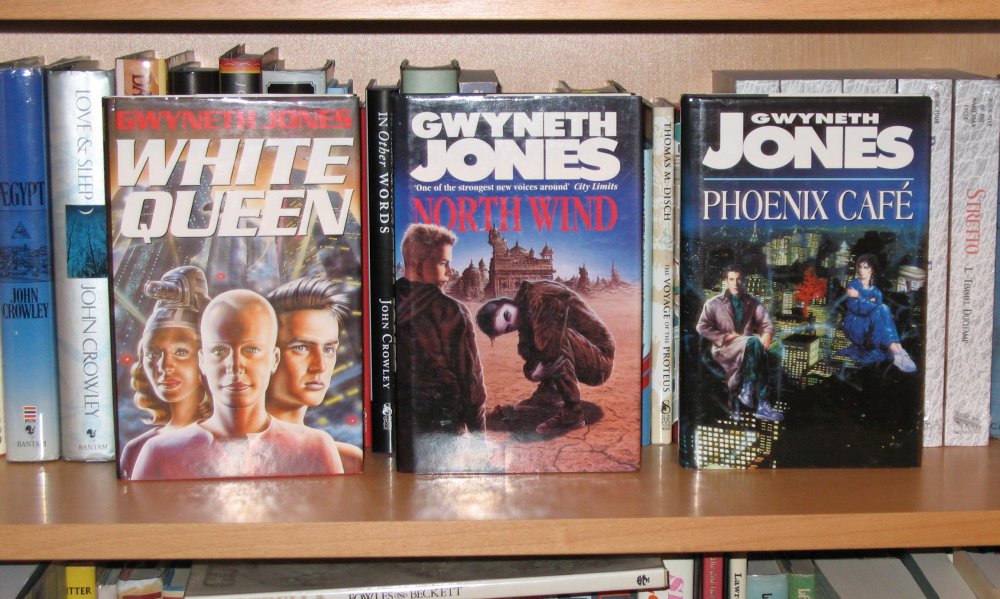
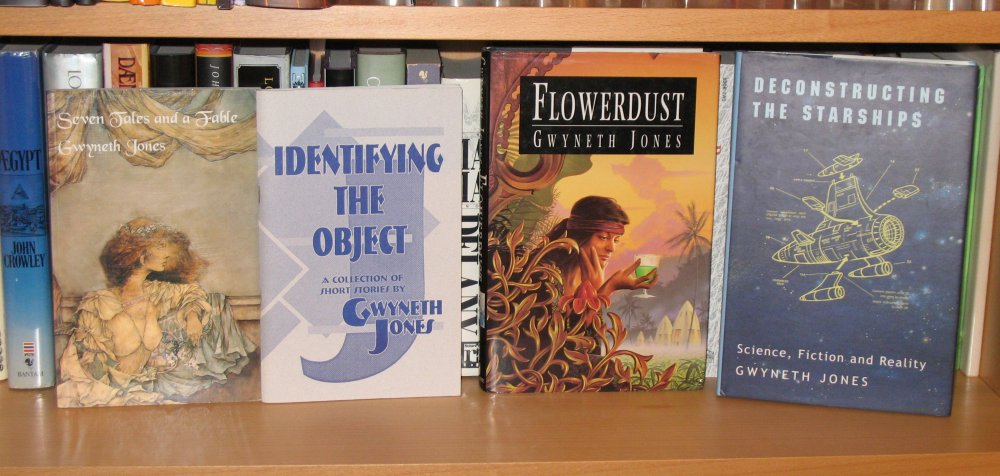
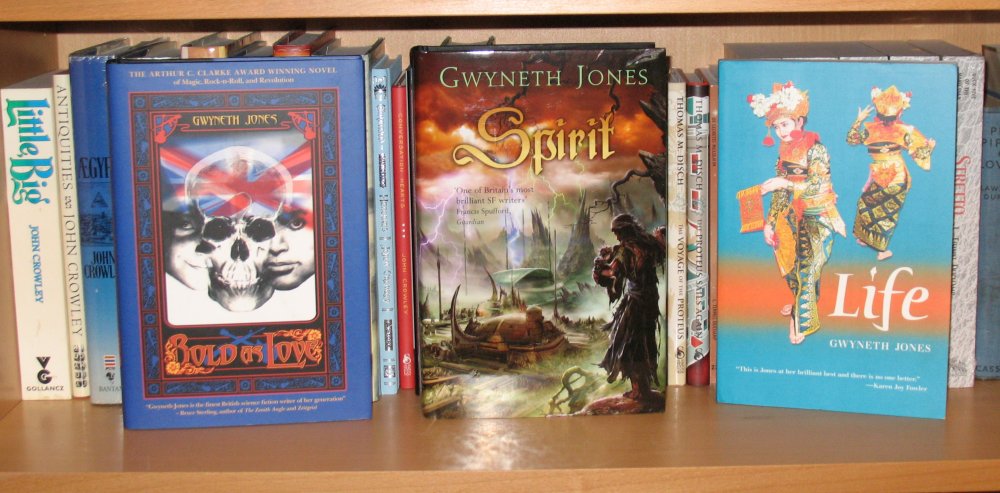
‘Forward Echoes’, Gwyneth Jones – is another Interzone story, this time from #42, December 1990. A slightly reworked version was also published three years later as ‘Identifying the Object’ in a chapbook collection of the same name from Swan Press. ‘Forward Echoes’ introduced the two main characters of Jones’s novel White Queen, and the Aleutians, the alien race of that novel and its sequels North Wind and Phoenix Café (and, of course, the recent and excellent Spirit: The Princess of Bois Dormant – see my review here). I think what first appealed to me about this story was its strangeness. It’s one of the most sfnally-evocative (to coin a phrase) stories I’ve ever read.

‘FOAM’, Brian Aldiss – was later expanded into a section of Aldiss’s 1994 novel, Somewhere East of Life. In 1991, Gollancz relaunched the magazine New Worlds as a paperback anthology edited by David S Garnett (in those days, Garnett was almost ubiquitous), and the story first appeared in that. Aldiss manages to layer strangeness upon strangeness in a somewhat picaresque plot set in the central Asian republics in the near-future (as was). This is another story, like the Jones, which makes something peculiar and sfnal of our world.

‘The Road To Jerusalem’, Mary Gentle – is the third and final Interzone story, from #52 in October 1991. It’s also the only alternate (alternative) history story in the list. In it, the knights templar have continued to exist to the present, and the world is a very different place. But it’s only as the story progresses does it become clear exactly how different.

The most recent story of the ten above is nearly eighteen years old. Which means it’s probably about time I brought the list up-to-date. I’ve certainly read some excellent stories published since Mary Gentle’s ‘The Road to Jerusalem’, but none seem to have stuck with me as much as the above ones have done. Perhaps I need to read stories a couple of times before they grow on me enough to be tagged as “favourites”. Perhaps that’s an exercise for another day – looking back over the short fiction I have access to which was published after 1991, and seeing if any of them have the same impact on me the above ten did.


3 Comments

Thoughts on Space and Fiction

There is a story, no doubt apocryphal, about a European company which signed a contract with a Japanese manufacturer of televisions. The contract allowed for 1% wastage, or 1 in 100 defective televisions sets. Come the day the first batch was delivered, and the CEOs of the two companies stood and watched as ninety-nine brand-new televisions were transported into the warehouse. The Japanese then presented the European CEO with a box containing a smashed up TV. When asked what it was, the Japanese CEO explained that it was the one defective television set from the hundred, as stipulated in the contract.

With CNC robots and CAD/CAM, manufacturing in the 21st Century is a sophisticated, precise and cost-efficient process. Back in the early 1960s, the Apollo command modules were built by hand by North American Aviation. The first one, CM 012, contained so many faults, Apollo 1 commander Gus Grissom intended to hang a lemon from the control panel. No more than a few days later, Grissom was dead, along with his crew, Ed White and Roger Chaffee, killed by a fire inside the command module during a plugs-out test.

In order to navigate to the Moon, much of the course calculations for Apollo were performed by rooms full of computers at Mission Control in Houston, Texas. Aboard the spacecraft, there was only the Apollo Guidance Computer, a device considerably less sophisticated than an average mobile phone of today. The AGC required the astronauts to enter “verbs” and “nouns” using a DSKY (display/keyboard) in order to start programs. It had a vocabulary of around 38,000 words. In Carrying the Fire, Michael Collins’ autobiography, he describes having to make 850 key-strokes in order to enter the necessary data and program calls for Columbia and Eagle to rendezvous on the Lunar Module‘s return from the lunar surface.

Even cruder was Gemini’s radio-control “encoder” for the Agena target vehicles, which used a “little box topped by two concentric wheels and a lever”. All instructions “ended in either a one or a zero, and were formed by setting up the first digit on the outer wheel and the second digit on the inner wheel, and transmitting all three by turning the lever from center to either the left (for zero) or the right (for one)” (also from Carrying the Fire).

The technology to return to the Moon not only exists, but is a great deal more sophisticated and effective than it was in 1969. True, the same laws of physics still apply, and the solutions to the problems those laws present have not changed. But in the tools and instruments used to implement those solutions, there is really no reason why Project Constellation should not be able to put one or more astronauts back on the lunar surface in relatively short order. In the 21st century, the hardware can be built to better engineering tolerances, with less faults, for less cost and in shorter time. The entire trip can be managed by computers onboard the spacecraft, using software which does not require data to be read out over the radio to the crew and then laboriously inputted by them.

But it’s not the hardware and software which have prevented return trips to the Moon. Some might say it’s the lack of public will – and yet, there were still those criticising and demonstrating against Apollo when Neil Armstrong and Buzz Aldrin landed on the Sea of Tranquility. There are many since who have complained that the money spent on Apollo could have been better spent on other things. Perhaps it’s the lack of political will. When President Kennedy gave his famous speech, “we choose to go to the Moon in this decade and do the other things, not because they are easy, but because they are hard…”, he may have been motivated by a desire to win the Cold War in at least one area, but he made it happen. I see no reason why a later president could not have managed something similar – providing they had the will, their motivation is irrelevant.

Money is often cited as another stumbling block. The Apollo programme up to Apollo 12 cost $16.1 billion in 1969 dollars – about $112 billion in 2005 dollars (figures from Return to the Moon by Harrison Schmitt). By 1969, the US Administration had spent approximately $83 billion on the Vietnam War, and $214.4 billion in Iraq by 2005. So money is clearly not a problem.

What about expertise? The Mercury, Gemini and Apollo programmes were designed, managed, built and staffed by young people, who frequently put in long hours to get the job done. It’s been said that no equivalent workforce exists today, and that people now are unwilling to work the necessary hours. Which is plainly rubbish. Look in any large corporation and you’ll find a workforce which often puts in ridiculous – and unpaid – hours to finish projects and meet deadlines. There is certainly enough expertise throughout the world in computing and information technology for a return to the Moon – after all, the bulk of the work in the 21st century version will lie there and not in hand-engineering hardware.

There is perhaps one element of the Apollo programme which no longer holds true, and might in part explain why it has never been repeated. NASA at that time was dominated by a large number of strong-willed and charismatic leaders – not just the astronauts, but also the administrators and chief engineers. Many of them were ex-military, or had fought in World War II. The entire organisation’s culture was very much based on personal leadership. People’s careers could be ruined by saying the wrong thing to the wrong person in a meeting. It could be argued this mindset had been forged during half a decade of global war; certainly no such comparable event happened in the second half of the 20th century. NASA is now a bureaucracy, with systems and procedures and checks and balances. Many critics have complained that it this which is holding back Project Constellation – take the recent decision by NASA to convert from Imperial to SI units… which they subsequently abandoned because it would have been too difficult and costly to implement. I don’t necessarily agree that the leadership/organisational model used by NASA during Apollo is necessary for a return to the Moon, but it’s certainly clear that the compromises foisted on the organisation in the decades since then have severely jeopardised its operations.

Yes, I think we should return to the Moon. And then travel onwards to Mars, and the planets, dwarf planets and moons beyond. It doesn’t matter if there is no immediately obvious benefit to doing so. Not all of the benefits of Apollo were plain at the time. I’m not much bothered whether the next set of astronauts on the Moon are American, Chinese, Indian, Russian or European. But it is a little embarrassing to see NASA floundering as it tries to implement a programme they have already implemented once before and which should be so much easier to do now. Even worse, they’re failing in other areas – the International Space Station will likely not last much longer than 2016.

It’s been said that landing on the Moon killed science fiction. I suspect the reverse is true. The Apollo programme demonstrated that space is not the benign environment advertised by science fiction short stories, novels and films. Far from it. As a result, one branch of sf turned inwards – the New Wave – while another slid further into fantasy – Star Wars and its ilk. Space has become a place of dreams and fancy, and so unreachable. There is a hardy few dipping their toes in the water, so to speak, in the International Space Station and aboard Shuttle missions. But, by and large, space is an environment, a setting, which exists chiefly in books and films.

Not so long ago we had the Mundane sf Manifesto, which insisted on “stories set on or near the Earth, with a believable use of technology and science as it exists at the time the story is written”. It was, and remains, controversial. Perhaps now, on the 40th anniversary of the first landing on the Moon, we should re-introduce the sub-genre of Space Fiction, stories set in space which treat the setting honestly and accurately. Perhaps the sub-genre could be used to re-introduce space as it actually is to the public, perhaps it might even rekindle interest in it as something achievable and conquerable – because only when you have identified the problems, can you start working on solutions…


1 Comment

40th Anniversary of Apollo 11

Back in May, I decided to celebrate the 40th anniversary of the first lunar landing on my other blog, A Space About Books About Space. In keeping with the blog’s reason for being, I thought I’d do this by posting reviews of books specifically about Apollo 11 and its crew. So for the past few weeks, I’ve been busy reading the biographies and autobiographies of Neil Armstrong, Buzz Aldrin and Michael Collins. I don’t think I’ve ever read so much non-fiction in so short a period ever before.

Anyway, the first of my Apollo40 posts is now up, kicking off a series of relevant book reviews over the next five days. Feel free to check it out.


Leave a comment

Reading & Watching Roundup – July 2009

Here’s what I’ve been reading and watching in the last few weeks:

Books
The Pilgrim Project, Hank Searls (1964), I reviewed on my Space Books blog here.

The Daily Mirror Book of Garth 1975, Frank Bellamy (1974). I remember Garth from the 1970s and early 1980s. I often stayed at my grandparents, and they took the Daily Mirror every day. The central premise is that Garth, who is immensely strong, has various adventures in time and space, usually righting wrongs as part of a war between Good and Evil – with Good represented by Garth’s “lover through the ages”, Astra. Usually, when travelling through time, Garth occupies the body of a man who resembles him in every way. The comic strip was limited by its format, and often had to repeat information each day, but the stories were reasonably inventive and Frank Bellamy’s art was excellent.

The Jane Austen Book Club, Karen Joy Fowler (2004), I decided to read after seeing the film, which I enjoyed. I have several books by Fowler – Sarah Canary, and a couple of collections – but I’d not read any of her mainstream fiction. The Jane Austen Book Club is cleverly structured – the discussion of each of Austen’s books is led by one member of the group, and that allows Fowler to tell their life-story, which in part echoes the themes of the Austen novel. Fowler also plays games with the narrator – the book opens with “our book club” and “we”, and returns to second person at various points, but none of the characters actually narrates the book. The film is a mostly faithful adaptation, although Jocelyn is played by Maria Bello and so younger than the book version. The sole male, Grigg is also more successful in the film, having made money in a dot com start-up; in the book, he’s just tech support. Overall, it seems strange to describe a novel by Karen Joy Fowler as light reading, but that’s what The Jane Austen Book Club is.

Flaubert’s Parrot, Julian Barnes (1984), I picked to broaden my reading. I’d not read any Barnes before, so I had little idea what to expect. And… this is not a book which wears its research lightly. The narrator, Geoffrey Braithwaite, is an amateur Flaubert expert and the novel is as much a dissection of the French writer’s life as it is about its putative plot – in which Braithwaite tries to determine which of the stuffed parrots on display in two Flaubert museums is the actual one Flaubert used when writing ‘Un coeur simple’. Braithwaite also has a secret of his own, which he gradually reveals as the book progresses. Flaubert’s Parrot is very clever and informative… but the central metaphor strikes me as a bit thin and Braithwaite’s own story doesn’t actually reflect thematically on his Flaubert expertise. As a readable and interesting treatise on Flaubert, the book succeeds very well; but as a novel, it feels unbalanced and Braithwaite fails to compete with the subject of his expertise.

After the Vikings, G David Nordley (2004), is a self-published collection of five stories which had previously appeared in Analog and Asimov’s during the first half of 1990s. They all take place on Mars, and are tied together with a framing narrative in which a pair of aliens discuss the extinct race which once lived on the planet. My copy is the 2004 revised edition, and it features some of the worst cover art I’ve ever seen (not the same as the version shown on Amazon). But the stories…. Back in the late-1990s, I tipped Nordley as a writer to watch, chiefly on the strength of his novella ‘Into the Miranda Rift’, originally published in the July 1993 issue of Analog and nominated for the Hugo and Nebula that year. He’s still regularly published in Asimov’s and Analog but since I’ve not seen either magazine for nearly 10 years, I’ve read only a handful of stories by Nordley and none recently. And he’s yet to produce a novel. After the Vikings is less good than I expected – the stories are very much 1990s Analog/Asimov’s sf, a little heavy in places on the science and the moralising, but well put together. I’m not sure about the final novelette, ‘Martian Valkyrie’, which features an inventive means of getting to Mars, but also includes some heavy-handed racial stereotyping and an unpleasant undercurrent of sexism.

Eclipse 2, edited by Jonathan Strahan (2008), I bought because of the good reviews it’s received. And because I wanted to read more recent genre short fiction. The anthology is a good read, although I found the contents mixed. The stand-outs are Tony Daniel’s ‘Ex Cathedra’ and Peter S Beagle’s ‘The Rabbi’s Hobby’. Terry Dowling’s ‘Truth Window: A Tale of the Bedlam Rose’ is near-incomprehensible as it requires the reader to be familiar with the universe of Dowling’s novel, Wormwood – although, to be fair, the novel does seem like it might be worth reading. Alastair Reynold’s ‘Fury’ contains some good ideas, but feels a bit weak for him. Stephen Baxter’s ‘The Turing Apples’ is polished, but felt a bit cold and uninvolving to me. Nancy Kress’s ‘Elevator’ is just plain dull. The rest are all enjoyable and well-written, but none really struck me as especially exciting. Oh, and there’s a Chiang too. Which won the BSFA Award this year. And I wrote about it here.

Starship Fall, Eric Brown (2009), from NewCon Press is a sequel of sorts to an earlier novella, Starship Summer, published by PS Publishing. It’s set on the same world, Chalcedony, and features the same cast. With Brown, you always know you’re going to get well-written character-driven sf, and Starship Fall is no exception. There’s no cutting-edge idea at the heart of it, just a story about people on an alien world which unfolds in elegant prose to an inevitable bitter-sweet conclusion.

Apollo 11 Owners’ Workshop Manual, Christopher Riley & Phil Dolling (2009), I read for my Space Books blog. A review will be appearing there later this month.

Films
The Dark Is Rising, dir. David L Cunningham (2007), is yet another attempt to create a film franchise from a YA fantasy series. Hollywood hasn’t done too well so far – Pullman’s His Dark Materials never got to book two, which is a shame; and the second Chronicles of Narnia film didn’t do very well at the box office. The Dark Is Rising is adapted from the 1973 novel of the same name by Louise Cooper, actually the second book of the series. A boy on his fourteenth birthday learns that he is the “Seeker”, who must find the six Signs so the Light can defeat the Dark. There’s something old-fashioned about the film despite an attempt to drag it into the twenty-first century. It feels very mid-twentieth century, all English village halls and village schools and fierce winters. Although it doesn’t appear on screen, there’s a sense of austerity to the story. Not having ever read the book, I can’t say how well it has been adapted, but most of the adult cast appear to be sleepwalking through their parts. Christopher Ecclestone as the Rider is especially poor. I suspect The Dark Is Rising will be another film franchise which slowly fades away uncompleted.

Guard Post, dir. Su-chang Kong (2008), is set in a, well, in a guard post, in the demilitarized zone between North and South Korea. A company of South Korean soldiers have turned up to GP 506 (the film’s original title) to relieve the company on duty. Except they find said company slaughtered, but for a single survivor. Over the next few days, they try to discover what happened, while one by one they themselves die. This film isn’t as gruesome as I expected – which is good, because I’m not a big fan of grue. But neither is it quite as suspenseful as the premise suggests. It’s done well, but nothing about it really stood out for me.

Battlestar Galactica: Season 4 and The Final Season (2008 – 2009), probably deserves a post of its own, but never mind. Lots of people have written at greater length and more intelligently than I could manage on this television series. What is interesting about the various commentaries scattered about the tinterweb are the points each commentator has picked up on. For me, BSG often failed because the writers didn’t have a clear idea right from the start what they were trying to do. So some episodes contradicted others, some made no sense in light of earlier revelations, and some were clearly knocked together in service to the “moral of the week”. The devil, they say, is in the details, and that’s where BSG often let itself down. When the fleet finds Earth, they determine that it was once populated by Cylons…. How? If they can identify 2,000 year old remains as Cylons, then why could they never determine who was a Cylon in the earlier seasons? But then I was never convinced by the Cylons – the BSG writers never seemed to grasp what machine intelligence might actually mean, or what machine intelligences in human bodies would be like. As for the final episode, ‘Daybreak’, I’m not as annoyed by it as some were. I quite like the idea of the Colonials feeding into the genetic heritage of Earth, and I can’t get upset at them walking away from their culture. Which is notoriously ephemeral anyway.

Boy Meets Girl (2009), was for review for videovista.net. See here.

The Last Sentinel, dir. Jesse V Johnson (2007), was also for review for videovista.net. See here.

Once Upon A Time In America, dir. Sergio Leone (1984), is in the Time Out Centenary Top 100 Films, but I don’t understand why. How a film can be so highly regarded when its central character rapes two women and suffers no qualms or consequences is beyond me. Once Upon A Time In America covers the beginnings of a group of Jewish gangsters in New York during Prohibition, and their eventual demise. The story is framed by the return of one, played by Robert DeNiro, thirty years later in answer to a mysterious summons. It’s all to do with the way his fellow gangsters met their deaths. The characters, being gangsters, are all nasty pieces of work, and quite frankly it’s difficult to care about them or what happens to them. At least in Westerns, there’s a disconnect – the milieu seems to be unrelated to the world as it is – so vile behaviour by characters is less likely to break the emotional compact with the viewer. And anyway, most Westerns are essentially white hats versus black hats. Once Upon A Time In America at least doesn’t romanticise gangsters – but then, that’s why it’s not especially entertaining.

Inkheart, dir. Iain Softley (2008), is yet another attempt by a Hollywood studio to kick off a new fantasy franchise. This time it’s based on the YA novels by Cornelia Funke. Brendan Fraser can apparently bring characters to life when he reads a story out loud – i.e., magically create them as real live people in his world. And he discovered this by reading a blindingly-obscure YA fantasy by an Italian writer to his young daughter… and subsequently giving life to the book’s chief villain and causing his wife to disappear into the book. And ever since he’s been hunting for copies of that book in order to try and “read” his wife out of it. With daughter, now twelve-years-old, in tow. Funke is German, and her books were first published in that country… which means this film has a European flavour somewhat at odds with its Hollywood treatment. It’s all very picturesque, and the European view of literature and fairy-tales sits uneasily on the US’s typical approach to this type of fiction. If The Dark Is Rising felt like 1950s England, then Inkheart feels even less anchored in the here and now.

The Band’s Visit, dir. Eran Kolirin (2007), is an Israeli film about, well, a band visiting Israel. The band are the Alexandria Ceremonial Police Orchestra from Egypt, and they’ve been invited to play at the opening of a new Arab cultural centre in Petah Tikva. Unfortunately, when they arrive at the airport, there’s no one there to meet them so they have to make their own way. They get it wrong and end up in Bet Hatikva, a dead-end town on the edge of the Negev Desert. (Arabic has no “p”, only a “b”, so the confusion is understandable.) The band are stuck overnight in Bet Hatikva, as there are no more buses. A local café owner, Dina, helps out, providing food and somewhere for the band members to stay. This is not a film in which much happens, but it’s well observed and the gentle humour and sharp characterisation carries you through to the end. Sasson Gabai as band leader Colonel Tawfiq Zakaria is especially good.

Honeydripper, dir. John Sayles (2007), is the latest film from my near-namesake. In this one, Danny Glover plays the owner of the eponymous ramshackle club in Alabama in 1950. He’s in danger of losing it – receipts are down and his unscrupulous landlord wants him out; and the local sheriff also wants to go into “partnership” with him. So Glover pins all his hopes on a live performance by Guitar Sam, a New Orleans star. Who doesn’t show. Happily, a young substitute takes his place, the concert is a success, and Glover gets to keep his bar. Given the period and location, it’s no surprise that the whites are pretty much entirely unlikable; but then neither are the blacks presented as paragons. Of course, much of the appeal of a film like Honeydripper is the music – blues, and early rock and roll. Although the latter only makes an appearance in the final scene. A polished work, with a sharp script, featuring polished performances and some good music; although overall not as good as Sayles’s Lone Star or Matewan.