Oops. The more alert among you might have noticed this post pop up a day or two ago while it was unfinished. That’s what happens when you click on the wrong button because you’ve not realised the time and have to dash off to work… Anyway, here is the full content I meant to post – books, films, you know the drill…
Books In-flight Entertainment, Helen Simpson (2010). Every five years, another collection of Simpson’s short stories appears. Reading her is a bit like reading a masterclass in literary short fiction, although the stories in In-flight Entertainment felt a bit inconsequential compared to earlier collections. Several of the stories were about climate change, and not exactly subtle – in the title story, for example, a man on a plane has to suffer a lecture on “why climate change is nonsense” from someone who clearly doesn’t know what he’s talking about; meanwhile, an elderly passenger dies and is left in his seat for the remainder of the trip. Simpson is certainly worth reading, but nothing in this collection grabbed me as much as some of her earlier stories had done.
Halcyon Drift, Brian Stableford (1972), is the first book in the sextet variously named ‘Star-Pilot Grainger’ or ‘The Hooded Swan’, after either the narrator or the experimental ship which he pilots. This novel is typical of its time – it’s thin, for one thing. Grainger is a misfit, unemployable after crash-landing on an uninhabited world, rescued after several years and then sued by the rival who rescued him. Oh, and he’s got some sort of alien resident in his mind as well. Grainger is then recruited by the owner of the Hooded Swan, an experimental ship. Their first mission is to enter the eponymous drift, a dangerous region of space (the science explaining why it’s dangerous is nonsense, of course), and find a long-lost ship carrying treasure ahead of other ships. This is solid late 1960s / early 1970s space opera, with pointy spaceships (although not the Hooded Swan), space flight much like sea travel, and a a blithe disregard for plausibility. It’s a bit grimmer than most of its kind, however.
The Saturn Game / Iceborn, Poul Anderson / Gregory Benford & Paul A Carter (1989). No. 14 in the Tor doubles series published in the late 1980s. The actual contents themselves are from earlier. The Anderson was originally published in Analog in 1981, and appears to have been reprinted a number of times. I’ve no idea why: it’s complete rubbish. An exploratory mission to Iapetus from a huge research vessel in the Saturnian system comes a cropper. The crew of four are not trained scientists. In their strangely copious free time they play a fantasy role-playing game, and have done for so many years it’s threatening to spill over into real life. When their trip to Iapetus’ surface turns into a disaster, they must trek across the moon’s surface to safety – and only come close to success by fantasising it as a quest in their “game”. Anderson obviously had this neat idea of juxtaposing the twee fantasy RPG world with the hard sf story of visiting Iapetus. But he gets the details of the moon wrong, the prose tries too hard and often falls flat on its face, and I find it highly implausible such incompetent people would be let near a spacecraft in the first place. The second novella is original to the Tor double. In it, a mission to Pluto discovers life on the dwarf planet. Meanwhile, everyone on Earth thinks the whole thing is a scam by the sole astronaut – the only survivor of the crew of four – and the Project Pluto team on the Moon. Clearly much of the thought in this story went into the creation of the Plutonian ecology, because the story’s not up to much, the politics is simplistic, and the characterisation is poor.
No Truce with Kings / Ship of Shadows, Poul Anderson / Fritz Leiber (1989). No. 5 in the Tor doubles series published in the late 1980s. I’m wondering myself why I immediately read another Poul Anderson novella after finding the one above so poor. But I did. ‘No Truce with Kings’ originally appeared in F&SF in 1963. Which does cast a somewhat different light on it. The story takes place a couple of centuries after a nuclear war. A feudalistic state now exists on the Pacific coast of the US, but there has been a coup by a faction wanting to impose a more democratic society. They are helped by a pan-continental Order of Espers. Except the Espers aren’t really psionic – they just have fancy advanced technology given to them by undercover aliens… who have secretly engineered the coup because they want the Earth to have a supra-national democratic world state before it can be invited into some sort of galactic federation. Anderson makes out that feudalism is a better and more successful form of government than democracy. Rubbish. This novella is better than ‘The Saturn Game’, but not by much. The second novella, ‘Ship of Shadows’, is from 1969, and is Leiber trying to pull off a Cordwainer Smith story. The viewpoint character is amnesiac and has poor eyesight – so everything he sees is blurred and hard to understand. The Big Reveal is that they are all aboard a spaceship orbiting a dead Earth – although using the word “ship” in the title seems a bit of a giveaway to me. Confusingly-written, thin on plot, and mostly pointless. Not impressed.
Real-time World, Christopher Priest (1974), is Priest’s first collection, and holds up surprisingly well despite being thirty-six years old. The first four stories are very good indeed. The second half of the collection is less good, but the collection ends on a strong note with the title story, which may be a bit too consciously Ballardian but still works well. I wrote about one of the stories in Real-Time World on NextRead for their Short Story Month here. A new edition of the book, with added notes by Priest, is available from Priest’s own GrimGrin Studio here.
The One Kingdom, Sean Russell (2001), was May’s book for this year’s fantasy reading challenge, and I wrote about it here.
Yukikaze, Chōhei Kambayashi (2010), was originally published in Japanese in 1989, but this is the first English edition of the 2002 revised version. I reviewed it for Vector.
When We Were Orphans, Kazuo Ishiguro (2000). Much as I like Ishiguro’s writing, it’s difficult to feel the same about his characters. In this one, Banks, a famous detective in the 1930s (in the style of Sherlock Holmes), is a pompous self-deluded idiot. He grew up in Shanghai but returned to the UK at age ten after his parents mysteriously vanished. More than a decade later, he visits Shanghai and imagines a) that he can rescue his parents from their kidnappers, b) resolve the war between the Chinese and the Japanese, and c) that the kidnap of his parents and the war are linked and so the solution to the first will bring about the second. Ishiguro’s consistency of voice is impressive, but the central conceit of the story felt like too much of a hurdle to suspend disbelief.
Child of the River, Ancients of Days and Shrine of Stars, Paul J McAuley (1997 – 1999), or the Confluence trilogy, is McAuley doing Baxter on Gene Wolfe’s The Book of the Long Sun. Sort of. Confluence is an artificial needle-shaped world, dominated by a river running its length, and orbiting a black hole. The creators of Confluence – or rather, those who caused Confluence to be built – entered the black hole and so left the universe thousands of years before. Yama is discovered as a child floating in a boat on the river, but he’s plainly not one of the ten thousands races (mostly uplifted from animals) which inhabit Confluence. There’s very much a Wolfean vibe going on here, with McAuley using existing obscure words for all manner of objects, from fauna to types of boats. In the first book, Yama travels to the capital Ys, having adventures on en route and learning something about himself and his powers. In the second book, Yama learns more about Confluence, and the narrative contains great globs of Baxterian story – a bit like finding cubes of beef in a bowl of onion soup. The final book explains everything by looping in and out of Confluence’s timeline, sort of like a cross between Heinlein’s ‘By His Bootstraps’ and Baxter’s Timelike Infinity. This is good, inventive stuff, quality UK sf, but perhaps too rich a brew to read all three books one after the other.
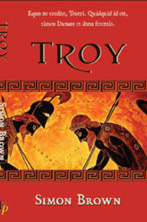
Troy, Simon Brown (2006), is, as the title suggests, a collection of ten stories, each inspired by a character from the Trojan Wars. The stories are variously literary fantasy and science fiction – the most sfnal is ‘The Masque of Agamemnon’, co-written with Sean Williams and available online here (some of the others are on Simon Brown’s web site here). They’re very well done indeed – I wouldn’t mind reading more by Brown.
Starfield, edited by Duncan Lunan (1989), is a bit of a curio. It was published by The Orkney Press, and is an anthology of Scottish science fiction. The contents are a mix of known names and unknown – the latter mostly are winning entries from the annual Glasgow Herald SF Short Story competition. There’s an early William King, a couple of short Alasdair Gray pieces, some Edwin Morgan poems (although I much preferred ‘VENJINSS’ by alburt plethora), and a long story by Chris Boyce from 1966, among others.
Starlight 2, edited by Patrick Nielsen Hayden (1998), is pretty much a snapshot of US literary sf and fantasy at the turn of the millennium. As were the first and third volumes in the anthology series. This one contains fiction by Robert Charles Wilson, Susanna Clarke, Jonathan Lethem, Angélica Gorodischer, Ted Chiang, Martha Soukup, and several others. While none especially stood out for me – except perhaps Raphael Carter’s Tiptree Prize-winning ‘Congenital Agenesis of Gender Ideation’ – this is a collection of well-written, polished genre fiction.
The Captain’s Doll, DH Lawrence (1923), is another from the Lawrence omnibus I found in a charity shop. It’s the best of the three novellas in the book – the other two are ‘The Ladybird’ and ‘The Man Who Died’. ‘The Captain’s Doll’ is set in Germany during the 1920s. Hannele is an impoverished German countess, who is having an affair with an English infantry officer, Captain Alexander Hepburn. She ekes out a living making dolls, and makes the eponymous one of Hepburn. Then Hepburn’s wife appears, and makes it plain she’s there to stop her husband’s philandering. However, she doesn’t realise Hannele is the other woman, but instead believes it to be Hannele’s friend. Then the wife dies in a suspicious accident. Hepburn returns to Britain, and a year later hears that Hannele has moved to the Tyrol and is engaged to an Austrian Regierungsrat. He travels there with mixed motives – he has sworn off women, but neither is he willing to let Hannele go. He meets her, is invited to her house for tea, and then the two go on a trip up the mountain to see a glacier. Lawrence excels at the interaction between his characters – here, the argument between Hepburn and Hannele as they tramp up the mountain is brilliantly done – although he does have a tendency to go off on introspective rambles which are often repetitive. In ‘The Captain’s Doll’, this latter tendency is not so obtrusive because the two main characters are, well, they’re a little bit odd. Good stuff.
Books of Blood VI, Clive Barker (1986). Barker is the master of padding. And it shows even in his short fiction. There are four stories in this slim book, but each one is about twice the length it needs to be. He’s one of those authors I’ve continued to read because I liked a couple of things he did – but there’s nothing in this collection remotely as good as them. The same could be said for his novels. Time for a purge of the book-shelves, I think.
Found Wanting, Robert Goddard (2008). And it was indeed. There’s an interesting idea buried in this – that the son of the woman who claimed to be Princess Anastasia grew up incognito in Denmark and founded a successful multinational – but having the main character be chased around Scandinavia while people explained the mystery to him is not a good way to tell the story.
Films Charlie Wilson’s War, dir. Mike Nichols (2007). I fail to understand why the US insists on trying to make something heroic out of ill-thought adventurism and blatant interference in other nations’ sovereign affairs. They’d be the first to cry foul if someone did it to them. In Charlie Wilson’s War, the titular Wilson is a good ole country boy congressman with control over the intelligence budget… which he uses to funnel money and arms to the Mujahideen in their fight against the Soviet invaders. Of course, as soon as the Russians were kicked out, the Mujahideen turned into the Taliban. Which the people who knew something about the situation expected. But Wilson saw only the plucky Afghanis fighting the evil Reds. This is what happens when you give parochial cow farmers covert control of foreign policy…
La Cérémonie, dir. Claude Chabron (1995). Nope, still don’t get it. I know Jonathan McAlmont is a big fan of Chabron’s films, but I’ve now seen a couple of them – because Isabelle Huppert stars in them – and I can’t see the appeal. In this one, Huppert is the post-mistress in a small village, and a bit of a rebel. A young woman starts as the housekeeper of a well-to-do family in the village, but the woman is illiterate and goes to great lengths to disguise the fact. Resentment builds up, in part fuelled by Huppert’s character, and it all comes to a violent end. An interesting thriller/drama, and entertaining, but it often feels too clinical in places to really admire.
Gran Torino, dir. Clint Eastwood (2009). This was a surprise: Eastwood actually playing to his current strengths – i.e., in a role as an septuagenarian hard-ass. The racism in the film is harsh, and Eastwood’s character never quite redeems his bigotry – and it’s difficult to carry a film on an unlikeable protagonist, especially one who makes an effort not to be liked. There’s a weird subtext that it’s characters such as the part Eastwood plays which made the US great – as made concrete by the titular car – which doesn’t strike me as an especially edifying lesson for the history books. Nevertheless, Gran Torino is put together well, everyone plays their parts with skill, and it’s an easy film to like.
The Comedy of Errors, dir. James Cellan Jones (1983), is the third of the BBC’s Shakespeare collection, which I’m steadily working my way through. There were these twin boys, and they had as bonded servants another pair of twins. Except the pairs were separated – boy plus servant – at an early age. One grew up in Ephesus, and the other Syracuse. Both think the other dead. Then the one from Syracuse comes to visit Ephesus on business… It’s an obvious set-up for mistaken identity. Except both men are called Antiphone. And their servants are both called Dromio. And both pairs happen to be wearing exactly the same outfits. At which point, any sane person’s head will explode from an overabundance of implausible coincidences… Michael Kitchen was good as the Antiphones, and Roger Daltrey not too bad as the Dromios. The comedy manages to be both sly and obvious, but some of the language was horribly clunky. Not one of the Bard’s best.
The House Bunny, dir. Fred Wolf (2008), I added to my rental list after reading somewhere that it was funny and ironic. The review lied. It’s a typical brainless sexist Hollywood comedy. A sorority of losers succeeds by turning themselves into objects of male desire, helped by an ex-Playboy Bunny. Admittedly, Anna Faris as the Playboy Bunny played her mind-numbingly stupid character well, but what’s funny about a stupid Bunny Girl? It’s pandering to stereotypes. But then the entire film did that. Eminently avoidable.
Dr Jekyll and Mr Hyde, dir. John S Robertson (1920), and The Cabinet of Dr Caligari, dir. Robert Wiene (1920), I saw these two silent films in one night in Sheffield Cathedral, with live accompaniment provided by the organist. Not your typical venue for a pair of silent horror films, but never mind. It was an excellent night out, although church pews are bit hard and tend to numb the arse cheeks after a while. Barrymore chews scenery like it’s a seven-course banquet in Dr Jekyll and Mr Hyde; although that was pretty much the style of the time. The Cabinet of Dr Caligari was all German Expressionist sets, weird camera angles, and creeping shadows. I’m glad I saw them – and the accompaniment was expertly done – but I’ll not be rushing out to buy the DVDs…
His Girl Friday, dir. Howard Hawks (1940), is another classic from some list of top 100 films – but I forget which. The copy I saw was a poor transfer, which was a shame. Dialogue doesn’t come much snappier than this, although the plot descended into farce when the main characters were trapped in the local prison. A very fast film – everything seemed to happen in quick succession. I can see why it’s a classic, and while it’s funny in parts, it all went a bit too farcical for me.
Revolutionary Road, dir. Sam Mendes (2008), is an adaptation of the novel by Richard Yates, which I’ve not read. And, in some strange way, this film’s literary origin told against it. The first two acts are optimistic, as Leonardo diCaprio and Kate Winslet marry and set up home, then decide to jack it all in and move to Paris with the kids. But I knew it couldn’t last – books and films of this type never do. And so it proved, as everything started to go horribly wrong. The two leads were excellent, and the film evoked period extremely well. But it’s by no means a cheerful movie, even though it initially tries to represent itself as such.
The Red And The White, dir. Miklós Jancsó (1967), is another one of those foreign films I stuck on my rental list and can no longer remember why I did so. Happily, whenever I done this it’s always turned out well, and this one was no exception. The red and the white from the title are Russians, and the film is set two years after the October Revolution. Hungarian irregulars support the Reds in their battles with the Whites. This is not a film with a definable story-arc, or any kind of resolution. It’s brutal, but not gory, and was unsurprisingly banned in Russia for not showing the Reds as “heroic” (not that the Whites are heroic, either). Definitely worth seeing.
District 9, dir. Neill Blomkamp (2009), I’d been looking forward to seeing for a while. It was, according to many, one of the best sf films of last year. So I was surprised while watching it to find that I didn’t think it very good at all. The opening shots of the alien saucer over Johannesburg are effective, but then there’s an immediate break in tone as the main character, Wikus van der Merwe, is introduced. He’s a bumbling, self-effacing bureaucrat, and clearly a twit. But District 9 isn’t a comedy. It didn’t help that the story was initially framed as “found footage” – i.e., excerpts from newscasts and a documentary about van der Merwe which was being filmed as District 9‘s events unfolded – but every now and again, the PoV would pull back and cinematically break out of the framing narrative. And if presenting the story as an idiot comedy wasn’t enough, in the second half van der Merwe suddenly turns into some sort of action hero and the film into a standard Hollywood shoot-em-up. Not good. Very disappointing.
I Know You Know, dir. Justin Kerrigan (2008), is an odd film. I reviewed it for VideoVista here.
Repulsion, dir. Roman Polanski (1965), was Polanski’s first English-language film, a psychological horror film set in London and starring Catherine Deneuve. I reviewed it for Videovista here.
Blake’s 7 – Series 3 (1980). I have odd memories of bits and pieces of this programme from when it was first broadcast and, while I knew the general set-up and characters, I don’t think I could have described the plot of any individual episode. Series 3 is a case in point. Two new characters join the crew of the Liberator in this series, and I have quite strong memories of someone living in a spaceship hidden under the sea with a disguised hatch on the beach. Which proves to be the home of Dayna, as introduced in the first episode of this series. One thing I certainly hadn’t forgotten was how cheap Blake’s 7 was, with sets even wobblier than Dr Who’s, alien worlds that bear a remarkable resemblance to parts of the UK, and alien monsters that wouldn’t convince a two-year-old. The central characters are drawn well, Avon and Vila especially – both get some great lines – but the episodes themselves are mostly rubbish. As Blake’s 7 progressed through each season, it grew less plausible and more nonsensical, and some of the episodes in series 3 must have been the nadir. Still, it’s a piece, an important piece, of UK telly sf, was always watchable drama, and there were some good ideas in there every now and again.
Anvil! The Story of Anvil, dir. Sacha Gervasi (2009), I thought would appeal to me, given that I’m a metal-head. It’s a warts-and-all documentary on the titular Canadian heavy metal band who have been going for thirty years. Their fortunes have declined with the years, however – although, unsurprisingly, this film has improved them somewhat. Anvil! is very much like all those talent shows put together by Simon Cowell – it’s ordinary people parading their delusions which makes for the entertainment. Anvil! is not unlike Chris Smith’s American Movie in that respect. But it shouldn’t have been. It’s about a working band. They’re not Spinal Tap, and it’s misrepresentation to present them as though they were. Nor does Anvil! even try to engage with the music – despite the director claiming to be “England’s number-one Anvil fan” on first meeting the band in 1982, and having been a roadie for them on three tours. The film holds up the members of the band and characterises them as idiots, when they clearly do what they do for the love of the music. Other, more honest, documentaries have explored the tribal nature, both among the musicians and the fans, of metal music. I’d have thought the director of Anvil! was in a position to understand this. Perhaps it wasn’t entertaining enough. Perhaps he thought Anvil as Spinal Tap would prove more popular. I suspect he may have been right…
Cymbeline, dir. Elijah Moshinsky (1982), is another of the BBC’s Shakespeare adaptations. The thing about Shakespeare is that you already know the story, even if you know nothing about the play. The plot of Cymbeline is a case in point. An exiled noble, Posthumus, proud of his wife Imogen’s constancy (she’s King Cymbeline’s daughter), boasts of it to an acquaintance while in Rome. The Roman, Iachimo, doesn’t believe him, so they bet on it. Iachimo is off to visit Britain, and if he can seduce Posthumus’ wife, then he wins the bet. Of course, he cheats – hides in a trunk, has it carried into Imogen’s bedroom, and pops out in the middle of the night and notes whatever information he needs to convince Posthumus that he slept with his wife. Posthumus, showing a remarkable lack of faith in a wife he was only too happy to be boastful about, promptly goes mad. Shakespeare dresses this up with a pair of princes stolen at childbirth, who grew up believing themselves the sons of a woodman; and a war. Strangely, despite Cymbeline clearly being set in Roman Britain, the director chose to stage it in Elizabethan dress. Helen Mirren was excellent as Imogen, and Robert Lindsay as the conniving Iachimo. I must admit I’m enjoying working my way through Shakespeare’s plays, and these BBC The Complete Dramatic Works of William Shakespeare are superior adaptations.
The White Ribbon, dir. Michael Haneke (2009). There can be little doubt that Haneke is one of the most interesting directors currently making films. And good as The White Ribbon is, I have to wonder how far he can go. I knew this film would not have a resolution because it was a Haneke film. I knew that what was happening on the screen was not a story as such. It documents the events of a year before the outbreak of World War War in a rural German feudal village. Someone strings up a wire between two trees, and the doctor runs into on his horse, causing him to fall and break his collar-bone badly. The horse has to be shot. The baron’s young son is abducted and beaten. A farmer’s wife falls through rotten floorboards and into a threshing machine, which kills her. The midwife’s retarded son is tortured. There is a mystery here, but all attempts to investigate it prove fruitless. Instead, we’re shown what monsters the baron, the doctor and the local pastor are. As if the horrible events are reactions to the culture, the society, of the village which they have created. The White Ribbon is, like most of Haneke’s films, one which defies easy analysis. I rented this, but I suspect I shall be buying a copy of my own. Because it’s a film which needs rewatching.
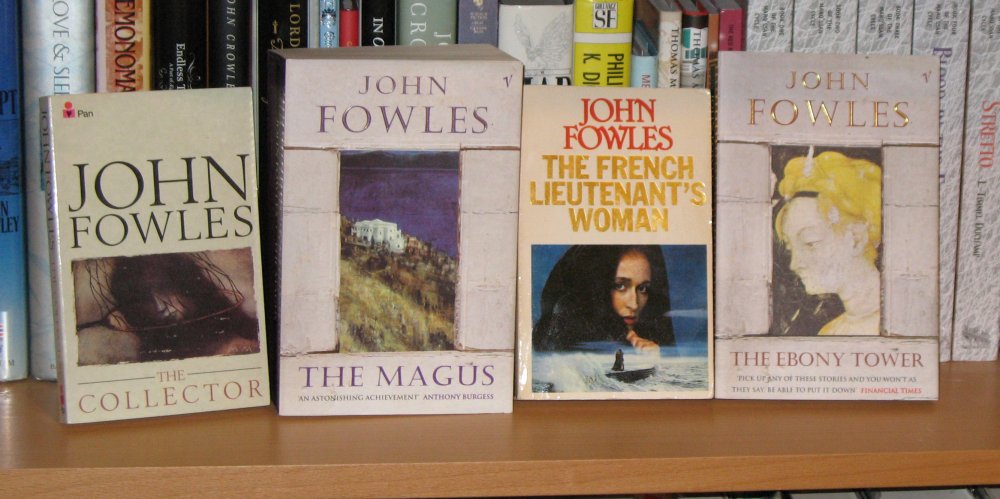
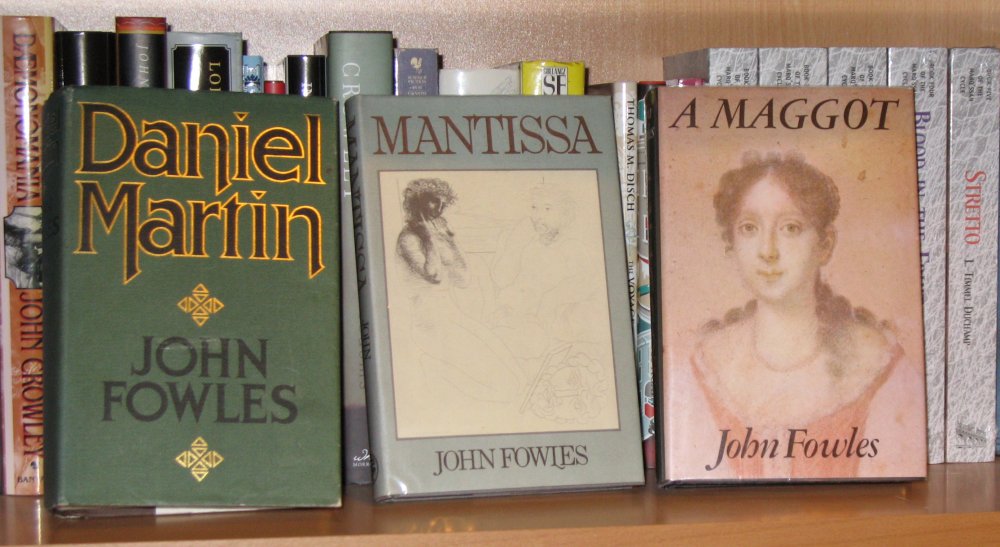
I came late to John Fowles’ novels – the first novel of his I read was A Maggot, which I started on the train journey to alt.fiction in 2006. I seem to recall buying it because it’s actually a sf novel. Whatever the reason, I thought it very good indeed and decided to read the rest of Fowles’ books. And from there it was a short step to collecting first editions of them.
Fowles had a deceptively readable prose-style. He managed to make complex ideas and situations – and not a few completely nonsensical ones – simple to parse and follow. His post-modernism also appeals to me, something he has in common with Lawrence Durrell. Having said that, some of his books are better than others. The French Lieutenant’s Woman is justifiably a classic, and A Maggot is almost as good. The Magus I suspect would have impressed me more if I’d read it in my teens or twenties. Mantissa is a bit of a dirty old man’s book, but some of the stories in the collection The Ebony Tower are superb (although the title story also has a whiff of dirty old man about it). I’ve yet to read The Collector or Daniel Martin.
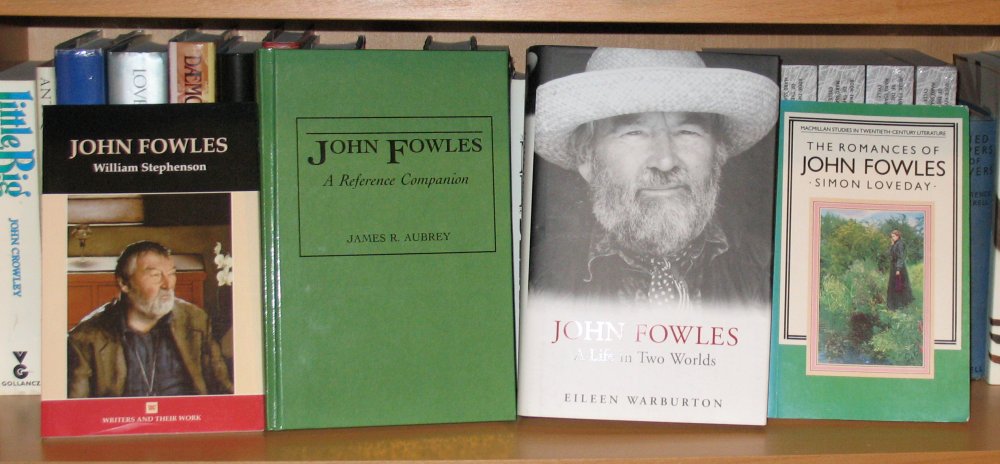
My collection is not complete. Fowles wrote seven novels and a number of non-fiction books. First editions of The Magus and The French Lieutenant’s Woman are a bit out of my budget. I have some of the non-fiction, and I have his one collection of poems. Some of the books I owned are also signed.
I’ve mentioned in earlier posts for this year’s reading challenge that perhaps my choice of material perhaps wasn’t all together smart. It seemed like a good idea six months ago… Read the first book of a fantasy series each month. See what I think to it, see whether I’d want to read the rest of the series. And, having read a number of fantasy series, I didn’t think it would be that difficult.
What I’d not taken into account is that my taste in books has changed a bit since I ploughed through Robert Jordan’s Wheel of Time, or George RR Martin’s A Song of Ice and Fire…
As a result, May’s book – The One Kingdom by Sean Russell – proved a real slog and I was late finishing it (see here). And I’m running late on June’s. Which is King’s Dragon by Kate Elliott. I also very much doubt I’m going to finish it.
I’m less than 100 pages in. One narrative is about a sixteen-year-old girl who has just been forced into slavery, and it seems her “owner” engineered the situation as much because he fancies her as because he wants some sorcery book she owns. So she’s likely to be raped. The second narrative has a youth sent to serve the local count. At present, he’s mucking out the stables.
I don’t want to read books like this. And King’s Dragon has 700 pages. It’s not a book, it’s a blunt instrument. To be fair, the writing is perfectly readable. But there’s far too much world-building, one of the narratives is offensive, and the other one is just plain dull.
So I’m giving up. I’m also giving up on the challenge. I managed it for six months, and it was too much of a chore. I’m going to try just one more book – The Wizard Hunters by Martha Wells – and then stop. I’ve got my summer reading project anyway.
This month’s VideoVista is up, containing my reviews of Roman Polanski’s English-language debut Repulsion from 1965 (see here), and Justin Kerrigan’s new film I Know You Know (see here).
I’ve done books and films for the first six months of 2010, so now it’s the turn of albums. I don’t seem to have bought that many albums so far this year, and most of those I have bought were remastered CD editions of ones I’ve had on vinyl for a long time. Having said that, a couple of new albums immediately jumped out as best of the year so far – and are likely to remain so for the rest of the year.
We Are The Void, Dark Tranquillity (2010). This definitely counts as a return to form for the Gothenburg masters of melodic death metal. I posted the promo video for the first single from the album here, and the rest of the album is just as good. I can’t wait for them to tour the UK to promote the album. (Band web site)
Curse of the Red River, Barren Earth (2010). I bought this after a positive review in Zero Tolerance magazine, and I’m extremely glad I did. It’s progressive death metal, much like Opeth – but where Opeth incorporate 1970s acoustic guitar into their songs, Barren Earth instead feature weird 1970s hippy rock with flutes. And it works superbly. This is going to be a favourite for a long time. Barren Earth, incidentally, is a Finnish metal supergroup, featuring members of Amorphis, Moonsorrow, Swallow the Sun and Kreator. (Band web site)
The Never Ending Way of Orwarrior, Orphaned Land (2010). A long awaited album. Orphaned Land’s last album, the excellent Mabool, was released in 2004, and a follow-up was promised a couple of years later. And then put back, and back, and back… Until finally it was released this year. Was it worth the wait? It’s more progressive than Mabool, perhaps even a little more commercial. It’s certainly very good, and some of the tracks on it are excellent. Not quite sure yet if it’s better than Mabool, however. (Band web site)
The Engines of Armageddon, The Engines of Armageddon (2009). These are a Nottingham-based band, and currently unsigned – the album is self-released. They describe their music as stoner-thrash-prog-doom-groove metal, and that’s as good a description as any. I’ve seen them live three times now, and they’ve been excellent on all three occasions. I bought the CD and T-shirt the first time I saw them live – any band which performs a song about RFID chips titled ‘Fuck the Chip’ definitely deserved £10 of my money. (Band web site)
Escaping the Abyss, Fornost Arnor (2009). This is also self-released (although the band formed their own label, Witch-King Records, for the release). It’s a mix of black, death and progressive metal, and works extremely well. I particularly like the acoustic bits, which are not your usual progressive black metal. (Band web site)
I watched a lot of films during the first half of this year. Sadly, many of them were not very good. Some of them, happily, were very good indeed. Below are the best five I watched. Only one is a Hollywood film, and it’s more than fifty years old.
Secret Ballot, dir. Babak Payami (2001). I think this was the first Iranian film I’ve ever watched, and it reminded me a great deal of one of my favourite films – Elia Suleiman’s Divine Intervention from Palestine. It shares a similar black humour, although it’s a much more realistic film. Some of the set-pieces are absolute classics – especially the traffic lights one.
Atomised, dir. Oskar Roehler (2006). This is an adaptation of the novel by Michel Houellebecq. I thought the book very good, but the argument in its epilogue didn’t quite convince me. Roehler tries for the same effect with two paragraphs of text on-screen before the final credit… and they’re even less effective. Having said that, the film handles the story’s emotional arc more effectively, and the use of colour in the flashback sequences is cleverly done.
The Bothersome Man, dir. Jens Lien (2006). I still don’t know why I put this on my DVD rental list, but I’m glad I did. Its humour is even blacker than Secret Ballot‘s, and the scene where Andreas jumps in front of the underground train – the second time, not the first one – is hysterical.
For All Mankind, dir. Al Reinert (1989). I love documentaries on this topic – the Apollo lunar landings were an astonishing achievement, and I could sit and watch films about them all day. Reinert’s is probably the best one ever made on the subject, and incorporates some excellent NASA footage.
There’s Always Tomorrow, dir. Douglas Sirk (1956). Sirk was my one big film discovery last year – I fell in love with his movies after renting All That Heaven Allows – but despite making around forty films, most of them in Hollywood, only a dozen or so are available on DVD. There’s Always Tomorrow is one of the really good ones, and Eureka! have done this release proud. As they also have done for his A Time To Love And A Time To Die. If they then went on to do the same for the rest of his films, I would be really happy.
So, not an unsurprising set of films, given my taste in cinema. The second half of 2010 is going to have to work hard if it’s to beat the five named above. Oh, and look: no science fiction. Not, I have to admit, that I’ve ever been a huge fan of sf cinema. It’s always struck me as the written genre’s more flamboyant but less smarter sibling.
We’re halfway through the year (give or take a day or two) and I have, as usual, read a lot of books. Some of them impressed me more than others. The following five impressed me the most. I will, of course, do my usual best of the year post in December, and I suspect one or two of the books below might make that post.
Lord Byron’s Novel: The Evening Land, John Crowley (2005). I wouldn’t be at all surprised if this makes the final best of the year list – it’s one of those novels which leaves you with an itch to reread it. Not only is it a cleverly-plotted historical detective novel, but Crowley performs an astonishing piece of literary impersonation (not, I hasten to add, that I’m an expert on Byron; but Crowley certainly convinced me).
The Magus, John Fowles (1977). Fowles’ sheer readability always surprises me when I read his books. This one is no different. Fowles’ own characterisation of it as a “novel of adolescence written by a retarded adolescent” is unnecessarily harsh, although I suspect I would have appreciated the book a great deal more if I’d read it in my twenties. I’ve a feeling this one won’t make the final cut.
Lady Chatterley’s Lover, DH Lawrence (1928). I certainly hadn’t expected to like Lawrence’s prose as much as I did on reading this. My previous experiences with 1920s writers had not been entirely encouraging. But I’ve since gone on to read three of Lawrence’s novellas, and I have The Rainbow and Women in Love lined up on the TBR.
The Turing Test, Chris Beckett (2008). This collection won the Edge Hill Prize last year, and Chris’ first novel, The Holy Machine, has just been republished by Corvus Press, so he’s finally getting the recognition he deserves. I wrote back in February that “his fiction feels more like it’s touching the edges of genre than actively engaging with it”, which is not a criticism.
Troy, Simon Brown (2006). Another collection of genre-ish short stories. The book’s title is descriptive: each of the ten stories is inspired by a character from the Trojan Wars. They are literary fantasy and science fiction, and very well-written. I wouldn’t mind reading more by Brown. Most of the stories in Troy originally appeared in Eidolon, an Australian sf magazine, and the collection was published by Ticonderoga Publications, an Australian small press.
Oops. No science fiction. Well, yes, the Beckett and the Brown are sf, but not entirely and certainly not heartland sf. And they’re collections, not novels. I did actually read a lot of sf novels during the first half of this year, but I seem to have lost the knack of privileging sensawunda over writing chops, so no matter how mind-blowing their gosh-wow special effects they seem to lack a certain something. I can no longer read sf as adventure stories. I’ve yet to work out if that’s good or bad…
When a television series pilot opens with what seems to be a vision of hell – writhing naked bodies, men fighting bloodily to the death, people being shot, human sacrifices – and then later features a suicide bomber on a train… you know you’re not watching your usual anodyne and juvenile science fiction series. But then Caprica is the new series from the makers of the re-imagined Battlestar Galactica, and Battlestar Galactica could never have been described as “anodyne and juvenile”.
Caprica is set fifty-eight years before the events of Battlestar Galactica – in fact, Commander Adama is a child in the Caprica pilot – and sets out the events which led to the creation of the Cylons and their eventual revolt against the humans.
Daniel Graystone (Eric Stoltz) is the CEO and driving force behind an electronics company on the world of Caprica, one of the Twelve Colonies. He invented the holoband, which provides access to a virtual world or cyberspace called V-Space. At present, he’s working on a robot soldier for the Caprican government, but is having little success. Graystone’s teenage daughter, Zoe, is a computer genius. She has invented an AI copy of herself, called Zoe-R, in the virtual nightclub she and her friends frequent in V-Space. It’s the nightclub which is the aforementioned vision of hell.
Joseph Adams (Esai Morales) is a lawyer on Caprica, although he is originally from Tauron. He has connections with the Ha’la’tha, an organised crime syndicate on that world, but refuses to do their bidding.
As in Battlestar Galactica, the Twelve Colonies practice pantheism – and again, their gods share the names of the Greek pantheon. But Zoe and two school friends have turned their back on the gods and embraced monotheism. They are secretly members of a group called the “Soldiers of the One”. Zoe and her friends run away to Gemenom, where they hope to contribute to the monotheistic cause. They don’t get very far. One gets cold feet and doesn’t even get on the maglev train to the starport. And, while on the train, another reveals that he is carrying bombs strapped around his middle. Which he promptly detonates.
Daniel Graystone and Adams meet at the enquiry into the terrorist attack. Adams’ wife and daughter were on the same carriage as Zoe and her suicide bomber school friend.
It’s not hard to see where the story will go. Graystone is struggling with his robot, his daughter has created an AI. Put the two together and you have a… Cybernetic Lifeform Node (which is, I must admit, a particularly naff backronym). This, then, is the genesis of the Cylons.
Adams’ role in the story is less immediately obvious. Towards the end of the pilot, he admits his family name was originally Adama, and vows to change it back. This certainly explains his connection to Battlestar Galactica, if not to the story of Caprica. Because up until that point, he has only been used by Graystone, chiefly by approaching his Ha’la’tha contacts and asking them to steal a chip created by a competitor which Graystone needs to load Zoe-R into the Cylon. Adama’s payment for this will be an AI of his dead daughter.
One of the things that made Battlestar Galactica such compelling viewing was its full-frontal assault on the difficult subjects not normally tackled by sf television series. Perhaps sometimes it tried too hard to be edgy, and so sacrificed rigour for the issue of the week. Opening Caprica with a terrorist bombing shows the series certainly plans to continue Battlestar Galactica‘s dramatic use of contentious topics. While the programme makers have married this to a religious war – monotheism vs pantheism – they’ve also demonised the monotheistic worldview by defining it using only a black and white moral framework. There’s no reference to a creed, or a body of law, only the repeated insistence that morality is polar and imposed on humanity by their god. It feels overly simplistic, as if the monotheistic cult were invented by Zoe and her teenage friends.
Also appealing in Battlestar Galactica was the care and depth of detail with which its world had been built. Admittedly, it’s easy enough to create a futuristic, and not quite recognisable, world when the programme is almost exclusively set inside various spaceships. It’s harder to do for a programme set in a city – especially if the city is not entirely CGI. Caprica uses production design to show that it predates Battlestar Galactica, but it doesn’t quite work. Hats and old-fashioned suits are not enough. Of course, Caprica of sixty years prior to Battlestar Galactica is not going to map on any comparison between now and a US city of the 1940s. But there are enough differences between the two Earth time periods – not just the clothes; but the cars, the sensibilities, the technology… – to at least suggest that Caprica doesn’t really feel as though it takes place sixty-eight years before Battlestar Galactica.
Also somewhat problematical is Graystone’s motivation. He’s a fat cat captain of industry. He wants his Cylon to succeed because it means a huge contract from the Caprican government. Zoe-R is a means to an end – on first meeting her in the V-space nightclub, he dismisses her as a sophisticated software construct, not a true AI. Yet he offers to create a similar AI of Adama’s dead daughter. Not his wife, but his daughter. And Adama comes close to seriously considering the offer, even though he has a son (who grows up to become Commander Adama of Battlestar Galactica).
According to Caprica‘s makers, the programme will be a soap opera of sorts, focusing on the Graystone and Adama families. A rich industrialist with a low ethics threshold versus a lawyer who denies his crime syndicate background as a matter of personal morality sounds way too much like a loaded scenario, especially given the simplistic moral framework the Cylons are plainly going to inherit from Zoe-R… Nonetheless, I suspect it will be addictive viewing and I plan to buy the Season One DVD boxed set of Caprica when it is released in UK later this year.
You want to be a writer, you want to write. But why science fiction? Of all the modes of fiction you could write, why choose sf?
You’re not going to be hip, you’re not going to be relevant. Even during the Apollo programme, sf wasn’t relevant. In 1969, Neil Armstrong was the first human being to step onto the Moon; the following year, the Hugo Award for best science fiction novel was awarded to… The Left Hand of Darkness by Ursula K Le Guin. It’s an excellent novel, but it has nothing to do with space travel. Even the year before, the Hugo went to Stand on Zanzibar by John Brunner, a novel about over-population.
You’ll not get any critical plaudits – not from outside the genre, anyway. Science fiction has been accused of cardboard characters, lumpen prose, in-yer-face exposition, and idiot plotting and, to be fair, it’s not an entirely unfair accusation. Nor is it wholly accurate. Those who claim characterisation and prose style are unimportant in sf because it’s all about the ideas, they’re nincompoops. That’s like saying eating food is not about the taste, it’s about the calories.
Sf doesn’t sell very well – in fact, you’ll probably never be able to give up the day job. And the nearest you’ll get to a jet-setting lifestyle is gazing longingly at contrails in the sky. You might get free trips every now and again, but it’s more likely to be to Derby than Rio de Janeiro. If you’re really lucky, you might be asked to appear on a television programme. It’ll be on BBC4, however, so no one will watch it.
Then there’s that blank look you’ll get when you tell people you’re a writer and they ask what sort of books you write. As soon as you say “science fiction”, the smile will congeal on their face and they’ll wander off to watch some paint dry. Unless it’s a sf fan who’s asked you, of course. In which case, they’ll probably tell you exactly what was wrong about your last story or novel. Assuming, that is, they’ve a) heard of you, and b) read it. Neither of which is guaranteed.
Then there’s all that stuff you need to be an expert in. Yes, you can just Make Shit Up, but readers’ credulity only stretches so far. And they all have different thresholds – some will just wow at the ringworld, others will (famously) work out that it’s inherently unstable. And there’s definitely a level of knowledge, especially in the sciences, below which you cannot drop. No -300 degrees Celsius on your icy moon, for example. No supernovas visible in nearby star systems at the exact moment they occur. No, er, breathable atmosphere and water oceans on Venus. The closer you get to the real world, the more you have to make sure it’s right (or, at the very least, highly plausible). Aliens, artificial intelligences, faster-than-light travel, time travel… they’re not real, so no one’s going to cavil if they don’t operate as they do in other authors’ novels. It’s often seen as an advantage if they don’t, if their workings are entirely original to your story.
Because you have to continually struggle to be original and inventive. You have to write as though everyone who reads your story or novel has read every other sf story or novel that’s ever been published. There are no shortcuts. You’ve got build an entire world, or universe, and it’s got to be entirely off the top of your head. Yes, there are tropes you can recycle, used furniture, characters from central casting, but unless you’re being deliberately knowing you won’t be forgiven for making use of them. Well, you might get away with using some, providing there’s plenty that is original in your story or novel.
But.
You probably want to write science fiction because you’ve been reading it since you were a kid. You’re a fan. You can’t even imagine writing anything else. That may well be the best reason in the world to write anything. But there are lots of other wonderful things science fiction can do. It’s a wide genre, there’s room for a whole universe of things. There’s even space in there for things that – ssh, don’t tell anyone – for things that are not really science fiction. You can pretty much set the boundaries yourself. There are all those sub-genres, for a start: space opera, cyberpunk, hard sf, alternate history… In fact, there are so many, people have been arguing about them since 1926.
Also, let’s face it, world-building is fun. You can do as much or as little as you like; you can show as much of it, or as little of it, as you like. You have a level of power over your creation no other genre can match. Many of the visuals are pretty cool too – all those eyeball kicks and special effects on the page. This is stuff you’re never going to see in real life. After all, sf is as big as your imagination. It’s only limited by what you, the writer, can’t conceive. Sort of like a reverse strong Sapir-Whorf Hypothesis. Writing sf, you not only broaden your readers’ horizons, you stretch your own as well. You can’t help it – it’s the nature of the genre.
Then there’s the whole community that comes attached. It’s a vocal community, and it can be as condemning as it can be approving. But on the whole sf readers are a friendly bunch, and they’re not afraid to make their opinions known. I don’t know if sf has the largest online presence of all the modes of fiction, but I suspect it has the largest in comparison to the size of its market.
On the whole, I think the pros outweigh the cons. It’s not just the vast canvas available for stories, but the breadth and variety of the genre itself. There’s not much you can’t do. There are no other modes of fiction which offer the same openness to different approaches or different styles. You can be as relevant as you desire. And sf has permeated popular culture so much you can even be hip, if that’s your thing.
We all know the UK economy is in a terrible state, and it’s not all that different in other countries. Massive deficits, swingeing cuts. Looking at the future, it seems no one’s going to be wearing shades for a while. Except perhaps science fiction writers. After all, isn’t sf known for mapping the way to utopia as often as it treads the road to dystopia? Isn’t sf famous for proposing solutions to situations before they become problems, for warning what might happen if things don’t change?
Well, yes and no.
Science fiction has never been predictive, at least no more so than is necessary for plausible world-building. The one sf prediction most often quoted, Arthur C Clarke and geostationary satellites, wasn’t even from a sf story but from a technical paper published in Wireless World. Which is not to say that history has turned many of the future worlds built by science fiction into quaint alternate history. The need for verisimilitude can sometimes resemble futurology, since both depend upon extrapolation. But for science fiction, it’s done for dramatic effect and need only be as complete as is required in the story.
Nor is science fiction didactic. Hugo Gernsback may have said that he saw sf as “an idea of tremendous import, but it is to be an important factor in making the world a better place to live in, through educating the public to the possibilities of science and the influence of science on life which, even today, are not appreciated by the man on the street”, but it’s doubtful that policy lasted more than a handful of years. As a young sf reader, I learnt a lot by reading science fiction but a) educating the reader was unlikely to be the story’s chief objective, and b) a lot of what was espoused was, well, wrong – or rather, was opinion presented as fact.
Which doesn’t mean that sf is entirely escapist, or written purely to be escapism. According to John Gray, in an article in the New Statesman, sf “pursues an inquiry into what it means to be human”, a narrowing of the focus of “the bourgeois notion of fiction as a criticism of life”. Yet he also adds that science’s role “has been to gauge the limits of the species”. Science’s role, I would have thought, is to explain the world around us.
The public perception of sf, in all media, is weighted towards escapism. But when Gray claims that the situations documented by science fiction are no longer seen as open to change, or resolution, that human beings cannot “shape the future”, his explanation is that the genre has become more personal. The world, or universe, is no longer at stake in sf stories.
Where is he pointing? Space opera routinely puts the galaxy in peril, and it’s possibly the most popular sub-genre of sf at present. It is also, possibly, the most escapist. Nor am I convinced sf ever really had the power to affect the real world: either by inspiring those who read it – the cliché of the sf reader growing up to become a scientist – or the warning implicit in a sf story being taken seriously by the general public. When did people start looking to sf for answers? 1984 and Brave New World are rubbish examples because they’re not generally considered to be sf. Even HG Wells stands across the genre rather than within it.
Yet what Gray says is partly true. Look at the shortlists for the various sf awards this year, and much of sf nominated seems entirely personal, about the problems of individuals and not worlds. The stories and novels seem less inclined to identify problems or offer solutions. The sf of 2010, if the shortlists are any guide, no longer offers maps to the future, dystopian or utopian. Science fiction is said to be a genre in conversation with itself, but once upon a time it was also in conversation with the future. That discussion seems to have dried up; indeed, science fiction and the real world, of whatever period, no longer appear to be on speaking terms…
There seems to me to be a misperception here. Someone looks at the critically-acclaimed shiny new – the awards shortlists, in other words – and sees nothing comparable to Well’s utopian blueprints or Orwell’s cautionary tale. But those two books were never emblematic of sf. And awards shortlists rarely reflect the state of the genre.
There are indeed lots of people talking in sf – not just China Miéville, not just the dead white European males named in Gray’s article. Perhaps, yes, the biggest conversation sf is having is with itself, but there are those talking to the future and talking about the real world – Jetse de Vries’ Shine anthology and DayBreak Magazine, Bruce Sterling’s The Caryatids, Ian McDonald’s Brasyl, to name but a few.
One branch of sf may be growing increasingly escapist, and another trying to drop the science all together and rename itself “speculative fiction”… but still the genre’s remit stretches in scale from the cosmic to the individual. Which leaves room somewhere in the middle for all manner of world-changing, all manner of conversation with who- and whatever. Just because Planet Earth is in trouble, it doesn’t mean everyone is talking about it, or indeed has to. But someone will be. Science fiction is a broad church.




 , Dark Tranquillity (2010). This definitely counts as a return to form for the Gothenburg masters of melodic death metal. I posted the promo video for the first single from the album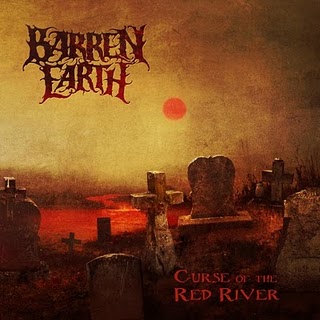
 , Barren Earth (2010). I bought this after a positive review in
  , Orphaned Land (2010). A long awaited album. Orphaned Land’s last album, the excellent
  , was released in 2004, and a follow-up was promised a couple of years later. And then put back, and back, and back… Until finally it was released this year. Was it worth the wait? It’s more progressive than
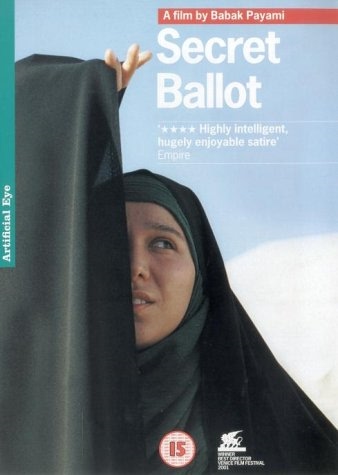
 , dir. Babak Payami (2001). I think this was the first Iranian film I’ve ever watched, and it reminded me a great deal of one of my favourite films – Elia Suleiman’s
  from Palestine. It shares a similar black humour, although it’s a much more realistic film. Some of the set-pieces are absolute classics – especially the traffic lights one.
 , dir. Oskar Roehler (2006). This is an adaptation of the novel by Michel Houellebecq. I thought the book very good, but the argument in its epilogue didn’t quite convince me. Roehler tries for the same effect with two paragraphs of text on-screen before the final credit… and they’re even less effective. Having said that, the film handles the story’s emotional arc more effectively, and the use of colour in the flashback sequences is cleverly done.
 , dir. Jens Lien (2006). I still don’t know why I put this on my DVD rental list, but I’m glad I did. Its humour is even blacker than
  , dir. Al Reinert (1989). I love documentaries on this topic – the Apollo lunar landings were an astonishing achievement, and I could sit and watch films about them all day. Reinert’s is probably the best one ever made on the subject, and incorporates some excellent NASA footage.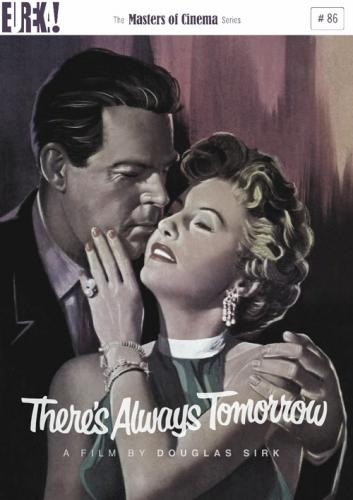
 , dir. Douglas Sirk (1956). Sirk was my one big film discovery last year – I fell in love with his movies after renting
  – but despite making around forty films, most of them in Hollywood, only a dozen or so are available on DVD.
  . If they then went on to do the same for the rest of his films, I would be really happy.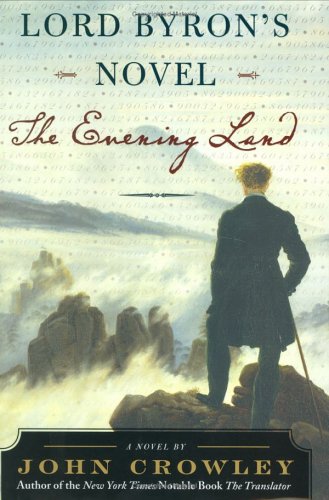
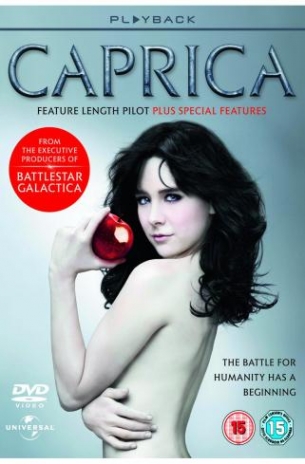
 is the new series from the makers of the re-imagined
  , and
, and 

