
This month’s VideoVista is now up, with my review of Fritz Lang twisty-turny thriller Beyond a Reasonable Doubt (see here) and French historical drama La veuve de Saint-Pierre (review here).
Did I mention…
Women in sf reading challenge #7: Zoo City, Lauren Beukes
I had originally picked Beukes’ Moxyland as one of my twelve books for this year’s reading challenge, but then I met the author at the Eastercon back in April, and Zoo City won the Arthur C Clarke Award… So I swapped one out for the other, even though the latter says on the back, “File Under URBAN FANTASY”. Although, of course, there was that Clarke Award win, which meant the jury at least felt Zoo City could be read as science fiction. Besides, last month’s book for my reading challenge was Steph Swainston’s The Year of Our War (see here), and I failed to find a way to read that as sf…
Which is all pretty much beside the point, as I’ve now read Zoo City, and I’m happy to count it as one of the twelve books of my reading challenge – and also one of the twelve books by women writers I read during July, my women-only month.

While Zoo City may display the trappings of urban fantasy, it reads chiefly like a cyberpunk novel, a near-future dystopia told from the point of view of a have-not. Who, in this case, is Zinzi December, a recovering addict and ex-journalist who caused her brother’s death, served her sentence, and was “animalled”. In the world of Zoo City, those who have committed crimes find themselves lumbered with animal familiars as manifestations of their guilt. For Zinzi, it is a sloth. In the world of Zoo City, magic also exists – though it’s not the magic of Dungeons & Dragons or your standard identi-kit heroic fantasy. Mashavi feels more like some sort of extra-sensory talent than it does spell-casting or thaumaturgy (although African styles of magic do make several appearances in the book). Zinzi’s mashavi is finding lost things, and it’s what she now does for a living – because the animalled are the dregs of society, and forced to live in derelict buildings in slum areas of the city. The city in this instance is Johannesburg, and there is a very obvious South African flavour to the novel (Beukes is South African).
After her last client is murdered, Zinzi is forced into accepting a type of job she normally avoids: finding a lost person. The missing person is teenager Songweza Radebe, one half, with her brother S’busiso, of pop twins iJusi . The Spector/Cowley-like figure who controls iJusi, Odi Huron, wants Song back without anyone learning of her disappearance. Zinzi may be reluctant to take on the case, but it soon proves to be even more complicated and darker than she had imagined. The climax of the novel, however, is not Song’s re-appearance but the discovery of a heinous plot to which the disappearance was peripherally linked. While the clues were there, that final twist does come as a bit of a surprise. The plot which drives the story for much of its length ends on a positive note, only to kick off another related, and darker, end-game. This, or its reverse, is a technique I’ve noticed in other crime novels of recent years.
Zoo City reads like noir. It’s a crime novel which happens to be set in an alternate South Africa in which felons have animal familiars and magical talents. Beukes does throw in the odd “found document” which attempts to put a science-fictional gloss on these aspects of her world, but their success is immaterial. The book doesn’t need to be read as sf, and can enjoyed for exactly what it is. Zinzi’s voice dominates the story and, despite Zinzi’s background and some of her more unsavoury activities, Beukes does an excellent job of making her sympathetic. Zoo City is a fast read, but it’s by no means fluffy. I enjoyed it a lot more than I expected to (I would normally run a mile, very quickly, from anything labelled “urban fantasy”).
On the front of the paperback edition of Zoo City I bought is a quote from William Gibson: “it feels effortless, utterly accomplished”. He’s right. Zoo City is a polished piece of fiction. For a second novel, it is astonishingly good. I can’t say whether it is better than the books it beat for the Clarke Award, as I’ve not read any of the others. (They were: Monsters of Men, Patrick Ness; The Dervish House, Ian McDonald; Generosity, Richard Powers; Declare, Tim Powers; and Lightborn, Tricia Sullivan.) But certainly Zoo City is a very good book, and not at all an embarrassing winner – which is more than the Nebula Award can say this year…
Shelf stackers
I didn’t think I’d bought that many books since my last book haul post back in early June, but when I came to take photos of my recent purchases… Well, there you go. It appears I have bought rather a lot. No wonder my postie just cards me and runs away.
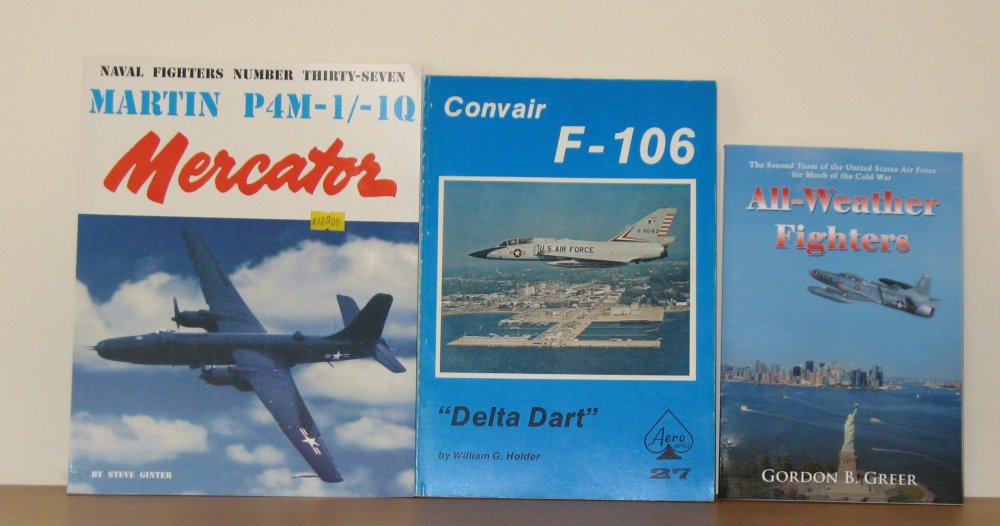
Some aeroplane books to start. I have two or three of Steve Ginter’s Naval Fighter Aircraft series now, but only for the aircraft I actually find interesting, like the Martin P4M-1/-1Q Mercator. The books are well put-together, with lots of photographs and information. Convair F-106 “Delta Dart” and All-Weather Fighters were bought chiefly for research for my moon base novella.
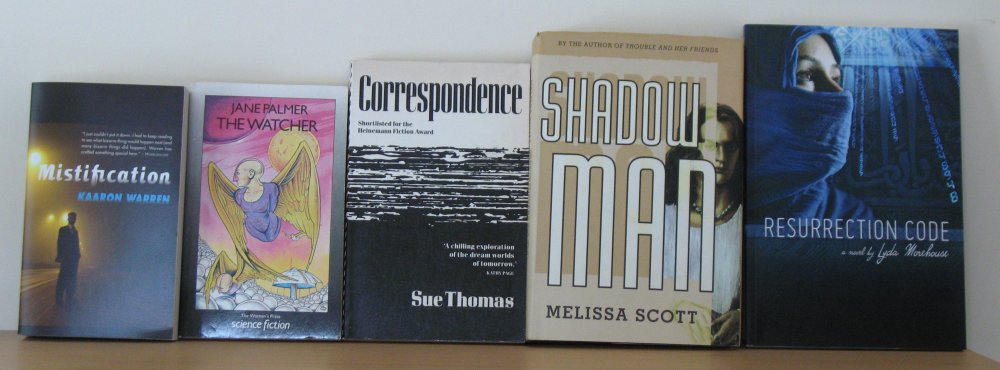
Some sf novels by women writers. Kaaron Warren’s Mistification is one of the few books I kept from the big box of Angry Robot releases I won in the alt.fiction raffle. Jane Palmer’s The Watcher goes with the other Women’s Press sf novels I own, as does Sue Thomas’s Correspondence. Melissa Scott’s Shadow Man is for the 2011 Reading Challenge, and Lyda Morehouse’s Resurrection Code I think was recommended to me by Amazon after I bought Kameron Hurley’s God’s War. I’ll be writing about it here soon.
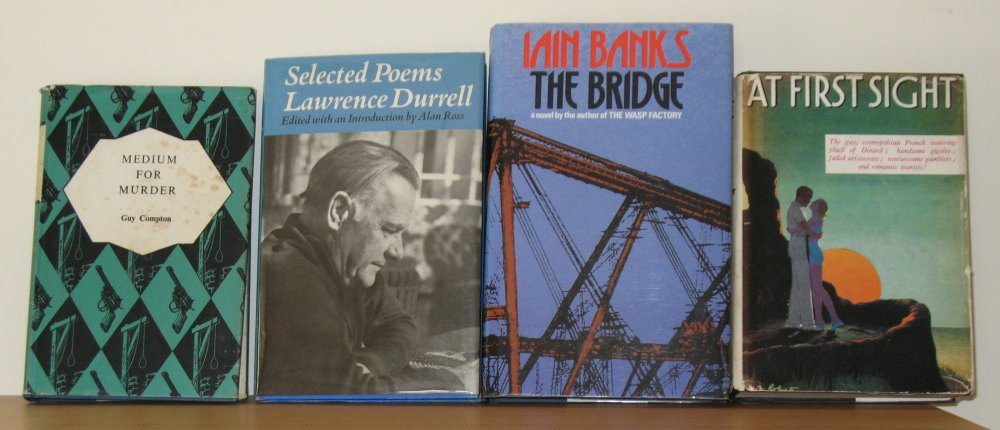
Some first editions – well, okay, Medium For Murder by Guy Compton, AKA DG Compton, is actually a Mystery Book Guild edition. Selected Poems is signed; as is At First Sight, Nicholas Monsarrat’s second novel, from 1935. Both were lucky eBay finds. First editions of The Bridge are typically expensive, but I managed to find one for a reasonable price.

Three for the Watson collection (see here) from Andy Richards’ Cold Tonnage.
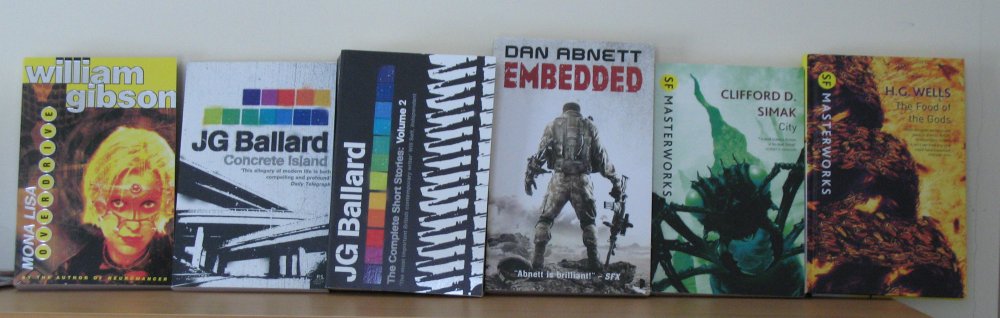
Some sf paperbacks. I read Gibson’s Sprawl trilogy years ago, but never owned copies. Now I have all three books, I’ll be giving it a reread sometime. I’ve also been picking up Ballard’s books, as I find them far more appealing now than I used to. Embedded is another book from the alt.fiction raffle prize. And finally, two from the relaunched SF Masterworks series – I’m fairly sure I read Simak’s City many, many, many years ago (I was a big Simak fan in my mid-teens); I know I’ve certainly not read Wells’s The Food of the Gods.
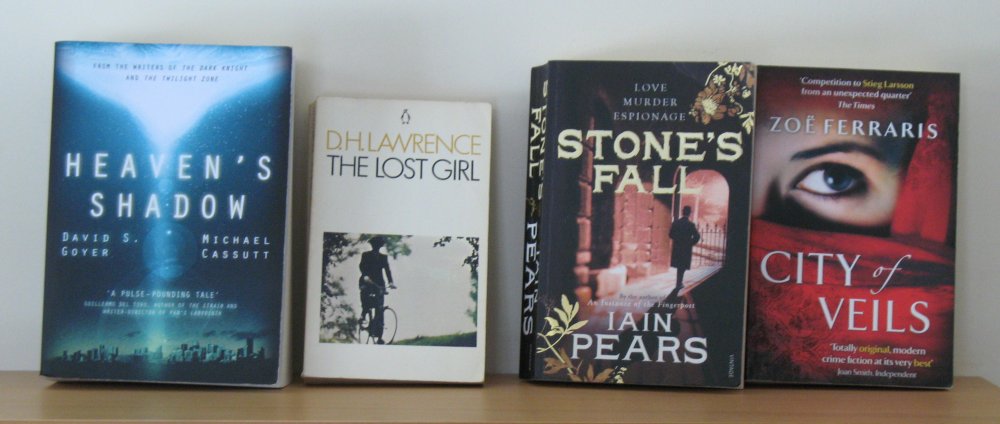
Heaven’s Shadow I swapped for my Interzone review copy of Daniel H Wilson’s Robopocalypse with Robert Grant of Sci-Fi London (ta, Robert). I want to read Heaven’s Shadow because it features near-future space exploration; I expect to hate it because it’s a mega-hyped techno-thriller type sf novel. DH Lawrence’s The Lost Girl and Iain Pears’ Stone’s Fall are both charity shop finds. City of Veils is the second of Zoë Ferraris’ crime novels set in Saudi Arabia. I’ve already read it and thought it much better than her first novel, The Night of the Mi’raj.

Some first editions. I have about a dozen of Pulphouse Author’s Choice Monthly mini-collections, and am trying to complete the set. But only the signed, numbered editions. I’ll have to read Newton’s City of Ruin before I tackle the third book in the series, The Book of Transformations. I read American Adulterer earlier this year and liked it enough to buy a cheap copy of the hardback.
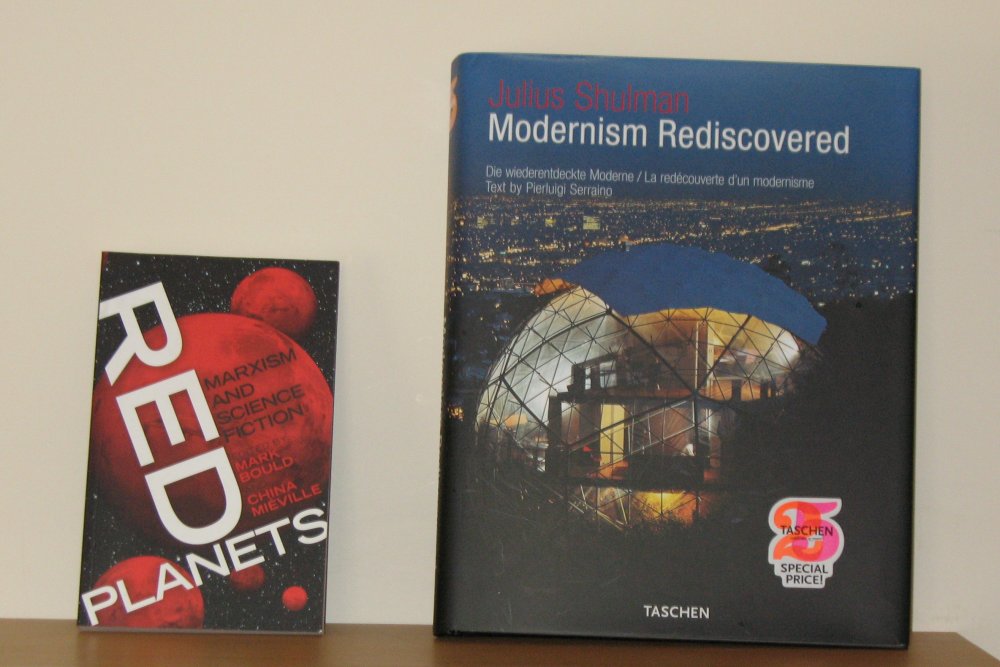
I didn’t know Modernism Rediscovered was going to be so bloody big when I ordered it from Amazon. It was only about £13 (and I put part of a voucher toward it as well). It’s an abridged edition of the three-volume set, which costs… £200. Contains lots of lovely photos of California Modernist houses. Red Planets I’m looking forward to reading. I really should read more criticism, and this looks like an interesting set of essays.
The future we used to have, part 4
Time for something nice to look at, so here are some photos and artwork of what the year 2000 might have looked like from earlier decades…
land

Red Banner Textile Factory, St Petersburg, by Eric Mendelssohn (source: Lost Vanguard: Soviet Modernist Architecture 1922-32, Richard Pare)

Park Synagogue, Cleveland Heights, by Eric Mendelssohn

The De La Warr Pavilion, Bexhill, East Sussex

Palacio de los Deportes, Mexico City, by Félix Candela

Centrosoyuz Building, Moscow, by Le Corbusier (source: Lost Vanguard: Soviet Modernist Architecture 1922-32, Richard Pare)

People's Commissariat for Heavy Industry (proposed): I Fomin, P Abrosimov, M Minkus 1934
water
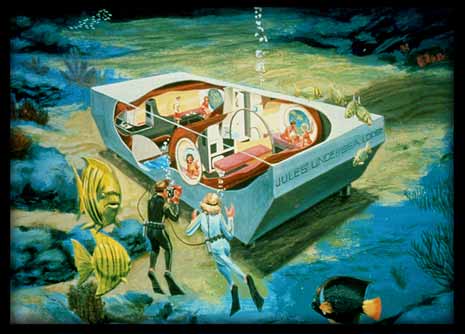
Jules Underwater Lodge (source: http://www.jul.com)

The Ben Franklin cutaway from Popular Science (source: http://seawifs.gsfc.nasa.gov)
air

Republic XF-12 Rainbow

Convair NB-36, which carried a nuclear reactor

Saro Duchess, a jet-powered version of the Princess

North American XB-70 Valkyrie

North American XF-108 Rapier

Hawker P.1103 (source: http://rp-one.net)
space

The US military's Manned Orbiting Laboratory


An early Shuttle proposal

Space Station Freedom, circa 1985
Arabia Felix
À propos a recent discussion on Twitter regarding Matthew Cook’s story ‘Insha’Allah’ in the current issue of Interzone, below is an old and racist description of the phrase and its uses, taken from English-Arabic conversational Dictionary, first printed in 1909, my edition a 1969 edition, from Hirschfeld Brothers Ltd of Great Portland Street, London:
A favorite word of the Oriental, which he pronounces at every possible, suitable or unsuitable, opportunity, but with which he generally simply cloaks his innate laziness and indolence, frequently also his ill-will. As the European by hearing this inshallah always pronounced with the same nugatory, often even ironical tone, is at last reduced to sheer despair, he will do well to break his companion of it as soon as possible. The Muslims only should not be interfered with, because the Koran prescribes to them the continuous use of this showy phrase.
I have a second copy of the book, different cover but identical contents, which claims to be by Professor Anwar Hafiz and Moustafa Aziz, but does not give a publisher or year of publication. It also omits the footnotes. I suspect it is a pirate edition.
As noted above, the Qu’ran commands Muslims to use “insha Allah” when describing any future action – see Surat Al-Kahf:
18:23 – And never say of anything, “Indeed, I will do that tomorrow,”
18:24 – Except [when adding], “If Allah wills.” And remember your Lord when you forget [it] and say, “Perhaps my Lord will guide me to what is nearer than this to right conduct.”
Jupiter Rising
Issue 33: Euanthe of Jupiter has now been published. If you have a Kindle, you can buy it right this very second from here. If you’d prefer hard copy, then buy it from here. And the reason you should buy a copy? Because it contains my death metal science fiction story, ‘Words Beyond the Veil’.
Alastair Reynolds claims his ‘At Budokan’, published in Jetse de Vries’ Shine anthology, is the first ever death metal science fiction story. But does it quote the lyrics from a real death metal album, eh? Mine does – in fact, it quotes extensively from Worlds Beyond the Veil by Mithras. So I think that makes mine the first true death metal science fiction story.

Books from my collection: Park and Robson
Back in the 1990s I was in a BSFA Orbiter with Justina Robson, so when her first novel was published I bought it. I’d already seen some of its chapters, so I knew it was good. I continued to buy Justina’s novels because I know she’s an excellent writer and she rarely disappoints.
Paul Park became one of my favourite authors after I read Coelestis – which remains a favourite sf novel to this day (see here). I subsequently tracked down copies of his debut trilogy, The Starbridge Chronicles, and then his small press novels. When the Princess of Roumania quartet was announced, I was a little disappointed that he had turned to fantasy, and what appeared to be YA fantasy at that. But I bought the books, read them – and they’re not YA, they’re actually one of the best fantasy series of this century.
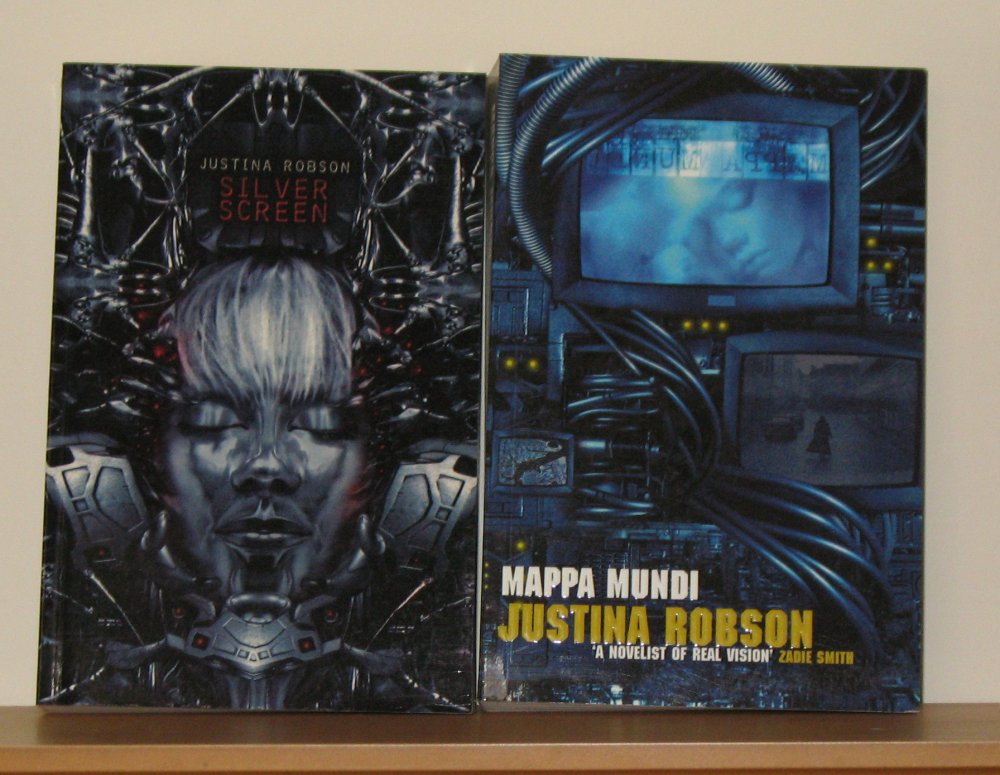
Silver Screen and Mappa Mundi. Both were shortlisted for the Arthur C Clarke Award, which is a pretty damn impressive achievement.
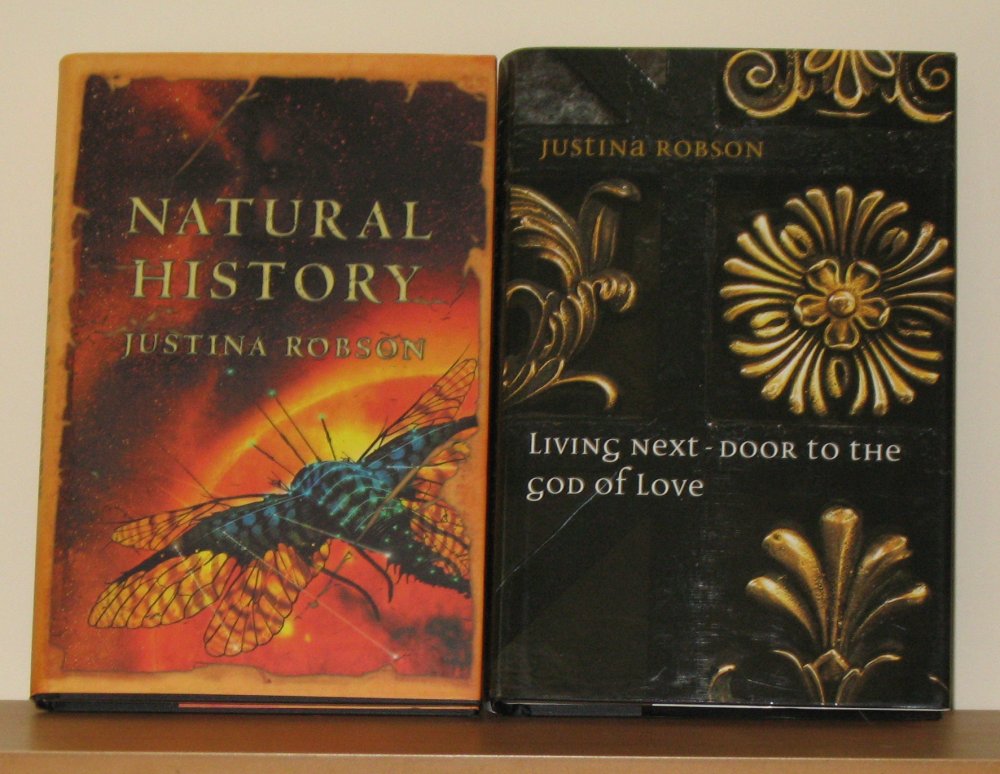
Natural History and its loose sequel Living Next Door to the God of Love. Though I’d have said Natural History was a better novel than Silver Screen or Mappa Mundi, it wasn’t shortlisted for the Clarke. It did make the shortlist for the BSFA Award, however; as did Living Next Door to the God of Love.

The Quantum Gravity, or Lila Black, quintet – Keeping It Real, Selling Out, Down to the Bone, Going Under and Chasing the Dragon. I plan to read all five some time this summer as a reading project. Watch this space.
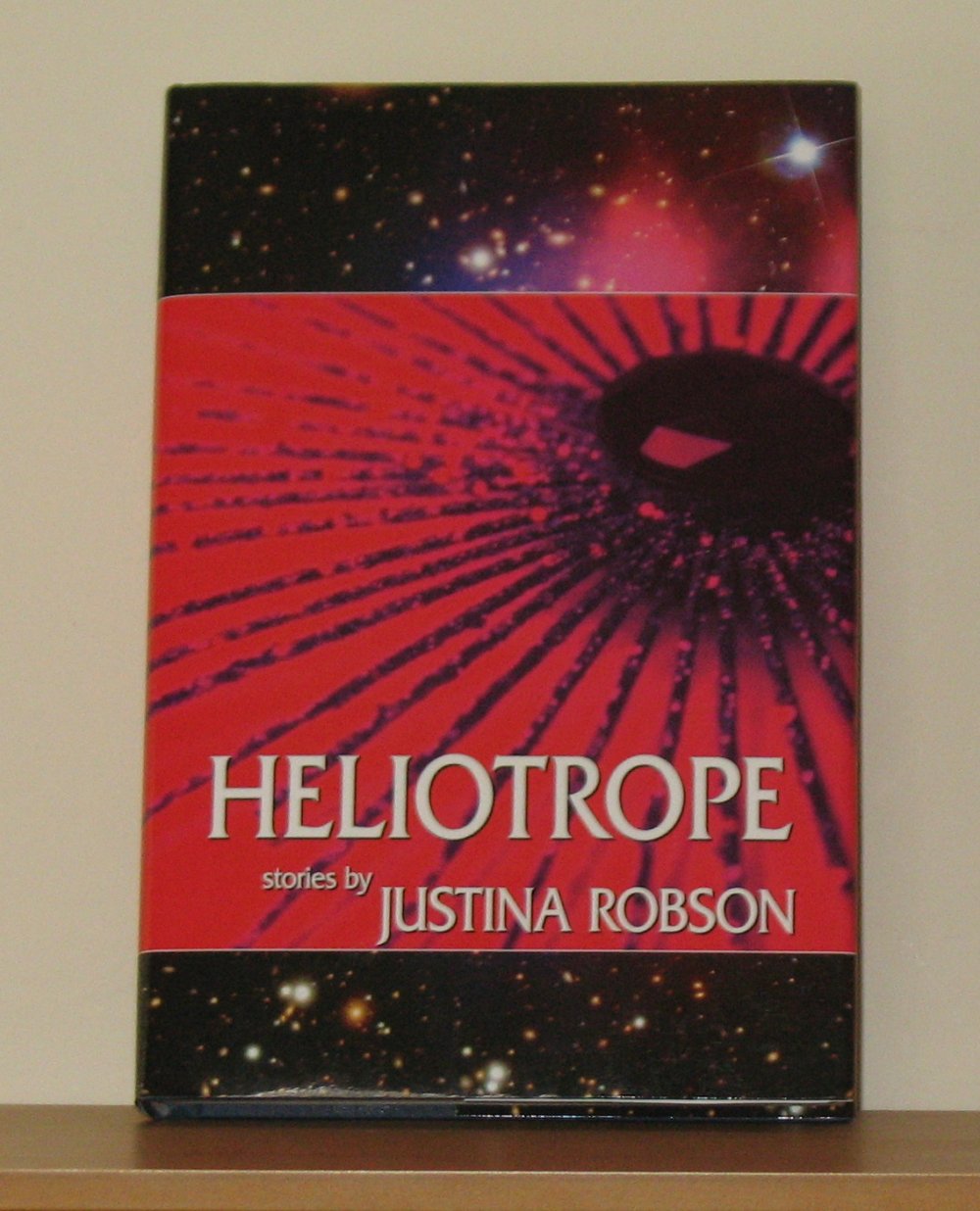
Justina’s only collection to date, Heliotrope, was published by Australian small press Ticonderoga to celebrate her appearance as GoH at the Australian National SF Convention in Perth this year. It’s a shame that one of the UK’s best sf writer’s only collection has to be published on the other side of the planet. My edition is the signed and numbered edition. Adam Roberts wrote the introduction.
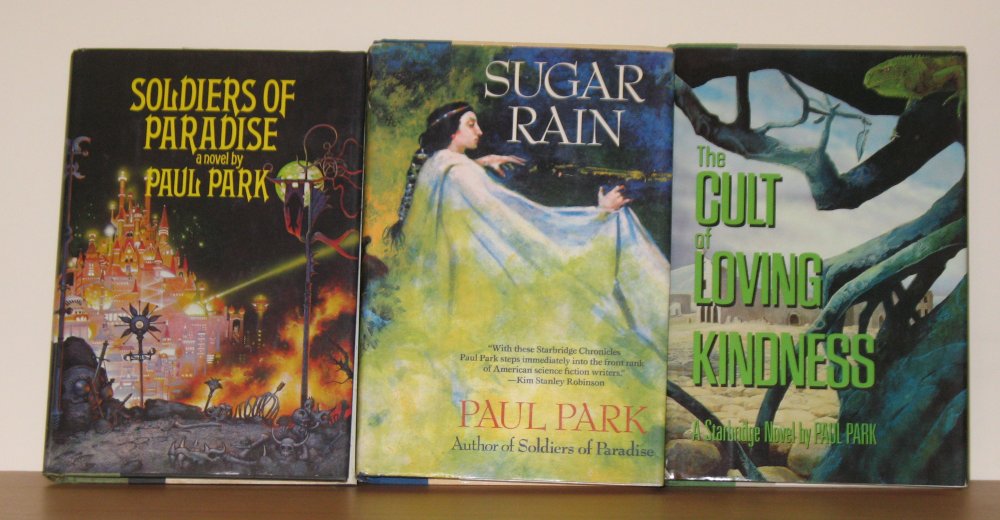
The Starbridge Chronicles: Soldiers of Paradise, Sugar Rain and The Cult of Loving Kindness. There is a SFBC omnibus edition of the first two books, The Sugar Festival, which I’ve not seen. The trilogy is set on a world which, like Aldiss’ Helliconia, has seasons which are generations long.
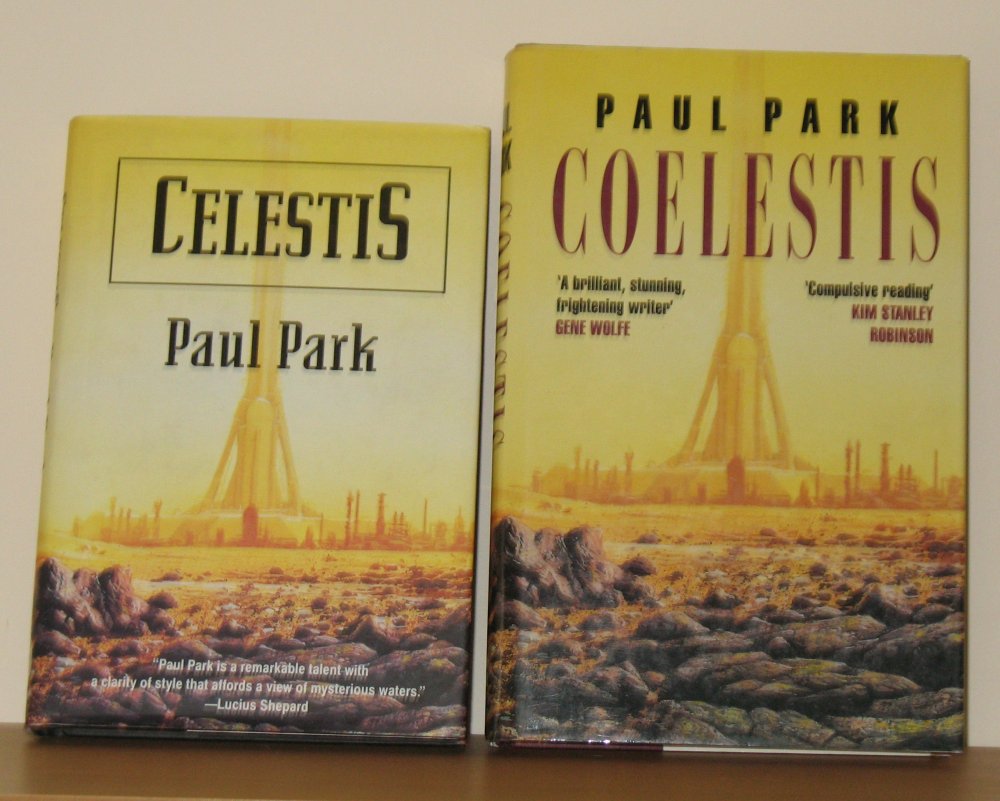
The US and UK editions of Coelestis. The UK edition predates the US one by two years. Not sure why I have both. As I recall, the only first edition I could initially find was the US one, so I bought it. But at the 2005 Worldcon I found a copy of the UK edition, which I bought so Paul Park could sign for me. Which he did.

No Traveller Returns is a novella from PS Publishing. Park has another due late this year, Ghost Doing the Orange Dance (originally published in F&SF in February last year). If Lions Could Speak is a short story collection. The Gospel of Corax describes the life of an alternate theosophical Jesus. Three Marys is also set in Biblical Palestine. Perversely, copies of these three small press books appear to be more readily available than those of the Starbridge Chronicles.
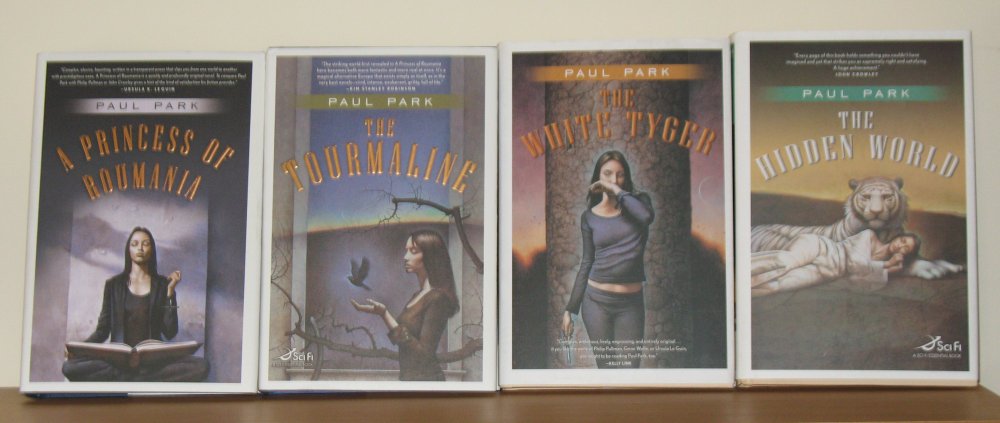
A Princess of Roumania, The Tourmaline, The White Tyger and The Hidden World are one of the best fantasy series I’ve read in recent years.
Is a lack of realism good for science fiction?
At the back of mainstream novels, you will sometimes find a list of “sources”, i.e., the books the author used as research for the novel. This has never been common practice in science fiction, though you’ld think the genre requires so much more research than mainstream fiction. It’s not just the science, but also that the real world the readers know and understand is rarely used as a setting. So there’s a wealth of additional information the writer needs to get across. And few sf authors are working scientists, astronauts or, well, aliens.
In fact, the only astronauts to write sf set in space were Edward Gibson (Reach, 1989; In the Wrong Hands, 1992) and Buzz Aldrin (Encounter with Tiber, 1996; The Return, 2000; both with John Barnes). Scott Carpenter’s two novels (Steel Albatross, 1991; Deep Flight, 1994) are underwater techno-thrillers, and are based upon Carpenter’s post-NASA oceanographic career. Also relevant is Robert Zubrin, founder of the Mars Society, who wrote a sf novel (First Landing, 2001) about the first colony on Mars.
This doesn’t mean there are no sf authors who research, or no sf authors who list sources at the backs of their novels. However, I suspect the general aversion to info-dumping in sf also extends to authors demonstrating – or proving – that they have performed any research. Perhaps they consider the presence of its “fruits” in the story evidence enough – certainly, there’s a level of authority and realism evident in prose that contains proper research. Kim Stanley Robinson considers “exposition just another form of narrative” – and is one of the few sf authors to list sources, or give a bibliography, at the end of his novels. He also writes very realistic science fiction. His Mars trilogy is considered one of the best hard sf series of all time, and notable for its realistic depiction of the initial colonisation of Mars. In his words,
And in science fiction, you need some science sometimes; and science is expository; and so science fiction without exposition is like science fiction without science, and we have a lot of that, but it’s not good. So the word “infodump” is like a red flag to me, it’s a Thought Police command saying “Dumb it down, quit talking about the world, people don’t have attention spans, blah blah blah.” No. I say, go read Moby Dick, Dostoevsky Garcia Marquez, Jameson, Bakhtin, Joyce, Sterne — learn a little bit about what fiction can do and come back to me when you’re done. (From Outspoken Authors: The Lucky Strike)
While it’s true that some subgenres of sf demand more research than others that doesn’t mean some get a free pass. Space opera is a very unrealistic form of science fiction. It could be argued it doesn’t need to be, but I disagree. The Milky Way is not the Wild West, and any story which treats it as such is doing itself, and its readers, a disservice. Having said that, space opera is a very popular subgenre and, to many non-fans, it is emblematic of all science fiction. As a result, they see sf as an unrealistic mode of fiction, one which fails to address realistic concerns.
I sometimes wonder if sf’s frequent lack of realism is a result of writers during the early decades of the genre failing to recognise – or deliberately rejecting – their own amateurism. They would dream up neat ideas, and write stories about them, without actually bothering to build anything like a realistic or plausible world in which to explore their idea. The central conceit was all; it was the only thing which needed to be phrased plausibly. The writers may have been experts in the real world – or as much as any of us are experts – but the setting of their story was invented so that knowledge was of little use.
Of course, it’s also true that on those days sf writers could blithely make something up and the chances of them being called on it were remote. Perhaps there might be an irate letter in the magazine a month or two later. These days, any reader can look something up online, and make their opinion known on Twitter, Facebook, blogs, forums, etc. There’s no excuse for getting it wrong now – those tools are just as available to the writer as they are the reader (though you would hope the writer would go the extra mile).
Looking at much sf written today, it seems to me it is turning more fantastical. No effort is made to explain the ideas used in a story, no effort is made to make them appear feasible or plausible. Why then are they sf and not fantasy? They may be stories written in a science fiction mode, but they are entirely unrealistic. That may be one way to offset criticism. If everything in a story is entirely made-up – in the purest sense of the term – then readers can’t object to any inaccuracy. But is that tactic necessarily a good thing?
To me, sf is about ordinary people doing extraordinary things in extraordinary settings. Yet the genre has featured a lot of extraordinary people doing extraordinary things in extraordinary settings. You can understand why the latter would appeal to adolescents – they all want to be special snowflake heroes and succeed in changing the world. (High fantasy is also full of protagonists such as these.) But the real world, and most invented worlds, are populated chiefly by ordinary people. Not by super-brainy scientists or manly bullet-chewing marines or super-competent alpha males. Ordinary people, of all genders, races, cultures, religions, sexual identities, etc, etc. When you have the whole universe to play with, why limit diversity? It makes no sense.
But then, sf has never been an observational genre, and has never really known how to meld the quotidian with the fantastic. The opposite, in fact: it deliberately eschews the quotidian, it revels in the fantastic. It lacks realism. I can understand the desire to exclude realism in some subgenres, I can even see how many readers would prefer non-realistic – escapist, immersive – stories. But I don’t think that’s the only way to do it, and I suspect it does little good to the genre’s reputation to produce only those.
Meme! Women sff writers of the 1980s
Following on the from the previous meme, women sff writers of the 1970s, here’s a list from James Nicoll of women writers whose careers began in the 1980s. Again, italicise those you’ve heard of, bold those you’ve read at least one work by, and underline those whose work you own an example of.
Marcia J. Bennett
Mary Brown
Lois McMaster Bujold
Emma Bull
Pat Cadigan
Isobelle Carmody
Brenda W. Clough
Kara Dalkey
Pamela Dean
Susan Dexter
Carole Nelson Douglas
Debra Doyle
Claudia J. Edwards
Doris Egan
Ru Emerson
C.S. Friedman
Anne Gay
Sheila Gilluly
Carolyn Ives Gilman
Lisa Goldstein
Nicola Griffith
Karen Haber
Barbara Hambly
Dorothy Heydt (AKA Katherine Blake)
P.C. Hodgell
Nina Kiriki Hoffman
Tanya Huff
Kij Johnson
Janet Kagan
Patricia Kennealy-Morrison
Katharine Kerr
Peg Kerr
Katharine Eliska Kimbriel
Rosemary Kirstein
Ellen Kushner
Mercedes Lackey
Sharon Lee
Megan Lindholm*
R.A. MacAvoy
Laurie J. Marks
Maureen McHugh
Dee Morrison Meaney
Elizabeth Moon
Paula Helm Murray
Rebecca Ore
Tamora Pierce
Alis Rasmussen (AKA Kate Elliott)
Melanie Rawn
Mickey Zucker Reichert
Jennifer Roberson
Michaela Roessner
Kristine Kathryn Rusch
Melissa Scott
Eluki Bes Shahar (AKA Rosemary Edghill)
Nisi Shawl
Delia Sherman
Josepha Sherman
Sherwood Smith
Melinda Snodgrass
Midori Snyder
Sara Stamey
Caroline Stevermer
Martha Soukup
Judith Tarr
Sheri S. Tepper
Prof. Mary Turzillo
Paula Volsky
Deborah Wheeler (Deborah J. Ross)
Freda Warrington
K.D. Wentworth
Janny Wurts
Patricia Wrede
* She had one story published in the 1970s but, as James Nicoll says, “what the hell”.
Several of the names seem vaguely familiar, and I suspect I may have read short fiction by them. I’ve only marked those I’m sure about, however. I did own books by a number of those I’ve read, but they went in the last purge of the book-shelves.

