It Doesn't Have To Be Right…

… it just has to sound plausible


Leave a comment

Earth Made of Glass, John Barnes

A sequel to A Million Open Doors (1992, USA), which I did not like much, also set in Barnes’s Thousand Cultures universe and featuring the same characters, Girault and Margaret Leones. Earth Made of Glass (1998, USA) was shortlisted for the Clarke Award in 1999.

This second Thousand Cultures novel is, I think, a better book – at least, I liked it slightly more – but not for the right reasons. Like the novel preceding it, the story could easily take place in the present-day. It doesn’t need to be science fiction. In A Million Open Doors it was toxic masculine society versus repressed puritanical society. Here, it’s racist society versus enclosed society. In the first novel, the two cultures were invented, openly so, but invented based on a set of principles. In Earth Made of Glass, the two cultures, which share the limited habitable area of the world of Briand, are appropriated. The Tamil Mandalam are an attempt to create the culture of southern India in the first few centuries CE, specifically that which generated the Cankam, a huge body of epic poetry often considered to be the historical highlight of Tamil literary culture. The Maya of Kintulum, on the other hand, are a best-guess at how the Maya actually lived. None of those involved in setting up the two cultures had any connection, cultural, racial or geographic, to them.

By the time the springer arrives at Briand, the Tamil and the Maya hate each other, and consider each other to be less than human. A past disaster has resulted in a Maya shanty town outside the Tamil capital of Tanjavur. Ethnic violence is commonplace. The main Maya city of Yaxkintulum is completely off-limits to the Tamil. Girault and Margaret are sent in undercover to find some way to stop the ethnic violence and bring both cultures peacefully into the Council of Humanity fold.

Barnes does a good job of describing Tanjavur and its culture, but the endless racism towards the Maya gets tiresome very quickly. (As does the joke about people trying to pronounce Girault correctly.) And when the action shifts to Yaxkintulum, it proves just as fascinating a place (and, ironically, the Maya relied heavily on AI to invent the stories and myths which are carved into every available surface in the city). The Maya want to improve relations, and embark on a risky plan. They send a Mayan prophet to Tanjavur, with a message to not let their lives be defined by their literary corpus or mythology. Things began to look up, but then rapidly go downhill.

The two cultures are fascinating, but it feels like a guilty pleasure. Occitan and Caledony in A Million Open Doors were entirely invented; Tamil Mandalam and the Maya are not. They’re very deliberately skewed takes on real cultures. It feels like misuse, or perhaps even abuse, even though they make for a more interesting read than the dull Occitan and Caledon cultures. There is also a major female player in the plot – she’s not a character because Barnes’s characterisation of her is basically “slut”, but she has more impact on the story than anyone else. Every mention of her leaves a bad taste in the mouth. Even more so, when the narrative seems to expect the reader to admire the most racist of the Tamils.

There were two more novels after Earth Made of Glass, The Merchants of Souls (2001, USA) and The Armies of Memory (2006, USA). There’s mention in both A Million Open Doors and Earth Made of Glass of an alien race whose artefacts have been discovered in numerous places, and that sort of makes me want to read the rest of the quartet, even though I may find lots in them I don’t like…


2 Comments

Venus Plus X, Theodore Sturgeon

This was a reread, although I couldn’t tell you when I last read the book. The late seventies or early eighties, at a guess. I’d remembered the novel’s basic set-up, but nothing else. Venus Plus X (1960, USA) is set in the distant future, in a utopian community of hermaphroditic humans (not really an acceptable term these days, but these have the organs of both sexes and can procreate). 

A man from the mid-twentieth-century is pulled forward in time to the community of Ledom. Yes, it’s “model” backwards, but Sturgeon admits in a postscript he reversed the name of a can of his favourite tobacco. The time-traveller, Charlie Johns, is asked to give his opinion on Ledom and its society. Various guides show him around and explain things. Everything in Ledom is a consequence of the “A-field”, a sort of force-field, and the “cerebrostyle”, which can write knowledge directly onto people’s brains. There is also a chapter on biology – the Ledoms have both sex organs, and two uteruses, and always give birth to twins.

Alternating with this guidebook-style narrative is some sort of sitcom featuring two families who live next door to each other. These sections are almost entirely dialogue.

(The cover shown above, which I think is the edition I have in storage, badly misrepresents the actual story)

There are long sections on gender, which I suspect only gammons and terfs will disagree with, and religions, which manages to erase almost all of them except Christianity and misrepresents those it does mention. Sturgeon’s thesis is that both of these – the elimination of gender through the creation of hermaphroditic humans, and a charitic religion – were necessary to create the utopian Ledom. Except, while Sturgeon rightly points out gender roles are social constructs, he still defines them using biological sex; and, as others have pointed out, the gender politics Sturgeon presents were not universal even back in 1960 – and his model society only exists more because of its two magical inventions than anything else.

Charlie learns Ledom exists inside an A-field bubble on an Earth devastated by nuclear war. He also discovers – against the wishes of the Ledom senior members – that the Ledoms give birth to normal humans, which are then (surgically?) altered to be Ledoms. For some reason, this sends Charlie completely off the rails and he tells them he, and all humans, would kill them if they could. When Charlie tries to escape to the past, he discovers the truth about the time-travel machine. Meanwhile, nuclear bombs explode outside Ledom’s A-field – is this implying humans still live? Or that Ledom is actually in the present? It’s unclear.

Sturgeon writes that he wanted to write a novel about sex. The novel credited with introducing the topic of sex into science fiction is Philip José Farmer’s novella, ‘The Lovers’ (1952, USA). The earliest sf novel I can find centred around a hermaphroditic character is Katherine Burdekin’s Proud Man (1934, UK), but in that novel the hermaphrodite travels back in time from the future to 1930. Burdekin’s novel, according to Wikipedia, criticises gender roles. Venus Plus X doesn’t do that – it posits a near-utopia, which despite its arguments only survives because it hides a horrible secret, which, to be fair, is a common science fiction trope, sort of like soylent green. I wasn’t convinced.

The title, incidentally, comes from the phrase “men are from Mars, women are from Venus”, and Charlie speculates the hermaphroditic Ledoms are women with a bit extra, “x”. Ugh.


Leave a comment

The Paradise Mission, Phillip Man

I’ve been a fan of Mann’s science fiction for many years, but I was disappointed by his last sf novel (he died in 2022), The Disestablishment of Paradise (2013, New Zealand), which was shortlisted for the Clarke Award. He had one more novel published, Chevalier & Gawayn (2022, New Zealand), only in New Zealand. I have a copy, bought online a couple of years ago.

The Paradise Mission (2014, New Zealand) is a novella aimed at teenagers and set on the same planet as The Disestablishment of Paradise, called, er, Paradise. One of the areas where The Disestablishment of Paradise scored highly was in its world-building. And that’s what The Paradise Mission sort of is. It’s a quick run-through of the more notable lifeforms on Paradise, as encountered and experienced by a somewhat breathless narrator.

Hetty is an Explorer, an interstellar scout sent on solo missions to survey planets. Previously, she had been on two-person missions with Crispin, but now Crispin is missing. He landed on Paradise, and no one has heard from him since. Except for a puzzling message saying he has found gold.

Hetty makes her own way to Paradise to hunt for Crispin. She finds his ship and lands beside it, but there’s no sign of him. Notes in his cabin point to three locations around the planet, which she then visits in her air-sled, finding him at the third. The bulk of the story is Hetty making sense of the flora on Paradise, which includes: the Dendron, 220 metre tall three-legged ambulatory tree-like creatures; Monkey Jokers, which are a sort of plant spider; the Michelangelo, a pitcher plant with psychic abilities; and a plant that creates vast tubes in the mountains, which act like organ-pipes and leads to Crisping labelling the range the Windsong Mountains.

Hetty has adventures. She finds Crispin, who is trying to help a Dendron which is ready to reproduce but can’t without help from another Dendron. Hetty uses her earlier encounter with a Michelangelo to call for a Dendron. Afterwards, Hetty and Crispin decide Paradise should remain untouched, and so falsify their reports to the Space Council.

Given The Disestablishment of Paradise is about the closing down of a colony on Paradise, it seems Hetty and Crispin were unsuccessful in protecting the planet. Having said that, there’s no indication how much earlier to the novel The Paradise Mission takes place. As for the novella being aimed at teenagers… other than Hetty being quite, well, excitable, as a narrator, and the frequent mentions of the young age of Explorers – and their capacity for risk-taking, and curiosity, etc, which justifies this… Well, there’s not much that makes it a YA novella – although the two characters are not explicitly described as teenagers, they’re at minimum not far from it.

Mann’s oeuvre, while small, packed a punch. The Story of the Gardner – Master of Paxwax (1986, New Zealand) and The Fall of the Families (1987, New Zealand) – is a superior space opera, and very much unlike most space operas. The A Land Fit for Heroes quartet (1993-1996, New Zealand), an alternative history in which Rome did not fall, presents a fascinating portrait of an alternate Britain. His other sf novels were high-quality literary sf of a type you rarely see these days. But The Paradise Mission is one for completists, I suspect. It’s hardly a good introduction to his work… 

Although it is a good introduction to the setting of The Disestablishment of Paradise.


Leave a comment

Memory of Water, Emmi Itäranta

Shortlisted for the Clarke Award in 2015 – and it’s not often a translated work makes it onto the award shortlist. In fact, the only one prior to Memory of Water (2012, Finland) was Stanisław Lem’s Fiasco (1988, Poland), although there have been four since Itäranta (Frankenstein in Baghdad (2013, Iraq), The Electric State (2017, Sweden), Vagabonds (2011/2012, China) and The Anomaly (2020, France)).

Memory of Water was originally published in Finnish. There’s no mention of a translator, and Itäranta lives in the UK according to the bio, so I’m guessing she translated the novel herself. That might explain a couple of word misuses, such as “the hidden core of the profession pertains that tea masters were once…”, and “woolgathering” when context suggests it should be “digressing”. Less understandable is the use of Scandinavian Union as the name of the novel’s setting, when it seems to be set in Finland, which is not a Scandinavian country, and both Sweden and Norway are described as polluted and uninhabitable.

Several centuries from now, climate crash, and war, has drastically changed the face of the Earth. Many former nations are now underwater, and the Chinese rule pretty much everywhere. Water is so scarce it is controlled by the military. Noria is the daughter of a tea master, and his apprentice. He shows her the family secret: a hidden spring.

After Noria’s father dies, she becomes tea master, and her mother moves to the capital, Xinjing. In a nearby garbage dump, Noria and her friend find a series of CD-ROMs which contain the log of an expedition to the Lost Lands (ie, Sweden and Norway) several centuries previously. The expedition was presumed lost and the Lost Lands uninhabitable. The novel never actually reveals what’s in the logs, only that it contradicts what everyone has been told. Noria, and her best friend, to whom Noria revealed the secret of the spring, decide to retrace the route of the lost expedition. Before they can set off, the military arrest Noria.

Memory of Water is not the first sf novel to feature a Chinese-controlled future. Two examples which spring (ahem) to mind are Gwyneth Jones’s Bold as Love quintet (2001-2006, UK) and David Wingrove’s Chung Kuo series (1989-1997 and 2010-2014 and 2017-2024, UK). Nor is it the first sf novel set in a Europe mostly underwater. Despite that, Memory of Water’s setting never quite convinces. The writing is lovely, and the surroundings are described in poetic and leisurely detail (sometimes somewhat over-leisurely). But the scarcity of water doesn’t – I’m tempted to say “hold water”, but that would be cruel. Anyway, it doesn’t seem entirely credible, and if it were indeed true then I doubt the tea ceremony would still exist centuries later. The fact Sanja can fix “past-technology”, including a CD-player, is not really feasible either, but it breaks suspension of disbelief less than the water thing.

Which is a shame, as the “water thing” is what the novel is actually about.


Leave a comment

Shards of Honor, Lois McMaster Bujold

Bujold was pretty much ubiquitous on the Hugo Award shortlist throughout the 1990s and early 2000s. True, the Hugo has its favourites, and they have their moments, and then the favourites change. At the time, I couldn’t see the appeal of Bujold’s Vorkosigan series – I read a couple of them, but they seemed somewhat bland and derivative, and not what I would have expected of award-winning science fiction novels. They’re not, of course – not what you’d expect of award-winning sf novels, that is, just instalments in a well-liked, comfortable sf series, and it was the series which kept on winning awards, not the novels.

And yet, reading Shards of Honor (1986, USA) now – a reread as I’d read it once before back in the 1990s – the one thing that stands out is how… polished it all is. It was Bujold’s debut novel, but by internal chronology it’s the second book in the Vorkosigan series. The main hero of the series, Miles Vorkosigan, isn’t even born when the novel takes place – it is, in fact, about his parents.

Cordelia Naismith is an officer of the Beta Colony Survey, when her team on an uninhabited Earth-like planet is attacked by Barrayaran soldiers. She is left behind when her team-mates escape, only to be captured by Aral Vorkosigan, the captain of the Vorkosigan ship in orbit, who has himself been marooned after a mutiny by his ship’s political officer. Barrayar is a militarist empire, with an old-style aristocracy and a Soviet-like “Political Education” apparatus. Vorkosigan is completely old school, a man of honour, a stiff-necked aristocrat, and known as the Butcher of Komarr.

Naismith and Vorkosigan have to trek some 200 kilometres to reach a Barrayaran supply cache, with a brain-damaged Beta Colony officer. Unfortunately, they’re met by the mutinous political officer and his cronies, who take them prisoner. But Vorkosigan turns the tables, only for the political officer to mutiny again. Which this time is foiled by Naismith, shortly before she escapes.

Oh, and the two fell in love during the trek and Vorkosigan proposed marriage to Naismith. Despite her feelings for him, she refused.

And that’s what the novel is about: Beta Colony Survey officer and Barrayaran military aristocrat, a romance. There’s an invasion, a space battle, a gratuitous rape/torture scene, a military defeat, lots of fatuous Betan politics (including a running joke about the Betan president, “I didn’t vote for him”), and brutal Barrayaran court intrigue.

Like Jack McDevitt’s novels, there’s not much here that’s actually science fiction. Set in the future, yes. Lots of different interstellar polities, yes. But it’s all very, well, American (even the aristocratic Barrayarans, who resemble Hollywood depictions of European royalty more than anything else). There’s a few sf bells and whistles – plasma mirrors, stunners, disruptors, plasma arcs (all weapons), plus spaceships and stargates and so on. Several years ago, I invented the term “Ruritanian sf” to describe this sort of genre fiction – see here.

It’s all very entertaining and smooth, with a pair of likeable leads (important for romance, of course), and a background that seems both familiar to sf readers and yet also a tiny bit different – no doubt helped by the sympathetic treatment of what would normally be the bad guys. I can understand the appeal – well-defined universe, good buys to root for, bad guys to boo and hiss, and a fixity of worldview common to US sf.

Shards of Honor is one of the few Vorkosigan novels which didn’t get nominated for an award, although, to be fair, it was Bujold’s debut novel. I enjoyed it, and I’ll continue reading the series – but this is science fiction that doesn’t challenge, and I usually expect more of the sf I read.


Leave a comment

A Million Open Doors, John Barnes

Nominated for both the Nebula and the Clarke Awards. Barnes seemed to have a moment in the mid-to late-1990s, with a Hugo nomination, three Nebula nominations and three Clarke nominations. But no wins. And nothing since then except appearances on the Locus Award/readers’ poll pretty much every year until a decade ago (for his last published novel, in fact). A Million Open Doors (1992, USA) is only the second book by Barnes I’ve read – I read Mother of Storms (1994, USA) back in 1999.

A Million Open Doors is the first of four novels set in the Thousand Cultures. Taking place several centuries from now, Earth has colonised a number of worlds, each of which is home to one or more “cultures”, groups of people – ethnic, national, religious, some even completely invented. Like Nou Occitan, which is supposed to be some sort of Iberian Romantic culture of troubadours and duellists, but is really just massively sexist. The worlds were colonised by slower than light ships, but now “springers”, instantaneous transport, even across interstellar distances, connect them together.

When Giraut catches his paramour in flagrante delicto with a gang of “Interstellars” (youths aping what they think is an Earth culture by “beating up and degrading young girls”), he accompanies a friend to Caledony, which has just received its first springer. Caledony is a religious culture, which uses Christianity to justify some garbled economic philosophy. Giraut opens a school to teach Occitan culture – music, duelling, poetry, dancing, painting, etc – to the joyless Caledons. Unfortunately, the success of the Centre for Occitan Arts prompts a coup by hardliners, house arrest for the previous government, martial law and armed mobs on the streets.

To build support, Giraut and his liberal Caledon friends stage a camping trip across the continent, but there’s an accident in the mountains, resulting in several fatalities. While dashing back to get into communications range, Giraut discovers the ruin of an alien city. Meanwhile, while he was away, Council of Humanity troops have overthrown the hardliners…

Reading A Million Open Doors, I had trouble working out why it was science fiction. Yes, other planets, springers, spaceships, etc, but you could set the story on Earth. Some community full of rapists, another full of nutball religious types – I’m pretty sure you could find two towns that qualify in the US. Even the alien ruins could be the ruins of some prehistoric American culture. All the rest is just bells and whistles.

And when a science fiction novel is not science fiction, then what’s the point of it? And you also have to wonder why the novel appeared on two science fiction award shortlists. In other respects, it’s all just a little too textbook. Giraut is a male chauvinist, but he comes to value and respect women – and even falls in love with one who isn’t even attractive and whose physical flaws he mentions repeatedly. Two characters are killed irretrievably – the technology exists to bring people back using personality recordings, and there’s even an example to illustrate it, the victim of a brutal sexual assault, torture and murder. (This is not just everyday sexism, this is everyday sexual assault.) The bad guys get their just desserts – except, well, not really, a friend who insulted Giraut is humiliated (with a spanking), and the villainous pastor who seized power on Caledony is imprisoned off-world.

A Million Open Doors lost the Clarke to Jeff Noon’s Vurt (1993, UK), and the Nebula to Doomsday Book (1992, USA) by Connie Willis (Sarah Canary (1991, USA), Karen Joy Fowler, or China Mountain Zhang (1992, USA), Maureen McHugh, would have been better winners). Even so, it didn’t belong on those shortlists. It’s mediocre, its one idea is in service to a story that doesn’t even need to be science fiction, and it’s offensive in parts.


Leave a comment

Walking Practice, Dolki Min

The debut novel of a South Korean illustrator, recently translated and published in English, and one of four winners of the Otherwise Award this year. The narrator is an alien living in Seoul who must concentrate on presenting a human appearance, or they’re liable to sprout arms and legs and eyes in odd places. They enjoy dating people online, arranging to meet them at home for sex and then, well, eating them. Yes, the narrator presents as both male and female during the story, and the title refers in part to the different gaits required to pass as each gender. 

The prose tries to maintain a chatty tone, which I found grating. I know almost nothing about contemporary Korean literature, so I’ve no idea if it’s a popular style there (although I recall something similar in Greek Lessons (2011, South Korea) by last year’s Nobel laureate Han Kang when I read it earlier this year). I’ve read enough translated fiction, and even fiction in its original language and then translated into English (Swedish and French fiction, mostly) to know there’s a difference between translation and transliteration – and sometimes the latter often fails to take culture into account, both the original and that of the language being translated into (the same occurs all the fucking time from UK to US English, of course). The English translation of Roadside Picnic (1972, USSR) by the Strugatsky brothers didn’t work for me because it relied too much on American idioms, and I don’t expect to find them in a Russian novel. Larsson’s Millennium trilogy was translated by an American who’d lived and studied in Denmark but was unfamiliar with many elements of Swedish culture and society. It showed. On the other hand, the English subtitles for a Swedish detective show I watched recently failed completely to transliterate a common Swedish expression because there was no obvious way to do so and keep the original sense.

Then there’s the writing system… Korean, of course, has its own writing system, Hangeul, and it’s very different to the variations on the Latin alphabet used by many other languages. An afterword by the translator points out the difficulties she had representing the author’s Hangeul orthographic tricks in the Latin alphabet. The nearest she could manage was through varying the kerning – which, as she admits to worrying about, does indeed look like bad typography or misprints.

Obviously, there’s more to Walking Practice (2023, South Korea) than the tone of its narrative and the fact the English reading experience is a poor copy of the Korean reading experience. There’s a cinematic feel to the story, but unlike a movie there’s no story arc or resolution. Korean cinema doesn’t follow Hollywood story paradigms – it’s something to do with cats at present, isn’t it? – which is a good thing, and I’ve seen many excellent South Korean films. In future, I think, I’ll stick to their movies.


1 Comment

Subspace Explorers, EE ‘Doc’ Smith

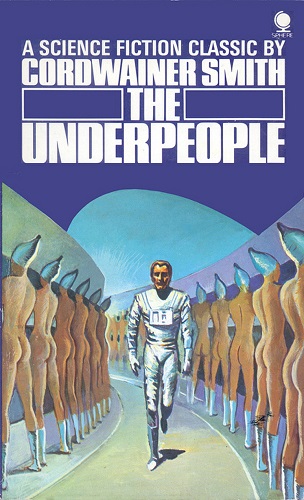
There is a Brian Aldiss story, ‘Confluence’ – I’ve referenced it a number of times in reviews – which consists of amusing dictionary definitions of words from an alien language. Such as “SHAK ALE MAN: the struggle that takes place in the night between the urge to urinate and the urge to continue sleeping”. And, “YUP PA: a book in which everything is understandable except the author’s purpose in writing it”. Sadly there’s no word that means “a book in which everything is understandable except a person’s reason for reading it”. Which is certainly true when it comes to the works of EE ‘Doc’ Smith, and most especially Subspace Explorers (1965, USA). It was a reread for me, but I last read it when I was twelve or thirteen, and I remembered pretty much nothing of it. Sadly, I cannot go back to that state of blissful ignorance.

Several centuries from now – exactly when is impossible to tell as the world-building is extremely poor – the Earth is split into a WestHem and EastHem: the first is a corrupt democracy controlled by corrupt unions, and the second is a tyranny masquerading as communism. In fact, the entire political set-up of the novel is cobbled together from US knee-jerk right-wing myths: communism evil! unions bad! politicians corrupt! big government bad! monopolistic corporations good! There are also colonies on a number of other worlds, all of which were settled, and are run, by corporations. Spaceships travel through subspace to journey between these worlds and “Tellus” (the Latin name for Earth, which Smith, bizarrely, used in all his fiction). 

A spaceship, the Procyon, suffers some sort of catastrophe in subspace. There are only five survivors – the first officer, the astrogator, the daughter of the owner of the biggest oil company in existence and wed to the first officer only hours earlier, her friend who is also the girlfriend of the astrogator, and a scientist who later turns out to be the giantest brain in all of human history. The oil magnate’s daughter is an oil dowser, and the subspace wreck has given her super mind powers, which she then teaches to the other four…

Meanwhile, the nasty old unions in WestHem are trying to break the corporations, who want to automate everything in order to keep down inflation (er, what?). The copper miners threaten to strike, because copper is apparently vital in the future. But the psionic five can dowse for metal, and they find a huge copper deposit on another planet for GalMet, the mining monopoly, also based offworld. The copper miners’ strike fails, so the milk truck drivers go on strike, because centuries in the future milk is once again delivered to people’s homes in bottles and this is so vital to life on Earth that a strike could cause society to collapse… The corporations break the strike using giant-sized battle tanks to deliver the milk (yes, really).

Anyway, the corporations defeat the nasty unions, inadvertently triggering a nuclear war, but never mind, the corporations’ “superdreanought” spaceships manage to destroy the missiles before they cause any important damage. The corporations trigger a WestHem election, but lose it to a coalition of all the political parties – which are all corrupt and evil, of course. But never mind. “Enlightened self-interest”, AKA unregulated corporate operations, will win out eventually. Then the corporations’ blockade of Earth Tellus is broken by a mysterious fleet of superdreadnoughts from an unknown planet.

Then it turns out one corporation, previously unmentioned in the novel, has for more than 200 years been running a secret world with a strictly-regimented “feudal” society (it’s not feudal, of course, because Smith clearly doesn’t know what feudalism is). That’s where the mysterious fleet came from. (The Company Agents are all electrically-charged, and they wear rubber-soled boots, so if anyone touches them – which is just, no, just too fucking stupid for words.) Our hardy heroes, the five from the shipwreck mentioned earlier, with the amazing mind powers, who by now have taught pretty much everyone on the corporation-run planets their amazing mind powers, free the Company serfs on The Company World. But the Company serfs had been infiltrated by agents from a secret world settled by the USSR! And with only five pages to go our hardy heroes defeat them too! 

I went into Subspace Explorers with low expectations. It not only failed to meet them, it dug a bottomless pit and then dived into it. Reading the infantile take on politics and economics used by Smith, his hatred of unions and valorisation of unregulated corporations, the implication inflation is more dangerous to a nation than nuclear war, I can only wonder how many of the techbros responsible for the shit state of the world today were influenced by it. We may mock sf and its “Torment Nexus”, but right-leaning politics as understood by a five-year-old such as that described in Smith’s novel, has probably caused more damage. Subspace Explorers is not just bad, it can cause brain damage. Techbros may well name-drop the Culture, but it wouldn’t surprise me to learn Musk, Altman, Andressen, Thiel et al have read and assimilated this novel.

If you ever meet anyone who claims to like Subspace Explorers, back away slowly from them. Then turn around. 

And run.


Leave a comment

Witch World, Andre Norton

I remember reading some novels by Norton back in the 1970s, but I don’t remember if Witch World (1963, USA) was one of them. Probably not. Nothing in it seemed remotely familiar. Or particularly good. Although it was on the Hugo Award shortlist in 1964. The only memory I have of the novels by Norton I read back then is that they were science fiction adventure stories, on a par with something like the Hardy Boys. And with, I seem to recall, mostly teenage or young adult protagonists. Enjoyable, but not memorable. To a teenager, at least.

And I think you’d have to be a teenager to put up with the awful cod-mediaeval dialogue Norton uses in Witch World. The plot is simple: Simon Tregarth – who is not a teenage or young adult protagonist – is on the run after a life of adventure post-war, not always on the right side of the law. He meets a man who promises him a new life, where he will never be caught. Tregarth goes with him, and learns the man is the guardian of the Siege Perilous, a magical stone which can send people to other worlds. Tregarth gets sent to one. Cue adventure.

The world is vaguely mediaeval, with the odd bit of high tech, which even Tregarth thinks is weird in inconsistent. There’s also magic, but he doesn’t blink an eye at that. Nor the fact it’s only women who can perform magic, and they lose the ability if they’ve had sex (which is a bit annoying for Tregarth, as he fancies one of the witches big time). But then it turns out he has magical abilities – a man! inconceivable! – and he’s definitely not a virgin.

Anyway, Tregarth joins the Guards of Estcarp, and plays a pivotal role in a war against the Kolder, human invaders from another world – Norton comes within an inch of describing them as “Yellow Peril” – who turn those they capture into robot zombies. Despite proving unstoppable for much of the novel, Tregarth manages to stop them. There are, of course, a few diversions along the way – failing to defend the trader city of Sulcarkeep, meeting the misogynist Falconers of the mountains, a pogrom against those of the “old blood” in Karsten, a forced marriage in Verlaine, and even discovering the tomb of one of the ancient race who occupied the planet before the humans arrived. It’s all very thrilling…

Witch World went on to spawn a series of more than twenty books over four decades, not all by Norton alone. I have the second book of the series, Web of the Witch World (1964, USA), but I very much doubt I’ll be reading any further.


2 Comments

The Affirmation, Christopher Priest

I’ve read a number of Priest’s novels over the years – I think the first was The Glamour (1984, UK) back in the late 1980s. And there was a period in the late 1990s when I read each new novel by him as it hit paperback. That ended with The Separation (2002, UK), which I seem to recall had a troubled publishing history. It was nearly a decade before his next book appeared, by which point he’d sort of dropped off my radar, before slowly creeping back intermittently over the next couple of decades.

Which is not to say I didn’t like what I’d read, and I’d always admired his writing, and sort of planned to catch up with the works I’d missed. Hence, The Affirmation (1981, UK), which was originally published 44 years ago, and joined the SF Masterworks series in 2011. It’s also the first novel to feature the Dream Archipelago, which Priest returned to several times, in a collection and a further three novels.

In 1976, twenty-nine year old Peter Sinclair suffers a breakdown after a string of appalling luck over a few weeks – his father dies, he’s made redundant, his landlord evicts him, and his girlfriend dumps him. He decides to write his autobiography as a form of recovery. But as he writes, he searches for a “greater truth” by disguising its setting. So the UK becomes Faiandland, London is Jethra, and everyone in Sinclair’s life is given another name.

In this “autobiography”, Sinclair has won a lottery for immortality treatment, and travels south by ship to Collago, an island in the Dream Archipelago. There is a side-effect to the treatment: amnesia. So Sinclar must document his life in order to help the clinic’s therapists restore his memories. But this version of Sinclair has written an “autobiography” too, about his life in London…

The narrative drifts back and forth between Sinclair in the UK and Sinclair in the Dream Archipelago, each one muddying the other. UK Sinclair is clearly in a bad state. He’s rescued by his sister, and then his girlfriend turns up and the two reconcile and move in together. It does not go well. Faiandland Sinclair is not sure he wants to be immortal, even after entering into a relationship with the Dream Archipelago avatar of his girlfriend.

The Dream Archipelago is first presented as an invention of Sinclair, which explains its inconsistencies and the somewhat unharmonious names. It’s equatorial, the northern continent is inhabited, the southern continent is uninhabited, but there’s a war and the islands form a neutral zone. The point being Sinclair’s invented world is not very convincing. But Sinclair is so invested in it – intellectually and emotionally – that he has trouble determining which is which. Details slip and slide between the two, especially after Sinclair has taken the treatment and is trying to regain his memory.

The Affirmation is… unsettling, and cleverly done. Priest covered similar ground in later novels, and in a manner that was more sophisticated. Which is hardly surprising. He had a singular oeuvre, which is definitely worth exploring, and I clearly have more catching up to do.