It Doesn't Have To Be Right…

… it just has to sound plausible


Leave a comment

Reading diary, #58

This is the last but one Reading diary post before my 2017 reading is all written up. And then, of course, I’ll have to start documenting my 2018 reading… Which I hope to do more frequently and more diligently than I did in 2017.

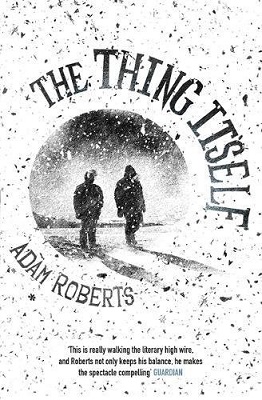
The Thing Itself, Adam Roberts (2015, UK). I have not in the past got on especially well with Adam Roberts’s novels. He’s an enormously clever bloke and has excellent taste in fiction, but I think there’s something in his approach to the genre which rubs me up slightly the wrong way. Except. I really did like The Thing Itself and thought it very good indeed. The narrator is a radio astronomer, wintering in Antarctica with a creepy geek. This is during the 1980s. The geek is secretly experimenting with perception – the idea that our senses mediate the world, that there is something there, in reality, an idea based on Kant’s Ding an sich, which our senses edit out… but what if we could actually perceive it… “It” all turns out to be a bit Lovecraftian and eldritch, but the geek’s unsuccessful attempt to kill the narrator, and the brief glimpse the narrator has of unadulterated reality, were enough to fuck him up. And now, decades later, he’s a complete loser (although the geek is in Broadmoor). But then he’s contacted by a secret thinktank – and it’s pretty obvious they’ve built themselves an AI, but the narrator is too dumb to realise this – because they need him to approach the geek… And, of course, everything goes horribly wrong and the narrator ends up on the run, not entirely sure who he’s running from and increasingly convinced the mad geek has developed some sort of superpower. There are also a number of historical sections, which better explain, and illustrate, the book’s central Ding an sich premise. I do have a couple of minor niggles, however. The narrator uses a cane, which he loses while fleeing from hospital… but mysteriously has it back a chapter or two later. And a female character changes name over a couple of pages. But that’s minor, trivial even. I thought this a very good sf novel.

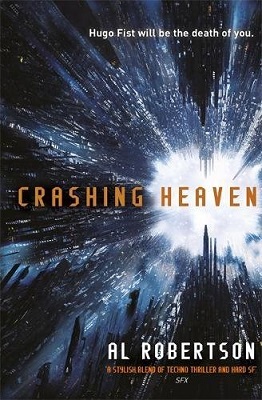
Crashing Heaven, Al Robertson (2015, UK). The trade paperback of this, among several others, was being given away free at Mancunicon, the 2016 Eastercon, so I grabbed myself a copy because, well, free. And, you know, it’s twenty-first century space opera and I still pretend to like that – although it does seem like increasingly fewer of them float my boat, as it were. Crashing Heaven is a case in point. It ticks all the boxes for 21st-century space opera, but that to me felt like more of a handicap than an advantage. Forster is an ex-soldier and POW, returning home to the Station after the cessation of hostilities with a collective of AIs who apparently dropped a rock on a lunar outpost that happened to be hosting a children’s schooltrip. (They denied doing it, of course.) Implanted inside Forster is an AI called Hugo Fist, which was designed to kill AIs (in that sort of handwavey computing cyber warfare bollocks that sf seems to love) and which manifests as an old-style music hall ventriloquist’s dummy. Unfortunately, due to some contract shenanigans, Fist is due to soon take-over Forster’s body, effectively killing him. Worse, Forster thinks the AIs are innocent of the lunar rock thing (I mean, come on, it’s obvious right from the start they didn’t do it). It’s all a plot, of course, by the “gods” of the Station  – who are apparently uploaded humans so sociopathic they refuse the same existence and abilities to every other human, which to me is just putting a sf spin on slavery. And that’s pretty much the world of the Station – slavery, genocide, megaviolence, the usual 21st century science fiction crap. Not interested. Crashing Heaven is apparently the first book in a series. I won’t be reading the sequels.

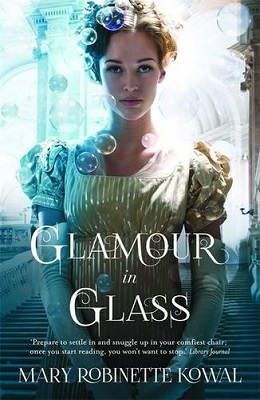
Glamour in Glass, Mary Robinette Kowal (2012, USA). I read the first book of this series a while ago, and a conversation on Twitter in late 2017 persuaded me to carry on with the series. So I bought book two. Which is Glamour in Glass. (Amusingly, according to the spine, it’s the second book in the “lamourist Histories”. Oops.) At the end of the first book, plain-but-talented Jane married estranged-earl David, and the two make their living as among the best glamourists in England. One of their clients is the Prince Regent,. He reveals to Jane that she will finally get her postponed honeymoon. In Belgium. Ostensibly there to study a new glamourist technique which can make things invisible, it turns out David is spying for the British Crown – since Napoleon has escaped and is expected to retake France… The end result is less Jane Austen and more Georgette Heyer, and I do love me some Heyer, but the Heyer of An Infamous Army rather than Cotillion. Which is no bad thing, although the change in tone between the first half of the book and the second did jar a little. And the final scene wasn’t quite as dramatic as the lead-up had suggested. (On the other hand, a modern eye does mean some of the more skeevy aspects of Heyer’s fiction are avoided.) But I did enjoy the book, and I’m glad I was persuaded to give them another go. I think I’ll carry on reading them.

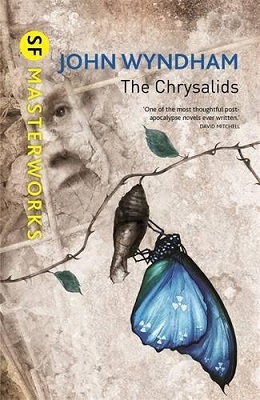
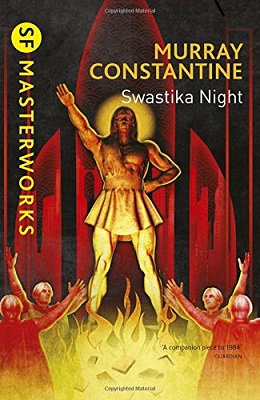
Swastika Night, Murray Constantine (1937, UK). It says Murray Constantine on the cover but it’s sort of an open secret that Constantine was a pseudonym of Katherine Burdekin, so I have to wonder why Gollancz chose to use the pseudonym on the SF Masterwork edition. I mean, no one remembers either name these days, so it makes no fucking difference. Use her real name, make it obvious the writer was female. Anyway, the story is set 700 years after the Axis won WWII, and and Europe is all Greater Germany. People – well, men… as women are considered subhuman and treated like animals – are divided into Nazis, Germans and everyone else. A clever Englishman visits Germany on pilgrimage and hooks up with a German friend who had worked in the UK. Through him, he meets the local Nazi lord, who reveals a secret history. Hitler was not tall and blond and godlike, and women were once considered equal to men… There are perhaps a few people in the US, or members of UKIP, who may be surprised by these revelations, but to the human race it’s the sort of reveal which has almost no dramatic impact. It’s not helped by the fact the narrative consists mostly of characters lecturing each other. The misogyny is baked into the world but, despite suggesting homosexual relationships are both common and unremarkable, there’s a still a whiff of homophobia. Swastika Night is not a great book. Had its profile remained prominent in the decades since it was first published, it might have been considered an important book. Sadly, it was all but forgotten. It’s good that the SF Masterworks series has chosen to publish it – although it would have been better thad they used the author’s real name – and it is scarily more relevant now than it has been since the 1940s… It’s an historical document, it reads like an historical document… but it’s a sad reflection on our times that its premise is no longer historical…

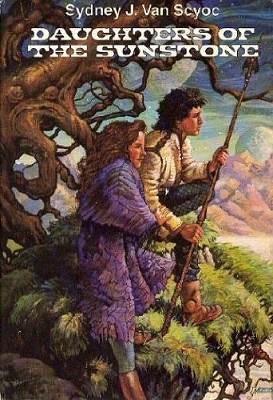
Bluesong, Sydney J Van Scyoc (1983, USA). This is the second book of Van Scyoc’s Daughters of the Sunstone trilogy, which I have in the SFBC omnibus edition. I’ve been a fan of Van Scyoc’s fiction for a long time, and I’m not entirely sure why. Or rather, I hadn’t remembered why until I started reading this trilogy, beginning with Darkchild (see here), and now Bluesong. She was genuinely good. She built strange worlds and set stories in them that were predicated on that strangeness and yet had plots which explained the cause, and sometimes cure, of the strangeness. She was never especially popular, but I think I’d rate her one of the best female US sf writers of the 1980s. Sadly, her last novel appeared in 1991 (although she apparently had a couple of stories in F&SF about ten years ago). The Sunstone novels are set on the world of Brakrath which, although mostly low tech, was settled from another world centuries before and remains aware of them. The planet is a bit too cold to be comfortable for humans, so they hibernate during the winter. Even during the spring, the valleys would be too cold for agriculture… but for the barohnas, the female rulers of each valley, who have the power to focus and direct the sun’s rays… to defrost the land and provide sufficient warmth to grow things. In Bluesong, a young woman realises she is not one of the river people among whom she lives, runs away, and eventually ends up finding her father among the desert people… But she is actually a daughter of a barohna, and so will change into one herself. Van Scyoc draws her alien societies well, and this series is particularly good at dropping hints toward a story arc. I liked Bluesong more than Darkchild, but they’re both pretty good. Cherryh may have received more love during the 1980s, and, er, since, and was hugely more prolific, but Van Scyoc was just as good.

The Hidden Side of the Moon, Joanna Russ (1987, USA). I don’t think I ever doubted that Russ was an extremely clever writer, although it was more evident in some stories than others – some of her short fiction, in fact, was so much of its time, it was hard to see see past how emblematic of their period of writing they were. But it wasn’t until I read The Hidden Side of the Moon that I realised how consistently clever a writer was Russ. This is not a specially curated collection, but it’s so much more intelligent a collection than her The Zanzibar Cat. Perhaps it’s because not every story in it is genre, and it was not put together to showcase her genre credentials. Perhaps it’s because every story in it is fiercely feminist. I don’t know. I do know a collected works of Russ is long past overdue – not just the short fiction, but also the non-fiction, like the essays in Magic Mommas, Trembling Sisters, Puritans & Perverts, or her criticism. She is, like Samuel R Delany, one of the most important writers American science fiction has produced. And yet who is it who remains in print and has countless stories and novels adapted by Hollywood? Philip K Dick. A drug-addled hack. We are, I suppose, fortunate that Asimov, one of the most graceless prose stylists of his generation, has not been so enthusiastically adopted by Hollywood. And while I still have a soft spot for some of Heinlein’s works, he’s pretty much science fiction’s embarrassingly outspoken old uncle with all the offensive opinions at the family barbecue, who’s pretty harmless until he starts touching up his young nieces. It’s long past time science fiction stopped venerating skeevy old hacks like Asimov and Heinlein and Dick, and started lauding the real grand masters, like Delany, Russ, Tiptree and Le Guin.

1001 Books You Must Read Before You Die count: 131


Leave a comment

All the new year feels

I think on the whole 2017 is best forgotten. I did have some good times – conventions in Sweden, Finland and Denmark, for example – but on the whole the year was a bit of a dead loss. I had plans, I had modest plans. I failed them all. Well, I didn’t manage to get much done during the year outside the day job. I’m hoping 2018 will be much better in that regard.

Having said that, it’s hard to be optimistic when your country has decided it would sooner be racist and poor instead of prosperous and a member of the planet’s largest trading bloc. And then the US elected a posturing baboon to the White House, and the GOP seems determined to roll back every piece of legislation that had begrudgingly dragged the US into the 21st century… So, the world went to shit and it sort of killed my motivation to do much other than lose myself in movies.

I’m not expecting 2018 to be any better politically or geopolitically. I’d like to move to a more civilised country. But it’s hard to change a situation that isn’t personally broken – I work four days a week at a job I enjoy, for money that more than pays for the stupid number of books and films I buy. And my current situation certainly doesn’t prevent me from writing, or reviewing. I’ve done both in previous years.

So in 2018, I want to start writing again. I want to finish the third book of my space opera trilogy, A Want of Reason. Which is all plotted out and about a third written, and will likely turn out to be the most un-space-opera space opera that ever space opera’d. I’m basing an entire chapter on Le grand meaulnes, FFS. It opens with a terrorist attack. By one of the good guys. And wait until you see the Space Communists from Space… I also have several ideas for novellas I’ve been mulling over for a few years. I could have a bash at the Poseidon Quartet (as mentioned in Apollo Quartet 5: Coda – A Visit to the National Air and Space Museum). Or maybe the Jupiter Quartet, which I’ve been thinking of doing for a while… I’d like to write some short fiction too, although I am notoriously crap at it, well, at finishing it. I envy people who can sit down and bang out a first draft in one sitting.

I also intend to drag SF Mistressworks out of mothballs. I read several books that qualify for it during 2017, so I just need to write the reviews. And I’d like to start reviewing again for the venues I reviewed for previously. It’s all very well banging out a couple of hundred words on books I’ve read, and films I’ve seen, on my blog, but most of those “reviews” sort of turned into rants and I really need to be a bit more disciplined in my criticism. In fact, I’d like to write more about science fiction in 2018. At one point, I was going to write a whole series of posts, Fables of the Deconstruction, on individual sf tropes. I did space travel (see here) and robots (see here), but never got any further. And then there’s the spoof how to write space opera guide myself and another award-winning sf writer drunkenly hacked out one night… We really should finish it.

Of course, I’d like to read more books too. I managed to reduce my four-figure TBR pile by exactly one book in 2017. That’s excessively rubbish. I didn’t make my target of 140 in the Goodreads Reading Challenge (I finished the year on 128), so I plan to beat that for 2018. I’m an inveterate list-maker, so I’ve already started putting together a list of the books I want to read this coming year. I think I should buy less books too – I mean, buying eleven per month on average is not good for, well, for the fabric of the building I live in. I should probably have a clear-out at some point, but some authors I’ve been collecting for so long I’m reluctant to get rid of their books, even if I no longer read them…

So, resolutions… They should be in a handy list (see above). Twelve is a good number; there are twelve months in a year, twelve days of Christmas, twelve eggs in a dozen, er, eggs… So how about twelve resolutions for 2018?

  1. Read more books than last year – I have to beat 128 books but would prefer to beat 140 books
  2. Speaking of which… only start reading a new book when I’ve finished the last one
  3. Read at least six books from countries whose literature I’ve never read before
  4. Watch less films than last year – I mean, 602 is a bit fucking excessive; anyway, now LoveFilm has packed in I’ve only got one DVD rental service
  5. Finish the damn space opera novel – it’s all there in my head, and has been for a two years; I just need to get it down on paper
  6. Complete at least one novella – they’re probably going to take a shit-ton of research; why do I do this to myself?
  7. Complete at least four short stories – bonus points if I can actually sell the bloody things
  8. Get SF Mistressworks back up and running, start reviewing books again
  9. Write more about science fiction on this blog, so it’s not all films I’ve watched and books I’ve read
  10. Drink less wine
  11. Exercise – I’ve made half-hearted attempts at developing a running habit several times in the past; it usually lasts a month or so
  12. I plan to attend two Nordic cons in 2018, but maybe I can squeeze a third one in?

There, they look achievable. All I need is a bit of motivation. And self-discipline. I don’t expect to complete all twelve, but they’re mostly about getting me back to where I was before 2016 landed on my head at the day job. And then, in 2019, I can start building on them…

Happy New Year.


3 Comments

Reading diary, #57

I’ve got a few of these posts to get out before I complete documenting my 2017 reading. The books below were all read two months ago, but I’ve been a bit crap at writing them up. I’ve been a bit crap at finishing books, in fact, and have got into the bad habit of picking up a new book before reaching the end of the current one… and then having to go back and finish it later. I’ve got piles of books scattered around the living-room which only need me to read the last twenty or so pages so I can put them back on the shelves (or send them off to the charity shop). I think I’ll make that a resolution for 2018: only pick up a new book when I’ve actually reached THE END in the one I’m reading. And if that means carrying two books on my daily commute, so be it.

Anyway, November 2017’s reading consisted of…

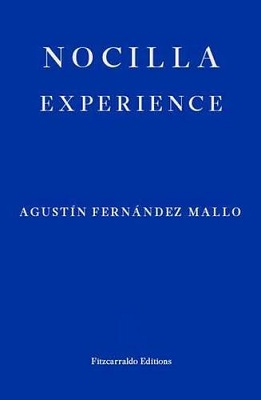
Nocilla Experience, Agustín Fernández Mallo (2008, Spain). This is the sequel to Nocilla Dream, which I read and thought very good last year – see here. There is a third book, Nocilla Lab, although I can find no information on when Fitzcarraldo Editions plans to publish it, or indeed Mallo’s most recent novel, Limbo. Like the first book, Nocilla Experience is split into numbered sections, 112 in total, some several pages long, others no more than a sentence or two. They are a mix of fiction and fact, or, such as in the case of the snippets of dialogue from Apocalypse Now, found documents. The main narratives all deal with obsession – a man who is trying to eat every box of corn flakes he can find with a sell-by date the same as his ex-wife’s birthday; another who turns bubblegum stuck to pavement into tiny paintings; a third man runs a restaurant that serves up found objects instead of food, although they’re presented as food… It’s a fascinating literary experiment, although I’m not entirely sure how it’s supposed to fit together – or if indeed it’s meant to. And, for some reason, much as I liked it, Nocilla Experience didn’t quite appeal to me as much as Nocilla Dream did. But I’m still looking forward to the third book… and I wonder if there are any Spanish writers inspired by Mallo – the “Nocilla generation” – who have also been translated into English…

The Silver Wind, Nina Allan (2011, UK). I’m still not sure if that’s “wind” as in what you do to a clock, or “wind” as in the movement of air. And I heard the author read one of the stories from this linked collection at a Fantasycon in Brighton several years ago. But there’s a fob watch prominent on the cover, and the six stories inside are all about time – so much so, watches and clocks are repeatedly called “time machines” – and there are definite hints that travel through time takes place in some of the stories. But each story also features variations on a small cast of characters, suggesting alternate universes more than time travel. It all makes for an unsettling read, a mosaic narrative which refuses to remain constant, which refuses to settle down. While the plots themselves are little different to those you might find in a series of literary fiction short stories, the fact the world in which they take place seems to rest on shifting sands gives them a fantastical atmosphere. It’s something Allan does in most of her fiction, but in The Silver Wind, because of the small cast and the interweaving of lives and stories, it’s much more obvious. Good stuff.

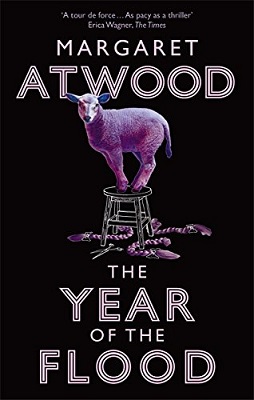
The Year of the Flood, Margaret Atwood (2009, Canada). This is the sequel to Oryx & Crake, and now apparently the second book of a trilogy, followed by MaddAddam, which I also own. I read Oryx & Crake a couple of years ago and, to be honest, I don’t recall much of the plot. I do remember finding it all very unconvincing and Atwood’s neologisms quite cringeworthy. That last is still true in The Year of the Flood, but the world it describes seems much better made. But brutal. Horribly, stupidly brutal, in fact. It’s cruel in a way that only science fiction and fantasy can manage, a scale of brutality that needs an invented world to achieve. Atwood seems to revel in the gore in parts of this novel, and I’m not interested in such fiction. I don’t want to read books that normalise psychopathic behaviour, and far too much science fiction does that. On the other hand, the “sermons” which introduce each section of The Year of the Flood are hilarious. It is, I think, a much better book than its predecessor, but it is also disappointingly violent. I don’t know when I’ll get to MaddAddam, but I suspect it’ll take me a while.

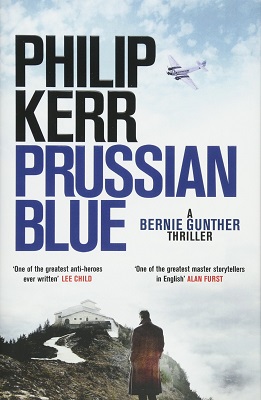
Prussian Blue, Philip Kerr (2017, UK). This is the twelfth novel in Kerr’s Bernie Gunther series, begun back in the early 1990s with his Berlin Noir trilogy. Since returning to the series in 2006, Kerr has been banging them out one a year, with no discernible loss in quality. And over the twelve books, we’ve seen Bernie survive WWII, bounce around South America, Cuba, Germany, and now it’s the mid-1950s and he’s a concierge at a small hotel on the Riviera. Each of the Gunther novels has followed the same template – what Bernie is doing now, and how he gets himself out of the bad situation he seems to have got himself into, and a narrative set at some point before, or during, the Second World War, when he worked for various iterations of the Berlin police. In Prussian Blue, a face from the past turns up and blackmails Bernie into murdering a woman in England, so he goes on the run. That face from the past was Bernie’s criminal assistant during an investigation into a murder in Obersalzberg, Hitler’s mountainside retreat in Bavaria, which he had to solve in a week before Hitler arrived to celebrate his fiftieth birthday. Unfortunately, Obersalzberg, administered by Hitler’s private secretary, Martin Borman, is rife with corruption, and there is no shortage of suspects. Just make matters worse, Borman doesn’t much care if the crime is solved, just as long as he has someone he can put in front of a firing squad. Which he soon finds. But Gunther also has a suspect. Unfortunately, the murder is linked to the millions Borman and his cronies are ripping off from the Third Reich. And while Borman’s brother, who hates him, is waiting in the wings to bring him low, he and Gunther have been out-manoeuvred.  Worth reading.

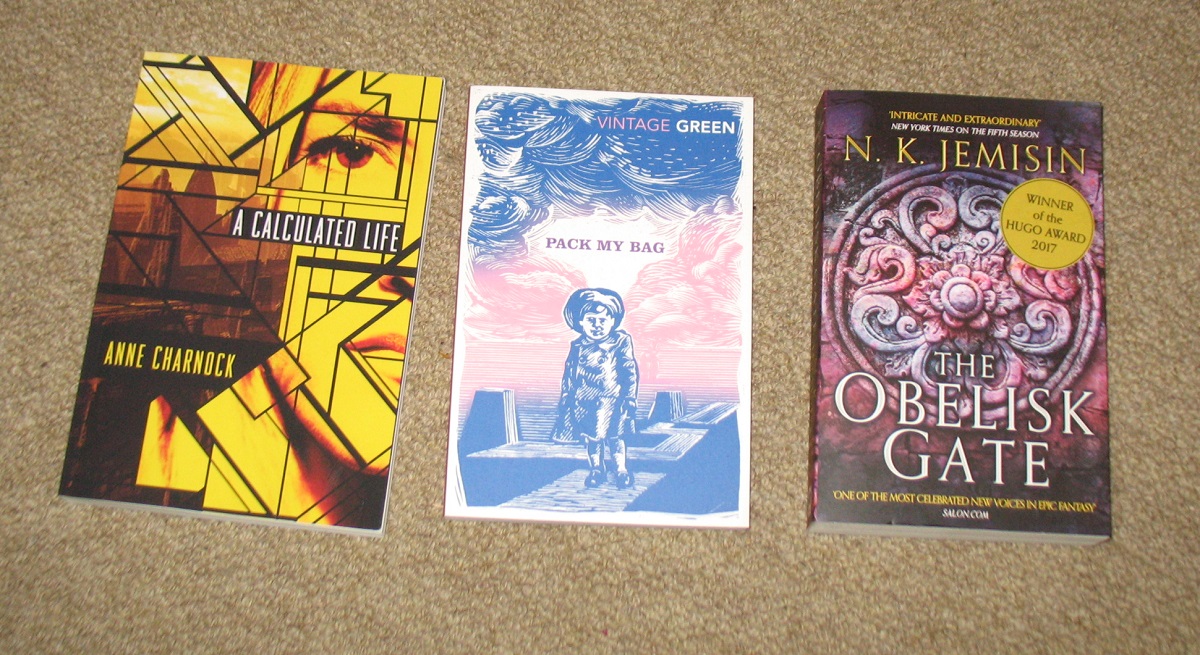
Dreams Before the Start of Time, Anne Charnock (2017, UK). I forget who originally recommended Charnock, but I read her Sleeping Embers of an Ordinary Mind (see here), and was impressed enough to want to read more. Which I now have done. Although it has taken me pretty much exactly twelve months. But it was worth the wait. Dreams Before the Start of Time is… an ensemble piece. There are a group of people, related by blood or marriage or just friends, and they’re living their lives in London and Shanghai over the next few decades, beginning several years from now. The story opens with a young woman deciding to become a single mother, but using a sperm donor. Her friend, on the other hand, has a one-night stand, and decides to keep the consequences. As the years unfold, attitudes to the means of conception, gestation and child-rearing change as technology progresses and sensibilities reflect new social mores. A sf novel like this in direct opposition to the Atwood above – the world has not ended, there are no sexual assaults, no mega-violence, no violence, in fact. There needs to be more science fiction like this. Of course, it helps that the writing is really good – good enough for me to pick the novel as one of my top five books of the year – see here. I was given Charnock’s A Calculated Life, her debut novel, for Christmas. I’m looking forward to reading it.

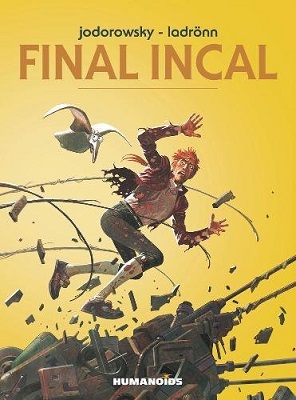
Final Incal, Alejandro Jodorowsky & Ladrönn (2017, France). Jodorowsky keeps on coming back to the Incal. This is hardly a surprise as it’s been his most successful title – although Incal spin-off the Metabarons has probably appeared in more media incarnations. In Final Incal, the multiverse is in danger when an evil machine intelligence creates a plague and the only defence is to convert everyone into a robot… Three iterations of John DiFool all meet up between universes, in the hunt for their lover, Luz, and the means to save the multiverse from destruction. But only one of them can complete the task. The artwork, by Ladrönn, is very good indeed. Apparently, Moebius did start work on the project, but only completed the first part, so Jodorowsky had Ladrönn redo it from the start. The story is the usual Jodorowsky weirdness, although it’s starting to feel a little recycled by now. This was an astonishing piece of sf in its day, and it continues to make for good reading decades later. But I have to wonder whether these returns and extensions to it are doing it any favours. I guess I’ll find out when I get around to reading Deconstructing the Incal

1001 Books You Must Read Before You Die count: 131


Leave a comment

2017 in books: the stats

Well, 2017 was a crap year in reading terms. I managed only 123 books, my worst showing since 2005’s 110 books read. I’d expected 2017 to be lower than the previous year, and had even reduced by Goodreads Reading Challenge target from 150 to 140… And still failed to achieve it. Oh well.

If 2017 failed in terms of quantity, it certainly didn’t for quality. I read a number of excellent books – and was hard-pressed to pick my favourites for the year (see here). I think I’m better at choosing what to read now than I used to be, and it’s not always turning to the same favourite authors. I have them, of course; who doesn’t. And I plan to read all they’ve written… but I also like to read stuff that’s unlike my usual reading material – and I’ve found some new favourites by doing that.

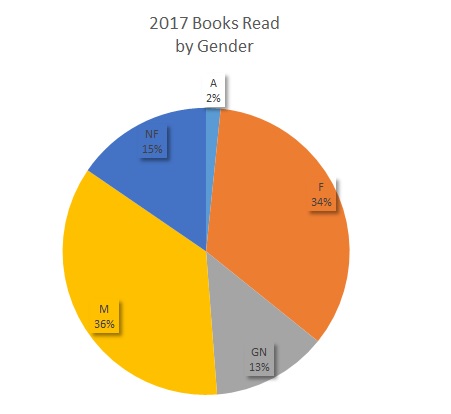
I’ve made an effort in the past few years to balance my reading between male and female writers of fiction. Men just pipped women this year. I suspect that’s because I read a bunch of novellas and I just happen to own more novellas by male writers than female writers. “A”, incidentally, stands for anthologies, “NF” for non-fiction, and “GN” for graphic novels (although, to be honest, they were pretty much all bandes dessinées).

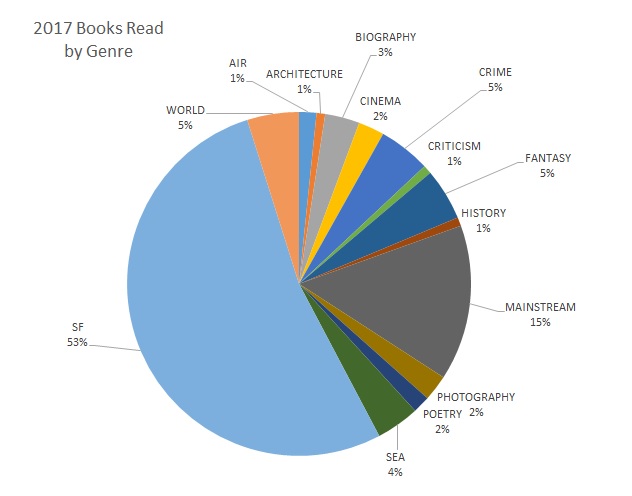
I’ve yet to work out if I’m still a science fiction fan – I mean, I write it, and I still read it, but I have a low opinion of much of the genre’s output. And then I tot up the books read by genre at the end of the year, and it seems science fiction forms almost half of my reading. So I guess I must still be a sf fan. My mainstream reading is down too – even if you add in “world” (which would be translated non-genre fiction), it’s still less than last year’s 27%. Checking back, my sf reading was 40% last year… but I’ve no idea why I read so much more sf in 2017. Was it a good year for science fiction? Not that I read novels as soon as they’re published all that often – sometimes it can take me up to a decade to get around to reading a book I bought when it was first published. I don’t know. There were several sf novellas published in 2017 by writers whose fiction I like. Perhaps that accounts for it.

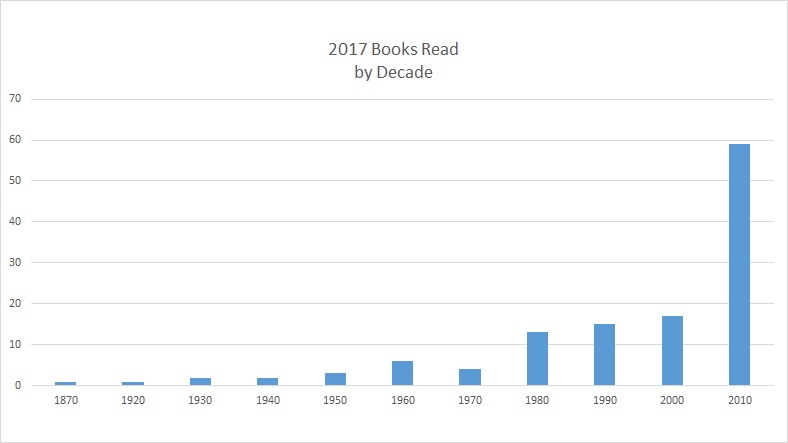
Despite my comment above – and yes, there are books that have sat on my shelves for more than a decade before I finally got around to reading them – it always surprises me to learn the bulk of my reading is from the current decade. I don’t actively seek out the New Shiny – often, I avoid it. So that’s a bit weird. The 1920s and 1930s are probably due to some DH Lawrence I read. The 1870s was, I think, a couple of Jules Verne books.

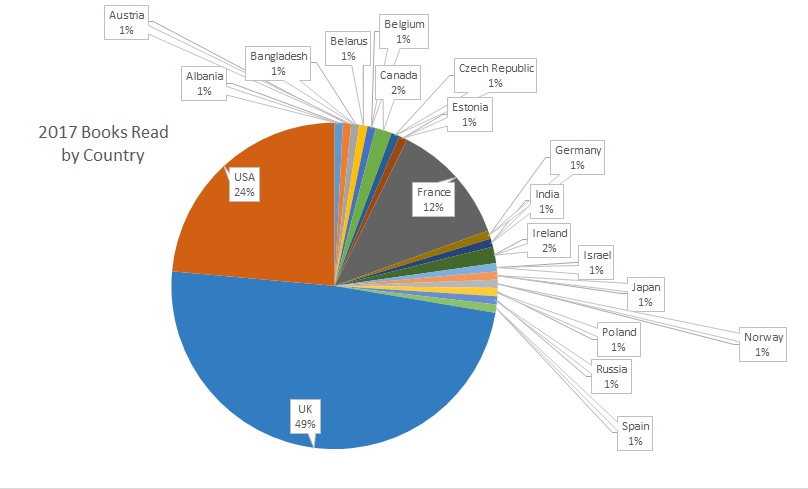
In 2016, I started to track the country of origin of the writers I read, and was surprised how much of my reading is by UK writers. That apparently hasn’t changed – although it has risen from 39% to 49% (and the US has dropped from 35% to 24%). But in 2017, I read further afield – twenty countries compared to seventeen. And some of 2017’s countries were new to me: Albania, Belarus, Bangladesh, Estonia and Norway. Several years ago, I challenged myself to read a book each month from a different country, but I got bogged down in an Orhan Pamuk novel and never finished it. I might have another go at the challenge in 2018.


Leave a comment

2017 in movies: the stats

In 2017, I watched 532 films – well, some were seasons of television series, which, thinking about it, I don’t know why I track as I only do so for those I watched on DVD or Blu-ray. Anyway, I watched 532 “films”, some of them more than once. Some I’d seen before, in previous years. In fact…

… over three-quarters of what I watched I saw for the first time in 2017. Some of them I rewatched a second, or even third, time during the year (SY). Others I had seen once previously in an earlier year (1P) and some I’d seen several times in previous years (MP).

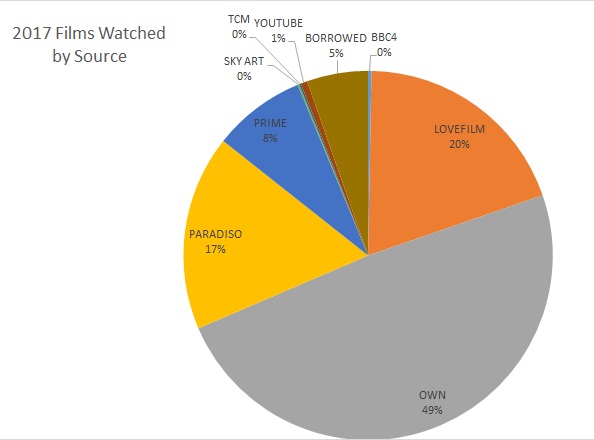
Nearly half of the films I watched were ones I owned. LoveFilm, which closed at the end of September, was the next biggest source; followed by Cinema Paradiso, another DVD rental service (and the only one left, I think). The only streaming service I have is Amazon Prime, which throws up the occasional good film. I might subscribe to MUBI or Curzon in 2018. I haven’t decided yet. There are a couple of Netflix TV series I’d like to see but I’m not sure if they’re worth paying the subscription. Annoyingly, Amazon are apparently dropping the Youtube app from their service – too much of a competitor for out-of-copyright material, I guess. Monoplistic bastards.

During 2017, I decided to track the gender of the directors of the films I was watching. The film industry is even more of a sausage-fest than book publishing. I made an effort to seek out films by female directors – and even found some I intend to follow, like Claudia Llosa and Lucía Puenzo (both South American) – but I did stick to the sort of films I like, and while women do make them, they’re a small percentage of the total. I hope that changes. In the chart above, “P” means two or more directors, which can be anything from a pair, like the Archers, Powell and Pressburger, to an anthology film by half a dozen directors. And “S” is TV series.

I’m not very good with film genres. I tend to classify most films as “drama”. I’m not convinced there’s a good way to categorise film genres. Okay, so SF, horror, fantasy… those are quite obvious. But what’s the difference between a thriller movie and an action movie? When is a drama a rom com? What the fuck is “action comedy”? I cheated a bit – I’m not sure if the 007 films are thrillers or action films, so I made them their own genre, “Bond”. Chiefly because I bought the complete films box set on Blu-ray on Black Friday. And “Disney” is its own genre, irrespective of whether the films were cartoon or live action. I watched a bunch of Elvis Presely films, so he got his own genre too.

I like to think I watch a wide spread of films, so it always comes as a surprise at the end of the year to discover that the most popular decade among the films I watched was… the current one. Oh well.

In 2017, I made an effort to seek otu films from countries I’d not seen films from before, and managed to add another 14 to the list: Thailand, Kazakhstan, Lithuania, Venezuela, Mongolia, Georgia, Vietnam, Peru, Singapore, Jordan, Jamaica, Estonia, Cuba and Romania. I also managed to keep the US films I watched to around a quarter of my total viewing. As a result of expanding the countries from which I watch films, I’ve become a fan of China’s Sixth Generation directors, and am keen to watch more movies from Cuba, Peru, Chile and the Baltic states. In total, I watched films in 2017 from the countries in the map below.


1 Comment

Moving pictures 2017, #70

This is it, the last post of the films I watched in 2017. I hope they’ve been entertaining, and perhaps informative. And if I’ve made new fans of some of my favourite directors, then I can honestly say I’m happy and they’ve been worth the effort.

Of course, because that’s the way it goes, this series of post ends with more of a whimper than a bang…

Life, Daniel Espinosa (2017, USA). I can just imagine the pitch meeting. Hot young producer: “So they take this alien creature, a microbe say, onto the space station to study it, and it grows… and this is the kicker… it grows into an alien killing machine! And it kills off the crew one by one!” The studio executives are all nodding and going: “This sounds very original and exciting.” Meanwhile, the PA in the corner is banging her head against the desk and muttering, “It’s Alien, for fuck’s sake. It’s Alien, for fuck’s sake. It’s Alien, for fuck’s sake.” And yup, that’s pretty much what this is. Okay, so it’s no facehugger, but a microbe is brought from Mars by a probe; and it’s not the Nostromo, a corporate tug light-years way from Earth, but the ISS (of a decade or two hence) some 400 kilometres above our heads. But the plot is Alien from start to finish. And it adds nothing to the original. I like the idea of using the ISS and showing an accurate depiction of living in space in a commercial sf/horror movie… except it’s not that accurate. The ISS of the film looks like it was initially based on the real thing, but the Cupola is ten times larger, and everywhere is a bit dim and ill-lit, not the shining white of the real thing. As for the rest of the movie… microbe grows into alien monster, alien monster kills astronauts. Yawn. Apollo 18 did the monster space fiction thing better; Alien did the haunted house with monster in space thing better. Life is shit. And then you die. Or something.

Tre Fratelli, Francesco Rosi (1981, Italy). Until I started watching this, I hadn’t realised it was by the director of Christ Stopped at Eboli, which I watched last year and liked a great deal. I’d also thought Tre Fratelli was on the 1001 Movies You Must See Before You Die list. But apparently not. Or, at least, not the 2013 edition I’ve been using. And, for some bizarre reason, despite the year of release, I had it in my head it was Italian Neorealism Which it is not. It’s a well-observed and -played drama, much like the other Rosi film I’ve seen. Well, except for the dream sequences. Whech were quite odd. Especially the one for the brother who works as a counsellor at a borstal-type place. The other two brothers are a judge, who has just accepted a terrorism case and his wife now fears for their lives, and a factory worker involved in a strike. The judge’s wife, it turns out, has good reason to be scared. I should watch more films by Rosi, I think. I thought this one pretty good, too.

Mindhorn, Sean Foley (2016, UK). I found this on Amazon Prime, it was late, I’d had a glass of wine or two, and it proved entertaining enough I sat through it to the end. The title refers to an early 1970s detective character on television played by a now washed-up actor. There’s a murder on the Isle of Man, and the chief suspect goes into hiding and insists he will only give himself up to ‘Mindhorn’, as if the fictional detective were a real person. So the actor has to play him one more time. Naturally, being a complete dickhead, he tries to take over the investigation, but the police treat him with the contempt he deserves. Just to confuse matters, Mindhorn’s love interest from the telly show (and real life) also lives on the Isle of Man… but she married the stuntman who doubled for Mindhorn. Who is a smug, and none too bright, plonker. That’s the problem with films like this: the characters are all “characters”, not real people, comic caricatures on which the writers and/or actors have lavished much time and effort. It can kill a comedy. Happily, here it doesn’t. Not because the characters are well-drawn, but because they grow, Mindhorn himself especially. Yes, he’s a total dickhead, but he becomes more sympathetic as the film progresses. The central premise is not especially original – and, to be honest, Norwegian Ninja spoofed the concept way better – but Mindhorn manages to be a consistent, and plausible, low-budget alternative. I enjoyed it. Worth seeing.

South, Frank Hurley (1919, UK). Hurley was an Australian who accompanied Shackleton on his 1914 to 1916 expedition to Antarctica. South is a compilation he made of the footage and photographs he shot during that period, as well as on a 1917 expedition to South Georgia. This is similar material to Herbert G Ponting’s footage of Scott’s ill-fated expedition, although Shackleton of course returned home. It’s fascinating stuff, not just seeing unspoilt wilderness as witnessed by among the first human beings to visit it, but also the crude yet effective methods used to combat the appalling conditions. South doesn’t have the same frisson as Ponting’s The Great White Silence, and not just because there’s no tragedy attached, but because it has less of a narrative through-line. It’s a compilation of documentary footage almost a century before non-narrative cinema became a thing. It’s fascinating, but it’s probably an acquired taste.

The Letter, William Wyler (1940, USA). Bette Davis is the wife of a British rubber plantation owner in Malaya. She shoots a man in cold blood, and then claims it was self-defence as he had assaulted her. Everyone rallies to her side, and she seems to take the legal hoops through which she must jump as no more than an inconvenience she had herself initiated by shooting her assaulter. Except, it’s not so cut and dried. As the husband discovers when Davis confesses the dead man was her lover and she loves him still. My mother found this DVD in a charity shop, and it was only after watching it that I discovered it appears on a best films list – not one of the 1001 Movies You Must See Before you Die lists, but perhaps a They Shoot Pictures Don’t They one – so clearly it’s held in regard by some. I found it a well-played, if dated, drama, likely due to its origin as a play by Somerset Maugham, although Wyler, a name I know quite well and normally a safe pair of hands, didn’t seem to bring much to the adaptation. It played like a Davis vehicle, and while perhaps better written than most such, it had more the feel of that than of a cinematic adaptation of an ensemble theatre piece. Enjoyable enough, but not one to seek out.

Foolish Wives*, Erich von Stroheim (1922, USA). I had to buy this from a seller on eBay who had ripped an out-of-copyright version,  because it’s not actually available on DVD in the UK or US. Despite being such an important film. But, of course, it was a silent film, and importance means fuck-all when compared to commerical success, and silent films stoped being commercially successful back in the 1920s, shortly after The Jazz Singer was released (although many excellent silent films were released years later – FW Murnau’s Tabu wasn’t released until 1931). Von Stroheim plays a con merchant who pretends to be a German aristocrat in order to separate rich US women from their riches. It’s a genre of film which, to be honest, should really be instructional for the prospective con artist rather than tell the victims’ stories, and it’s only the fact films take so long to make it into the cinemas that renders the techniques they reveal useless. Well, that and rich people’s desire to safeguard the wealth they’ve stolen. But who gives a fuck about them. Our culture does not always reflect our concerns, sometimes it drives them. So long as the rich are valourised in popular media, so their depredations will be accepted in real life. Commercial media is a powerful tool, as the right wing press has learnt, and attitudes can be changed through film and tv. But for all, say, Dr Who’s progressiveness, Hollywood’s regressiveness has meant two steps back for every one step forward. Foolish Wives is nearly a century old, but it had a more responsibile attitude to its topic than anything produced by Hollywood in the past thirty years. True, it was going for a moral lesson, and it was one that punished the director’s character – but he did little more than Wall Street has done, and he saw his just desserts. Wall Street never has.

1001 Movies You Must See Before You Die count: 895

3 Comments

Moving pictures 2017, #69

I have two of these posts left to round off my film-viewing in 2017. Which means 70 Moving picture posts, each of half a dozen movies (although one or two might only have been five movies), which by my reckoning, if my maths is right, is around 420 movies I reviewed during the year. Although, “review” might be a bit strong a term for my rambles and rants. Anyway, this time around I managed it again – six films, six different countries. Admittedly, half of the the films were by directors known to me, and I’ve seen other films by them, but never mind.

Hollywood Hotel, Busby Berkeley (1937, USA). That’s the last of the Busby Berkeley Collection 2, with only four films in this set instead of six. And they weren’t especially good ones. Hollywood Hotel was directed by Berkeley but doesn’t feature any of his signature production numbers, unfortunately. Dick Powell plays a small-town saxophonist who’s been hired by All Star Pictures in Hollywood. He leaves his position with Benny Goodman’s band – Benny Goodman played by Benny Goodman – flies to California and is put up in the eponymous hotel. Which is also where big movie star Mona Marshall has a suite. And Marshall has just thrown a diva tantrum and refuses to go to the premiere of her new film. So All Star Pictures put out a casting call for a lookalike, and hire Virginia Stanton to impersonate Marshall at the premiere (Marshall and Stanton are played by real-life sisters Lola and Rosemary Lane, of the Lane Sisters), and and also order new-hire Powell to accompany her. No one tells him, however, that she’s not the real article. Cue mistaken identity hilarity. Powell is then fired, and ends up working at a drive-in burger joint, before getting another chance at stardom, with the help of Stanton. Hollywood Hotel is mostly entertaining, although the musical numbers are a bit weak – except perhaps for the Benny Goodman ones. Lola Lane is terrible, but Rosemary Lane is good, which is weird. Unfortunately, the film suffers from a lack of a big production number, and, it has to be said, a completely unrealistic depiction of how Hollywood works… Meh.

Souvenir, Bavo Defurne (2016, Belgium). I found this on Amazon Prime, which occasionally throws up films worth seeing. Isabelle Huppert plays a factory worker who was once a winner of an analogue to the Eurovision contest. A young boxer who starts work at the factory recognises her, enters into a relationship with her, and persuades her to have another go at stardom. So she re-enters the pan-European song contest, with some help from her ex-mentor (and ex-lover), and proves a big success. Huppert plays her part with a weird distanced sort of smile on her face all the time – the character is an alcoholic, but I don’t think that’s what she’s trying to convey. And the song she sings during her auditions and performances isn’t actually very good. I don’t recall when Huppert is supposed to have won the contest, but it can’t have been that long ago, the eighties perhaps. And yet it sounds to me – and I’m no expert on French pop, although I’m a big fan of French bands Niagara and Guesch Patti, both of which were successful during the late eighties and early nineties, but they were pop rock, and not the drippy saccharine ballard Huppert sings. It’s an interesting story, and played well by its cast – although this is Huppert, so what do you expect – but it all felt a bit dated, and the music on which the story rested seemed too weak to carry the movie.

A mohácsi vész, Miklós Jancsó (2004, Hungary). This is the fifth of the Kapa and Pepé films, and just as baffling as the earlier four. Unlike the previous four films, it appears to be mostly historical, alth0ugh it doesn’t make a great effort to present an historically accurate mise-en-scène – which is not in itself a problem, as some great historical films have made little effort to convince in terms of mise-en-scène, and I’m thinking of several by Sokurov here as good examples…  But, of course, the Kapa and Pepé movies don’t so much revel in their anachronisms as make it a feature of the series. The two titular characters are, after all, supposed to be timeless. So while A mohácsi vész – the title translates as The Mohács Evil, and refers to the Battle of Mohács… although I’m not entirely sure if it’s the 1526 battle or the 1687 one, although the costumes suggest the former. But Péter is crowned king – and to be honest, I suspect the two swap identities beween films, if not in the films themselves – is crowned king, and battles the… Ottomans? (Not Ottomen obvs.)  But then the film jumps to the modern day, and the same character dynamics and relations – and even arguments – still seem to apply… although the mise-en-scène is now an abandoned factory or something. Music features just as heavily, although in this case it’s provided by a male-voice choir. Partway through the film, Kapa and Pepé make use of an autogyro type vehicle – it’s clearly faked up for the film and would otherwise not fly – but it feels more like a time-machine, especially that from George Pal’s 1960 film, although that may be simply be me layering my own cultural references on the film, especially given that in A mohácsi vész the autogryro seems to only fly. If that makes sense. I’m a big fan of Jancsó’s sixties films, with their overtly political stories, declamatory dialogue, and almost dance-like staging in which the cast are continually on the move. These Kapa and Pepé movies are completely different, although they play just as many games with the medium’s form and expectations – there are layers and layers to the movies, and that’s not taking into account the meta-cinematic nature of some of them in which Jancsó himself appears… and is killed… only to re-appear later as himself again. The six films, offered as a “set”, were a lucky find on eBay. I’m glad I bought them. And I’d still like more of Jancsó’s oeuvre to be made available.

The Legend of Bhagat Singh, Rajkumar Santoshi (2002, India). Back in the 1940s, while Mahatma Gandhi was waging a campaign of non-cooperation against the British in order to win India’s independence, Bhagat Singh was a member of the Hindustan Republican Association and fighting his own battle for independence. Where Gandhi promised self-rule, and replacement of the British by the Indian upper classes, Singh preached true equality and independence. He also used more traditional terrorist tactics to make his point – beginning with the murder of a police officer, and ending up with a symbolic bombing of the Indian parliament (symbolic in as much as it wasn’t intended to harm anyone, and Bhagat and his fellow bomber surrendered immediately afterward). Once in court, the HRA use the dock as a platform to get their message out to the country. In one scene, they cross-examine an ex-member of their group who is a government witness and trick him into revealing the recipe for a homemade bomb – which the press dutifully record, and print the next day. But, of course, this is also a Bollywood film, so there are dance numbers. And they’re handled quite well. To anyone not used to the Bollywood formula, their presence in an historical drama about the fight for Indian independence might seem odd, but… Bollywood. I enjoyed this, and learnt something about India’s twentieth-century history I hadn’t known (I had known the British behaved like total racists bastards, as we have done throughout our history, but I’d not known about Singh and the HRA). Worth seeing.

Indiscretion of an American Wife, Vittorio De Sica (1953, Italy). Apparently top US producer David O Selznick wanted a vehicle for his wife, actress Jennifer Jones. For whatever reason, he chose De Sica to make it – a story set in Italy, based on an Italian novella, starring Jennifer Jones and Montgomery Clift in the lead roles and an otherwise mostly Italian cast. De Sica did not deliver the happy rom com Sezlnick wanted, which is probably why this film is more or less forgotten. Which is a shame, as it’s actually pretty good. Unfortunately, the copy I watched – on one of those “three classic films on one disc” cheapo DVDs – was a pretty poor transfer. There’s a Criterion edition, which includes both Selznick’s cut and De Sica’s cut (I don’t know which cut I saw). It’s probably worth getting. Jones plays an American wife who returns to Rome to meet her ex-lover, an Italian. They discuss their relationship, and her impending departure (and return to her husband), and it’s all very well done. Jones and Clift are good in their roles – although the production was apparently troubled. I’ve seen the film described as a lost classic in several places and, Criterion edition notwithstanding, that does seem to be the case. Worth seeing.

Kangaroo, Tim Burstall (1987, Australia). My mother found this for me. It’s an Australian made-for-TV movie based on DH Lawrence’s semi-autobiographic novel Kangaroo, which is about his time in Australia. Although Lawrence is from the same part of the UK as I am – or perhaps that should be the other way round – ie, Nottinghamshire, and his most famous novels are set there, it’s easy to forget that he travelled a lot and lived in several different countries. He died in France, but his ashes are interred in Taos, New Mexico, USA. In Kangaroo, a notorious British writer arrives in Australia, only to find his reputation has preceded him. He is treated with hostility by the local authorities – they even search his lodgings for anti-war material. It doesn’t help that the writer gets involved in with several secretive political organisations, especially one run by the title character, a nickname for the fascist “Diggers Club”. One for fans of Lawrence only, and they’d probably be better off with the novel.

1001 Movies You Must See Before You Die count: 894


2 Comments

The night before Christmas

Well, not really, there’s a still a few nights to go, and not even Nordic countries give out presents this early. But there were a few recent additions to the book collection, and now is as good a time as any to document them.

A mix of old and new for the collection. John Crowley and M John Harrison are writers whose works I much admire, so Ka: Dar Oakley in the Ruin of Ymr and You Should Come With Me Now were books I’d been looking forward to. The Gentleman’s Guide of Vice and Virtue I picked up after a conversation with Jeannette Ng at Sledge-lit. I’m not convinced it’s my thing, but we’ll see. Too Many Murderers is DG Compton in his first incarnation as a crime writer. These books are really hard to find, especially with dustjackets. And The Baroness #1: The Ecstasy Connection… I stumbled across mention of the book somewhere, and it sounded really trashy and dated, so hey why not? And no, I paid nowhere near the price asked for Amazon.

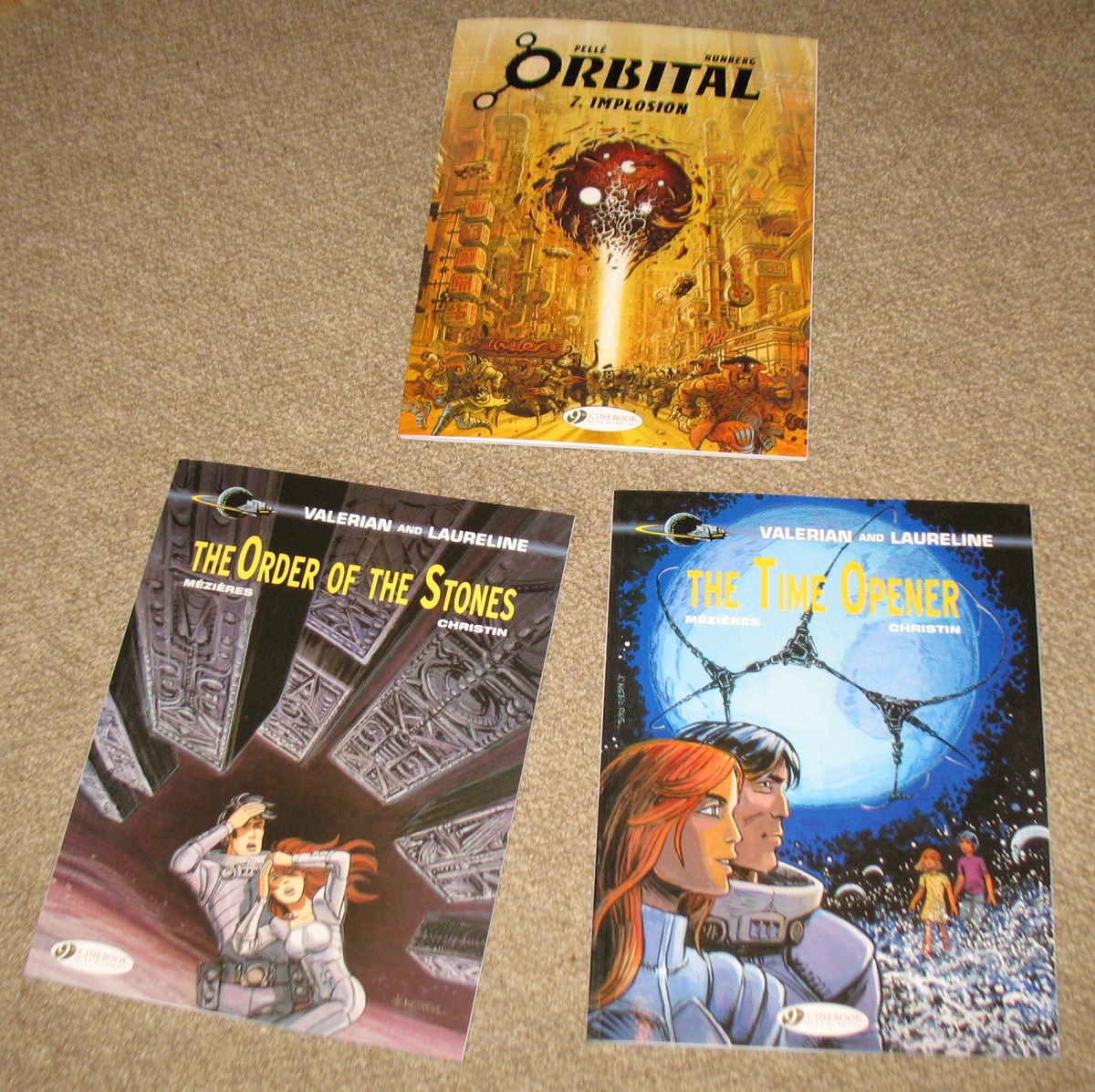
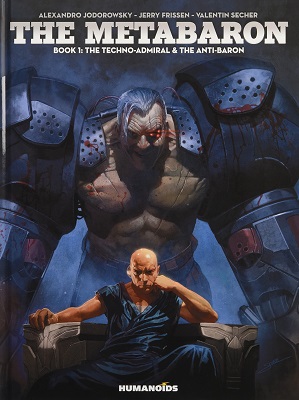
Some more of Jodorowsky’s bandes dessinées. When I bought Deconstructing the Incal (see here), I realised I’d missed Final Incal. So I bought a copy. The Metabaron Book 1: The Anti-Baron and The Metabaron Book 2: The Techno-Cardinal and the Transhuman aren’t actually by Jodorowsky, although they’re based on his characters and he apparently had input into the story. The art in the first book is gorgeous, and appears to be CG; but in the second book it looks like rough sketches. There’s a third book due next year.

I forget why I started buying these Aircraft Since… books, but once I had a half a dozen it seemed the perfectly natural thing to do to carry on and complete the set. Hence Boulton Paul Aircraft Since 1915 and McDonnell Douglas Aircraft Since 1920 Volume I and Volume II. I currently have 22 of them.

I wanted a copy of A Pictorial History of Diving the moment I stumbled across a copy on eBay. But it was over $100. So I kept an eye open, but in the end I had to source a reasonably-priced copy from abebooks.co.uk. I have quite a few of the Secret Projects book, but I missed several when they were originally published in the 2000s, like this one, American Secret Projects: Bombers, Attack and Antisubmarine Aircraft 1945 to 1979. The Lawrence Durrell chapbook is a signed limited chapbook from Tragara Press reprinting David Gascoyne’s obituary of Durrell from The Indpendent. Well, Durrell innit.


Leave a comment

2017, the best of the year: music

I only purchased three albums and one EP during 2017. Admittedly, they’re extremely good ones, and by favourite bands – but that’s it. that’s my top five for this year.  And it’s only four. I also went to only three gigs during the year – to see Magenta, Anathema and Akercocke – and I didn’t go to Bloodstock, after a six-year run, because it clashed with the Worldcon in Helsinki. And it looks increasingly likely I won’t be making Bloodstock in 2018 either. Ah well. I’m not entirely sure why I’ve been consuming less music with each passing year. But I have a few theories. Partly, it’s economic – as the Tories have run down this country, first with their useless Austerity and now with their criminal Brexit, so fewer bands I like have toured the UK, and of those that do tour here, most stick to the major cities – some don’t even bother playing anywhere but London. Things changed at work too. I used to wear headphones when I was working, but I’ve been so busy these last couple of years I got out of the habit. And at home these days, I’m more likely to be in the living-room with a DVD on while I’m working on the laptop, than I  am at the desk and listening to music.

Having said that, I’ve alwasy chased new music, rather than sit back and wait for the bands I  like to release new albums. A lot of the metal bands I listen too aren’t professional, they have day jobs, and they have neither the time nor the money to put out a new album every year. But there were always new bands to find. But that requires time and effort from me, and I’ve just not been up to it this last year or two. Which means that for 2017’s best of, it was pretty much me sitting back and waiting for the bands I like to release new albums. Which, fortunately, some did. One band even reformed and released new album!

albums
1 Aathma, Persefone (2017, Andorra). I’ve been a fan of Persefone’s complex progressive death metal since first hearing their album Core back in 2008. I’ve seen them live once, when they toured as support for Obituary in 2010. They were excellent. During the interval between their set and Obituary’s I wandered across to the merchandise table. One of Persefone’s guitarists was behind it. When I admitted I’d come to see them and not Obituary, he came round the table and hugged me. Persefone have not released many albums, but each one has been better than the last.

2 Renaissance in Extremis, Akercocke (2017, UK). I first saw Akercocke back in 2005, when they supported Opeth at the Forum in London. Back then, they wore suits and had long hair, and had been nicknamed “Satan’s bankers”. I’ve seen them several times since – the most recently only a couple of months ago – and they always put on an excellent show, even if the suits and long hair are long gone. I was disappointed when they split u p – although that did give us Voices, an excellent band – but very happy indeed when they decided to reform. And Renaissance in Extremis is pretty much  Akercocke on top form – it’s new, but it couldn’t be anybody but Akercocke.  The  editoin  I bought came in  a fancy hardback book, with three  CDs.

3 Beyond the Gate, Within the Fall (2017, Sweden). I came across this band a couple of years ago, and I’ve followed them ever since on bandcamp. They produce solid Scandinavian progressive death metal, and, okay, some times the clean vocals are a bit dodgy, but their guitar work is excellent. The title track to this four-track EP is especially good. The band is also surprisingly productive, althuogh they tend to release EPs rather than albums – but as a writer of novellas I can hardly complain.

4 Farmakologinen, Oranssi Pazuzu (2017, Finland). I came across Oranssi Pazuz several years ago, chiefly because their music was described as a mixture of black metal and psychadelic space rock. And it actually was that. I loved their album Valonielu, and kept an eye open for new material. But they’re not very prolific, and while I missed 2016’s Värähtelijä, I didn’t miss this year’s Farmakologinen. And it’s just like the cover art suggests – a wall of black metal guitars with spacey psychadelic organ and bleeps and bloops. It shouldn’t work. But it does, it really does.


Leave a comment

2017, the best of the year: films

A couple of years ago, I thought it might be a good idea to try and watch all the films on the 1001 Movies You Must See Before You Die list (the 2013 edition). This year I also decided to try and watch a film from as many countries as I could. Both challenges have been going quite well: I’ve watched 897 of the 1001 so far, 56 of them seen for the first time this year; and I’ve watched movies from 53 countries… although only Thailand, Kazakhstan, Lithuania, Venezuela, Mongolia, Georgia, Vietnam, Peru, Singapore, Jordan, Jamaica, Estonia, Cuba and Romania were new to me in 2017.

It also occurred to me in 2017 that most of the films I watched were directed by men. So I started to track the genders of the directors whose films I watch in an effort to see more films by female directors. Unfortunately, female directors are hugely outnumbered by men, especially in Hollywood, and I managed only 43 films by women during the year. Having said that, a couple of those female directors became names I plan to keep an eye on, such as Claudia Llosa and Lucía Puenzo.

films
I watched 602 films in 2017, although only 532 were new to me this year. I also decided in 2017 to watch more documentaries, and ended up watching so many that I thought it best to split my film best of the year lists into two, one for documentaries and one for “fictional” films… except I’m not sure what to call the latter, but I think “narrative cinema” is the preferred term.

documentary
1 I am Cuba, Mikhail Kalatozov (1964, Cuba) [1]. I loved Humberto Solás’s Lucía after watching it, and I wanted to see Tomáz Guttiérez Alea’s Memories of Underdevelopment a second time, and there was this box set from Mr Bongo that included both, as well as I am Cuba and Strawberry and Chocolate. So I bought the box set… and was blown away when I watched I am Cuba, a documentary commissioned by the Soviets to promote Cuba, but which was so innovative it was never actually released. Kalatozov reportedly strung cameras on wires, but even knowing that it’s hard to work out how he achieved some of his shots. And this was in 1964, when there was no CGI. I am Cuba also presents the island as a near-utopia, and while the USSR and its satellite nations were never that, they at least aspired to it – which is more than can be said of the West. The American Dream isn’t utopia, it’s a deeply mendacious justification for the success of the few at the expense of the many. Even now, 53 years after I am Cuba was made, Cuba remains poor, but has one of the best free healthcare systems on the planet, and the US is rich and its healthcare system is unaffordable by the bulk of its population. Some things are more important than giving a handful of people the wherewithal to buy their own Caribbean island.

2 The Pearl Button, Patricio Guzmán (2015, Chile). If you’ve not watched a film by Guzmán, why not? The Pearl Button is a meditation on the universe, water, the history of Chile, especially the Pinochet dictatorship, and the genocide of the country’s indigenous people. It’s a mix of stock footage and gorgeously-shot film, all tied together by the calm voice of Guzmán. He describes how Pinochet’s goons would torture people and then dump their bodies offshore from helicopters. He interviews supporters of Salazar, president before Pinochet’s coup, who were put in concentration camps. He speaks to the handful of survivors of the Alacalufe and Yaghan tribes of Patagonia, which in the late 1880s were infected with Western diseases, and the survivors hunted for bounty, by settlers. He discusses Jeremy Button, a a Yaghan tribesman taken back to Britain on the HMS Beagle in 1830 (it was when returning Jeremy Button to Patagonia a year later that Darwin first travelled aboard the HMS Beagle). The Pearl Button is not only an important film because of what it covers, but a beautifully-shot one too. You should watch it.

3 Behemoth, Zhao Liang (2015, China) [2]. This year I went on something of a China/Taiwan cinema kick. I forget what started it off, but I discovered lots of new names to watch and lots of excellent films. Zhao Liang I had, I think, put on my rental list because his films sounded like Jia Zhangke’s , who was already a favourite. But Zhao makes documentaries, and Behemoth is about coal in China, the mines and those who live on their periphery and survive by gleaning. Zhao’s earlier work has been very critical of the Chinese authorities – meaning his films are not wholly official – but they are also beautifully framed. And in Behemoth, he goes one further and uses split-screen, but also arranging his screens in such a way they’re not initially obvious as split-screen and then suddenly turn kaleidoscopic. It’s not a technique I’ve seen before, and it probably wouldn’t work in most situations, but it’s absolutely brilliant here. Zhao Liang is a name to watch.

4 Francofonia, Aleksandr Sokurov (2015, France) [4]. I’ve been a fan of Sokurov’s films for many years and own copies of much of what he’s directed during his long career. I’d heard about Francofonia some time in 2014, but it wasn’t until 2015 it appeared, and not until 2017 it was released in the UK – and only at Curzon cinemas, but, annoyingly, only the Curzon cinemas in London. FFS. I’d liked to have seen it on a big screen. But I had to console myself with the Blu-ray. Which was pretty much as I expected – a typical Sokurovian mix of documentary, meditation, narrative cinema and autobiography – although the production values were a distinct cut above his previous work. It’s a good entry in Sokurov’s oeuvre, if not one of his best ones, but even merely good Sokurov is still so much better than most film-makers can manage. It’s also been heartening seeing how well it has been received… because that means we might see more films from Sokurov. Because I want more, lots more.

5 Samsara, Ron Fricke (2011, USA). I loved Koyaanisqatsi when I watched it last year, and I later learned that its director of photography, Ron Fricke, had made a pair of similar non-narrative films himself: Baraka and Samsara. They’re basically footage of various parts of the planet, with only the most tenuous of links and no over-arching story. The emphasis is entirely on the imagery, which is uniformly gorgeous. Of the two, I thought the second, Samsara, much the better one.The footage is beautiful, the parts of the world it covers fascinating, and it’s one of the few films out there which gives you faith in humanity. I quite fancy having my own copy of this.

Honourable mentions: The Epic of Everest, JBL Noel (1924, UK) astonishing silent documentary of an early attempt to climb Everest; Baraka, Ron Fricke (1992, USA) gorgeous non-narrative cinema from around the world; Festival Express, Bob Smeaton (2003, UK) 1970 tour across Canada aboard a train featuring Janis Joplin, the Grateful Dead and others; Cameraperson, Kirsten Johnson (2016, USA) Johnson’s life stitched together from outtakes from her documentaries and privately-shot footage; Sofia’s Last Ambulance, Ilian Metev (2012, Bulgaria) affecting fly-on-the-wall film of an ambulance crew in Sofia’s beleagured healthcare system; Petition: The Court of Appeals, Zhao Liang (2009, China) filmed in the shanty town outside Beijing where petitioners lived while waiting the years it took for their appeals to be heard, if ever.

narrative
1 The Sky Trembles and the Earth is Afraid and the Two Eyes Are Not Brothers, Ben Rivers (2015, UK). I loved this film – it’s perhaps a stretch to call it narrative cinema as it’s also partly a documentary. Anyway, I loved this film… so much I went and bought everything by Ben Rivers that was available (no surprise, then, that his two other feature-length films get honourable mentions below). The Sky Trembles and the Earth is Afraid and the Two Eyes Are Not Brothers – the title is taken from a Paul Bowles story, which partly inspires it – opens as a documentary of Olivier Laxe filming Mimosas. But then Bowles’s story intrudes, and Laxe, a real person, and his film is indeed real and has been released… Laxe’s story morphs into the plot of Bowles’s short story. This is brilliant cinema, an unholy mix of documentary, fiction, literary reference, art installation and narrative cinema.

2 Privilege, Peter Watkins (1967, UK). I knew Watkins from The War Game and Punishment Park, both mock documentaries about very real horrors; so when I watched Privilege it came as something of a surprise. True, it’s similar, in as much as it’s a mock documentary, set a few years ahead of when it was made; but it also seems a more tongue-in-cheek film, and plays up the ridiculousness of its premise. The segment where the star is filming a government commercial for apples, for example, is hilarious. In the movie, Watkins posits a fascist UK in which a pop star is used as a symbol to make unpleasant government policies more palatable. We’ve yet to see that happen here, if only because politicians foolishly believe they have media presence. They don’t. They’re as personable as a block of rancid butter. And often as intelligent (BoJo, I’m looking at you; but also Gove, Hammond, Davies, Rudd…) We should be thankful, I suppose, because if they ever did decide to use a media star with actual charisma, we’d be totally lost. On the other hand, satire apparently died sometime around 2015, so perhaps Watkins may prove more prophetic than he knew…

3 Embrace of the Serpent, Ciro Guerra (2015, Colombia) [3]. I stumbled across this on Amazon Prime and stuck it on my watch list. It was later recommended to me, so I sat down and watched it, and… it was excellent. It’s set in the Amazonian jungle, and covers a pair of expeditions for a legendary plant, one in 1909 and the other in 1940. There’s a bit of Herzog in it, and probably some Rocha too, and the cinematography is often amazing. I wrote about it here.

4 Arabian Nights, Pier Paolo Pasolini (1974, Italy). 2017 was a bit of a Pasolini year for me. I bought a boxed set of his films on Blu-ray, and worked my way through them – although a number I’d seen before. Arabian Nights feels like an ur-Pasolini film, in that it does so well some of the things some of his films were notable for – a non-professional cast acting out elements of a story cycle in remote locations. The title gives the source material, but the look of the movie is pure Pasolini – although much of it comes down to his choice of locations in North Africa. Of all the Pasolini films I’ve seen, this is by far the prettiest; and if its treatment of its material is somewhat idiosyncratic, 1001 Nights is far too complex a source for honest adaptation.

5 The World, Jia Zhangke (2004, China) [5]. I “discovered” Jia in 2016, but it was obvious he was a director to keep on eye on, and so I sought out his other works. Including this one. Which I thought worked especially well – not that this other films are bad, on the contrary they’re excellent. But something about this one especially appealed to me. It’s set at a theme park containing famous buildings from around the world. The movie follows two workers there, one a dancer and the other a security guard. The film is a sort of laid-back thriller, in which the cast move around the artificial world of the theme park, trying to make ends meet, and trying to keep their relationship together. The World has a documentary feel to it, and often seems more fly-on-the-wall than narrative drama. But I think it’s its literalisation of the term “microcosm” that really makes the film.

Honourable mentions: Marketa Lazarová, František Vlačíl (1967, Czech Republic) grim mediaeval drama, something the Czechs seem to do well; Elena, Andrey Zvyagintsev (2011, Russia)  languidly-paced character study of a rich man’s wife as she attempts to provide for her son from an earlier marriage, beautifully shot; Reason, Debate and a Story, Ritwik Ghatak (1974, India) more ethnographical film-making and political debate from a favourite director; Shanghai Dreams, Wang Xiaoshuai (2005, China) grim semi-autobiographical drama from a Sixth Generation director; Suzhou River, Lou Ye (2000, China) cleverly-structured mystery from another Sixth Generation director; Madeinusa, Claudia Llosa (2006, Peru) affecting story of a young woman in a remote village in the Andes; The Case of Hana and Alice, Shunji Iwai (2015, Japan) a lovely piece of Japanese animation; Je vous salue, Marie, Jean-Luc Godard (1985, France) a thinly-veiled retelling of the Virgin Mary Godard turns into a compelling drama; Uncle Boonmee Who Can Recall His Past Lives, Apichatpong Weerasethakul (2010, Thailand) the best of Weerasethakul’s atypical fractured-narrative films I’ve seen so far, mysterious and beautifully shot; O Pagador de Promessas, Anselmo Duarte (1962, Brazil) the only Brazilian film to win the Palme d’or, an excellent piece of Cinema Novo;  Muriel, Alain Resnais (1963, France) enigmatic meditation on memory presented as a laid-back domestic drama; The Love Witch, Anna Biller (2016, USA) pitch-perfect spoof of a 1970s B-movie supernatural thriller that also manages to be feminist; Two Years at Sea, Ben Rivers (2011, UK) and A Spell to Ward off the Darkness, Ben Rivers & Ben Russell (2013, UK) see above.