Somewhat later than usual, but here’s the usual roundup of readings and watchings…
Books
The Chimpanzee Complex 1: Paradox, Richard Marazano & Jean-Michel Ponzio (2009), is another European graphic novel published in English by Cinebook. The opening is a killer. It’s 2035, and an unidentified spacecraft is detected heading for a crash-landing in the Pacific Ocean. The US Navy sends a flotilla to intercept it. The spacecraft proves to be… the Apollo 11 capsule, containing Neil Armstrong and Buzz Aldrin. So who were the three astronauts who returned to Earth in 1969? Unfortunately, Paradox can’t quite keep the sheer effrontery of that opening premise going. The military determine that the reappearance of Armstrong and Aldrin justifies a trip to the Moon, which subsequently takes place. Clues then point to an unknown Soviet mission to Mars contemporary with Apollo. So off they head to the Red Planet. Paradox is done well, with excellent artwork, and designs that have clearly been thought about. The sequels, The Sons of Ares and Civilisation, are already on my wants list.
Orbital 2: Ruptures, Serge Pellé & Sylvain Runberg (2007), is the sequel to Orbital 1: Scars, and continues immediately from it. The secret of the world of Senestam proves to be less than inventive than I’d expected, but Pellé and Runberg still tell a well-rounded story with excellent artwork. For a sf graphic novel, it’s surprisingly political – which is no bad thing. Apparently, two more books have been, or are due to be, published in France: Nomads and Ravages. Hopefully, they’ll be published in English by Cinebooks soon. Interestingly, according to an interview here, Runberg claims Iain M Banks’s Culture novels as an inspiration for Orbital.
T is for Trespass, Sue Grafton (2008), is the latest in the continuing alphabetical adventures of Kinsey Millhone, a private investigator in an invented city north of Los Angeles. The next, U is for Undertow, is due to be published in January 2010. Grafton has my respect for keeping this series going for so long, and managing to keep the characters and world consistent throughout. Since the books began in the early 1980s, and the internal chronology doesn’t map onto the real world, T is for Trespass takes place in late 1987. In this one, an elderly neighbour takes a tumble and is too injured to look after himself, so his niece hires a nurse to look after him. But the nurse is a sociopath who makes a living from selling off her charges’ assets, emptying their bank accounts, and then murdering them.
The Translator, Leila Aboulela (1999), is the first novel by a Sudanese writer, who was resident in Aberdeen but apparently now lives in Abu Dhabi. The title character is Sammar, a Sudanese widow living in Aberdeen. She translates work for the university and becomes involved with a Scottish Islamic expert, Rae Isles. I’m in two minds about this one – Sammar frequently describes things as though she is seeing them “through fog and mist”, and that’s what reading this book felt like. I like lyrical prose, but this often felt over-done.
An April Shroud, Reginald Hill (1975), is an early Dalziel & Pascoe novel, and not an especially memorable one. Pascoe gets married and disappears off into the wilds of Lincolnshire for his honeymoon. Which leaves Dalziel on his own in the county. He falls in with a dysfunctional family who live in a manor house, and when people start turning up dead he realises he’s become much too close to the family. I’ve read a fair number of the books in this series, but reading early books in series with which you’re familiar isn’t always a good idea.
The Brains of Earth/The Many Worlds of Magnus Ridolph, Jack Vance (1966), is an Ace double with a pair of early Vances back-to-back. The Brains of Earth is, well, just plain silly. An alien race have decimated their world in a battle to rid themselves of invisible mind-parasites, and now they have determined to clean Earth of the selfsame parasites. so they recruit an Earthman to do it for them. Except it proves to be more complicated that that. Despite nearly inventing dark matter, this isn’t Vance’s best by a long way. The Many Worlds of Magnus Ridolph, a collection of shorts from the late 1940s and early 1950s, is better. Ridolph is part Cugel and part Kirth Gersen, and the stories read like early trying-out of plots for both of them. Both books are for completists only.
Of Worlds Beyond, edited by Lloyd Arthur Eshbach (1947), is a 1964 reprint of a compilation of essays on writing science fiction by well-known writers from the early days of the genre – Robert Heinlein, Jack Williamson, EE Doc Smith, L Sprague du Camp, AE van Vogt, John W Campbell… Not, you would have thought, the best people from whom to take writing advice, given that none of them were especially good writers. But then writing per se was not seen as important in sf in those days – or even nowadays, according to some. The interesting thing about these essays is the fixity of opinion of the writers. There’s a right way and a wrong way – and their way is the right way. The fact that each author’s way is different, and each has been successful, doesn’t to them mean their way is not the one true way to writing publishable science fiction. An historical curiosity.
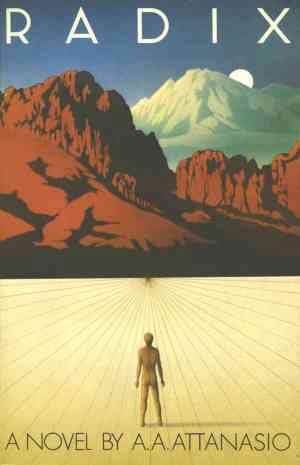
Radix, AA Attanasio (1981), was October’s reading challenge novel, and I’ll be posting a piece here on it shortly.
Islands, John Fowles and Fay Godwin (1978), is a coffee-table book about the Scillies, with text by Fowles and black and white photos by Godwin. Fowles’ prose is good, but the book seems neither one thing nor the other – it’s not big enough or glossy enough to be a proper coffee-table book; it’s not informative enough to be a guidebook (nor are the photos – admittedly very nice – useful in that regard); and it’s not personal enough (cf Lawrence Durrell’s The Greek Islands) to be a book by and about Fowles…
My Death, Lisa Tuttle (2004), is a PS Publishing novella I bought in their recent sale. The narrator is an American writer resident in Scotland, as Tuttle is an American writer resident in Scotland. Her career has suffered after the recent death of her husband, and in an effort to find a project to pull her life back together, she decides to write a biography of early feminist novelist Helen Ralston. Who was also an American writer resident in Scotland. My Death ends twice – although one feels somewhat rushed – and each end gives an entirely different complexion to the story. Recommended
The Clock King and the Queen of the Hourglass, Vera Nazarian (2005), is another PS Publishing novella I bought in their sale. I thought this looked interesting when it was published, but never got around to buying it until recently. And… it’s not as interesting as I’d expected. In the distant future, Earth’s last civilisation creates a young woman to a much older genetic template. She is intended to mate with the Clock King, a man who is held in stasis for generations, and then brought for a short period… to mate with the young woman. The prose has its moments, but feels stilted in places; the world-building is a bit perfunctory; and the story is not entirely original. Overall, it felt like a valiant attempt to do something that someone else once did, only memories of the original one insisted it was better…
Age of Bronze: Betrayal Vol 3 Part 1, Eric Shanower (2008), is the first half of the third part of Shanower’s graphic novel retelling of the Trojan War. As comics go, this is a busy one, but there’s a lot to get through. Shanower is trying to be as authentic as possible, and each book includes an extensive bibliography. If it’s a bit soap-opera-ish in places, that’s perhaps from a need to humanise a story originally told using an entirely different story-telling paradigm.
Journey into Space, Toby Litt (2008). Lately a number of literary authors have written sf novels – more so than in earlier years, anyway. Some were happy to say their books were science fiction; others did all they could to distance their novels from the genre. Litt is one of the former – the Penguin web site describes Journey into Space as “science fiction at its most classic and beguiling: timeless, vast in scope and daring in execution”. Not that anyone would believe if he said it wasn’t sf: it’s set aboard a generation spaceship, which is very much a genre staple. Having said that, it’s clear Litt isn’t actually a sf writer. In parts, Journey into Space felt more like a writing exercise than an exploration of its ideas. And literary authors are often too diffident when deploying sf tropes, and that lack of confidence gives their novels a peculiar apologetic air, which often reads as old-fashioned genre-wise. I like literary fiction and I like sf, and I’ve been mostly dissatisfied by literary authors’ attempts at science fiction. Isn’t it about time a sf writer upped their game and wrote a proper literary sf novel?
Films
Marooned, dir. John Sturges (1969), features a subject I find appealing but which is typically done badly by Hollywood – the Space Race. Marooned is based on a novel by Martin Caidin, who wrote a number of books on space and space exploration, both fiction and non-fiction. In Marooned, the crew of an Apollo spacecraft are stuck in orbit after their retro-rockets fail. They’ve just spent the last five months in Skylab-like space station, so they’re not at their best. And their oxygen is running out. Cue rescue mission – sticking an experimental lifting body on top of a Titan launcher, and launching in the eye of a hurricane. The film-makers tried hard, especially at depicting zero gravity; but a lot looked wrong. The spacesuits, for example, looked mostly authentic, but had these cheap-looking red plastic helmets which looked silly. And the stock footage used for the launches mixed and matched Saturn V, Saturn IB, and Titan. Oh, and for men who had the “right stuff”, the marooned astronauts fell apart surprisingly quickly…
Annie Hall, dir. Woody Allen (1977) – I’m not an Allen fan. In fact, I dislike his films. But this is supposed to be one of his best, so I thought I’d give it a go. And… I found it mostly annoying. The only bit that amused me was when Allen dragged Marshall McLuhan into the frame from off-screen to prove that someone was misquoting him.
Blindness, dir.Fernando Mireilles (2008), was something of a surprise. I expected to enjoy this – a serious adaptation of a high concept literary/sf novel by a Portuguese writer. But I absolutely hated it. The plot is simple – people start to go blind, and because of fears of infection they are locked up in quarantine compounds. And in those compounds, society quickly breaks down. The speed with which the blind people turn into animals irritated me, their passivity in the face of threats of violence, their inability to rise above their situation… It probably works well in a novel, but in a film it makes for an excruciatingly dull and annoying experience.
Stranded, dir. María Lidón (2001), is an independent Spanish-made film about a group of astronauts who are, well, stranded on Mars. Plot-wise, it’s similar to Brian de Palma’s 2000 film Mission To Mars – astronauts are marooned on the Red Planet, but are saved by mysterious aliens. But in Stranded it’s the artefacts left by long-dead aliens which save the day. Considering that it was made for a twentieth of the cost of de Palma’s film, Stranded isn’t bad. It looks a bit cheap in places, and the characters are straight out of Central Casting, but it’s eminently watchable.
A Thousand Months, dir. Faouzi Bensaïdi (2003), is a Moroccan film and is one of those films with several intersecting stories. Some parts of it were amusing, such as the man who controlled the local television transmitter and would turn it off during the middle of a popular soap opera because he enjoyed being popular as the only person who knew what happened in it. Overall, a slow film but worth persevering.
Role Models, dir. David Wain (2008), I didn’t expect to like as much as I did. A pair of typical Hollywood dickheads have to mentor a kid each after being sentenced to fifty days of community service. It’s all typically Hollywood affirming life-lessons rubbish, but it’s also very amusing. Jayne Lynch, the founder of the mentoring programme the two join, speaks an inspired line in gibberish. And having one of the kids into live role-playing was different.
The Keeper, dir. Keoni Waxman (2009), I reviewed for videovista.net – see here.
Fragments, dir. Rowan Woods (2008), I also reviewed for videovista.net – see here.
The Gold Rush, dir. Charlie Chaplin (1925), is one of the American Film Institute’s 100 Movies – 10th Anniversary Edition, but I can’t say I enjoyed it all that much. Chaplin plays a prospector in the Alaska Gold Rush. There are some funny set pieces, but most of the film is embarrassingly mawkish. The version I watched was narrated by Chaplin, and it’s a bit weird watching something on the screen while a voice tells you what you’re seeing.
The Baader-Meinhof Complex, dir. Uli Edel (2008), tells the story of the Red Army Faction, a German terrorist group responsible for a number of murders and attacks during the 1970s. The film never quite engages with terrorists’ rhetoric, perhaps in an attempt to make them more sympathetic (which they’d need to be to carry the film). Their path to violence is clearly shown – while the film shows their response is extreme, it doesn’t present many alternatives. The groups mistreatment by the authorities after their arrest is also shown in detail. The Baader-Meinhof Complex does feel a little too slanted towards its subjects, which can make for uncomfortable viewing; but it’s still worth seeing.
Dragon, dir. Leigh Scott (2006), is a low-budget sword and sorcery film, and it shows. The acting was terrible, the CGI was poor, and the dialogue was cringe-inducing. One actor couldn’t decide if he had an American accent or a Northern Irish accent. I can remember little of the plot – lots of badly-staged sword-fights in some woods, that’s about all. Avoid.
Bridge To Terabithia, dir. Gábor Csupó (2007). Hollywood never lets a good idea go to waste. Children’s fantasies are doing well at the box office, so they dig up as many as they can find and adapt them – Narnia, The Golden Compass, Inkheart, City Of Ember, The Dark Is Rising… and now Bridge To Terabithia. Except this one is a bit different. Two lonely kids make friends and invent a fantasy land in a wood near where they live. So it’s not explicitly fantasy – either secondary world, or hidden mythology. I quite enjoyed it.
Planet Of The Apes, Beneath The Planet Of The Apes, Escape From The Planet Of The Apes, Conquest Of The Planet Of The Apes and Battle For The Planet Of The Apes. I bought the boxed set containing these films cheap on eBay since I fancied watching them. The first two I knew I’d seen before, but some of the others I was less certain. I remember seeing one back in the 1970s when we lived in Oman. The cinema was at the army barracks in Ruwais – the side of one of the buildings was the screen, and auditorium was an area surrounded by a barasti fence and containing folding chairs. In the event, it turned out I’d seen the first four before; but I don’t think I missed anything by never having seen the fifth. The quality plummets as the series continues. By Escape From The Planet Of The Apes, much of the plot is carried by characters explaining it to each other, and both Conquest Of The Planet Of The Apes and Battle For The Planet Of The Apes start with extended recaps of the entire series from the beginning. The original has its moments, and it has one of sf cinema’s great endings; but they should have stopped there.
Red Planet, dir. Antony Hoffman (2000), is the second of two Mars films from that year – the other is Brian de Palma’s Mission To Mars. And it’s hard to say which of the two is the best. De Palma’s is more realistic… up until the third act, where mysterious aliens show up and save the day. Red Planet is less realistic upfront – the Mars 1 spacecraft is too sf-nal to be plausible – but its plot and ending doesn’t involve an alien super-race. Unfortunately, it suffers from having an mostly unlikeable cast, and you don’t really care if they all die on Mars.