Jupiter magazine’s next issue, #30 Hermippe, is due to be published any day soon. It contains my Jupiter Quartet of poems… and I can’t think of a more appropriate place for them to appear.
this month’s dvd reviews…
… are now up on Videovista.net. Including my review of 1940s noir-ish potboiler The Big Clock


In the deepest water
At 8:15 on the morning of 23 January 1960, Jacques Piccard and Lieutenant Don Walsh, US Navy, climbed into the pressure sphere of the bathyscaphe Trieste, and sealed the hatch. Less than ten minutes later, they were descending towards the floor of the Pacific Ocean, towards the floor of the deepest part of the Pacific Ocean: Challenger Deep.
Challenger Deep is 35,994 feet (10,971 metres) deep. If you put Mount Everest in it, there would still be a mile of water above the mountain’s peak. It is a slot-shaped depression, about one mile wide by four miles long, in the floor of the Mariana Trench. There have been only three descents to Challenger Deep. The Trieste‘s was the first, and the only one to carry human beings. Two remotely operated vehicles have also been there: Kaikō in 1995 and Nereus in 2009. Given conditions on the floor of the Mariana Trench, this is hardly surprising. Down there in the hadal zone, the pressure is close to seven tons per square inch, the temperature is around two degrees Centigrade, and light itself cannot reach. Yet there are creatures living there.
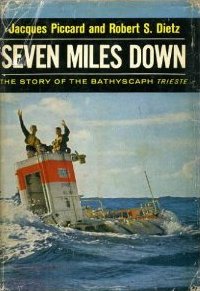
Seven Miles Down by Jacques Piccard and Robert S Dietz is the only book written specifically about the Trieste and its descent into Challenger Deep. The Trieste was invented by Piccard’s father, Swiss professor Auguste Piccard, who was apparently the inspiration for Hergé’s Professor Calculus. Piccard senior was one of those scientist-inventors who no longer seem to exist. In the 1930s, he built a balloon with a pressurised gondola, and ascended into the stratosphere, the first person to ever do so. A decade later, he turned his attention in the opposite direction, and invented the bathyscaphe, or “deep boat”, in order to study the depths of the ocean. It operates much as a balloon does, although using gasoline, which is lighter than water, rather than air. His first such vessel was the FNRS-2, named for the Belgian Fonds National de la Recherche Scientifique, which financed its construction and early operations. It was later sold to the French Navy, who upgraded it to the FNRS-3. The Trieste, however, was privately funded.
I forget where I stumbled across mention of the Trieste‘s descent to Challenger Deep. I was aware of it, of course; but knew little beyond the fact that it had happened. I certainly didn’t know that this year was its fiftieth anniversary. I remember watching the BBC submersible drama series The Deep, which featured a drilling rig on the floor of an ocean trench some 20,000 feet below the sea-surface. While The Deep wasn’t very good (nuclear reactors do not explode), I thought a crewed facility on the floor of the deepest part of the ocean might make a good location for a short story. So it might well have been that which inspired me to look up the Trieste…
… at which point I discovered that there’d been very little written about the descent. Last year was the fortieth anniversary of the Apollo 11 Moon landings and a number of books were published to celebrate it. This year was the fiftieth anniversary of the Trieste‘s descent and there’s been… nothing. In fact, the only things I could find proved to be contemporary with it: an article from Life magazine written by Walsh (see here), and Seven Miles Down by Jacques Piccard and Robert S Dietz. And the latter has apparently never been reprinted since.
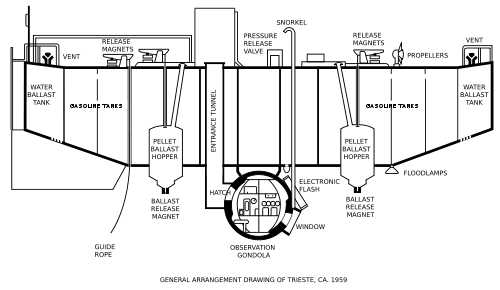
source: Wikipedia
The book is actually more a history of the Trieste, and Piccard’s involvement with it, than it is a blow-by-blow account of the descent to Challenger Deep. The opening chapters cover the FNRS-2 and -3, the difficult time Piccard senior making his dream of a bathyscaphe reality, and the early dives. There is mention of Otis Barton and William Beebe, who invented the bathysphere and pioneered direct study of the deep ocean using a submersible. About halfway through the book, Dietz joins the story. An oceanographer attached to the US Navy’s Office of Navy Research and based in London, he helped persuade the US Navy to buy the Trieste and put Jacques Piccard under contract. During the second half of the 1950s, the Trieste made some thirty-five descents, piloted by Piccard and carrying scientists as observers. These were initially in the Mediterranean, and later off the coast of California. It was not until 1959 that a request was made of the Chief of Naval Operations to authorise “bathyscaphe (Trieste) operations (Project NEKTON) in the Mariana Trench, between November 1959 and February 1960”. Permission was given, a new and stronger pressure sphere was ordered from Krupps of Germany, and once that was fitted the Trieste was shipped from her base of operations in San Diego to Guam. She made six descents to various depths in the South Pacific before Piccard and Walsh made their record-breaking dive to Challenger Deep.
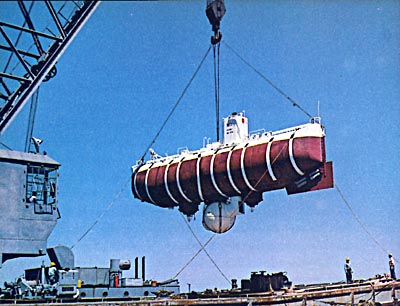
source: US Navy
Much of Seven Miles Down is written from Jacques Piccard’s point of view, although he does hand over the narrative at various points to Dietz. The prose is workmanlike but readable. Piccard maintains a nice balance between technical detail and his own impressions and experiences. It makes for an interesting read, although the prose doesn’t really come alive until the chapter on the descent to Challenger Deep. The technology involved is perhaps not as fascinating, and nowhere near as complex, as that in the Apollo programme, but the descents were every bit as dangerous – in Challenger Deep, there were 200,000 tons of water pressing on the Trieste‘s pressure sphere, for example. If Piccard had miscalculated the amount of gasoline needed in the float, or iron shot used as ballast, the bathyscaphe might never have returned to the surface. In fact, they were very lucky: during the descent, Piccard and Walsh heard something explode but could not work out what it was (on previous dives lights, a camera, and stanchions had all imploded). It was only during the ascent that Walsh spotted that the window at the rear of the antechamber had cracked. If it gave way, they could not clear the water from the antechamber and entrance tunnel and so would be unable to exit the sphere. They’d have to remain inside it for the five-day journey back to Guam and dry dock. Fortunately, the window didn’t break.
An appendix gives the technical specifications of the Trieste, and lists all sixty-five dives made by the bathyscaphe between 1953 and 1960. After the descent to Challenger Deep, the Trieste returned to San Diego but did not dive again. In 1963, she was modified and then used to search for the missing submarine, USS Thresher. She underwent numerous modifications and upgrades over the years before eventually being retired in 1980. She now resides at the National Museum of the US Navy in Washington DC.
Here’s an excellent video by Rolex about the Challenger Deep dive:
Finally, this year the X Prize Foundation announced a $10 million prize for the first privately-funded submersible to make two crewed descents to Challenger Deep. And yes, I did write a science fiction story set in a crewed base in Challenger Deep. It just needs a little more work before I start submitting it…
Another obscure British sf masterwork
Among the books recommended to me by others for inclusion on my list of British sf masterworks (see here) was A Man of Double Deed

The title character of A Man of Double Deed
Coman returns to Earth after adventures on Venus – several of his previous escapades are mentioned in the novel – to find something strange going on. The youth of 2090 have taken to murder and suicide. It’s almost an epidemic. The only solution the World Council can conceive is a “War Section”. This is an area, preferably on another planet, in which the murderous teenagers and young adults can be left to their own violent devices. The Council is meeting shortly to consider implementing such a War Section, but the leader of the Council, Marst, is being influenced to vote against the proposal by a conspiracy. Coman’s boss, Karns, asks him to travel to the Fifteenth City, a holiday destination built above a line of islands in the Pacific, to persuade Marst to change his vote. Marst is apparently under the influence of a pair of “jokers”, telepaths who oppose the keymen but fortunately possess much weaker abilities. Coman and his two wives travel from the Twelfth City (London) to the Fifteenth City. Shortly after their arrival, while at a swimming-pool, Coman identifies one of the jokers, a woman called Linnel. He seduces her – Jonl and Sein are not happy about it, but they trust him. With Linnel’s help, Coman manages to prevent the conspiracy.
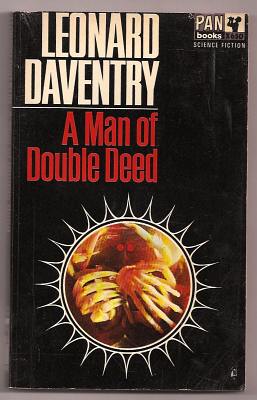
The plot summary above probably doesn’t quite illustrate how odd this novel is. Superficially, it resembles an ordinary piece of science fiction tosh from the 1950s or 1960s, with a superman hero, a supporting bevy of beautiful subservient women, and a future Earth which in no way resembles the Earth of the time of writing but still feels horribly dated. But that would be doing A Man of Double Deed
Coman is such a strange hero, for one thing. He is a dour intellectual, but not a misanthrope. He is not a man of action, but is often called upon to behave like one. There’s something of the World War II RAF officer in him, a combination of education, arrogance, pragmatism, and a grudging respect for others. He is his own biggest critic, but extremely private with his criticisms. He is very British.
Nor are the women of the story, Jonl, Sein and Linnel, characterless females. On the contrary, Jonl could become a keyman herself, but does not wish to do so on principle. Sein is more stereotypical a female character. She loves Coman, and longs for a baby. She gets her wish in the end, and it’s a result all are happy with. Linnel is a femme fatale, but an insecure one who falls for Coman’s singular charms, but refuses to bend entirely to his will. These three are not, I hasten to add, brilliantly-drawn female characters, or even especially realistically-drawn ones, but they are a good deal better-realised than is common for genre fiction of the time.
A Man of Double Deed
Perhaps the invention on display in the novel is not especially high, but the writing is solid, and even occasionally good, the characters are drawn well, and the plot comes to a satisfactory end… even if not everything is explained. What, for example, was the conspiracy which had hired the two jokers? Why did they not want a War Section? Nevertheless, A Man of Double Deed

Books from my collection: Phillip Mann
Phillip Mann was born in the UK but has been resident in New Zealand since 1969. Between 1982 and 1996, he wrote nine well-regarded science fiction novels. He’s had nothing published since, although Wikipedia claims he is working on a new novel. I hope so.
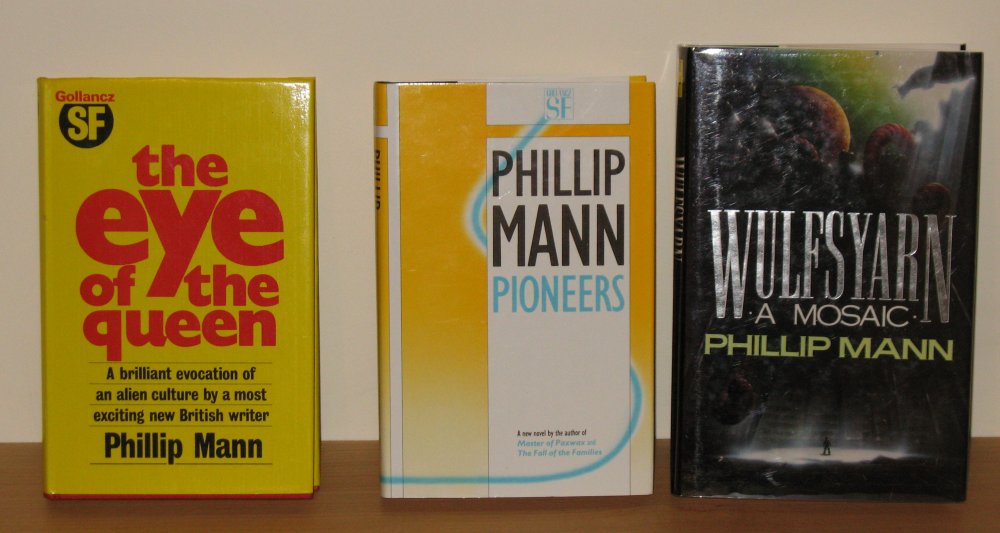
His first, fourth and fifth novels. The Clute and Nicholls Encyclopedia of Science Fiction


Mann’s second and third novels were the diptych, The Story of the Gardener: Master of Paxwax


His last four books were the alternate history quartet, A Land Fit for Heroes: Escape to the Wild Wood


Damn. Now I want to reread all his books…
British SF Masterworks redux
After all the comments on my list of 50 British science fiction masterworks, I decided to revisit it. There were several authors I’d inadvertently left off – and no, I’ve no idea how I managed to miss Paul J McAuley (sorry); but he’s on there now. There were also a couple of books I listed which, on reflection, were either too peripheral to the genre, or not really masterworks. The Durrell stays on, however, because a) he’s my favourite writer, and b) it features a number of sf tropes.
Brian W Aldiss claims in Trillion Year Spree

I’ve also changed Lessing’s entry from The Memoirs of a Survivor

So I have made some changes. And somehow the list has grown to fifty-five books.
1 – The Time Machine, HG Wells (1895)
2 – Last And First Men, Olaf Stapledon (1930)
3 – Brave New World, Aldous Huxley (1932)
4 – Nineteen Eighty-four, George Orwell (1949)
5 – The Day of the Triffids, John Wyndham (1951)
6 – The Death of Grass, John Christopher (1956)
7 – No Man Friday
8 – The Space-Born
9 – On The Beach, Nevil Shute (1957)
10 – WASP, Eric Frank Russell (1958)
11 – A Clockwork Orange, Anthony Burgess (1962)
12 – The Drowned World, JG Ballard (1962)
13 – Memoirs of a Spacewoman
14 – A Man of Double Deed
15 – A Far Sunset
16 – The Revolt of Aphrodite [Tunc

17 – Pavane, Keith Roberts (1968)
18 – Stand On Zanzibar, John Brunner (1968)
19 – Behold The Man, Michael Moorcock (1969)
20 – Ninety-eight Point Four
21 – Junk Day
22 – T-City trilogy [Interface


23 – The Continuous Katherine Mortenhoe
24 – Rendezvous with Rama, Arthur C Clarke (1973) – my review here.
25 – Collision with Chronos
26 – Inverted World, Christopher Priest (1974)
27 – The Centauri Device, M John Harrison (1974)
28 – Hello Summer, Goodbye
29 – Orbitsville [Orbitsville


30 – The Alteration
31 – The White Bird of Kinship [The Road to Corlay


32 – SS-GB
33 – Canopus in Argos: Archives [Shikasta, The Marriages Between Zones 3, 4 and 5, The Sirian Experiments, The Making of the Representative for Planet 8, The Sentimental Agents in the Volyen Empire], Doris Lessing (1979 – 1983)
34 – The Hitch-hiker’s Guide to the Galaxy [The Hitch-hiker’s Guide to the Galaxy, The Restaurant at the End of the Universe, Life, the Universe and Everything, So Long, and Thanks for All the Fish, Mostly Harmless], Douglas Adams (1979 – 1992)
35 – Where Time Winds Blow
36 – The Silver Metal Lover
37 – Cageworld [Search for the Sun!


38 – Helliconia, Brian W Aldiss (1982 – 1985)
39 – Orthe
40 – Chekhov’s Journey
41 – In Limbo
42 – Queen of the States
43 – Wraeththu Chronicles [The Enchantments of Flesh and Spirit


44 – Code Blue – Emergency!
45 – Kairos
46 – The Empire of Fear
47 – Desolation Road, Ian McDonald (1988)
48 – The Child Garden, Geoff Ryman (1989)
49 – Take Back Plenty
50 – Wulfsyarn
51 – Use of Weapons, Iain M Banks (1990)
52 – Vurt, Jeff Noon (1993)
53 – The Time Ships, Stephen Baxter (1995)
55 – Fairyland, Paul J Mcauley (1995)
So that’s the new list. I still intend to read and review some of the more obscure books – and have already done the Rex Gordon (see here). Those books I’ve written about on this blog now have links beside them – some are full-blown reviews, some are just a paragraph or two in one of my Readings & Watchings catch-up posts.
Now let the discussion begin.
Again.
An obscure British sf masterwork?
Several of the authors I included in my fifty British SF Masterworks list (see here), I’d not actually read. And with good reason – they’re more or less forgotten. One such author was Rex Gordon, the pen-name of Stanley Bennett Hough, born in 1917, who wrote nine science fiction novels between 1953 and 1969. Of those novels, the best-known is perhaps No Man Friday


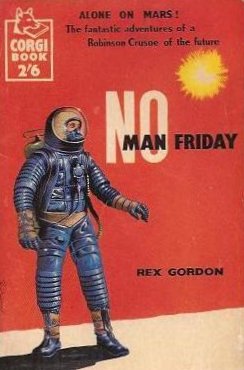
Gordon Holder is the narrator of No Man Friday
No Man Friday
En route to Mars, Holder has to leave the confines of the rocket to fix a deflector-plate which is causing the craft to spin. On his return, something goes wrong and the outer and inner airlock doors are both opened. Everyone inside dies. Only Holder survives, because he’s still wearing his spacesuit. Gordon has clearly thought about what it would be like to wear an inflated spacesuit in a vacuum, and describes the difficulty of performing tasks in such a suit – although he didn’t anticipate the damage to fingernails that modern-day astronauts apparently experience on EVA (see here).
The rocket crashes on Mars, but again Holder survives. Given that Gordon had no knowledge of the surface conditions of Mars – the first Mars lander would not be until 1971, when the Soviet Mars 3 managed to transmit data and pictures for 22 seconds; and the first successful landers were the US’s Viking 1 and Viking 2 in 1976 – nonetheless, he manages a reasonably believable Martian surface, not unlike, say, the Atacama Desert.
Holder manages to use the wreckage of the rocket, and its surviving equipment, to manufacture both water and oxygen. He builds himself a sand scooter, and goes exploring. But wherever he goes, it’s all the same: an endless red desert, populated only by strange Martian cacti and the over-sized termites which feed on them. He even experiments with the plants, trying to find some method of preparation which will make them edible and nutritious.
Then he discovers evidence of some larger animal – he has already guessed that the low gravity and air pressure would result in creatures larger in size than earthly ones. This creature proves to be humanoid in shape, but its behaviour demonstrates it is clearly not intelligent. But the giant centipede creatures, the size of buses, which feed on the corpses of the humanoids and communicate via biological light-organs, definitely appear to be.
Holder sets out to follow the giant centipedes, and eventually discovers their nesting area. He attempts to communicate with them…
Fifteen years later, a US rocket lands on Mars, and its crew are astonished to see a human approaching their craft on foot. Holder has survived as a favoured pet of the giant centipedes. He explains this to the Americans, telling them that the Martians will only allow one rocket per year to land on the Red Planet. The Americans reply that the system is unworkable, not least because the Soviets are planning their own mission. Holder tries to return to the Martians, but is unable to do so – some strange barrier prevents him.
No Man Friday
No Man Friday
Some personnel news
M-Brane SF has announced the table of contents for #21, due out 1st October, and which includes my story ‘Human Resources’. It’s another near-future science fiction story, although set in a slightly different world to ours. Apart from that minor difference, and the, er, “brain-hacking”, everything in it is real.
Don’t forget to buy a copy.
Undersea habitats, full stops and low humour – a little more on Fantasycon 2010
It occurred to me reading my last post on Fantasycon 2010 that the convention was more than just the hotel and the books I purchased. I spent the weekend in the company of a couple of hundred people, all of whom are interested enough in genre fiction to spend a weekend dedicated to it in a hotel. So I really should mention a few of those people. Unfortunately, my memory is not what it once was – well, obviously, it’s still a memory, but it’s no longer as effective as it once was. Or at least, no longer as effective as memory insists it once was…
I arrived at the con around mid-afternoon – it’s an easy journey for me to Nottingham. There weren’t many people about but after about an hour sat in the bar I spotted my first friendly face: Mark Harding. He admitted he’d been in the hotel since the night before. Over the course of the evening, the bar began to fill with con-goers. I spoke with: Mark about projects we were each working on; Gavin Smith, author of Veteran


Most of Saturday I spent in the bar and in the dealers’ room. When I wasn’t browsing through the stocks of the various dealers, I was chatting to Roy Gray on the Interzone table. Andy Remic turned up for the day, as did Mark Charan Newton. Andy finally saw my review of Ian Whates’ anthology Conflicts


After we got back from the Thai restaurant, we waited for the banquet to finish so we could attend the awards ceremony. But we discovered that would mean standing up for the duration as all the seats were taken by those who’d attended the banquet. So we went back to the mostly-deserted bar. Which soon filled up, once the awards ceremony was over. I remember an interesting conversation with Terry Edge about writing workshops and the way in which rules of punctuation are often broken by successful writers. I lasted until about midnight before calling it a day.
The Sunday was a much quieter day and, like the day before, was spent mostly in the bar or dealers’ room. I forget how I spoke to and about what, although I do remember discussing poetry with Gaie Sebold. I’d planned to leave about three p.m., but the raffle took longer than I’d expected, so I didn’t actually catch a train until 4:40 p.m.
That was Fantasycon (redux): a series of conversations on a variety of topics (most were writing-related), some of which were lubricated by beer, some not. I don’t generally attend programme items – I keep promising myself I’ll go to more of them, but I usually fail. Because I enjoy sitting in the bar, chatting to friends and meeting new people.
And buying books, of course…
Space frogmen, magnetic shower-curtains and jugs – Fantasycon 2010
So that was Fantasycon. It was my first. Sort of. I turned up for just the Saturday of Fantasycon 2008, but this year I stayed in the hotel for the entire weekend. For a couple of reasons: first, I didn’t go to the Eastercon, so this was my first, and probably only, con of the year; and second, they were launching Catastrophia, which contains one of my stories, at Fantasycon.
For a number of years, Fantasycon has taken place in the Britannia Hotel in Nottingham, which is actually where the first con I ever attended took place. Back then it was called the Albany. The convention was Mexicon 3 in 1989. At the time, I was living in Mansfield, “that once-romantic, now utterly disheartening colliery town” as DH Lawrence puts it. (It’s actually my home town.) I’d seen mention of Mexicon in Matrix, the BSFA newsletter, and since I’d never been to a convention before, I decided to give it a go. I bought a membership, and drove into Nottingham each day. It wasn’t the best way to attend a science fiction convention, but I haven’t looked back since.
Next year, however, Fantasycon won’t be in Nottingham, but in Brighton. Which is a bit of a shame, as Nottingham is much more convenient for me. Having said that, the Britannia is a bit of a dump. It’s a 1970s Brutalist tower block, so it looks great from the outside but the interior is showing its age; and it appears as though it was last refurbished about twenty years ago. There is, for example, a room off the main Forum Bar, used to access the function rooms at the rear of the hotel, which looks as though it once was a posh restaurant. Bizarrely, it has no windows. There are just tables and these strange niches containing banquette seats with colourful upholstery. It’s a wide corridor with tables lining it. During one conversation during Fantasycon, Neil Williamson and I decided that the hotel should put all the interior décor back as it was when the place opened in 1969, and make it into a 1970s experience. (But not with nylon sheets, I could never sleep in a bed with nylon sheets.)
While the building itself might not be up to much, the staff were friendly, the breakfast was plentiful, and the bottled Coronation Street real ale was very drinkable, so I’ve no real complaints. Having said that, every time I stay in hotels, I’m always surprised by the dwarf showers. I’m not especially tall, but the showerheads in hotel showers are always fixed to the wall at about the level of my chin. I remarked on this as I was heading down in the lift to breakfast on the Saturday. To which the diminutive Ian Watson replied, “For you, perhaps.”
The other thing about hotel showers I always forget is the magnetic shower-curtain. As soon as you step into the tub, it attaches itself to you and tries to envelop your body. Having a shower is a constant battle with a sheet of thin plasticised material. You daren’t turn to face it in case it glues itself to your face and asphyxiates you. Who needs knife-wielding psychos in the bathroom when you can be attacked by a magnetic shower-curtain? If Hitchcock were still alive, he’d make a film about it. I’m sure of it.
I also had the usual problem with the keycard for my hotel room, which required five trips down to the reception over the Friday and Saturday. It wasn’t as bad as the Hilton during the 2009 Eastercon in Bradford. My door lock there broke so often I ended up on first-name terms with the maintenance man.
I spent most of Fantasycon, as is usual at conventions, in the bar chatting to people. The various conversations I had seemed to revolve around writing more than is usually the case at an Eastercon. Most of the people I met were writers, so perhaps that’s why. I only made a single programme item, which was about short stories. A group of us ventured out of the hotel on both the Friday night and the Saturday night for food – Indian the first night, and Thai the next. The Indian wasn’t up to much. We walked into the restaurant and saw it was deserted. When we remarked on this, the waiter said, “Wait until 4 a.m.” That didn’t bode well, but we stayed. The food was nothing special. The Thai, however, was very good. The restaurant’s toilets were marked “Gent” and “Lady”, which amused us more than it should have done.
Highlight of the weekend for me was the Catastrophia launch on the Saturday afternoon. Because I have a story in it. PS Publishing were actually launching seven books that afternoon, Catastrophia being only one of them. There were about half a dozen of us Catastrophia contributors there for the launch. We sat at a long table, people bought the book and then moved down the table collecting our signatures. It took me a few goes to get my signature right – in fact, I ended up writing an exemplar on the back of the little piece of card giving my name so I knew how my book-signing signature was supposed to look. Obviously, I didn’t want to sign books with the same signature I use on cheques. One of the other PS books being launched was Cinema Futura, an essay collection on sf films. The contributors to that book – again not all of those in the book – sat at another long table on the opposite side of the bar. When it look liked our line had died down, I bought a copy and dashed across the room to get it signed. I can’t show you Catastrophia because I’ve not received my contributor copy yet. But you can be sure I’ll be sticking photos of it up here when I do.
The only other programme item I made was the raffle, compered entertainingly by Guy Adams. I was only there because I’d been given five tickets. Happily, I won two items, both of which I was quite pleased about and shall be keeping. (Sorry, Roy.)
Those two weren’t the only books I got at Fantasycon, of course. I bought a number. I actually purchased less than I usually do at cons, perhaps because I’m more of a sf fan than a fantasy/horror fan, and so there were less books which were likely to appeal to me. But there were some I wanted; others just caught my eye. You can probably guess which are which.
 Three small press books: Terry Grimwood, Andrew Hook and Mark Harding were all at Fantasycon. I’m not sure what The Places Between and Ponthe Oldenguine are about, or even how the latter’s title is pronounced; but they looked interesting. Music for Another World is an anthology which doesn’t contain a death metal hard sf story by Yours Truly, but I got a copy anyway.
 Another three small press books: Silversands is Gareth L Powell’s first novel, and is a handsomely-produced signed hardback from Pendragon Press. Ultrameta by Douglas Thompson sounded really interesting; and Cinema Futura I’ve already mentioned – it contains a sixty entries on science fiction films by science fiction writers.
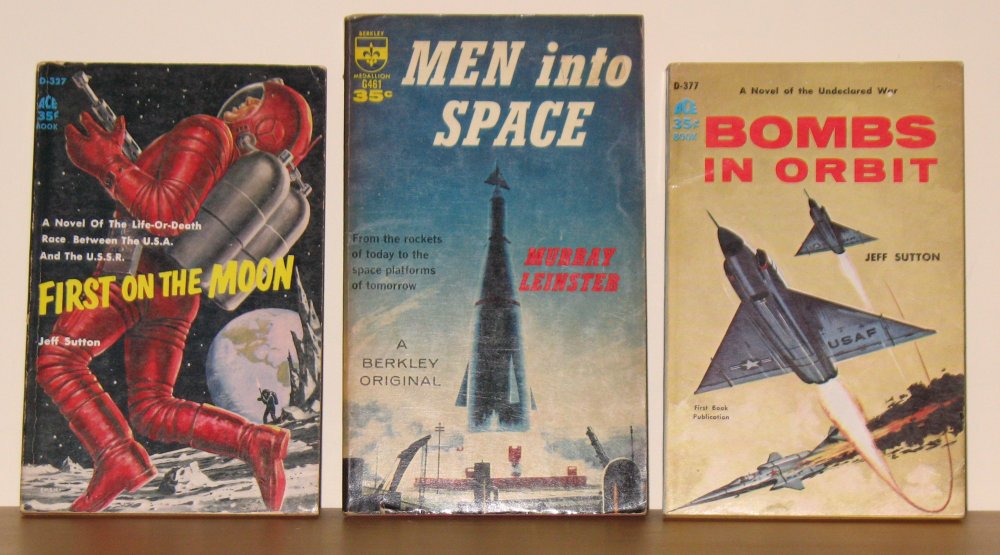 I couldn’t resist these three. First On The Moon


 It wasn’t just the F-102s on the cover which inspired me to buy this book. As soon as I saw “SPACE FROGMEN!”, I knew I had to have it. So I did.
 Another three 1950s sf novels. The Worlds of Eclos


 I won this in the raffle. It’s a nice sturdy box which contains eight issues of the magazine Murky Depths – which, among other things, has published a graphic novel version of Richard Calder’s Dead Girls

So that’s the Fantasycon book haul. And that was Fantasycon. I had a good time, and I might well go next year. We shall see…
Ah yes, the “jugs” in the title of this blog post… That’s from a conversation about music which took place on the Saturday. I wanted Neil Williamson to listen to something on my iPod, but he said he didn’t have his headphones with him. I suggested getting mine, pointing out they weren’t earbuds, just normal headphones. Nor were they those big ones, jugs, that sit over the entire ear. I actually meant “cans”. But after that slip, headphones became known as jugs for the duration of the weekend.

