It Doesn't Have To Be Right…

… it just has to sound plausible


7 Comments

Reasons to be cheerful… in space opera

Consolatory fantasy typically ends with the existing power structure back in charge, and they’re usually the good guys – no matter how unfair the society – so as a result I suppose that could be seen as optimistic. Of course, the bad guys are always much worse. Most space operas follow a similar set-up. If it’s not the barbarians at the gates, it’s the rot from within. Either way, the empire or republic is in for a kicking and the good guys have to put up the good fight to save it. If the empire does go down in flames, a new more powerful one will rise phoenix-like from its ashes. So far, so consolatory.

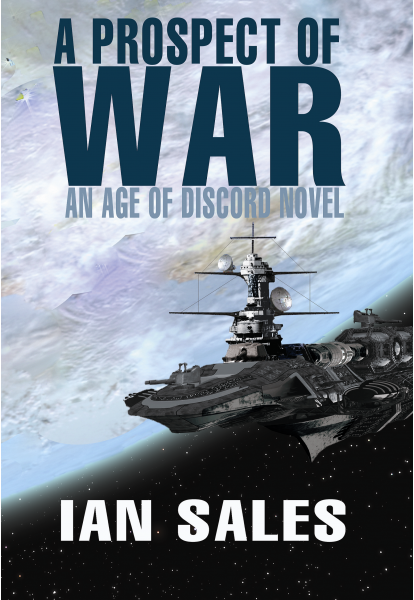
I will happily admit I deliberately set out to pastiche the consolatory fantasy template when I wrote A Prospect of War. Here’s the emperor – he’s under threat. So here’s a posse of good guys all set to fight the dark lord and defend the throne. And so the plot of the novel pretty much kicks off the conspiracy and sees the peasant hero gather his forces for the final battle.

However, part of the fun of writing the sequel, A Conflict of Orders, was then carefully upsetting that structure. The final battle takes place halfway through the book, rather than at the end of the trilogy. The villain is defeated (that can hardly be a spoiler) and the throne is once again safe… And then the tone of the story changes…

There is a plot hiding beneath the story of the An Age of Discord trilogy. Hints and clues to it appear in both A Prospect of War and A Conflict of Orders, and it was always my intention to bring that plot into the light and resolve it in the third and final book, A Want of Reason. But in the years since I finished writing A Conflict of Orders and now – when I have to write A Want of Reason from scratch to complete the trilogy – I’ve changed my mind about a lot of things. Not least what happens in A Want of Reason. Part of this is practical – I put together lots of notes for the third book back when I was writing the first two, but those notes now sit on a dead computer and are inaccessible. But it’s also true that my definition of what constitutes an optimistic ending, never mind an interesting story, has changed in the years since I completed A Conflict of Orders. Which is not to say that A Want of Reason will be a domestic novel – I’m not going to do a Tehanu (much as I would love to)…
SpaceOpera

But as A Want of Reason begins to take shape and settle into its story, I’m finding it a much darker novel than I had expected. The focus of the story too has altered, and now rests on a different selection of characters. Casimir Ormuz, the peasant hero, is still there, of course. But his journey to the resolution – never mind the resolution itself – is very different to the one I had originally envisaged.

I wrote each novella (and novel) of the Apollo Quartet to confound reader expectations. I see now that I’d been working to a similar principle – albeit considerably weaker – when I’d written A Prospect of War and A Conflict of Orders. But for A Want of Reason… I’m going all-out. The good guys will become bad guys, and the bad good, and the ending will neither reinforce the status quo nor raze the empire to the ground.

There’s not much room for innovation in space opera, given that everyone judges the subgenre by its bells and whistles. It’s either the world-building or – and this is a development of the past few years – its gingerbread prose which seeks to disguise common tropes beneath obfuscatory metaphors. The story templates haven’t changed, the tropes certainly haven’t changed. (There’s probably a Tough Guide to Space Opera, er, Space post somewhere in all this.) And those few space operas which have rung changes have generally caused very few waves. Has there, for example, been anything comparable to Nova published in the twenty-first century? (Having said that, are there any space opera authors as fiercely intelligent as Samuel R Delany currently being published?) There’s Ann Leckie’s trilogy of Ancillary Justice, Ancillary Sword and Ancillary Mercy, of course, which used an astonishing piece of sleight of hand in using female as a default personal gender to add a fresh new flavour to something Iain M Banks had been doing for three decades. And while Banks was certainly more innovative than pretty much every other writer of space opera – a consequence, I suspect, of having one foot in the literary fiction camp – even then he had a tendency to use tropes as they were set up rather than subvert or re-engineer them.

Sadly, Banks is gone and I suspect Leckie’s trilogy will prove a one-off blip. Space opera was already busy retrenching after the exciting times of the British New Space Opera of the eighties and nineties – not just Banks, but Take Back Plenty, Eternal Light, Light… But that movement introduced more of a hard sf sensibility to space opera (and some of the names attached to it, including McAuley and Reynolds, are probably better considered hard sf writers), without substantially changing its story patterns or its commonest tropes.

I’ve said before that space opera – if not science fiction itself – is an inherently right-wing genre (even if not all of its practitioners are right-wing). But more than that, I think space opera is inevitably drawn to the right. If someone writes a space opera which isn’t right-wing, it soon veers back to that side of the political spectrum. In part, it’s a function of the political systems which usually appear in space opera: emperors and empresses and empires and bloody great huge space navies. (I don’t, incidentally, hold with the argument that it’s the supposed tyranny of the laws of physics which lends science fiction, especially hard sf, its right-wing character.) However, I do think that science fiction has now, more than ever, reached a position where much of what qualifies as sf is little more than the rote deployment of sf tropes. There’s no insight, no consideration, attached. Put FTL into a story and no one so much as blinks. It’s just part of the furniture. Flat-pack science fiction.

And if you’re going to claim FTL is okay, it’s plausible, because there might be a Kuhnian paradigm shift which means it could happen… Which is, er, not my point at all. The tropes exist, they’re the building blocks of both space opera and science fiction. But I don’t think they should be used uncritically. I’d like to think I haven’t used them myself uncritically. Admittedly, a commercial space opera is likely not the best vehicle to deconstruct space opera tropes (but then I’d have said an commercial fantasy trilogy might not be the best place to deconstruct epic fantasy tropes, but Delany went and wrote his Nevèrÿon novels; but then, Delany…).

My area of interest in writing lies chiefly in the shape of stories, the narrative structures used to present a story in a particular way. I’m not interested in immersion – or rather, no more so than I need for a story’s world to be rigorous in my own mind. I’m not interested in literary techniques designed to make one reader response more likely than others… I jokingly mentioned in a recent conversation that I’d set a story on an exoplanet orbiting Gliese 876 but moved the setting to 61 Virginis because I didn’t think it plausible the story could have taken place given the original star’s distance, and likely travel times, from Earth. This is a science fiction story, of course, which posits a human civilisation across several star systems. No one would have noticed, but it was important to me.

If a science fiction story creates its own world , its version of Mars, Dubai, the Atlantic Ocean, etc, that doesn’t to me mean it does not demand the same level of rigour which pertains in the real world, in mimetic fiction. And at those points where the science fiction touches the real world… then the rigour applies just as much. This was a defining philosophy of the Apollo Quartet. The An Age of Discord space opera trilogy, however, does not touch the real world – at least not to any degree which might affect its setting. But its universe still needs to be internally rigorous. This may be why I find narrative structures and story templates preferable to be experimented upon – because they do not jeopardise rigour. (Yes, yes, you can make a point of ignoring rigour – surrealism, if you will – but that’s a different discussion.)

And so, in a more roundabout way than I am typical guilty of, it’s back to A Want of Reason and my total inability to wrap up what is supposed to be a commercial space opera trilogy in a nicely commercial way. The final chapter of A Conflict of Orders gives a flavour of the third and final book, and it wasn’t until I came back to that chapter a few months ago that I realised exactly what I’d set myself up for. Empress Flavia is on the Imperial Throne – and she’s kicked off a crack-down. When I first wrote it, it probably meant something in terms of my original plan for A Want of Reason. Now, it means: space opera fascism! And that’s what you’ll be getting: a space opera setting that moves ponderously to the right, in order to set up a climax that shifts everything irrevocably to the left. And, meanwhile, your favourite characters? I’ve either dialled them back so far in the narrative they no longer have any agency, or I’ve got them doing stuff villains normally do.

Because. Space opera.

1 Comment

On writing and how to

I’m probably the last person who should be giving writing advice, which is as good a reason as any for a blog post on the topic. If you want to know how to write short stories which are guaranteed to sell, look elsewhere. I suspect no one else really knows either, they’re just not honest enough to admit it. “Hey, it worked for me – sure it’ll work for you!” Yeah right. If you’re looking for rules on writing readable saleable fiction, I’m the wrong person to ask. If that makes me a dilettante, then so be it. I’m interested in fiction, I’m interested in how fiction works, and I’m interested in using that knowledge to create fiction which does something different. At least, that is, within my chosen genre.

It often seems wannabe writers can’t make a move without bumping into some “rule” or other: “show, don’t tell”, “prose must be transparent to let the story shine through”, “there are only seven plots”, “use a three-act structure”… They’re all bollocks. Fiction, least of all science fiction, is not a programming language. It doesn’t need to be compiled, and it won’t break the reader if, for example, you chose not to use quotation marks around dialogue.

And no one knows why some fiction succeeds and some doesn’t. It is not true that good novels will always see print (never mind sell by the boatload). There are a lot of excellent novels that have never been published, there are a lot of bad novels that have seen print (and some have even been phenomenally successful). There are also a lot of hugely popular novels which garnered a raft of rejections before someone eventually took a chance on them.

As for posterity… Dickens was a hack, an unashamedly populist writer – he even let his readers choose how one novel ended. And Jane Austen was allegedly neither the best writer of her generation nor the most popular – but her novels have endured, while the others are forgotten. Mary Shelly wrote seven novels, but it is her debut, Frankenstein, which is remembered two hundred years later by most people.

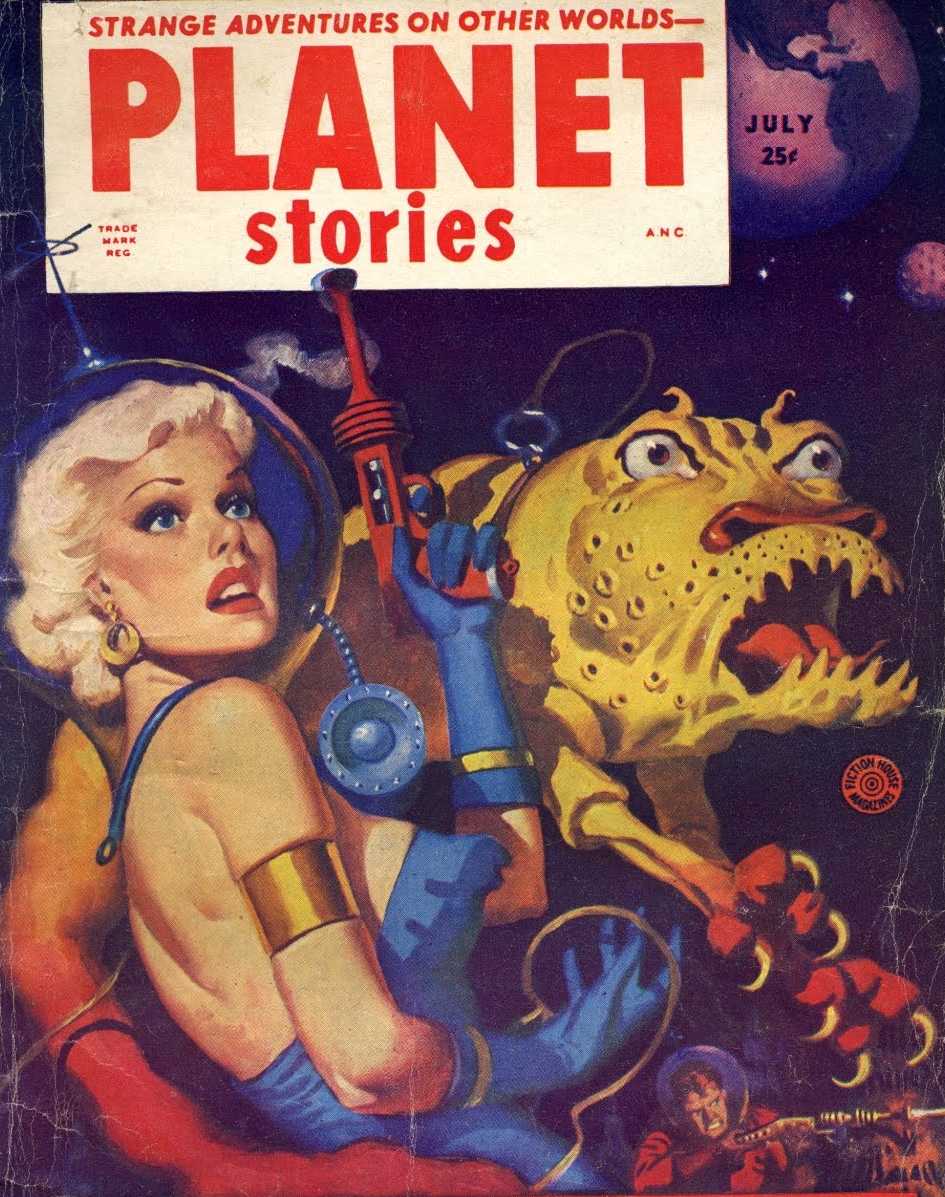
Science fiction should be willing to stretch the boundaries of narrative and genre. That it usually doesn’t is a result of the fact it is, at heart, a form of pulp fiction. It had its beginnings in pulp magazines, and though it has at times tried to throw off its origins – the New Wave being the most celebrated attempt – the basic form usually ends up prevailing. And not necessarily for the right reasons.

0423-planetstories

It’s a long-accepted truism science fiction readers are more open-minded, more willing to accept the Other, than readers of other genres… Or are they? Has sf become a victim of its own success? Its most prevalent models have proven so popular across most media that all forms of science fiction are assumed to be of that type. It’s an easy argument to believe – the Sad Puppies certainly fell for it – but it’s not in the slightest bit true. Science fiction is a broad church, and it’s long been my contention that those who take the trouble to admire, and understand, how the genre operates will make better use of the tools available to a writer.

So it’s all very well just blithely introducing FTL into a science fiction text, because the story requires several different locations and the genre insists they be separated by light-years. Except… Firefly put all its worlds in a single planetary system. Not, it has to be said, a particularly plausible solution, but at least it was an attempt to address a common sf stumbling block: space is big, hugely mind-bogglingly big. There are remarkably few science fiction novels which take account of that – notable examples being the current fad (see below) for generation starship stories, such as Aurora and Children of Time.

But if Whedon failed to interrogate the tropes he deployed – no real surprise there – there’s no reason why other writers cannot. There is no GREAT BIG BOOK OF TROPES which must be obeyed. There are no rules which dictate how tropes should be deployed. No matter what some people might insist. Making use of them the same way everyone else has done is just lazy writing, cheap shorthand for complex objects (as is hiding those tropes under a thin veneer of metaphor – but that’s a rant for another time). Each trope certainly exists for a reason, and it makes for much more interesting fiction, to me, if it is the reason that’s interrogated.

The big point about writing, the thing that drives all others, is that you get out what you put in. But your readers probably won’t. There are tricks you can use to trigger a specific reader response, but sooner or later your readers will spot those tricks and they will no longer work. So you might as well write something which meets your own objectives and not those of some mythical reader. The market does not exist, it’s an emergent phenomenon – so it’s no good writing “to the market” because there’s no such thing. And should you decide to try – well, by the time you’ve written your novel, the fad is likely over, unless you’re uncannily good at trendspotting. You can only write to please yourself and hope it pleases others…

It’s not like I’m one to talk. The Apollo Quartet has sold in total some 3000 copies over 3.5 years, of which just over half were sales of Adrift on the Sea of Rains. I was surprised during a conversation at Fantasycon 2015 to be told the Apollo Quartet is held in high regard. It often feels like “regard” should have a number attached and I know – from tracking my own sales – what that number is for the Apollo Quartet. Certainly among my friends and acquaintances, the four books have their fans. But not every review of them has been complimentary or fulsome.

I wrote each book of the Apollo Quartet to deliberately not be what readers of the preceding book had praised. People liked that Adrift on the Sea of Rains was literary, so I wrote The Eye With Which The Universe Beholds Itself to be a science fiction puzzle narrative. With each book I tried to push the boundaries of narrative and narrative structure. I made a number of artistic decisions which readers have questioned – not just the lack of quotation marks, but also the lack of closure, the refusal to spell out acronyms, the use of inference to link two narratives… the choice by myself to make the reader work to understand the story. I didn’t intend the Apollo Quartet to be light reading, and that dictated how I approached writing it.

apollo17

There is, now I think about it, another reason why I’m a poor choice of person to write about writing science fiction: I can’t stick to the point, and I’m not entirely sure if this piece is in any way helpful. Writing advice is a poisoned chalice at the best of times – success is too individual for any particular technique to be held up as a general guideline. (I’m assuming a basic facility with language, of course). Having said that, one piece of advice I can give: get yourself a sympathetic group of beta readers. They will tell you what works and what doesn’t. Don’t just bang your novel up on Kindle, unseen by anyone else. (And don’t get me started on self-published 99p science fiction novels – that’s a rant for another day.)

There’s an unspoken compact between writer and reader. You can either stick to it… or have a bit of fun with it. Personally, I think the latter makes for more interesting fiction. Unfortunately, the former is more likely to result in successful fiction. You pays your money and you takes your choice…


11 Comments

Is that the book you really meant to write?

So that’s A Conflict of Orders, the sequel to A Prospect of War and the second book of my space opera trilogy, handed over to the publisher. Now I’ve got to make a start on the third book. And I’d say I’ve got carte blanche, literally, except I haven’t really, because there’s a plot laid out in the first two books and there’s all that foreshadowing I’ve done and the hints and clues I’ve dropped… But I’ve still got plenty of room to manoeuvre, and after writing the Apollo Quartet I’m going to take every damn inch available. Not just because I can but because I want to.

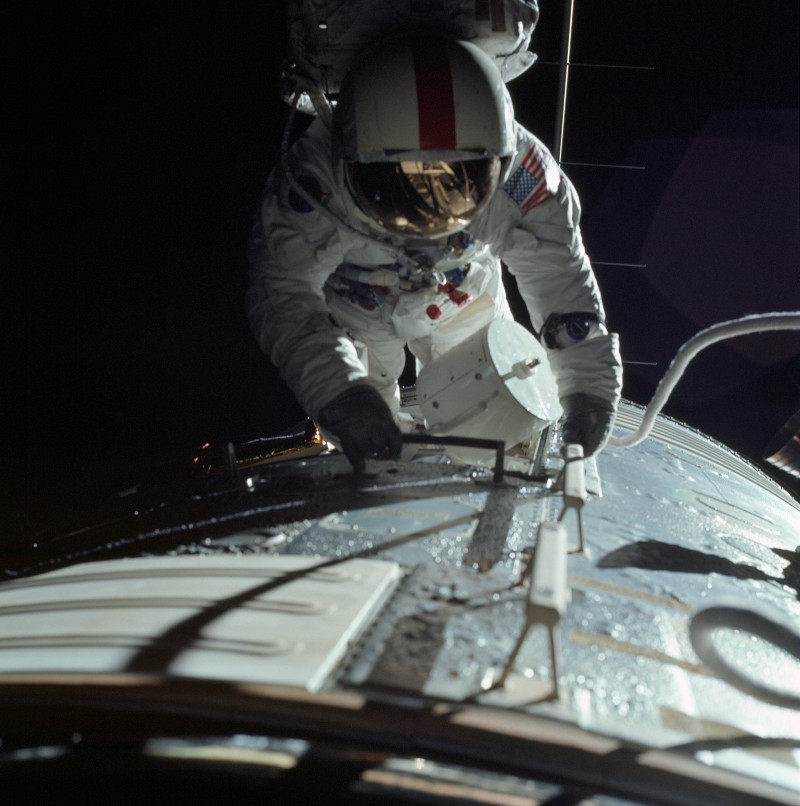
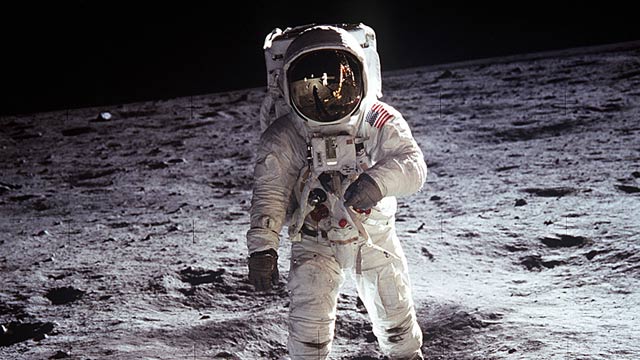
When I started writing Adrift on the Sea of Rains, I was trying to capture what it actually felt like to be wearing an Apollo era spacesuit on the Moon. It would be an act of imagination, of course – I’m not an astronaut, I’ve never been to the Moon, I’ve never worn a A7LB. But I’d read plenty of astronaut autobiographies and books about spacesuits and NASA technical documentation from the Apollo flights. And it struck me a Cormac McCarthy-like prose style would be good for evoking the desolation of the lunar surface. So I wrote my novella about a group of astronauts in an Apollo programme which had continued into the 1980s, and who were now stranded at a Moon base after the Earth had destroyed itself during a nuclear war.

ht_apollo_11_aldrin_ll_110901_wmain

I made certain artistic decisions that were, well, not the way you were “supposed” to do things. A long glossary. Astronauts that spoke like real astronauts, with no concessions made to the reader. No quote marks around the dialogue. I had no idea what sort of reception Adrift on the Sea of Rains would receive, but I was dead set on it being exactly the way I wanted it to be…

The rest, as they say, is history.

However, I’d foolishly decided to make my novella the first of a quartet. The Apollo Quartet. It had a nice ring to it. I went through a number of story ideas before eventually settling on what became the second book, The Eye With Which The Universe Beholds Itself – and then ditching the original structure after a comment in a review of Adrift on the Sea of Rains – none of which is especially relevant, as the point of this post is… writing sequels.

There are several different types of sequel. The most obvious is the one which continues the story begun in the preceding volume. Some of these can stand-alone, but many read like one humongous book split into several smaller volumes. Other types of sequel may be set in the same universe, and feature exactly the same cast, but follow a different plot – and those various plots may themselves contribute to a greater story arc (or simply fill in more details about the series’ world or protagonist). Some sequels share only a setting, but may reference the events of earlier books in the series.

Of course, a sequel doesn’t have to follow the story or protagonist or setting, the link might be more tenuous. Theme, for example. It might even be extra-textual. As it is in the Apollo Quartet. Although Adrift on the Sea of Rains has no real closure, the story would not be continued in the next novella, it would never be continued. The only link would be that provided by the quartet’s title: the Apollo programme. That’s about as extra-textual as you can get: imagined variations on a real-world space programme.

As for the second book’s story… The more I thought about it, the more I liked the idea of doing exactly the opposite of what was expected. People had said Adrift on the Sea of Rains was literary rather than science fiction, so I’d write The Eye With Which The Universe Beholds Itself to appeal more to a reader of science fiction (but I gave it a literary title because why not). The narrative would be a puzzle, one that no character in the story could solve, and I wasn’t going to explain it either. All the clues would be there, but the reader would have to put it all together themselves. That would likely piss some people off, but that was the plan. Especially since I wasn’t even going to put the main plot front and centre but hide it behind the two narratives. The idea was to write exactly what admirers of the first book weren’t expecting or, from their comments, didn’t especially want.

So I did.

Some liked it more than the first book, some didn’t.

But then I had to do something completely different for the third book.

If Adrift on the Sea of Rains was more literary than sf, and The Eye With Which The Universe Beholds Itself was more sf than literary, then book three would be… neither. The Apollo Quartet was based on alternate takes on the Apollo programme, but I’d make this third novella pure alternate history. The Mercury 13 provided the perfect opportunity to do so. But I also wanted to write about the bathyscaphe Trieste, and while I had the perfect story for it – the recovery of a spy satellite film canister – there was no obvious link, or indeed any link, to the Apollo programme. However, since part of the philosophy behind the Apollo Quartet was making the reader do the work, it occurred to me I didn’t need to explicitly document the link. A few hints, and let the reader figure it out. I’d done that in The Eye With Which The Universe Beholds Itself, it’s just that in this novella one narrative was not a consequence of the other, because the consequences took place outside the story.

1956-the-legacy-of-the-bathyscape-1

This became Then Will The Great Ocean Wash Deep Above (the most Lowry-esque title of the entire quartet).

Right from the moment I’d decided Adrift on the Sea of Rains would be the first book of the Apollo Quartet I knew what the final book would be about: the wife of a real-life Apollo astronaut who wrote science fiction. Because I wanted to juxtapose the invented space travel of her imaginary worlds with the real space travel of his. I also liked the idea of ending a trio of alternate Apollo histories with the real Apollo programme. In other words, this fourth novella wouldn’t even be science fiction.

Except, I went and spoiled things. First, I decided to make it a novel, rather than a novella. I’d originally planned to have two narratives – one would be the protagonist’s real life, the other would be one of her stories. But that felt too much like Margaret Atwood’s The Blind Assassin. When I started writing the novel, I decided to namecheck only women science fiction writers, but it occurred to me I could make more of a point by setting my story in a world in which science fiction was a women’s genre. And from that point, I was just throwing stuff in to make reading the novel as rich an experience as possible – not just the names of real-world women sf authors, but also references to well-known sf stories. I put the protagonist’s story in the centre of the novel and used the first half to show the inspiration for it and the second half to reflect its plot. Not to mention hints back to the earlier books of the quartet…

This was All That Outer Space Allows.

So none of the books of the Apollo Quartet are actual sequels according to the commonly-understood meaning of the term. And I approached each one with the intention of surprising, and possibly annoying, those who had admired the previous book. It seems to have worked. And it worked for me too as a way of finding my way into the stories of the quartet. Sometimes, as a writer, you need that. It’s easy enough when the plot of book 1 follows through into books 2 and 3 and 4, all you’re doing then is delaying the resolution – and, since you don’t want those sequels to be pure padding, complicating the resolution. You’re basically lay the groundwork for closure.

But closure is a commercial fiction thing, like transparent prose and sympathetic protagonists. And that’s particuarly true of genre fiction. Readers expect everything to be neatly resolved by the time they reach the last page. The Good King is back on the throne and the Dark Lord defeated. The alien invasion has been rebuffed and it was all because they needed our water. The drop-out hacker has found the secret at the heart of the evil corporation and revealed it to the world, which is rightly appalled (but nothing actually changes, of course).

Thing is, stories don’t actually need to end neatly. They don’t even need to end. And good books are those where it feels as though the universe continues to exist even after you’ve turned the last page. You can have giant novels split into multiple parts of publication, you can have a series where the same cast in the same setting experience different stories… or you can play around with the concept of “sequel”, much as you can play around with narrative and its various constituents. And doing that’s a lot more fun than putting the same old group of people through yet another lot of jeopardy, all in the name of drama.

But what about the space opera, you ask. That’s one enormous novel split into three, or at least that’s what the blurb implies. True, each book doesn’t really stand alone, and they need to be read in order. But even within the constraints imposed by a single story told over three books, I like to think I’ve bent the sequel template a little out of shape. Because a common complaint levelled at the second books of trilogies is that they do little more than move the cast into position for the big showdown in book three. I wanted to avoid that in A Conflict of Orders. So I changed the story. I stuck to the overall plot: evil duke conspires to take the imperial throne, ingenu from the sticks leads the opposition. But instead of continuing the story from the good guys’ point of view, I decided to give equal narrative space to the bad guys. And then I flipped the conspiracy on its head.

Structurally, A Conflict of Orders rings a few small changes. Since A Prospect of War was about putting a force together to combat the Serpent’s forces, clearly a big battle was in the offing. In epic fantasy, this is usually left until the very end, when the forces of good and evil line up against each other and everybody throws everything they’ve got against each other… And somehow or other the good guys manage to win the day. But there was no way I was going to drag the preparations for the final battle out over book two and half of book three. So I made it the centre-piece of A Conflict of Orders. And I described using short chapters, so I had lots of viewpoints of the action. And then, once the battle was over, I moved the plot into second-gear. The Admiral and her forces have won the day, and now it’s all a matter of cleaning up. Except there’s more going on than originally appeared to be the case… And that’s what book three, A Want of Reason, will resolve.

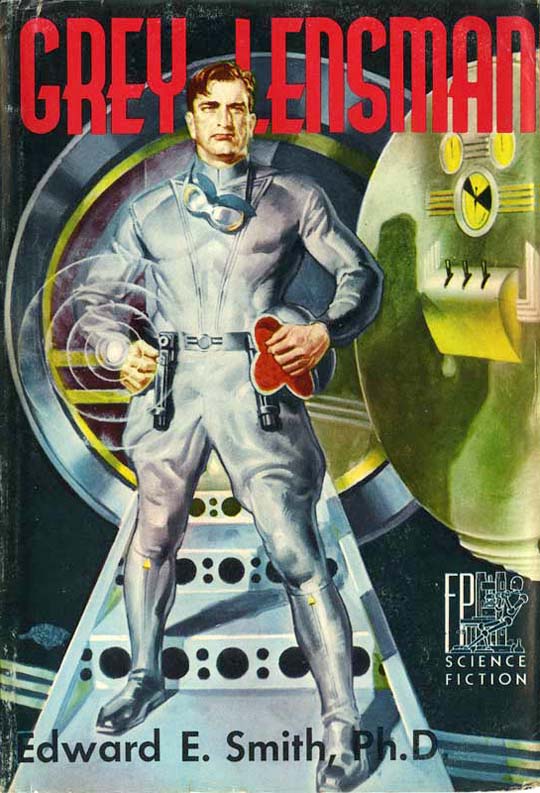
So, in terms of sequels, the space opera trilogy, An Age of Discord, doesn’t follow the typical pattern of a linear plot split over three volumes. In point of fact, there are three nested stories going on, and each volume resolves one of them. It’ll likely do my credibility no good, but this structure was partly inspired by EE ‘Doc’ Smith’s Lensman series. Now they’re not very good books – Smith’s, that is – and the writing in them is mostly embarrassing. I’d also question their historical importance. But one thing they did really well was escalate jeopardy. No sooner had Kimball Kinnison defeated one villainous conspiracy then it was revealed there was a higher level of villains who had been controlling it. (To be fair, this structure was somewhat spoiled by the series being published in book form in internal chronology order, which revealed the over-arching struggle between the Arisians and the Eddorians right at the start.)

Gray_lensman

I’m not about to reveal the plot of A Want of Reason, and not just because it has yet to be written and even I don’t know how it will probably go. I’m thinking I might have a go at introducing Marxism into space opera, but we’ll see how it goes. I’ve already thrown away the plan I’d had in the back of my mind when I wrote A Conflict of Orders (for the record, it was an historical narrative thread, set 1000 years in the past, which would explain the trilogy’s underlying conspiracy). Having said all that, A Conflict of Orders very much ends, as A Prospect of War did, with the various narrative threads poised to make the jump to the next level. Casimir Ormuz and the Admiral have raised their forces, and they’re about the meet the Serpent’s army and navy in battle… And more than that, I probably shouldn’t say…

You’ll just have to read the book to find out.


4 Comments

Breaking the wall, breaking the wall

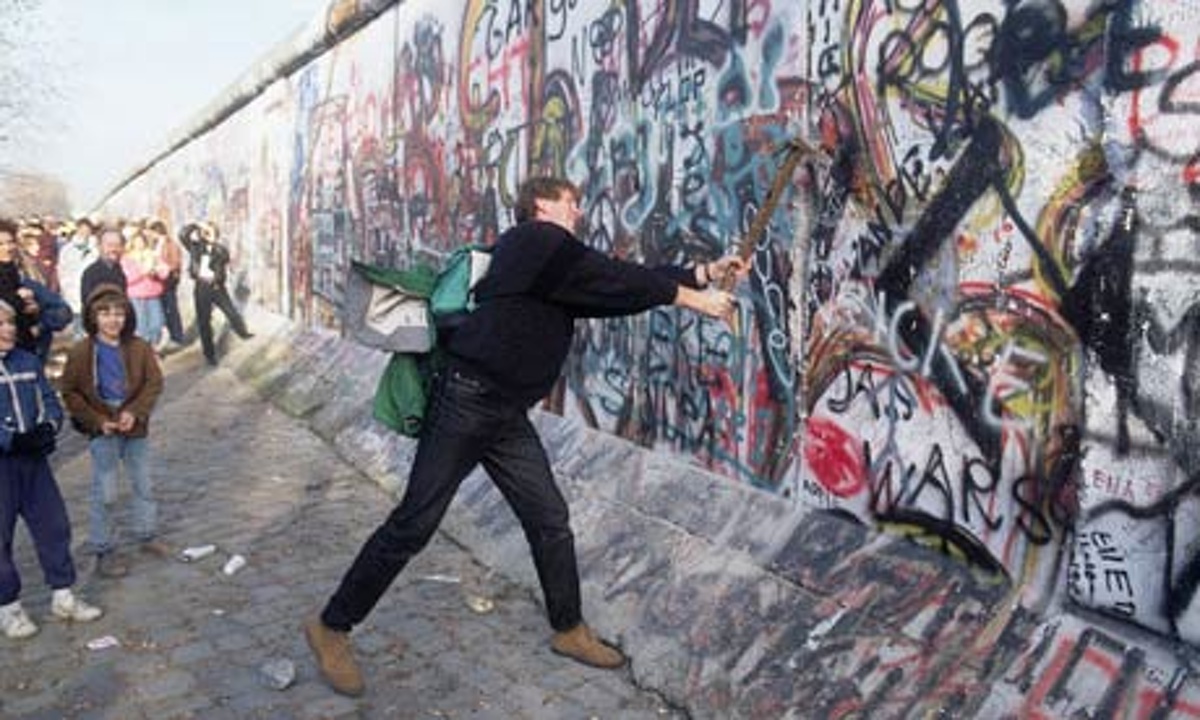
There comes a moment in Michael Haneke’s Funny Games (1997) when Paul, one of the two young men who has invaded the holiday home of a middle-class Austrian couple, turns to the camera and winks at the audience. Breaking the fourth wall is shocking because the compact between film-maker and viewer, or writer and reader, is suddenly revealed as completely artificial and based wholly on trust. Yet that compact exists only as a matter of expectation, because that’s the way stories are. We know the book we are reading, the movie we are watching, is an invention, a fabrication. There might be elements of fact to it – that street in New York really does look like that, for example – but the people whose story we are following, they aren’t real, if we visit New York we’re not going to bump into them, we’re not going to reminisce with them about the events of this story which they experienced and we witnessed… That’s how fiction works.

Kim Stanley Robinson has said that he considers exposition to be “just another narrative tool”. Exposition is important to science fiction and fantasy. Genre stories may take place in entirely invented worlds, ones in which the reader has no actual knowledge or experience, no built-in map to help navigate it and its societies or technologies… And so the author must explain those fabricated details. Otherwise elements of the story may not make sense, or may in fact be completely impossible to parse.

Of course, in most cases, this information is already known to the story’s characters – they know how to navigate their world. This is why the “As you know” conversation, where one character explains something to a second who already knows it because the reader needs to be informed, is the most egregious form of exposition. No one actually does this: “I’m just off to the supermarket, which, as you know, is a large store that sells a variety of foodstuffs at competitive prices.” Even successful authors still use “As you know”. They shouldn’t. It’s a failure of craft. It is also, when you think about it, breaking the fourth wall.

If a narrative is tightly limited, constrained the POV of the protagonist, why should the author need to explain anything? The character already knows it, or has come to terms with the fact they do not need to know. Not everyone who travels by air in 2015 understands how jet engines work, so why should everyone who travels between stars need to understand how FTL works? The problem with exposition is that it can only work by breaking point-of-view. In other words, exposition breaks the fourth wall.

teenager-Berlin-Wall-007

Not an issue, of course, if the narrative is written in third person omniscient, but that voice is much less popular now than it once was, and almost non-existent at the more commercial end of popular fiction. It might also be argued that omniscient POVs pretty much straddles the fourth wall anyway – and there are certainly examples in literary fiction where an omniscient POV is used to make explicit the fictive nature of a story.

And yet… immersion requires a level of knowledge about the world of the story to work, and without a narrative angel sitting on the reader’s shoulder whispering exposition, how is the reader to truly immerse themselves in an invented world?

The point here is not that exposition is necessary, but that it is crude. It is not the techniques used for exposition that are crude – “As you know” conversations, wodges of explanatory text aimed directly at the reader… Exposition itself is crude. It breaks the fourth wall, it exists only because the reader is aware, consciously or subconsciously, of the reader-writer compact. Without the reader’s acceptance of the fictive nature of the story, exposition could not exist. It would make no sense.

That compact, however, is a real thing. And it is possible to make use of it in ways that fiction normally does not. In Apollo Quartet 2, The Eye With Which The Universe Beholds Itself, for example, I set out the clues to a puzzle which I knew the protagonist of the story could not solve. But the reader could. I did so by using a a device which is so blatantly expositional it can only exist outside the story: the glossary.

In Apollo Quartet 4, All That Outer Space Allows, on the other hand, I decided to do things differently. I had originally intended to write it firmly within Ginny’s point of view, and rely on a general air of familiarity – ie, the USA in the 1960s – to allow the reader to accept those aspects new to them. But I also made some artistic decisions specific to my story – such as naming Ginny’s husband Walden, because All That Outer Space Allows was partly inspired by Douglas Sirk’s 1955 movie, All That Heaven Allows, in which Thoreau’s polemic is prominently mentioned – and it occurred to me that there was no need to rely on the reader’s extra-textual knowledge to spot that connection… Because I could break the fourth wall and make the link explicitly. So I did.

And once I’d done that, it occurred to me there were other aspects of my novel that could be “enhanced” by the sort of commentary open only to the author or a critic. Not to explain the purpose of a scene – that surely should be obvious – but to give some indication of why a particular scene might exist, or indeed provide what would normally be extra-textual knowledge in order to strengthen the novel’s argument.

There is, it has to be said, a fine line to be trod here. Particularly with science fiction. How… porous should the fourth wall be? If well-handled exposition allows the world of the story to leak out into the narrative, and badly-handled exposition is akin to a series of windows in the wall… I chose to build doors in my fourth wall. All That Outer Space Allows is a novel about writing science fiction, and so it seemed especially apposite to draw attention to the fictive nature of the story by breaking the fourth wall and commenting directly on the narrative. And doing so in, and as part of, the narrative.


5 Comments

What is it about space opera?

It often seems to me that space opera has within itself to be all things that are science fiction. Most writers, however, treat it as little more than action-adventure in space, or the fall of some historical empire transplanted to an interstellar canvas (with added cool techno-gizmos). Given the size of that canvas – there are literally no limits – there’s more than ample opportunity to ask relevant questions and play through the various answers. Some space opera authors have indeed done so – Iain Banks springs to mind: in his Culture novels he often examined the morality of intervention in other sovereign states’ internal affairs. Sadly he’s an exception, rather than the rule.

So why is it so few space operas do little more than pit one group against another, usually differentiated by either race, class or politics? Or show an interstellar polity torn apart from within or without? And the science fiction, well, that’s embodied in the background or some maguffin around which the plot revolves.

valerian

One of the chief elements of a space opera which the subgenre rarely seems to interrogate is the whole idea of an autocratic or feudal interstellar polity, in which custom and tradition has embedded an oligarchy so deeply in place it can only be dislodged by actually razing the polity to the ground. Historically (real history, that is), rulers claimed divine descent and so justified their exalted position – this was probably the second biggest con ever perpetrated on humanity, after the concept of an afterlife (capitalism comes a close third) – but any such claims of godly DNA are risible at best, deluded at worst. And if those rulers didn’t actually claim divine descent, they certainly claimed divine right – ie, they ruled in the name of the gods, with the gods’ permission and blessing. Quite how you prove that is beyond me, but it certainly happened – and there are probably a few royals out there who are so stupid or inbred they still believe it.

But let’s assume a space opera empire is ruled by a particular dynasty for the same reasons that such dynasties ruled in real history, ie, canny politics and/or historical accident, and park that for a moment. What about the actual society, its various levels and the lack of social mobility? What Herbert called “fraufreluches” in Dune. I can understand the need for a tightly-controlled society in an artificial environment such as a space station – everybody’s lives depend on people not breaking things – but space operas in the main presuppose a galaxy of earth-like planets ready to be colonised by land- and resource-hungry humanity… Except, wait, they can’t be all that land-hungry because a lot of space operas feature worlds that are either populated to a ridiculously dense degree, or almostly entirely empty. And those densely-populated worlds… A world like Trantor or Coruscant, it would be impossible to feed the population of such a world, it’s just not physically possible to ship in the foodstuffs required to support a population of a trillion or more (Wikipedia gives Corsuscant’s population as “Approx. 1 trillion”, although the Wookiepedia claims three times that; isn’t the internet wonderful?). Assuming an average of 2,500 calories per person per day, for the entire population that’s equivalent to about 5 billion (or 15 billion) cows a day.

For a highly technological (ie, “magical” per Clarke’s dictum) space opera, most problems, not just food, would be magically solved by magical science and magical engineering – replicators, or something like that. If there’s no scarcity, you’d expect the society to be relatively flat, and any social classes that have shaken out have done so depending on whether the empire follows an egalitarian socialist model or a more restrictive model based on, well, any variety of right-wing ideologies. I’ve said in the past that science fiction – and especially space opera – is an inherently right-wing mode of fiction, irrespective of the politics of its writers. Just look at the various societies depicted in science fiction texts, look at the solutions proposed to the problems presented by science fiction texts. It’s said that editor Donald A Wollheim once ran a straw poll among sf fans on the best form of government and “benevolent dictatorship” proved most popular. Even back in the 1960s and earlier, when science fiction traded on the assumption its fans were “better” than readers of other modes of fiction (“fans are slans”), that’s still a horribly juvenile result. But then look at genre’s various role models, and then count all those Marxist space operas…

The idea of science fiction, or indeed any mode of fiction, as primarily a form of “entertainment” has often been used to poison the debate regarding the genre’s uses. Some people – often stupid ones – will champion fiction as a literature of ideas, a vehicle for thought experiments, and then pooh-pooh concepts or approaches they don’t like as “message fiction”. All fiction is message fiction. It’s only the content of the message, and the power of its vector, which differs. And, of course, the ability of the reader to pick up the message.

But space opera… Most space operas require huge, often cumbersome, authoritarian political structures in place at the start. And there’s usually an associated fascination with all the pomp and circumstance and cool uniforms that go with such structures – er, Star Wars anyone? (And now we have Imperial Stormtroopers appearing at conventions and such… Er, they were the bad guys, you know.) Of course, the better entrenched the power structures, the greater the equity gap, the more melodrama there is when the empire burns. But where space operas so often fail is in showing the consequences for everyone. Heroes must by definition have sufficient agency to either destroy or save the empire, but those embedded in the power structures are far from the only victims. As the title of Robert Sheckley’s 1972 story has it, ‘Zirn Left Unguarded, the Jenghik Palace in Flames, Jon Westerley Dead’ – palaces are, after all, home to more than just empresses and emperors. In CL Moore’s excellent Judgment Night, the two protagonists, Princess Juille and Egide, prince of the H’vani, actually meet at a “pleasure moon” which is, naturally, purely for the use of the upper classes and, as in other space operas, the only non-aristocrats mentioned are servants or soldiers.

foss_palace

I freely admit that when I started writing my space opera trilogy, An Age of Discord, I chose to base the plot on a well-established story template from consolatory fantasy: someone is trying to unseat the emperor, for reasons not clear when the story opens. Toppling the throne, of course, does not necessarily entail a complete destruction of the empire, it might just be a dynastic struggle. But this is a consolatory fantasy, which sort of presupposes an elemental battle between good and evil – and a dark lord makes a better villain than an ambitious cousin. I had no intention of using a moral landscape painted in such primary colours in my trilogy, and it was while considering the alternatives that it occurred to me I should present the irruption caused by the plot across all levels of imperial society. To some extent, I had to consider this: the main protagonist, the “peasant hero” was by definition a member of the lowest sector of society.

But there’s a paradox there. While the fight may affect, or indeed include, all levels of society, the conditions which define defeat or victory exist only in the uppermost levels. So I had no choice but to elevate my peasant hero if he was to play any sort of useful role in the struggle – and this in a society in which social mobility is near-impossible. I could show how the consequences applied to all social levels, and I felt I needed to show that – so  I had to make a discussion on the society of my interstellar empire an important element of the plot. Which I did. A Prospect of War opens with three main narrative threads – one features serfs (I call them proletarians), another has a pair of middle-class (ie, yeoman) characters pretending to be proletarian, and the final one is firmly yeoman (but also features aristocrats). There’s no getting away from involving the upper sectors of society if the stakes are empire-wide, so I had to introduced them – but by making one of the protagonists a peasant hero, I could use the mechanism of his elevation to the position required to lead the fight as commentary.

I based the empire of A Prospect of War on an historical model and I built a fictitious history for my empire which justified its various institutions. (Chiefly, I admit, by limiting the technology of my empire such that Age of Reason technology was more than sufficient to maintain society.) I also went for pomp and circumstance. I gave everyone uniforms, and then I described them (I even worked out a colour scheme for the uniforms of army regiments). I described the architecture because that’s another good signifier of monolithic social structures and embedded power groups. I used the sword – the carrying of it, the legal right to use it – as an indicator of social class. In other words, I made it as plain as I could that here was a society that had not, and could not, change or progress. Except by violent upheaval. Which I even signposted – the empire of A Prospect of War is around 1300 years old, and came into being when a powerful admiral used his fleet to seize the throne of the preceding empire.

The term “space opera” was coined as a pejorative, a reference to “horse opera”, which were bad Western stories. In the decades since the term first appeared, its meaning has changed, and those works boasting the label have gained a measure of respect that now puts them on a par with other types of science fiction. Moore’s Judgment Night, mentioned earlier, was first published as a magazine serial in 1943. Wilson Tucker coined the term “space opera” in 1941. I’ve no idea how Judgment Night was originally received by its readers – perhaps at that time it had not even been identified as space opera. It’s certainly a classic of the subgenre now. But like early classics in any genre or subgenre, it deals chiefly with archetypes and its tropes have long since become clichés (sadly, in Judgment Night‘s case, several elements of its plot seem to have been forgotten by science fiction for several decades, such as a princess leading the defence of the empire). For me, A Prospect of War had to function not just as an entertaining space opera, but also as a commentary on space opera – and, to some extent, consolatory fantasy. I’d like to think I managed to do so, but that’s for the book’s readers to say.


6 Comments

A prospect of space opera, part two

If you want a book to sell, you have to be pretty relentless in pushing it all the time, but I can’t say it’s something I enjoy doing. I’ve always believed you judge a person by their deeds, not their words. Except in this case, the deeds, er, are the words. Or something. So consider this blog post, a discussion of some aspects of the universe of my space opera, A Prospect of War, and space opera in general, as in the nature of a a discreet poke to remind you that HEY, I JUST HAD A SPACE OPERA PUBLISHED BY TICKETY BOO PRESS AND IT’S AVAILABLE FOR PURCHASE ON KINDLE (a hardback edition will be launched in July).

Serfs up, dude
The interstellar empire in which A Prospect of War takes place is feudal. It’s not the only political system you might find in a space opera novel, although it’s a relatively common one. But when the speed of communication is limited to the speed of travel – and travel itself is slow and often uncertain – local government needs a high degree of autonomy. However, if the throne is going to maintain control, it needs to know those running things locally have its interests at heart, and what better remote rulers than a group of people tied to the throne by chains of privilege, self-interest and obligation. They owe their position to the throne, and they’re well-rewarded for enacting the throne’s wishes. And, of course, should one get out of line, there’s always the threat of the throne organising the others to gang up on them.

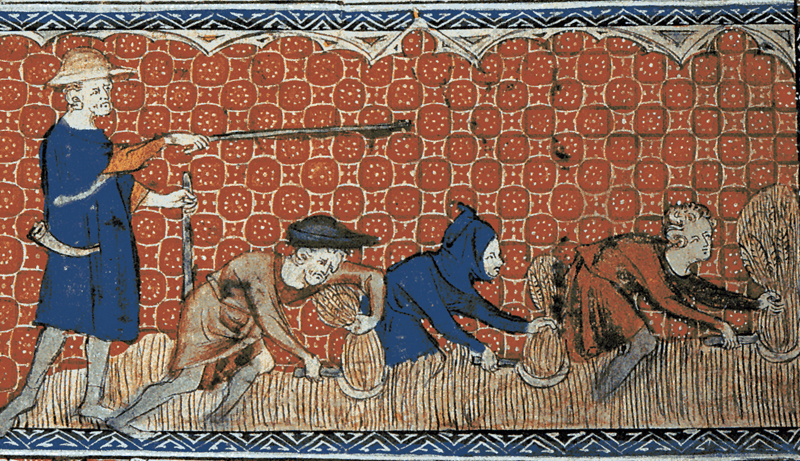
Having said all that, such a political structure only works if everyone has clearly defined roles and responsibilities. And that includes the people at the bottom. They’re going to be the most numerous, so they need to be the most tightly-controlled. Such as, not letting them travel. Pretty much like serfs back in the Middle Ages. The serfs would be the economic resources in a fief, and in return are protected, and to some degree succoured, by the noble who owns their bond. But you can’t just have serfs and nobles, since the latter have enough on their plate without also managing the serfs. So you need a freeman or franklin class between the two…

One point to bear in mind is that these social classes are real to the people in them. Serfs – or, as I called them in A Prospect of War, proles – can’t just go gallivanting off on adventures just because some interesting stranger passes through their village. A franklin – or yeoman – arguably might, but they have their own responsibilities and obligations. As for the nobility… Well, the genre has enough stories about over-privileged oafs trampling all over the rank and file in defence of another group of over-privileged oafs – oh wait, that’s what my space opera is about… Or is it?

Reeve_and_Serfs

But back to the government side of things… When it comes to an interstellar empire, there’s another factor to take into account: anyone who rules the space between planets automatically has the high ground. No world is safe from orbit. This is where the navy comes in. They don’t so much enforce the throne’s rule as rattle sabres menacingly from orbit. Needless to say, space is big. Really big. Vastly, hugely, mindboggingly big. To borrow a phrase. Things can get lost, really lost, in space. So I cheated. In A Prospect of War, interstellar travel takes place using a sort of hyperspace, an alternate dimension, called the toposphere. This means there’s effectively no actual space between planetary systems, it’s completely out of the equation. It’s as if the countryside between city-states didn’t exist – though a journey still takes a certain amount of time. This makes the concept of an imperial navy much more plausible.

The Imperial Navy in A Prospect of War is one of three institutions which effectively rule the empire, alongside the civil government and the regnal government. In Dune, Frank Herbert writes “In politics, the tripod is he most unstable of all structures”, but since I can’t find any other reference to that sentiment I suspect he just made it up. Certainly for my space opera universe, I decided a tripod was no more and no less unstable than any other form of government. Besides, the nature of an interstellar empire and the history of that empire naturally inclined to a three-way balance of power – the navy to safeguard the space between worlds, the nobility to rule the individual worlds, and the throne as the ultimate recipient of fealty. However, in my universe past events had seen enfranchisement develop among the nobility, leading to a legislative forum, an electorate, and also an administration to support it – the civil government. And this despite the fact the throne already had an administration in place to enact its will – the regnal government. So, there’s some duplication of government institutions – like the Imperial Exchequer (regnal) and the Imperial Treasury (civil). Some of the plot of the trilogy is driven by the politics between these two governments, just as much as it is by the conspiracy which intends to overthrow either, or both, of them.

What, no guns? At all?
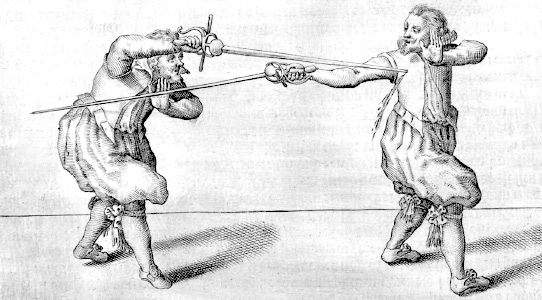
One thing I knew people would notice about A Prospect of War is that it’s a space opera, set in space, with spaceships… but everyone has swords. Just swords. No guns. I liked the idea of swords as personal weapons, because they made violence intimate. And they also made handy signifiers of social class – because swords need skill to use, which means training, which means spending money. And the more money a person spends, the better their teacher, and so the better a swordfighter they become. Unlike a gun, a sword is not a democratic weapon. The empire of A Prospect of War is not a democracy.

koppen-treatise-1619

If people carry swords, what’s to prevent someone else from, well, just shooting them? We all know that scene in Raiders Of The Lost Ark (this one). My solution was to, er, pretend guns don’t exist. No projectile weapons. No gunpowder. Just never got invented. It requires a leap of faith, but I’ve been told it works. True, there are “directed-energy” plasma cannons, but they need lots of power, so a lack of handheld versions isn’t implausible. (It’s implied in the novels that the five space opera technologies, which includes directed-energy, are used without any real theoretical understanding – a consequence of them having been reverse-engineered from a derelict spaceship millennia before.) Besides, space opera blasters – guns of any description – aren’t very dramatic. Swordfights are much more exciting. Just as long they’re not those interminable Hollywood swashbuckles, of course.

But if swords are badges of social rank, then not everyone can have them. Especially not proles. Contrary to the belief of one particular nation state, an armed populace is not necessarily the best defence against… well, anything. And although the empire has an emperor and dukes and earls, etc, it’s not precisely a tyranny. So, no swords for proles. They only get to use knives and non-edged weapons. Even the soldiers. Well, except for the marines, who use boarding-axes, as much because they’re useful tools in boarding actions as because they’re lethal close-order weapons.

All this makes for interesting battles, a sort of Age of Reason-type mass combat but without the firearms. There’s hugely lethal artillery – the directed-energy cannons – and a much higher degree of mobility than was historically the case… but otherwise it’s pretty much two lines of soldiers charging forward and lamping each other with maces. Which also makes the violence in a battle very much more intimate than if guns existed. And making violence intimate makes it that much more dramatic. Especially when the reader is emotionally invested in the characters… As I would hope they are.


3 Comments

A prospect of space opera

I might have mentioned once or twice I have a new space opera out, A Prospect of War. And since books apparently don’t market or sell themselves – big publishers have whole departments to do that, or so I’ve been told – I felt I’d better wibble on about it a bit. A Prospect of War will be officially launched as a signed limited hardback at Edge-Lit in Derby in July, but if you pre-order now you get a free ebook edition. Or you can buy the ebook straightaway, if you’d sooner have in that format. (ETA: The publisher has moved the book to Kindle: UK and US.)

apow

So, a space opera. That’s like with an empire. In space. With an, er, emperor. But A Prospect of War is not your typical space opera. Despite taking place in an empire that occupies some ten thousand worlds, it’s all a bit low tech. I was going for a sort of Edwardian aesthetic when I wrote it, steel plates and polished wood, but these days I suspect it’ll just be read as steampunk-ish. Which is not necessarily a bad thing.

The reason I designed such a universe was because I didn’t want it to feel dated, no matter when a person read it. I wanted it to be hermetic, with no references to anything recognisable in the real world, or that could have been extrapolated from “current” science or technology. So all the computers are mechanical, and even artificial lighting is generated using the piezoelectric effect. And then there are the five handwavey devices which have made this an interstellar empire – topologic drive (FTL), charger (anti-gravity), directed-energy cannon (big shooty plasma-beamy things), power toroid (cheap energy), and force-curtain (useful for making sure your air doesn’t escape in space). There’s a back-story explaining how a relatively low-tech planet-bound civilisation ended up with these, and one day I may write a novella about it.

Then there’s the narrative of A Prospect of War, which was partly modelled on that of an epic fantasy. Or at least, that was the original plan. There’d be a peasant hero, who’d find himself embroiled in an empire-wide plot bent on… hell, let’s go for the obvious one: a plot to take the throne from the emperor. Your basic consolatory fantasy story. Why not? Except… what makes the peasant hero the, er, hero? If he’s a nobody, what is it about him that results in him leading the fight to save the throne? There’s no magic in A Prospect of War – I mean, that would be like polluting space opera…

Okay, perhaps a suitably science-fictional “magic” power might be okay. Like prescience. It worked for Paul Atreides, after all. True, he was also the son of a powerful noble, but you know what I mean. However, I wanted something a bit more original, and I think I managed it. In fact, this later proved only one of many serendipitous choices I made while I was writing – you know, where you write something because it seems like a neat idea at the time, and then later on in the narrative you realise you’d inadvertently foreshadowed something really cool.

In most epic fantasies, the narrative follows the peasant hero, getting to know him (it’s pretty much always a “him”) first, then showing how he picks up the various members of his gang, which he subsequently uses to defend the noble emperor. Or something. I decided to mix this up a little – the peasant hero would be your typical ingenu but he’d also be pushed and pulled by a couple of conspiracies. Which meant introducing some additional points of view as quickly as possible. This may have been a mistake. The opening chapters of A Prospect of War bounce around among four main characters, rather than focusing on the peasant hero. This means the novel has a somewhat steep learning curve – a situation not helped by my decision to try and avoid big fat lumps of exposition (although, to some extent, exposition was unavoidable, but I hope I kept it to a reasonable level).

The narrative of A Prospect of War, if it were plotted out, would look a bit like a map of a railway network. Sort of. The separate “tracks” of the story meet and cross and bounce off each other as the novel progresses, before eventually meeting up for the transition to the second book. Sometimes they’re chasing a mystery, other times the direction is dictated by the answer to a mystery.

Just to make things a little more interesting, when I was designing the universe I decided that topologic travel would be measured in weeks, but time would have passed more slowly in the real universe – a “time-lag”. On a logarithmic scale. So one week in the toposphere (the sort of hyperspace used by the topologic drive) equals eight days in the real universe; two weeks equals thirty-two days. And so on. A word of advice: never do this. It made working out the internal chronology of A Prospect of War, and its sequels, a complete nightmare. Especially when you have different groups of characters gallivanting about space.

All this focus on plot and the shape of the narrative doesn’t mean I skimped on my cast. It was important to me the characters were as well-rounded as I could make them. The peasant hero, Casimir Ormuz, might be typical of the breed – although he’s no special snowflake (well, perhaps a little bit) – but I hung the rest of the narrative on another four characters. Who, er, all happen to be women. Ormuz is a member of the crew of a tramp data-freighter. The ship’s captain, Murily Plessant, represents one of the story’s factions. Then there’s the Admiral, who is secretly building up a force to defend the throne. Her lieutenant of intelligence, Rizbeka Rinharte, is instrumental in bringing Ormuz and the Admiral together. And finally there’s Sliva Finesz, an inspector investigating financial irregularities high up in the government, who gets dragged into the whole thing. None of these, by the way, are precisely good or bad; it doesn’t fall out into two neat little camps like that. And it gets especially mixed up in the second book, A Conflict of Orders.

The other element of the space opera I spent time developing was my empire’s history. I wanted that sense of deep history you get in the best science fiction. I didn’t quite go so far as putting together a family tree covering 1200 years of the empire’s ruling dynasty… Well, okay, I started one, but I never finished it. But I did write notes covering some six or seven thousand years of history, most of which would never actually appear in the books. I actually made a start on an encyclopaedia, which I thought might eventually make a companion volume…

Next time, I might write about feudalism… in spaaaace.


113 Comments

Science fiction has lost the plot

I recently finished The Dog Stars by Peter Heller, which was not published as science fiction but was shortlisted for the Arthur C Clarke Award last year. In it, a flu pandemic has killed 99% of the population of the US, and the survivors have, of course, turned to warlordism and survivalism. It’s not a very good book – its presence on that shortlist is, frankly, mystifying. One character appears to be ripped off from John Goodman’s part, Walter Sobchak, in The Big Lebowski; and the narrator apparently suffered minor brain damage previously from a bout of meningitis and so narrates the novel in mildly-broken English… which serves no purpose in the story at all.

Anyway, warlordism and survivalism… There’s a long tradition of such post-apocalypse tales in science fiction and I’m sure we can all think of at least half-a-dozen examples. I’ve objected before to the assumption that the survivors of any apocalypse would immediately start killing each other, when clearly cooperation is the only sustainable strategy for survival.

And then there’s the dystopia, a much-beloved setting for YA. In almost all cases, a privileged elite enjoy lives of luxury while the bulk of the population either scrabble for a living below the poverty line, or are rigorously oppressed with no freedom to object; or both. I can understand the dystopia’s appeal for the YA market. In order to “break” the setting, which is the point of the story, the protagonist needs to be a super-special snowflake – which not only feeds into teenage narcissism but also relies upon, and reinforces, the risible “Great Man of History” theory, which is itself the sort of nonsense kids believe.

It could be argued that such dystopias only reflect the real world, that their popularity is a symptom of the times we live in. Perhaps that’s true. Certainly the UK is currently governed by a cabal of greedy fascists who are hell-bent on selling off as much of the country as possible to their plutocrat friends. There is not much difference between Downing Street and Panem’s Capitol.

pic_1337396574_1

It strikes me that these two branches of science fiction are actually conditioning us to accept our current situation. Dystopia readers are waiting for a Katniss – and then everything will be all right. Post-apocalypse readers know they’re currently better-off, even if they’re being oppressed, than they would be with gangs of marauding slavers, rapists and murderers roaming the countryside. Science fiction was once a literature which encouraged change, which explored ways and means to effect changes. Now it’s comfort reading, it makes us feel good about our reduced circumstances because at least we’re not suffering as much as the fictional characters we read about.

And if it’s not apocalypses and dystopias, it’s interplanetary or interstellar wars. Making us feel good about our governments’ military adventurism. And fictional universes that embody so many libertarian sensibilities it’s becoming increasingly hard to argue that right-wing politics are not the default mode for the genre. Even left-wing authors create worlds built on right-wing principles, as if dramatic stories were impossible any other way. Which is simply not true.

Once upon a time, science fiction was driven by an outward urge. True, we know a great deal more about our planet and our universe than we did then. But there is still a lot we don’t know – the depths of the oceans, for example, remain mostly unexplored. We’ve found over 1800 exoplanets, but the furthest we’ve trod is our own moon, 400,000 km away – and that was over forty years ago anyway. What happened to that urge? Where are the science fiction novels inspired by it? I can perhaps think of only a handful published in the past twelve to eighteen months which might qualify.

The bulk of sf currently being published seems more designed to accommodate us to our meagre lot. It’s not holding up a mirror to our times, it is complicit with those forces which shape the modern world. It is telling tales to maintain the status quo by showing just how improbable, how impossible, meaningful change is.

A friend is currently trying to put together a list of sf novels about climate change – and it’s perhaps telling that most such science fictions take place after the climate has crashed. It’s almost as if we’re unable to prevent it – it’s going to happen and there’s nothing we can do about it. Except, of course, there is. There are lots of things we could do. But certain powerful interests in the modern world don’t want the changes preventing climate crash would entail. So we have become resigned to consuming stories in which climate crash is a faît accompli.

Back in 1926 when Hugo Gernsback published the first issue of his magazine and so created the genre, he saw “scientifiction” as a possible force for good. And it’s certainly true that fiction can have profound effects on the real world – and not just in terms of inspiring nerds to invent new gadgets. These days, however, science fiction has all importance of middle-class fad foodstuffs. We consume it like we consume Greek yoghurt – and it’s not even that, it’s more like a bee flew over a pot which was then filled with curdled milk from a dog they found wandering the back streets of Athens…

So what went wrong? When did we become so resigned to the present, so resigned to our powerlessness, that we began to ignore not only change but the possibility of change in our science fictions? And what can we do about it?


5 Comments

Fables of the Deconstruction, #1: Robots

All too often, people point at the tropes in a piece of fiction and use them to categorise it. This story has spaceships in it, therefore it’s science fiction; this one has elves, so it must be fantasy. One of the tropes often used to “identify” sf is the robot – well, a robot is clearly the product of technology, it’s an artificial person, a mechanical man or woman (or neither). What’s not science-fictional about that?

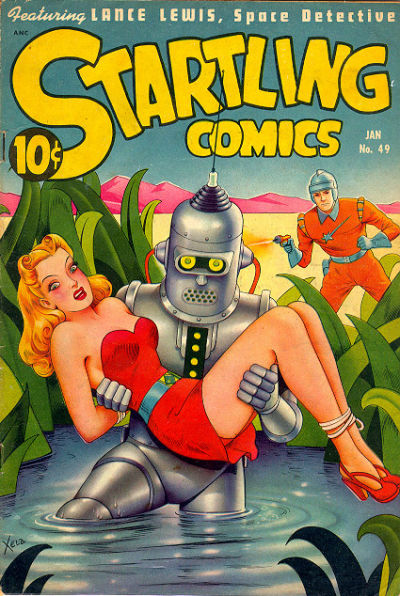
startling-comics-0491

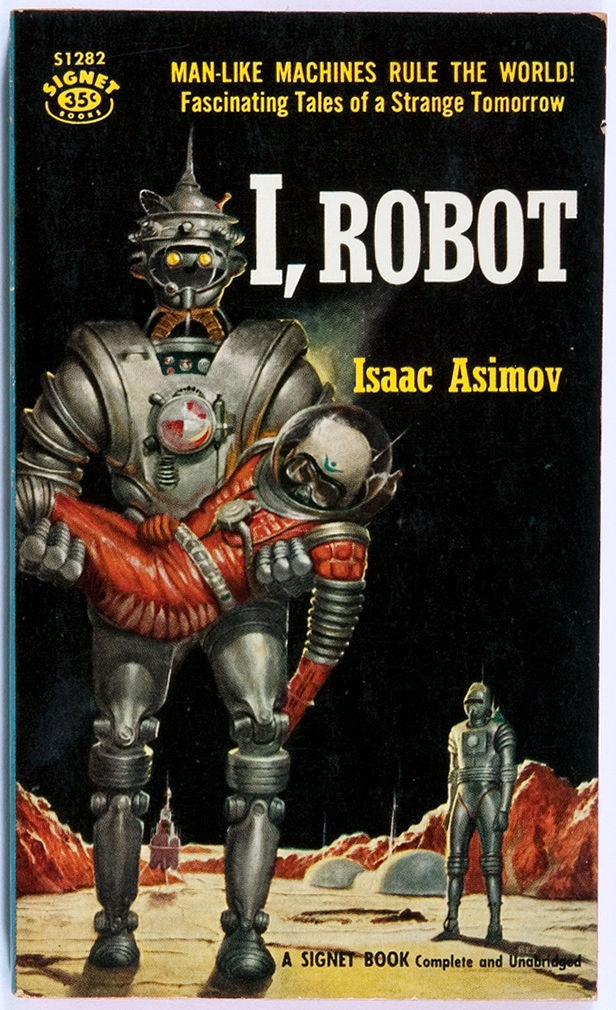
The term “robot” comes from Karel Čapek’s RUR (1920), and is derived from the Czech word robota, a local form of serfdom in which serfs had to work only for a specified number of days each year for their liege. RUR was first translated into English in 1923 but, according to the OED’s Science Fiction Citations, the word’s first appearance in English wasn’t until 1925, in a novel by French-born British writer Thomas Charles Bridges, The City of No Escape. However, it was the mid-1930s before “robot” appeared in US science fiction magazines. It was then, of course, co-opted by Isaac Asimov, who wrote some forty short stories and a few novels (it’s hard to be precise as Asimov spent much of his later years trying to stitch his oeuvre into one great stupid shared future history, featuring both psychohistory and robots).

Čapek’s robota were actually biological – what are now commonly referred to as “androids” – so I’m not entirely sure why the term was adopted for purely mechanical beings. Perhaps this was because the mechanical being was an already existing trope: the automaton. (The SF Encyclopedia indicates there was a story in the November 1931 issue of Amazing titled ‘Automaton’.) But automata were real things – marvels of mechanical ingenuity, show-pieces, designed to display their inventor’s cleverness and so win them the patronage of some wealthy potentate; and they were often fake (the Mechanical Turk, for example). Automata were typically good for a single task, and in no way a replacement for a human being.

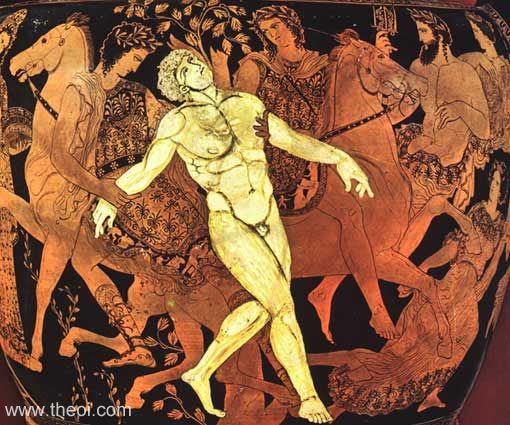
L6.1Talos

Go even further back, of course, and you have the golem, an automaton powered and controlled entirely by magic. There are also automata in Greek mythology, built by Hephaestus – such as Talos, the giant bronze man who protected the island of Europa (although it seems the clockwork owl in Clash Of The Titans is an invention of the film’s writers). But neither automata nor golems fit in with early science fiction’s burning enthusiasm for science and engineering, for technology. If electronics magazines showed readers how to build their own television sets, their readers were hardly likely to be interested in a mechanical servant which required magical incantations to operate.

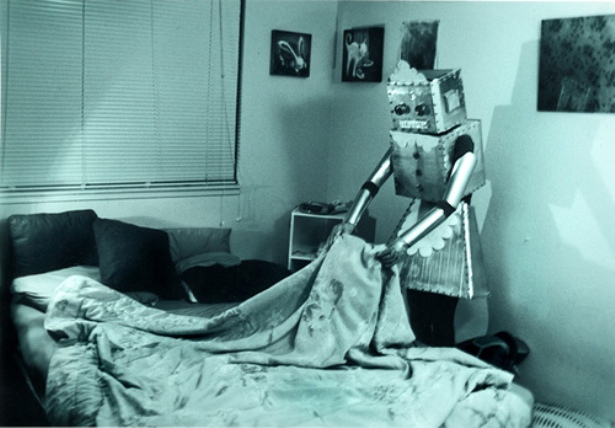
robot_maid

And yes, servant – because technology exists, so these magazines would have you believe, to make life easier and more comfortable, and what could improve comfort more than a servant – to do the cooking, cleaning, laundry, fetch the mail, etc. And because these robots are servants, so they must be in the shape of a human being. Unlike real servants, however – and here lies their obvious superiority – they don’t require wages, food or rest, will always perform tasks to the high standard required, and will never be lazy, sullen, unresponsive or rebellious. In other words, robots are perfect slaves, but without offending anyone’s delicate morals. This could, however, be taken too far, as in Jack Williamson’s ‘With Folded Hands…’ (1947), in which robots do such a good job of looking after humanity that the race becomes too weak to survive without them. Or they could prove so ubiquitous that some humans might believe they were robots themselves, as in Margaret St Clair’s ‘Asking’ (1955) – although once the protagonist learns her true nature, she adopts all the arrogance of a slave-owner toward robots.

VW-Puebla-Robot

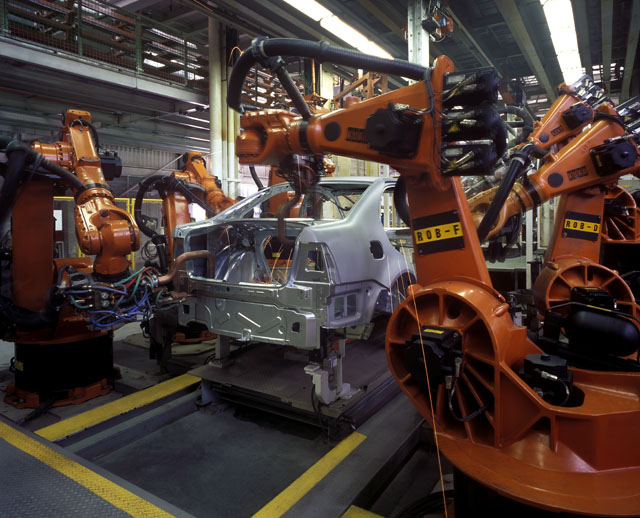
In the real world, robots are entirely different. They’re more often referred to by a name specific to their purpose, such as a Computer Numerical Controlled Machine or Autonomous Underwater Vehicle or space probe. They’re built for specific tasks, or to perform within specific spheres of operation; and programmed only for that task or for that sphere. They’re used in situations that are too dangerous for human beings – eg, AUVs and space probes – but they’re not capable of everything a human could do. Or they’re used to perform repetitive tasks more quickly, more frequently and more accurately than a human could. In such cases, building robots in the form of a human being is not an advantage.

Science fiction, however, rarely shows robots as CNC machines, AUVs or space probes, but almost always as anthropomorphic machines. (Although Star Wars didn’t – not only is R2-D2 one of the most famous robots in sf cinema, but remember the variety of robot forms in the Jawa Crawler?) The SF Encyclopedia claims robots have proven popular in sf cinema because they can be played by human actors. (These days, of course, they’re done using CGI.) But in written sf? Why this insistence on human form? Why this need to present them as mechanical humans? After all, pretending robots are human is effectively treating them as an underclass, as slaves. If they are human in all but origin – something which applies just as much to artificially-created persons, such as the title character in Paolo Bacigalupi’s The Windup Girl, – if they are human to that degree, then to treat them as not-human is no more than scientific bigotry, it’s the sort of immoral rationalisation used by owners of slaves.

Io-robot

There are certainly science fictions featuring robots which question the morality of their existence, but they’re uncommon. Asimov used his robots to solve simplified moral conundrums, based around his Three Laws, which are themselves a moral code reduced to a single dimension – a moral code, that is, which does not question the existence or ownership of robots. Implicit in the use of anthropomorphic robots in almost every science fiction is an acceptance of slavery. And, to make matters worse, such robots are often then dehumanised – Cylons referred to as “toasters” in Battlestar Galactica, for example. Having created these ersatz people and enslaved them, they need to be reduced to the status of machines in order to justify ownership. They’re the people we demonise because we want to excuse our poor treatment of them, because we want to justify our belief that they are inferior to us. Much like the Tories are doing to the poor and unemployed in 21st Century Britain – calling them “skivers” and “scroungers”, as if it is their own fault, it is something they’ve done themselves, which means they’re not as good, not as human, as everyone else.

weapon

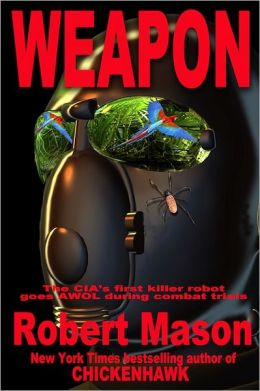
And speaking of Cylons, they’re another form of robot common in science fictions: the killer robot. Arguably, these sorts of robots are more common in twenty-first century science fictions (horribly old-fashioned Hugo-nominated stories by Mike Resnick notwithstanding). Robots make an excellent enemy because they are implacable – unlike humans, or even aliens, they will not stop, they cannot surrender, and you can destroy as many of them as possible without worrying about the morality of it all. Likewise, generals can sacrifice countless numbers of robots for the most trivial of gains, and it doesn’t really matter since they’re little more than smart bombs. It’s the machine-nature of war-robots that is stressed, and not their human-like qualities. Owning people, it seems, is fine in sf, but the genre still feels some small qualms at killing them in great numbers.

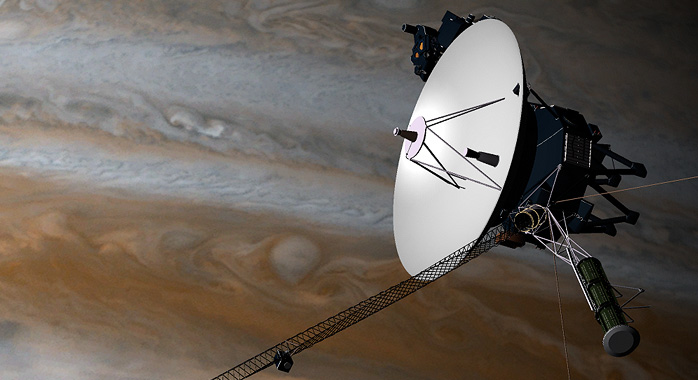
Of course, real robots are not people. No matter how sophisticated their programming, the code which drives them is still a series of IF and WHILE and FOR loops. Any operation they perform must be part of their programming… or they can’t do it. Even if they do have the right snazzy tool fitted to one of their manipulator arms. Smartphones are pretty damn clever devices, but no one would ever consider them more than a machine. The same is true of supercomputers, Voyager 1, Curiosity, a UAV or those dancing industrial robots in that old Volkswagen advert.

voyager

Perhaps people think there are no dramatic possibilities, other than in military sf, in robots-as-machines. Perhaps that’s why authors and film-makers have their robots look and behave like human beings. But once upon a time, science fiction’s spacecraft all used to resemble pointy rockets, of the sort painted by Chesley Bonestell in those Collier’s Magazine articles by Wernher von Braun. Look at the cover art of any late twentieth century or twenty-first century science fiction novel, however, and you’ll now see a huge variety in sizes, shapes and designs of spaceships.

What I think would be interesting would be to ditch the anthropomorphic robot, the ersatz human, with all its dodgy moral baggage, and instead treat robots as they actually are – like space probes, CNC machines, UAVs: ie, accept that they are products of their programming, they are tools, very sophisticated tools, but ones which can only perform tasks for which they have been designed and programmed. After all, it’s the twenty-first century, we shouldn’t be presenting worlds in which people, artificial or otherwise, are enslaved; we should be creating visions of the future in which technology plays a true role, is not just setting or a piece of hand-wavery used to justify magical maguffins. Far too many science fictions use genre tropes as little more than window-dressing for stories based on historical templates and loaded with historical baggage.


4 Comments

Science fiction under pressure

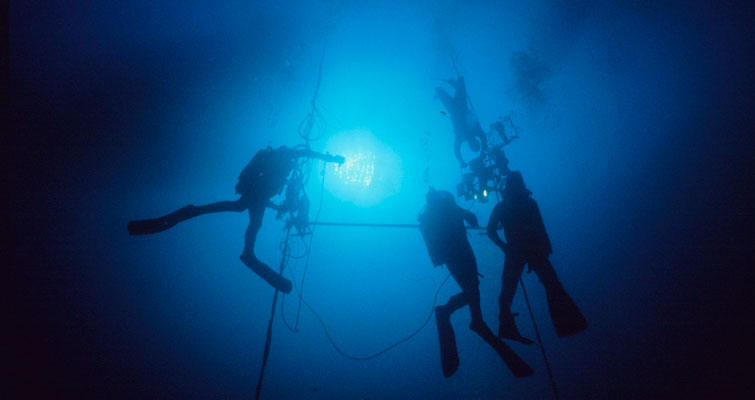
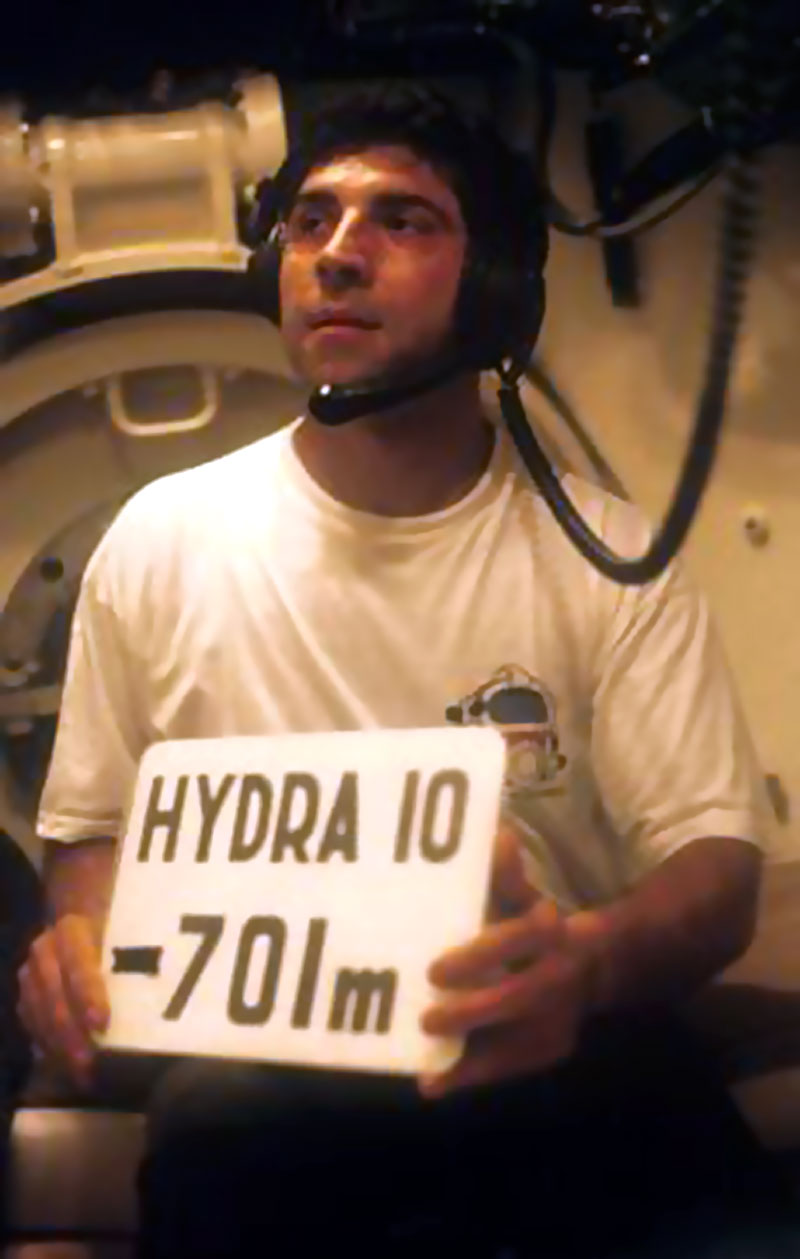
As a species, we have little experience with naturally hostile environments, a century’s worth perhaps. By “hostile”, I don’t mean environments such as the Arctic, which are uncomfortable, or could prove fatal without basic survival tools. I mean environments which are pretty much instantly lethal without complex technological assistance. Human beings have to date visited two: space (including the lunar surface) and the sea deeper than 200 metres below the surface (it’s actually shallower than that, but the depth record for free diving currently stands at 214 m).

A scene from Luc Besson's The Big Blue

A scene from Luc Besson’s The Big Blue

Science fiction has covered the first of these in countless stories and novels, with varying degrees of accuracy. But no reader of sf doubts the hazardous nature of outer space. While all too many science fictions present magical technology allowing human beings to live and work and make war in space, there’s still a background of ever-present danger. In fact, it’s almost become a cliché.

But what of the opposite extreme? High atmospheric pressure rather than vacuum? Certainly the former have been covered in science fictions, though the genre tends to treat it as much the same as the latter – ie, both are survivable when wearing a spacesuit. But spacesuits are actually just personal spacecraft, designed for the same environment as spacecraft – ie, space. (If that’s not belabouring the point a bit much.) They provide a self-contained atmosphere and protection from radiation. A spacesuit wouldn’t work on a planetary surface with a datum pressure of, say, 50 atmospheres. It would be unwearable, constricted by the gas pressing against every square centimetre, its joints locked since they are designed to maintain a constant internal volume. When submarines get squished when they sink too deep in the sea? That’s what would happen to a spacesuit… and the person inside it.

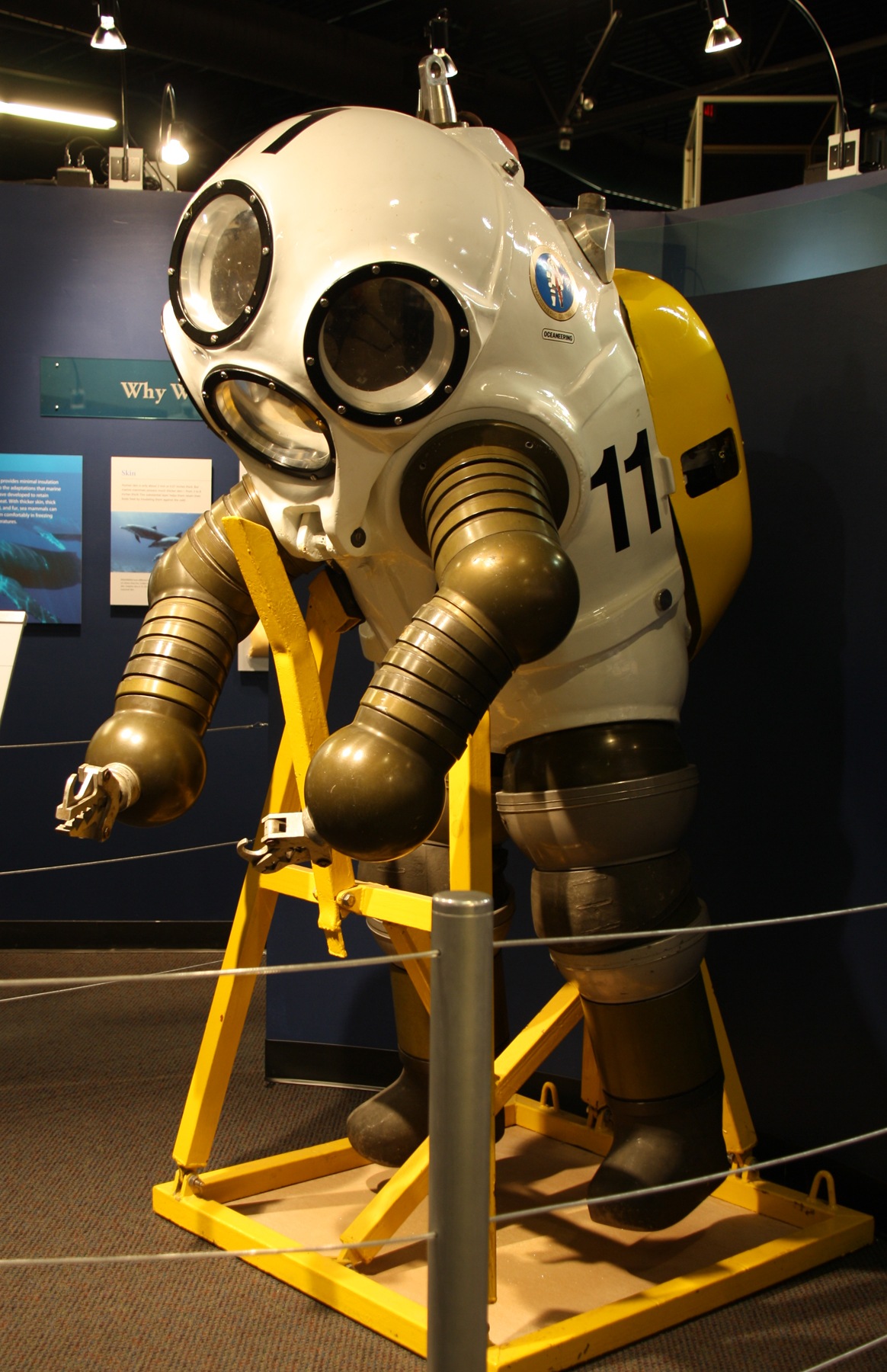
A JIM suit

A JIM suit

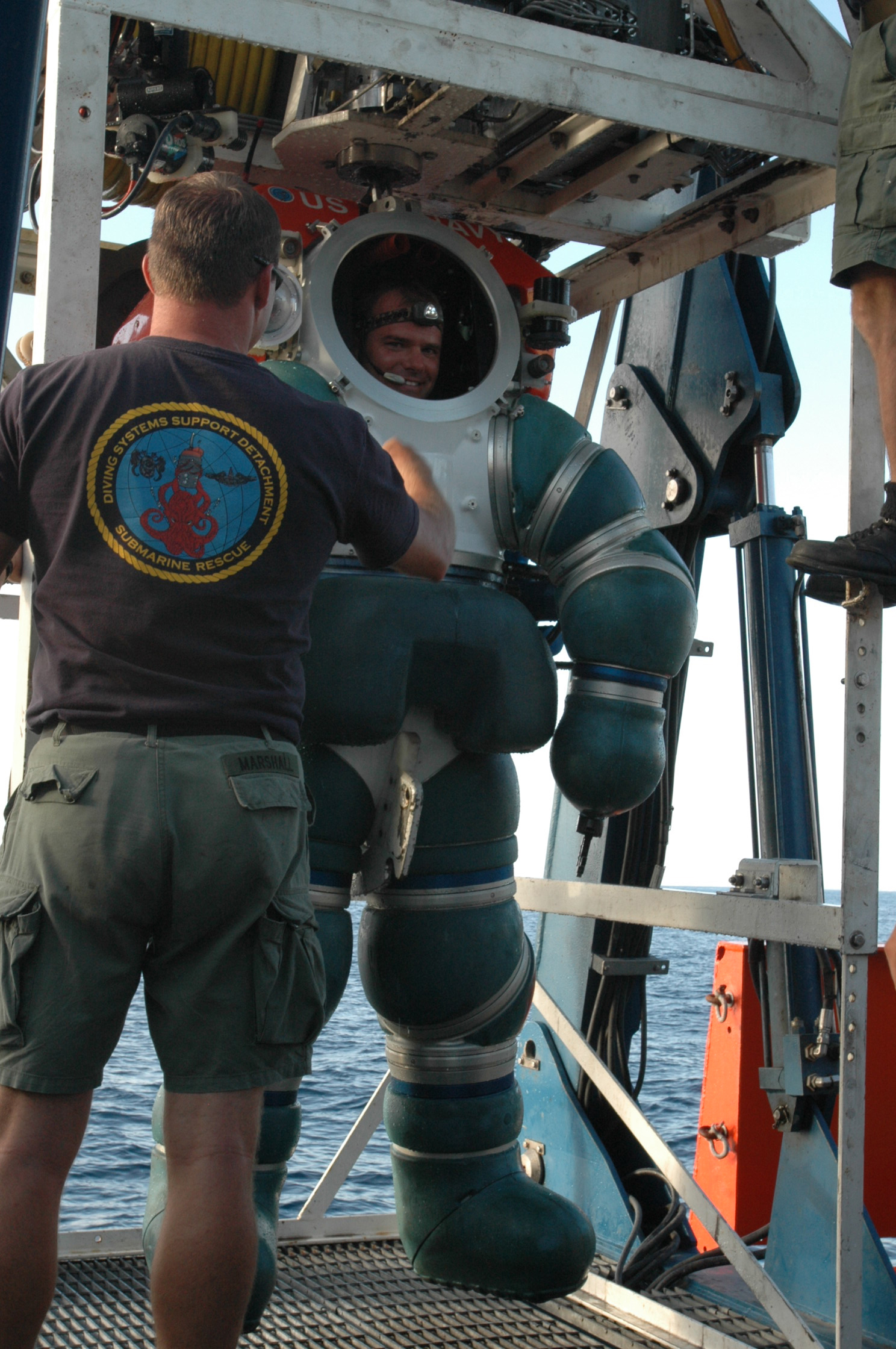
Which doesn’t mean hyperbaric environments would necessarily be out of reach. One solution would be to use an Atmospheric Diving Suit, which is much like a spacesuit but designed to keep pressure out rather than in. The current depth record in an ADS is 610 m (2000 ft), which is 61 atmospheres. Perhaps with the advent of new and stronger materials, or some sort of force-field, environments with much higher pressures would be accessible to someone in an ADS.

Chief Navy Diver Daniel P Jackson in the Hardsuit 2000

Record holder Chief Navy Diver Daniel P Jackson in the Hardsuit 2000

The only recent example that comes to mind of a sf novel set (partly) on a world with a hyperbaric environment is Alastair Reynolds’ On the Steel Breeze (2013), the second book of his Poseidon’s Children trilogy. Several chapters take place on the surface of Venus, which, as well as a mean surface temperature of 462° C, has a surface pressure of 92 to 95 atmospheres. In the novel, some of the characters go EVA on the surface, an apparently not uncommon pasttime, in “surface suits”:

The suits were essentially ambulatory tanks. They were glossy white, like lobsters dipped in milk. They had no faceplates, just camera apertures. Instead of hands, they had claws. Their cooling systems were multiply redundant. That was the critical safety measure, Chiku learned in the briefing. Death by pressure was so rare that it had only happened a few times in the entire history of Venus exploration. (p 128)

Clearly – refrigeration aside – Reynolds’ surface suit is much like a beefed-up ADS, and in no way resembles a spacesuit. Which is as it should be.

But what if a closer interaction with the environment is required? Perhaps there’s a need for something more dextrous than “claws”? Or human beings must be as unencumbered as possible in order to live and work in this hyperbaric environment. Obviously not the surface of Venus, but perhaps somewhere less extreme…

Theo Mavrostomos at a simulated depth of 701 m

Theo Mavrostomos at a simulated depth of 701 m

You can saturate a human body up to pressures around 70 atmospheres – that’s the current record, set during a simulated saturation dive by Theo Mavrostomos in 1992. He spent two hours at a depth equivalent to 701 metres (2300 feet). The term “saturation” means the person’s tissues have absorbed the maximum possible partial pressure of gas. A sudden return to normal atmospheric pressure would result in explosive decompression. A too-quick return would cause the absorbed gas to bubble out of the person’s tissues – the “bends”, or decompression sickness, which can be fatal. There are other hazards associated with hyperbaric environments. At pressures above 5 atmospheres, nitrogen causes nitrogen narcosis, or “the rapture of the deep”; and at pressures higher than 15 atmospheres High Pressure Nervous Syndrome can affect people breathing helium-oxygen mixtures.

A pair of North Sea saturation divers

A pair of North Sea saturation divers

High pressure air is extremely difficult to breathe – not just the physical act of drawing it into the lungs, but also the lungs diffusing it into the blood. By using a less dense gas, such as helium, to maintain the correct partial pressure of oxygen (too much oxygen is poisonous), the human body can handle greater pressures. But this also presents its own set of problems – there’s HPNS, but also helium’s excellent conductivity of heat, not to mention the shortening of sound wavelengths resulting in the infamous “Donald Duck” voice (at the limit of saturation diving, this can make divers pretty much unintelligible). HPNS can be mitigated by adding some nitrogen back into the mix, and “unscramblers” are used on the radio links to divers but these are not wholly effective. There is no solution to helium’s conductivity other than bloody great heaters scattered throughout the saturation system.

At present, we’ve about reached the limit possible with saturation diving. In the oil industry, working at depths of 100 to 250 metres (320 to 820 ft) is routine. Deeper than 450 metres (1500 ft), ROVs are used. Greater pressures than 70 atmospheres may be possible – perhaps by using hydrogen, which has half the atomic weight of helium. Unfortunately, hydrogen is extremely flammable, although some helium could be added to render it safe. French diving company Comex consider it possible to reach depths of 1000 metres (3281 ft), or 100 atmospheres, using a hydrogen mix, but no one has tried and there’s currently no impetus to do so.

A still from Ridley Scott's Alien

A still from Ridley Scott’s Alien

Where this gets interesting is that, as far as I know, no one has used this in science fiction. While hyperbaric environments, or dense atmospheres on high-gravity planets, perhaps even gas giants, have undoubtedly been used, it’s either been with some science-fictional equivalent of a ROV, or magical spacesuits which operate as well in 100 atmospheres as they do in a vacuum, or perhaps even a kind of armoured suit capable of withstanding great pressure like a souped-up ADS. Dense atmospheres seem mostly to appear in science fiction only as settings for winged aliens or humans, such as in Vonda N McIntyre’s ‘Fireflood’ (1979) or Wings’ (1973; see here). Gas giants are quite common in sf, though mostly the action takes place in their upper atmosphere. One that doesn’t is Poul Anderson ‘Call Me Joe’ (1957), in which a disabled operator “drives” a ROV on Jupiter’s surface – James Cameron used a similar idea in Avatar (2009).

But sf typically treats alien worlds – what we now call exoplanets – as either extensions of space, or Earth-like, or near enough Earth-like not to make any difference. Those hardy explorers of countless science fictions often have little more to deal with than inclement weather, although perhaps one or two might need a breathing mask… No one has ever thought of the Earth’s surface as remotely like space – it’s an environment entirely distinct, and although it covers a wide range of conditions they’re all survivable. So why no variety in alien worlds? Ignorance initially, almost certainly; but then it becomes about the story, about some “alien” aspect of the exoplanet which drives the plot, as in Marion Zimmer Bradley’s Endless Voyage (1975; see here). Yet, allegedly, science fiction is about science and technology, and how we use it…

Mars Arctic Research Station

Mars Arctic Research Station

Surely it would be more interesting to explore the techniques and technology that might be used to explore, or perhaps even colonise, an environment that is neither Earth-like nor vacuum? A saturation system strikes me as a perfectly suitable method to use in a hyperbaric environment; and one that is filled with dramatic possibilities. Just think, you could murder someone by knocking them out and them putting them in a balloon’s gondola… Too much science fiction, to my mind, fails to get across the true experience of the strange environments in which it takes place. It’s passed off as “setting” using a few incidental details, but in all other respects treated as if it were, say, middle America, or the Wild West. A more rigorous approach to such things would be far more interesting.

Of course, it’s not just exoplanetary environments. There’s certainly science fiction set underwater at great depth (see my earlier blog post on the topic here), but most such sf imagines that human beings have been physiologically engineered to survive in that environment. But, as far as I’m aware, no one in sf has made the mental leap from deep sea to hyperbaric planetary surface.