I like stories that play around with the structure of their narrative. I like reading them, I like writing them. I particularly like the way they allow you to hide things, so you can drop them all on the reader at the end and blow their mind. I call that the B-52 Effect – not after the bomber but after the drink, which you knock back and it sort of goes whoommppfff when it hits your stomach. If I can do that in my fiction, then job done.
While I was thinking about interesting narrative structures, it occurred to me it’s not something genre fiction does often, but when it does it generally does it quite well. And I tried to think of ten excellent novels that boasted interesting narrative structures. But I could only think of five:
Lord Byron’s Novel: The Evening Land, John Crowley (2005), has perhaps the most common form of non-linear structure used in genre fiction, comprising two separate narratives – one of Byron’s fictional novel, which is also glossed with historical notes; and the second narrative is an email exchange set in the present about Byron’s life and his novel. One narrative informs the other and is in turn informed by it. I like that.
Ash: A Secret History, Mary Gentle (2000), shares a similar structure to Crowley’s novel, in that the main narrative is – perhaps – a fictional work about the title character, and this is wrapped within another narrative which comments on Ash’s narrative and is in turn changed by her narrative.
Use Of Weapons, Iain M Banks (1991), famously has two narratives intertwined and chronologically opposed – one moves forward in time, like your average normal linear plot; but the other alternates with it and moves backwards in time. It makes for a mind-blowing climax, but sadly it’s a single shot: once you know the ending, you’re not going to get that B-52 Effect again.
The Dispossessed, Ursula K Le Guin (1974), equally famously has a non-linear structure narrative, with alternating chapters set on each of the story’s two worlds, Anarres and Uras, but not in chronological order. According to the Wikipedia article on the book, the chapters if re-ordered chronologically would go: 2, 4, 6, 8, 10, 12, 1, 3, 5, 7, 9, 11, 13.
Synthajoy, DG Compton (1968) is, given that I’ve only read eight of Compton’s seventeen sf novels, the only one I’ve read so far that isn’t a two-hander. Most have a pair of protagonists, typically one male and one female, and the viewpoint alternates between them. Interestingly, in The Steel Crocodile the sections overlap so the reader sees events from both viewpoints. Synthajoy, however, has a single POV. At the start of the book, the protagonist is in an institution being “cured” after committing a crime. The narrative then starts to seamlessly slide into the past and describes the events that led up to the crime, and throughout the novel drifts back and forth between the two narratives. It is very cleverly done.
There are surely other genre novels with narrative structures other than the bog-standard linear beginning-to-end plot, but I’m having trouble thinking of good ones. There are fix-up novels, of course, though there’s nothing especially interesting in that as a structure. And both The Fifth Head of Cerberus and Icehenge comprise three loosely-linked novellas, and are both very good and cleverly done. Literary fiction is much more adventurous in this regard and two examples leap immediately to mind: Cloud Atlas and Girl Reading. Anyone else have any examples worth mentioning?
And there’s me thinking I’d given up commenting on the books I’d read here on my blog…
Sunburst, Phyllis Gotlieb (1964). A review of this will be going up on SF Mistressworks this week (need MOAR REVIEWS, btw. Volunteer. Please.) Garish cover art, a strapline that reads, “A fiendish race of demonic children is spawned in the genetic chaos of a runaway nuclear explosion”, a thirteen-year-old girl as a protagonist, and a prose style that feels two decades earlier that its publication date… It’s actually not bad.
The Maltese Falcon, Dashiell Hammett (1930). This is allegedly the best crime noir novel ever written, which doesn’t say much for the genre. I knew the story from the Bogart film, and was surprised at how faithful an adaptation it proved to be. There’s a feeling throughout the story that Hammett was blithely making shit up… and then there’s this section on the history of the eponymous bird which names various mediaeval texts and it all seems very convincing. I liked Gutman, and Hammett did a good job with his dialogue. Spade was a cypher, and I was soon sick to death of reading about his “wooden features”. Couldn’t get a handle on the femme fatale or Joe Cairo. The functional prose was, at best, functional. The film is better.
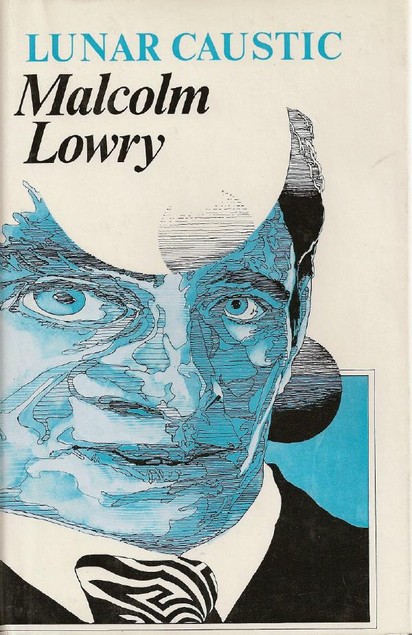
Lunar Caustic, Malcolm Lowry (1968). Which is perhaps chiefly interesting because of its publishing history. An early version of this novella was accepted for publication in Story magazine in the 1930s, but Lowry called it back. And continued to work on it. I can sort of understand the impulse. When Lowry died in 1957, he left behind several manuscript versions, and his wife and Earle Birney, a neighbour and university professor of English, spliced together this 1968 edition out of them. It’s set in a psychiatric hospital in New York and is, like much of Lowry’s fiction, partly autobiographical. There are moments of genius in it, though it does feel somewhat slight compared to some of his other novella-length fiction, especially ‘Through the Panama’. Also, its publication history has disguised the fact that it’s set in 1936, when Lowry checked himself into Bellevue Psychiatric Hospital (though he started work on it in 1934, on his arrival in New York). As a result, it feels weirdly old-fashioned for its time – given its publication year it’s tempting, for example, to read it as a contemporary of One Flew Over the Cuckoo’s Nest, which suggests that psychiatric hospitals changed very little in the intervening three decades. Lunar Caustic was intended to be a part of a seven-novel sequence, The Voyage That Never Ends, which would I suspect have been a major work of English literature. As it is, we can only treasure what little we have.
The Watcher, Jane Palmer (1986). And this one I did review for SF Mistressworks and you can see my review here.
Girl Reading, Katie Ward (2011). A very impressive debut, and almost certain to end up on my top five books of the year. I wrote about it here.
Sion, Philip Boast (1999). Boast’s weird alternate secret biblical histories are something of a guilty pleasure, but I think this one pushed the weirdness factor a bit too far. It’s set in Biblical Judea, and told from the point of view of Mary Magdalene. Except she’s not really Mary Magdalene. Whoever she is, she has lived before, and remembers historical events dating back to Moses and Abraham, and even much, much earlier. In Sion, Joseph and Mary belong to a sect, but Jesus also has brothers and sisters. And it was Jesus’ brother James who is considered the messiah of prophecy. But Jesus truly is the Son of God, although his message of love is anathema to the sect and to their conception of a messiah. Jesus marries Mary Magdalene, and after the crucifixion, Mary and child escape to France. The story is then narrated by their son, Jude, who travels and eventually discovers the Ark of the covenant and its secret. He dies and then becomes a disembodied intelligence who leaps from body to body, occasionally meeting up with his mother, who is apparently doing the same. The final section explains that Mary was a passenger aboard an asteroid starship crossing through this universe, but which crashed and stranded a group of them on prehistoric Earth. Or something. It’s not entirely clear. It’s a shame the book is so unbalanced, with far too much of the narrative spent on too detailed a description of Mary’s time in Judea. It’s only when Jude appears that it picks up pace, but even then it throws away the entire point of the plot in a hurried final section. Disappointing.
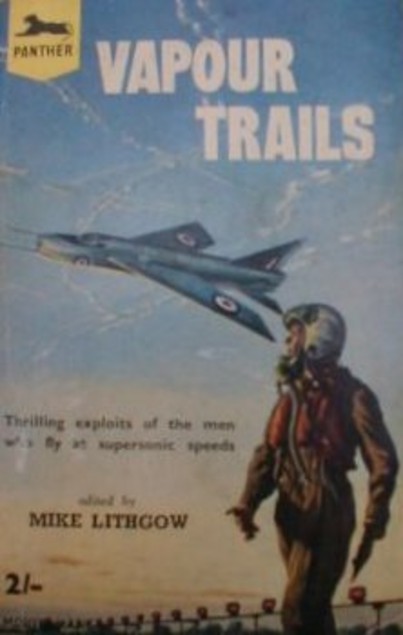
Vapour Trails, Mike Lithgow, ed. (1958). Funniest book I’ve read all year. It’s a series of essays about test piloting by British pilots of the day. You get the impression that a number of the anecdotes they recount have seen plentiful use in after-dinner speeches. The more astonishing incidents are those set during the really early days of aviation, where anyone with sufficient money could buy a plane and learn to fly it themselves. One test pilot, for example, tells of an incident in the 1920s at an airfield where he worked. A wealthy German had bought himself a Blériot plane and was learning how to fly it. Blériots, apparently, could manage an altitude of 200 feet on warms days, but only 20 feet on cold days. The German set off across the airfield in his plane, and eventually took off. Just as he was about to clear the hangars, he turned off his engine… and the plane promptly crashed. When asked why he’d turned off the engine, he explained he’d picked up a tail wind and thought that was enough to keep him flying… Recommended, even if you’re not an aviation buff.
The Ascendant Stars, Michael Cobley (2011). Is the third and final book of Cobley’s Humanity’s Fire space opera trilogy, and notable among such types of books in that it actually resolves the plot and leaves pretty much everything neat and tidy. In the previous two books – Seeds Of Earth and The Orphaned Worlds – Cobley went slightly berserk and set so many balls spinning, it was hard to keep track of them all. There was the invasion of Darien by an imperialistic alien race, there were the cyborg Legion of Avatars imprisoned in hyperspace and about to break free, the lost human colony who have been operating as mercenaries for the bad guys but have now schismed, the planned terrorist attack which turns out to be much more than it seems, and I forget what else. And it appears it’s all a feint or something because the Godhead, a vast machine intelligence resident in hyperspace, wants to transcend and needs to blow up fifty suns to do so. Cobley handles his large cast with deftness, there are some nicely-written set pieces, and his universe contains plenty of variety and diversity. However, and perhaps it’s just me, but it all feels a bit tired. The Humanity’s Fire trilogy is an accomplished space opera trilogy, but I’ve lost faith in the subgenre, in its “anything goes” ethos, its “chuck everything in” world-building… I think we’re seeing the end of new space opera, British or otherwise. It’ll either settle into a rut, much as high fantasy has done for the past twenty years, or it will slowly fade away. It already feels a bit like the twentieth century, ie a progressive experiment that people are inexplicably turning their back on – cf Leviathan Wakes. Regression is not the next step. We need something new to come along, and I think, and hope, we may be seeing New Hard Science Fiction poised to take its place…
I forget where I saw mention of Lydia Netzer’s Shine Shine Shine. I’m pretty sure it wasn’t on one of the many blogs I read, nor by one of the people I follow on Twitter. It certainly wasn’t recommended to me by Amazon – I forget the last time I bought a book by an author unknown to me because it was recommended by Amazon. Wherever it was, the précis of the plot was enough to pique my interest, as the blurb says: “This is the story of an astronaut lost in space, and the wife he left behind”. Since the fourth book of my Apollo Quartet, All That Outer Space Allows, will be about the wife of an Apollo astronaut, I was both intrigued by Shine Shine Shine as well as having a “professional interest” in it.
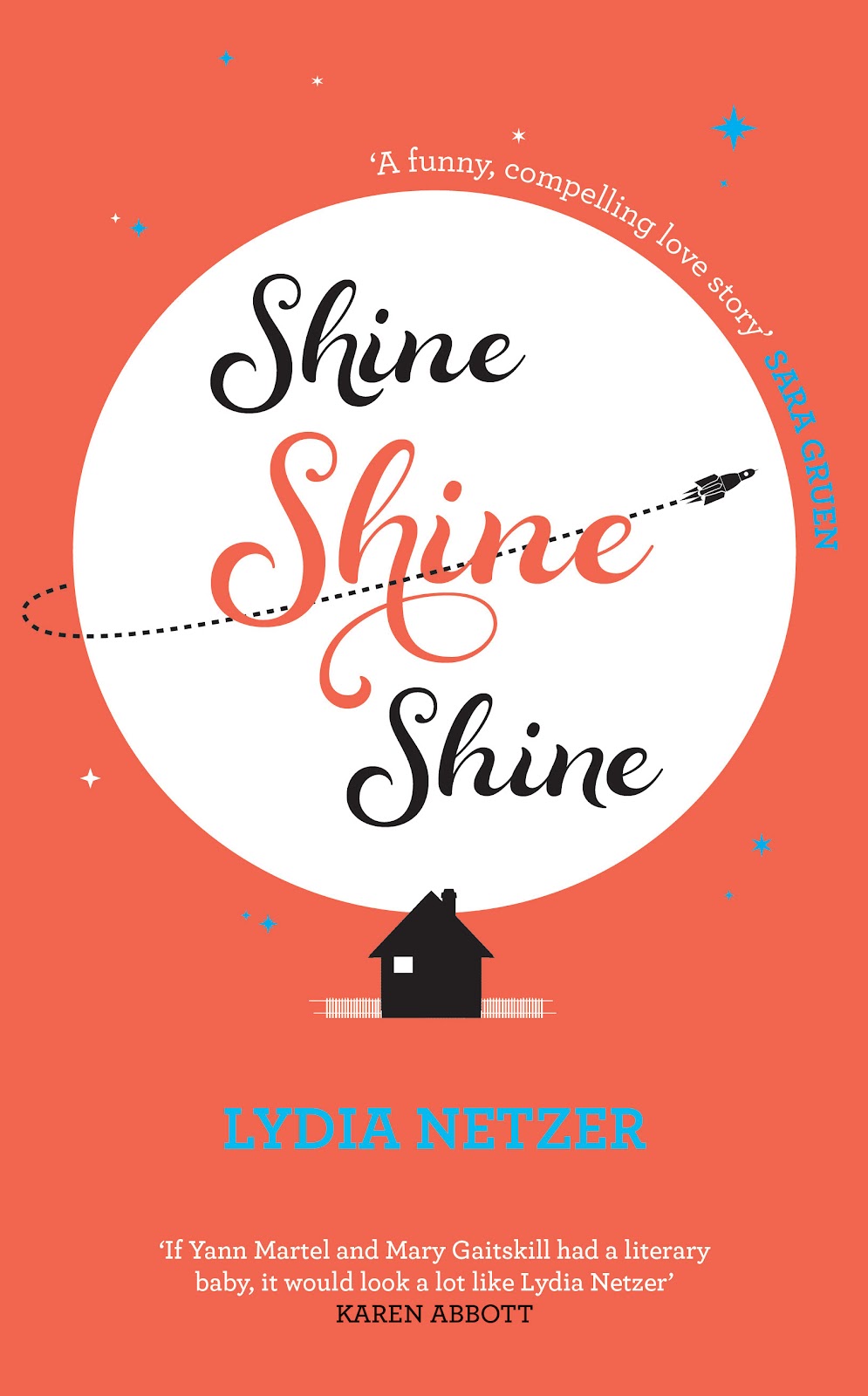
Happily, it was on half-price promotion in Waterstone’s, so I bought a copy. The cover is,um, very pink, and it doesn’t look anything like a novel featuring an astronaut. Nor did I recognise any of the names who have blurbed the book. But never mind, the story still sounded like it might appeal.
UK cover
But, oh dear. The novel opens:
Deep in darkness, there was a tiny light. Inside the light, he floated in a spaceship. It felt cold to him, floating there. Inside his body, he felt the cold of space. He could still look out the round windows of the spaceship and see the Earth.
This doesn’t bode well. The novel is set in the very near-ish future, though it’s depicted as the present day for all but the fact of mission to the Moon, but that’s language straight from the science fiction of yore. In fact, everything in the novel about the Moon mission is, well, wrong. Plainly Netzer has done no research on it – her prose has zero authority when discussing the astronaut husband. She gets the physics wrong, she gets other details wrong. One of the crew, for example, is a lieutenant commander in the US Air Force. Except lieutenant commander is a naval rank. The USAF equivalent is major. That’s shoddy craft.
And yet, there are things to like about Shine Shine Shine. It’s very “creative writing class” in places, but Netzer has created an interesting protagonist in Sunny, a young pregnant Virginia housewife with alopecia and a son with Asperger’s, whose decision to not hide her alopecia kicks off the story. Her early childhood is not especially convincing, but the sections set in the foothills of the Appalachians in western Pennsylvania, where Sunny and Maxon, her husband, meet as children are good. Maxon, the roboticist turned astronaut, also has Asperger’s, and is depicted throughout as very close to a robot himself. He’s also a genius, a Nobel prize laureate, and a millionaire. While Maxon is handled quite well, all this is just over-egging his character.
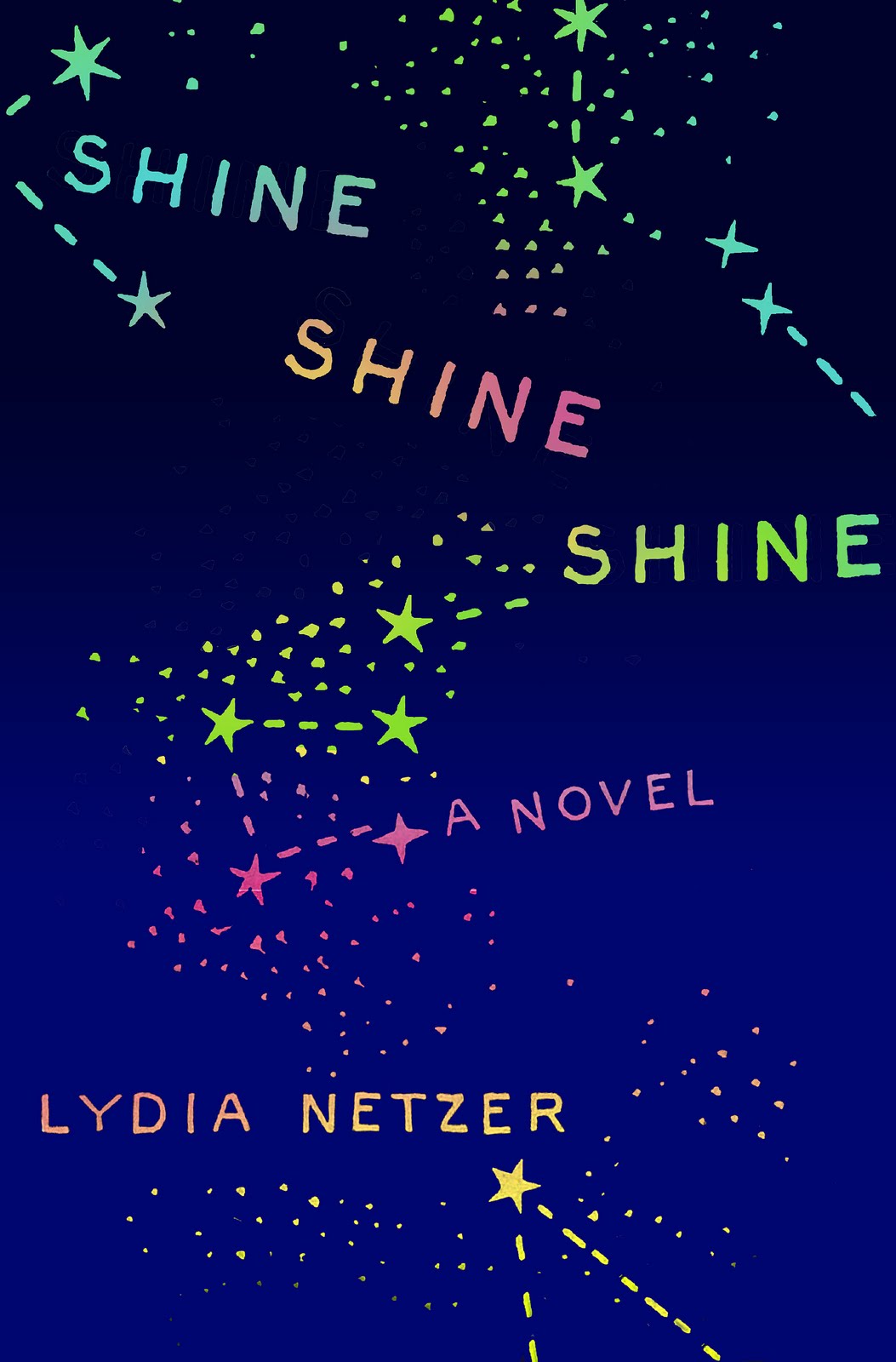
US cover
In fact, the entire story is a little over-egged. It opens with Sunny involved in a minor car accident. Her wig flies from her head. So she decides to no longer wear it. Her Virginia housewives circle, of course, did not know she was bald. Sunny has tried so long to be “normal” – hiding the fact of her baldness, using her husband’s genius to excuse his inability to interact with people, organising her neighbours and becoming a pillar of the local community.
Meanwhile, she is heavily pregnant, her husband is on his way to the Moon to oversee the creation of the first robotic colony there, their son, Bubber, has severe Asperger’s but is likely a savant of some kind, and her mother is on life support in hospital, her body riddled with cancer. A meteor strikes the spacecraft Maxon is aboard, stranding the crew in cislunar space (I think – the astrographics is nonsense throughout). Back on Earth, Sunny tries to hold her family together in the face of these threats, and attempts to find the person she was before she subsumed herself in the role of Virginia housewife. Her story is interspersed with flashbacks, describing her birth and early childhood in Burma (her father was a missionary), and her life as a child in Pennsylvania, living next door to Maxon and his hillbilly family of – I think – meth-makers.
Shine Shine Shine could have been an excellent novel, but it’s let down by a lack of research and a consequent lack of verisimilitude. True, not every reader is going to be as critical of the spacecraft-set parts of the novel as myself, but writers should always strive for verisimilitude. Research, research and then research some more. They say “write what you know”, but that’s complete rubbish. If everyone did that, literature would be very dull indeed. But that doesn’t mean you can make shit up when it’s easily checkable. Doing that only makes you look a fool – cf Dan Brown. If Maxon’s career had been in any way convincing, Shine Shine Shine would have been greatly improved. As it is, the novel reads like a thesis for a Creative Writing MA. Disappointing.
Last night I was in Leeds seeing Opeth perform live. Opeth, of course, are Swedish. But they were supported by Anathema, a British band whose lack of major success continues to astonish me. They should be filling stadiums. It’s the fifth time I’ve seen both bands, but the first time they’ve toured together.
But, Anathema. They started out in 1990 as the doomiest of doomy metal bands, but by their third album in 1996 had morphed into a sort of alternative metal / goth rock / prog rock sort of band. They’re not easy to pigeonhole, nor are they relentlessly non-commercial. The reverse, in fact. In recent years, they seem to have drifted a little towards Radiohead territory, though I think they’re a great deal better than that band. In evidence, here’s ‘Untouchable Part 1’ from their last album, Weather Systems. They played it last night. It was bloody good.
As for the venue, the less said about that the better… The gig took place in the Leeds Metropolitan Universe Student Union. Capacity is allegedly 1100, but I’d guess safe capacity is about three-quarters of that. The place was packed solid – so much so that if you left the room, you couldn’t get back in. And the ventilation appeared to be off, as well. Ten minutes into Opeth’s set, the room was like a sauna. People were leaving because it was too hot. The organisers apparently knew this because they lined up free cups of water along the bar.
Also, during the thirty-minute break between bands, only one half of the bar was open, so it was immediately 10 deep and so impossible to get served. Student Unions generally make piss-poor venues for gigs – most seem to have been designed by idiots, complete warrens with toilets miles from the bars, unnecessary staircases, too small rooms, and always run on the cheap. Leeds Met was no exception. It’s a shame: it could have been an excellent gig, but the venue ruined it.
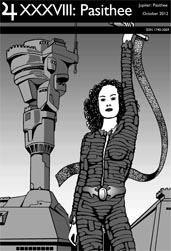
Jupiter XXXVIII: Pasithee is now out and features six excellent short stories, and a small poem by Yours Truly. The poem is titled ‘Rainbow Mars’ and is chock full o’references to the Red Planet of fact, fiction and myth.
It’s worth getting hold of Jupiter. It’s published some very good fiction over the years, and has maintained an enviably regular publishing schedule.
It’s not just the Europeans and their bandes dessinées who produce science fiction in comic form. In my previous post (see here), I mentioned the UK’s anthology comics, such as 2000 AD or Starlord. There have been also many other sf comics and/or graphic novels published over the years. Here are the ones I own. Some are British, some are American, some are by British writers working for American publishers…
Ron Turner was a stalwart of the British comics scene, especially science fiction, with a career stretching from 1936 until his death in 1998. Rick Random, Space Detective, was created in 1953 for Super Detective Library, a collection of small comic books much like Commando and War Picture Library. Random appeared in 27 books between 1954 and 1957, but his adventures were later reprinted in a variety of venues, including 2000 AD summer specials. There was even an all-new story in 2000 AD in 1979. The book pictured collects ten of Random’s adventures, all but one drawn by Turner. No writing credits are given, but Harry Harrison is known to have written for the series.
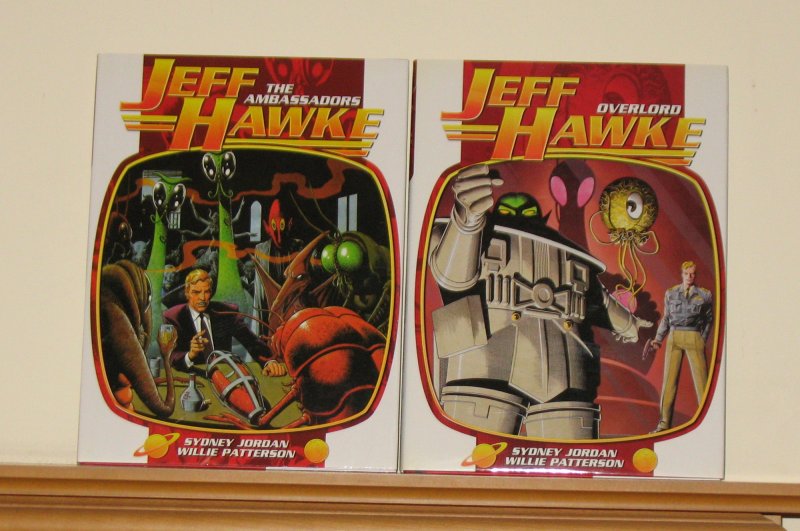
Another important venue for sf comics in the UK was newspapers. The tabloids would often feature a number of strips, some of which were ongoing serials. Jeff Hawke, who appeared in the Daily Express between February 1955 and April 1974, was created and drawn by Sydney Jordan. Titan Books published two of the stories back in the mid-1980s, but the above two are much more recent. They’re worth getting hold of.
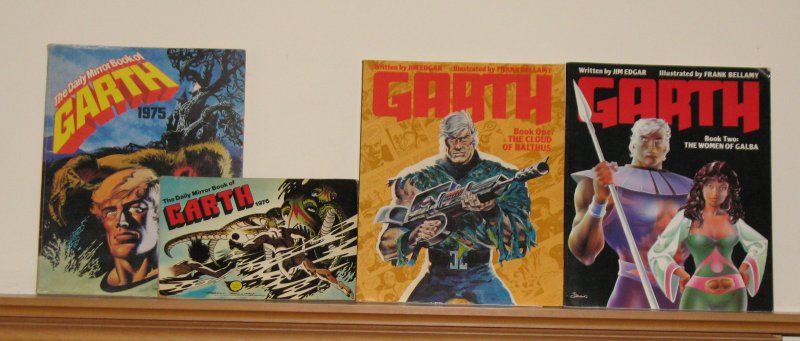
Another excellent sf strip from a newspaper is the Daily Mirror’s Garth. This ran from 1943 until 1997, but it’s the Frank Bellamy version I remember best. He drew it from 1971 to 1976 (my grandfather subscribed to the Daily Mirror, and I’d read the strip whenever I visited him). In the mid 1980s, Titan reprinted two stories in individual volumes – The Cloud of Balthus and The Women of Galba (ignore the awful cover art). The Daily Mirror only published two Garth annuals, in 1975 and 1976 – both are shown. Given there are 165 Garth stories, it’s about time someone did a proper job of collecting and republishing them.
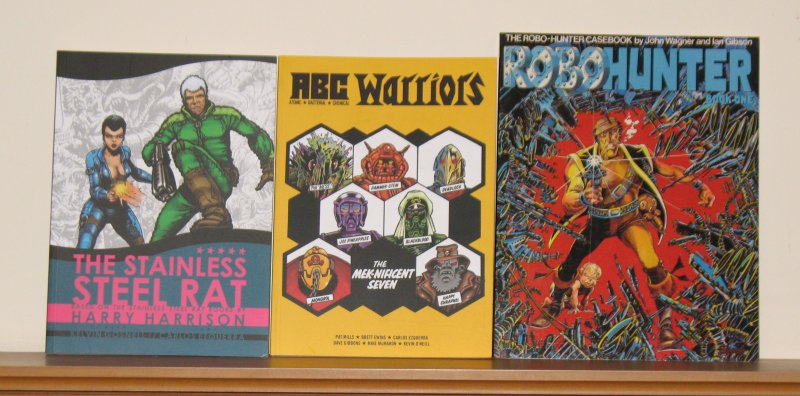
And then there’s 2000 AD, which has been publishing issues constantly since 1977. I used to subscribe to it back in the late 1970s/early 1980s, and I have fond memories of many of the strips it featured. Which is what prompted me to buy the above. Robohunter is an old Titan Books reprint I bought back in the 1980s. The other two are more recent and were published by Rebellion, 2000 AD’s publisher. Sadly, it’s never wise to revisit things you loved when you were younger. The Stainless Steel Rat may be an improvement on the books, but that’s not saying much, and the adaptation misses out a couple of important plot points. ABC Warriors has its moments, but it’s really just a derivative mash-up of half a dozen war movies, with crap dialogue to suit.
Luther Arkwright is the work of Bryan Talbot, and appeared in a limited series comic in the late 1980s. It was collected as a trade paperback in the late 1990s, and a sequel Heart Of Empire was published soon after. It’s a New worlds-ish steampunky alternate worlds sf sort of thing, and it’s quite brilliant. Every self-respecting sf fan should own a copy. In fact, they should own copies of everything Talbot has done.
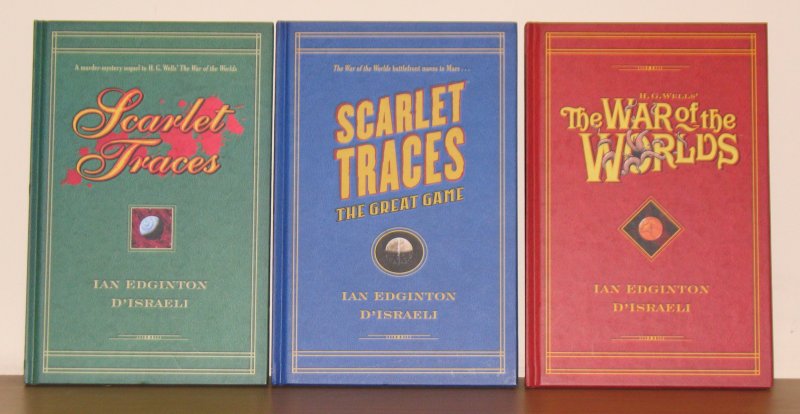
Also brilliant is Scarlet Traces and its sequel, The Great Game, a story set in Victorian Britain after Wells’ Martians have succumbed to the common cold. The British Empire has reverse-engineered the Martian technology and as a result maintained its technological and global preeminence. Later, Edginton and d’Israeli adapted Wells novel as a sort of prequel to their series.
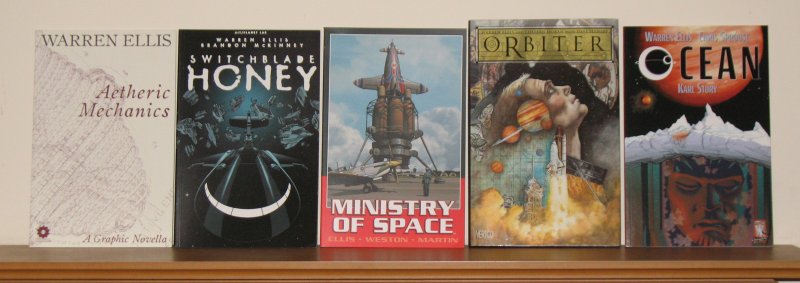
Warren Ellis is British, but much of his work has been done for various US comics publishers. Several of the mini-series he has written are science fiction – such as the above. Ministry of Space, an alternate history story in which the British have a post-war space programme is especially good. Not shown are Ignition City and Anna Mercury, which a friend is currently borrowing.
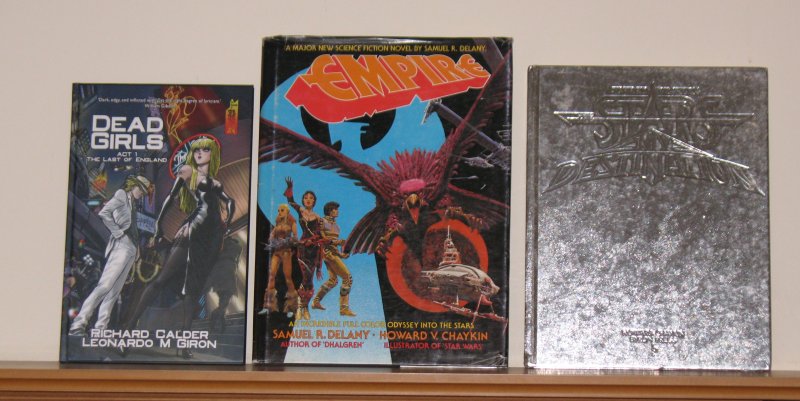
Sf novels occasionally get the graphic novel treatment, although not always successfully – or rather, the project is not always completed. The silver book above is the graphic novel of Alfred Bester’s The Stars My Destination, drawn by Howard Chaykin, from 1979. It’s signed by Bester, Chaykin and Byron Preiss. It’s also only half of the novel’s story. A concluding volume was never produced. Empire shares a title with a Samuel R Delany novella, but the story Delany wrote for this Chaykin-illustrated story is not that ‘Empire’. Dead Girls is the first volume in an adaptation of Richard Calder’s novel of the same name, published House of Murky Depths. It originally appeared as a strip in the magazine Murky Depths, which has since ceased publication. The graphic novel will, however, continue. The edition shown is signed and numbered.
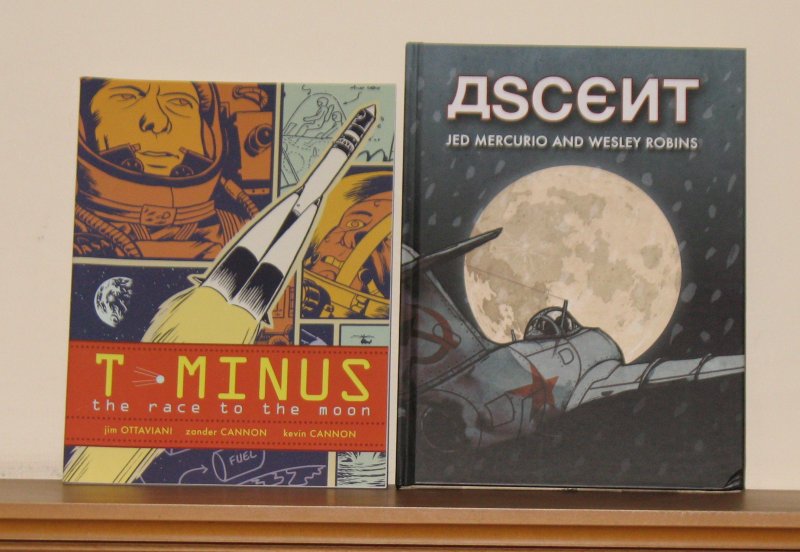
Jed Mercurio’s Ascent is one of my favourite novels, but sadly this graphic adaptation fails to capture what I like about the book. T-Minus is a comic-book potted history of the Space Race and is quite good.
Night And The Enemy is an illustrated short story, written by Harlan Ellison and illustrated by Ken Steacy. The Sacred and the Profane is a graphic novel, written by Dean Motter and also illustrated by Steacy, which first appeared in Star*Reach from 1977 to 1978. In the 1980s, Motter and Steacy rewrote, redrew and coloured it, and it was published in Epic Illustrated – which is where I saw it for the first time. (I used to buy issues of Epic Illustrated and Heavy Metal during the 1980s when I was passing through Schiphol, travelling to and from the Middle East.) The collected edition above is signed and numbered. It’s also very good.
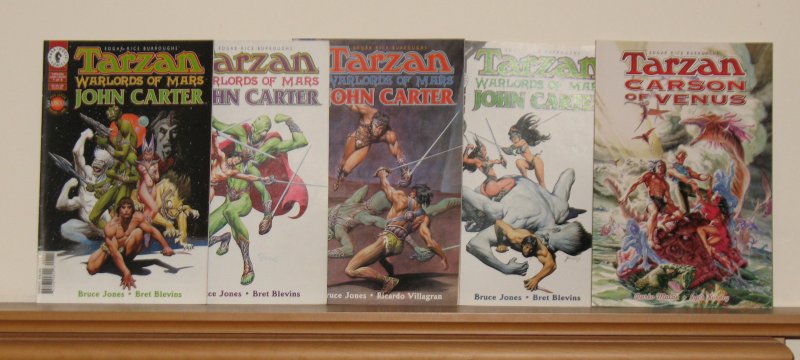
I’m not entirely sure why someone decided a mash-up featuring Tarzan and another of Edgar Rice Burroughs’ characters was a good idea, but they went and did it. First Tarzan met Carson of Venus, and then he met John Carter of Mars. Not an entirely successful pair of literary experiments.
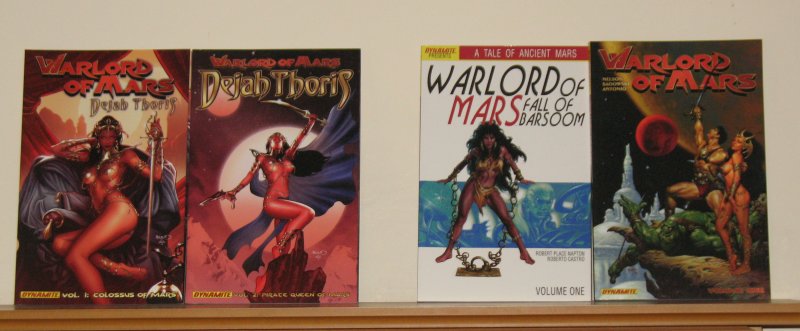
Recent years, perhaps triggered by the Disney film, have seen a surge of new John Carter adaptations, as well as omnibus editions of older versions. The two Dejah Thoris graphic novels aren’t too bad, though it would be nice if they could put some clothes on her. The other two are quite poor.
UK comics have traditionally followed an anthology format, with each issue containing a number of different stories or installments of a serial. This is very different to the US tradition, in which a single story occupies a whole issue, or series of issues. And while US comics have pretty much entirely been stories of super-powered men and women in brightly-coloured tights, most UK comics were typically humorous (Beanie, Dandy, Whizzer and Chips, etc), war-related (Warlord, Victory, etc), or science fiction (2000 AD, Starlord, etc).
But there is another comics tradition, which only rarely appears in the US or UK – the bande dessinée. In continental Europe, science fiction has often been driven by these “drawn strips”, much more so than it has been in Anglophone countries. Every now and again, some of the more popular bandes dessinées are picked up by English-language publishers, translated and introduced to an English-speaking audience. Cinebook have been doing a sterling job in this regard over the last few years, but they’re by no means the first.
I’ll admit to being a fan of sf bandes dessinées, though I don’t buy them as often as I’d like to. Most, of course, have not been translated into English – although they may well have been translated into most other European languages. Anyway, here are the ones I have. Most are in English, but some are in French.
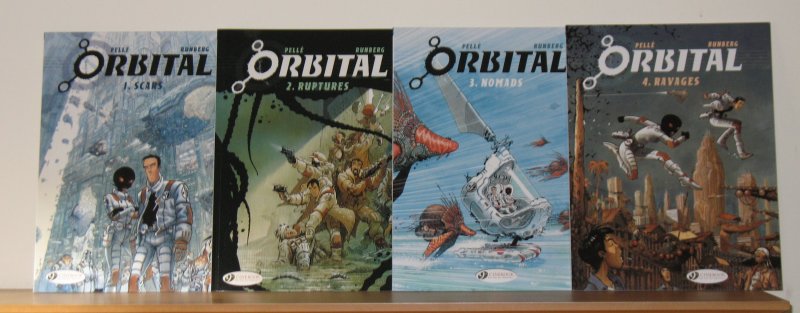
Orbital, written by Sylvain Runberg and drawn by Serge Pellé, is solid space opera of a type which rarely appears in graphic form in English. A human and a Sandjarr, members of two races that were at war several years before, are put together as diplomat-troubleshooters, and have various adventures.
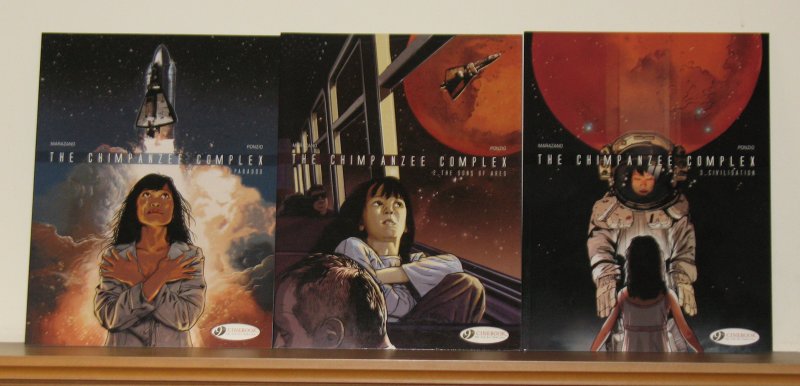
The Chimpanzee Complex, written by Richard Marazano and drawn by Jean-Michel Ponzio, opens brilliantly – in 2035, a copy of the Apollo 11 Command Module splashes down in the Pacific, but only Armstrong and Aldrin are aboard. A mission to the Moon is hastily cobbled together to discover the CM’s origin. This then moves onto Mars, where the crew find a colony of cosmonauts led by Yuri Gagarin. Sadly, the final volume doesn’t quite sustain the level of inventiveness, but it does do something quite weird and interesting with the story.
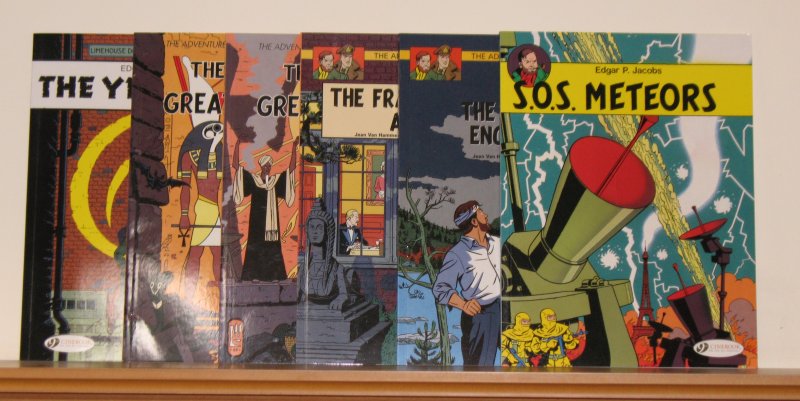
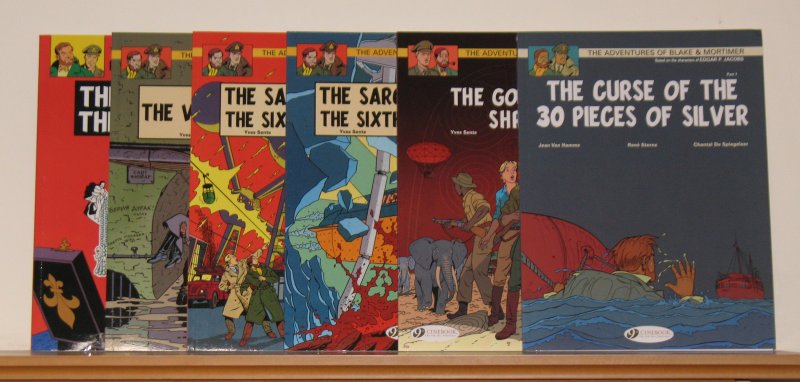
One of the big bandes dessinées series is Edgar P Jacob’s The Adventures of Blake and Mortimer. It first appeared in Tintin Magazine in 1946, and continued through to Jacobs’ death in 1987. Since then, new stories have appeared from Jacobs Studios. To date, Cinebook have translated and published 13 books. Like Tintin, they’re all drawn in a ligne claire style, and while they’re often text-heavy (often with text describing what’s visible in the panel), the stories are generally a quite cleverly-done mix of history and science fiction.
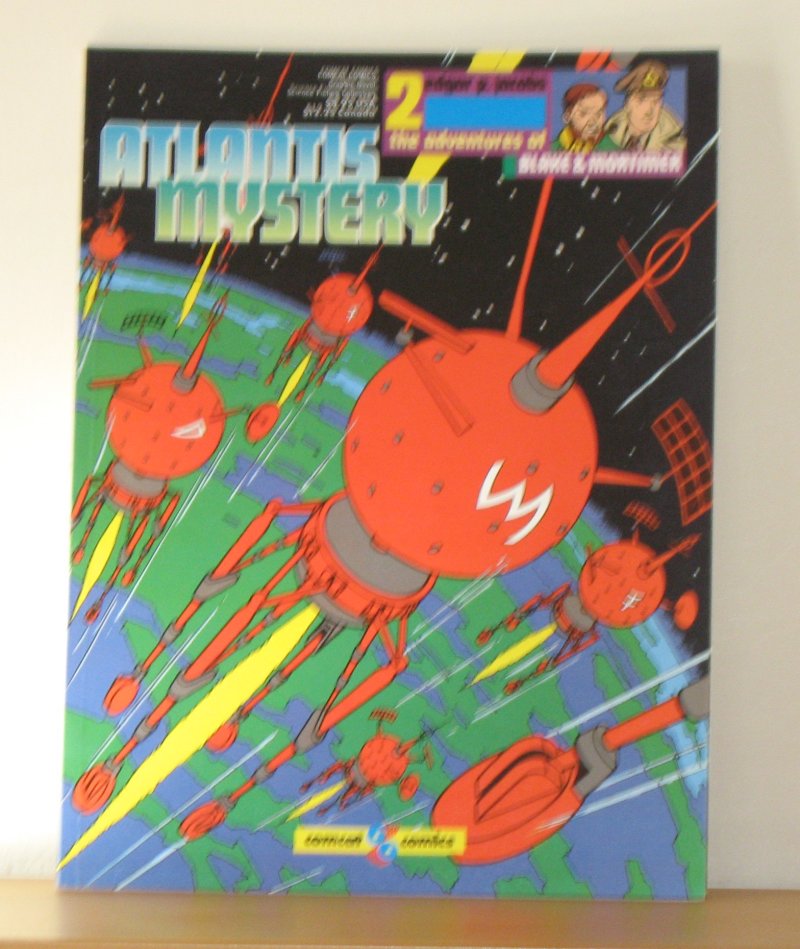
There was an earlier attempt to introduce Blake and Mortimer to an English-speaking audience. Back in the early 1990s, US publisher Catalan Communications published two Blake and Mortimer books. I found this one in Abu Dhabi. It has since been republished as volume 12 in the Cinebook editions of the series.
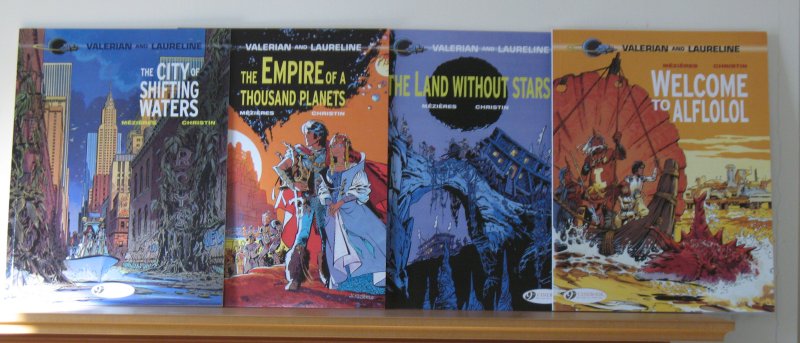
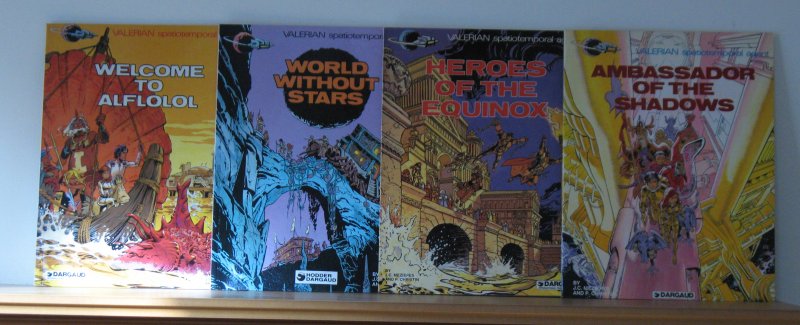
Another big bande dessinée series is agent spatio-temporel Valérian et Laureline. This started in 1970, and there are now twenty volumes available. So far Cinbeook have translated and published the first four.
Again, there was an attempt to introduce Valerian and Laureline to English-speakers back in the 1980s. A US subsidiary of the French publishers, Dargaud, translated and published four random volumes – numbers 3, 4, 6 and 8. I’ve no idea why they stopped.
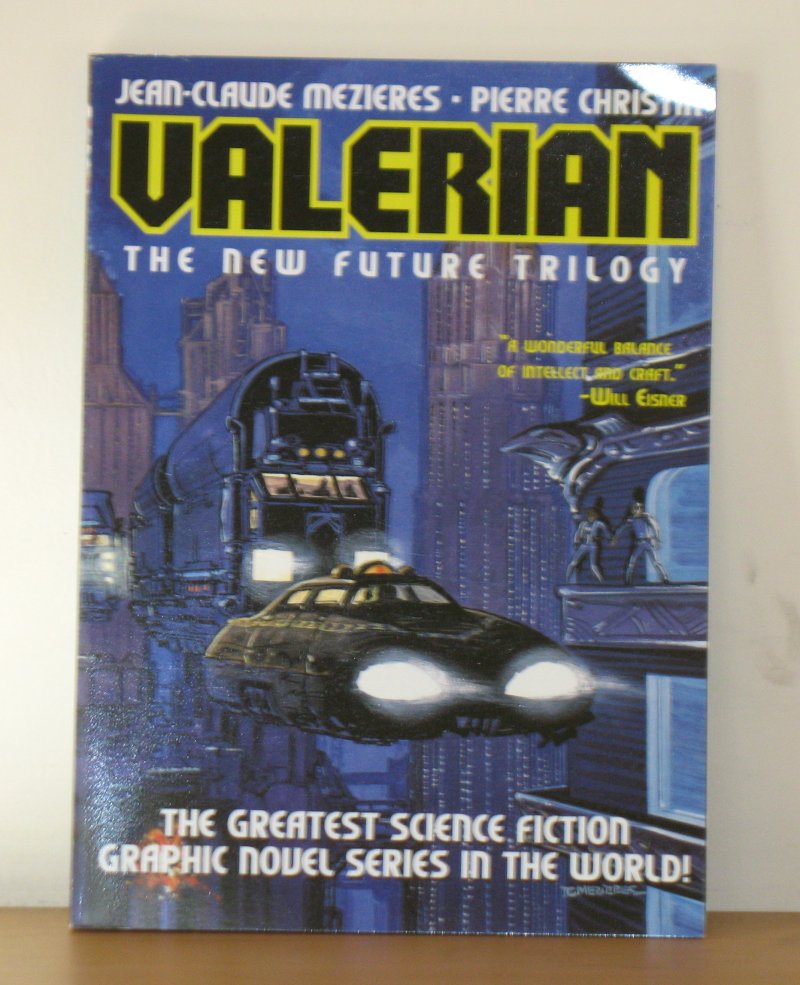
In 2004, ibooks published an English-language omnibus of three Valerian and Laureline stories – numbers 13, 14 and 15.
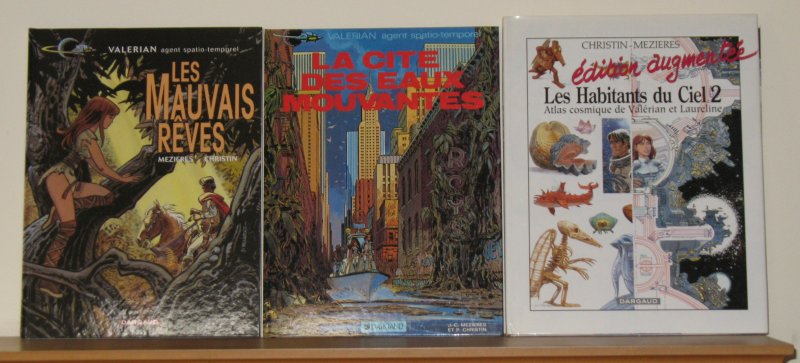
And here are some of the original French editions, including a prequel published in 1983 and the second of two encyclopedias about the universe of the two spatio-temporal agents.
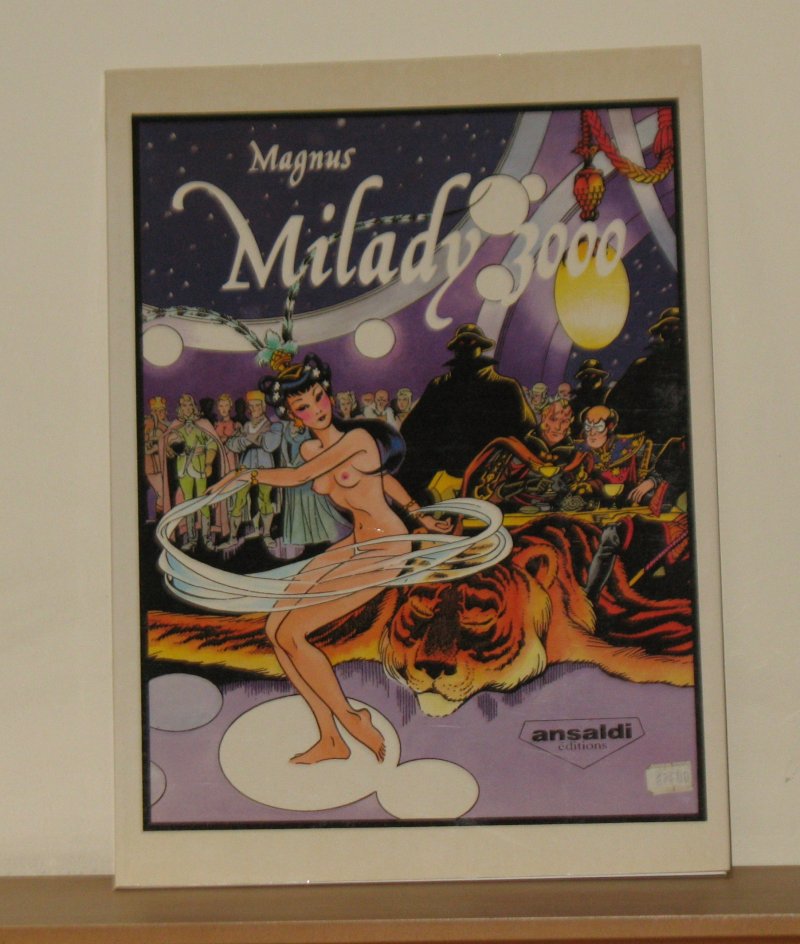
I’m not sure why I have this. This copy of Milady 3000 is a French translation of an Italian comic. It’s far future space opera, and quite well done. It apparently lasted from 1980 to 1984, and appeared in both Métal Hurlant and Heavy Metal.
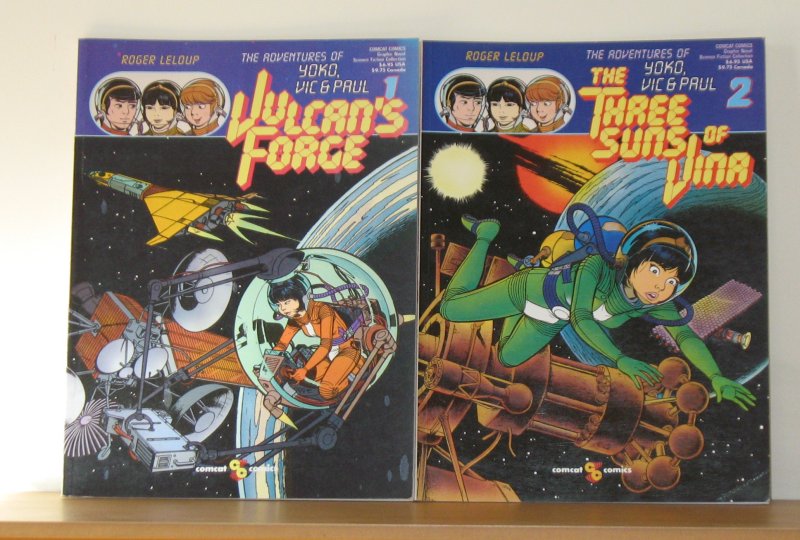
The Adventures of Yoko, Vic and Paul is another popular series being republished by Cinebook. These two books are earlier editions by Catalan Communications. The series began in 1970 and currently comprises twenty-five volumes. Catalan Communications published only the two I have, but Cinebook has so far reached volume seven.
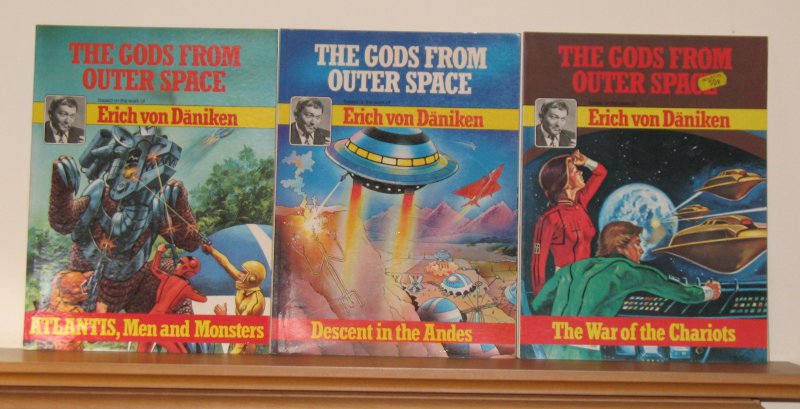
I’ve had these for years, and I can no longer remember where or when I bought them. They’re English translations of a Polish series based on the works of Erich von Däniken. I think only these three volumes were published in English, though there were eight originally in the Polish series.
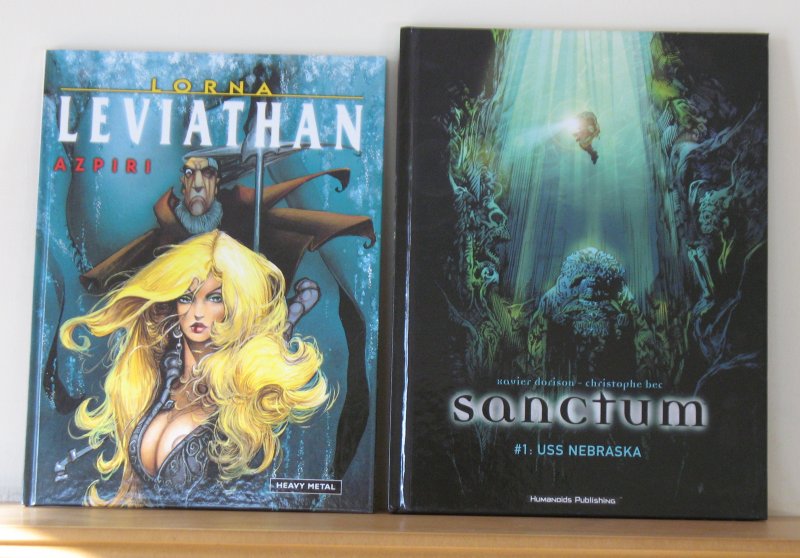
Lorna is originally Spanish, by Alfonso Azpiri, and has appeared in Heavy Metal. Leviathan is the fourth of six books featuring Lorna, and I’ve no idea if any others have been published in English. It’s definitely not for, er, children. Sanctum is a three-part French series by Xavier Dorison and Christophe Bec. As far as I can determine, only the first volume has been published in English. So it looks like I’ll be getting the French “Intégrale” edition to find out how the story ends…
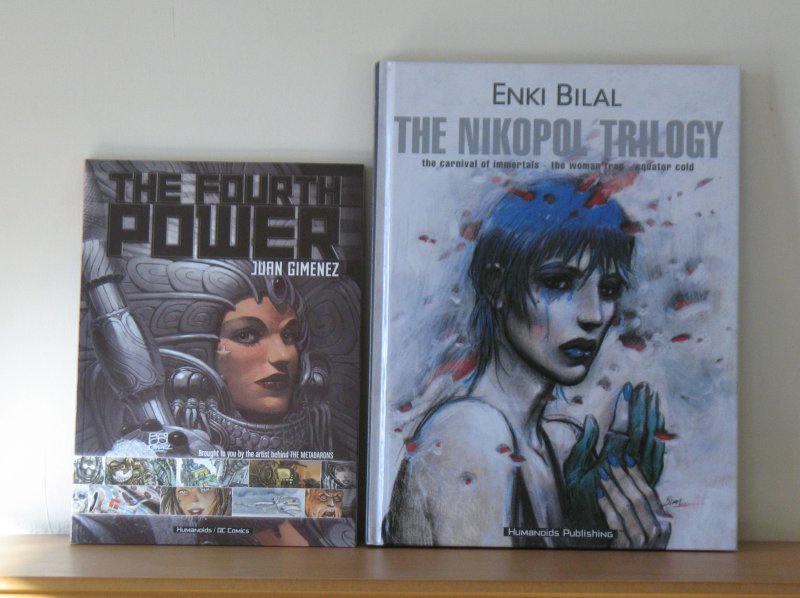
The Fourth Power is a full-on space opera bandes dessinées by Juan Giménez, an Argentine artist who illustrated Alejandro Jodorowsky’s Metabarons series. The Nikopol Trilogy by Enki Bilal was the basis for Bilal’s live-action/CGI film Immortal.
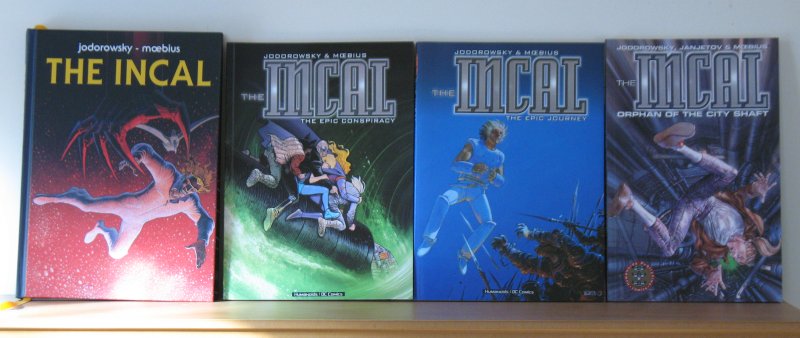
No post on bandes dessinées is complete without mention of Alejandro Jodorowsky, and his most famous work, The Incal. It may well be, however, better known for Moebius’ artwork than Jodorowsky’s script. It’s been published several times in English. Back in the early 1990s, Titan Books published several volumes; then Humanoid Associates, the English-language arm of the French publishers, published four volumes; and last year, Self Made Hero published a very nice omnibus edition. I’ve only managed to find three of the four Humanoid Associates editions, but now I have Self Made Hero edition I don’t need to complete the set…
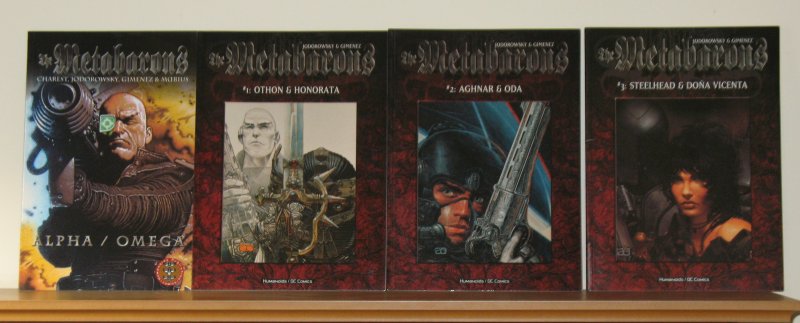
Another popular Jodorowsky series, this time illustrated by Juan Giménez. There is, I believe, a Metabarons RPG. The French originals stretches over nine volumes, but only the first six, in three omnibus volumes, are available in English.
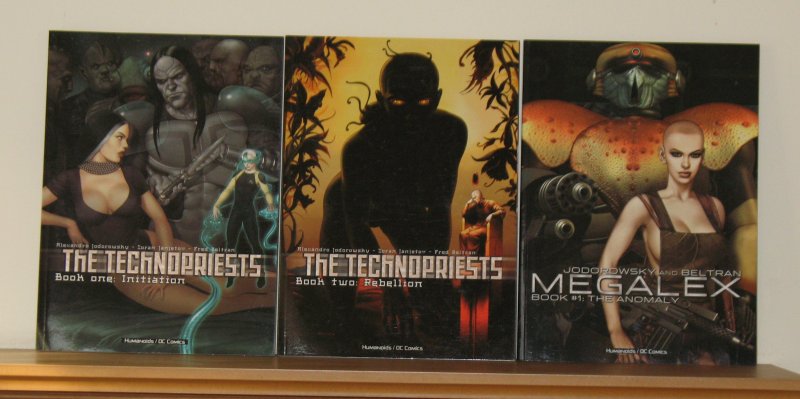
Technopriests, written by Jodorowsky and illustrated by Zoran Janjetov, is even more bonkers than the Incal or Metabarons. Humanoid Associates have to date only translated the first two of the eight-volume series. Megalex is a three-volume series, illustrated by Fred Beltran, but only the first book is available in English.
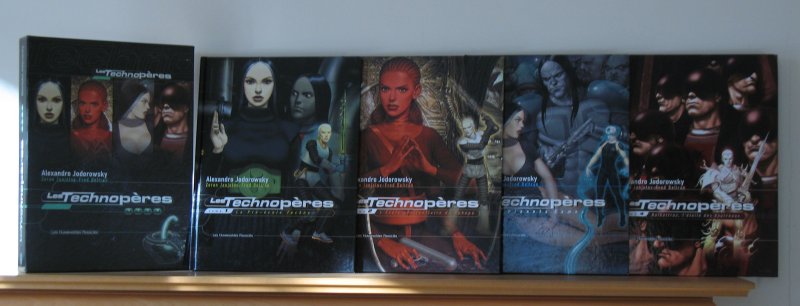
However, I have the first four volumes of Les Technopères in French, plus a presentation box for them. I just need to get hold of the remaining four volumes…
In my post on Dan Dare last week (see here), I mentioned I owned a copy of Dare by Grant Morrison and Rian Hughes, but seemed to have lost it. If you’ve seen my flat, this probably isn’t much of a surprise. Fortunately, while digging out some books for a post on bandes dessinées – which will appear later today – I stumbled across it. The cat hadn’t sold it on eBay, after all.
Anyway, here it is:
Dare was originally published in Revolver, from 1990 to 1991, but the comic folded before the last installment, so it was completed in Crisis, a 2000 AD spin-off. The trade paperback edition was published in 1991. Copies are not especially hard to find these days, and it’s worth getting.
Most science fiction treats space travel like air travel or sea travel. This is hardly surprising, since only a handful of authors of sf novels have actually experienced space travel (Buzz Aldrin, Edward Gibson, Mike Mullane, Scott Carpenter… I think that’s it). And back in the early days of the genre, of course, no one had. A couple of rocket scientists – Wernher von Braun and Willy Ley, for example – had a bash at sf; but most early sf authors simply adapted what they knew.
So there was the spaceship as ocean liner, requiring a dock (space station), with cabins for passengers, a bridge, and a bloke who sat in a comfy chair and just gave orders. Or there were the spaceships based on the barnstormers, small aircraft that people kept in their backyards, that required only a couple of hundred feet to take off, so they could jump in them, take to the air and fly off somewhere.
Of course, we now know space travel is nothing like either of the above. To get into orbit, an expensive task in terms of both energy and hardware, travellers are crammed into a tiny module. And everything is controlled by computer. If Skylon or the X-37B is any indication, future spacecraft won’t even have crew. And yet sf continues to use those old metaphors: the ocean liner in space, the barnstormer of the stars.
These metaphors completely ignore the basic realities of space travel. Not just the vast distances involved, distances that pretty much make it impossible to map any kind of human story onto an interstellar setting. But the whole metaphor of space as “the final frontier” breaks down as soon as you realise how hazardous simply being in space actually is.
The problem is not so much that these metaphors for space travel exist, but that they have become so embedded in science fiction that no one bothers to question them any more. They’re picked up and slotted into stories as if they’re part of the background. It’s a bit like writing contemporary fiction, only the trains in the story still run on steam. We have more than fifty years of actual space travel. Necessary practicalities and the history of space exploration have given us a tradition we can use in sf – and I don’t mean cosmonauts peeing on the back wheel of the bus that takes them to the launchpad, not that sort of tradition.
But sf is wedded to those patterns first laid down back in the 1930s, and all that’s been done in the years since is a gradual refining of them. Not only do I think it’s time we ditched those metaphors for space travel and came up with something inspired by post-1950 history, but I also think we need to look carefully at every metaphor and trope currently in use in sf. Because metaphors are narrative tools, not plug-in modules for story settings. We need to go through all those tropes and strike through the ones which are based on models that no longer hold true and haven’t done for almost a century. I chose space travel as my example as it’s a topic that both interests me and which I’ve researched for my own fiction. But there are plenty of others – robots, cyberspace, aliens, etc…
This is where the interesting science fiction is going to be, in the stories that re-engineer the tropes, that relate them to the real world. Slotting together identikit tropes only results in identikit fiction, and I don’t want the genre to be defined by such stories.
I forget where I saw mention of Katie Ward’s Girl Reading – I’ve a feeling it was on one of David Hebblethwaite‘s lists of novels by non-genre imprints that might eligible for the 2011 Clark Award. The blurb sounded interesting, so I stuck it on my list of books to keep an eye open for… And a few months ago, I saw it at my mother’s so I borrowed it. (She doesn’t remember the book, and certainly hasn’t read it, so one of my sisters may have left it there.)
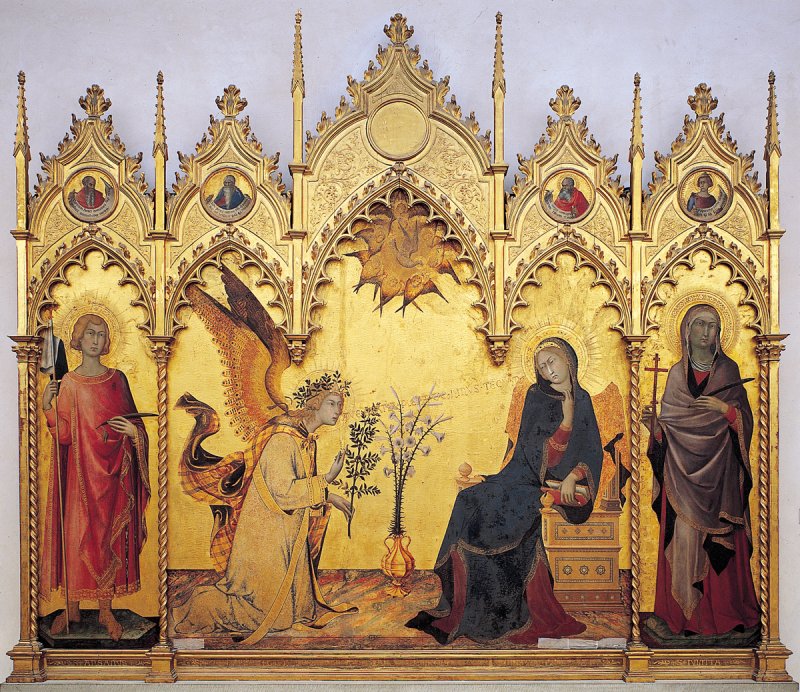
Annunciation, Simone Martini (1333)
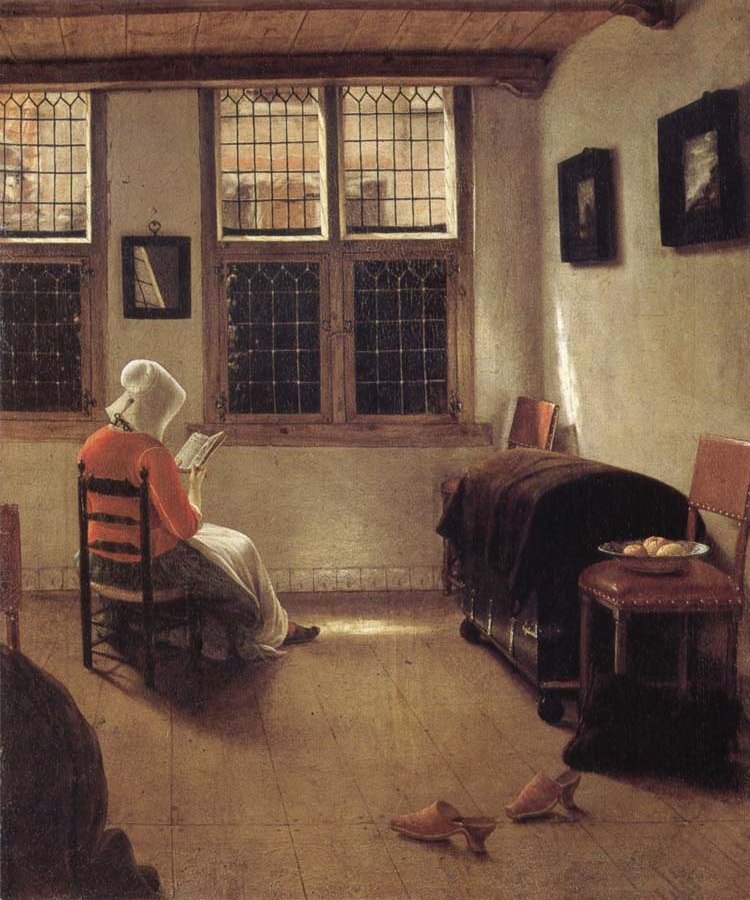
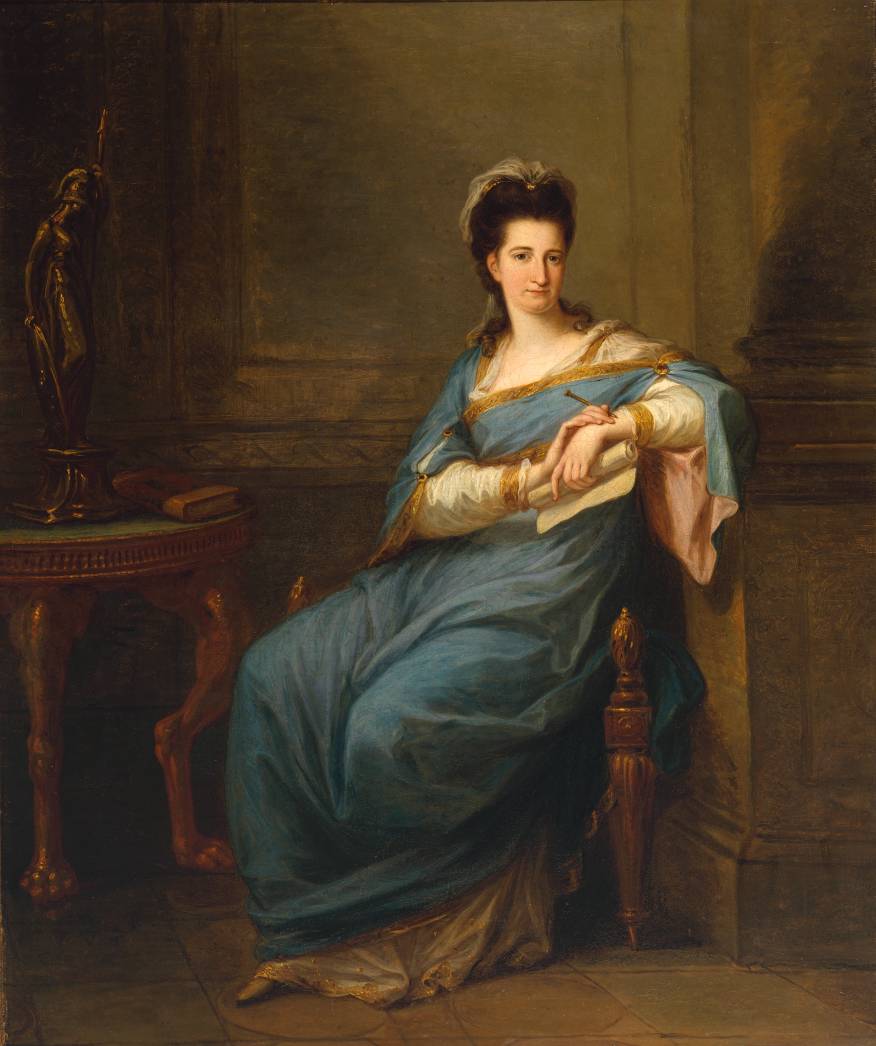
Girl Reading is not one of those novels which defy summary, but a description of its plot – or plots – does not really give the true flavour of the book. It is constructed from seven sections, set in, respectively, Siena in 1333, Amsterdam in 1668, an English country house in 1775, London in 1864, another English country house in 1916, London in 2008, and an unnamed European city in 2060. The sections are not linked, except by mention of the previous section’s subject – ie, a picture of a girl reading. (The exact pictures which inspired the novel are given in ‘A Note’ at the end of the book; some are reproduced in this post).
Woman Reading, Peter Janssens Elinga (1668-1670)
Comparisons with Cloud Atlas are inevitable, and while Ward’s control of voice may not be as accomplished as David Mitchell’s, Girl Reading trumps Cloud Atlas because it relies less on hoary clichés for its plot and because its structure makes sense within the context of the story. It’s there in the final section, ‘Sincerity Yabuki – Sibil, 2060’:
“Sibil makes you experience, in mesh, real or fictionalised aspects of what is already there embedded within a real-world object. The artwork is the starting point; from that, it weaves an extended portrait of sorts, showing us this art piece in a new way.” (p 302)
Isn’t that we all we do? When we see the cover-art of a novel, we imagine the story it represents. When we witness an event in real life, we try to make a story of it as if that somehow makes it more understandable, helps makes sense of the narratives of our own lives. For a fixed number of objects – paintings and photographs – Girl Reading not only makes this process overt, it presents the results of the process for us.
Portrait of a Lady, Angelica Kauffman (1775)
It’s a science-fictional conceit – so, yes, the book was perhaps suitable for consideration for the Clarke Award – but because the narrative works forward from the past to the future, it’s unlikely Girl Reading will ever be read as science fiction. True, it doesn’t reveal its genre underpinnings until that final section, and the links between the sections are subtle, but that last section does make sense of it all. It often seems that literary fiction novels lack a final payoff – or rather, it sometimes feels as though much of the story didn’t actually contribute toward the ending. Not a twist ending, not something that makes you drastically reconsider all that has gone before – although the ending of Girl Readingdoes do something like that. But when it does happen, it’s good. Of course, that’s not to say it’s necessary – I can think of several such novels where much of the book’s appeal lies in the journey toward the ending.
Giulia Grisi, Horatio Nelson King (1860s)
Girl Reading is written throughout in the present tense, without the use of speech marks for dialogue. Obviously, this is a style which appeals to me, but Ward’s prose is also good. It is, perhaps, a little precious in places, but not so much it obstructs the narrative or draws attention to itself. She has a fine eye for what gives surroundings character, and though the language is not particularly complex she succeeds in evoking sense of place:
Haunted by sadness. It is a grand building, but Angelica has been in grander, and it is the absence of society, of comings and goings, that makes it feel enormous like a cavern, serious like a church. (p 109)
The female subjects of each section are also well-drawn, interesting characters – the young woman of fourteenth-century Siena, the deaf-mute Dutch maid, even the ambitious but conflicted young Parliamentary assistant in 2008. Their concerns are personal – yes, relationships – but they work in context. Above all, the historical detail is convincing, and the characters fit their historical milieu. That’s a difficult trick to pull off for a story set in one historical period, and harder still to do for multiple periods.
Vanessa Bell (née Stephen), Duncan Grant (circa 1916-1917)
There have been sadly few books I’ve read this year which I’ve classified as “impressive”, that I finished knowing I had just read something special. Girl Reading was one of them. On the strength of it, I’ll be keeping an eye open for future books by Katie Ward. And I very much suspect her debut novel will be appearing in my top five at the end of the year.









 It Doesn't Have To Be Right...