I may have been involved in science fiction for 25 years, but I’m relatively new to this “author” thing. I’ve done plenty of panels at conventions, but I’ve never given a reading, and I’ve certainly never spoken about something I’ve written to a bunch of complete strangers who may or may not have come to hear me talk or indeed have any clue who the hell I am.
But that’s what I did last Sunday.
The National Space Centre in Leicester had organised a two-week celebration of “Space Fiction”, beginning on 9 February and lasting until 24 February. I was asked if I’d like to contribute on one of those days as one of the clients of the John Jarrold Literary Agency. Since Adrift on the Sea of Rains and The Eye With Which The Universe Beholds Itself are proper hardcore realistic space fiction books it struck me they’d be well-suited to a reading in the National Space Centre… And so it was arranged: Philip Palmer, Chris Beckett and myself would each give a 30-minute talk/reading on Sunday 17 February.
As you approach the National Space Centre, the first thing you see is a giant pupa pointing up into the sky above Leicester. That’s the Rocket Tower. The rest of the building looks more like something you’d find on a university campus or science park. I’m not sure what I was expecting – something like a museum, I suspect – but it’s far more resolutely modern than my dim memories of visits to museums as a child suggested. I was immediately taken with the Soyuz on display in the main foyer. And it really is a tiny spacecraft. I’d known that, of course – I’ve researched this stuff, after all. But you have to see it in the flesh, so to speak, to realise quite how small and makeshift and fragile it is. The Soyuz is apparently only one of two on permanent display in the West.
I was collected from the foyer by Charlie, who was wrangling the three of us that day. She did an excellent job of looking after us, so much thanks. The actual venue for the talk proved to be a small lecture area just off the main concourse, with rows of benches facing a small stage backed by a large screen. There was another screen above the stage. Most of the National Space Centre is one big open space, partitioned into display areas by walls no more than three metres high, so there was a lot of background noise. But we had microphones.
Phil Palmer’s talk began at 12:15. He talked about science fiction and extrapolation, and it was obviously something he had spoken about before. He then read from both Debatable Space and Hell Ship. The audience was mostly families with small children – about twelve to fifteen people in total. Chris Beckett arrived during Phil’s talk.
Afterwards, we had a thirty-minute gap before Chris’ session started at 13:15, so we went to get a bite to eat from Boosters Restaurant. It was sandwiches and soup, so my face fell when I saw it. I asked one of the staff if they had anything that was dairy-free. He told me they’d make me any sandwich I wanted in a dairy-free version. That level of service and helpfulness still impresses me – it shouldn’t do, not in the twenty-first century; but it’s still unusual enough in the UK to be a pleasant surprise.
Chris’s talk was not as well attended as Phil’s had been. He spoke about rogue planets and how they’d been scientifically proven about he’d written Dark Eden. He also described the inspiration for the novel, and then read one of the chapters.
There was then another thirty-minute gap until my talk at 14:15. Phil had booked a ticket for the planetarium show, so he shot off to that while Chris, his wife Maggie, and myself went for a wander round. We headed for the Rocket Tower, though I was a little worried about suffering from vertigo on the top deck. But I was fine as long as I didn’t get too close to the railing. The LM simulator looked more like a computer game than an actual copy, but the 1960s living-room was good. The three of us recognised several items in it from our own childhoods. There was a piece of moon rock in a globe of the Moon, and one wall gave an illustrated timeline of the Space Race. The next deck down celebrated Soviet achievements, though from what I could see the Soyuz simulator was just a little room with a plastic seat in it. I didn’t linger as I needed to get back to lecture area.
Then it was time for my talk. I’ve not done public speaking since I left school decades ago, and I knew this was going to be nothing like being on a panel at a convention. For one thing, my audience would be just walk-ins, who had likely wandered across to see what was going on. My name will have meant completely nothing to them. (In the event, beside Phil and Chris, at least two members of the audience knew me – Will Ellwood, who I know via Twitter, and Dave Caldwell, who was a member of an APA I was in back in the 1990s.)
As soon as I was ready to begin, I hit my first snag. I only had two hands. I was using a PowerPoint presentation, so I needed to hold the clicker to advance the slides. I also needed to hold a microphone. And then there was the script of my talk, which I hadn’t learned off by heart. Damn. I’d need three hands. Charlie happily lent me her hands-free mike. She then introduced me and I started babbling…
I thought it went quite well. I managed not to speak unintelligibly fast, and I clicked through the slides in mostly the right places. I spoke about realistic space travel and science fiction’s poor record in depicting it, using ocean liners as spaceships rather than actual real spacecraft (such as the Soyuz in the foyer), and how I came to write the Apollo Quartet. I cut down the excerpts from Adrift on the Sea of Rains and The Eye With Which The Universe Beholds Itself I’d planned to read, and that proved to be a wise decision. I finished it pretty much exactly in thirty minutes. And the entire audience stayed throughout the entire talk. Afterwards, a couple of people came up and thanked me and said they had found it interesting.
Phil, Chris and myself then moved across to a table in the main concourse, where people could buy copies of our books and we would sign them. We were actually approached by more people asking for directions than we were people who wanted to purchase our books. But never mind.
It was a fun day. I’d liked to have taken the time to explore the National Space Centre more fully, and I certainly think it’s an interesting place to take children. Personally, perhaps, I’d have preferred more hardware and less science, but that’s what fascinates me. All the same, I could happily spend a day there.
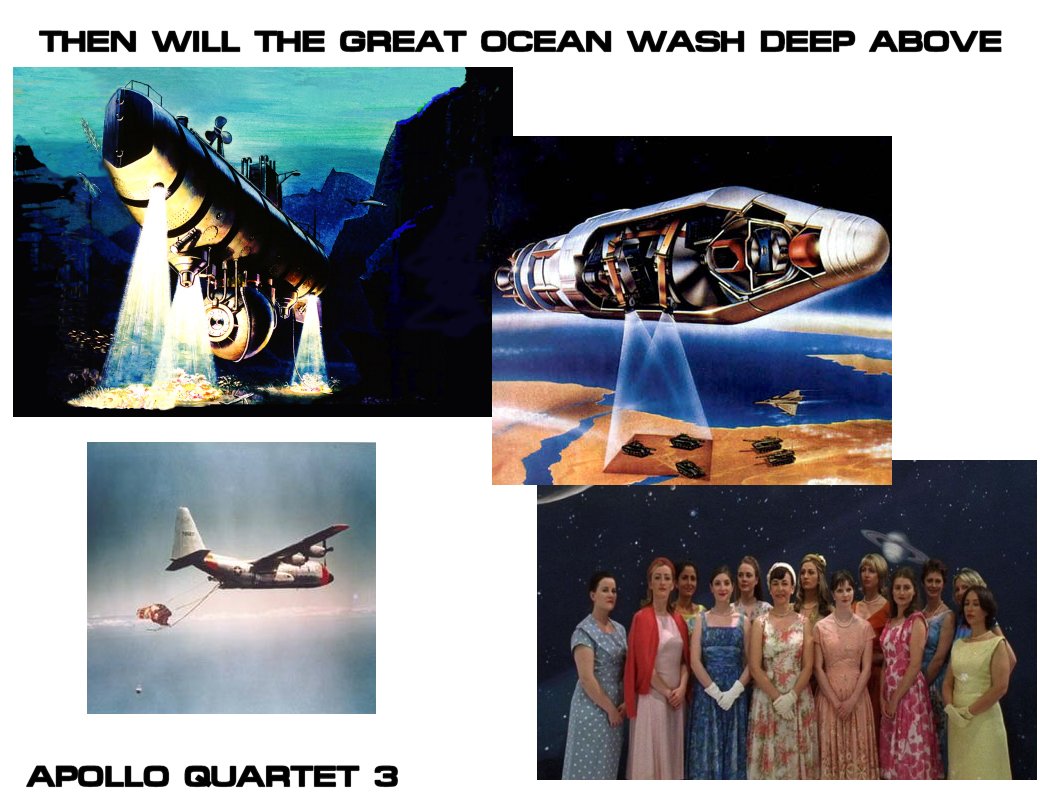
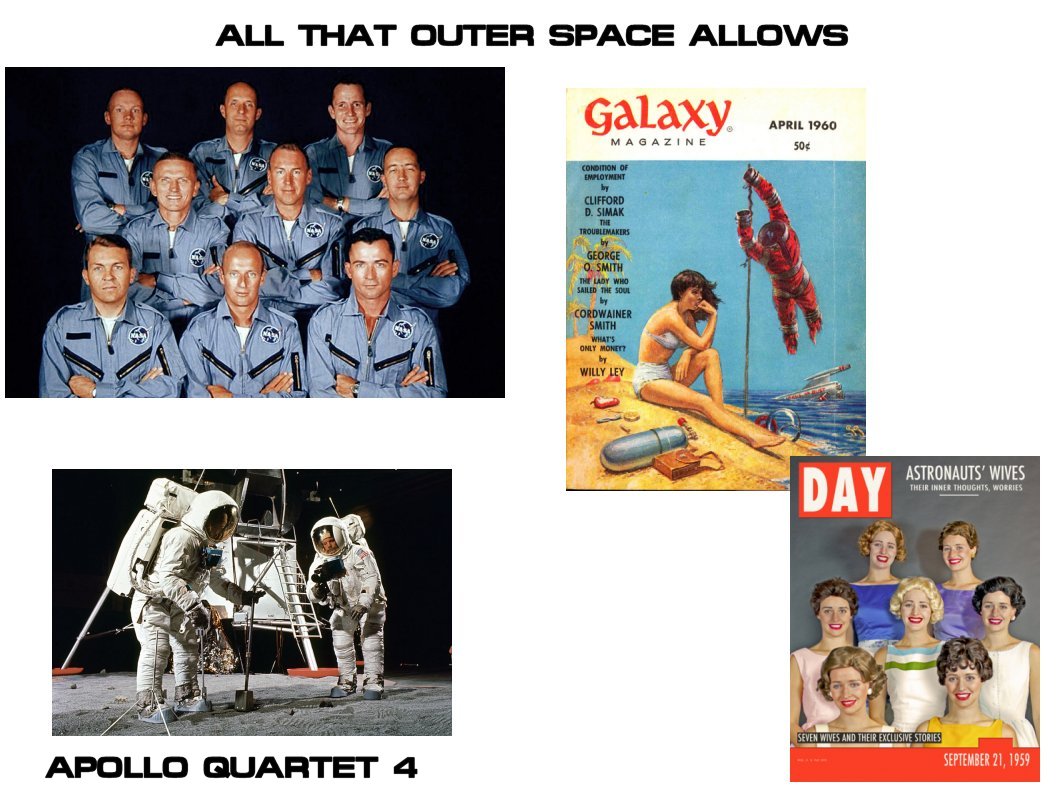
Finally, the last two slides of my presentation were hints to the stories of the final two books of the Apollo Quartet. And here they are…
Some people have made a lot of money very quickly through self-publishing; some people have won big prizes on national lotteries. I’m not sure which has the better odds, but I suspect there’s little difference in it. You can, of course, increase your chances of doing the former – write something derivative that plugs into an existing fanbase, and self-promote to such an extent you’re indistinguishable from spam. If, on the other hand, you self-publish because you have a vision and you want to get it out there, but no one else is interested in publishing it for you… Well, in that case, don’t give up the day-job just yet…
I’ve made no secret of my reasons for self-publishing the Apollo Quartet. I didn’t want to compromise on my vision for Adrift on the Sea of Rains – a vision that has been happily vindicated, since the novella has been shortlisted for the BSFA Award; and I wanted to launch the book at the same time as Rocket Science, and no existing small press, had they chosen to publish it, could have done so in time.
I also chose to publish the book as both paper and ebook. I could, of course, have just released it on Kindle, as so many self-published authors do. But instead I paid a printer – MPG Biddles – to do me hardback and paperback copies.
I have learnt much about writing and publishing over the past ten months…
1 the elephant in the room
It’s actually a huge South American river, not a pachyderm, but it certainly dominates book-selling. And it treats us small fry very badly. If I hadn’t signed up for Amazon Advantage, my books would be shown as unavailable on the Amazon website (I’ve only signed up for the paperbacks, so the hardbacks are indeed shown as “currently unavailable”). Signing up for Amazon Advantage, I have to accept the 60% discount Amazon takes. So every sale I make through Amazon is at a loss. If they ordered 100 copies tomorrow, I’d have to refuse the order. I can’t afford to fulfil it. As it is, the orders Amazon has placed for single copies in dribs and drabs over the months are costing me more as I have to pay postage for each copy I send them.
Incidentally, I’d be happy to cut all my ties to Amazon, but I see no alternatives. I use the Amazon affiliates scheme on this blog, and I had planned to drop it. So I investigated a few alternatives. The Book Depository one is simple enough to use, but they’re owned by Amazon anyway. The Waterstone’s one is a joke. It’s run by a third party, you have to apply for approval first, and I couldn’t find out how to link to individual titles on the Waterstone’s site. They should sort that out – they’d get a lot more business.
2 it doesn’t have to be ebook all the way
Publishing on Kindle is trivial. You format the document, knock up a cover, and then upload it to Amazon through the Kindle Direct Publishing website. Easy. Publishing paper books is harder, but not that much more so. And it does cost money, which publishing on Kindle doesn’t – but even then, it’s not that much. For The Eye With Which The Universe Beholds Itself, I formatted the document as PDF, and had the cover-art done the same way. I got an estimate from MPG Biddles, then placed the order, uploaded my PDF files to their website… and weeks later boxes of books were delivered to my house. It cost me £202 for one hundred 80pp paperbacks.
Of course, selling paper books is more difficult than ebooks. You have to hold stock of a physical item, and ship it to customers when they order copies. For Kindle ebooks, Amazon does all the work for you. You just watch the sales mount up (or not). And selling around the world is trivially easy. Except Amazon US pays you in US$, which is a problem.
3 what’s the bottom line?
Amazon offers 35% and 70% royalty rates on books published on Kindle. You chose the price at which you sell the book. It’s best, of course, to look at the price of comparable ebooks. Too high and no one will buy it, too low and people will think it’s not worth reading. The ebook market is still in flux at the moment, with huge numbers of low-priced self-published books, and ebooks from major imprints priced roughly the same as hardback copies. So there are as many pricing models as there are publishers. I chose to price my ebook editions at about two-thirds of the paperback price – £2.99. That seems to be working quite well.
For self-published paper books, there is no royalty. There is only sale price minus unit cost. I priced Adrift on the Sea of Rains at £3.99, because I felt that was a fair price for a 80pp paperback novella. Unfortunately, I was thinking like a buyer not a seller. It was too low, and I’d have to sell the entire print-run of 100 to cover my costs. So for The Eye With Which The Universe Beholds Itself I increased the price to £4.99. Which means…
Cost per unit: £2.02
Cover price: £4.99
Profit per unit sold: £2.97
Except…
For copies sold over the internet, I include p&p in the £4.99, so that’s –
£4.99 – (£2.02 + £1.10*) = £1.87 per sale
For copies sold by hand, I only charge £4.00, so that’s –
£4.00 – £2.02 = £1.98 per sale
(* I don’t include the cost of envelopes as I re-use as much as I can; but if I did, it would be an additional 20p)
If I sold copies only over the internet, I’d have to sell 52 copies to break-even; if I sold only by hand, it would be 51 copies. The true figure is probably slightly higher as I sell using both methods, and there’s those copies I sell through Amazon Advantage. Nor do I factor in the cost of the copies I give away for review.
Of course, this is only the manufacturing cost. There are a host of unpaid contributions which create the final product – not just myself as writer, designer, promoter, publisher and book-seller; but also the cover artist and the editor. At present, I’ve been lucky enough to receive all that for free (though I plan to pay once Whippleshield Books is more established). There are also peripheral costs which have to be included – ISBNs, the ecommerce website – so it’s going to be a while yet before Whippleshield Books climbs out of the red.
However, those £2.99 Kindle ebooks are more or less pure profit (less Amazon’s cut, the VAT they charge but do not pay, delivery cost, etc.). The money from Kindle sales helps finance the paper versions of the books. I’ve also sold more copies on Kindle than I have paperbacks or hardbacks. In fact, it’s been interesting watching sales uptick when Adrift on the Sea of Rains gets mentioned online. There was small jump in sales when SF Signal reviewed it. And a considerably larger one when the book was mentioned on the Guardian’s book blog – “one of the most outstanding self-published books of the year”. More copies were bought on Kindle as a result of that mention than in the preceding nine months.
Having said all that, there is one advantage to publishing a book as a paperback or hardback rather than just on Kindle: you get taken seriously. If I’d gone for the low-cost option – ie, ebook only – I very much doubt I’d have sold as many copies, seen the books reviewed so many times, or even had one shortlisted for the BSFA Award. The future of publishing may lie in self-publishing – I hate the term “indie author”, incidentally – but, with the exception of a handful of outliers, the rewards are proportional to the effort, and money, you put into it…
Time for a musical interlude, I think. The song below is from the debut EP of an unsigned band from Zduńska Wola and Sieradz in Poland, and I happen to think it’s rather good. The EP can be downloaded for free from here. Enjoy.
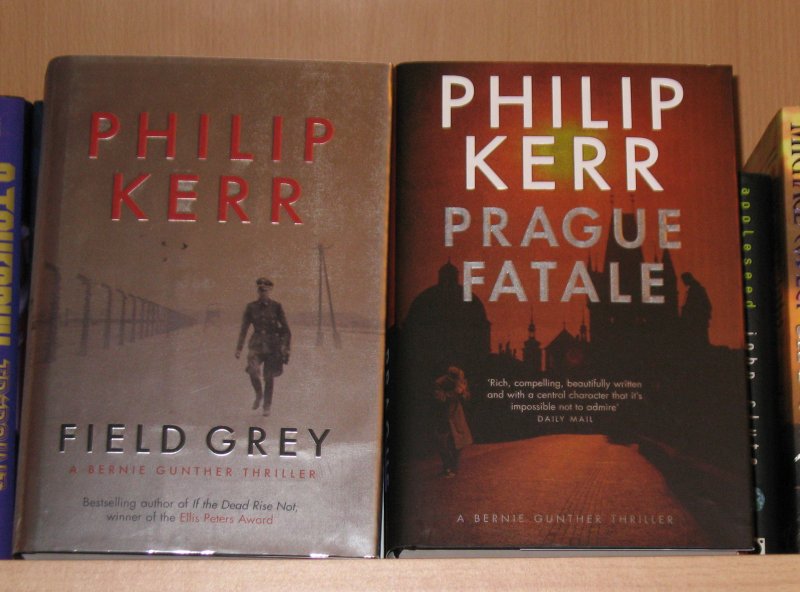
Not all of the authors whose books I collect in first edition are science fiction or postwar British literature. One or two of them are non-genre and more recent. Like Philip Kerr – who could, I suppose, be classified as a genre author as most of his books have been crime novels featuring the historical twentieth-century detective/policeman, Bernhard Gunther. I’m not sure why I decided to collect Kerr’s novels – there are other authors I read with as much enjoyment and anticipation, but I don’t generally hang onto their books once I’ve read them. Perhaps he was just easier to collect when I started tracking down first editions…
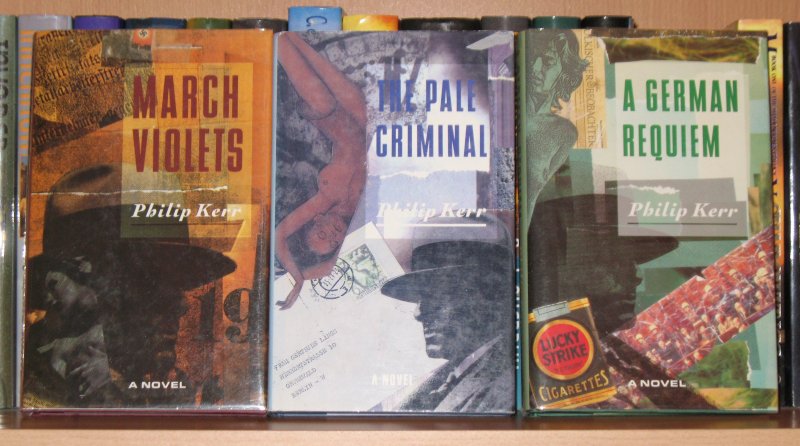
Whatever the reason, here are all of Kerr’s books to date. There’s a new one – a Bernie Gunther novel, of course – due out in March this year: A Man Without Breath. It’s on my wishlist.
The original Bernie Gunther trilogy, now available as an omnibus edition, Berlin Noir. A German Requiem is signed. (I see on Amazon that first edition copies of A German Requiem start at £120…)
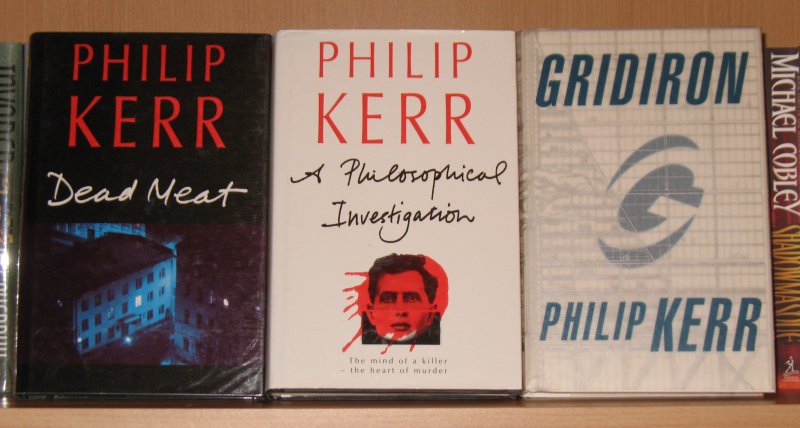
Dead Meat, a police procedural set in the Moscow, was televised in the mid-1990s under the title Gruschko, but I’ve never seen it. It doesn’t appear to have ever been released on DVD. When I first read A Philosophical Investigation, I was extremely suspicious of its philosophical underpinnings, and that was twenty years ago. I should think I’d be even more sceptical now. Gridiron, about a computerised building which starts killing its inhabitants, is probably Kerr’s worst book – yes, it’s such a hoary plot even The X-Files used it. My copy is signed.
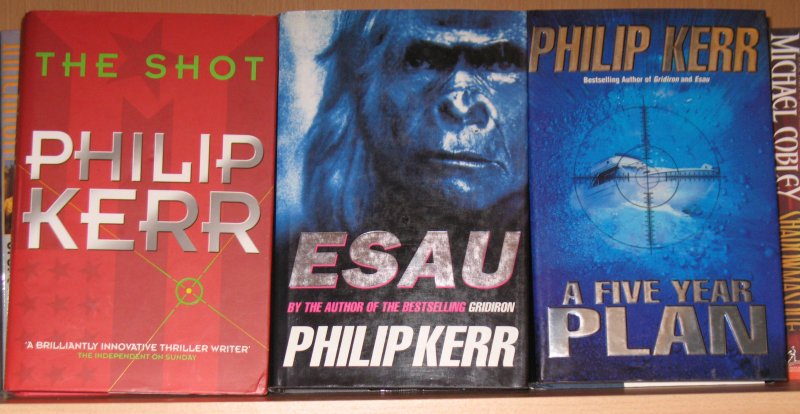
Three more thrillers. None especially stand out. My copy of the The Shot is signed.
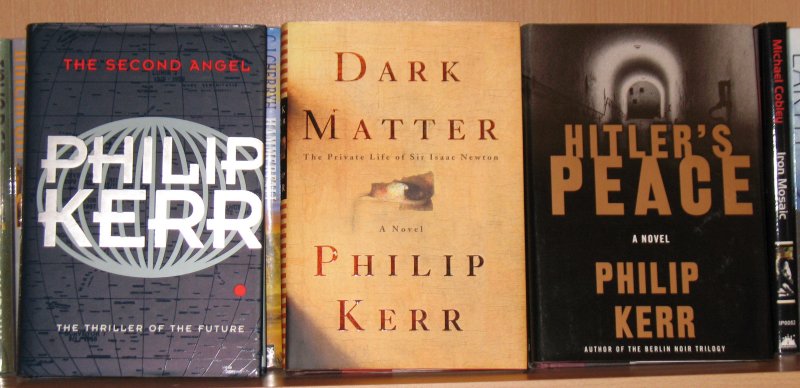
The Second Angel is actually a superb science fiction novel, and probably my favourite of all Kerr’s books. Dark Matter is an historical crime novel, with Isaac Newton as the detective. Hitler’s Peace is about the Tehran meeting between Hitler, Stalin, Churchill and Roosevelt.
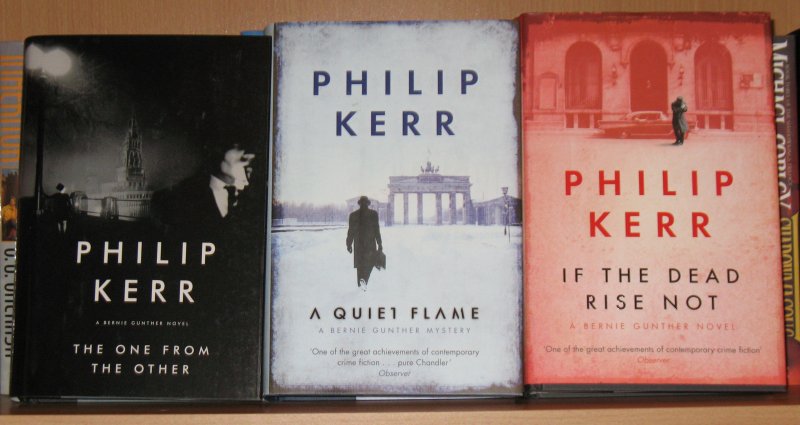
After a decade and a half, Kerr returned to Bernie Gunther, though now covering his activities since the end of World War II. The One From The Other is set in postwar Germany, but then moves to Palestine. In A Quiet Flame, Gunther is in Argentina, involved with the Perons and high-ranking Nazis who escaped capture by the allies. If the Dead Rise Not sees Gunther living in Cuba, with a second narrative set in Berlin in 1935 as the Germans set about building a venue for the 1936 Olympics.
These two I have yet to read. They’re the seventh and eighth Gunther books.
Kerr has also written children’s books under the name PB Kerr – a series of seven Arabian fantasy novels, Children of the Lamp, and a YA novel about a boy who accompanies two chimpanzees to the Moon, One Small Step. I reviewed the latter here.
I stumbled across this post on io9, via SF Signal, and I can’t decide if it’s typical of their cluelessness or whether the site deliberately caters to clueless people. To be fair, they have carefully quoted the word “rules” because the ten points they make are a combination of wrongness, bad advice and the opposite of common sense.
io9’s 10 writing “Rules” they wish more science fiction and fantasy authors would break…
1) No third-person omniscient
As far as I’m aware, readers prefer third-person limited PoV, so publishers prefer it, so writers use it more. Omniscient is no longer as popular in genre fiction as it once was, though you will see it used in thrillers or literary fiction, with varying degrees of success. Given genre’s current trend for immersion, omniscient voice would be counter-indicated.
2) No prologues
I’ve been saying this for years. Wannabe writers write prologues because their favourite books – no matter how old – feature prologues. And even then, those books probably didn’t need them.
3) Avoid infodumps
According to Kim Stanley Robinson, info-dumping is just another narrative technique – and one he uses interestingly in 2312 with its Dos Passos-like “Quantum Walks”. Anything which interrupts the flow of the narrative should generally be avoided, and that includes exposition. There are ways of getting important information across to the reader – some of them are more elegant than others. In Adrift on the Sea of Rains, I used a glossary – and used that glossary to tell the story of the Apollo programme. In The Eye With Which The Universe Beholds Itself, the glossary serves triple duty – telling the story of the Apollo and Ares programmes, but also offering clues to the real story of the novella and hiding the coda.
4) Fantasy novels have to be series instead of standalones
At present, publishers in the UK like trilogies. You probably stand a better chance of getting a contract if you’ve written a trilogy rather than a stand-alone novel. There’s no reason why fantasy novels (of the epic mediaevalish secondary world variety) shouldn’t be stand-alones, and many have been – such as, er, um… well, I’m sure there must be one somewhere.
5) No portal fantasy
Isn’t portal fantasy a bit out of fashion these days? Most epic fantasies are secondary world fantasies.
6) No FTL
So that would be like Alastair Reynolds’ entire oeuvre, then? Books set outside the Solar System but without FTL have been around for a long time. An especially good one is William Barton’s Dark Sky Legion from 1992. It’s a damn sight more interesting an approach than pretending spaceships are ocean liners and interstellar space is just a very large ocean…
7) Women can’t write “hard” science fiction
Argh. This isn’t a rule, even if in quotes. This is just rank ignorance. And to the people in the comment thread of the io9 post asking for the names of women hard sf writers… Well, there’s this thing called the internet, it has search engines you can use, so go and bloody look for yourself. Admitting you’re ignorant is only the first step. Now you have to do something about it. Don’t go demanding people give you a list of authors’ names. Go and look for yourself. It’s not difficult.
8) Magic has to be just a minor part of a fantasy world
Random assertion is random.
9) No present tense
That’s me screwed then – the Apollo Quartet and Wunderwaffe are all written in the present tense. I like it, I like its immediacy. And I’ve read some excellent books written in the present tense – such as Katie Ward’s Girl Reading.
10) No “unsympathetic” characters
The problem with unsympathetic characters is that they’re, well, unsympathetic. And if you do find yourself sympathising with them, then you probably need help. Writing unsympathetic characters – especially in epic fantasy – means you end up with rapey grimdark shit, and that’s something the genre really needs to grow out of. It’s not big and it’s not clever.
So there you have it. Within a subset of genre fiction, all novels apparently do not break these “rules” – though obviously of course lots of other genre novels do. But to point that out would have rendered io9’s entire article meaningless.
Well, the National Space Centre in Leicester. Which, for a fortnight in February, is putting on a “Space Fiction” special event. Between 9 February and 24 February, a number of authors will be giving talks at the National Space Centre. The full schedule is here.
I’ll be there on Sunday 17 February, with fellow John Jarrold Literary Agency clients Chris Beckett and Philip Palmer. Since Adrift on the Sea of Rains and The Eye With Which The Universe Beholds Itself are your actual bona fide proper hardcore space fiction, I’ll be talking about, and reading from, them. There’ll also be copies available to buy.
I guess I’d better start making notes on what I’m going to say…
Though, strictly speaking, it’s not – some of the books below were brought to me by Santa. But this is certainly the first book haul post of the year. And it’s the usual mix of first edition hardbacks, charity shop finds, literary fiction, science fiction, and books on or about other things all together…
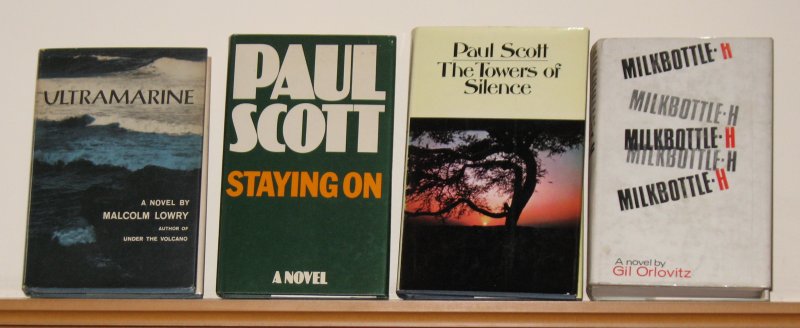
Some literary first editions. I read Ultramarine over Christmas and it is very good indeed. I will read more Lowry. Milkbottle-H was recommended by someone on LibraryThing and this was the only edition of the book I could find. Paul Scott is a favourite writer, and both The Towers Of Silence and Staying On are for the collection.
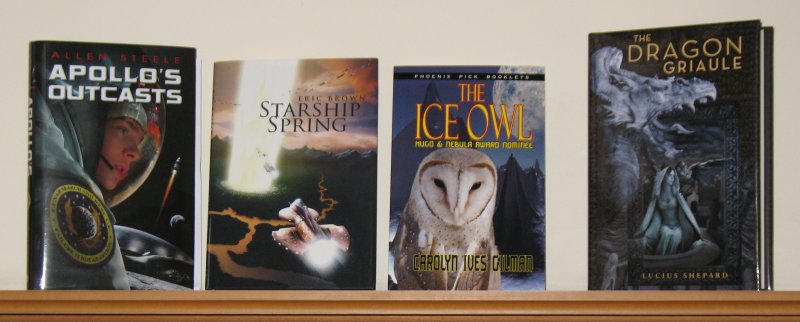
Some genre first editions. Apollo’s Outcasts I’ll be reviewing for Vector. I should know about this sort of stuff, right? Starship Spring is the final book in Eric Brown’s Starship quartet – I bet you can guess the titles of the other three. The Ice Owl is a novella by Carolyn Ives Gilman. I shall be reviewing it for Daughters of Prometheus. The Dragon Griaule is a beautiful-looking collection from Subterranean Press. I have all of its contents as separate novellas… except for the one original to this book. Which they clearly put in so that people like me would buy it.
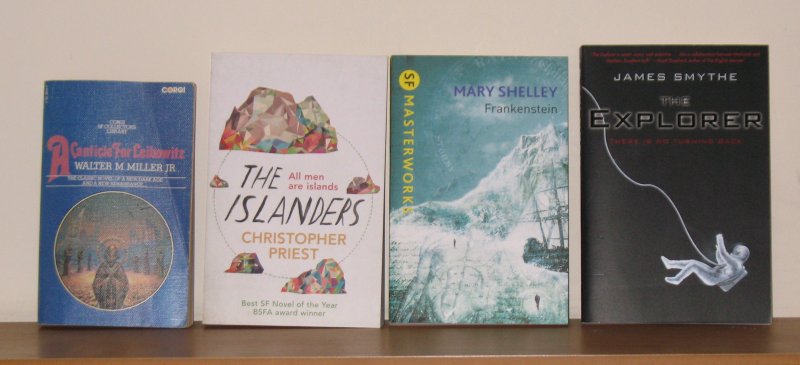
Some genre paperbacks. Unbelievably, I have never read A Canticle For Leibowitz. Good job I found this copy in a charity shop, then. The Islanders was a Christmas present. Frankenstein joins the other SF Masterworks. And The Explorer was sent to me by James Smythe (I swapped it for a copy of Adrift on the Sea of Rains).
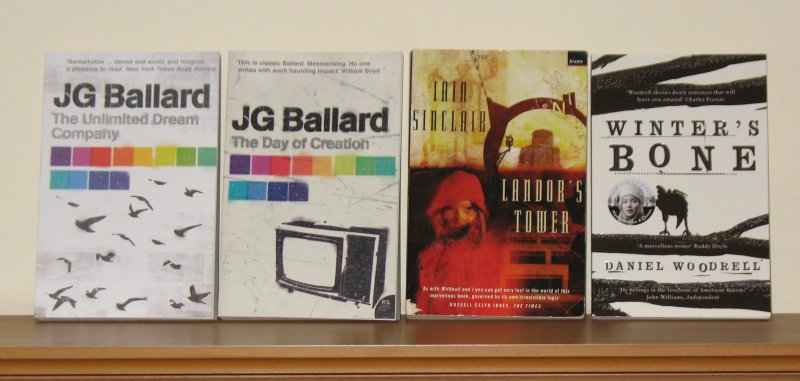
Non-genre paperbacks. Two more of the attractively-packaged Ballard paperbacks, The Unlimited Dream Company and The Day of Creation. That’s all of them now. I’ve been picking up Iain Sinclair novels – this one is Landor’s Tower – when I see them in charity shops, but have yet to actually, er, read them. Winter’s Bone I wanted to read after being very impressed by the film adaptation. Santa gave it to me.
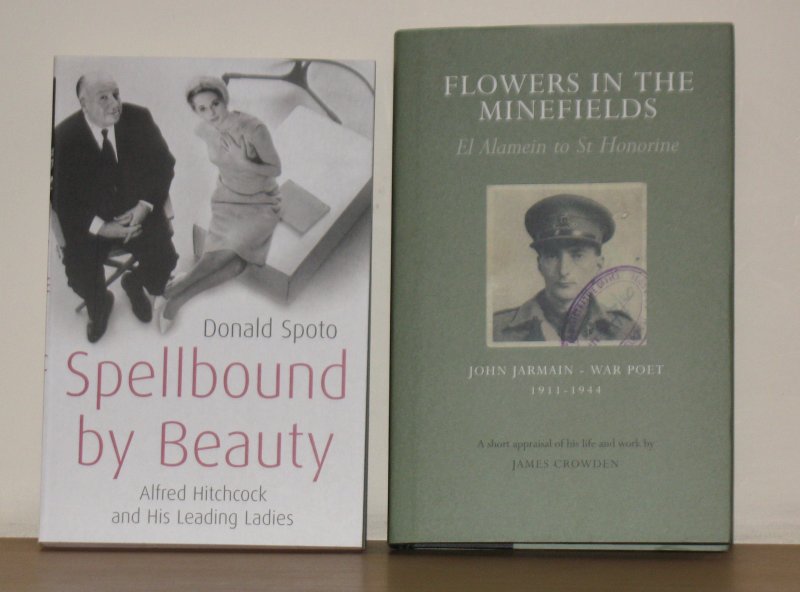
I’ve always rated Hitchcock as a director, so I made an effort to watch The Girl, the TV movie about his relationship with Tippi Hedren during the filming of The Birds and Marnie. It was excellent. Spellbound by Beauty is the book it was based upon. John Jarmain is one of my favourite poets, and Flowers in the Minefields is a collection of his poems and letters, with commentary. It is, I think, the only book about him ever published.
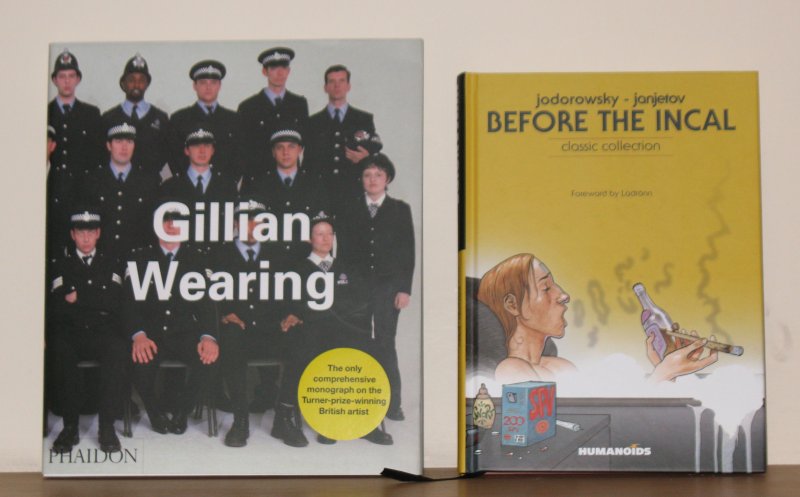
During a visit to Louisiana, a modern art museum in Denmark, over Christmas I saw some photographs by Gillian Wearing, and was sufficiently intrigued to pick up a book about her work. Before The Incal is a prequel bandes dessinée and it is excellent.
So there we go: 50 essential science fiction novels, as chosen by Jared Shurin (here and here), James Smythe (here and here) and myself (here and here). And, of course, there’s the original abebooks.com list.
Only three books appeared on all three lists: Frankenstein, Nineteen Eighty-Four and The Handmaid’s Tale. None, you’ll note, were published as sf novels. Two are by women. Only the one by a man appeared on the abebooks.com list.
Across all three lists, there were 34 books out of 150 by women writers (including duplicate choices). We could – should – have done that better. There were nine books by non-Anglophone writers. So, a fail there too. Theme- and subgenre-wise, however, the choices were widespread, with everything from a Choose To Your Own Adventure to a bande dessinée.
Time-wise… both James and Jared liked the 1950s (both with 10 books), and the 1980s (9 for James, 12 for Jared). I preferred the 1970s (12 books) and the 1990s (also 12 books). Which is odd, as I think I’m oldest. The 1980s was the most popular decade overall, with 28 books chosen by the three of us. Jared like the most 19th century novels (4), and James liked the most 21st century novels (11).
Finally, for the record, here’s the list which sparked off the ones put together by Jared, James and myself. I’ve done the meme thing to it – you know, bold if you’ve read it, italicise if it’s on the TBR. Also, * if it’s on my list, † if it’s on James’, and ‡ if it’s on Jared’s.
1 A Journey to the Center of the Earth, Jules Verne (1864) 2 The War of the Worlds, H.G. Wells (1898) 3 Brave New World, Aldous Huxley (1932) 4 When Worlds Collide, Edwin Balmer & Philip Wylie (1933) 5Odd John, Olaf Stapledon (1935) 6 Nineteen Eighty-Four†‡*, George Orwell (1949) 7 Earth Abides, George R Stewart (1949) 8 Foundation†, Isaac Asimov (1951) 9 The Illustrated Man, Ray Bradbury (1951) 10 The Demolished Man, Alfred Bester (1953) 11 Ring Around the Sun, Clifford D Simak (1953) 12 Mission of Gravity, Hal Clement (1954) 13The Long Tomorrow, Leigh Brackett (1955) 14 The Chrysalids†, John Wyndham (1955) 15 The Death of Grass or No Blade of Grass, John Christopher (1956) 16 Starship Troopers, Robert Heinlein (1959) 17 The Sirens of Titan†, Kurt Vonnegut (1959) 18 Alas, Babylon, Pat Frank (1959) 19A Canticle for Leibowitz†, Walter M Miller (1960) 20 Venus Plus X, Theodore Sturgeon (1960) 21 Solaris†*, Stanislaw Lem (1961) 22 The Drowned World†, JG Ballard (1962) 23 Hothouse, Brian Aldiss (1962) 24 A Wrinkle in Time‡, Madeleine L’Engle (1962) 25 Dune*, Frank Herbert (1965) 26 Make Room! Make Room!, Harry Harrison (1966) 27 Logan’s Run, William F. Nolan & George Clayton Johnson (1967) 28 Do Androids Dream of Electric Sheep?, Philip K Dick (1968) 29 The Left Hand of Darkness‡, Ursula K Le Guin (1969) 30 Behold the Man, Michael Moorcock (1969) 31 Ringworld, Larry Niven (1970) 32 Rendezvous with Rama*, Arthur C Clarke (1972) 33 Roadside Picnic, Boris & Arkady Strugatsky (1972) 34 The Female Man*, Joanna Russ (1975) 35 Man Plus, Frederik Pohl (1976) 36 The Stand, Stephen King (1978) 37 The Hitchhiker’s Guide to the Galaxy†‡, Douglas Adams (1979) 38 Nor Crystal Tears, Alan Dean Foster (1982) 39 Ender’s Game‡, Orson Scott Card (1985) 40 Consider Phlebas, Iain M Banks (1987) 41 Falling Free, Lois McMaster Bujold (1988) 42 Hyperion†, Dan Simmons (1989) 43 Red Mars†*, Kim Stanley Robinson (1993) 44 Ribofunk, Paul Di Filippo (1996) 45 Cryptonomicon, Neal Stephenson (1999) 46 Uglies, Scott Westerfeld (2005) 47 Old Man’s War, John Scalzi (2005) 48 Little Brother, Cory Doctorow (2007) 49 Acme Novelty Library #19, Chris Ware (2008) 50 Embassytown†, China Miéville (2011)
I make that 32 read and 3 on the TBR. There are, I must admit, some bizarre choices – Alan Dean Foster? But no more so than the lists James, Jared and myself put together, I suppose. There are a number of traditional choices, books I avoid because I don’t think they’re very good, even though most people claim them as “classics”. Such as, of course, the Asimov. It’s also a very testosterone-heavy list – I make it 5 female authors. I was embarrassed I only managed to list 16 on mine, but that’s three times more than this list. Finally, of those books I’ve not read or are not on the TBR… I’m not bothered about actually reading them. Which I guess means this list fails in one respect.
Overall, it’s been a fun exercise. I’m not sure I’d generate the same list if I were to do this a year from now. I suspect James and Jared would say the same…
Day two and here are my essential sf novels, from 26 through to 50. See here for Jared’s on Pornokitsch and here for James Smythe’s.
To me, what constitutes science fiction has always been quite clear, and my numerous attempts at defining the genre have merely been a way of communicating that certainty. But what does “essential” mean? I found that much harder to define. Yes, I relied a lot on my favourite novels when compiling this list – I thought they were brilliant, therefore they must be essential. Except several of them I could not quite squeeze in. My favourite DG Compton novel, for example, is Synthajoy, but in yesterday’s list I instead included The Continuous Katherine Mortenhoe – because I think it covers a theme more essential to a true exploration of the science fiction genre. Likewise, I wanted to include Jed Mercurio’s Ascent, a novel that has been a touchstone work for my own writing for several years. But it only hints at being alternate history in its final pages, and it barely qualifies as space fiction. Oh well.
We readily agreed that graphic novels, or bandes dessinées, were allowed. I picked the most obvious choice – see number 26 below. I’d like to have chosen Dan Dare or the Trigan Empire, but I don’t think either really characterises a tradition in British sf comics – certainly not one that continues to this day. So, much as I love them, I found their inclusion hard to justify.
Certainly, there were movements during the last few decades in sf which I needed to represent in my list: cyberpunk, steampunk, New Space Opera… As long as I picked one work from each, and could justify its presence, then job done. The works I chose for those subgenres are not the most obvious ones, but I think they’re the most important – or I certainly believe they deserve to be. Others may disagree.
Anyway, the list…
26The Incal, Alejandro Jodorowsky & Moebius (1981)
In France, there is a strong sf tradition associated with comics, or bandes dessinée. Not all of these have been translated into English – sadly. The Incal is one of the most popular bandes dessinée, and rightly so. It is completely bonkers, beautifully drawn, and an excellent example of what the medium can do.
27Downbelow Station, CJ Cherryh (1981)
Cherryh has been churning out muscular hard sf since 1976, and she’s still going. Somehow she has managed to stitch all these novels in to a single future history. It’s an astonishing achievement. This book is perhaps her best-known, and is very much characteristic of her oeuvre.
28Native Tongue, Suzette Elgin Haden (1984)
Women-only utopias do not happen overnight – though from some of the novels which feature them you might think so. Native Tongue charts one route, starting from a near-future in which women are reduced once again to the status of chattel. The development of a women-only language, Láadan, is instrumental in overturning this situation. This novel is both linguistic sf and feminist sf.
29The Handmaid’s Tale, Margaret Atwood (1985)
The scary thing about this book is that it’s completely made-up but it feels like it could really happen – might be happening now, in fact. You see it in the news every day, and sometimes you have to wonder what is going through people’s heads – the Young Earthers and Creationists, the congresswoman who publicly declares women should not have the vote, New Mexico recently passing a law which requires rape victims to carry pregnancies to term… I’d consider making such people read this book, but I have a horrible feeling they’d consider it utopian fiction…
30Last Letters from Hav, Jan Morris (1985)
Hav is not a real place, though you might be fooled into thinking so as you read this novel. Very early proto-sf often couched its tall tales in the form of travel journals, but once Gernsback bootstrapped the genre into existence, as a form of sf it seemed to go into decline. A pity, if Last Letters from Hav is any indication of what it can do.
31Metrophage, Richard Kadrey (1988)
Say “cyberpunk” and everyone immediately thinks of Neuromancer. But I’m not convinced that’s an especially essential book – cyberpunk has become a lifestyle, and does it really matter which novel – arguably – booted it up into existence? What is essential, however, is the book which folded cyberpunk back into science fiction. This one. It marked the end of cyberpunk as a sf literary movement. All the cyberpunk novels and stories that followed were just twitchings of the subgenre’s rotting corpse.
32‘Great Work of Time’, John Crowley (1989)
This is one of my two slightly sneaky inclusions. We did agree to allow novellas, and many novellas are indeed published as independent books. But this one never was – it first appeared in the collection Novelty. It is possibly the best time paradox story ever written, with the possible exception of Ted Chiang’s The Merchant and the Alchemist’s Gate.
33Take Back Plenty†, Colin Greenland (1990)
New Space Opera has been good for science fiction. But if this book had been its model rather than Banks’ Culture novels, it could all have turned out very differently. Take Back Plenty celebrates the pulp side of sf, and does so with intelligence, wit and verve. It is one of the genre’s best books.
34The Difference Engine†, William Gibson & Bruce Sterling (1990)
Another slightly sneaky choice, as Sterling appears alone at the end of this list. The term “steampunk” was coined by KW Jeter, and his Morlock Night and Infernal Devices are emblematic of the subgenre. But they’re not actually that good. The Difference Engine is good. It is the one steampunk novel that stands head and shoulders above the rest of the subgenre (which is now, sadly, a lifestyle).
35Stations of the Tide, Michael Swanwick (1991)
This sf novel is the only one I can think of which mixes science fiction and Southern Gothic. It’s a mashup that shouldn’t by rights succeed. But it does. It is a rich and strange book – and sf needs to be rich and strange more often.
36Sarah Canary†, Karen Joy Fowler (1991)
Not all first contact novels involve hardy explorers beaming down onto an alien planet and trying to communicate with mysterious aliens. Sometimes the mysterious aliens are here on Earth; and sometimes we will never know if they were alien or even if we have made contact. This book is proof that sf does not need to be about the future, spaceships, robots, time travel, or giant computer brains.
37Red Mars*, Kim Stanley Robinson (1992)
This is the definitive novel on the near-future colonisation of another planet – in this case, our neighbour, Mars. Enough said. (Don’t forget to read the sequels too.)
38China Mountain Zhang, Maureen F McHugh (1992)
Near-future sf is difficult to do well, if only because the author is expected to have some sort of magical crystal ball. But sf has never been predictive, and when it has got something right it’s been a happy accident. China Mountain Zhang is a near-future novel, but that’s incidental. It is beautifully written. That’s all that matters. McHugh is one of the genre’s very best writers.
39Dark Sky Legion, William Barton (1992)
We may never find a way to circumvent the speed of light. Which means 90% of science fiction is just so much magical hogwash. But some writers have tried to envisage a distant future in which the speed of light restriction still holds true. This is the best of the bunch. It also does something interesting philosophically – and sf is traditionally not very good at that.
40A Fire Upon the Deep, Vernor Vinge (1992)
Some space operas aren’t New, though they appeared while New Space Opera was doing its thing. The central premise of A Fire Upon the Deep, the Zones of Thought, is one of those ideas that shows why sf is such an important and vibrant mode of fiction. The somewhat ordinary plot attached is almost incidental.
41Fatherland, Richard Harris (1992)
One form of alternate history is vastly more popular than any other: Hitler winning WWII. It’s impossible to write a story based on it that is neither derivative nor clichéd. This is probably the best of the lot – because it is set decades after the War, and is only peripherally concerned with the fact of the Nazi victory.
42Coelestis, Paul Park (1993)
There are many themes which science fiction rarely tackles. Postcolonialism is one. It smacks too much of the real world – and too much of the real world that is not the First World – for most sf writers and readers. Coelestis treats the subject with intelligence, and then goes on to deconstruct the colonial identity of one of its protagonists. A masterwork.
43Shadow Man, Melissa Scott (1995)
Among the many themes covered by sf over the decades has been sexuality and gender. The most famous such novel is LeGuin’s The Left Hand Of Darkness, but given the one-book-per-author rule I couldn’t pick that. (And besides, its treatment of its hermaphroditic humans is somewhat problematical.) Scott complicates matters here by throwing in five genders and nine sexual preferences and, while the gender politics are still a little iffy, this is an essential exploration of the theme.
44Voyage, Stephen Baxter (1996)
This is not only alternate history, it is also space fiction: it is an alternate history of a NASA mission to Mars. The research is impeccable, and it makes a highly plausible fist of its premise. Space fiction has been chiefly dominated by writers who are not very good, which is unfortunate. Happily, Baxter can write well, and he does so in this book.
45Ash: A Secret History, Mary Gentle (2000)
Is it science fiction, or is it fantasy? The world of the title character does seem more fantastical than sfnal, but it’s wrapped in a near-future narrative which is resolutely sf. And the way the two narratives interact, and change each other, is definitely straight from science fiction’s toolbox.
46Light, M John Harrison (2002)
This is perhaps the most literary science fiction novel ever written (not counting, of course, the two sequels). Or perhaps it’s the most science-fictional literary novel ever written. On balance, I suspect the former – it is too steeped in genre to be wholly accessible to readers of literary fiction. That still makes it essential for sf readers, however.
47Life, Gwyneth Jones (2004)
Surprisingly, working scientists are not especially popular as protagonists in science fiction. This novel is about one. And science. It is also brilliant.
48Alanya to Alanya, L Timmel Duchamp (2005)
First contact is a genre staple. This novel – the first of the Marq’ssan Cycle quintet – is not the first in which the visiting aliens choose to speak only to women, and which subsequently prompts a global crisis. It is, however, notable for a near-future world in which the ultra-rich rule openly and cruelly. Elizabeth Weatherall, PA to the chief villain of this book, goes on in later volumes to become one of the genre’s great villains in her own right. Go read all five books.
49The Road, Cormac McCarthy (2006)
Post-apocalypse is such a well-established subgenre that recently most such novels have been by writers of literary fiction. And this is the best of those. It’s also much better than any genre post-apocalypse novel. Sadly, the trope has now been so over-used it’s become banal. Someone needs to do something different with it.
50The Caryatids, Bruce Sterling (2009)
We look at the world today and see impending climate crash and the collapse of national economies… but no sf novel except this one has dealt with such a scenario. It’s for good reason that Sterling was one employed as”Visionary in Residence” at a Californian university. Essential reading for the near-future.
And that’s it. I think I’ve covered all the major bases. Not every book in my list of fifty is a blinding piece of literary genius – this is science fiction, after all… But I think my choices show a good spread of themes and subgenres, and every book is certainly worth reading. I couldn’t get everything in, however. Some choices were just too hard to justify. For example, one subgenre of sf I was keen to have on my list was early space travel. Unfortunately, I’ve not read Garitt P Serviss or Willy Ley, and there’s a reason why High Vacuum (1956), First on the Moon (1958) and The Pilgrim Project (1966) are forgotten. So, no early space travel. Instead, I have Voyage as my entry for realistic space fiction (as if I’d really pick Bova, or Steele, or their like).
Finally, it has been a little dismaying putting together this list to discover how many of my selections are out of print. Some have recently been made available after many years OOP, either in the SF Masterworks series, or as ebooks through the SF Gateway. Respect to both for that. But others on my list have languished in obscurity since their original publication. This, I feel, doesn’t invalidate their, er, essentialness. After all, books don’t stay in print because they are essential, they stay in print because they’re popular, because people keep on buying them.
We have no real agreed academic canon in genre fiction, no fixed list of sf novels which teachers and lecturers turn to when designing courses on the subject. Yes, there are several books that people point to when the word “classic” is mentioned, but most of those are artefacts of the genre’s history. They were not chosen because experts in the subject have over the decades deemed them the best science fiction has produced in its eighty-seven years. Perhaps it’s good that sf is democratic in that regard… but when it elevates Foundation, Starship Troopers, the Lensman series and the like to greatness, I have to wonder…
A couple of weeks ago, abebooks.com published a list of 50 Essential SF Novels, about which, of course, there is much to argue. This prompted a discussion on Twitter between Jared Shurin of Pornokitsch, James Smythe of The Explorer, and myself. We decided to each generate our own list of 50 essential sf novels, which we would post over two days – 25 books per day. Jared’s list is here and James’ list is here. The rules were simple: the definition of science fiction up to the individual, novels only (so no collections or anthologies), novellas allowed, graphic novels (or bandes dessinées) also allowed, only one book per author, and only books that you have yourself read.
It proved a harder exercise than I expected. I could have picked 50 of my favourite sf novels – but what made them “essential”? Instead, I chose novels across a mix of science fiction modes and subgenres. I also wanted a gender-balanced list, but unfortunately couldn’t manage it – only 16 of the 50 writers below are female. That one-book-per-author rule did no help at all. There are many women sf writers who probably belong on this list, but whose books I’ve not actually read – such as Octavia Butler, MJ Engh, Charlotte Perkins Gilman, CL Moore, Judith Merrill, Carol Emshwiller, Marge Piercy, Naomi Mitchison… I could only choose those I’d read.
But, the list. Here it is, the first twenty-five novels of fifty that every self-respecting sf fan should have on their bookshelves, given in order of original publication. The remaining twenty-five will appear tomorrow.
1Frankenstein†, Mary Shelley (1818)
The original proto-sf novel and a bona fide classic of English literature. Of course it’s essential.
2The Time Machine†, HG Wells (1895)
Another proto-sf novel. Time travel is a well-established subgenre, but which time travel novel is the most essential in a collection? I submit it is this one. Far too many time travel stories use the trope merely to improve matters for the protagonist. Well’s classic describes, and comments on, the time of its writing through the future history of humanity.
3A Princess of Mars, Edgar Rice Burroughs (1912)
Edgar Rice Burroughs has a lot to answer for – this planetary romance arguably fixed science fiction as a pulp genre, and it took a good forty or more years for sf to break free. A Princess of Mars is a silly book, with its Gary Sue hero and naked Martians, its magical science and its simplistic set-up… but it is also an essential stop on the road to modern science fiction.
4Metropolis, Thea von Harbou (1926)
One of the genre’s first novelisations – if not the actual first – as it was based on the 1924 screenplay of Lang’s film. It’s all a bit overwrought and florid, in direct contrast to the movie, but its message remains timeless.
5Last And First Men†, Olaf Stapledon (1930)
It starts in the twentieth century and finishes two billion years later. It also throws away more idea for novels within its pages than any other book in the entire sf canon. Except perhaps Stapledon’s own Star Maker, which I’ve not read yet…
6Nineteen Eighty-Four*, George Orwell (1948)
For some reason, totalitarian dystopias haven’t been especially common in genre sf – perhaps because this one did it so well; or perhaps because most sf writers and fans aren’t willing to engage with politics that don’t match their own… Where dystopias do appear in sf (they’re more common in literary fiction), they’re generally little more than background, a dim setting against which some noble-browed hero can shine.
7The House That Stood Still, AE van Vogt (1950)
Like many early sf writers, van Vogt was hugely prolific. Also like them, most of his stories and books were not very good. In this one, van Vogt crashed together noir and pulp sf, and the result is something which stands above everything else he wrote (despite the occasional characteristic silliness). It’s essential because it’s emblematic of genre fiction of the period. If Philip Marlowe and Flash Gordon had a baby, it would look like this book.
8The Sword of Rhiannon, Leigh Brackett (1953)
Planetary romance as a subgenre is hard to take seriously. We’ve put robots on the surface of Mars, we know there are no ancient civilisations, no canals, etc. But Brackett was an order of magnitude better than most writers working in this subgenre, and it shows. This is probably her most characteristic planetary romance.
9The Stars My Destination†, Alfred Bester (1956)
Thinking about it, I don’t know why this book is “essential”, but I do know that any sf book collection without it feels incomplete. It is in many ways the distillation of 1950s sf, a crazy pulp re-imagining of The Count of Monte Cristo, which revels in its pyrotechnic prose.
10Solaris*, Stanisław Lem (1961)
The Anglophone world is not, of course, the only one with a sf tradition. Many countries have strong sf traditions. Such as Poland – and Solaris is perhaps the best-known Polish sf novel by the Polish sf writer best-known outside Poland. It’s also an excellent film (but that was made by a Russian).
11Dune*†, Frank Herbert (1965)
On a prose level, Dune is not especially good. It’s also unevenly structured. But its world-building is second to none, and it is the first truly immersive sf novel. All that praise for its ecological theme is just hogwash to disguise the fact that most males when they were teenagers wanted to be Paul Atreides.
12A Torrent of Faces, James Blish & Norman L Knight (1967)
Overpopulation is a common theme in sf, and the first three-quarters of the twentieth century were awash with Malthusian nightmares. This one shows its age somewhat, but its prose is very nicely detailed and its story is well-balanced.
13Camp Concentration, Thomas M Disch (1968)
People do things – mostly nasty – to other people, and sometimes sf writes about it. This is not the best-known sf novel about an experiment to increase the intelligence of a human being, but it is the best one.
14The Fifth Head of Cerberus†, Gene Wolfe (1972)
You’d think that a genre of fiction with the word “science” in its name would be clever. But it isn’t always. Sometimes, however, it can be very clever. Like The Fifth Head of Cerberus, which is a sort of cunning puzzle in fictive form.
15Rendezvous With Rama*†, Arthur C Clarke (1972)
Some people think sf is all about Big Dumb Objects, and Clarke’s Rama is probably the most iconic BDO of them all. A mysterious alien vessel, seemingly dormant, enters the Solar System and then leaves it. This is sf as fiction of the ineffable. Ignore the inferior sequels.
16Crash, JG Ballard (1973)
Good sf is about the real world, no matter when and where it is set. Or what happens in the story. Crash is avant garde, it is brutal, it can and will offend. But it also says something important about people’s relationship to technology.
17The Continuous Katherine Mortenhoe†, DG Compton (1973)
A quarter of the world’s CCTV cameras can be found in the UK. It is the most-surveillanced nation on the planet. And yet it’s not some horrible Stalinist totalitarian state – as sf insists would be the case. (Our current lords and masters seem to prefer Dickens as a model.) The Continuous Katherine Mortenhoe shows the ultimate in paparazzi – a reporter who has had one eye secretly replaced with a television camera. His subject just wants to be allowed to die in peace. But it’s not going to happen. A sf novel that says something important, now more than ever.
18The Dispossessed†, Ursula K LeGuin (1974)
Too much sf ignores politics, content to describe some simplistic system which meets the needs of either story or writer. Given the breadth of the genre and the size of its toolbox, it’s a shame sf doesn’t try more often for meaningful political commentary in its fictions. Happily, some writers have made a career of doing so, and LeGuin is among the best at this. As this novel demonstrates.
19Dhalgren†, Samuel R Delany (1974)
There aren’t many sf novels which could legitimately make it onto a list of twentieth-century literary classics, but Dhalgren is one of them.
20The Female Man*†, Joanna Russ (1975)
This is not just a book about women-only worlds, it is also an excellent explanation of why such worlds need to exist. Sf is far too useful a tool to be merely tales of action/adventure in outer space. This book demonstrates why, and does it in a way that cannot fail to affect readers.
21Hello Summer, Goodbye, Michael G Coney (1975)
There are not that many sf novels in which humans never appear – possibly because it’s a difficult trick to pull off well. But Coney manages it in this beautifully-written coming of age story set on an alien world.
22A Scanner Darkly†, Philip K Dick (1977)
One word: drugs. This is Dick’s best novel – perhaps not his druggiest, or funniest, or most paranoid; but certainly the one where all three elements work together most effectively. Happily, it doesn’t read like he made it up as he went along, even if he did. Which is more than can be said for the bulk of his oeuvre.
23The Ophiuchi Hotline, John Varley (1977)
Varley set three novels and a number of novellas and short stories in his Eight Worlds universe. In it, mysterious aliens have destroyed human civilisation on Earth, leaving only those on the other planets and moons of the Solar System to survive – as best they can. Happily, they have access to advanced technology beamed in blueprint form from Ophiuchi. A silly conspiracy plot provides the excuse for a travelogue through the Eight Worlds, before reaching an ending that actually throws away an entire novel’s worth of ideas. But this novel is an excellent example of sf’s penchant for optimism in the face of adversity.
24Gateway†, Frederik Pohl (1977)
Another one of sf’s better-known Big Dumb Objects. The space station of the title is a mysterious depot for alien FTL starships, which humans use Russian roulette-fashion to fire themselves off into the rest of the galaxy, hoping to return with riches. It’s like the National Lottery, but with aliens off-stage somewhere (instead of hosting the prime-time game shows).
25The Wanderground, Sally Miller Gearhart (1979)
There has been a strong tradition in sf throughout its history of women-only utopias – from Charlotte Perkins Gilman’s Herland in 1915 through works by Francis Stevens, Marge Piercy, Joanna Russ, Pamela Sargent, Suzy McKee Charnas, Sheri S Tepper, Nicola Griffith, and others. Sadly, it’s been marginalised by a readership who would sooner read about derring-do by manly men. The Wanderground is not entirely women-only – the men still live in the cities, and they’ve not changed their ways much – but the women-only settlements in the hills are something very much different. Perhaps there’s a bit too much magical powers about it all, but this novel possesses a great deal of charm.
The remaining twenty-five essential sf novels will be posted here tomorrow.
note: * means the book is also on abebooks.com’s list; † means the book is in the SF Masterworks series.
 It Doesn't Have To Be Right...