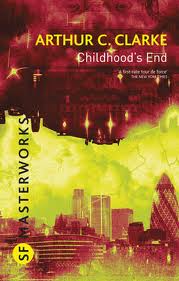
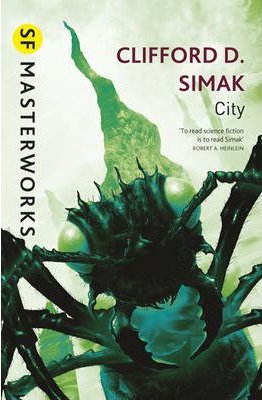
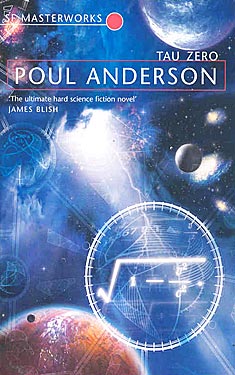
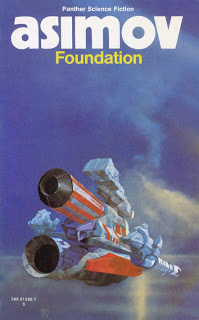
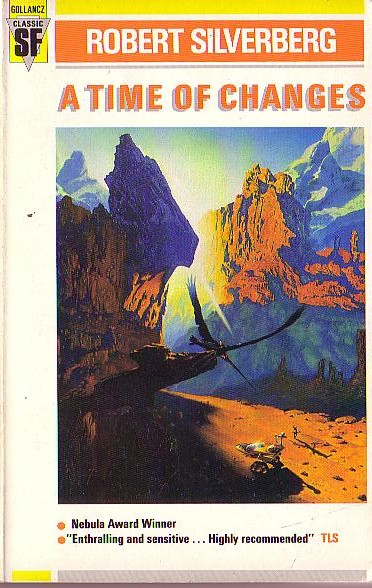
Back on 22 June, I posted a poll to see which six allegedly classic science fiction novels you would like me to read as my summer reading project. I promised to read the books and then write a blog post on each one. In hindsight, it was clearly a foolish thing to promise, although perhaps there were one or two books in the seventeen I chose for the poll that I sort of wanted to read/reread. Sadly, only one of those made it to the final six. Which are, for the record:
You lot must really hate me – The Moon is a Harsh MistressandFoundation. Still, a promise is a promise. Foundation is one of three rereads of the six books. I last reread it in 2006, thugh for some reason I don’t appear to have written about it then. Childhood’s End I read some time back in the early to mid-1980s, I think. I’ve not reread it since. A Time of Changes I’ll have read around the time my Gollancz Classic SF edition was published, which was 1986. The remaining three books I’ve never read before. They’re also in the SF Masterworks series, and those are the editions I own – in fact, Foundation and A Time of Changes are the only books in the six that aren’t SF Masterworks.
Anyway, some time in July I will start my summer project, and after I have finished each book I will write a review here on the blog. I am not expecting my reviews to be positive, but you never know, I might be pleasantly surprised…
It’s halfway through 2013, and it’s proven quite a year so far in ways both good and bad. This post is to celebrate some of the good stuff – namely the best of the books I’ve read, the films I’ve seen, and the albums I first heard during the previous six months.
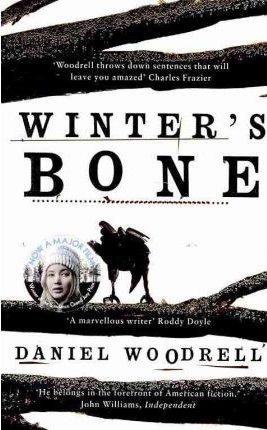
Books Winter’s Bone, Daniel Woodrell (2006) I read this after seeing and liking the film and I was much surprised to discover it was not some piece of cheap commercial fiction with an unusual setting, but instead a beautifully-written literary novel which happened to use a genre plot. The film is pretty damn good too. I plan to read more by Woodrell. I wrote about this book here.
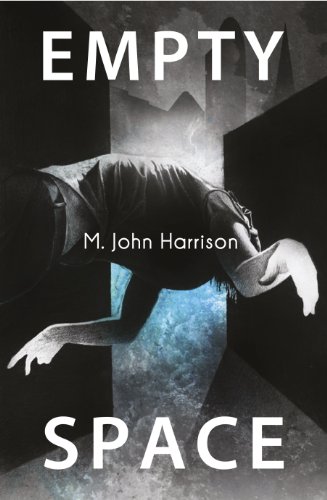
Empty Space, M John Harrison (2012) is the third book in the Kefahuchi Tract trilogy and I really must reread Light and Nova Swing one of these days. If at first I thought Empty Space felt a little undisciplined in its spraying of tropes across its narrative threads, the more of it I read the more I realised how very carefully engineered it was. I wrote about this book here.
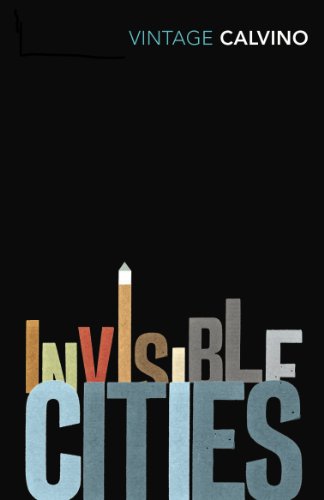
Invisible Cities, Italo Calvino (1972) is the most recently-read book to appear in this list. I had no real idea what to expect when I picked it up, but its lyrical and oblique descriptions of the cities (allegedly) visited by Marco Polo immediately captivated me. I wrote about this book here.
The Wall Around Eden, Joan Slonczewski (1989) is one of those books I read and enjoyed, but only realised how well-crafted it was when I came to write a review of it for SF Mistressworks. It reads like a masterclass in science fiction. This book really needs to be back in print. See my review here.
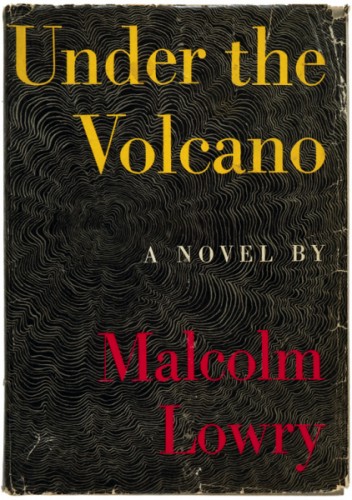
Under the Volcano, Malcolm Lowry (1947) Some books just leave you speechless at the quality of the prose, and while I’d already fallen in love with Lowry’s writing when I read his novella ‘Through the Panama’, there was always a chance this, his most famous and most lauded novel, would not appeal as much. Happily, it did. Even more so, perhaps. A bona fide classic of English-language literature. I wrote about it here.
Honourable mentions go to Osama, Lavie Tidhar (2011), whose grasp may not quite match its reach but it comes damn close; Before The Incal, Alejandro Jodorowsky & Zoran Janjetov (2012), which matches The Incal for bonkersness and sheer bande dessinée goodness; Underworld, Don DeLillo (1997), which is a bit of a bloated monstrosity, and contains too much baseball, but also features moments of genius; The Steerswoman’s Road, Rosemary Kirstein (2003), which is actually a cheat as its an omnibus of The Steerswoman (1992) and The Outskirter’s Secret (1993) and I only read the latter this year, but it’s an excellent series and deserves praise; Jamilia, Chingiz Aïtmatov (1958), which proved to be a lovely little novella set in the author’s native Kyrgyzstan; and Sons and Lovers, DH Lawrence (1913), which shows with beautiful prose how psychology should be used in fiction.
Um, not that much science fiction there. I seem to be failing at this science fiction fan business…
Films Le Mépris, Jean-Luc Godard (1963) I am not a huge fan of Godard, so I was somewhat surprised how much I liked this film. Perhaps it’s because it feels a little like Fellini’s 8½ (both are about film-making), which is also a favourite film, and looks a bit like something by Antonioni.
Only Yesterday, Isao Takahata (1991) I’ve been working my way through Studio Ghibli’s output, though I find most of it either twee, cloyingly sentimental or a little juvenile. But not this one. I wrote about it here.
About Elly, Asghar Farhadi (2009) For much of its length, this film feels like an art house mystery, but then it takes a turn into something completely different and wholly Iranian. I wrote about it here.
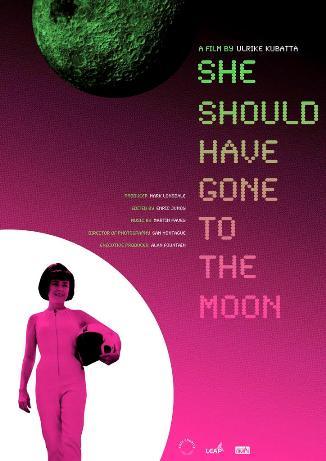
She Should Have Gone to the Moon, Ulrike Kubatta (2008) I bought this as research for the Apollo Quartet, and was surprised to discover it was a beautifully-shot documentary and meditation on the thirteen women who successfully passed the same medical tests as the Mercury astronauts.
Honourable mentions go to Gertrud, Carl Theodor Dreyer (1964), grim and Danish and beautifully subtle; Man With A Movie Camera, Dziga Vertov (1929), an astonishing and meta-cinematic document of 1920s Russia; Black Cat, White Cat, Emir Kusturica (1998), broad comedy but also very funny; Le Havre, Aki Kaurismäki (2011), typically deadpan but somewhat cheerier than usual; and The Sun, Aleksandr Sokurov (2005), a human portrait of Emperor Hirohito at the end of WWII.
Well, will you look at that, not a single Hollywood film in the entire lot. Instead, we have films from France, Germany, Japan, Iran, Denmark, Russia, the former Yugoslavia, Finland and a documentary from the UK.
Music Construct, Dark Tranquillity (2013) A new album from one of my favourite bands, and with each new album they just get better and better. Can’t wait to see them live.
Death Walks With Me, Noumena (2013) A new album from Finnish melodic death metal masters after far too long a wait. Trumpet!
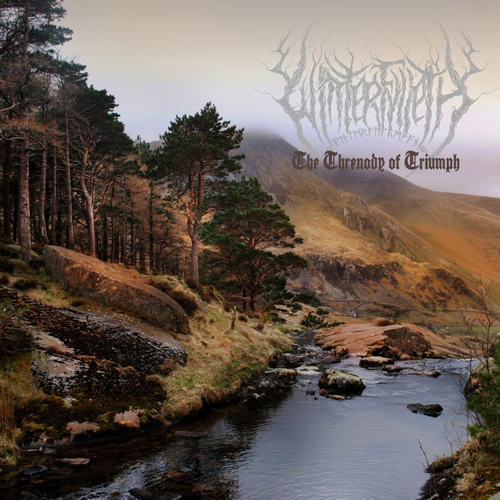
The Threnody Of Triumph, Winterfylleth (2012) They call it English heritage black metal, though I’m not entirely sure what that means – a wall of guitars, with howling vocals layered over the top, some lovely acoustic interludes, and they’re bloody good live too.
Dustwalker, Fen (2013) More English heritage black metal but also very atmospheric, perhaps even a bit shoegazer-y in places; a formula that works extremely well.
Unborn and Hollow, Forlorn Chambers (2013) A demo EP from a new Finnish band, which mixes and matches a couple of extreme metal genres to excellent effect. Very heavy, very doomy, with a lot of death in it too. I’m looking forward to seeing an album from them.
Honourable mentions: Conflict, Sparagmos (1999), classic Polish death metal; Of Breath and Bone, Bel’akor (2012), Australian melodic death metal; Deathlike, Ancient VVisdom (2013), strange acoustic doom from Texas; Where the End Begins, Mentally Blind (2013), accomplished demo from a Polish death metal band.
Something must be wrong with me. How else to explain it? It’s been over a month since my last book haul post, and look how few books I’ve bought since then. The mantlepiece, at least, is grateful, as its load was somewhat lighter as I was putting together this post. And the rate of increase in the TBR has decreased a little. You know you’re in trouble when you’re measuring the rate of change in the TBR rather than the actual number of books you own but have yet to read. So it goes.
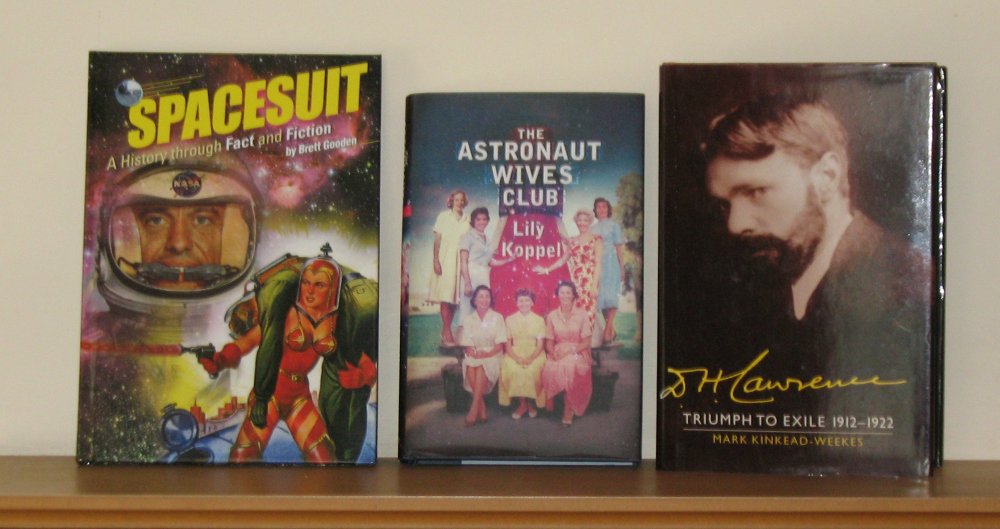
Some non-fiction: Spacesuit I fancied the look of, chiefly because it includes spacesuits from fiction; but we’ll see how it stacks up against the other books on the topic I own. The Astronaut Wives Club is research for Apollo Quartet 4, and it’s nice when you decide on a topic to write about and someone then goes and publishes a factual work on that very subject. DH Lawrence: Triumph to Exile 1912 – 1922 is the second volume of a three-volume biography of the writer and belonged to my father. I have the first, but now I’m going to have to see if I can get hold of a hardback edition of the third book.
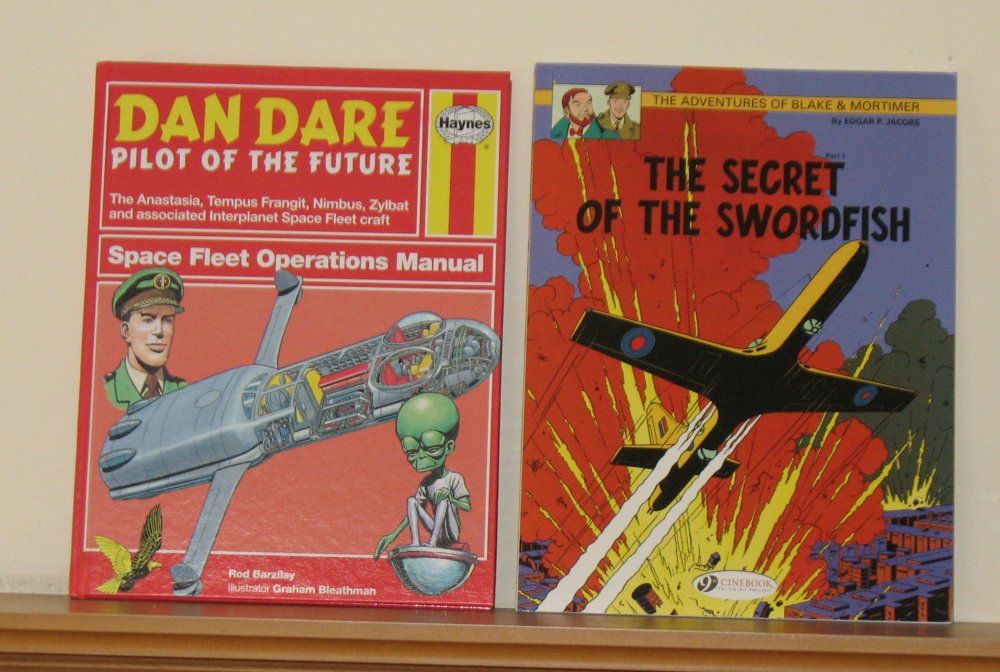
Haynes have branched out from car owners’ workshop manuals, and while I can understand them applying the same formula to various famous aircraft, such as the Avro Vulcan and Supermarine Spitfire, or even the Space Shuttle and Lunar Rover, some of the fictional “vehicles” they cover make less sense – like the U.S.S. Enterprise, the Millennium Falcon, or Gerry Anderson’s Thunderbirds. Still, I’ve been a fan of Dan Dare for years, so I thought the Space Fleet Operations Manual worth a go. It’s… okay. Cutaways of the various spacecraft, thumbnail sketches of the characters and alien races. There’s not much detail. Ah well. The Secret of the Swordfish, Part 1 is the fifteenth volume in the series, and there’s only a few to go before it’s all done. This is the first Blake and Mortimer story, originally published in 1950, and it shows. The artwork is Jacobs’ usual ligne claire style but the story is neither as complex nor as clever as much later volumes.
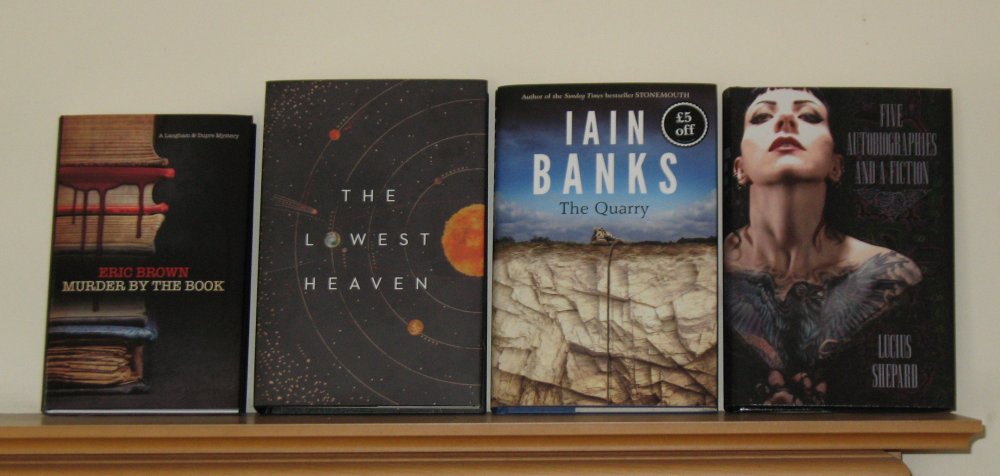
For the collections: Murder by the Book is Eric Brown branching out into crime, and I’m looking forward to reading it (especially since I know what one of its touchstone works was). I was kindly sent an ARC of The Lowest Heaven but after reading the first story by Sophia MacDougall I decided it was worth buying the limited edition. So I did. Review to follow shortly-ish. The Quarry I bought from Waterstones, and it’s not like I was never going to buy the book in hardback. Five Autobiographies and a Fiction I bought direct from Subterranean Press. Idiot HMRC decided to charge VAT on it, even though books are exempt. I have applied for a refund but it’ll be weeks before I get it. So, of course, they did it to the next book I ordered from the US. I’ve been buying books from publishers and eBay sellers in the US for years without a problem, and then twice in one month they wrongly stiff me for VAT. Stupid HMRC are stupid.
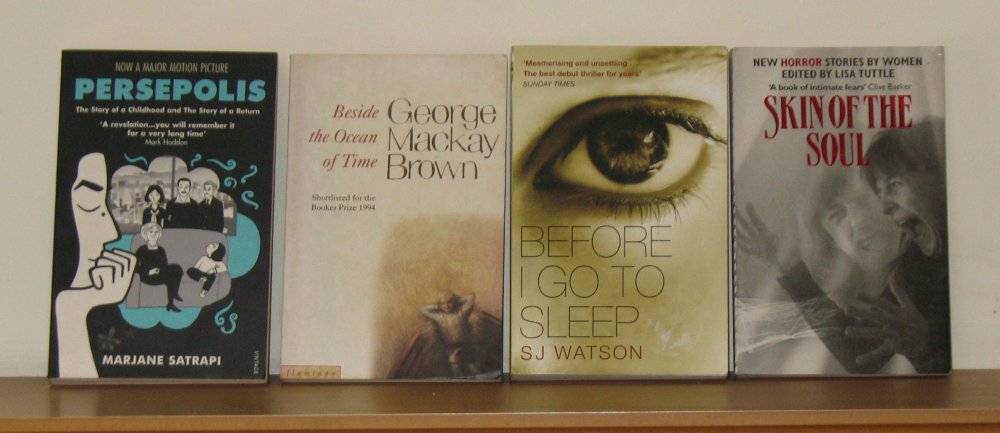
Some charity shop finds: Persepolis, a graphic novel about a woman growing up in Iran. I’ve been there, you know: Persepolis. It was in the early 1970s, we went on holiday to Iran, and stayed in Isfahan, Shiraz and Tehran. At one point, we went to see the ruins at Persepolis. I really ought to see about digitising the cine film my father shot when we were there. Beside the Ocean of Time was a lucky find – I’ve been interested in trying something by George Mackay Brown since seeing him mentioned on, I think, Eve’s Alexandria. Before I Go To Sleep I vaguely recall being one of those literary/mainstream novels based on a sf idea from a couple of years ago. I can’t actually remember what people said about it, however. I guess I’ll find out for myself. Skin of the Soul is a Women’s Press anthology of horror stories by women writers. I wavered on this one – I mean, it’s not sf so I can’t review it for SF Mistressworks; and I’m not a huge fan of horror, anyway. But then I saw Suzy McKee Charnas and Karen Joy Fowler on the TOC, and I decided to buy it.
Finally, two books I bought from Waterstones’ “buy one get one half price promotion”. Guess which one I got for half price: is it HHhH at £8.99 or A Possible Life at £12.99? I really wanted HHhH as I’d heard so many good things about it, but as is always the way with these promotions finding a second book proved difficult. Yes, I did want to read A Possible Life, but not enough that I’d pay near enough thirteen quid for the trade paperback. But there was nothing else that looked remotely interesting. I must have been in a good mood.
Considering I think of myself as a science fiction fan and the stories I write I classify as science fiction, I don’t seem to read that much of it – only two sf novels since my last reading round-up post. (Actually, it’s four as I read a further two for SF Mistressworks (here and here), so I’ve not mentioned them in this post.) I suspect by the end of the year, however, genre will still form more than half of my reading. [Checks spreadsheet of books read] Ah, so far this year, 57% of the books I’ve read were science fiction. Well, there you go: this last lot of books must have been an aberration. No matter.
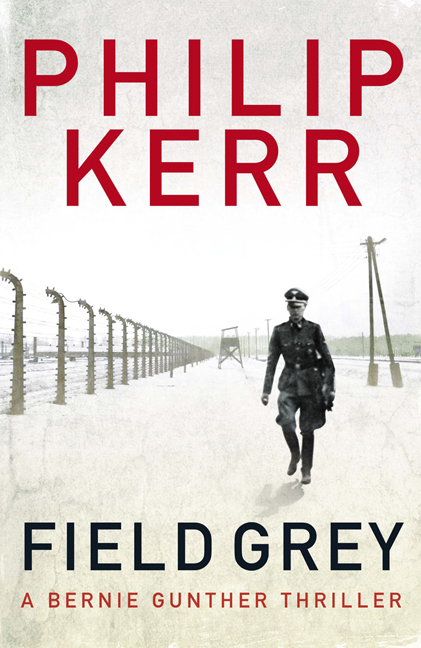
Field Grey, Philip Kerr (2010) Bernie Gunther seems to have settled in Cuba after the events of If the Dead Rise Not, except things take a turn for the worse when he finds himself having to say no to either the Cuban secret police or his gangster boss. So he skips town in a boat; but is pulled over by a US Navy cutter out of Guantanamo, and once (they think) they’ve identified him, they summarily imprison him for a bit and then send him back to Germany to stand trial for war crimes. Only it transpires that what the Amis really want is his help in identifying a French war criminal who is being repatriated from the USSR, where he was a POW. Except that’s not what they really want… And this has to be the most confusingly-plotted of Kerr’s novels I’ve read, with its plots-within-plots-within-plots, er, plot. It’s excellent on detail, as usual – when Bernie spends time in a Soviet gulag, for example, it’s clear Kerr has done his research. With nine books now in the series, Kerr is building up quite a back-story for Bernie – like some of the others, Field Grey spends as much time on Bernie’s war-time exploits as it does in the 1950s when the story opens. Good stuff.
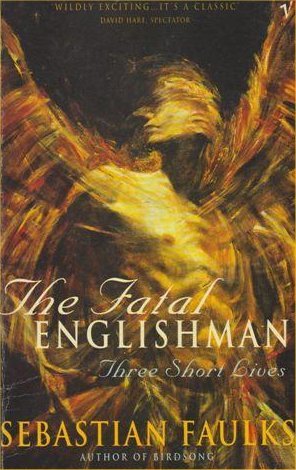
The Fatal Englishman, Sebastian Faulks (1996) I’ve now read all of Faulks’ books, except his first, A Trick of the Light, which is impossible to find, and his latest, A Possible Life (which I bought in Waterstones only this last weekend). Birdsong is obviously his best, though I did like Human Traces a lot as well. The Fatal Englishman, however, is non-fiction, and about three men who all died at a relatively young age, though their lives to that point had promised much. The first is Christopher Wood, a talented painter in the 1920s, who fell foul of opium just as he was beginning to produce his best work. Richard Hilary was a Spitfire pilot during the Battle of Britain and was horribly burned in a crash. He underwent pioneering plastic surgery, and then wrote a book on his experiences, The Last Enemy, which made him famous. He desperately wanted to return to flying fighters, but his injuries made it difficult. He did manage to wangle a posting flying night fighters, but died in a mysterious crash some weeks later. The last of the three is Jeremy Wolfenden, son of Jack Wolfenden of the Wolfenden Report. Extremely clever, a bit of a rebel, homosexual and a heavy drinker, Wolfenden was expected to go far but got himself mixed up with the intelligence services while serving in Moscow as a journalist in the 1950s. He fled the USSR for the USA, got married and seemed to be dealing with his drinking. But it killed him at the age of 31. He never even got to see the Wolfenden Report published, which would have legalised his sexuality.
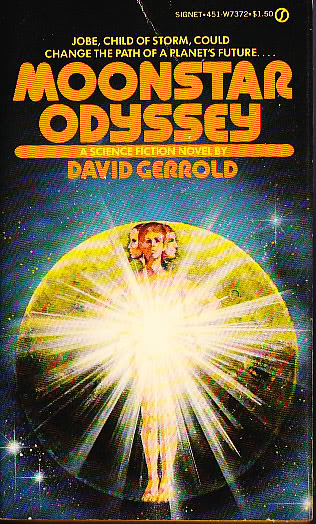
Moonstar Odyssey, David Gerrold (1977) This has been on my wishlist so long, I’ve forgotten why I put it there; and having now read it I’m even more mystified. The world of Satlik has been terraformed and shallow seas now cover its lunar-like landscape. The climate is maintained by a number of orbital mirrors, which also provide day and night. The inhabitants are not ordinary humans, however, but remain genderless until puberty, or “blush”, when they choose which sex they will be as an adult. Moonstar Odyssey is allegedly about Jobe, who is “different”, and while the stories and accounts which make up the novel repeatedly say as much, there’s little in there to suggest it. For a start, the plot doesn’t actually start until three-quarters of the way in, and when it does Jobe doesn’t actually do that much – she doesn’t save the planet, her family, a group of strangers, or anything. While Gerrold has built an interesting world in Satlik, he hasn’t written a story anywhere near as interesting in Moonstar Odyssey. Rather than working in its favour, its palimpsest nature leaves you waiting for much of the book for something to actually happen.
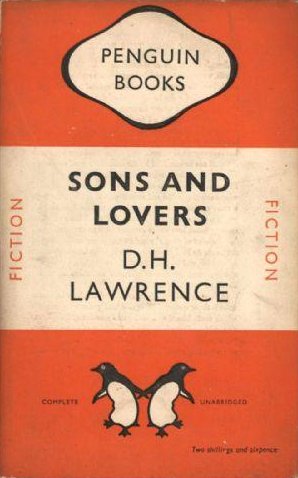
Sons and Lovers, DH Lawrence (1913) I’m slowly working my way through Lawrence’s oeuvre and am continually surprised I’d not read him years ago. Perhaps knowing of him and his work from a young age – my father was a huge fan of his books, so much so he dragged my mother to see Lawrence’s shrine in Taos on a visit to the US – I heard enough about him to think his works would hold no interest for me. After all, they’re around a century old, and it’s proper literature which, like most kids, I’d only read if I was told to. I finally read Lady Chatterley’s Lover a few years ago, and loved it. So now I’m reading all of his books. Opinions are divided as to which is his best: Lady Chatterley’s Lover, Women in Love or this, his third novel, Sons and Lovers. I’ve only read two of the three, so I’m unable to judge the matter; but certainly Sons and Lovers seems a more human story than Lady Chatterley’s Lover – perhaps because it isn’t simply focused on a central love triangle, but is more of a family saga (albeit focusing a lot on Paul Morrel and his relationships, especially his relationship with his mother). If The White Peacock felt a bit arbitrary and haphazard in places, Sons and Lovers is a remarkably controlled novel. While the story skips forward in uneven chunks at times, and the change in focus from eldest son William to second son Paul is a little disconcerting at first, the handling of the characters is beautifully done and the Nottingham of the time feels like a real, historical place. After finishing the book, I watched the 2003 ITV adaptation starring Sarah Lancaster as Mrs Morrel, but it was more Barbara Taylor Bradford than DH Lawrence and seemed to miss the point of the book. It also changed the story’s chronology, so that it ended on the even of World War I. I initially read Lady Chatterley’s Lover because it’s a classic of English literature, and was surprised to find I really liked it. I decided to read more of Lawrence’s works because my father was a fan and I wanted to read them for him. Having now read Sons and Lovers, I’m turning into something of a fan of Lawrence’s fiction.
Under the Volcano, Malcolm Lowry (1947) I’m glad I read some of Lowry’s short fiction and Ultramarine before I read Under the Volcano. Lowry is a very autobiographical writer, and part of the fun in reading him is spotting those parts of his life he’s used before in stories. In this book, for example, some of the background of the brother, Hugh – specifically his time at sea – echoes both Lowry’s own time as a seaman and the events in Ultramarine. The plot, as is true for much of Lowry’s fiction, is relatively simple: Geoffrey Firmin used to be the British Consul in the Mexican town of Quauhnahuac, but has been let go because of his excessive drinking. He is, in fact, killing himself with booze. The Consul’s wife, Yvonne, had left him but she has now returned. Also visiting is Hugh, the Consul’s step-brother. It is the Day of the Dead in 1938, and the three visit the nearby town of Tomalin by bus to view the local celebrations. And then things sort of happen. Lowry is another author I discovered via my father’s book collection, and who has since become a favourite – although I admire his prose more than I do Lawrence’s. I love its discursive nature, its occasional bouts of postmodernism, the way Lowry immerses you in the character of the narrator, no matter who that narrator is. And like both DH Lawrence and Lawrence Durrell (another favourite writer), Lowry’s descriptive prose is often very beautiful, especially when describing the landscape. Under the Volcano is considered an important book in English literature – in fact, Modern Library ranked it number 11 in their list of 100 best English-language novels of the 20th century (ignore the Readers’ List, which has clearly been poisoned by moronic right-wingers and Scientologists).
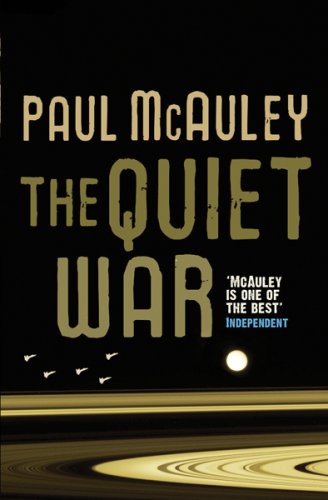
The Quiet War, Paul McAuley (2008) I’d been looking forward to finally reading this and so about a quarter of the way in was somewhat surprised to discover that I really didn’t like it. It’s not that it’s a bad book – on the contrary, it’s very well done, and paints a convincing portrait of life on the Jovian and Saturnian moons. But, for me, The Quiet War fares badly in comparison to Kim Stanley Robinson’s 2312, probably because it’s a far more traditional sf novel, and that’s not something I especially value in my reading at this time. I didn’t like the future McAuley was writing about, with its technological feudalism ruled by families of (pretty much) gangsters; I didn’t like that McAuley had his characters justifying that political set-up; I didn’t like that the political systems on Callisto and Ganymede and the other moons were often characterised as foolish or immoral. Having said that, I did like the technological side of McAuley’s future and thought it quite inventive. But still, it’s a novel about a war, and a war for the thinnest and most repugnant of reasons, and no amount of eyeball kicks can hide the bad taste that leaves. That the end of the story somewhat redeems it is in the book’s favour, and leaves me more likely to consider the sequel, Gardens of the Sun, than I would had The Quiet War ended a chapter or two earlier. All the same, I’d much prefer to read near-ish future novels which don’t rely on stupid wars for their narrative impetus, and which seem to recognise that people are products of their environments and that such future environments would be greatly different to the present day – and so the people living in them would be too. I don’t much see the point in extrapolating sociologically from the nineteenth century and pretending the twentieth century never happened, even if some days the last one hundred years do feel a bit like a great social experiment that has now ended…
Rise, L Annette Binder (2012) I received this as a birthday present from my sister and was a little puzzled why she’d bought it until I remembered it was on my wishlist. Then I wondered why it was on my wishlist. A small press collection of literary/fantasy stories – not my usual choice of reading material. I eventually worked out – with help – that I’d seen a review of it on Larry Nolen’s blog and it must have taken my fancy enough for me to wishlist it. And yes, it was a pretty good call. The fourteen stories in this collection hover on the edge of the fantastic. Some are slipstream, some are explicitly fantasy, and some contain no fantastic element at all. They are also very domestic. All of them are beautiful written, although Binder does have a tendency to cut things short and several of the stories seem to end somewhat abruptly. The level of observation and sharpness of detail is especially impressive. The opening story, ‘Nephilim’ is among the more fantastical and very good. ‘Shelter’ is heart-breaking, as is ‘Mourning the Departed’. Also very good is ‘Dead Languages’. Definitely worth reading.
Invisible Cities, Italo Calvino (1972) A book I’d wanted to read for a long time, although I knew nothing about it. But it appears on lots of 101 Book You Must Read Before You Die and 100 Best Books of the 20th Century lists, so clearly it’s thought to be very good indeed by very many people. I eventually scored a copy on readitswapit.co.uk, bunged it on the TBR… and finally got around to reading it. It took me a day. It’s a thin book, only 148 pages and many of the pages aren’t even full. Marco Polo is at the court of Genghis Khan, and he tells him of the various cities he has visited. A framing narrative in italics comments on the interaction between the two, and the effect on Khan of Polo’s tales. The remainder of the book is organised in short chapters, often no more than half a page, in which Polo gives allusive descriptions of the cities he claims he has been to. And they really are wonderful. None of the cities are real, but they could be – and yet this is not a travelogue of an invented place(s), like Jan Morris’ Hav. Having said that, as I was reading it, I kept on thinking, this is what The City & The City should have been if only Miéville had not stuck on that silly mystery plot. I’ve no idea if Invisible Cities was an inspiration for The City & The City, but I suspect it might have been. This is a book everyone should read. Go out and buy yourself a copy.
A conversation with Richard Palmer on Twitter this morning reminded me of my reading challenge a few years ago in which I reread a number of science fiction classics that I remembered fondly from my early teens. The challenge did not go well. I hated most of the books, could not understand why I’d ever liked them in the first place, and ended up purging my bookshelves of everything by Harry Harrison, EE ‘Doc’ Smith and Alan Dean Foster. So, of course, I thought it would be a good idea to have another go. As you do. But I’m not entirely sure which books to read and write about. As a result, I’ve decided to throw out a bunch of suggestions (of books that I actually own), and run a poll.
I’ve listed a bunch of titles below, and you get to select six for my challenge. I will read each book and then blog my thoughts on it during July, August and September. Asterisked titles will be rereads, though I likely last read them decades ago. Yes, all of the writers in the poll are male – but that’s deliberate. Twentieth-century sf by women writers I read for SF Mistressworks, and I generally to find it to be of middling to good quality. The titles I’ve put in the poll below are from middling to bad quality. At least, that’s what I’m expecting. Some may prove to be much better than I remembered them, though I’ll be surprised if they do.
Remember, a maximum of six votes only. If you have any suggestions for titles not on the poll, leave a comment and I may consider reading it as one of the six. But nothing published after 1975, please. I’ll close the poll at the end of the month, giving you just over a week to vote.
All too often when people suggest science fiction titles to introduce non-sf readers to the genre, they pick something that will show them what the genre is capable of. But everybody knows that all ready – they can see it on telly, in the cinema. They know all about space battles, planets exploding, alien vistas, robots, cyberspace, weird ideas. Whether they recognise some of those ideas as science fiction is an entirely different matter – is The Adjustment Bureau, with its “magic fucking hats”, a sf movie, for example? The reason these people don’t read science fiction is because they think it’s badly-written, or mired in outdated sensibilities and so irrelevant to them. And we’re no help because we thrust shit books written ninety years ago by some dead old white bloke at them. So what if the men all wears hats and the women do the dishes, it’s about galactic empires! It’s a classic of the genre!
But, honestly, why should we expect them to plough through three hundred pages of tin-eared dialogue, cardboard cut-out characters and leaden prose just for an “idea”? The whole point of written sf is that it can do what media sf does, but it can do it better. The plots will be logically and internally consistent, it won’t insult your intelligence, it may challenge your preconceptions and prejudices, it will have themes and motifs, and it tries to say something beside “money, please, now park your bum here for 100 minutes”. Plus all those space battles and exploding planets, too. Nothing in a science fiction novel is likely to make you *headdesk* like the “cold fusion” in Star Trek Into Darkness.
So when we try to think of titles for a non-sf reader to read… we should pretty much bin all the classics of the genre. We should choose books that demonstrate sf can be well-written, even beautifully written, that it can handle ideas considered too outrageous for cinema audiences, that it can tell stories that are well-plotted, internally consistent, without dumb plot-holes, stupid bromances, or daddy-issues that obliterate the actual story… We should suggest books that are recent, relevant, and have something interesting, or perhaps even important, to say.
And such science fiction novels do exist. It took me a while, but I think I came up with five. They’re all twenty-first-century novels. I have also read them. One or two might have won or been nominated for prestigious genre awards. They are, in no particular order…
Intrusion, Ken MacLeod (2012) Because it’s a near-future thriller written with genre sensibilities, works brilliantly and recognisably as a cautionary tale on the world we live in, and yet it also does something a writer of near-future thrillers would never consider doing, or might even actually be afraid of doing.
Dark Eden, Chris Beckett (2012) Not only because it won the Arthur C Clarke Award a month or two ago, but because it’s a story everyone will recognise but set on a world which will be completely new to them; and it’s beautifully written too.
Spin State, Chris Moriarty (2004) Because written science fiction can do the fast-paced action/adventure but it can also, in the same story, ask big questions about identity, memory, the future of humanity… and try to answer them.
Solitaire, Kelley Eskridge (2002) Because if science fiction is not about the people, then what’s the point in it – and how much are those people products of the world in which they live?
Life, Gwyneth Jones (2004) Because sometimes science fiction is actually about science and scientists, and how their calling affects themselves, their lives, those around them, and the world.
So: five science fiction novels, published this century by genre imprints. All are currently available. One is the first book in a trilogy, the third part of which has just been published. One is by a small press. I count eleven appearances in genre award shortlists by the five books, and two wins. So it’s not just me who thinks they’re good books. All five books are, I believe, accessible to someone who has not read science fiction before but is familiar with many of its tropes from television or cinema. And all five books, I feel, will show why written sf can do so much more than sf on television or in the cinema…
I like lists of books, even if it’s a list of books I’m not much interested in. And while I’ve read a number of epic fantasies – at one point I probably read them nearly as much as I read science fiction – I no longer have much time for the subgenre. A few years ago for one of my annual reading challenges, I tried to read a dozen I’d not tried before. I gave up six months in.
I’ve actually read very little twenty-first century epic fantasy, and I believe I tried a grimdark fantasy novel once and didn’t think it very good. On the other hand, I’ve never been so desperate for reading material that I’ve had to read a Dragonlance book or anything by RA Salvatore. In other words, I don’t know much about epic fantasy; and when you look at the interminable chronicles that have been published in the past decade or so, then I know even less. But I do know a little bit. And I do have a few favourite epic fantasy novels (of varying degrees of epicity), few of which I saw mentioned on any of the lists presented by Jared Shurin, Liz Bourke, Tansy Rayner Roberts or Justin Landon. So here’s a small and humble list of my own. Which is in no way presented in opposition to their lists, or as a shot across anyone’s bows or anything. Consider it a small pendant list. Or something.
I couldn’t think of fifty titles, so here are the few titles I could think of. They’re not in the remotest bit essential, they’re merely fantasy novels that I think are really good. Some of them are a bit obscure. They will not give you a good idea of what the epic fantasy field is currently like, nor will they educate in the history of epic fantasy.
I have split the list into sections, depending on the books’ degree of epical fantasyness. This is a cheat, plain and simple, because it allows me to sneak in some books that are fantasy but not epic, and even a couple that are not even – kof kof – fantasy. In all other respects, I stuck to the rules – ie, one book or series per author, must have read it, etc.
The most epic 1Lens of the World, King of the Dead, The Belly of the Wolf, RA MacAvoy (1990 – 1993)
Though only slim, the books of this trilogy probably cover more ground than many fat commercial fantasy series (GRMM and Robert Jordan, I’m looking at you). A dwarf of mysterious parentage is taught by a mysterious mentor, rises to power, loses his position, flees, travels around for a bit, and ends up ushering in a new age of science. 2Isles of the Forsaken, Ison of the Isles, Carolyn Ives Gilman (2011 – 2012)
The best fantasy I’ve read in recent years. After a war, the Innings turn their attention to their eponymous colonial possessions and try to take them in hand… leading to a war between reason and old beliefs. Brilliantly done. 3A Wizard Of Earthsea, The Tombs of Atuan, The Farthest Shore, Tehanu, Ursula K LeGuin (1968 – 1990)
I shouldn’t have to say anything about these books. I read the original trilogy as a kid and loved them. I came to Tehanu later, but I think it’s still an important part of the quartet. 4The Year of Our War, Steph Swainston (2004)
This is a superhero story couched in the language of epic fantasy, with a few nods in the general direction of science fiction. I’ve only read the first book of the trilogy, but The Castle Omnibus is on my wishlist. 5Tales of Nevèrÿon, Samuel R Delany (1979)
A trilogy/quartet of fantasy novels in which Delany in his inimitable way deconstructs the fantasy template. With much chewing of fingernails. I’ve only read the first but I do have Neveryóna and Flight from Nevèrÿon on the TBR (albeit as three paperbacks). 6 The Eternal Champion, Michael Moorcock (1965 – present)
There’s sure to be something in the many thousands of fantasy novels Moorcock banged out and then stitched together into his multiverse. Myself I’ve only read Corum: The Prince in the Scarlet Robe and a handful of the Elric books, but I have Fantasy Masterwork editions of the others. 7The Chosen, The Standing Dead, Ricardo Pinto (1999 – 2001)
An astonishingly original fantasy, in which a young man of noble birth who grew up in the provinces becomes an unwitting pawn in power-games in the imperial court. There is a third and final book, The Third God, but I’ve yet to read it (it is rather huge). 8The Pastel City, A Storm of Wings, In Viriconium, Viriconium Nights, M John Harrison (1971 – 1984)
Anti-epic anti-fantasy, so of course it belongs on this list. These four books do for ennui what berserker rage did for the Vikings.
Perhaps not quite so epic 9A Princess of Roumania, The Tourmaline, The White Tyger, The Hidden World, Paul Park (2005 – 2008)
A beautifully-written portal fantasy in which our world turns out to be the invention. A teenage girl is the hidden princess, but the fight to regain her family’s throne changes her world and herself in strange ways. 10The Weirdstone of Brisingamen, The Moon of Gomrath, Elidor, Alan Garner (1961 – 1965)
I read these as a kid, I think every kid should read them. 11The Grail of Hearts, Susan Shwartz (1991)
An intelligent retelling of the Grail King myth with added Arthuriana. When I started reading it, I expected to find myself well out of my comfort zone, but I ended up loving it. 12The Man Who Painted the Dragon Griaule, The Scalehunter’s Beautiful Daughter, The Father of Stones, Liar’s House, Lucius Shepard (1984 – 2010)
The Dragon Griaule is one of western fantasy’s more recent great creations. These four novellas are not the only stories Shepard has told about it, though they are the only ones I’ve read. Last year, Subterranean Press brought out a collection of the above four plus a further two novellas, The Dragon Griaule. It is already sold out. I have a copy. 13The Warrior Who Carried Life, Geoff Ryman (1985)
A strange and poetic fantasy, which bucks the trend in being slim, beautifully-written and allusive. 14Kirith Kirin, Jim Grimsley (2000)
An evil queen forces the rightful heir into hiding, where he falls in love with a humble villager. An epic fantasy that crashes together a variety of forms and results in something new and interesting. And in the appendices, a larger and much stranger world is revealed…
Just a little bit of epicness 15Grendel, John Gardner (1971)
I suspect every epic fantasy writer sooner or later falls in love with their dark lord and is often sorely tempted to let them win anyway (I mean, come on, magical messiahs and grizzled warriors are boring). Grendel was the original dark lord (-ish) and this is his story. 16Mythago Wood, Robert Holdstock (1984)
If you go into the woods today, you’re bound to have a surprise… And it’s true, a bunch of animated teddy bears having a picnic would “surprise” anyone. But what you’ll find in this novel’s titular wood is so much more surprising. A genuine British fantasy classic.
Well, maybe epic’s not the best word 17The Solitudes, Love & Sleep, Daemonomania, John Crowley (1987 – 2000)
Epic is probably the last word you’d think of to describe the Aegypt tetralogy – I’ve yet to read Endless Things, the fourth book – but there is a certain epic grandeur in the way they rewrite history as a fantastical story, in both the present and Elizabethan Europe. 18Rats and Gargoyles, The Architecture of Desire, Mary Gentle (1990 – 1991)
I remember the fuss when these books first appeared, and they deserved it. Hermetic science is by no means a D20-style magic system but, you know, that’s a good thing. Valentine White Crow and Balthazar Casaubon are one of fantasy’s great couples. 19Watership Down, Richard Adams (1972)
Bunnies! Oh, and I hate that stupid song. But I love the book.
It’s sf but it’s written in the language of epic fantasy, so there 20The Sword of Rhiannon, The Secret Of Sinharat, Leigh Brackett (1942 – 1964)
Strictly speaking, it’s planetary romance, but all that sufficiently advanced tech is indistinguishable from fantasy magic anyway, and there are ancient races and weird stuff that most sf commentators won’t even bother to explain away as sf. And the writing is a great many cuts above what was common for pulpish tales of this ilk. Don’t just read the two named novellas, read them all. 21The Shadow of the Torturer, The Claw of the Conciliator, The Sword of the Lictor, The Citadel of the Autarch, Gene Wolfe (1980 – 1983)
People have been arguing whether this is fantasy or science fiction for decades. Obviously, it’s science fiction and so shouldn’t have been in the Fantasy Masterwork series. But it is certainly presented like a fantasy story. Which is why it’s on this list. 22The Steerswoman, The Outskirter’s Secret, Rosemary Kirstein (1989 – 1992)
The first book reads like fantasy for much of its length, but then you start to realise it’s actually science fiction. The second continues to use the language of fantasy but is quite plainly sf. Both are excellent. There are another two books in the series on my TBR, and a fifth promised some time soon.
Epic moving pictures 23Monty Python and the Holy Grail, Terry Gilliam & Terry Jones (1975)
It’s a quest, it counts. It also probably contains more quotable lines than any other ten cult films. 24Red Sonja, Richard Fleischer (1985)
It opens with a ghost telling Red Sonja that she has just been raped, her parents murdered, and their house burnt to the ground… as if she didn’t know already. Brigitte Nielsen plays the title character with all the expressiveness of a stick of wood, and the story gleefully plunders and mangles clichés from the entire field. 25The Fellowship of the Ring, The Two Towers, The Return of the King, Peter Jackson (2001 – 2003)
Pretty much the dictionary definition of epic fantasy on the silver screen. 26Krull, Peter Yates (1983)
Possibly the weirdest epic fantasy film of them all. It’s like someone watched a swashbuckler and thought that’s what fantasy films should be like – except with flying carthorses, one-eyed giants, a giant spider woman, an out-of-focus evil monster, a flying fortress, and a, er, boomerang. Plus every British actor in Equity at the time.
So that’s over two-dozen entries, encompassing 46+ books (where the “+” refers to the several million in Moorcock’s Eternal Champion multiverse), and half a dozen films (which may or may not actually be actually very good films). No doubt you will all now want to mock me for my choices…
(You should, of course, go and read the lists put together by Jared Shurin, Liz Bourke, Tansy Rayner Roberts and Justin Landon, since they actually know quite a lot about epic fantasy and their lists are both educational and entertaining.)
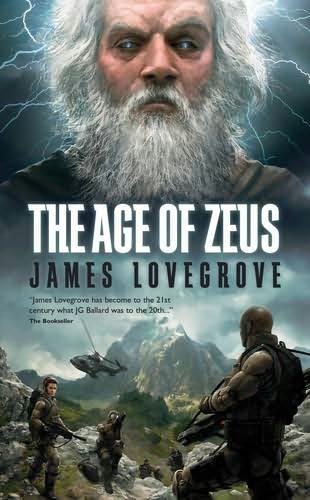
If any sufficiently advanced technology is indistinguishable from magic, then it follows that any sufficiently advanced technology is equally indistinguishable from divine powers. Zelazny used such a premise in his Lord Of Light back in 1968, and won a Hugo Award for it. James Lovegrove’s Pantheon trilogy, of which The Age of Zeus is the second book, is based on a similar conceit, but it’s unlikely to win any awards. That’s not because The Age of Zeus is a bad book. It’s written by someone who knows their craft, and can spin an entertaining yarn. But that’s all The Age of Zeus feels like: a yarn.
The Greek pantheon has returned, and rules once again from its ancestral home on Mount Olympus. It was not an easy or painless transfer of power, and even now, a decade after their coup, Zeus et al continue to commit random acts of divine violence. But Regis Landesman, arms manufacturer, has had enough, and so secretly puts together a team of a dozen soldiers, armed and armoured with cutting-edge technology, to do battle with the gods. Of course, he calls them the Titans. Sam Akehurst, an ex-detective sergeant from the Metropolitan Police, is Tethys, the leader of the Titans. Like the others, she has personal reasons for hating the Olympians. As, so it seems, does Landesman. Given that he takes the Titan call-sign Cronus, it shouldn’t be hard to guess what that reason is.
Some might say a novel should have no greater ambition than to entertain. I disagree. No artform should be merely bread and circuses. It needs to engage with the real world. Good fiction has something to say, whether or not you concur with what is being said. The Age of Zeus is not short of words, and many of them do indeed reflect on the real world. The Greek gods seized power in a violent coup, but a decade later they are the acknowledged rulers of the Earth. Which makes the Titans terrorists – but is “one man’s freedom fighter is another man’s terrorist” a strong enough skeleton for a story? The four-centimetre-thick spine of The Age of Zeus suggests it is. This is a fat book. It is also fast-paced. It opens with a combat scene – a prologue, which is actually a flash-forward to chapter 35 – clearly intended to yank the reader into the story. In fact, there are a lot of combat scenes. The Age of Zeus is a resolutely modern sf novel: its prose lingers lovingly on its military hardware and technology, each character has a carefully-plotted back-story, much of the dialogue displays a ready wit, and the story is structured as a series of obstacles to be overcome before the grand finale.
But, for all The Age of Zeus‘s techno-porn, there’s a god-sized hole at the heart of the novel, and it’s caused by Lovegrove’s authorial sleight of hand. He explains his Titans’ technology with some well-documented sfnal devices, but the Olympians’ powers are the result of… Well, all you can see is a blur as the author waves his hands in front of your face. As a result, the final big reveal is robbed of much of its divine power.
Despite having almost seven hundred pages, The Age of Zeus is not a heavy read. Its heroine is engaging – even if her competence as a Titan is a little implausible – and she’s ably supported by a cast of secondary characters who play their parts well. Lovegrove has fun with his premise, and he’s not afraid to get in a few digs at the real world. The Age of Zeus is indeed an entertaining novel. It’s a book for a dull journey or to read on a beach. I suspect that was its intent.
This review originally appeared in Interzone #228, May-June 2010.
Whippleshield Books is now just over one year old and has to date published two books, one of them an award-winner. Although I started up the press in March 2012, and published Adrift on the Sea of Rains on 9 April 2012, Whippleshield Press’s online presence didn’t happen until 25 May 2012. So that’s a handful of days over twelve months, plus or minus a month or two. It has been… an interesting year.
Any discussion of self-publishing is sure to be over-shadowed by the likes of Hugh Howey and Amanda Hocking. They have been amazingly successful at it – and, to be honest, I can’t see why. I’ve read Wool, it’s not very good. Which pretty much demonstrates there is no magic formula to success at self-publishing. Something in Wool clicked with a large number of people, but whatever it was it’s far from obvious. What this means is that Howey is not an expert on self-publishing, and has very little that’s useful to add to the debate. And, in all fairness, he has admitted as much: this is what worked for me, he has said, but it doesn’t mean it will work for you. The media, however, are only interested in success stories, as if somewhere in every one of them is an obvious recipe for success. There has been some discussion recently of such “survivor bias”, and to anyone with any common sense it’s plain that luck is not a transferable skill. If one ticket wins the lottery, buying the ticket with a number one up from it does not mean you will also win.
Commercially, Whippleshield Books has not been a “winner”. I’m okay with this – I didn’t set it up to make me pots of money. If anything, I expected it to be a financial burden for much of its life. Happily, it went into the black in March this year… but then the ecommerce annual fee came due and I also had to reprint Adrift on the Sea of Rains. But it’s been back in the black since the beginning of May and seems likely to remain there. Whether it’ll have earned enough to pay the cost of producing book three of the Apollo Quartet is a different matter, however. I’ve been funding Whippleshield Books out of my own pocket so far, so if it doesn’t it won’t affect my planned publishing schedule.
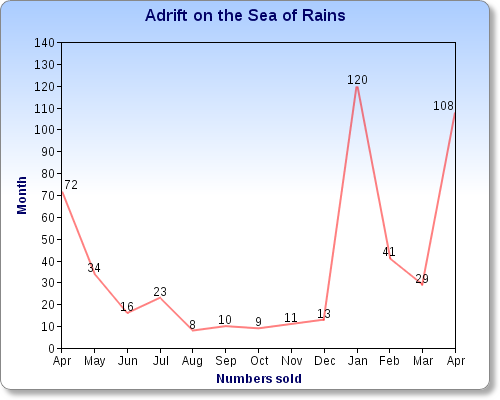
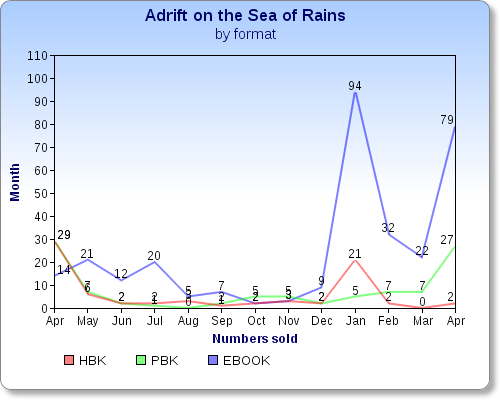
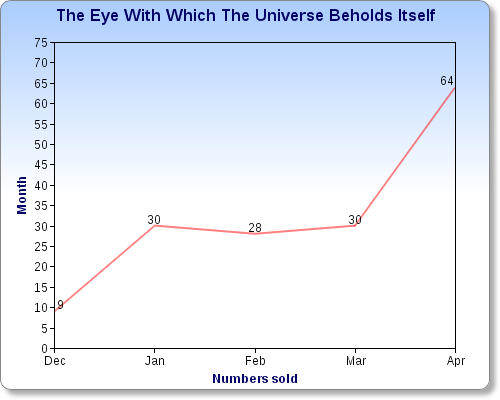
Speaking of which, I’ve received three submissions in the past twelve months. One I bounced immediately as not meeting the guidelines. The other two I rejected after requesting the full ms. To be honest, I had expected to be sent more, even if most would prove completely unsuitable. I can only surmise I’m the only person writing the type of fiction I want to publish. Happily, I’m not the only person who wants to read it, as sales for the first two books of the Apollo Quartet have shown:
The two spikes are due to mentions in the Guardian (here and here). The second one coincided with Adrift on the Sea of Rains winning the BSFA Award, so the win may also have contributed. But given that the full novella was published in the BSFA Award booklet for members, I suspect it didn’t have that much effect. I’ve added “WINNER OF THE 2012 BRITISH SCIENCE FICTION ASSOCIATION AWARD” to the product description on Amazon, but I’ve no idea if that has had any impact.
Adrift on the Sea of Rains continues to sell well on Kindle – better in the UK than in the US, it must be said. The number of Amazon paperback orders has also picked up, typically now around one a week. Of course, I’d sooner those sales took place on the Whippleshield website, but I know of no way to drive customers there from Amazon. When I mentioned in a previous blog post that Kindle sales were “more or less pure profit”, someone on a forum responded: “I had to laugh at this one. Shows a real lack of understanding of the costs involved in running a successful website. Electronic files take up disk space which has to be paid for. The transfer of electronic files uses bandwidth that has to be paid for”. To which I can only say, if you’re paying for storage of a single electronic copy of your book, and can actually work out the cost of uploading that file to Amazon, then I suspect other people are laughing at you.
Of course, The Eye With Which The Universe Beholds Itself has only been available since late January this year, so around four months in total. And word about Adrift on the Sea of Rains is still making its way throughout the genre landscape – such as making an appearance on SF Squeecast here, courtesy of Paul Cornell. Two books is a slim presence, especially given that they’re novellas too. I’ve had no short fiction published in genre venues with large audiences, at least not yet. So my platform remains small, and still chiefly confined to the UK.
Interestingly, Wunderwaffe, a short story of 9000 words which originally appeared in Anarchy Books’ Vivisepulture anthology, and which I produced as a chapbook limited to 12 copies before publishing it on Kindle, has been selling surprisingly well in the US. This may due to its low price. The $1.16 price-point, and the clearly stated length of 27 pages, however, hasn’t prevented a couple of people from leaving one-star reviews complaining that it isn’t a novel. I’m especially impressed by the review which states “stick to established authors that don’t give short stories under the cover of a book”. I think you’ll find “established authors” have also been known to publish short stories on Kindle too. In fact, John Scalzi’s latest novel was serialised, with each chapter sold as a separate ebook (not entirely the same thing, I know, but you know what I mean).
So there you have it – Whippleshield Books after twelve months. More or less. Plans for world domination may have to be put back another year or so. I believe Adrift on the Sea of Rains is the first self-published work to win a BSFA Award – although there are a couple of self-published works in this year’s Hugo shortlists. The stigma attached to the word “self-publishing” is slowly being eroded, but that doesn’t mean the self-published market is still not full of badly-written and poorly-edited derivative rubbish. But the good stuff is getting easier to find. I like to think that Whippleshield Books is, and will be, seen as a purveyor of that “good stuff”.
Reading about deep sea exploration, it struck me that the bottom of the ocean is a much scarier place than outer space. Humans cannot survive in either, of course, without technological intervention; but the sea is a more deceptive environment. It should be safe, it nurtured us after all – before birth, and back when life on Earth began. But we can’t breathe H2O, and the pressure can kills us in lots of sneaky and interesting ways long before it’s strong enough to squish us flat. And yet science fiction has treated the difficulties and dangers of the deep ocean with much the same disregard as it has for space.
Getting off a planet is costly and dangerous, and requires the expenditure of a great deal of energy. Sf pretends it has a magic way of doing this, one that mitigates the difficulty and danger. Getting to the bottom of the ocean may be much simpler – you just sink – but it’s equally dangerous. And living down there requires much the same level of assistance and engineering as living in space. Science fiction has its space stations and O’Neill cylinders and hollowed-out asteroids and orbitals, and they allegedly make living in space as mundane as living on this planet. Likewise, the genre posits underwater cities and humans genetically-engineered to live underwater, or submarines capable of reaching fantastical depths. But it’s all glib and unconvincing, just like sf is in its treatment of any place off-Earth.
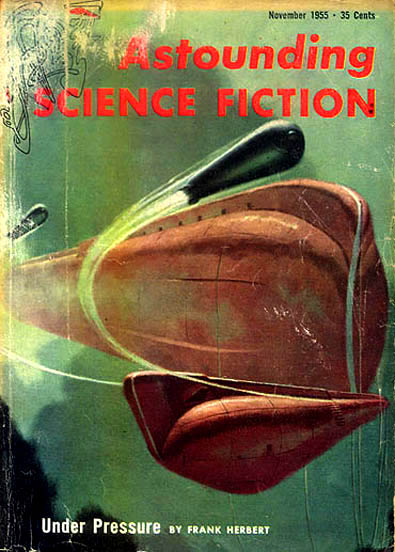
I’ve not read a great deal of watery sf. For some reason, it seems to have passed me by. It’s not been as popular a subject in genre writing as outer space, which may explain how I’ve managed to miss it. I’ve certainly read Twenty Thousand Leagues Under the Sea (1870), whose Nautilus marks one of the first depictions of a submarine in fiction, if not the actual first. At one point in the novel, Nemo stops off at a “submarine forest”, and leads a party including Aronnax to “a narrow valley, between high perpendicular walls, situated about seventy-five fathoms deep”. Or about 450 ft. Which would be about 13.8 atmospheres, and would require compression and decompression – neither of which are mentioned. Another famous science-fictional submarine is the “subtug” in Frank Herbert’s first novel, The Dragon in the Sea (1956, AKA Under Pressure). The story focuses on the mental pressure suffered by the crews of such submarines, as they sneak into enemy territory and pump oil from secret oilfields. The actual physical pressure of the deeps on the submarine itself is mostly ignored. Both The Deep Range (1957) and The Ghost From The Grand Banks (1990) by Arthur C Clarke, neither of which I’ve read, feature submarines. The first is apparently about undersea farming, and the second the raising of the wreck of the Titanic (also the subject of a thriller by Clive Cussler, titled – obviously – Raise the Titanic).
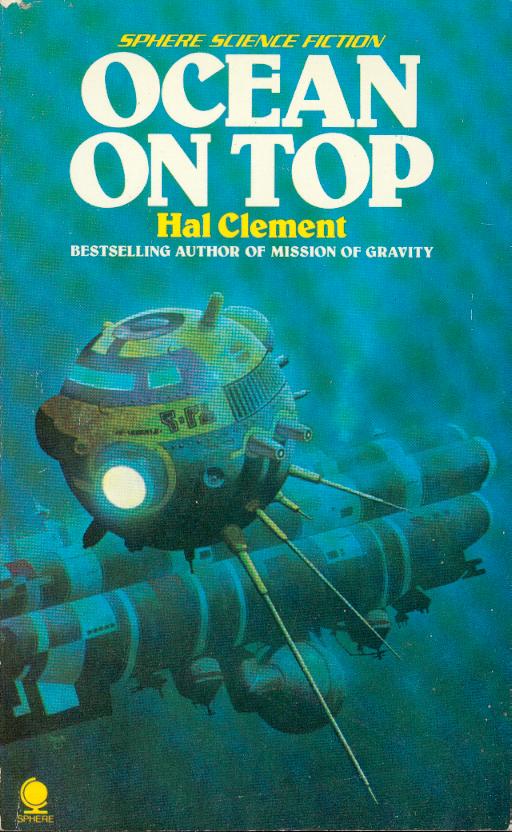
Still in the 1950s, Frederik Pohl and Jack Williamson wrote a trilogy of novels set in and around the underwater city of Marinia: Undersea Quest (1954), Undersea Fleet (1956) and Undersea City (1958). I don’t believe I’ve ever seen copies of these, but from the cover art on Wikipedia they look like juveniles. James Blish and Norman L Knight’s A Torrent of Faces (1967), a novel which proved a better read than I had expected, features a semi-submerged hotel which sinks. Also in the novel are people genetically-engineered to be semi-aquatic, and much of the shallower regions of the oceans are farmed by them to feed the Earth’s tens of billions. A sf novel about which I know nothing is Hal Clement’s Ocean On Top (1973), and I mention it only because the cover art of the UK paperback features what looks like the bathyscaphe Trieste. In Marta Randall’s Islands (1976), the narrator joins an expedition to dive on sunken Hawaii to hunt for artefacts and treasure. The narrative doesn’t go into much detail on the diving. In 2000, Allen Steele swapped outer space for underwater in Oceanspace. According to the blurb on Amazon, it’s set in 2011 and depicts an undersea research station which encounters some sort of sea monster. Harriet Klausner gives it, of course, five stars, but another reviewer complains with a straight face of the characters’ lack of depth. Peter Watts Rifter series – Starfish (1999), Maelstrom(2001), Behemoth: ß-Max (2004) and Behemoth: Seppuku (2005) – is about humans modified to live and work in the deep ocean, but you have to wonder why he named one book after an obsolete videocassette format. Most recently, Carolyn Ives Gilman’s novella Arkfall is set in the world-ocean of a Europa-like moon – see my review on Daughters of Prometheus here.
I mentioned Clive Cussler earlier. His novels often feature submersibles and diving. I’ll admit I’ve not read any of them for over a decade. The first seven or eight were fun thrillers, but their quality began to plummet with the publication of Treasure (1988) and by Shock Wave (1996) they were all but unreadable. These days, Cussler runs a writing sweatshop much like James Patterson. Lincoln Child’s Deep Storm (2007) is a technothriller set in a secret military deep sea habitat, but judging by the plot précis given on Wikipedia, it seems little different to Crichton’s The Andromeda Strain.
For more underwater science fiction, see these two posts on the topic, part one and part two, on Joachim Boaz’s Science Fiction and Other Ruminations.
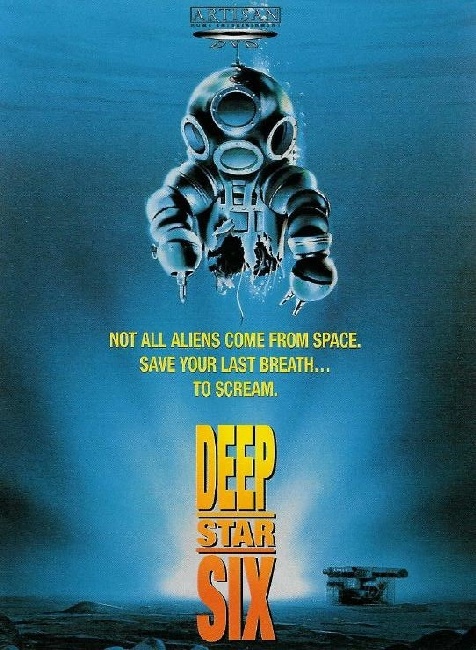
In the cinema, the topic again seems less popular than outer space. 1989 must have been a good year for underwater epics, however, as it saw the release of The Abyss, Leviathan and Deep Star Six. All three are set in habitats in the bottom of the sea. In The Abyss, it’s an oil rig – and they have a close encounter of the third kind. It’s been praised for its accuracy, but the liquid-breathing diving suit is pure invention. See here for photographs of the abandoned movie set, built in an uncompleted nuclear power plant. In Leviathan, they’re building an undersea missile base – so that would be just like a nuclear ballistic missile submarine then, that doesn’t move – and they stumble across the wreck of a Soviet ship which was apparently carrying a biological weapon. It infects the crew of the habitat, and the film turns into a soggy Alien. In Deep Star Six, they’re mining the ocean floor, and accidentally open a cave that has been sealed for millions of years, so releasing a monster. Which finds its way into the habitat… and the film turns into a soggy Alien.
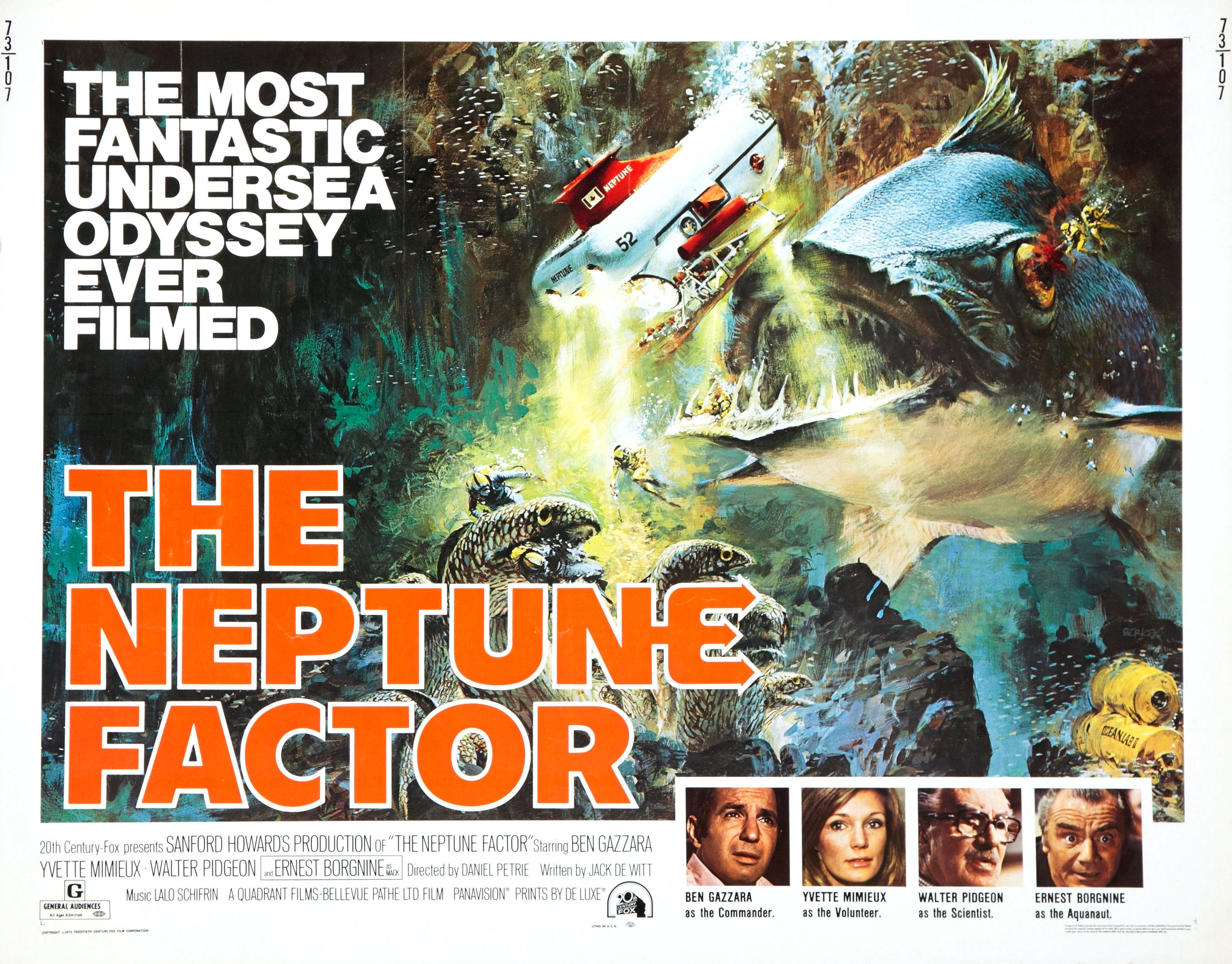
I’ve yet to buy a copy of The Neptune Factor (1973) on DVD, but from the plot summary on Wikipedia it sounds a bit daft. That may be a real submersible on the poster – DSV-2 Alvin, by the looks of it – and the underwater habitat in which the scientists live and work is called Sealab… But when an earthquake causes Sealab to fall into an oceanic trench, and the DSV is sent to rescue them, it encounters giant monster fish. Voyage to the Bottom of the Sea (1961) is just as silly. Seaview is a state-of-the-art nuclear submarine, with ballistic missiles… and giant windows in the bow. While it is on trials, a meteor shower causes the Van Allen Radiation Belt to catch fire (um, right…), and the Earth has three weeks before everyone dies. The admiral in command of Seaview saves the day by firing a nuclear missile into the Van Allen Belt.
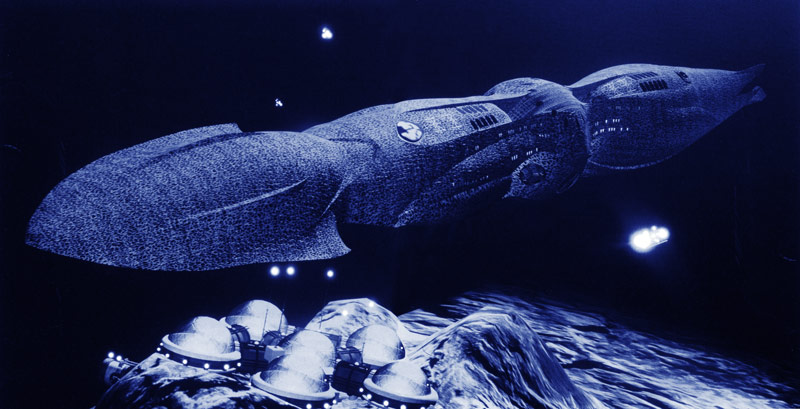
Sphere (1998) has all the ingredients for a good story but somehow manages to be a rubbish film. A giant mysterious craft is discovered deep on the ocean bed (just like that one in the Baltic Sea), and a team of scientists are sent down to investigate. That first shot of the alien craft as the divers approach it is impressive… but it’s all downhill from there. Dark Descent (2002) is set in Challenger Deep. It’s a straight-to-DVD film and stars Dean Cain, which should tell you all you need to know. It’s basically Outland at the bottom of the ocean, with Cain in the Connery role.
Voyage to the Bottom of the Sea spawned a television series which ran for 110 episodes from 1964 to 1968. It’s been shown on British television several times, but I only vaguely remember watching it. The programme also featured a Flying Sub, which appears to have been based on Jacques-Yves Cousteau’s Diving Saucer. I also vaguely remember seeing episodes of Primus, a US series which ran for only a single season in 1971 and 1972. It was about a diver and his various adventures. I must have seen it on Dubai television later that same decade. In the 1990s, there was seaQuest DSV. I only saw the first season in 1993, and fled the country before the second and thirds seasons were broadcast. I left for reasons other than to avoid seaQuest DSV, but missing them was an unintended bonus. I also reviewed the novelisation of the pilot episode for Paperback Inferno, and can remember only that the book was terrible and I filled the review with nautical and marine puns (as you do). More recently, in 2010, the BBC broadcast The Deep, a serial of five episodes starring Minnie Driver and James Nesbitt. Bits of it were interesting, but much of it was rubbish. Nuclear reactors, for example, do not explode.
I’ve probably missed out loads of genre books, films or television series which were, if only partly, set underwater. There are, of course, lots of films about naval submarines – from Das Boot to The Hunt For Red October – and no doubt far more technothrillers which feature submersibles or divers than those written by Clive Cussler… but it’s not a genre I read. I’m tempted to try some of them but, while you don’t read technothrillers for the prose, I do hope they’re a good deal better than the crap Cussler’s sweatshop churns out these days…





 It Doesn't Have To Be Right...