There’s an excellent post here by Adam Roberts, written with his characteristic perspicacity and wit, on awards and self-pimping. Now I must hang my head in shame, as I did post a little something of that sort back in December, but in my defence I’m just farting in a thunderstorm. (And Adam himself admits he’d thought The Eye With Which The Universe Beholds Itself was published in 2012, and I wanted to make people aware that it was actually out in 2013. Note to self: do not publish anything in January.) However, I was intending to post something here about what I’d myself nominated for the BSFA (and I will likely do the same for the Hugo), just as soon as I’d figured out what I was going to choose…
Each year, I tell myself I will read more short fiction, or I will read more books during their year of publication. Each year, I fail to do so. So it’s a rare year when I get to actually cobble together a list of nominations in all four BSFA categories – novel, short fiction, non-fiction, artwork – of reasonable length. This year, sadly, is no exception. So, for what it’s worth, these are what I’ve nominated so far…
Novel
Checking back over my records, I see I’ve read nineteen books published in 2013, but only six of them are genre novels. Which doesn’t give me much of a pool to nominate from – but the following are easily the best of those six, and I’d be happy to nominate them even if I’d read ninety books published in 2013.
Short Story
At the start of the year, I made an effort to keep abreast of new genre short fiction as it was published – not just in the various online venues I regularly visit, but also the genre print magazines to which I subscribe – which would be, er, Interzone. Sadly, that effort didn’t last long. I did, however, read two genre anthologies published in 2013, and both contained some very good fiction.
As for the non-fiction and artwork categories… I’ll be spending this weekend trying to cobble together a short list of each to nominate (nominations close on Tuesday 14 January). And I have until 31 March to decide what I’m going to nominate for the 2013 Hugo Awards…
I’m going to try something new this year, and rather than just make lists of books I want to read, I’m going to be a little more flexible by applying a few rules instead. I don’t think any of these are especially onerous, so they should be pretty easy to stick to.
Read 2014 books as soon as I can after purchasing them – there’s a few due this year I’d like to read (see here), so I just need to actually read them this year. This may mean reading earlier books in the series in order to catch up.
Try to maintain a 50:50 male/female writer ratio – so after every book by a man I read, I have to read one by a woman (fiction only; non-fiction, graphic novels and anthologies don’t count).
Read more translated fiction – I want to read the rest of Abdelrahman Munif’s Cities of Salt trilogy, I’d like to read more Elfriede Jelinek, I’ve also got books by Roberto Bolaño, Leila Aboulela, Naguib Mahfouz and Tove Jansson already on the TBR, but I’d also like to try fiction from countries whose literature I’ve yet to read.
I’ll also continue to document my reading – I’ve one last “recent reading” post for 2013 to come – and I’ll try to single out works I’m especially taken by, much as I have done in the past. I ought to do the same for films too – I made a start in 2012 with a series of films you must see posts, but have only managed to post two a year since then. Having said all that, I don’t want to give myself to much to do as, well, I’ve got a bit of fiction writing to do too – you know, research and write the fourth book of the Apollo Quartet, All That Outer Space Allows; I’m also keen to get started on a novel I want to write; and I have a whole bunch of short stories I really need to get finished.
Incidentally, nine days into the new year and I’ve already started as I mean to go on – after finishing MD Lachlan’s Fenrir, I started on Minaret by Leila Aboulela (her second novel, and the second by her I’ve read). Only another 356 days to keep this up…
I did something similar to this back in early 2013, though looking at that earlier post – see here – I note that I only managed to purchase 5 of the 15 books I mentioned, and only actually read one of them. And one of the books was postponed until 2014… This year I’ve managed to track down a few more titles that I’m looking forward to, though we’ll seen this time next year how many I’ve bought and/or read…
January
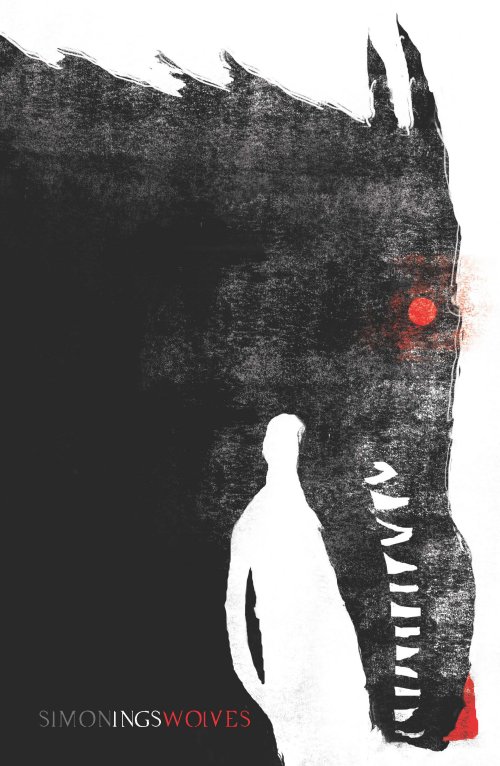
Ings, Simon: Wolves (Gollancz)
Roberts, Adam & Mahendra Singh: Twenty Trillion Leagues Under the Sea (Gollancz)
Smythe, James: The Echo (Harper Voyager) – the sequel to The Explorer, and the second book of what I see is now called the Anomaly Quartet.
April
Beckett, Chris: Mother of Eden (Corvus) – the sequel to the Clarke Award-winning Dark Eden.
Watson, Ian: The Uncollected Ian Watson (PS Publishing) – must admit I’m slightly puzzled by the title of this: “uncollected” – can there really be such a thing for a man who’s had thirteen collections published…
July
Baxter, Stephen: Ultima (Gollancz)- the sequel to Proxima.
Park, Paul: All Those Vanished Engines (Tor US) – a new novel from Park, is it possible to describe how much this excites me?
September
Cobley, Michael: Ancestral Machines (Orbit) – a new set in the universe of the Humanity’s Fire trilogy.
Gibson, Gary: Extinction Game (Tor UK)
Mitchell, David: The Bone Clocks (Sceptre)
Late in the year, date to be revealed
McFarlane, Alex Dally, ed.: The Mammoth Book of SF Stories By Women (Constable & Robinson)
Yes, there are no debuts there. Though there are several due out this year, I don’t know enough about them as yet to decide if they’re worth reading. Perhaps nearer their publication dates, some buzz will start to form among my online friends and acquaintances, and that may persuade be they’re worth a punt. That was, after all, how I came to read Ancillary Justice in 2013. Also, as the year progresses I will no doubt discover other new books I really want, much as I did in 2013. While new titles from major genre imprints are relatively easy to find, those from small presses aren’t; and I’ve no doubt missed out quite a few literary fiction novels by authors I really like, too.
ETA: I meant to add this before the post went live but forgot – the new Paul Park novel, All Those Vanished Engines, shares its title with an installation by sound artist Stephen Vitello, which includes “a commissioned text by local novelist Paul Park”. I don’t know what the link is between the novel and Vitello’s installation.
December
I wrote a guest post on Iain Banks for Fantástica – Ficción – they were kind enough to translate it into Spanish. The post includes a never-seen-before photograph of Banks I took at the 1990 Eastercon in the Adelphi Hotel in Liverpool.
And I guest-edited issue 61 of Focus, “the British Science Fiction Association’s magazine for writers”, on the topics of self-publishing and social media. Contributions were provided by Geoff Nelder, Gary Gibson, William King, Tony Ballantyne, Colin Tate, Keith Brooke, Vaughan Stanger, Darren Nash, Joyce Chng, RB Harkness, Berit Ellingsen, Jonathan McCalmont, Del Lakin-Smith, Donna Scott, Danie Ware and Helen Arney.
If I had to pick a favourite year out of the last ten, it wouldn’t be 2013 – and that’s despite winning the BSFA Award, being a finalist for the Sidewise Award, and publishing books 2 and 3 of the Apollo Quartet, both of which were well-received. I’ve already posted my favourites in books, films and albums of the year – see here – and even a tiny little pimpish post about what I had published in 2013 – see here. This post, however, is going to be all numbers and graphs, showing exactly how much culture I consumed, and in what media.
Books
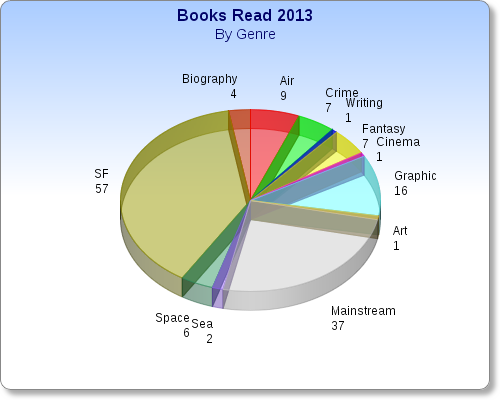
In 2013, I read a total of 148 books, which is slightly down on my previous year’s total of 153. In fact, the number of books I read in a year has been dropping steadily each year since 2008’s high of 220. There are actually a few books I dipped into for research, but since I didn’t actually read them, I didn’t record them as read. The books I read in 2013 break down by genre as follows:
Science fiction still forms the majority of my reading, though I suspect reading for SF Mistressworks has kept this higher than it would have been otherwise. Most of the biographies I read were research for Then Will The Great Ocean Wash Deep Above, as were several of the space books.
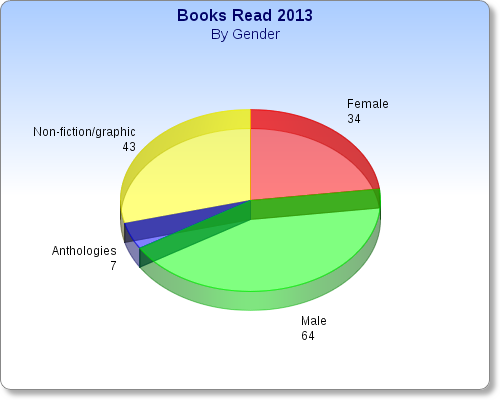
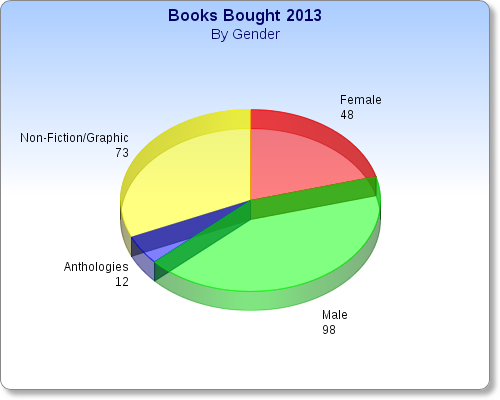
The books I read break down by author’s gender as:
While some graphic novels, particularly bandes desinées, might be by a single writer/artist, many are collaborative – so I’ve lumped them in with the non-fiction. Also, four of the seven anthologies were women-only, but given that anthologies more often contain fiction by both genders I thought it best to record them as a separate category.
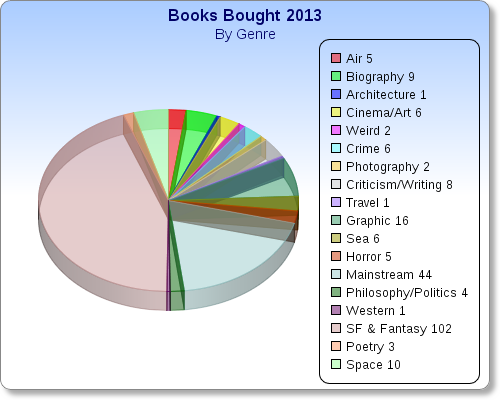
In 2013, I bought, was given, or was sent for review 231 books. I read only 72 of them (but some purchases were actually first editions, or better copies, of books I’d read previously, so I’ve counted them as read). So that’s a net gain on the To Be Read massif of 78 books… which is not the proper way to do it. I should be buying less books than I read. By genre, my book purchases break down as follows:
I had to munge a couple of categories together due to the crappy online chart-making website I was using. As for “Weird”… I couldn’t think of a better name for a category which contains a book by Velikovsky and a book on the Bermuda Triangle (the latter was research for Then Will The Great Ocean Wash Deep Above). The two photography books are books of photographs by photographers rather than books about photography. The one travel book is by, of course, Lawrence Durrell.
By gender – for fiction only – it looks like this (again, I’ve separated out anthologies, even though most of those I bought during the year were women-only):
Films
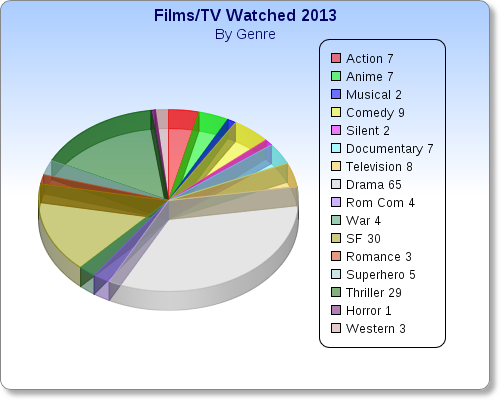
In 2012, I watched 180 films and 8 seasons of television programmes. Of those, 142 were for the first time and 44 were re-watches. These charts don’t include those television series I watched which were broadcast, only those I watched on DVD. By genre, they break down as:
It seems my favourite film genre is drama – that’ll be because I watch so many world cinema/art house films. I’m surprised at science fiction’s strong showing, though I suspect they’re all either rewatches or recently-released sf films I got on rental DVD. Five of the anime films were Studio Ghibli, the romance films were the result of a lazy Sunday spent watching Movies24, and the single horror film I saw was on one of those two-films-on-one-disc DVDs and it was the other film I bought the DVD for.
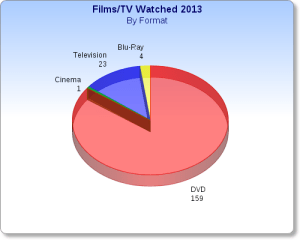
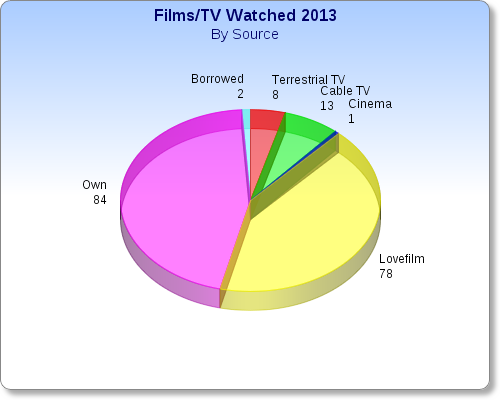
Speaking of DVDs, I also recorded on what format and where I watched each of the films – as follows:
Around two-thirds of the way through the year, Lovefilm changed my rental package, and instead of allowing me only 6 discs a month, they started sending out new discs as soon as they’d received the ones I’d returned. I’m not complaining. I run three rental lists at Lovefilm – one for Hollywood films, one for classics, and one for world/art house cinema. I’m sent one from each list in a single envelope. Which partly explains why my most-watched directors in 2013 were Aleksandr Sokurov, Fritz Lang and Otto Preminger. They were closely followed by Alfred Hitchcock, Douglas Sirk, Michael Haneke and Werner Herzog, most of which, I think, were actually rewatches. Sokurov is… well, his films are beautifully photographed but many of them make Tarkovsky’s films look like they were edited for the MTV generation. It’s a shame so few of them are available in the UK.
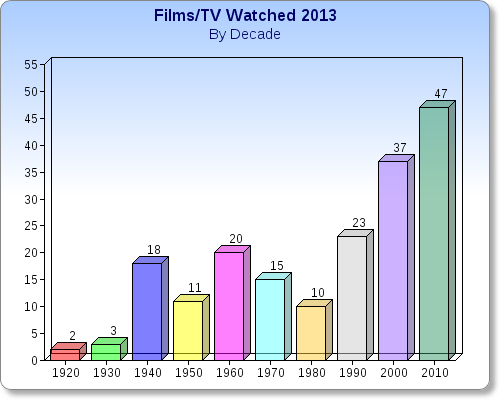
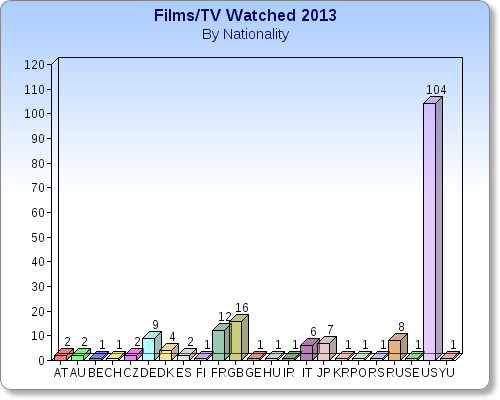
Those three rental lists also mean the films I’ve watched are spread quite well by decade, if not by nationality:
Yes, that’s a lot of American films – but they do produce a lot of films. It’s all those classic movies, you see. Great Britain comes second, followed by France, Germany, Russia, Japan and then Italy. I think in 2014 I’ll try to watch less US films. That sounds like a resolution worth keeping.
I will also, of course, try to read more books and buy less. And write more. And I’m sure there are plenty of other good intentions I can persuade myself I might be able to keep up for a whole twelve months, but for now I think I’ll just stick to the easy ones…
Whenever a book-related meme pops up, I love to jump on board. And apparently there’s one currently doing the rounds: “List 10 books that have stayed with you in some way. Don’t take more than a few minutes and don’t think too hard. They don’t have to be ‘right’ or ‘great’ works, just ones that have touched you”. I saw this on Liz Bourke’s blog here, and decided to have a go.
I’ve done something similar before, I think, but not for quite so many titles… Which made this one a bit harder than expected. But here they are, in the order in which the books occurred to me:
1Ascent, Jed Mercurio (2007), a novel I hugely admire and which has inspired me in my own writing. 2The Alexandria Quartet, Lawrence Durrell (1957 – 1960), because on reading it I fell in love with Durrell’s prose and began collecting everything he had ever written. 3The Undercover Aliens (AKA The House That Stood Still), AE van Vogt (1950), bonkers California noir meets pulp sf, and the only van Vogt novel I’d ever recommend to anyone. 4Dune, Frank Herbert (1965), still the premier example of world-building in science fiction. 5Dhalgren, Samuel R Delany (1974), the sf novel I’ve probably reread more times than any other. 6Coelestis, Paul Park (1993), one of my top five favourite novels of all time. 7Dan Dare: The Red Moon Mystery, Frank Hampson (1951 – 1952), the scene where Hank and Pierre first see through the clouds hiding the surface of the Red Moon haunted me for years as a kid. 8Cotillion, Georgette Heyer (1953), the first of hers I read, and her novels are still my chief comfort reading. 9The Barbie Murders, John Varley (1980), I fell in love with Varley’s Eight Worlds, and the title novelette still remains a favourite. 10Guardian Angel, Sara Paretsky (1992), I’ve always preferred crime fiction written by women, and Paretsky is why – this was the first of hers I ever read.
Not such a great showing gender-wise – only two women out of ten. While there are certainly a great number of women writers I admire and whose novels and short stories I love, I spent my formative years reading mostly science fiction, and sadly it was chiefly science fiction by male writers. There were exceptions – in amongst all those books by Heinlein, van Vogt, Simak, EE ‘Doc’ Smith, Harrison, Herbert, Tubb, Vance, etc, I read and became a fan of Cherryh, Le Guin, Van Scyoc, Julian May… Later, I discovered Gwyneth Jones, Mary Gentle, Joanna Russ, Leigh Brackett… and now, of course, I think most of the twentieth-century science fiction I read is by women writers.
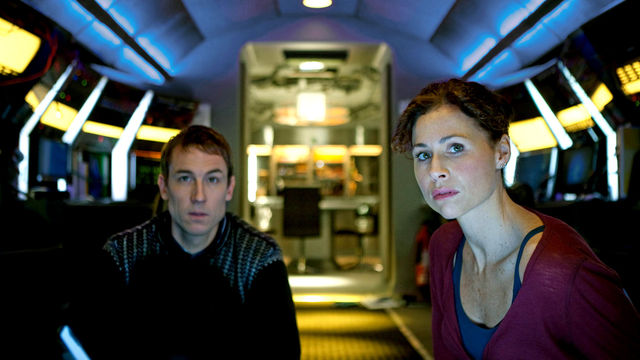
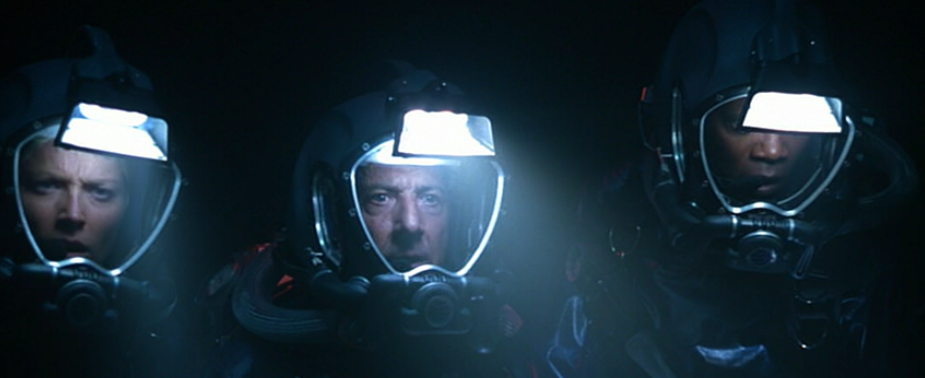
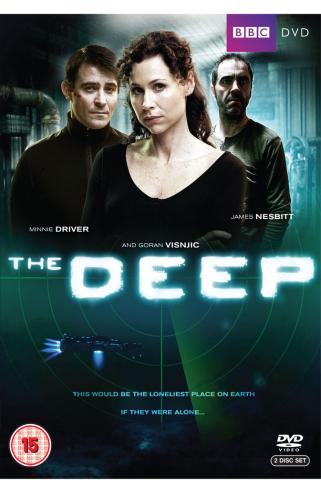
Last weekend, I watched all five episodes of The Deep, a Tiger Aspect Productions serial originally broadcast on BBC 1 during summer 2010. Much like the movie Sphere – with which it shares some similarities – there are some neat ideas in The Deep, and a setting that could be really cool…
The neat ideas first: 1) exploring vent-fields beneath the Arctic icecap, and finding a thermophilic biodigester which produces biogas with unprecedented metabolic efficiency; and 2) discovering that the Russians have been secretly drilling for oil under the seabed in a UN Exclusion Zone beneath the icecap (shades of Frank Herbert’s The Dragon in the Sea?). Idea 1 provides the motive for the expedition to visit the vent-field on the Lomonosov Ridge and a satisfyingly earth-changing end-game. Idea 2 gives us the villains and the obstacles they present which the protagonists must overcome in order to win through to the end.
The setting is 2,000 feet deep in the Arctic Ocean. So the cast are confined to the interior of submersibles and/or submarines. At that depth, the pressure is around 70 atmospheres. Submarines make for really dramatic environments – they’re claustrophobic and subject to unforeseeable external hazards; and in this case, they’re high-tech too. The Deep features three such vessels: Hermes, a research submersible, which disappears with all hands at the start; Orpheus, a second research submersible which is sent six months later to continue Hermes’ research and also discover her fate; and Volos, the giant submarine the Russians are using as a base of operations for their illegal drilling. Each vessel also carries a mini-submersible, single-person but they can carry two at a squeeze.
So far so good. Orpehus arrives at the Lomonosov Ridge, discovers the wreck of Hermes, but is then disabled – and one of the crew killed – by… something. They are captured by Volos, but the Russian submarine remains silent. Aboard Volos, the Orpheus crew discovers all but two of its crew dead, cause unknown. The two survivors try to commandeer Orpheus, but she’s going nowhere because her systems are down. These are fixed by salvaging “the motherboard” from Hermes. But, oh no, the nuclear reactor aboard Volos is over-heating and will soon explode. Except there are other survivors aboard Volos, including a member of Hermes’ crew. It’s a race against time to rescue them before the Russian sub blows up.
Which happily it doesn’t, as one of the crew does a Spock and saves the day (at the cost of his own life). Oh, and the thing that killed the Volos’ crew and disabled both Hermes and Orpheus proves to be… a giant underwater radar. Which the Russians were using to probe beneath the seabed and find oil deposits.
Only now there’s another problem. That thermophilic biodigester is really important, but all the samples aboard Volos are dead. Fresh ones are required… from the oil well at the bottom of the nearby Laurentian Abyss. Well, they call it the Laurentian Abyss, and claim it’s 8,500 feet deep; but the real Laurentian Abyss is closer to 20,000 feet deep. So they have to go and get another sample. But the captain of the Volos won’t let them go, and in fact plans to use the giant underwater radar to destroy Orpheus. But they defeat him. And go and fetch another sample of the thermophilic biodigester by lowering a one-person sub into the well itself. And then the Volos blows up. And the good guys – well, the ones that are left – escape.
There you have it: five sixty-minute episodes of nail-biting underwater drama… Except. There’s just so much that is plain wrong in those five hours that the entire serial can’t help but sink into the abyss…
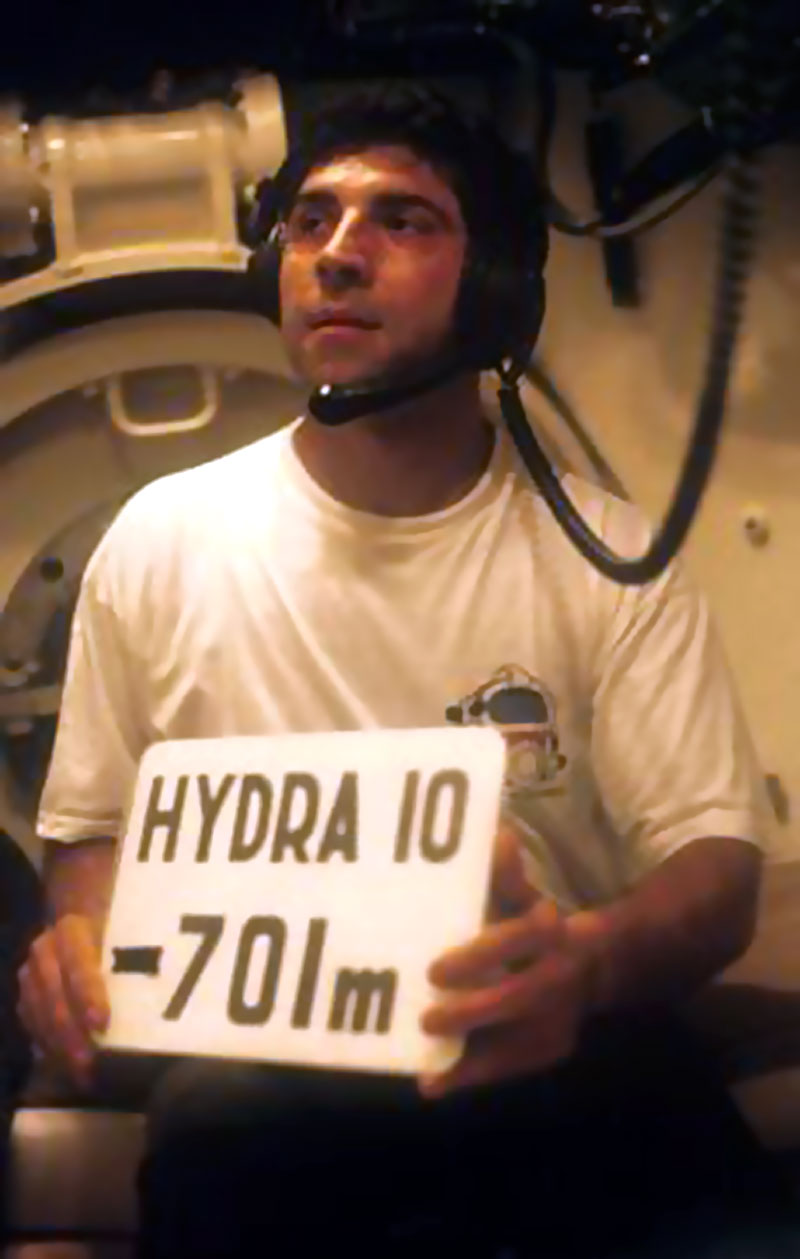
Those mini-submersibles I mentioned… They’re carried inside each of the vessels, and leave it via a moon pool. At a depth of 2000 feet, at a pressure of 70 atmospheres. So the interior of Hermes, Orpheus and Volos would also have to be pressurised to 70 atm… or be instantly flooded. We’re informed the crew are breathing “neonox”, a neon-oxygen mix, at high pressure, so, you know, it’s a little bit plausible. The current depth record is held by Theo Mavrostomos who, as part of Comex’s HYDRA 10 experiment in 1992, spent 3 hours at 2,300 feet (71 atmospheres) in a hyperbaric chamber on land. But the entire experiment took 43 days: 15 days compression, 3 days at 68 atmospheres, and 24 days decompression. There are no two weeks of compression in The Deep.
It’s borderline plausible – one man has spent 3 hours at 71 atm and survived, but that was 20 years ago. However… there’s no reason why any of the subs should have a moon pool. The mini-submersibles could just dock to a hatch. So then the interior could be pressurised to 1 atm. Just like real-life submersibles. In Sphere, the film adapted from Michael Crichton’s novel, the underwater habitat is 1,000 feet beneath the surface, but it has a moon pool. However, it’s needed because the cast go saturation diving. They go out into the water. No one does in The Deep.
And, of course, nuclear reactors don’t explode when they overheat. Nor do they require the control rods to be inserted by hand – as they must be aboard Volos (hence, the Spock scene). The US Navy has been operating nuclear-powered submarines since 1954, and the Russians since 1959. Several have been lost with all hands. None have exploded. (Incidentally, it’s never mentioned what powers Orpheus. Really really powerful and long-lasting and giant and heavy batteries, I imagine.)
Then there’s that giant underwater radar. And numerous mentions to “calling on all frequencies” by various members of the subs’ crews. Radar doesn’t work underwater. That’s why they use sonar. And radio doesn’t work very well below the surface either. Various navies have used extremely low frequency radio for communication with submarines (ie, with wavelengths of several thousand kilometres), but it’s expensive and technically difficult. Which is why acoustic transmission is the most common form of communication with vessels underwater.
And when the high-powered radar waves hit the Orpheus and shorted out its systems? That’s because it “reversed the polarity” on the motherboard. That’s what one of the characters actually says. And it seems Orpheus has one motherboard through which everything must be routed – not just for its failure to totally disable the sub, but also to allow it to be fixed in one fell swoop later. Never mind building in redundancy…
But, you cry, these are piffling! What do I care about HYDRA 10 or nuclear reactors going boom? The Deep was jolly exciting drama and those are mere trivial details. After all, the moon pool looked pretty neat, so what does it matter if no real submersible could descend to 2,000 feet with one? Or even to 8,500 feet.
As for the other niggles, they’re even more trivial. So what if one of the Russians lights up a cigarette at 70 atms pressure? So what if another character declares Volos, at 300 metres long, larger than any surface vessel – when both supertankers and US Navy aircraft carriers are all over 300 metres in length (and the largest supertanker ever built, Seawise Giant, was 458 metres long)? So what if a marine biologist is asked to do an autopsy and seems to know what he is doing, despite saying he’s only ever dissected a rabbit for his Biology GCSE? So what if the thermophilic biodigester produces nitric acid as a byproduct of its metabolic process, and the acid has been corroding all the subs’ hulls – but the concentration would be so weak in, like, the Arctic Ocean that it couldn’t even corrode tissue paper? So what if the underwater well, from where they fetch the fresh sample, is a hole several metres in diameters and when have you ever seen an oil well that large or even a drill bit? That’s less than trivial! It is meaningless.
There were problems with the story itself, true; and with the script. Characters telling each other stuff they should already know – “We’re breathing Neonox, a mixture of neon and oxygen”, “That’s a vent-field”, etc. Not to mention a dramatic scene resulting wholly from the fact two switches had been swapped over but their labels had not been changed.
My point is that the details I’ve mentioned above could all be easily checked. And putting them right would not have affected the story (although a hatch doesn’t look as cool as a moon pool, I’ll grant). But when you leave stuff like that in, it will annoy some people and you will lose them. Why not get it right and keep them? No one’s saying it should be, “That submarine must be 300 metres long, that’s nearly as long as a supertanker or a US Navy aircraft carrier, but not as long as Seawise Giant, which was 458 metres long.” Because that would be silly. Instead of, “That submarine must be 300 metres long, that’s longer than anything you’ll see on the surface,” why not, “That submarine must be 300 metres long, that’s really big for a submarine”?
The giant underwater radar is more problematical as it’s a plot device. Something has to generate the EMP which leaves Orpheus dead in the water, something has to kill the crew of Volos. There’s a lovely line in the Wikipedia article on offshore geotechnical engineering, which goes, “For the sub-bottom stratigraphy, the tools used include boomers, sparkers, pingers and chirp.” The article explains that geophysical surveys make use of a combination of sonar and seismic refraction, so perhaps one or more of those might have been used instead of the implausible giant underwater radar.
When I started this post a few days ago, it was with the intention of just pointing out some of the howlers in The Deep. But yesterday’s discussion on Twitter suggested to me there’s a wider point to make. When you’re writing, there’s stuff you make up and stuff you look up. And if you don’t know which is which, then perhaps you need to rethink your story. Never assume your readers won’t spot it when you’ve got details wrong. It’s perhaps forgiveable when the knowledge required is arcane or difficult to find. But the simple stuff? Characters using the Jubilee Line on the London Underground in 1940, 37 years before it was built? Characters referring to the Paras as “redcaps”, when that’s the nickname of the Royal Military Police? Why would a writer not bother to look these things up? If they’re that lazy with the details, what does that say about the story, or the novel, as a whole?
You can’t, as they say, please all of the people all of the time – but you can at least make an effort to please as many as you possibly can. If I’m writing and I want something to happen in my story but I’m not clear on the details, then I look them up. I don’t just wing it and hope no one notices. This does not mean every story needs to be fact-checked. It’s not always necessary. I wrote a story about an ATA pilot who flew Spitfires, so I researched both. I wrote another story set in an unnamed town during an unnamed decade (which sort of resembles the 1940s) – no research was necessary. If a story is set on an invented world in an invented galactic empire, then there’s not much you can look up anyway. But if it’s set in London, or Belfast, or beneath the Arctic icecap – then it’s time to get googling.
The internet is an amazing tool, so why not make use of it? Pretty much all of the information mentioned in this article, I found online. And if I could find it, so could anyone…
We’re a couple of weeks away from Christmas and the end of the year, so it’s time to look back with a critical eye over the past twelve-ish months and the words, pictures and sounds I consumed during that period. Because not everything is equal, some have to be best – and they are the following:
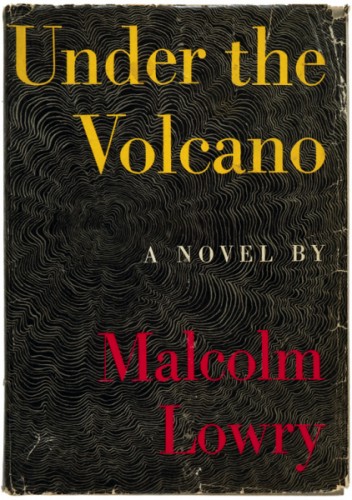
BOOKS 1Under the Volcano, Malcolm Lowry (1947) A classic of British literature and rightly so. I fell in love with Lowry’s prose after reading ‘Into the Panama’ in his collection Hear Us O Lord from Heaven thy Dwelling Place, although I already had a copy of the novel at the time (I’d picked out the collection, Under the Volcano and Ultramarine from my father’s collection of Penguin paperbacks back in 2010). Anyway, Under the Volcano contains prose to be treasured, though I recommend reading Ultramarine and Lowry’s short fiction first as it is semi-autobiographical and you can pick out the bits he’s used and re-used. This book was also in my Best of the half-year.
2Winter’s Bone, Daniel Woodrell (2006) I’d bought this because I thought the film was so good and because Woodrell had been recommended to me. But instead of the well-crafted crime novel I was expecting to read, I found a beautifully-written – and surprisingly short – literary novel set in the Ozarks that was perhaps even better than the movie adaptation. I plan to read more by Woodrell. Winter’s Bone was also in my Best of the half-year.
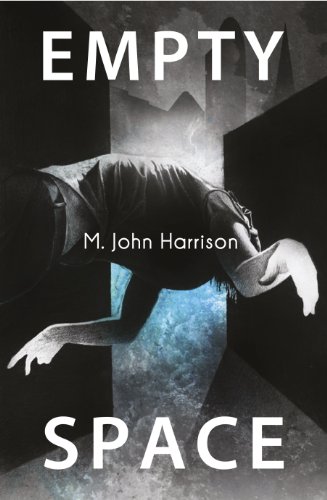
3Empty Space: A Haunting, M John Harrison (2012) The third book in the Kefahuchi Tract trilogy, and I’m pretty damn sure I’ll have to reread all three again some time soon. Although the fulcrum of the story is Anna Waterman and the strange physics which seems to coalesce about her, Empty Space: A Haunting also does something quite strange and wonderful with its deployment of fairly common sf tropes, and I think that’s the real strength of the book – if not of the whole trilogy. And this is another one that was in my Best of the half-year.
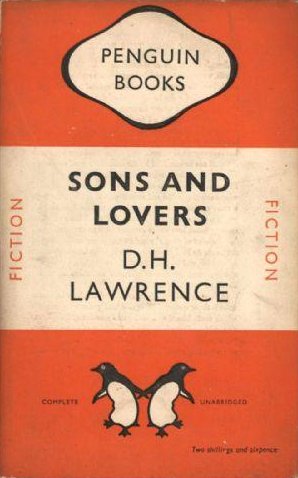
4Sons and Lovers, DH Lawrence (1913) When I looked back over what I’d read during 2013, I was surprised to find I held this book in higher regard than I had previously. And higher than most of the other books I’d read during the year too, of course. At the half-year mark, I’d only given it an honourable mention, but it seems to have lingered and grown in my mind since then. It is perhaps somewhat loosely-structured for modern tastes, but there can be little doubt Lawrence fully deserves his high stature in British literature.
5Promised the Moon, Stephanie Nolan (2003) I did a lot of research for Then Will The Great Ocean Wash Deep Above, and this was the best of the books on the Mercury 13. But even in its own right, it was a fascinating read and, while sympathetic to its topic, it neither tried to exaggerate the Mercury 13’s importance nor make them out to be more astonishing than they already were. If you read one book about the Mercury 13, make it this one.
Honourable mentions: Ancillary Justice, Ann Leckie (2013), an exciting debut that made me remember why I read science fiction; Invisible Cities, Italo Calvino (1972), beautifully-written tall tales presented as Marco Polo’s report to a khan; The Wall Around Eden, Joan Slonczewski (1989), a masterclass in writing accessible sf, this book needs to be back in print; The Day Of The Scorpion, Paul Scott (1968), the second book of the Raj Quartet and another demonstration of his masterful control of voice; The Sweetheart Season, Karen Joy Fowler (1996), funny and charming in equal measure; The Lowest Heaven, edited by Anne C Perry & Jared Shurin (2013), some excellent stories but also a beautifully-produced volume; Sealab, Ben Hellwarth (2012), a fascinating history of the US’s programme to develop an underwater habitat; Cities of Salt, Abdelrahman Munif (1987), a thinly-disguised novelisation of the US oil companies’ entry into Saudi, must get the rest of the trilogy; and Wolfsangel, MD Lachlan (2010), Vikings and werewolves are definitely not my thing but this rang some really interesting changes on what I’d expected to be a routine fantasy, must get the next book in the series…
Oops. Bit of a genre failure there – only one sf novel makes it into my top five, and that was published last year not this; although four genre books do get honourable mentions – two from 2013, one from 2010 and one from 1989. I really must read more recent science fiction. Perhaps I can make that a reading challenge for 2014, to read each new sf novel as I purchase it. And I really must make an effort to read more short fiction in 2014 too.
FILMS 1About Elly, Asghar Farhadi (2009) A group of young professionals from Tehran go to spend the weekend at a villa on the Caspian Sea. One of the wives persuades her daughter’s teacher, Elly, to accompany them (because she wants to match-make between the teacher and her brother, visiting from his home in Germany). Halfway through the weekend, Elly vanishes… and what had started out as a drama about family relationships turns into something very different and unexpected. This film made my Best of the half-year.
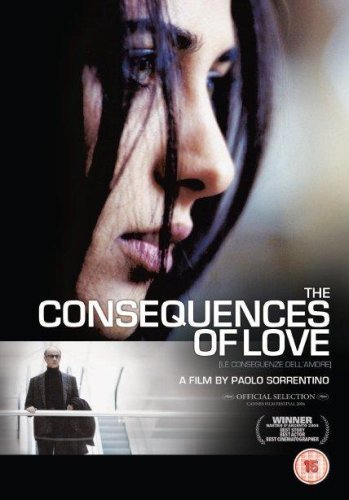
2The Consequences Of Love, Paolo Sorrentino (2004) The phrase “stylish thriller” could have been coined to describe this film, even if at times – as one critic remarked – it does resemble a car commercial. A man lives alone in a hotel in a small town in Switzerland. Once a week, a suitcase containing several million dollars is dropped off in his hotel room. He drives to a local bank, watches as the money is counted by hand and then deposited in his account. One day, the young woman who works in the hotel bar demands to know why he always ignores her… and everything changes.
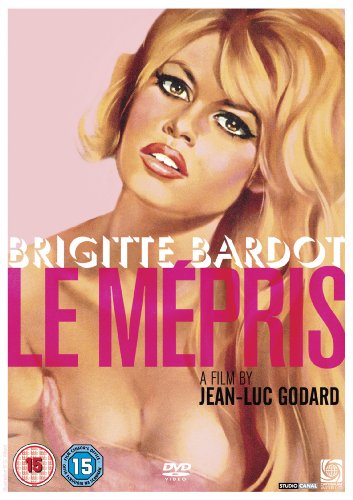
3Le Mépris, Jean-Luc Godard (1963) I don’t really like Godard’s films, so the fact I liked this one so much took me completely by surprise. Perhaps it’s because it feels a little Fellini’s 8½ if it had been made by Michelangelo Antonioni. I like 8½, I like Antonioni’s films. Perhaps the characters are all drawn a little too broadly – the swaggering American producer, the urbane European director (played by Fritz Lang), the struggling novelist turned screenwriter, and, er, Brigitte Bardot. Another film that made my Best of the half-year.
4Only Yesterday, Isao Takahata (1991) An animated film from Studio Ghibli which dispenses entirely with whimsy and/or genre trappings. A young woman goes to stay with relatives in the country and reflects on what she wants out of life. The flashback sequences showing her as a young girl are drawn with a more cartoon-like style which contrasts perfectly with the impressively painterly sequences set in the countryside. Without a doubt the best Ghibli I’ve seen to date… and I’ve seen over half of them so far. Once again, a film that made my Best of the half-year.
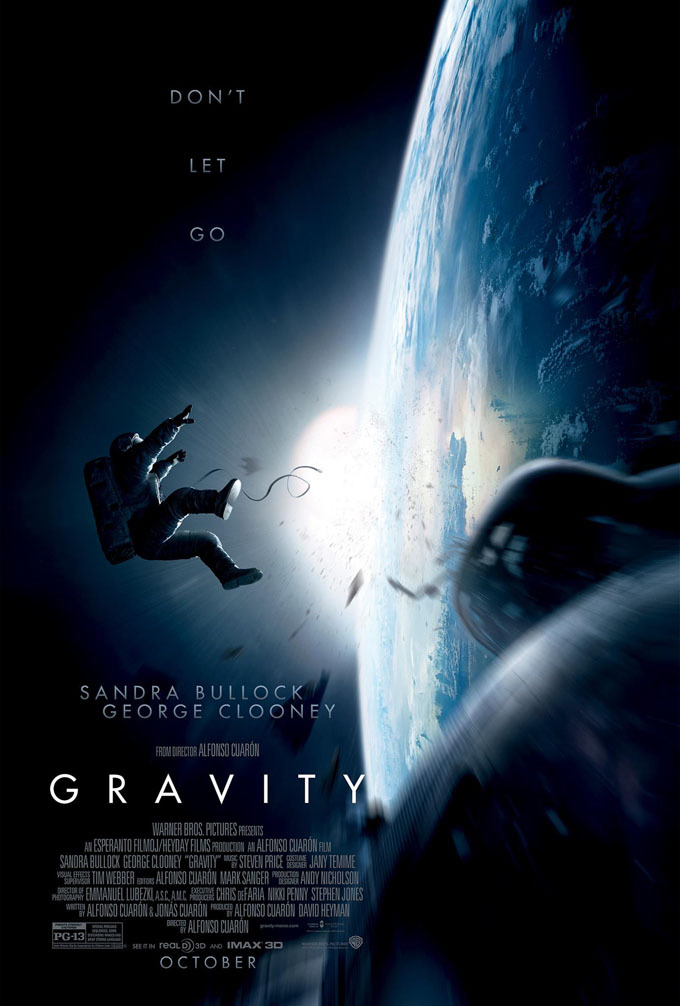
5Gravity, Alfonso Cuarón (2013) I had to think twice whether or not to put this in my top five. It was the only film I saw at the cinema this year, and I suspect seeing it in IMAX 3D may have coloured my judgement. To be fair, it is visually spectacular. And I loved seeing all that hardware done realistically and accurately on the screen. But. The story is weak, the characters are dismayingly incompetent and super-competent by turns, some of the science has been fudged when it didn’t need to be, and it often feels a little like a missed opportunity more than anything else. Perhaps I’ll feel differently after I’ve seen it on Blu-Ray…
Honourable mentions: She Should Have Gone to the Moon, Ulrike Kubatta (2008), an elegantly-shot documentary on the Mercury 13; Gertrud, Carl Theodor Dreyer (1964), grim and Danish but subtle and powerful; Man With A Movie Camera, Dziga Vertov (1929), astonishing meta-cinema from the beginnings of the medium; Sound of My Voice, Zal Batmanglij (2011), Brit Marling is definitely becoming someone to watch; Love in the Afternoon, Éric Rohmer (1972), the best of Rohmer’s Six Moral Tales; The Confrontation, Miklós Jancsó (1969), more socialist declamatory and posturing as a group of students stage their own revolution; Tears For Sale, Uroš Sotjanović (2008), CGI-heavy Serbian folk-tale, feels a little like Jeunet… but funny and without the annoying whimsy; Ikarie XB-1, Jindřich Polák (1963), a Czech sf film from the 1960s, what’s not to love?; Dear Diary, Nanni Moretti (1993), an entertaining and clever paean to Rome and the Italian islands, and a rueful look at the Italian health service; and The Sun, Aleksandr Sokurov (2005), a poignant and beautifully-played character-study of the Emperor Hirohito in 1945.
This year for a change I’m also naming and shaming the worst films I watched in 2013. They were: The Atomic Submarine, Spencer Gordon Bennet (1959), a typical B-movie of the period with the eponymous underwater vessel finding an alien saucer deep beneath the waves; Cyborg 2: Glass Shadow, Michael Schroeder (1993), an unofficial sequel to the Van Damme vehicle and notable only for being Angelina Jolie’s first starring role; The Girl from Rio, Jésus Franco (1969), Shirley Eaton as Sumuru, leader of the women-only nation of Femina, plans to take over the world, it starts out as a cheap thriller but turns into cheaper titillatory sf; The 25th Reich, Stephen Amis (2012), WWII GIs in Australia find a UFO, go back in time millions of years to when it crashed, then a Nazi spy steals it and ushers in an interplanetary Nazi regime, bad acting and even worse CGI; Battlestar Galactica: Blood and Chrome, Jonas Pate (2012), they took everything that had been good about Battlestar Galactica and removed it, leaving only brainless military characters and CGI battle scenes.
ALBUMS 1Construct, Dark Tranquillity (2013) Every time Dark Tranquillity release a new album, it makes my best of the year. I guess I must be a fan then. In truth, they are probably my favourite band and their last half-dozen albums have each been consistently better than the one before. So many bands seem to plateau at some point during their career but DT amazingly just get better and better. This album was on my Best of the half-year.
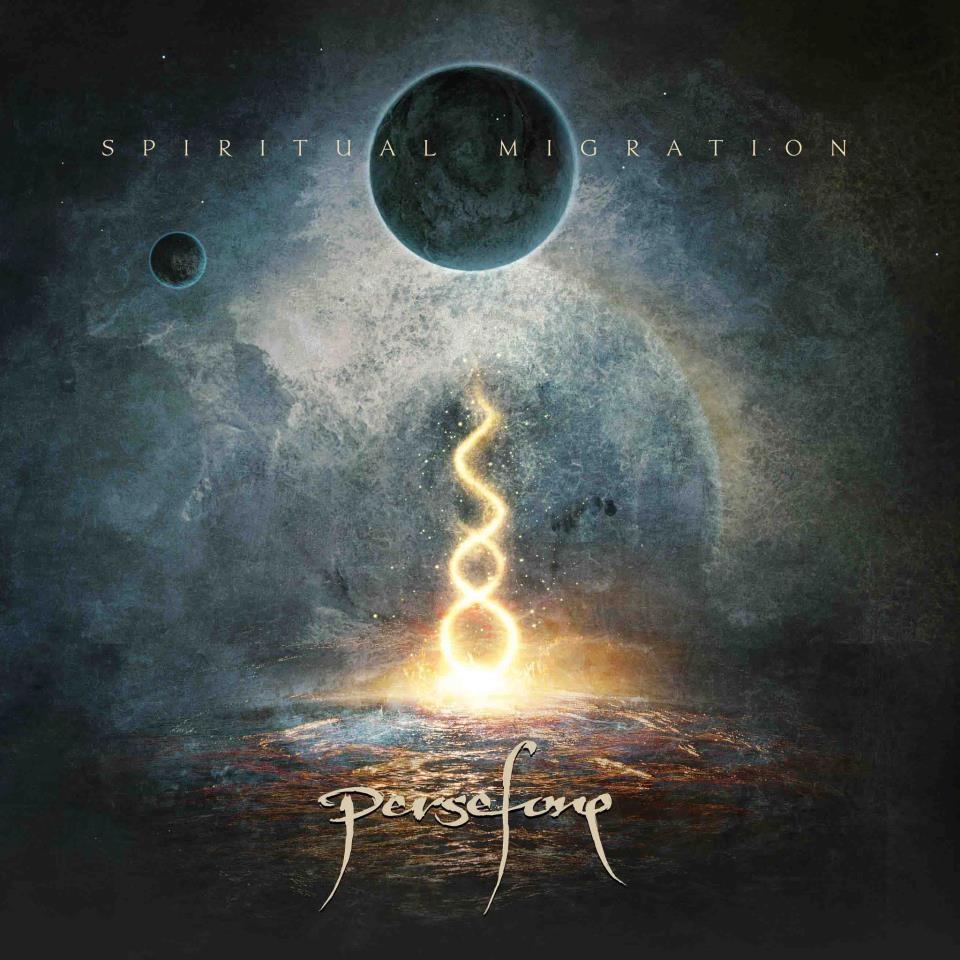
2Spiritual Migration, Persefone (2013) Another band who improves with each subsequent album. And they’re good live too – although I’ve only seen them the once (they really should tour the UK again; soon). This is strong progressive death metal, with some excellent guitar playing and a very nice line in piano accompaniment. I didn’t buy this album until the second half of the year, which is why it didn’t appear in the half-year list.
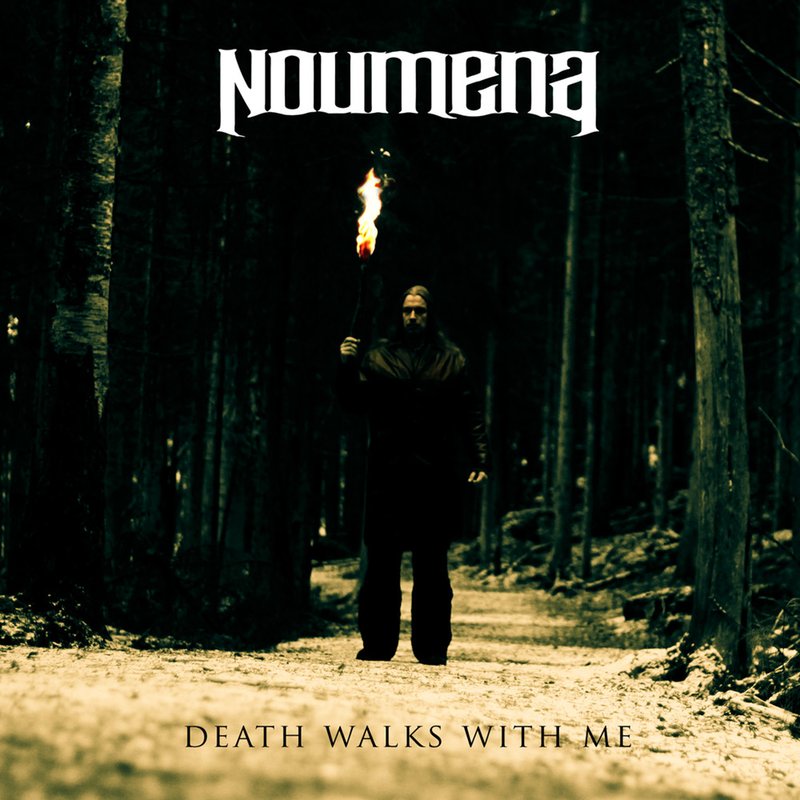
3Death Walks With Me, Noumena (2013) A new album by a favourite band after far too long a wait, so this was pretty sure to make my top five. Noumena play melodic death/doom metal, an inimitably Finnish genre, but they also use clean vocals, and a female vocalist, quite a bit. One song even features a trumpet solo. I posted the promo video to one track, ‘Sleep’, on my blog here. And the album also made my Best of the Half-Year.
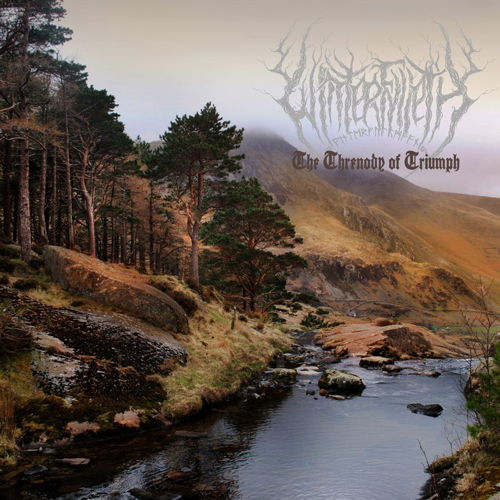
4The Threnody Of Triumph, Winterfylleth (2012) I first saw Winterfylleth live before they were signed back in 2008 at the Purple Turtle in Camden at the Day of Unrest (see here), and I’ve seen them a couple of times since. This, their latest album, shows how far they’ve come and amply demonstrates why they’re so good. They call it English heritage black metal, which I think just means they sing about English historical sort of things (the band’s name is Anglo-Saxon for “October”). Another album from my Best of the half-year.
5Of Breath And Bone, Be’lakor (2012) On first listen I thought, oh I like this, it deserves to be played loud. And it really does – it’s not just that Be’lakor, an Australian melodic death metal band, have excellent riffs, but also that there’s a lot more going on in their music than just those riffs. The more I listen to Of Breath And Bone, the more I like it – originally I only gave it an honourable mention in my Best of the half-year, but having played the album so much throughout 2013, I think it deserves a promotion.
Honourable mentions: Dustwalker, Fen (2013), shoegazery black metal that works extremely well; Where the End Begins, Mentally Blind (2013), excellent sophomore EP from a Polish death metal band, with an astonishingly good opening track (see here); Unborn and Hollow, Forlorn Chambers (2013), a demo from a Finnish death/doom band, and very very heavy, sort of a bit like a doomy version of Demilich, in fact, but without the vocal fry register singing; Shrine of the New Generation Slaves, Riverside (2013), more polished, er, Polish progginess, a little rockier than the previous album, although one track does include some very melodic “sexamaphone” [sic]; All Is One, Orphaned Land, proggier than previous albums but still with that very distinctive sound of their own, incorporating both Arabic and Hebrew; and Nespithe, Demilich (1993), a classic piece of Finnish death metal history, I picked up a copy of the re-mastered edition at Bloodstock – there’s a special Demilich compilation album, 20th Adversary of Emptiness, due to be released early next year, I’ve already pre-ordered it.
One of the things I really like about metal is that it’s an international genre, and here is the proof – the bands named above hail from Sweden, Andorra, Finland, the UK, Australia, Israel and Poland. There’s also quite a good mix of metal genres, from death to black metal, with a bit of prog thrown in for good measure.
I’m slowly catching up on documenting my recent reads. Last year and the year before I was in the 100 Books A Year Challenge on LibraryThing, and would write a quick review of each book as I read it. Which meant compiling these recent readings posts was pretty painless. But I didn’t bother with the challenge this year, and without that I’m not disciplined enough to write about books the moment I’ve finished them – well, not unless it’s a book everyone is talking about, like a certain sf debut of 2013. Anyway, that’s my excuse for splitting this post into three. Also, it would be way too TL;DR if it had been a single post.
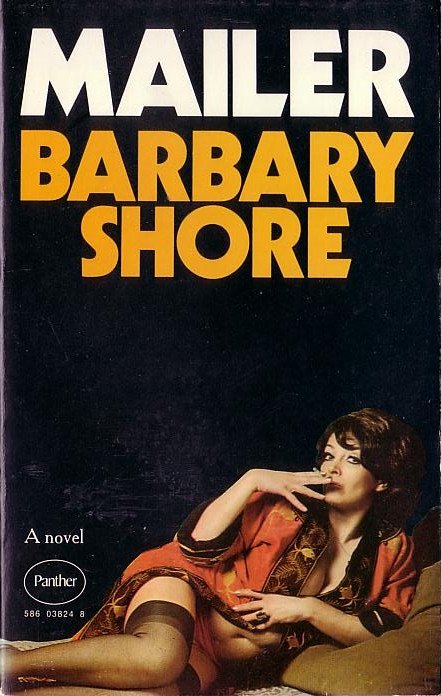
Barbary Shore, Norman Mailer (1951) I found three 1970s paperback novels by Mailer in a local charity shop and was sufficiently appalled by the awful covers to give them a go. I know of Mailer, of course; and I’m pretty damn sure I read The Executioner’s Song many years ago… But if Barbary Shore had been my first exposure to his fiction I’d not have bothered any further. According to an introduction added to this later edition, Mailer considers this the best of his early novels – “if my work is alive one hundred years from now, Barbary Shore will be considered the richest of my first three novels”. The other two must be really bad then. Because Barbary Shore is a bit shit. Mailer’s style is so mannered and artificial, and characters repeatedly lecture each other, it’s often painful to read; and yet the story is supposedly set in the lower reaches of New York society. The narrator has returned from fighting abroad during WWII with little or no prospects and decides to become a writer. So he uses the last of his savings to rent himself a room in a boarding-house while he writes his Great American novel… And where he gets involved with the landlady, a blousy blonde rejoicing in the name of Guinevere, her really badly-drawn young daughter, the boarding-house’s two other tenants (one of whom proves to be a McCarthyist, the other is actually Guinevere’s husband and an ex-communist), and the sort of manic pixie Holly-Golightly-type that US literary fiction of the 1950s and 1960s seemed to think were a) real women and b) evidence of the author’s ability to write female characters. I guess I won’t be reading the other two Mailer novels. All three can go back to the charity shop.
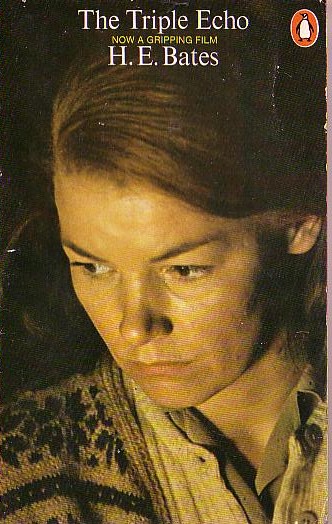
The Triple Echo, HE Bates (1970) A couple of years ago, I found a boxed set of Bates’s novels and novellas in a charity shop. It was really cheap, and I vaguely remembered he was highly-regarded, so I bought it. The first novella I read, Dulcima, didn’t go all that well (see here). It was apparently turned into a film in 1971. The Triple Echo was slightly better, and I vaguely recall seeing its film adaptation (starring Glenda Jackson and Oliver Reed). During WWII, a woman on a smallholding, whose husband is a prisoner of the Japanese, strikes up a friendship with a soldier at a local barracks. He visits her on his leave days and helps her out around the farm. But then he decides to desert, and stays with her. In order to disguise his presence she tells everyone her sister is visiting, and he lets his hair grow long and dresses like the farmer. Then an officer and a pair of NCOs from the barracks turn up, looking for the deserter. They meet the “sister”, fail to see through the disguise and the sergeant invites “her” to a dance that Saturday… Bates’s prose fails to impress. It’s, er… nice. That’s about all that can be said for it. But then you come across a line like “the war seemed a million miles away”, and then there’s nothing nice about a reliance on cliché. I’ve still got the rest of the Bates boxed set to read, and I may try one or two more. But it’ll be back to the charity shop with it after that.
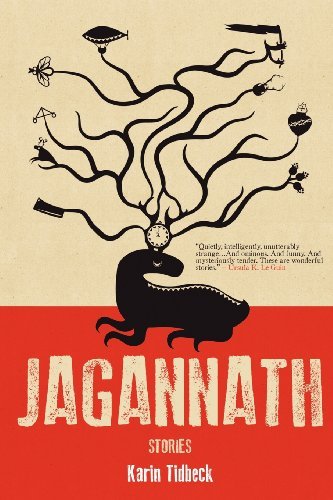
Jagannath: Stories, Karin Tidbeck (2012) I picked up a copy of this at Fantastika in Stockholm in October, where Karin was one of the GoHs. I’d not read any of her stories prior to reading this collection, although I think I had a fairly good idea of what to expect – her name is one that crops up quite often among my circle of friends and acquaintances online. I’ll confess up-front that dark fantasy and New Weird are definitely not my thing – only this week I baled on Catherynne M Valente’s Palimpsest after 70 pages. However, the first story in Jagannath: Stories, ‘Beatrice’, immediately hooked me, and I pretty much sailed through all thirteen stories in the collection. Some worked for me much better than others. The subtle horror of ‘Rebecka’ was good, I liked ‘Brita’s Holiday Village’ and ‘Reindeer Mountain’, and the faux documentary of ‘Pyret’ was cleverly done. Jagannath: Stories is a pretty strong collection – I had been told Karin is a name to watch and I’m more than happy to agree.
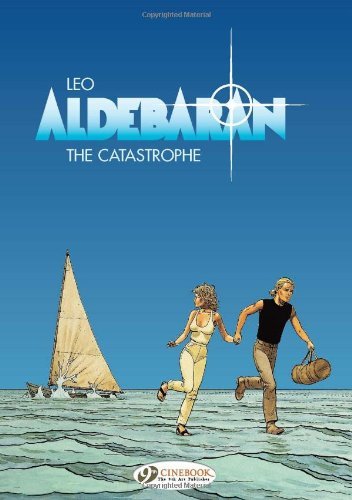
Aldebaran 1: The Catastrophe (1996), Aldebaran 2: The Group (1997) and Aldebaran 3: The Creature (1998), Léo. These three volumes from Cinebook contain five installments of Léo’s first series, which were originally published in French as La catastrophe, La blonde, La photo, Le group and La créature. They’re set on an inhabitable planet orbiting the eponymous star some 100 years after contact with Earth has been lost. The colonists have spread across the planet’s few small continents, but much of its flora and fauna remains a mystery. The story opens in a small fishing village, when the appearance of one local creature – one that’s massively larger than anything else – results in tragedy. Only two teenagers escape, and they find themselves involved with a group fighting against the colony’s theocratic government. It transpires the group – there’s only two of them left – were among the original colonists over a century ago and have survived so long due to a mysterious creature, which may or may not be intelligent. In the first book, the teenagers try to escape the priest, and his soldiers, who is chasing them because he believes they know something about the group… which, it seems they do, although they weren’t aware of it. They’re caught and spend time in prison. Several years later, they escape, meet up with the two members of the group, learn of the group’s history, and set off to meet the creature – in the hope it will also gift them (and a few other people) with immortality. The third book opens with a crash in a jungle, introduces a ship from Earth, and sets up the story for the next series, Betelgeuse. The art is not unlike that of Moebius, it’s certainly very clean, but the characters seem drawn with more detail – and it takes a few pages to get used to it. I actually thought it pretty good – slow to start, perhaps, but Léo has created an interesting world – and I plan to get both Betelgeuse and the third series, Antares.
I don’t normally bother with these sorts of posts, as usually it’s hardly worth it. However, while I can’t hope to match the prolificity of some authors I know, and I’m still a small fry in the genre ocean, I decided it might be worth mentioning that I did have one or two pieces published this year… Well, all right, four. Two short stories: ‘The Incurable Irony of the Man Who Rode The Rocket Sled’, which appeared in The Orphan here; and ‘The Last Men in the Moon’, which appeared in the literary anthology Because of What Happened from the Fiction Desk. And, of course, two books of the Apollo Quartet – The Eye With Which The Universe Beholds Itself, which was published in January this year and not in 2012, even though it feels like it; and Then Will The Great Ocean Wash Deep Above, which was published only a week ago…
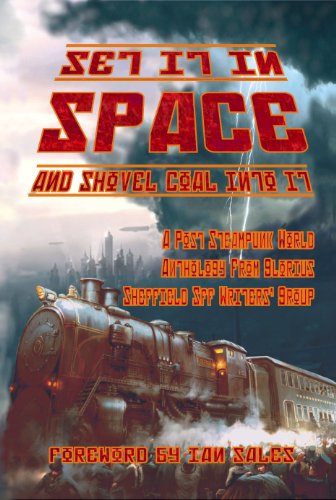
From the above, it looks like I’ve not done much during the past 11 months. True, 2013 doesn’t feel like my most productive year ever, but I’m sure I did a few other things… I reviewed three books for Interzone, two for Vector and nineteen for SF Mistressworks. I contributed some guest blog posts here and there, wrote the introduction to Set it in Space and Shovel Coal into it, an anthology by the Sheffield SF and Fantasy Writers Group, and gave talks at both the National Space Centre and the University of Sheffield Natural History Society. I spent a weekend in Berlin with family, and another weekend in Stockholm at this year’s Swecon, two cities I’d never visited before – and I had an excellent time in both. I saw 41 bands perform live, most of those at Bloodstock. I attended four conventions, including the one in Sweden. I also read a metric ton of books as research for my two novellas above…
Shit, I thought I’d done more than that. It certainly feels like I should have done. I must make more of an effort next year. As it is, I suspect I may be the one buying the curry in 2014…








 It Doesn't Have To Be Right...