The first book by David Guy Compton I read was Justice City back in 1996. I picked it as one of my ten best books that year, and described it then as “excellently written, believable characters, and a crime plot that depends on its political dimension as much as it does on the psychology of its cast”. It wasn’t until six years later that I read another Compton, Chronicules. While not a comforting book to read, I did review it (see here), and noted that the prose was “a joy to read”. Last year I read Scudder’s Game, and only last month The Electric Crocodile. The more of Compton’s novels I read, the more I appreciate his writing. Yes, they are grim and misanthropic, and most have a very 1970s atmosphere – but that, I suppose, is part of their appeal.
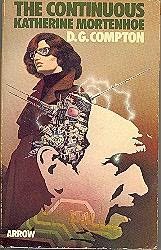
The Continuous Katherine Mortenhoe – also known as Death Watch and The Unsleeping Eye – is perhaps Compton’s best-known sf novel. It was originally published in 1974, and adapted into a film titled Death Watch by Bertrand Tavernier in 1980. I’ve not seen the film, although I certainly plan to find a copy. In the novel, the title character is diagnosed with “Gordon’s Syndrome” and told she has four weeks left to live. A successful television programme, Human Destiny, has found success broadcasting the final weeks of terminal patients, and they want Katherine to be a subject – for a large sum, of course. But she refuses. The producers of Human Destiny had been planning to try out some new technology on her: one of their reporters, Rod, has had his eyes replaced with television cameras. (His eyes still look the same, so Katherine would never know she was being filmed every moment.)
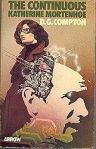 The novel is set in the future, and it’s a very 1970s future. I remarked on this in my capsule review of The Electric Crocodile and, I have to admit, it’s an aesthetic I find appealing – all that Brutalist architecture, the huge antiseptic data processing centres, the clunky technology… The society of Compton’s future is also a product of the book’s time of writing. It’s a future not much different from then, but not much like now. People live in huge blocks of flats, and die only of old age… except for notable exceptions, such as those who feature on Human Destiny. Mortenhoe works as an editor for a publisher – or rather, she manages a computer system which writes romance novels. Yet this old school Labour future also has its rich and privileged – everyone is provided for, but there’s still the fabulously wealthy. And from Compton’s characterisation of one such rich character in The Continuous Katherine Mortenhoe, it’s plain where his sympathies lay.
In fact, if there’s one thing that stands out in Compton’s novels it’s his sympathies. The technology or technological innovation around which Compton bases his stories – in The Continuous Katherine Mortenhoe, it’s Rod’s camera-eyes; in The Electric Crocodile, it was the supercomputer which allowed a self-proclaimed scientific “elite” to dictate the direction of human progress… It’s the misuse or abuse of this technology which is the plot-engine of the novels; and the fuel on which that engine runs is outrage. Rod’s camera-eyes represent an infringement of Katherine’s privacy of unthinkable levels. Every aspect of her life will be held up to public scrutiny and, possibly, probably, ridicule. She will have no secrets. Technology has robbed everyone of their secrets.
Much like the other Compton novels I’ve read, The Continuous Katherine Mortenhoe is a character study of its protagonists – the eponymous “heroine”, of course; and Rod the cameraman. The sections told from Rod’s viewpoint, however, are in the first person. As in The Electric Crocodile, Compton often repeats scenes from each character’s viewpoint, although the disconnect between what they experience is not so marked as it is in that earlier novel. While Rod is a bit of an everyman – he has a failed marriage in his back-history, and his ex-wife makes several appearances – Katherine is extremely well-drawn. She loves her current husband, but their marriage is perhaps best described as “comfortable”. She is not adventurous – but in order to escape the Human Destiny production team, she disguises herself as an indigent. And her decision to do so fits in wholly with her character. She is wholly ordinary, but extraordinary in small ways.
The writing, as in other Compton novels, is excellent. Of those British sf writers who were popular during the 1970s, Compton is perhaps the best prose stylist. Some may have been more popular, Bob Shaw, for example. Some of them may have had a steady career writing books for US publishers, such as EC Tubb or A Betram Chandler. But Compton was, I think, the best writer of the lot. Having said that, his books are very British, and very miserable. So it’s no surprise his novels have been mostly forgotten. Which is a shame. But I certainly plan to read more by him.

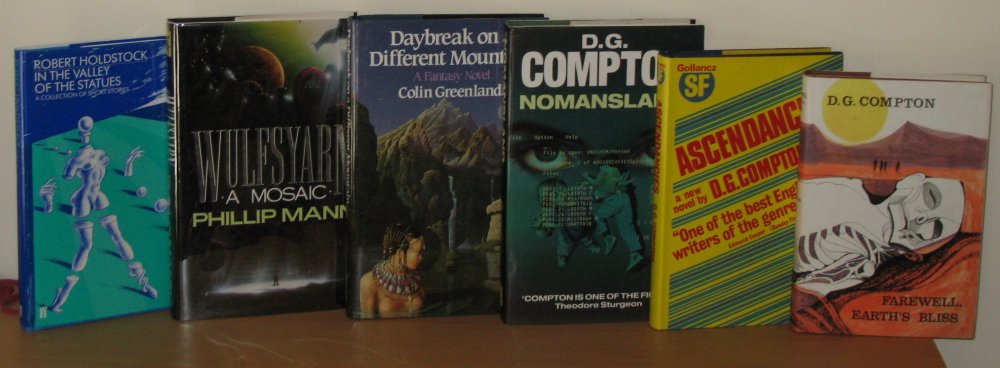


 (see
(see  . It’s a comedy about science fiction, and I thought it was bloody awful. And there’s my review of
  (see
(see  by Gavin G Smith, should go up on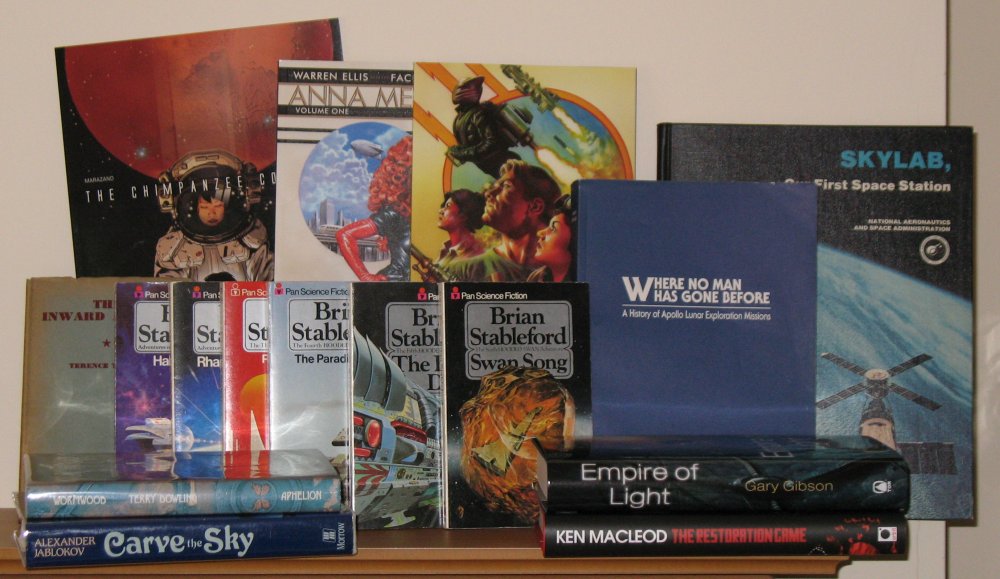
 , about, er, Skylab; and
  , a history of the “Apollo Lunar Exploration Missions”. They’re for the
  and
and  . The third graphic novel is the final part of The Chimpanzee Complex trilogy,
  , and I’ve yet to decide if the story works. I think I need to reread all three, one after the other. I shall probably do that and then write something about it.
 and
and  – are subtitled “Adventures of STAR-PILOT GRAINGER”; while the remaining four books –
  ,
,  ,
,  and
and  – are all subtitled “The ___ HOODED SWAN Adventure”. To be honest, showing all six books is a bit of a cheat as I only bought three of them recently. The other three I’ve had for a while. Finally, hiding to the left of
  , a collection of poetry by Terence Tiller from 1943. I like Tiller’s poetry, and now have several of his collections.
 by Ken MacLeod; and the final book of Gary Gibson’s Giant Space Fish trilogy,
  . To the left, we have a signed edition of
  , Alexander Jablokov’s debut novel; and a sf collection by Terry Dowling,
  , which is also signed. I didn’t think Dowling’s story in the
  anthology, ‘Truth Window: A Tale of the Bedlam Rose’, worked especially well, but I was intrigued enough by the universe in which it was set to hunt down this collection of stories also set in that universe. It was not an easy book to find. But I have a copy now, muahaha.



 , and my review is
  It Doesn't Have To Be Right...