It Doesn't Have To Be Right…

… it just has to sound plausible


4 Comments

Watsonia

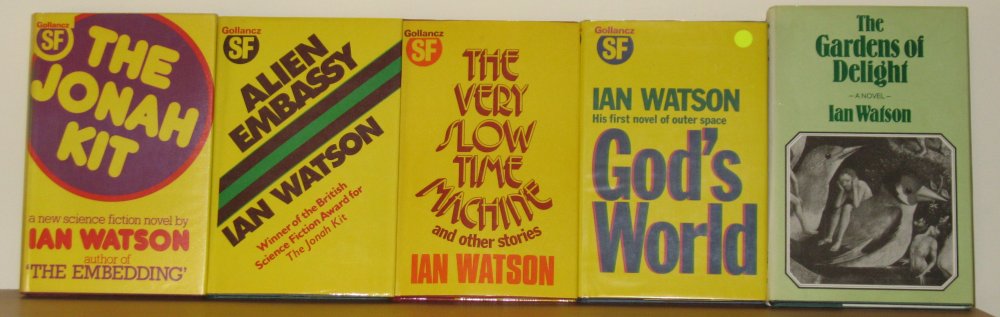
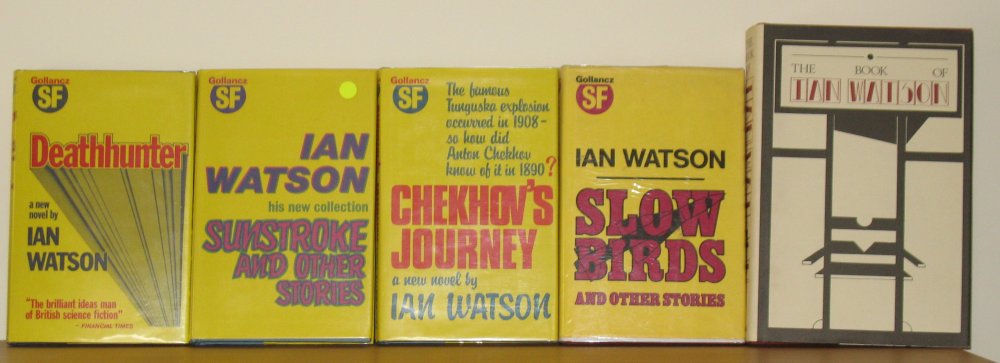
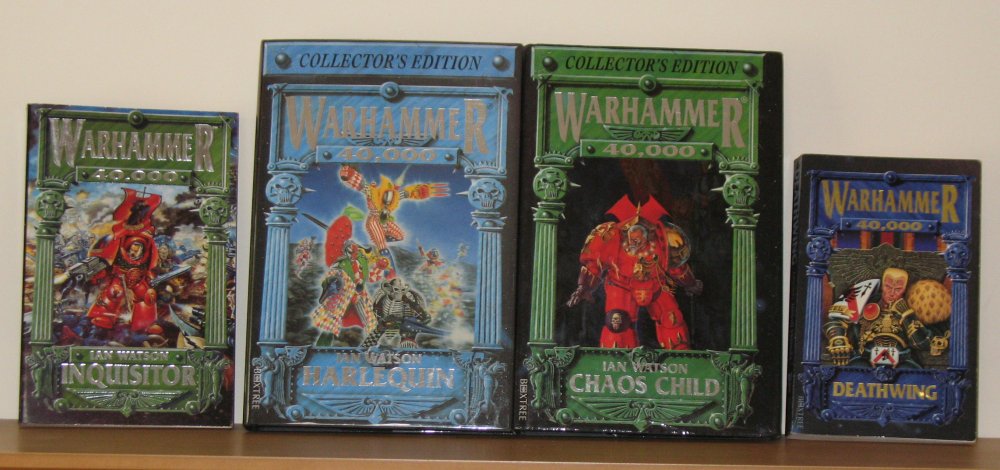
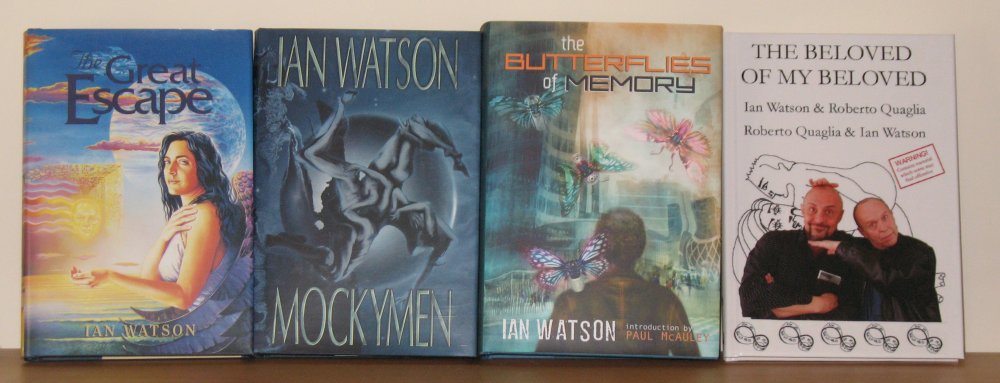
I suspect Ian Watson himself would probably scoff at being described as a national treasure of British science fiction, but in four decades he has written twenty-nine novels and a dozen collections and every single one of them is worth reading. As Adam Roberts can attest, as he’s been on something of a Watson kick recently. Myself, I’ve been a fan for many years and have managed to accumulate a goodly collection of first editions, many of which are signed. My collection is not complete, but it is close. No Space Marine, for example; though I’ve been looking for a good copy for years. And at least two books, I believe – The Whores of Babylon and Converts – were only published in paperback (I have them, but they’re not pictured below).

But I do have many books by Ian Watson. As you can see…


8 Comments

that was the weekend: alt.fiction

I always come home from conventions feeling mentally refreshed but physically drained. It’s the near-constant input of ideas in conversations and programme items. And so too – in part – for alt.fiction in Derby this weekend just gone. This year’s was the fifth alt.fiction, but the first time it has stretched over two days. It was also my fifth alt.fiction, and I thought it worked well as a weekend event.

I am not, I admit, the target market for alt.fiction. It’s the workshops which draw most of those who attend, and they don’t interest me. The general programme is usually of more interest, though being a fan primarily of sf I don’t bother with the fantasy and horror items. Unfortunately, this year the item which appealed most was on at 10:00 am on the Saturday, and I didn’t time my arrival appropriately. One item I did attend was Al Reynolds’ GoH speech. He said at one point during it that, in common with a lot of writers he’s spoken to, he had a period of childhood illness, and it was the enforced inactivity of that which prompted his love of books and reading. I wonder how true that is. It’s certainly not what happened to me. I was ill several times as a kid, with the usual diseases: chicken pox, measles, German measles… But I’d been a voracious reader from a really early age (and before discovering science fiction, it was mostly books about marine mysteries, such as the Marie Celeste).

I dragged Al Reynolds and Keith Brooke along to the raffle, promising them it was worth attending to hear Guy Adams in full flow. I’d seen him MC the raffle at Fantasycon last year, and very entertaining he was. I also won some books. At alt.fiction, the raffle was presented by a double act comprising Guy Adams and Sarah Pinborough; and they were indeed highly entertaining. And I won some books too. A cardboard box full of Angry Robot’s releases to date in 2011, in fact. I gave away several to friends – while the new editions of KW Jeter’s steampunk novels, Infernal Devices and Morlock Night, are very attractive books, I already have earlier editions of both. And some of the fantasy or horror novels simply don’t appeal to me. But Dan Abnett’s Embedded definitely looks like it’s worth reading (I asked him to sign it for me). The other books were: a Kaaron Warren; Guy Adams; the third book of Andy Remic’s Clock Vampires series; a couple of urban fantasies; the second book of Ian Whates’ City of 100 Rows; Aliette de Bodard’s Servant of the Underworld (which I bought at the Eastercon); and some others. I also received a copy of Lavie Tidhar’s The Bookman in my registration pack, but gave that away as I’d bought a copy at the Eastercon.

In the year since the last alt.fiction, the coffee shop / bar in the forum of the QUAD had been refurbished. Before it’d had soft sofas and low tables; now it has 4-seater tables more suited for a coffee shop / restaurant. Unfortunately, this meant that the room now contained only flat surfaces, and so the acoustics were terrible. When the place was full, you could barely hear the person next to you for the background noise. Which, of course, did not stop us talking.

I’m not going to be able to name everyone I spoke to over the weekend, but it was good to catch up with some people I’d not seen for a while, to meet in person for the first time some people I know only online, and to meet people I’ve never met before. I spoke a lot, and some people actually listened to me. I also listened to lots of people speaking. I don’t think the ideas bank was quite as well stoked afterwards as it was at the Eastercon, but then the nature of the conversations at alt.fiction, a writing-oriented convention, are sure to be different anyway. To be honest, it’s only a day later and I can’t remember many of the conversations I had. But they were all good, interesting and enjoyable, and if I was in the habit of name-dropping I’d thank all those I chatted to by name.

I caught the train home on the Sunday evening feeling tired and brain-dead. The following morning, the day felt weirdly silent as I travelled to work – since the previous two days had been so filled with noise and conversation. I don’t think I heard more than a dozen words spoken from the time I awoke until the moment I arrived at the office and sat down at my desk. I think the world will continue to feel strangely quiet for another day or so. Perhaps we should adopt that as a standard of a convention’s success? Certainly, using it alt.fiction can be said to have succeeded very well.


9 Comments

Meme! Women sff writers of the 1970s

Got this from Nicholas Whyte, who got it from James Nicoll. Italicize the authors you’ve heard of before reading this list of authors, bold the ones you’ve read at least one work by, underline the ones of whose work you own at least one example of.

Lynn Abbey
Eleanor Arnason
Octavia Butler
Moyra Caldecott
Jaygee Carr
Joy Chant
Suzy McKee Charnas
C. J. Cherryh
Jo Clayton
Candas Jane Dorsey
Diane Duane
Phyllis Eisenstein
Cynthia Felice
Sheila Finch
Sally Gearhart
Mary Gentle
Dian Girard
Eileen Gunn
Monica Hughes
Diana Wynne Jones
Gwyneth Jones
Leigh Kennedy
Lee Killough
Nancy Kress
Katherine Kurtz
Tanith Lee
Megan Lindholm (AKA Robin Hobb)
Elizabeth A. Lynn
Phillipa Maddern
Ardath Mayhar
Vonda McIntyre
Patricia A. McKillip
Janet Morris
Pat Murphy
Sam Nicholson (AKA Shirley Nikolaisen)
Rachel Pollack
Marta Randall
Anne Rice
Jessica Amanda Salmonson
Pamela Sargent
Sydney J. Van Scyoc
Susan Shwartz
Nancy Springer
Lisa Tuttle
Joan Vinge
Élisabeth Vonarburg
Cherry Wilder
Connie Willis

I’ll also note that I own every book written by Gwyneth Jones, Mary Gentle and Sydney J Van Scyoc.


1 Comment

The future we used to have, part 3

Being the next in an ongoing and irregular series of posts featuring cool pictures from around and about the tinterweb of cool modernist and futurist vehicles, buildings, and suchlike. Some are real, some never got off the drawingboard.

aircraft

Convair Sea Dart

Avro 730 model kit

Vickers Type 559 interceptor

spacecraft

Soviet LK lunar lander

Proposed Mars mission

cars and trucks

General Motors Futureliner

Chrysler 1961 concept car

Buick 1956 concept car

buildings

credit: Julius Shulman

Credit: Julius Shulman

Le Corbusier Museum, Chandrighar, India

cities

From World Fair 1939

From GM Futurama 1964

Underwater habitat from GM Futurama 1964


29 Comments

Best Science Fiction/Fantasy Books by Women Writers

After all the arguments over the results of the Guardian poll of best/favourite sf novels, it seems the US’s NPR has decided to have a bash here: “Best Science Fiction, Fantasy Books? You Tell Us”. Sigh. I’m not going to bother trawling through the 1700+ comments (as of the time of writing of this post) to see what the gender ratio is. I fully expect it to work out to about 5 – 10% female.

Instead, what I am going to do is suggest an alternative poll: your favourite five novels by women sf/fantasy writers. Leave a comment listing them. Let’s see how we do.

To start with, here are mine:

Kairos, Gwyneth Jones
Ash: A Secret History, Mary Gentle
Angel with the Sword, CJ Cherryh
The Left Hand of Darkness, Ursula K Le Guin
The Grail of Hearts, Susan Shwartz

This proved harder than I expected. There are a lot of genre novels by women writers I like a great deal, and many I have have read several times. And quite a few I’ve read recently which I expect I will return to one day. But actually picking the best of that long list? To make it a little easier, I’ve limited myself to one book per author, though there’s no reason anyone else need do so.

EDIT: and if you’re stuck for suggestions, check out the SF Mistressworks blog.


14 Comments

The Five Rules of Good Writing

So I’ve been working on a new novel, and that got me thinking about the way I approach writing. Which is basically write, edit, write, edit… and so on until I’m happy with it. But there are some rules I try to stick to. And, since everyone likes list, I thought I’d share them.

  1. Make every sentence, and everything in it, unambiguous
  2. Map every ramification of the ideas in the story
  3. Leave no holes in the plot for the story to escape through
  4. Get the details right (and that means research)
  5. The resolution should always be a consequence of the actions of one or more characters

So, there you go. A sure-fire recipe for success at writing. You heard it here first.


7 Comments

Apology, explanation and – oh well, it didn’t work…

Yesterday’s post, Home truths, was something of an experiment. As one commenter pointed out, my opinion of Asimov and Foundation are well-documented, and there’s little need to repeat it. But that fact, and the responses to Fabio Fernandes’ Mind Meld on the Russ Pledge on SF Signal yesterday and Cheryl Morgan’s post on the SFWA website on gender balance on 13 June, suggested a small test…

On two previous occasions on this blog I’ve made my thoughts on Asimov’s fiction plain, and both times I received around a month’s worth of hits in a single day. I was also on the receiving end of a number of threats and insults. One person even called me a “retarded nazi pedophile”. And all this for suggesting that Asimov is a rubbish writer and Foundation not a very good sf novel…

Then there’s the “mansplaining” on the Mind Meld and on Cheryl’s piece on the SFWA site. I covered some of the choicer ones here. A lot of male sf readers, it seems, turn combative when accused of sexism in their reading choices – despite an unwillingness to question those same choices.

So, it occurred to me, which of the above two would upset sf readers the most? After all, it takes a hell of an emotional investment in a book to call someone a “retarded nazi pedophile” for daring to slag it off. Would sf readers respond with such passion to being called sexist?

Sadly not. Most of the comments on my Home truths post are about Asimov.

But then, as someone pointed out, most readers of my blog already accept that most male sf readers are sexist. And my thoughts on the contribution of women in sf is also well-documented. For my experiment to have worked, it really needed a bigger pool of test subjects, ones that were ignorant of the women in sf debate – but unfortunately no one linked to it from reddit or fark.

So, sorry for the trollbait. It seemed like a good idea at the time. And it didn’t exactly prove what I wanted it to prove. It sort of did, but not really; and the results are probably tainted anyway. Ah well.


22 Comments

Home truths

Truth #1
Isaac Asimov was a rubbish writer, and his Foundation is a rubbish book. It has cardboard characters who act as though they belong in 1940s middle America and not a galactic empire. The invention is minimal, the prose is bland and uninspired, the plot doesan’t make sense, and how the book has come to be consider a classic is beyond me. I am embarrassed when people think to suggest it as a good introduction to science fiction, or one of the genre’s best books.

Truth #2
The majority of male science fiction readers are sexist. They not only refuse to read books by women sf writers, they refuse to acknowledge that not doing so is wrong. They attempt to justify the evident unfairness in the genre through such mealy-mouthed justifications as “The gender of the writer is irrelevant” or “why should I impose quotas on my reading?” or “what about the men’s studies?” This is sexism. It is wrong.


10 Comments

The Battle of the Sexists

So Fabio Fernandes put together a Mind Meld on SF Signal about the Russ Pledge and invited a bunch of very reasonable people and myself to contribute. It prompted a lively comment thread. Many of the comments contained the following “mansplaining” gems:

1. You have the numbers wrong – it wasn’t 4% of the books in the Guardian poll were by women, it’s closer to 12%.

And this is acceptable? According to Niall Harrison’s survey at Strange Horizons, 41.7% of books received by Locus were by women; in the UK, it was 37%. It’s not gender parity, but neither is it around 12%. Books by women sf writers are under-represented. Fact. Stop arguing about numbers and do something about it.

2. Why should I impose quotas on my reading?

Because if you’re part of the problem which results in that 12%, then you need to change your reading habits. You have an unconscious bias. You need to make a conscious effort to break that bias. And if that means imposing a quota on the genders of the authors you read, then that’s what you need to do.

3. A book stands on its own merit.

Right. So you have this magical ability to determine exactly how good every book ever published is, then? You can just look at a book and know it’s going to be good. Maybe that’s because you have a bias towards books by male writers and find them more enjoyable because they confirm your prejudices. Maybe you need to change that bias, and next choose to read a book by a woman writer. Who knows, it might “stand on its own merit” too.

4. I don’t care about the gender of an author.

Of course, you don’t; that’s why there’s an imbalance in the first place, that’s why women writers are under-represented. The fact that you don’t care just means you’ve never taken the trouble to think about your bias. So start thinking about it.

5. Writing by women is at least as good as writing by men.

I know you’re trying to be helpful, but… Writing by women is as good as writing by men. There’s no “at least” in it.

6. What about other under-represented minorities?

Women aren’t a minority – in the US in 2009, there were 155.6 million females and 151.4 million males; in England, 25.2 million females and 23.9 million males (2001 census figures). Women are a majority. Except when it comes to talking about science fiction books. This is not acceptable.

Clearly something needs to be done. Being reasonable is not a solution – all that does is perpetuate the unfairness. And, to be honest, I don’t even understand why people would argue against something that is blatantly unfair. Being asked to take the Russ Pledge does not infringe your human rights, it is not asking you to do something that will cost you money, or may lead to injury. It is asking you to make a conscious choice in one particular aspect of your life. It is asking you to question your own biases. It is asking you to stop being a sexist. And, be honest, how is sexism defensible?

Sadly, this appears to be a situation that few actually care about, or are willing to do something about. After an initial burst of enthusiasm, the hits on SF Mistressworks are now a third of what they were, even though I’ve been posting at least one review a day since the blog started. Most people, it seems, would sooner look at a photograph of John Scalzi’s new car (which is not a slur on John Scalzi himself).

At the beginning of the year, I decided my 2011 reading challenge would be to read, and blog about, a sf novel by a women writer each month. And I’ve been doing that. But next month, I’m going to do more: in July, I will only read books written by women, irrespective of genre. I already have a dozen titles picked out. One of them will be God’s War by Kameron Hurley – because last week on Twitter, Niall Harrison raved about the book and a number of us were persuaded to buy copies. The book was already on my radar – as any sf novel based on Arab culture would be, given my background; and one day, perhaps, I would have got round to buying and reading it. But Niall’s comments were enough to convince to buy a copy there and then. That’s the way this sort of thing should work – for books by women writers just as often as for books by male writers. And yes, I will post something here about God’s War here when I’ve finished reading it.

And, incidentally, I’m still looking for more reviews for the SF Mistressworks blog.


2 Comments

All the news that’s fit to print

Nearly halfway through the year, and time for a little self-promotion – i.e., my magazine and anthology appearances during the rest of this year.

Andy Remic wanted “bizarro fiction” for Anarchy Book’s anthology Vivisepultura, and I certainly hope my story in it qualifies. There’s only one way to find out: buy a copy. Due to be published on 1st August.

I’ll be in The Exagerrated Press’ The Monster Book for Girls, edited by Terry Grimwood, which I believe will be launched at Fantasycon in Brighton in September.

I have a story in Eibonvale Press’ new anthology, Where Are We Going?, edited by Allen Ashley – due to be published in late 2011 / early 2012. The story is my bathypunk one, which was inspired by the one and only descent to Challenger Deep, the deepest part of any ocean , in 1960.

Next month’s Jupiter sf magazine has one of my stories in it. It will be, as far as I’m aware, the only death metal hard sf story ever to see print. It quotes extensively from the lyrics of one of my favourite bands, Mithras (with their permission, of course). Then there’s Alt Hist #3, publication date currently unknown, which will contain one of my stories.

Finally, there’s Rocket Science, the hard sf anthology I’m editing for Mutation Press. The submission period starts on 1st August, so I’m fully expecting to get mailbombed on that date.

For those of you who can’t wait, there’s always ‘Disambiguation‘ on the Alt Hist website, and ‘Barker’ in the Winter 2010 BFS Journal.