It Doesn't Have To Be Right…

… it just has to sound plausible


2 Comments

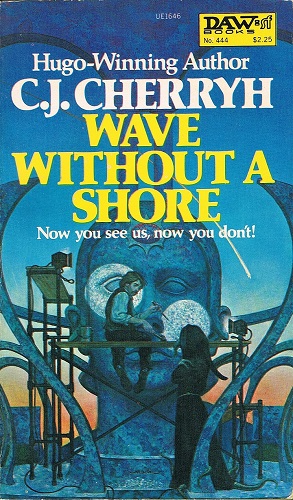
Wave Without a Shore, CJ Cherryh

The back cover blurb of Wave Without a Shore (1981, USA) describes it as “a different sort of interplanetary novel by the author of Downbelow Station (1981, USA) and The Faded Sun” trilogy (1978-1979, USA). Which is almost true. It certainly doesn’t resemble the two titles mentioned – for one thing, it’s set entirely on the surface of a single planet. So, not really “interplanetary” either, I guess.
The world of Freedom was settled by humans, even though it already had a native population, the ahnit. The humans built a city, Kierkegaard, and settled down to develop a way of life that resulted them in not seeing things which do not fit their worldview or “reality”. Such as the ahnit. Who more or less become invisible to them. As do humans who drop out.

Herrin Law considers himself the cleverest person on the planet. He becomes a sculptor at the university in Kierkegaard, where he meets Waden Jenks, son of the world’s First Citizen, and almost as clever as Herrin, if not equal in intelligence. Jenks’s cleverness, however, lies in politics. There’s also a third super-smart student, Keye Lynn, who starts out as Law’s girlfriend, then after Jenks has seized power from his father, moves in with Jenks.

Jenks commissions a statue of himself from Law, which Law turns into a series of carved domes, within which is the statue, in Kierkegaard’s only square. Meanwhile, Freedom’s sole contact with other worlds, a freebooter merchant, threatens Jenks and Kierkegaard, and Jenks responds by shopping him to the military… who then start building a station in Freedom orbit.

Much of the first half of the novel is taken up with philosophical discussions between Law and Jenks. Everyone on Freedom is solipsistic to the degree they can choose what and what not to see in their surroundings. But when Jenks, encouraged by the visiting military, tells Law to never sculpt again, and then has his goons break Law’s hands to make sure… Law is driven into a crisis and begins to “see” the ahnit.

It’s a neat concept – and reminds me a little of Miéville’s The City & the City (2009, UK) – but Cherryh spends so long setting up the characters of Law and Jenks, and describing the underpinnings to the Freedom humans’ solipsism, the story drags badly for much of its length. Nor is it helped by both Law and Jenks being so arrogant and self-centred and unlikeable. It also reminds me a little of other novels by Cherryh, such as Voyager in Night (1984), and while it’s set in her Alliance-Union universe, it’s on the fringes of it, like The Faded Sun trilogy and Angel with the Sword (1985, USA). So, probably one for completists.

Leave a comment

Millennium 8: The Girl with Ice in her Veins, Karin Smirnoff

The second book of the third trilogy featuring Lisbeth Salander, genius sociopath hacker. The problem with novels which centre sociopaths as the hero is the villains have to be complete psychopaths in order to present some spectrum of good to bad. So, here, for example, a bad guy who infiltrates a group of eco-activists turns out to be a paedophile, because being on the bad guy’s side is not enough on its own. And when every villain is grotesque beyond plausibility, suspension of disbelief even, then you have to wonder what point the story is trying to make.

On the other hand, this is a deckare, a thriller, so I guess making a point is not, well, the point of the book. The Girl with Ice in her Veins (2025, Sweden) is not a translation of the book’s original Swedish title, Lokattens klor, which means “the lynx’s claws”, but neither of the titles is especially relevant to the plot – although there is a a newly-introduced character nicknamed Lo, lynx. She’s a baddy, of course.

Like the preceding novel, The Girl in the Eagle’s Talons (2022, Sweden), The Girl with Ice in her Veins is set mostly in the invented north Swedish town of Gasskas. It also features the same cast – not just Salander and Blomkvist from the original trilogy, but also Blomkist’s daughter and family, Salander’s niece, and the trilogy’s main villain, disabled white supremacist millionaire Branco. The ecological theme also continues, although this time it’s opencast mining rather than windfarms.

Salander’s niece, Svala, is interning at the local newspaper and has joined a local group of eco-activists. After discovering a local abandoned sanatorium is secretly in use, Svala’s mentor at the newspaper is murdered. A bomb explodes near a disused mine, which appears to be in the process of being re-opened. There is also a consortium interested in opening a new mine in the area.

It’s all connected, of course, although the novel seems more interested in the depredations of the secondary cast, especially the villains. The Cleaner is hired to murder someone in Copenhagen, who turns out to have connections to the new mine in Gasskas, but instead he decides to help Svala. A visiting Greek/Chinese millionaire, who is interested in investing in re-opening the old mine (which is actually owned by Gaskass kommune), turns out to be the father of Blomkvist’s grandson. But because he’s a baddy, he’s also a domestic abuser and made his fortune through people trafficking. Branco pops up every now and again. He’s after the harddisk containing billions in cryptocurrency which Svala was given by her mother and which she has hidden. He’s also less interested in business and more in his white supremacist political organisation.

The Girl with Ice in her Veins resolves its main plot-threads, but Branco once again escapes. So that’s the plot of book three – as yet untitled – sorted. The prose is present-tense again, and often choppy. It mostly works, but occasionally gets perilously close to the fourth wall. I did spot a couple of weird choices in translating Swedish words/culture, but fewer than in the previous book. The Girl with Ice in her Veins is not a great book, but then the series could hardly be called a great series. The first book, The Girl with the Dragon Tattoo/Män som hatar kvinnor (2005, Sweden), was a solid serial killer hunt thriller, but it’s been downhill since then. I must admit, I do wonder how far they plan to take the series. Blomkvist is now in his sixties, Salander is slowing down too… The Girl in the Eagle’s Talons and The Girl with Ice in her Veins do feel a little like they’re moving Svala to centre-stage, so who knows…


Leave a comment

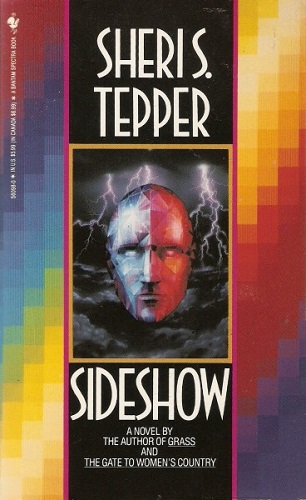
Sideshow, Sheri S Tepper

This is the third novel in a loose trilogy, and I have to wonder if it was originally intended to be a trilogy, even though the three books were published one after the other. The first book, Grass (1989, USA), is considered a genre classic, and was No 48 in the original SF Masterworks series. Tepper, who came to her career late, appeared frequently on the Clarke, Tiptree and Campbell Awards during the late 1990s and early 2000s, and with good reason – she wrote a number of excellent sf novels. Her feminism grated with some genre commentators of the time (men, of course), although these days it mostly seems notable for being not very intersectional.

Grass was followed by Raising the Stones (1990, USA), and then Sideshow (1992, USA), and all three are linked by the Arbai, an ancient race of dragon-like aliens who created a galaxy-wide network of Doors, which provided instantaneous travel between worlds. In Sideshow, an alien visits Earth in the late twentieth century and persuades a pair of joined twins to destroy an Arbai Door moments after it arrives on Earth. While doing so, they accidentally fall into the Door.

The story then jumps ahead several thousand years to the world of Elsewhere, which is the only planet left in the galaxy inhabited by humans not “enslaved” by the Hobbs Land Gods (an alien fungus which has created a hive mind out of all the infected humans, as described in Raising the Stones). But the founding philosophy of Elsewhere is a perversion of the term “diversity”, where a thousand or so cultures are protected despite their depredations on their members, such as sacrificing babies, treating women as property, abusing children, and generally allowing the privileged to treat the poor as less than human… 

Elsewhere is administered from Tolerance, which uses Enforcers to, well, enforce Elsewhere’s distortion of diversity, by ensuring people do not move between cultures, the cultures do not change, or do not use technology of a higher level than is mandated for their culture. The Provost in Tolerance once a year consults a hidden computer holding the minds of the thousand academics from the galaxy’s greatest university (before the Hobbs Land Gods), but those uploaded minds, especially the four most powerful, are now quite insane and have been masquerading as “gods” and interfering in many cultures.

A team of three Enforcers, the joined twins from the twentieth century (they ended up in Elsewhere when they fell through the Door), and a mysterious old woman and her equally aged male companion (and an even more mysterious not wholly physical companion called Great Dragon), travel to the uninhabited centre of one of the continents, on the run from the mad uploaded “gods”, and eventually discover the secret of Elsewhere and the Arbai.

It makes for an odd novel. The cultures are perversions, but then Tepper has been deliberately perverse before – in Raising the Stones, for one – and it’s clear she’s arguing against the philosophy which governs Elsewhere. Even so, “diversity” was a bad choice of word to use. It makes something reprehensible of something that should be admirable. And it sometimes seems Tepper delighted in doing just that. There are also weird tonal shifts between the various sections – the opening chapters with the conjoined twins reads like some sort of US carnival novel (sadly all too common in twentieth-century US science fiction) flavoured with a little Ray Bradbury. But then Sideshow turns into a Jack Vance novel, although the wit is considerably more heavy-handed than Vance’s. The final section is pretty much explanations, but relies a little too much on close knowledge of the preceding novels, which, to be fair, I read in 2020 and 2018.

And yet, this is Tepper. You expect certain things, a certain angle of attack, so to speak,  and in Sideshow she delivers it. A bit too much in places, I think. The main characters are mostly sympathetic, but the rest are grotesque, often more like caricatures than characters, especially the villains. It’s a book that’s slow to start, picks up pace in the middle, before slowing down once again for the grand finale. Which is, to be honest, a little disappointing.

Tepper is always worth reading, and in Sideshow she’s as inventive as ever, as extreme as ever, and as readable as ever. I’m not convinced you need to read Grass or Raising the Stones first, but it would probably help.


Leave a comment

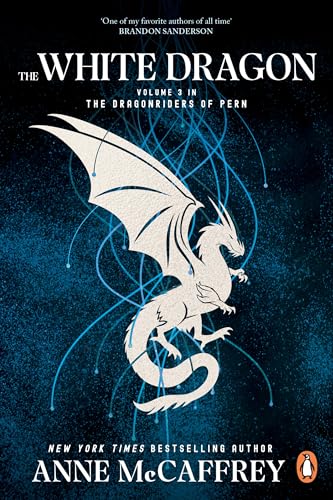
The White Dragon, Anne McCaffrey

The White Dragon (1978, Ireland) is the concluding volume to the original Dragonrider of Pern trilogy, but having now read the book it doesn’t much feel like the conclusion to anything. So I suppose it’s fortunate McCaffrey continued to churn out Pern novels for a few more decades…

The White Dragon follows directly on from Dragonquest (1971, Ireland). It focuses on Jaxom and Ruth, the teenage heir to Ruatha Hold and his undersized dragon, which is white if you hadn’t guessed. Ruth, the dragon, proves to be better at some things than the other dragons, despite being undersized and not sexually developed. He is faster and more manoeuvrable in the air, he has an excellent memory which is useful when travelling between (which is always italicised), and fire-lizards love him. Fire-lizards were introduced in the previous book and are sort of ferret-sized (I think) pocket dragons, about as smart as cats, and have been adopted by many on Pern as pets. They also seem to remember events that happened in the distant past.

The dragonriders, hold lords and master craftsmen have determined that humans first settled Pern on the southern continent, but they can find no record of why they fled north. The oldtimers – dragonriders from 400 years previously who helped save the day in the first book of the trilogy, Dragonflight (1968, Ireland) – were given land on the southern continent because they were causing problems with the present-day dragonriders and holds. But it looks like there’s lots more, and more desirable, land available on the continent.

And The White Dragon is more or less about that – exploring the southern continent, uncovering the ruins of the first human settlement on Pern, some political wrangling between an ambitious hold lord on the southern continent and the established holds on the northern continent, and Jaxom’s romance with the sister of said ambitious hold lord… There’s no plot per se, just a series of events which develop the characters and the background, and hint at the actual history of the planet.

Which doesn’t mean it’s not an entertaining read. Jaxom is an engaging character, as are the immediate supporting cast, more so at least than in the earlier two books, and Ruth can be amusing at times. Things happen… but there’s no real plot, no climax, no closure, no suggestion the story has concluded. Looking at the Pern books, it doesn’t seem so much a series as a collection of linked trilogies, and I’ve no idea which novel actually continues the story from The White Dragon.

I’ve enjoyed reading the trilogy, far more than I expected to, but I’ve no plans to read any more. If there is a book that follows on directly from The White Dragon, perhaps I might give it a go. But Wikipedia is no help, and I don’t intend to read umpteen books on the off-chance I find it… So, for now, I shall bail – but I will no longer malign the Dragonriders of Pern series as it’s actually not that bad.


Leave a comment

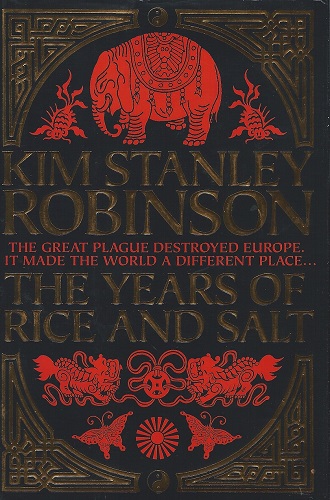
The Years of Rice and Salt, Kim Stanley Robinson

I’m a big fan of KSR’s fiction, because of the subjects he tackles and his treatment of them just as much as the stories he tells. He doesn’t just make use of common sf tropes, he interrogates them. A lot more sf authors should do that.

The Years of Rice and Salt (2002, USA) may be an alternate history, but it’s not a story set in a world which differs from ours due to some change in the past; it is in fact several stories – ten of them. Nor is it the book promised by its back-cover blurb, which posits a story set in a present-day world in which the Black Death in the fourteenth century killed 99% of the population of Europe instead of one-third. As a result, other civilisations flourished. Obviously, they flourished in real history – but in KSR’s novel they ended up dominating the world. The Years of Rice and Salt is not that either. It’s not a history of the world following on from the jonbar point. Which I suppose would be almost impossible – and huge! – to write. Like Laurent Binet’s Civilizations (2019, France), it is a series of vignettes which skip forward through the centuries, and around the world, from the Black Death to the present day. 

The linking conceit is that there is a group of people, connected eternally as a “jati”, who are repeatedly reincarnated. They die, spend time in the bardo, and are then reincarnated – as humans, or as animals. Allowing KSR to provide a focus point from which to hang to ten different stories taking place over the centuries in his alternate history. Sometimes the members of the jati remember their earlier lives, but usually they don’t.

The Black Death wipes out Europe. The Islamic Empire is never dislodged from the Iberian Peninsula. The Chinese continue to war on their western border, but also explore east and eventually settle the western coast of North America. A progressive empire develops in southern India. A league of Native American nations in central North America form a federation and keep their independence. There is a decades-long war which involves all three of the major world powers – the Indian empire, the Islamic empire, and the Chinese empire. Once the dust has settled, a new world order prevails. The various members of the jati are present, or pivotal, in some of the more important events in this 700 year history. Which also take place all over the world – Samarkand, Beijing, the Great Lakes, an Islamic city in western France, a Chinese San Francisco, and so on…

It’s fascinating stuff. The linking text is, to be honest, a not especially interesting mechanism to give the novel structure, and the ten “books” in The Years of Rice and Salt would be equally engrossing without them. KSR’s research is impressive – but not perfect: at one point, he states the Islamic punishment of cutting off the right hand of criminals is worsened because it forces criminals to use their left “unclean” hand when eating. That’s the whole point of the punishment. But the invented history KSR has created is astonishing. It feels all too real, which I guess is the point of the novel. Recommended.


Leave a comment

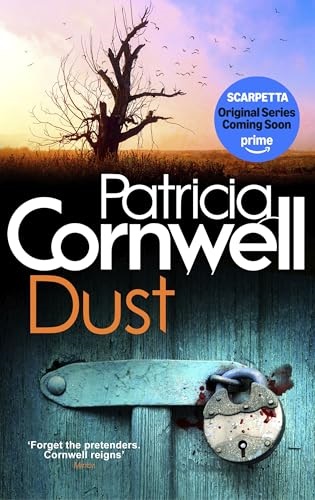
Scarpetta 21: Dust, Patricia Cornwell

Benton, Scarpetta’s husband, a FBI profiler, is away working on three linked murders of women in Washington DC, but his expertise is being ignored, disparaged even. And then the body of a murdered woman appears in Cambridge (Massachusetts, that is), Scarpetta’s jurisdiction, and it’s clear it’s connected to the three in Washington, even if it seems to contradict the prevailing theory held by the FBI about the crimes.

Scarpetta, Benton, Lucy and Marino find themselves trying to identify a serial killer who, it seems, is being protected by someone powerful, at least to the extent the FBI agent in charge of the investigation is ignoring evidence and focusing instead on a teenager who disappeared seventeen years before.

Once again, Scarpetta’s reputation is under attack, as are her family and relationships, but this time she sets out to methodically prove every point of her – and Benton’s – theory of the crimes, and so bring down the FBI agent deliberately misleading everyone. As in other books in the series, the murderer is more than human, almost as if the nearest the US can get to real-life superheroes are serial killers, which is pretty damn sick no matter which way you look at it. It might even be said crime novels which focus on serial killer stories – as so many of the Scarpetta series have – have much in common with fantasy or science fiction. True, one of the reasons I like the Scarpetta series is because Cornwell details the forensic science used – which does occasionally read like science fiction (much like the many CSI TV series).

Another draw is Cornwell’s focus on characterisation. Her cast are not enigmatic, phlegmatic, whimsical or just sketched-in, as is usually the case in crime fiction. She started out using first-person narratives, then switched to third-person omniscient before moving back again to first-person, except now there’s far more interiority and Scarpetta’s every thought is worked through implacably.

Dust (2013, USA) is one of the better books in the series, even though the plot centres around an implausible serial killer, and a defining event occurs off-stage and is far too easy to be credible. There’s also a fascinating article about Cornwell after the novel in the ebook edition, highlighting the many parallels between Cornwell herself and her characters, especially Scarpetta and Lucy..


Leave a comment

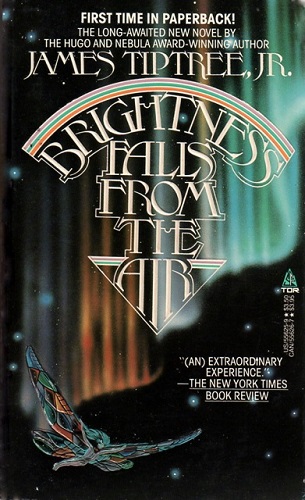
Brightness Falls from the Air, James Tiptree Jr

The second of only two novels published by Tiptree, and opinions on it are somewhat divided, chiefly I suspect because of one element of the book that has aged very badly – and was questionable to begin with.

The world of Dameim is home to an alien race who were illegally tortured and maimed in order to harvest a chemical they exude, which was then distilled into an extremely expensive drink called Star Tears. (The drink is mentioned in an earlier story by Tiptree, and the later collection The Starry Rift (1986, USA) takes place in the same universe.) Dameim is now overseen by three guardians, who live in a sort of safari lodge (which Tiptree admitted was inspired by her childhood safaris with her parents). They’re visited by a group of ten tourists, there to witness the wave-front of the Murdered Star pass over the planet. But two other men also disembark, apparently through some error, as does the supercargo who looked after the passengers while they were in cold sleep.

There are two plots – the last survivor of an alien race has tracked down the person who fired the shot which destroyed their sun, ie the Murdered Star; and three of the visitors are planning to make themselves some Star Tears – by torturing and maiming Dameii, of course. The latter plays out pretty much as you’d expect – the villains reveal themselves, and seize control. The first plot presents more of a surprise. It wasn’t the genocide everyone believed, and the alien’s “vengeance” is… complicated.

So far, so not especially a science-fictional story. There are real-world analogues to the two plots. However, the novel’s resolution depends in part on “time flurries” caused by the Murdered Star’s wave-front, and that’s pretty much sf. Tiptree also hints the cause of the genocide has, through the wave-front, altered everyone’s perceptions of Damiem and the Dameii.

Unfortunately, there’s one misstep the novel can’t recover from – among the tourists are four actors ranging in age from thirteen to sixteen, and they’re porn actors. Even in 1985, readers struggled to accept this, and it’s even less acceptable now than ever before, post-Yew Tree, post Trump and Epstein and the Andrew formerly known as prince… The actors are engaging characters, but the teen pornography leaves a bad taste.

I’ve seen Brightness Falls from the Air (1985, USA) described as Tiptree best-known but least-liked novel. She only wrote two and is much better known for her short fiction, so it seems a dumb way to refer to the book. And yet, except for the under-age sex, there’s a lot to like about Brightness Fall from the Air. The main plot is perhaps not intrinsically sf, although Tiptree makes the setting entirely genre, and the many plots and subplots she handles with admirable deftness. It’s perhaps the most colourful and yet bleak novel I’ve read.

The Starmont Reader’s Guide to James Tiptree, Jr (1986, USA) by Mark Siegel, one of only two critical works on Tiptree’s fiction I’ve managed to find, suggests a common theme to much of her fiction: she believed mortality, or the acceptance of mortality, was necessary to create art; it is the shadow of death, oblivion, hanging over us that drives creativity. Brightness Falls from the Air certainly illustrates this theory.

I’ve read a lot of Tiptree this year, and the more I read the more I like it. I’ve always regarded a handful of her stories as stone cold classics of the genre. It’s also true many of her stories have not aged particularly well. I’ll happily recommend her works to people, but with the caveat they should probably stick to her short fiction.


Leave a comment

The Long Arm of Gil Hamilton, Larry Niven

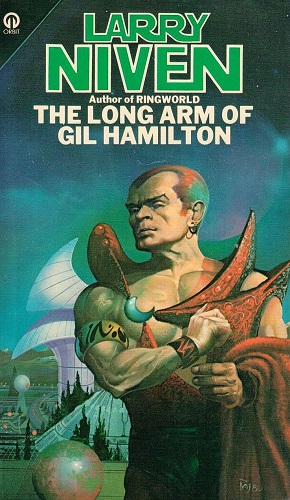
We make foolish decisions all the time, probably even several times a day. Mostly, they cause no harm, perhaps a little mild embarrassment, and often no one witnesses the embarrassment but we know about it ourselves all the same. I have no idea why I decided to complete my exploration of Larry Niven’s oeuvre. I last read books by him back in the early 1980s, and while I had fond, if incomplete, memories of some of them, I also knew they weren’t very good. But, for some reason, I decided to read the rest of his books. I don’t know; perhaps I saw a couple, with their pretty damn cool Peter Andrew Jones cover art, in my local secondhand sf bookshop, and thought, yeah, let’s give them a go, I liked them back when I was, er, fourteen or fifteen, what could possibly go wrong?

Everything, of course.

I’d remembered the ideas in Niven’s books over the decades, and I knew he was a proponent of “transparent prose”, which is what writers say when their prose is so bad it’s almost an anti-style, and yes, I’d remembered Niven’s politics were considerably to the right of mine (and not just because I’m British but because he’s a conservative loon)… but what I’d forgotten was how effortlessly offensive his fiction was. My sensibilities were still in flux back in my mid-teens, so perhaps I just skated over the worst bits and only took the good, if rare, bits on board.

The Long Arm of Gil Hamilton (1976, USA) was not a Niven book I’d read back in the day. It’s a collection of three novellas set in Niven’s Known Space universe and featuring a single protagonist, Gil Hamilton. Who is an officer in the UN police, which is called ARM, Amalgamated Regional Militias (an unconvincing backronym, which Niven himself admits). Hamilton lost an arm in an accident in the Asteroid Belt, and developed a telekinetic arm as replacement – he has ESP, it works like an arm, only not as strong, but it can reach through solid objects. Even though he had the lost arm replaced with a transplant, he still has his psionic arm. See, the “long arm” in the title, it’s a pun: Hamilton works for ARM and he has a psionic arm too. Hoho.

Hamilton chiefly investigates organleggers… and this is where I have to wonder how I didn’t immediately recoil at Niven’s politics back in the day. Earth in the Known Space series has a population of eighteen billion, which, according to Niven, means it’s massively overpopulated and covered almost entirely by cities. (Earth currently has a population of over 8 billion but there are still vast swathes of unpopulated wilderness. I can bore you with population density by country, but you can look it up on Wikipedia yourself.) For some reason, these 18 billion people have an insatiable demand for new organs. So insatiable, in fact, that pretty much breaking any law results in a death sentence so the criminal’s organs can be harvested. Having one more kid than licensed, for example. Or drunk driving. Which first supposes the death penalty is normal – it’s not, the US is an aberration (one of around 15% of nations). And second, that all medical conditions are solved by transplanting a new organ. It’s complete nonsense, complete right-wing nonsense.

The plots of the three novellas are almost incidental. Hamilton is, to be fair, a mostly engaging narrator. In the first story, Hamilton is confronted with the seeming suicide of a Belter friend by direct simulation of the pleasure centres of the brain. Except it goes against everything Hamilton knows about his friend. It’s murder, of course. And Hamilton tracks down the killer. In the second, an attempt on Hamilton’s life leads him to suspect an organlegger who retired when the world government made it legal to use cryogenically frozen bodies for organs harvesting. The third story is one Niven freely admits he had the most trouble completing – it’s a locked-room murder mystery, of a sort, but also a sf story, which, according to the essay which ends the collection, took Niven several goes to get right… and even then it’s confusing, muddled and neither a good murder-mystery nor a good sf story. 

Everything in The Long Arm of Gil Hamilton, although it mentions other nations, is Americocentric. Everything operates according to US laws and sensibilities. This is hardly surprising – it’s a US sf collection written by a US sf author for the US sf market. And that was not only common, it was the actual state of the genre for much of the twentieth century. So it seems churlish to point this out, except to say it makes these books – not just Niven’s, but other sf authors of his generation – irrelevant to a twenty-first century sf audience.


Leave a comment

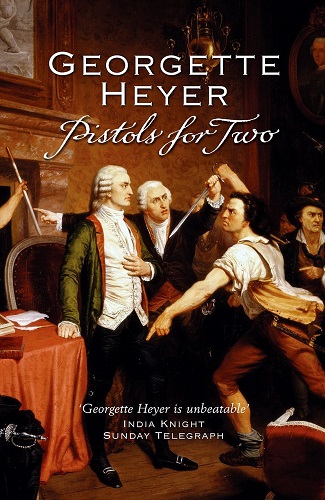
Pistols for Two, Georgette Heyer

Heyer’s only collection, until a recent one was cobbled together from this and some uncollected pieces, which is not much of a surprise as her only published stories were contemporary, and the contents of Pistols for Two (1960, UK) appeared nowhere else. They are… condensed versions of Heyer’s Regency novels. Mostly.

Pretty much every story is a young woman, either nineteen or twenty, who finds herself in a situation with a man – of the Quality, of course – a dozen or so years older, and so comes to love him or realise she has always loved him, and they agree to marry. In some cases, Heyer holds back on the history of the characters in order to male the romance more, well, cuter. The two guardians who refuse to allow their wards to marry because they were once engaged and it all went wrong but they’ve carried a torch for each other ever since. The young woman who prevails on an unknown lord to prevent the duel between her brother and a known rake, only to discover the unknown lord is the rake and he’s fallen for her.

The only one that breaks the mould is the young cit gentleman who puts up at a country inn on his way home from working in Portugal, and finds himself the intended victim of murderous thieves. Fortunately, one of his fellow guests is a Bow Street Runner.

Short stories by definition allow less room for character development, and Heyer did tend to rely on a series of stock characters. So it’s a hardly a surprise the stories in Pistols for Two feature those self-same stock characters, and the plots read mostly like incidents from a novel-length work.

On the other hand, it’s Heyer and these stories are typical of her work. If you like Heyer, you’ll like these. If you like these, you’ll like Heyer’s other works.