It Doesn't Have To Be Right…

… it just has to sound plausible


6 Comments

Moving pictures, #27

If I’ve been posting overmuch on movies, it’s because the day job has not left me much time of late for reading and thinking about science fiction…
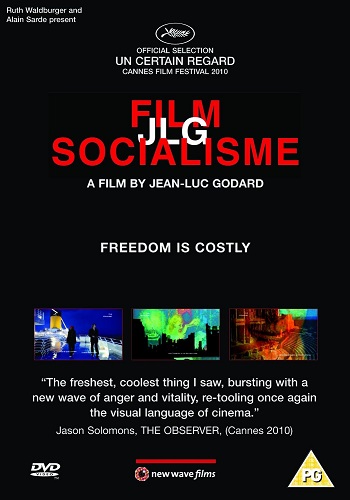
film_socialismaFilm Socialisme, Jean-Luc Godard (2010, France). There are some things you like the idea of more than you like the actuality. And, for me, that’s sort of true of Godard’s films. I admire his approach to cinema, his willingness to experiment and push at the boundaries of the medium, I admire what he’s made and what he’s done with his career… but I don’t necessarily like every film he’s made. Film Socialisme is a case in point. It’s a film whose concept I find more appealing than its execution. And yet I’m not so daft not to realise that its intent is likely to result in a film that wouldn’t be especially enjoyable. If that makes sense. It’s sort of like Koyaanisqatsi, which on paper should be dull and uninteresting but is actually a fascinating piece of cinema; Film Socialisme, on the other hand, sounds intriguing on paper, but is actually somewhat dull to watch. Partly, I suspect, that’s from Godard’s choices at presenting his material. The film is split into three “movements”. The first is set aboard a cruise ship, and is presented much like a fly-on-the-wall documentary, with no plot and no discernible characters; and it occasionally it drops into low-resolution video. The second movement is a somewhat absurd family drama at a petrol station, in which a pair of children put their parents on trial. And the third movement is cinematography of several well-known cities around the world. Bits of it work really well. But it feels mostly like an early draft, like someone working out a theory they haven’t quite thought through. I suspect it needs another viewing.
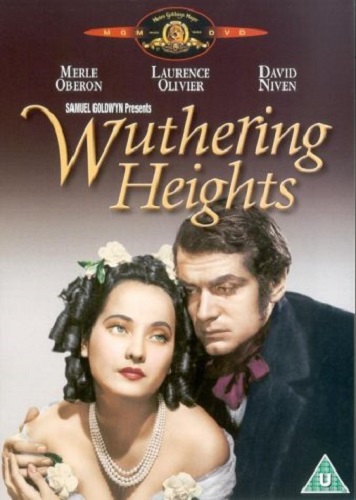
wutheringWuthering Heights*, William Wyler (1939, USA). I may be getting my early nineteenth-century classics confused, but wasn’t there a mad woman confined to an attic and a house on fire and lots of running across the moors in Wuthering Heights? I don’t know; I’ve never read the book. I watched Andrea Arnold’s adaptation of it back in 2013, but I don’t remember much from it. This version from 1939, however, seems to be the one most people know of – hence it’s appearance on the 1001 Movies You Must See Before You Die list, no doubt. Merle Oberon is Cathy, the girl from the big house who loves uplifted street urchin Heathcliff, played as an adult by Olivier. (And no, I’ve no idea what “wuthering” means.) There is a particular style of historical movie Hollywood did in the 1930s – I’m thinking of Queen Christina (see here) as well as this one – filmed in stark black-and-white, with only a token nod in the direction of authenticity or fidelity to the source material, and usually positioned as vehicles for their star or stars. Wuthering Heights sits firmly in that tradition. Like other films of its type, it relies heavily on its source material for its emotional content, but restructures and simplifies the plot and characters to meet the needs of the medium, often to the point where the original story is unrecognisable. The result is rarely satisfactory, except perhaps to those who don’t know the source. Not that I did – but I still found this film undeserving of its place on the 1001 Movies You Must See Before You Die list.
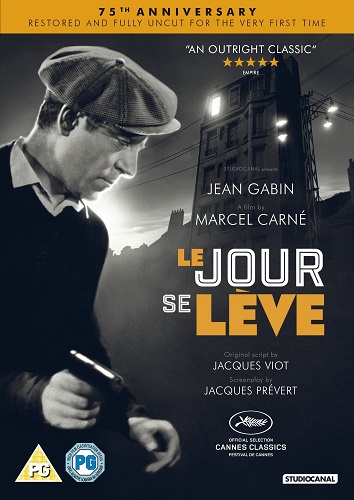
le_jourLe jour se lève*, Marcel Carné (1939, France). It seems I might have a bit of a blindspot when it comes to French cinema of the 1930s and 1940s, because so much of it appears on best of lists and 1001 Movies You Must See lists, and yet I’ve only really liked a small handful. Which, sadly, does not include Le jour se lève… despite its appearance on the latter list. In précis, Le jour se lève sounds like an interesting film: a man shoots another visiting his flat, then barricades himself inside, while the police gather outside the building to arrest him at the break of day. Meanwhile, the man’s story is told in flashbacks, leading up to the motive behind the shooting. It’s cleverly done, and so well-structured you never lose sight of either the framing narrative or the flashback chronology… But when all’s said and done, the story is somewhat banal – yes, he was involved with two women, and the prior lover of one of them is the victim. It’s a film that’s easy to admire for its technical skill, if not for its plot. The characters are not exactly sympathetic, and the jump-about chronology hardly gives the viewer ample reason to sympthasise with them anyway. It’s a film that feels cold, and about which it is easier to feel cold rather than get excited. A borderline case for the 1001 Movies you Must See list.

autumn_avoAn Autumn Afternoon*, Yasujiro Ozu (1962, Japan). I am not technically a convert to Ozu… although I watched Tokyo Story a couple of years ago and was not especially taken with it… but then earlier this year I watched Floating Weeds and liked it a lot, and then went on to watch Late Autumn, which I liked even more… And now An Autumn Afternoon, which feels like a satirical retake of Late Autumn, and which I find myself liking a great deal. Which I guess actually does make me a convert to Ozu. Like Late Autumn, An Autumn Afternoon concerns men trying to marry off young women. Five men, friends since middle school, meet regularly. One would like to find a husband for his daughter, another thinks his secretary should get married. They invite an old school teacher to one of their meetings, and then learn that he now runs a noodle-shop in a working-class area. While visiting the noodle-shop, one of the men, Hirayama, the ostensible central character of the film, runs into a petty officer from the ship he commanded during the war. Meanwhile, Hirayama’s son-in-law borrows money to buy a refrigerator… and a set of golf clubs. An Autumn Afternoon is a very “inside” film, a very uchi film. Not only is the outside framed as if it is indoors, with walls to either side mimicking the many shots of corridors which appear in the movie, but the plot itself revolves around people of the outside group who have relationships with those in the inside group, ie, the central cast. It is also a beautifully-shot film, and the framing of much of it reminded me of Douglas Sirk’s work. As too did the slightly mocking and subversive tone it took to to the society it depicted. I liked Floating Weeds and Late Autumn a lot, but I loved An Autumn Afternoon. Highly recommended.
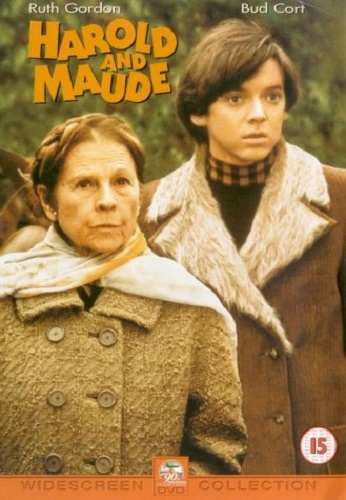
haoldHarold and Maude*, Hal Ashby (1971, USA). This was apparently a critical and commercial failure on its release, although it has subsequently picked up a cult following. I cannot honestly see the appeal. Harold is the son of a wealthy socialite, but he is glum and mordant and stages fake suicides for his mother. She brushes them off as bad jokes. Maude is an old woman Harold meets at a funeral (he is in the habit of attending the funerals of strangers; as is Maude). She’s a bit of a character – she steal cars, she believes in living for the day, she’s pretty much a mad grandma. The two hang out together, Harold falls in love with Maude, they plan to get married. But on her eightieth birthday, shortly before the wedding, she commits suicide as she feels eighty years is long enough. The film pretty much hangs from Maude’s characterisation and she is not, to put it bluntly, an especially believable character. The ease with which she steals cars is, for a start, highly implausible. No one says it’s meant to be, but there are some things in a story you can appropriately slide over, and some things you can’t. Harold’s joke suicides, for example, its easy to accept them, no matter how horrible or improbable (and at least one is physically impossible as presented), but there’s a limit to what’s plausible – and some elements of Maude’s character don’t pass the test. Another US film whose presence on the 1001 Movies You Must See Before You Die list is somewhat baffling.
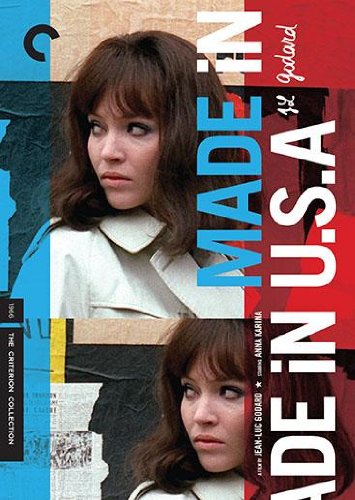
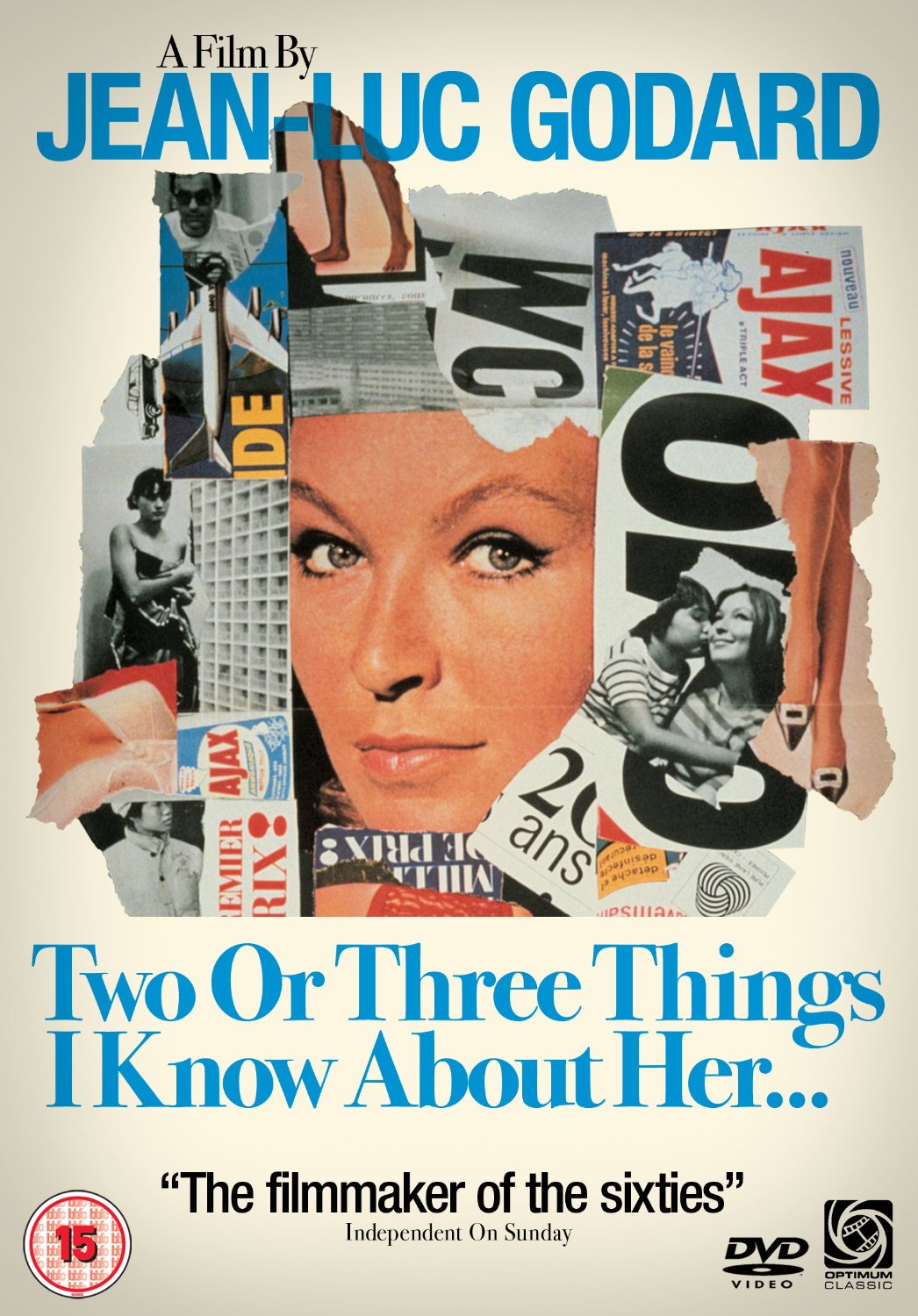
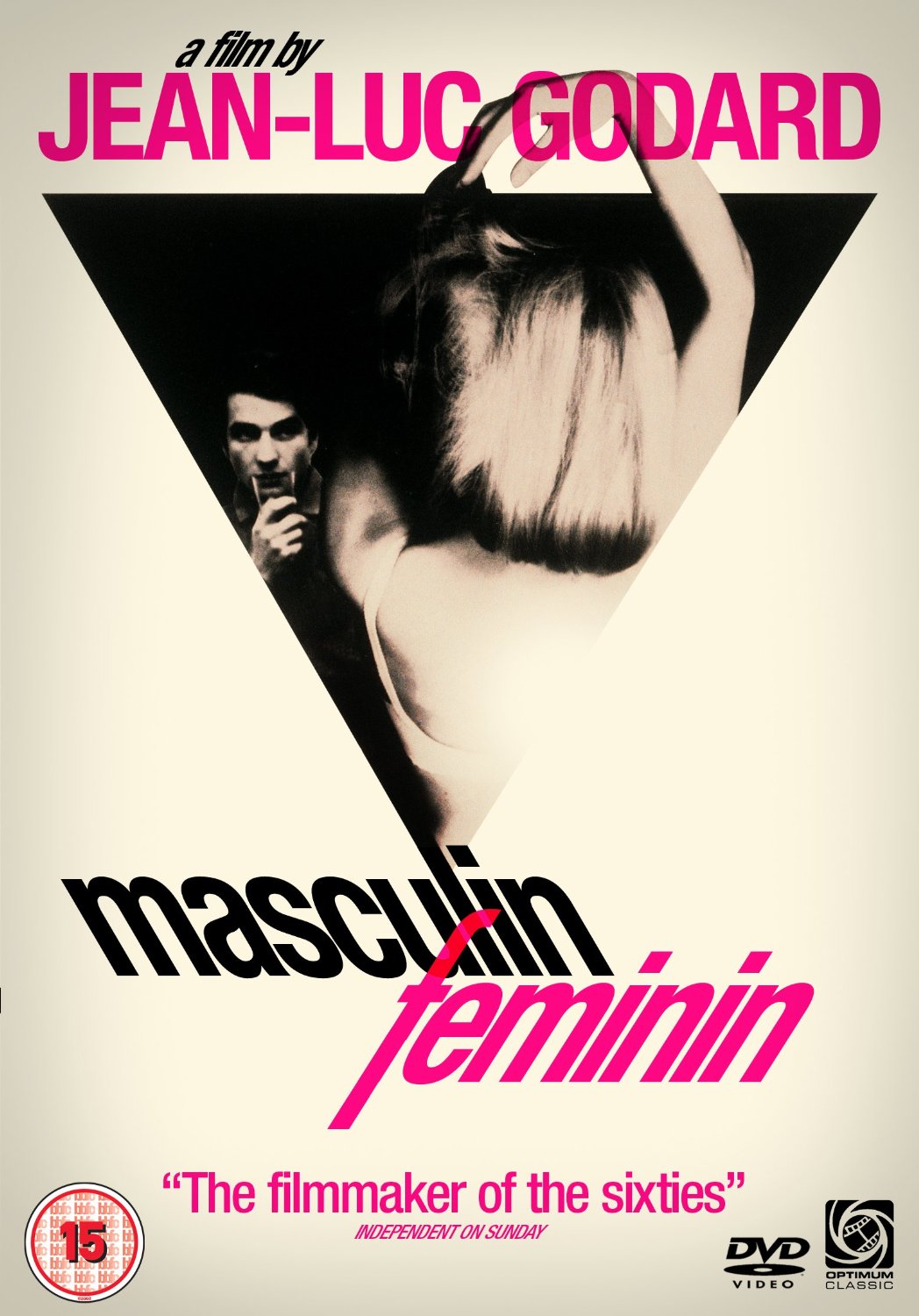
made_in_usaMade in U.S.A., Jean-Luc Godard (1966, France). This was shot back-to-back with 2 or 3 Things I Know About Her, which is one of my favourite Godard films. Of course, that’s no reason for this film to be equally good. Which, sadly, is the case. I’ll admit I’ve never understood the obsession some European directors had with US noir films – Rainer Werner Fassbinder and his The American Soldier (and others), Godard and Made in U.S.A. (and others)… Perhaps it was envy of the glamour and romance of the Hollywood system… except – noir? Perhaps it was the stark morality of noir, something European culture had given up centuries before. Perhaps it was… I don’t know, the use of archetypes as characters, the use of stereotypes and cliché as cinematic shorthand… Not that either Fassbinder or Godard could ever have made a straight noir film à l’américaine, as is amply demonstrated by Made in U.S.A. It is allegedly set in Atlantic City, but no effort was made to use locations, or to dress sets, in order to give the impression of a US setting. Anna Karenina travels to the city to meet her boyfriend, learns he is dead, and decides to investigate his death. Karenina then bounces from one group of characters to another, being lectured at by, and lecturing to, these people. She finds a strange man in her hotel room, knocks him out… and he later turns up dead in the flat of a writer. Made in U.S.A. has certainly blown my Godard theory out of the water – well, mostly. I mean, I’ve also recently watched Goodbye to Language and Film Socialisme, and I thought they were interesting, if not entirely successful, experiments, and certainly worth rewatching. Made in U.S.A., despite being a colour film, reminds me more of Masculin féminin and Une femme mariée than it does 2 or 3 Things I Know About Her or Week End. Still, I bought the DVD, so I’ll be able to watch it again, and perhaps I’ll revise my opinion.

1 Comment

Moving pictures, #18

More of a geographic spread this time around, with only two of the six from Hollywood – and both of those I only watched because they’re on the 1001 Movies You Must See Before You Die list. Some of you may have noticed that I had a go at putting together my own version of the list, but so far only managed about 300 films. It’s a work in progress, of course; and will undoubtedly change as I watch more films, or change my minds about films I’ve already listed. It has so far proven difficult not to put too many films on my list by directors I rate highly – such as Dreyer below – but even then I seem to have included half a dozen by one favourite director but only two by another. So it’s not like I’ve been all that consistent. Ah well. We’ll see how it goes. Meanwhile, more films from the actual 1001 Movies You Must See Before You Die list, and a few others, what I have viewed recently…

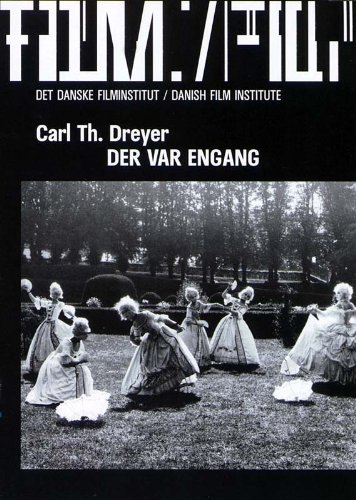
once_uponOnce Upon a Time, Carl Theodor Dreyer (1922, Denmark). As is no doubt obvious from the title, this is a fairy tale. It’s adapted from a play of the same title by Holger Drachmann, first performed in 1885. The film isn’t complete, however, as about half has been lost – but the Danske Filminstitut have managed to salvage a narrative using still photos and new intertitles based on original sources. It’s a less engaging film than Dreyer’s The Bride of Glomdal, although the staging is often impressive – as can be seen from the still on the DVD cover. I seem to recall the story dragging somewhat – and that there were a lot of intertitles, although whether that was a result of the fact half the footage has been lost, I’m not sure. I seem to recall other films by Dreyer from the same period featuring more intertitles than I’d expected. On the other hand, you’d expect a silent movie adaptation of a stage play to be quite talky… I do like Dreyer’s films – I’d certainly put him in my top ten directors list… (For the record, they would be, at this particular time, in no particular order, Sokurov, Tarkovsky, Suleiman, Antonioni, Haneke, Hitchcock, Dreyer, Benning, Kieślowski and Kaurismäki.)

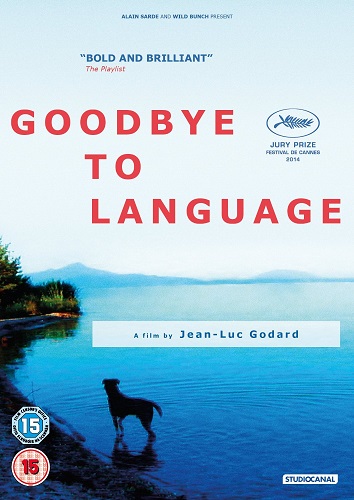
goodbyeGoodbye to Language, Jean-Luc Godard (2014, France). Some things I like the idea of more than I like the actual thing. One of those things is experimental cinema. I like that some film-makers explore how the medium can be used to tell stories, film-makers like James Benning, for example. But not every experiment film works for me. I remember watching and not liking Lukas Moodysson’s Container, although I do like Moodysson’s other movies. Godard was a director who certainly experimented, and one or two of his experiments I do indeed like – such as Two or Three Things I Know About Her or Weekend. Goodbye to Language experiments with both 3D filming techniques – entirely lost on me as I watched a 2D version – and cinematic narrative… and it’s not an easy film to watch. There are scenes which look and feel more like documentary footage, there are scenes in which characters lecture at each other (not unusual in a Godard film), there are strange camera tricks and photographic effects. The story has to be puzzled out from what’s shown on the screen, and it’s not at all obvious. Watching Goodbye to Language was a bit of a chore, but, as mentioned earlier, I like the idea of the movie – and might well give it another go sometime. Sometimes it happens you don’t take to something immediately, but leave it a while, return to it, give it another go… and it becomes a favourite. I suspect that won’t happen here, but perhaps I might decide I do actually like it…

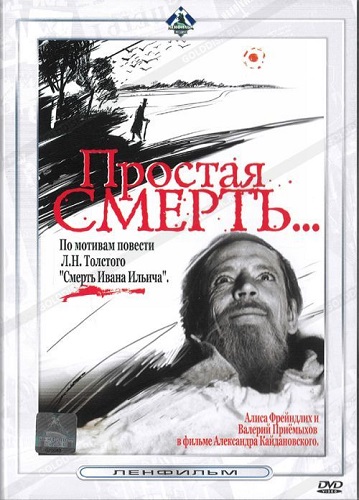
A_Simple_DeathA Simple Death, Aleksandr Kaidanovsky (1985, Russia). Kaidanovsky is perhaps better known as an actor – he played the lead in Tarkovsky’s Stalker, and one of Pirx’s crew in Test Pilota Pirxa – but he also directed three feature films: Гость (an adaptation of a Jorge Luis Borges story), Жена Керосинщика, and Простая смерть. The last, A Simple Death, is an adaptation of Tolstoy’s novella, ‘The Death of Ivan Ilyich’, and pretty faithfully follows its plot: a magistrate who has led a mostly good and successful life falls while hanging curtains one day and hurts his side, the pain grows each day until he is bedridden and his codition is terminal, where he reflects on his mortality, his life and the injustice of his current predicament. Although made in 1985, A Simple Death is black and white, and parts of the film reminded me strongly of Sokurov’s Stone, in which Chekhov returns to the present day and surprises the young man who is caretaker of his house. There’s a similar aesthetic at work, although Kaidanovsky’s film and camera work is not as experimental as Sokurov’s. Good stuff.

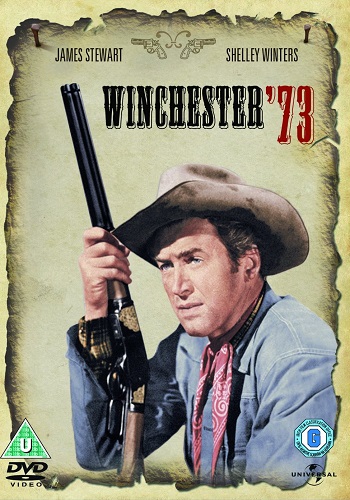
winchesterWinchester ’73*, Anthony Mann (1950, USA). The title refers to a model of rifle, the Winchester 1873, which was a superior repeating rifle and much prized. Even more prized, however, was the “one in a thousand”, which was is a particular instance of the Winchester ’73 which was so well-made – more by accident than by design – that it shot so much truer than the other 999 rifles made in that batch. Winchester ’73 opens with a crowd gathering in Dodge City to either witness or take part in a shooting competition, the prize for which is a “one in a thousand”. The contestants are whittled down to two: Jimmy Stewart and Stephen McNally. And there’s plainly bad blood between the two. Stewart wins, but McNally later ambushes him, steals the prize rifle, and gets the hell out of Dodge. Stewart and buddy chase after him. Meanwhile McNally has lost the rifle in card game with a gunrunner, who then sells it to a Native American chief (Rock Hudson) on the warpath. Who then attacks a cavalry detachment, but Stewart and buddy turn up and help them cavalry win the day. Hudson is killed and a young Tony Curtis finds the prize rifle. The sergeant gives it Charkes Drake, as Stewart has already left. Drake, and fiancée Shelley Winters (who had met Stewart back in Dodge), continue with their journey, but come a cropper with a member of McNally’s gang, and so the rifle ends up back in McNally’s hands. At which point Stewart turns up and the two shoot at each other for the gun. Throughout the film, they’ve been depicted as superlative shots, but this last scene has them repeatedly missing each other. Guess they weren’t so good, after all. As mid-centiury Westerns go, Winchester ’73 isn’t a bad one – and it’s certainly refreshing to see Stewart acting tougher than he usually does. But I’m not really sure why it needs to be on the 1001 Movies You Must See Before You Die list.

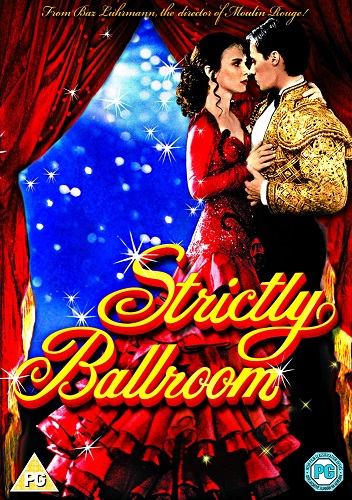
strictlyStrictly Ballroom*, Baz Luhrmann (1992, Australia). I should think most of the populations of Australia and the UK, amd a goodly-sized proportion of the US, have already seen this film, but somehow or other I’d never managed to do so. Of course, I only watched it because it was on the 1001 Movies You Must See Before You Die list. And now I have. It was… okay. It’s a spoof set around a regional ballroom dancing championship in Australia. The son of a dancing school instructor is the local star, and tipped to do well in the competition. But his partner leaves him for another dancer since he has a tendency to stray from “proper dance steps” – and, against his parents wishes, and with some persuasion, he decides to take as his partner a young woman who hangs around the dancing school but is not a dancer. They practice secretly, she develops into an excellent dancer, and he even learns some useful life lessons – and how to dance the pasodoble correctly – from her immigrant parents. Apparently, the film was adapted from an earlier play written by Luhrmann when he was  a student. It’s also one of the most successful Australian films of all time. It has now been made into a stage musical, which I guess means it’s now as mainstream as you could possibly get.
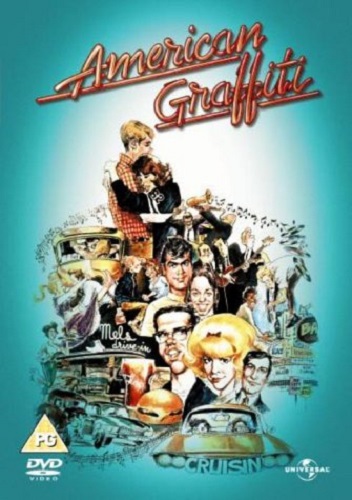
grafittiAmerican Graffiti*, George Lucas (1973, USA). After THX-1138, Lucas decided to make something more commercial, and so chose a story based on his own memories of growing up in Modesto, California. Although audience response to the film was good, and he had a number of big names batting for him, the studio first wanted their own re-edit of it and then to release it as a TV movie. However, saner heads prevailed, and the film was given a theatrical release, and went on to make a pretty good profit. All of which may be interesting, but is of no consequence when considering American Graffiti as a film. And it’s a Californian coming-of-age movie, a duller subject I can’t imagine. Obnoxious teenagers with over-inflated senses of self-worth driving around small town USA and getting up to drunken antics. Richard Dreyfus spends much of the movie chasing after a young woman he saw fleetingly in a car. Paul Le Mat cruises around with a teenybopper, before ending up in a road race against Harrison Ford. Charles Martin Smith chats up a young woman, mostly by telling lies, and then cruises around with her. And so on… Yawn. I have no idea why this film is on the 1001 Movies You Must See Before You Die list.

1001 Movies You Must See Before you Die count: 753


Leave a comment

Moving pictures, #13

Had a fun weekend not so long ago. The Royal Mail managed to lose my address, they somehow managed to not find the place they’d been delivering my mail to for the past ten years. The mail in this case being my rental DVDs from Amazon. On receiving the returned DVDs, Amazon marked my account so no new films would be dispatched until I’d confirmed my address. Which I did. But this managed to break things, so my account got stuck in “do not dispatch”. I contacted Amazon’s help desk, and they apologised and immediately put 3 DVDs from my list in the post. And they added a fourth to make up for the hassle. The help desk person also raised a note to Amazon’s engineering department about the fact my account was stuck. And they fixed it. Which meant their system immediately despatched the next 3 DVDs from my rental list. With the two discs a week I get from Cinema Paradiso… I ended up with nine DVDs to watch that weekend.

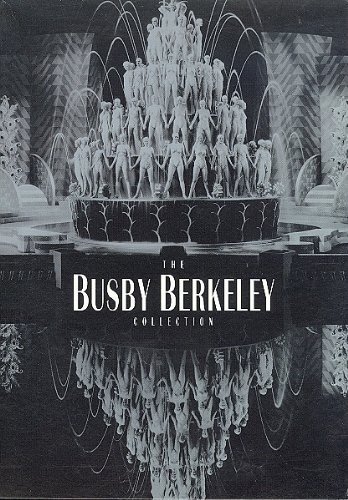
busbyGold Diggers of 1933, Mervyn LeRoy (1933, USA). There is, it has to be said, something of a formula to the films in this Busby Berkeley Collection. A producer wants put on a show, but for some reason can’t. Then everyone rallies round… and it happens. Here, it’s a lack of money but once that hurdle is overcome, the show goes on. The story focuses on four actresses – the “gold diggers” of the title – played by Ruby Keeler, Joan Blondell, Ginger Rogers (all three of whom appear in several of the other films) and Aline McMahon. Of course, it’s the Berkeley routines for which these movies are remembered – and with good reason. (Although, to be honest, I also think Ginger Rogers is great.) In this one, Rogers sings ‘We’re in the Money’, which probably everyone knows – although they probably don’t know it’s from this movie, I certainly didn’t – including a verse in pig Latin. Another routine features dwarf Billy Barty as a baby in a pram, who later gives Dick Powell a can opener so he can get through the metal lingerie (yes, actual metal) worn by dancers. Er, right. I’ll admit I bought the Busby Berkeley Collection so I could watch a couple of the films on the 1001 Movies You Must See Before You Die list that were not available on rental (or indeed in UK editions). But I’ve really enjoyed the movies and, unlike some other DVDs I’ve bought just because they’re on the list, I’ll be keeping this box set. Well worth the money (sung to the tune of ‘We’re in the Money’, of course).

christ_eboliChrist Stopped at Eboli*, Francesco Rosi (1979, Italy). This is another one of those Italian Neorealist films that was new to me and which I found myself impressed by. Admittedly, one of the reasons I started watching the films on the 1001 Movies You Must See Before You Die list was to expand the range of films I was watching. It’s not that my viewing was limited to Hollywood films – I’ve been a fan of a number of non-Anglophone directors for many years, such as Tarkovsky, Bergman, Kieślowski, Suleiman, Haneke, Antonioni… among others. But the list seemed like an excellent source of titles I’d not seen and would probably like… and it subsequently introduced me to Italian neorealism as a film movement I’d not previously been aware of or explored. All of which is probably irrelevant as Christ Stopped at Eboli is not classifed as Italian neorealism – but it is Italian and it is on the 1001 Movies You Must See Before You Die list, and it’s also a film I likely would never have seen otherwise. Which would have been a shame, as it’s very good. In 1935, painter and writer Carlo Levi is exiled to a village in southern Italy for his anti-fascist activities. Since he studied to be a doctor, he ends up practicing medicine for the peasants (the local doctors aren’t interested in treating the peasantry). His politicial sensibilities also result in a rocky relationship with his putative “warden”, the local mayor; and he also forms a relationship with the local priest, also an exile, whom the mayor hates. Christ Stopped at Eboli is an odd film – it was filmed in 1979 but set 44 years earler… and from the looks of it horribly little set dressing was required. The pace is languid, content to let the relationships between the characters slowly be revealed and the scenery to speak for itself. The end  result is a movie which is slow to start but slowly drags you in. So much so, in fact, that by halfway through the film I was very much impressed. Worth seeing.

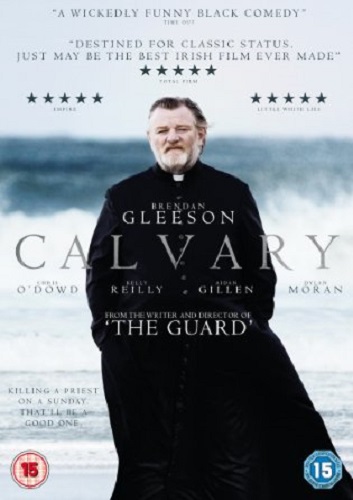
calvaryCalvary, John Michael McDonagh (2014, Ireland). Several people recommended this film to me, and I’d heard good things of it, so I bunged it on the rental list and lo it dropped through onto the doormat one day… It’s set in present-day Ireland, a man gives his confession to his local priest and tells him he will kill the priest because the man giving confession was abused as a boy. The priest knows who it is, but there’s nothing he can do about it. However, the priest has a week to get his affairs in order – and so he does. Sort of. He goes to the bishop, but the bishop tells him he should go to the Garda (the bishop comes across more like a politician or middle manager than a man of God). At one point, someone sets fire to the church. Calvary is sort of a gentle black comedy, if such a thing exists, and very much based on its characters – none of which, it must be said, are especially sympathetic, with the exception of the priest, played by Brendan Gleeson, who has been threatened with murder. His assistant (verger?) is an idiot; one of the locals is a doctor and a nasty snide piece of work; another is innocent to the point of stupidity… At times, some of the characters teeter on the edge of caricature, and I suspect it’s only the presence of Gleeson anchoring the film which keeps them from doing so. A film worth seeing, but not I think a great film.

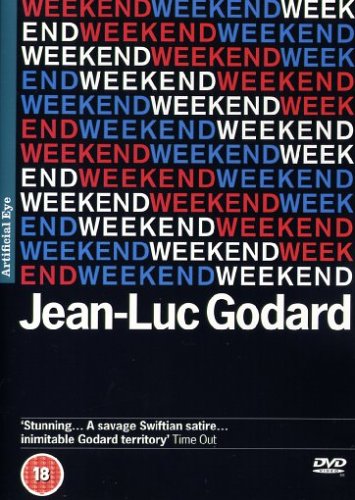
weekendWeekend*, Jean-Luc Godard (1967, France). I was convinced my Godard theory held water – colour films good, black-and-white films not good. True, it was based solely on the fact that the two Godard films I really like – Le mépris and 2 or 3 Things I Know About Her – are both colour films. It wasn’t much of a theory, it has to be said – for a start, I’ve only seen nine of Godard’s films, the most recent of which is, er, Weekend, and which is also a colour film. On the one hand, I didn’t like Weekend as much the other two films, but I did like more than the black-and-white films I’ve seen. It’s a less pretentious movie than Godard’s others, but it’s also more… chaotic. A bourgeois couple drive out to the country to visit the wife’s dying father. Each has decided to murder the other, so their relationship is somewhat fraught. As they drive through the country they become involved in various violent events. An odd film, and plainly deliberately so. That sort of appeals to me – although it did, in places, do that Godard thing I’m less fond of, where characters talk at each other. And the scenes set in the wood were dubious at best. I guess, on reflection, my Godard theory still holds, although I think Weekend probably requires another watch.

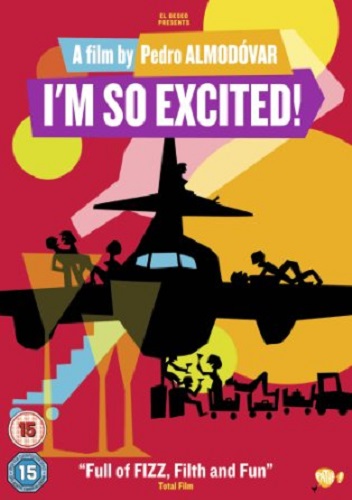
excitedI’m So Excited!, Pedro Almodóvar (2013, Spain). I spotted this one in a charity shop, and I’ve always enjoyed Almodóvar’s films… albeit not as much as I once did… but I thought it worth a quid and… Oh dear. Talk about light and frothy – I’m So Excited! (original title Los amantes pasajeros translates as “the fleeting lovers or “the passenger lovers”, according to Wikipedia; and seems better suited) is set aboard a flight to Mexico, and it’s probably only the frothiness of the script that keeps the aircraft in the air. A cock-up on the ground, perpertrated by Antonio Banderas and Penelope Cruz in cameos, results in one of the aeroplane’s undercarriage not folding away properly, which means the aircraft will not be able to land when it reaches Mexico City. So they go into a holding pattern above the airport they departed from while things are figured out. The economy class passengers and cabin crew are put to sleep with tranquilisers, leaving only the dozen or so first class passengers, four cabin crew and the two pilots awake. All of whom, it transpires, have some sort of known or unknown relationship with each other. It’s not that I’m So Excited! isn’t a fun film – because it is. It just feels like a somewhat OTT comedy-drama sketch stretched to feature-film length. The brightly-coloured production design, and the fact much of the movies takes place in the aircraft’s first class section, only heightens this resemblance. One for fans, probably.

busbyDames, Ray Enright (1934, USA). This is the one with the Berkeley routine with giant Ruby Keeler heads which freaked me out. Not because they were Ruby Keeler, just the sight of loads of giant heads dancing about it. (Not real heads, of course; they were actually giant cut-outs.) In pretty much all other respects, Dames follows the pattern as followed in the other films in the Busby Berkeley Collection. Well, almost. In this one, an eccentric millionaire promises to leave his fortune to a relative, providing said relative can prove he leads a moral life. Unfortunately, the relative’s daughter is a dancer in a musical show, and the millionaire thinks muscial shows are the height of immorality. Dames is more of an outright comedy than the other films in the box set, but the Berkeley routines – in all their shark-jumping glory – are all present and correct. Not just the previously-mentioned one with the giant heads, but also one in which Joan Blondell sings to washing hanging on a line and the various garments start dancing. (Sadly, no Ginger Rogers in this one.) Again, a good box set to get. I’ve really enjoyed the movies in it.

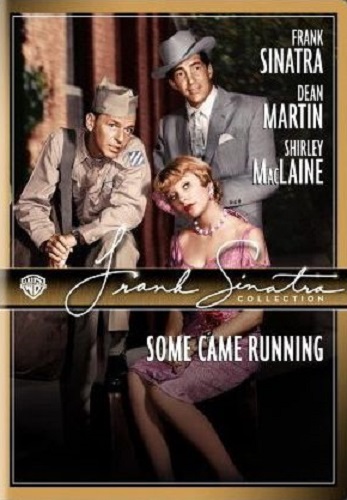
some_came_runningSome Came Running*, Vincente Minnelli (1958, USA). There are quite a few movie adaptations of Great American Novels on the 1001 Movies You Must See Before You Die list, and this is the second by author James Jones (his other is From Here to Eternity). An Army veteran, Sinatra, wakes on a bus on his way to his home town, having been put on it while drunk. He doesn’t really want to go, but he’s there now. The vetervan was a published writer and is estranged from his brother, who put him in an orphanage when their parents died, even though the brother had just married. This brother tries to patch things up, but Sinatra is not interested – although he is friendly to his niece, and falls in love with a friend of his brother, an English teacher. Then there’s Shirley Maclaine, who had been as drunk as Sinatra and joined him on the bus – but sober, he’s not interested in her, although she has fallen in love with him. Meanwhile, the teacher persuades Sinatra to start writing again. And he’s also fallen in with a group of gamblers, headed by Dean Martin. Some Came Running is very much a Great American Novel film – it’s all there: the romantic triangle, the class commentary, academia, the military, writing, small town America… If there were a checklist, Some Came Running could probably manage a good 75%. Sinatra is good in the lead, Maclaine was nominated for an Oscar (but lost to Susan Hayward in I Want to Live!), and Martin plays Martin… I suppose your appreciation of this movie depends on how you feel about Great American Novels. I enjoyed it, but I’m not entirely sure why it’s on the 1001 Movies You Must See Before You Die list.

1001 Movies You Must see Before You Die count: 737


Leave a comment

The year in moving pictures

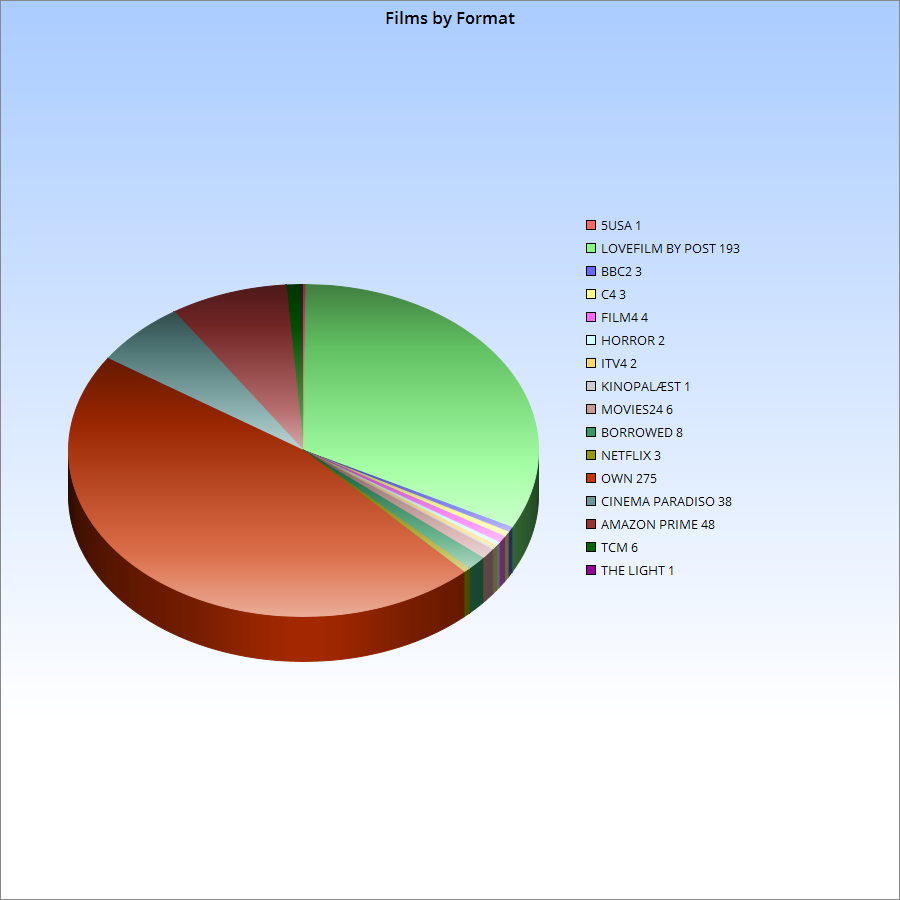
In 2015, I decided to try and watch as many films as I could on the 1001 Movies You Must See Before You Die list, started subscribing to a second DVD rental library, and bought myself an Amazon Fire TV Stick. As a result, I watched 571 films during the year, of which 115 were rewatches (some more than once). In among those were 170 from the aforementioned list.

The bulk of the movies I watched were DVDs or Blu-rays I’d purchased myself. (I bought a multi-region Blu-ray player so I could watch Region A Blu-rays.) But I also watched quite a number from Amazon’s Lovefilm by Post. See below.

2015_films_by_source

Kinopalæst is the cinema in Denmark where I saw Star Wars: The Force Awakens, and The Light is the cinema in Leeds where I saw SPECTRE. Yes, they were the only two films I saw at the cinema. I did quite well on my Amazon Fire TV Stick – 48 movies, all of which were included free with Amazon Prime.

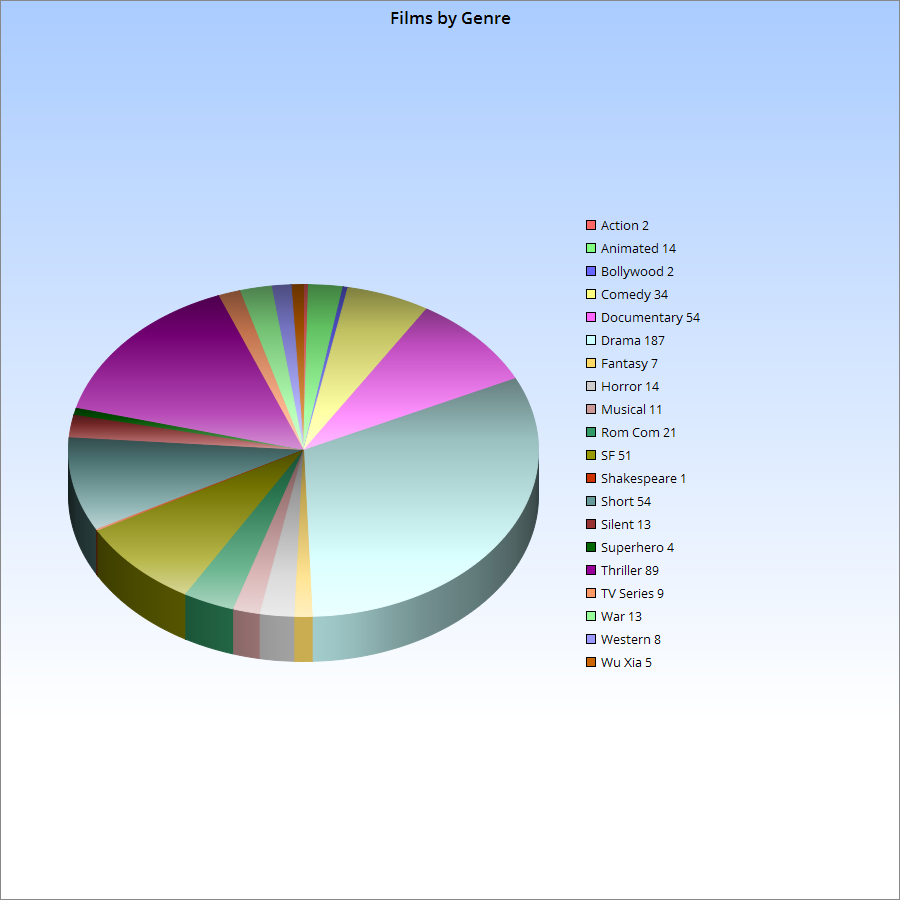
In terms of genre, drama seems to have done especially well, although admittedly it’s a broad term and perhaps some of the films I’ve categorised as drama might better be labelled something else. Anyway, see below.

2015_films_by_genre

The two Bollywood films were from the 1001 Movies You Must See Before You Die list – or rather, one of them was: the other, Deewaar, proved to be a 2004 film of that title and not the 1975 one on the list (although both starred Amitabh Bachchan). Although last year I rented several of the plays from the BBC’s Shakespeare Collection from the late 1970s/early 1980s, the one Shakespeare movie this year was Laurence Olivier’s Henry V, which I thought very good.

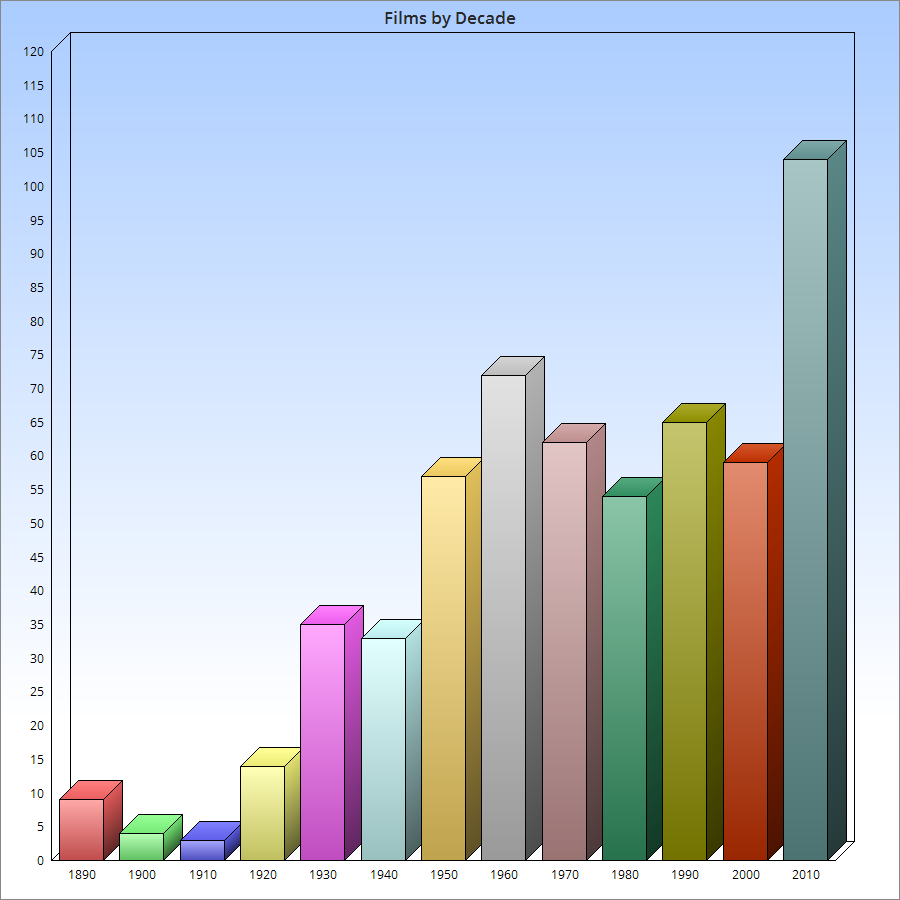
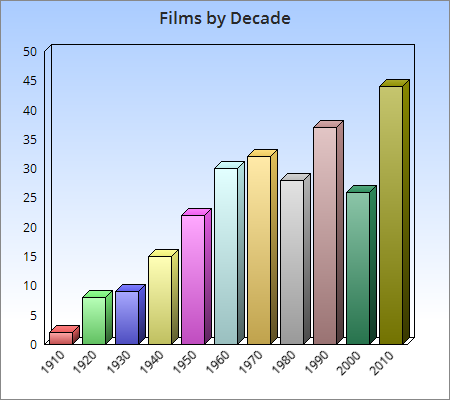
By decade, the films I watched pretty much follows the same graph for books read: the current decade is the most popular (surprisingly), and there’s a steady increase through the decades which peaks at the 1960s. See below.

2015_films_by_decade

The late nineteenth-century/early twentieth-century were a result of watching some early Dreyer silent movies and a DVD collection, Early Cinema – Primitives and Pioneers, because one of the films on it was on the 1001 Movies You Must See Before You Die list.

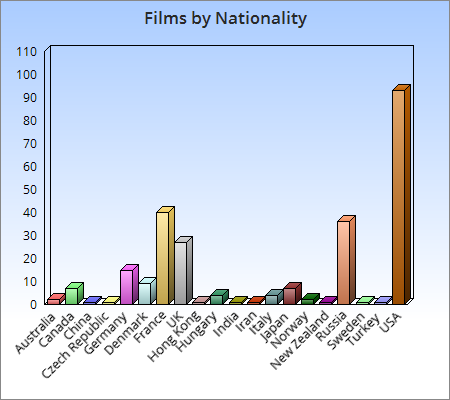
By nation makes for an interesting graph. Although I’ve been working my way through the 1001 Movies You Must See Before You Die list, which includes movies from many different nations (but over half are from the US, sadly), I’ve been a fan of world cinema for years and many of my favourite directors work in non-Anglophone cinema. See below.

films_by_country

The high number from Russia is no doubt due mostly to Aleksandr Sokurov, a favourite director; for Denmark because of Carl Theodor Dreyer, and for Germany it’s probably Rainer Werner Fassbinder. Only two from Sweden – I obviously need to watch more Bergman…

Speaking of favourite directors, Sokurov comes out top for 2015 with 33 (most, it has to be said, were rewatches). Second is Jacques Tati, a 2015 “discovery”, at 15, then James Benning, another 2015 “discovery”, at 13. The remaining top ten goes as follows: Rainer Werner Fassbinder (12), Alfred Hitchcock (11), Carl Theodor Dreyer (10), Lars von Trier (8), Sergei Eisenstein (6), and lastly George Stevens, Michael Curtiz, Leni Riefenstahl, Jean-Luc Goddard and Jean Cocteau (5).

I finished the year having seen 703 movies on the 1001 Movies You Must See Before You Die list, and a quite large pile of DVDs and Blu-rays on my To Be Watched list. I plan to keep on with the list in 2015, although I think I’ll take it a bit slower, perhaps spend some evenings each week reading rather than film-watching. Plus, it’s getting to the stage now where I have to purchase titles in order to watch them as they’re not available for rental. We’ll see how it goes.


2 Comments

2015, the best of the year

On balance, 2015 wasn’t a bad year for me. Things improved in $dayjob, goodish things happened in my little corner of genre, and I read a number of excellent books and watched lots of excellent films. Music-wise, it was both successful and not so successful: I discovered some more new bands on Bandcamp, and this year we went VIP for Bloodstock and it really was worth the extra money; but I saw fewer bands live than in previous years, and none of my favourite ones toured the UK – and if they did, it was only in the big cities, like London, Birmingham or Glasgow. But, like I said, some excellent books and films – so much so, I had trouble picking my top five in each. But I did finally manage it.

Oh, and I got a new cat. Oscar. He’s two years old, and I’d forgotten how much of a pain young cats can be.

books
A strange year of reading, on reflection, and I’m not entirely sure why. I read some books as research for All That Outer Space Allows (which was published this year), I read some other non-fiction books (on space and aircraft and submersibles, mostly), I read some sf novels for SF Mistressworks and some more recent genre works… And I decided to widen my reading to include more classic literature. While I like to think of myself primarily as a science fiction fan, of late I’ve found it hard to generate much enthusiasm for recent sf. In part, that’s due to the way fandom is changing as a result of social media and online promotion, but also because a lot of current sf seems to me more interested in style rather than content. I like sf ideas and sense of wonder, but I also like good writing, sophisticated themes and a willingness to experiment with form and structure. While some works which meet those criteria were indeed published in 2015, those I came across didn’t feel especially progressive. Which is why you’ll notice a few notable titles missing from my top five below (and I have only one, in fact, that was actually published in 2015).

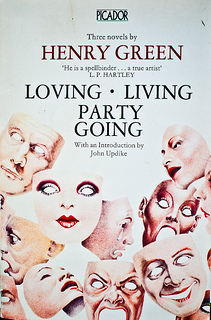
loving1 Loving, Henry Green (1945).
An author new to me in 2015, and despite being about a subject – life belowstairs in the Irish country house of an English nob during WWII – that doesn’t interest me in the slightest, Green’s writing was wonderful and his narrative technique amazing. I will be reading more by him – hell, I plan to read everything he ever wrote.

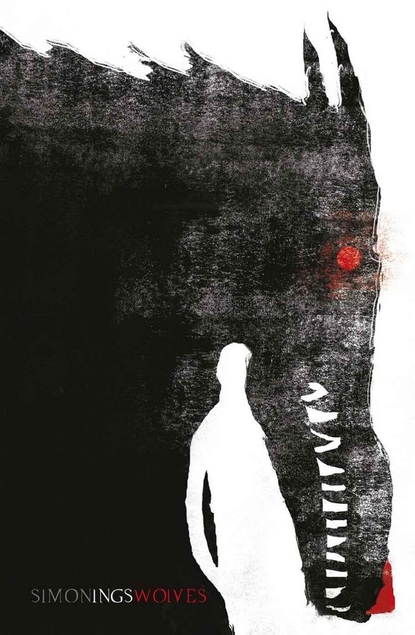
wolves2 Wolves, Simon Ings (2014).
There was some small fuss when this appeared in early 2014, but by the time awards came around it had been forgotten. Which was a shame. And I wished I’d read it in time to nominate it last year – because this is plainly one of the best sf novels of 2014. The focus of his novel tends to drift a little as the story progresses, but Ings has still managed to produce one of the smartest works of sf – if not the smartest work of sf – of the last few years.

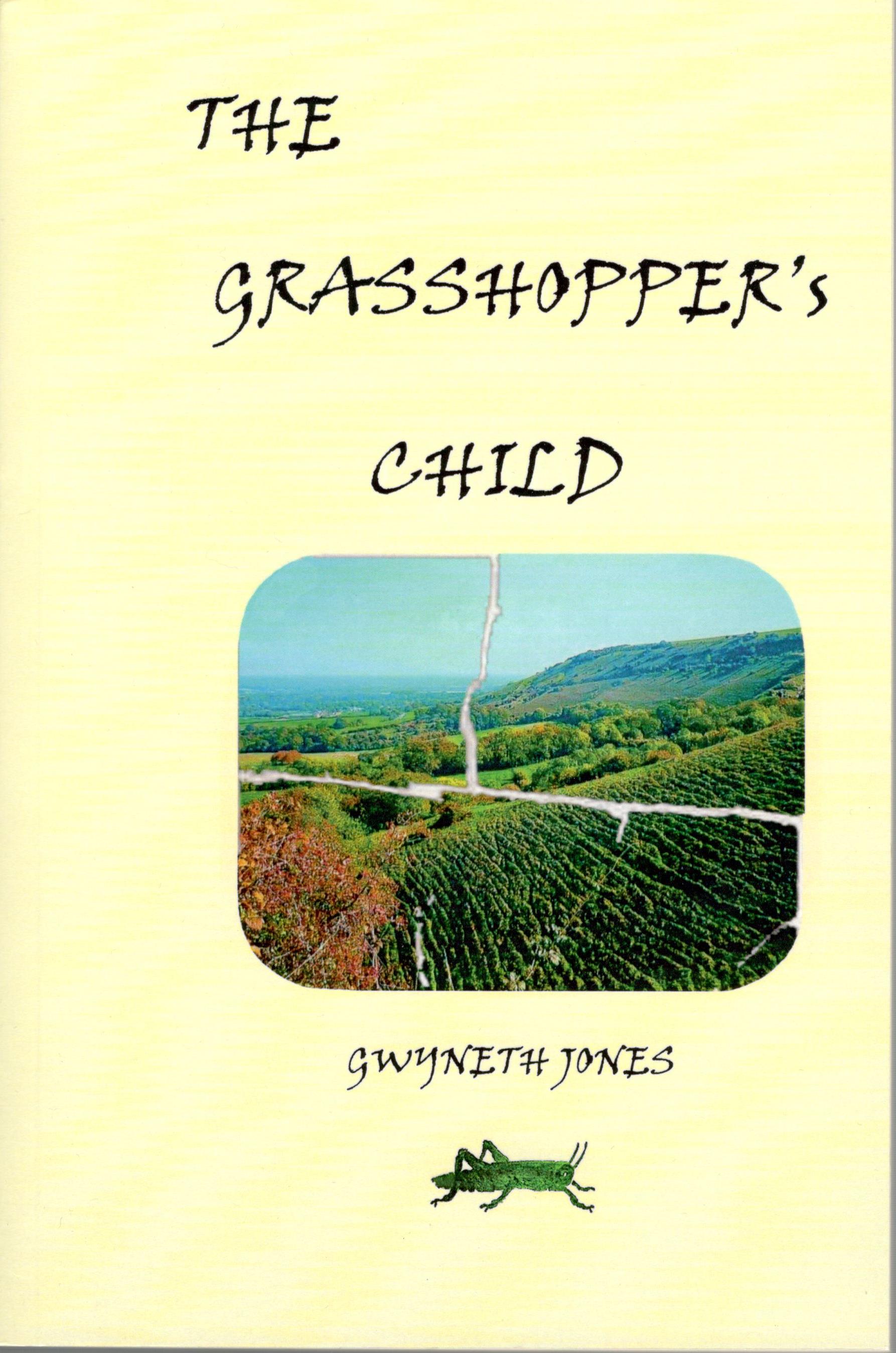
grasshopperschild3 The Grasshopper’s Child, Gwyneth Jones (2014).
A new Gwyneth Jones novel is cause for celebration, even if it’s a YA addendum to the non-YA Bold as Love quintet. But there’s a reason Jones is my favourite science fiction writer, and they’re all evident in this short novel. On the one hand, this is a smart YA novel and I’m no fan of YA fiction; on the other, it’s Gwyneth Jones and her Bold as Love world. But it’s also self-published, so it needs to be on as many best-of lists as possible so that Jones keeps on writing. (And why was it self-published? Do the major UK genre imprints not want to publish new work by the country’s best sf writer?)

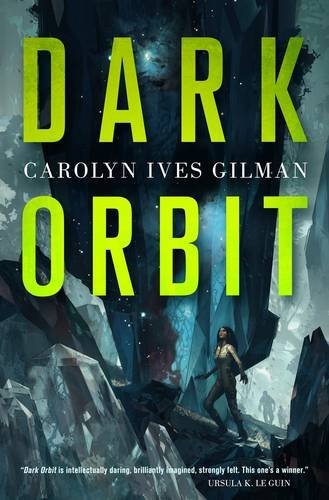
darkoribt4 Dark Orbit, Carolyn Ives Gilman (2015).
I’ve been saying for years that Gilman is a name to watch, and she has at last been given the opportunity to demonstrate it to a wider audience. (She amply demonstrated it with her fantasy diptych from ChiZine Publications back in 2011/2012, but genre commentators can only apparently see what appears from major imprints – which is, if you’ll forgive me, fucking short-sighted). Anyway, Dark Orbit deservedly received a lot of positive reviews, and though to me it didn’t quite feel like Gilman firing on all cylinders, it showed great promise. More from her, please.

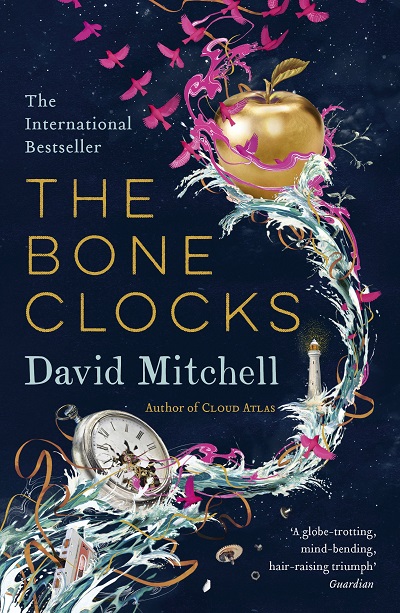
bone_clocks5 The Bone Clocks, David Mitchell (2014).
Friends have been singing the praises of Mitchell for years, but I’ve never really understood why. I mean, I enjoyed Cloud Atlas, and I thought it was clever… but it did seem a little over-praised. But The Bone Clocks is the novel that all the praise had led me to believe Cloud Atlas was. It’s his most insightful yet – and also his most genre.

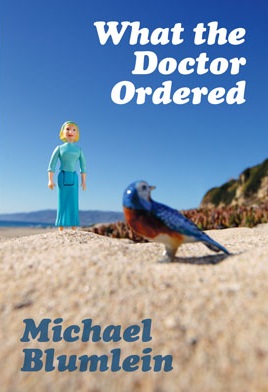
Honourable mentions: a few titles got bumped from best of the half-year top five, although they were excellent books and probably didn’t deserve to be demoted – namely, The Leopard, Giuseppe Tomasi di Lampedusa (1958), a classic of Italian twentieth-century literature (a bloody good film too); A Division Of The Spoils, Paul Scott (1975), the final book of the Raj Quartet and as beautifully written as the other three; and What the Doctor Ordered, Michael Blumlein (2013), wich showcases why he remains one of my favourite genre short story writers. Also read and noteworthy were: Strange Bodies, Marcel Theroux (2013), a literate mystery based on an interestingly odd premise; Pale Fire, Vladimir Nabokov (1962), my first by him and, though perhaps overly prissy, excellent; One Thousand and One Nights, Hanan Al-Shaykh (2011), a bawdy, and multiply-nested retelling of some of its title’s stories; Housekeeping, Marilynne Robinson (1981), her beautifully-written debut novel; and Galactic Suburbia, Lisa Yaszek (2008), used for research and a fascinating read.

films
I went all-out on the 1001 Movies you Must See Before You Die list in 2015. So much so, in fact, that I signed up with a second DVD rental service, Cinema Paradiso, because they had some films from the list that weren’t available on Amazon’s Lovefilm by Post. And I bought an Amazon Fire TV Stick too, which gave me access to even more movies. Meanwhile, I purged my DVD collection of all the superhero films (why did I buy them in the first place?) and the shit sf movies (why did I buy them in the first place?), not to mention lots of other films I’d bought over the years. My collection is now looking very different, much more of cineaste’s collection (even though I say so myself), with lots of works by Sokurov, Dreyer, Murnau and Benning – and from earlier years, Bergman, Tarkovsky, Kieslowski and Haneke, among many others.

The 1001 Movies You Must See Before You Die challenge has been… interesting. It introduced me to the works of James Benning. I’ve also seen a lot of not very good films that really didn’t belong on the list (mostly from Hollywood, it has to be said). And I’ve seen a lot of early cinema, most of which proved quite interesting. Only one of the five films in my top five was not a “discovery” from the 1001 Movies You Must See Before You Die list.

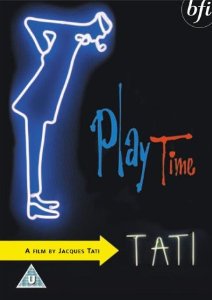
playtime1 Playtime, Jacques Tati (1967)
How could this not be my number one choice? It certainly was halfway back in June, and it remains so now at the end of the year. I loved its Brutalist production design, its situational humour, its wit… it is a work of cinematic genius. I’d watched a rental DVD but I loved it so much I bought a Blu-ray copy for myself… and then bought a boxed set of Blu-rays of Tati’s entire oeuvre. A film that went straight into my personal top ten best films of all time.

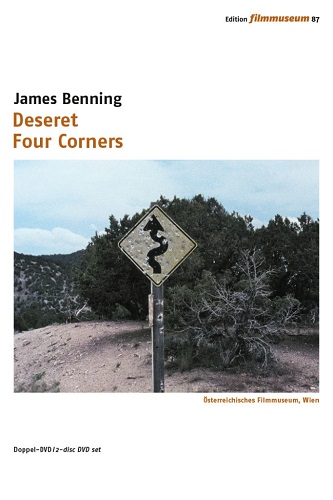
deseret2 Deseret, James Benning (1995)
Ever loved a film so much you went out and bought every DVD you could find by that director? Oh wait, I did that for Tati. But I also did it for Benning. Fortunately, Östereichesichen Filmmuseum have been releasing Benning’s films on DVDs the last couple of years, so there were a few for me to get. And yet… Deseret is static shots of Utah landscape, and later cityscape, while a voice reads out stories from the New York Times from 1895 to the present day. It is cinema as art installation. And I loved it. I am now a huge Benning fan. And I have all of the DVDs that Östereichesichen Filmmuseum have released. And am eagerly awaiting more.

shepitko3 Wings, Larisa Shepitko (1966)
Shepitko’s Ascent is on 1001 Movies You Must See Before You Die list, but the only copy of it I could find was a Criterion double with Wings. I bought it. I watched Ascent. It was good. But then I watched Wings. And it was so much better. A female fighter pilot of the Great Patriotic War, and Hero of the Soviet Union, is now the principal of a school. It’s an artful juxtaposition, more so because the protagonist is female. And it was Shepitko’s debut film. War films, like Ascent, strike me as too easy as choices for assorted lists, but the social drama versus war of Wings is much more interesting. This film should have been on the 1001 Movies You Must See Before You Die list. I’d also like to see more by Shepitko.

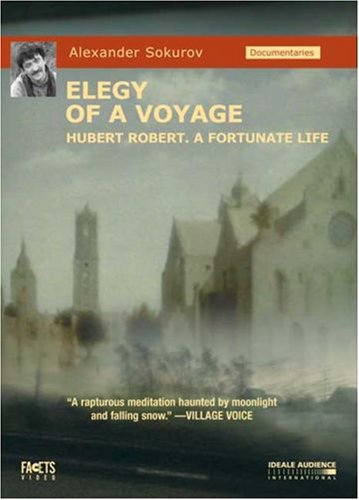
elegy_voyage4 Elegy of a Voyage, Aleksandr Sokurov (2001)
Come on, you didn’t expect me not to have a Sokurov film on this list, did you? I’m being nice by not putting five on it. Well, okay, five maybe could have made it, but one was a rewatch from previous years and so didn’t count. But four could have done. (Yes, the other three are in my honourable mentions below.) Elegy of a Voyage is one of Sokurov’s documentaries, but it’s more of a meditation than an informational film, in which Sokurov muses on journeys and art, particularly ‘The Tower of Babel’ by Bruegel.

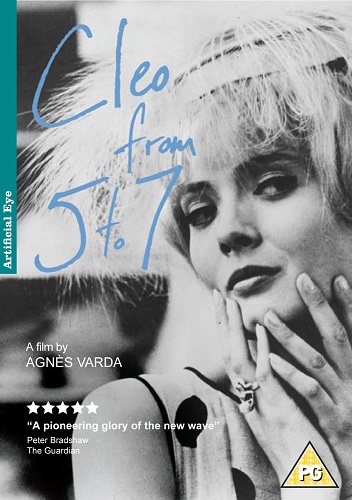
cleo5 Cleo from 5 to 7, Agnès Varda (1962). I have found the Nouvelle Vague to be something of a mixed bag – in fact, I’ve found the oeuvres of Nouvelle Vague directors to be something of a mixed bag. But the only Varda I’d seen prior to Cleo from 5 to 7 was a documentary from 2000. Cleo from 5 to 7 may have covered similar ground to some of Godard’s 1960s films, but it does it so much better. Loved it.

Honourable mentions: two films were dropped from my best of the half year list, one a Sokurov, one a documentary: Jodorowskys Dune (2013) is a fascinating look at a major sf film that never happened, but still left its fingerprints all over sf cinema; Stone (1992) is a typically enigmatic drama from Sokurov… but I could just as easily mention Whispering Pages (1994; which he knocked together after his financing fell apart, but it still manages to hit all those Sokurovian notes), or Spiritual Voices (1995; a documentary about Russian soldiers on the Afghanistan border whose first 40 minutes are a static shot of a Siberian wood). But there’s also Tati’s Mon oncle (1958), nearly as good as Playtime; James Cameron’s Deepsea Challenge (2014), an excellent documentary on his visit to Challenger Deep, only the third person to do so; American Dreams (lost and found) (1984), another Benning piece with an unconventional narrative; Salt of the Earth, Herbert J Biberman (1954), an astonishing piece of social realism drama that deserves to be better known; Sleeping Beauty, Clyde Geronimi (1959), easily the best of the Disney feature films. Day Of Wrath (1943) was another excellent film from Dreyer, Effi Briest (1974) was I thought the best of the Rainer Werner Fassbinder box set I watched, and 2 or 3 Things I Know About Her (1967) was a Jean-Luc Godard that I was surprised to find I liked very much.

albums
I spent much of the year further exploring Bandcamp, and so stumbled across yet more excellent music. I did not, however, see much music live this year – Sólstafir were excellent back in February, Voices and Winterfylleth were very good in September, and highlights of this year’s Bloodstock included Ne Obliviscaris, Sumer, Opeth and Agalloch.

1 Sidereus Nuncius, Apocynthion (2013)
Spanish progressive death metal, not unlike NahemaH (also Spanish, and a favourite band… although they disbanded last year). It seems a little unfair to describe a group’s sound by how much like another band’s it is, but metal these days is such a wide and diverse genre labels are often next to useless. Apocynthion play prgressive metal with clean and growl vocals, some death metal song structures, sound effects and samples, a heavy post-metal influence and a great deal of technical ability.

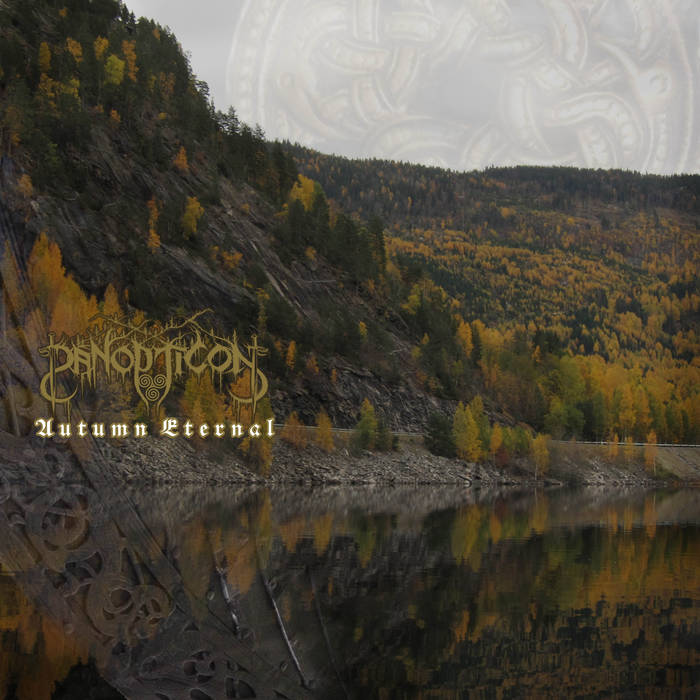
panopticon2 Autumn Eternal, Panopticon (2015)
Panopticon’s Kentucky from 2013, with its mix of black metal and bluegrass, is an astonishing album… but I picked it for my best of last year. Their new album (I say “their” but it’s a one-man show) mixes folky acoustic parts with intense black metal, and it works really well.

3 Ghostwood, Navigator (2013)
This is polished progressive rock with a little bit of djent thrown into the mix, with solid riffs and some catchy hooks. They described themselves as “for fans of Porcupine Tree”, although I think this album is better than most of that band’s albums.

grorr4 Anthill, Grorr (2012)
A relatively recent discovery this one, Grorr play progressive death metal, but more like Gojira than, say, Opeth. There’s all sorts in here – bagpipes, sitar, various types of drums. It’s a wonderfully varied album, but still coherent.

5 An Act of Name Giving, Butterfly Trajectory (2015)
Anothe rrecent discovery. Butterfly Trajectory also play progressive death metal – there seems to be a common theme to this top five… They’re from Poland, and while their sound is quite Opeth-ish, they’re a good deal better than fellow countrymen Gwynbleidd who play similar material. Butterfly Trajectory seem to like their progressive bits a tad more than their death metal bits, which works really well.

Honourable mentions: Worst Case Scenario, Synesthesia (2015), French progessive death metal with plenty of other musical styles thrown in, excellent stuff; Kyrr, Kontinuum (2015), Icelandic post-metal, a little more commercial than fellow countrymen Sólstafir… whose Ótta (2015) and Svartir Sandar (2011) are excellent heavy post-metal albums; Cold and the Silence, Martriden (2015), yet more shredding from excellent medlodic death metal group, who seem to have gone a bit funkily progressive with this new album, and it works really well; and finally, RAMA, RAMA (2015), which is a weird mix of doom, stoner, psychedelic and desert rock all in a three-song EP.


2 Comments

Moving pictures, #23

Still trying to get up to date on these…

femmeUne femme mariée, Jean-Luc Godard (1964, France). I have a theory about Godard. So far I’ve seen about half a dozen of his films. Two of them I loved, the rest I didn’t much care for. The two I loved were both shot in colour – Le Mépris and Two or Three Things I Know About Her – the rest were black and white. So it seems I only like Godard’s colour films. Obviously I need to watch more to determine the truth of this theory, but Une femme mariée is black and white and I didn’t really like it. The married woman of the title is having an affair, and the film opens with her and her lover in bed. Then she leaves him, fetches her young son from school and meets her husband at the airport. He has a colleague with him. They head to the couple’s apartment, where they eat dinner. The colleague leaves, husband and wife then run around a lot and come close to domestic violence (it didn’t much look like a “play-fight”, as Wikipedia has it). And then… This is one of those films where the cast act naturally and it’s all about the dialogue. And like many Godard films, it’s all over the place, and the plot often seems like little more than a vehicle which allows the cast to pontificate on various topics that seem to have little or no bearing on the actual story (which is, I suppose, just as true of Two or Three Things I Know About Her, but in that film everything around the “lecturettes” worked much better and seemed much more interesting). Une femme mariée seems to be generally rated as one of Godard’s best, but I wonder how much of that is trading on its title character.

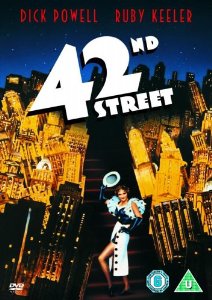
42ndstreet42nd Street*, Lloyd Bacon (1933, USA). I found this in a charity shop. It’s one of several Busby Berkeley films on the 1001 Movies list, many of which aren’t that easy to find in the UK. Busby Berkeley… a camera placed above the stage and looking down as large numbers of dancers make patterns not unlike those you’d find in a kaleidoscope. Then they wrap a plot around it. In this case, it’s a progenitor of Chorus Line and films of that ilk. I tweeted a line from this, “It’s going to be the toughest five weeks you’ll live through”, and asked people to guess the movie, expecting them to pick Platoon or Full Metal Jacket – which one or two did. No one guessed a 1930s film about putting on a Busby Berkley musical. Which is all beside the point. Ginger Rogers in an early role plays one of the female leads, the plot is fairly standard for the type, the final numbers are the usual over-the-top Busby Berkeley extravaganzas, and it’s easy to see why such films were popular back in the day… and you have to wonder why something similar isn’t equally successful today. Or perhaps that’s just me.

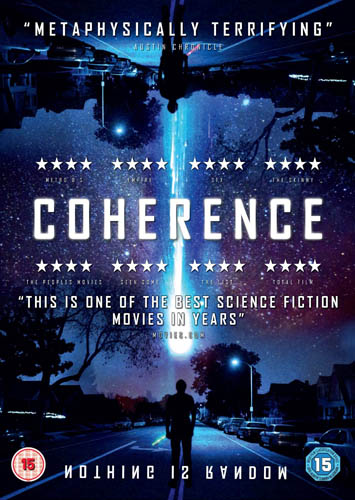
coherenceCoherence, James Ward Byrkit (2013, USA). Some films should hold your interest because they have an intriguing genesis, or a really fascinating idea at their core. And certainly the elevator pitch for Coherence sounded to me like something which would appeal. Unfortunately the end result never quite manages to pull it all together. It’s one of those films where the low or non-existent budget becomes a strength rather than a weakness – it was filmed mostly in the director’s own house. There’s a dinner party, and during it a comet passes over and things turn strange… Strange as in superposition, multiple instances of the same events – which means dinner guests from other alternate universe versions of the dinner party getting mixed up and crossing into alternate universes. So much so that keeping up with who is really who, and from where, becomes near impossible. The cast are generally good, but it’s one of those films where everyone talks over one another, and while real life is certainly like that it does get annoying very quickly in a movie (which is by definition artificial, and it’s the ones which make a virtue of it I tend to prefer), and anyway it sort of worked against what was quite a clever central conceit. The premise demanded a domestic story, but the idea needed to be progressed much faster than it was – the longer you take to develop an idea, the thinner it seems, whether it deserves it or not. Coherence managed to dissipate its drama when it really had more than enough to make a very good film.

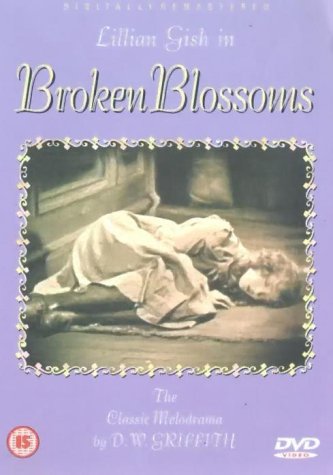
broken_blossomsBroken Blossoms*, DW Griffth (1919, USA). This film is also known as The Yellow Man and the Girl, which probably tells you all you need to know about it. Some of Griffith’s other films have been accused of racism, and while Broken Blossoms‘ lead is played by a white man in Chinese make-up, the film was deliberately written to push tolerance during a period of heavy anti-Chinese prejudice. A Buddhist monk leaves China for London, where he finds it hard to promote Buddha’s peaceful philosophy to London’s huddled masses. Especially Lillian Gish, the abused daughter of a boxer. The monk rescue her after she’s been badly beaten by her father, and the two fall in love. But it is not to be. It’s pretty much Romeo and Juliet, even down to the ending, but set among the slums of London, and with Romeo as a Buddhist monk (which, I suppose, in the England of the time makes him no more welcome a suitor than a Montague to a Capulet). Griffith has a number of films on the 1001 Movies list, and while he was undoubtedly a pioneer of the medium, I can’t see what this particular film did to merit inclusion. Maybe it’s just because it’s an historical document…

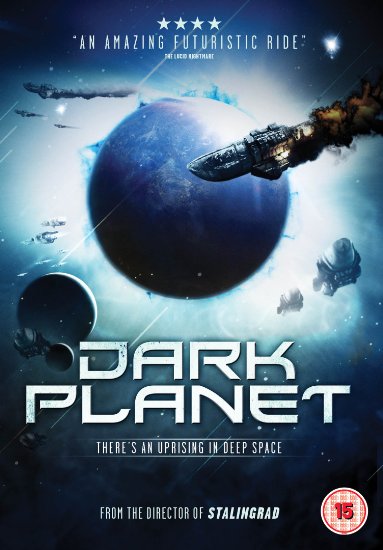
dark_planetDark Planet, Fyodor Bondarchuk (2009, Russia). The real name of this film is Обитаемый остров, or The Inhabited Island – which is the name of the Strugatskys novel from which it was adapted. Why a random English-language distributor decided to randomly re-title it with the entirely random title Dark Planet is beyond me (mind you, we did better than the French, as it was titled Battlestar Rebellion in France). Because it deserves better. Which is not to say it’s perfect. Bondarchuk – yes, son of the actor – has made plenty of well-received films – I thought his 9th Company wasn’t bad, for example – and while Dark Planet certainly entertains throughout its length, it does feel a little like too much of it ended up on the cutting-room floor, and it’s more notable for the story it could have been, and which is plainly obvious, than for the story it is. A young man of Earth, played by the improbably good-looking (and, according to Bondarchuk, totally untalented) Vasiliy Stepanov, crashlands on a world on which the entire population are held in thrall by towers which broadcast brainwashing signals. You can see how it would have made sense in the novel, although it doesn’t really in the film. The plot is a little haphazard, but the final battle scene is done quite well. It’s a film that feels more like a series of missed opportunities than a coherent narrative – I’m reminded of The Crimson Rivers (Les Rivières Pourpres), in which the film-makers decided to leave some important exposition on the cutting-room floor because it slowed the pace of the narrative… resulting in a film that made a weird and inexplicable leap in its third act. Anyway, Dark Planet: worth a second look, though I’d prefer an edition more in keeping with the film-makers’ intentions than the one I watched. (After I wrote the above, I discovered the original Russian release consists of two parts of 100 minutes and 115 minutes. This UK release is an edited down version of 118 minutes. Why?)

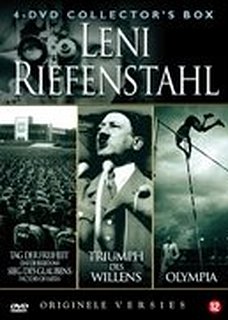
leni_riefenstahlOlympia 1, Fest der Völker*, Leni Riefenstahl (1938, Germany). Riefenstahl, tame director of the Nazis, is a name I certainly know, but I’d never had any real desire to watch her movies. But she’s on the 1001 Movies list, more than once in fact, and her films are not available for rental, so I ended up buying a box set which included the two Olympia films, Triumph of the Will and a pair of other propaganda pieces. So I’m probably now on a list somewhere. Anyway, I watched Triumph of the Will several weeks ago but didn’t think it worth mentioning it here because, well, it’s a film about Nazis and Hitler and while it may have been state of the art in the 1930s, and still holds up reasonably well today, it’s probably only of real interest to historians. Olympia 1, Fest der Völker, however, is a more interesting film because it actually presages the way we watch sports on television, if not lays the actual groundwork for sports broadcasting. It is, as the title states, a film of the 1936 Olympics. So there’s lots of people in quaintly-long shorts competing in various athletic events, with occasional shots away to the wholesome German crowd or Hitler. Of all the events, I found the high jump the most interesting because it predates the Fosbury Flop, meaning the techniques on diplay looked odd and mostly inefficient. There is a second part, Fest der Schönheit, which I have yet to watch.

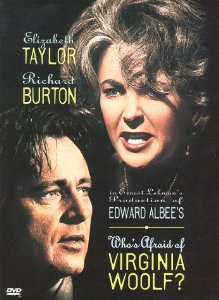
whosafraidWho’s Afraid Of Virginia Woolf?*, Mike Nichols (1966, USA). I’d always thought I’d seen this, and had it in my head it was some fluffy rom com much like those Rock Hudson films I love so much. It’s not, of course. It’s a very intense, and really quite mean, three-hour play by Edward Albee cut down to a two-hour cinema outing by Mke Nichols – his first film, in fact. Elizabeth Taylor and Richard Burton play a married couple at a small town college. She’s the dean’s daughter, he’s a professor of history whose boat has long since sailed. And now they just snipe at each other. A young couple join the faculty (George Segal and Sandy Dennis) and are invited to dinner by Taylor and Burton. They all get very pissed. Certain truths are aired. There is a lot of very uncomfortable dialogue. And… ho hum. There’s some good stuff in here, some really sharp dialogue – but I’m not convinced Taylor and Burton overcome their Hollywood profiles sufficiently to do the characters justice. Segal is pretty good, though. The film is also long – and it’s shorter than the play. It drags quite a bit in places. Having said that, watching Who’s Afraid Of Virginia Woolf? didn’t make me interested in Albee’s work, although this appears to be the only play of his that made it onto the silver screen.

1001 Movies You Must See Before You Die count: 625


Leave a comment

Best of the half year, 2015

It’s that time of the year again, time to look back at the books I’ve read, the films I’ve watched, and the albums I’ve listened to, and decide which five earn a place on the much-coveted best of the half-year lists. To put these lists into perspective, I have – by 20 June – bought twelve albums (all from bandcamp), watched 234 films (which does include a number of rewatches), and read 74 books (which includes half a dozen previously read books). I’ve also been documenting my reading in a series of Reading diary posts (currently at #7, with #8 to be posted shortly), and my film-watching in a series of Moving pictures posts (fifteen so far this year).

So far, 2014 has felt like quite a good year. To date I’ve read 74 books, which is a slight dip from this time last year but up on the year before. And in both years I comfortably managed to read 150 books (which is just as well as I’ve entered 150 books for my GoodReads 2015 Book Challenge). On the film front, I have as usual failed to make it to the cinema even once, so most of my movie-watching has been on DVD – and I’ve started buying Blu-rays more often now too. Most of those DVDs were rentals, which has helped so far knock sixty titles of the 1001 Movies You Must See Before You Die list, not all of which, incidentally, I’m convinced belonged on the list. I’ve also spent the year so far tracking down copies of films on DVD by my favourite directors, especially Aleksandr Sokurov. I now own all but one of his DVDs, but since the only copies of it I’ve found are priced around £200 to £250 I might have to use – kof kof – “alternative” sources. Anyway, I’ve been watching a lot of films – 238 to date. Some of them I’ve watched more than once. Finally, music… which has not been as successful this year as books or films. I’ve spent most of my time listening to groups on bandcamp, and have consequently discovered a number of excellent bands – in fact, all of the ones mentioned in this post were purchased there. I’ve only been to two gigs this year – one was Sólstafir, who were excellent; the second was half a dozen bands at a gig sponsored by Femetalism. None of my favourite bands have released new albums so far this year, although one or two have releases planned later in the year.

Anyway, here are the lists, with the usual honourable mentions as well.

books
whatdoctororderedspread0What the Doctor Ordered, Michael Blumlein (2013). Blumlein has been a favourite writer for many years, but his short fiction has always been more impressive than his novels. And this new collection – only his second since 1990’s The Brains of Rats – amply demonstrates why Blumlein is such a brilliant short story writer. A much undersung writer who deserves to be better known. Incidentally, Centipede Press have done a lovely job with the book.

grasshopperschildThe Grasshopper’s Child, Gwyneth Jones (2014). A new novel from a favourite author. It’s actually a YA novel set in the universe of the not-YA Bold as Love quintet. There is a fierce intelligence to Jones’s books which shines through her prose, and it’s one of the reasons I consider her the UK’s best science fiction writer currently being published – except she isn’t these days, as The Grasshopper’s Child was self-published. Seriously, that shouldn’t be happening.

raj4A Division Of The Spoils, Paul Scott (1975). The final book of the Raj Quartet, and what a piece of work the quartet is. Scott is superb at handling voices, and in Barbie Batchelor has created one of fiction’s great characters – although this book belongs more to Guy Perron, a gentleman NCO keen to return to the UK now the war is over, but who comes into the orbit of the Layton family (who have been a constant presence running through all four books). I’m already looking forward to rereading the quartet.

the_leopardgThe Leopard, Giuseppe Tomasi di Lampedusa (1958). I watched the film of this and that persuaded me to read the book. And I’m glad I did. There are Lawrentian elements to it, although a story which valorises the aristocracy and (mostly) presents the lower classes as venal in order to demonstrate the coming of a new world order… would not be my first choice of reading. But Tomasi di Lampedusa manages to give his fading nobles an air of tragedy as their time passes, even if the Salina family’s paternalism feels like a relic of a much earlier age.

darkoribtDark Orbit, Carolyn Ives Gilman (2015). Another favourite author. This novel is set in the same universe as Gilman’s excellent novellas ‘The Ice Owl’ and ‘Arkfall’, and while some elements of the novel are not entirely successful, it does make use of some heavy concepts and it handles them really well. A science fiction novel that makes you think – and we really could do with more of them these days.

Honourable mentions. A pair of polished collections – The Lady of Situations, Stephen Dedman (1999), and Adam Robots, Adam Roberts (2013), not every story in them worked, but the good ones were very good indeed. Strange Bodies, Marcel Theroux (2013), which surprisingly seems to have been missed by much of sf fandom, which is a shame. A Man Lies Dreaming, Lavie Tidhar (2014), a pulp detective tale with a failed Hitler as the hero shouldn’t work, but this blackly comic take on it definitely does. Touch, Claire North (2015), is perhaps not as successful as last year’s The First Fifteen Lives of Harry August, as its fascinating premise is married to a weak plot; but never mind.

As usual, I’ve been collecting stats on my reading. And it breaks down as follows…

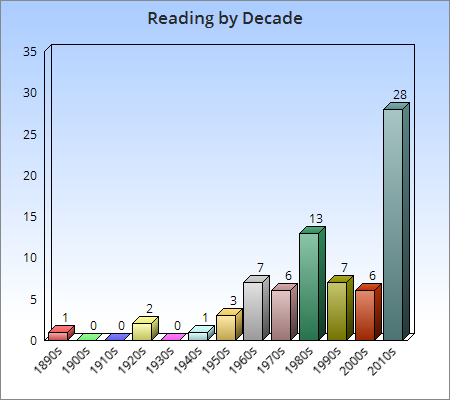
decade2015

I hadn’t realised I’d read so many recent books, and I’ve no idea why the 1980s is the next most popular decade – perhaps it’s due to the books I picked to review for SF Mistressworks. The one nineteenth century book was HG Wells, the two 1920s ones were DH Lawrence.

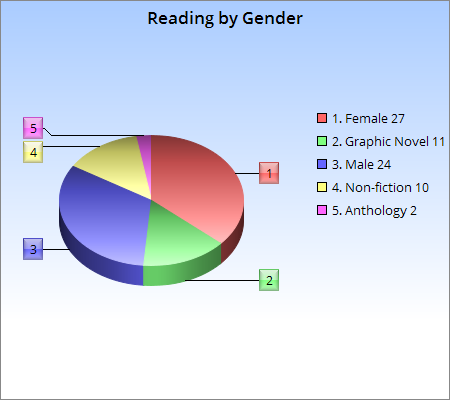
gender2015

I alternate genders when choosing fiction books to read, but I seem to have slipped up somewhere, and women writers currently outnumber men in my reading.

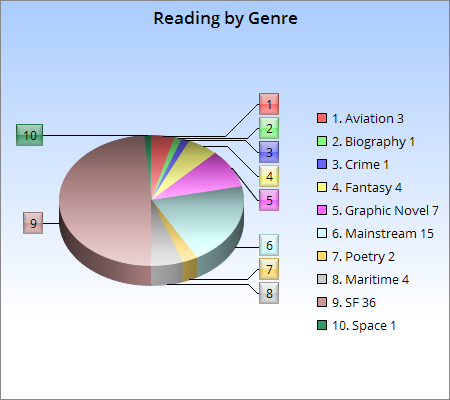
genre2015

It never feels like I read a lot of science fiction, but at almost half of my reading I guess I must be doing so. Mainstream is the next highest genre, but only twenty percent. To be fair, it seems the mainstream books are often more memorable than the genre ones. But at least the numbers explain the good showing by genre in my top five and honourable mentions.

films
playtimePlaytime, Jacques Tati (1967, France). I’d never actually seen a Tati film until I rented Les Vacances de M Hulot last August. I enjoyed it, but something I read somewhere persuaded me to add his Playtime to my rental list. And I watched it for the first time early this year. And loved it so much, I bought a Blu-ray of it. And then I spotted that a Tati Blu-ray collection was on offer on Amazon, so I bought that too. But none of Tati’s other films blew me away as much as Playtime, although Mon Oncle comes a close second (and so makes my honourable mentions below).

elegy_voyageElegy of a Voyage, Aleksandr Sokurov (2001, Russia). I’ve watched this three times since I bought it, as part of my 2015 love affair with Sokurov’s films. As the title suggests, the film is a meditation on travel, and art, with Sokurov in voiceover describing a journey he takes which ends up at a museum in, I think, a German city. Elegy of a Voyage is everything that Sokurov does so well, that makes a film a Sokurov film. Not to mention the somewhat idiosyncratic artistic choices Sokurov makes, such as using a 4:3 aspect ratio, distorting the image so it almost resembles a painting, and the use of colour filters to further distance the viewer from the picture. The beauty of Sokurov’s films is not that they bear repeated viewings, but that they require it.

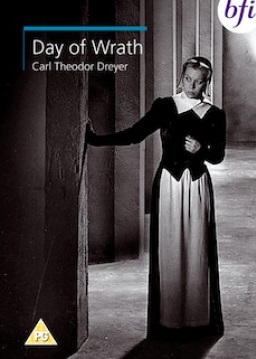
dayofwrathDay Of Wrath, Carl Theodor Dreyer (1943, Denmark). This year I also became a fan of Dreyer’s films – his Gertrud had been a favourite for a couple of years – but in 2015 I bought DVDs of all his available movies. And worked my way through them. The silent films are astonishingly modern – especially The Passion of Joan of Arc – but I do prefer the later films, and after Gertrud, Day Of Wrath is I think his next best – and like Gertrud, it’s about women and women’s roles in society, but this time set in 1623 and describing how a young woman saves her mother from a charge of witchcraft by marrying the local pastor. And then it all goes horribly wrong.

jodosduneJodorowsky’s Dune, Frank Pavich (2013, USA). One of the reasons I bought a Blu-ray player capable of playing multi-region Blu-rays was because I wanted to see this film – to date it has not been released in the UK. Jodorowsky’s Dune is a documentary about the unmade film adaptation of Frank Herbert’s novel, which only exists in concept art by Chris Foss, Moebius and HR Giger… and a complete storyboard “bible” which Jodorowsky’s producers sent to a number of US studios. A fascinating look at what could have been a fascinating film.

sokurov_earlyStone, Aleksandr Sokurov (1992, Russia). A young man looks after the house Chekhov once lived in, and then one night a man who might be Chekhov mysteriously appears… Filmed in black and white, elliptical and, in the second half, featuring Sokurov’s trademark timelapse photography of a snowy landscape. While Elegy of a Voyage is a documentary, this is fiction, but deeply allusive fiction – which is why I woke up the morning after watching this and discovered I’d gone and ordered a pair of Chekhov books from Amazon…

Honourable mentions. Fear Eats The Soul, Effi Briest and The Marriage of Maria Braun, all by Rainer Werner Fassbinder (1974, 1974 and 1979, Germany), and all from a DVD box set I received for Christmas, these were I felt the best three. The Big Red One, Samuel Fuller (1980, USA), I’m not a big fan of WWII films but this is a good one, and even manages to rise above what is obviously a smaller budget than most such films get. Mon Oncle, Jacques Tati (1958, France), more modernist low-key humour, which may not be as cinematically beautiful as Playtime, but comes a close second. James Cameron’s Deepsea Challenge, John Bruno, Ray Quint & Andrew White (2014, USA), another Blu-ray not available in the UK which motivated my purchase of a multi-region Blu-ray player, this documentary covers Cameron’s descent to Challenger Deep in 2012. Two or Three Things I Know About Her, Jean-Luc Godard (1967, France), although not a Godard fan I do love some of his films, such as this one, a study of a bored housewife who works on the side as a prostitute; I’ve already bunged the Criterion DVD on my wishlist. Whispering Pages and Spiritual Voices, Aleksandr Sokurov (1994 and 1995, Russia), a completely opaque drama and a deeply philosophical documentary (about Russian soldiers), yet more evidence of my admiration for Sokurov’s works. Moscow does not Believe in Tears, Vladimir Menshov (1980, USSR), an odd drama about three women in Moscow in the 1950s and the 1970s, which makes a pleasing antidote to US “evil empire” propaganda. Dilwale Dulhania Le Jayenge, Aditya Chopra (1995, India), a superior Bollywood film about UK-based NRIs and arranged marriages, with amusingly broad comedy, well-staged musical numbers and a pair of likeable leads. The Man from London, Béla Tarr (2007, Hungary), my first Tarr and probably the most plot-full of his films, and while I’m still not quite plugged into his brand of slow cinema, it’s definitely the sort of cinema that appeals to me.

As with books, I’ve been collecting stats on the films I’ve watched…

filmnation

I still seem to be watching mostly American films, but that’s likely because so many on 1001 Movies You Must See Before You Die list are American – or, at the very least, the US ones are easier to find (ie, readily available for rental). The good showing for Russia is, of course, Sokurov – several of his films I’ve watched two or three times already this year.

films decade

A reasonable spread across the decades, although I would have expected the fifties and sixties to do better than the seventies, as I much prefer films from those earlier two decades. The first decade of this millennium doesn’t seem to have done very well either, which is odd.

albums
ghostwoodGhostwood, Navigator (2013). A US prog rock band I stumbled across on Bandcamp, and then began listening to repeatedly. In parts they remind me of Australia’s Chaos Divine, and though they describe themselves as “for fans of: Porcupine Tree”, I think I prefer this album to those by Steven Wilson’s band. There are a few bits of electronica in there somewhere, but also plenty of heavy riffing- the title tracks boasts especially good riffage. And very catchy melodies. Good stuff.

sidereusSidereus Nuncius, Apocynthion (2013). A Spanish death metal band with a death metal / post-metal sound not unlike NahemaH’s – who were also from Spain, but have sadly disbanded after only three albums. I hope Apocynthion stay together and produce many more albums. The opening track with its insistent drumbeat is especially good.

secretyouthSecret Youth, Callisto (2015). I bought a Callisto album several years ago, and though I enjoyed their brand of heavy post-metal I never bothered with any of their subsequent albums. But then Zero Tolerance magazine streamed this, their latest, I gave it a listen, discovered it was very different to their earlier album… and liked it so much I bought it. It’s still post-metal, but the growls have been mostly replaced by clean vocals, and in places there’s almost an early Anathema-ish sound to it.

worstcaseWorst Case Scenario, Synesthesia (2015). This was very much a lucky discovery and while at first they reminded me quite heavily of The Old Dead Tree – who, like Synesthesia, are also from France – repeated listens proved they definitely had their own thing going. Like The Old Dead Tree, they drift between death and goth metal, but they also throw quite a bit of prog into it, and it’s a mix that works well, even if in places they sound a bit Muse-ish.

ottaÓtta, Sólstafir (2014). These Icelanders were excellent live, so I bought their last two albums (the only ones available on Bandcamp), and it’s hard to say which is the better of the two. There are a couple of cracking tracks on 2011’s Svartir Sandar, but I decided Ótta was just a little bit the better of the two, if only for the banjo-accompanied title track.

Honourable mentions. Doliu, Clouds (2014), a UK doom band, and the track ‘if these walls could speak’ is absolutely brilliant. Entransient, Entransient (2015), a US prog metal band with a bit of post-rock thrown in for good measure. Good stuff. The Malkuth Grimoire, Alkaloid (2015), a German progressive death metal supergroup, containing (ex-)members of Necrophagist, Obscura, Spawn of Possession, Aborted, Dark Fortress, God Dethroned, Blotted Science and Noneuclid, this is quality stuff, in the same area as Barren Earth but a very Germanic version. Svartir Sandar, Sólstafir (2011), see above. Half Blood, Horseback (2012), as the album’s Bandcamp page puts it, “shifts from Americana twang to fiercely evil buzzing guitars to hypnotically meditative kraut-drone”, which is as good a description as any; file alongside Ultraphallus.


4 Comments

Moving pictures, #16

It seemed like a good idea to document the films I watched throughout the year, especially since I was working my way through a 1001 Movies You Must See Before You Die list. What I hadn’t considered was how many movies I’d watch. And so have to document. Ah well. Here are more. Ones from the list indicated with an asterisk as usual.

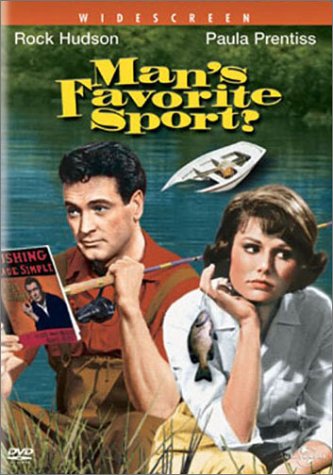
mansfaveMan’s Favorite Sport?, Howard Hawks (1964, USA). I like Rock Hudson films, I like Technicolor films, I like screwball comedies. Throw in Howard Hawks as director, and Man’s Favorite Sport? ought to be a sure-fire winner. Sadly, it isn’t. Chiefly because it was written as a Cary Grant / Katherine Hepburn vehicle, but ended up with Rock Hudson and Paula Prentiss. While both are very good in their roles, Hudson isn’t Grant and has always performed better in Hudson roles. But, by god, the Technicolor certainly makes a picture of this moving, er, picture. The comedy has its moments, the chemistry on screen does create sparks, and Hudson does his best delivering the Grant one liners… but Man’s Favorite Sport? is mostly a lovely-looking film. Hudson plays a fishing expert at Abercrombie & Fitch, who has secretly never fished in his life. And then a fishing resort – represented by Prentiss – persuades his boss to enter him in a competition for publicity purposes. When Hudson comes clean, Prentiss and resort owner’s daughter Maria Perschy have to, er, teach a man to fish. A good piece of early sixties rom com, starring a master of the form and a rising comedic actress. For all its flaws, it’s still bags of fun.

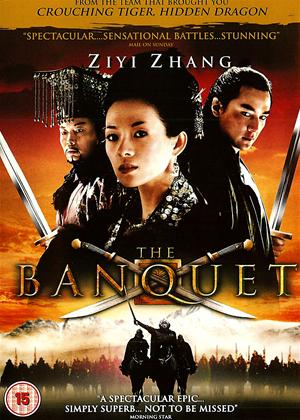
banquetThe Banquet, Xiaogang Feng (2006, China). This was apparently based on Hamlet, although you’d have to be pretty forgiving to acknowledge it. Set in China during the tenth century, a crown prince has exiled himself to a remote theatre after his father married the noblewoman the prince was in love with. But then the emperor is killed by his brother, and assassins are sent to kill the prince. They fail, but he makes his way to the imperial court anyway, where things all get a bit complicated. Like a lot of wu xia movies, The Banquet is a pretty lush production, and the story covers pretty much all the bases – there are epic sword fights, gruesome deaths, love-making with lots of gauzy veils, complicated court politics, sumptuous sets and costumes… and an ending that comes completely out of left-field. One of the better wu xia films I’ve seen recently.

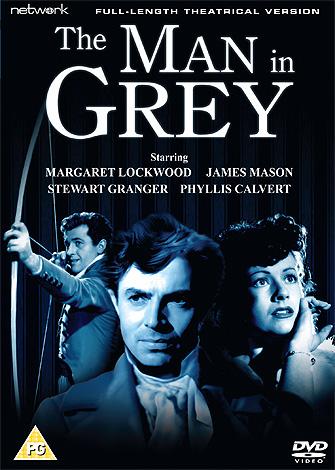
the_man_in_grey_uk_dvdThe Man In Grey*, Leslie Arliss (1943, UK). Stewart Grainger and Phyllis Calvert meet up at an auction room during WWII (he’s a RAF officer, she’s a WREN), and in the process of chatting her up inadvertently bids on a box of trinkets that are all that’s left of the Rohan aristocratic family. He admits to a connection to the Rohans and is far from complimentary; she admits the last male Rohan was her brother. The film then flashes back to the Regency period, and now Phyllis Calvert is an heiress at a posh school in Bath. After leaving school, she’s introduced to the ton, where the eponymous noble, James Mason, asks for her hand in marriage – mostly for appearance’s sake. Later, she bumps into an incorrigible rake, Grainger again, and is smitten by his charms. Grainger is an actor in a company with a woman Calvert was friendly with back in her school at Bath, and she invites the woman, Margaret Lockwood, now down on her luck, into her household. So you have a situation where Mason is having an affair with Lockwood, while Calvert is secretly in love with Grainger. It’s all a bit ploddingly predictable, if you know the form, and Mason’s presence, and the year of release, suggest it’s a “quota quickie” (Mason was a Quaker and refused to fight during WWII), none of which stands against it as some of those quota quickies were actually pretty good. This one is clearly held in such high regard it made the 1001 Movies You Must See Before You Die list, although to be honest I couldn’t see why. A watchable bit of Regency hokum, with an unneccessary contemporary (as of 1943) framing narrative, and a good turn by its leads… But it’s hard to see it as a classic.

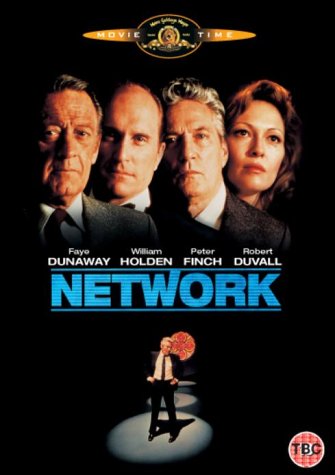
networkNetwork*, Sidney Lumet (1976, USA). I’d assumed I’d seen this at some point in the past – the film is near enough forty years old, and it seems reasonable to assume it was on television several times during the 1980s – but if so, I’d completely forgotten everything about it… as I discovered when I started watching it. The other thing that readily became apparent was that its satire had completely lost its teeth. A corrupt and manipulative media? Driven by profit? That’s not satire, that’s reality. Turning Peter “I’m mad as hell and I’m not going to take it anymore” Finch’s nervous-breakdown news anchor into a prophet of the modern age is a bit, well, that horse has long bolted. And it was probably leaping a fence near the horizon when this film was released. Even casting Faye Dunaway as the ratings-hungry TV executive willing to do anything for the network just plays into your standard sexist arguments about women in the workplace. Some films belong on the 1001 Movies You Must See Before You Die list; some don’t. This is one of the latter. Um, maybe I should put together my own list…

2or3things2 or 3 Things I Know About Her*, Jean-Luc Godard (1967, France). I have mixed feelings about Godard’s films. Most I’ve found a bit dull, but I absolutely adored Le Mépris. And while he’s never been afraid to experiment with the form – something I admire in directors – he was also hugely prolific. So after the disappointing Masculin Féminin (see here), I wasn’t expecting much of 2 or 3 Things I Know About Her. But I actually thought it really good. My second favourite Godard, so far. And I liked it enough to want to watch more of his films. 2 or 3 Things I Know About Her is basically a film study of Marina Vlady, who plays a bourgeois mother who also has sex for money. It follows her as she does housewife things interspersed with meetings with clients. Occasionally, she, and other members of the cast, break the fourth wall. There are also shots of building works in Paris, and some nice concrete architecture. Apparently, this was one of three films Godard made in 1967 – he’d shoot 2 or 3 Things I Know About Her in the morning and Made in USA in the afternoon. Like I said, some films belong on the 1001 Movies You Must See Before You Die list, some don’t. This is one of  the former. I think I’ll get myself a copy of this film, on Blu-ray if I can.

joanofarcThe Passion of Joan of Arc*, Carl Theodor Dreyer (1928, France). Another director I seem to have fastened on to it is Carl Theodor Dreyer, and it’s certainly true Gertrud is a favourite film and I hold Day Of Wrath in high regard… It could be argued that The Passion of Joan of Arc is his most famous film, despite being silent and originally released in 1928. But even though nearly ninety years old it’s an astonishingly… modern film, with its reliance on close-ups and the quite brutal way it depicts Joan of Arc’s burning at the stake. In fact, even the look and feel of the film is weirdly modern. Watching the movie, it’s hard to believe it was made in 1928. Happily, eureka! have done a bang-up job on releasing it on DVD (and Blu-ray). The slipcase not only includes the disc but also a thick booklet on the film. And so it should: The Passion of Joan of Arc is an important film, and should be treated as such. It’s just a shame many other important films are not treated as well.

fatherlandFatherland, Christopher Menaul (1994, USA). Apparently Mike Nichols spent $1 million on the film rights for Robert Harris’s novel but couldn’t interest any studios in the project. So HBO made it as a TV movie instead. And although it netted Miranda Richardson a Golden Globe, it’s actually not very good. Hitler victorious is likely the most popular form of alternate history, but Harris gave his version an interesting spin – setting his story twenty years later, as celebrations for Hitler’s 75th birthday are ramping up throughout Germania, and which will culminate in an historic meeting between the Führer and US President Joe Kennedy Senior. Unfortunately, the death of a party figure starts SS Major March on an investigation which threatens to uncover the Reich’s biggest secret (hint: it’s not a secret in the real world). Rutger Hauer, a Dutchman, plays March, a German; while Miranda Richardson, a Brit, plays Charlie McGuire, an American reporter in Berlin for the festivities who gets dragged into the affair. The film was apparently made in Prague, which doesn’t stand in for Berlin especially well, and the production can’t seem to decide if it should present Germania as a German-speaking nation or, as is often the case in English-language productions, have everyone speak English so subtitles are not needed. So it does a bit of both. The plot is also thuddingly predictable, whether you know the source text or not; and Hauer is a bit too laconic to convince as a SS officer. Disappointing.

1001 Movies You Must See Before You Die count: 599


3 Comments

Moving pictures, #8

The Blu-ray was starting to crackle and fill the screen with static when you ejected a disc, and its remote control was seriously irritating me with its bad design and hard-to-figure-out-what-button-was-what; and the old stereo was just sitting there doing nothing since only the DVD-player had been plugged into it… So I had a bit of a clear-out. I bought myself a new Blu-ray player, one that can play all regions of DVD and Blu-ray, from mrmdvd.com, and chucked everything else away. I also bought myself a soundbar, but it turned out my 18-month-old television didn’t have the necessary new-fangled output for it, so I had to cancel the order. Gah. Backward compatibility FTW. Not. Anyway, the corner of the living-room now looks a lot tidier, the new player works very well indeed, and, of course, I’ve watched my Criterion Blu-ray of All That Heaven Allows*…

europa_europaEuropa Europa*, Agnieszka Holland (1990, Germany). A Jewish boy is captured by Soviets while escaping Germany, grows up in a Soviet orphanage, but is then captured by Nazis – and pretends to be an Aryan German. It’s based on a true story, and protagonist Jupp (AKA Solomon Perel, AKA Josef Peters) first acts as translator to front-line Wehrmacht troops, but is then sent to a Hitler Youth school. Where he falls for an Aryan mädchen, a dubbed Julie Delpy… except she wants a child for Hitler but Jupp can’t let her see his todger because he’s circumcised and that’ll reveal him as a Jew. This is all based on a true story – in fact, the real Jupp appears as himself in an epilogue set in Israel in the year of filming. But I never quite felt the film got across the fear Jupp must have been feeling as he masqueraded as a Hitler Youth. The hate, not to mention the rejection, of his position was there, and some of the lengths Jupp went to in order to disguise his race, not to mention his reasons for doing so, were certainly horrific. This is an excellent film, and if it fails occasionally in the implementation, it’s still a story that demands to be told. Definitely worth seeing.

shock_aweAntichrist, Lars von Trier (2009, Denmark). I’m really not sure what to make of von Trier’s films. There was much to admire in Antichrist, for example – including a scene supposedly imagined during therapy that was pure Sokurov – but it’s always like 4 and 5 makes 10. Admittedly, the final credits revealed Antichrist was dedicated to Tarkovsky, which made some of it understandable (including that Sokurov-ish scene), but some of von Trier’s signature touches seemed to work much better than others. A couple lose their child, and the husband – Willem Dafoe – persuades the wife – Charlotte Gainsbourg – that they must go to an isolated cabin in the woods. Then it all goes a bit strange. In von Trier’s favour is that his films bear, if not demand, re-watchings. There are elements in this one, for example, which don’t initially seem to make sense. But there’re also those which plummet toward the schlocky, which other von Trier films have suffered from. After so much metaphorical and allegorical payload, the film turns into art house horror, and it does tend to undo what’s go before. It’s not that von Trier does not have the courage of his convictions – if there’s one thing this film does not lack throughout its length, it’s conviction – but it often feels like he does’t have enough confidence in his allusiveness, or feels a need to shock the viewer as if whatever judgement a film may receive will depend entirely on that shock value. When you look at earlier films, such as Europa, the shocking end felt of a piece with the story, and if it seemed melodramatic it was at least in keeping with the movie’s aesthetic. But in Antichrist, the horror doesn’t quite blend… and I can’t decide if that’s a deliberate provocation or an unintended artefact. I suppose the fact I can’t tell at least demonstrates von Trier’s importance as a director…

Lisa-And-The-Devil-blu-rayLisa and the Devil, Mario Bava (1973, Italy). I have enjoyed the odd Mario Bava in the past, and I do like the fact they’re very much movies of their time and not particularly gory… so I bunged a few on the rental list, and one of them dropped through the letter box. Also, of course, Elke Sommer. While Lisa and the Devil had its moments, and a story that actually wasn’t too bad, this was pretty cheap entertainment and not a film that’s worth watching more than the once. A tourist lost in Toledo stumbles across an antiques shop in which a creepy-looking Telly Savalas is buying an item. Later, having failed to find her friends, she accepts a lift from a couple in a limousine. The car breaks down outside a creepy-looking mansion… and the butler there proves to be Telly Savalas. It’s all something to do with an aristocratic family, a dark secret, and a demon or something. Apparently, the film was recut to resemble The Exorcist in the US and bombed because… everyone thought it was a rip-off of The Exorcist. Duh. More for fans of Bava or bad 1970s horror, I suspect.

daysofheavenDays Of Heaven*, Terrence Malick (1978, USA). I really wanted to like this, Malick is a very visual director and this is one of those not-very-commercial-successful Hollywood film where the auteur seems to win out over the usual crass Hollywood product. There’s also a (mostly) good cast too. But it really didn’t work. It felt like substandard DH Lawrence transposed to 1920s Texas, and the lovely cinematography was not enough to save it. Richard Gere and Brooke Adams move to Texas from Chicago in 1916, and find work with a local farmer. He falls for Adams, so Gere persuades her to marry him so the two of them can live the good life at the farmer’s expense. It ends badly. Duh. This is a film rightly praised for its cinematography, but the story was slow and uninvolving, and even in 1978 Gere might make a good lead in a rom com but he didn’t have the chops for something as serious as this (unlike Same Shepard, who played the farmer). Disappointing.

masculinMasculin Féminin*, Jean-Luc Godard (1966, France). I have mixed feelings about Alphaville and I absolutely adore Le Mépris, but I can’t really say I’ve seen anything else by Godard that I’ve liked. Including this one. The problem with a lot of Nouvelle Vague cinema is that its characters are self-absorbed to a point that makes them unsympathetic and dull to watch. (The same is also true of a some of Rohmer’s earlier films.) As for plot, well, that’s just bourgeois. (I jest, as I actually agree that plot is over-rated.) Anyway, Masculin Féminin is a series of discussions, monologues, diatribes and pontificating by a young man who enters into a relationship with a young woman, and her two flat-mates, who does not share his tastes or politics. I vaguely recall there being lots of polo-neck jumpers and arguments in corridors. It was all a bit yawn.

bela_tarr_collectionThe Man from London, Béla Tarr (2007, Hungary). After watching on rental thirty minutes of Barr’s Sátántangó in which nothing happened, I decided I ought to buy one of his films in order to give him a fair go – and from what I’d read, his style of film-making was likely to appeal. So I bought The Béla Tarr Collection box set, which contains three of his films, and this was the first of them I watched, coincidentally with a friend who was also new to Tarr’s movies. It made for an interesting experience. The story of The Man from London is apparently taken from a Simenon story, and it was a while before we nailed down the setting. But the movie also proved a welcome antidote to most Hollywood films, in that the pacing was leisurely, if not glacial, the cinematography was lovely, it was black and white, and the only way to watch was to patiently let it slowly unfold. It was a little off-putting to have one of the actors dubbed by a Fox brother – they have way too distinctive voices – but given the stately progress of the story it actually seemed to fit really well. I’m told some of Tarr’s films are real exercises in endurance, but this was an excellent introduction to his oeuvre. And I still have two more films to watch in the box set…

planete_sauavageLa Planète Sauvage*, René Laloux (1973, France). A highly-regarded science fiction animated film that happens to be on the 1001 Movies You Must See Before You Die list… so why not buy a copy? On Blu-ray? So I did. And, well… I was expecting weird, the cover of the Blu-ray alone is enough to prime a viewer for weird. And, it has to be said, I do like me some weird in my cinema. But while it struck me that the story of La Planète Sauvage was fairly routine, and something you might find in a bande dessinée or Polish sf story… the animated design by Roland Topor definitely qualified as strange. On an alien world, giant blue aliens – like the one on the Blu-ray cover – keep humans as pets, though there are many “feral” humans about. A baby human is adopted as one such pet by a young alien girl, but somehow manages to follow the electronic teaching she receives and so becomes educated. He later escapes and meets up with a group of feral humans, and persuades them to fight against the aliens… As allegories go, this is pretty in-your-face, and the idea of using sf to hide what you really want to say and make it palatable was past its sell-by date in 1973. But La Planète Sauvage still presents a unique vision, and is worth seeing for that (even if some of the short films included on the Blu-ray are a bit too much Métal Hurlant, and so less interesting).  Nonetheless, worth watching.

baron_bloodBaron Blood, Mario Bava (1972, Germany/Italy). Another 1970s Bava horror film that, er, stars Elke Sommer. A young American man with a toothsome smile visits relatives in Austria, where he learns about a castle which used to belong to an ancestor, called, er, Baron Blood. Sommer plays an archaeologist investigating the castle’s history while it is being refurbished. She and young American man, while acting about, read out a curse inflicted on Baron Blood, and then read out the words meant to lift the curse. So the baron comes back from wherever he was… and after killing a few people ends up as Joseph Cotton in a wheelchair. This is pretty much standard 1970s Euro horror fare, and if it isn’t, it certainly fits my idea of what it might be. It was kind of fun, but even for Bava it was pretty weak.

shock_aweMelancholia, Lars von Trier (2011, Denmark). You know where science fiction literalises metaphors? Now imagine that depression was a giant planet on a collision course with Earth… Von Trier has said that the story of Melancholia was inspired by his discovery that people with depression remain calmer during crises than people not suffering depression. Which revelation actually leads to three readings of the film. As your actual science fiction, it’s nonsense – the near approach of the rogue planet Melancholia, and its effects on the Earth, are not in the slightest bit scientifically accurate. As genre, it’s hard to imagine a literalised metaphor more in your face than a giant planet about crash into the Earth. However, seen as a study of Kirsten Dunst’s character, in the face of the collision with Melancholia… The first time I watched the film, I took the first reading, despite the fact the story is mostly about Dunst’s wedding, subsequent breakdown and recovery with her sister’s family (also the hosts of the wedding and reception). And the planet Melancholia crashes through the story like a giant implausible thing of implausibility. It all looks absolutely gorgeous, of course, but your suspension of disbelief is in sore need of a hook to hang it on. However, a combinations of readings two and three a) renders it a much more interesting film, and b) allows you to appreciate the lovely cinematography for what it is. I thought Melancholia much better on this rewatch than I had the first time I saw it. I still need to work out what von Trier is doing with his films, but he’s certainly one of the more interesting directors currently making movies.

1001 Movies To See Before You Die count: 577

* For the record, the colours are gorgeous, but the picture is so precise it appears slightly grainy, and the shadows and dark areas tend to block out a little. And I really need to get a soundbar or something. Oh, and the film itself is still brilliant.


2 Comments

2013, the best of the year

We’re a couple of weeks away from Christmas and the end of the year, so it’s time to look back with a critical eye over the past twelve-ish months and the words, pictures and sounds I consumed during that period. Because not everything is equal, some have to be best – and they are the following:

BOOKS
UnderTheVolcano1 Under the Volcano, Malcolm Lowry (1947) A classic of British literature and rightly so. I fell in love with Lowry’s prose after reading ‘Into the Panama’ in his collection Hear Us O Lord from Heaven thy Dwelling Place, although I already had a copy of the novel at the time (I’d picked out the collection, Under the Volcano and Ultramarine from my father’s collection of Penguin paperbacks back in 2010). Anyway, Under the Volcano contains prose to be treasured, though I recommend reading Ultramarine and Lowry’s short fiction first as it is semi-autobiographical and you can pick out the bits he’s used and re-used. This book was also in my Best of the half-year.

wintersbone2 Winter’s Bone, Daniel Woodrell (2006) I’d bought this because I thought the film was so good and because Woodrell had been recommended to me. But instead of the well-crafted crime novel I was expecting to read, I found a beautifully-written – and surprisingly short – literary novel set in the Ozarks that was perhaps even better than the movie adaptation. I plan to read more by Woodrell. Winter’s Bone was also in my Best of the half-year.

empty3 Empty Space: A Haunting, M John Harrison (2012) The third book in the Kefahuchi Tract trilogy, and I’m pretty damn sure I’ll have to reread all three again some time soon. Although the fulcrum of the story is Anna Waterman and the strange physics which seems to coalesce about her, Empty Space: A Haunting also does something quite strange and wonderful with its deployment of fairly common sf tropes, and I think that’s the real strength of the book – if not of the whole trilogy. And this is another one that was in my Best of the half-year.

sons4 Sons and Lovers, DH Lawrence (1913) When I looked back over what I’d read during 2013, I was surprised to find I held this book in higher regard than I had previously. And higher than most of the other books I’d read during the year too, of course. At the half-year mark, I’d only given it an honourable mention, but it seems to have lingered and grown in my mind since then. It is perhaps somewhat loosely-structured for modern tastes, but there can be little doubt Lawrence fully deserves his high stature in British literature.

promised_moon5 Promised the Moon, Stephanie Nolan (2003) I did a lot of research for Then Will The Great Ocean Wash Deep Above, and this was the best of the books on the Mercury 13. But even in its own right, it was a fascinating read and, while sympathetic to its topic, it neither tried to exaggerate the Mercury 13’s importance nor make them out to be more astonishing than they already were. If you read one book about the Mercury 13, make it this one.

Honourable mentions: Ancillary Justice, Ann Leckie (2013), an exciting debut that made me remember why I read science fiction; Invisible Cities, Italo Calvino (1972), beautifully-written tall tales presented as Marco Polo’s report to a khan; The Wall Around Eden, Joan Slonczewski (1989), a masterclass in writing accessible sf, this book needs to be back in print; The Day Of The Scorpion, Paul Scott (1968), the second book of the Raj Quartet and another demonstration of his masterful control of voice; The Sweetheart Season, Karen Joy Fowler (1996), funny and charming in equal measure; The Lowest Heaven, edited by Anne C Perry & Jared Shurin (2013), some excellent stories but also a beautifully-produced volume; Sealab, Ben Hellwarth (2012), a fascinating history of the US’s programme to develop an underwater habitat; Cities of Salt, Abdelrahman Munif (1987), a thinly-disguised novelisation of the US oil companies’ entry into Saudi, must get the rest of the trilogy; and Wolfsangel, MD Lachlan (2010), Vikings and werewolves are definitely not my thing but this rang some really interesting changes on what I’d expected to be a routine fantasy, must get the next book in the series…

Oops. Bit of a genre failure there – only one sf novel makes it into my top five, and that was published last year not this; although four genre books do get honourable mentions – two from 2013, one from 2010 and one from 1989. I really must read more recent science fiction. Perhaps I can make that a reading challenge for 2014, to read each new sf novel as I purchase it. And I really must make an effort to read more short fiction in 2014 too.

FILMS
about-elly-dvd1 About Elly, Asghar Farhadi (2009) A group of young professionals from Tehran go to spend the weekend at a villa on the Caspian Sea. One of the wives persuades her daughter’s teacher, Elly, to accompany them (because she wants to match-make between the teacher and her brother, visiting from his home in Germany). Halfway through the weekend, Elly vanishes… and what had started out as a drama about family relationships turns into something very different and unexpected. This film made my Best of the half-year.

consequences2 The Consequences Of Love, Paolo Sorrentino (2004) The phrase “stylish thriller” could have been coined to describe this film, even if at times – as one critic remarked – it does resemble a car commercial. A man lives alone in a hotel in a small town in Switzerland. Once a week, a suitcase containing several million dollars is dropped off in his hotel room. He drives to a local bank, watches as the money is counted by hand and then deposited in his account. One day, the young woman who works in the hotel bar demands to know why he always ignores her… and everything changes.

lemepris3 Le Mépris, Jean-Luc Godard (1963) I don’t really like Godard’s films, so the fact I liked this one so much took me completely by surprise. Perhaps it’s because it feels a little Fellini’s if it had been made by Michelangelo Antonioni. I like , I like Antonioni’s films. Perhaps the characters are all drawn a little too broadly – the swaggering American producer, the urbane European director (played by Fritz Lang), the struggling novelist turned screenwriter, and, er, Brigitte Bardot. Another film that made my Best of the half-year.

onlyyesterday_548494 Only Yesterday, Isao Takahata (1991) An animated film from Studio Ghibli which dispenses entirely with whimsy and/or genre trappings. A young woman goes to stay with relatives in the country and reflects on what she wants out of life. The flashback sequences showing her as a young girl are drawn with a more cartoon-like style which contrasts perfectly with the impressively painterly sequences set in the countryside. Without a doubt the best Ghibli I’ve seen to date… and I’ve seen over half of them so far. Once again, a film that made my Best of the half-year.

gravity5 Gravity, Alfonso Cuarón (2013) I had to think twice whether or not to put this in my top five. It was the only film I saw at the cinema this year, and I suspect seeing it in IMAX 3D may have coloured my judgement. To be fair, it is visually spectacular. And I loved seeing all that hardware done realistically and accurately on the screen. But. The story is weak, the characters are dismayingly incompetent and super-competent by turns, some of the science has been fudged when it didn’t need to be, and it often feels a little like a missed opportunity more than anything else. Perhaps I’ll feel differently after I’ve seen it on Blu-Ray…

Honourable mentions: She Should Have Gone to the Moon, Ulrike Kubatta (2008), an elegantly-shot documentary on the Mercury 13; Gertrud, Carl Theodor Dreyer (1964), grim and Danish but subtle and powerful; Man With A Movie Camera, Dziga Vertov (1929), astonishing meta-cinema from the beginnings of the medium; Sound of My Voice, Zal Batmanglij (2011), Brit Marling is definitely becoming someone to watch; Love in the Afternoon, Éric Rohmer (1972), the best of Rohmer’s Six Moral Tales; The Confrontation, Miklós Jancsó (1969), more socialist declamatory and posturing as a group of students stage their own revolution; Tears For Sale, Uroš Sotjanović (2008), CGI-heavy Serbian folk-tale, feels a little like Jeunet… but funny and without the annoying whimsy; Ikarie XB-1, Jindřich Polák (1963), a Czech sf film from the 1960s, what’s not to love?; Dear Diary, Nanni Moretti (1993), an entertaining and clever paean to Rome and the Italian islands, and a rueful look at the Italian health service; and The Sun, Aleksandr Sokurov (2005), a poignant and beautifully-played character-study of the Emperor Hirohito in 1945.

This year for a change I’m also naming and shaming the worst films I watched in 2013. They were: The Atomic Submarine, Spencer Gordon Bennet (1959), a typical B-movie of the period with the eponymous underwater vessel finding an alien saucer deep beneath the waves; Cyborg 2: Glass Shadow, Michael Schroeder (1993), an unofficial sequel to the Van Damme vehicle and notable only for being Angelina Jolie’s first starring role; The Girl from Rio, Jésus Franco (1969), Shirley Eaton as Sumuru, leader of the women-only nation of Femina, plans to take over the world, it starts out as a cheap thriller but turns into cheaper titillatory sf; The 25th Reich, Stephen Amis (2012), WWII GIs in Australia find a UFO, go back in time millions of years to when it crashed, then a Nazi spy steals it and ushers in an interplanetary Nazi regime, bad acting and even worse CGI; Battlestar Galactica: Blood and Chrome, Jonas Pate (2012), they took everything that had been good about Battlestar Galactica and removed it, leaving only brainless military characters and CGI battle scenes.

ALBUMS
construct1 Construct, Dark Tranquillity (2013) Every time Dark Tranquillity release a new album, it makes my best of the year. I guess I must be a fan then. In truth, they are probably my favourite band and their last half-dozen albums have each been consistently better than the one before. So many bands seem to plateau at some point during their career but DT amazingly just get better and better. This album was on my Best of the half-year.

spiritual2 Spiritual Migration, Persefone (2013) Another band who improves with each subsequent album. And they’re good live too – although I’ve only seen them the once (they really should tour the UK again; soon). This is strong progressive death metal, with some excellent guitar playing and a very nice line in piano accompaniment. I didn’t buy this album until the second half of the year, which is why it didn’t appear in the half-year list.

DeathWalks3 Death Walks With Me, Noumena (2013) A new album by a favourite band after far too long a wait, so this was pretty sure to make my top five. Noumena play melodic death/doom metal, an inimitably Finnish genre, but they also use clean vocals, and a female vocalist, quite a bit. One song even features a trumpet solo. I posted the promo video to one track, ‘Sleep’, on my blog here. And the album also made my Best of the Half-Year.

Winterfylleth-The-Threnody-Of-Triumph4 The Threnody Of Triumph, Winterfylleth (2012) I first saw Winterfylleth live before they were signed back in 2008 at the Purple Turtle in Camden at the Day of Unrest (see here), and I’ve seen them a couple of times since. This, their latest album, shows how far they’ve come and amply demonstrates why they’re so good. They call it English heritage black metal, which I think just means they sing about English historical sort of things (the band’s name is Anglo-Saxon for “October”). Another album from my Best of the half-year.

Of-breath-and-bone5 Of Breath And Bone, Be’lakor (2012) On first listen I thought, oh I like this, it deserves to be played loud. And it really does – it’s not just that Be’lakor, an Australian melodic death metal band, have excellent riffs, but also that there’s a lot more going on in their music than just those riffs. The more I listen to Of Breath And Bone, the more I like it – originally I only gave it an honourable mention in my Best of the half-year, but having played the album so much throughout 2013, I think it deserves a promotion.

Honourable mentions: Dustwalker, Fen (2013), shoegazery black metal that works extremely well; Where the End Begins, Mentally Blind (2013), excellent sophomore EP from a Polish death metal band, with an astonishingly good opening track (see here); Unborn and Hollow, Forlorn Chambers (2013), a demo from a Finnish death/doom band, and very very heavy, sort of a bit like a doomy version of Demilich, in fact, but without the vocal fry register singing; Shrine of the New Generation Slaves, Riverside (2013), more polished, er, Polish progginess, a little rockier than the previous album, although one track does include some very melodic “sexamaphone” [sic]; All Is One, Orphaned Land, proggier than previous albums but still with that very distinctive sound of their own, incorporating both Arabic and Hebrew; and Nespithe, Demilich (1993), a classic piece of Finnish death metal history, I picked up a copy of the re-mastered edition at Bloodstock – there’s a special Demilich compilation album, 20th Adversary of Emptiness, due to be released early next year, I’ve already pre-ordered it.

One of the things I really like about metal is that it’s an international genre, and here is the proof – the bands named above hail from Sweden, Andorra, Finland, the UK, Australia, Israel and Poland. There’s also quite a good mix of metal genres, from death to black metal, with a bit of prog thrown in for good measure.