It Doesn't Have To Be Right…

… it just has to sound plausible


Leave a comment

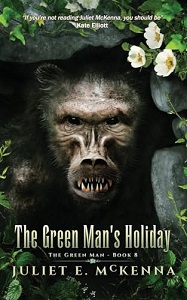
The Green Man’s Holiday, Juliet E McKenna

This is the eighth book in the series, which is pretty impressive given, I believe, the first one wasn’t actually intended to be published, and certainly wasn’t planned as the first book of a series. But the premise lends itself to multiple stories, and the novels so far have been very good… so why not?


Daniel Mackmain is the son of a human man and a dryad. As a result, he can speak to, and interact with, creatures from English folklore. He is also occasionally given tasks by the Green Man. Over the course of the preceding seven books, Mackmain has given up his work as a jobbing carpenter, and settled down as estate manager at a stately home, and has a girlfriend who is a hydrology consultant and a Swan Maiden. Mackmain has also built up a network of people like himself, half-human half-folkoric creature, across the UK.

In The Green Man’s Holiday (2025, UK), Mackmain and his girlfriend, Fin, have taken a week off and rented a small cottage in the Mendips. First, the phones stop working, then their car, and then someone dumps a newborn on their backdoor step. They contact the police and the baby is returned to its distraught parents.

But it’s not a real baby, it’s a changeling. And Mackmain realises this. So he and Fin need to find the real baby, and then swap it for the changeling. They find the baby easily enough – through a portal at some nearby standing stones. But Fin becomes trapped on the other side of the portal while rescuing the baby, leaving Mackmain to resolve everything on his own. Without rousing the suspicions of the police.

But not, unfortunately, before attracting the attention of a hag (really nasty pieces of work, introduced in an earlier novel in the series). So Mackmain has to foil the hag, return the baby, and somehow find a way to get Fin back.

They’re a lot of fun these books – and yes, you do learn about British folklore. They deserve to be popular. I’ll happily read them as long as McKenna writes them. In this one, the odds seemed stacked higher than previously against Mackmain – of course, he’s sure to win through, but it feels like a close run thing. I admit a lot of the parts of England where these stories take place are unknown to me, and might as well be a foreign country. I mean, when I hear “Cotswolds” and “Mendips”, I think Midsummer Murders and what I call “chocolate box England”. The Green Man series may use similar locales, but there’s nothing sanitised (or even whitewashed) about them in the books, and they’re very much set in the UK of the twenty-first century.

Not my favourite of the series so far, but they’re all good so there’s only a tiny difference in it. Recommended.


Leave a comment

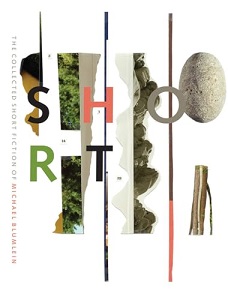
Short, Michael Blumlein

I’ve been a big fan of Blumlein’s fiction for years, ever since coming across one of his stories in an Interzone anthology back in the late 1980s – it was either his debut story, ‘Tissue Ablation and Variant Regeneration: A Case Report’, in Interzone: the 1st Anthology (1985, UK), or ‘The Brains of Rats’, his second published story, in Interzone: the 2nd Anthology (1987, UK). Whichever it was, it inspired me to track down everything else he had written.

Which was not easy at the time. I found a copy of his first collection, The Brains of Rats (1990, USA), which had been published by US small press Scream Press and was not readily available in the UK (I forget where I bought it; it might have been at a convention). His debut novel, The Movement of Mountains (1987, USA), which was science fiction, appeared in the UK in 1989. His second novel, X, Y (1993, USA), which was horror, was only available as a US massmarket paperback.

Then there was a gap – a story every year or two, a handful of novellas, but nothing at novel-length until The Healer (2005, USA). And a decade later, a handful of collections of his fiction. Of which Short (2023, USA), and its companion volume, Long (2023, USA), are the latest. Sadly, we lost Blumlein in 2019, so when these two volumes claim to be complete, they will stay that way. He was a singular talent, and almost sui generis. His stories were carefully crafted, and always thought-provoking. Some, obviously, worked better than others, and reading Short, which contains all twenty-nine of his published short stories, the differences can be stark.

Blumlein’s debut story, ‘Tissue Ablation and Variant Regeneration: A Case Report’, first published in Interzone in 1984, is remarkable. It’s also emblematic of Blumlein’s career – somewhere on the borderline between science fiction and horror, with occasional steps entirely into one genre or the other, often based around something medical, and always with very analytical prose. ‘Bestseller’, one of his more popular stories, is a case in point: a struggling writer answers a mysterious advert, and agrees to donate bone marrow for a large sum of money to an ailing billionaire. Then other parts of the billionaire’s body begin to fail, and the writer finds himself donating more and more…

Other stories read as though they were written to a specific market – ‘Snow in Dirt’, for example, was written for an anthology inspired by fairy tales. Even the stories originally published in F&SF feel like F&SF stories, and are lighter in tone than Blumlein’s other works.

Having said that, twenty-nine Blumlein stories in succession is a little overwhelming. His prose is intense and his stories are subtle. Short is a collection to be dipped into and savoured, I think. On the other hand, I now want to reread Blumlein’s novels. Fortunately, I recently purchased a copy of The Movement of Mountains (my copies of his books are in storage). 

And, of course, I have Long still to read.


Leave a comment

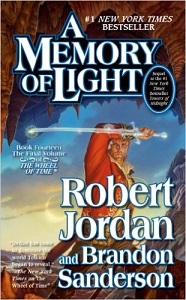
Wheel of Time 14: A Memory of Light, Robert Jordan & Brandon Sanderson

And so the Wheel of Time finally rolls to a halt. After fourteen volumes in what was intended to be a ten-book series, and the literal death of the author. It has been a slog, a brain-rotting plod through some of the worst prose ever to appear between two covers. Jordan had no discipline, seemed to think a plot meant merely moving characters around on a map, or, occasionally, not moving them, and used quirks and silly habits to define each of his cast, who behaved like teenagers. Sanderson, who wrote the last three books, is little better. He may treat the characters like adults, but he doesn’t understand what a chapter is. In A Memory of Light (2013, USA), there is a chapter which describes every skirmish of the Last Battle over a single day and is nearly 200 pages long. And is then followed by three much shorter chapters, also covering the Last Battle on that same day. Sanderson’s prose is also somewhere around the same level as Dan Brown or RA Salvatore:

… a skim of ebullience over sombreness.

Simply rob anyone who was not poor. Of course, that would just make everyone poor in the end.

The beasts yelled, howled and screeched depending on the orifice they’d been given.

Cooked bodies. To them, it was like the aroma of fresh bread.

… as the trumpets sounded in the air.

The houses had the feel of mice clustered together before a cat.

The Last Battle is the centrepiece of the novel, it’s what everything has been leading up to over thirteen fat books. It takes place on the Field of Merrilor, which is actually a random piece of ground on the border between two countries. No reason is given for the name, or why a random section of countryside should deserve a name. In real history, battles are named for nearby towns or villages, such as Waterloo. The nearest town or village to the Field of Merrilor is– oh, there isn’t one.

While all this is going on, Rand is battling the Dark One in some sort of place outside of time and space. This fight seems to involve each of them showing each other what the future will be like if either of them survives, and shouting at each other IN ALL CAPS.

The whole thing is dragged out so much, it’s mind-numbingly boring. We know the good guys are going to win because Mat is a tactical genius – despite the fact the bad guys hugely outnumber them and have an actual superhero leading them. There are, of course, other battles going on elsewhere – three of them, in fact. But they’re soon lost and everything shifts to the Field of Merrilor. I’ll say one thing in Sanderson’s defence: he finds some novel uses for Travelling (but then everything else the Aes Sedai and Asha’man do is just your standard AD&D battle magic).

Pretty much all of the central cast survive to the end of the book, although Sanderson throws a few bait-and-switches in order to make it happen. The Forsaken… I’d completely lost track of who was who. They’ve changed names and appearances throughout the series. Nor did they seem to do much except whinge at each other. In fact, for much of the novel, if not the entire series, the biggest hurdles the good guys had to face were other good guys. The Seanchan invasion. The Children of Light. All the various factions. And, after all that, the bad guys turn up in overwhelming force, with hundreds of thousands of Trollocs, every other nasty creature that’s been named in the previous thirteen books, and an actual army, with its own wielders of the One Power, from some other part of the world that’s been mentioned perhaps twice in the entire series…

The Wheel of Time is not a good series, and A Memory of Light is not a good novel nor a good end to the series. I’m glad I finally finished the series. I’m also slightly astonished I bothered to read it all.


Leave a comment

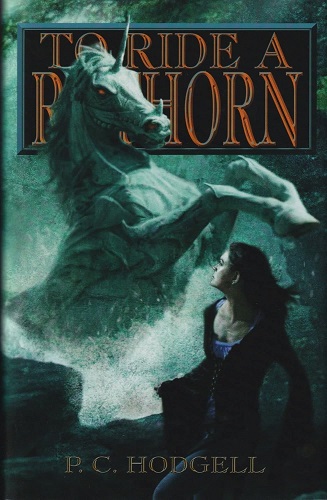
Chronicles of the Kencyrath 4: To Ride a Rathorn, PC Hodgell

To Ride a Rathorn (2006, USA) is the fourth book in Hodgell’s, to date, ten book series, the Chronicles of the Kencyrath. This is heartland fantasy, so heartland it reads like a dramatised supplement for a fantasy role-playing game. And while main character Jame flips between Goth Mary Sue and emo superhero, collecting power tokens as the narrative progresses, there’s still much to like here. The world-building, for one.

Robert E Howard does this thing in some of his Conan stories where he hints at much greater historical depth than his Hyperborea can realistically carry. I’m not convinced it’s deliberate, but it gives some of his stories an added dimension which offsets their illogical mash-ups of historical periods. Hodgell does something similar – the historical depth, that is, not the mash-up.

The Kencyrath have lived on many worlds since being forced from their home world by Perimal Darkling. Rathillien is just the latest. Jame is a Highborn, and the twin sister of Torisen, lord of the Knorth, one of the Kencyrath houses. Jame was introduced as a thief in the first book, discovered her brother and assisted him in a great battle in the second book, tried to discover her role in the third book, and now, in the fourth book in the series, she’s been made Torisen’s heir and enrolled at Tentir, which seems to be some sort of training school for elite soldiers. Jame is not expected to succeed, nor is her presence appreciated.

Despite this, she muddles through, and even manages to resolve a few issues, some relating specifically to her house, Knorth, and its history, and some related to Tentir’s own history. Such as the rathorn colt – a sort of horse with armour and horns. which has been hunting Jame and which she turns into a reluctant ally. The title To Ride a Rathorn is actually a pun – because the phrase means something like “to grab the tail of a tiger” but there’s also this rathorn which Jame might end up actually riding…

Jame’s specialness gets a bit wearying at times – being the centre of a narrative is one thing, having the entire world revolve around a Mary Sue is another. It also means there’s not much jeopardy – no matter what Hodgell throws at Jame, she’s going to win through. There are, after all, seven more books to go. But the details are fun, the world-building is interesting, and the plot rolls forward with the relentlessness of a, er, charging rathorn.

I’m not a big fan of epic fantasy, or sword & sorcery, or whatever this sort of commercial fantasy is currently called. It’s mostly badly-written, derivative and lacking in originality. The basic template may have moved away from mediaeval Europe in recent years, but that hasn’t made it any more original. Hodgell’s Chronicles of the Kencyrath are no less derivative than a fantasy role-playing game from the industry’s heyday back in the 1970s, but I still think there’s enough of a sideways spin in these books to make them stand out from the rest.

Judged against the whole genre of science fiction and fantasy, they’re perhaps not much. But within the specific space they occupy, commercial European-inspired fantasy, they’re actually not bad, and worth reading.


Leave a comment

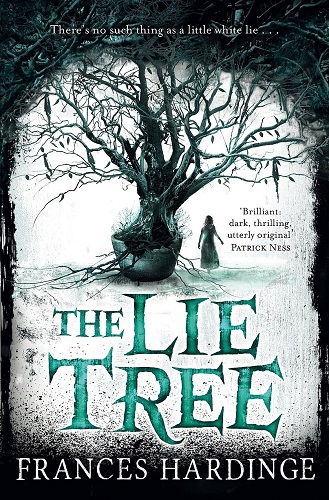
The Lie Tree, Frances Hardinge

I’d heard good things about Hardinge’s fiction for several years, but I’d never bothered checking them out because, well… fantasy… YA… Not my usual, or preferred, choice of reading. But The Lie Tree (2015, UK) popped up for 99p on Kindle, and I thought it worth seeing what all the fuss was about.

And I’m glad I did.

Faith’s father, a reverend, is a celebrated palaeontologist in the 1860s, but he’s been accused of faking the fossils he discovered, so he and his family flee to the invented Channel Island of Vane to join a dig there. But all is not as it seems. The invitation was a ruse because the reverend is in possession of something that others want.

On the one hand, the title of the novel is a hint to the central element of its plot, which is not revealed until at least halfway in; on the other, it’s hard to describe the plot without spoilers. The spoiler-free version would go: Faith defends her father, uncovers a conspiracy against him, then tries to solve his murder and so learns his secret, the reason why he was invited to Vane, and uses it to take revenge on his killers.

However, a major part of the novel – although it doesn’t really kick in until around a third of the way in – is that Faith is clever, but because she is a girl it means nothing. She wants to be a scientist but her gender bars her from it. This is a novel about women as property, about chattel slavery of half of the human race, and about the means and methods open to women of the time to arrange a future for themselves and then safeguard it. Faith is a teen, and knows her much younger, and not very bright, brother, whom she loves nonetheless, is accounted more valuable than her. Even though she has the intelligence, the aptitude and the interest to follow in her father’s interests.

And it’s this element of the novel which lifts it above others of its ilk. Faith thought her father valued her because of her intelligence, but he was just using her – much as he used others to further his aims. Faith meets a woman – two, in fact, but one more so than the other – who have found a way to be intellectual without offending Victorian (male) society – I am for some reason reminded of JG Farrell’s The Siege of Krishnapur (1973, UK), an excellent novel – but it doesn’t end well. And also I’m reminded of Jeanette Ng’s Under the Pendulum Sun (2017, UK), which presents as a fantasy set in Victorian times but is actually a brilliant commentary on Victorian fiction by women, missionary colonialism and women’s rights.

The Lie Tree is really good, and I should definitely read more by Hardinge.


Leave a comment

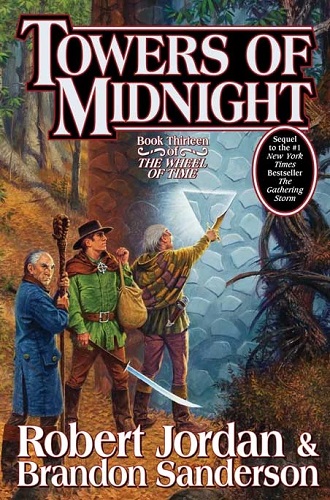
Towers of Midnight, Brandon Sanderson

The thirteenth book of the Extruded Fantasy Product that is The Wheel of Time, and the second written by premier Extruded Fantasy Producer Sanderson after Jordan’s death. This is the end-game of the series – and has been for several books – and there’s still one more humungous tome to go.

Rand al’Thor has finally grown up (it’s only taken him twelve books), and proves that when he puts his mind to it he has, well, super-powers. But he doesn’t use them to defeat the bad guys because that would end the story real quick. Meanwhile, Egwene is trying to get the Aes Sedai behind her, but someone is murdering sisters in the White Tower, so Egwene arranges an ambush in Tel’aran’rhiod, the dream world. Perrin Aybara finally accepts what people have been telling him for around seven or eight books, that he’s not just a blacksmith out of his depth but the actual leader of an actual army – oh, and he turns out he’s even more powerful in Tel’aran’rhiod than Egwene because of all the wolf dream stuff. Mat Cauthon still eyes up every woman he meets and tries to work out which of his friends he should introduce them to, but he also rescues Moiraine (remember her?) from the Aelfinn/Eelfinn (one of the genuinely dramatic bits of the novel, to be fair). Oh, and he invents cannons, as well. Elayne is, well, Elayne spends the novel being pregnant and being a queen. And there’s some weirdness going on at the Black Tower, with an increase in toxic masculine behaviour (!), and something preventing those there from Travelling out (gosh, not an obvious piece of foreshadowing at all).

There’s a few other bits and pieces going on, and a handful of sections from the POVs of supporting characters – but it still feels like there’s a lot of verbiage for very little actual progress. By the end of Towers of Midnight (2010, USA), the good guys have a gigantic army gathered at the field of Merrilor, which I think puts them in place for the Last Battle… Incidentally, I don’t recall any actual towers of actual midnight being mentioned in the novel, other than in the glossary (which places them on the Seanchen continent – er, what?).

On the plus side, Nynaeve loses her braid, so there’s no more pulling of it (although it doesn’t stop Sanderson from repeatedly mentioning she wants to pull it). Sanderson clearly doesn’t have Jordan’s fascination with spanking, but every female character is introduced with a description of her breasts. There are also lots of descriptions of clothes, mostly female. The prose reads like it was dictated (which is how I believe Sanderson “writes”), the sort of narrative scramble created by someone who puts things down as they think of them. There must have been some planning, of course, given the vast cast (ugh) of the series and the even vaster wordage, but was that Sanderson or Jordan?

Sanderson doesn’t appear to know what a chapter is. There are 57 in this novel. Each one contains sections from the POVs of the different lead – and supporting – characters. The chronology is more or less linear, but there’s no structure or logic to which narrative thread follows which – sometimes, several sections follow one POV, other times it flips between several in a single chapter. It’s not as if the chapters were all the same length, either. I couldn’t work out what in story terms signalled the end of one chapter and the beginning of the next.

There’s only one more book to go: A Memory of Light (2013, USA). There’s a lot of heavy lifting needed to finish off the story – which no doubt explains its 350,000+ words.

We shall see how that goes. 


Leave a comment

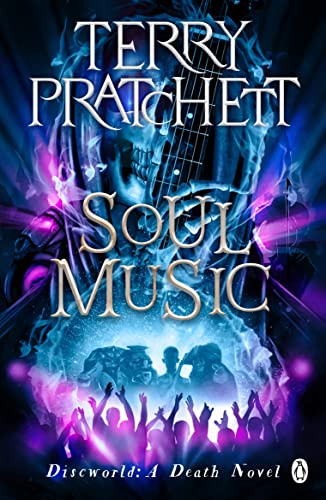
Soul Music, Terry Pratchett

I’ve heard it said the Grateful Dead were not actually very good live, but every now and again everything would sort of fall into place and it would be an almost transcendental experience – and it was those moments which led to their popularity. I’ve no idea if that’s true, but I do know that such moments can happen at a live performance. I remember one gig at Corporation in Sheffield – I forget the year, or who was the main act, but a support act was playing. I was standing with two guys, complete strangers, and none of us was impressed. Then the band started a new song and all three of us said, “Now that’s interesting.” (For the benefit of non-Brits, that means it was good.)

In Soul Music (1994, UK), Pratchett takes those moments – generated here by magic, and by some magical force for its own ends – to chart (see what I did there?) the invention of a new kind of music in Ankh-Morpork. A harpist from Llamedos (read it backwards) moves to Ankh-Morpork. Unable to afford a license to perform, the harper falls in with a troll and a dwarf, and the three form a band, The Band With Rocks In (because the troll is a drummer and his drums are, er, rocks). The harper’s, er, harp is broken at an unlicensed performance, but he finds a new one in a mysterious shop that mysteriously appears mysteriously. And that changes everything. Suddenly, all The Band With Rocks In’s performances are like those mythical Grateful Dead performances.

Meanwhile, Death has left his post, upset over the death of his apprentice and adopted daughter, so his granddaughter takes over the role. But she’s not especially good at it. When she turns up to the Mended Drum at which the harpist – now calling himself Buddy (referencing a pop star who died, um, 66 years ago), and the troll has taken the name Cliff (a rock joke, and referencing a pop star who, I suspect, will never die)… The harpist is supposed to die at the gig, but instead Death’s granddaughter allows him to live… which only makes the music magic more powerful…

Pratchett has a great deal of fun taking the piss out of the music industry, although many of his references are a good thirty years earlier than the year the book was published. And some of the jokes about bands on the road were already clichés when Pratchett made use of them. Neither of which means the book isn’t amusing. And the Death/Death’s granddaughter narrative makes for a good contrast – and introduces some interesting characters (and makes use of several old ones).

I find the music industry a more interesting target than some of the targets in earlier Discworld novels, but it does occasionally feel like the jokes are a little too obvious and the commentary not as pointed or insightful. Having said that, my taste in music is… niche, and quite specific, and has regularly been misrepresented in popular culture. So perhaps that got a little in the way when I read Soul Music. All the same, I enjoyed it, although I wouldn’t put it in the top five of Discworld novels (of the ones I’ve read).


Leave a comment

Men at Arms, Terry Pratchett

Cited by many as their favourite of the Discworld novels, Men at Arms (1993, UK), the fifteenth book in the Discworld series, is certainly one of the more quotable books of the series, at least in the sense it has more quotable lines of commentary than the sort of bad jokes people like to quote (but really shouldn’t). The one about Vimes and his boots – a serious point, not a joke – has had a lot of airplay on social media over the years.

Men at Arms is the second of the City Watch novels, featuring many of the cast from Guards! Guards! (1989, UK). A new recruit, human but brought up by dwarfs, is unknowingly the heir to the throne of Ankh-Morpork (which has not had a king or queen for centuries), and a prominent member of the Assassins’ Guild has decided restoring the monarchy would be good for the city and his own much-reduced fortunes.

Meanwhile, the Night Watch has taken on some other recruits under a new hiring initiative, including a dwarf, a troll and a woman. They are, of course, completely inept, except the woman, who’s actually a werewolf. They investigate a series of random murders, and begin bonding as a squad. Sergeant Vimes is due to marry a duchess, the richest woman in the city (although, to be honest, the eccentric animal (dragons, in this case) sanctuary-obsessed aristocrat is a bit of a tired cliché). And the aforementioned assassin has stolen the “gonne”, Discworld’s only firearm, and is using it to murder people to discredit the Lord Patrician, the ruler of Ankh-Morpork.

It can hardly be a surprise the new recruits foil the plot, more by accident than by design, but that’s how these sorts of stories work. Pratchett has fun with his characters, using them to mock various institutions and attitudes, both Ankh-Morporkian and real world. There are several laugh out loud lines, and a number of bitter-sweet moments. II’s easy to understand why so many pick Men at Arms as a favourite.


Leave a comment

Lake of Souls, Ann Leckie

I still think Leckie’s Ancillary Justice (2013, USA) was a much-needed shot in the arm for space opera. It had been taking on more and more characteristics of military sf, after New British Space Opera was co-opted by US authors and editors and became New Space Opera. But that’s an argument for another day. There was lots to like in the two sequels to Leckie’s debut, as well. Also the two pendant novels published since, Provenance (2017, USA) and Translation State (2023, USA) (although less so for the latter, I thought). I’ve yet to read Leckie’s fantasy novel, The Raven Tower (2019, USA).

Lake of Souls (2024, USA) is Leckie’s first collection, containing stories originally published between 2006 and 2019, and including a story original to the collection. The contents are organised in three sections: stories from the Imperial Radch universe, stories from the universe of The Raven Tower, and, opening the collection, stories unconnected to either.

Collections are by definition mixed bags. It probably comes as no surprise the stories set in the universes of Leckie’s novels are (mostly) better than the unconnected ones. Having said that, of the three Imperial Radch stories, only one reads like the same universe as the novels, one could possibly be in that universe, but the third appears to have no connection at all (it’s some sort of fable). 

The unconnected stories… the title story is a first contact that goes wrong, and reminded me of several similar pieces from the 1990s, two stories are based on premises that are definitely creaking at the seams these days, but ‘The Justified’, which is a very modern type of sf, and the Le Guin-ish ‘Another Word for World’ (big clue in the title there) are better.

The seven stories set in the world of The Raven Tower are more consistent, although the longest one, ‘The God of Au’, makes a jump two-thirds of the way in and nothing after that makes sense. I quite liked ‘The Unknown God’ and ‘Beloved of the Sun’, but the others are not especially memorable. Having said that, I suspect a collection of only fantasy stories might have been a better collection than Lake of Souls.

I was not really surprised on reading Lake of Souls to discover Leckie’s short fiction wasn’t up to the standard of her novels. While the world-building was generally done well, even if some of the premises were badly shop-worn, in several stories she failed to stick the ending. There are authors whose short fiction is much better than their novels, James Tiptree Jr, for example. It seems Leckie is the opposite.


2 Comments

How have the Hugos changed?

When you look at the Hugo Award fiction category nominees of the last few years, it seems like the same names keep on cropping up. Only an idiot would deny the Hugo nominees are more diverse than they were twenty years ago, but shouldn’t that mean the award now selects from a wider pool of authors? You’d assume so, given the existence of the internet. True, in recent years, the short fiction categories have been dominated by fiction published on tor.com or Clarkesworld; but in the 1980s and 1990s, the short fiction categories were dominated by fiction published in Analog, Asimov’s and F&SF.

Has anything really changed? I decided to have a look. (I was bored last weekend, obviously.)

There’s little point in comparing the representation of gender, race, nationality, etc, of nominees over the decades, as the awards are clearly far more inclusive. I was interested only in the number of writers considered by Hugo Award voters.

I split the Hugo Awards into three cohorts: early years (1953 to 1970), middle years (1971 to 2000), and present day (2001 to 2020). They’re unevenly-sized cohorts – the 1950s is not a full decade and we don’t have all the nominees for the early awards; in the 1970s, the novelette category was dropped for several years, and… 17 years (no award in 1954), 30 years and 20 years… But the split works when you consider the various cultural movements in sf and sf fandom.

big fish in a small pond

In total, over 67 years, 397 authors have been nominated for a Hugo fiction award – on average, five each in novel, novella, novelette and short story. For 1,256 nominations… 397 is a surprisingly low number. It gets even weirder when you look at how many times individual authors have been nominated. Almost half of those 397 have only a single nomination. Among the others…

The most-nominated author is Mike Resnick, with 30 nominations. The top ten looks like this:

1 Mike Resnick 30 1989 – 2012
2 Connie Willis 24 1980 – 2011
3 Robert Silverberg 23 1968 – 1990
4 Michael Swanwick 22 1986 – 2009
5 Ursula K Le Guin 20 1970 – 2003
6 Larry Niven 19 1967 – 1990
7 Harlan Ellison 18 1966 – 1994
8 George RR Martin 17 1980 – 2012
9= Poul Anderson 15 1959 – 1990
9= Orson Scott Card 15 1979 – 1992
9= Kim Stanley Robinson 15 1983 – 2018
9= Charles Stross 15 2002 – 2014

The years are first nomination to last nomination. The writers’ careers typically lasted much longer.

That’s a lot of old white men. Interestingly, the only author nominated in all three cohorts is Ursula K Le Guin, who had nominations dating from 1970 to 2003.

Among authors who have been nominated only since the turn of the century, the highest number of nominations is for Charles Stross, who managed 15 nominations in 12 years. Seanan McGuire, who has had 13 in just eight years, will likely end up beating his record.

Digging into the Hugo Award nominations for each year, it was surprising how often authors achieve multiple nominations in the same year. Seanan McGuire managed four in 2013, as did Michael Swanwick in 2003. (John C Wright also had four in 2015, but that was entirely due to Sad Puppy bloc voting.)

In early years, it was even more prevalent, with several authors appearing three times across all the fiction shortlists. John Varley even managed an unbroken six-year run, from 1977 to 1982, of two nominations per year.

The one thing the numbers do show clearly is that authors “have their day”. They will be nominated for half a dozen years on the trot, and then disappear. Some pop up a few years later, but most don’t. In some cases, it’s because their career has ended – either retirement or death – but others continue to be published but are never nominated, perhaps because they’re out of fashion or their fans no longer vote for the Hugo. Everything, as they say, shall pass.

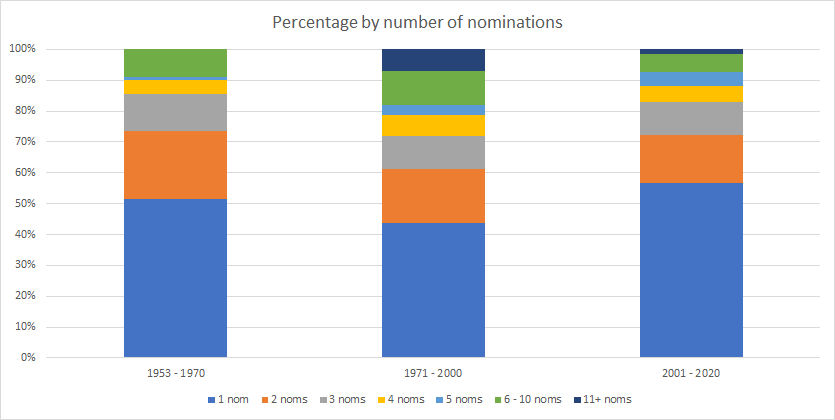
But I set off down this rabbit hole to understand if the size of the pool of writers nominated for the Hugo Awards has changed. Overall, 49% of nominees are “one-hit wonders” (a statistic slightly thrown out by the Sad Puppy campaigns of 2014 and 2015), and 16% have had only two nominations.
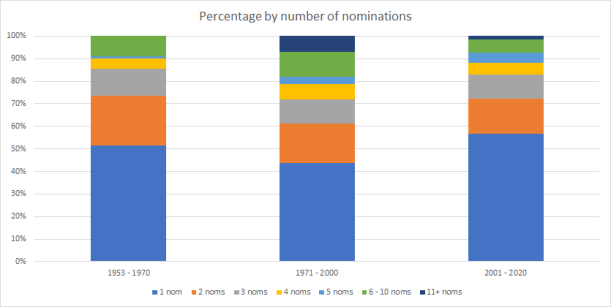
And when you look at the one-hit wonders, it’s clear present-day voters read much wider: from 1953 to 1970, 51% of nominees appeared only once; from 1971 to 2000, 44% of nominees appeared only once; and from 2001 to 2020, fully 57% of nominees appeared only once (without the Sad Puppies, it would probably be a couple of percentage points lower, but still better than earlier cohorts). I had not expected that. The second cohort, 1971 to 2000, also shows more authors being repeatedly nominated. There were indeed some authors very popular among Hugo voters during this period, such as Connie Willis and Ursula Le Guin, but also Silverberg, Resnick, Varley, Niven and Card. (Lois McMaster Bujold’s success stretched across two cohorts, so she doesn’t score so highly here.)

debut or established?

One other question occurred to me. Present day Hugo voters, it seems to me, like debut novels. Certainly, the industry has changed and debut novels are pushed much harder than they used to be, sometimes even more so than new works by established authors. The whole concept of “building a career” has gone, killed by the need for a quick profit. Best-selling series of the past, like the Wheel of Time or Malazan Books of the Fallen, took several volumes to build up to best-seller levels. That wouldn’t happen now. Instead, we get instant best-sellers, like the Kingkiller Chronicles, followed by a decade-long wait for a sequel. If this is meant to be an improvement, it’s hard to understand how.

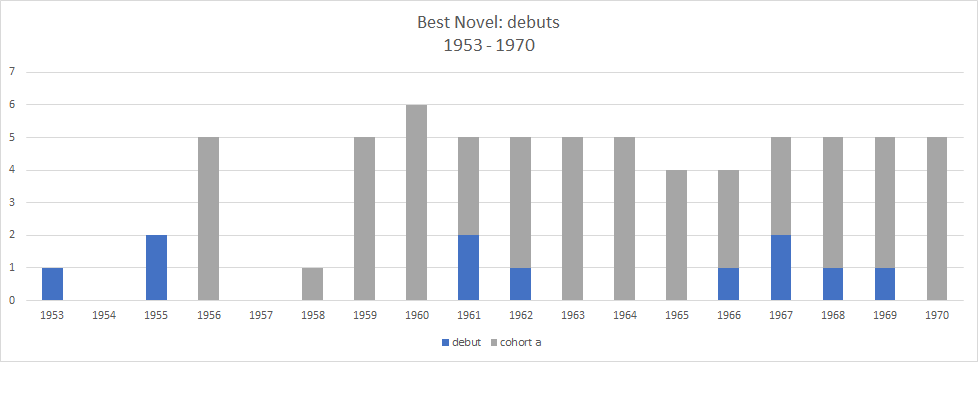
But, Hugo nominations can at least show – for best novel, specifically – which nominated novels over the years were debut novels. Popular perception – based on changes in the industry – suggest this is a recent phenomenon. So I went through every best novel shortlist, marking off those which were debuts – as in, the first book the author had published, also including collections. It’s a little difficult to be sure for the first cohort, since novels were often serialised in magazines, and it wasn’t always the serialised version that was nominated but a later hardcover/paperback release, and sometimes even both versions – ‘Dune World’, for example, was nominated two years before Dune, which was a joint-winner in 1966.

The results were… interesting.
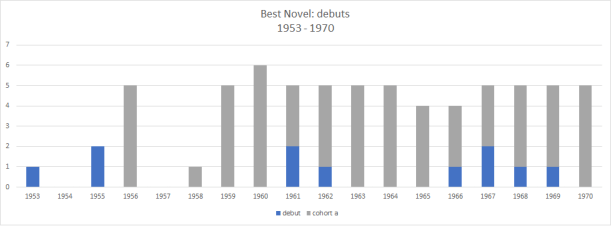
I’d have expected a few more debuts in this cohort, given the genre was relatively young. But magazines had been serialising novels from the very beginning, so most well-known authors likely had plenty of novel-length works under their belts by 1953.
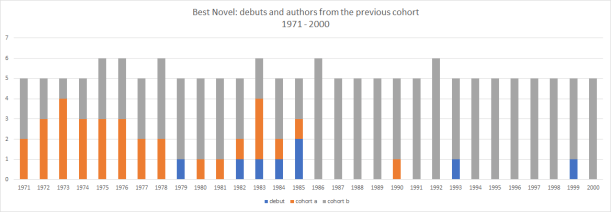
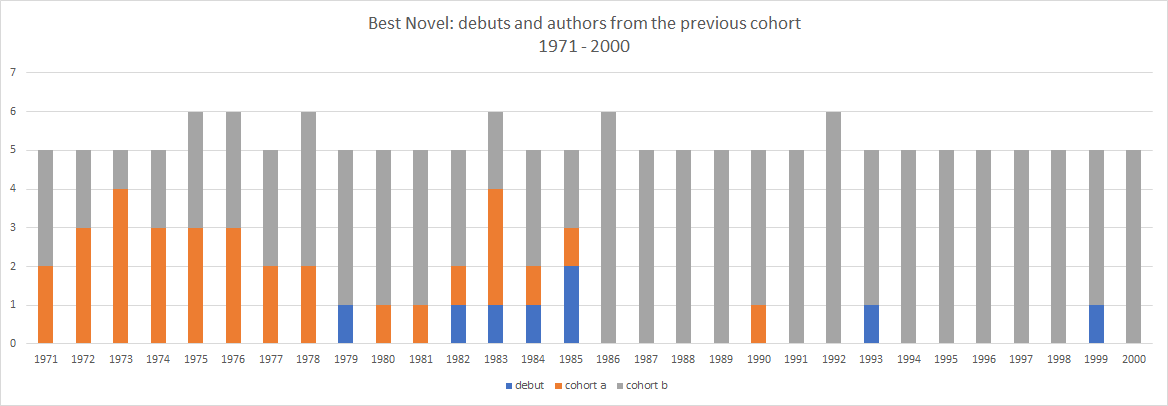
There’s considerable overlap between the earlier cohort and this one, and it takes a good fifteen years to fade away. (Perhaps I should have defined my cohorts differently – 1953 to 1965, 1966 to 1985, 1986 to 2015, and 2016 to 2020?) Aside from a blip in the early 1980s, debut novels were not that popular, appearing in only seven of the years. Interestingly, one of the two debuts on the 1985 shortlist was Neuromancer by William Gibson; the other was Emergence by David R Palmer, a fix-up of two novellas nominated for the Hugo in previous years. Palmer published one more novel and then vanished.
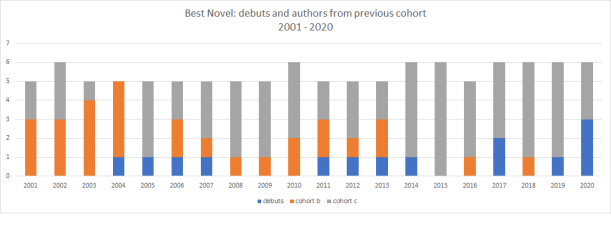
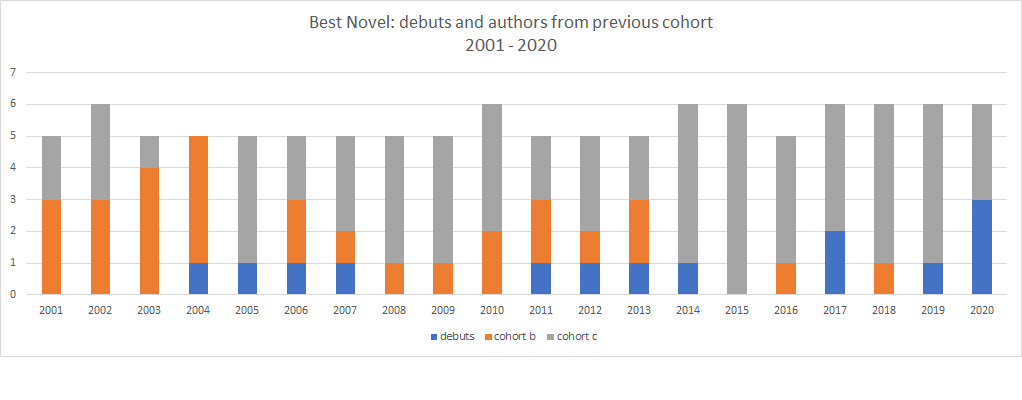
Again, there’s overlap from the preceding cohort, and it too takes around fifteen years to fade away. But debuts are also clearly more popular, appearing on the shortlists of eleven of the twenty years, and even making up half of the shortlist in 2020. On the other hand, the one debut novel on the 2004 shortlist was Charles Stross’s Singularity Sky – and he was then nominated each year for further five years. The debut novels nominated in 2011, 2012, 2013 and 2014 were by, respectively, NK Jemisin, James SA Corey (technically not a debut as one of the two authors who write under that name had been previously published), Saladin Ahmed (who has published no novels since), and Ann Leckie. At least two novels I’d thought were debuts – by Paolo Bacigalupi and Yoon Ha Lee – proved not to be, as both had published collections earlier.

in conclusion…

While recent years have seen several authors nominated multiple times, or for several years on the trot, it’s to a lesser degree than was the case in the decades before the turn of the millennium. So it may seem like the same names keep on appearing, but it was much worse in the past. On the other hand, it’s true debut novels are now more prevalent on the Best Novel shortlist than they were previously. I suspect this is a result of both social media and changes in the industry. Sf fandom has always been tribal – does anyone seriously believe Mike Resnick was the absolute best genre author of the 1990s and 2000s? – although I wouldn’t be surprised if a number of writers in twentieth-century Hugo Award shortlists owed their many nominations to logrolling…

Tribalism still plays a major role, of course, with lists of eligible works posted by influential authors, fans basically providing unpaid marketing for their favourites, and authors branding themselves as personalities separate from their novels (rather than “the death of the author”, it’s privileging the author over the work). But this is the world in which the Hugo Award now operates, and it too will likely change over the next decade or two.

additional findings

The most popular middle initial for Hugo nominees is apparently “M”.

The author with the most works published before their first Hugo nomination is Kevin J Anderson, with over one hundred novels or collections. A number of authors had published at least twenty books before their first nomination – Jim Butcher, Neil Gaiman, Frederik Pohl, Bob Shaw, Sheri S Tepper, Philip José Farmer, Michael Bishop, Robert Silverberg, Andre Norton and John Brunner.

The longest unbroken run for best novel nominations is Charles Stross, with six years. Orson Scott Card managed five years in a row.

Only Robert Silverberg has managed more than one novel on the shortlist – two in 1972 (A Time of Changes and The World Inside) and two in 1973 (The Book of Skulls and Dying Inside). He was obviously very popular then. Of course, there was also Blackout and All Clear by Connie Willis, which were published as two books, but the Hugo administrator decided to combine their votes, so giving Willis a win in 2011. As I remember, it was not a popular decision.

Only three people have been nominated for a Hugo posthumously for novel-length works. Both Edgar Rice Burroughs (died 1950) and EE Doc Smith (died 1965) were nominated for Best All-Time Series in 1966. Robert Jordan (died 2007) was, with Brandon Sanderson, nominated for Best Novel for The Wheel of Time series. And no, I can’t remember how they managed to swing that, either.