It Doesn't Have To Be Right…

… it just has to sound plausible


Leave a comment

The Years of Rice and Salt, Kim Stanley Robinson

I’m a big fan of KSR’s fiction, because of the subjects he tackles and his treatment of them just as much as the stories he tells. He doesn’t just make use of common sf tropes, he interrogates them. A lot more sf authors should do that.
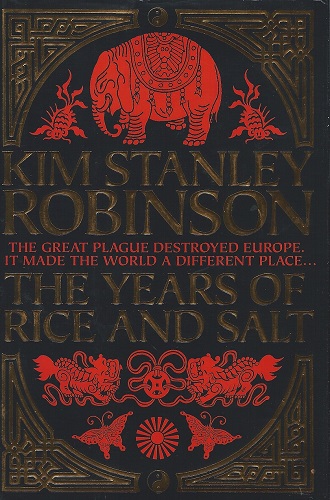
The Years of Rice and Salt (2002, USA) may be an alternate history, but it’s not a story set in a world which differs from ours due to some change in the past; it is in fact several stories – ten of them. Nor is it the book promised by its back-cover blurb, which posits a story set in a present-day world in which the Black Death in the fourteenth century killed 99% of the population of Europe instead of one-third. As a result, other civilisations flourished. Obviously, they flourished in real history – but in KSR’s novel they ended up dominating the world. The Years of Rice and Salt is not that either. It’s not a history of the world following on from the jonbar point. Which I suppose would be almost impossible – and huge! – to write. Like Laurent Binet’s Civilizations (2019, France), it is a series of vignettes which skip forward through the centuries, and around the world, from the Black Death to the present day. 

The linking conceit is that there is a group of people, connected eternally as a “jati”, who are repeatedly reincarnated. They die, spend time in the bardo, and are then reincarnated – as humans, or as animals. Allowing KSR to provide a focus point from which to hang to ten different stories taking place over the centuries in his alternate history. Sometimes the members of the jati remember their earlier lives, but usually they don’t.

The Black Death wipes out Europe. The Islamic Empire is never dislodged from the Iberian Peninsula. The Chinese continue to war on their western border, but also explore east and eventually settle the western coast of North America. A progressive empire develops in southern India. A league of Native American nations in central North America form a federation and keep their independence. There is a decades-long war which involves all three of the major world powers – the Indian empire, the Islamic empire, and the Chinese empire. Once the dust has settled, a new world order prevails. The various members of the jati are present, or pivotal, in some of the more important events in this 700 year history. Which also take place all over the world – Samarkand, Beijing, the Great Lakes, an Islamic city in western France, a Chinese San Francisco, and so on…

It’s fascinating stuff. The linking text is, to be honest, a not especially interesting mechanism to give the novel structure, and the ten “books” in The Years of Rice and Salt would be equally engrossing without them. KSR’s research is impressive – but not perfect: at one point, he states the Islamic punishment of cutting off the right hand of criminals is worsened because it forces criminals to use their left “unclean” hand when eating. That’s the whole point of the punishment. But the invented history KSR has created is astonishing. It feels all too real, which I guess is the point of the novel. Recommended.
Leave a comment

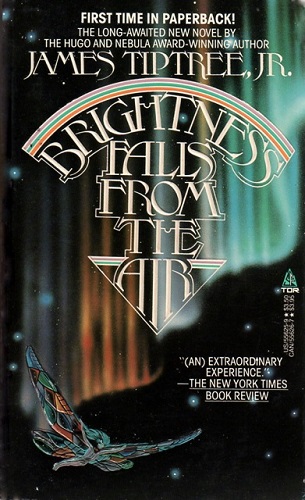
Brightness Falls from the Air, James Tiptree Jr

The second of only two novels published by Tiptree, and opinions on it are somewhat divided, chiefly I suspect because of one element of the book that has aged very badly – and was questionable to begin with.

The world of Dameim is home to an alien race who were illegally tortured and maimed in order to harvest a chemical they exude, which was then distilled into an extremely expensive drink called Star Tears. (The drink is mentioned in an earlier story by Tiptree, and the later collection The Starry Rift (1986, USA) takes place in the same universe.) Dameim is now overseen by three guardians, who live in a sort of safari lodge (which Tiptree admitted was inspired by her childhood safaris with her parents). They’re visited by a group of ten tourists, there to witness the wave-front of the Murdered Star pass over the planet. But two other men also disembark, apparently through some error, as does the supercargo who looked after the passengers while they were in cold sleep.

There are two plots – the last survivor of an alien race has tracked down the person who fired the shot which destroyed their sun, ie the Murdered Star; and three of the visitors are planning to make themselves some Star Tears – by torturing and maiming Dameii, of course. The latter plays out pretty much as you’d expect – the villains reveal themselves, and seize control. The first plot presents more of a surprise. It wasn’t the genocide everyone believed, and the alien’s “vengeance” is… complicated.

So far, so not especially a science-fictional story. There are real-world analogues to the two plots. However, the novel’s resolution depends in part on “time flurries” caused by the Murdered Star’s wave-front, and that’s pretty much sf. Tiptree also hints the cause of the genocide has, through the wave-front, altered everyone’s perceptions of Damiem and the Dameii.

Unfortunately, there’s one misstep the novel can’t recover from – among the tourists are four actors ranging in age from thirteen to sixteen, and they’re porn actors. Even in 1985, readers struggled to accept this, and it’s even less acceptable now than ever before, post-Yew Tree, post Trump and Epstein and the Andrew formerly known as prince… The actors are engaging characters, but the teen pornography leaves a bad taste.

I’ve seen Brightness Falls from the Air (1985, USA) described as Tiptree best-known but least-liked novel. She only wrote two and is much better known for her short fiction, so it seems a dumb way to refer to the book. And yet, except for the under-age sex, there’s a lot to like about Brightness Fall from the Air. The main plot is perhaps not intrinsically sf, although Tiptree makes the setting entirely genre, and the many plots and subplots she handles with admirable deftness. It’s perhaps the most colourful and yet bleak novel I’ve read.

The Starmont Reader’s Guide to James Tiptree, Jr (1986, USA) by Mark Siegel, one of only two critical works on Tiptree’s fiction I’ve managed to find, suggests a common theme to much of her fiction: she believed mortality, or the acceptance of mortality, was necessary to create art; it is the shadow of death, oblivion, hanging over us that drives creativity. Brightness Falls from the Air certainly illustrates this theory.

I’ve read a lot of Tiptree this year, and the more I read the more I like it. I’ve always regarded a handful of her stories as stone cold classics of the genre. It’s also true many of her stories have not aged particularly well. I’ll happily recommend her works to people, but with the caveat they should probably stick to her short fiction.


Leave a comment

Scarpetta 20: The Bone Bed, Patricia Cornwell

The twentieth book in the Kay Scarpetta series. Only nine more to go – including the one due this October. The title refers to a palaeontological dig in Alberta, Canada. A female paleontologist disappeared and several months later Scarpetta is sent an anonymous email containing a short video of the missing woman and a photo of a severed ear. Despite Scarpetta having no connection to palaeontologist, the place in Canada, or even dinosaurs.

Then the body of a woman turns up in Boston Bay, tied to a buoy. Scarpetta manages to recover the body intact. Shortly afterwards she is in court being cross-examined by the lawyer of a billionaire industrialist who has been charged with hiring the murder of his missing wife. But the body in the bay is not her.

And when they do identify the body, it turns out she was someone Marino was flirting with on Twitter, so he comes under suspicion…

Initially, it all seems like yet another plot to destroy Scarpetta’s career and reputation, a feeling only reinforced by the grilling she gets in court and the FBI investigating Marino. But it actually isn’t. It’s just your common or garden psychopath serial killer, of which the US has plenty, and Scarpetta’s involvement is more by accident than by design, or at the very least a happy and contrived coincidence on the part of the killer.

It also starts to look like Scarpetta is going to dangle herself as a victim, only to turn the tables – as in many other books in the series. But again, the killer abducts her only because of, er, happy coincidence, and for other reasons she’s rescued by the usual gang – Lucy, Marino, etc.

I’ve no idea if Cornwell was deliberately teasing the reader with hints of her more formulaic books, but I did like the fact The Bone Bed (2012, USA) didn’t hew closely to the formula. The title came from an actual bone bed visited by Cornwell, which inspired the novel – but it’s actually more or less peripheral to the story. She could have dropped the murder of the palaeontologist and it wouldn’t have substantially changed the plot.

A middling Scarpetta novel, I think. Slight above average, but not one of the more memorable ones. In its defence, it focuses more on crimes, and a killer, who has absolutely nothing to do with Scarpetta.


Leave a comment

The This, Adam Roberts

It has been suggested good Bruce Willis movies are the ones where he has hair, and in bad ones he is bald. Obviously the same wouldn’t work for Adam Roberts’s novels, because, well, his hairline may be receding but it doesn’t vary by book. I did think, however, something similar might operate with the titles of his novels – those which start with the word “the” were excellent, those without are merely good. But, according to Wikipedia, of Roberts’ twenty-four novels, only three have the definite article as the first word in their title… 

True, I liked two of them, including The This (2022, UK); but I’ve not read the third. And, to be honest, I did like some of the ones without an initial “the”. So, not a good theory then. I suppose I was trying to find a reason why I liked The Thing Itself (2015, UK) and The This so much more than the other novels I’d read by Roberts. The answer was, of course, there in the books: they are explicitly explorations of the ideas of individual philosophers, Kant and Hegel, respectively. What I know about philosophy and philosophers can be written on a small post-it note, so perhaps it’s the discipline which hewing to the particular philosopher’s works has forced on Roberts – sort of like Oulipo, I guess – which has, to my mind, produced works of science fiction I find I much prefer.

On the other hand…

The title refers to a company which creates a hands-free app for social media. In the future, a war between Hive Mind Theta, the end-result of all those people having the hands-free social media client implanted in their brains, and the rest of humanity takes place in orbit about Venus, which HMΘ are intending to terraform. 

The two main narratives are set around a century apart. In the very near future, Rich Rigby, a freelance journalist, interviews a PR person from The This. The company then sets out to recruit him to their network, so intently it draws the attention of, er, HMG. They persuade him to join The This, but he’ll have a computer virus embedded in his brain. This will allow the authorities to spy on the hive mind.

Then there’s Adan Vergara, a none-too-bright New Yorker of a century or so after Rigby, who is cut off by his mother and has to join the military. They’re fighting HMΘ, but Vergara seems to be able to shutdown HMΘ droids on the battlefield simply by uttering a single gnomic phrase. He was told this phrase by someone, or something, who hacked his Phene (a semi-aware sexbot, essentially), which Adan profoundly loves.

As the war ends, Adan is pulled into the far distant future, where he meets the embodiment of Hegelian world spirit, which was threatened by the existence of the hive mind. He is told how he, and Rich Rigby, helped put humanity back on track, so the universe would end with a Prime Mover as intended. 

As I read the final section of The This, I was reminded of AE van Vogt’s The Universe Maker (1953, Canada), where the hero is pulled into the far distant future to have the plot of the novel explained to him by a giant space brain. The This is, of course, considerably better written, and a “novelisation” of Hegel’s Phenomenology of Spirit (1807, Germany) is hardly the same as Van Vogt’s crackpot science and dream-inspired haphazard plotting.

To be honest, I was more taken with Rigby’s and Vergara’s narratives. The opening section, a piece of experimental prose, was good, but experimental prose is best in small doses. But Rigby and Vergana – it’s superior prose. I do wonder how much of Roberts’s The Black Prince (2018, UK) project, the completion of an unfinished novel by Anthony Burgess, rubbed off on The This, because there’s a distinct Burgessian feel to the language. I also suspect one of the earlier sections, which features a string of social media posts as marginalia, was included only so Roberts could include some of his bad Twitter jokes – but perhaps that’s unkind.

The This is the best of Roberts’s novels I’ve read so far (which is around half of them). Recommended.


Leave a comment

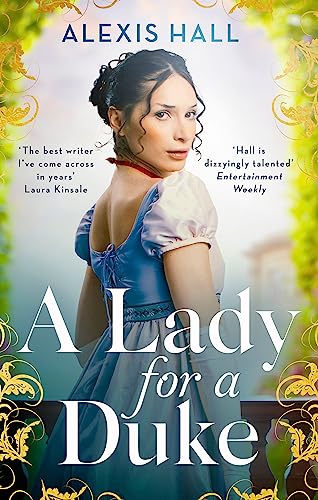
A Lady for a Duke, Alexis Hall

Not much to say about this one. A Regency romance with a transgender heroine and a hero who’s suffering with PTSD after Waterloo. I’m a fan of Heyer, so I know my Regency romances, and Hall does a spot-on job here. Yes, the dialogue is a little more “modern” than Heyer’s interpretation of Regency speech patterns, but that’s a deliberate choice by the author (explained in an afterword) and works well given what the story covers. (It’s also been argued Heyer’s dialogue was more invented than accurately historical.)

Viola Carroll returned from France after Waterloo determined to be her true self. But it seems her childhood friend, Gracewood, who fought alongside her at Waterloo, believes she’s dead, and has consequently been suffering, addicted to laudanum, ever since. A rescue mission north to Gracewood’s Northumbrian castle to ensure his younger sister gets a season in London results in Viola and Gracewood coming face to face – and he eventually realises who she is.

Of course, they end up in London, where young sister is a hit. Gracewood and Viola reconcile –  even more so they realise they’ve always loved each other… but then young sister is kidnapped by a rake, so everyone pulls together, and a happy end is comfortably achieved.

Hall deftly navigates all the Regency tropes, and is careful to make sure the fact Viola transgender is not a plot-driver. If anything, Gracewood’s PTSD – unknown at the time, of course – impacts the plot more. This does however lead to far too many conversations where you want the two to stop ignoring propriety and accept what’s in front of them, but that’s in the nature of the genre.

It seems churlish to complain a romance is feel-good, when it features PTSD and possible transphobia, but Hall manages it. The updated speech patterns work well, and help ground the concerns of the novel. I recently reread Georgette Heyer’s The Masqueraders (1928, UK), and it all felt a bit inconsequential, and even a little offensive in parts, after A Lady for a Duke (2022, UK). I do think we should learn from fiction, and my opinion on Heyer’s novels has changed over the years, although I still find them fun, but when something comes along and uses that same language, and points out where, really, her novels haven’t done good by their subjects or inspirations… we should take notice.


1 Comment

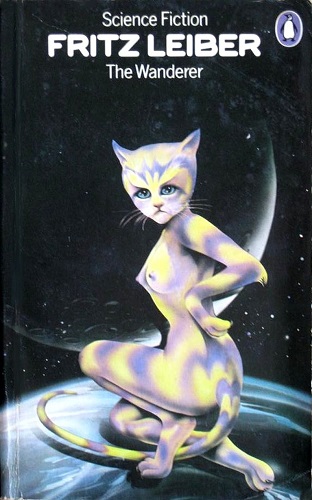
The Wanderer, Fritz Leiber

Winner of the Hugo Award in 1965, in a shortlist which included Cordwainer Smith, Edgar Pangborn and John Brunner. The Smith read like half a novel, I really didn’t like the Pangborn, and I have the Brunner on the TBR. Even so, I’m not convinced The Wanderer (1964, USA) was the best of the four.

A strange planet appears suddenly – from hyperspace, it’s theorised – in the Solar System, just outside the orbit of the Moon. Its presence causes earthquakes and tidal waves, and rips the Moon apart. The planet, named the Wanderer, proves to be actually destroying the Moon for fuel. Because it’s populated by thousands of alien races (including sexy alien cat women), and they’re on the run. The universe is packed with life – none of it visible from Earth, for, er, reasons – and it’s ruled by a government which resists change and adventurism, and the Wanderer’s dwellers are free spirits, gallivanting about the universe in search of, well, adventure.

The story is told through short sections from a wide cast of characters, all American except for a handful of non-US ones. There’s a German scientist, who appears twice and comes across like a cartoon Nazi; and a pair of drunken British writers (one Welsh, one English), who are caricatures, not characters. They also live in a UK that doesn’t exist, where people eat “sausage-and-mashed” rather than sausages and mash. 

All the time I was reading the book, I was trying to figure out when it was set. The US has a base on the Moon, and the USSR a mission on Mars… But the KKK is running around openly in Florida (there are several uses of the n-word and some really offensive racism), the English character remembers a bombing raid as a child, a man in the US claims to be the perpetrator of the Black Dahlia murder (from 1947), and South Africa still has apartheid. So, probably early Sixties, then. (Despite the moonbase and Mars.)

I’m told Leiber’s technique of using multiple viewpoints was something new in science fiction. Certainly it’s a technique more associated with techno-thrillers and the like, but they didn’t begin to appear until later. To be honest, most of the viewpoints don’t actually add anything – there’s a group of UFO nuts in California who explain what’s happening in the first half of the novel, and two Americans independently kidnapped by the aliens who have the second half of the novel explained to them. The rest are, well, not even local colour. 

Hard to believe The Wanderer was the best science fiction novel published in 1964.