It Doesn't Have To Be Right…

… it just has to sound plausible


Leave a comment

Moving pictures, #39

Well, slightly less than half of this post are US films, although I’d prefer it to be no more than one or two per post. But we’re getting there, as our national railway famously once said only to be privatised and then completely fail to get anywhere…
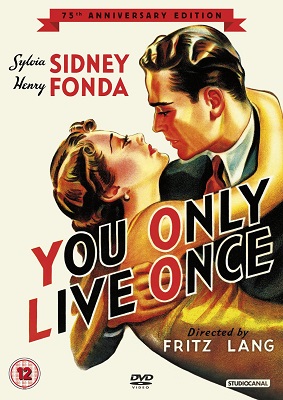
only_live_onceYou Only Live Once, Fritz Lang (1937, USA). This was a cheerful movie. Henry Fonda plays a habitual criminal who decides to go straight – mostly thanks to the love of a good woman, in this case Sylvia Sidney, the secretary of the local public defender. But not everyone is so forgiving. Although the public defender (who is secretly in love with his secretary) gets Fonda a job at a delivery company, he’s fired when he takes time out to look over a new house with his new wife. And no one else will employ him because he’s an ex-con. Absolutely no one. And then someone robs an armoured car, and a hat is left at the scene which points to Fonda as the culprit. He’s found guilty (the trial is off-screen, probably because it sounds so much a travesty of justice Lang was too embarrassed to show it), and Fonda ends up on Death Row. But an opportunity for escape presents itself, he takes it, but accidentally kills the prison priest… seconds after the warden has received news that Fonda is innocent and has been pardoned. Too late! Fonda collects his wife, and the two go on the lam. To be honest, I’d expected more from Lang. I’ve seen a fair number of his noir movies, and I expected this to be as good as they were. And certainly the scene where Fonda escapes from prison is very atmospherically staged and shot. But everyone is so horrible to Fonda, and the odds are stacked against him so strongly, the set-up to justify Fonda’s abrupt shift from optimism to desperation feels forced and completely implausible. So, not one of Lang’s better films.
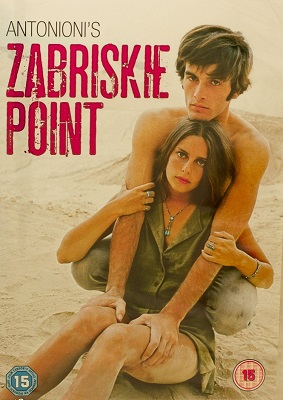
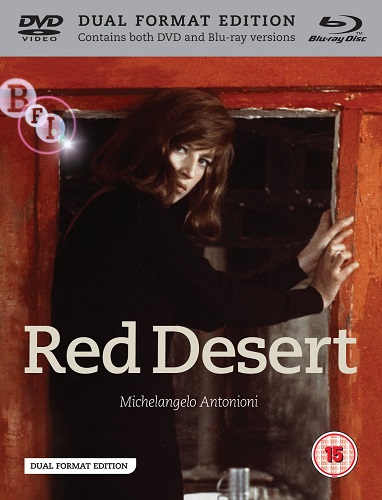
zabriskieZabriskie Point*, Michelangelo Antonioni (1970, USA). I’m a big fan of Antonioni’s films, and his Red Desert is one of my all-time favourite movies; but I also like late 1960s/early 1970s hippy films – or, at least, ones that comment on the hippy condition. It’s not just the direct rebellion, nor the questioning of society, but also that so many of these types of films throw in an additional dimension – which might well be typical hippy occult bullshit, but at least adds something a little more interesting to the story. And so to Zabriskie Point, which opens with semi-documentary footage of a protest at a California university. But when the police turn up, the protest takes a violent approach and several people are killed. Including a policeman. The film then abruptly switches to two characters: a young woman who is looking for a man in the Mojave Desert who works with emotionally disturbed children. Meanwhile, a young male student from the university protest, and a prime suspect in the death of the cop, steals a plane and flies off to Arizona… where he meets the young woman. And they go to Zabriskie Point, a real place just east of Death Valley, Nevada, where they have sex – well, actually, a full-blown orgy kicks off… and this isn’t really a film where you can describe the plot, or where such a précis would do the film any favours. But it is by Antonioni so it looks absolute fantastic and, to be fair, he makes just as good a fist of depicting the culture he’s filming as Demy does in Model Shop – they’re neither part of the culture, but their outsider status allows them see more than might be visible from inside. Antonioni made several excellent movies – I’d put Zabriskie Point in the top five of those; in fact I think I’d call it my third favourite after Red Desert and Blow-Up.
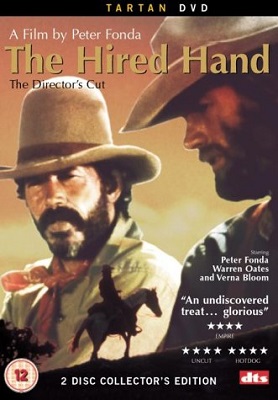
hired_handThe Hired Hand*, Peter Fonda (1971, USA). Sigh. Another 1970s Western on the 1001 Movies You Must See Before You Die list. But… well, this is a surprise. I’m not a fan of the Western, and have only three in my DVD collection – and I’ve probably seen more than I ever really wanted to because they’re on the 1001 Movies list… Certainly I’d never have considered watching this one: an early seventies Western, directed by Peter Fonda… (Even though I liked Easy Rider a lot.) But in fact it turned out to be pretty damn good. For exactly the same reasons why it flopped on release back in 1970. It’s slow, its cinematography is poetic, and it has a great soundtrack. Its story, to be fair, is not very interesting, and its characters are not very strong… but the whole works because the pictures and story go together exceedingly well. Fonda plays a drifter who decides to return to the wife who kicked him out years before, and asks only that he be taken on as a “hired hand” in order to prove he has changed. But a stop-off en route had made enemies of some nasty sorts and they track him down, and your typical Wild West showdown ensues. Where The Hired Hand really scores, however, is in its opening third: the cinematograhpy goes mad for dissolves and montages, and it works wonderfully well. The bluegrass score by Bruce Langhorne is also really well done – and I’m not a person who really notices incidental music (I have, like, three original soundtracks in my music collection… er, except for all those ones by Andrzej Korzyñski). Altogether, this is good stuff, and I’m tempted to pick up a copy for myself.

24_city24 City, Jia Zhangke (2008, China). I had been seriously impressed by Zhangke’s A Touch of Sin, so of course I added the rest of Zhangke’s oeuvre to my rental list… and this was the first sent to me. And, I’m happy to report, I did not choose wrong. Zhangke is a name to watch and a new director to join my favourites. The title refers to a new suburb built on the site of an aircraft factory. The film covers several decades in a semi-documentary style, first interviewing workers in the aircraft factory (whose location and purpose is a state secret because the aircraft are military). The film is divided into three sections: one during the days of the plant’s operations, another after it has closed and the plant has been mothballed, and one after the site has been redeveloped and a dormitory suburb now occupies the location. The mix of staged interviews, informal interviews (one scene consists entirely of a man at a bar reminiscing about his career at the factory), and small family dramas which illustrate the personal histories affected by the history of the factory and the town which springs up in its place, is extremely effective; and I especially like the factualness of it. 24 City is, apparently, a real place, and the story of the film is no doubt based upon, or inspired by, real events; but the mix of fact and fiction I find quite compelling – much as I did in A Touch of Sin. Excellent stuff.
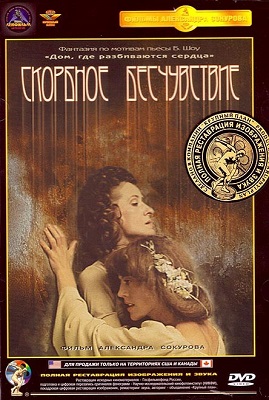
mournfulMournful Unconcern, Aleksandr Sokurov (1983, Russia). This was another work by Sokurov that remained underground for many years – it was banned by the Soviet authorities – before finally being publicly screened after glasnost… and was promptly nominated for a Golden Bear. It’s based on George Bernard Shaw’s Heartbreak House, but is intercut with documentary footage. The cinematography is, surprisingly, straightforward, but the whole thing feels ike an unholy mix of David Lynch and Peter Greenaway, albeit put together in an entirely Sokurovian way. That documentary footage, for example – it’s contemporary with the setting, the 1920s, and features Shaw himself, a zeppelin, World War I, an Antarctic expedition, the River Ganges, and various places in Africa. The choices of incidental music is also typically Sokurovian, and often anachronistic. Heartbreak House, subtitled “A Fantasia in the Russian Manner on English Themes”, which is apparently a reference to Chekhov, whose plays inspired Shaw’s, is set in the home of Captain Shotover – played by Ramaz Chkhikvadze as half Falstaff and half Lear – and is partly a drawing-room farce and partly an Edwardian sex comedy. Gunfire and explosions can be heard on the soundtrack throughout the entire film, which ends with a zeppelin dropping a bomb and blowing up the house. It’s… an odd beast. The story seems well-suited to Sokurov’s feelings about the Soviet Union. The use of documentary stock footage is perhaps more intrusive than in the other films in which Sokurov uses it, but it works really well (some of the inserts provide clever and amusing commentary on the main story). I’m not so sure about the story itself, however – I don’t know what changes Sokurov made to Shaw’s play, though the setting seems to be as described. Still, like all of Sokurov’s films, it’s one that will require repeated viewings.
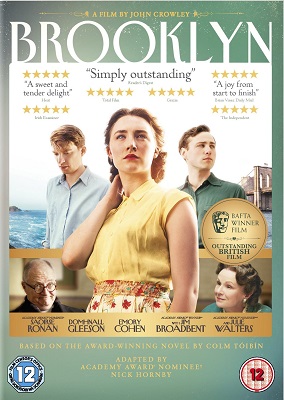
brooklynBrooklyn, John Crowley (2015, Ireland). This was one of those films of the last year or so which received lots of positive buzz and reviews, and didn’t involve superheroes, so I thought might be worth watching. It’s also an adaptation of a novel (winner of the Costa Novel Award, but only longlisted for the Man Booker) by Colm Tóibin, who, I admit, I’ve never read. The story is relatively simple – a fact stressed by several of the reviews: young Irish woman in the 1950s travels to New York in order to build a new life. She lives in a boarding-house and works in a department store, but she is shy and unassuming and very homesick. Then she meets a young man, of American-Italian extraction, and the two enter into a relationship. She is is now much happier and more settled. But then her sister in Ireland dies unexpectedly, so she returns to succour her mother. And now life back in Ireland seems much more attractive than it did when she left for New York. That is until the town gossip reveals something the young woman had been sort of trying to forget… and so she returns to New York. It’s a very pretty film, the cinematography is quite lovely, and the cast are uniformly good. Julie Walters as the landlady of the Brooklyn boarding-house, however, is a scream. But the story all feels a bit drab and low-key and devoid of any real insight, which makes the movie feel more like well-shot wallpaper than actual drama. I enjoyed it, but I think it was over-praised.
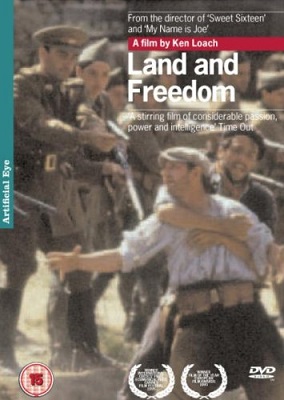
land_freedomLand and Freedom, Ken Loach (1995, UK). I thought this was on the 1001 Movies You Must See Before You Die list, but not apparently the edition of it I’m using. Still it’s by Ken Loach and the subject matter – the Spanish Civil War – made it seem worth renting. And so it proved. An old working-class man in Liverpool collapses in his council flat, the ambulance comes, but he dies en route. Later, going through his things, his granddaughter discovers he had sailed to Spain in the 1930s to fight for the Republicans against the fascists. She reads his letters… and these are dramatised, with Ian Hart playing the young Scouser. On arrival on Spain, it all seems a bit haphazard, but Hart joins POUM’s milita and is soon out fighting (which basically seems to involve taking potshots from the POUM trenches at fascist soldiers in their trenches). At one point, the militia oust a troop of fascist troops from a village, and the villagers then conduct a fierce discussion on private ownership and collectivisation. After Hart is injured training new recruits – a rifle explodes when he fires it – things take a turn for the worse as the various left factions begin fighting amongst themselves, and even start killing those whose idealogies are not approved. It hardly comes as a surprise the fascists win (even for those who don’t know their history). The right always will… because the left seems happier fighting among itself than showing a united front to the enemy – just look what’s happing in the UK now. You look at Trump, and it’s 1930s Germany all over again; you look at the UK, and it’s 1930s Spain. Neither, of course, bode well… I’ve watched the occasional Ken Loach film over the years and enjoyed them, but have never really made an effort to seek them out. However, I find myself appreciating social realism in movies much more these days than I used to (and consequently despising fascistic sfx-heavy tentpole movies). I see there are three box sets of Loach’s films available – Volume 1, Volume 2 and At the BBC. I might well avail myself of them…

1001 Movies you Must See Before You Die count: 792

1 Comment

Moving pictures, #38

Wa-hey, I did it! An entire Moving pictures post without a single US film. Which is not say I watched zero US films during the period, just that they were so shit they weren’t worth documenting (and, to be honest, there were only one or two of them). But still, it’s an achievement. And one I hope to repeat.

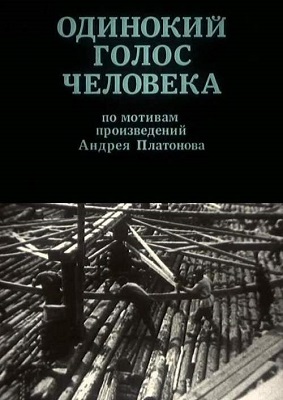
lonelyThe Lonely Voice of Man, Aleksandr Sokurov (1978, Russia). This was Sokurov’s first feature-length film, created as his thesis at the prestigious VGIK film school – but the school authorities wouldn’t accept it, and despite requests to do so by a number of big names, Sokurov had to submit something else in order to graduate. The Lonely Voice of Man, meanwhile, became an underground film; and it wasn’t until glasnost that it finally saw official release – although Sokurov took the opportunity to “reconstruct” it first. It had already built up a reputation from its underground showings, but post-glasnost it picked up several awards, and much critical acclaim, at numerous festival showings. It’s roughly based on the writings of Platonov, in much the same way, I guess, that Whispering Pages is based on the writings of Gogol or Save and Protect is based on Madame Bovary. Sokurov takes a very loose approach to “adaptation”. To be honest, I know nothing about Platonov – had not even heard of him until watching this film – but I don’t doubt that familiarity with his oeuvre would add more to the viewing experience, much as it would for the aforementioned films (which, to be honest, is not something I’ve tested – although I did drunkenly buy a collection of Chekhov’s stories while watching Stone; and when I found a copy of Gogol’s collected short stories in a charity shop, I bought it…). Anyway, The Lonely Voice of Man opens with the historical footage depicted on the poster I’ve used on this post, before moving onto the plot of Platonov’s novella ‘The River Potudan’, in which a young man returns home after fighting for the revolution. His girlfriend has since qualified as a doctor, and their two changed circumstances affect their relationship. So he runs away and becomes a manual labourer in a nearby town. The cast are non-professionals, and the picture is distorted – although to a much lighter extent than Sokurov uses in later films. The cinematography is dark, with a muted palette, and a camera that focuses on objects as often as it does the characters, not to mention a non-chronological narrative. While not everything in the film is immediately parseable, the sudden switches between seasons seem, to me, to signal, changes from one narrative to another – ie, boyfriend and girlfriend getting married, and after the husband has left. In Figures of Paradox, Jeremi Szianawski considers The Lonely Voice of Man a masterwork, but it seems to me more of an apprentice piece, a working-out of the themes and techniques Sokurov goes on to make extensive use of in his career (although both Szianawski and myself agree that The Second Circle is a masterpiece). There’s no doubt in my mind that Sokurov is one of the most interesting directors currently making films – and that’s as much a result of his contradictions as it is of the idiosyncratic approach he has taken to film-making.

subarnarekhaSubarnarekha*, Ritwik Ghatak (1965, India). Although this film appears on the 1001 Movies You Must See Before You Die list (one of two Ghatak movies to do so; the other is The Cloud-Capped Star), it has apparently never been released on DVD with English subtitles. Which is a shame. Having now seen it, I think it’s a better film than The Cloud-Capped Star, but not as good as A River Called Titas (which is not on the 1001 Movies You Must See Before You Die list; go figure). But I own all three films now, so I can watch them again at leisure. Ghatak directed eight films in total, and is highly-regarded – if not of the same stature as Satyajit Ray, he’s not far from it – so it’s weird that only The Cloud-Capped Star and A River Called Titas are available on DVD (and the first is not that easy to find – Amazon third-party sellers have it at £80 (but you can get it direct from the BFI for £20)). Anyway, Subarnarekha, AKA The Golden Thread, opens with a woman being taken away from a refugee camp, but her son is left behind. A young man takes the boy in hand, and takes him with him, and his daughter, when they leave and settle in West Bengal. Jump ahead a few years and the orphan boy and the daughter are now in love, but the father is told his career at the factory, amd his rise to manager, could be threatened if his daughter marries someone from a lower caste (ie, the orphan). Then it gets sort of complicated – but that difference in caste, and how it impacts the father’s career, is the axle on which the story revolves. It might well be heresy, but I think I prefer Ghatak’s films to Ray’s. To date, I’ve seen three by Ghatak and four by Ray – but Ray was both much more prolific and is more readily available on DVD in the UK, so perhaps I’ll change my mind once I’ve seen more of Ray’s films. I do wish more by Ghatak were available, however.

sils_mariaClouds of Sils Maria, Olivier Assayas (2014, France). I’ve followed Assayas’s career on and off since first seeing Irma Vep back in 2000, although, annoyingly, the film of his that has sounded most interesting to me was 2002’s Demonlover, which was never released on DVD in the UK. He’s a film festival favourite, and his last film, Personal Shopper, won him the Best Director Award at Cannes this year (a joint win with Cristian Mingiu). Clouds of Sils Maria is an English-language film despite being set in Switzerland and with a French actress, Juliette Binoche, in the lead role. Binoche plays an actress who has been asked to accept an award in Zurich on behalf of a reclusive Swiss playwright. Her own career began when she played one of the two lead roles in the stage and screen versions of the playwright’s most famous play, which is about the relationship between a young woman and an older woman. Binoche is travelling with her assistant, Kristen Stewart, an American, and the mirroring of their relationship with that of the two women in the play is, er, well, a bit obvious. Fortunately, both actresses are good in their roles – Stewart is especially good – and if the shape of the story unfolds all too predictably, the script provides more than enough material for the cast to get their teeth into so they put on a good show. But, for all that, the film comes across as a somewhat dull story that just happens to be especially well-made. Perhaps it’s the milieu in which it’s set – the European great and good, swanning about in swanky hotels, and arguing over a past, and career histories, that don’t feel especially well-seated in the plot. Assayas strikes me as a more consistent director than François Ozon – although it may be unfair to compare the two as Ozon belongs to a later generation of French film-makers – but I think Ozon’s oeuvre is the more varied and interesting of the two, and Ozon’s best films are better than Assayas’s.

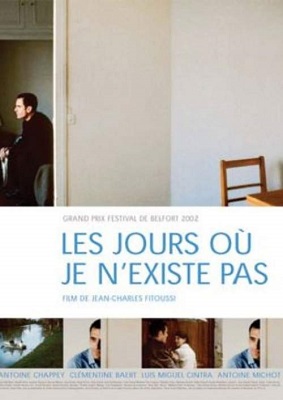
days_whenThe Days When I Do Not Exist, Jean-Charles Fitoussi (2002, France). This film was sent as a “bonus” with a purchase made on eBay, so I had no idea what to expect. And the internet was no real help – there’s no Wikipedia page for Fitoussi, and the imdb page for Les jours où je n’existe pas is surprisingly free of information. Whch is a shame, as it proved to be an excellent movie. It opens with a funeral, and an actor discussing the life of the person interred in the grave. The conversation – well, monologue – continues in the car as they drive away from the cemetery. And it’s only then that the main narrative begins: a man meets a woman in a park, and the two begin a relationship. But he only exists on alternate days. To him, it’s an unbroken succession of days, but for her – she’s alone every other day, and it begins to pall. So much so that she asks a friend to help try and prevent her husband (I think they’re married by this point) from appearing. But it doesn’t work. The story is told chiefly through voice-over narration (framing narrative aside), and there are occasional breaks away from the characters when the camera shoots landscape (although there’s something Benning-like about these scenes, the camera is not static but slowly pans and zooms). The whole effect feels a little like Patrick Keiller and a little like Godard (when he’s being experimental, but not too off-the-wall), but it works really well. Definitely a pleasant surprise. According to imdb, Fitoussi has made almost a dozen films, although only three or four are feature-length. I’ll definitely keep an eye open should any of them appear in editions with English subtitles.

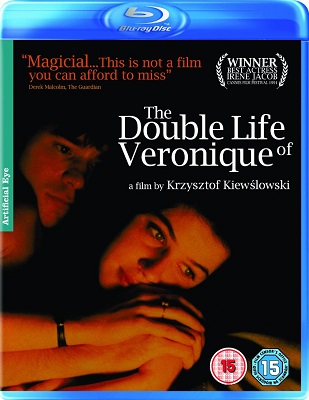
veroniqueThe Double Life of Veronique*, Krzysztof Kieślowski (1991, France). On its release, a film critic said of The Double Life of Veronique that it made “little or no sense on paper”, and she was pretty much spot-on. It doesn’t. The story is complete tosh. And yet it’s a beautifully-shot and beautifully-played piece of cinema. It not only works, it works exceedingly well – so well, in fact, it won both the Prize of the Ecumenical Jury and the FIPRESCI Prize at Cannes. (Barton Fink won the Palme d’Or that year, and La belle noiseuse the Grand Prize of the Jury.) The film’s title refers to young women, both played by Irène Jacob. The first is Weronika, who travels to Kraków to stay with her sick aunt, auditions for a conductor and is chosen by him as lead soprano for a planned concert. On the way home from the audition, during a violent protest, she spots a young woman who looks exactly like her. This second woman takes some photographs and then gets on a coach and drives away. This is Veronique, who teaches music at a school in Paris. Twenty minutes into the film, during the concert, Weronika collapses and dies on stage. The focus shifts to Veronique, who is suddenly overcome with sadness. A series of strange events seem to link her to the dead Weronika but transpire to be a “test” by a puppeteer and writer of children’s books Veronique has met. His last such test is sending her a cassette of ambient sounds. The postmark on the envelope leads her to a Paris railway station, where she finds the puppeteer in a café. He has been waiting there for her for two days. Angry, she leaves him – but he follows her to her hotel and the two become involved… The Double Life of Veronique is, quite frankly, made by Irène Jacob in the title role. Though the cinematography is pure Kieślowski, as is the ultra-careful timing of the story, the plot feels thinner than Krzysztof Piesiewicz’s usual material. None of which is to say The Double Life of Veronique is a bad film, or even disappointing for Kieślowski, because I thought it a better film than Three Colours: Blue, even if it did feel like the story was forever about to topple into nonsense. I need to watch Kieślowski’s other films to see if they’re also as good as I remember them – especially No End, which I seem to recall liking a great deal – although it seems not all of them have been released on Blu-ray… although Arrow Academy are going to release Dekalog in a dual edition box set later this year – it’s on my wishlist.

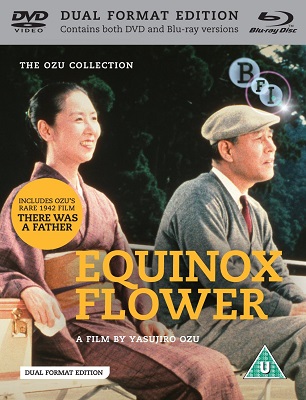
equinoxEquinox Flower, Yasujiro Ozu (1958, Japan). I must be getting into Ozu’s films – I recognised the characters in this movie as the same ones from Late Autumn and An Autumn Afternoon. And because the plot was about marrying off daughters, a subject shared with those other two films, I initially thought it followed on from them. But it was actually made two years before one and four years before the other. (Although, just to confuse matters, the main character has the family name Hirayama in each film, but is played by a different actor… each of which plays a differently-named character in the other two films.) In Equinox Flower, Hirayama must deal with his own two daughters, neither of which want arranged marriages – and the boyfriend of one, in fact, approaches Hirayama to ask for the hand of his daughter – as well as trying to reconcile an old friend with his estranged daughter and also help  a female acquaintance find a husband for her daughter… The film is set mostly in Hirayama’s office, home and a Ginza bar called Luna, where the estranged daughter works. There is also a scene in the same inn which appears in the later two films (with the same landlady too). I’ve said before that Ozu’s films are very domestic – and it’s not just that they’re chiefly uchi, but more that the stories are driven by the interlinkage between several families who seem to be undergoing the same trials and tribulations. And yet there’s a telling moment in Equinox Flower, toward the end, which admits the outside world, when Hirayama and his wife are at seaside, sitting side-by-side on a bench (it’s the cover image of the DVD), and she tells him that WWII was a wonderful time for her, and he replies that he hated it. And this is after differences of opinion over their daughters’ futures and the one’s impending marriage. It’s in the small things that Ozu excels – it is, in fact, where he finds his stories. And I’m not entirely sure if the fact they’re Japanese makes them more domestic than they would be had they been set in another nation. I think it might well. Good stuff.

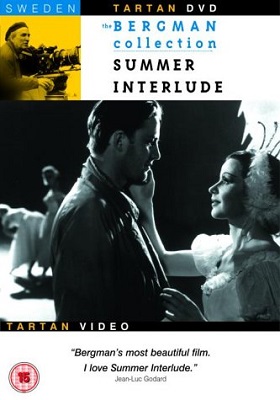
summer_interlideSummer Interlude, Ingmar Bergman (1951, Sweden). Bergman is a Swedish institution – at least from the outside – perhaps so much so that he overshadows everything else produced on film or television in the country (twenty-first century Nordic crime TV series notwithstanding). And, despite the size of his output, Bergman’s oeuvre isn’t all that varied. His many films are usually three- or four-hander plays, typically about relationships or families, played out with a bit more scenic freedom than a theatre offers. Summer Interlude, considered among his best by some, is a case in point. The lead character is a ballerina, who goes to stay with relatives in the country for a holiday, and subsequently has a holiday romance. But the unsophisticated boyfriend doesn’t understand the dancer’s sophisticated world – especially her relationship with her urbane “uncle” – and it all ends badly. It’s all very, well, play-ish, a story driven by relationships which are laid out in dialogue rather than through visual clues – although Bergman certainly uses his scenery to good effect (and I have to wonder if the scene involving wild strawberries inspired the later film of that title). Criticising Bergman would be like criticising Shakespeare, but nothing should be sacred – and, like Shakespeare, some of Bergman’s output works better, or at least appeals to me more, than others. Summer Interlude has its moments, but I think I’d place it in middle-tier Bergman – neither a stand-out nor one of the forgettable ones.

1001 Movies you Must See Before You Die count: 791


Leave a comment

La petite mort de sf

I’ve been working my way through Figures of Paradox, a study of Aleksandr Sokurov’s films by Jeremi Szaniakawski, and at one point he references the Kantian sublime, “the feeling that is so great it inspires neither love nor hate”, and it struck me that science fiction, in its own small way, is forever striving for that moment of the sublime. It’s not an actual objective of the genre, just something its readers look for in the texts they read. But they call it “sense of wonder” (please let’s not use “sensawunda”, which sounds like a brand of margarine). However, sense of wonder isn’t the same as the sublime. It’s a small version of it, the B-movie version – more colourful certainly, lots of bright primary colours in fact, but less actually awe-inspiring.

I think that difference in intensity may be simply a lack of physicality. Mountains are, famously, there. But the sublime doesn’t require an actual physicality. When NASA published the photographs of the surface of Vesta back in 2011, the asteroid was 188 million kilometres from Earth – and no one in my lifetime will ever visit the asteroid in person – but the fact of Vestia’s existence, its realness, the knowledge that it shares this universe with us, still prompted a moment of the sublime.

vesta

And against that, all science fiction can do is… manipulation of scale. When Stephen Baxter casually drops a billion-year history into the plot of his novel, when Alastair Reynolds writes of a journey across the width of a galaxy in his story, when Ann Leckie mentions in passing that the Radchh live in a Dyson Sphere… Because the story is focused on individuals, the sudden realisation – carefully stage-managed by the author, of course – that the story encompasses so much more, at a scale so much greater than the merely human, evokes sense of wonder. Admittedly, suspension of disbelief relies on a degree of plausibility. The universe is fifteen billion years old – that’s not only plausible, it’s a scientific fact. But a Dyson Sphere is not, on the face of it, an especially plausible idea… but it was proposed in scientific literature, and has since become part of science fiction to such an extent its plausibility no longer seems relevant: it has a form of virtual plausibility.

Of course, not all science fiction makes use of sense of wonder. Not every science fiction story takes place over billions of years or across millions of planets. On the contrary, some forms of science fiction deliberately downplay the sense of scale in order to suggest a more homogenous setting for the story – such as space opera. I mean, seriously, no one thinks there are zillions of human-habitable worlds out there just waiting to be settled, or that there’s a Kuhnian Paradigm Shift waiting somewhere in history’s wings to turn reduce the distance between these worlds to journeys of hours, days or weeks instead of centuries and millennia. But then it’s not like space operas are intended to be plausible in any way. They’re just adventure stories, and they use a language all their own.

In a mode of fiction which offers “idea” on one axis and “sense of wonder” on the other, there will always be works which score low, or even zero, on one axis. And too, the popularity of regions of such a graph will shift with time and fashion. We’ve had New Space Opera and we’re now living through the tail-end of it. Space opera has returned to its roots; the space operas being published today are no different in sensibilities to those of the 1970s (although the style of prose may well have changed). One sub-genre which seems to be flowering at present is military sf. Just look at the thousands of self-published titles available on Kindle. And as subgenres of science fiction go, mil sf is probably the least sophisticated. It is war stories told in the language of science fiction. It relies on an insultingly simplified worldview; it is the pulp sf of our times.

I gave this post the title “La petite mort de sf” not because I think science fiction is dead. (Again…) I used the expression “la petite mort” because of its meanings – including “fainting fit”, “nervous spasm”, or, more recently, “post-orgasmic unconsciousness”. While I’m not suggesting science fiction – good or bad – should inspire such states, it seemed like a good fit for an analogy of the gap between sense of wonder and the Kantian sublime. Paul Kincaid once wrote a critical work titled What it is We Do When We Read Science Fiction – and a very good critical works it is too – but I wonder if a more important question is: What It is We Want When We Read Science Fiction. And what I find interesting is the tools built into the genre which address those wants; and a) how those tools have come into being, and b) how the tools are deployed to generate specific effects. For “tool”, you might as well read “trope”… although I think of tropes as the manifestation of deep-seated ideas, sort of like how three-dimensional figures appear in two-dimensional space…

Like manipulation of scale, sf is also open to manipulation of affect. The cheapest way to do this is through language – choosing the right words, essentially. This is not something unique to sf, by any means. Nor is it a technique used all that much in the genre. For much of science fiction’s history, prose has been seen as merely the transmission vector for story. Some sf writers have declared prose should be “beige” or “transparent”, the idea being it should not be a barrier to understanding the story or plot. But, quite frankly, if any style of prose is such a barrier then it’s not doing its job. This doesn’t mean the reader shouldn’t have work for it. Prose can do many things – it can declare, describe, imply, suggest, evoke, generate trains of thought only peripherally linked to the text being read… It can create pictures in your brain, moving pictures, stories which not only re-enact those written on the page but go further, outside the story, beyond the story…

Which means prose carries a heavy burden, over and above that of story. Personally, I prize clarity; but I also prize detail. Perhaps even an over-abundance of detail. Prose should not be “transparent” or “beige”, it should evoke as much as it possibly can, using all the tools at its disposal, linguistic and genre. And there are a great number of tools at the sf writer’s disposal – not just the manipulation of scale or the manipulation of affect mentioned earlier in this post.

True, science fiction will never reach the sublime, but no form of literature will. In its use of sense of wonder, it can approximate it (in a peculiarly circumscribed way, that is). Unfortunately, it is also chiefly a commercial genre of fiction, and much of its DNA was drawn from pulp fiction. The genre as it exists today prizes story and plot and all the mechanical things which together form beginning, middle and end; and yet it has the potential to be so much more. Sometimes, it hints at that promise – and it’s not necessarily genre authors who manage to do so…

Science fiction is a broad church. It has room for two-fisted tales of interstellar derring-do just as much as it does for lyrically-written cautionary tales or avant garde explorations of inner space. And in some years, one form of science fiction will be more popular, and win more awards, than another form. Like the alleged variation in lengths of skirts during times of economic hardship and boom, so science fiction cuts its cloth to the world around it. Unlike skirts, however, it doesn’t appear to go up when times are bad, but the reverse. When times are good, sf is typically optimistic; when the future is not so rosy, dystopia and mil sf rule the roost. It is a barometer of our times.

But it still has a long way to go before it gets close to the sublime.


1 Comment

Reading diary, #33

I decided that July would be a month of only reading non-fiction, and I stuck mostly to that – although first I had to finish Arcadia; and there were a couple of graphic novels during the month as well…

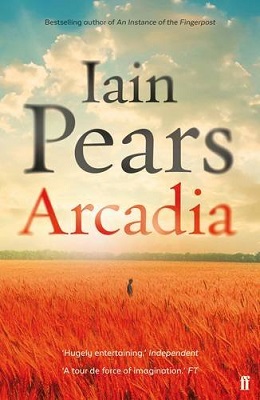
arcadiaArcadia, Iain Pears (2015). I’d heard mixed reports about this book, none of which especially encouraged me to read it. But it was shortlisted for the Arthur C Clarke Award, and I had planned to read all of the shortlisted books. Over the years, I’ve read Pears’s other novels – although only one or two of his Jonathan Argylle series – and thought them very good. Mention of an Arcadia app also made the book sound intriguing. While I’m not one to look down my nose at lit fic authors attempting genre – some do it badly, but a lot of the more interesting genre fiction these days is being written by those with no genre history – my views on Arcadia on opening the novel were at best conflicted. And when I actually came to read it… I was surprised. It’s woefully old-fashioned, there’s no doubt about that; despite the app, despite the fact it opens in the 1960s. And lead character Rosie Wilson reads like a Lucy Pevensey for the 1970s. But Arcadia is also addictively readable, more so than any other book on the Clarke shortlist – I polished it off, all 736 pages, in a weekend. There are, basically, four plot-threads. The first is set in 1960s Oxford and features a member of the Inklings and the fantasy world he has developed, Anterworld. Then there is the narrative set in Anterworld, featuring some of the characters he’s invented. And another thread in which it’s visited, Narnia-like, by the aforementioned Rosie, a fifteen-year-old girl who part-time housekeeps for the Oxford professor. Then there’s a thread set in a near-future totalitarian UK, where a secretive project on Skye turns out to be time-travel and not, as believed, a portal to alternative worlds which can be colonised. Except the time-travel/Anterworld thing wants to have its cake and eat it too, which leads to some pretty torturous plot-logic, delivered via info-dumps and lectures, in order for it to all link up. There are a few halfway decent ideas in here – and if most of them feel somewhat familiar, that hardly makes this book unique among, well, among award-nominated genre novels… Much as I enjoyed Arcadia, it did feel a little like reading a book from the 1970s or 1980s. But I’d still rate it higher than at least half of the Clarke shortlist.

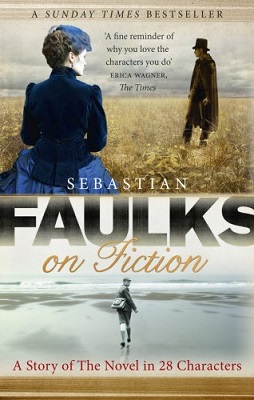
faulksFaulks on Fiction, Sebastian Faulks (2011). This book was published as a companion piece to a BBC television series which I’ve not seen. In it, Faulks considers twenty-eight characters from literature, and comments on them. The characters are split into “types”: heroes, lovers, snobs and villains. And within each group, he considers a well-known character from a famous novel. Some of the choices are obvious: Sherlock Holmes as a hero, Constance Chatterley as a lover, Fagin as a villain. Some are a bit odd: James Bond as a snob (although given the use of brand-names in the books, it does sort of make sense), Winston Smith as a hero… And I wouldn’t have chosen Ronald Merrick as a villain to represent the Raj Quartet – Barbie Bachelor is a much more interesting character; nor do I necessarily agree with the conclusions Faulks draws about the four books and Merrick’s role in them. But then the Raj Quartet is one of the few works covered in Faulks on Fiction which Faulks read for the first time for the television series. Many of the others he had read as a schoolboy or a student, and he writes as much about how his view of the book has changed with this new read as he does in analysis of the character under discussion. Of the twenty-eight novels covered, I’ve read only nine (but I’ve seen film/tv adaptions of a further seven), which at least gives me a position to compare Faulks’s thoughts with my own. He raises points I’d not considered in many cases and there’s very little I’d disagree with on those characters with which I’m familiar. Admittedly, I seem to hold both DH Lawrence and Paul Scott in higher regard than Faulks does – though, to be fair, I don’t prize Lawrence for his characterisation, and that’s pretty much the focus of the essays in Faulks on Fiction. An interesting read.

restrictedRestricted Areas, Danila Tkachenko (2016). Tkachenko is a Russian photographer and this is his second collection. The photographs focus on the wreckage of the Soviet Union, photographed in winter and covered in snow. So there are ruined apartment blocks, an ekranoplan (a Bartini Beriev VVA-14, in fact), and even the Buzludhzha Monument, among other subjects. Photography is not a hobby in which I indulge, but I do like these collections of the failures of the twentieth century (particularly when the failure was not a result of anything intrinsic to the failed object). It is, I suppose, a form of armchair urban exploration – but it has the advantage of someone else catching that moment of sublimity and making it public. There is something about the technological and engineering hubris of the twentieth century, and the artefacts which are all that remain, that I find particularly appealing. Tkachenko’s photographs capture some of those in a particular light, and that in turn adds an interesting dimension to the subjects of the photos.

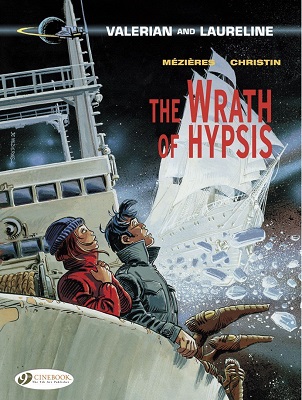
valerian_12Valerian and Laureline Vol 12: The Wrath of Hypsis, Jean-Claude Mézières & Pierre Christin (1985). This volume immediately follows on from The Ghosts of Inverloch, which was pretty much set-up… and it feels a little like there’s a middle volume missing somewhere. In the first of the two-parter, Earth and Galaxity Central (the HQ of the time-travelling intergalactic agency for which Valerian and Laureline work) was under threat from something either in the distant past or the deep future. The head of Galaxity gathered together a group of disparate characters – human and alien – at Inverloch Castle in Scotland in the 1980s… and in The Wrath of Hypsis they follow a ghost ship from Earth to the mysterious world of Hypsis… where it all goes a bit silly. The Holy Trinity – although not as they’re typically depicted in various works of dubious historical accuracy – are residents of Hypsis and responsible for Earth, and they’ve come to the conclusion the “experiment” is not working. It’s all a bit random and unsupported, and probably felt a bit more cutting-edge and dangerous back in 1985. Thirty years later, it reads like an incomplete premise. A shame… because this really is a superior space opera series. I suspect splitting a story over two episodes was considered pushing it for a bande dessinée that averaged 48 pages in length, but this particular story could have done with more room.

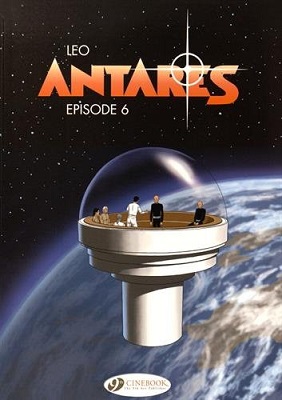
antares_6Antares Episode 6, Léo (2015). I started reading Léo’s sf bandes dessinées at the tail end of 2013, starting with the Aldebaran series, after stumbling across them on Amazon and thinking they might be worth a go. They were. After the three books of the Aldebaran series (published as five books in the original French) came Betelgeuse in three volumes (also originally five books), and now Antares, which has stretched to six “episodes”. (There’s a further linked series, The Survivors, currently unfinished, with three volumes.) Anyway, in Aldebaran, Kim Keller, a native of the human colony on a world orbiting that star, finds herself involved with a group who have been granted immortality by the enigmatic alien Mantris. In Betelgeuse, she is recruited for a mission to discover why the colony on a world orbiting that star has suddenly gone silent, and so finds herself involved with another Mantris and a humanoid alien race. Finally, in Antares, Kim is asked to join an expedition to settle a planet orbiting… not Antares, which is a red giant, but GJ-1211, a main sequence star which is invisible from Earth against the brightness of Antares. The expedition is run by religious zealots, and they don’t get on at all with Kim – especially when it seems she’s tied into whatever’s going on. They’re pretty good these bandes dessinées – smart science fiction and well-drawn. Worth reading.

third_reichThe Third Reich: A New History, Michael Burleigh (2000). I’ve had this for a few years but it’s a bit on the thick side – 965 pages! – which has always put me off reading it. But when I decided that July was going to be a month of reading non-fiction, it seemed like the perfect opportunity to finally tackle it. As I write this, I’m about a third of the way into the book, but I didn’t think it worth waiting until I’d actually finished it before writing about it because… well, we all know what happened, and it’s the way in which Burleigh tackles and presents his material that is important. And… he likes his big words. For example, “fissiparous” appears at least once a chapter. This is a writer who is determined not to dumb down his style. Burleigh’s approach also seems to demand some form of collusion from the reader, inasmuch as there are a number of editorial comments suggesting the reader is of course clever enough to agree with Burleigh’s point. The events recounted in The Third Reich: A New History took place between 100 and 70 years ago, and it’s pure coincidence that I chose to read the book now, in a post-Brexit UK and Trump-possible US, a time which scarily re-enacts some of the history described by Burleigh. Since the EU referendum, hate crimes are up in the UK by 57%. (And it’s all very well saying a leave vote was a protest vote against the political classes; but when the leave campaign’s main plank was xenophobic and racist anti-immigrant rhetoric, it takes a peculiar kind of blindness to paint it as a political protest.) How long before the EDL start wearing uniforms? How long until immigrants are asked to wear badges indicating their origin? Only this week, a chain of gourmet hamburger restaurants colluded with immigration police to arrest and deport some of their staff – and given that some of those staff had been working for the chain for at least four years… I’ve not yet finished The Third Reich: A New History – it’s going to take me a couple of months, I think, to do that – but I at least know how it ends. As we approach the 2020s, I have no idea what’s in store for the UK, the EU, the US, indeed this planet… Which makes it all too easy to sympathise with the Europeans of the 1920s…

1001 Books You Must Read Before You Die count: 126


1 Comment

Moving pictures, #37

I’m still working toward my entirely USA-free Moving picture post, but I’m not quite there yet…

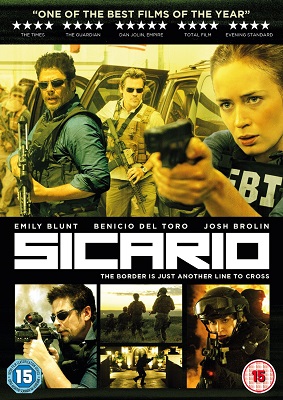
sicarioSicario, Denis Villeneuve (2015, USA). I’d heard many good things about this film, although these days that doesn’t really give you any real indication of what to expect. It’s a thriller about the US-Mexican border and drugs and drug cartels. That tells you much more. Like, for example, it’s an essentially racist film. Every Mexican is either a gangbanger or an illegal immigrant. The only one that isn’t, a Mexican lawyer working with the US authorities, turns out to be an assassin bent on revenge. The message of the film seems to be the only way to beat the drug cartels is to descend to their level – ie, to tacitly admit that the rule of law has failed. This is pretty much implicit in the fact the operation which comprises much of the film’s narrative is planned and led by the CIA. Who are legally prohibited from operating on US domestic territory. But that’s not a narrative I’m prepared to accept. Treating Mexicans like subhumans, assassinating drug barons, and behaving like Wild West cowboys makes the good guys worse than the bad guys. You cannot win if you surrender the moral high ground. What makes it especially egregious is that there’s an easy way to solve the problem: legalise drugs. I fail to see how it can continue to be considered “political suicide”. The only explanation is that the illegal drug market earns so much it is in its interest to remain illegal, and those involved have bought sufficient politicians to keep the situation unchanged. Of course, it doesn’t help when popular culture valorises those who both supplying drugs and those break the law in order to prevent the supply of drugs. Because in order to create a hero, you need a villain for them to fight (but not necessarily defeat – because the War on Drugs is as unwinnable, and as just as much created and perpetuated by the forces of so-called law and order, as the War on Terror). This is not drama, it’s propaganda for the status quo. Films like Sicario have tendency to make me rant, which is why I dislike watching them. It nevertheless is a nice-looking film, and Emily Blunt is good in the lead role. But the story is a bag of shite, and a film that requires you to cheer for people who have willingly abandoned law and morality in order to achieve a suprious objective (and, in this case, a frankly objectionable, illegal and offensive, objective) leaves you little to like. Meh.

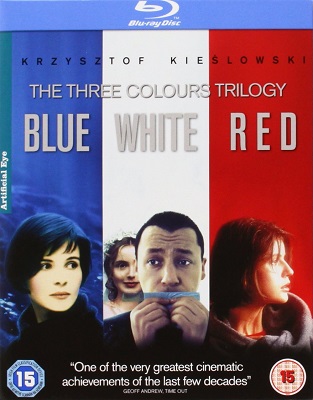
three_coloursThree Colours: Blue*, Krzysztof Kieślowski (1993, France). Many years ago, I decided to widen my movie viewing by watching something highly-regarded that wasn’t your usual Hollywood output. I’d been subscribing to Sight & Sound for a few years, and over the decades I’d watched the occasional “arthouse film” or “world cinema” – if anything, I liked those sort of’films, which displayed different sensibilities and visions to those I’d grown up with. And so I came across Kieślowski, who was apparently regarded as a critics’ and directors’ director, and I dutifully bought all his available films in Artificial Eye DVD editions. And yes, they were good films, streets ahead of a lot of the stuff I was used to watching. Although Blind Chance didn’t do much more than other films using the same repeated-time premise had done, and while I really liked No End it felt like an aberration in Kieślowski’s oeuvre… But of all his works, the Three Colours trilogy is reckoned the best, and I duly bought it and watched each of the three films and thought them superior drama… Recently, Artifical Eye decided to release all of Tarkovsky’s films on Blu-ray for the first time, which reminded me they had already done so for some of Kieślowksi’s – so I decided to replace my DVD copies with Blu-ray editions, and… Juliette Binoche plays the wife of a composer who attempts to free herself of her life after her husband’s death in a car accident. But it proves much harder than she had anticipated. But with a Kieślowski film, it’s as much about the cinematography as it is the story – this is the film with the infamous sugar cube scene. I was surprised by what I’d remembered from previous viewings – the overall shape of the story had gone, but a sequence shot from the back offside wheel of a car had stuck with me, perhaps because it had struck me as a corny shot when I first saw it and still seems somewhat corny. But most of the rest of the film has that clarity of mise en scène you often see in French films (well, except perhaps in some of Godard’s more experimental movies), as well as the tight focus on a single character, usually an emotionally-damaged person. Blue is certainly excellent film-making, and Kieślowski’s reputation is well-deserved; but after watching the film it felt like a superior example of a particular type of film rather than a superior film. If that makes sense.

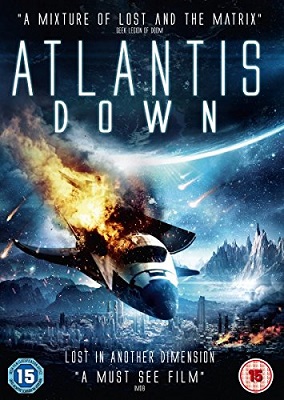
atlantisAtlantis Down, Max Bartoli (2010, USA). I bought this at the same time as the execrable Battle Tanker (see here), but it’s not that much better. The title refers to a Space Shuttle (surely by 2010 it was known the fleet was going to be retired? The last flight, by Atlantis, coincidentally, was in July 2011, after all). But not apparently in the world of Atlantis Down. A simple supply mission to several space stations goes awry when a bright flash strikes the Shuttle, and the crew mysteriously find themselves back on Earth… or is it? One member remained behind on the spacecraft, but the rest find themselves in a mysterious wood. And as they explore it, they’re killed off one-by-one in weird ways. It’s some alien experiment or something, but it’s also exceedingly derivative and dull. I forget what the actual point of the alien experiment actually was; I’m probably better off for not remembering. I do recall that the CGI Shuttle didn’t look right, that the Shuttle’s flightdeck appeared weird (the windows were above the crew’s heads), and that the references to “internal gravity” just made the whole thing sound stupid. Atlantis Down is not as bad as Battle Tanker, but that’s nothing to be proud of. It’s two wasted hours I could have better spent watching something by, say, Sokurov…

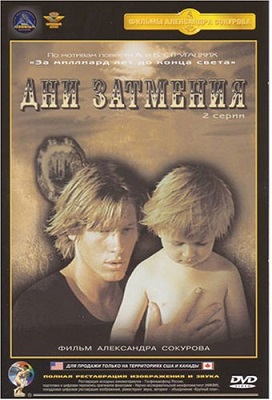
days_eclipseDays of Eclipse, Aleksandr Sokurov (1988, Russia). It’s not easy to love everything in a particular director’s oeuvre. Take Douglas Sirk, for example. All That Heaven Allows is my favourite film, and I also love Imitation of Life, Magnificent Obsession and Written on the Wind. But Sirk also made a lot of forgettable films, like Taza, Son of Cochise or Battle Hymn. Aleksandr Sokurov is the director I most admire, and while I don’t love his films in the same way I love All That Heaven Allows, I do find them endlessly fascinating – and one or two I have watched repeatedly because they are so gorgeously filmed and yet so strangely resistant to parsing. Days of Eclipse is one of Sokurov’s better known films, albeit not in the Anglophone world as no English-subtitled edition has ever been released on DVD. It is also, unlike many of his other films, an adaptation of a novel, a science fiction novel, Definitely Maybe by Arkady and Boris Strugatsky. But not an especially faithful adaptation – in the book, the main character is an astrophysicist and a mysterious force is interfering with his research; in the film, the main character is a doctor in a poor town Turkmenistan, and he discovers that religious faith appears to be improving the health of his parents. The movie is shot in a variety of different styles – mostly in a sienna-tinted monochrome, but occasionally in colour, and sometimes in straight black and white. If there’s a pattern to this, I didn’t spot it. The protagonist also unfortunately looks more like a member of a boyband than a Soviet physician, which is a little off-putting. But it’s certainly a film – like all of Sokurov’s – which bears repeated viewings and, in fact, pretty much demands them. I’m going to have to watch it again, for sure. At least it’s not one of the impenetrable ones which, typically, I tend to prefer as I can never figure out what’s going on in them. Days of Eclipse feels perversely straightforward. I still think Sokurov is one of the most interesting directors currently working, and I love the philosophical meditations of his documentaries… but his fictional films seem, to me, to succeed more the… more painterly they are. If that makes sense. The stories feel like snapshots, as though an encylopaedic knowledge is required to tease out and comprehend all the references. It makes for a viewing experience that leaves you wanting another viewing…and another one… and another one. I’m glad I finally got to see Days of Eclipse, even though I found it a little disappointing; but I’m extremely glad I have a copy of my own and can watch it again at my leisure. Which I certainly plan to do.

julietJuliet of the Spirits*, Federico Fellini (1965, Italy). When I bought myself copies of Casanova and Fellini Satyricon, I decided to chuck Fellini’s Roma onto the order despite having never seen it. I could have chosen Giulietta degli spiriti (Juliet of the Spirits) instead, since it was Fellini’s first film in colour and initially it looks on a par with the films mentioned… Fortunately, I didn’t. I liked Roma much more than I did Juliet of the Spirits. You see, there’s something I don’t quite get about Fellini’s films. The colour ones I’ve seen are hugely self-indulgent – it’s their chief appeal; and yet the black and white ones I’ve watched have not been as indulgent to the same extent. Except perhaps . And now I think about it, the whole trapeze thing in the final act of La strada is pretty self-indulgent… But Juliet of the Spirits is just as mad as Fellini Satyricon and Casanova, and just as much the product of a director who appeared to have free rein, and no desire to self-censor. It’s the complete antithesis of Hitchcock. At least it is in that respect. But Hitchcock apparently liked to build complicated sets on soundstages, and so too did Fellini – pretty much all of Juliet of the Spirits appears to take place on one. (I was also maused to spot in the openning titles that much of the film’s wardrobe had been supplied by Bri-Nylon.) The title character is married to a man who organises events and charity shows, and is also a serial philanderer. A series of encounters with a number of strange people guide her to a resolution with her husband. It would not be unfair to describe the film as a series of encounters with grotesques (in its original sense – the word derives from the statues placed in grottos in 15th century Italy), although the “caves” here are mostly over-furnished sets intended to be people’s homes, or a wood, or the beach, or…  Giulietta Masina is quite astonishingly good in the title role, appearing both knowing and wide-eyedly innocent. The artificial nature of some of the sets – their house, for example, appears to have an astroturf lawn – sometimes feels tonally wrong. And, to be fair, the whole occult element of the plot was totally lost on me. I would rate it higher than the black and white Fellini films I’ve seen – except for – but not as good as the other colour ones I’ve seen.

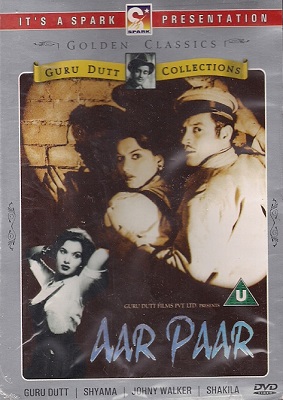
aar_paarAar Paar, Guru Dutt (1954, India). There’s this weird series of tonal shifts in many of the Bollywood films I’ve seen. Apparently serious subjects are interrupted by song and dance routines, or unprompted moments of physical comedy. Aar Paar does sort of the reverse. It starts off as a comedy – a bit of light-hearted joshing as Dutt is released from prison, and while wandering the streets of Mumbai he pratfalls when he trips over the legs of a mechanic under a car… This last is Nicky, the love-interest, and that’s the “meet cute”. But Nicky’s father will have nothing to do with Dutt. He carries a message, as promised, from another prisoner to a local gangster… and so becomes embroiled in the gangster’s dirty schemes, while posing as a taxi-driver. But as he woos Nicky, and she comes to love him, against the wishes of her father, so a young woman working in the gangster’s bar falls in love with Dutt. And then it all turns serious, with Dutt coerced into being the getaway driver for a bank robbery because the gangster has kidnapped Nicky… And then Dutt, plus Bollywood regular Johnny Walker, decide to double-cross the gangster and rescue Nicky, leading to a Hollywood-style car chase and shootout. With songs, of course. I think th ereason I enjoy Dutt’s films is because he shows more of India than you see in more recent Bollywood films – the first song in Aar Paar features a series of women carrying water; compare that with the generic Westernised yuppie characters in Dil Chahta Hai. True, Aar Paar owes a lot of its story and story beats to Hollywood rather than Bollywood, but it’s still a very idiosyncratic approach to the material, and it’s also highly entertaining. I’ll be watching more by Dutt, I think.

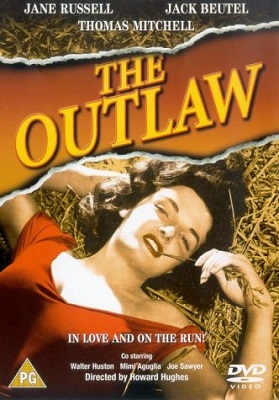
outlawThe Outlaw, Howard Hughes (1943, USA). I think this one ended up on my rental list because I thought it was a Howard Hawks film – and so it is… sort of. It was actually directed by Howard Hughes, but Hawks was uncredited co-director. And, after all that, it seems the film is mostly famous for Jane Russell’s boobs. Hughes claims to have invented a push-up bra in order to make Russell’s bust more, er, well, more. But according to Wikipedia she never wore it. And, to add insult to injury, Russell plays a token over which the male characters fight but isn’t in the movie all that much. It’s actually about Billy the Kid, Doc Holliday and Pat Garrett – and although the last is a sheriff, I’m not entirely sure who the title refers to. Anyway, Russell tries to kill Billy in revenge for her brother but fails; later, after Billy has been wounded in a fight with Garrett, she nurses him back to health… and falls in love with him. But Holliday still wants his horse back – the theft of which kicked off the whole plot, although it being in the Kid’s possession didn’t prevent the two from becoming friends (Holliday and the Kid, that is). But it transpires Russell is also Holliday’s girl, so her falling for the Kid pisses him off. There’s a double-cross which sees her strung up to tempt the Kid back so Garrett and Holliday can capture him. And some gunfights. And mostly it felt like the sort of mythologising sexist rubbish Hollywood has always churned out about the Wild West, with nothing to lift it above any others of its ilk. I believe it is currently out of copyright, but I can think of no good reason why it should be remembered and celebrated.

1001 Movies You Must See Before You Die count: 789


2 Comments

Reading diary, #32

I seem to have come over all genre. No idea how that happened. Six books and all are genre. Two weren’t published as genre, although one of them did win a science fiction award. I’m sure I’ll be feeling better the next time I come to write one of these posts…

the-brain-from-beyond-jhc-by-ian-watson-[3]-3859-pThe Brain from Beyond, Ian Watson (2016). This was launched at Mancunicon, but they didn’t have the signed edition available, so I ordered it from PS Publishing a couple of weeks later. It’s your typical Watsonian mad science fiction, which is – I hasten to say – not a bad thing. The invention of time travel has resulted in a lot of lost time machines, and so the Time Machine Salvage Ship Fibonacci, with its crew of four and AI, must go looking for them… and so gets dragged into a bonkers plot involving aliens in statis buried under Antarctica for 12,000 years which had been discovered a couple of centuries earlier, a Boltzmann Brain from far future after the universe has collapsed, a Creationist geologist from a theocratic USA… and jumps back and forth in time, stitching together the various elements of the story so that cause and effect end up tied up in some sort of Gordian Knot. Despite a tendency to fling ideas at the page in the hope that some will stick, this is a fun and clever novella. A definite contender for the BSFA short fiction award next year.

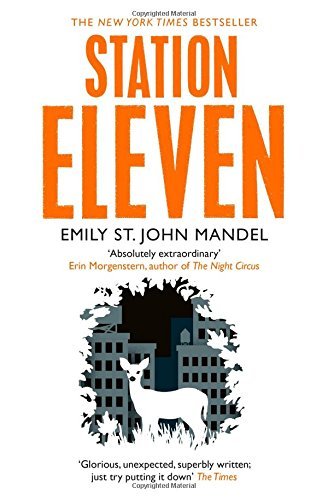
station_elevenStation Eleven, Emily St John Mandel (2014). This won the Clarke Award last year, and while I’d heard many good things about it, it’s a lit-fic post-apocalypse novel and I find post-apocalypse fiction banal at the best of times, and lit fic attempts at the genre all too often seem to think they’re doing something brand new and innovative, that no one has ever thought of before, and so the prose tends to reek of smugness. So my expectations were not especially high. Happily, Mandel proved a better writer than I’d expected, and I found myself enjoying reading Station Eleven. It’s still banal, of course; more so, in fact, because it trots out the Backwoods Messiah With The Persecution Complex plot, which should have been retired sometime around 37 CE. Anyway, a global flu epidemic wipes out most of humanity. Station Eleven opens in Toronto, when a famous actor has a heart attack on stage and dies. Then everyone else starts to die from the flu. The book jumps ahead twenty years to a post-apocalypse US, and a travelling orchestra/acting troupe, who travel the southern shores of the Great Lakes. And then there is a half-hearted attempt at a plot, which ties in with some of the flashback sections, which are about either the actor or the main character of the post-apocalypse story, a young actress in the travelling troupe. The writing was a great deal better than I’d expected, and so despite being post-apocalypse I came away from Station Eleven a little impressed. A worthy winner of the Clarke Award.

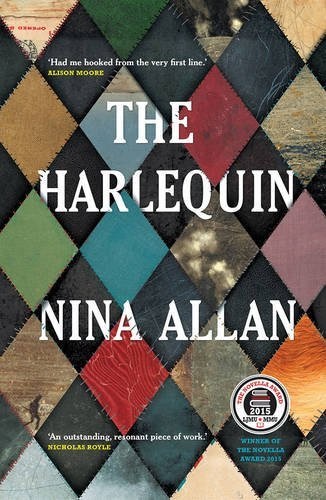
harlequinThe Harlequin, Nina Allan (2015). At some point it seems every writer has a go at a World War I story. Although World War II was more recent, and killed more people, and had a more profound effect geopolitically, for some reason it’s the Great War which attracts the literateurs. It’s not like I can claim to be immune – I’ve written at least one short story set during WWI. But Allan’s The Harlequin is actually set immediately after the Armistice, when concious objector Dennis Beaumont, who drove an ambulance near the Front, returns to London. On arrival, he bumps into an old shool master, whose reputation was somewhat unsavoury. Beaumont tries to pick up his life, with his sister and his fiancée, but instead finds himself in purely sexual relationship with a barmaid from a rough pub and unsuccessfully trying to ingratiate himself with the widow of a soldier who died in his ambulance. The Harlequin scores big on atmosphere, but like a lot of Allan’s fiction there are several things going on that don’t quite fit together. Clearly something happened to Beaumont in France, and its not until the end of the novella we learn that it might have been supernatural. But it feels like the plot is not in synch with the protagonist’s behaviour – the events of the past are insufficient grounding for his actions in the present. Still, what do I know? The Harlequin won the Novella Award last year. Allan is certainly a name to watch, and her prose is really very good, but, for me, her stories are never quite joined up…

dont_bite_sunDon’t Bite the Sun, Tanith Lee (1976). I’ve been after a copy of this, and its sequel Drinking Sapphire Wine, for several years – although not enough to hunt down a copy on eBay, or even shell out full price for the omnibus edition available from Amazon… but it was one of those books I kept an eye open for in the dealers room at conventions, in the hope of picking up a cheap secondhand copy. And, in the end, I had to leave the country to find one: I bought this is the Alvarfonden book room at Fantastika 2016 in Stockholm. I also found a copy of Drinking Sapphire Wine at the same time. A pair of lucky finds. I reviewed Don’t Bite the Sun on SF Mistressworks here. I can’t say it was really worth the wait…

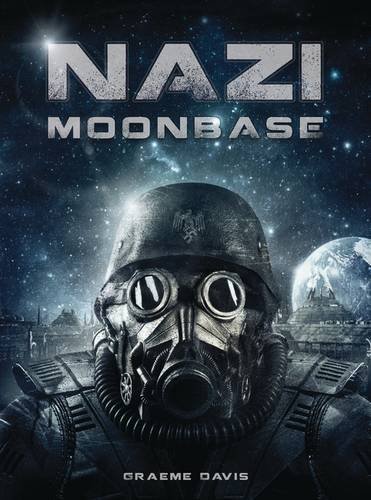
nazi_moonbaseNazi Moonbase, Graeme Davis (2016). I stumbled across this on Amazon – I can’t remember what I was actually looking for – and as soon I saw I knew I had to have it. It’s a faux non-fiction book which takes the whole Nazis at the South Pole Who Went To The Moon mythology as fact. It’s a clever melding of the various nutjob theories, and impressive in the way it presents it all absolutely straight-faced. It even takes the piss out of Iron Sky at one point by pointing out that Swastika-shaped buildings would be a bad design for the lunar surface. However, when it sticks to the interstices of known history, that grey area populated by the mythology, then it comes across as almost plausible. But the book has a tendency to push a little bit too far and declare as real something that plainly cannot be… Um, I’m explaining that badly. It’s suspension of disbelief, basically. UFO and Nazi occult science mythology exist in the shadows of science and history, and part of the reason for their longevity and pervasiveness is that they can fit in those dark spaces and the lack of illumination works in their favour. But when they step out of the shadows, the whole edifice collapses. And at several points in Nazi Moonbase, it threatens to do just that. As someone who has themselves stitched an invented history – more than one, in fact – into real history, I’m aware of the difficulties and sensitive to the techniques used. Nazi Moonbase is not entirely successful in that regard, although I did find it very amusing.

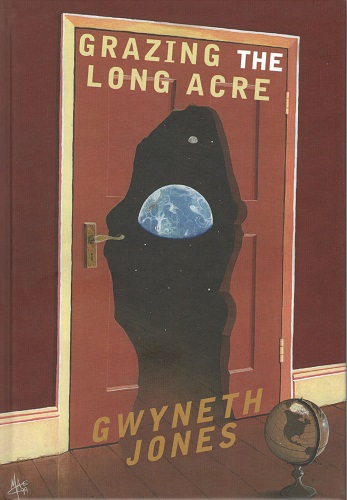
grazingGrazing the Long Acre, Gwyneth Jones (2009). I ‘ve been a fan of Jones’s fiction for many years, and consider her the best science fiction writer the UK has produced… so even though I probably I already have the stories in this PS Publishing collection in other books, I had to have it. The slipcased signed and numbered edition too. Grazing the Long Acre contains: ‘Gravegoods’, ‘The Eastern Succession’, ‘Blue Clay Blues’, ‘Identifying the Object’, ‘Balinese Dancer’, ‘Grazing the Long Acre’, ‘La Cenerentola’, ‘Destroyer of Worlds’, ‘The Fulcrum’, ‘The Voyage Out’, ‘Saving Tiamaat’, ‘The Tomb Wife’ and ‘In the Forest of the Queen’. Only ‘Destroyer of Worlds’, which originally appeared in Dark Terrors 5, was new to me. ‘The Fulcrum’, ‘The Voyage Out’, ‘Saving Tiamaat’ and ‘The Tomb Wife’ also appear in The Buonarotti Quartet; ‘Gravegoods’, ‘The Eastern Succession’, ‘Blue Clay Blues’, ‘Identifying the Object’, ‘Grazing the Long Acre’, ‘La Cenerentola’ and ‘In The Forest of the Queen’ are also in The Universe of Things. And yes, I have both of those collections. (‘Balinese Dancer’, incidentally, is also one of the stories in Daughters of Earth, followed by an essay on Jones and the story by Veronica Hollinger.) Apart from ‘Destroyer of Worlds’, as mentioned previously, I’d read all the stories before. Not that it proved a hardship. There are some authors whose novels you love but their short fiction you are cool toward; and vice versa. But Jones’s short fiction I find as sharp and bitingly intelligent as her novels, and while I may enjoy some stories more than others, in terms of quality I find little to distinguish between the two lengths. This reread proved an interesting exercise because revisiting stories can change your perspective on them. I found ‘The Eastern Succession’, for example, a far subtler story than I remembered it. But ‘La Cenerentola’ I felt a little heavy-handed. ‘Balinese Dancer’ was another I thought much better than I’d remembered it; and the Buonarotti stories proved much stranger than I recalled – the aliens of ‘The Fulcrum’ who are not aliens, the horror of the creature which bleeds… qubits?; the creepy atmosphere of the mausoleum in ‘Gravegoods’. I recently posted a review of Jones’s The Universe of Things I wrote back in 2012 (see here), and reading this collection four years after that I found my opinion of the stories pretty much unchanged. This is why I am a huge fan of Gwyneth Jones’s writing.

1001 Books You Must Read Before You Die count: 126


4 Comments

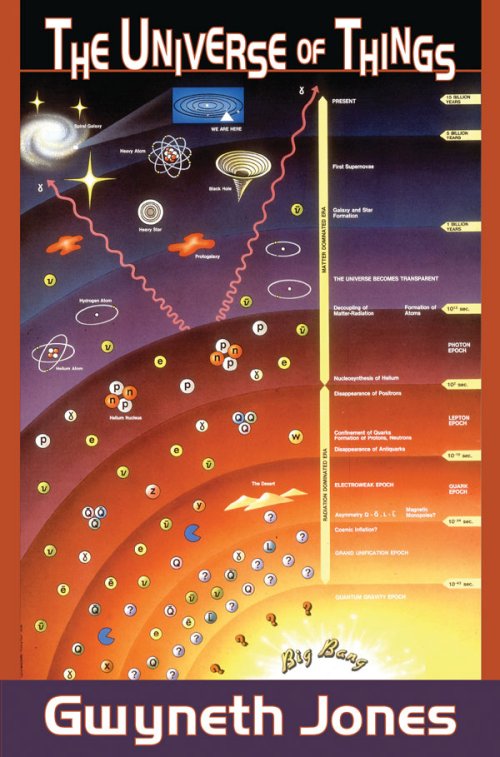
The Universe of Things, Gwyneth Jones

universe-cvr-lr-100The Universe of Things
Gwyneth Jones
Aqueduct Press, 2011
ISBN 978-1-933500-44-7

Gwyneth Jones does not write many short stories – forty-one in thirty-seven years – but when she does, by God they’re worth reading. As a result, throughout her career Jones has published remarkably few collections: five, in fact; and three of those are chapbooks. Unfortunately, there is a great deal of overlap between these collections, but if I were to choose one as the best, with the best choice of stories, and the most representative, with the widest selection of stories… it would be Aqueduct Press’s The Universe of Things. It contains fifteen stories, ranging from 1988 to 2009. Most are from the late 1980s and early 1990s. Most are science fiction, but not all. Some cover a page or two, others are novelette-length.

This is one of the strongest collections of genre short stories I have ever read. There is not a bad story in it – even the single-page ‘One of Sandy’s Dreams’, originally written for The Drabble Project in 1988, manages to do more in 100 words than China Miéville’s BSFA Award nominated short story ‘Covehithe’ did in several thousand.

Some of the stories are set in the universes of Jones’ novels. The title story takes place in the world of the Aleutian trilogy – White Queen, North Wind, Phoenix Café and Spirit – and is deceptively simple. An Aleutian takes its car along to a mechanic to have it serviced before selling it. The mechanic realises it is something more than just a car, it is a car that has been driven by an alien. He determines to do more work than asked, so he can then make an offer on the car, and so sell it profitably because of its provenance. But while effecting repairs, his thoughts are drawn to the Aleutian customer, and he briefly experiences how they view the world around them. His desire for the Other drives this epiphany, but to glimpse heaven is to recognise the cost of admission.

Change always exacts a cost. ‘The Eastern Succession’ takes place in the future-distant Peninsula of Divine Endurance and Flowerdust. One of the ruling princes has died heirless, so the remaining Dapur (the female councils who actually rule the principalities) gather in a town to determine to which of three candidates they will offer the crown. They must chose a prince who is both popular with the people of the prince-less state, the governments of the other principalities, and the Koperasi, the people who conquered the Peninsula and now rule it. The narrator is a young man of no family who visits the town to observe the deliberations. As a male, he has no power in Peninsulan society. Jones not only neatly turns the tables on gender relations, but she shows how pervasive sexism is at all levels and in all aspects of society. When the narrator tries to influence the Dapur’s decision through revealing a secret, it ends badly for all concerned. The narrator is playing at politics, he is imposing his own worldview, his own desires, on a situation which is resistant to both – but it is not him who pays the price for his meddling. There’s a clear sense in ‘The Eastern Succession’ that tradition exists for good reason, that change is costly and not always beneficial – and this in a world which is a distorted reflection of our own and, tellingly, set in a non-Western culture.

‘La Cenerentola’ by comparison is both near-future and set in Europe. A same-sex couple, Thea and Suze, are holidaying with their young daughter in the south of France and make the acquaintance of an American woman and her three daughters. Two of the woman’s daughters are beautiful, almost perfect, teenage twins; the third is a ragamuffin. The twins are in fact clones of the mother, their genetics tweaked to “improve” them – and yet, perhaps they are not: perhaps they are no more than holographic “eidolons”, idealised visions of their mother. The story plays with the tale of Cinderella, as its title suggests – Jones has, like Angela Carter, frequently turned to fairy tales for inspiration – but there’s no happy ending for this Cinders. Whatever the twins are, clone or eidolon, they are also signifiers of conspicuous consumption and part of their price has been exacted from the third child. Like the other stories in The Universe of Things, ‘La Cenerentola’ presents with a remarkable economy of words a fully-fledged world which seems as real and true as the real world. It seems wholly appropriate, for example, that in the world of Thea and Suze women fill every role and men are mentioned only in passing.

‘The Thief, the Princess, and the Cartesian Circle’ mocks the construction of a fairy tale while making use of its ur-text. It is a fairy tale, but also a postmodern literary piece, as mutable as the changes it rings on its titular protagonists. Though it opens with a line which follows the form, but not the content, of its type:

Once upon a time there was a princess who was quite pretty and fairly intelligent, and when the time came to marry her off, the royal family didn’t worry about it too much. (p 225)

The story then promptly gives the lie to this opening – the princess is headstrong, wilful and unbiddable – and then subsequently dismantles the fairy tale narrative to suggest a layer of inventions in which the relationship of the princess and the thief is defined by the world in which they live, and in which they define the world around them. The princess is driven by a need for realness but inhabits ever-changing surroundings – her environs are defined by herself; she is her environs. This is woman as creator, using a mode of fiction in which women’s empowerment is either gifted by an external agency or altogether absent.

‘Grandmother’s Footsteps’ is one of three horror/dark fantasy stories in the collection. A young couple move into an old house in dire need of renovation. But again, the change exacts a high price: the house is haunted. Or perhaps not. The narrator, Rose, must juggle her daughter, her career as an animator, and her aspirations for the house, and she is unequal to the task. Her failure to cope is externalised as the spirit haunting the house – the Ghost of Christmas Yet to Come, so to speak. Some of the imagery in the story extremely unsettling, and that the story maintains a chilling tone throughout, despite a focus on the quotidian, is testament to the strength of the prose.

The jewel of the collection is ‘Identifying the Object’, which has been a favourite story of mine since I first read it in Interzone in 1990 under its original title of ‘Forward Echoes’. It is, like ‘Blue Clay Blues’ and ‘The Universe of Things’, set in the world of the Aleutian trilogy. In fact, the Braemar Wilson of ‘Identifying the Object’s is the eponymous “white queen” of the first Aleutian novel. Braemar, the narrator Anna Jones, and Johnny Gugliogi (also the protagonist of ‘Blue Clay Blues’) are in Africa on the trail of what may or may not be the first aliens to land on Earth. Though it is set in the near-future, there is a thoroughly contemporary feel to the story. It is about Europeans experiencing an earthly Other while in pursuit on an unearthly one. It is also a story replete with assumptions, which it neatly skewers one by one:

Once he caught her in low company, têta-à-tête with an African down by the lifeboats. The black man fled. I heard racist assumption and that awful note of ownership in my poor friend’s voice.

“Hey! How come you suddenly speak their lingo?” (p 256)

There is no neat ending, no flying saucer on the Mall with a handsome representative in a space-age jumpsuit. There are many agendas at work here, and the truth of the alien landing is neither obvious nor relevant. Either way, a price must be paid – the possibility of the aliens’ existence is enough to force change. And this in an Africa which has refused to implement Western-imposed change; or rather, has made of its own change imposed upon it by Western powers. ‘Identifying the Object’ remains a favourite sf short story, and it continues to astonish me it was never shortlisted for an award.

It’s tempting to look for common threads in Jones’ fiction, but I suspect you’d find exactly what you were looking for. Her stories do not present easy answers. They’re happy to describe complex situations – indeed, they revel in their complexities. For that reason, Jones has often been called a “political” writer. In essence, this means she doesn’t write action-adventures stories in space. This is not sf as escapism, this is sf as literature. This is fiction that forces you to think, that makes you challenge your prejudices and preconceptions. These are stories that argue against change while forcing you to embrace it. These are stories which could only be science fiction, etc, yet are greater than mere genre fiction.

Gwyneth Jones is the finest writer of science fiction, who is currently still writing, this country has produced. Highly recommended.

This review originally appeared on Daughters of Prometheus in May 2012.


3 Comments

Moving pictures, #36

Nope… FAIL. I started well… but then it all turned into US films. Admittedly, a few are classics but…

idaIda, Paweł Pawlikowski (2013, Poland). Despite his name, despite the fact this film was made in Poland, about a Polish subject, with a Polish cast and Polish money… the director is a Brit and his previous films were all set in the UK. None of which makes the blindest bit of difference, of course. If there’s a sensibility at play here, then it’s undoubtedly more Polish than British – and that’s not just because Ida was filmed in black and white and is paced more like East European “slow cinema” than it is, say, Gosford Park. All of which, to my mind, are good things. The title refers to an orphan about to take her vows at a convent. The mother superior tells her she has one living relative, an aunt, and she should visit her before making her final decision. Ida’s aunt proves to be a judge, and a decade before in the 1950s had a been a state prosecuter known as “Red Wanda” who sent men to their deaths at state show trials. Ida wants to learn what happened to her parents, so the two drive to the rural farm where the family lived. They were Jewish, but had been protected by the locals during the Nazi Occupation; but then one night they disappeared. The family who now run the farm – and had protected the family – are afraid Wanda and Ida want their property back, and are prepared to fight for it. But Ida is really about the relationship between Red Wanda and her niece, and while Ida herself is something of a blank – played by a non-professional in her first role – Agata Kulesza as Wanda quickly takes over the film and carries it through to her abrupt end. Ida was the first Polish film to win an Oscar for Best Foreign Language Film, and I think it’s on a later 1001 Movies You Must See Before Die list than the one I’m using. An excellent film, definitely worth seeing.

taalTaal, Subhash Ghai (1999, India). Bollywood films are now a regular part of my viewing. I admit I prefer the historical ones more than the current ones, but this one did have a good soundtrack. And from my limited experience to date, it seems most Bollywood films follow the same plot: boy meets girl, boy loses girl, boy wins back girl. There’s also usually a class difference between the two, or at least something that makes the two lovers “star-crossed”. In this case, Akshaye Khanna is the son of a wealthy industrialist, and Aishwarya Rai is the daughter of a lowly folk singer. They meet cute (he nearly falls off a cliff, is saved by her, then inadvertently causes her to nearly fall off), and, er, fall in love, but his father is against the match, and insults her family when they visit in Mumbai. She goes off and becomes a pop star, using songs based on her father’s music, and pop-star/producer Anil Kapoor asks her to marry him. But Rai is still carrying a flame for Khanna, as he is for her; and Kapoor reluctantly realises this and gets the two back together again. So, pretty predictable stuff. But the song and dance routines are good, especially an extended number when Rai performs at a MTV Award ceremony in Canada. Fun.

dallasDallas Buyers Club, Jean-Marc Vallée (2013, USA). Which is anything but fun. McConaughey apparently lost 21 kg to play the lead role, and he looks bloody awful. It’s quite off-putting. True, he’s playing a man who’s HIV+ and only a heartbeat away from full-blown AIDS… and has a lifestyle that includes heavy drinking and smoking and frequent drug use. But it’s what he does after his diagnosis which forms the plot of the film. Dallas Buyers Club is about the system Ron Woodroof – a real person, and this film is based on his life – put in place to obtain unapproved drugs to prolong his life as a HIV sufferer. He smuggled the drugs into the US by claiming they were for his personal use, and got around the law by not selling them but giving them away free to people who paid him $400 a month to be in his buyers club. It was not his idea – he picked it up from schemes being used in New York – but Woodroof did sue the FDA for the right to take one of the unapproved drugs he had been using. Much has been made of McConaughey’s side-kick in the buyers club, a transgender called Rayon, who was not a real person but based in part on a number of people known to Woodroof, and played by Jared Leto. To be honest, Dallas Buyers Club felt like a film of actors acting rather than a somewhat liberal-with-the-facts retelling of a person’s life- oh wait, of course, biopic… I mean, it felt like an artefact, not that it was helped by being about a bunch of not very nice people who had found themselves in a truly horrible situation not of their making. And while people certainly died because HIV treatment was ineffective and inadequate during the early 1980s, Dallas Buyers Club unhelpfully implies this was partly the FDA’s fault because it refused to approve drugs… Except pharmaceuticals need to be carefully regulated because without controls all manner of horrible shit would be killing desperate people in order to fatten the P&L accounts of Big Pharma. Dallas Buyers Club also apparently claims the drug Woodroof was originally prescribed is toxic and ineffective, but it’s not. And the treatment he self-administered is far less effective than the film claims. It’s bad enough to paint the FDA as the villains when they perform a vital role; it’s another to completely misrepresent drugs and drug regimens in service to drama. Meh.

twentieth_centuryTwentieth Century, Howard Hawks (1934, USA). For a film made only three-and-a-bit decades into the century, naming it for the entire 100 years is a bit of a hostage to fortune. Still, we’re talking Hawks here, and pre-Code, and screwball comedy – so it’s likely to be entertaining if nothing else. And so it proves. John Barrymore is a Broadway actor and producer, and he decides to turn lingerie model Carole Lombard into a Broadway star, despite her initial lack of apparent talent. He succeeds. Three years later, she plits from him, and his career goes into decline and he ends up in jail for debts. He escapes, disguises himself and catches the Twentieth Century train – the real source of the film’s title – from Chicago to New York. Also aboard is, of course, Lombard. The movie then turns into a drawing-room farce, only the drawing-room is very long but very narrow and is travelling across country at a high rate of speed. There are a number of running jokes featuring other passengers, such as a man known for writing cheques he can’t redeem, and he gives one to Barrymore. Of course, the plot runs along rails as set as the Twentieth Century itself, and the presence of a desperate Barrymore after one big hit and Lombard on the same train naturally leads to a new partnership and, if not a happy ending, at least one that could lead to happiness.

shanghaiShanghai Express*, Josef von Sternberg (1932, USA). When it comes to US films from the 1930s I’ll admit I’m frequently baffled why some made the 1001 Movies You Must See Before You Die list and others didn’t. I could be charitable and suppose the list-makers hadn’t managed to watch every Hollywood film from the decade, but that would be unfairly assuming they’d skimped on their due diligence – I mean, you don’t produce a list called 1001 Movies You Must See Before You Die without making a serious effort to watch as many eligible films as possible. Perhaps it just comes down to value judgements – after all, “best is just subjective”… Except, of course it fucking isn’t, otherwise everything would mean nothing. But people respond differently to films, as I’ve certainly learnt during my informal project to watch all of the movies on the aforementioned list. So perhaps that’s it. True, I like me a 1930s screwball comedy much more than I like me a po-faced 1930s thriller, especially ones that wears its orientalism proudly on its sleeve and even uses “yellowface” in one of its lead characters. The title refers to a celebrated madam, played by Marlene Dietrich, who is on a train from Beijing (here called Beiping) to Shanghai during a civil war. Also on board are an ex-lover of Dietrich, a French general, a bible-basher, and a half-Chinese businessman. The last is played by Werner Oland, best known for playing Charlie Chan. And he proves to be more than a businessman, he’s actually a rebel warlord. And he takes the ex-lover, a British officer and brain surgeon on his way to operate on the governor-general of Shanghai, as hostage for one of his men taken by the Chinese authorities. It’s all very intense, and each character has a well-defined character arc… but you can’t help noticing that it’s played pretty damn insensitively and for all its star performances it’s still little more than Yellow Peril. If the 1001 Movies You Must See Before You Die list must have a 1930s film set aboard a train on it, it’d have been better off with Twentieth Century – and I don’t think that’s a great film either.

road_to_gloryThe Road to Glory, Howard Hawks (1936, USA). Not sure what happened here – the rental service must have suffered some sort of blip and sent me two Howard Hawks films from the thirties. But never mind. If the title of The Road to Glory reminds you of a later film by a certain Stanley Kubrick, the title is not the only thing the two (nearly) share. Both are set among French soldiers during World War I. And both far from glorify combat. However, where Kubrick’s movie was about three soldiers unfairly charged with cowardice, and the officer who fights to save them from the firing squad, The Road to Glory is about, er, two French Army officers who fall in love with the same woman. Oh well. I tend to think of Hawks as one of those directors who produced solid films with just that little bit more which showed he had a real eye for the medium. He was no auteur, but neither was he a workmanlike director. But that extra touch isn’t always evident in his movies. It’s there in Scarface, a handful of tricks and a certain eye in some of the scenes; but there’s little in The Road to Glory that doesn’t look like anything more than a dab hand at staging, lighting and blocking. I’ve watched quite a few of Hawks’s films by now, but I can’t say I’ve spotted a “Hawks vision”. Which is not something you can say of Hitchcock’s films. There’s something very distinctive about the way the Hitch staged and shot his movies, and if Hawks had an approach all his own I’ve yet to spot it. Perhaps I need to see more of his films. Perhaps no such thing exists.

battle_tankerBattle Tanker, Jeffrey Scott Lando (2011, USA). I spotted this in a charity shop and though it looked like the sort of thing put out by the Global Asymlum, I thought it might be worth a go. It wasn’t. It’s shit. Really shit. There’s this mysterious weaponised substance called ICE-10, which has something to do with a meteorite that landed in the 1960s and something to do with anti-matter – like everything in this movie, it’s all confused bollocks. This ICE-10 is kept in a secure facility in Alaska, but they want to drill there so the US government has decided the safest place for it is at the bottom of the Marianas Trench. The plan is to put the substance aboard an oil tanker, sail it to the trench, and then scuttle the ship. This is all helpfully explained… and the film abruptly cuts to the ship and it seems they’ve already gone and put the ICE-10 aboard and are halfway across the Pacific. We’re told the ship is a Very Large Crude Carrier, and the film’s title seems to confirm this, but VLCCs do not have holds with hatch covers because why would you put a giant deck hatch on a tank of oil? The ship is also entirely CGI, so it’s not like they couldn’t get it right – although it is very cheap and crap CGI. The interiors are just as bad, although at least they’re not tricked-out industrial plants. The character arcs and dialogue follow text-book story beats, which has the unfortunate side-effect of making the characters comes across as complete fucking idiots for most of the movie- oh wait, that’s how these sort of things work, you can’t have common sense in use too early because how else are you going to show that the characters have grown. Seriously, ban all recipes and templates from script-writing – it makes for shit movies. Having said all that, only a complete fucking idiot would expect Battle Tanker to be quality; and while I was expecting a piece of shit, it failed to even rise to those levels. At various points, the ICE-10 containment – the design of this on the monitoring software bore no resemblance to the actual CO2-wreathed hardware, suggesting a budget shortfall – is “vented”, which generates great clouds of anti-matter, or something, which makes things which encounter it blow up, such as US Navy cruisers, airliners, and, er, Honolulu… I found this DVD in a local charity ship, but I think the world would be a better place if, instead of returning it, I destroyed it.

1001 Movies you Must see Before You Die count: 787


Leave a comment

Moving pictures, #35

One of these days, I’ll put up one of these posts and it will not contain a single English-language film. But this time, I’m batting two from six for foreign-language films, which is an improvement on one from seven like my last Moving pictures post…

romaRoma, Federico Fellini (1972, Italy). When I picked up copies of Casanova and Satyricon, I decided to throw in Roma as well, even though I’d not seen it. I had thought, from the title and cover art (though, to be fair, I’d not looked especially closely at the latter), that Roma was set during, well, Roman times. Like Fellini Satyricon. I was, in fact, expecting something similar to that film, which is why I’d bought it – Fellini in all his 1970s indulgent colour. But it turns out Roma is about a young Fellini, who was actually from Rimini, arriving in Rome, and falling in love with the city. The end result is something which has the freedom and plotlessness of a New Wave film, but is in glorious colour and contains a strong thread of Fellini’s somewhat earthy humour. I had expected to like the film for the same reasons I’d like Fellini Satyricon – ie, because it was, basically, bonkers – but actually found myself liking it because it felt like a string of vaguely-related Nouvelle Vague scenarios shot with the sureness and control of a master director and in which the process of filming itself became one of the story’s narratives. One particular scene springs to mind: Fellini is filming something on Rome’s ringroad, and it begins to rain… Apparently, it was shot entirely on a soundstage, although it doesn’t look like it is. A featurette on the Blu-ray points out that a lot of the Roman locations were actually shot on soundstages – and that the same was true of many of the street scenes in Fellini’s . So there you go. I’d sort of added Roma to an order on a whim, but I liked it a lot and I’m glad I bought it.

futureworldFutureworld, Richard T Heffron (1976, USA). I found this in a charity shop, and while I can remember seeing Westworld, I wasn’t so sure if I’d ever seen this sequel. And having now watched it, I’m still not sure. Some bits seemed familiar, other bits didn’t. I suspect I probably did see it – the scenes with “Clark”, the robot rebuilt by the janitor, seemed familiar, and they’re not scenes that would normally be excerpted or trailed where I might have otherwise seen them. Anyway… after the oops-we-appear-to-have-killed-a-lot-of-our-paying-guests of Westworld, Delos is determined to push ahead with its robot-serviced fantasylands, and so has another go with a big promotional splash. Included in said splash are old-school newspaper reporter Peter Fonda and up-and-coming TV reporter Blythe Danner. Of course, there’s more going on than Delos’s PR department want people to know… Well, no, not really: the robots are perfectly safe, and are unlikely to run amuck and slaughter guests. Instead, Delos is planning to replace state and industry world leaders with robot replicas, although how people would tell the difference is never explained. Or indeed why they should be any different. Robot replicas reporting to a corporate overlord versus our current generation of politicians… Nope. Same thing. Aside from a frankly bizarre dream sequence in which Blythe Danner has sex with rogue robot gunfighter Yul Brynner, Futureworld is a bog-standard 1970s sf film in which frankly rubbish sfx are married to a hackneyed plot that some sf author probably covered two decades before. It’s not like the production design is anything special either – and I really like 1970s production design. Meh.

endearmentTerms of Endearment*, James L Brooks (1983, USA). Jack Nicholson is an ex-astronaut and a sad ageing womaniser. Shirley Maclaine, after being introduced via an entirely pointless prologue featuring her and her daughter, Debra Winger, and their relationship, is Nicholson’s neighbour. For reasons he does not appear to understand, he invites her out for a drink. The two are initially repelled by each other, for, it must be said, fairly good reasons. But they too fall in love, and Maclaine somehow succeeds in rehabilitating Nicholson, although her own snobbery survives more or less intact. As for Winger, who swoops into the story at various points, as if her life and relationships are germane to the central plot and not episodes that interfere in the central relationship between Maclaine and Nicholson. Terms of Endearment apparently won five Oscars – for Best Picture, Best Director, Best Actress, Best Supporting Actor and Best Adapted Screenplay – which no doubt explains its presence on the 1001 Movies You Must See  Before You Die list, but it is a pretty boring film. Maclaine is reasonably good, Nicholson does his usual gurning, Winger is good but her presence feels like an attempt to shoehorn a second plot in (perhaps it had more space in the original novel), and I totally forget who else was in the movie. I can at least now cross it off the list… but without any real sense of accomplishment.

red_desertRed Desert*, Michelangelo Antonioni (1964, Italy). This was a rewatch, and I normally don’t bother mentioning them – especially when I’ve written about the film before on this blog, as I did here… But Red Desert is so good, it’s one of my top ten films, and I rewatched it because I finally got around to upgrading my DVD copy to the Blu-ray edition and… It’s a beautiful film, it’s a painterly film. And it shines on Blu-ray. The film is all about industrial landscapes and their effect on the environment – as translated through Monica Vitti’s damaged character – and never has pollution looked so pretty. The scene where the group of friends gather in a hut on the jetty, and a ship draws up alongside… The ship seems even more over-powering, so close and so huge… It completely overshadows the sexual games the couples had playing in the hut earlier. The white fog which covers everything when they leave seems like a fitting commentary. Red Desert is a favourite film – hence the purchase of it on Blu-ray and this additional review of it – and it not only survived a rewatch, but the rewatch only increased my admiration for the film. A genuine piece of cinematic genius.

horizonswest11Horizons West, Budd Boetticher (1952, USA). When this dropped through the letter-box, I assumed I’d stuck it on my rental list because it was on the 1001 Movies You Must See Before You Die list. But it’s not. And it’s not a Howard Hawks western. So it must have been because it stars Rock Hudson. Except he’s not actually the star. Robert Ryan is the star. He and Hudson are brothers. After returning from the civil war (they were on the losinig side, you know, the side that thought it was okay to own slaves), they settle down to farm the family homestead. But Ryan has ambition. So he enlists the help of some local disaffected veterans, begins rustling cattle and selling them to the Mexicans, and so builds up a fortune. Raymond Burr plays the local grandee, who is a nasty piece of work, and provides additional motive to Ryan to earn his fortune – other, that is, than Burr’s wife, whom Ryan falls for, and who later proves the driver of his worse actions. Hudson meanwhile takes over as marshal and ends up attempting to bring his brother to justice. It’s an interesting situation, but it’s given the usual shallow Hollywood treatment. And there’s nothing else to recommend it. Missable.

shineShine*, Scott Hicks (1996, Australia). A biopic, and you know how much I love them… The subject in this case is David Helfgott, an Australian concert pianist. The film opens with Helfgott (Geoffrey Rush in fine form) demanding entrance to a closed restaurant during a storm… and over the course of the film he gets to know its staff, one in particular, and becomes a regular there playing the piano. He is a psychiatric patient, and it is a friend of one of the waitresses – Lynn Redgarve – who eventually marries him and so rehabilitates him. Before that, we have his history: his teen years as a gifted pianist, driven by his tyrannical father, arguments over competitions, over whether he can study in the US, his move to London to study at the Royal College of Music, his eventual breakdown and admission to a psychiatric hospital… This is a polished piece of biopic-ery, but I can’t honestly see anything in it that lifts it above others of its ilk. How it made the 1001 Movies You Must See Before You Die list is a mystery. Which is hardly something I’ve no said before… I watched it, that’s enough. Meh.

1001 Movies You Must See Before You Die count: 786


4 Comments

Reading diary, #31

Been a while since the last one of these. I have been reading, of course, and I’ve even managed to get into the habit of polishing off a few pages when I get home from work. And now that Dayjob Horrible Project has moved into a slightly less frantic phase (but only slightly less), I can start getting some writing done… including those reviews I owe people… Meanwhile, here are some short paragraphs, that aren’t really reviews, about books I’ve read…

if_on_a_wintersIf on a winter’s night a traveller*, Italo Calvino (1979). You are reading a book which opens with the line, “You are about to begin reading Italo Calvino’s new novel, If on a winter’s night a traveller,” and you think, sigh, metafiction. But this is Italo Calvino, and so you take the advice Calvino offers: “Relax. Concentrate. Dispel every other thought”– Hang on, every other? How will you know which ones to dispel and which ones to keep? And yet, it is perhaps sound advice as you read about a reader who reads a book only for his reading to be cut short, and when he goes looking for a complete copy of the novel he was reading he discovers he had been reading an entirely different book altogether… And at the book shop he meets a young woman who is also interested in this literary mystery he has uncovered, and together they discover yet a third novel mixed in with the previous two. But then he meets the young woman’s sister and becomes involved in her schemes… and at some point both young women end up in one of the narratives you are reading about him reading… And yet despite this literary shell game, where the narrative peas seem to proliferate out of sight under the cups, the whole is intensely readable and not in the slightest bit confusing. In parts it reminded me of Nabokov’s Pale Fire, although without the prissiness. It certainly convinced me I should read more Calvino – If on a winter’s night a traveller may be one long literary trick, but it’s gloriously done. Bravo.

gorelGorel and the Pot-Bellied God, Lavie Tidhar (2011). And from the sublime to, er, Tidhar. This is the first of his “gunpowder fantasies”, which I take to mean generic heroic fantasies but with firearms. (Obviously the guns and bullets and gunpowder are all made by magic, as fantasy worlds rarely have an industrial base.) Gorel travels to Falang-Et, the home of a frog-like race, in order to steal their most sacred magical object (not that he knows exactly what it is). En route, he meets up with a bird-like man and a fish-like woman, and the three join together for the theft. Which doesn’t go quite as planned. Of course. That’s the nature of these sort of story. The setting hovers on the edge of strangeness and familiarity. I’m not that widely read in this type of fantasy, or New Weird, but I think there’s a bit of Lovecraft in there somewhere; and probably some Clark Ashton Smith and William Hope Hodgson, for all I know. Whatever it is, the combination is pretty effective. The book’s novella-length works in its favour too, although the prose is occasionally a little too light on detail. It’s still not my thing, but I did enjoy it.

technopriestsThe Technopriests Supreme Collection, Alexandro Jodorowsky, Zoran Janjetov & Fred Beltran (2013). Originally published between 1998 and 2006, the eight-book bande dessinée series collected in this omnibus follow the fortunes of Supreme Technopriest Albino, and his two siblings, as he rises through the technopriest hierarchy while the other two track down the three pirates who raped their mother and so fathered them. The story is framed as Albino’s reminiscences during a journey to lead 50,000 technopriests to a new home in a distant galaxy. When the three were born, the mother rejected Albino and his four-armed red-skinned sister Onyx, and lavished all her affection on grey-skinned Almagro. She started up a business making “kamenvert” cheese, which became a galactic monopoly. But Albino wanted to be a videogame creator for the technopriests, only he proved to have much greater talent in that area than anyone had expected… This is not Moebius – the art is gorgeous, but all the characters are somewhat pumped up, so to speak. Happily, Jodorowsky’s off-kilter inventiveness is abundant. Although it takes a few twists and turns, it’s a more straightforward morality tale than The Incal or The Metabarons, and in parts it does feel a little like it’s retreading ground already covered in those earlier series. But if you like Jodorowsky’s bandes dessinées, you’ll like this one.

pavanePavane, Keith Roberts (1968). I’ve had this book for years – I collected the original SF Masterworks series as they were published – and was fairly sure I’d read it many years before. But having now read it (again?) I’m not so sure. I think I may have read a part of it as a short story – it’s a fix-up, after all. The central conceit has made it a touchstone work for an entire genre – alternate history or counterfactual stories. In Pavane, Queen Elizabeth I was assassinated and the Duke of Medina Sidonia successfully invaded England. The book is set at the time of writing in a Catholic Britain which is technologically far behind the real 1968 – obviously because of the Roman Catholic Church. It’s handled well – society seems to be stuck in the late 1600s, and some areas of science and technology not much past then. The first chapter, for example, is about a steam-powered road train. There is also a chain of great semaphore stations stretching the length and breadth of the country, as electricity has not been discovered nor radio invented. I’ve certainly heard it said that the Catholic Church set back science in Europe by about a thousand years, but I’ve never seen it argued with any degree of intellectual rigour. True, Hero of Alexandria had his aeolipile in the first century CE, and all the work done by Islamic medics, mathematicians and astronomers was completely ignored by the Church… But Roberts’s premise needs to be taken with a pinch of salt, since quite a few places – like the Holy Roman Empire – remained under Roman Catholic influence for a long period and progressed pretty much at the same pace as everywhere else. Still, Roberts was one of British sf’s better writers, and if Pavane isn’t his best book, it’s still a good one. ‘The White Boat’ is worth the price of entry alone. Worth reading.

death_familyMy Struggle 1: A Death in the Family, Karl Ove Knausgård (2009). Yes, I know the cover the book spells it Knausgaard, but the proper Norwegian is Knausgård; and no, I don’t know why the publisher felt a need to “Anglicise” it, as it’s not exactly hard to write. But anyway. This is the first book in a six-volume autobiography – as I write this five volumes are currently available in English – although for some reason the series has been published as fiction. Knausgård, it seems, prefers the term “novel” because he wrote the books as if they were fiction, although they were based closely on his own life. Certainly it’s true the level of detail for something set thirty years ago suggests fiction more than reminiscence. A Death in the Family covers Knausgård’s teen years in Tromøya in southern Norway, his friends, the girls he fancies, his introduction to alcohol, and his difficult relationship with his parents. In the second half of the novel, Knausgård tries to come to terms with the death of his father, and the state his grandparents have fallen into since their son’s death. I’ll admit I found the level of detail fascinating, even though the story itself is mostly banal. And the weird distancing effect between adult Knausgård presenting his memories and the lack of self-awareness by the teen narrator made for an interesting juxtaposition. I think I’ll give the second one, A Man in Love, a go…

old_devilsThe Old Devils*, Kingsley Amis (1986). “Professional Welshman” Alun Weaver returns to his South Wales hometown after a career in London as a writer and poet and TV pundit. His old friends are in two minds about his re-appearance. And that of his wife, Rhiannon. Yet they welcome the pair pretty much with open arms, and some private bickering. And a lot of drinking. One of the good things about The Old Devils is that, on the one hand, the various characters are conflicted about the Weavers’ return; on the other, things quickly settle into what is clearly a well-established routine. A number of past events resurface and cause a few problems, but they seem to be resolved with a surprising lack of drama – in fact, the most dramatic scene is prompted by the pettiest of disagreements. There’s often some nastiness on display – and of all the characters, it’s the wives who are treated worst. One might almost suspect Amis was a misogynist – one wife is cruelly mocked by her friends, another has her character assassinated, and a third heartlessly abandons her husband. The men are old codgers and drunkards, and amusing at times, but The Old Devils‘ one-sidedness does get wearying as the novel progresses. I’ve no idea why The Old Devils is on the 1001 Books You Must Read Before You Die list.

1001 Books You Must Read Before You Die count: 126