It Doesn't Have To Be Right…

… it just has to sound plausible


8 Comments

Overlooked Classics?

Inspired by this post, I decided to have a go at producing my own list of ten sf novels which don’t really deserve to be forgotten. They’re hardly lost classics – in fact, most of the following I bought remaindered. But that doesn’t necessarily mean they’re bad. Good books get remaindered too. Nor does it mean, as a friend once insisted, that they’re faulty because they’re full of spelling mistakes. Books get remaindered because they didn’t sell.

The science fiction novels below were never going to win awards or redefine the genre. But they are entertaining reads, by no means ordinary, and certainly worth picking up if you see them in some second-hand or charity shop.

The Broken Worlds (1986)
Raymond Harris
Harris had three books published, and then vanished. This is his first. It’s a space opera, set after the fall of a galactic empire. The Martians, immortal warriors, are trying to recreate the empire. Caught up in this are cabaret artist Attanio Hwin and the mysterious woman Sringlë. As space operas go, The Broken Worlds is more colourful than most. While Harris doesn’t try to give his universe depth by slapping on some pseudo-historical patina, he still manages to present a series of worlds which are unique and interesting. EC Tubb did something similar with his Dumarest series, but that was unremittingly grim. The Broken Worlds is fun – The Encyclopedia of Science Fiction even calls it “an attractive picaresque adventure”. Harris’ other two novels are Shadows of the White Sun, which is better than The Broken Worlds but not as much fun, and The Schizogenic Man, which is perhaps the least interesting of the three.

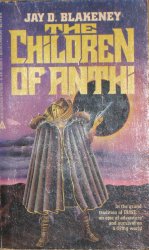
The Children of Anthi (1985)
Jay D Blakeney
Blakeney is a pseudonym of romance writer Deborah A Chester, who is also known under the name Sean Dalton for her YA sf series Operation StarHawks. The Children of Anthi is a richly-detailed space opera, in which scout Omari crashes on the world of Ruantl and is taken hostage by the world’s inhabitants. The story takes place on a single planet, but Blakeney has clearly spent a lot of time mapping out its society and customs. In places, it’s almost Herbert-esque, and fans of Dune will probably find something to enjoy in this novel. There is a sequel, Requiem for Anthi (1990), which is also worth tracking down.

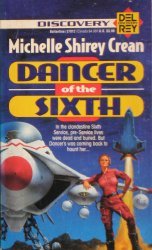
Dancer of the Sixth (1993)
Michelle Shirey Crean
As far as I’m aware, Crean has never had another novel published. Which is a shame, because Dancer of the Sixth is a pretty good read. It’s military sf, but it’s from that strange sub-set which feature female heroines, usually pilots. In this instance, the pilot is called Dancer, and she’s not a pilot anymore. Now she’s a member of the Sixth Service, military intelligence, and her past has been wiped and she conditioned to forget it. Until one day a fighter crash-lands on the planet where Dancer is stationed, and the pilot proves to be… someone masquerading as Dancer. So the real Dancer takes her place to find out what’s going on.

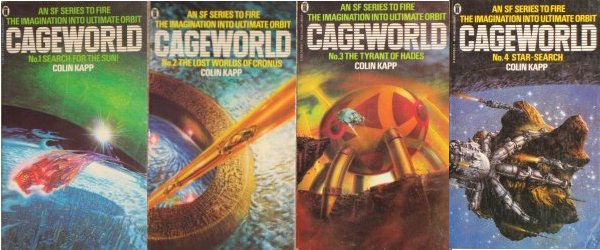
Cageworld (1982 – 1984)
Colin Kapp
This is a cheat as it’s a series of four books: Search for the Sun!, The Lost Worlds of Cronus, The Tyrant of Hades and Star-Search. The series features one of the most impressive Big Dumb Objects in sf – the entire Solar system has been encased in a concentric series of Dyson Spheres. Embedded in each Sphere are holes, and in these holes are Earth-like planets. People live both on these planets and the outer surface of the spheres. It’s all completely implausible of course, but that doesn’t matter. The series opens on the Mars-shell. The fabulously wealthy and mysterious Land-a has recruited Master of Assassins Maq Ancor, Space Illusionist Cherry, and Sine Anura, Mistress of the Erotic, to travel in towards the Sun in a specially built space-ship, Shellback. Contact with the shells’ controlling AI, Zeus, has been lost and they must discover why. In the subsequent novels, the same three travel outwards from Mars-shell, seeking to determine why emigration outwards has halted. Baroque and a great deal of fun.

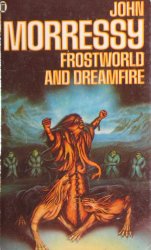
Frostworld and Dreamfire (1977)
John Morressy
Morressy wrote a series of sf novels set in a future interstellar federation called the Sternverein. This is the best of them. (The worst, The Mansions of Space, should be avoided.) Unusually for such space operas – and it’s the only one of Morressy’s series that is like this – Frostworld and Dreamfire is told from the viewpoint of an alien. Hult is the last of the Onhla, a race of primitive humanoid hunters who live on the frozen face of the planet Hragellon. He sets out on a quest to discover the world where legend claims other Onhla settled ages past. The Encyclopedia of Science Fiction describes the novel as “a strongly constructed and occasionally rousing epic of a metamorphic humanoid’s search”. Also worth seeking out is Morressy’s Del Whitby trilogy, also set in the Sternverein – Starbrat, Nail Down the Stars and Under A Calculating Star.

Part two of this post – another five “overlooked classics” – to follow soon.


3 Comments

I Did This So You Don’t Have To – Part 4

Here’s the final lot of films from the SciFi Classics 50-Movie Pack.

The Incredible Petrified World – a diving bell is sucked into a labyrinth of underground caverns, and the four crew-members are trapped there. A mad victim of a shipwreck from years before tells them there is no escape, but our plucky heroes – and heroines, of course – manage to find a route to the surface via a volcanic vent. This film is possibly only of interest to potholers.

Queen of the Amazons – a woman’s husband disappears during a trip into the African jungle. She organises an expedition to find him… only to discover he’s shacked up with the local Amazon queen. But she falls for her guide – who rescues her from all manner of jungle-related danger, of course; including man-eating lions and, er, locusts. There’s not much that’s sf about this movie. In fact, suspiciously many of the films in this 50-movie pack have been set in the African jungle. Maybe they’re hangovers from H Rider Haggard‘s She and King Solomon’s Mines

The Amazing Transparent Man – many years ago, comic 2000AD ran a story about a “Visible Man” – a chemical accident had turned his skin transparent so all his internal organs were, well, visible. This film, on the other hand, is just another tired retread of HG WellsThe Invisible Man. This time, however, he’s aiming for world domination. If he succeeds, how are they going to put his head on the coins and stamps, eh?

Horrors of Spider Island – an agent puts together a troupe of dancing girls for a show in Singapore. En route, their plane crashes and the bevy of beautiful girls find themselves stranded on a deserted island. It’s all sunbathing and skinny-dipping for a while… until their manager is attacked by a giant spider and turns into a half-man half-spider creature. Just like Club 18-30, then. While watching this, I couldn’t work out why the soundtrack was slightly off – the dialogue didn’t seem to match the lip movements. It was only afterwards I learnt that the film is German. I’d just assumed it was an early Roger Corman or something…

Devil of the Desert vs The Son of Hercules – another Italian swords & sandals starring some random bodybuilder as Hercules. These have all started to blur into one homogenous blob of badly-dubbed English, poorly-choreographed fight scenes, evil despots who live in caves and/or castles, and some bodybuilder hero in a leather skirt.

Zontar, The Thing from Venus – an object approaches Earth and proves to be an invader from Venus. It persuades an astronomer to act as its agent on Earth, but is eventually defeated. There was lots of people explaining the plot to each other – usually accompanied by manic laughter – and when Zontar finally does put in an appearance he looks like, well, like a bloke in a rubber monster suit.

Kong Island – some scientists visit the titular island with a plan to turn its gorilla population into an unstoppable army through the use of brain transplants. But a giant gorilla foils their fiendish plot. I know I’ve watched this one, but I have no memory of it. That’s probably a good thing

Bride of the Gorilla – Raymond Burr (better known as Perry Mason) is a plantation manager in a South American jungle. He falls for his boss’s beautiful wife, so he kills the old man and takes over the plantation and the wife. But his crime is witnessed by a native sorceress. She curses him. Every night, he turns into a… wild gorilla. After ripping various people to bits, he’s hunted down and shot. It’s all very silly but quite watchable.

Mesa of Lost Women – a mad scientist invents a serum which makes women beautiful. Men, however, turn into evil dwarves. (Sounds like beer to me.) The serum is actually made from, er, “spider hormones”. A group of people are taken to the secret lair of the mad scientist and manage to foil his fiendish plot.

Hercules and the Tyrants of Babylon – another US star gets roped into one of these Italian Hercules epics. This time it’s Peter Lupus of the Mission Impossible television series. He has to rescue the beautiful Queen of the Hellenes from the eponymous rulers of Babylon – who were actually the most interesting characters in the film. In all other respects, this was just like all the other Hercules films.

Hercules Unchained – happily, this was the last of swords & sandals. Hercules drinks from an enchanted spring, loses his memory, and shacks up with the beautiful but evil Queen Omphale. Fortunately, brave Ulysses helps him regain his memory, so Hercules wins the day yet again. I always thought Hercules only performed twelve labours, but it feels like I’ve watched hundreds of these films. I think I’d sooner muck out the Augean stables than watch another one…

White Pongo – the title creature a legendary white gorilla. A scientific expedition heads into the jungle to find it. One thing about this film puzzles me: the boxed set is titled SciFi Classics, but I fail to see what’s science-fictional about a jungle expedition to find a white gorilla. It’s not even horror, which at least some of the other non-sf films in the set are. But perhaps it’s a bit late to be asking this.

The Snow Creature – now this one is peripherally sf, inasmuch as the objective of the expedition is to find the fabulous Yeti. But in most other respects, it’s very like White Pongo. Parts of this movie appeared to have been filmed on location – although I suspect it’s the Rockies rather than the Himalayas…

That’s it. All fifty movies watched. And I survived. Now onto the second 50-movie pack, Nightmare Worlds

Also see parts one, two and three.


1 Comment

Alt.Fiction 2008

That’s the third alt.fiction finished. And each year it has grown bigger, and more areas of the labyrinthine Assembly Rooms have been opened to the event. I only made it to only two items during the day – a reading from his new novel, Kéthani, by Eric Brown (with the able assistance/prompting of Tony Ballantyne), and a talk by my agent, John Jarrold. I did want to attend the talk on ‘Science Fiction’ given by Eric Brown, Tony Ballantyne and Charles Stross. But it was the last item on the agenda at 8:15 p.m, and I didn’t want to get home late. Sorry I missed it, guys.

All attendees were given an ARC of Charles Stross’ Halting State in their convention pack. I had a chat with Charlie – mostly about the appalling cover art to the US edition of his Saturn’s Children and his upcoming signing tour of the US – and then got him to sign the ARC. On which subject… There were no dealers present – other than the redoubtable and near-ubiquitous Elastic Press, NewCon Press and TTA. This was both good and bad. Bad because I might have been able to pick up a few hard-to-find titles from the wants list. Good because it saved me money. The event organisers were selling books by the attending authors, and there was a signing session arranged about halfway through the day. But there was a poor choice of titles available, and they were pretty much all massmarket paperbacks. But then alt.fiction isn’t a convention per se, and that’s reflected in the attendees. This was particularly obvious during John Jarrold’s talk. Alt.fiction is aimed at unpublished writers, and in that respect the many talks provide some very useful and helpful information. And, of course, an opportunity to network.

Annoyingly, I forgot to take my camera along – although one or two people were happy I’d left it behind. I can’t think why… But, despite that, despite the lack of dealers, I had a good time, and I’ll certainly be attending next year’s alt.fiction.


2 Comments

Breeding Always Shows

For April’s entry in my 2008 Reading Challenge to try each month a classic author I’ve never read before, I picked A Question of Upbringing by Anthony Powell. It’s actually the first book in the 12-volume series A Dance to the Music of Time, and was first published in 1951.

In his 99 Novels: The Best in English Since 1939, Anthony Burgess describes A Question of Upbringing as “a work we may not always like, but we cannot ignore it”. That’s hardly a ringing endorsement, but the fact that he’s named it as one of the ninety-nine says much. Even the most cursory of googles will throw up plenty of approving reviews. Time magazine even included it in its 100 Best English-language Novels from 1923 to 2005. A Dance to the Music of Time is clearly a highly-regarded series of novels.

A Question of Upbringing opens with its narrator, Nick Jenkins, in his final year at Eton. It is 1921. Jenkins describes several incidents which took place that year, and serve to introduce the characters who will reappear throughout the series: Charles Stringham, Peter Templer and Kenneth Widmerpool. After finishing at Eton, Jenkins visits with Stringham, and then spends a few days with Templer. He next goes to stay in France, ostensibly to improve his French, before taking a place at Oxford. There he meets up with Stringham once again, and joins Professor Sillery’s coterie of possible future movers and shakers. The novels ends with a car crash: Templer on a visit drives his car into a ditch while carrying Jenkins, Stringham and some others as passengers.

As plots go, not much happens in A Question of Upbringing. Admittedly, it’s a relatively thin novel – 223 pages in my Fontana paperback edition – and it is only the first of twelve books. It’s an introduction, chiefly to the characters. Powell’s prose, in fact, focuses on the people, often at the expense of everything else. There are no sweeping passages of landscape painting as you’d find in Lawrence Durrell, or even John Jarmain. Jenkins analyses everyone he meets, and every action or utterance they make. It’s as if you’re standing before a large painting, armed with a magnifying glass and peering through it with your face no more than inches from the canvas. There is no clue to the “big picture” in A Question of Upbringing (which seems slightly weird, when compared to modern-day blockbuster high fantasy series).

The period in which the novel is set also invites unfair comparisons with PG Wodehouse or EF Benson. But A Question of Upbringing is no comedy of manners. The cast might all be upper-class twits – as Burgess points out, “Powell cannot take the lower classes seriously” – but Powell does draw his characters with a sharp eye, and he takes them very seriously.

The writing throughout is mannered, but very good. There is some strangely old-fashioned grammar – a tendency to run on sentences using colons, for example; but it doesn’t impede reading. Burgess’ pyrotechnics might be memorable, as are Durrell’s lyrical purple passages; but Powell is not so flamboyant. There are some striking images – A Question of Upbringing opens with a description of snow falling on a workmen’s brazier, which effectively sets the motif for the entire twelve-volume sequence.

I enjoyed and appreciated A Question of Upbringing. Which makes it the first success of this year’s reading challenge. While I’ve no plans to dash out and buy the other eleven books, should I see them in some second-hand book shop or charity shop: then yes, I will buy them and read them.

Besides, I’ve a feeling A Dance to the Music of Time improves a great deal as more of the big picture is revealed…


Leave a comment

The future is for the old, not the young

There’s an interesting article on the New Scientist blog pointing out that NASA’s workforce is greying. The average age of the organisation’s employees is now 47. During Project Apollo, most of the engineers and technicians were in their twenties. On 31 January 1971, when Alan Shepard walked on the Moon, he was, at 47, the oldest Apollo astronaut.

The greying of sf fandom is another established fact: the average age of people who attend sf conventions has risen each year.

I have to wonder if the two phenomena aren’t related. Of course, not all sf readers are rocket scientists and not all rocket scientists are sf readers. But both groups surely share a fascination with space exploration and space travel, with the universe out there. Away from planet Earth. The future, to both groups, lies in space, where humanity is no longer dependent upon a single fragile world.

Admittedly, space exploration is expensive and dangerous. But so is the War in Iraq. And many developed nations are happy to throw money into that. Of course, once – if – it’s all over, there’ll be vast profits to be made, rebuilding all the infrastructure destroyed by the invaders. But there are also huge profits to be made in space. The ROI on sending a M-type asteroid to Earth orbit from the Asteroid Belt would be phenomenal. And there’s all that real estate – not exactly habitable, it has to be said – waiting out there to be sold and tamed…

Is it that outward vision which society is slowly losing? There are no blank spaces left on maps of the Earth anymore – now we’re just dotting the i’s and crossing the t’s. And thanks to Google Maps, you can see anywhere on the globe from the comfort of your own home. You would think that now the Earth now holds so few mysteries, we’d go hunting for more away from the planet.

But instead we appear to be looking in and at each other. Even the War on Terror is just more inward-turned gazing: our enemy is hiding in our midst; watch each other; be vigilant; trust no one. Perhaps that’s the problem – all this overt and covert surveillance is taking the mystery out of our daily lives. And without small mysteries to sustain us, we can’t engage with the bigger ones. Pioneer spirit is like a muscle, it needs regular exercise…

Is sf engaging with those big mysteries? Looking at this year’s BSFA Award shortlist (see here), it would seem not. Three novels set in the near-future (Black Man, Brasyl, The Execution Channel), one set in an alternate present (The Yiddish Policemen’s Union), and only one featuring an interstellar humanity (The Prefect). Oh, and a meta-fictional graphic novel (Alice in Sunderland). In fact, it appears these days that the most popular forms of sf with interstellar settings are military sf and space opera. And both chiefly involve war, both chiefly involve entrenched political systems falling apart or struggling to adapt to violent change.

It’s a cliché, albeit a true one, that sf inspired a great many young men and women to become rocket scientists. And it was those people who helped put men on the Moon. I don’t believe for a moment that sf’s role is inspirational or didactic – even if that’s what Hugo Gernsback intended when he first published Amazing Stories in 1926. Science fiction is a branch of literature, and it has no responsibilities other than those which attach to it as such. I’ll confess I liked the idea of Mundane SF as an antidote to increasingly right-wing military sf and shoddy space operas. But on reflection it’s only another call to look inwards, to ignore what’s out there. Writing about the possible is hardly engaging with the big mysteries. It’s giving small-minded solutions to small problems.

Sf needs to re-engage with the big mysteries. Maybe then we can start looking up and out again. Maybe then we’ll be allowed to look up and out again.


3 Comments

I Did This So You Don’t Have To – Part 3

Yet more cinematic delights from the SciFi Classics 50-Movie Pack. And I use the word “delights” advisedly.

Warning From Space – yet another Japanese monster movie. In this one, flying saucers approach Tokyo – but not to destroy it. There’s a meteor on a collision course with Earth, and the aliens have come to warn humanity. I think this is the one that has the aliens that look like giant upright starfish with a big eye in their middle. They were… silly.

Phantom from Space – a flying saucer lands in California and a space-suited alien disembarks from it. He attacks and kills two passers-by. The authorities chase after him. So he takes off his spacesuit and underneath he’s… invisible!

Hercules & the Captive Women – sigh. More sandalled bodybuilders running up and down sandy valleys and in and out of caves. The eponymous women – it’s one at a time, rather than many at once – have been left out as sacrifices to Proteus by the queen of Atlantis. Hercules is only there because his friend, King Androcles of Thebes, drugs him and takes him on a mission to uncover who it is that’s trying to conquer Greece. But Hercules defeats the Atlanteans – the queen and an army of strange blond identical men with what look like false foreheads – and everyone lives happily ever after.

Lost Jungle – this one is a vehicle for 1930s animal trainer Clyde Beatty, and an excuse to have a lion and a tiger fight it out on-screen. Beatty’s (he plays himself) girlfriend disappears on an expedition to discover the lost island of Kamor, which boasts both African and Asian fauna. Lions and tigers, in other words. Beatty, freely admitting that Kamor will save him the expense of a trip to Africa and India, joins a rescue mission. And, er, rescues her. Oh, and there’s a fight between a lion and a tiger. Even though Beatty plays himself, the film makes an effort to give him a character-arc. I suspect that’s unusual in a 1934 film.

Teenagers from Outer Space – a bunch of Martians arrive in California in a flying saucer and decide it is an excellent place to raise their giant lobster-like cattle. Unfortunately, these creatures will destroy all earthly life, so one heroic Martian escapes to warn the population of a nearby town. There’s a sort of earnest amateurishness to this film.The special effects are poor, the acting is terrible, and the plot involves a lot of running about. Despite that it’s actually not bad.

Rocky Jones, Space Ranger: Menace from Outer Space – yet more interplanetary derring-do by Rocky, sidekick Winky, and token female Vena Ray. There’s a comet approaching the Earth, and it’s controlled by some villains. Rocky heads off in his spaceship and saves the day. Can anyone spell “formula”?

Colossus and the Amazon Queen – I bet Rod Taylor (of George Pal’s The Time Machine, among other films) doesn’t mention this one on his c.v. He plays the sidekick of strongman Glauco (played by yet another bodybuilder). The pair of them go exploring, and find themselves in the hands of the Amazons. Glauco escapes, and then rescues the others. All these Italian swords & sandals epics are starting to blur into one… Astonishing to think that these films were made in the same country that gave us the great Michelangelo Antonioni

Moon of the Wolf – there’s a werewolf loose down in the bayou. Even when this film was made in 1972, its plot was a cliché. David Janssen plays the manly sheriff, Bradford Dillman the louche aristocrat who’s really a werewolf, and Barbara Rush the sister who had a fling with the sheriff but had to go away because she consorted with the one of the lower orders… Southern Gothic meets An American Werewolf in Paris. In recent years, this has become an extremely popular sub-genre in written fiction – for reasons I completely fail to understand.

The Wasp Woman – an early Roger Corman, this one wasn’t too bad… except for the title character. The owner of a cosmetics company injects herself with wasp royal jelly in the hope of looking younger. Which it does. It also turns her into a wasp-human hybrid at intervals. Who attacks and kills people. Pretty silly. Um, on reflection, perhaps it wasn’t that good after all.

The Galaxy Invader – an alien crash-lands in the wrong part of the US, and a group of drunken rednecks go hunting for him. It’s sort of like Deliverance. But without a decent script. Or anyone who can act. Or a decent director. Or coherent dialogue. Actually, it was more like a home video.

Also see Part 1 and Part 2.


1 Comment

Swing, clang!, shuffle, swing, clang!, shuffle, swing, ow!

Between 1993 and 2002, I was a member of a long-running sf APA called Acnestis. Each month, we’d write a couple of sides on genre-related subjects, make 30 copies, and then send those copies to the administrator. Who would then send out a parcel containing one copy of each member’s contribution to everyone. Today, I was hunting through some of my contributions to Acnestis, and stumbled across this review of George RR Martin‘s A Game of Thrones from 2001. Enjoy…

There is little in A Game of Thrones that can be counted as truly original. The setting is stock high fantasy: a mix and match of Dark Ages peasantry and Camelot-style pageantry. There are, fortunately, no elves, dwarves, gnomes or (gag) hobbits. But there are dragons (although they only appear near the end), and lots of mediaeval hack-and-slash swordsmanship.

Where A Game of Thrones may be traditional high fantasy in terms of setting, it’s not in terms of structure. Unlike the Wheel of Time, Martin does not use the “hero’s journey” template but builds up his story from a number of narrative strands, only some of which actually intersect.

First, there are the various members of the Stark family, lords of the Northern wastes. Lord Eddard Stark, head of the family, is a rigid, honourable man, traditional in his views, and a good friend of King Robert Baratheon. The king has been outmanoeuvred increasingly often by his wife, Cersei, and her family, the Lannisters. When his advisor dies, King Robert turns to Stark to take over the position and bring his reign back on track. This, of course, upsets the Lannisters. Stark moves to the capital, King’s Landing, to take up his duties. There is much politicking and corruption, and, well… any more would constitute a spoiler.

Jon Snow is Stark’s bastard son and, while he is acknowledged as fruit of Stark’s loins, he can never inherit the family title or possessions. So he joins the Night Watch, a Foreign Legion-type organisation which guards the Wall far to the north. Winter is coming (seasons appear to last several years in the world of A Song of Ice and Fire), and mysterious, probably magical in origin, creatures are attacking the Wall and threatening to invade.

The other members of Stark’s family include: Bran, who is crippled after overhearing something he shouldn’t and who looks set to develop powers of some kind which could help later in the story; Robb, the heir, who takes over when his father heads south to the capital; Sansa, the eldest daughter, betrothed to King Robert’s son (who is spoilt and cruel, and takes after his mother, Cersei); and Arya, Stark’s other daughter, who is something of a tomboy and more interested in sword-fighting than courtly intrigue and pomp and circumstance.

On another continent, Daenerys, last of the Targaryen dynasty, the previous rulers of Baratheon’s kingdom until he had overthrown them, has been married to Khal Drogo, lord of a Mongol-type horde. Her brother, who is a real nasty piece of work, is hoping the khal will provide him with an army to take back the throne “stolen” by Baratheon.

The novel alternates chapters between these (and a few more) characters, and all of them in some way affect the story-arc and the novel’s resolution. Despite the size of the cast-list (and Martin includes a sizeable dramatis personae at the back of the book; and, of course, a map at the front), it’s easy to keep track of the major characters. (I had to keep on referring to the dramatis personae for some of the minor characters, however.)

This technique of multiple viewpoint-narratives is one that’s commonly used in techno-thrillers, which is itself a best-selling genre. It’s also better-suited to the complex political nature of Martin’s story than the traditional hero’s journey structure would be. This, however, doesn’t really explain the book’s appeal.

It’s either the setting, or the story. The story owes more to dynastic historical or semi-historical fiction than it does to high fantasy. There’s no Quest, no object which can save or destroy the world, no army of darkness, nor even some vast prophesied change which must be helped or avoided. In that respect, A Game of Thrones is really quasi-historical fiction. There’s little in the way of derring-do, or real heroics, and certainly no one person upon whose shoulders the fate of the world rests…

Which means, I suppose, that high fantasy must sell more because of its setting than any other factor. The question is, is it the details of the particular world, or the mere existence of the particular world, which appeals? Will any old mediaeval land do, or is it the differences between the fantasy land and the historical model? There is, as I said earlier, little that’s all that original in A Game of Thrones. The cities, villages and castles are straight from the Dark Ages. The combat, arms and armour are straight from the Matter of Britain…

Which raises an interesting point. In many high fantasy series (and A Song of Ice and Fire is one), both hack-and-slash sword-fighting exists alongside thrust-and-parry. Historically, in the West, one developed from the other; the two techniques did not really exist alongside each other. During the Middle Ages, swords were big, heavy, often required two hands, and had cutting edges. They were, effectively, sharp-edged clubs. You swung them, as hard as you could, at your opponent. If you were strong, skilled, or lucky, you inflicted a wound. By the reign of Elizabeth I, sword-fighting had become cut-and-thrust, the mode perhaps most familiar from “swashbuckler” movies. Swords could cut, but they could also wound or kill with the pointy bit at the end. The cutting-edges gradually disappeared over time (because a blade without cutting-edges was stronger), until during the Renaissance sword-fighting focused almost exclusively on the pointy end—i.e., the rapier (a corruption, via the French, of the Spanish espada de ropera, or “town / dress sword”).

In A Game of Thrones, the noble male characters wear full-plate armour, often ornately decorated (and, judging by Martin’s descriptions, some of them probably have to be seen to be believed…). It is very difficult to kill someone in full-plate with a rapier. The blade simply isn’t up to piercing it. You’d have to find a weak spot (inside the elbow, for example), and hope you manage to hit it before you get brained with a mace or morning-star. Plus, of course, rapier sword-fighting requires you to be light on your feet—difficult when you’re weighed down with a suit made out of sheet metal. So, two knights in full-plate who want to cause damage have little choice but to swing at each other with hefty swords with cutting-edges (a great sword, bastard sword, sword-and-a-half, or something similar). Personal combat would be pretty much fixed in this mode.

And the mode used in personal combat would carry across into group combat or battles. Peasants, of course, would not have swords—swords are, after all, expensive, and certainly cost more to replace than your average peasant. No, the peasants have sharpened sticks. Put a bit of steel on the end and you have a pike (or put a short curved blade on the end, and the peasant’s weapon becomes doubly useful: he can chop up your enemies or reap the harvest with it). Alternatively, give your peasant lots of small pointed sticks, and a bow, and he becomes an archer, a “long distance” weapon.

Presumably Martin wanted to give his ersatz Dark Ages world some colour, and so threw in Arthurian pageantry. Which happened to go well with the social system he had set up. But, Arthurian pageantry demands full-plate and bastard swords; full-plate and bastard swords do not lead to exciting fight scenes—swing, clang!, shuffle, swing, clang!, shuffle, swing, ow!, shuffle, etc. The swashbuckling style of sword-fighting is exciting. So he threw that in as well…

Perhaps it’s this element of mix and match that lends high fantasy its appeal. It is, to some extent, the romance of the Middle Ages, without all the nasty stuff—squalor, rape, pillaging, disease, short lives, etc. The nearest high fantasy gets to this is in the combat, which is only one minor aspect of the period lifestyle. And so writers of high fantasy pick out all the romantic imagery of the Middle Ages, suggesting a low-maintenance lifestyle of well-earned hardship (never comfort), little responsibility and a level of self-actualisation that’s keyed to bringing in a good harvest. But you can’t have serfs without liege-lords and, it has to be said, there’s something equally attractive about the life of luxury led by the nobility: little or no fruitless work (that’s all done by the peasants), no decisions made by others, a very direct responsibility for lifestyle maintenance (everyone gets what they deserve), and all conflicts or problems are purely personal and can be resolved at the personal level (even in battle).

It’s all very well grinning with pride at a job well done, and looking forward to a hearty dinner of cheese and ale, as your sons bring in the bountiful harvest. But let’s not forget that your liege-lord could choose that very moment to come riding down onto your (clean, of course) hovel and rape your wife and daughters for a bit of sport. And there’s nothing you can do about it. In high fantasy, only villains of the darkest stripe would do such a thing, and their serfs are evil by association, so they deserve it.

It is, when you dig deep enough, American Rationalism that’s informing the various worlds of high fantasy best-sellers. Rewards are earned, never a function of position. Unless you’re a villain… in which case, you get your just desserts, anyway. One man can indeed change a world. Except, of course, he doesn’t. He leaves it exactly as he found it. The hero is there to maintain the status quo.

If there is a lesson here, it’s that a best-selling genre novel should boast: a) a world in which individuals can have a very real impact; b) said impact has to be earned through hard work and steadfastness; c) said impact is welcomed by all; d) the danger is always immediate and personal, as are the rewards; and e) there should be lots of colour.

A Game of Thrones, it goes without saying, features all of the above. As does Robert Jordan’s Wheel of Time series. The actual writing itself is immaterial. It need only be immediate. Themes and motifs only get in the way. Which might explain the merely competent writing that seems a given of high fantasy.

A Song of Ice and Fire is actually better-written than most of its ilk—although the line on page two, “A cold wind was blowing out of the North, and it made the trees rustle like living things”, initially seems to suggest otherwise (a Thoggism, if ever I saw one). Martin’s use of language may not be perfect, but his command of narrative structure is far superior to that of best-selling authors such as Robert Jordan, or David Weber. The prose is uniformly tight, without the extended introspective passages beloved of lesser writers. The dialogue is natural, and remains true to the characters uttering it. For those reasons alone, A Game of Thrones is a superior example of its type. Add in Martin’s departure from the standard template, and you have another reason for appreciating the novel in and of itself. But when you include the world he has built, the very sub-genre he is working in, well… you have a best-seller. Of course.


2 Comments

Yours is the Earth and everything that’s in it

I probably know what every Brit my age knows about Rudyard Kipling – born in India… The Jungle Book… Nobel Prize for Literature… ‘If–‘… He’s supposed to be the quintessentially British Empire writer. And yet I’ve only seen Disney’s The Jungle Book, and never read anything by him. Which is why I picked Kim as my March reading for this year’s challenge…

Kim is the orphaned son of an Irish soldier, brought up as a beggar on the streets of Lahore. One day, he meets a Tibetan lama, and becomes his chela or disciple. The two set off on a religious trek around India, searching for the River of the Arrow which will free the lama from all sin. In the past, Kim has also run errands for Mahbub Ali, a Pathan horse-trader who works for the British secret service. Through Ali, he becomes involved in the Great Game, the covert war for control of Central Asia between Russia and Britain throughout the Nineteenth Century.

During their journey, Kim stumbles across the regiment his father belonged to, and is identified as the son of a Sahib. He is sent to school, but then recruited by Mahbub Ali’s superior officer. He sends him to a top school for Sahibs in Lucknow. After several years there, Kim returns to his lama, and the two continue their religious trek, this time up into the foothills of the Himalayas. There they stumble across a pair of Russian spies and Kim does his part for Empire.

If British sf authors followed in the footsteps of HG Wells, after reading Kim I have to wonder if US sf authors took Kipling’s path. There’s something about its depiction of India during the days of British Empire which reads more like early US-style space opera than historical fiction. The mix of strange cultures, the historical info-dumping, the somewhat archaic language (all thee and thou), the nobility of purpose of the characters… It’s a rich and heady stew and every bit as exotic and adventuresome as Edgar Rice Burroughs’ Barsoom or Leigh Brackett’s Mars.

The prose is… odd. It’s not just the archaic language – you soon cease to notice that. But it almost falls into reportage in places, and Kipling frequently breaks the illusion between reader and story – at one point, for example, he even adds authorial commentary to an expression used by a character:

‘The house be unblessed!’ (It is impossible to give exactly the old lady’s word.)

A lot of the plot is carried in dialogue – as it is in a lot of early science fiction, where characters explain intentions and actions and consequences to each other. It’s never done crudely, like sf’s infamous “As you know, Bob,” info-dump. But I did wonder if such poor exposition in sf was born from a bad attempt to emulate Kipling’s style. Also, Kim‘s plot features a hurried tying-up of plot-threads and an abrupt resolution – yet another characteristic sf shares with Kim.

Despite all that, the landscapes in Kim are vividly-drawn, and the writing is at its most evocative and impressive when the story moves into the Himalayas. Perhaps some of the characters are a little over-the-top, especially Hurree Babu and Lurgan, two of Kim’s colleagues in the British secret service. And perhaps some parts of the story are glossed over a little quickly, such as Kim’s school years in Lucknow. But what is there has its compensations. It’s a fascinating world Kipling describes; but while there are enough adventurous elements to the story to keep you reading, there is also a lot of instructional dialogue.

I suspect I’ll not be reading Kim again. However, the (cheap) edition I bought also includes The Jungle Book. I think I’ll give that a go one of these days… and then stick the book up on bookmooch.com.


1 Comment

Mazel Tov

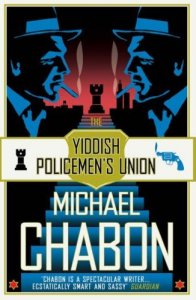
It takes a brave man in the US to criticise Israel. In The Yiddish Policemen’s Union, Michael Chabon has been even more courageous – in the world of his novel, Israel does not even exist. The Yiddish Policemen’s Union is an alternate history – or “counterfactual”, if you’re a literary snob – in which the Jews were booted out of Palestine in 1948, and so David Ben-Gurion never unilaterally declared on 14 May 1948 the establishment of the nation state of Israel. Instead, the US provides land in Alaska for temporary settlement, Sitka, on a sixty-year lease.

(There are clues in the story indicating that the world of the novel diverged further from our history than initially seems the case – a republic in Russia, mention of an atom bomb being dropped on Berlin in 1946, and references to a war with Cuba during the 1960s.)

Like Robert Harris’ Fatherland, Chabon uses his alternate history to tell a story whose resolution is dependent upon knowledge of real history. And also like Harris’s novel, The Yiddish Policemen’s Union reads like another genre entirely – in this case, a hard-boiled detective novel. Meyer Landsman is an alcoholic homicide detective living in a fleabag hotel. When a fellow tenant is murdered – executed, in fact, by a shot to the back of the head while high on heroin – Landsman investigates. Since Sitka is weeks away from “Reversion” – i.e., the end of the Jews lease on the Alaskan land, and thus the end of their “homeland” – Landsman’s superiors want him to drop his investigation. He deliberately disobeys them… and uncovers a conspiracy which reaches all the way up to the United States’ president.

The Sitka of The Yiddish Policemen’s Union is – as the title suggests – a Yiddish culture, rather than the real-world Israel’s Hebrew. Chabon does not translate the Yiddish, but the meaning of the words is clear from context. Anthony Burgess did something similar with Nadsat in A Clockwork Orange – even going so far as to say his intention was to “brainwash” the reader into understanding the borrowed Russian terms much as the protagonist Alex was himself brainwashed not to inflict violence. Given that Chabon has said in interviews that the inspiration behind The Yiddish Policemen’s Union was an article he wrote about a Yiddish phrasebook, this is perhaps not unsurprising.

The prose is very Chandleresque, although it occasionally struck me as a mite too calculatedly so. Some of the turns of phrase, the off-the-wall similes and metaphors, read a little forced. The relationship between Landsman and his partner, Berko Shemets, however, is handled beautifully – some of the best characterisation I’ve read in recent years, in fact. Interestingly, Chabon originally wrote the novel in the first person. Third-person present tense, I think, works much better. The tense gives the story an immediacy which pulls the reader along and over the hurdles created by unfamiliar Yiddish terms or Jewish practices.

Again like Fatherland, The Yiddish Policemen’s Union ends with an event which comes as little surprise to us from our knowledge of the real world. Chabon handles it at a remove, which lessens its impact. Landsman’s cynicism also acts as a barrier against the shock we should feel. But then, to have made him naive and credulous would have meant he could not follow the plot to its conclusion. As it is, the climax slips past little too quickly and easily.

Where The Yiddish Policemen’s Union really shines is in Chabon’s creation of Yiddish Sitka. It’s a fascinating alternate world, and described with a depth and level of detail uncommon in many alternate histories. Perhaps this is because the novel’s focus is very narrow – i.e., a single city and its environs, rather than an entire world. All the same, it’s an impressive invention.

Minor quibbles aside, I was much impressed by The Yiddish Policemen’s Union. Much has been made of Chabon’s sensitivity for the genre, and that attitude is very much clear in this novel. He has written a story that is quite clearly science fiction, without pandering to the snobbery of either the genre or its detractors. If only more writers would do the same…