Here’s what I’ve been reading and watching in the last few weeks:
Books
The Pilgrim Project , Hank Searls (1964), I reviewed on my Space Books blog here.
The Daily Mirror Book of Garth 1975, Frank Bellamy (1974). I remember Garth from the 1970s and early 1980s. I often stayed at my grandparents, and they took the Daily Mirror every day. The central premise is that Garth, who is immensely strong, has various adventures in time and space, usually righting wrongs as part of a war between Good and Evil – with Good represented by Garth’s “lover through the ages”, Astra. Usually, when travelling through time, Garth occupies the body of a man who resembles him in every way. The comic strip was limited by its format, and often had to repeat information each day, but the stories were reasonably inventive and Frank Bellamy’s art was excellent.
The Jane Austen Book Club , Karen Joy Fowler (2004), I decided to read after seeing the film, which I enjoyed. I have several books by Fowler – Sarah Canary
 , and a couple of collections – but I’d not read any of her mainstream fiction. The Jane Austen Book Club is cleverly structured – the discussion of each of Austen’s books is led by one member of the group, and that allows Fowler to tell their life-story, which in part echoes the themes of the Austen novel. Fowler also plays games with the narrator – the book opens with “our book club” and “we”, and returns to second person at various points, but none of the characters actually narrates the book. The film is a mostly faithful adaptation, although Jocelyn is played by Maria Bello and so younger than the book version. The sole male, Grigg is also more successful in the film, having made money in a dot com start-up; in the book, he’s just tech support. Overall, it seems strange to describe a novel by Karen Joy Fowler as light reading, but that’s what The Jane Austen Book Club is.
Flaubert’s Parrot , Julian Barnes (1984), I picked to broaden my reading. I’d not read any Barnes before, so I had little idea what to expect. And… this is not a book which wears its research lightly. The narrator, Geoffrey Braithwaite, is an amateur Flaubert expert and the novel is as much a dissection of the French writer’s life as it is about its putative plot – in which Braithwaite tries to determine which of the stuffed parrots on display in two Flaubert museums is the actual one Flaubert used when writing ‘Un coeur simple’. Braithwaite also has a secret of his own, which he gradually reveals as the book progresses. Flaubert’s Parrot is very clever and informative… but the central metaphor strikes me as a bit thin and Braithwaite’s own story doesn’t actually reflect thematically on his Flaubert expertise. As a readable and interesting treatise on Flaubert, the book succeeds very well; but as a novel, it feels unbalanced and Braithwaite fails to compete with the subject of his expertise.
After the Vikings , G David Nordley (2004), is a self-published collection of five stories which had previously appeared in Analog and Asimov’s during the first half of 1990s. They all take place on Mars, and are tied together with a framing narrative in which a pair of aliens discuss the extinct race which once lived on the planet. My copy is the 2004 revised edition, and it features some of the worst cover art I’ve ever seen (not the same as the version shown on Amazon). But the stories…. Back in the late-1990s, I tipped Nordley as a writer to watch, chiefly on the strength of his novella ‘Into the Miranda Rift’, originally published in the July 1993 issue of Analog and nominated for the Hugo and Nebula that year. He’s still regularly published in Asimov’s and Analog but since I’ve not seen either magazine for nearly 10 years, I’ve read only a handful of stories by Nordley and none recently. And he’s yet to produce a novel. After the Vikings is less good than I expected – the stories are very much 1990s Analog/Asimov’s sf, a little heavy in places on the science and the moralising, but well put together. I’m not sure about the final novelette, ‘Martian Valkyrie’, which features an inventive means of getting to Mars, but also includes some heavy-handed racial stereotyping and an unpleasant undercurrent of sexism.
Eclipse 2 , edited by Jonathan Strahan (2008), I bought because of the good reviews it’s received. And because I wanted to read more recent genre short fiction. The anthology is a good read, although I found the contents mixed. The stand-outs are Tony Daniel’s ‘Ex Cathedra’ and Peter S Beagle’s ‘The Rabbi’s Hobby’. Terry Dowling’s ‘Truth Window: A Tale of the Bedlam Rose’ is near-incomprehensible as it requires the reader to be familiar with the universe of Dowling’s novel, Wormwood
 – although, to be fair, the novel does seem like it might be worth reading. Alastair Reynold’s ‘Fury’ contains some good ideas, but feels a bit weak for him. Stephen Baxter’s ‘The Turing Apples’ is polished, but felt a bit cold and uninvolving to me. Nancy Kress’s ‘Elevator’ is just plain dull. The rest are all enjoyable and well-written, but none really struck me as especially exciting. Oh, and there’s a Chiang too. Which won the BSFA Award this year. And I wrote about it here.
Starship Fall, Eric Brown (2009), from NewCon Press is a sequel of sorts to an earlier novella, Starship Summer, published by PS Publishing. It’s set on the same world, Chalcedony, and features the same cast. With Brown, you always know you’re going to get well-written character-driven sf, and Starship Fall is no exception. There’s no cutting-edge idea at the heart of it, just a story about people on an alien world which unfolds in elegant prose to an inevitable bitter-sweet conclusion.
Apollo 11 Owners’ Workshop Manual , Christopher Riley & Phil Dolling (2009), I read for my Space Books blog. A review will be appearing there later this month.
Films
The Dark Is Rising , dir. David L Cunningham (2007), is yet another attempt to create a film franchise from a YA fantasy series. Hollywood hasn’t done too well so far – Pullman’s His Dark Materials
 never got to book two, which is a shame; and the second Chronicles of Narnia
 film didn’t do very well at the box office. The Dark Is Rising is adapted from the 1973 novel of the same name by Louise Cooper, actually the second book of the series. A boy on his fourteenth birthday learns that he is the “Seeker”, who must find the six Signs so the Light can defeat the Dark. There’s something old-fashioned about the film despite an attempt to drag it into the twenty-first century. It feels very mid-twentieth century, all English village halls and village schools and fierce winters. Although it doesn’t appear on screen, there’s a sense of austerity to the story. Not having ever read the book, I can’t say how well it has been adapted, but most of the adult cast appear to be sleepwalking through their parts. Christopher Ecclestone as the Rider is especially poor. I suspect The Dark Is Rising will be another film franchise which slowly fades away uncompleted.
Guard Post , dir. Su-chang Kong (2008), is set in a, well, in a guard post, in the demilitarized zone between North and South Korea. A company of South Korean soldiers have turned up to GP 506 (the film’s original title) to relieve the company on duty. Except they find said company slaughtered, but for a single survivor. Over the next few days, they try to discover what happened, while one by one they themselves die. This film isn’t as gruesome as I expected – which is good, because I’m not a big fan of grue. But neither is it quite as suspenseful as the premise suggests. It’s done well, but nothing about it really stood out for me.
Battlestar Galactica : Season 4
 and The Final Season
 (2008 – 2009), probably deserves a post of its own, but never mind. Lots of people have written at greater length and more intelligently than I could manage on this television series. What is interesting about the various commentaries scattered about the tinterweb are the points each commentator has picked up on. For me, BSG often failed because the writers didn’t have a clear idea right from the start what they were trying to do. So some episodes contradicted others, some made no sense in light of earlier revelations, and some were clearly knocked together in service to the “moral of the week”. The devil, they say, is in the details, and that’s where BSG often let itself down. When the fleet finds Earth, they determine that it was once populated by Cylons…. How? If they can identify 2,000 year old remains as Cylons, then why could they never determine who was a Cylon in the earlier seasons? But then I was never convinced by the Cylons – the BSG writers never seemed to grasp what machine intelligence might actually mean, or what machine intelligences in human bodies would be like. As for the final episode, ‘Daybreak’, I’m not as annoyed by it as some were. I quite like the idea of the Colonials feeding into the genetic heritage of Earth, and I can’t get upset at them walking away from their culture. Which is notoriously ephemeral anyway.
Boy Meets Girl (2009), was for review for videovista.net. See here.
The Last Sentinel , dir. Jesse V Johnson (2007), was also for review for videovista.net. See here.
Once Upon A Time In America , dir. Sergio Leone (1984), is in the Time Out Centenary Top 100 Films, but I don’t understand why. How a film can be so highly regarded when its central character rapes two women and suffers no qualms or consequences is beyond me. Once Upon A Time In America covers the beginnings of a group of Jewish gangsters in New York during Prohibition, and their eventual demise. The story is framed by the return of one, played by Robert DeNiro, thirty years later in answer to a mysterious summons. It’s all to do with the way his fellow gangsters met their deaths. The characters, being gangsters, are all nasty pieces of work, and quite frankly it’s difficult to care about them or what happens to them. At least in Westerns, there’s a disconnect – the milieu seems to be unrelated to the world as it is – so vile behaviour by characters is less likely to break the emotional compact with the viewer. And anyway, most Westerns are essentially white hats versus black hats. Once Upon A Time In America at least doesn’t romanticise gangsters – but then, that’s why it’s not especially entertaining.
Inkheart , dir. Iain Softley (2008), is yet another attempt by a Hollywood studio to kick off a new fantasy franchise. This time it’s based on the YA novels by Cornelia Funke. Brendan Fraser can apparently bring characters to life when he reads a story out loud – i.e., magically create them as real live people in his world. And he discovered this by reading a blindingly-obscure YA fantasy by an Italian writer to his young daughter… and subsequently giving life to the book’s chief villain and causing his wife to disappear into the book. And ever since he’s been hunting for copies of that book in order to try and “read” his wife out of it. With daughter, now twelve-years-old, in tow. Funke is German, and her books were first published in that country… which means this film has a European flavour somewhat at odds with its Hollywood treatment. It’s all very picturesque, and the European view of literature and fairy-tales sits uneasily on the US’s typical approach to this type of fiction. If The Dark Is Rising felt like 1950s England, then Inkheart feels even less anchored in the here and now.
The Band’s Visit , dir. Eran Kolirin (2007), is an Israeli film about, well, a band visiting Israel. The band are the Alexandria Ceremonial Police Orchestra from Egypt, and they’ve been invited to play at the opening of a new Arab cultural centre in Petah Tikva. Unfortunately, when they arrive at the airport, there’s no one there to meet them so they have to make their own way. They get it wrong and end up in Bet Hatikva, a dead-end town on the edge of the Negev Desert. (Arabic has no “p”, only a “b”, so the confusion is understandable.) The band are stuck overnight in Bet Hatikva, as there are no more buses. A local café owner, Dina, helps out, providing food and somewhere for the band members to stay. This is not a film in which much happens, but it’s well observed and the gentle humour and sharp characterisation carries you through to the end. Sasson Gabai as band leader Colonel Tawfiq Zakaria is especially good.
Honeydripper , dir. John Sayles (2007), is the latest film from my near-namesake. In this one, Danny Glover plays the owner of the eponymous ramshackle club in Alabama in 1950. He’s in danger of losing it – receipts are down and his unscrupulous landlord wants him out; and the local sheriff also wants to go into “partnership” with him. So Glover pins all his hopes on a live performance by Guitar Sam, a New Orleans star. Who doesn’t show. Happily, a young substitute takes his place, the concert is a success, and Glover gets to keep his bar. Given the period and location, it’s no surprise that the whites are pretty much entirely unlikable; but then neither are the blacks presented as paragons. Of course, much of the appeal of a film like Honeydripper is the music – blues, and early rock and roll. Although the latter only makes an appearance in the final scene. A polished work, with a sharp script, featuring polished performances and some good music; although overall not as good as Sayles’s Lone Star
 or Matewan
 .
.

 , a variant of one of my favourite sf novels, AE van Vogt’s
  . So I tracked down a copy and read it. It made for a somewhat bizarre reading experience – I blogged about it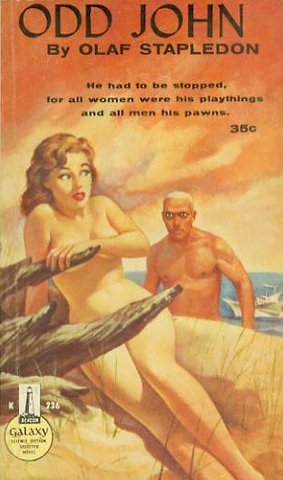
 , Olaf Stapledon (1959). This had already been published by Galaxy in 1952. As far as I’m aware, both editions were identical – i.e., the Beacon one was not “edited”.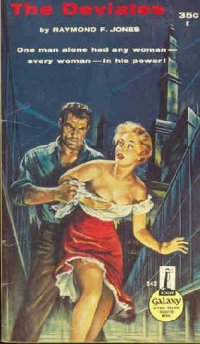
 , Raymond F Jones (1959). This was a spiced-up version of Jones’s novel
  . I have the Beacon one but not the original.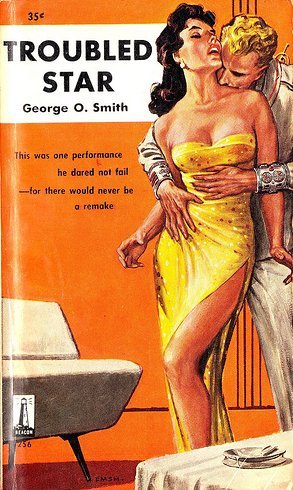
 , George O Smith (1959), was originally published under the same title as a serial in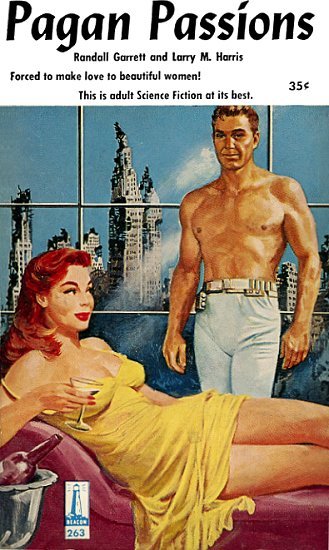
 , Laurence Janifer and Randall Garrett (1959), was, as far as I can determine, original to the Beacon series.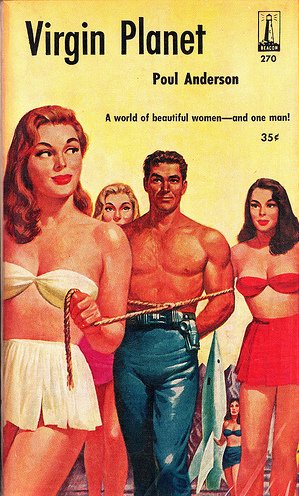
 , Poul Anderson (1960), was a spiced-up version of a novel of the same title published the year before.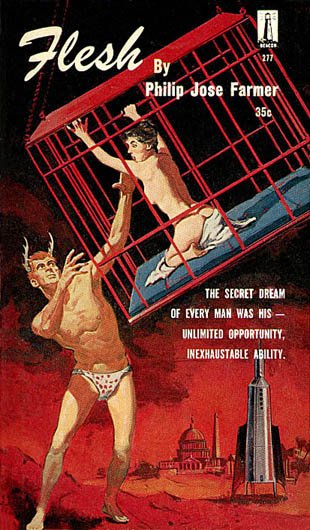
 , Philip José Farmer (1960), probably didn’t need any sexual content adding. It was original to the Beacon series.
 , Sam Merwin, Jr (1960), was an expanded version of ‘The White Widows’, originally published in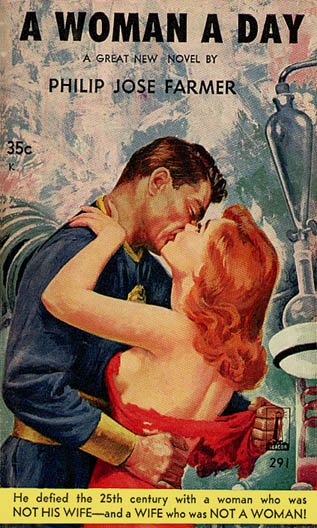
 , Philip José Farmer (1960), was an expansion of ‘Moth and Rust’, originally published in
  and
and  . I have both versions, so I could do this one.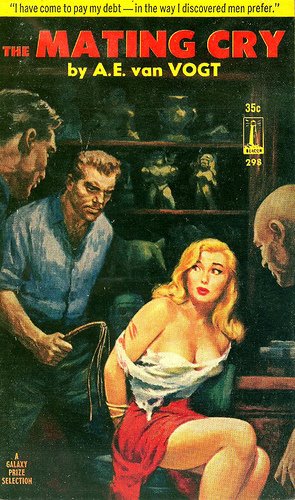
 from 1950. It was later published as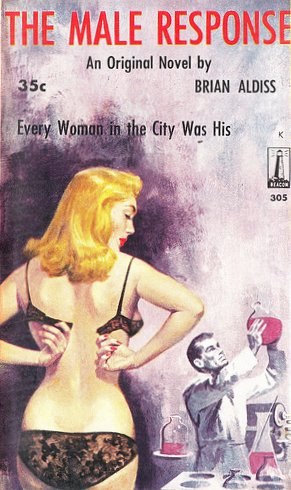
 , Brian Aldiss (1961), is another book which I think was original to the Beacon series.
 , Cyril Judd (1961), is a spiced-up version of
  . Although I’ve yet to read the Beacon edition, the original is a fairly ordinary tale of settlers on Mars, which might as well be set in any new town in the American Midwest. I really should get around to reading the Beacon version, so I can compare the two.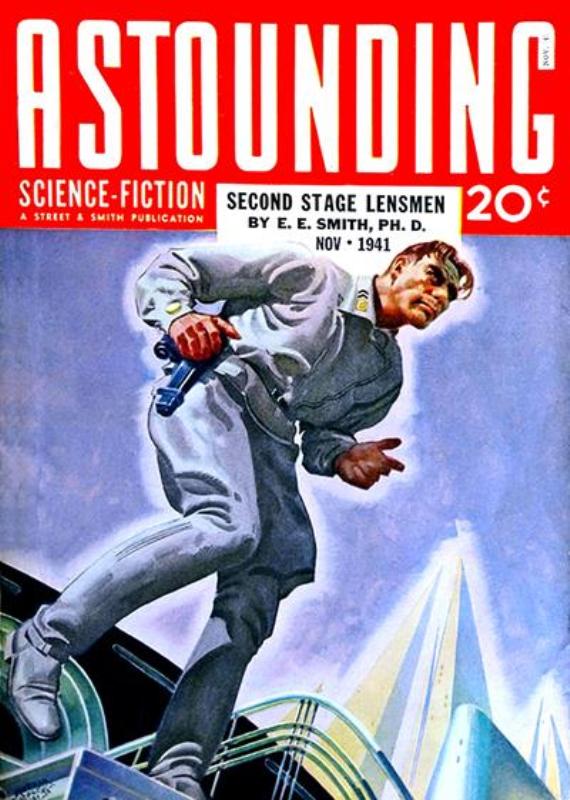
 is not a novel we should be holding up as indicative of the genre. A person who has a low opinion of science fiction is only going to have it confirmed by this book.
 . Which was shortlisted for the Hugo Award for Best all-Time Series in 1966 (it lost out to Asimov’s
  . In fact,
 (published by Pyr and edited by Lou Anders).
 is post-modern. It’s not story, and the makings of story. It’s simply two nested narrative universes, with two different vocabularies. And, using those different vocabularies for essentially the same story often confuses. ‘True Names’ adds further confusion through having the point of view leap from character to character without signalling a transition, having multiple iterations of the same characters, and having new characters randomly introduced as the story progresses.
 are clue enough. But I find it hard to find computing terminology
  It Doesn't Have To Be Right...