Not so many books and films for this update, since I’ve been working on, well, stuff. Incidentally, after the nonsense pulled by Amazon in the US, I’m trying a bit of an experiment here and using affiliate links to Book Depository – for the books, anyway.
Books
Chimpanzee Complex 2: The Sons of Ares, Richard Marazano and Jean-Michel Ponzio (2010), continues on from the first volume (see here), both in terms of plot, but also in containing an excellent idea which the story doesn’t quite use to its full potential. In the first book, it was the landing of a second Apollo 11 capsule sixty-five years after the original. In The Sons of Ares, the crew of the Mars mission have reached their destination and found the base of a secret Soviet Mars mission from the 1980s. Which was commanded by Yuri Gagarin. Whose death had been faked by the Politburo. But the Soviet cosmonauts don’t seem to have aged a day and… I guess I’ll have to wait for the third volume, due later this year, to find out what’s really going on in this series. Right now, I haven’t much of a clue.
Guardians Of The Galaxy: War Of Kings Book 2, Dan Abnett & Andy Lanning (2010), is also a little confusing, but that’s because it’s part of one of those Marvel “event” things, where they spread the story across half a dozen titles, requiring you to read them all if you want to get the full, er, picture. While this installment features lots of references to events not covered in earlier Guardians of the Galaxy volumes, it does make sense on its own. It’s also witty and funny, and Abnett and Lanning manage to shoehorn all the previous incarnations of the Guardians of the Galaxy into the story, without falling foul of Marvel’s typically unwieldy mungeing together of disparate character universes. When I first heard that the Guardians of the Galaxy were coming back, I was looking forward to reading their new incarnation. When I learnt the group now featured a talking raccoon, I was not so happy. But Abnett and Lanning have done an excellent job, and I’ve enjoyed the three volumes I’ve read so far. I hope there are more to come.
Prince Caspian, CS Lewis (1951), is the second book of the Narnia Chronicles. Well, it’s the second book to be written, but the fourth by story chronology. It’s not as patronising as The Lion, the Witch and the Wardrobe, but nothing very much happens in it. Peter, Susan, Edmund and Lucy are dragged back to Narnia, only to discover the world very much changed. Well, it’s been a few hundred years since they were last there. Now, nasty men from Telmar have taken over, and all the talking animals and magical things are slowly disappearing. The titular prince is a Telmarine but he wants Narnia back how it was. His uncle, who has seized the throne, wants rid of him. But Capsian escapes and, with the help of Peter, Susan, Edmund and Lucy – and Aslan, of course – overthrows his uncle and everyone in Narnia lives happily ever after. Except for most of the Telamrines – but they get to travel back through a magical gate created by Aslan to their original world, which is actually our world. There are two really interesting ideas in Prince Caspian, but Lewis makes nothing of them. First, Peter, Susan, Edmund and Lucy lived and ruled in Narnia for fifteen years – and so grew to early adulthood. But when they returned to the real world, they reverted to their original ages. And when they find themselves once again in Narnia, they remember ruling Narnia but they’re still children – those fifteen years don’t appear to have affected them all. Likewise, the fact that the Telmarines are originally from the real world – there’s an entire story all its own in that… As it is, Prince Caspian is mostly taken up with the four kids blundering through a wood as they attempt to reach a meeting of Narnia’s inhabitants in order to lead the fight against the Telmarines. I realise I’m the wrong age to read these books, but I’d not expected them to be so disappointing.
Animal Farm, George Orwell (1945), I don’t believe I’d ever read before, but it’s hard to say because it’s one of those stories which have entered popular culture so you know everything about it anyway. Orwell lays it on a bit thick – there are dumb animals and there are dumb animals. And the story displays a real cynical view of people I’d not thought George “you have nothing to lose but your aitches” Orwell subscribed to. I’m glad I read the book, and I did enjoy it. Liked the ending too.
T-Minus: The Race to the Moon, Jim Ottaviani, and Zander & Kevin Cannon (2009), is a comic-book retelling of the Space Race, which I read to review on my Space Books blog – see here.
The Poison Throne, Celine Kiernan (2010), was a review book for Interzone. It was originally published in Ireland in 2008 as a YA novel, and I’m not entirely convinced it will find many fans among fantasy readers.
Moon Lander, Thomas J Kelly (2001), I read to review on my Space Books blog – see here. Having recently found myself annoyed at the fluffy approach to invention in several sf author’s works, I found the authentic real detail in this book fascinating. The prose was pretty awful, but I wish science fiction could manage the same level of authenticity.
A Better Mantrap, Bob Shaw (1982), is a collection of short stories. The contents are polished, if lightweight, but they’ve mostly aged badly. It killed an afternoon, but it’s not Shaw’s best work by a long shot. Bizarrely, none of the stories in the book has the title ‘A Better Mantrap’, and I never did figure out why they called the collection that.
The Turing Test, Chris Beckett (2008), is a much better collection. Many of the stories in The Turing Test appeared in Interzone, and it’s also the book which won Beckett the Edge Hill Prize last year. One of the judges remarked that they hadn’t known they were science fiction fans until reading The Turing Test, but… I found several of the stories in this collection a little old-fashioned in their use of sf – something I’d also noticed about Beckett’s novel, The Holy Machine, when I read it. He’s an excellent writer certainly, but his fiction feels more like it’s touching the edges of genre than actively engaging with it. Perhaps I’ve been reading too many books about the Apollo programme, too many books which present something that, while real, is about as science-fictional as you can get and yet is wholly authentic. Beckett uses sf tropes, but they feel like literary tropes. In ‘La Macchina’, one of the stories in The Turing Test, there are robots and they go “rogue” – or seemingly develop artificial intelligence. That’s the idea which enables the plot, but it doesn’t quite convince – it doesn’t quite feel like sf. For me, the best story in the collection was ‘Karel’s Prayer’, which displays an almost Chiang-like working out of its central premise. Still, these are minor quibbles – this is a very strong collection of stories, and definitely worth reading.
A Very British Coup, Chris Mullin (1982), I bought in a charity shop as I remembered enjoying the television series when it was broadcast back in the 1980s. But what an annoying book this proved to be. In A Very British Coup, the Labour Party is taken over by left-wing extremists, led by Harry Perkins, an ex-steel worker from Sheffield. Labour wins the 1987 General election by a landslide. But the establishment – and the US – are not happy at having a bunch of lefties in Number Ten, what with all their lefty policies such as nuclear disarmament, removal of US military bases, protectionism, forcing pension funds and insurance companies to invest in industry, etc. So a loose alliance of press barons, civil servants and the US government set out to destroy Perkins and his Cabinet. And they succeed. I actually agreed with most of Perkins’ policies, but what made A Very British Coup so annoying was that Mullin made Perkins completely powerless. Despite being the legally elected leader of the country, he could do nothing. I also found it hard to believe that the civil service would actively work against the leader of the government – that would be treason, after all. A quick read, and a bit too simplistic to be a good read.
Films
Secrets Of Sex , dir. Antony Balch (1970), was one of this month’s review DVDs from VideoVista – see my review here. A bizarre and amateur, albeit mildly entertaining, look at the war of the sexes by a cult UK director. The DVD includes two short films directed by Balch, but written and starring William S Burroughs.
Hatchet For The Honeymoon , dir. Mario Bava (1970), was one of this month’s review DVDs from VideoVista – see my review here. My first Bava, and I was definitely not impressed.
Heart Of Fire , dir. Luigi Falorni (2008), was one of this month’s review DVDs from VideoVista – see my review here. A good one this one. I like North African cinema, and this was a quality film.
It’s A Wonderful Life , dir. Frank Capra (1946), unbelievably I had never seen before. It’s one of those films which everyone knows about – and knows the story of – although it’s never been shown on British television with anything like the frequency it has been on US television. I’d heard it was sentimental tosh, and I thought I knew what the story was… and perhaps for the final third of the film, when Clarence the angel appears and shows Jimmy Stewart what life in the town would have been like without him, It’s A Wonderful Life is indeed overly sentimental. But it’s mostly a portrait of small town American life in the first few decades of the twentieth century, and it does that very well. I thought it was very good, and I’m not ashamed to admit it.
As You Like It (1978) is one of the BBC’s The Complete Dramatic Works of William Shakespeare
 series, which I plan to slowly work my way through. I’ve probably seen a handful of Shakespeare’s plays all told, and none since leaving school. And yet he is a sort of important writer for us Brits. But rather than wait for a production to appear at my local theatre, I thought I’d watch the BBC versions on DVD. This one stars Helen Mirren in the role of Rosalind / Ganymede. Unlike most of Shakespeare’s plays, I’m familiar with the story of As You Like It, since I researched it for my story ‘In the Face of Disaster’, which will be appearing in PS Publishing’s Catastrophia anthology, edited by Allen Ashley (and due to be launched at Fantasycon in September of this year). Put simply, Duke Frederick has booted his brother out of power, and the latter now lives rough in the Forest of Arden (which apparently contains lions, giant snakes and palm trees). The exiled duke’s daughter, Rosalind, has remained in the palace, as she’s the best friend of Duke Frederick’s daughter, Celia. Meanwhile, Orlando, the youngest son of one of the exiled duke’s strongest noble supporters, has been cut out of his inheritance by his nasty older brother, Oliver. Orlando travels to Duke Frederick’s court and challenges the duke’s champion wrestler (Darth Vader David Prowse). He manages to beat him in one of the worst choreographed fights I’ve ever seen. Rosalind and Orlando fancy each other, but are too tongue-tied to say as much. Then Duke Frederick boots Rosalind out of the palace, and so she and Celia run off to the Forest of Arden. Rosalind decides to disguise herself as a boy, Ganymede. They stumble across a shepherd, hire him and buy a cottage in which to live. Orlando, meanwhile, has also wandered into the Forest of Arden, where he joins the exiled duke’s followers. And he leaves poems praising Rosalind’s beauty nailed to trees. He meets Ganymede, but does not recognise her, er, him. Rosalind as a boy is hugely irritating – like some sort of fast-talking woodland wide boy. He persuades Orlando to woo him as if he were Rosalind in order to improve Orlando’s chances with her, er, him. So, in Elizabethan times, this would have been a boy playing a girl pretending to be a boy who has just persuaded another character to treat him as a girl. No wonder they went and carved out an empire… Anyway, it all ends happily. Amazingly so, in fact. There’s just been a triple wedding in the forest, officiated by an angel, when up rides a member of Duke Frederick’s court. He explains that Duke Frederick was on his way to the forest with an army to wipe out the exiled duke and his followers when he met a monk. He got chatting to him, found God, and has decided to abdicate and lead a religious life. So the exiled duke can have his throne back. Oh, and nasty Oliver turned nice earlier after Orlando rescued him from a giant snake and a lion. As stories go, it’s complete tosh, a bunch of costumed nitwits wandering around in an English wood. Back in Old Bill’s day, it must have been hilarious. A couple of the jokes are still funny – although, to be fair, I had to watch the play with the subtitles on in order to follow it. But I still plan on watching the rest of Shakespeare’s oeuvre.
The X-Files – I Want To Believe , dir. Chris Carter (2008). Several years ago, I borrowed the first five seasons of The X-Files from a friend, and watched them back-to-back, two to three episodes a night. By the end of it, I was so paranoid, I could barely sleep… But the television series died a long drawn-out death back in 2002 and, despite many promises, seemed unlikely to revive. Until this film. Which, to be honest, wasn’t really worth the wait. Mulder and Scully sleepwalk through their roles, Billy Connolly plays a bizarrely Scottish paedophile ex-priest who has psychic flashes which leads him to the victims of a serial killer. Or is it a serial killer? This felt like a weaker episode from the television series, stripped of much of what made the series required viewing in the first place. It worked as a thriller, but it didn’t work as an X-Files film. A disappointment.
Passenger , dir. Andrzej Munk (1963), I stuck on my lovefilm rental list because… er, because… well, it must have looked interesting or something. Much as I like and admire the films of Kieslowski, I can’t say I’m a big fan of Polish cinema. Passenger was indeed interesting, although something kept it just short of being excellent. And that’s despite the fact that it’s unfinished. Munk died in a car crash before he completed filming, so half of the film is a series of stills and a voiceover – like Chris Marker’s La Jetée
 . Those scenes take place aboard a cruise liner, in which a German woman recognises another passenger – and subsequently comes clean to her husband about her past. She was a guard at Auschwitz, and the woman she recognised was one of the political prisoners. The scenes set at Auschwitz were complete, and apparently filmed at the death camp. While the juxtaposition of film and stills makes for an interesting approach to the material – even if it was accidental – the scenes set at Auschwitz seem to weaken as the story progresses, and that robs what should have been a powerful story of some of its, well, its power. Passenger is an interesting film, but it did feel as if it could have been a great film.
One Flew Over The Cuckoo’s Nest , dir. Milos Forman (1975), is another from the Time Out Top 100 Centenary List I’d never seen before. I can’t see what all the fuss was about, to be honest. Jack Nicholson played Jack Nicholson, as he always does. The rest of the cast – including some well-known names in their debut roles – played their parts well. But throughout it felt like you were missing something that you knew was there in the source novel. Perhaps it was because the story was so clearly one which demanded a first-person protagonist, and that’s something that’s never really works in films. The act of watching a film by definition puts you outside the protagonist’s head. Apparently, Ken Kesey refused to watch the film since it didn’t use Chief Bromden as the narrator. I can sort of understand how he felt. Not sure if I ever want to read the book, though.

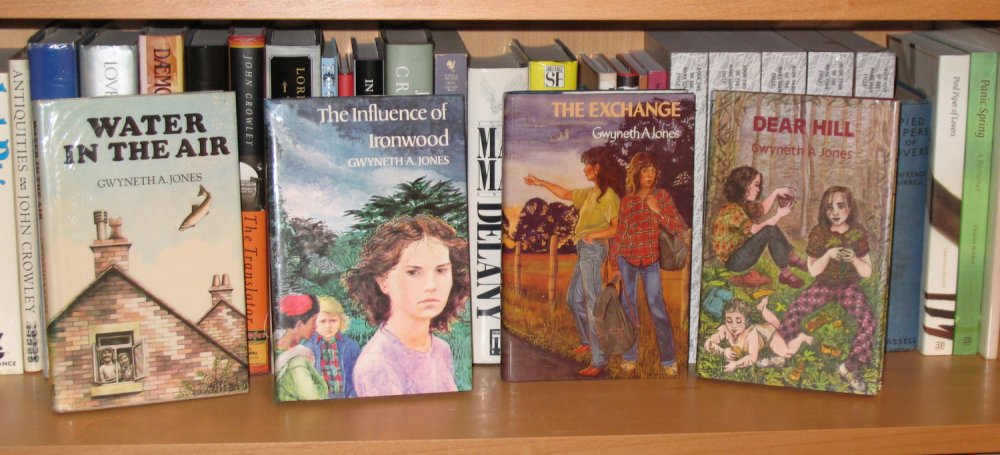 Four early YA novels, published as by Gwyneth A Jones.
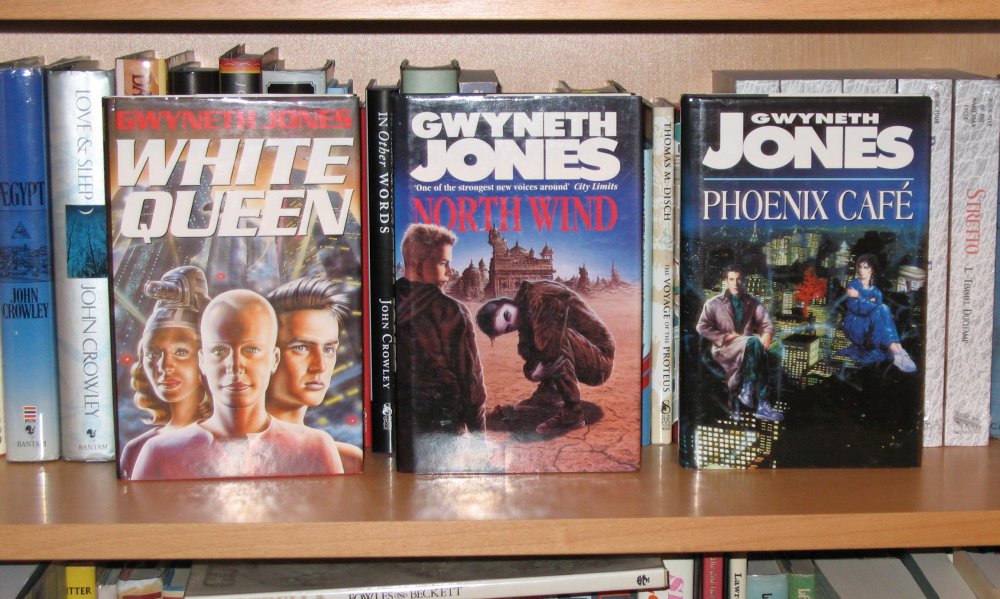 The Aleutian trilogy.
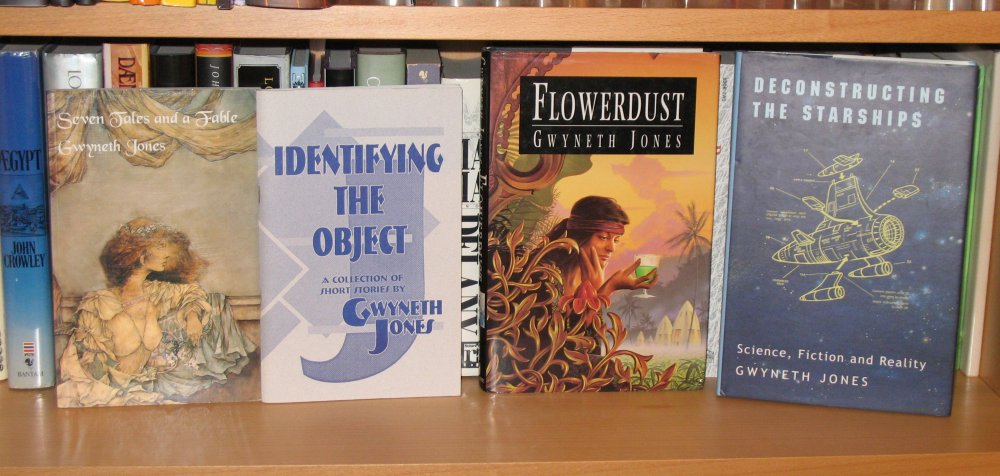 Two small press collections, a sequel of sorts to Divine Endurance, and a criticism collection.
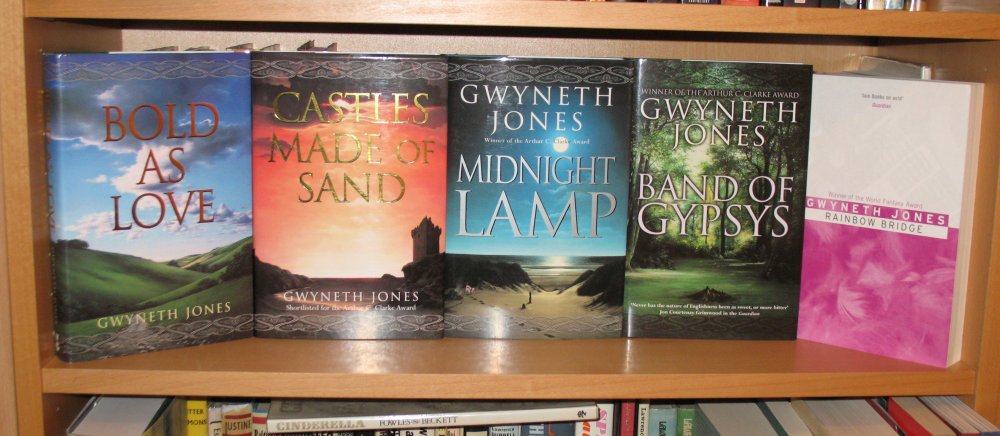 The Bold as Love Cycle.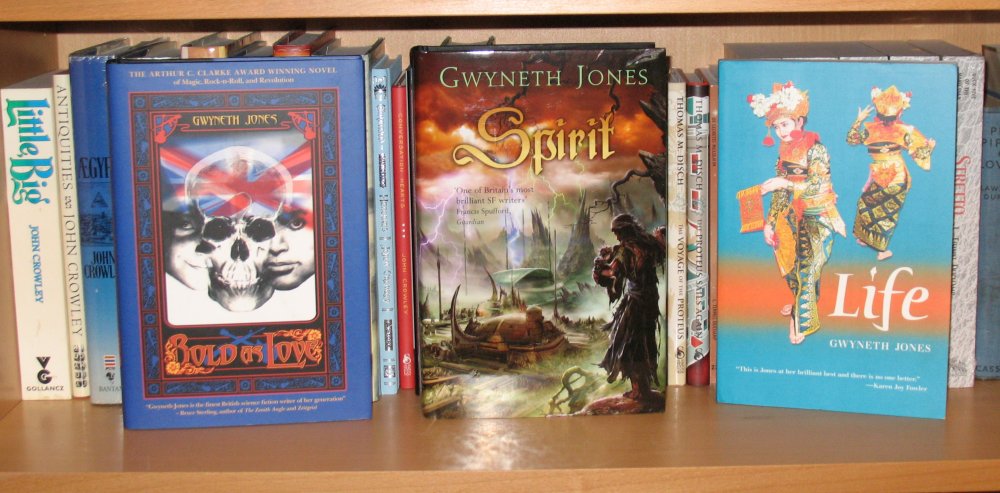
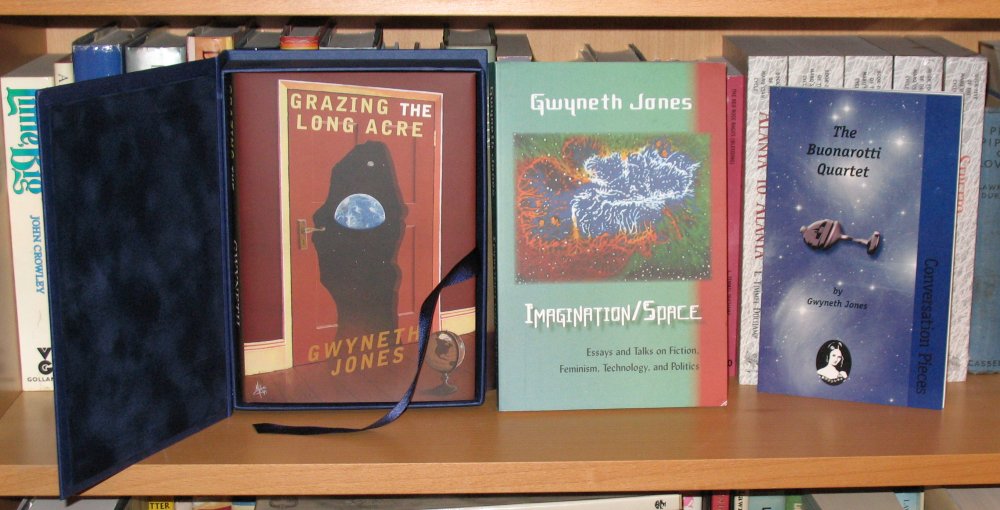 A short story collection from the excellent PS Publishing, and a 4-story collection and criticism collection from the equally excellent Aqueduct Press.
 , contains one of creepiest chorus riffs ever – sort of like the Addams family on acid – and a general amazingness that shows why Dark Tranquillity are simply the best metal band on the planet. I shall be buying the album. Special edition. You can just enjoy the video below. It’s called ‘Shadow In Our Blood’. It is amazing.
 , which I have absolutely no desire to see.) I returned the DVD of
  for
for  It Doesn't Have To Be Right...