It Doesn't Have To Be Right…

… it just has to sound plausible


2 Comments

What are we going to do when we get there?

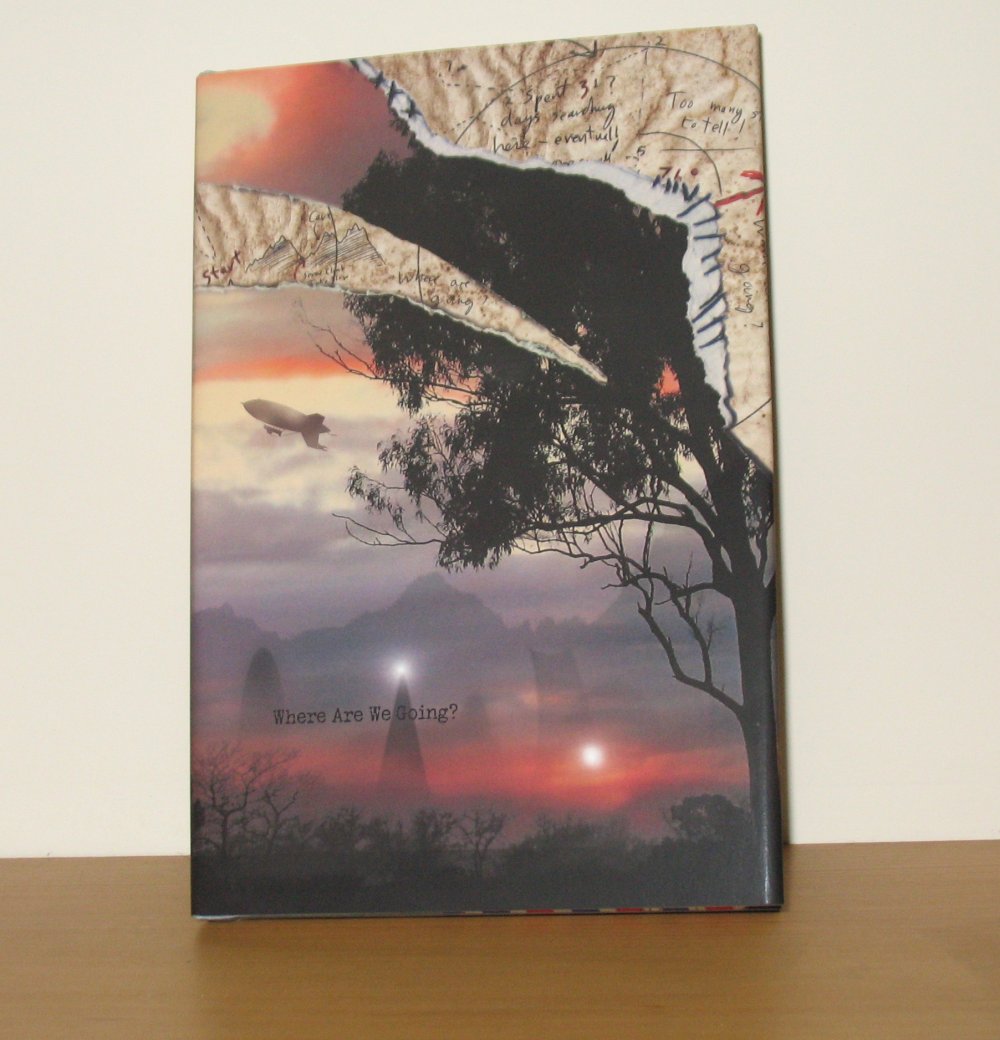
Look what arrived in the post yesterday: my contributor copy of Where Are We Going?, an anthology edited by Allen Ashley and published by Eibonvale Press. It looks very nice indeed. And it has an excellent line-up too.

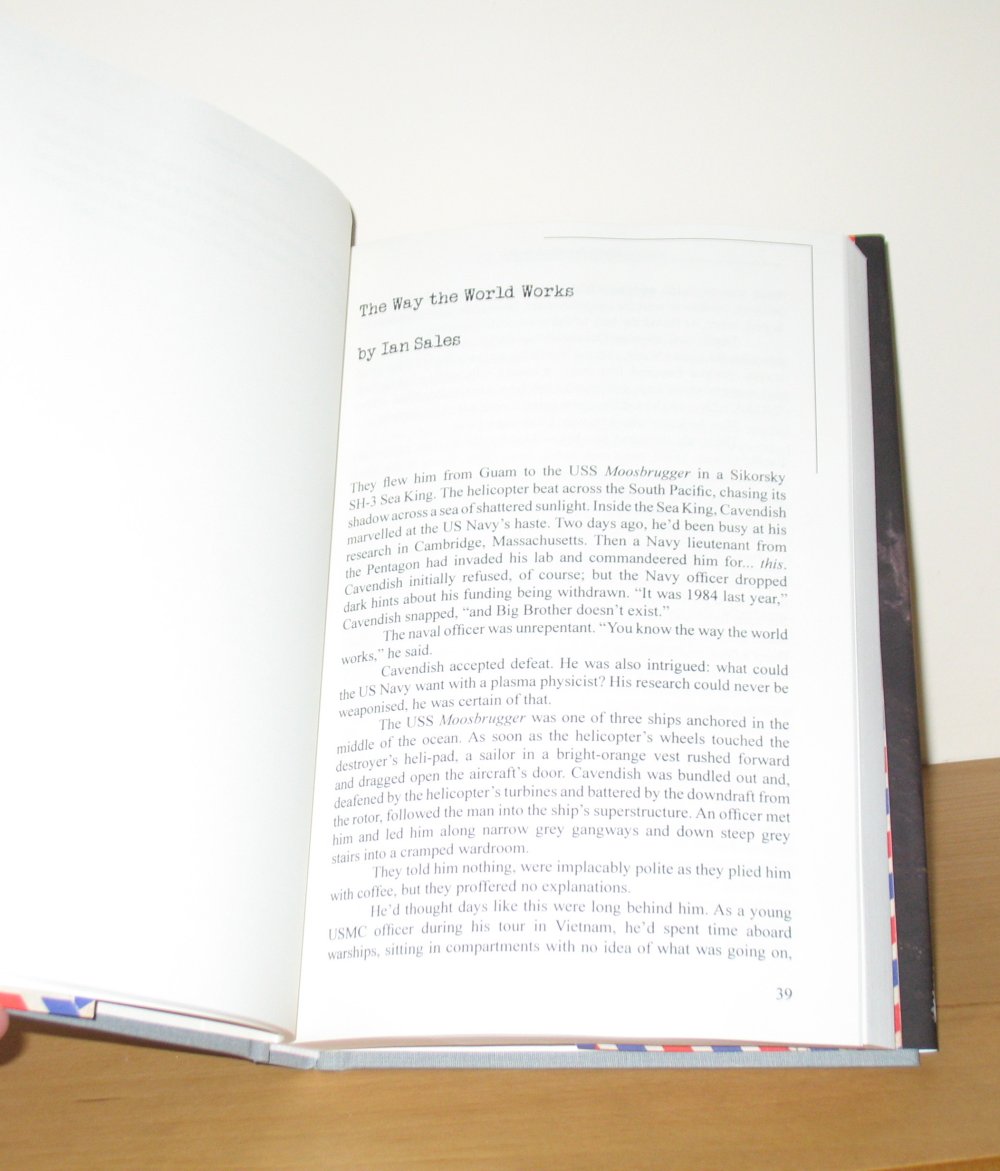
And here’s my story, ‘The Way The World Works’. It’s my bathypunk one – see here. It’s good to finally see it in print.

The anthology was launched in London on 2 March. Unfortunately, I couldn’t make it, but judging by the write-up and photos here, it went very well indeed.


4 Comments

Don’t Look Back In Wonder

Andrew Wheeler gives a run-down on the Hugo fiction shortlists here, but it’s some of the comments he makes in passing that I find interesting. He first complains that Peter Watts ‘The Things’ is a “backwards-looking story … which retells a famous old story in a new way” and that “there have been far too many backwards-looking SF stories over the last two decades”. I don’t know about the “far too many” – I suspect Wheeler reads a great deal more sf short fiction than I do (and my reading will be skewed toward UK-produced sf short fiction anyway) – but I don’t recall all that many similar types of stories off the top of my head. Theodora Goss riffed off HG Wells a couple of years ago, I seem to recall. Even so, what’s wrong with approaching old stories in new ways? Science fiction is, after all, a genre in conversation with itself. Doing it too often, yes, can be bad, and I bow to Wheeler’s greater knowledge on whether that point has been reached. But in moderation I think it’s good and perhaps necessary.

Wheeler than goes on to say that Allen Steele’s ‘The Emperor of Mars’ “is the first really egregiously ‘gosh, wasn’t yesterday’s future so much better than ours’ story this year, flattering all of those aging Boomer SF readers who didn’t become the space-station jockeys and planet-hopping businessmen they all thought they’d be when they were twelve”. As far as I can determine, the story is not set in an alternate future – it mentions NASA missions to Mars during the 1990s, and the 2008 Phonenix mission – so if it is playing on a nostalgia for the space programme of the 1960s and 1970s, then it’s only doing so in imagining a renewed interest in crewed space exploration and colonisation in the next few decades. But how does that make it “yesterday’s future”? I can understand that baby boomers (I’m not one myself), who remember the excitement of Apollo, might look for something which harkens back to that in their science fiction. But why is that necessarily a bad thing? Wheeler goes further when discussing James Patrick Kelly’s ‘Plus or Minus’ and says, “monkeys in cans is so 1970”.

Er, what?

Magical spaceships are apparently twenty-first century? A complete absence of technological realism in sf is twenty-first century? Hardly – Edmond Hamilton and EE ‘Doc’ Smith were making up magical sf shit nearly 100 years ago. So what should modern sf be? Why should stories which attempt to treat space exploration and colonisation realistically – which doesn’t automatically mean they’re looking back to Apollo, of course – be bad?

Obviously, I enjoy stories which feature space travel and exploration. And I like stories which treat the topic realistically. Hence Rocket Science. And in my own fiction I’ve done both sorts of “looking back” that Wheeler identifies above: ‘Barker’, for example, re-imagines the first flight of an American into space. It’s retro in as much as it’s a re-examination of the historic flights of Alan B Shepard and Laika. But it’s not riffing off past science fiction, it’s riffing off history. I believe this is a perfectly valid approach to writing science fiction.

Yet any sf argument on the subject of “retro” or “looking back” is going look a bit foolish in the face of one of the genre’s most popular past-times: holding up sixty-year old works as the best sf has to offer. If that’s not “looking back”, then what is? Idolising old and not very good books simply because they’re are what introduced individuals to the genre makes no sense to me. It also seems an odd definition of “good”. Surely re-working those alleged “classics” is a valid artistic response to them? Likewise for reworking old tropes, or even old inspirations.

They say there is nothing new in science fiction anyway – there are no new ideas, only new spins on old ideas. And why limit the tools you can use when writing science fiction? Looking backwards is not always driven by a need for comfort. Sometimes, it can do the exact opposite.


Leave a comment

Let’s do the meme

I seem to have been strangely busy the past week or so, and, I have to admit, somewhat short on inspiration for a subject to write about here. So here’s some cheap content: a meme. This was originally put together by Charles Tan. As usual: bold it if you’ve read it, italicise it if you own it but haven’t read it.

1. The Monkey’s Wedding and Other Stories by Joan Aiken
2. Rashomon and Seventeen Other Stories by Ryunosuke Akutagawa
3. The Kite of Stars and Other Stories by Dean Francis Alfar
4. I, Robot by Isaac Asimov
5. Black Projects, White Knights by Kage Baker
6. The Best of J. G. Ballard by J.G. Ballard – well, I have volume one of the Complete Stories, so I assume that counts.
7. Perpetuity Blues and Other Stories by Neal Barrett, Jr.
8. The Imago Sequence and Other Stories by Laird Barron
9. Occultation by Laird Barron
10. Mirror Kingdoms: The Best of Peter S. Beagle
11. The Collected Stories of Greg Bear by Greg Bear
12. The Chains That You Refuse by Elizabeth Bear
13. The Girl With The Flammable Skirt by Aimee Bender
14. Lord Stink & Other Stories by Judith Berman
15. Trysts: A Triskaidecollection of Queer and Weird Stories by Steve Berman
16. A Book of Endings by Deborah Biancotti
17. Blooded on Arachne by Michael Bishop
18. One Winter in Eden by Michael Bishop
19. The Poison Eaters & Other Stories by Holly Black
20. Labyrinths: Selected Stories and Other Writings by Jorge Luis Borges
21. From the Files of the Time Rangers by Richard Bowes
22. Streetcar Dreams by Richard Bowes
23. The Stories of Ray Bradbury by Ray Bradbury
24. Graveyard People: The Collected Cedar Hill Stories by Gary Braunbeck
25. Home before Dark: The Collected Cedar Hill Stories by Gary Braunbeck
26. Particle Theory by Edward Bryant
27. Tides from the New Worlds by Tobias S. Buckell
28. Bloodchild and Other Stories By Octavia E. Butler
29. Dirty Work: Stories by Pat Cadigan
30. The Night We Buried Road Dog by Jack Cady
31. The Panic Hand by Jonathan Carroll
32. Burning Your Boats: The Collected Short Stories by Angela Carter
33. Fireworks: Nine Stories in Various Disguises by Angela Carter
34. The Bloody Chamber: And Other Stories by Angela Carter – er, why the “collected stories” and then two more collections?
35. Stories of Your Life and Others by Ted Chiang
36. The Collected Stories of Arthur C. Clarke by Arthur C. Clarke – I’ve read half a dozen or so Clarke collections so I must have read the contents of this,
37. The Ladies of Grace Adieu and Other Stories by Susanna Clarke
38. Novelties & Souvenirs, Collected Short Fiction by John Crowley
39. The Avram Davidson Treasury by Avram Davidson
40. The Enquiries of Dr. Eszterhazy by Avram Davidson
41. Driftglass: Ten Tales of Speculative Fiction by Samuel R. Delany
42. We Can Remember It for You Wholesale by Philip K. Dick
43. Strange Days: Fabulous Journeys with Gardner Dozois by Gardner Dozois
44. Beluthahatchie by Andy Duncan
45. What Will Come After by Scott Edelman
46. Axiomatic by Greg Egan
47. I Have No Mouth, and I Must Scream by Harlan Ellison
48. The Beast that Shouted Love at the Heart of the World by Harlan Ellison
49. Deathbird Stories by Harlan Ellison
50. The Collected Stories of Carol Emshwiller by Carol Emshwiller
51. Dangerous Space by Kelley Eskridge
52. Fugue State by Brian Evenson
53. Harsh Oases by Paul Di Filippo
54. The Fantasy Writer’s Assistant and Other Stories by Jeffrey Ford
55. The Empire of Ice Cream by Jeffrey Ford
56. The Drowned Life by Jeffrey Ford
57. Returning My Sister’s Face and Other Far Eastern Tales of Whimsy and Malice by Eugie Foster
58. Artificial Things by Karen Joy Fowler
59. What I Didn’t See and Other Stories by Karen Joy Fowler
60. Smoke and Mirrors by Neil Gaiman
61. Fragile Things by Neil Gaiman
62. Burning Chrome by William Gibson
63. In the Forest of Forgetting by Theodora Goss
64. Take No Prisoners by John Grant
65. A Separate War and Other Stories by Joe Haldeman
66. Last Summer at Mars Hill by Elizabeth Hand
67. Saffron & Brimstone: Strange Stories by Elizabeth Hand
68. Things That Never Happen by M. John Harrison
69. The Past Through Tomorrow by Robert Heinlein
70. 20th Century Ghosts by Joe Hill
71. Skin Folk by Nalo Hopkinson
72. The Coming of Conan the Cimmerian by Robert E. Howard
73. The Lottery and Other Stories by Shirley Jackson
74. Unexpected Magics: Collected Stories by Diana Wynne Jones
75. Minor Arcana by Diana Wynne Jones
76. Grazing the Long Acre by Gwyneth Jones – though I have read all of Jones’ other collections.
77. The Wreck of the Godspeed and Other Stories by James Patrick Kelly
78. The Baum Plan for Financial Independence and Other Stories by John Kessel
79. Night Shift by Stephen King
80. Different Seasons by Stephen King
81. Hearts in Atlantis by Stephen King
82. Portable Childhoods by Ellen Klages
83. Scenting the Dark and Other Stories by Mary Robinette Kowal
84. Nano Comes to Clifford Falls and Other Stories by Nancy Kress
85. Nine Hundred Grandmothers by R.A. Lafferty
86. Objects of Worship by Claude Lalumiere
87. Black Juice by Margo Lanagan
88. Red Spikes by Margo Lanagan
89. Yellowcake by Margo Lanagan
90. Mr. Gaunt and Other Uneasy Encounters by John Langan
91. The Best of Joe R. Lansdale by Joe R. Lansdale
92. The Wind’s Twelve Quarters by Ursula K. Le Guin
93. The Compass Rose by Ursula K. Le Guin
94. The Birthday of the World and Other Stories by Ursula K. Le Guin
95. Red as Blood, or Tales from the Sisters Grimmer by Tanith Lee
96. The First Book of Lankhmar by Fritz Leiber
97. The Second Book of Lankhmar by Fritz Leiber
98. The Nightmare Factory by Thomas Ligotti
99. Stranger Things Happen by Kelly Link
100. Magic for Beginners by Kelly Link
101. Engines of Desire: Tales of Love & Other Horrors by Livia Llewellyn
102. H. P. Lovecraft: Tales by H.P. Lovecraft
103. Breathmoss and other Exhalations by Ian R. MacLeod
104. You Might Sleep by Nick Mamatas
105. Dreamsongs: A RRetrospective by George R. R. Martin
106. Invisible Country by Paul McAuley
107. Harrowing the Dragon by Patricia McKillip
108. The Bone Key by Sarah Monette
109. The Best of Michael Moorcock by Michael Moorcock
110. Black God’s Kiss by C.L. Moore
111. The Cat’s Pajamas and Other Stories by James Morrow
112. Dreams of the Compass Rose by Vera Nazarian
113. Unforgivable Stories by Kim Newman
114. The Secret Files of the Diogenes Club by Kim Newman
115. The Original Dr. Shade and Other Stories by Kim Newman
116. Monstrous Affections by David Nickle
117. The Best of Larry Niven by Larry Niven
118. I Am No One You Know: Stories by Joyce Carol Oates
119. The Complete Stories by Flannery O’Connor
120. Zoo by Otsuichi
121. Lesser Demons by Norman Partridge
122. Mr. Fox and Other Feral Tales by Norman Partridge
123. Night Moves and Other Stories by Tim Powers
124. Little Gods by Tim Pratt
125. Map of Dreams by M. Rickert
126. Holiday by M. Rickert
127. The Best of Kim Stanley Robinson by Kim Stanley Robinson
128. The Ant King and Other Stories by Benjamin Rosenbaum
129. Unacceptable Behaviour by Penelope Rowe
130. The Adventures of Alyx by Joanna Russ
131. Long Walks, Last Flights, and Other Journeys by Ken Scholes
132. Filter House by Nisi Shawl
133. Love Songs for the Shy and Cynical by Rob Shearman
134. The Jaguar Hunter by Lucius Shepard
135. Trujillo and Other Stories by Lucius Shepard
136. Phases of the Moon: Stories from Six Decades by Robert Silverberg
137. Are You There and Other Stories by Jack Skillingstead
138. The Girl With No Hands and Other Tales by Angela Slatter
139. Crystal Express by Bruce Sterling
140. Ascendancies: The Best of Bruce Sterling
141. Houses Without Doors by Peter Straub
142. Magic Terror: 7 Tales by Peter Straub
143. Absolute Uncertainty by Lucy Sussex
144. The Best of Michael Swanwick by Michael Swanwick
145. Gravity’s Angels: 13 Stories by Michael Swanwick
146. Monterra’s Deliciosa & Other Tales & by Anna Tambour
147. The Ice Downstream by Melanie Tem
148. The Far Side of the Lake by Steve Rasnic Tem
149. Her Smoke Rose Up Forever by James Tiptree, Jr.
150. Ten Thousand Light-Years from Home by James Tiptree, Jr.
151. In the Mean Time by Paul Tremblay
152. My Pathology by Lisa Tuttle
153. Ventriloquism by Catherynne M. Valente
154. The Jack Vance Reader by Jack Vance – have read half a dozen of his collections, so have probably read the contents of this.
155. City of Saints and Madmen by Jeff VanderMeer
156. The Third Bear by Jeff VanderMeer
157. Strange Things in Close-up; the Nearly Complete Howard Waldrop
158. Dead Sea Fruit by Kaaron Warren
159. Everland and Other Stories by Paul Witcover
160. The Island of Doctor Death and Other Stories and Other Stories by Gene Wolfe
161. The Very Best of Gene Wolfe by Gene Wolfe – have read three or four Wolfe collections, so have probably read contents of this.
162. Impossible Things by Connie Willis
163. Fire Watch by Connie Willis
164. The Doors of His Face, The Lamps of His Mouth and Other Stories by Roger Zelazny
165. Impossible Stories by Zoran Zivkovic
166. The Writer, The Book, The Reader by Zoran Zivkovic

Not a good list for me: too many writers I have no desire to read. I also suspect there’s a lot of overlap for those authors who have more than one collection listed, especially where one of them is a “best of” or “collected stories”. Many of the authors I’ve probably read the contents of their “collected stories” volumes as I’ve read so many of their short stories.

If I were to put a list of collections together, I suspect it would look very different from this one.


Leave a comment

Alternate reading material

My story ‘Disambiguation’ is now up on the website of Alt Hist, the magazine of historical fiction and alternate history. It was originally published here on my blog a couple of months ago, but now it’s found a better home. It’s something of an experimental piece since it’s constructed from a series of real and fake Wikipedia articles. It also has flying boats in it. Go read it. Please.


2 Comments

A portrait of the writer as a young man

I have always been a science fiction writer. I remember filling an exercise book with deck-plans for a starship when I was twelve years old. I wish I could find that book, but it has long since vanished. During my teens I played RPGs, and wrote up the sessions as fiction. After joining the British Science Fiction Association in the late 1980s, I turned my hand to writing your actual original science fiction. Not entirely successfully, it has to be admitted. And this despite the fact there seemed to be new sf small press magazines appearing every five minutes in the UK. Some of the titles I remember, and still have copies of, are: BBR, Dream Magazine, New Moon Quarterly, Works, REM, Exuberance, Critical Wave, Territories, The Lyre, Nova SF, Auguries, Strange Attractor, Opus Quarterly, Sweet Dreams Baby!, New Visions, The Edge, The Scanner, Sierra Heaven…

I submitted fiction to several of the above, but my first ever published short story was a space opera parody which appeared in The Scanner #8 in 1990. It wasn’t very good. Shortly after graduating from university, I left the UK. And spent ten years working in the United Arab Emirates. While there, I started submitting fiction to the pro magazines, with even less success. Occasionally, I tried stories at small press mags… Which is how Sierra Heaven ended up with my second piece of published fiction in their Summer 1997 issue.

Here, for your delight and delectation, your edification and edumacation, is that story. It’s a space opera metafictional story, titled ‘Pulp!’, that probably owes far too much to certain film by Quentin Tarantino. Apologies for the poor quality of the scan.

Click here: Pulp!


2 Comments

A veritable bargain… or two

Old stories never die, they either sit and moulder in old magazines, or they get republished again and again. But not anymore. Thanks to the magic of modern technology, they can live again. Just reformat that Standard Manuscript Format, slap on some cover-art, and publish it for the Kindle.

Which is precisely what I’ve done for two of my stories. These are the Euripidean Space ones – ‘Thicker Than Water’ and ‘A Cold Dish’ – and were originally published in Jupiter magazine. They’ve been described as “fun, pure sf”, are set on the moons of Saturn, and are hard science fiction based upon / inspired by Ancient Greek mythology sort of. They’re available on both amazon.co.uk and amazon.com, for much cheapness.

Go on, Kindle-folk, you know you want them…


Available on Amazon UK here and Amazon US here.


Available on Amazon UK here and Amazon US here.

(Apologies for the cover-art: I’m better at the words than I am the pictures.)


15 Comments

A science fiction story – with flying boats!

A week or so ago I set myself a challenge: to write a science fiction story in which a flying boat featured prominently. I was hoping to come up with some heartland sf story, something with spaceships and aliens and such. And flying boats, of course. But I couldn’t think of a plot in which a flying boat, especially a historical one, might plausibly appear in the distant future or on another planet.

I could have just invented some futuristic flying boat, but I was determined it’d be a known type – and I had in mind one of those flying boats from the 1930s which carried passengers to Australia or across the Atlantic. So I dreamt up and considered a number of ideas, and promptly discarded them… and then realised there was only one way I could justifiably have a Short Empire flying boat, for example, in a sf story. But I didn’t really want to write alternate history. I wanted something more sfnal than that.

And I think I’ve sort of done it.

It’s a somewhat experimental story – in both structure and the fact that the plot is only implied. I shouldn’t think it’s the first story, science fiction or mainstream, to ever be written in this fashion, but it’s the first time I’ve tried it. It was fun to research, and I had fun “writing” it. I hope it proves as much fun to read.

Here it is (PDF): Disambiguation

Enjoy.


5 Comments

Anatomy of a Story: A Cold Dish

Back in October 2009, I wrote a piece on my first Euripidean Space story, ‘Thicker than Water’ – you can find it here. ‘A Cold Dish’ was the second of my stories set in that universe, and it too was published in Jupiter magazine – in Jupiter 28, April 2010.

‘A Cold Dish’ is based on the play The Suppliants by Euripides. The play recounts how Theseus approaches the king of Thebes in order to ask for the bodies of the Seven Against Thebes, the seven leaders of an army which failed to invade the city-state. In Ancient Greece, burial rites were very important, and wars fought over dead bodies were not uncommon in the literature of the time. Unfortunately, this plot didn’t translate well to my Euripidean Space universe. It wasn’t really dramatic enough. Further, the need to bury dead heroes is not a cultural urge which translates to modern Western European culture.

In the universe of my Euripidean Space stories, the Earth has locked itself off behind a firewall for reasons unknown. This has left a number of off-planet settlements – on Mars, in the Asteroid Belt, among the moons of Jupiter and Saturn – struggling to survive. Patrolling the Solar System is an alien sentinel, origin unknown, which appears to exist solely to protect a number of alien artefacts. Unfortunately, these artefacts are not obvious – some of them could be somewhat unusual natural phenomena. In ‘Thicker Than Water’, for example, the artefact was a sea of buckminsterfullerenes on the moon of Tethys.

I’d already decided what the alien artefact would be in this, my second Euripidean Space story, and that dictated its setting. The Saturnian moon Mimas is sometimes known as the “Deathstar moon” because it features an enormous crater, Herschel, which covers a third of its face – as is obvious from the photo below. Herschel resembles a huge radio-dish, like Arecibo or Jodrell Bank. Identifying the artefact gave me part of the story’s plot – the “seven” would attack Mimas to prevent the Mimanteans from experimenting with the artefact. Herschel Crater also gave me the story’s title: ‘A Cold Dish’.
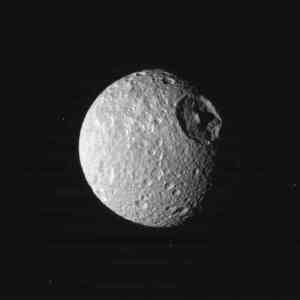
Image credit: NASA/JPL/SSI

But it still wasn’t enough. Happily, the title of the story – it was originally only a working title – provided the answer: revenge. Theseus’s mission to Mimas would be partly to retrieve the bodies of the dead heroes, but would also be driven by revenge. My Theseus analogue I named Spiro Maris – the Spiro, I suppose, from his adventures in the Labyrinth on Crete. I don’t recall why I gave him the family name Maris. The other characters in ‘A Cold Dish’ also bear names derived from their Greek counterparts. The Seven of Euripides play were Amphiaraus, Capaneus, Hippomedon, Parthenopeus, Polynices, Eteocles and Tydeus. Not all are named in ‘A Cold Dish’, but of those that are… Capaneus was known for his immense strength, so I called him Armstrong. Amphiarus means “twice-cursed”, which became Bimalison. Hippomedon… well, “hippo” is horse, so I named him Steed. The two Foote brothers are so named because their father was Oedipus, or “swollen-footed”.

As an example of “just enough information”: in ‘Thicker Than Water’, I’d named the settlement Torus for its carousel living-quarters. This phonetically aped Tauris, the name of the city where the Euripides’ play I’d based the story on had taken place. I felt I needed something similar for ‘A Cold Dish’. The Suppliants takes place in Thebes, but I couldn’t find any reference to the name’s meaning. So I decided to use the name as is for the Mimantean settlement. But I called it The BES, without actually bothering to work out what the acronym meant. The Built Environment System? It didn’t really matter.

As for “too much information”. I realised I didn’t know how large Saturn would appear in the Mimantean sky. The moon orbits at a mean distance of 185,520 kilometres, so I suppose I could work it out. Or I could finesse it, of course, and simply not mention it. But it felt like a useful detail. Instead, I went hunting on the internet, and on the JPL-NASA website found this:

Courtesy NASA/JPL-Caltech

The webpage here contains a number of artist’s impressions of the surfaces of the moons of Saturn and Jupiter.

I had a plot, a cast and a location. Now I needed an opening. I had this image in my head of figures in spacesuits encrusted with ice, so that’s what I used. Maris is inspecting the frozen bodies of the Seven, and then returns to the BES to negotiate with the Mimanteans. The rest of the story more or less wrote itself. I needed a Greek chorus. In ‘Thicker Than Water’, I’d used Saturn’s radio noise, but I wanted something different. So I decided to have all voice communication in the BES broadcast throughout the settlement. That allowed me to insert the grieving mothers, who provide the chorus in Euripides’ play, into the story and, as a bonus, gave me some pointers to the character of the Mimanteans. I also managed to include a reference to Theseus’s boat (also known as Granny’s broom).

The more I read up on the Ancient Greek characters on whom I was basing my cast, the more information I could insert into the story regarding their backgrounds. For each of the Greek city-states, I picked a moon: Athens became Rhea, Troy is Iapetus, Sparta is Hyperion, for example. Likewise with the personalities from the myths: Oedipus I renamed Rex Foote, Agamemnon is Stanovsky, Helen of Troy is, er, Helen Bright, Paris is Alexander Lek… Some of these may well make appearances in other Euripidean Space stories.

Some might say I’ve put far too much into ‘A Cold Dish’. All the references to Euripides’ play and Greek myths, which most readers won’t actually spot, some might consider those irrelevant in “a fun pure SF piece” (as Rich Horton described it on sfsite.com). But I believe stories should be more than just “fun”. I’d like to think there’s plenty to unpack in my stories, not just what appears on the surface. I feel that enriches the reading experience.
Leave a comment

woof!

Des Lewis has started a “Real Time Review” of the Winter 2010 BFS Journal (see my photos of it here). So far, he’s read the first eight stories from New Horizon. Which includes mine, ‘Barker’ – about which he writes:

“A claustrophobic vision, this time in a punch-drunk comic-strip rocket. Real history and real names in retrocausality. To my hindsight surprise, I enjoyed it thoroughly as a lighter part of these movements in a dark symphony.”

I’m not entirely sure what the “dark symphony” is in reference to, but I’ll take my compliments where I find them.

Full review here. You’ll need to scroll down to see Des’s comments on ‘Barker’.