It Doesn't Have To Be Right…

… it just has to sound plausible


Leave a comment

La petite mort de sf

I’ve been working my way through Figures of Paradox, a study of Aleksandr Sokurov’s films by Jeremi Szaniakawski, and at one point he references the Kantian sublime, “the feeling that is so great it inspires neither love nor hate”, and it struck me that science fiction, in its own small way, is forever striving for that moment of the sublime. It’s not an actual objective of the genre, just something its readers look for in the texts they read. But they call it “sense of wonder” (please let’s not use “sensawunda”, which sounds like a brand of margarine). However, sense of wonder isn’t the same as the sublime. It’s a small version of it, the B-movie version – more colourful certainly, lots of bright primary colours in fact, but less actually awe-inspiring.

I think that difference in intensity may be simply a lack of physicality. Mountains are, famously, there. But the sublime doesn’t require an actual physicality. When NASA published the photographs of the surface of Vesta back in 2011, the asteroid was 188 million kilometres from Earth – and no one in my lifetime will ever visit the asteroid in person – but the fact of Vestia’s existence, its realness, the knowledge that it shares this universe with us, still prompted a moment of the sublime.

vesta

And against that, all science fiction can do is… manipulation of scale. When Stephen Baxter casually drops a billion-year history into the plot of his novel, when Alastair Reynolds writes of a journey across the width of a galaxy in his story, when Ann Leckie mentions in passing that the Radchh live in a Dyson Sphere… Because the story is focused on individuals, the sudden realisation – carefully stage-managed by the author, of course – that the story encompasses so much more, at a scale so much greater than the merely human, evokes sense of wonder. Admittedly, suspension of disbelief relies on a degree of plausibility. The universe is fifteen billion years old – that’s not only plausible, it’s a scientific fact. But a Dyson Sphere is not, on the face of it, an especially plausible idea… but it was proposed in scientific literature, and has since become part of science fiction to such an extent its plausibility no longer seems relevant: it has a form of virtual plausibility.

Of course, not all science fiction makes use of sense of wonder. Not every science fiction story takes place over billions of years or across millions of planets. On the contrary, some forms of science fiction deliberately downplay the sense of scale in order to suggest a more homogenous setting for the story – such as space opera. I mean, seriously, no one thinks there are zillions of human-habitable worlds out there just waiting to be settled, or that there’s a Kuhnian Paradigm Shift waiting somewhere in history’s wings to turn reduce the distance between these worlds to journeys of hours, days or weeks instead of centuries and millennia. But then it’s not like space operas are intended to be plausible in any way. They’re just adventure stories, and they use a language all their own.

In a mode of fiction which offers “idea” on one axis and “sense of wonder” on the other, there will always be works which score low, or even zero, on one axis. And too, the popularity of regions of such a graph will shift with time and fashion. We’ve had New Space Opera and we’re now living through the tail-end of it. Space opera has returned to its roots; the space operas being published today are no different in sensibilities to those of the 1970s (although the style of prose may well have changed). One sub-genre which seems to be flowering at present is military sf. Just look at the thousands of self-published titles available on Kindle. And as subgenres of science fiction go, mil sf is probably the least sophisticated. It is war stories told in the language of science fiction. It relies on an insultingly simplified worldview; it is the pulp sf of our times.

I gave this post the title “La petite mort de sf” not because I think science fiction is dead. (Again…) I used the expression “la petite mort” because of its meanings – including “fainting fit”, “nervous spasm”, or, more recently, “post-orgasmic unconsciousness”. While I’m not suggesting science fiction – good or bad – should inspire such states, it seemed like a good fit for an analogy of the gap between sense of wonder and the Kantian sublime. Paul Kincaid once wrote a critical work titled What it is We Do When We Read Science Fiction – and a very good critical works it is too – but I wonder if a more important question is: What It is We Want When We Read Science Fiction. And what I find interesting is the tools built into the genre which address those wants; and a) how those tools have come into being, and b) how the tools are deployed to generate specific effects. For “tool”, you might as well read “trope”… although I think of tropes as the manifestation of deep-seated ideas, sort of like how three-dimensional figures appear in two-dimensional space…

Like manipulation of scale, sf is also open to manipulation of affect. The cheapest way to do this is through language – choosing the right words, essentially. This is not something unique to sf, by any means. Nor is it a technique used all that much in the genre. For much of science fiction’s history, prose has been seen as merely the transmission vector for story. Some sf writers have declared prose should be “beige” or “transparent”, the idea being it should not be a barrier to understanding the story or plot. But, quite frankly, if any style of prose is such a barrier then it’s not doing its job. This doesn’t mean the reader shouldn’t have work for it. Prose can do many things – it can declare, describe, imply, suggest, evoke, generate trains of thought only peripherally linked to the text being read… It can create pictures in your brain, moving pictures, stories which not only re-enact those written on the page but go further, outside the story, beyond the story…

Which means prose carries a heavy burden, over and above that of story. Personally, I prize clarity; but I also prize detail. Perhaps even an over-abundance of detail. Prose should not be “transparent” or “beige”, it should evoke as much as it possibly can, using all the tools at its disposal, linguistic and genre. And there are a great number of tools at the sf writer’s disposal – not just the manipulation of scale or the manipulation of affect mentioned earlier in this post.

True, science fiction will never reach the sublime, but no form of literature will. In its use of sense of wonder, it can approximate it (in a peculiarly circumscribed way, that is). Unfortunately, it is also chiefly a commercial genre of fiction, and much of its DNA was drawn from pulp fiction. The genre as it exists today prizes story and plot and all the mechanical things which together form beginning, middle and end; and yet it has the potential to be so much more. Sometimes, it hints at that promise – and it’s not necessarily genre authors who manage to do so…

Science fiction is a broad church. It has room for two-fisted tales of interstellar derring-do just as much as it does for lyrically-written cautionary tales or avant garde explorations of inner space. And in some years, one form of science fiction will be more popular, and win more awards, than another form. Like the alleged variation in lengths of skirts during times of economic hardship and boom, so science fiction cuts its cloth to the world around it. Unlike skirts, however, it doesn’t appear to go up when times are bad, but the reverse. When times are good, sf is typically optimistic; when the future is not so rosy, dystopia and mil sf rule the roost. It is a barometer of our times.

But it still has a long way to go before it gets close to the sublime.

4 Comments

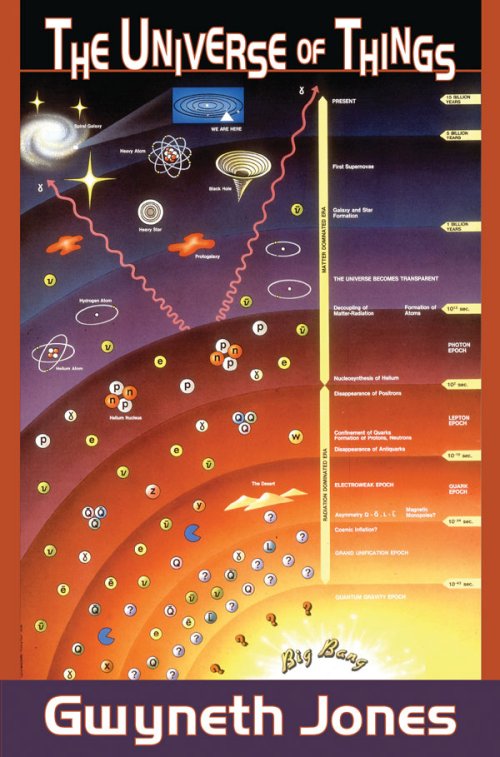
The Universe of Things, Gwyneth Jones

universe-cvr-lr-100The Universe of Things
Gwyneth Jones
Aqueduct Press, 2011
ISBN 978-1-933500-44-7

Gwyneth Jones does not write many short stories – forty-one in thirty-seven years – but when she does, by God they’re worth reading. As a result, throughout her career Jones has published remarkably few collections: five, in fact; and three of those are chapbooks. Unfortunately, there is a great deal of overlap between these collections, but if I were to choose one as the best, with the best choice of stories, and the most representative, with the widest selection of stories… it would be Aqueduct Press’s The Universe of Things. It contains fifteen stories, ranging from 1988 to 2009. Most are from the late 1980s and early 1990s. Most are science fiction, but not all. Some cover a page or two, others are novelette-length.

This is one of the strongest collections of genre short stories I have ever read. There is not a bad story in it – even the single-page ‘One of Sandy’s Dreams’, originally written for The Drabble Project in 1988, manages to do more in 100 words than China Miéville’s BSFA Award nominated short story ‘Covehithe’ did in several thousand.

Some of the stories are set in the universes of Jones’ novels. The title story takes place in the world of the Aleutian trilogy – White Queen, North Wind, Phoenix Café and Spirit – and is deceptively simple. An Aleutian takes its car along to a mechanic to have it serviced before selling it. The mechanic realises it is something more than just a car, it is a car that has been driven by an alien. He determines to do more work than asked, so he can then make an offer on the car, and so sell it profitably because of its provenance. But while effecting repairs, his thoughts are drawn to the Aleutian customer, and he briefly experiences how they view the world around them. His desire for the Other drives this epiphany, but to glimpse heaven is to recognise the cost of admission.

Change always exacts a cost. ‘The Eastern Succession’ takes place in the future-distant Peninsula of Divine Endurance and Flowerdust. One of the ruling princes has died heirless, so the remaining Dapur (the female councils who actually rule the principalities) gather in a town to determine to which of three candidates they will offer the crown. They must chose a prince who is both popular with the people of the prince-less state, the governments of the other principalities, and the Koperasi, the people who conquered the Peninsula and now rule it. The narrator is a young man of no family who visits the town to observe the deliberations. As a male, he has no power in Peninsulan society. Jones not only neatly turns the tables on gender relations, but she shows how pervasive sexism is at all levels and in all aspects of society. When the narrator tries to influence the Dapur’s decision through revealing a secret, it ends badly for all concerned. The narrator is playing at politics, he is imposing his own worldview, his own desires, on a situation which is resistant to both – but it is not him who pays the price for his meddling. There’s a clear sense in ‘The Eastern Succession’ that tradition exists for good reason, that change is costly and not always beneficial – and this in a world which is a distorted reflection of our own and, tellingly, set in a non-Western culture.

‘La Cenerentola’ by comparison is both near-future and set in Europe. A same-sex couple, Thea and Suze, are holidaying with their young daughter in the south of France and make the acquaintance of an American woman and her three daughters. Two of the woman’s daughters are beautiful, almost perfect, teenage twins; the third is a ragamuffin. The twins are in fact clones of the mother, their genetics tweaked to “improve” them – and yet, perhaps they are not: perhaps they are no more than holographic “eidolons”, idealised visions of their mother. The story plays with the tale of Cinderella, as its title suggests – Jones has, like Angela Carter, frequently turned to fairy tales for inspiration – but there’s no happy ending for this Cinders. Whatever the twins are, clone or eidolon, they are also signifiers of conspicuous consumption and part of their price has been exacted from the third child. Like the other stories in The Universe of Things, ‘La Cenerentola’ presents with a remarkable economy of words a fully-fledged world which seems as real and true as the real world. It seems wholly appropriate, for example, that in the world of Thea and Suze women fill every role and men are mentioned only in passing.

‘The Thief, the Princess, and the Cartesian Circle’ mocks the construction of a fairy tale while making use of its ur-text. It is a fairy tale, but also a postmodern literary piece, as mutable as the changes it rings on its titular protagonists. Though it opens with a line which follows the form, but not the content, of its type:

Once upon a time there was a princess who was quite pretty and fairly intelligent, and when the time came to marry her off, the royal family didn’t worry about it too much. (p 225)

The story then promptly gives the lie to this opening – the princess is headstrong, wilful and unbiddable – and then subsequently dismantles the fairy tale narrative to suggest a layer of inventions in which the relationship of the princess and the thief is defined by the world in which they live, and in which they define the world around them. The princess is driven by a need for realness but inhabits ever-changing surroundings – her environs are defined by herself; she is her environs. This is woman as creator, using a mode of fiction in which women’s empowerment is either gifted by an external agency or altogether absent.

‘Grandmother’s Footsteps’ is one of three horror/dark fantasy stories in the collection. A young couple move into an old house in dire need of renovation. But again, the change exacts a high price: the house is haunted. Or perhaps not. The narrator, Rose, must juggle her daughter, her career as an animator, and her aspirations for the house, and she is unequal to the task. Her failure to cope is externalised as the spirit haunting the house – the Ghost of Christmas Yet to Come, so to speak. Some of the imagery in the story extremely unsettling, and that the story maintains a chilling tone throughout, despite a focus on the quotidian, is testament to the strength of the prose.

The jewel of the collection is ‘Identifying the Object’, which has been a favourite story of mine since I first read it in Interzone in 1990 under its original title of ‘Forward Echoes’. It is, like ‘Blue Clay Blues’ and ‘The Universe of Things’, set in the world of the Aleutian trilogy. In fact, the Braemar Wilson of ‘Identifying the Object’s is the eponymous “white queen” of the first Aleutian novel. Braemar, the narrator Anna Jones, and Johnny Gugliogi (also the protagonist of ‘Blue Clay Blues’) are in Africa on the trail of what may or may not be the first aliens to land on Earth. Though it is set in the near-future, there is a thoroughly contemporary feel to the story. It is about Europeans experiencing an earthly Other while in pursuit on an unearthly one. It is also a story replete with assumptions, which it neatly skewers one by one:

Once he caught her in low company, têta-à-tête with an African down by the lifeboats. The black man fled. I heard racist assumption and that awful note of ownership in my poor friend’s voice.

“Hey! How come you suddenly speak their lingo?” (p 256)

There is no neat ending, no flying saucer on the Mall with a handsome representative in a space-age jumpsuit. There are many agendas at work here, and the truth of the alien landing is neither obvious nor relevant. Either way, a price must be paid – the possibility of the aliens’ existence is enough to force change. And this in an Africa which has refused to implement Western-imposed change; or rather, has made of its own change imposed upon it by Western powers. ‘Identifying the Object’ remains a favourite sf short story, and it continues to astonish me it was never shortlisted for an award.

It’s tempting to look for common threads in Jones’ fiction, but I suspect you’d find exactly what you were looking for. Her stories do not present easy answers. They’re happy to describe complex situations – indeed, they revel in their complexities. For that reason, Jones has often been called a “political” writer. In essence, this means she doesn’t write action-adventures stories in space. This is not sf as escapism, this is sf as literature. This is fiction that forces you to think, that makes you challenge your prejudices and preconceptions. These are stories that argue against change while forcing you to embrace it. These are stories which could only be science fiction, etc, yet are greater than mere genre fiction.

Gwyneth Jones is the finest writer of science fiction, who is currently still writing, this country has produced. Highly recommended.

This review originally appeared on Daughters of Prometheus in May 2012.


1 Comment

Flying north

Recent events – the desire by our current government to commit political suicide, and half the population to commit economic suicide – have somewhat over-shadowed the past couple of weeks, but prior to the UK imploding very messily, I spent a weekend in Stockholm at Fantastika 2016, this year’s Swecon. It was my second Swecon, and my third Nordic con. My first had been Fantastika 2013, in the same venue as this year’s Fantastika – the Dieselverkstaden in Sickla, an area to the south of Stockholm’s city centre.

I flew to Sweden early on Friday 17 June. I’d been panicking a bit because I’d had trouble finding out where I was supposed to check-in online, but fortunately I got it sorted the evening before I flew. And when I boarded the aircraft – a Norwegian Boeing 737-800 – I discovered I had one of the seats by the emergency exit over the wing. In other words: leg room! After landing at Stockholm, I caught the Arlanda Express into the city-centre – SEK 280! – where I met up with Tobias Bodlund. We caught the Metro to Gamla stan, and had a burger and a couple of beers. The plan was to cross the bridge to Slussen and catch the Saltsjöbanan urban railway to Sickla… But it seemed the railway was closed as they were extending it or something, so we had to catch a replacement bus. The weather was hot and sunny, and the bus was like a sauna.

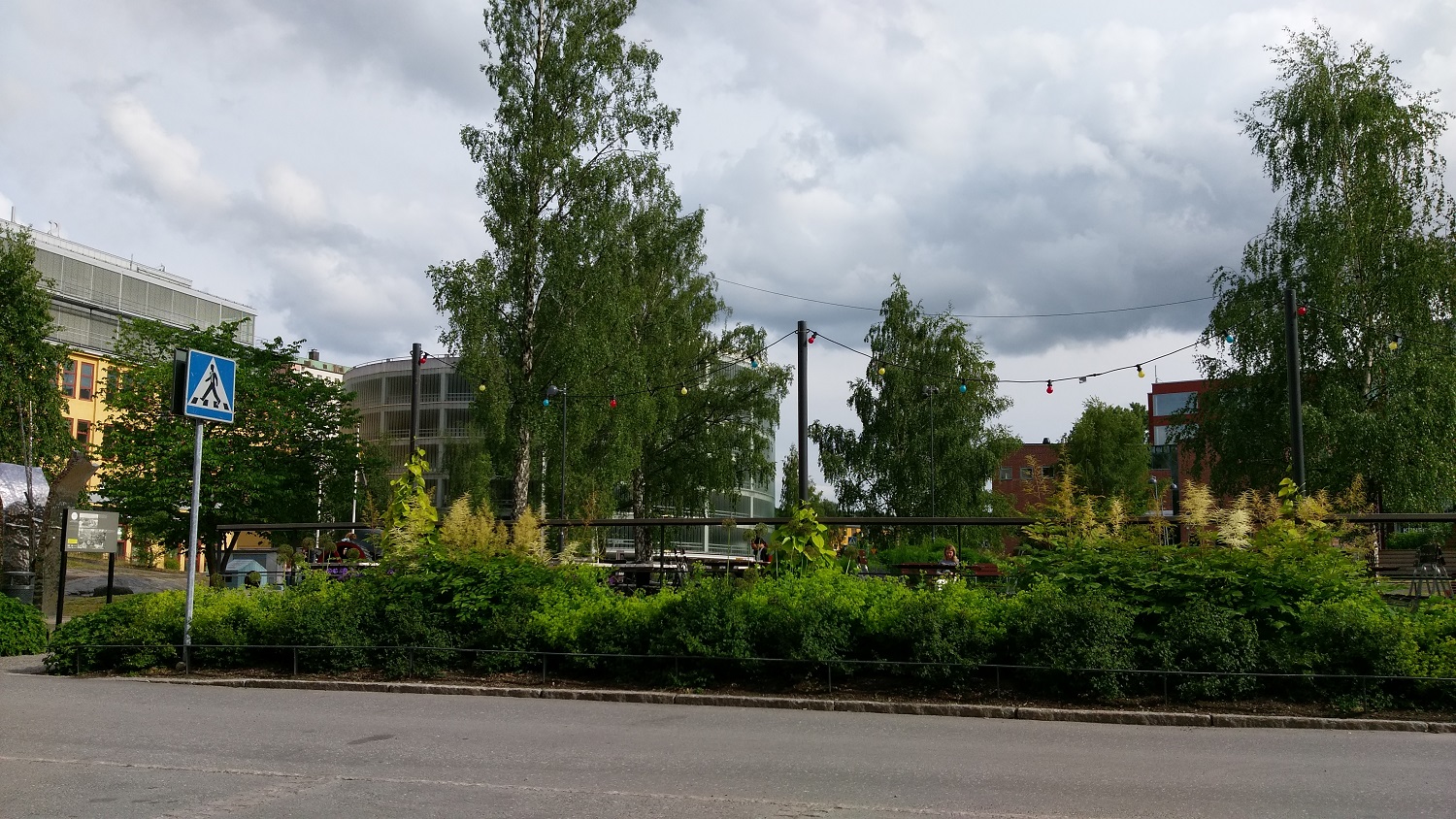
At Fantastika 2013, this area in front of the Dieselverkstaden had been a building site

At Fantastika 2013, this area in front of the Dieselverkstaden had been a building site

I checked into my hotel, showered and then headed over to the Dieselverkstaden to register… Early in the evening a group of us ate at the Italian restaurant just by the Diselverkstaden – although “restaurant” is perhaps a bit strong. You picked your food from a variety of bowls of saucers and pasta in a display counter, they dished it out onto a plate, and then stuck the plate in one of a dozen microwaves on a shelf behind the counter. Despite that, the food wasn’t that bad. Later, I caught one of the programme items, a conversation between GoH Caroline Mullan and Linnéa Anglemark.

Next was Jukka Halme’s infamous quiz, which I was told I had to go to… and where I was immediately volunteered to be one of the contestants. Jukka’s quiz is designed to be difficult, and the scoring can be a bit random, but it’s also intended to be entertaining. Which it certainly was. Our team was international, with GoH Jerry Määttä (Sweden), Thomas Recktenwald (Germany) and myself (UK). We also won. By a thumbs up. (The audience managed to score the same number of points – don’t ask – as us, but we’d managed a thumbs up for a close guess on one question.) Apparently, the score keeper – a volunteer from the audience – normally wins. I also managed to answer one of the “four fields” questions correctly and scored the full two points, which has apparently never been done before.

I had another beer or two after the quiz – unlike the last Fantastika, they’d set up a small bar in the concourse area outside the two auditoriums used for the programme.

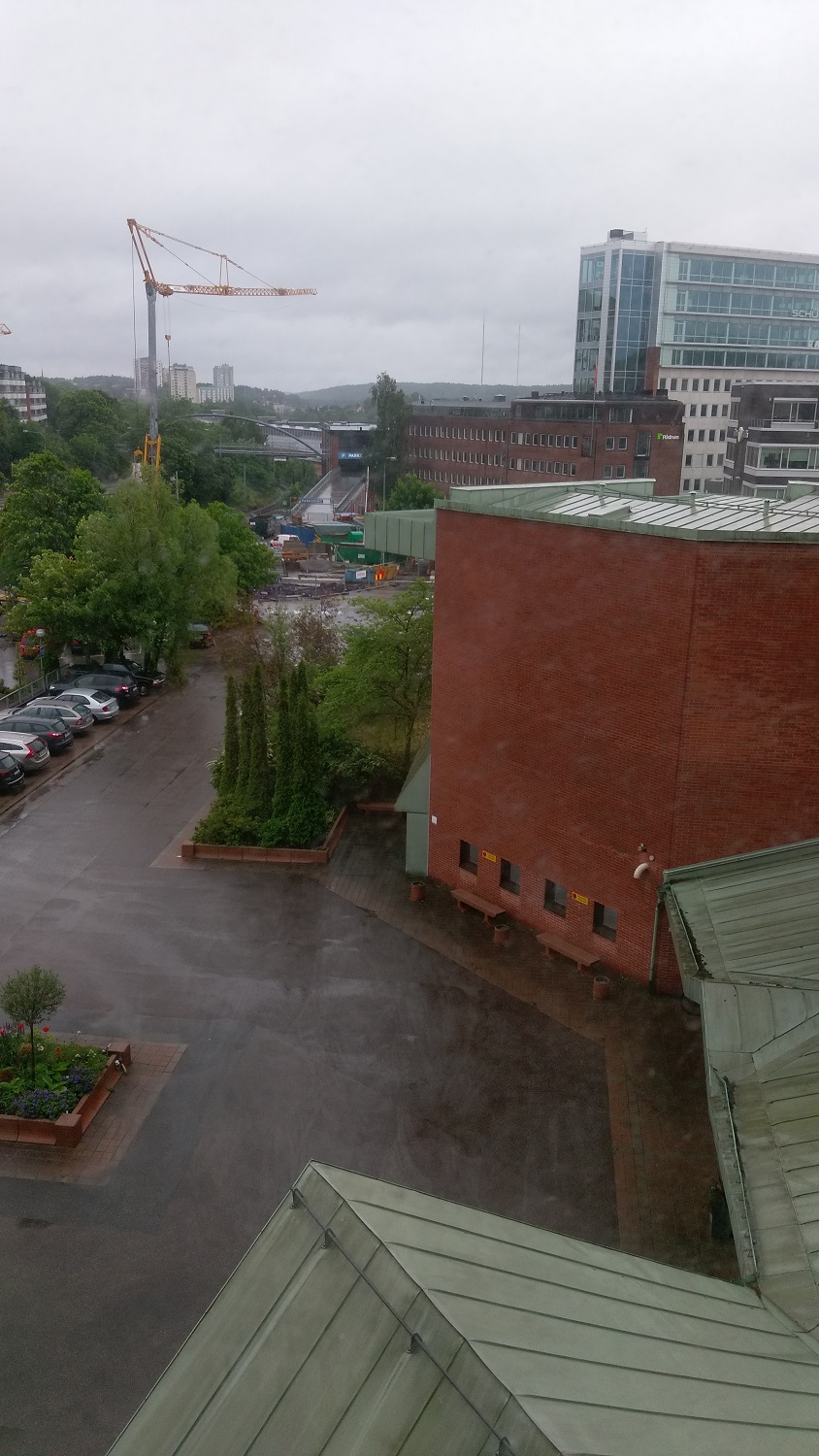
The view from my hotel room on the Saturday morning

The view from my hotel room on the Saturday morning

The next morning when I woke up, it was chucking it down. And it rained most of the day. I wondered if I’d brought the weather with me from the UK. Breakfast was packed – there were at least four coach parties, one British, staying at the hotel. Fantastika 2013 had taken place in October, and the hotel had been a lot less busy. Back across to the Diselverkstaden to catch a few programme items and several wanders around the SAAM/Alvarfonden book room (a Swedish fan charity which sells secondhand books, mostly UK and US paperbacks, for SEK 10 to SEK 30). Tobias and I ate lunch at the Mexican taverna next to the Italian restaurant. Then it was an afternoon of programme items, visits to the book room, and the occasional beer. I ate in the hotel restaurant that night as I was on a panel at 6 pm, which was apparently when a lot of people went for dinner. The panel was titled “That’s why I killed him!” and was about character motivation. On the panel were GoH Maria Turtschaninoff, Anna Jakobsson Lund, Mats Strandberg, myself, and moderator Markku Soikkeli. I thought the panel went pretty well – and I was surprised when Markku asked me about the motivation behind the title character in my story ‘Barker’. (Easy: he’s based on a dog…).

After hanging around, drinking beer and chatting in the Diselverkstaden until around midnight, I headed back to the hotel.

Sunday was a quieter day. The con seemed to be winding down from around mid-morning. By mid-afternoon, when GoH Carolyn Ives Gilman had her signing, people were starting to leave. (I’d brought copies of her books for her to sign but, annoyingly, only realised I’d forgotten her debut, Halfway Human, when I landed in Sweden. Gah.) After the closing ceremony, led off by acapella singing by the Gléowine chair and closed with the spirit of Swecon being handed over to Kontur (Uppsala, 26 to 28 May next year), those of us that remained had the dead dog party in the Dieselverkstaden’s Bistro (last time, it had been in the Bishop’s Arms, a UK-style pub). The weather was nice and pleasant – bar the occasional shower – so we carried on until the bar closed. And when we moved across to the hotel, we managed to catch one more round before its bar closed.

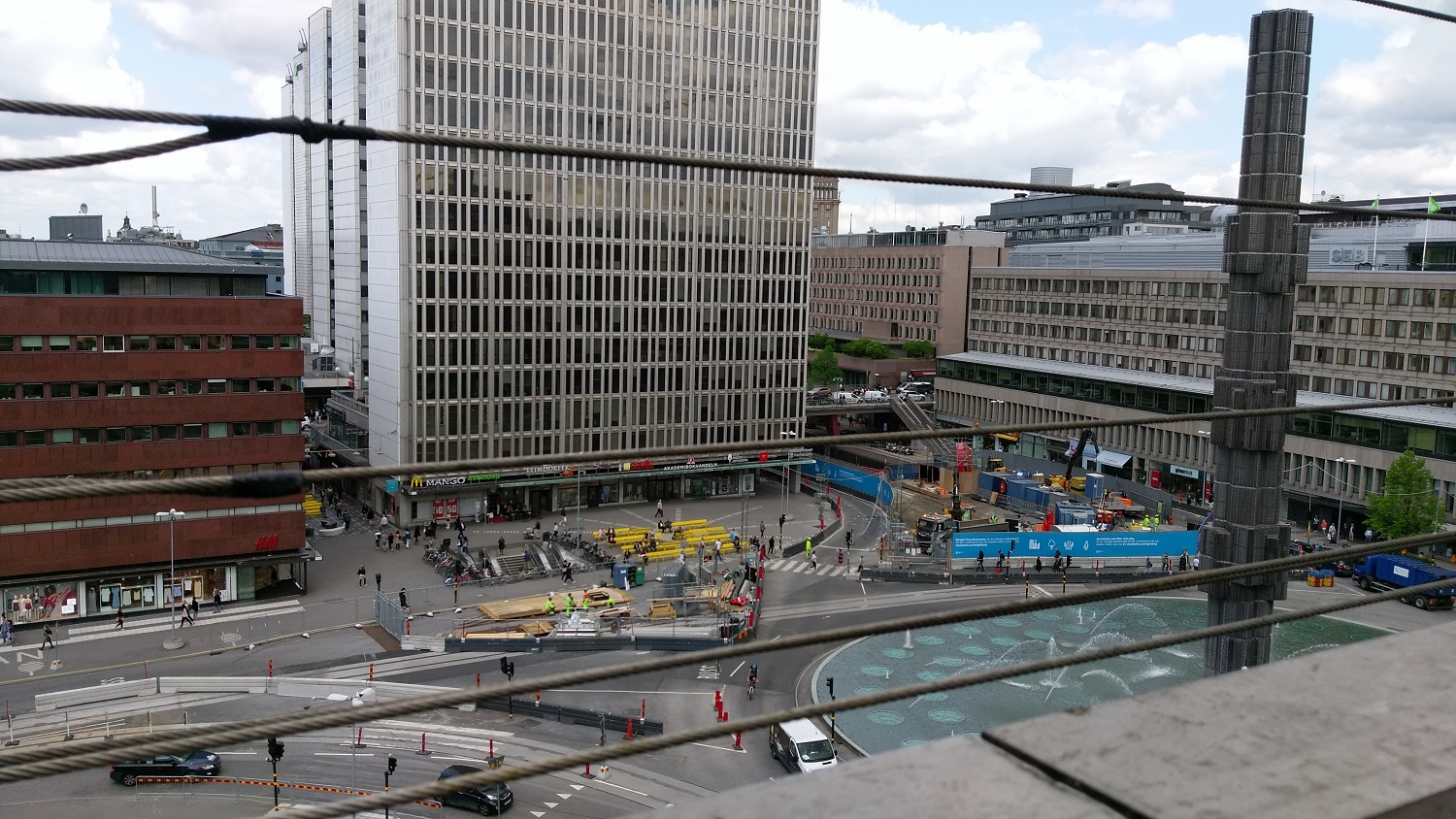
Sergels torg, from the top of the Kulturhuset

Sergels torg, from the top of the Kulturhuset

My flight back to the UK was at 6 pm on the Monday, so I had plenty of time to kill. I woke up early, panicked a bit because I’d forgotten to check-in online the night before, but managed to do it on my phone (and discovered when I boarded the plane that evening that I’d once again got a seat by the emergency exit over the wing; result.) After checking out of the hotel, I took a taxi to the Centralstation, where I dumped my bag, and met up with Tobias. We went for lunch at the rooftop restaurant in the Kulturhuset, which overlooks Sergels torg. It was hot and sunny, just like it had been on the Friday (when I was also carrying a heavy bag around with me). After lunch, I said my goodbyes and caught the Arlanda Express to the airport, where I planned to kill the rest of the afternoon. The last time I’d flown from Stockholm had been on an early October morning, and the airport had been deserted. It wasn’t this time. It was heaving, and there weren’t many places left to sit.

My flight was delayed by 45 minutes, which meant I’d miss the train I’d planned to catch. Fortunately – for me, at least – the next train’s arrival had been delayed by 15 minutes, so I managed to catch it a couple of minutes before it left the station. But it was then delayed further – kids trespassing on the line between Manchester Airport and Manchester Piccadilly, apparently – and I didn’t get home until 10:30 that night. That final train ride is always the worst part of any journey home from abroad, because drives in just how shit our railway network is. Of course, we know who to thank for that…

Three years ago, I’d had an excellent time at Fantastika 2013, so it had always been my plan to attend another Swecon. When I learnt Fantastika, in the exact same venue, had been chosen as the Swecon for 2016, I knew I had no excuse not to go. And especially since I’d met a lot more people in Nordic fandom at Archipelacon last year… And yes, this Fantastika was a good as the earlier one, if not better. Not only are the Swedish (and Nordic) fans extremely friendly, but they’re also still focused on celebrating the books and stories that fandom is actually about. While there was a panel on the novels Robert Heinlein – which was actually very interesting – there were also lots of discussion of current science fiction and fantasy works. The experience reminded why I became a fan myself.

I really ought to shout out to all the people I spoke to over the weekend, but I’ll probably go and get a forget someone – but I’ll have a go anyway. Here, in no particular order, goes… Tobias, Johan, Luke, Fia, Kristin, Erik, Jukka, Jessica, John-Henri, Caroline, Brian, Chris, Barbara, Anders, Jukka, Carolina, Thomas, Patrik, Jerry, my fellow panellists, Tommy, Flemming, AR, Karin… and if I’ve missed anyone, I sincerely apologise.

As mentioned earlier, next year’s Swecon is in Uppsala. I’m hoping I’ll be able to go. And if not, there’s always Worldcon 75 in Helsinki in August next year.


24 Comments

The inaugural Sputnik Award

A few days ago, Lavie Tidhar tweeted a sarcastic comment, as he is wont to do, about libertarians having a science fiction award, the Prometheus, but there being no corresponding award for socialists. And while he likely didn’t mean it seriously, it did occur to me that perhaps there should be an antidote to science fiction’s notorious right-wingness (and by that I’m referring to the texts, not the authors). Where are the science fiction works which posit socialist, or communist, futures? Where are the sf books which celebrate left-wing political thought? And isn’t it about time we showed those right-wingers that: no, they don’t speak for all of us. In fact, they probably only speak for a minority.

Back in 2009, Mark Boulds and China Miéville published a  book of essays on “Marxism and Science Fiction” titled Red Planets. And Miéville has proffered a reading list of left-wing genre works. But this should be something which is ongoing, which grows each year, which is in conversation with both itself and the wider genre (yes, including its more fascistic elements).

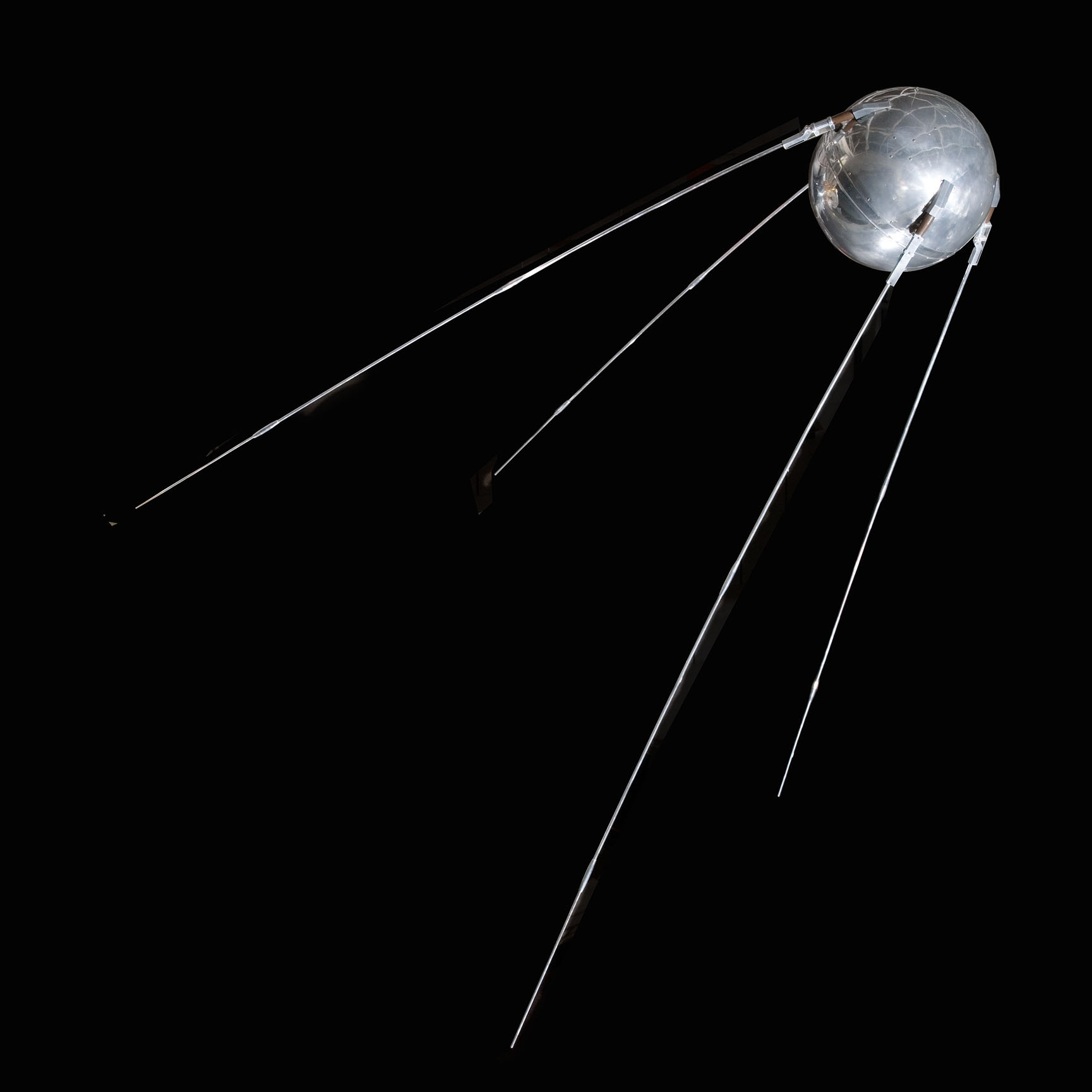
So, somewhat tongue-in-cheek, I thought it might be a good idea to, well, take Lavie’s idea and punt it out into public for discussion. And I decided to call this imaginary socialist sf award the Sputnik Award because it was the most obvious name for it – celebrating both the first artificial satellite to orbit the Earth (you can’t get MOAR SPACE than that), the Russian for “fellow traveller” (used as code for “communist”), and named for a thing rather than a person (who might later prove divisive or contentious).

Sputnik, hanging in Milestones of Flight, National Air and Space Museum

Sputnik, hanging in Milestones of Flight, National Air and Space Museum

However… awards need shortlists. From which they can choose a winner. Who will then receive a trophy or something. But, well, socialist science fiction… Such a thing exists, it must exist, but where is it? Can anyone suggest any science fiction novel, novella, short story or graphic novel, published in 2015, which is both science fiction and socialist? There’s Kim Stanley Robinson’s Aurora, although that posits a form of Athenian democracy (a political system much beloved in sf) rather than outright socialism; Carolyn Ives Gilman’s Dark Orbit certainly embodies the spirit of socialism, although the only political systems mentioned are anything but; and there’s Carter Scholz’s ‘The United States of Impunity’ which is only just sf and only just fiction and more of a critique of the current economic and politic climate in the US than anything else…

There must be examples out there. Any suggestions? Or is sf just too right-wing? Are we going to have to accept that science fiction exists only as a right wing genre? That even its left-wing writers end up writing right-wing stories? I hope not.

Because that would be really sad.


1 Comment

The wrong side of the Pennines

Eastercon this year took place in Manchester, on the other side of the Pennines. I very much prefer Eastercons when they’re outside London, and even more so when they’re relatively close – and Mancunicon was only 55 minutes away by train. Having said all that…

Every Eastercon begins with travel woes, and Mancunicon was no exception. I’d booked a taxi in plenty of time to take me to the station, giving me 40 minutes before my train left. But at the time the minicab was supposed to arrive, it didn’t. And continued not to arrive… until eventually appearing 15 minutes before my train was due. This was because the current minicab operating model has a central dispatching office put out jobs for drivers to bid on. And if they don’t receive any bids, or don’t accept any of those they do receive, then you don’t get a taxi. And they don’t bother to tell you. This is not helpful. The cab driver who eventually turned up told me he’d bid on the job earlier but his bid had been rejected – otherwise he’d have arrived much sooner.

As it was, I managed to make train, although it was close. The trip was uneventful, and I then had a ten-minute walk to my hotel. Not normally a bad thing. But it was a warm day, I was wearing a coat and carrying a box of Whippleshield Books to sell. So I was knackered and soaking wet by the time I made it to my hotel room. I then met up with Tobias, who’d flown over from Stockholm, and we headed across to the Hilton Deansgate, the con venue. I sort of liked the hotel, but I’m not convinced it was an especially good con hotel. Most of the programme rooms were far too small, meaning you had to get to them really early to get a seat. The dealers were split across two rooms, which didn’t work. The hotel had only three lifts, which meant there was a queue when people wanted to head up to the twenty-second floor for book launches in the Presidential suite (which was itself too small). There was no place to sit down and relax – one  bar was pretty much standing-only, the other was laid out like a coffee-shop. And the snack food provided during the con was disgusting.

On the plus-side, the location was excellent – lots of shops and eateries within easy walking distance. And even a museum of science and technology… which I didn’t visit. And a cinema. Given better use of the Hilton Deansgate’s conference facilities – and some comfy chairs in the mezzanine bar – it would make a really good venue. Having said that, Mancunicon was a victim of its own success. I was told they’d expected 700 to 800 attendees, but actually had 950 people over the weekend. It was certainly busy a lot of the time.

I made, as is my usual practice, less than a handful of programme items. I was on one – on space opera, ‘The Stars Are Your Canvas’, with Mike Cobley, Tom Toner, Alison Sinclair, Jo Zebedee and Gavin Smith. I think the panel went well enough, although in hindsight we didn’t actually interrogate our subject much, and by the end it had turned into a bit of a nostalgia fest for certain space opera properties… Ah well. Then there were the BSFA Awards (congrats to the winners)… Oh, and I made the NewCon Press book launch in the Presidential suite too. But the highlights of the weekend were, as ever, meeting up with friends, and those free-wheeling conversations you have in the afternoons while you’re sat round a table – including one discussion on neurology, theology and Game Theory with Simon Morden and Alex Lamb; another on the various media adaptations of Dune with Adrian Tchaikovsky; not to mention all those “catch-up conversations” you have with friends that aren’t really catching-up because you know pretty much what they’ve been up to since you last saw them thanks to Twitter and Facebook status updates… Of course, there’s also meeting new people. Which I did. And seeing many people I’d not seen for many years…

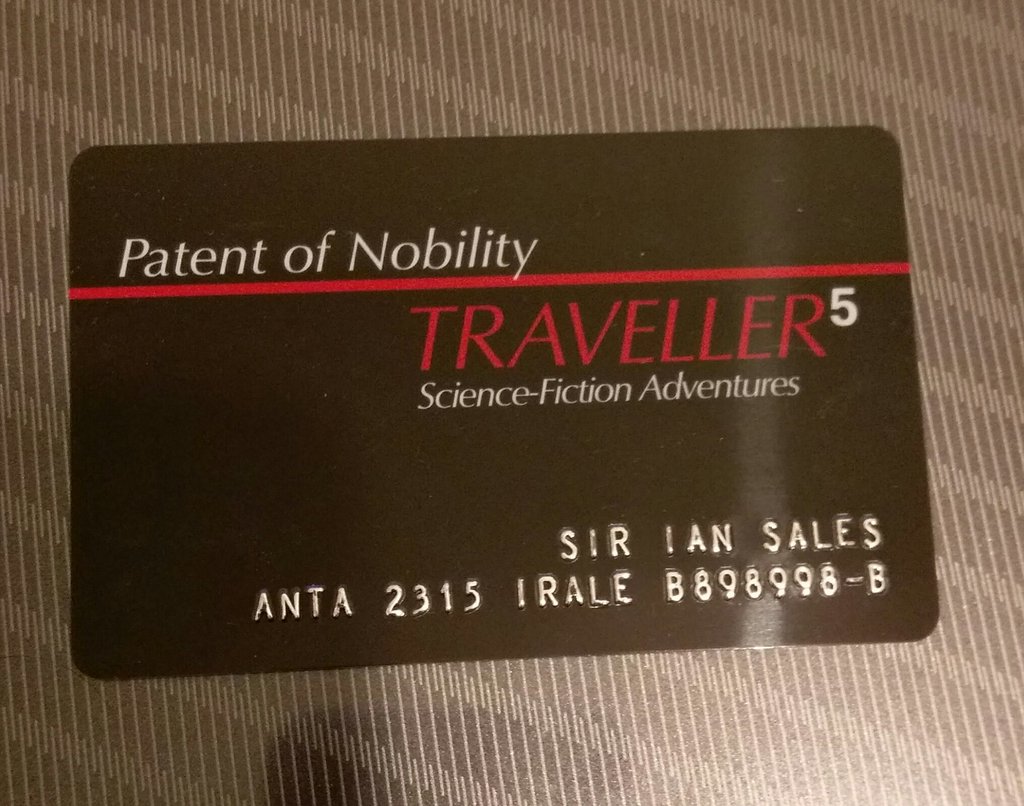
Oh, and for the record, the Traveller identity card I mentioned during the space opera panel? Here it is:

patent

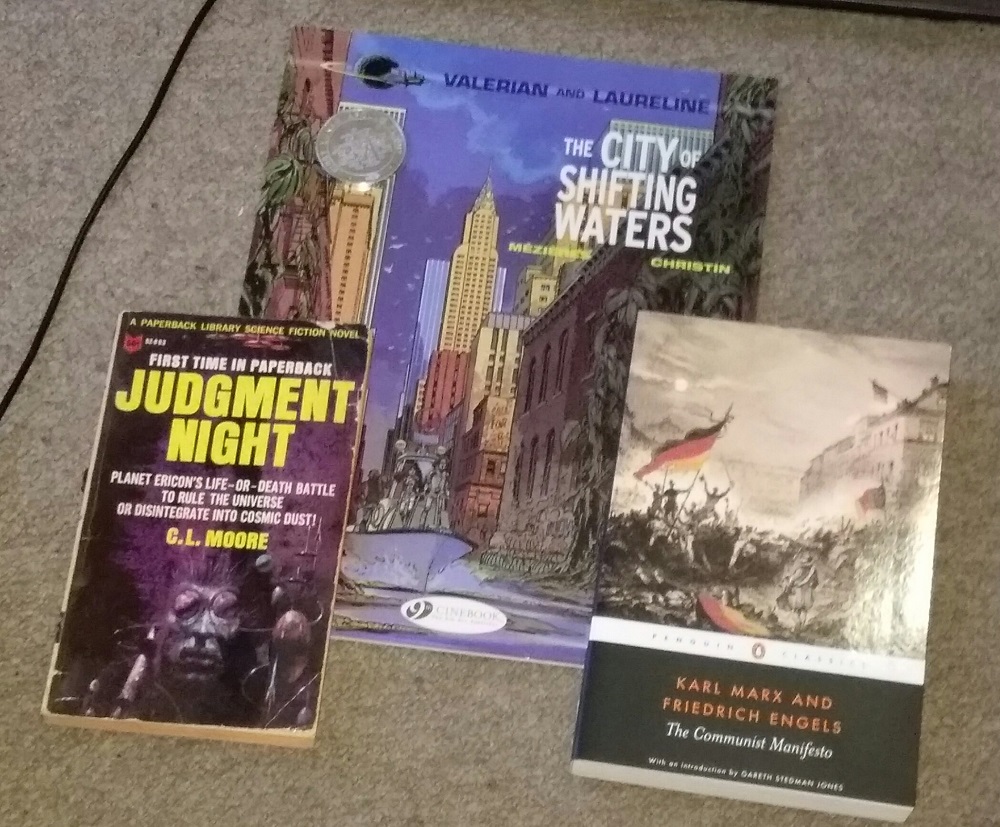
I also mentioned Judgment Night, the Valerian and Laureline series, The Communist Manifesto and a coin that’s flown around the Moon:

IMAG0010_1

I didn’t do so well on the social front, and went to be early on all three nights. I’d developed a bad back about a month ago, and all that standing around wasn’t do it any good. As usual, I also ate badly during the day, thanks to the poor choices available (such as the aforementioned disgusting con food). On the Sunday, I nipped to a nearby Sainsbury’s and bought lunch there. I wish I’d done it on the previous two days. Twice, I had dinner in the hotel restaurant. The food was pretty good. On the Saturday night, a group of us went to a nearby Indian restaurant. The food was good, but it was a bit too loud in there (a birthday party on the mezzanine, apparently).

I want to like Mancunicon more than I did. I think the two things that spoiled it for me were pain from my back and the somewhat feeble dealers’ room. I bought three books at the con; I usually come back with a carrier-bag full. In the past, I’ve spent hours browsing the books in the dealers’ room, but that took all of five minutes at Mancunicon. I suspect I was also hoping it would be more of a relaxacon, with places to chill out; and while many of the programme items looked interesting, the faff in actually getting a seat in the rooms put me off even trying. None of which is to say Mancunicon was a badly-organised Eastercon. On the contrary, it did extremely well – especially when you consider it was a rescue bid.

(Speaking of which, 2017’s Eastercon in Cardiff collapsed, but a rescue bid in Birmingham was announced at Mancunicon: Innominate at the Hilton Metropole at the NEC, GoHs Pat Cadigan, Judith Clute and Colin Harris. And 2018’s Eastercon will be Follycon in Harrogate, with GoHs Kieron Gillen, Kim Stanley Robinson, Nnedi Okorafor and Christina Lake.)

Oh well, perhaps I’ve been spoiled. Archipelacon is going to take a lot of beating. I did quite well with my own books (and I’m eternally grateful to Roy Gray for having them on the TTA table). It always surprises me – in a good way, of course – when people come up to me and say nice things about them I was hoping I wouldn’t have to carry a box full of Whippleshield Books back home, and happily I sold just over half of those I took with me. (The books are, of course, still available from the Whippleshield Books website here.)

In summary, a middling-to-good Eastercon for me. Mostly my fault – but also partly because the venue didn’t quite work as a con hotel. I wish I could say I came home fizzing with ideas and enthusiasm for writing projects… but I didn’t. I left at lunch-time on the Monday – it was absolutely hammering it down and I didn’t fancy walking to the station but a friend planned to order a cab… The journey home went without a hitch, and the cat at least was happy to see me and spent a good five minutes telling me off for disappearing on him. I did tell him but… Anyway, Birmingham next year – and I remember the hotel from the 2011 Eastercon… A good venue, but expensive and miles from anywhere, I seem to recall. But that’s twelve months away…


1 Comment

Awards time again

This is not a post listing what 2015 works of mine are eligible for genre awards. I disagree with the practice, I think it badly distorts the award-space, and it’s bending the entire field out of shape thanks to the stupid wrangling over who and what each of the awards actually represent. I’ve refused to post lists of my eligible works in the past, and I see even less of a reason to start doing it now.

However, I do vote in awards – well, one of them: the British Science Fiction Association Award. And I’ve been doing so for over twenty years. This year, there’s been a change to the process. Voters have until 31 December to nominate four works in each of the categories – novel, short fiction, non-fiction and art – in order to make up a long list. During January, voters will get to nominate four works from that long list to generate the short lists. Which will be voted on, and awarded, at the Eastercon in Manchester on the weekend of 25 to 28 March 2016.

Eligible works must have been published during 2015. Novels must have been published in the UK – unless they’re ebook only, in which case country of publication is irrelevant. There are no geographical restrictions on short fiction, non-fiction or art.

5_05_lrg

According to my records, I have read only nine genre novels published during 2015. One of them I would like to nominate – Carolyn Ives Gilman’s Dark Orbit – but it has yet to be published in the UK and so is ineligible. Of course, there’s no reason why I can’t nominate a book I’ve not read – I have until the end of January to read it, after all.

One novel I suspect will appear on a lot of ballots is Kim Stanley Robinson’s Aurora. It’s certainly been one of 2015’s high-profile releases. And Kim Stanley Robinson is one of the genre’s best authors. The book has received a great deal of praise. But. It didn’t work for me. For all the work he put into designing the ecology of his generation starship, the characters were completely flat and, despite the interesting commentary on narratology in the AI narrative, it all read to me like Californians in Spaaace. However, there was another generation starship novel published during 2015, by an author better known for writing epic fantasy: Children of Time by Adrian Tchaikovsky. While the narrative set aboard the spaceship was a little too trad to me, the spider-based civilisation which forms the core of the novel’s story was fascinating and brilliantly done. Children of Time will be taking one of my slots.

Then there’s Ancillary Mercy, the final novel in the Imperial Radch trilogy. I found this disappointing. I liked the first book, Ancillary Justice, very much – but it seems that was pretty much a prologue to the actual plot. Which, as resolved in Ancillary Mercy, was unsatisfyingly small-scale. There was also far too much talking about each character’s emotional state, to the extent it often overwhelmed the narrative. I won’t be nominating it.

David Mitchell’s Slade House was Mitchell being clever, which he does well, but was pretty slight – not to mention deploying a few too many horror clichés, or indeed being structured such that one entire section was pure exposition. Ilka Tampke’s Skin had much to recommend it, particularly its depiction of Roman Britain, but although not marketed as YA it read like it had been put together following YA story patterns – to its detriment. The less said about Christopher Fowler’s The Sand Men, the better. Claire North’s Touch was based on an appealing premise – so appealing, in fact, it seems to have spontaneously appeared half a dozen times in the past couple of years; something in the water? – but its weak plot scuppered it. The First Fifteen Lives of Harry August was much, much better.

Among the 2015 books on my TBR are Justina Robson’s Glorious Angels, the final book in Alastair Reynold’s Poseidon’s Children trilogy, Poseidon’s Wake, Dave Hutchinson’s Europe at Midnight, and Chris Beckett’s Mother of Eden. I also plan to keep an eye on the recommendations of several other people, and if anything they mention takes my fancy then I’ll read it. For this first round of the BSFA Award at least, it’s worth putting in a speculative vote – ie, for a book you’ve not read but think might be award-worthy – rather than letting the vote go to waste.

As for short fiction… Every year, it gets to this time of year and I realise I’ve not been reading the short fiction published in various places, so I go and skim-read all the various magazines until I find something which takes my fancy. This year, however, I have at least one dead cert: A Day in Deep Freeze by Lisa Shapter, a novella published by Aqueduct Press. That will be getting one of my slots. There’s also a David Herter story on tor.com, ‘Islands off the Coast of Capitola, 1978‘, and I’m a big fan of Herter’s fiction. But we’ll see what comes of my high-speed trawl through 2015’s genre fiction over the next week or so…

I have two candidates for non-fiction – My Fair Ladies by Julie Wosk, a study of “female androids, robots and other artificial Eves”; and Adam Roberts’s Rave and Let Die, if only because I don’t want him to give up his genre criticism. Jonathan McClamont has written some excellent ‘Future Interrupted’ columns in Interzone during the year. Likewise Nina Allan and her ‘Time Pieces’ column. And there was an extended conversation back in July across the blogosphere, about science fiction and criticism and the history of science fiction, prompted by an article by Renay published by Strange Horizons, ‘Communities: Weight of History‘… which then led to ‘The Weight of History‘ by Nina Allan… which then intersected with Jonathan McCalmont’s ‘What Price Your Critical Agency?‘ and resulted in Maureen Kincaid Speller’s ‘{and then} a writing life beyond reviews‘. In a genre space in which corporate marketing and support network advocacy is bending fandom out of shape, this is an important sequence of articles, and some, if not all, deserve nominations.

Finally, there’s art… another category I tend to look for suitable nominees at the last minute. One of my nominations will go to Kay Sales for the cover art to All That Outer Space Allows, not only because it’s a lovely piece of design but because I think the cover designs for all four books (the second editions of the first two, plus three and four) are striking and worthy of an award. Interzone has continued to publish some excellent interior illustrations for its stories. I particularly liked Richard Wagner’s illustration for ‘The Worshipful Company of Milliners’ by Tendai Huchu and Vincent Sammy’s illustration for ‘Songbird’ by Fadzlishah Johanabas, both in #257. I’ve had a quick look at my bookshelves, and online, for cover art from genre books published in 2015… and failed to find any which particularly stood out. Except, perhaps, the cover art to Hannu Rajaniemi’s Collected Fiction, which is by Luis Lasahido. But I shall continue to look, in the hope I find enough candidates for my ballot before the end of the year.


6 Comments

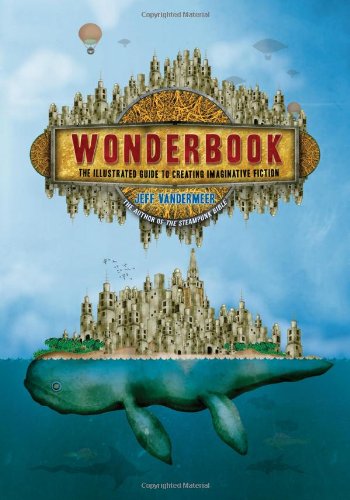
Wonderbook, Jeff VanderMeer

wonderbookThey say everyone has a book inside them. Some people, it seems, even have a book about writing books inside them. While many of the latter have been written by people whose only published work appears to be a book about writing a publishable novel, there are a large number by authors with long and illustrious careers. This is especially true in science fiction and fantasy, a mode of fiction which as been curiously self-fertilising since its inception in the pages of Amazing Stories in 1926. Names from the letters pages of the pulp magazines soon had stories appearing in those same titles. There is a long list of successful science fiction and fantasy writers who have published “how to write” books, from Bob Shaw to Ben Bova, from Lisa Tuttle to Damon Knight, and from Stephen King to Ray Bradbury. And yet, despite the marquee names on the covers, such books are not always useful. Shaw’s How to Write Science Fiction (1993) may be an entertaining read, but its advice can be distilled down to “read lots of books”. The best, despite its age, is probably Knight’s Creating Short Fiction (1981). Bova’s The Craft of Writing Science Fiction that Sells (1994) is simplistic, and the stories – his own, of course – he uses to illustrate his points do the book no favours. However, Bova did go on to edit a series of books on specific aspects of writing science fiction for Writer’s Digest Books and, while necessarily specialist in the topics they cover, they can be helpful.

All of which is a roundabout way of introducing Wonderbook by Jeff Vandermeer. Vandermeer is no stranger to genre fiction – he is an award-winning writer and anthologist, and he also runs a highly-regarded small press, Cheeky Frawg Books. Wonderbook, subtitled “the illustrated guide to creating imaginative fiction”, has apparently been several years in the making. Given the book’s size, and its copious illustrations, that’s a boast it’s easy to believe. In fact, as an object, Wonderbook is pretty impressive, which is not something that can be said of most “how to write” books.

And yet… There’s something in the whole concept of a “how to write” book which seems vaguely antithetical to the process of creating fiction. The axiom that writing is a craft, that it is a skill set which can be taught, appears to suggest there is a right way and a wrong way to do it. As a result, “how to write” books often come across as prescriptive – “this is what fiction should be”, “this is what genre fiction should be”… And this can lead to a blanding out of literature written in a science fiction or fantasy mode.

If the recent self-publishing boom has taught us anything, it’s not just that everyone has a book in them, but that most of those books really should have never seen the light of day. It’s not simply an inability to tell a compelling story, it’s that many self-published writers simply do not have the language skills – their books are replete with typos, grammatical errors and malapropisms.

But is a facility with written language all that’s required? Certainly, a writer should know what they are doing before they make a deliberate choice not to do it. It’s not that there’s a need for rules, or even accepted ways of doing things… but expectations certainly exist – from editors to readers, from publishers to reviewers…

Wonderbook scores higher in this regard than other books of its ilk – the clue is there in the subtitle. This is a book designed to catalyse the creative process, and then show how to shape that creative impulse. Vandermeer is also clear on Wonderbook’s audience: “although of use to beginner and intermediate writers working in any genre, Wonderbook’s default setting is fantasy rather than realism” (p xiv). The book covers its subject in seven chapters, titled: Inspiration and the Creative Life, The Ecosystem of Story, Beginnings and Endings, Narrative Design, Characterization, Worldbuilding, and Revision. Each chapter contains numerous illustration – some instructional, some merely decorative. There are also a number of sidebar essays by established genre writers, such as Kim Stanley Robinson, Lauren Beukes, Karen Lord, Ursula K Le Guin, Nick Mamatas and Neil Gaiman. And a detailed analysis of Vandermeer’s own novel, Finch.

The sidebar essays demonstrate that asking ten different writers how to write will result in ten different answers, many of which will be either contradictory or too specific to be of much use. Authors with successful careers have by definition experience at writing publishable fiction, but what worked for them is not necessarily transferable. Nor should it be.

There are plenty of examples given of the narrative techniques covered in Wonderbook, but unfortunately some of the details are just plain wrong. The love affair in Kim Stanley Robinson’s 2312 is between Swan and Wahram, not Waltham (p 87). Iain M Banks’s Culture novels do not “postulate a far future in which humankind has spread out across the galaxy”, but are set during our present day – see the novella ‘State of the Art’ (p 147).

Despite all that, if you’re looking for insights into writing for publication successfully, a “how to write” book is not necessarily the best place to look. Shaw’s advice – “read lots of books” – may be trite, but it’s still the best way to learn how to write. Some “how to write” books may present novel-writing as a “get rich quick” scheme, but anyone with any sense knows it’s anything but. Wonderbook makes no such claims: its lessons are clear, its analyses are mostly unobjectionable, the illustrations add welcome texture, and it’s a poor reader who will walk away from the book without learning something. For the “beginner or intermediate writer”, it’s certainly one of the best books available of its type. For the seasoned writer, perhaps not so much – there’s just a little too much which feels restrictive.

But that’s the nature of writing about writing fiction.

This review originally appeared in Interzone #250, January-February 2014.


64 Comments

10 things I learnt writing space opera

The following may read as pure cynicism, but it’s actually meant to be tongue-in-cheek. I thought it best to mention that before some redditor sees it and starts frothing at the mouth…

1. There is nothing to be learned from analysing other space operas
Why are some space operas successful, and some not? It’s no good looking for a magic ingredient or a magic formula – there isn’t one. This also applies to epic fantasy, another resolutely commercial form of genre fiction. I read Robert Jordan’s Wheel of Time series to see what made its books bestsellers. I couldn’t figure it out. They were terrible and derivative, and often astonishingly dull. They also sold by the boatload. Go figure.

2. Yes, you can be too clever
Space opera is a commercial subgenre of science fiction and has proven wildly successful on television and in the cinema. It is broad-brush literature. Yes, you can get clever with it, but the sort of people who enjoy space opera are unlikely to appreciate it, and the sort of people who like clever fiction are unlikely to pick up a space opera in the first place. This doesn’t mean there aren’t successful exceptions, of course. But. M John Harrison’s Light had his name on the cover, so readers knew exactly what they were getting. And Leckie’s Imperial Radch trilogy judged the amount of cleverness to include pretty much perfectly.

3. In a trilogy or series, never put off the resolution of minor plot threads or mysteries until the next book
It’s one thing to draw out a plot over the length of a trilogy or series, but that’s the meta-story – no one expects that to be resolved in the first book. But if you’ve included a bunch of minor plot threads, or even a couple of mysteries, you need to resolve them before the end of the book in which they appear. Readers will either conclude the plot thread doesn’t work, the author has forgotten about it, or won’t remember it when you do resolve it in the book following. See above re too clever…

4. Readers will swallow anything… as long as it’s a trope
As Joe Abercrombie tweeted several weeks ago: “Always surprises me the things people find utterly unbelievable in a fantasy. Giant winged lizard? Fine. Female smith? BEYOND RIDICULOUS.” In space opera, that would be: Faster-Than-Light travel? No problem. A society that never developed gunpowder? I DON’T BELIEVE IT. Guess what – it’s all fucking made-up. Every bit of it. Dragons are not real, FTL is not real. So if the author wants to posit a star-faring society without guns, then why the hell not? Um, see above re too clever…

5. Familiarity does not breed contempt, it breeds the moneys
Commercial fiction of any genre trades on the familiar. It exists mostly to be comfort reading, and most people don’t like to have their likes and prejudices questioned. See Puppygate, see Lovecraftgate, see anybody who uses the term “political correctness” or “social justice warrior” unironically. Space opera is big spaceships, big battles, derring-do and as much colour as can be reasonably squeezed into 700 action-packed pages. Themes are big and bold and simple: good people win, bad people lose; evil empires are evil; one man (it’s always a man, of course) with a stout heart can topple the biggest of empires; if you can’t map Middle America values onto a fictional universe, then it is clearly wrong.

6. Unless your space opera is military sf, don’t package it to look anything like military science fiction
If you put a GIANT SPACE BATTLESHIP on the cover of your space opera, most readers will expect to find something inside which is all about the GIANT SPACE BATTLESHIP and nothing else. Manly man human space fleets battling nasty reptile aliens, for example. And when that’s not what’s in there… When people buy a meat pie, they expect to get a pastry shell filled with some sort of flavoured flesh. If it was filled entirely with, say, aubergine, they would be rightly disappointed. Of course, books are not meat pies, and it may well be that a military-sounding book title and a GIANT SPACE BATTLESHIP on the cover are actually relevant to the story, which is, despite all that, not at all military science fiction. But that, of course, is why we have blurbs – and why Kindle books let you read an excerpt.

7. Too much description is a bad thing
Descriptive prose gets in the way of action. Though how immersion is supposed to work without descriptive prose is beyond me– oh wait, clichés. Of course… And you could always stick it in dialogue. Readers like dialogue – it explains things. You know that writers’ maxim: show, don’t tell? It should really be: don’t show, tell it in dialogue. Fact.

8. It’s impossible to know what needs to be explained
Some readers will complain because a space opera’s particular flavour of FTL is not backed up by an info-dump. Others will be unwilling to suspend their disbelief regarding the book’s social set-up without some sort of history lesson to “explain” it. There is no way of knowing what level of exposition is appropriate, or what elements actually require exposition – it varies from reader to reader, from story to story. Personally, I tend to go for “less is more”, but readers seem to trust authors far less these days than they used to.

9. There needs to be a Poe’s Law type thing for pastiches
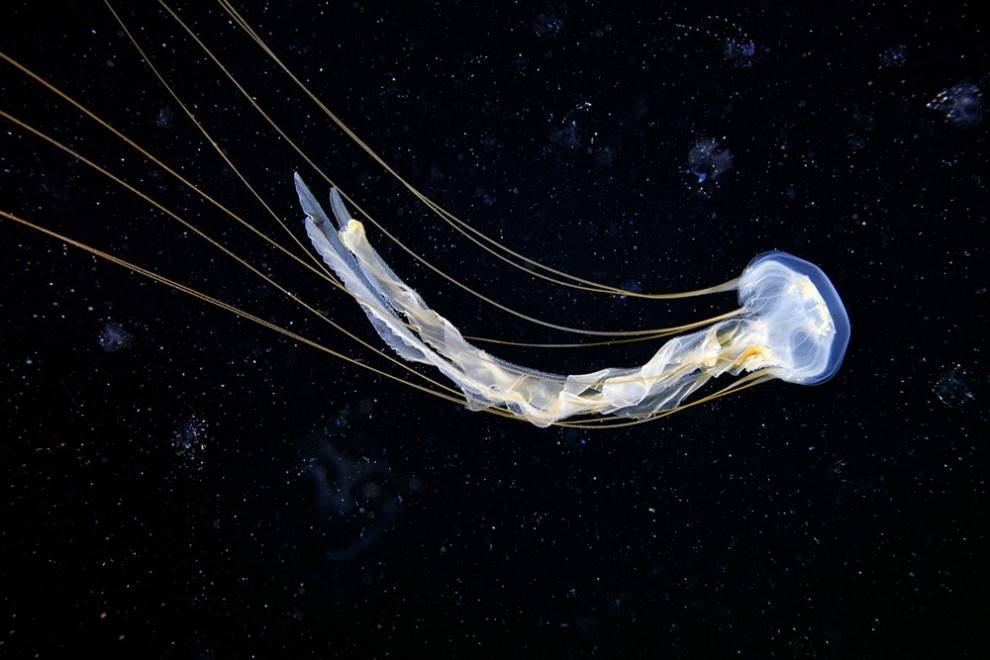
Science fiction, they say, is a genre in conversation with itself. It might be better to consider it as some sort of colony creature, which passes its genes – ie, tropes – from one generation to the next, slowly evolving, often mutating, as it goes. A GIANT SPACE JELLYFISH. Conversation, after all, it implies some sort of intellectual engagement, and if tropes are what genre uses to propagate itself, you wouldn’t expect them to be used so uncritically so often. So when tropes are indeed pastiched, it’s often impossible to tell if it’s being done ironically or uncritically.

10. You can overthrow the universe as long as you put it back how you found it
Nothing ever really changes in space opera – or in epic fantasy, for that matter. Different uniforms but the same old jackboots. You can only take progression so far. See earlier re female smith. Start putting too much progression in there and you put the entire genre at risk – you get Puppygate. Still it’s hardly surprising that a subgenre based on autocratic political models is regressive, it’s written into its DNA. And if you change that, well, you haven’t really got space opera, have you? So keep your universe tidy and put things back where you found them. You know it’s the “right” thing to do…

Chrysaora-sp-1

Of course, for every point made above, someone is going to name a particular space opera which disproves the point. Which, er, pretty much proves point 1. But when you look at a genre which exists in two distinct markets, one of which is driven by marketing spend (proper published books), and one by weird sales algorithms (self-published Kindle books), it tends to be the more traditional fare which succeeds best in the latter market. Besides, the points made above are not actually meant seriously…

Or are they?


7 Comments

Reasons to be cheerful… in space opera

Consolatory fantasy typically ends with the existing power structure back in charge, and they’re usually the good guys – no matter how unfair the society – so as a result I suppose that could be seen as optimistic. Of course, the bad guys are always much worse. Most space operas follow a similar set-up. If it’s not the barbarians at the gates, it’s the rot from within. Either way, the empire or republic is in for a kicking and the good guys have to put up the good fight to save it. If the empire does go down in flames, a new more powerful one will rise phoenix-like from its ashes. So far, so consolatory.

I will happily admit I deliberately set out to pastiche the consolatory fantasy template when I wrote A Prospect of War. Here’s the emperor – he’s under threat. So here’s a posse of good guys all set to fight the dark lord and defend the throne. And so the plot of the novel pretty much kicks off the conspiracy and sees the peasant hero gather his forces for the final battle.

However, part of the fun of writing the sequel, A Conflict of Orders, was then carefully upsetting that structure. The final battle takes place halfway through the book, rather than at the end of the trilogy. The villain is defeated (that can hardly be a spoiler) and the throne is once again safe… And then the tone of the story changes…

There is a plot hiding beneath the story of the An Age of Discord trilogy. Hints and clues to it appear in both A Prospect of War and A Conflict of Orders, and it was always my intention to bring that plot into the light and resolve it in the third and final book, A Want of Reason. But in the years since I finished writing A Conflict of Orders and now – when I have to write A Want of Reason from scratch to complete the trilogy – I’ve changed my mind about a lot of things. Not least what happens in A Want of Reason. Part of this is practical – I put together lots of notes for the third book back when I was writing the first two, but those notes now sit on a dead computer and are inaccessible. But it’s also true that my definition of what constitutes an optimistic ending, never mind an interesting story, has changed in the years since I completed A Conflict of Orders. Which is not to say that A Want of Reason will be a domestic novel – I’m not going to do a Tehanu (much as I would love to)…

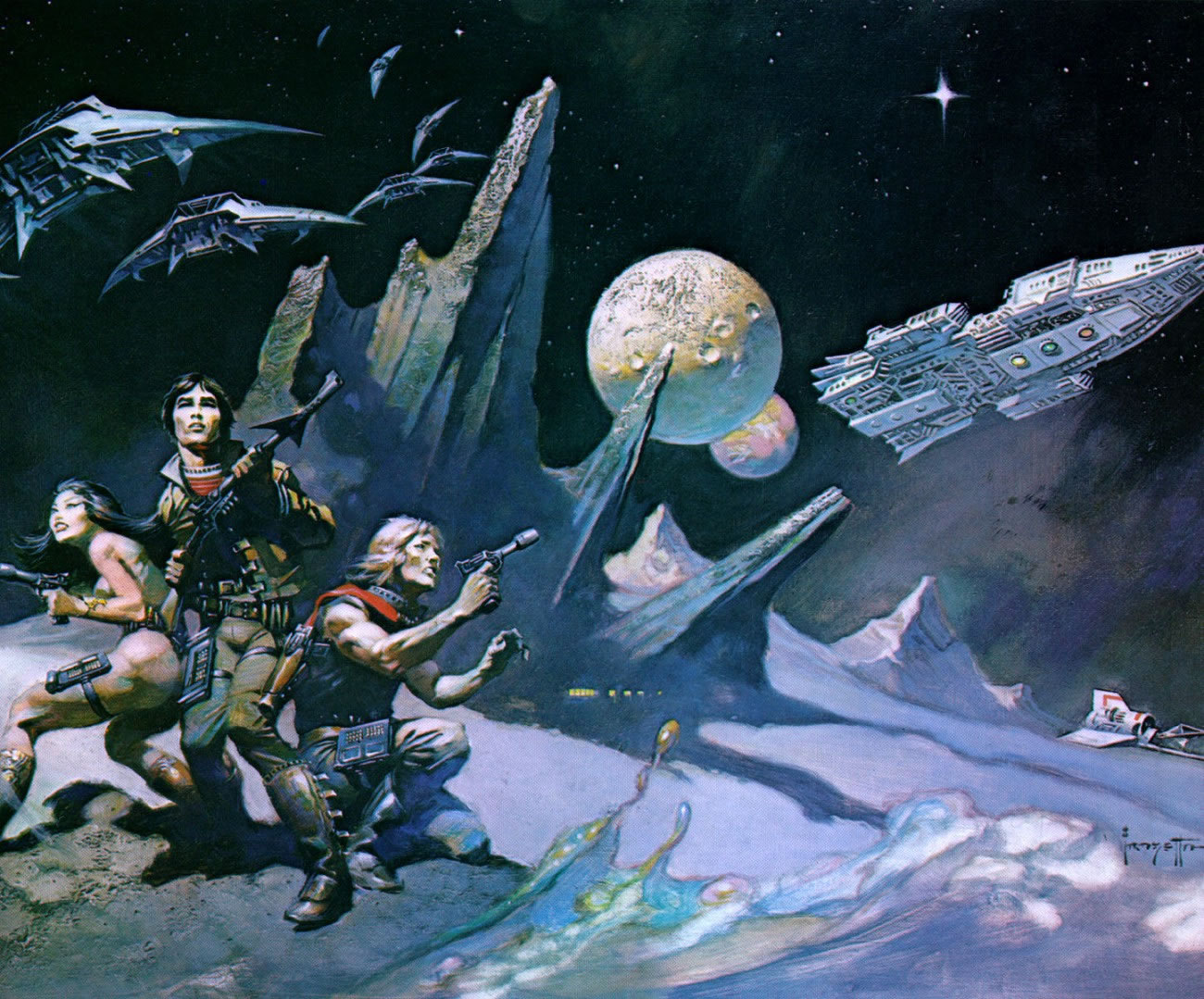
SpaceOpera

But as A Want of Reason begins to take shape and settle into its story, I’m finding it a much darker novel than I had expected. The focus of the story too has altered, and now rests on a different selection of characters. Casimir Ormuz, the peasant hero, is still there, of course. But his journey to the resolution – never mind the resolution itself – is very different to the one I had originally envisaged.

I wrote each novella (and novel) of the Apollo Quartet to confound reader expectations. I see now that I’d been working to a similar principle – albeit considerably weaker – when I’d written A Prospect of War and A Conflict of Orders. But for A Want of Reason… I’m going all-out. The good guys will become bad guys, and the bad good, and the ending will neither reinforce the status quo nor raze the empire to the ground.

There’s not much room for innovation in space opera, given that everyone judges the subgenre by its bells and whistles. It’s either the world-building or – and this is a development of the past few years – its gingerbread prose which seeks to disguise common tropes beneath obfuscatory metaphors. The story templates haven’t changed, the tropes certainly haven’t changed. (There’s probably a Tough Guide to Space Opera, er, Space post somewhere in all this.) And those few space operas which have rung changes have generally caused very few waves. Has there, for example, been anything comparable to Nova published in the twenty-first century? (Having said that, are there any space opera authors as fiercely intelligent as Samuel R Delany currently being published?) There’s Ann Leckie’s trilogy of Ancillary Justice, Ancillary Sword and Ancillary Mercy, of course, which used an astonishing piece of sleight of hand in using female as a default personal gender to add a fresh new flavour to something Iain M Banks had been doing for three decades. And while Banks was certainly more innovative than pretty much every other writer of space opera – a consequence, I suspect, of having one foot in the literary fiction camp – even then he had a tendency to use tropes as they were set up rather than subvert or re-engineer them.

Sadly, Banks is gone and I suspect Leckie’s trilogy will prove a one-off blip. Space opera was already busy retrenching after the exciting times of the British New Space Opera of the eighties and nineties – not just Banks, but Take Back Plenty, Eternal Light, Light… But that movement introduced more of a hard sf sensibility to space opera (and some of the names attached to it, including McAuley and Reynolds, are probably better considered hard sf writers), without substantially changing its story patterns or its commonest tropes.

I’ve said before that space opera – if not science fiction itself – is an inherently right-wing genre (even if not all of its practitioners are right-wing). But more than that, I think space opera is inevitably drawn to the right. If someone writes a space opera which isn’t right-wing, it soon veers back to that side of the political spectrum. In part, it’s a function of the political systems which usually appear in space opera: emperors and empresses and empires and bloody great huge space navies. (I don’t, incidentally, hold with the argument that it’s the supposed tyranny of the laws of physics which lends science fiction, especially hard sf, its right-wing character.) However, I do think that science fiction has now, more than ever, reached a position where much of what qualifies as sf is little more than the rote deployment of sf tropes. There’s no insight, no consideration, attached. Put FTL into a story and no one so much as blinks. It’s just part of the furniture. Flat-pack science fiction.

And if you’re going to claim FTL is okay, it’s plausible, because there might be a Kuhnian paradigm shift which means it could happen… Which is, er, not my point at all. The tropes exist, they’re the building blocks of both space opera and science fiction. But I don’t think they should be used uncritically. I’d like to think I haven’t used them myself uncritically. Admittedly, a commercial space opera is likely not the best vehicle to deconstruct space opera tropes (but then I’d have said an commercial fantasy trilogy might not be the best place to deconstruct epic fantasy tropes, but Delany went and wrote his Nevèrÿon novels; but then, Delany…).

My area of interest in writing lies chiefly in the shape of stories, the narrative structures used to present a story in a particular way. I’m not interested in immersion – or rather, no more so than I need for a story’s world to be rigorous in my own mind. I’m not interested in literary techniques designed to make one reader response more likely than others… I jokingly mentioned in a recent conversation that I’d set a story on an exoplanet orbiting Gliese 876 but moved the setting to 61 Virginis because I didn’t think it plausible the story could have taken place given the original star’s distance, and likely travel times, from Earth. This is a science fiction story, of course, which posits a human civilisation across several star systems. No one would have noticed, but it was important to me.

If a science fiction story creates its own world , its version of Mars, Dubai, the Atlantic Ocean, etc, that doesn’t to me mean it does not demand the same level of rigour which pertains in the real world, in mimetic fiction. And at those points where the science fiction touches the real world… then the rigour applies just as much. This was a defining philosophy of the Apollo Quartet. The An Age of Discord space opera trilogy, however, does not touch the real world – at least not to any degree which might affect its setting. But its universe still needs to be internally rigorous. This may be why I find narrative structures and story templates preferable to be experimented upon – because they do not jeopardise rigour. (Yes, yes, you can make a point of ignoring rigour – surrealism, if you will – but that’s a different discussion.)

And so, in a more roundabout way than I am typical guilty of, it’s back to A Want of Reason and my total inability to wrap up what is supposed to be a commercial space opera trilogy in a nicely commercial way. The final chapter of A Conflict of Orders gives a flavour of the third and final book, and it wasn’t until I came back to that chapter a few months ago that I realised exactly what I’d set myself up for. Empress Flavia is on the Imperial Throne – and she’s kicked off a crack-down. When I first wrote it, it probably meant something in terms of my original plan for A Want of Reason. Now, it means: space opera fascism! And that’s what you’ll be getting: a space opera setting that moves ponderously to the right, in order to set up a climax that shifts everything irrevocably to the left. And, meanwhile, your favourite characters? I’ve either dialled them back so far in the narrative they no longer have any agency, or I’ve got them doing stuff villains normally do.

Because. Space opera.


1 Comment

On writing and how to

I’m probably the last person who should be giving writing advice, which is as good a reason as any for a blog post on the topic. If you want to know how to write short stories which are guaranteed to sell, look elsewhere. I suspect no one else really knows either, they’re just not honest enough to admit it. “Hey, it worked for me – sure it’ll work for you!” Yeah right. If you’re looking for rules on writing readable saleable fiction, I’m the wrong person to ask. If that makes me a dilettante, then so be it. I’m interested in fiction, I’m interested in how fiction works, and I’m interested in using that knowledge to create fiction which does something different. At least, that is, within my chosen genre.

It often seems wannabe writers can’t make a move without bumping into some “rule” or other: “show, don’t tell”, “prose must be transparent to let the story shine through”, “there are only seven plots”, “use a three-act structure”… They’re all bollocks. Fiction, least of all science fiction, is not a programming language. It doesn’t need to be compiled, and it won’t break the reader if, for example, you chose not to use quotation marks around dialogue.

And no one knows why some fiction succeeds and some doesn’t. It is not true that good novels will always see print (never mind sell by the boatload). There are a lot of excellent novels that have never been published, there are a lot of bad novels that have seen print (and some have even been phenomenally successful). There are also a lot of hugely popular novels which garnered a raft of rejections before someone eventually took a chance on them.

As for posterity… Dickens was a hack, an unashamedly populist writer – he even let his readers choose how one novel ended. And Jane Austen was allegedly neither the best writer of her generation nor the most popular – but her novels have endured, while the others are forgotten. Mary Shelly wrote seven novels, but it is her debut, Frankenstein, which is remembered two hundred years later by most people.

Science fiction should be willing to stretch the boundaries of narrative and genre. That it usually doesn’t is a result of the fact it is, at heart, a form of pulp fiction. It had its beginnings in pulp magazines, and though it has at times tried to throw off its origins – the New Wave being the most celebrated attempt – the basic form usually ends up prevailing. And not necessarily for the right reasons.

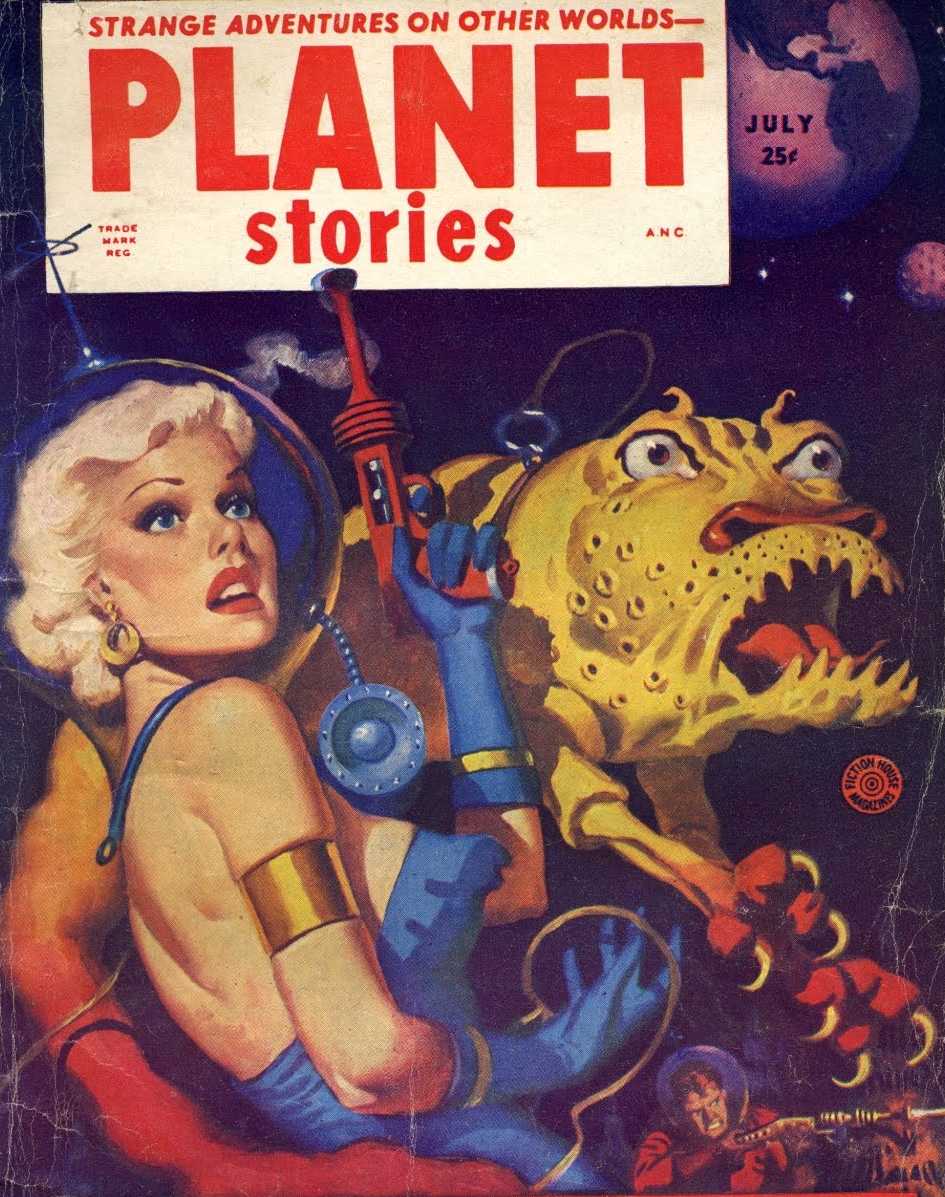
0423-planetstories

It’s a long-accepted truism science fiction readers are more open-minded, more willing to accept the Other, than readers of other genres… Or are they? Has sf become a victim of its own success? Its most prevalent models have proven so popular across most media that all forms of science fiction are assumed to be of that type. It’s an easy argument to believe – the Sad Puppies certainly fell for it – but it’s not in the slightest bit true. Science fiction is a broad church, and it’s long been my contention that those who take the trouble to admire, and understand, how the genre operates will make better use of the tools available to a writer.

So it’s all very well just blithely introducing FTL into a science fiction text, because the story requires several different locations and the genre insists they be separated by light-years. Except… Firefly put all its worlds in a single planetary system. Not, it has to be said, a particularly plausible solution, but at least it was an attempt to address a common sf stumbling block: space is big, hugely mind-bogglingly big. There are remarkably few science fiction novels which take account of that – notable examples being the current fad (see below) for generation starship stories, such as Aurora and Children of Time.

But if Whedon failed to interrogate the tropes he deployed – no real surprise there – there’s no reason why other writers cannot. There is no GREAT BIG BOOK OF TROPES which must be obeyed. There are no rules which dictate how tropes should be deployed. No matter what some people might insist. Making use of them the same way everyone else has done is just lazy writing, cheap shorthand for complex objects (as is hiding those tropes under a thin veneer of metaphor – but that’s a rant for another time). Each trope certainly exists for a reason, and it makes for much more interesting fiction, to me, if it is the reason that’s interrogated.

The big point about writing, the thing that drives all others, is that you get out what you put in. But your readers probably won’t. There are tricks you can use to trigger a specific reader response, but sooner or later your readers will spot those tricks and they will no longer work. So you might as well write something which meets your own objectives and not those of some mythical reader. The market does not exist, it’s an emergent phenomenon – so it’s no good writing “to the market” because there’s no such thing. And should you decide to try – well, by the time you’ve written your novel, the fad is likely over, unless you’re uncannily good at trendspotting. You can only write to please yourself and hope it pleases others…

It’s not like I’m one to talk. The Apollo Quartet has sold in total some 3000 copies over 3.5 years, of which just over half were sales of Adrift on the Sea of Rains. I was surprised during a conversation at Fantasycon 2015 to be told the Apollo Quartet is held in high regard. It often feels like “regard” should have a number attached and I know – from tracking my own sales – what that number is for the Apollo Quartet. Certainly among my friends and acquaintances, the four books have their fans. But not every review of them has been complimentary or fulsome.

I wrote each book of the Apollo Quartet to deliberately not be what readers of the preceding book had praised. People liked that Adrift on the Sea of Rains was literary, so I wrote The Eye With Which The Universe Beholds Itself to be a science fiction puzzle narrative. With each book I tried to push the boundaries of narrative and narrative structure. I made a number of artistic decisions which readers have questioned – not just the lack of quotation marks, but also the lack of closure, the refusal to spell out acronyms, the use of inference to link two narratives… the choice by myself to make the reader work to understand the story. I didn’t intend the Apollo Quartet to be light reading, and that dictated how I approached writing it.

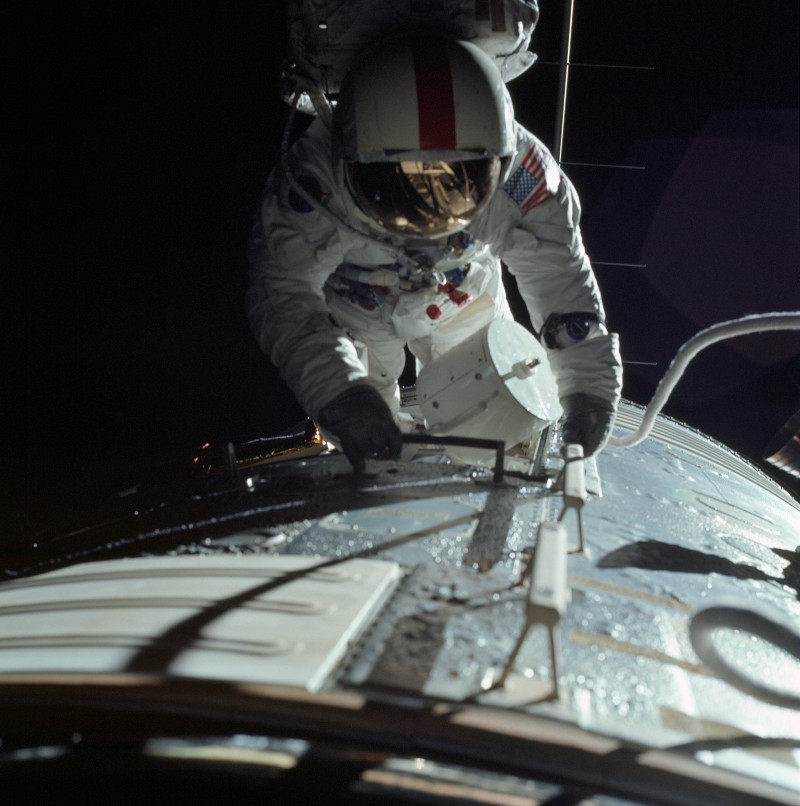
apollo17

There is, now I think about it, another reason why I’m a poor choice of person to write about writing science fiction: I can’t stick to the point, and I’m not entirely sure if this piece is in any way helpful. Writing advice is a poisoned chalice at the best of times – success is too individual for any particular technique to be held up as a general guideline. (I’m assuming a basic facility with language, of course). Having said that, one piece of advice I can give: get yourself a sympathetic group of beta readers. They will tell you what works and what doesn’t. Don’t just bang your novel up on Kindle, unseen by anyone else. (And don’t get me started on self-published 99p science fiction novels – that’s a rant for another day.)

There’s an unspoken compact between writer and reader. You can either stick to it… or have a bit of fun with it. Personally, I think the latter makes for more interesting fiction. Unfortunately, the former is more likely to result in successful fiction. You pays your money and you takes your choice…