It Doesn't Have To Be Right…

… it just has to sound plausible


2 Comments

Women in sf reading challenge #4: Winterlong, Elizabeth Hand

You’d have thought that with two four-day weekends in April, I’d have had plenty of time to read that month’s book from my reading challenge. Unfortunately not. However, during April I did manage to pick up copies of China Mountain Zhang, Maureen F McHugh; The Year of Our War, Steph Swainston; and Zoo City, Lauren Beukes (which I’m going to read instead of the planned Moxyland) – so I’m all set for the next three months at least.

Which is just as well, as April’s book was the last from my list I could just pick off my shelves: Winterlong by Elizabeth Hand. I’ve no idea how long I’ve had the book – but the “£2.00” scribbled in pencil inside the cover suggests I bought it at a convention, probably during the early 1990s. This can’t have been all that long after it was published – Winterlong, Hand’s debut novel, first appeared as a Spectra Special Edition paperback in late 1990, and as a paperback original in the UK a year later. It’s the latter edition I own. I also own the sequel, Æstival Tide, but not the third book of the trilogy, Icarus Descending – which apparently was never actually published in the UK (don’t you hate that? when UK publishers only publish the first two books of a US trilogy, but not the third?).

This year’s reading challenge has given me a welcome excuse to finally read Winterlong (and perhaps its sequel), something I’d been meaning to do for a while. It has always been my impression that I would enjoy Hand’s writing. I’ve read some of her short stories, and around this time last year I read her novella Illyria, and I’ve always thought her writing very good. She writes with a very literary style, closer perhaps to fantasy than science fiction, low on rigour, but with lovely prose – much like a writer I admire very much, Paul Park. So I had expected to like Winterlong

Sadly, I didn’t. There is lush prose – and I like lush prose; I’m a fan of Lawrence Durrell’s writing, after all. But often it seems to tip into florid prose, and, unfortunately, in Winterlong it’s florid prose which dominates. As I read the novel, I couldn’t help thinking that if Hand had applied the writer’s phrase “kill your darlings”, the book would have been half its 440 pages in length. I mean, a sentence like “The black domino of a Persian malefeants with her whip pied the pastel train of a score of moth-winged children trying very hard to perform the steps of a salacious maxixe” (p 171) shouldn’t have made it through the editing process. Which is not say that Winterlong is a bad book or doesn’t have anything interesting to say. It simply reads like a first novel written by someone whose reach exceeded their grasp, who had yet to gain control over their style, whose focus lay too much on the individual word-choices and not enough on the cumulative effect of those choices.

Wendy Wanders is a subject at the Human Engineering Laboratory, a “neurologically augmented empath approved for emotive engram therapy”. She can “tap” patients’ memories and emotional states, ostensibly for therapeutic reasons. But she was autistic as a child, and though her neurological augmentations have “fixed” her – as well as making her empathic – she is still not entirely cured. The HEL is located just outside the City of Trees, which was destroyed hundreds of years in the past, left for nature to run riot over, and is now inhabited by remnant peoples unrelated to the mainstream Ascendant population of the country. From hints and clues in the text, I’m guessing the City is Washington DC.

Things go horribly wrong at the HEL and, during an attack by those for whom the HEL scientists were working, Wendy escapes with the help of a lab assistant, Justice Saint-Alaban, an inhabitant of the City. Once in the City, she disguises herself as a man and joins a troupe of actors. This troupe mostly performs Shakespeare’s plays and Wendy, as Aidan Arent, takes the female roles – yes, that’s a woman pretending to be a man who plays women on stage who, in many of Shakespeare’s plays, disguise themselves as men… (Hand studied drama and anthropology at university.)

Meanwhile, Raphael Miramar, a male prostitute, and one of the most beautiful and desired in the City, has chosen to go and live with his lover, leader of the Natural Historians, hoping to trade commitment for an education. The City is run by the Curators, descendants of various museum staff – the Natural Historians, the Botanists, the Zoologists, etc. There are also Houses of prostitutes, both male and female, who cater to the Curators, and seem to do little else except arrange sumptuous balls.

Raphael’s lover, however, is not so committed to the relationship,  now that Raphael no longer lives the pampered lifestyle of his House, and so is losing his looks. Raphael makes friends with a junior Natural Historian, but inadvertently kills her, and is forced to flee. He falls in with a group of lazars, children infected with diseases spread by viral rains dropped during “air raids” by Ascendant airships, is identified as their god, the Gaping One, and taken to meet their leader, the man who attacked the HEL – who has been resurrected after being tortured to death by the aardmen, genetically-engineered dog-humans, and is now quite mad.

Winterlong is structured as a series of nine parts, each written in the first-person from either Wendy’s or Raphael’s point of view. The opening part, ‘The Boy in the Tree’, was also published separately as a novella in Full Spectrum 2 a year before Winterlong‘s publication. Neither Wendy nor Raphael, it has to be admitted, are especially sympathetic characters. The novel hints at a greater world, with its references to “Ascensions” and a war with the “Balkhash Commonwealth”. However, the story is focused tightly on events within the City of Trees, which has something of the flavour of Delany’s Bellona, something of New Orleans, and something of a Shakespearean Venice or Forest of Arden.

In fact, it’s all very fin de siècle and decadent, perhaps even Gothic; which perhaps explains the prose style. It’s also strangely reluctant to engage too much with the world it describes. Everywhere is dirty, there is sex and death, but it all feels a little sanitised and innocent, perhaps because the prose focuses so much on the appearance and odours of things. It gives the environs of many of the scenes the feel of a set-dressing, rather than a vital, living place within which a story is occurring. When, for instance, Raphael rapes the assistant Curator he has just inadvertently murdered, it’s over and done with in a bland sentence: “Then I ravished her.”

Yet the City is unnatural. It’s not simply the life-style of those in the Houses. Much of the flora and fauna has also been altered – and are known by the term “geneslaves”. There are the aforementioned aardmen, but also willow trees which kill, and an intelligent talking chimpanzee (one of the Players in the troupe Wendy joins). It’s the sort of world which appeared quite often in science fiction during the late 1980s and early 1990s – I’m thinking of Geoff Ryman’s The Child Garden (1989), or Michael Swanwick’s Stations of the Tide (1991) – although Hand’s version is more dystopian and post-apocalyptic than most. The City is an interesting place, but the prose often works against the story, confusing what shouldn’t be difficult to parse.

In her review of the full trilogy in SF Eye #13 (reprinted in Deconstructing the Starships), Gwyneth Jones writes that Hand is “a writer who embraces gender difference – whether or not she notices where this embrace is leading her”. Certainly it’s true that there’s much that’s traditional in the gender roles played by the characters in Winterlong. Wendy becomes Aidan and discovers empowerment; Raphael stops being a sex toy and learns evil. The Shakespearean confusions and mistaken identities only work if you accept traditional gender roles. Given the world of Winterlong, it would not be unreasonable to expect some fluidity in this area – Wendy’s masquerade at least hints at the intent – but Hand fails to question the underlying assumptions with which she writes. And the opportunity is lost.

This review almost sounds as if I’m characterising Winterlong as a complete failure. Which is not the case. I thought it interesting, but overwritten. I have the sequel, but Winterlong has not really inspired me to read it, as Rosemary Kirstein’s The Steerswoman made me keen to seek out its sequels. But perhaps one day I will get round to reading Æstival Tide and, perhaps also, if I spot a paperback copy of Icarus Descending in a dealers’ room at a convention I might well buy it.
41 Comments

“I am stupid and proud of it.”

Isn’t that what they’re saying, all those people who insist that science fiction doesn’t have to be literature? They don’t understand anything more complex than the graceless idiot-prose of, say, Asimov, so they insist that’s what sf should be. Because it’s not their fault, of course; it’s everybody else that’s wrong. Other people may look down on science fiction, but they don’t care – in fact, they’re glad people look down on the genre. They take it as validation. Those other people, they claim, only sneer at sf because they don’t know anything, they think they’re better than us sf fans.

Bollocks. You’re the one practising snobbery – reverse snobbery. And it makes you look very, very foolish.

A lot of science fiction is rubbish. But that’s okay, it’s a wide genre, with room for many things in it. What you should not do is claim that the rubbish is the good stuff. You should not redefine sf so it privileges the bad over the good. And you certainly shouldn’t use that upside-down measure of quality to sneer at other genres of fiction.

That may be your science fiction, but it’s not mine.

My science fiction is the literature of ideas. It’s the one that has the widest remit of any mode of literature, the one that’s capable of so much more than any other… I don’t want it to be kept in the gutter by talentless hacks and moronic fans. I don’t want its highest ambition to be that it is “entertaining”. All fiction should have ambition; it should strive to better itself. It should struggle to document the human condition as closely as possible. It should provoke thought, discussion, commentary. It should redefine. Science fiction is no exception. I want it to change the way I think about the world, about myself, about the future. My science fiction includes people like the late Joanna Russ, who used the genre to fight for equality. It includes writers like JG Ballard who made us question the world around us. It includes writers who use science fiction as commentary, as a tool to examine life and the world.

That is science fiction.

And all those people who prefer the term “speculative fiction” – in effect, you’re saying it’s okay to limit science fiction to ham-fisted space adventure stories. That’s just as wrong. Renaming the genre is not the way to gain respectability. What you have to do is acknowledge the genre’s variety – the good and the bad – and then you have to up your game. What you’re practising is just another form of snobbery. Between the two of you, you’re doing the genre no favours, and yourselves even less.

So, please, if you’re happy in this “gutter” you’ve created, don’t call it “science fiction”. Be honest. Call it “space pulp fiction” or something, give it a name that sounds stupid so we know who you are. And if you call it “speculative fiction”, then you’re just as guilty of keeping sf in that so-called gutter. Acknowledge that real science fiction has breadth and variety. The fact that you’re only capable of paddling in the shallows doesn’t invalidate the rest of the genre pool.

Defend your own tastes, by all means; but never think to tell me or anyone else what is and what is not science fiction.


2 Comments

Read this book!

The first programme item I was on at Illustrious, the 2010 Eastercon last weekend, was “Read This Book”. It was, however, cancelled, perhaps because it was scheduled against the BSFA Awards. I can’t say I’m too upset about the cancellation – and the Award Ceremony is one of the few Eastercon programme items I make a point of attending. Also worth noting is that even by Saturday afternoon, right up to the point where I learnt the panel was cancelled, I had no real idea which novel I was going to urge the audience to read…

But right now, on this day of this year, with the benefit of hindsight and more thought than I was capable of during Illustrious, I am going to imagine that the novel I would have chosen for the panel, that the novel I would have chosen until another one comes along and completely blows me away, is actually, er, two novels. And, given what I have written about science fiction on this blog over the past couple of years, they are choices that may surprise people. (Having said that, people who know me also know how much I love these two novels.)

The first one is…

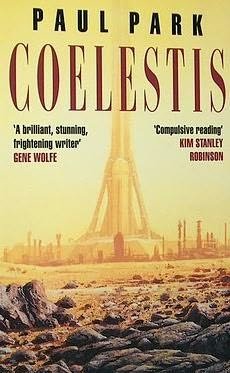
My absolute favourite science fiction novel is Coelestis by Paul Park. I demand rigour in my science fiction. If you can change the background, and the story remains unchanged, then it isn’t sf. Yet Coelestis is completely unconvincing as sf. It is defiantly not-sf science fiction. And that is one reason why it is so brilliant. It is also beautifully written, and extremely unsettling.

Simon Mayaram, a junior consular official, has recently arrived on a tide-locked colony world distant from Earth. At the orders of his boss, he reluctantly takes the consul’s place at a party thrown by the local colonial movers and shakers at Goldstone Lodge. Also present is Junius Styreme and his beautiful daughter, Katharine. The Styremes are aliens, members of one of the two races native to the planet. Prior to the arrival of humanity, they were enslaved by the planet’s other race, the Demons. The humans wiped out the Demons and freed the aliens. Now the aliens show their gratitude – the rich ones, at least – by using drugs and surgery to become human. But not everyone feels the same way. A group of rebels attacks Goldstone Lodge, killing all those present. Except Simon and Katharine. They escape but are quickly captured. The rebels take them across to the planet’s dark side, where they discover a surviving Demon holds the rebels in thrall. The Demon, and the loss of her drugs, slowly returns Katharine to her alien nature. As Simon, who loves her, watches in horror…

John Clute has described Coelestis as a “Third World” novel, but to me it is very definitely post-colonial sf. It is also anti-colonial. The world of the novel doesn’t map exactly onto India – or any other ex-Empire colony – but the parallels are clear. The life-style enjoyed by the humans is very like that of the British in the Raj. The desire of the aliens to mimic their masters bears some similarities with the way India has subsumed elements of British culture – such as the language (which remains the nearest the country has to an official language). Park makes these likenesses even starker by refusing to invent a society for his world. It is the twentieth century in all but name – although there are intriguing hints of a future Earth beyond the characters’ understanding. But for the aliens, the first section of Coelestis could be set in Mayapore.

But once Simon and Katharine find themselves on the dark side, the nature of the story changes. Whereas Park had initially used the colonials-in-situ, and their struggle to remain inappropriate, as commentary, he uses Katharine and Simon in captivity to first deconstruct the identity of the aliens, and then to deconstruct Simon’s identity. It makes for an discomfiting read. Coelestis uses its limited toolbox of science-fictional conceits to address only those areas Park wants to study. The rest is immaterial, and so no attempt at rigorous or plausible world-building is made. It’s not there because it doesn’t matter, because not having it there points up all the more the difference between the aliens and the humans, and humanity’s actions.

Coelestis is not a comfortable read. But it is one of those science fiction novels which can change the way you look at the world. And there are remarkably few of them.

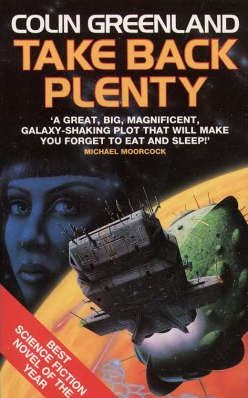
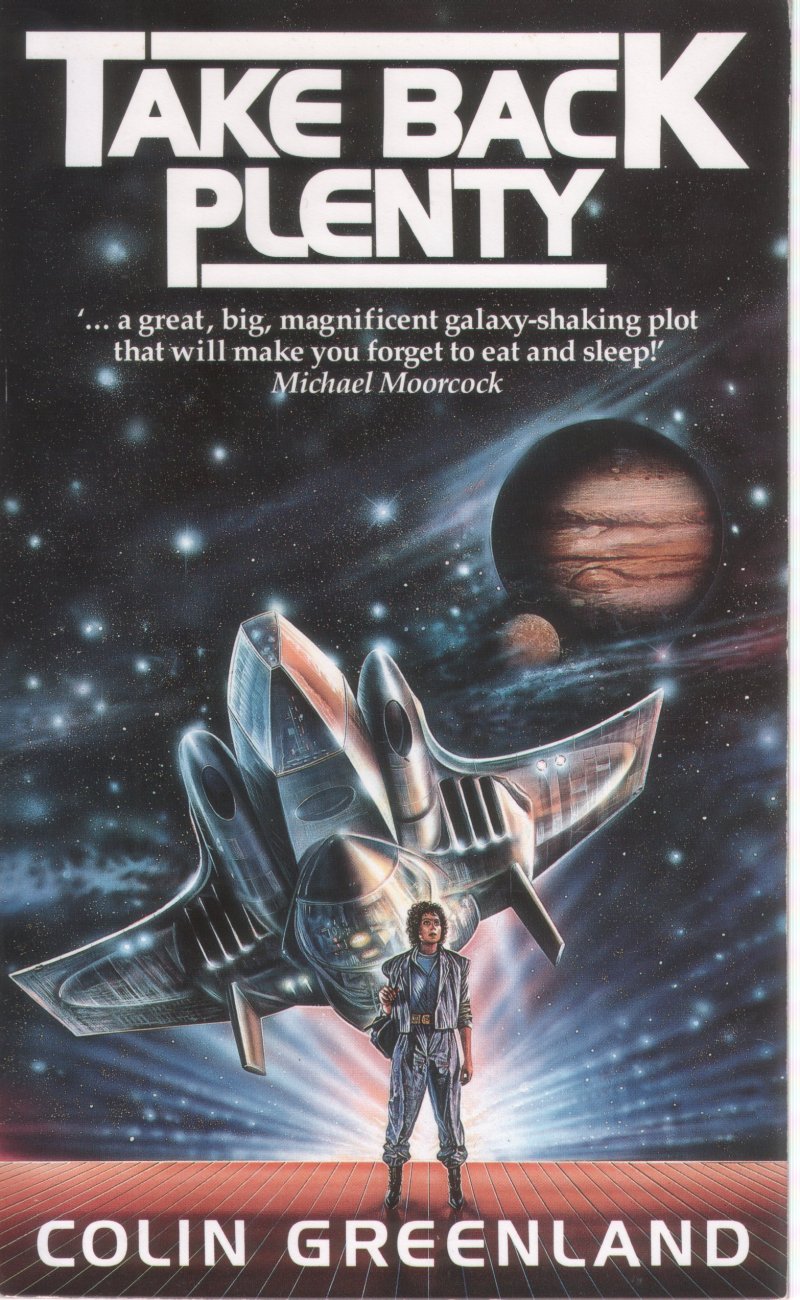
My second choice could only be science fiction. Unlike Coelestis, it has rigour. But I also demand authenticity in my sf. Take Back Plenty by Colin Greenland is proudly inauthentic, it glories in its lack of authenticity. Its story takes place in a Solar system that only ever existed in wildly unscientific pulp science fiction. It features canals on Mars, a Venus of impenetrable jungles, and a cast of colourful aliens. It is a clever postmodern space opera and a rollicking good read.


Tabitha Jute is captain of the space barge Alice Liddell. While on Mars, Tabitha inadvertently causes a near-riot, and is subsequently fined by the authorities. But she doesn’t have the money to pay the fine. Fortunately, she meets up with Marco Metz, leader of the cabaret act Contraband, and he contracts her to take him and his band to Titan. First, they stop off at Plenty, an alien artefact orbiting Earth. It had been built by the alien Frasque, but they’d been booted out of the Solar System by the Capellans – highly advanced aliens who’d bootstrapped humanity into space, but now kept everyone sealed within the orbit of Pluto.

Of course, Contraband isn’t really a cabaret act and Tabitha is forced to flee Plenty with the members of the band. They crash-land on Venus, are rescued by pirates, and then delivered to the Capellans.

To say anymore would give away the novel’s climax.

The story of Take Back Plenty is told by a mysterious, and not entirely reliable, narrator – complete with authorial interventions. Sections of the book are also interspersed with conversations between Tabitha and Alice, the space barge’s AI persona. These conversations round out Tabitha’s background and character. They also help explain the Solar system of the story. Tabitha Jute is one of the great female characters of science fiction. She is not feisty, she is not kick-ass. She is not strong because she was raped as a young woman; she is no one’s Perfect Girlfriend. In a book which revels in its inauthenticity, she is stunningly real.

When Take Back Plenty was published in 1990, I remember there being a lot of talk about it. It went onto win both the BSFA and Arthur C Clarke Awards. I’ve argued in the past that it kicked off the British New Space Opera movement. But the more I think about it, the more I think that’s not the case. Take Back Plenty re-appropriated the tropes of pulp space opera, but it used them in a knowing and postmodern way. It didn’t add hard science or “grit” to space opera. It added realness, yes, and dirt under science fiction’s fingernails; but its tropes were still the candy-coloured conceits of early space opera. By doing this, the novel privileged story, not setting –  yet another difference to New Space Opera. So much so, in fact, that Take Back Plenty even aped those old serials by giving poor Tabitha no actual control over the plot.

On its publication, Take Back Plenty promised a new and exciting trend in British science fiction. Sadly, that never materialised. Greenland’s novel was a one-off. He followed it with a pair of sequels, Seasons of Plenty and Mother of Plenty; but the vision had soured and neither matched the joy of Take Back Plenty. Greenland wrote one other sf novel, Harm’s Way, a steampunk space opera, but has written no novel-length science fiction since. Which is a shame.

So there you have it. Two science fiction novels I love and admire. (Science fiction novels I love but don’t admire would be a much longer list.) Sadly, both are currently out of print. Obviously I think they should be on the SF Masterworks list – assuming rights are available and all that. I urge everyone to seek out second-hand copies of these two books and read them. Or perhaps an enterprising ebook publisher might like to consider editions on Kindle (providing the authors are willing, of course).

Coelestis and Take Back Plenty are a pair of novels I am happy to champion. And I can even do that without feeling embarrassed they’re science fiction.


10 Comments

21st century sf mistressworks meme

As promised, here is a list of science fiction novels by women sf writers whose careers have been active chiefly during the past decade. The sharper-eyed among you will spot two authors who were also on the previous sf mistressworks list. I felt both books deserved to be on this list, and so they are. While researching this list, I discovered that many of the more recent women sf writers whose names I knew hadn’t actually had novels published so far – such as Rachel Swirsky, Kij Johnson, Jennifer Pelland, Theodora Goss, Vandana Singh… Or they had written only fantasy novels to date – eg, Aliette de Bodard, Mary Robinette Kowal, Vera Nazarian…

Same as before: science fiction only, no YA. Trilogies and series named in [square brackets]. I could have snuck in a collection or two (see above), but decided that might have been pushing it a bit. Bold for those you’ve read, italics for those you own but haven’t read. My own showing is a bit embarrassing on this list.

1 Solitaire, Kelley Eskridge (2002)
2 Warchild [Warchild], Karin Lowachee (2002)
3 Natural History, Justina Robson (2003)
4 Maul, Tricia Sullivan (2003)
5 The Time Traveller’s Wife, Audrey Niffenegger (2003)
6 Spin State, Chris Moriarty (2003)
7 Dante’s Equation, Jane Jensen (2003)
8 Steel Helix [Typhon], Ann Tonsor Zeddies (2003)
9 Life, Gwyneth Jones (2004)
10 Nylon Angel [Parrish Plessis], Marianne de Pierres (2004)
11 The Courtesan Prince [Oka-Rel Universe], Lynda Williams (2004)
12 Survival [Species Imperative], Julie E Czernada (2004)
13 Banner of Souls, Liz Williams (2004)
14 City of Pearl [Wess’har Wars], Karen Traviss (2004)
15 The Year of Our War, Steph Swainston (2004)
16 Bio Rescue, SL Viehl (2004)
17 Apocalypse Array [Archangel Protocol], Lyda Morehouse (2004)
18 The Child Goddess, Louise Marley (2004)
19 Alanya to Alanya [Marq’ssan Cycle], L Timmel Duchamp (2005)
20 Carnival, Elizabeth Bear (2006)
21 Mindscape, Andrea Hairston (2006)
22 Farthing [Small Change], Jo Walton (2006)
23 Half Life, Shelley Jackson (2006)
24 The Carhullan Army, Sarah Hall (2007)
25 Bright of the Sky [The Entire and the Rose], Kay Kenyon (2007)
26 Principles of Angels [Hidden Empire], Jainne Fenn (2008)
27 Watermind, MM Buckner (2008)
28 The Rapture, Liz Jensen (2009)
29 Zoo City, Lauren Beukes (2010)
30 Walking the Tree, Kaaron Warren (2010)
31 Birdbrain, Johanna Sinisalo (2010)
32 Who Fears Death, Nnedi Okorafor (2010)
33 Song of Scarabaeus, Sara Creasy (2010)

(Incidentally, I did start Bright of the Sky, but gave up halfway through.)

EDIT:
It has been pointed out to me that Steph Swainston’s The Year of Our War is more fantasy than it is sf. I’ll leave it on the list for the time-being – for one thing, it’s one of the books I picked for my 2011 reading challenge.

I’d also intended to include Kage Baker, but I’ve never read any of her books. The first of the Company series, In the Garden of Iden, was published in 1997 and so not eligible for this list. Which novel should I include?

And I’ve also added Louise Marley, a writer I’d missed, at #18.


4 Comments

An important announcement

Today is the 50th anniversary of Yuri Gagarin’s flight. Half a century ago, Gagarin was the first human being to leave this planet – albeit for only one hour and forty-eight minutes. Thirty years ago today was also the launch of the first Space Shuttle to reach orbit, Columbia. Which was sadly lost eight years ago on mission STS-107 when it broke up on re-entry, killing its crew of seven. I am choosing to honour Gagarin’s achievement – and Columbia’s crew; and all those who have been in space, however briefly – in my own way:

I’m going to edit a hard science fiction anthology.

It will be titled Rocket Science, and it will be published in 2012 by Mutation Press.

This announcement is advance warning. I’m looking for submissions, but I won’t be open to receive them until 1st August 2011. I want stories and non-fiction of up to 6,000 words, which meet the following description:

Science fiction does take place in a vacuum. Travel more than 100 kilometres vertically from where you’re standing, and you’ll be in space. Where there’s no life-sustaining air; where the cold, and direct sunlight, can kill. There’s no gravity, and background radiation will cause cancer in one in ten people. Yet the future of our species quite possibly lies up there, or somewhere that will require us to cross space to reach.

Too often, science fiction glosses over the difficulties associated with leaving a planetary surface, traveling billions of kilometres through space, or even living in a radiation-soaked vacuum. The laws of physics are side-stepped in the interests of drama. Yet there’s plenty of drama, plenty of science fiction drama, in overcoming the challenges space presents. Whether it is, for example, an alternate history take on the Apollo Lunar landings; the discovery of an alien artefact on a moon of Jupiter; or the story of a mission to the nearest star.

ROCKET SCIENCE is looking for stories which realistically depict space travel and its hazards. The reader needs to know what it would be like to be there. This doesn’t mean stories must be set in interplanetary or interstellar space; but the technology and science involved must be present somewhere. It could be a story set in a spacecraft, on an asteroid or space station; or about a mission soon to leave Earth’s surface. It could be a first contact, a rescue against the odds, or a study of some unusual space phenomenon. Whatever suits. Don’t be afraid to be literary.

But no space opera, definitely no space opera.

Payment will be £10.00 per 1,000 words. Again, don’t send in any submissions until 1st August 2011. So you’ve got plenty of time to come up with something suitable.

You can find more details on the website here. I’ve also put together four flyers (PDF), which you can print out, hand to friends, stick on the wall of your den / study, etc., etc. You can find them here: one, two, three and four. If you have any questions, feel free to email the editorial address given on the flyers and website.


11 Comments

Towards a new definition of hard

There is a branch of science fiction – some would say it’s the branch which actually defines the genre – known as “hard science fiction”. Like all the terms associated with sf, its meaning is confused, confusing, disputed and not always useful. Wikipedia, for instance, defines hard sf as science fiction which is “characterized by an emphasis on scientific or technical detail, or on scientific accuracy, or on both”. Yet this is not what I’ve always understood by the term.

To me, hard sf has always been that mode of science fiction which features, or emphasises, the “hard” sciences – physics, cosmology, chemistry, etc. This is in contrast to soft sf, which focuses on the “soft” sciences – anthropology, psychology, archaeology, etc. The fact that two such intersecting definitions for the same thing exist is not unusual in science fiction. Indeed, the genre itself has never been satisfactorily defined.

Yet I also believe that hard sf needs to be rigorous. And Wikipedia’s definition (taken from The Encyclopaedia of Science Fiction) does indeed focus on that. But some fictions which would be excluded from the label using Wikipedia’s definition I would still describe as hard sf. Indeed, the classic example given for the sub-genre is often Hal Clement’s Mission of Gravity. Which features aliens and, by implication, faster-than-light travel. Neither concept is “scientifically accurate” in the most rigorous sense of the phrase. Clearly, the definition is problematical.

Categorising a fiction by the sciences which feature in it, hard or soft, is no better. Both types may be present. And if they exist in equal measure, is the fiction hard or soft? And which science is hard and which soft? In order to define hard sf, you must first define the hard sciences. So that’s not going to work either.

And then I came across this…

There’s an interesting article here on the Cosmos Magazine website about humanity’s future in space – or rather, lack of a future. Much of the author’s discussion revolves around the limitations placed on rocketry by chemistry. Rocket engines have not substantially changed for almost a century, and that’s because there’s very little that can be done to improve what is, at its most basic, a chemical reaction. The laws of chemistry dictate how much energy that reaction can generate, and those laws are not something that can be changed. This seems counter-intuitive because in so many other areas of science and technology progress is rapid and effective – computing, for example. But, as the author of the piece writes, “In the case of electronics and information systems, we are dealing with soft rules, related to the limits of human ingenuity. In the case of space flight, we are dealing with hard rules, related to the limits of physics and chemistry.”

Science fiction often has to sidestep such “hard rules” in order to tell a story. The aforementioned faster-than-light travel is a good example. The laws of physics are quite clear that the speed of light cannot be exceeded. There are theoretical ways around this, but most are either impossible or unlikely – Alcubierre’s drive, for example, would require more energy than is available in the entire universe.

So perhaps we should consider sf which stays within the boundaries of these hard limits as hard science fiction. Any fiction which requires authorial invention to circumvent these limits would thus be “soft” sf – or whatever other sub-genre its characteristics identify it as, such as space opera.

Admittedly, it’s not as if a new, or more accurate, definition of hard sf is demanded. Most genre readers and commentators are quite happy with shifting, amorphous and evolving genre categories. Others insist that science fiction is resistant to taxonomy; or even that taxonomy itself is not useful in genre conversations. But taxonomy does indeed have its uses – it allows people to compare like with like, it sets the terms of reference for discussions, it allows for commentary on thematic similarities. And my new definition at least has the benefit of being “hard” itself: we know the hard limits imposed on us by the laws of the universe, and we can recognise those concepts and conceits invented by the author to circumvent those limits.

And it does seem fitting that hard sf should be definable, that it should operate within clearly-drawn boundaries, that its definition should be as rigorous as those fictions which comprise it.


Leave a comment

Anatomy of a Story: Killing the Dead

The author tells us that he’d had the title in his head for years, but no real plot to go with it. “Later the idea of setting the story on a generation starship occurred to me,” he says. “And then I decided it should be about terrorism, which fit perfectly with the setting – the sealed environment of a generation starship is especially vulnerable to terrorists. The rest of the story came out of a conversation with Eric Brown as we travelled north from a convention on a much-delayed train.”

So reads part of the introduction to my story ‘Killing the Dead’ by the editors of the Postscripts magazine/anthology . It appeared in ‘Edison’s Frankenstein’, issue 20/21, dated December 2009. According to my records, I finished ‘Killing the Dead’ in June of 2008, tried it at two magazines, before it was bought by Pete Crowther and Nick Gevers of Postscripts at the end of July. It was another 18 months before it eventually saw print.

I had indeed had the title knocking around for years – the earliest version of the story I can find was written on an Amstrad PCW, and I owned that I when I was at university in the early 1990s. In the 500 or so words which are all I completed of that draft, the story is set on an alien world and in a city which, like in ancient Egypt, sits on one side of a river with a necropolis on the other. But that’s as far as I got with it. Some fifteen years later, I decided to have another go. I kept the necropolis, but moved it onto a generation starship – which then gave me a reason for preserving the bodies of the dead. And indeed for their destruction to be a major felony, with ramifications for all those aboard. It also gave me the opening image of the dark spreading across the sky.

‘Killing the Dead’ is one of the few stories I’ve written where I actually did make it up as I went along. I had a fairly clear idea of the cast and plot: members of the starship’s crew are preserved after death in necropolises with the intention of resurrecting them, and their valuable skill-sets, once the starship reaches its destination. But someone is destroying the tombs, and so jeopardising the crew’s ability to build a functioning colony when they arrive. These crimes would be under investigation by a detective, who previously has had little beyond the occasional theft or assault to look into.

The logic behind all this was hashed out in the conversation with Eric Brown mentioned above. We were on our way to our respective homes from Novacon in Wallsall in November 2007. He told me I should write the story, so I did. I finished it in less than a week. But it wasn’t very good, and needed more work. So I fiddled with it over the next six months.

I did some research, of course: I picked a suitable destination and worked out how long the journey would reasonably take. At some point I decided that I wanted the story to reference Dante’s Divine Comedy. I’d already described the necropolises as low hills of seven levels in reference to Purgatorio, but I wanted to include more. So I split the story into seven sections – including a dream sequence – and buried in each section an image derived from one of the seven terraces of Purgatory. These are:

1 The Proud, who carry huge stones on their back
2 The Envious have their eyes sewn shut
3 The Wrathful walk around in acrid smoke
4 The Slothful are engaged in a ceaseless activity of some sort
5 The Covetous lay face down on the ground
6 The Gluttonous are forever tempted by fruit out of reach (although I think the source I used mentioning running water, so I went with that instead)
7 The Lustful must pass through a wall of flame

I leave it to the reader to find the relevant sentences in the story.

Despite all this, I don’t think I’d actually figured out the end when I started the story. I didn’t know who the terrorists were. So when I did work it out, it came as a surprise – but one of those good ones, one of those ones where you realise the answer has already been set up in the story right from the start.

The same was true of the final few sentences. I’d been hiding references to purgatory throughout the story, so it seemed only natural that the journey aboard the generation starship should be cast as a form of limbo. It also occurred to me that a fear the journey’s end might leave them in hell rather than heaven could be a valid motivation for the terrorism.

Incidentally, all the named characters in the story are named for various mythologies’ gods of the dead: Arawn (Welsh), Supay (Inca), Flins (Wendish), and Jabru (Elamite).

Those few venues which did review the issue of Postscripts were positive about ‘Killing the Dead’. It didn’t set the genre on fire, although I’d have been surprised if it did. Tangent Online described the story as “Highly recommended”, and Gav at NextRead was also nice about it. And, er, that’s about it.

For those of you who want to make up your own mind, here it is (PDF).


2 Comments

A portrait of the writer as a young man

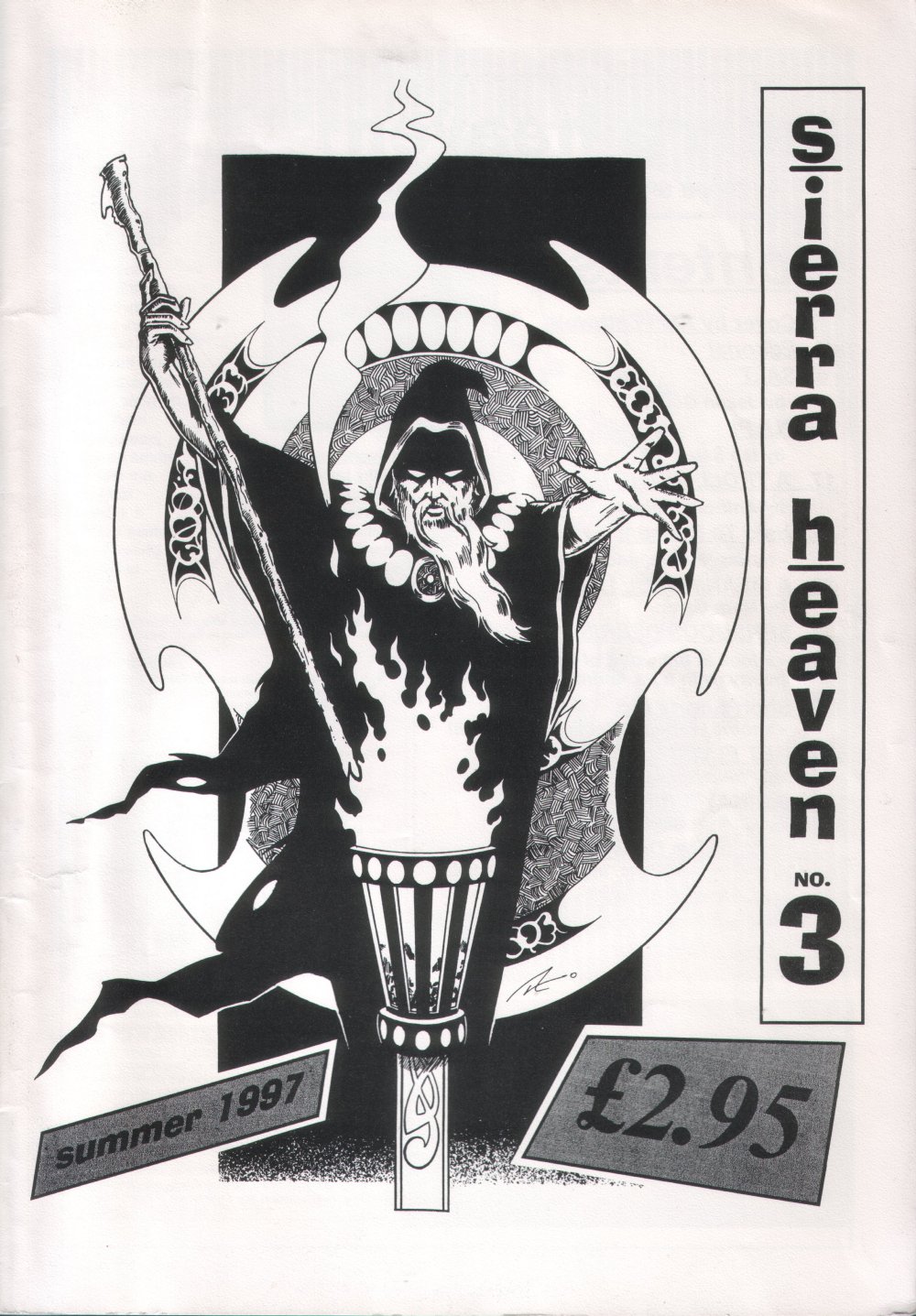
I have always been a science fiction writer. I remember filling an exercise book with deck-plans for a starship when I was twelve years old. I wish I could find that book, but it has long since vanished. During my teens I played RPGs, and wrote up the sessions as fiction. After joining the British Science Fiction Association in the late 1980s, I turned my hand to writing your actual original science fiction. Not entirely successfully, it has to be admitted. And this despite the fact there seemed to be new sf small press magazines appearing every five minutes in the UK. Some of the titles I remember, and still have copies of, are: BBR, Dream Magazine, New Moon Quarterly, Works, REM, Exuberance, Critical Wave, Territories, The Lyre, Nova SF, Auguries, Strange Attractor, Opus Quarterly, Sweet Dreams Baby!, New Visions, The Edge, The Scanner, Sierra Heaven…

I submitted fiction to several of the above, but my first ever published short story was a space opera parody which appeared in The Scanner #8 in 1990. It wasn’t very good. Shortly after graduating from university, I left the UK. And spent ten years working in the United Arab Emirates. While there, I started submitting fiction to the pro magazines, with even less success. Occasionally, I tried stories at small press mags… Which is how Sierra Heaven ended up with my second piece of published fiction in their Summer 1997 issue.

Here, for your delight and delectation, your edification and edumacation, is that story. It’s a space opera metafictional story, titled ‘Pulp!’, that probably owes far too much to certain film by Quentin Tarantino. Apologies for the poor quality of the scan.

Click here: Pulp!


13 Comments

The future’s so bright, you gotta wear chains

While reading Marianne de Pierries’ Dark Space last week (see here), it struck me that sf writers are all too keen to extrapolate or invent science and technology in their fictions – FTL, AI, anti-gravity, etc. – but they then insist on imagining socially regressive societies. The world of Araldis in Dark Space is markedly sexist – the women are either wives or mistresses, and have no say in Araldisian society. Why would a writer do that? After the decades of struggle for gender equality, to then write about a society in which women are once again second-class citizens just seems stupid. It’s not even a failure of the imagination because it was plainly a deliberate artistic choice.

But this is not unusual in space opera. Writers invent galaxy-spanning empires with magical technology… and then populate them with tyrants, slave traders, mass-murderers, pirates and all manner of scum and villainy, design them with systemic inequality, inequity, injustice and unfairness. True, scum and villainy exists in modern-day society, and even the twenty-first century has its share of inequality and inequity. But they don’t define it.

Space opera is an inherently right-wing subgenre. As is military science fiction. There are exceptions but, as a general trend, both subgenres tend to the right of centre. It is, I suspect, a consequence of the form, since not all writers of space opera or military sf cleave to the political right. But the vast majority of those writers – Anglophone ones, as that’s the bulk of my reading, and the area about which I know most – live in developed nations, where slavery is illegal, where everyone has the vote, where fairness in many areas of life is either legally or constitutionally protected. And yet these same authors can happily invent a future universe in which sentient beings are treated worse than animals, the first solution to any problem is unregulated violence, and inequality is institutionalised… And that inequality is all too often ignored by the protagonists, because typically they’re among the privileged. (This latter is especially true of secondary-world fantasy, with its penchant for adventuring princes; but that’s an argument for another day.)

There are, I noted above, exceptions. Iain M Banks, Alastair Reynolds, Ken MacLeod, for example. These exceptions are usually British. Having said that, while Banks’s Culture is famously a post-scarcity utopia, he still populates his novels with plutocratic shits (possibly a tautology) and the like – if only to give Special Circumstances something to do…

I’ve been wondering why space opera / mil sf needs to be so socially regressive / right wing. Is it a consequence of science fiction’s history? Military science fiction often appears to be little more than fancied-up Horatio Hornblower in Space, and so copies 17th Century British society – in all respects but the technology. It could be that Asimov’s Foundation trilogy, famously based on Gibbon’s The Decline and Fall of the Roman Empire, led to the Roman Empire as a model for galactic empires in space operas. Personally, I suspect US science fiction owes an unconscious debt to Rudyard Kipling’s Kim. The similarities are striking.

And why are the exceptions mostly from the UK? Is it just a consequence of domestic politics? I’d like to think British sf owes an equal debt to HG Wells, but it was plainly dominated by the US mode – at least until the advent of the New Wave. Admittedly, the last couple of decades has seen more Wellsian sf creeping into British sf, though his influence continues to be ignored by US science fiction. Which is odd, historically, as HG Wells – and Jules Verne – were both extensively reprinted in magazines during the early days of the genre in the USA.

Some have argued that space opera and military sf require conflict, that without it there’d be no story. But conflict is not the only delivery mechanism for drama. There are others – exploration and puzzle-solving are two alternatives, for example. Literary fiction does not require rapes, murders, slavery, genocide or global wars to provide drama. Further, science fiction is, above all else, about the present. And present-day society – for the majority of those who read and write Anglophone sf – is mostly fair, and has become increasingly so over the centuries. (Bar current Tory policies designed to profit the few at the expense of the many.) That fairness is not universal, true; but even those who do not currently experience it are generally better off than they would have been in earlier decades and centuries.

Perhaps it’s simply that space opera / mil sf are predominantly escapist subgenres. Perhaps they can’t aspire to anything higher. If they were to comment on unfairness, if they were to justify their regressive societies as story qua story, you’d expect to see some discussion of those it effects most in the real world. But the Other is also noticeably absent from both subgenres. Both are still characterised by the privileged expressing their privilege – mostly using awesome weaponry.

The history of space opera and military science fiction, from EE ‘Doc’ Smith through Poul Anderson and John Brunner to CJ Cherryh and now Peter F Hamilton, is almost entirely populated with examples which demonstrate the above. It has become axiomatic. That needs to be questioned. A regressive society is not, in and of itself, implicit in space opera, and should not be treated as such. Space opera need not primarily be escapist; and escapist fiction need not be defined by unfairness in its invented universe.

It’s time to think a little more intelligently about the universes we create for our fictions. It’s time our fictions reflected our ambitions and didn’t simply parrot the assumptions of past decades.

It’s time we dragged space opera, and military science fiction, into the twenty-first century.