It Doesn't Have To Be Right…

… it just has to sound plausible


2 Comments

Lots of fingers pointing…

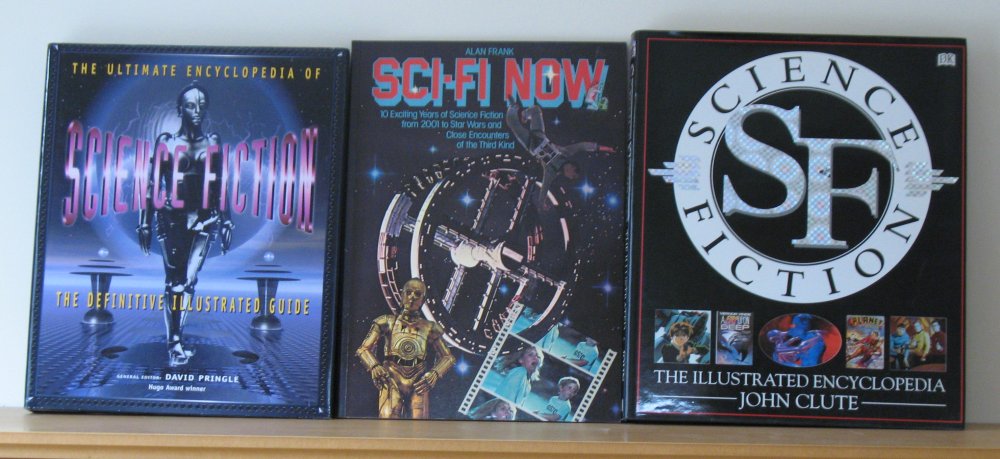
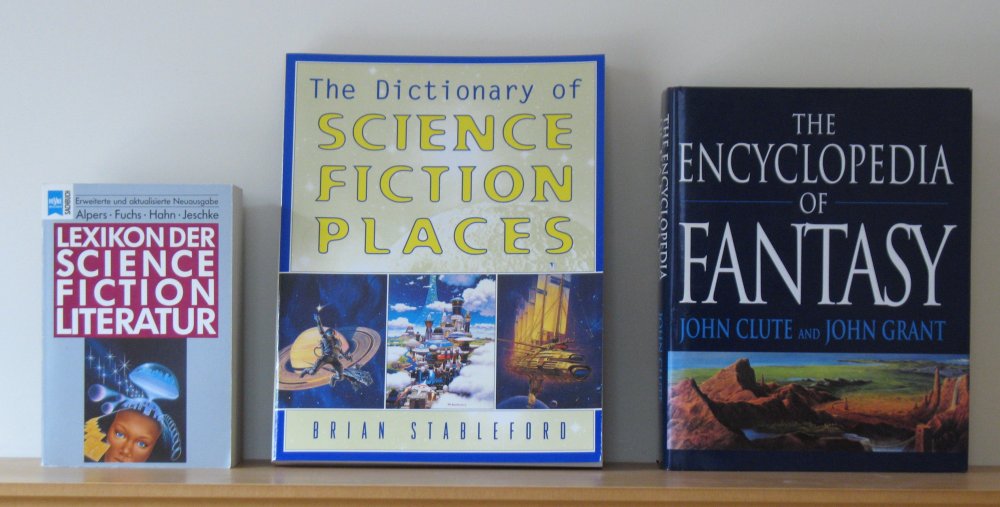
According to Damon Knight, “science fiction is whatever I’m pointing at when I say ‘science fiction'”, which is about the most useless and yet most accurate definition of the genre to date. Which has not stopped countless people trying to come up with definitions of their own. They’ve even written entire encyclopaedias on the subject. These are some of the ones I have on my book-shelves…

Peter Nicholls’ 1979 The Encyclopedia of Science Fiction was the first such. I bought a paperback copy for £1 at an antiques fair back in the late 1980s, but later picked up a hardback copy for a fiver on eBay several years ago. I have two copies of the next version, Clute & Nicholl’s The Encyclopedia of Science Fiction, because I bought the hardback edition when it was published – RRP £45!; but I got it for £27 from an acquaintance who claimed to have contacts in the book distribution trade. Anyway, when I moved to the Middle East after graduation, the book went into storage. But I stumbled across a paperback copy of the US second edition in Abu Dhabi. I don’t remember where I got the James Gunn The New Encyclopedia Of Science Fiction from. The latest version of The Encyclopedia of Science Fiction is, of course, online at sf-encyclopedia.com.

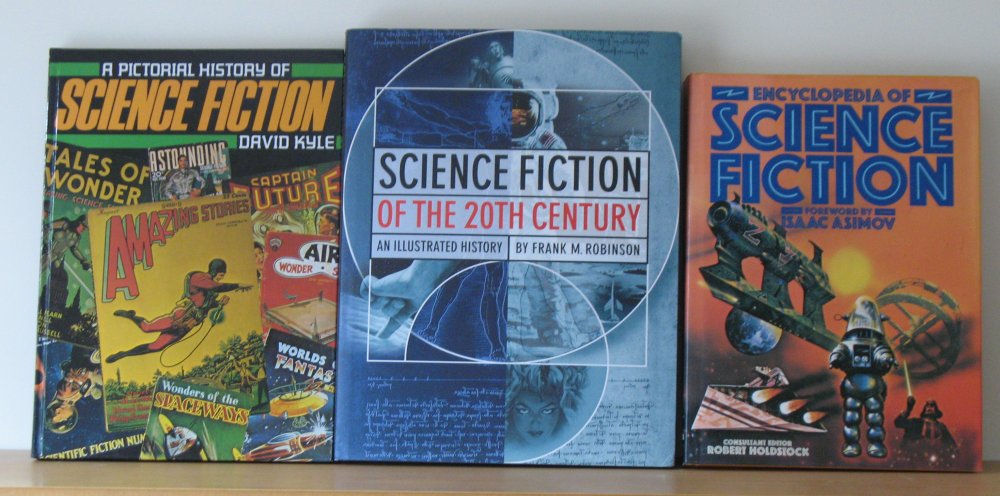
A trio of coffee-table books on science fiction. The Kyle and the Holdstock I’ve had for a couple of decades. Science Fiction of the 20th Century by Frank M Robinson I found cheap on eBay a few years ago.

I don’t recall where I bought any of these three books. I’ve a feeling I purchased Clute’s Science Fiction: The Illustrated Encyclopedia in Dubai. Sci-Fi Now I’m fairly sure I’ve had since the late 1970s.

No collection of science fiction encyclopedias would be, er, complete without Clute & Grant’s The Encyclopedia of Fantasy. Lexicon der Science Fiction Literatur I bought while studying in Aachen in 1990. According to my records, I bought The Dictionary of Science Fiction Places for £2 in a discount book shop in Harrogate in 2004.

Edit: for reference, my post on critical works on science fiction is here.


24 Comments

Galactic encounters of the 1970s

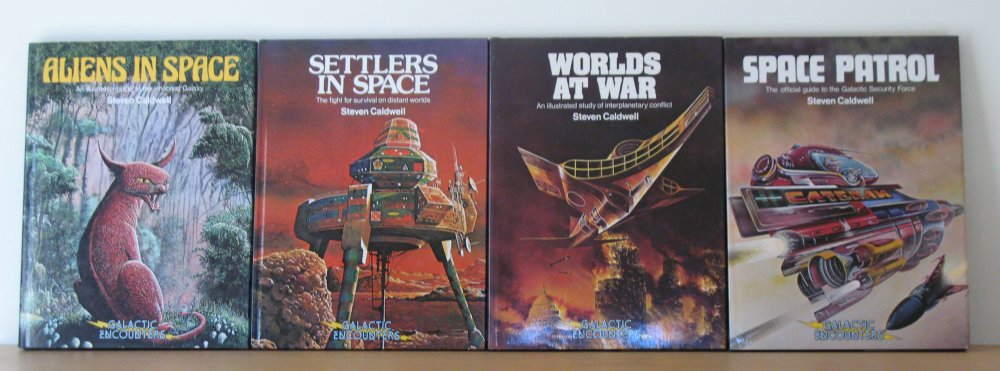
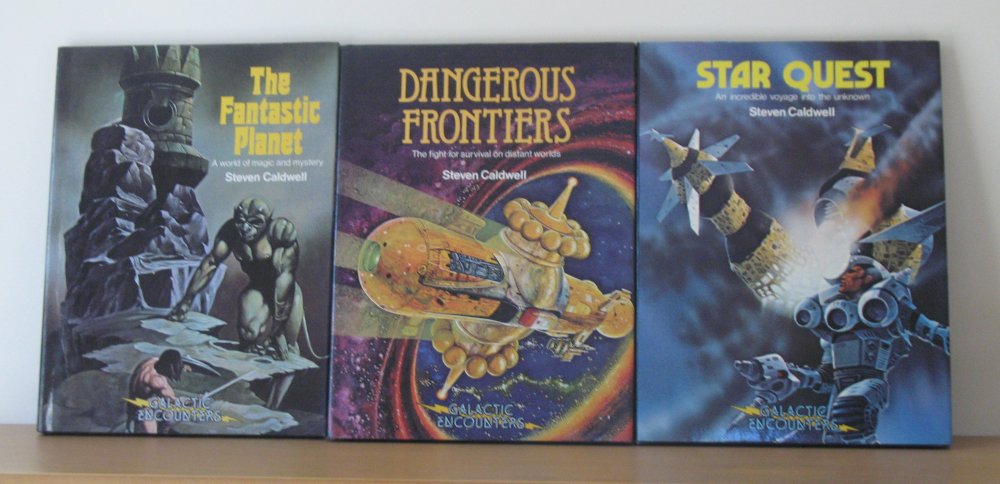
Back in the late 1970s and early 1980s, several publishers brought out colourful coffee-table sf books. Usually, they were filled with cover-art from sf novels, around which someone had written some text to tie the pictures together. Stewart Cowley’s Terran Trade Authority is probably the best-remembered example. I used to buy them whenever I saw them – often from book discount shops.

There were four Terran Trade Authority books all together, though I only have two of them: Spacecraft 2000 to 2100AD and Starliners. The other two were Great Space Battles and Spacewreck. I’m not sure where The Space Warriors fits into the TTA universe.

Cowley also wrote another series, Galactic Encounters, under the name Steven Caldwell, aimed at younger readers: Aliens in Space, Settlers in Space, Worlds at War, Space Patrol, The Fantastic Planet, Dangerous Frontiers and Star Quest. (Wikipedia doesn’t appear to know of Settlers in Space.)

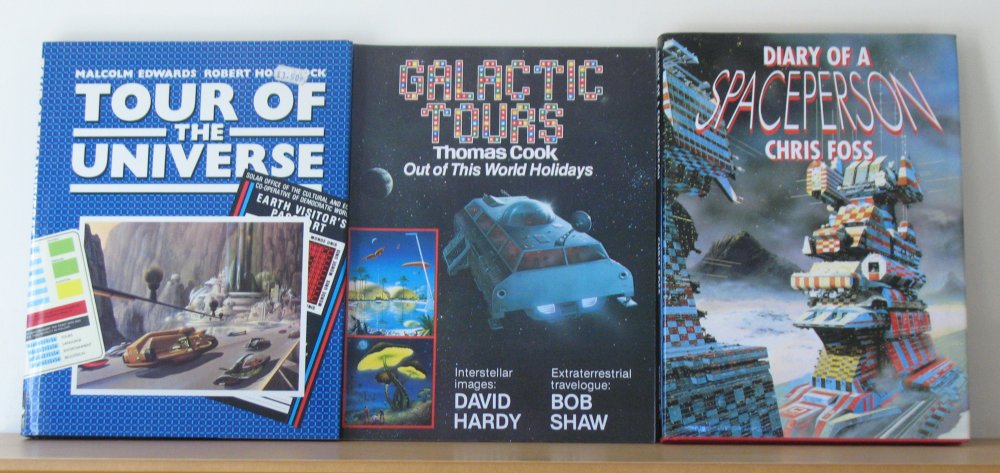
Even Robert Holdstock and Bob Shaw had a go at it: Tour of the Universe and Galactic Tours. Diary of a Spaceperson is full of lots of lovely Foss cover art, plus lots of pen and ink sketches of, er, bare-breasted women.

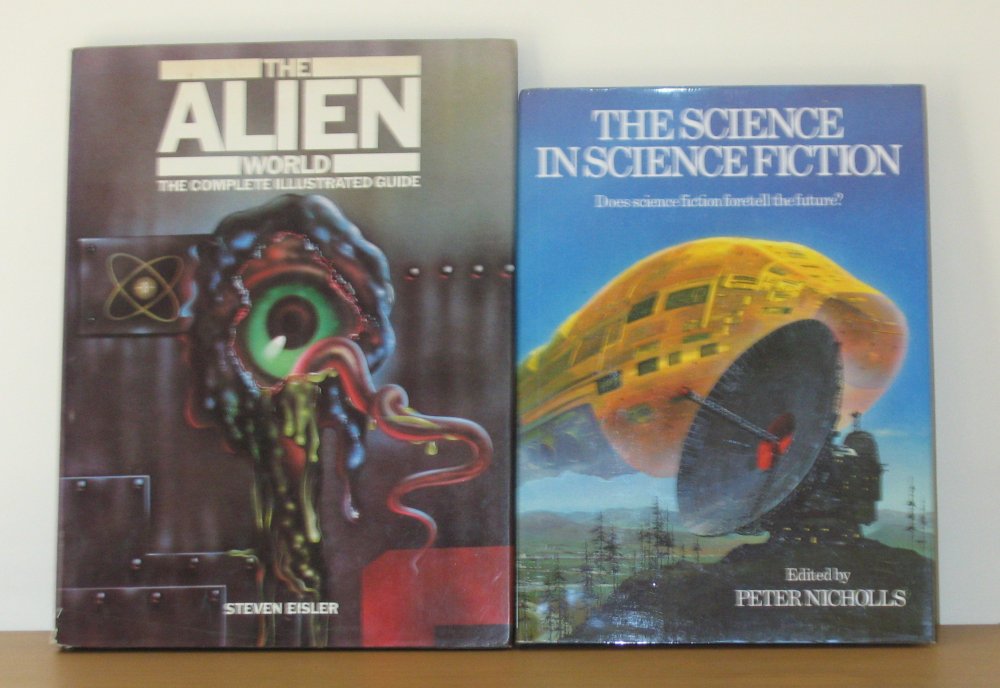
Not sure where I got The Alien World from. The Science in Science Fiction does exactly what it says on the cover.

Finally, a few years ago Morrigan Press produced a RPG based on the Terran Trade Authority. Morrigan Press seem to be now defunct, and the books are out of print.


17 Comments

Some thoughts on John Carter

There’s always been something more appealing about the idea of John Carter than about the books in which he features. It’s pure wish-fulfillment, of course – being magically transported to an alien world, becoming a fearsome warrior, falling in love with a beautiful princess… John Carter was always the manliest of men, and deeply honourable to boot, and so formed the sort of ur-hero it was easy for impressionable boys to worship and wish to emulate.

And, it has to be said, there something exciting in the mix of savagery and sophistication which pertained on Edgar Rice Burroughs’ Mars. Ancient cultures with flying ships and radium pistols, who still fought with swords from the backs of riding animals. The Barsoomian cultures had all the trappings of decadent cultures, yet were still vigorous and thrusting and more than able to put up a good fight. Which they did. Frequently.

But Edgar Rice Burroughs wrote his eleven Barsoomian novels between 1912 and 1964, and they were never more than pulp fiction. Adapting them faithfully for the screen in the twenty-first century was always going to be problematical. Attitudes and sensibilities have changed – for the better, of course – and it’s no good pretending fidelity to the source material excuses sexism or racism (though Michael Bay has no such excuse for his Transformers films).

Harder, of course, to realise would be the world of Barsoom itself. Not just the landscapes of Mars, the vast canyon that is Valles Marineris, or the 21-kilometre high Mons Olympus; but also the various races and fauna, the flying ships, the cities… The Tharks are 4.5 metres tall, with four arms. Prosthetics and make-up are not going to produce convincing copies of that. But CGI can. Especially 2012 state-of-the-art CGI. After 2009’s Avatar, we know such things are possible.
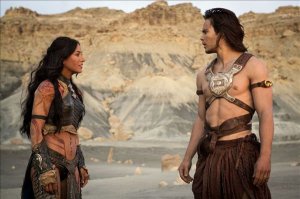
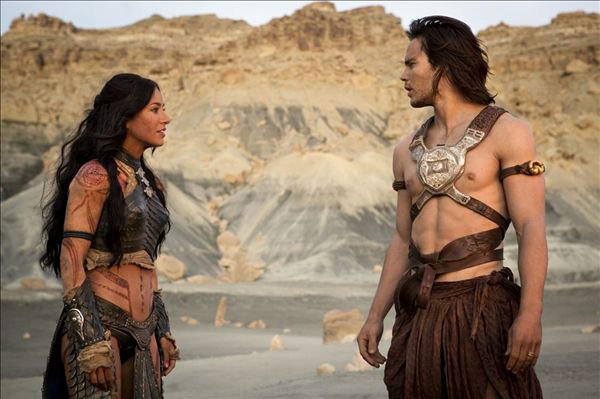
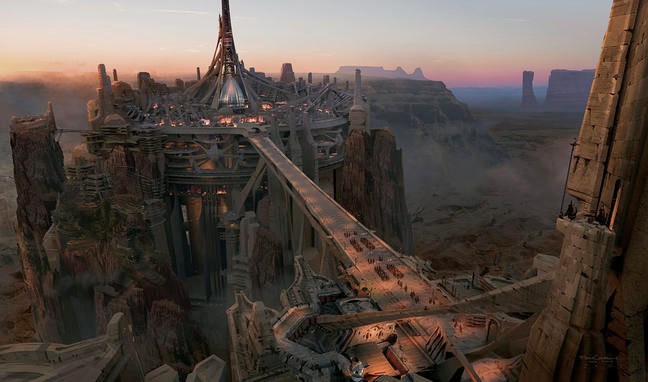
As a result, the Barsoom in Andrew Stanton’s John Carter looks fantastic. Some of the long shots are breath-taking. Perhaps they didn’t get in a shot of Mons Olympus, but there was a canyon which could have been Valles Marineris. And perhaps in places the Martian landscape did resemble the Arizona desert a little too closely. But there’s no denying John Carter is a great-looking film. And that applies to the production design too. It feels as though it melds elements of all the various cover-arts that have graced Burroughs’ books through the decades.
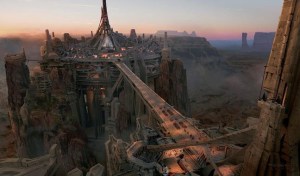
It is in the story, however, that the film has suffered the majority of its attacks. I’m not sure I understand quite why John Carter has come under so much fire. It resembles a typical sf tentpole release inasmuch as it’s a spectacle film, full of awesome visuals and frantic action. No other film of this type seems to have been criticised so much – and mostly for not being what its detractors wanted it to be. True, the white man leads natives to victory is a problematical story, though John Carter is nothing like as offensive as Avatar in that regard. What Carter brings to Helium is an alliance with the Tharks, and that is solely because the Tharks were first to discover him on his arrival on Mars. Yes, he can jump higher and strike harder than any Barsoomian, but it’s his facility with a sword – learnt as a member of the US Cavalry – which makes him a good warrior. The jumping is useful, and moves the plot along in various places; but it doesn’t make Carter better than everyone else.

Perhaps the biggest change between the books – or rather, between peoples’ memories of the books – and the film is Dejah Thoris. In the film, she is a scientist – Helium’s chief scientist, in fact, and close to discovering the “ninth ray”. She is also an excellent swordswoman, as is amply demonstrated throughout John Carter. And Carter himself has no problem with this. It’s a welcome change.

The film does suffer from a couple of narrative longeurs. A long trip down the River Iss seems to serve little purpose, though it does give John Carter the magical phrase he needs to travel between worlds. When the chief Thern explains the presence of his race on Barsoom to Carter, it does seem a somewhat blunt way of getting the information across. There are long journeys across the Barsoomian desert in which little happens. Despite this, the film’s 132 minutes pass surprisingly quickly.

There are elements of the film worthy of praise. There is wit in the script. The cast – many of whom are British – are uniformly excellent; though Tardos Mors, the ruler of Helium, seemed a bit useless. The Tharks are especially good. The story wrapped within a story wrapped within a story structure I thought worked well, and primed the film for two endings, both emotional – the first heart-breaking, and then a proper upbeat one after. Initially, the decision to hold off on revealing that Carter had lost his wife and child years before seemed odd, but when it did appear, intercut with a battle scene, it had a great deal of impact.

It’s been too easy for people to criticise John Carter. “It’s not like the books.” Well, no. I should hope not. “If they were going to bring Barsoom to the cinema, why did they do it that way?” Because that’s the way the film-makers chose to do it. Since when has it become a valid criticism to complain that a film wasn’t made the way the critic wanted it to be made? The fact of that matter is that Hollywood has been praised for creating tentpole sf extravaganza films which are sexist, racist, and insultingly stupid. John Carter is none of those. It’s a surprisingly modern spin on an old-fashioned sf adventure film. And happily it’s been done with intelligence. So yes, I would pay to see a sequel.

2 Comments

What are we going to do when we get there?

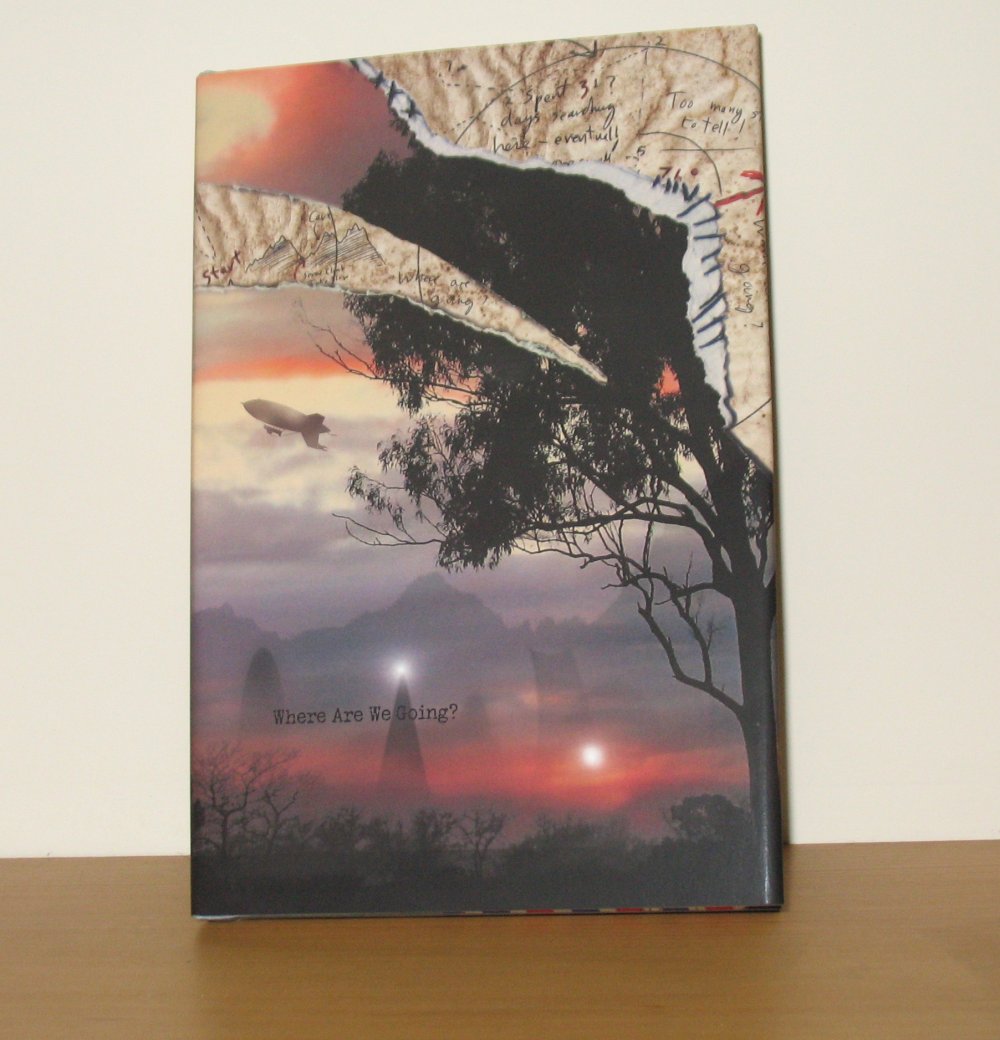
Look what arrived in the post yesterday: my contributor copy of Where Are We Going?, an anthology edited by Allen Ashley and published by Eibonvale Press. It looks very nice indeed. And it has an excellent line-up too.

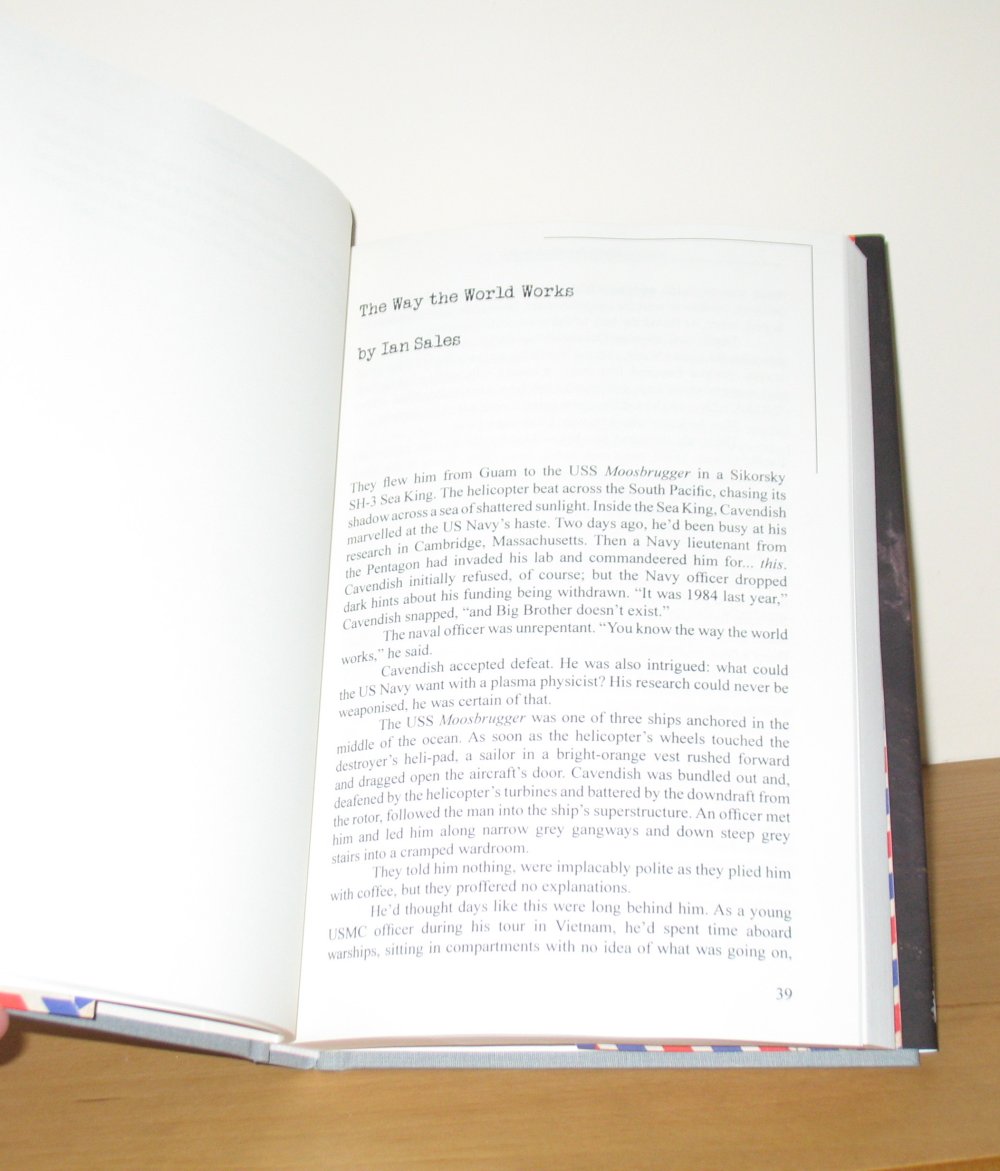
And here’s my story, ‘The Way The World Works’. It’s my bathypunk one – see here. It’s good to finally see it in print.

The anthology was launched in London on 2 March. Unfortunately, I couldn’t make it, but judging by the write-up and photos here, it went very well indeed.


39 Comments

The other POV

A couple of days ago on Twitter, Requires Hate tweeted that she would no longer read science fiction with male protagonists. Not a problem, you would have thought – there must be plenty of sf with female protagonists. And so there is. But not as much as you’d expect. The majority of science fiction novels are told from a male point of view. Some might have female POV characters – Gareth L Powell’s The Recollection, for example – but the story is shared with a male character. Sf novels, whether by women or men writers, with a single female protagonist are not that common.

So I tried to come up with list of some:

By women writers:
Spirit, Life and Kairos, Gwyneth Jones (SF Mistressworks reviews of Kairos here and here)
Alanya to Alanya and sequels, L Timmel Duchamp
Ash: A Secret History, Mary Gentle
Arkfall, Carolyn Ives Gilman
Angel At Apogee, SN Lewitt (SF Mistressworks review here)
City of Pearl, Karen Traviss (my blog post here)
God’s War and Infidel, Kameron Hurley (my blog post on God’s War here, review of Infidel here)
Debris, Jo Anderton
Dancer of the Sixth, Michelle Shirey Crean (SF Mistressworks review here)
Correspondence, Sue Thomas (SF Mistressworks review here)
Solitaire, Kelley Eskridge (my review here)
Zoo City, Lauren Beukes (my blog post here)
The Female Man, Joanna Russ (SF Mistressworks review here, here and here)
Winterstrike, Liz Williams (my blog post here)
The Steerswoman’s Road, Rosemary Kirstein (SF Mistressworks review here)
The Handmaid’s Tale, Margaret Atwood (SF Mistressworks review here)
Keeping It Real and sequels, Justina Robson

By men writers:
Take Back Plenty, Colin Greenland (my blog post here)
400 Billion Stars, Paul McAuley
Stealing Light, Gary Gibson
The Restoration Game, Ken MacLeod (my review here)
Synthajoy, DG Compton (my blog post here)
Never Let Me Go, Kazuo Ishiguro
The Caryatids, Bruce Sterling
The H-Bomb Girl, Stephen Baxter
The Ophiuchi Hotline, John Varley (my blog post here)

I may have got some of these slightly wrong as I’m going on my memory of the books – they might not be as exclusively female POV as I remember them. It’s unsurprising that I can think of more women writers who use female protagonists than men writers. I suspect this would be true for most people. Second, most of the books I could think of were relatively recent. Back in the Golden Age even the likes of Leigh Brackett and CL Moore wrote books with male protagonists.

Anyone else have any suggested titles?


2 Comments

International Women’s Day

Today is the 101st International Women’s Day, a celebration created by the Socialist movement in 1911. The poster below is not actually for the Day, but it seemed appropriate.

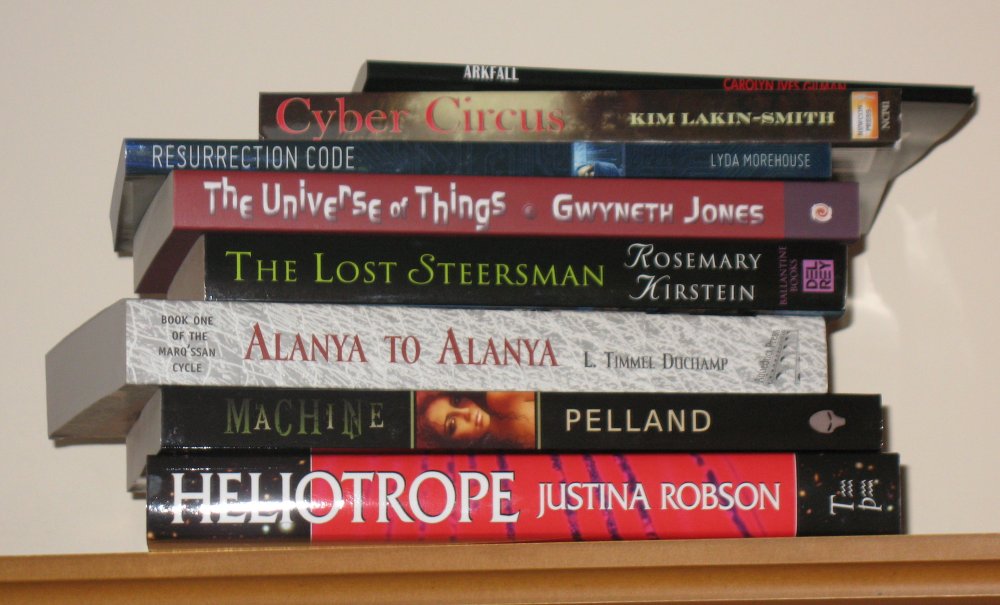
In recognition of International Women’s Day, here are eight recent science fiction novels / collections by women writers I will read / reread and then write about on this blog some time during the next few months (as they’re all too recent to qualify for reviews on SF Mistressworks).

The books are: Arkfall, Carolyn Ives Gilman; Cyber Circus, Kim Lakin-Smith; Resurrection Code, Lyda Morehouse; The Universe of Things, Gwyneth Jones; The Lost Steersman, Rosemary Kirstein; Alanya to Alanya, L Timmel Duchamp; Machine, Jennifer Pelland; and Heliotrope, Justina Robson. All of them except the Kirstein are small press.


5 Comments

Announcement number two

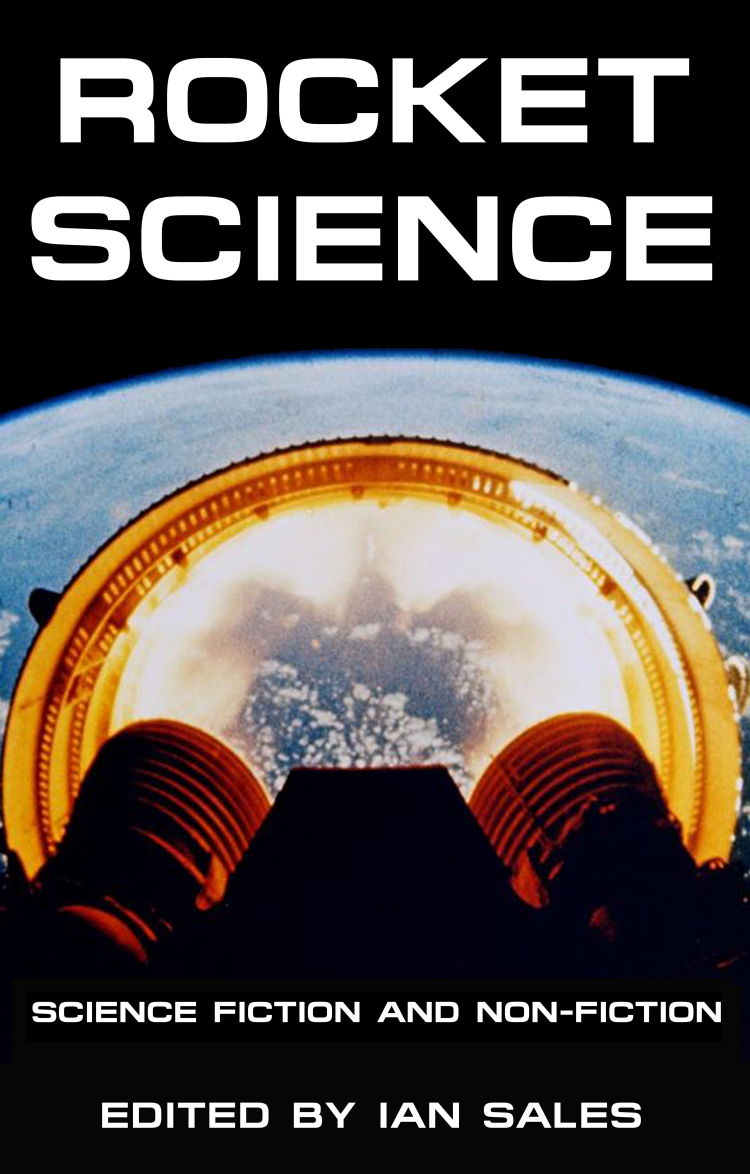
It’s been six months in the making, and when I took it on I had no idea what I was letting myself in for… But the files have now been sent to the printer and all I can do is wait and worry. Yes, Rocket Science is on the giant crawler thingy being carried from the assembly building to the launch pad. So to speak.

It’s been a learning experience. I’m pretty damn sure I’ve put together a good anthology containing some excellent fiction and non-fiction. If I had the chance to go back and do it again, I think I’d have a longer submissions period, and I’d spread out the editing process over several months. Towards the end there, I was starting to suffer from “typo blindness”, I’d been close-reading so many thousands of words on my computer display…

Anyway, we shall see what the world makes of it when physical copies finally appear in April. The launch is still set for the Eastercon, and there will be some of the contributors on-hand to read excerpts from their stories. More details will become available when the programme is finalised.


16 Comments

Announcement number one

Some of you will already be aware of this, but many perhaps won’t. These days, everyone seems to be doing it, though they might call it different things. I mean self-publishing, or so-called “indie” publishing. There are many reasons why an author might choose to publish one of their books themselves. Hoping to sell a million copies of it obviously isn’t one of them. For my part, I didn’t think the “infamous moon base novella” (see numerous mentions on this blog previously) would be accepted by a magazine or small press editor in the form I wanted it to appear. So I decided to publish it myself…

But more than that, I chose to set up an imprint specifically for the type of fiction I think my novella epitomises, and which I felt was not being published elsewhere. And so…

This April, Whippleshield Books will launch its first book, Adrift on the Sea of Rains by Ian Sales. This 20,000-word novella tells the story of an attempt to return home by a group of military astronauts stranded at a base on the Moon. Described by Adam Roberts, author of By Light Alone, as “written with an expert blend of technical precision, descriptive vividness and emotional penetration”, and by Kim Lakin-Smith, author of Cyber Circus, as “as poignant as it is impeccably researched”, Adrift on the Sea of Rains is the first in a thematic quartet. The remaining three installments will also be published by Whippleshield Books.

Whippleshield Books was founded by Ian Sales in order to focus on a type of science fiction which no one else seems to be publishing – ie, stories of high literary quality with extremely strong scientific and technological content. Whippleshield Books plans to publish some two to three titles a year, as signed limited hardbacks, trade paperbacks and ebooks. Submissions will open in May 2012, but bear in mind the acceptance criteria are extremely high.

Review copies of Adrift on the Sea of Rains as PDF, MOBI or EPUB available on request.

I hope to have a website ready some time in late April / early May where people can buy the book, though copies of the ebook will also be available from other sites. The second book of the Apollo Quartet, Wave Fronts, should be out before the end of the year; and perhaps there’ll be something else available if someone submits something I want to publish.


2 Comments

Guessing the Clarke

It’s that time of year again, when the books submitted for the Arthur C Clarke Award have been revealed – see here – and we get the opportunity to second-guess the judges. Sixty books were submitted, not all of which appear to be science fiction. Many are literary, rather than heartland sf. Some are even fantasy. In fact, looking at the heartland sf titles, I don’t think they don’t make an especially good showing – Leviathan Wakes is regressive, Neal Asher has never been favoured by the Clarke, Steve Baxter may be the most short-listed author but Bronze Summer is the middle of a trilogy, Bringer of Light is the fourth in a series, The Recollection is a little too generic, and I’ve heard mixed reports about Greg Bear’s Hull Zero Three. Some of the others are simply not award-worthy.

So this year, I’ll not be surprised if we see more of a literary list. On my first pass, I ended up with ten books, but the short-list is six and six only. I thought Eric Brown’s The Kings of Eternity was good, but it failed to make the BSFA Award short-list. Embassytown should be a dead cert, but from what I’ve heard it’s not as successful a novel as The City & The City. Reamde I’ve been told is a bloated techno-thriller, and no one has a good word to say about Blackout / All Clear on this side of the Atlantic. Which leaves three genre novels people have been talking about: The Islanders, By Light Alone and Osama. All three of which are also on the BSFA Award short-list.

I am also not expecting an all-male short-list. Given the discussion on women sf writers over the past year, I don’t think the judges would be so foolish. And since women literary writers who write sf seem to be more successful with the Clarke than women category sf writers… Both The Testament of Jessie Lamb and The Godless Boys have been highly praised. Random Walk is my left-field guess, because there’s always a left-field candidate on the Clarke short-list.

So I think the short-list will look like this:

Random Walk by Alexandra Claire (Gomer)
The Islanders by Christopher Priest (Gollancz)
By Light Alone by Adam Roberts (Gollancz)
The Testament of Jessie Lamb by Jane Rogers (Sandstone)
Osama by Lavie Tidhar (PS)
The Godless Boys by Naomi Wood (Picador)

And I think The Islanders will take the gong.

Of course, I could be completely wrong, and the short-list will be entirely space opera…


8 Comments

When men were men and so was science fiction

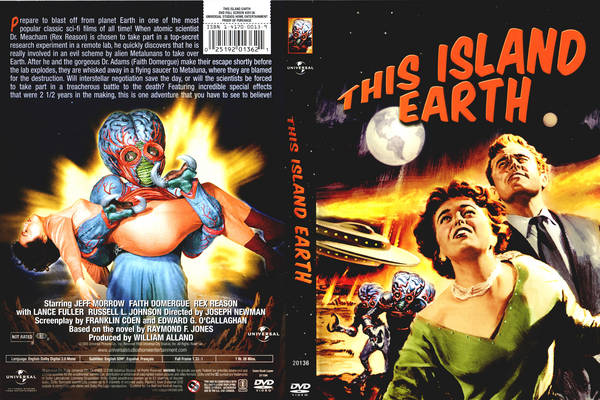
After reading the 2011 science fiction novel which prompted my Whores in Space post (see here), I read a 1950s sf novel: This Island Earth by Raymond F Jones. I’ve seen the film several times, and it’s fairly typical of its period – manly hero, women there only to scream, ugly mutant, flying saucer. I read the novel because I’d been toying with the idea of adapting part of it for a short story, and because I wanted to see if it was different to the movie.

It is.

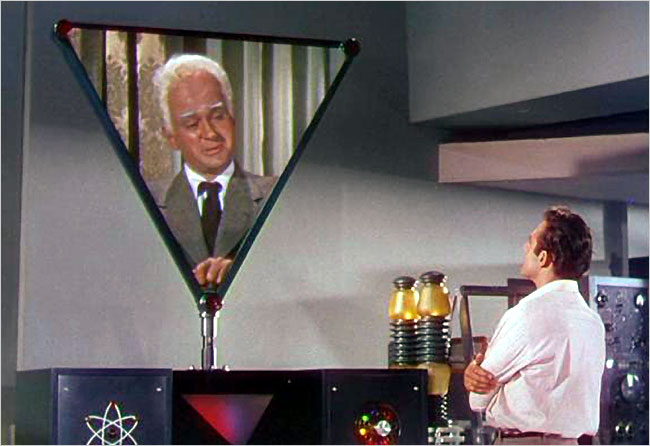
The first half of the film more or less follows that of the book. Cal Meacham is a manly electronics engineer in California. When an order for parts for a project goes awry and he receives instead some devices which are decades ahead of what he is expecting, his curiosity is piqued. He orders a catalogue, and from it he then orders the parts necessary to build an “interociter”. Without actually knowing what an interociter does. The bits are delivered, he figures out how to put them together… and it’s a communications device. Which is promptly used by someone to offer him a job as he has “passed the test”.

In the film, this is a man called Essex Exeter, but in the book he’s called Jorgasnovara. Exeter is head of a secret thinktank with access to technology more advanced than that known to 1950s USA. Jorgasnovara is head of an industrial plant which builds interociters using technology more advanced than that known to 1950s USA. Both, it transpires, are actually alien and are using the Earth as a supply depot in a war. In the book, the war is intergalactic and between a good bloc, the Llanna, and an evil bloc, the Guarra (whose members also smell bad). There is no Metaluna in the book, and no mutant monster.

This Island Earth was originally published in 1952. It’s a fix-up of three stories published in 1949 and 1950: ‘The Alien Machine’, ‘The Shroud of Secrecy’ and ‘The Greater Conflict’. Meacham fought in WWII, and is determined that the devices invented and built by scientists or engineers should never again be used as they were in that conflict: “like careless and indifferent workmen they have tossed the product of their craft to gibbering apes and baboons”. He is not only an engineer but also fervently anti-war. (But not anti- the occasional need for fisticuffs, however.) His engineering know-how and can-do-it-iveness therefore means he is better than everyone else. Only he knows the rightful use to which the devices he builds should be put. (It is this very arrogance which Jorgasnovara uses to recruit engineers to his organisation.)

And then there are the women…

The lone female in the novel is Dr Ruth Adams. She has a doctorate in psychiatry, but is employed as the assistant to the head of personnel. Meacham is immediately attracted to her. When he picks her up for a dinner date, he considers it “impossible to think of a MD and PhD in that dress”. Surprisingly, Ruth keeps her job after she marries Cal, though she does all the cooking – despite a mention earlier that Cal is capable of cooking for himself. Perhaps it’s unrealistic to expect a strong female character with agency in a 1950s sf novel written by a man, one which elevates engineers to the status of special universe-saving snowflakes. But Ruth’s portrayal still offends – she may be educated, but she’s very much Dale Arden and not Hildy Johnson.

It’s not the only aspect of the book which should upset modern sensibilities. The working class fare badly too. When the plant manager fires an incompetent employee, the union pulls everyone out on strike – despite what appear to be reasonable grounds for termination. And then someone sabotages the assembly line. Meacham immediately accuses the shop steward. Because, of course, manly men of science fiction despise anything that smacks of socialism, and so it naturally follows that a union man would obviously destroy the very factory where he works because management won’t meet his “unreasonable” demands.

Meacham’s manliness and engineering expertise means he never surrenders – always there is a solution, or a means of escape. Ruth, of course, is always the first to scream and give up when the couple find themselves in jeopardy. This also applies to the “Greater Conflict”, which by the final quarter of the book is threatening to destroy Earth. Despite the war having raged for millennia, and involving uncountable alien races far more advanced than humanity (they have giant computers!), it takes a can-do engineer like Meacham to spot why the Llanna have been steadily losing. They rely on their giant computers to determine strategy and tactics. As a result, they’ve become predictable, and the Guarra can guess their every move. They need to act randomly! Like randomly saving the Earth from the approaching Guarra battle fleet!

This Island Earth is not even tosh. It’s desperately old-fashioned, and probably felt so back in the 1950s. The pilotless aircraft which carries Meacham from his company lab to Jorgasnovara’s factory near Phoenix, Arizona, is propeller-driven, though you’d have expected such an advanced organisation to have jet aircraft (which had been flying for nearly a decade by 1952). The science throughout is nonsense: the journey to the Moon, for example, takes all day in one chapter, and mere minutes in another. In the same spaceship. Earth is apparently only a few hundred light years from the edge of the Milky Way (it’s closer to 25,000 light years). But then Jones doesn’t seem entirely sure what a galaxy is, or how great the distances between them (clue: The Andromeda Galaxy is about 2.6 million light years from Earth). Oh, and the interociter turns out to be a telepathic communications device – its use as a videophone is just there to disguise its true function. Except it is later revealed to be a weapon which fires devastating telepathic blasts… which also kill the interociter user…

No wonder the Llanna were losing the war. If only they had recruited a manly engineer from Earth a couple of thousand years earlier.