It Doesn't Have To Be Right…

… it just has to sound plausible


6 Comments

Science fiction traces

I firmly believe that a reading diet of only genre fiction is bad for you. It’s the equivalent of trying to live off junk food. For a writer, it’s even worse, perhaps even dangerous – certainly, it’s detrimental to their career. I used to break up my consumption of genre with modern literary fiction novels, though I’ve increasingly found I much prefer postwar fiction, especially British – Lawrence Durrell, Malcolm Lowry, Paul Scott, and the like. But I do still read some of the better-known modern literary fiction authors, even if their novels have proven somewhat samey in recent years.

One of those literary fiction novelists is Sebastian Faulks. I recently finished his Human Traces (2005), which is about the early years of psychiatry. Sort of. It begins in 1876, with the introduction as boys of its two main characters, Jacques Rebière in France and Thomas Midwinter in England. The two meet when in their early twenties, become great friends, qualify in medicine, and open a sanatorium in southern Austria. Later, the two disagree over the direction the nascent science of psychiatry should take, beginning a feud which only ends after the First World War.
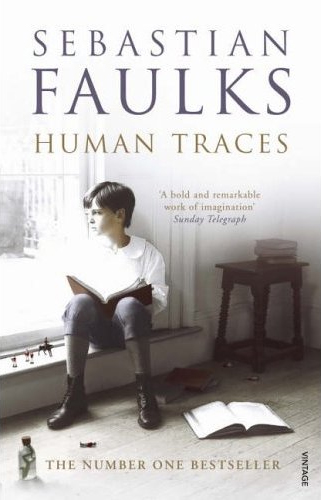
Human Traces is historical fiction. Its characters are invented but a number of real historical figures make appearances. It is about a variety of mental conditions, their historical diagnoses, and what we now know them to be. (Most asylums in the nineteenth century, for example, were filled with syphilis victims.) But Human Traces also contains at its core a very science-fictional idea.

Some three-quarters of the way through the book, Midwinter proposes a theory to explain why some people hear voices. It is his theory that psychosis is inextricably linked to self-awareness, and that it is the advent of self-awareness which created human beings. Early humans, he contends, heard voices as a matter of routine. In a speech given at his sanatorium, he outlines his theory:

… of how man, after he had learned language, had been able to conjure instructive voices in his head; and of how, after the invention of writing and under the influence of huge population upheavals, the ability to summon such voices had become rarer. (p 497)

This theory had been inspired by a number of things – not the least of which was Midwinter himself hearing voices when younger – but it was on an expedition to Africa that it began to gel:

But how could men without consciousness – a modern sense of time, and cause and other people – have done this? Picture your shepherd far away in the hills with no sense that he is a man, no idea of time in which he can visualise himself and his situation… How does he know he must keep tending his sheep? Why does he not forget what he is meant to do – as an ape would forget? Because under the anxiety of solitude, under the pressure of fear, he releases chemicals in his brain that cause not sweating palms, or racing heart, though perhaps those as well – but the voiced instructions of his king. He hallucinates a voice that tells him what to do. (p 450)

Midwinter contents that language was not a development of self-awareness, that self-awareness did not lead to civilisation; but that language and civilisation both came into being before humanity had consciousness. It was only the development of writing which led to self-awareness. He references a number of mythologies in proof – the Ancient Greeks in conversation with their gods, God speaking to Abraham in the Bible, and so on…

It’s not a conceit which sits well as the core of a realist novel. Nor is it one which really stands up all that well to scrutiny. It’s an interesting idea, certainly, but perhaps better suited to the sort of thought experiment for which science fiction is best suited. We know that writing developed in Mesopotamia around 8000 BCE. It has been estimated that Abraham lived around 1800 BCE, and the Greek pantheon has been traced back to sixth century BCE Greece. So writing had been around for several millennia before the examples Midwinter gives to demonstrate his thesis. And for those thousands of years, if his theory is correct, humanity had not been wholly self-aware…

It doesn’t really work. The weight of history stands against it. However, it would make for an interesting creation myth for a fantasy novel; or, perhaps, first contact could be the trigger from one state to the other for an alien race in a science fiction novel. Aliens of differing degrees, or variable degrees, of self-awareness have been used in sf before – in Peter Watt’s Blindsight, the aliens are not conscious; in the GDW role-playing game 2300AD, one of the alien races increased their intelligence from normally very low levels as their fight/flight reaction.

Having said all that, there’s perhaps an interesting idea to explore at the intersection of Midwinter’s theory and the City Burners. Between 1200 and 1150 BCE, the Late Bronze Age civilisations around the Eastern Mediterranean collapsed. From what little documentary evidence that has been found, raiders from the sea – known as the Sea Peoples or the City Burners – invaded a number of city-states and destroyed them, propelling civilisation back to illiteracy. Imagine if those Sea Peoples had been Midwinter’s unconscious humans, driven by the voices in their heads to destroy those civilisations who, through the widespread use of writing, could no longer hear the voices…

There’s a novel in there somewhere, if someone wants to write it.

2 Comments

Meme 101

Meme! I got this from Andrew Wheeler who got it from James Nicoll who got it from Martine Wisse, who took it from Science Fiction: The 101 Best Novels 1985-2010 by Damien Broderick and Paul di Filippo.

Bold if you own it, italics if you’ve read it, strikethrough if you think it doesn’t belong on this list…

The Handmaid’s Tale, Margaret Atwood (1985)
Ender’s Game, Orson Scott Card (1985)
Radio Free Albemuth, Philip K Dick (1985)
Always Coming Home, Ursula K Le Guin (1985)
This Is the Way the World Ends, James Morrow (1985)
Galápagos, Kurt Vonnegut (1985)
The Falling Woman, Pat Murphy (1986)
The Shore of Women, Pamela Sargent (1986)
A Door Into Ocean, Joan Slonczewski (1986)
Soldiers of Paradise, Paul Park (1987) (an excellent novel, but Coelestis is better)
Life During Wartime, Lucius Shepard (1987)
The Sea and Summer, George Turner (1987)
Cyteen, CJ Cherryh (1988)
Neverness, David Zindell (1988)
The Steerswoman, Rosemary Kirstein (1989)
Grass, Sheri S Tepper (1989)
Use of Weapons, Iain M Banks (1990)
Queen of Angels, Greg Bear (1990)
Barrayar, Lois McMaster Bujold (1991)
Synners , Pat Cadigan (1991)
Sarah Canary, Karen Joy Fowler (1991)
White Queen, Gwyneth Jones (1991)
Eternal Light, Paul McAuley (1991)
Stations of the Tide, Michael Swanwick (1991)
Timelike Infinity, Stephen Baxter (1992)
Dead Girls, Richard Calder (1992)
Jumper, Steven Gould (1992)
China Mountain Zhang, Maureen F McHugh (1992)
Red Mars, Kim Stanley Robinson (1992)
A Fire Upon the Deep, Vernor Vinge (1992)
Aristoi, Walter Jon Williams (1992)
Doomsday Book, Connie Willis (1992)
Parable of the Sower, Octavia Butler (1993)
Ammonite, Nicola Griffith (1993)
Chimera, Mary Rosenblum (1993)
Nightside the Long Sun, Gene Wolfe (1993)
Brittle Innings, Michael Bishop (1994)
Permutation City, Greg Egan (1994)
Blood, Michael Moorcock (1994)
Mother of Storms, John Barnes (1995)
Sailing Bright Eternity, Gregory Benford (1995)
Galatea 2.2, Richard Powers (1995)
The Diamond Age, Neal Stephenson (1995)
The Transmigration of Souls, William Barton (1996)
The Fortunate Fall, Raphael Carter (1996)
The Sparrow/Children of God, Mary Doria Russell (1996/1998)
Holy Fire, Bruce Sterling (1996)
Night Lamp, Jack Vance (1996) (really? This is not very good)
In the Garden of Iden, Kage Baker (1997)
Forever Peace, Joe Haldeman (1997)
Glimmering, Elizabeth Hand (1997)
As She Climbed Across the Table, Jonathan Lethem (1997)
The Cassini Division, Ken MacLeod (1998)
Bloom, Wil McCarthy (1998)
Vast, Linda Nagata (1998)
The Golden Globe, John Varley (1998)
Headlong, Simon Ings (1999)
Cave of Stars, George Zebrowski (1999)
Genesis, Poul Anderson (2000)
Super-Cannes, JG Ballard (2000)
Under the Skin, Michel Faber (2000) (I really disliked this)
Perdido Street Station, China Miéville (2000)
Distance Haze, Jamil Nasir (2000)
Revelation Space trilogy, Alastair Reynolds (2000)
Salt, Adam Roberts (2000) (not his best, by a long shot)
Ventus, Karl Schroeder (2001)
The Cassandra Complex, Brian Stableford (2001)
Light, M John Harrison (2002)
Altered Carbon, Richard Morgan (2002)
The Separation, Christopher Priest (2002)
The Golden Age, John C Wright (2002)
The Time Traveler’s Wife, Audrey Niffenegger (2003)
Natural History, Justina Robson (2003)
The Labyrinth Key/Spears of God, Howard V Hendrix (2004/2006)
River of Gods, Ian McDonald (2004)
The Plot Against America, Philip Roth (2004)
Never Let Me Go, Kazuo Ishiguro (2005)
The House of Storms, Ian R MacLeod (2005)
Counting Heads, David Marusek (2005)
Air (Or, Have Not Have), Geoff Ryman (2005)
Accelerando, Charles Stross (2005)
Spin, Robert Charles Wilson (2005)
My Dirty Little Book of Stolen Time, Liz Jensen (2006) (The Rapture may be better)
The Road, Cormac McCarthy (2006)
Temeraire /His Majesty’s Dragon, Naomi Novik (2006)
Blindsight, Peter Watts (2006)
HARM, Brian Aldiss (2007)
The Yiddish Policemen’s Union, Michael Chabon (2007)
The Secret City,Carol Emshwiller (2007)
In War Times, Kathleen Ann Goonan (2007)
Postsingular, Rudy Rucker (2007)
Shadow of the Scorpion, Neal Asher (2008)
The Hunger Games trilogy, Suzanne Collins (2008-2010)
Little Brother, Cory Doctorow (2008)
The Alchemy of Stone, Ekaterina Sedia (2008)
The Windup Girl, Paolo Bacigalupi (2009)
Steal Across the Sky, Nancy Kress (2009)
Boneshaker, Cherie Priest (2009)
Zoo City, Lauren Beukes (2010)
Zero History, William Gibson (2010)
The Quantum Thief, Hannu Rajaniemi (2010)

I make that 51 read, 33 owned, and 5 owned but not yet read. Not a bad showing. There are some good books on the list, but some feel as if they were picked because they were by a writer they wanted on the list and it was the only title published after 1985. There are certainly a few I don’t think belong on the list – and not just the ones I’ve struck through. Boneshaker, surely, is steampunk, not sf (are we still claiming steampunk is part of sf? do we really want to?). And the Noviks? Fantasy, yes? Also, the Collins trilogy is YA – the only YA on the list, I think.

It’s axiomatic that any such list will be questionable to some extent, though I do think this one is better than most. For one thing, it actually features books I’ve not read but would like to. There are also 32 women on the list, which is more than lists of this sort manage (though it could probably do better).


1 Comment

Wunderbar

Back in December last year, Anarchy Books published an ebook-only anthology, Vivisepulture. It contains twenty-two “weird tales of twisted imagination”, including one by me titled ‘Wunderwaffe’. When editor (and author) Andy Remic had asked me for a story for an anthology of “bizarro” fiction, I’d known straight away what I wanted to write about: Nazi flying saucers. I was aware of Iron Sky – I had in fact seen an advance trailer for it – but I’d been fascinated by the whole Nazi secret science mythology for a number of years. (This had led me to attempt reading WA Harbinson’s Projekt Saucer series, but I gave up after the second book as they really are quite appallingly written.)

In the event, the story I sent Andy Remic only mentioned Nazi flying saucers in passing and focused more on the Bell, a strange Nazi secret science device I was also using in Adrift on the Sea of Rains. A few reviews of Vivisepulture appeared online, one or two of which praised my story.

Recently, a twitter conversation prompted me to send Lavie Tidhar a PDF of ‘Wunderwaffe’ for him to read. But he is – and he freely admits it – somewhat dilatory at reading ebooks. So I cobbled together a little chapbook of the story, printed it off and sent to him.

And he’s gone and reviewed it – see here. (I can also recommend Lavie’s ‘A Lexicon of Steam Literature of the Third Reich’.)

I’ve produced twelve copies of the Wunderwaffe chapbook, so there are eleven remaining. I’m tempted to put them up on the Whippleshield Books website for sale. I’m also tempted to make chapbooks of one or two other stories I’ve written – perhaps ‘Dancing the Skies’ from The Monster Book for Girls; or ‘In the Face of Disaster’ from Catastrophia. A good idea? I quite like the concept of “cottage industry” short fiction chapbooks, though I recognise it’s by no means a new idea. I’m even considering doing something similar under the Whippleshield Books imprint for short stories which meet the guidelines.


Leave a comment

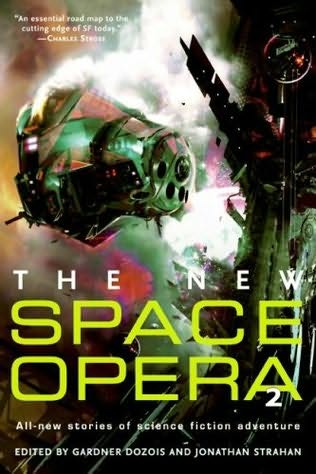
The New Space Opera 2, Gardner Dozois and Jonathan Strahan

The New Space Opera 2, Gardner Dozois and Jonathan Strahan, eds.
(2009 Eos, $15.99, 544pp)

When Wilson Tucker coined the term “space opera” in 1941 to refer to “the hacky, grinding, stinking, outworn space-ship yarn”, he can’t have imagined the sub-genre would still be going strong sixty-nine years later. Or indeed that it would be considered one of the more successful forms of science fiction. That’s not to say that the “outworn space-ship yarn” no longer exists. There are plenty of examples of it being published in the twenty-first century. Some of them are even space opera.

According David G Hartwell and Kathryn Cramer in The Space Opera Renaissance (2006), space opera never went away and merely evolved over the decades into the form we now call New Space Opera. Which is, of course, to completely ignore the British re-invigoration of the sub-genre in the 1980s and 1990s. Before there was New Space Opera, there was New British Space Opera. Of the nineteen authors in The New Space Opera 2, only three are British. Since this anthology is a successor volume and its publisher is American, this is not unexpected. Likewise the fact that eleven of the authors are from the US, with only three Canadians and two Australians. Science fiction is a US-dominated genre.

But is space opera?

It is, if you extend its definition to include some of the stories in The New Space Opera 2. Because from this anthology, the only possible conclusion is that the new space opera has not only morphed back into the old space opera, but it has also expanded to include a great deal more of science fiction. How else to explain the stories by Kristine Kathryn Rusch or Elizabeth Moon in The New Space Opera 2? Both are the sort of sf CJ Cherryh was churning out by the yard in the 1980s. Or Mike Resnick’s spoof tale, which may riff off Tucker’s original definition, but seems to miss the point of new space opera. While John Scalzi’s ‘The Tale of the Wicked’ may be space opera, inasmuch as it features spaceships, AIs and humanity at war with an alien race, it has neither the vigour, scale, nor inventiveness of new space opera. And Bill Willingham’s ‘Fearless Space Pirates of the Outer Rings’ is pure pulp sf, although its ending does drag it into the twenty-first century.

Perhaps this is the way of things. A new movement injects vigour into a moribund genre, and is then subsumed by it. Which is not to say that science fiction was entirely moribund, nor that it has been wholly re-invigorated. There is still a whiff of corruption from some areas of sf.

Happily, The New Space Opera 2 is mostly a good read. With contents provided by, as the back-cover blurb has it, “some of the most beloved names in science fiction”, the stories are readable and mostly entertaining. But naming any anthology after a movement – however arguable its definition – is a hostage to fortune. There are some good stories in The New Space Opera 2. There is some new space opera in The New Space Opera 2. There is even a small overlap between those two groups. But there are a number of pages which do not belong in either group.

The New Space Opera 2 scores best at presenting a snapshot of science fiction in 2009. It is not an all-inclusive snapshot – for that, one of the many “best of the year” anthologies is needed. The New Space Opera 2‘s contents lean in a specific direction. But the good stories in it show what’s been good in sf during the past couple of years – those stories, for example, by Robert Charles Wilson, John Barnes, John Kessel, John Meaney, Justina Robson, Sean Williams and Bruce Sterling. No anthology will ever be perfect, no matter how “beloved” its contributors. The New Space Opera 2 improves its chances with its titular theme. For most readers it will have a higher than average hit-rate. But as part two of a manifesto for new space opera, its title does it few favours.

This review originally appeared in Interzone #226, January-February 2010.


Leave a comment

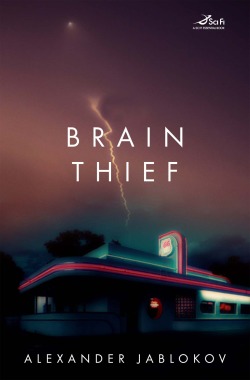
Brain Thief, Alexander Jablokov

Brain Thief, Alexander Jablokov
(2010 Tor, $24.99, 383pp)

In recent years, a number of literary authors have dipped their toes in the waters of science fiction. However, their lack of confidence, or inexperience, in deploying sf tropes often gives such attempts an air of diffidence, which in turn gives the novels an old-fashioned feel. This is because sf is a mode of storytelling, it is not just the garden in which its stories play. The reverse, science fiction authors writing mainstream fiction, is less common. But when science fiction authors write non-sf, it is never really not science fiction. Brain Thief, Alexander Jablokov’s new novel, is a case in point. It is science fiction lite; it presents its mystery credentials with greater authority than it does its science fiction credentials. But it is still at heart a story told in science fiction mode.

Brain Thief is Jablokov’s first novel after a ten-year hiatus. When a pop singer or rock star disappears for a decade, they’re retrenching, or “charging their creative batteries”, and there’s an expectation their new material will be a significant improvement over their last. When a writer – especially a genre writer – vanishes for ten years, it’s usually because real life has intervened. And so it was with Alexander Jablokov, whose previous novel, Deepdrive, was published in 1998. Jablokov has made no secret of that fact that he stopped writing novels “to raise a family and make a living”.

If there’s a fear attached to the return to writing of novelists after a lengthy period, it’s that they’ve failed to keep progress with their chosen genre and their new book reads like one that could have been written before they dropped from sight. Admittedly, Jablokov had shown a wide facility within the genre, from knowing interplanetary adventure to cyberpunk to new space opera. Happily, Brain Thief is very much a late noughties sf novel and – if this doesn’t sound too much like jacket copy – is almost the novel Bruce Sterling might have written if he hadn’t written The Caryatids.

While there are clear likenesses to Sterling’s fiction, Jablokov does not spin off ideas with the same frequency or outrageousness. Nor does he need to – Brain Thief is, after all, not a science fictional novel, but a mystery novel told in science fiction mode. Initially, this collision of modes makes for an annoying read – in science fiction, there is a world to be laid out before the reader; in a mystery novel, much has to be withheld. So while Jablokov happily explains the world of his story, he’s less open about the plot which drives it.

Bernal Haydon-Rumi is personal assistant to Muriel Inglis, a wealthy widow who finances oddball projects. One of these projects is Hesketh, an AI-controlled interplanetary probe under development by lone researcher Madeline Ungaro. On his return from a business trip, Bernal discovers that both Muriel and Hesketh have disappeared. And their disappearances are linked. He finds himself following a trail of clues – some generated by Muriel herself, some discovered on his own. Both disappearances, of course, have a single solution – not only the nature of the Artificial Intelligence which drives Hesketh, but also the one thread which binds all the characters into a single narrative.

Brain Thief is populated with a well-drawn, entertaining cast of characters. Bernal himself might be a tabula rasa, as is required by the story, but the rest might well populate an oddball comedy-drama set somewhere in one the USA’s more oddball corners. This is not a criticism – Brain Thief‘s characters are one of its strengths. Another is its writing. Its biggest strength is perhaps the fact that it isn’t trying to be a science fiction novel and a mystery novel. The sf permeates the mystery story, it’s not continually fighting it for dominance. Which means the resolution satisifies because it doesn’t need to do more than resolve the story. Jablokov has judged his plot, and integrated his world, to a nicety.

I wouldn’t surprised to see Brain Thief on a few shortlists in 2011.

This review originally appeared in Interzone #226, January – February 2010.

(Yet more evidence that sf awards are completely out of touch, irrelevant and no longer serve a useful purpose – Brain Thief, an excellent novel, appeared on only the Locus SF Novel list (as 16th of 18 titles). The big winner in 2011 was the bloated monstrosity that is Connie Willis’ Blackout/All Clear. Why bother, eh?)


14 Comments

What I learned self-publishing my book

There were two chief reasons why I self-published the first book of the Apollo Quartet, Adrift on the Sea of Rains: timing and control. I wanted to launch it on the back of Rocket Science at the Eastercon this year, and only by doing it myself would I make that deadline. I also took some chances with the book that most self-respecting editors would have baulked at: not using speech marks for dialogue, writing the flashback sequences in long discursive passages in italics, and using a list of abbreviations and an extensive glossary. I could have just formatted the book for Kindle, and loaded it up onto Amazon. Which is what a lot of self-published authors do. But – if only for my own self-respect – I decided that if I was going to self-publish I was going to do it properly: paperbacks, hardbacks, ISBNs, a proper small press…

And that’s what I did.

To be honest, the hardest part was writing the book. Typesetting it and getting it printed were not difficult. Likewise buying ISBNs. Or setting up the online shop. The launch at Eastercon went well, and I sold a good number of copies – and not just to people who knew me, or who had read other fiction I’d written (sadly, the latter number is lower than the former). And yes, I did have to do a bit of a “hard sell” at times.

But once the Eastercon was over, and I was back home, the really hard part began. They say the average self-published book sells less than a hundred copies, and those are mostly to family and friends. I’d gone past that number by selling my book at Eastercon and alt.fiction. But if I wanted sales to continue to grow, I needed to make them online. My next priority might well be writing book two of the Apollo Quartet – the working title is currently The Eye With Which The Universe Beholds Itself – but I also needed to work on promoting Adrift on the Sea of Rains.

And having now spent two months trying to do that, I’ve learnt a few home truths:

1. breaking out of your community is hard
There are about a dozen reviews of Adrift on the Sea of Rains online. Quite a few were done by friends of mine. I value their opinions, so the fact they thought the book good makes me happy. Some of the reviews were done by people unknown to me. But if I want to sell more copies of Adrift on the Sea of Rains, I need more of the latter than the former. I need people who have never heard of me to buy copies of the book. Reaching them is hard – they have no reason to listen to me. I’m an unknown quantity. I don’t even have the benefit of a known imprint on the spine of my book -ie, a logo which indicates a history of publishing science fiction a buyer knows they like.

2. there is no secret place online which will lead to sales
I have started threads promoting Adrift on the Sea of Rains on a handful of forums. I’ve watched the number of views of those threads climb up into the hundreds, but only a few people have actually posted comments. Even less have actually followed the links and purchased a copy. Again, it comes down to being an unknown. I’ve been a member of some forums for several years; people there know me. On others, I’m pretty much a drive-by spammer. People in the former situation are more forgiving of my promotional posts; but in neither case has it proven especially effective at generating sales.

3. quality is immaterial
I made sure Adrift on the Sea of Rains was a quality product – a well-made paperback and hardback, with striking cover art, and properly-edited text. None of that is obvious online. The same is true for the quality of the writing. Amazon provides a preview for the Kindle edition, but is that really enough to get an idea of how good the book is? You read the previews for some self-published authors, and the prose is semi-literate. Yet they seem to sell hundreds of copies a day. I suspect it’s the number of books such writers have available which is the chief factor in driving sales.

4. promoting your book will often lead to you defending your choice to self-publish
The fact that I chose to self-publish Adrift on the Sea of Rains will damn it in many people’s eyes. It’s true the vast majority of self-published titles are complete rubbish – even the successful ones. People will choose to believe I self-published because my story wasn’t good enough for a commercial publisher. (For some reason, small presses never seem to factor into this argument.) I could have pretended Whippleshield Books was not my press, and created some separate online identity to promote it. But that’s a lot of trouble to go to for a lie that would be quickly seen through. I’m operating an open submissions policy for Whippleshield Books, so it’s not a true self-publishing venture, it’s not solely for my books. But that’s a distinction many critics of self-published books consider irrelevant.

5. the internet allows you see how badly you’re failing in real-time
If you publish for Kindle, the Kindle Direct Publishing website displays how many copies you’ve sold on a monthly basis. Other sites, like goodreads.com or librarything.com, tell you how many people on those sites own copies of your book, or have seen fit to review it or comment on it. Very few casual readers will bother to write a short review of a book they’ve read. And when the number of readers is still in double-figures… Unsurprisingly, it can be very disheartening.

I came up with the idea for the Apollo Quartet partly because I’m a big fan of Lawrence Durrell’s Alexandria Quartet and partly because I had a couple of ideas for stories which I felt could be thematically linked (a third has changed greatly to fit into the quartet, and another was entirely replaced). I’m hoping that the appearance of each book will increase sales of the preceding volumes. And if, as some of the reviews have stated, Adrift on the Sea of Rains is good enough to appear on an award shortlist or two (providing people remember to nominate it, of course), then that too can only help.

None of this, however, alters the fact that Adrift on the Sea of Rains is a self-published book, a fact which will be seen to define it far more than its story or the quality of its prose. And while I can bemoan that, I can understand why it happens. Because, bar very rare exceptions, self-published books are typically pretty damn poor. Evangelists for so-called “indie” publishing may get all offended when this is pointed out – no, they’re not the future; yes, ignoring self-published books is entirely reasonable – but I’m not interested in promoting the means I used to get Adrift on the Sea of Rains out into the market, I’m interested in promoting my book. I may have self-published it, but that doesn’t mean I automatically support every self-published author on the planet. Nor am I convinced it is the best way to publish a book, or the only way which is economically sustainable in the mid-term. I support those books and authors I like and admire, irrespective of how their books were published.

And I would hope others apply the same to me and Adrift on the Sea of Rains.


1 Comment

The serendipity of writing

This weekend, I’ve been working on the second book of the Apollo Quartet, which will now be titled The Eye With Which The Universe Beholds Itself. It’s a line from the final verse of Percy Bysshe Shelley’s ‘Hymn of Apollo’ (1824):

VI.
I am the eye with which the Universe
Beholds itself and knows itself divine;
All harmony of instrument or verse,
All prophecy, all medicine is mine,
All light of art or nature;—to my song
Victory and praise in its own right belong.

Not only does the poem title link to the quartet title, but the quote I’ve used also sort of explains the plot.

Apollo Quartet Book 2 is partly about a colony on an exoplanet… and in my researches, I discovered that Apollo is the god of colonisation. Which is a pleasing link.

But, even better – the story requires a form of faster-than-light travel, and for reasons I no longer remember, I decided that the story’s FTL spacecraft were actually repurposed asteroids. This was because they needed an “anchoring mass” of – and I plucked this figure completely out of thin air – five gigatonnes. So I went googling for real asteroids with masses in the region of 5 x 10¹² kg. And the first one I found was… 1862 Apollo.

I love it when shit like that happens.


9 Comments

How science fiction works

Let’s be reductive and say science fiction refers only to those subgenres which occupy what is generally considered the genre’s heartland – hard sf, space opera, soft sf, first landing, first contact, military sf, etc. Let’s call all the rest “speculative fiction”, a term I dislike, but since they seem not to bother with the science aspect it is perhaps more appropriate.

Let’s say there are two types of science fiction as defined above. There is the type of science fiction that appeals to people who would happily read supplements for a role-playing game. And there is the type for people who would prefer to read a physics text, or a book about the engineering involved in building the Saturn V. Both types, at heart, operate by adjusting a reader’s sense of scale and turning that which cannot be conceived into something which can. Or vice versa. For example…

Credit: ESA/NASA/JPL/University of Arizona

Look at the photograph above. That’s the surface of Titan, a moon of Saturn. The photo was taken by Cassini-Huygens, a space probe which launched in 1997, and the Huygens part of which descended to Titan’s surface in 2005. Saturn orbits between 1.3 billion and 1.5 billion kilometres from the Sun. Earth orbits between 147 million and 152 million kilometres from the Sun. If you could travel to Titan in a straight line (which you can’t), it’d be a journey of around 1.2 billion kilometres… That’s equivalent to flying from London to New York and back over 108,000  times, or 6.5 million circuits of the M25 (at an average speed of 120 kph, that would take you about 1,150 years).

Numbers. They define our world – what we can directly see and experience, and what we can’t see or experience. As those numbers increase in size, so our sense of place in our world is increasingly diminished. Using science we can investigate, and gain an intellectual understanding of, this feeling of diminution. Science fiction, however, postulates situations in which we can experience it directly. It also gifts us with agency in this new world being explored. It is a visceral, albeit vicarious, manifestation of what science can show us.

Science fiction is scale, its uses and abuses. It can take something huge and beyond direct human experience, and by giving it the purpose of something within the reader’s real-world frame of reference, render it unfamiliar:

Planets. Seven of them. Armed and powered as only a planet can be armed and powered; with fixed-mount weapons impossible of mounting upon a lesser mobile base, with fixed-mount intakes and generators which only planetary resources could excite or feed. (p 40, Second Stage Lensman, EE ‘Doc’ Smith (1953))

It can directly manipulate the human frame of reference, and make of it something which would otherwise be strange and impossible to fathom:

It was not clear what had happened to the man for the next million years or so. One line of argument held that he had expanded himself to encompass a massive swathe of galactic space – swallowing hundreds of thousands of systems, across thousands of lights. (p 239, House of Suns, Alastair Reynolds (2008))

Or, it can simply map parts of the real world we cannot experience, and allow us to compare the scale of our frame of reference with that being described:

It took an effort to remember that the distance to the horizon was more than ten times that on Earth. That the storm was two thousand kilometres across. That the sky was hydrogen and helium a thousand kilometres deep, with cloud layers of ammonium ice above and decks of ammonium hydrosulphide and ammonium-rich water-ice and water-droplet clouds below, endlessly blowing around this vast world. (p 215, The Quiet War, Paul McAuley (2008))

There are a number of rhetorical tools and literary devices science fiction uses to manipulate scale and the reader’s perception of it. Analogy is a particularly common one – by directly referencing something known, and of a size encompassable by the reader’s mind, the sf text can make manageable the scale of something normally beyond comprehension. This is not always a good thing, as it can have a trivialising effect.

There is a great deal of implication in the findings of science. The photograph earlier in this post does not in and of itself present a particularly impressive-looking picture. It’s a stretch of orange ground littered with pebbles. But it’s on Titan. Which means… the launch of the space probe, the journey there, the distance the probe travelled, the mechanisms which comprise the probe and the science behind them, the descent into Titan’s atmosphere, Titan’s surface conditions… the real and true fact that it is an alien world.

Science fiction not only gives us the orange photograph, but it also shows us how it was achieved. It makes explicit the wonder. And since wonder is central to science fiction, then to define wonder is to define science fiction:

…where:
W = wonder
lg = greatest distance mentioned in the text
tg = greatest length of time mentioned in the text
Nn = number of ideas/nova in the text
Nf = number of ideas/nova reader has encountered previously
ir = closeness of the viewpoint character to the reader as a function of background, worldview, attitudes, etc – ie, an indicator of their ability to identify with the character
jn = number of situations of jeopardy for point-of-view character(s)
ja = amplitude of situations of jeopardy for point-of-view character(s), where 1 is fatal
Cn = size of cast in the text
Br = bandwidth of the reader (calculated from educational level, number of books read, age)
Dr = willingness of the reader to suspend disbelief


19 Comments

Alien zero

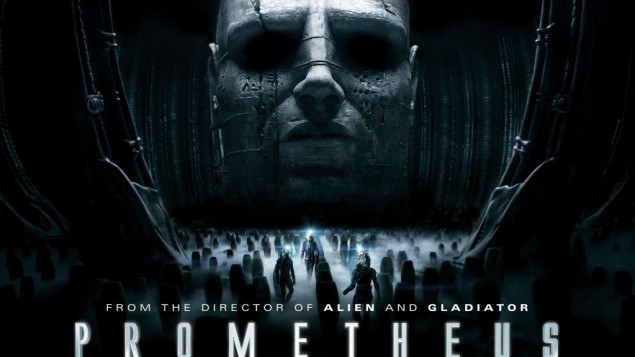
Prometheus – for a film which is not a prequel to the Alien franchise no honest well okay maybe it is – appropriately asks a ton of questions. Sadly, it either ignores them or gives dumb answers that don’t stand up to a second’s scrutiny. Having said that, as a film, it looks great. Pretty pictures, after all, trump everything.

The movie opens on a verdant planet beside a waterfall. There is a giant hairless humanoid standing on the shore, and a giant flying saucer hovering in the sky nearby. The giant opens a small container and eats its contents. It kills him. He falls into the water and his body dissolves down to its constituent DNA. This, we are supposed to believe, is an alien seeding human life on Earth.

But wait.

Did the giant humanoid mean to dissolve into primordial goop? Was it suicide? Or a really badly planned delivery method for planetary seeding, in which someone has to commit suicide? Maybe it was murder, maybe that was humankind’s original sin. But if we’re descended from them, why did we evolve to be so short and so hairy?

Cut to the Isle of Skye, later this century. Two palaeontologists have discovered 35,000-year-old cave paintings in a, er, cave. These paintings depict a giant pointing to a pattern of five circles. If it’s the same giants from the flying saucer, then they must have returned to Earth. Why? So they could prompt Upper Paleolithic humans to paint their picture? (We’ll ignore for the moment the fact that the oldest settlement so far discovered on Skye is younger than these cave paintings by about 30,000 years.)

This painting of a giant pointing the way to a pattern of five circles is apparently not unique to Skye. In fact, variations on it appear on artefacts from a wide variety of ancient civilisations, not all from the same time period – suggesting a number of visits, or a stay of a couple of millennia. This, apparently, is sufficient evidence for the two palaeontologists, Shaw (Noomi Rapace) and Holloway (Logan Marshall-Green), to persuade zillionaire Weyland to fund a mission to the “galactic configuration” represented by the five circles. “Galactic configuration”? What’s that then? A planetary system? Or a constellation of five stars? As seen from Earth? Thirty-five thousand years ago? Stars move, you know. Planets move too. Over time, their positions change – and so too does our viewpoint, as the Earth itself moves.

No matter. Movie logic says there’s something in the heavens which can lead our intrepid palaeontologists to a specific planet. Well, actually a moon of a gas giant. We’ll ignore the vast amounts of radiation the gas giant is likely producing, or its magnetosphere has trapped – this is a movie, after all. Weyland’s spaceship – called the Prometheus – lands on the moon, LV-223 (the first two Alien films took place on LV-426).

All this is handily explained in a briefing given by Shaw and Holloway to the members of the mission aboard Prometheus. However, rather than hire competent scientists for this trip, Weyland appears to have chosen to use rejects from Central Casting. It’s bad enough that the two leaders, Shaw and Holloway, believe in some von Däniken-type rubbish about gods from outer space creating humanity, but the rest of the team are no better. One tells another to fuck off when he introduces himself. Right. You’re zillions of kilometres from Earth – not “half a billion miles,” as one character later says; that would put you about twice as far from Earth as the Moon. Anyway, you’re light-years from Earth, in a spaceship with a small group of people, en route to an alien world. It is not a good time or place to act like an arsehole.

So there’s the scientific mission, the crew of Prometheus, the representative from Weyland, named Vickers, and an android, David. Vickers lives in a “lifeboat”, which is like a luxury flat stuck on the back of the spaceship. This lifeboat also contains a “medpod” – like the original Alien‘s “autodoc”, I imagine – but this one only works on human males. Er, right…

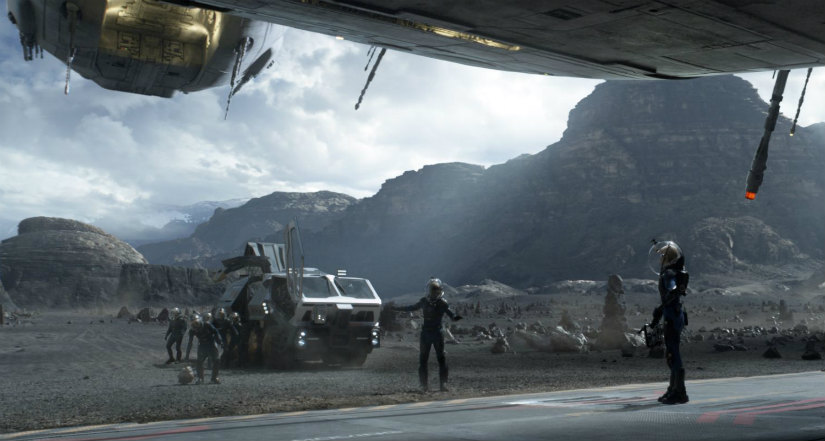
Prometheus lands on LV-223, and discovers a row of strange giant buildings. They’re like giant weathered pyramid-things, inside circular walls. Shaw and the others explore the nearest one. It contains lots of tunnels… and a room with a giant humanoid head. Also jars, lots of jars. Which start to ooze black gunk once the room is breached. Later, they determine the pyramid is a tomb.

Except most tombs don’t have spaceships buried under them. And these are the Giger boney boomerang spaceship from Alien… and the space jockey proves to be one of the giant hairless humanoids wearing a spacesuit. Which does make you wonder why they turned up to Earth in a giant flying saucer.

The boomerang spaceship also contains lots of jars, which the scientific team realise are a weapon. But a very strange weapon. It has different effects on different people. It made the giant at the beginning of the film turn into gunk, and so seeded the Earth. It makes the preserved head of a giant they find in the tomb explode. It turns one of scientific team into a super-strong diseased madman. It allows Holloway to impregnate Shaw with a tentacled monster. (She later uses the medpod to extract it – clearly it has been programmed to deal with pregnant males.)

When they find a surviving giant humanoid, and David manages to speak to him because he’s studied comparative linguistics and can somehow cobble together a working patois of the alien language from that… well, you don’t need that alien gunk to make your head explode. (Oh wait, maybe human languages are genetic too… Not.) But by this point in the film, the plot has already imploded into a black hole of illogic and nonsense and implausibility, so you only have yourself to blame. Prometheus is not a film to watch with your brain engaged. Just admire the pretty visuals. It makes for a much more entertaining 124 minutes.

Yes, Michael Fassbender pwns the film as the android David. Noomi Rapace’s character makes little sense, not least because religion has been fisted into a story it doesn’t fit. The rest of the cast might as well have worn red shirts. Vickers (Charlize Theron) tries to do a robot-or-not thing, but in the end proves she’s human the only way a woman in a movie possibly could: she fucks the captain (Idris Elba). At one point, Shaw is referred to as Holloway’s “zealot girlfriend”. Shaw and Vickers, incidentally, are the only two women in the film. So by 2093, we’ll have cool interstellar spaceships, but no gender equality. Plus ça change…

I saw Prometheus on IMAX 3D. It cost me £13. It was not worth it. I should have waited for the DVD and rented it. I also saw John Carter on IMAX 3D. That film was worth it. John Carter was a much better film. It also flopped. It’s unlikely Prometheus will flop – in fact, it’s probable the sequel implied by the ending will be made.

If you want to see a good sf film with giant spaceships and scary thrills, watch Cargo.


1 Comment

Fragment

So a year or two ago I had this idea for a postmodern planetary romance, a Leigh Brackett-style story as much about story as it was about the events in its strange and implausible world. But like most such projects – and I have an embarrassingly large number of them – it never got beyond some vague ideas and a couple of hundred words. I had a great title, ‘Gods of Saturn’, and what I thought was a pretty cool opening, but then other new shiny ideas captured my attention and my postmodern planetary romance got filed away in a forgotten folder. Until now. Maybe one day I’ll do something with it, actually finish it off perhaps, but for now it qualifies as one of those “stories that never were”, of which I have far more than I care to enumerate. But rather than let it go totally to waste and, in part, to perhaps prompt me into actually working on it and maybe finishing it, here’s the opening of ‘Gods of Saturn’ for you to enjoy…

Of all the winds which blow across the sand seas, an easterly is the most disagreeable. From that quarter, the town of Kumpara boasts no defence against the scouring grains of sand. The western wall of Pu Chou rises behind Kumpara’s tumbled blocks, and curves enfolding arms to north and south. But to the east: nothing.

There was, however, much which could be said about the couple who strolled along Kumpara’s long stone jetty one day in the Age of Helium, as small wisps of easterly wind whipped up dancing devils of sand.

Kumpara had seen better years, but had yet to reach the nadir of its decline; or its subsequent rise to quiet gentility. See it now, and perhaps you would find it hard to picture the narrow streets thick with blinding red dust, the sand whipped into fountains fifty feet high, and every house shuttered and doors firmly bolted. Those who lived there knew better than to risk the wind’s wrath.

A local spy – and there was one – who watched the young couple will have deduced they were strangers to Kumpara. The wind was not yet dangerous, but only the foolhardy or ignorant remained out once it began to blow. So too did their garments advertise their origins. The young lady was dressed in a fashion yet to be seen in the town. The eye in the telescope might have glimpsed the split skirt which was common at that time in the capital city, Xu; the high-collar, with its arcane symbols of rank and allegiance; the long gloved sleeves. Her companion was equally well-dressed.

As they turned to stroll back along the jetty, some feeling or whim caused the young woman to look back. She halted, head turned and, as if conjured into being by her gaze, features formed on the face of Saturn. The lemon and orange and tan stripes swirled like the ingredients of some decadent cocktail. It was a vast face, a face which filled the planetary canvas on which it appeared, and it caused the spy to drop his telescope and scramble from his vantage point.

As a result, he did not see the reactions of the Xuan lady and her companion. He did not see her turn her back on the face in disdain.

If such an occurrence sounds remarkable but the couple’s reaction does not, it is because at that time the gods of Saturn would often manifest on the face of the gas giant. From their celestial vantage point, they would gaze on each of the moons and on each of its civilisations. Their impact depended very much on the moon’s distance from Saturn. Here on Janus, where Saturn occupies a significant portion of the horizon, the gods held sway more than on, say, distant Iapetus.

When a god appears, all see him or her. When a god speaks, only those to whom they direct their instructions hear.

Lady Eresu turned to Captain Quradu and took his arm. She gently pulled him about. “Ignore him, Quradu,” she said softly. “He cannot harm us.”

The captain dropped his hand from the butt of his tantalum-pistol. That looming face – its presence alone in the sky suggested great power. Quradu looked up at Lady Eresu – as befitted her rank, she was a head taller than he – and noted her lack of concern.