It Doesn't Have To Be Right…

… it just has to sound plausible


1 Comment

Drawn strips

UK comics have traditionally followed an anthology format, with each issue containing a number of different stories or installments of a serial. This is very different to the US tradition, in which a single story occupies a whole issue, or series of issues. And while US comics have pretty much entirely been stories of super-powered men and women in brightly-coloured tights, most UK comics were typically humorous (Beanie, Dandy, Whizzer and Chips, etc), war-related (Warlord, Victory, etc), or science fiction (2000 AD, Starlord, etc).

But there is another comics tradition, which only rarely appears in the US or UK – the bande dessinée. In continental Europe, science fiction has often been driven by these “drawn strips”, much more so than it has been in Anglophone countries. Every now and again, some of the more popular bandes dessinées are picked up by English-language publishers, translated and introduced to an English-speaking audience. Cinebook have been doing a sterling job in this regard over the last few years, but they’re by no means the first.

I’ll admit to being a fan of sf bandes dessinées, though I don’t buy them as often as I’d like to. Most, of course, have not been translated into English – although they may well have been translated into most other European languages. Anyway, here are the ones I have. Most are in English, but some are in French.
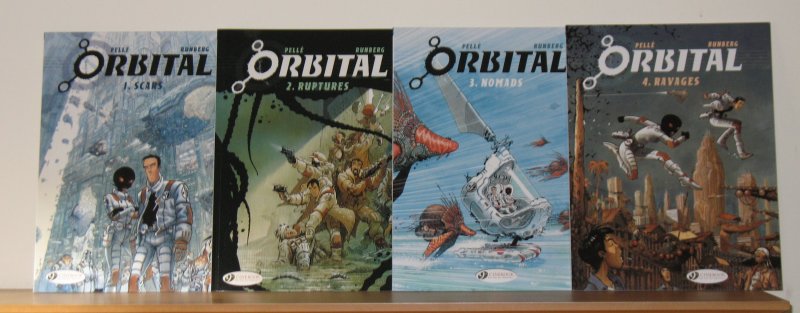
Orbital, written by Sylvain Runberg and drawn by Serge Pellé, is solid space opera of a type which rarely appears in graphic form in English. A human and a Sandjarr, members of two races that were at war several years before, are put together as diplomat-troubleshooters, and have various adventures.
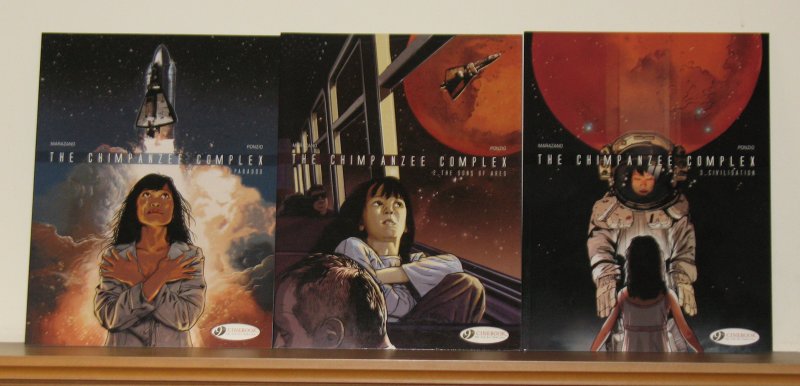
The Chimpanzee Complex, written by Richard Marazano and drawn by Jean-Michel Ponzio, opens brilliantly – in 2035, a copy of the Apollo 11 Command Module splashes down in the Pacific, but only Armstrong and Aldrin are aboard. A mission to the Moon is hastily cobbled together to discover the CM’s origin. This then moves onto Mars, where the crew find a colony of cosmonauts led by Yuri Gagarin. Sadly, the final volume doesn’t quite sustain the level of inventiveness, but it does do something quite weird and interesting with the story.
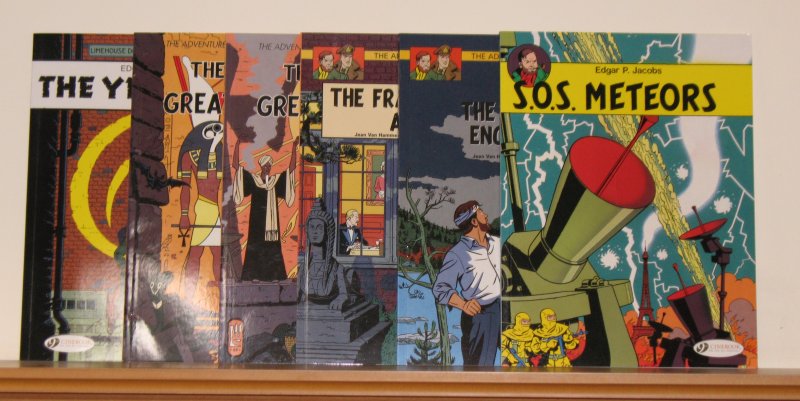
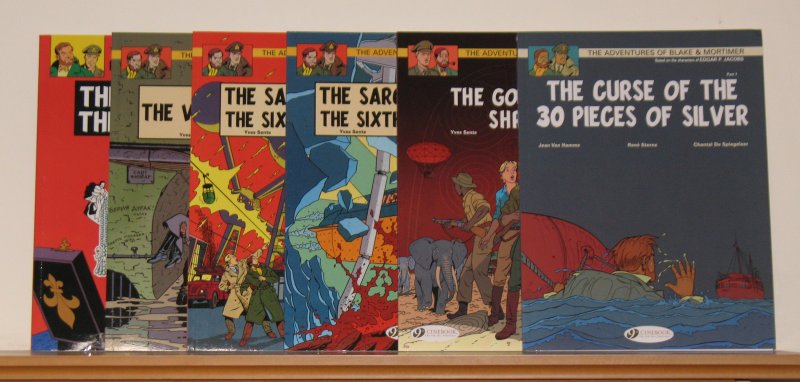
One of the big bandes dessinées series is Edgar P Jacob’s The Adventures of Blake and Mortimer. It first appeared in  Tintin Magazine in 1946, and continued through to Jacobs’ death in 1987. Since then, new stories have appeared from Jacobs Studios. To date, Cinebook have translated and published 13 books. Like Tintin, they’re all drawn in a ligne claire style, and while they’re often text-heavy (often with text describing what’s visible in the panel), the stories are generally a quite cleverly-done mix of history and science fiction.
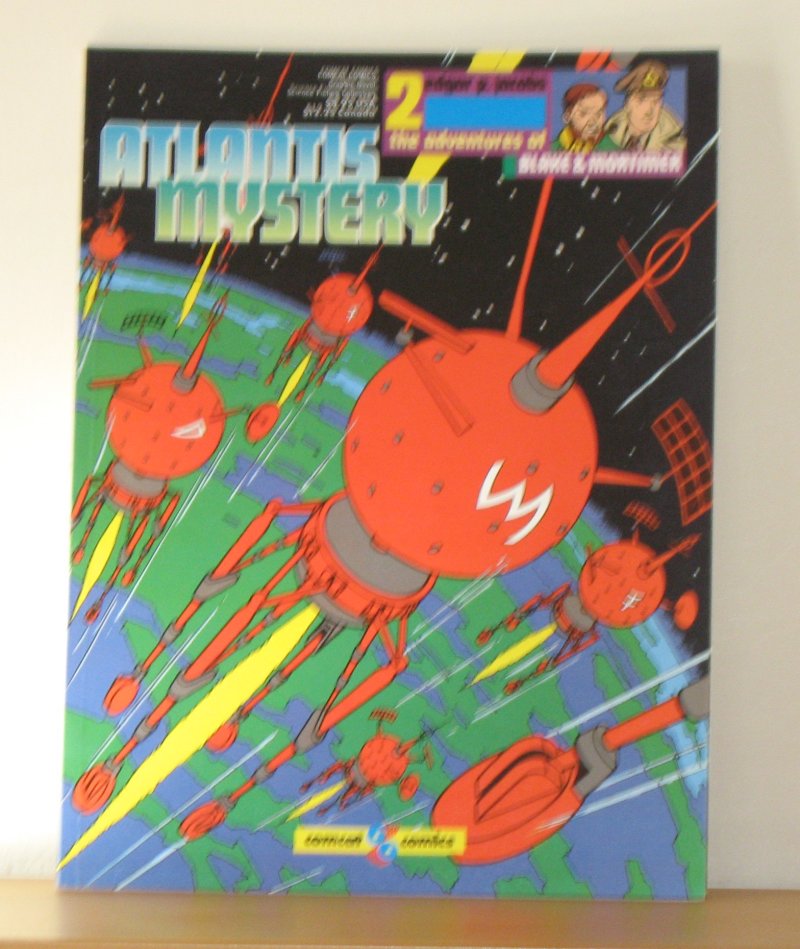
There was an earlier attempt to introduce Blake and Mortimer to an English-speaking audience. Back in the early 1990s, US publisher Catalan Communications published two Blake and Mortimer books. I found this one in Abu Dhabi. It has since been republished as volume 12 in the Cinebook editions of the series.
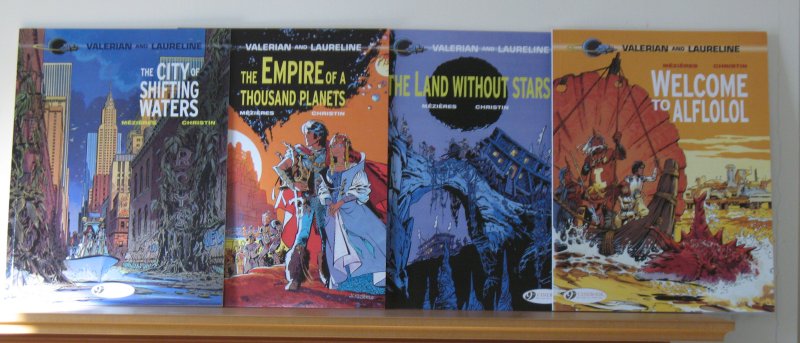
Another big bande dessinée series is agent spatio-temporel Valérian et Laureline. This started in 1970, and there are now twenty volumes available. So far Cinbeook have translated and published the first four.
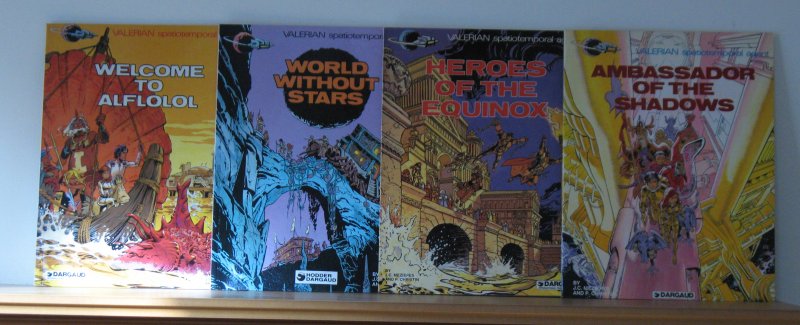
Again, there was an attempt to introduce Valerian and Laureline to English-speakers back in the 1980s. A US subsidiary of the French publishers, Dargaud, translated and published four random volumes – numbers 3, 4, 6 and 8. I’ve no idea why they stopped.
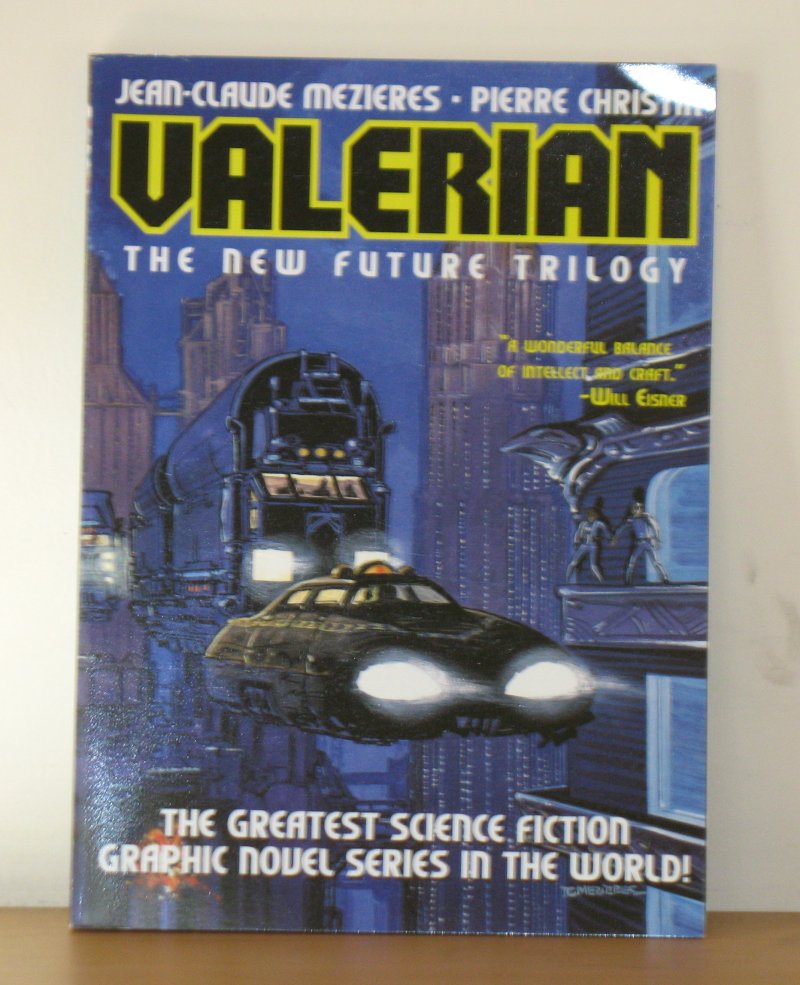
In 2004, ibooks published an English-language omnibus of three Valerian and Laureline stories – numbers 13, 14 and 15.
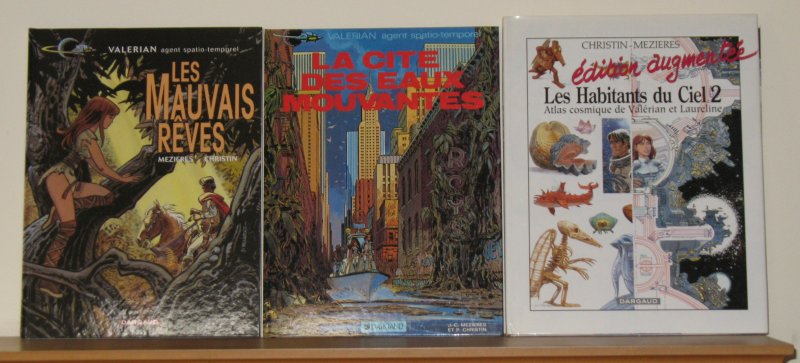
And here are some of the original French editions, including a prequel published in 1983 and the second of two encyclopedias about the universe of the two spatio-temporal agents.
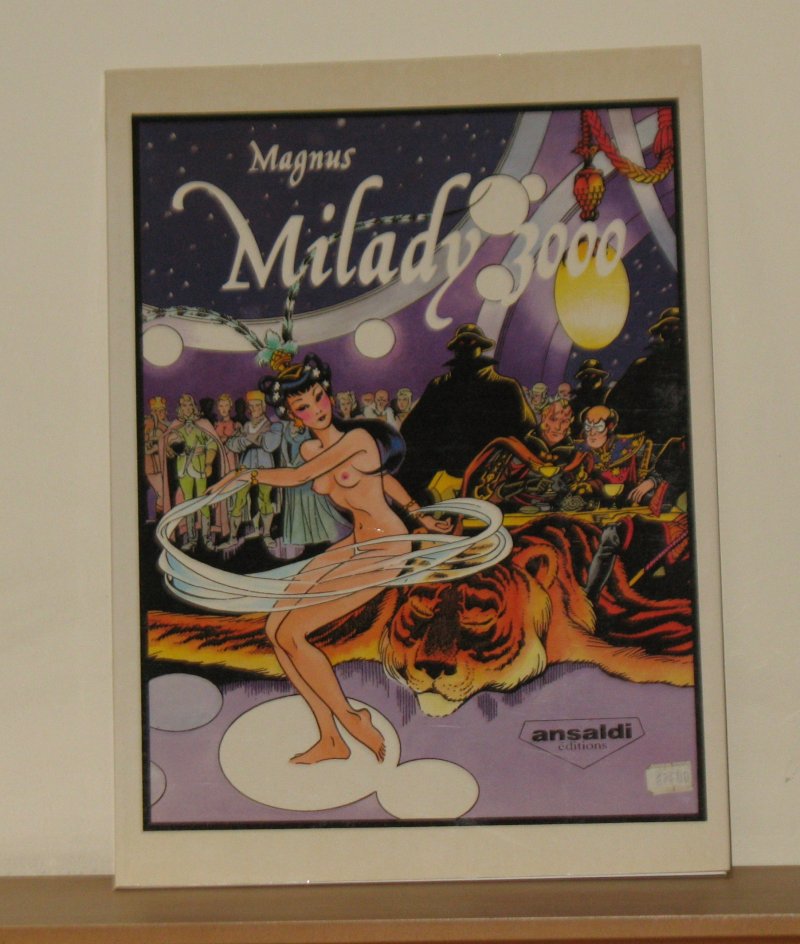
I’m not sure why I have this. This copy of Milady 3000 is a French translation of an Italian comic. It’s far future space opera, and quite well done. It apparently lasted from 1980 to 1984, and appeared in both Métal Hurlant and Heavy Metal.
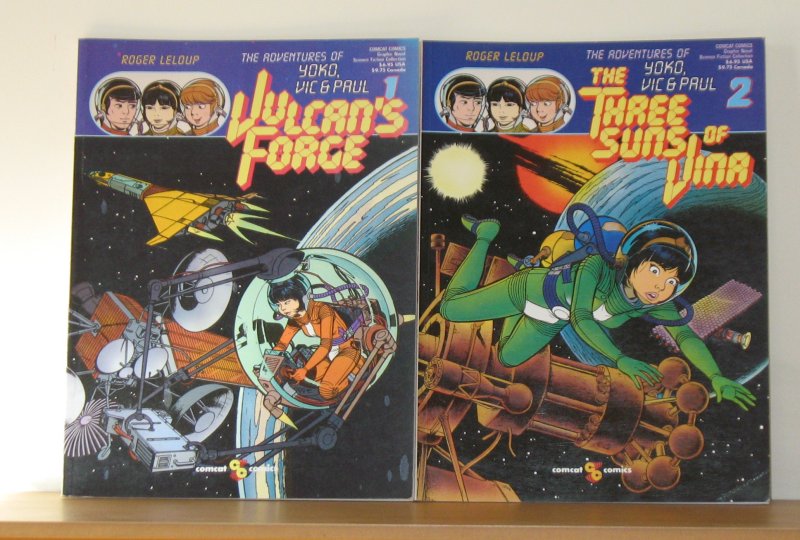
The Adventures of Yoko, Vic and Paul is another popular series being republished by Cinebook. These two books are earlier editions by Catalan Communications. The series began in 1970 and currently comprises twenty-five volumes. Catalan Communications published only the two I have, but Cinebook has so far reached volume seven.
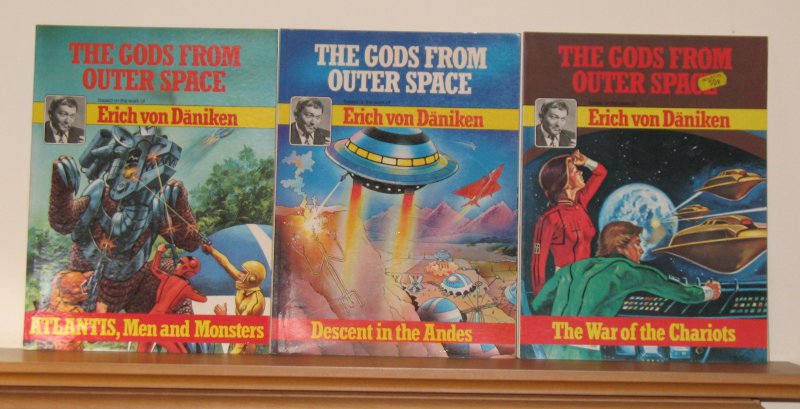
I’ve had these for years, and I can no longer remember where or when I bought them. They’re English translations of a Polish series based on the works of Erich von Däniken. I think only these three volumes were published in English, though there were eight originally in the Polish series.
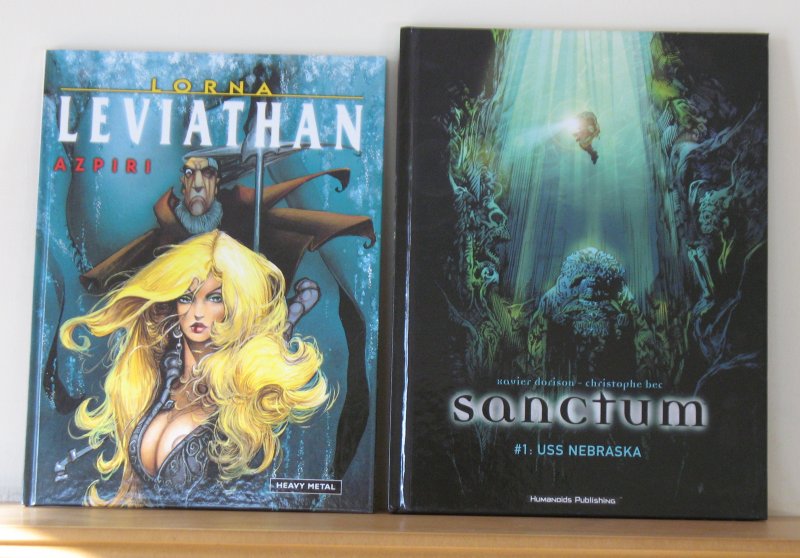
Lorna is originally Spanish, by Alfonso Azpiri, and has appeared in Heavy Metal. Leviathan is the fourth of six books featuring Lorna, and I’ve no idea if any others have been published in English. It’s definitely not for, er, children. Sanctum is a three-part French series by Xavier Dorison and Christophe Bec. As far as I can determine, only the first volume has been published in English. So it looks like I’ll be getting the French “Intégrale” edition to find out how the story ends…
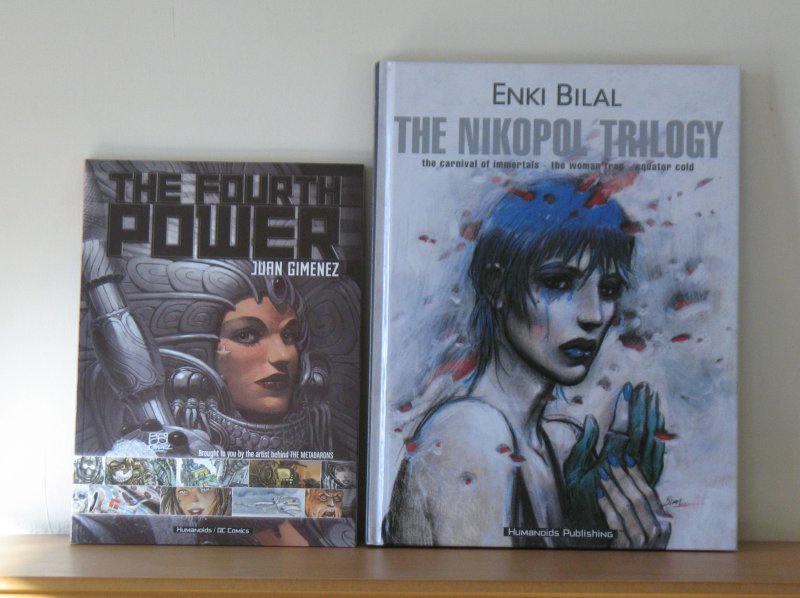
The Fourth Power is a full-on space opera bandes dessinées by Juan Giménez, an Argentine artist who illustrated Alejandro Jodorowsky’s Metabarons series. The Nikopol Trilogy by Enki Bilal was the basis for Bilal’s live-action/CGI film Immortal.
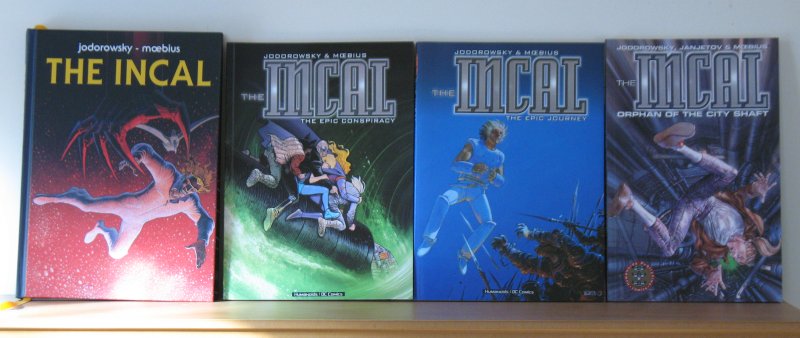
No post on bandes dessinées is complete without mention of Alejandro Jodorowsky, and his most famous work, The Incal. It may well be, however, better known for Moebius’ artwork than Jodorowsky’s script. It’s been published several times in English. Back in the early 1990s, Titan Books published several volumes; then Humanoid Associates, the English-language arm of the French publishers, published four volumes; and last year, Self Made Hero published a very nice omnibus edition. I’ve only managed to find three of the four Humanoid Associates editions, but now I have Self Made Hero edition I don’t need to complete the set…
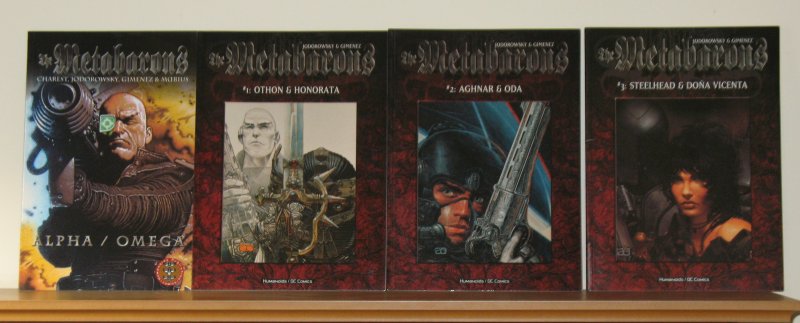
Another popular Jodorowsky series, this time illustrated by Juan Giménez. There is, I believe, a Metabarons RPG. The French originals stretches over nine volumes, but only the first six, in three omnibus volumes, are available in English.
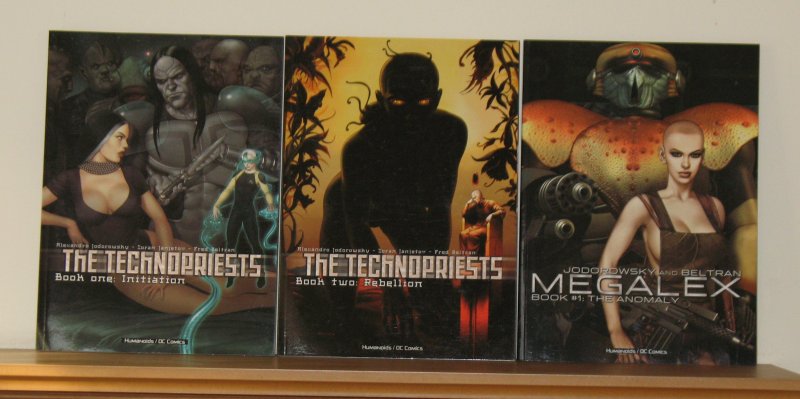
Technopriests, written by Jodorowsky and illustrated by Zoran Janjetov, is even more bonkers than the Incal or Metabarons. Humanoid Associates have to date only translated the first two of the eight-volume series. Megalex is a three-volume series, illustrated by Fred Beltran, but only the first book is available in English.
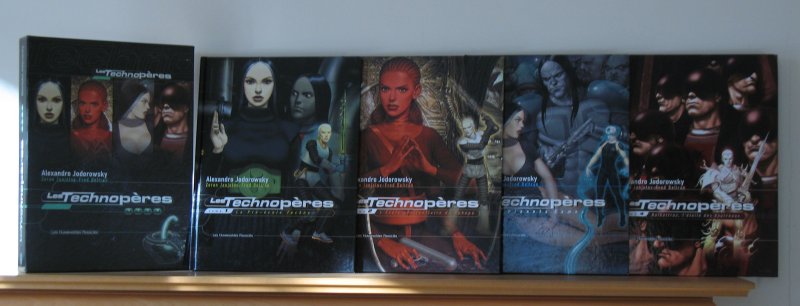
However, I have the first four volumes of Les Technopères in French, plus a presentation box for them. I just need to get hold of the remaining four volumes…

1 Comment

Who dares eventually finds it

In my post on Dan Dare last week (see here), I mentioned I owned a copy of Dare by Grant Morrison and Rian Hughes, but seemed to have lost it. If you’ve seen my flat, this probably isn’t much of a surprise. Fortunately, while digging out some books for a post on bandes dessinées – which will appear later today – I stumbled across it. The cat hadn’t sold it on eBay, after all.

Anyway, here it is:

Dare was originally published in Revolver, from 1990 to 1991, but the comic folded before the last installment, so it was completed in Crisis, a 2000 AD spin-off. The trade paperback edition was published in 1991. Copies are not especially hard to find these days, and it’s worth getting.


6 Comments

The journey is the metaphor, not the spaceship

Most science fiction treats space travel like air travel or sea travel. This is hardly surprising, since only a handful of authors of sf novels have actually experienced space travel (Buzz Aldrin, Edward Gibson, Mike Mullane, Scott Carpenter… I think that’s it). And back in the early days of the genre, of course, no one had. A couple of rocket scientists – Wernher von Braun and Willy Ley, for example – had a bash at sf; but most early sf authors simply adapted what they knew.

So there was the spaceship as ocean liner, requiring a dock (space station), with cabins for passengers, a bridge, and a bloke who sat in a comfy chair and just gave orders. Or there were the spaceships based on the barnstormers, small aircraft that people kept in their backyards, that required only a couple of hundred feet to take off, so they could jump in them, take to the air and fly off somewhere.

Of course, we now know space travel is nothing like either of the above. To get into orbit, an expensive task in terms of both energy and hardware, travellers are crammed into a tiny module. And everything is controlled by computer. If Skylon or the X-37B is any indication, future spacecraft won’t even have crew. And yet sf continues to use those old metaphors: the ocean liner in space, the barnstormer of the stars.

These metaphors completely ignore the basic realities of space travel. Not just the vast distances involved, distances that pretty much make it impossible to map any kind of human story onto an interstellar setting. But the whole metaphor of space as “the final frontier” breaks down as soon as you realise how hazardous simply being in space actually is.

The problem is not so much that these metaphors for space travel exist, but that they have become so embedded in science fiction that no one bothers to question them any more. They’re picked up and slotted into stories as if they’re part of the background. It’s a bit like writing contemporary fiction, only the trains in the story still run on steam. We have more than fifty years of actual space travel. Necessary practicalities and the history of space exploration have given us a tradition we can use in sf – and I don’t mean cosmonauts peeing on the back wheel of the bus that takes them to the launchpad, not that sort of tradition.

But sf is wedded to those patterns first laid down back in the 1930s, and all that’s been done in the years since is a gradual refining of them. Not only do I think it’s time we ditched those metaphors for space travel and came up with something inspired by post-1950 history, but I also think we need to look carefully at every metaphor and trope currently in use in sf. Because metaphors are narrative tools, not plug-in modules for story settings. We need to go through all those tropes and strike through the ones which are based on models that no longer hold true and haven’t done for almost a century. I chose space travel as my example as it’s a topic that both interests me and which I’ve researched for my own fiction. But there are plenty of others – robots, cyberspace, aliens, etc…

This is where the interesting science fiction is going to be, in the stories that re-engineer the tropes, that relate them to the real world. Slotting together identikit tropes only results in identikit fiction, and I don’t want the genre to be defined by such stories.


1 Comment

Dare more

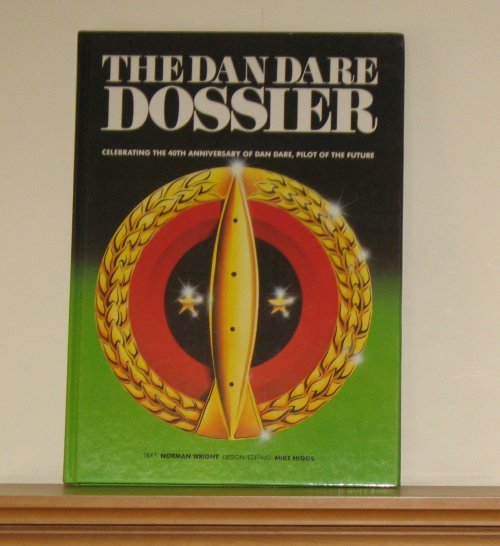
When I wrote my post on the Hawk Books reprints of the Dan Dare strips, I didn’t bother including the other Dan Dare books I own. So here they are. There is one not shown, however: Dare by Grant Morrison and Rian Hughes, which I have spent the past month looking for but have yet to find. No doubt I’ll stumble across it within hours of this post going up on the blog…

Anyway, more Dan Dare books, see:


This is the one started it all for me. As you can see, it’s a bit tatty. But then it is thirty-five years old and it did get chewed by mice at one point… It contains ‘The Red Moon Mystery’ and the first part of the Terra Nova trilogy, ‘Safari in Space’.

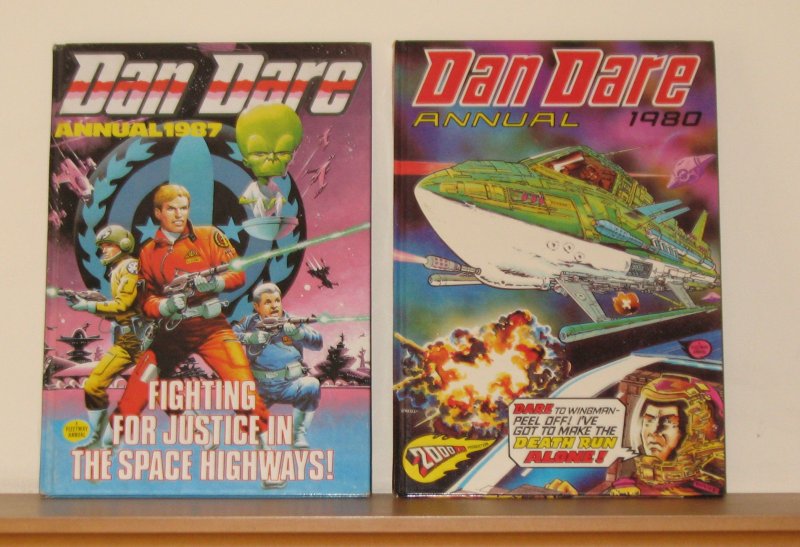
A pair of annuals from two of Dare’s later reincarnations. On the right, 2000 AD’s Dare from 1980, and on the left the relaunched Eagle’s Dare from 1987. Neither are especially good.

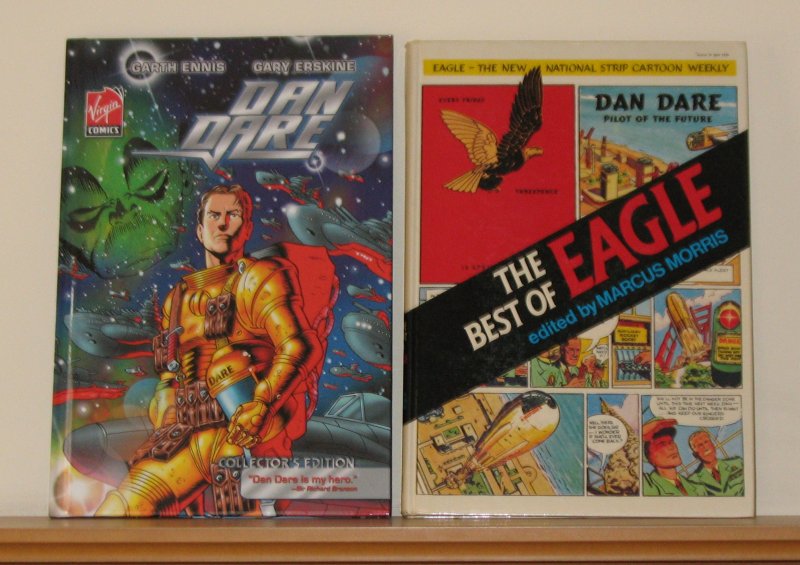
The beginning and possibly the end: Dan Dare began life in Eagle, and his last appearance was in a six-part mini-series in 2007 written by Garth Ennis. I thought the Ennis Dare very disappointing, so much so that I never bothered to buy the second “collector’s edition” volume containing issues 4 to 6.

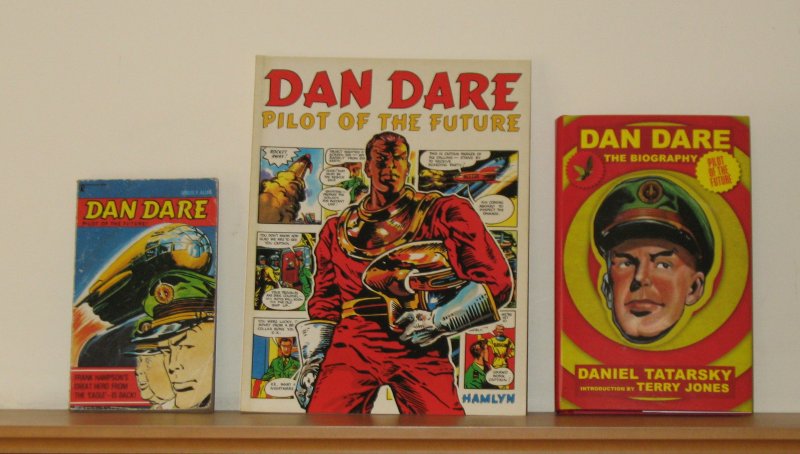
A novelisation of one of the Dare stories. It’s not very good. A collection of lesser Dan Dare stories from Eagle. And a non-fiction work on him, which I must get around to reading one of these days.

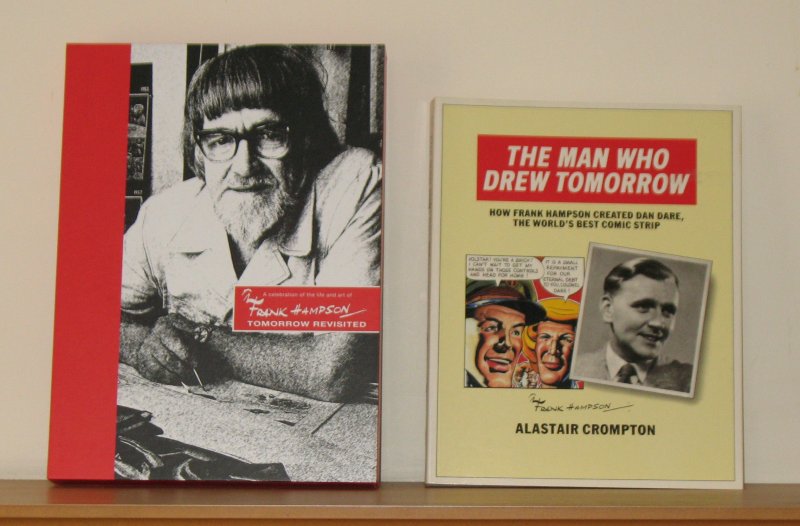
Two books about Dare’s creator, Frank Hampson. Tomorrow Revisited, published by PS Publishing, is actually a revised and expanded edition of The Man Who Drew Tomorrow.


8 Comments

More self-publishing home truths

Adrift on the Sea of Rains has been in print for just over six months and has so far sold around two hundred copies in all three formats. I didn’t set up Whippleshield Books and self-publish because I thought it was a sure-fire route to riches and success. I’d much sooner someone else had published the book. But I did it myself because a) I wanted it done quickly, and b) I didn’t want to compromise on my vision. Happily, I got the book out on time, and no one has had a problem with the way I structured the novella.

However, being a self-publisher and starting up a (very, very) small press has definitely taught me how difficult the entire process is. Basically, it’s a numbers game. If one hundred people know of your book and ten percent buy a copy, that’s ten sales. If one million know and ten percent buy a copy… well, you get the picture. But how to get your book in front of a million pairs of eyes? Every time someone buys a book by someone they’ve never read before, they’re taking a chance. How to convince them it’s a chance they won’t regret taking?

One of the myths of the American Dream and, by extension western society, is that hard work leads to success. It’s utter bollocks, of course. People work hard all their lives and still die owing thousands of dollars, pounds, euros, etc. Bosses expect workers to put in unpaid overtime, even though the workers don’t actually profit from those unpaid hours. But when you do work hard for yourself, you often find obstacles thrown up in your way – partly because the system is set up to protect established businesses, but also because the only methods open to you as an entrepreneur have been so widely abused they poison everything that uses them…

1 Most forums have indiscriminate zero tolerance spam policies
When is a self-published sf novel like a pair of Nike trainers, or Louis Vuitton luggage, or even Viagra capsules? When mention of it is classified as spam. It seems eminently sensible to limit the amount of spam subjected to members of forums, and many self-published authors have used the tactics of spambots in getting their title in front of as many people online as possible. As a result, most forum moderators categorise any kind of promotion as spam. Typically, there’ll be a ring-fenced thread or group, in which authors can promote their books. But outside of that – nope, not allowed. Even if the poster is a member of good standing, even if it’s relevant to the discussion. Verboten. The offending post, or link, gets removed, and you receive a patronising message from the moderator. You’d think a sf forum, for instance, would be interested in sf books. Self-publishers, or indeed small presses, of course, can’t rely on the presence of their books in book shops to spread knowledge of their titles. They have neither the print-runs nor the coverage to be able to do so. So they have to promote. But most of their intended audience is routinely blocked from getting the message.

2 It’s not a level playing field, and Amazon has its thumb on the scales
Amazon does not typically stock small press print titles. It will show them as “out of stock” or “unavailable”, even though the book is readily available from the small press’s own website. But when a person sees mention of a title and considers purchasing it, they will be often go and look on Amazon. They see “out of print”. Result: sale lost. If they’d known of the small press’s website, they could have gone there and bought a copy – but there’s no link from Amazon, and most people won’t bother to google for it. Which means that whenever you mention your small press or self-published title, you’re going to need to attach a link to your website. But that’s not allowed, that’s spam. It’s catch-22. Having said that, since Amazon takes a 60% discount – there’s no negotiation involved – any sale through Amazon will likely mean a loss. Amazon is a good platform selling ebooks, but for small presses without the economies of scale it’s completely useless for print books. Sadly, it’s also most people’s first port of call for print books.

3 Never mind the quality, feel the weight
I read somewhere of an established author who self-published a novel on Kindle and made $1250 of sales in ten days. He complained that was a poor result. But the vast majority of self-published novels on Kindle won’t make that in a year. The market does not have perfect information (which is one reason why capitalism can never really work), and so every reader out there for whom your novel might be a perfect fit is likely unaware of its existence. Instead, most readers will stick with what they know – they’ve read author A before and they like their books, imprint Z publishes good books so they’ll take a punt on their latest title, and so on. As a self-publishing small press, I need to get my name and the name of my press out there. My name doesn’t have sufficient weight to make much of dent in my intended market’s ignorance. The only way that will likely change is if… I get a contract with a major imprint.

4 Reviews are better for the ego than the bank balance
To date, Adrift on the Sea of Rains has been reviewed more than two dozen times on blogs, review sites and in print magazines. That’s a remarkable number for a self-published novella. On Amazon, it currently has eight customer reviews, which is not especially high – even for a self-published ebook. All of the reviews so far have been positive. The most negative comment I’ve seen about it is “it wasn’t too bad” by someone on GoodReads. Of those two dozen reviews, most of the people who wrote them received review copies – electronic or print. Reviews are good, they get word of the book out and about. People see the reviews and are sufficiently intrigued to buy the book. But only two or three of those reviews actually resulted in an uptick in sales. And I suspect there were several incidents of prospective buyers going to their preferred suppliers – Amazon, for example – not finding copies, and promptly giving up.

5 Once tarred, that’s you forever that is
I didn’t want Whippleshield Books to be a purely self-publishing venture, so I made it open submission. In six months, I’ve received a single query. I admit to being picky, but the guidelines are quite clear on what I want. I didn’t want to be spammed with inappropriate submissions – space opera, for example – but I’ve not even had that. Authors complain there aren’t enough venues to sell to, that those which do exist don’t like the sort of fiction they write… Perhaps there really is no one else writing the sort of fiction I want to publish. I find that hard to believe. Maybe it’s because Adrift on the Sea of Rains is self-published – I’ve made no secret of it. I know some book bloggers and review sites won’t touch it because it’s self-published – though they’ll happily review crap books by established imprints. Maybe the same also holds true for submissions?

Okay, perhaps not “forever”… I can think of two small presses originally set up to publish their founder’s own fiction. Both are now reasonably successful, with large catalogues of books by many different authors. Perhaps a decade from now, Whippleshield Books will be in the same situation. But in the years since those two small presses were established – and it’s less than a decade for both – much has changed in the publishing world. While new channels on the internet have made distribution and promotion much easier over a much wider area, the low barriers to entry have also significantly decreased the signal to noise ratio. The market is far bigger, but there are now so many traders that people can only hear you sing out your wares when they’re actually standing at your stall.

In a month or so, the second book of the Apollo Quartet should see in print. Having a second book out might change the game entirely for Whippleshield Books. It’ll be interesting seeing if it does. We shall have to see how it goes…


9 Comments

NEED MOAR SCIENCE!

Science fiction was born in the white-hot enthusiasm for the future found in the electronics magazines of the 1920s. Electronics – engineering – was going to build a better future for everyone, and science fiction would show the way forward. But there was also the pulp tradition as well, and that quickly polluted the pure-strain “scientifiction”, adding escapism and implausibility to the didactic rationality of the new genre.

Ninety years later, it looks like pulp won the battle for the hearts and minds of science fiction readers. In other words, there is very little science in science fiction. But then a lot of people think the acronym formed from the genre’s name, sf, should really mean “speculative fiction”. Ugh.

It’s true that that much sf could be placed on a sliding scale – at one end it would read “scientific content” and at the other “literary merit”. But scientific content and literary merit are not mutually exclusive. You can have both in a fiction. The fact that those who have tended to one have been poor at the other, and vice versa, is an historical accident. It’s neither a law nor a defining characteristic of the genre.

But taking the science out of science fiction does invalidate it. Sf is not some big amorphous playground in which you get to leave your grubby fingerprints over all the cool toys. Just because a fiction appropriates the trappings of sf – the spaceships, the robots, the Singularity, etc – that doesn’t necessarily make it sf. There is an underlying philosophy to the genre, a consequence of its beginnings, and to ignore that and treat sf like just another branch of fantasy is to ignore the genre’s history and its character. Which is why claiming sf pooh-poohs categorisation and boundaries is to miss the point of what it is.

When an author of mainstream fiction writes a story set in, say, the 1950s, or Budapest, or featuring a cellist, they do the research. They ensure their fiction has verisimilitude, that their 1950s isn’t just 2012 with hats, or Budapest isn’t a middle-American city with funny accents. Why do sf authors refuse to do that same? True, their invented worlds may not obey the same rules as the real world, but even when it does they blithely wave their authorial hand and magic allows the story to progress. That’s not science fiction. Treating the world as if it were some magical woowoo sort of place is anathema to science fiction. And, more than that, it’s entirely pointless.

Science fiction certainly needs the science putting back in, but perhaps it also needs to think about being didactic again. Don’t hide the science, don’t pretend you’re really writing woowoo futuristic fantasy. If there’s science in there, take pride in it.

Show your reader, I did science.


Leave a comment

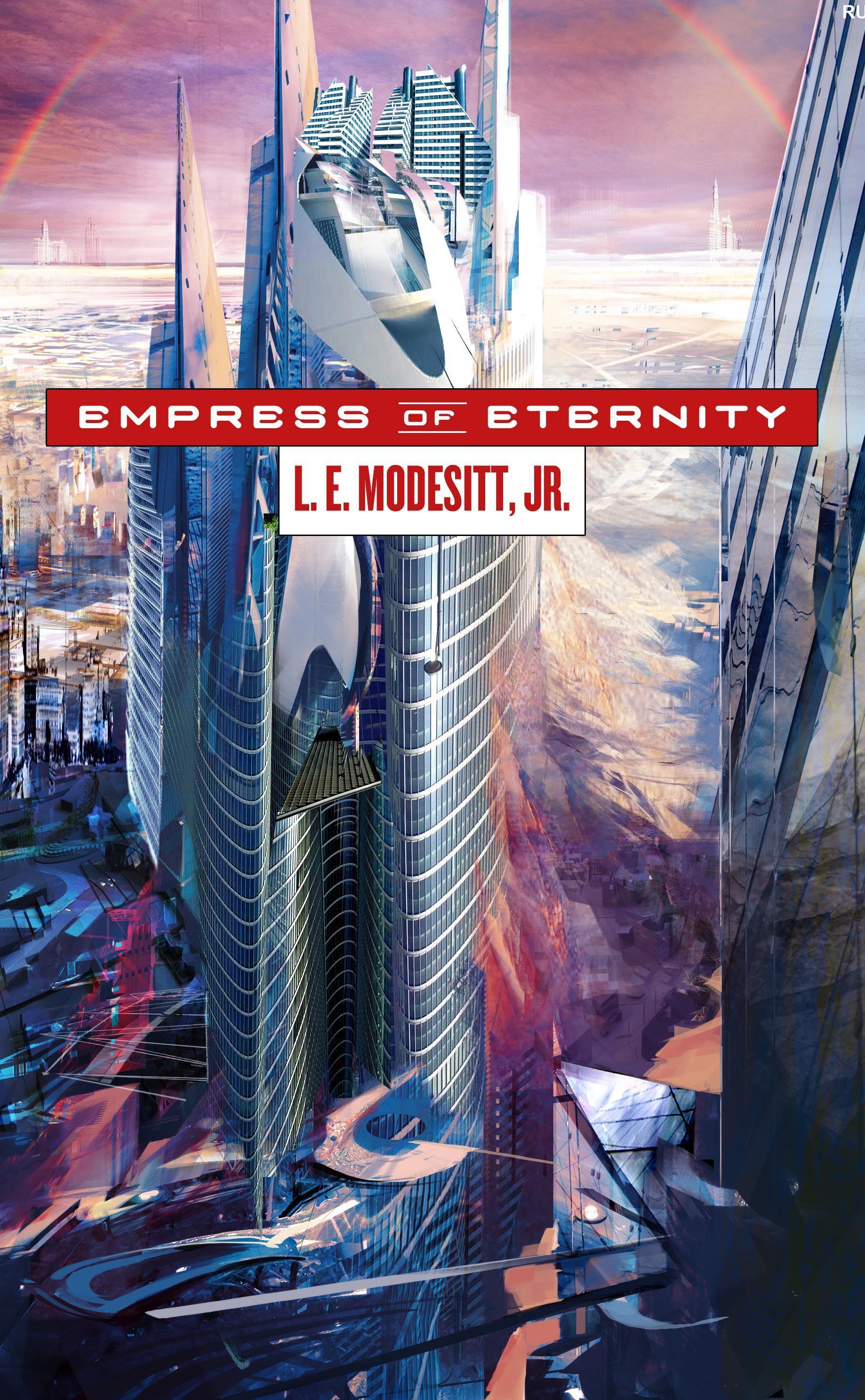
Empress of Eternity, LE Modesitt, Jr

Empress of Eternity, LE Modesitt, Jr
(2010 Tor, $25.99, 352pp)

LE Modesitt, Jr is a bulwark of genre fiction in the US. He stands, legs apart, one hand against the wall of fantasy, the other hand pressed against science fiction. Like the man, his novels, which are often the size of small buildings, straddle both genres. It’s an appropriate conceit, since Modesitt’s latest, Empress of Eternity, has an architectural feature at its core. The Canal straddles an unnamed continent on a world the blurb calls “Earth” but the story itself does not. This Canal is made of some indestructible material. No one knows what it’s for, who built it, or why. Three narratives describe the events surrounding three groups of people from three different eras, each of which is researching the mysterious Canal. According to the blurb, these narratives are set hundreds of thousands of years apart, but there is no indication of this in the text as each uses a different calendar.

Lord Maertyn is a scientist and minor ministerial functionary in the Unity of Caelaarn. He and his wife Maarlyna, who is recovering from a near-fatal illness, are researching the Canal. But there is a power struggle occurring back in the capital, and Maertyn becomes embroiled in it when his minister asks him to fill in for an absent assistant minister. Faelyna and Eltyn are also researching the Canal, but they are doing so for the Ruche. However, a coup among the rulers of the Ruche – the Fifty becomes the Twenty – is followed by a brutal campaign of brainwashing. Faelyna and Eltyn resist. Duhlye and Helkyria are researching the Canal for the Vaniran Hegemony. But the Vanir are under attack by the Aesyr, also of the Hegemony, but racially different and possessing their own armed forces. The Aesyr have a weapon, the Hammer, which they threaten to use unless the Vanirans reveal what secrets they have discovered in their research on the Canal.

These three stories seem to follow the same plot, before they abruptly, and solely due to authorial handwaving, become linked. Maarlyna transforms into the title character; the Aesyr provide a direct threat to the universe of the book… But the Ruche narrative is entirely superfluous. It neither impacts the resolution, nor assists in explaining it. In fact, very little of any of the three worlds is explained – the reader, for example, has to guess the relationship between the Vanir and Aesyr. It makes for a frustrating read. Further, characters lecture each other on assorted subjects, none of which sound remotely plausible. The description of the Hammer’s workings are the worst kind of technobabble; as indeed are the workings of the Canal. Which is, in fact, a “bridge” through time and apparently “anchored” at “discrete event-points”. Modesitt’s explanation badly confuses a philosophy of time with physics. He also presents events or situations to illustrate points… only to have a character then explain what has just been illustrated. The prose, too, is peculiar, and padded out with stylistic ticks which render sentences clumsy: “he smoothed his hair, short as it was”, “he carried but a bag”… That “as it was” is appended unnecessarily to sentences throughout the story; that inserted “but” appears on almost every page. Not to mention the Ruche characters’ “bio-orbs” and “calcjections”…

Empress of Eternity is a novel light on sense. This may well be because somewhere within its 352 pages a short story has been forcibly fed a pottage of words in an effort to bulk it up to novel-length. This is a novel remarkable for the number of scenes which neither advance the plot nor explain the world. The end result is some sort of van Vogtian tosh put in service of a plot which has neither beginning nor middle, but crashes to an unsatisfactory end. Van Vogt’s 800-word cliff-hangers, however, made his novels pacey reads. The same cannot be said of Empress of Eternity.

This review originally appeared in Interzone, #231 November-December 2010.


45 Comments

Shaping sf

Only a fool would deny the influence magazine editors Hugo Gernsback, John W Campbell and Michael Moorcock had on science fiction. So to suppose that editors still wield such influence over short form science fiction is not that much of a stretch of the imagination. I put together some pie charts of the contents of the year’s best anthologies for 2011 to test the truth of this. Perhaps it was unsurprising that the biggest markets in terms of readership provided the most stories for the anthologies. Writers will send their best works to where it will earn the most money and be read by the most people. But the editor still has to buy it. It could be arguing they’re just siphoning off the cream of the crop, but that would have to assume their taste plays absolutely no part in their purchasing decision. And that’s unlikely.

So, I put up some numbers, but it wasn’t enough for some people. Who chose to sneer on Twitter at my post. (To be fair, one did then apologise, and we went on to have an interesting discussion on the topic.) One of their criticism was “rotating editors” – but Gardner Dozois has been doing his year’s best anthology for twenty-nine years, Hartwell and Cramer for seventeen years. Sheila Williams has been editing Asimov’s since 2004, and it was Dozois for eighteen years before that; Stanley Schmidt has edited Analog since 1978, and retired only this year. Gordon Van Gelder has been the editor of F&SF since 1997 and its publisher since 2000. Not much rotation there.

David Hartwell, in a comment on my post, raised the point that year’s best anthologies are commercial endeavours. It’s a valid observation. Stephen King, for example, may not have written one of the absolute best stories of the year, but if it’s good enough for inclusion, then putting his name on the cover could help sell a few more copies. Plenty of people have said that year’s best anthologies aren’t really “best”. Fair enough. But it does devalue the term. If something is not the best, is not chosen solely because it is of the best quality, then it’s not, er, the best. Mind you, An Anthology of Good Stories Published In The Previous Year Which [editor’s name] Has Selected For Reasons Of Taste, Quality And Commercial Appeal probably wouldn’t fit on the front of a massmarket paperback.

It seems plain that the single biggest factor affecting genre fiction is the number of units shifted of genre books. Publishers publish books to make money, and if a book of a particular type does well they’ll naturally want to publish books of a similar type. Successful authors become well-known – often it’s their name alone which sells the books (cf the thriller sweatshops of James Patterson and Clive Cussler; or Virginia AndrewsTM). Hugo voters, faced with a ballot of novels they’ve not read, will often as not plump for the one by the author whose name they recognise, or have read and enjoyed in the past. The appeal of those names can carry across to short fiction – though now that shortlisted short fiction is routinely given free to voters (in both the Hugo and BSFA awards), you’d hope their decision would be based solely on the quality of the stories. Big names on the covers of fiction magazines will sell more copies of an issue than the names of unknowns…

Names have weight. Especially in a small group like the science fiction community. How many people have I heard explain Connie Willis’ Hugo win last year as the result of her being “a nice person”? Her book(s) was shortlisted for the award, but she won it. And some people’s writing will be preferred over others. Even by editors. Who have chequebooks, and can make good use of their choices. There have been, and likely will continue to be, magazines who routinely publish work by certain authors to the mystification of everyone – some people might perhaps remember UK small press magazine Dream from the 1980s and an author whose stories appeared in it regularly…

Science fiction is neither monolithic nor homogenous. Nor is the community which both supports it and feeds off it. Sf can be affected by a number of things; some parts can be affected while others are not. Despite being a written genre, it has been changed by individual films, Star Wars being the classic example. Changes in taste in short fiction rarely impact novels, but the reverse is not uncommon. As editors develop the characters of their magazines and so build up “stables” of writers, so they play a part in shaping genre fiction at short lengths. As anthologists turn to the same small number of names to provide reliably entertaining content, so do those names carry greater weight and their style of sf come to be reflected wider in the genre. As publishers rub hands gleefully at the runaway success of an author, so they start looking around for more material to capitalise on that success. And so on.

So no, it’s not stupid to imagine that editors and year’s best anthologies still have influence on science fiction. It’s stupid to imagine they don’t.


7 Comments

Dan Dare

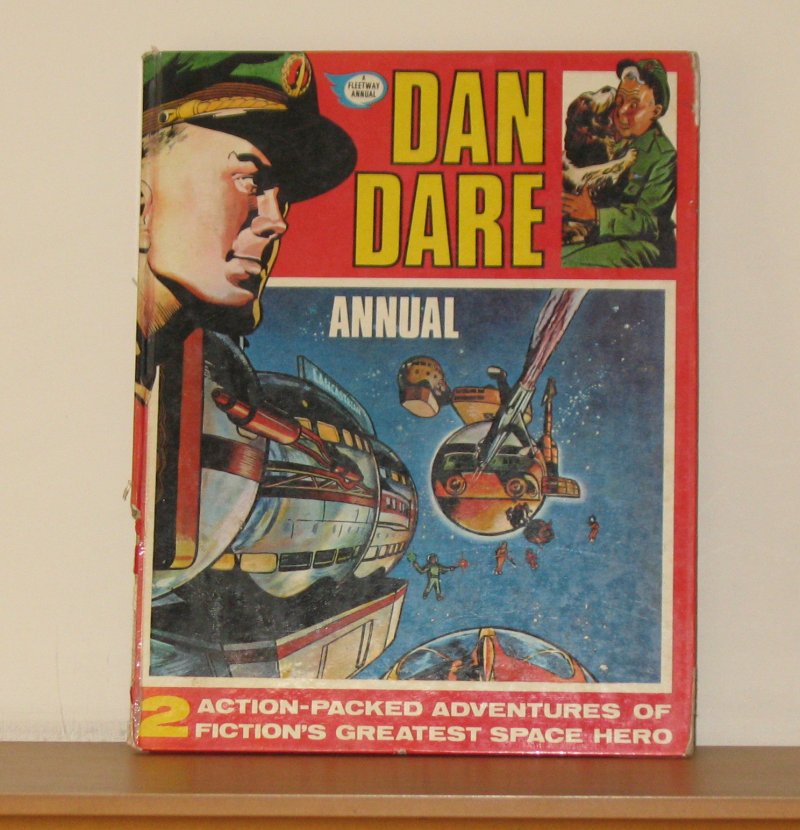
I’m fairly sure my first introduction to Colonel Dan McGregor Dare of Spacefleet was in the early 1970s, when my parents bought me a Dan Dare annual one Christmas. (No, I’m not old enough to remember Eagle, where Dare originally appeared.) The annual contained two stories, ‘The Red Moon Mystery’ and ‘Safari in Space’ – and they’re still my favourite Dare stories. We were living in Oman at the time, but I’m pretty sure they didn’t buy it there. Anyway, I treasured that book for years.

And then, during the early 1990s, I was in London visiting friends, and in a remaindered book shop on Charing Cross Road I found the seventh volume of a series of Dare reprints published by Hawk Books. I bought it, but never saw any of the other volumes in the series. When I returned to the UK to live in 2002, I decided to complete the series. It took me several years, and quite a bit of money, but I eventually did it. The last one I purchased was volume 4 Prisoners of Space in early 2009.

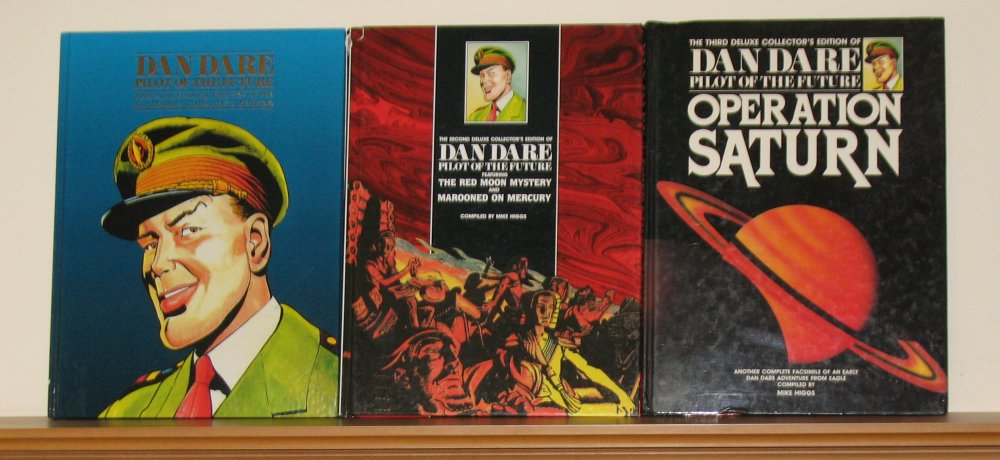
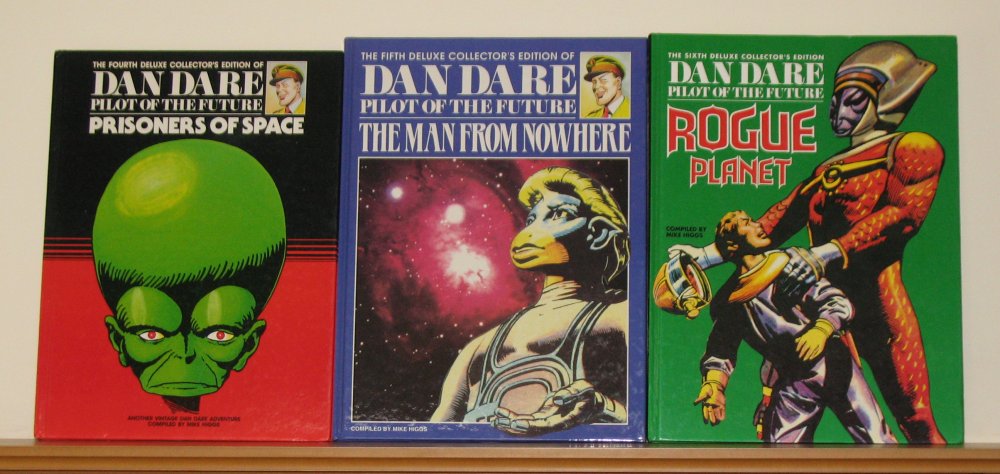
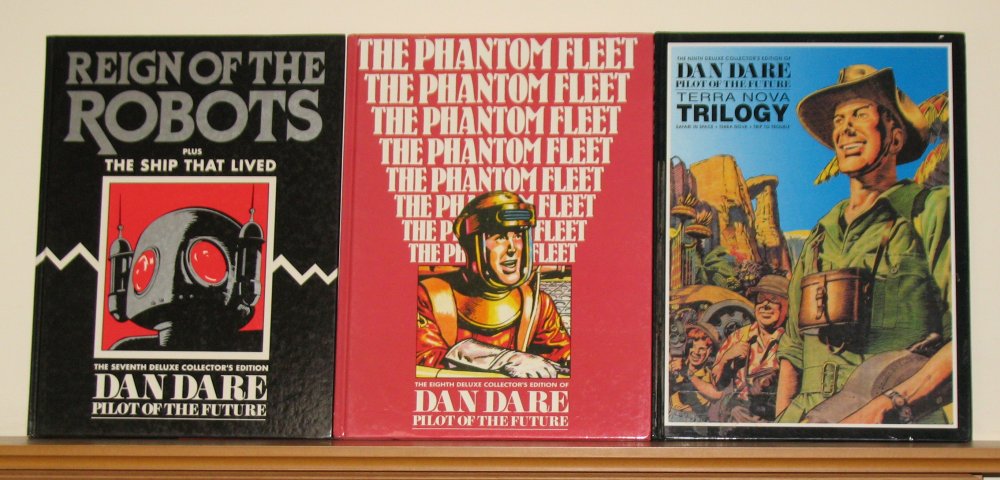
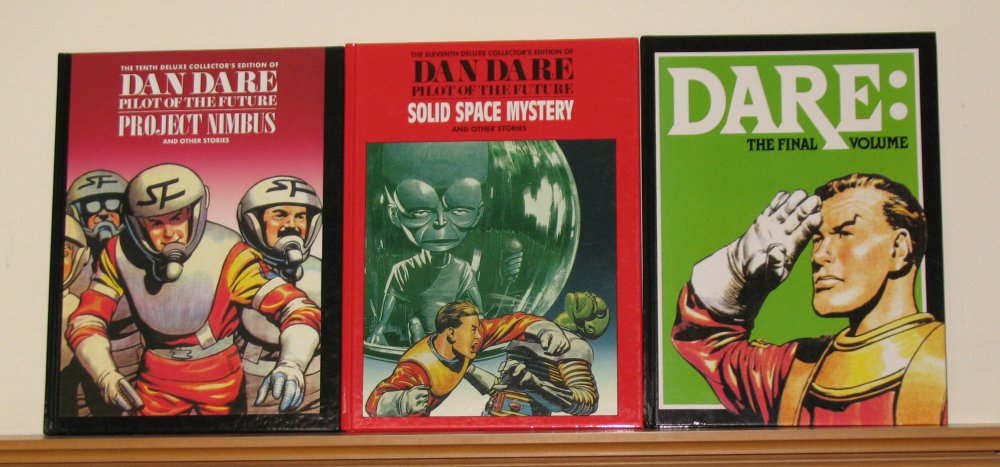
And here’s the full set…

 There are actually two editions of the first volume. I have the second edition, the 10th anniversary edition of the original. The Red Moon Mystery, volume 2, is one of Dare’s best stories.

 The Man from Nowhere, volume 6, and Rogue Planet, volume 7, is a two-parter and are one of the better stories.
 While Dare was away helping aliens on their home world in Rogue Planet, the Mekon conquered the Earth using robots – but Reign of the Robots, volume 8, is a bit silly, to be honest. The Terra Nova trilogy, volume 9, is one of my favourites. Since this was the most expensive volume to buy, it must be everybody else’s favourite too.
 The last three volumes cover stories written and drawn after Hampson handed over the reins and, sadly, neither the design nor the stories are as good as when he was in charge.
 Back in the day, you could actually buy replica Spacefleet uniforms. In fact, there was a huge amount of merchandising for Dare – everything from button badges to tin spaceship models. All before my time, of course. You often see items available on eBay for silly money. There’s even a novel, Dan Dare, Pilot of the Future by Angus P Allan, published in 1977. The book is illustrated with black and white line-drawings of panels from the comics, but as a novel it’s a bit rubbish.

Dan Dare has been resuscitated a number of times. In 1977, he appeared in the first issue of 2000 AD, and lasted until 1979. The strip has yet to be published as a trade paperback omnibus, which is really annoying. I do have a 2000 AD Dan Dare annual from 1980, but it’s not very good. The Eagle comic was relaunched in 1982, and featured Dan Dare as its flagship strip – but this was a grandson of the original Dan Dare. The new Eagle folded in 1994. In 1990, Grant Morrison scripted a new Dare, set in Thatcherite Britain, which was serialised in the Revolver comic. It was later republished as a trade paperback. In 2008, Virgin comics published a seven-issue Dan Dare mini-series written by Garth Ennis. I have an omnibus of the first three issues but wasn’t impressed. New Dare stories have also appeared in Spaceship Away, a magazine dedicated to Dare, and which has to date published twenty-seven issues. We won’t mention the terrible CGI television series.

Also worth noting is a “biography” written by Daniel Tartarsky, which was published in 2010: Dan Dare, Pilot of the Future: A Biography. Titan Books have also published a series of Dare reprint volumes, which are smaller in size than the Hawk Books versions. They’re also still in print. And it appears that Haynes will be publishing an Owner’s Workshop Manual on Spacefleet Operations in June of 2013. It’s already on my wishlist.


33 Comments

Toward working definitions of science fiction and fantasy

I’ve mentioned these thoughts in passing in other posts, but I decided it was time to put them together and see what happens. I have said in the past that science fiction makes explicit the wonder in the physical universe – see here; yes, with an equation too – but perhaps that’s also true of fantasy. Maybe instead of the horrible “speculative fiction”, or the equally awful “strange fiction”, we should use the term “wondrous fiction”. Though I believe Yes beat me to it.

Unfortunately, “wf” is a pretty naff acronym, especially if you use it as one and not an initialism. Would it be “wif” or “wuf”? “I am a wuf writer.” Ugh. Would bad wondrous fiction be known as “wiffy”? Um, and “wifi” has already been taken. Ah well, perhaps not.

However, it strikes me there are two defining loci for science fiction and fantasy. One is wonder, the other is agency. And while wonder identifies both genres, agency differentiates them:-

fantasy – stories in which agency, or power over the natural world, is given by authorial fiat to things, including human beings, which in the real world do not have such agency or power, or do not exist.

science fiction – stories in which agency, or power over the physical universe, is given by human beings – systematically – to things, including human beings, which in the real world do not have such agency or power, or do not exist.

No doubt everyone will now immediately think of exceptions which disprove these definitions. That seems to be the way this sort of thing works…